Editorial
Select search scope: search across all journals or within the current journal

Interfaces, interactions, and time are commonly understood as foundational constructs in the field of organizational frontlines, but their current definitions are fragmented and disconnected. We propose a set of propositions drawn from theorizing the foundational constructs to facilitate systematic studies of frontline phenomena and promote integration across studies. We also advance the concept of the frontline nexus, a constellation of relations that interconnect the foundational constructs, and propose that the nexus is the appropriate unit of analysis for the study of organizational frontlines. To specify a system that embeds the frontline nexus and situates its foundational constructs, we discuss the role of agency, technology, learning, and privacy as key structural characteristics. In response to changing frontlines, we offer 11 propositions to advance research and practice of organizational frontlines. These propositions encourage researchers to explore the potential of new technologies, investigate the role of frontline actors in shaping interaction outcomes, examine the impact of learning and development initiatives, and consider the ethical implications of frontline actions.
Service frontline encounters between customers and service providers have been subject to fundamental changes in recent years. As two major change agents, technology infusion and data privacy regulations are inextricably linked and constitute a critical ethical and societal issue. Specifically, service frontlines—as represented by human or technological agents, or some hybrid form—rely on customer data for service provision, which subjects them to privacy regulations governing the collection, submission, access, and use of any customer data thus captured. However, scant research outlines the significant implications of evolving data privacy regulations for service frontline encounters. To advance knowledge in this domain, this research distills six key dimensions of global data privacy regulations (fairness, data limits, transparency, control, consent, and recourse). Employing an intelligences theoretical lens, the authors theorize how these dimensions might become differentially manifest across three service frontline interface types (human-based, technology-based, and hybrid). Carefully intersecting the need for varying intelligences across data privacy regulatory dimensions with the abilities of service frontline interfaces to harness each intelligence type, this study offers a novel conceptual framework that advances research and practice. Theoretical, managerial, and policy implications unfold from the proposed framework, which also can inform a future research agenda.
Extant literature has studied how customer–salesperson price negotiations evolve in “normal” circumstances. However, recent economic recessions illustrate the need to advance theory on the question of how price negotiations evolve in “abnormal” times when customer demand significantly contracts beyond expected variation. In response to this gap in the literature, this study uses a multi-method design to investigate price negotiations during exceptional demand contractions. Our results from a theories-in-use study reveal that during such circumstances, salespeople’s perceived dependency on customers increases while customers’ perceived dependency on salespeople decreases. The inherent “power shift” should benefit customers in subsequent price negotiations. However, customers are
Prior works discuss servicescapes as a stable environment but abstain from examining servicescapes in crisis situations and how they impact frontline employees (FLEs). This paper investigates servicescapes as something other than static and planned, and it accounts for the uncertainty often present in servicescapes. Specifically, we conceptualize servicescapes in crisis situations on a continuum that takes into account the landscape’s (in)stability and the processes’ (un)predictability. In so doing, we provide a more nuanced understanding of FLE experience and job satisfaction in crisis servicescapes, such as humanitarian contexts. Our research on these rarely surveyed but highly important service-providing circumstances identifies how FLEs need to reconcile the dynamic contextual facets and the variables likely to influence their job satisfaction. Across two studies of humanitarian aid contexts, including one with the United Nations, we show that servicescape processes and/or landscapes are often dynamic. We further show that organizational value’s congruence, pleasantness, and convenience have a positive impact on FLE job satisfaction in crisis servicescapes by decreasing their perceived level of uncertainty.
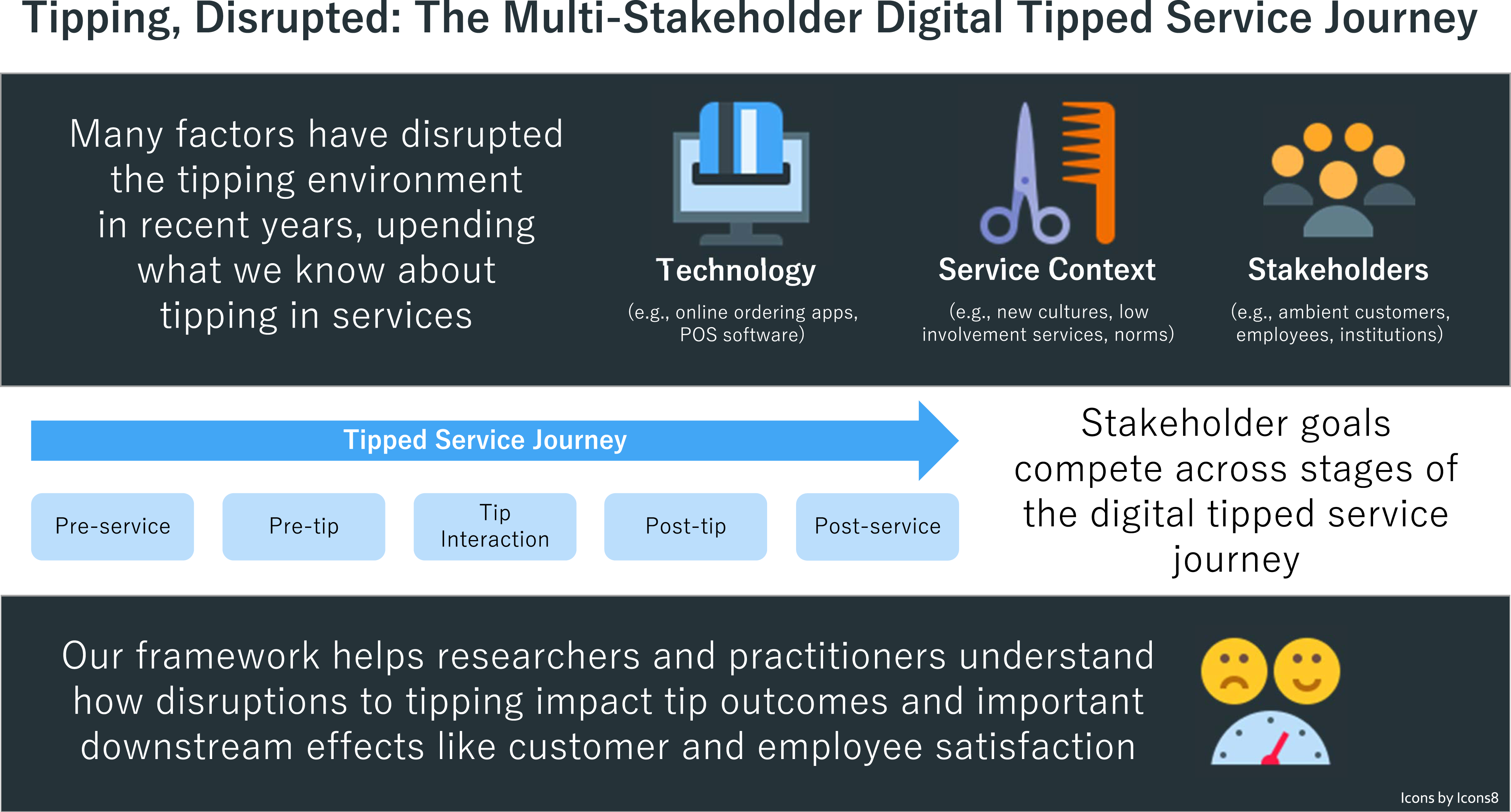
The shift from analog to digital point-of-sale systems (e.g. Square) and app-based service platforms (e.g. Uber) disrupted frontline services by creating new tipping processes that occur in an ever-expanding range of service contexts and involve new stakeholders. The increasing importance of tipping in the global economy and the uncertainty regarding tipping practices suggest the need for a comprehensive framework that accounts for evolving tipped service networks. We introduce the multi-stakeholder service journey lens to build a conceptual framework that accounts for the competing interests of customers, employees, frontline service managers, technology providers, and other stakeholders in emergent tipped services. This framework examines interactions between stakeholders at different points along the tipped service journey, while accounting for the technologies and contexts that shape stakeholder interactions and the sometimes divergent outcomes that result. Stakeholder interactions at each stage of the tipped service journey suggest theoretically rich research questions, such as “How do digital tipping technologies diffuse into and realign cultural practices?”, and important practical questions, such as “Which tip request framing and formatting choices result in the highest tips, most customer satisfaction, and optimum employee outcomes?” Our conclusion emphasizes the importance of multi-stakeholder service journey perspectives for examining digitally disrupted services.
This research examines the antecedents and outcomes of organizational frontline employees’ (FLEs’) resilience. Developing a better understanding of resilience, defined as an employee’s ability to overcome or bounce back from adversity, has become critical, as managers increasingly are struggling to manage change on the front lines. The results from three studies conducted in organizational frontline contexts confirm the importance of FLE resilience, demonstrating its association with increased effort and reduced turnover intentions. Moreover, using an experience sampling methodology, we find that nearly half the variance in resilience lies within individuals, which suggests that resilience is not merely a trait but rather malleable. As such, the main contribution of this research is to offer fresh insights into what leads to greater resilience in customer-facing roles. The results show that rather than being motivated by a desire for monetary compensation, FLEs’ resilience is driven by a sense of competence and relatedness to not only coworkers but also customers. Moreover, we find that autonomy is negatively related to resilience when customer orientation is low. For managers, our findings offer guidance on how to cultivate resilience to improve FLE effort and reduce turnover intentions in the face of adversity.
Recent disruptions, labor shortages, and fiscal pressures, especially in retail service environments, have necessitated and highlighted changes in the roles and responsibilities of frontline employees, often requiring them to enforce mask mandates and police customer deviant behavior (CDB). While extant work has investigated the impact of policing, or
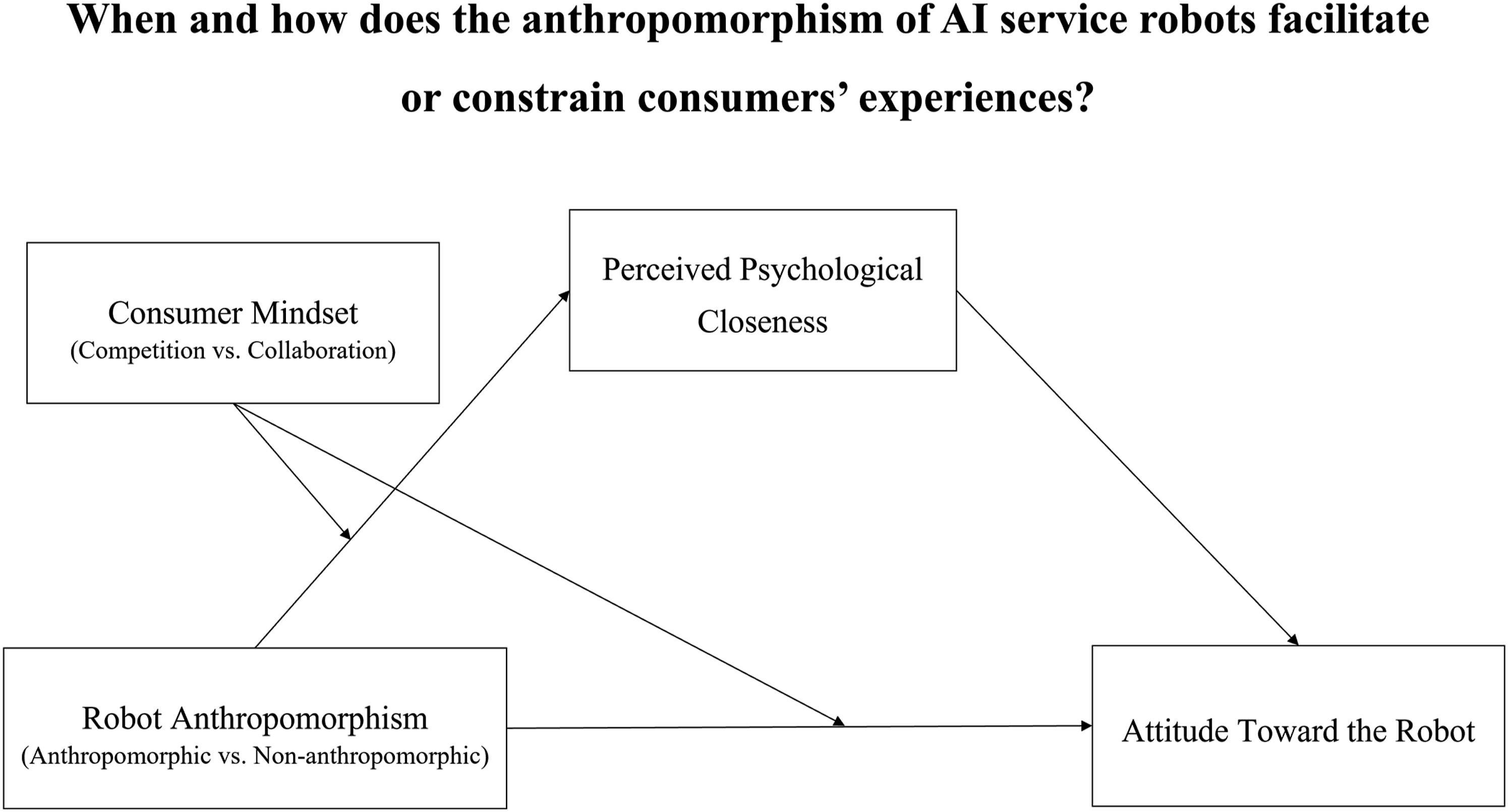
The use of artificial intelligence (AI) service robots is on the rise. With service frontlines gradually shifting to human–robot interactions, the question of whether the anthropomorphism of robots facilitates or constrains consumers’ experiences has emerged. This article focuses on the individual factor “consumer mindset” (competition vs collaboration) and investigates how it impacts consumers’ attitudes toward anthropomorphic AI robots during service delivery. Across three studies, we confirm our main prediction that competitive mindset consumers respond less favorably to anthropomorphic (vs. non-anthropomorphic) AI robots, whereas collaborative mindset consumers respond more favorably to anthropomorphic (vs. non-anthropomorphic) AI robots. We test the mediating role of perceived psychological closeness and the moderating role of interaction distance to explain the underlying mechanism. Our findings provide theoretical insights into the mixed results of previous studies of service robot anthropomorphism and have practical implications for service agencies using frontline robots.
Service encounters nowadays are increasingly characterized by customer-to-customer (C2C) interactions where customers regularly become targets of other customers’ misbehavior. Although previous research provides initial evidence of the contagiousness of such C2C misbehavior, it remains unclear whether, how, and why C2C misbehavior spreads when frontline employees (FLEs) are involved and what FLEs can do to curb it. Two online and one field experiment in the context of co-working and transportation services reveal that FLE-directed blame attributions drive the spread of C2C misbehavior while perpetrator-directed blame attributions reverse it. These blame attributions are greater the more severely customers judge other customers’ misbehavior. Findings further rule out alternative contagion mechanisms (social norms and emotional contagion) and show that contagion spills over to C2C misbehavior unrelated to the initial transgression. By specifying how contagion unfolds and by explicating the central role blame attributions play in C2C misbehavior contagion, this research uncovers its social dynamics, thus extending existing theory on customer misbehavior and attribution theory in multi-actor settings. Managerially, this research provides FLEs with explicit guidance on what they should do (personalized FLE interventions delivered either in person or remotely) and avoid doing (disapproving looks, FLE service recovery) when faced with C2C misbehavior.