



Abstract
Despite the popularity of gamification to improve the quality of experience in a variety of services, there is a lack of evidence on its effective integration into service design and the long-term impact of repeated gamified activities on customer experience. Using 10 studies, including behavioral data, survey, field, and laboratory experiments, this research investigates the effects of repeated gamified activities on customer experience quality and behavioral engagement. We examine the phenomenon through the lens of satiation theory, which explains the declining enjoyment for initially pleasurable activities. Supported by this theory, our results show evidence for a negative impact of gamified services that are highly repeated on experience quality and behavioral engagement. Further, we demonstrate strategies to compensate for such satiation by introducing mechanism and reward variety, a recovery period, and a sense of being near-to-winning. This research makes theoretical and managerial contributions by showing the potential backfire effects of gamification when gamified activities are repeated. Furthermore, this paper feeds the ongoing debate on standardization and personalization of service experiences. This paper demonstrates how high exposure to the same service experience can become counterproductive and increase risks of satiation.

Introduction
Gamification, the use of game mechanisms in nongame contexts (Deterding 2019), has become a popular way for service managers to improve the quality of customer experience and engage customers over time (e.g., Ciuchita et al. 2023). It is operationalized through various mechanisms, such as badges, points, or leaderboards. In the past decade, gamification has frequently been used to make tedious or boring activities enjoyable and engaging (Huotari and Hamari 2017). It has been applied in many service fields, such as healthcare (e.g., Feng, Tu, and Hsieh 2020), employee management (e.g., Höllig, Tumasjan, and Welpe 2020), retail (e.g., Hollebeek, Srivastava, and Chen. 2019), and online communities (e.g., Xi and Hamari 2020). Investments in the global gamification market are expected to grow significantly and continuously over the next decade (P&S Market Research 2020).
Although most literature assumes that gamification makes experiences fun and engaging over time (Leclercq, Poncin, and Hammedi 2020), academic literature on gamification suffers from myopia by investigating the effect of gamification after one participation while companies intend to use these strategies for repeated activities. Empirical evidence of the underlying processes and their evolution when gamified activities are repeated remains limited (Gutt et al. 2020, Wolf, Weiger, and Hammerschmidt 2020). Accordingly, scholars call for more investigations beyond punctual participation to include repeated gamified activities and understand their effect on customer experience as embedded in a whole journey (Ciuchita et al. 2022; Leclercq et al. 2020).
Psychologists have demonstrated that repeated consumption of most hedonic stimuli inevitably leads to a decline in enjoyment, called the satiation effect (Galak and Redden 2018). Researchers show that customers who experience declines in enjoyment tend to avoid future interactions and thus alter their behavioral engagement levels (Holahan et al. 2005). This effect has recently been spotlighted in customers’ interaction with games (Haenlein, Libai, and Muller 2022). Because gamification entails the integration of pleasure and game mechanisms into task performance (Cardator, Northcraft, and Whicker. 2017), we introduce the concept of satiation in the service design literature to assess whether the satiation effect and potential solutions to slow the onset of the effect also occur in the case of gamified services.
To address these gaps, the current research investigates the impact of highly repeated participation in gamified activities on customers’ experience quality and behavioral engagement. Therefore, we conducted a series of 10 studies, including behavioral data analysis, surveys, and field and laboratory experiments. We provide robust evidence of the satiation effect in services that are frequently gamified, namely, online communities, retail, and transformative services. We show that gamification can become counterproductive by harming not only customer experience quality but also generating reduced behavioral engagement when it is repeatedly used. We also identify several theory-driven strategies to slow the satiation effect: (1) satisfy customers’ needs for variety by altering the gamification mechanisms and types of rewards, (2) provide a recovery period between gamified interactions, and (3) induce a sense of being near-to-winning.
The contribution of the present research to the service literature is threefold. First, while gamified services are extensively discussed and assumed to affect behavioral engagement over time, very few studies examine the effect of gamification on highly repeated participation (except for Gutt et al., 2020; Lu, Xie, and Chen 2023). Our research uncovers this myopic design flaw within the literature and documents the satiation effect induced by highly repeated participation in gamified services.
Second, our approach contrasts with prior literature, which assumes beneficial effects of gamification (Cuichita et al. 2022; Mulcahy, Russell-Bennett, and Iacobuci 2020). In response to calls for further research along these lines (Deterding 2019; Vesa and Harviainen 2019), our findings suggest that the effectiveness of gamification is conditioned by proper management of a gamified approach. Accordingly, our efforts provide some operational solutions for limiting or countering the negative effects of the repeated use of gamified activities.
Third, we provide a conceptual contribution by integrating the satiation effect in the service design literature. While related concepts have been considered in the past, such as habituation or boredom, which are the consequences of an initial peak leading to an adaptation to the phenomena (Brüggen, Foubert, and Gremler 2011; Epstein et al. 2005; Thompson and Spencer 1966), satiation is characterized by an initial enjoyment of an activity that finally leads to a significant drop in enjoyment due to repetition (Galak and Redden 2018). Such phenomena are frequently encountered in management, as service design is intended to enhance consumer enjoyment and experience (Siebert et al. 2020). Countering this satiation effect is imperative to keep the customer experience fun and engaging. Our research opens a discussion in that direction.
The remainder of this article is organized as follows: We develop our conceptual model by reviewing the relevant literature on gamification in customer experience management and satiation theory. Then, we report methods and results from 10 studies to identify the satiation effect and test moderating conditions. Finally, we discuss the theoretical contributions and managerial implications of our findings and outline some research opportunities.
Theoretical Background
Gamified Activities in Service Design
Providing customers with a high-quality experience has proven to be a critical success factor for companies, as it promotes engagement (Kumar and Pansari 2016; Kuppelwieser and Klaus 2021). Higher levels of engagement lead to more word of mouth, advocacy, intent to interact further, and purchases, all of which contribute to overall business performance (Kumar and Pansari 2016). As Harmeling et al. (2017) perceive engagement as customers’ voluntary and behavioral contribution to the firm, this research will particularly focus on the conditions under which repeated gamification can affect the behavioral dimension of consumer engagement, that is, their intention to engage further in the gamified activity. Customer experience encompasses all the touchpoints customers have throughout their journey, covering the prepurchase, purchase, and postpurchase stages (De Keyser et al. 2020; Lemon and Verhoef 2016). In line with Verleye (2015), this research takes over the definition of experience quality as a balance finding between customer perceptions and service quality perceptions, which assumes an evaluation of met expectations to determine an overall experience quality (Verleye 2015; Zeithaml et al. 1990). To design touchpoints that provide a high-quality experience, companies and researchers are increasingly calling for the use of gamification (Ciuchita et al. 2023).
Gamification involves incorporating game elements into a core activity, making it an integral part of the experience. Gamification includes different types of activities or techniques, which can induce an enjoyable experience and a certain long-term behavioral engagement (McGonigal 2011). Originally, Caillois (1961) defined six components of a game: (1) it is free or not obligatory, (2) it is separate from the routine of life, (3) its results are uncertain, and (4) it is unproductive in that it creates no wealth. Games involve rules (5) that must be followed and (6) may exist in imagined realities. Outside its original context (i.e., games), gamification has been redefined as the use of game elements in nongame contexts (Deterding, 2019). It relies on activities such as leaderboards, challenges, and contests; this engagement strategy has attracted substantial research attention.
The goal of gamification is to enhance user outcomes and performance, allowing users to gain value from their interactions with the service (Ciuchita et al. 2023). Accordingly, Huotari and Hamari (2017) argue that the effectiveness of gamification resides in the customer experiences it provides, described by Ciuchita et al. 2023 as the consumption function of gamification. Mullins and Saberwal (2020) show that gamification strategies are composed of mechanisms (e.g., setup, rules, progression, and rewards) and dynamics (e.g., participants’ behaviors) as well as emotions (e.g., participants’ states of mind). They can add value to customers’ overall journey because, according to this experiential perspective, gamification makes task performance enjoyable. For instance, Höllig et al. (2020) highlight that perceived enjoyment during gamified interactions mediates the influence of the trait of competitiveness on mobile app usage intentions. Högberg et al. (2019) show that gamification affects the hedonic value of an activity, which in turn fosters engagement in the context of retail.
Many studies, listed in Web Appendix A, provide empirical evidence concerning the effect of gamification on customer motivations, experience quality, and engagement (e.g., Bitrian, Buil, and Catalan 2021). Accordingly, gamification activates intrinsic motivations—competence, autonomy, and relatedness—by integrating features commonly used in games into regular activities, making them fun and engaging (e.g., Feng, Tu and Hsieh 2020; Hwang and Choi 2020; Leclercq et al. 2018; Wolf et al. 2020). Customers who experience gamified interactions have reasons to continue their activities and use related digital platforms and technologies (e.g., Bekk, Eppmann, Klein, and Volckner 2022; Mulcahy, Russell-Bennett, and Iacobucci 2020).
Nonetheless, most of the existing theoretical elaboration as well as empirical investigations discuss the effect of gamification after a single instance of participation. Managers gamify their services to ensure long-lasting behavioral engagement (Hammedi et al. 2021). Research examining gamification effects over repeated engagement remains limited. Gutt et al. (2020) and Lu, Xie, and Chen (2023) outline that after successful badge achievement, customers increase their subsequent effort to reach the next badge. While these studies provide some empirical evidence for repeat behaviors, they focus on the use of badges in online communities and do not examine other gamification mechanisms. Moreover, these studies solely examine the effect on behavioral engagement without considering customer experience quality, which is still central for gamified services (Huotari and Hamari 2017). Aligned with the call from Ciuchita et al. 2023, the present research investigates how the effect of gamification evolves across participation. Haenlein et al. (2022) found that repeated sessions of mobile games may lead to a satiation effect. Because gamification involves the use of game mechanisms, this research examines the potential satiation effect in the context of highly repeated participation in gamified activities.
Satiation Effect
Satiation refers to the decrease in enjoyment that people experience when stimulations are repeated or prolonged over time (Galak et al. 2013); this hedonic decline occurs for various types of pleasurable experiences (Frederick and Loewenstein 1999). For example, diners often associate satiation with the feeling of “being full” and a reason to stop eating even if the meal is their favorite. This effect likely arises because for pleasurable activities, in which the initial levels of enjoyment are high, people become satiated when the activities are repeated too often (Alba and Williams 2013). However, satiation is not solely physiological; it is also psychological (Galak et al. 2009; Redden 2008; Sevilla et al. 2019). Alba and Williams (2013) posit that satiation reflects a subjective sense of the extent of past consumption. Experiential decline may follow various trajectories, including reduced levels of enjoyment, but it may also produce counterproductive impacts if activities exceed subjectively reasonable repetitions (Galak and Redden 2018). People can decide to stop their experience to avoid future interactions, such that they revise their behavioral engagement in the activities (Bhargave et al. 2018). Nelson and Redden (2017) show that people become satiated even faster when they make greater resource investments, such as devoting more working memory capacity to a task.
Similar to adaptation and habituation (Epstein et al. 2005; Thompson and Spencer 1966), satiation results from psychological processes, but the former phenomena represent the increasing ability of people to automatically respond to a stimulus after numerous exposures (Brüggen et al. 2011). Satiation instead refers to the hedonic decline induced by repetitions (Galak and Redden 2018). It is relevant to various consumption-related activities, including music and art (Nelson and Redden 2017). Understanding satiation can inform efforts to regulate hedonic consumption-related behaviors such as overconsumption of unhealthy food (Redden and Haws 2013) and enjoyment of music (Poor et al. 2012). Nelson and Redden (2017) suggest that the study of satiation helps practitioners prolong repeated pleasurable experiences and reduce switching behaviors. Because people tend to recall only recent experiences and forget about those that preceded them, understanding how satiation occurs and how it is affected is relevant to the regulation of customer behavior is highly important (Galak et al. 2009).
Hypothesis Development
The gamification literature has advocated gamified activities as a solution to the lack of behavioral engagement (Wolf et al. 2020; Wolf et al. 2021). While gamification has especially been useful to make redundant and cognitively stimulating tasks more pleasurable (Huotari and Hamari 2017; Leclercq et al. 2020), tasks that are by nature less enjoyable also show early signs of gamification inefficiency (Hanus and Fox 2015). In these situations, repetition appears to be a challenge for which gamification can provide additional or complementary (i.e., intrinsic or extrinsic) motivation to maintain behavioral engagement over time (Jang, Kitchen, and Kim, 2018). While past research has assumed a positive relationship between repetitive gamification and engagement based on theoretical conceptualization (Ciuchita et al. 2023; Mulcahy et al. 2020), we expect empirical findings to invalidate this hypothesis. In particular, we assume that the repetition of gamified activity reduces behavioral engagement when this observation is made over the long term based on satiation theory.
Repeatedly performing tasks can lead to the development of effective strategies, resulting in an increased sense of self-efficacy and the potential for a flow experience (Novak et al. 2000). However, we expect the opposite effect when the task is gamified because of the satiation effect. Although a stimulus may be enjoyable at the beginning (positive impact of gamification and behavioral engagement), satiation theory tells us that when this stimulus (here gamified activity) is repeated, the effect is reversed, and behavioral engagement should decrease (Galak, Kruger, and Loewenstein, 2011; Haenlein, Libai, and Muller 2022). In particular, whereas repeated nongamified activities can lead to phenomena similar to habituation or adaptation (e.g., Brüggen et al. 2011; Epstein et al. 2005; Thompson and Spencer 1966), gamified activities are meant to increase enjoyment (e.g., Poncin et al. 2017). Hence, their repetition is prone to a satiation effect when repeated, as satiation, by definition, originates from an enjoyable task (Galak et al. 2013). Consequently, we propose the following hypothesis:
Highly repeated participation in gamified activities negatively affects customers’ behavioral engagement, while the impact is reversed in nongamified settings. In addition to its functional dimension, gamification aims to create affective reactions (Mullins and Sabherwal 2020). Although gamification techniques increase the enjoyment of nongame experiences on single occasions (Hwang and Choi 2020; Wolf et al. 2020), the satiation effect (Alba and Williams 2013) suggests that repeating gamified activities leads to a drop in enjoyment. In line with satiation theory (Galak et al. 2011), we posit that decreased behavioral engagement can be explained by customers’ perceptions of reduced experience quality. Moreover, the theory on satiation explains that satiation occurs when a stimulus increases initial levels of enjoyment but starts decreasing when it is repeated (Alba and Williams 2013). It refers to the hedonic decline induced by repetitions (Galak and Redden 2018) and suggests a process in which a phenomenon might follow an inverted U-shaped model. While gamification has been stipulated to enhance engagement in the short run, it meets the conditions for the satiation effect to occur over time. In contrast, we further expect that if no gamification is used, the basic task under study would follow a steady pattern and neither benefit from an initial increase in enjoyment nor suffer from a hedonic drop over time and the onset of satiation. We thereby further assume that the repetition-induced hedonic drop over time should decrease below the initial level of enjoyment, which would be comparable to a situation without gamification in which an increase in the unpleasurable aspect of a task was stimulated. Hence, we set the following hypotheses:
Customer experience quality mediates the effect of highly repeated participation in gamified activities on customers' behavioral engagement. Although the academic literature assumes that gamification generates long-term benefits, we predict that satiation may compromise long-term behavioral engagement. To lengthen the time spans of engagement (Hollebeek et al. 2019), three relevant practices might slow satiation effects in gamified contexts. First, customers may cope with the onset of satiation by seeking different stimuli (Redden, Haws, and Chen 2017). Because satiation occurs when focal stimuli are repeated, the introduction of nonfocal stimuli may reduce hedonic decline by satisfying customers’ desires for variety (Galak et al. 2011). New stimuli may distract customers from focal stimuli and divert attention away from consumption (Galak and Redden 2018). According to Galak et al. (2011), variety is a particularly efficient strategy for decreasing the speed of the satiation effect when repeated activities take place within limited periods. Because gamification is traditionally defined as the incorporation of game elements into nongame settings (Deterding 2019), satisfying customers’ needs for variety may require differing gamification mechanisms and tasks, in addition to rewards. Considering the array of gamification mechanisms (e.g., competition, cooperation, and lottery) and the variety of gamification rewards that brands can offer (e.g., badges, points systems, progress bars, and coins), we assume customers likely become immersed in various side quests during their gamified interactions. By alternating these gamification mechanisms, rewards, or tasks, practitioners might slow the satiation effect on customers’ experience quality and subsequent behavioral engagement:
Varying the gamification mechanisms (H3a), the rewards offered (H3b), or the tasks (H3c) moderates the negative impact of repeated participation on customers’ experience quality and subsequent behavioral engagement. In particular, it reduces the speed of the onset of the satiation effect. Second, because the satiation effect occurs as the result of repeated stimuli, the absence of exposure to stimuli for extended periods may result in spontaneous recovery (Galak et al. 2009). Thompson and Spencer (1966) explain that spontaneous recovery occurs as a result of individual habituation, whereby repeated application of a stimulus results in a diminished response. However, when the stimulus stops, the response tends to recover, progressively, to its initial level. Such spontaneous recovery enables customers to return to their initial levels of enjoyment when they perform activities again (Galak et al. 2009). The time lapse required to recover from past satiation is subjective and varies according to the context (Redden 2015). Therefore, we propose that the satiation effect is weaker when customers perceive a recovery period between repeated participation in gamified interactions:
Perception of a recovery period moderates the negative impact of repeated participation in gamified activities on experience quality and subsequent behavioral engagement such that longer recovery periods reduce the negative impact on behavioral engagement. Recent literature suggests that gamification relies on gameplay, that is, the cognitive, emotional, and behavioral responses associated with games, rather than on the mechanisms used (Huotari and Hamari 2017; Leclercq et al. 2020). Such gameplay arouses customers’ intrinsic motivations by introducing uncertainty in task execution (Leclercq et al. 2020). Gamification mechanisms divide redundant tasks or ambitious objectives into smaller challenges with intermediate goals, thereby manipulating the uncertainty of achieving goals (Leclercq et al. 2018). Confronted with this uncertainty, customers may experience fun as long as they consider themselves capable of reducing uncertainty through their actions (Shen, Hsee, and Talloen 2019). Progress toward gamified objectives increases feelings of goal proximity (Gutt et al. 2020) and reduces levels of uncertainty (Leclercq et al. 2020). While the perceived likelihood of winning reflects participants’ perception of their chance to win and obtain the associated rewards, the near-to-winning feeling captures the perceived progress they make toward the winning state. Because such progress generates a gameful experience that varies over repeated participation, we hypothesize that customers’ perceptions of increased odds of winning their gamified objectives may satisfy their need for variety, thereby moderating the satiation effect. Even if the service literature has shown the benefits of perceptions of increased odds of winning on consumer attitudes and behaviors (Gutt et al. 2020), its ability to reduce satiation effects remains unproven. Similarly, this hypothesis contributes to the lack of insights into the boundary conditions of satiation and recommendations on how to reduce the satiation effect, which was initially hypothesized by service and marketing scholars (Ciuchita et al. 2023).
Near-to-winning feelings moderate the negative impact of repeated participation in gamified activities on customers’ experience quality and subsequent behavioral engagement.
Overview of Studies
In this research, we examine the satiation effect that occurs in gamified contexts and propose solutions to address this hedonic decline. We use satiation theory as a framework for understanding how a positive relationship between a gamified activity and experience quality can turn into a negative one when the activity is repeated. Satiation theory thus serves as a framework to explain a potential inverted U-shaped model and is operationalized in Figure 1 through the changing relationship between repeated gamified activities and experience quality. To test our hypotheses (see Figure 1), we conducted a series of 10 studies using a combination of behavioral data, survey, field, and laboratory experiments in frequently gamified contexts, including online communities, retail, and transformative services. Across all studies, we increased external validity by varying the type of gamified mechanism used. Following Caillois (1961), we considered the two broad categories of game, namely, games of chance (lottery and wheel of fortune) and competition (contest and challenges) and applied them in service settings (Deterding 2019). Conceptual model.
In Study 1, we used behavioral data collected from an online cocreation community to provide evidence for the satiation effect on actual behavioral engagement during gamified interactions (instead of intentions) and the opposite effect in nongamified interactions (H1). Studies 2A and 2B were field experiments conducted in transformative services and retail contexts, respectively, to further examine the extent to which the quality of the experience mediates the negative effect of highly repeated gamified activities on behavioral engagement (H2). Therefore, we asked respondents to participate multiple times in gamified activities and assessed the experience quality and their intentions to engage further. The experimental design used in Study 2A and Study 2B required respondents to participate many times. Therefore, in Study 2C, we conducted a survey in which customers took part in a cocreation contest and were free to participate as many times as they wanted. We then measured the quality of the experience and their behavioral engagement in the activity.
Highly repeated participation in gamified activities may trigger other experiential processes, in addition to the hedonic decline from the satiation effect. In Study 3, we delved deeper into the satiation effect and examined the potential impact of other experiential processes, such as a sense of self-efficacy, flow, boredom, and habituation, in addition to the hedonic decline associated with repeated participation in gamified activities. To do this, we conducted a laboratory experiment in the context of an online cocreation community, manipulating the number of repetitions and comparing the hedonic decline with these alternative processes.
The remaining studies (Studies 4, 5, and 6) aimed to identify strategies to slow the satiation effect induced by the high repetition of gamified activities. We conducted five laboratory experiments to test different ways to create variety and counter the satiation effect, including manipulating the type of gamification (Study 4A to test H2a), the proposed reward (Study 4B to test H2b), the task (Study 4C to test H2c), the length of the recovery period between gamified activities (Study 5 to test H3), and the near-to-win feeling (Study 6 to test H4). We also provide convergent evidence that the satiation effect occurs in gamified interactions and that there is an opposite effect in nongamified settings (Studies 1, 4A, and 4B). Web Appendix B summarizes the studies. Web Appendix C provides all the scales used in the various studies.
Study 1: Evidence of the Satiation Effect on Behavioral Engagement
Study Design and Procedure
We collaborated with a company that develops and promotes innovation through an online community of customers. This online community, founded in 2013, recruits members (mostly customers) who are willing to develop innovations. It invites them to share their innovative ideas with peers or contribute to others’ projects. The community covers activities from innovation conceptualization to commercialization. Partnering with this company allowed us to explore behavioral data from an online cocreation community.
We collected data from all active community members over a two-month period but excluded those members who were not active for at least 1 month before the study period. For each of the 192 active community members (94% men), we retrieved the number of days since registration (MRegistration = 146.57 days; standard deviation [SD] = 153.30 days) to determine their seniority in the community; seniority in online communities influences gamification’s effectiveness (Leclercq et al. 2020). We also gathered information about the amount and nature of the actions members performed within the community. We coded these activities as gamified or nongamified actions (dummy variables). Indeed, when community members make suggestions for ideas and product designs, they participate in a contest because an expert panel judges each submission and rewards the best ideas and designs with a proportion of the profits generated by ideas when they are commercialized. These activities were coded as gamified. In contrast, the reviewing/revising of submissions is not driven by gamification mechanisms. It is automatically rewarded with a proportion of the profit generated by commercialization. As argued by Leclercq et al. (2018), receiving automatic rewards for contributions refers to work-like activities rather than a game in which the rewards are uncertain and may depend on the contributions of others. Accordingly, the reviewing/revising of submissions were coded as nongamified. All activities, gamified or nongamified, were rewarded with royalties from the product launch. For each member, we computed a sum of gamified activities and another sum for nongamified actions during a 1-month period. The level of future engagement was captured through the sum of members' activity during the following period. The 1-month time lag was chosen because most members of the community contribute during one period each month, as it requires them to make significant efforts (developing an idea, conducting desk research, and commenting on innovations).
Our study included all community members undertaking gamified and nongamified activities. We counted the number of idea and design submissions and coded them as gamified activities (driven by competition), whereas reviews and revisions were nongamified activities (MGamified_act = 0.81; SD = 5.19; MNonGamified_act = 7.18; SD = 26.72). This distinction aligns with prior work that suggests gamification implies uncertain rewards, whereas other activities imply automatic rewards (Leclercq et al. 2020). Finally, we compiled the total number of activities undertaken during the second month as a future behavioral engagement score (MFuture_eng = 8.97; SD = 33.63).
Findings
To test for the presence of the satiation effect in gamified interactions, we performed regression analysis using the future behavioral engagement score as the dependent variable and the gamified and nongamified activities performed during the previous month as independent variables, measured by frequency. We also introduced member seniority as a control variable. Because the variables included in the model have different measurement levels, we standardized the coefficients.
The regression analysis indicates significant results (F (5, 186) = 75.81; adjusted R-squared [R2] = .66; p = .000). Our findings reveal a significant, positive impact of the number of nongamified activities undertaken by community members on their behavioral engagement during the following month (βNon-gamified = 0.53; p =. 000, Cohen’s f = 0.67). Conversely, they show a negative impact of the number of gamified activities performed by community members on their engagement during the following month (βGamified = −1.07; p = .033; Cohen’s f = 1.28). There is no direct impact of level of seniority on behavioral engagement, but it does significantly moderate gamified and nongamified activity effects. Web Appendix D details the results.
Our findings show that the more community members participate in gamified activities, the lower their levels of engagement during the following month. In contrast, the higher the number of nongamified activities, the more likely it is that their levels of behavioral engagement increase during the following month. These results confirm H1; repeated gamified activities lead to a drop in behavioral engagement, whereas repeated nongamified activities increase such behavioral engagement. Although these findings provide initial evidence of satiation effects in gamified settings, the field data cannot link these results to the hedonic decline that characterizes the effect. Studies 2A, 2B, and 2C address this limitation through field experiments. Moreover, the decrease in future engagement may be induced by the different natures and efforts put on the community’s activities but might not be the consequence of satiation. This potential effect induced by customers’ cognitive fatigue is ruled out through our experimental design in Studies 4A and 4B and controlled in Studies 5 and 6.
Study 2A: The Satiation Effect in the Context of Gamified Transformative Services
Study Design and Measurements
For this study, we collaborated with a running club. A total of 189 members (40% female, MAge = 31.23 years; SDAge = 7.63) participated in a weeklong activity. This activity was gamified through a contest. Each member was asked to indicate their number of steps per day, recorded with their running app. Every day, a leaderboard communicated with the progression of each member. At the end of the week, a winner was awarded. Participants were not informed about the prize beforehand to avoid any biases. Half of the respondents were invited to complete a questionnaire after the second day (low repetition of the gamified activity), while the others completed it after the fifth day (high repetition of the gamified activity).
The questionnaire included measures of experience quality and behavioral engagement in the sport activity. We used a 5-item scale suggested by Verleye (2015) to gauge customer experience quality and a 4-item scale adapted from Eisingerich et al. (2019) to assess customer behavioral engagement. The composite reliabilities (CRs) and Cronbach’s α values exceeded the recommended 0.7 level for each construct (Cronbach’s αExp. Quality = .87; CRExp. Quality = .91; Cronbach’s αCons. Eng = .79; CRCons. Eng = .87). In support of convergent validity, the average variances extracted (AVEs) were higher than 0.5 for both constructs (AVEExp. Quality = .70; AVECons.Eng. = .63). Because there were various levels of sport ability among the participants, as they may feel more or less advantaged during the contest, we also asked them to report the extent to which they felt good at running from 1 to 5, as well as their age and gender.
Findings
We tested H1 and H2 through a mediation analysis using Hayes’ (2013) PROCESS macro (Model 4; bootstrapped samples = 5,000; 95% confidence interval [CI]). We assessed the effect of repeated participation in gamified activities (low repetition vs. high repetition, independent variable) on the quality of the experience (mediator) and, consequently, on behavioral engagement in the activity (dependent variable). The perceived ability to run well was integrated as a control variable.
The results show that the direct effect of highly repeated participation in gamified activities on customer behavioral engagement in the activity is significant (β = 0.37; standard error [SE] = 0.09; p = .000; 95% CI = [0.20; 0.55]). We also detected an indirect negative effect through experience quality (β = −0.05; boot SE = 0.04; 95% CI = [−0.17; −0.00]). Highly repeated participation in gamified activities negatively affects customer experience quality (β = −0.38; SE = 0.10; p = .000; 95% CI = [−0.58; −0.19], Cohen’s d = 0.57), which positively affects behavioral engagement (β = 0.13; SE = 0.06; p = .038; 95% CI = [0.01; 0.25]; Cohen’s f = 0.33). These findings support the predictions of H1 and H2, namely, a negative effect induced by highly repeated participation in gamified activity on customers’ behavioral engagement through their evaluation of the experience quality (satiation effect). However, our results report partial mediation, suggesting that other processes may be initiated in parallel. The results are described in Web Appendix E. These findings may be biased by the 1-week timelapse between the first and last participation in the gamified activity. Study 2B controls this bias by imposing consecutive participation in gamified activities in a limited timeframe.
Study 2B: The Satiation Effect in the Context of Gamified Retail
Study Design and Measurements
In this study, we collaborated with a French retail chain from the FMCG sector. We conducted an experiment in one of their stores. A total of 164 shoppers (71% female, MAge = 41.48 y. o., SDAge = 11.32 y. o.) participated in a gamified activity, which was operationalized through a wheel of fortune, after their visit. Half of the participants, randomly selected, had the opportunity to spin the wheel twice (low repetition of gamified activity), while the others did so six times (high repetition of gamified activity). The wheel presented 10 icons with identical chances of appearing. The respondents were instructed that they might receive a reward based on the combination of icons they received.
After spinning the wheel, shoppers were asked to complete a questionnaire that included measures of experience quality (Verleye 2015; Cronbach’s α = .83; AVE = .67; CR = .89) and behavioral engagement with the store (based on Eisingerich et al. 2019; Cronbach’s α = .75; AVE = .58; CR = .84). Respondents also reported their age, gender, and frequency of visiting the store (rated on a scale of 1 [very infrequently] to 5 [very frequently]).
Findings
We replicated the mediation analysis from Study 2A using Hayes’ (2013) PROCESS macro (Model 4; bootstrapped samples = 5,000; 95% CI). We tested the effect of repeated participation in gamified activities (low repetition vs. high repetition) on the quality of the experience and, subsequently, on behavioral engagement with the store. Gender, age, and visit frequency were included as control variables.
Our results showed that while there was no direct relationship between participating in gamified activities repeatedly and a customer’s behavioral engagement in the activity, there was an indirect negative effect through the quality of the customer’s experience (β = −0.22; bootstrapped SE = 0.08; 95% CI = [−0.39; −0.08]). In particular, we found that highly repeated participation in gamified activities had a negative impact on the quality of the customer’s experience (β = −0.66; SE = 0.21; p = .002; 95% CI = [−1.09; −0.24], Cohen’s d = 0.50), which in turn had a positive impact on their behavioral engagement (β = 0.33; SE = 0.05; p = .000; 95% CI = [0.24; 0.402], Cohen’s f = 0.58). These results suggest that there is a satiation effect regarding repeated gamified activities, supporting H1 and H2. More information can be found in Web Appendix F.
Study 2C: Ruling out the Effect of the Constrained Gamified Setting
Studies 2A and 2B provide strong evidence of the satiation effect induced by highly repeated participation in gamified services. However, importantly, our experimental design requires participants to perform a certain number of repetitions, which may generate negative feelings. To rule out this alternative explanation, Study 2C reports the results from a survey in which respondents participated freely. In addition, we replicate previous findings in a different context, namely, in a competitive cocreation activity.
Study Design and Measurements
We recruited 158 students from a French business school (49% female, MAge = 22.23 y. o., SDAge = 4.85 y. o.) to participate in an online cocreation community organized by a fictitious start-up company that produces and sells cookies. The gamification strategy was operationalized through competition involving finding a new cookie flavor and brand name. Participants were informed that a panel of customers would evaluate the submissions, and the best proposal would receive a $250 reward. Participants were allowed to suggest as many ideas as they wanted.
After participating in the contest, participants completed an online questionnaire that included measures of experience quality (Verleye 2015; Cronbach’s α = .87; CR = .92; AVE = .73) and behavioral engagement with the activity (Eisingerich et al. 2019; Cronbach’s α = .87; CR = .95; AVE = .81). We also included items to control for participants' perceived value of the prize (“The prize offered to the winner is attractive”) and their perceived likelihood of winning (“I have more chances than others to win this contest”). These perceived prize values and perceived likelihood of winning are known to be central factors in gamified interactions (e.g., Hwang and Choi 2020; Leclercq et al. 2018). The questionnaire also included sociodemographic measures.
Findings
We ran a mediation analysis with Hayes’s (2013) PROCESS macro (Model 4; bootstrapped samples = 5,000; 95% CI) to assess the effect of repeated participation in gamified activities (independent variable) on the quality of the experience quality (mediator) and, consequently, on behavioral engagement (dependent variable). The perceived prize value and likelihood of winning are control variables.
The results showed that the direct effect of the number of repeated participations in gamified activities on engagement was not significant. However, we found evidence for an indirect path through customer experience quality (β = −0.01; bootstrapped SE = 0.01; 95% CI = [−0.03; −0.00]). Specifically, we found that the number of repetitions of gamified activities had a significant negative impact on experience quality (β = −0.05; SE = 0.02; p = .03; 95% CI = [−0.09; −0.00], Cohen’s f = 0.16), which had a positive impact on behavioral engagement (β = 0.29; SE = 0.11; p = .011; 95% CI = [0.07; 0.51], Cohen’s f = 0.19). These results suggest that the quality of the experience significantly mediates the impact of repeated gamified activities on behavioral engagement. More information can be found in Web Appendix G.
Our findings provide evidence of negative effects in gamified settings. In line with the literature on the satiation effect, Study 2C shows that decreased behavioral engagement following successive participation in gamified activities is the result of a hedonic decline. It also rules out the alternative explanation that this adverse effect is induced by the fact that the number of repetitions was imposed by the experimental design. Study 3 aims to rule out other processes that may explain the effect of highly repeated participation in gamified activities on customer experience quality. Indeed, people performing gamified tasks several times may learn how to do so effectively, thus generating a sense of self-efficacy (e.g., Chia-Lin 2022) and immersing them in a flow (e.g., Whittaker, Mulcahy, and Russell-Bennett, 2021). However, they may also become progressively used to the tasks and feel boredom or habituation. We compare those potential explanations with the hedonic decline induced by the satiation effect.
Study 3: Ruling out Alternative Processes Affecting Customer Experience Quality
Study Design and Measurements
A total of 102 participants (36% female, MAge = 37.78.23 years; SDAge = 12.85) were recruited from the Prolific platform to participate in an online cocreation activity organized by a fictitious start-up in exchange for a small financial reward. The activity required participants to suggest a new flavor of ice cream. The present study was a two-factor between-subjects experiment that manipulated the number of times respondents were asked to perform the activity. Participants were randomly assigned to either the low- or high-repetition condition, which involved two or eight repetitions, respectively. The choice of these numbers of repetitions was based on the findings from Study 2C. We indeed observed a strong decline in experience quality between the seventh and eighth rounds of participation. It is also corroborated with results from Galak et al. (2022), who examined temporal hedonic decline across two stimuli, music and art, asking participants to listen to a selected song or view four favorite photographs eight times in a row.
After submitting their ideas, respondents completed a questionnaire including measures of experience quality (Verleye 2015; Cronbach’s α = .94; CR = .96; AVE = .82), flow (Novak et al. 2000; Cronbach’s α = .83; CR = .90; AVE = .76), self-efficacy (Chueh and Huang 2023; Cronbach’s α = .86; CR = .92; AVE = .78), boredom (Stock 2016; Cronbach’s α = .77; CR = .87; AVE = .69), habituation (Cronbach’s α = .67; CR = .86; AVE = .76), and hedonic experience (Nambisan and Baron 2007; Cronbach’s α = .91; CR = .94; AVE = .79). We also measured the scenario realism through four items to characterize the contest: “credible,” “plausible,” “believable,” and “realistic” (Cronbach’s α = .96; CR = .97; AVE = .88). The experimental scenario had a satisfying level of realism (MLow_repetition = 4.02 out of 5, SDLow_repetition = 0.76; MHigh_repetition = 3.90 out of 5, SDHigh_repetition = 0.75). The questionnaire ended with sociodemographics (gender and age).
Findings
We tested the extent to which the effect of highly repeated (vs. less repeated) participation in gamified activities on the quality of the experience is mediated by flow, self-efficacy, boredom, habituation, and hedonic experience. Out of these five mediators, hedonic experience was the only one that revealed a significant indirect path (β = −0.21; bootstrapped SE = 0.10; 95% CI = [−0.45; −0.04]). This indicates that high repetition had a negative effect on hedonic experience (β = −0.43; SE = 0.17; p = .013; 95% CI = [−0.77; −0.09], Cohen’s d = 0.50), which in turn was a factor of customer experience quality (β = 0.49; SE = 0.09; p = .000; 95% CI = [0.31; 0.67], Cohen’s f = 1.02). A complete report of the findings can be found in Web Appendix H.
These results rule out alternative explanations concerning the impact of high repetition of gamification on customer experience quality. As conceptualized by Galak and Redden (2018), our findings confirm that the satiation effect is explained by a hedonic decline and not by altered self-efficacy, boredom, habituation, or a state of flow. In the remaining studies, we suggest ways to limit this effect.
Study 4A: Moderating Effect of the Gamification Mechanism Variety
Study Design and Measures
A total of 412 participants (42% female, MAge = 35.99 y. o., SDAge = 12.75 y. o.) were recruited from the Prolific survey platform pool for this study. Participants were invited to participate in an online cocreation activity organized by a fictitious start-up, in which they were asked to suggest a new flavor of ice cream.
As in the previous study, we manipulated the number of times participants were asked to perform the activity by assigning them to either the low repetition (two repetitions) or high repetition (eight repetitions) condition. We also manipulated the variety of gamification mechanisms used. We introduced four conditions, including a lottery mechanism, competition, both, and neither.
Hence, the study was a 2 (repetition: low vs. high) × 2 (variety of mechanism: absence vs. presence of lottery) × 2 (gamification: no competition vs. competition) between-subjects experiment. To operationalize competition, we informed participants that their submissions would be entered into a contest and that the company would reward the best ideas with a $50 prize. For the lottery, we indicated that one submission would be chosen randomly, and the winner would receive a $50 prize. The conditions in which only one of the two mechanisms was present represented without-variety versions, and the conditions that combined both mechanisms represented with-variety conditions. These groups alternated between competition and lottery (variety condition). Finally, the conditions without any of these mechanisms represented the nongamified version.
As in previous studies, we invited respondents to answer an online questionnaire immediately after they finalized their submissions; the questionnaire included measures of the quality of the experience and level of behavioral engagement. They satisfied validity criteria (Cronbach’s αExp. Quality = .94; CRExp. Quality = .86; AVEExp. Quality = .96; Cronbach’s αCons. Eng = .88; AVECons. Eng = .73; CRCons. Eng = .92). Again, we also controlled for perceived prize value and perceived likelihood of winning.
Findings
The three-way moderated mediation analysis to test H3a, using Hayes’ (2013) PROCESS macro (Model 11; bootstrapped samples = 50,000), includes behavioral engagement in similar future activities as the dependent variable, the manipulation of the repetitions of the activity (low vs. high) as an independent variable, and the respondent’s experience quality as a mediator. We tested the extent to which the variety of gamification mechanisms moderated the effect of repetition on experience quality. Accordingly, we considered the moderation effect of each gamification mechanism (lottery and competition) and the additional moderation of alternating the two mechanisms (with-variety condition). Perceived reward value and likelihood of being rewarded again function as control variables.
We found that repeating nongamified activities had a significant positive effect on the quality of the experience (β = 0.30; SE = 0.08; p = .000; 95% CI = [ 0.14; 0.45]), which in turn had a positive effect on behavioral engagement (β = 0.64; SE = 0.04; p = .000; 95% CI = [ 0.55; 0.73]). The use of a single, repeated gamification mechanism (without variety) had a negative effect on experience quality, regardless of whether it involved a lottery mechanism (β = −0.55; SE = 0.11; p = .000; 95% CI = [−0.78; −0.32]) or a competition mechanism (β = −0.67; SE = 0.11; p = .000; 95% CI = [−0.90; −0.44]). However, a three-way interaction in which the two gamification mechanisms alternated with many repetitions (with-variety condition) had a positive effect on experience quality (β = 0.90; SE = 0.17; p = .000; 95% CI = [ 0.57; 1.23]). This three-way moderated mediation was empirically supported (index = 0.57; bootstrapped SE = .12; 95% CI = [ 0.34; 0.82]). Accordingly, when only one gamification mechanism is used (lottery or competition), the high repetition of the activity deprives the customer experience quality (Cohen’s d = 0.67). However, when the gamification mechanism used varies, the negative effect of high repetition on the experience quality is inhibited (Cohen’s d = 0.02). The results are detailed in Web Appendix I.
These results provide further evidence of the satiation effect, demonstrating that it can be generalized to other gamification mechanisms. They also support our prediction that alternating gamification mechanisms moderate the satiation effect, providing support for H3a.
Study 4B: Moderating Effect of Gamification Reward Variety
Study Design and Measurements
We recruited 378 participants (48% women, Mage = 34.86 years, SDage = 12.87) from Prolific for a study in which they participated in an online cocreation activity organized by a fictional start-up, in which they were asked to suggest a name and slogan for a new ecofriendly taxi service. The study was a 2 (low vs. high repetition) × 2 (with vs. without badges) × 2 (with vs. without points) between-subjects design in which we manipulated both the number of task repetitions and the variety of prizes. Badges and points are common prizes in the gamification literature (Gutt et al. 2020). In two conditions, participants participated in the same activity, which was described as a competition in which they collected 100 points for each idea they submitted and additional points based on the quality of their submissions (one group had low-task repetition, while the other had high-task repetition). For the badge manipulation, participants took part in a competition in which they collected badges for each idea they submitted and had the opportunity to receive additional badges based on the quality of their submissions. The without-variety conditions used only one type of reward (badges or points), while the conditions that alternated the types of rewards were with-variety. Finally, the conditions without any rewards were nongamified.
The online questionnaire included measures of experience quality (Cronbach’s αExp. Quality = .92; CRExp. Quality = .95; AVEExp. Quality = .81), behavioral engagement (Cronbach’s αCons. Eng = .87; AVECons. Eng = .72; CRCons. Eng = .91), perceived likelihood of winning, and perceived prize value, similar to previous studies.
Findings
We tested H2b using a three-way moderated mediation analysis (Model 11; bootstrapped samples = 50,000), including engagement in similar activities (dependent variable), manipulation of the number of times the activity was repeated (independent variable), and respondent’s experience quality (mediator). We included the effects of each gamification reward (badges and points) separately (without-variety condition), as well as the impact of alternating them (with-variety condition). The controls were perceived prize value and perceived likelihood of winning.
The significant positive effect of repeated nongamified activity on experience quality (β = 0.36; SE = 0.14; p = .012; 95% CI = [0.08; 0.64]) affects behavioral engagement (β = 0.35; SE = 0.05; p = .000; 95% CI = [0.25; 0.46]). The use of gamification points to design the repeated activity negatively moderates the effect on experience quality (β = −0.74; SE = 0.22; p = .000; 95% CI = [−1.17; −0.30]), and this effect is similar when badges are used instead of points (β = −0.87; SE = 0.21; p = .000; 95% CI = [−1.29; −0.45]). However, the three-way interaction, alternating the two gamification rewards (with-variety condition), reduces the negative effects induced by repeated gamified activities (β = 1.06; SE = 0.29; p = .000; 95% CI = [0.49; 1.63]). Perceived likelihood of receiving a reward and perceived prize value reveal significant positive effects. The three-way moderated mediation is empirically supported (index = 0.37; boot SE = 0.14; 95% CI = [0.14; 0.69]). When one type of reward is at play, we find a negative effect of highly repeated gamified activities on customer experience quality (Cohen’s d = 0.41). This effect is reduced when the type of reward varies (Cohen’s d = 0.21). Web Appendix J details these results. These results thus generalize the moderating effects of gamification mechanism variety to the moderating effects of reward variety. They also support our prediction that alternating rewards (with-variety condition) moderate the satiation effect, further supporting H3b.
Study 4C: Moderating Effect of Gamified Task Variety
Study Design and Procedure
For this experiment, we used a 2 × 2 between-subjects design with 140 students from a French business school (46% female, MAge = 26.55 y. o., SDAge = 7.90 y. o.). The participants were invited to participate in a cocreation activity organized by a start-up, in which they had to suggest slogans for a coffee brand. The experiment manipulated the number of repetitions of the gamified activity (2 vs. 8 repetitions) and the task variety (submitting slogans only vs. alternating between submitting slogans and voting for the best propositions). The online questionnaire included measures of experience quality (Cronbach’s αExp. Quality = .90; CRExp. Quality = .93; AVEExp. Quality = .78), behavioral engagement (Cronbach’s αCons. Eng = .90; AVECons. Eng = .72; CRCons. Eng = .91), perceived likelihood of winning, and perceived prize value.
Findings
We tested H3c using a moderated mediation analysis (Hayes’s (2013) PROCESS macro, Model 7; bootstrapped samples = 50,000), including engagement in similar activities (dependent variable), manipulation of the number of times the activity was repeated (independent variable), and respondent’s experience quality (mediator). We assessed the extent to which task variety moderates the mediation effect. Similar to previous studies, we controlled the perceived prize value and perceived likelihood of winning.
The results confirm the indirect effect of highly repeated participation in gamified tasks on customers’ behavioral engagement through their experience quality. Accordingly, high repetition significantly affects customer experience quality (β = −0.64; SE = 0.10; p = .000; 95% CI = [−0.85; −0.43], Cohen’s d = 1.22) and subsequent behavioral engagement (β = 0.59; SE = 0.07; p = .000; 95% CI = [0.45; 0.74], Cohen’s f = 1.33). This indirect effect exists regardless of the level of task variety (βwithout_variety = −0.38; bootstrapped SE = 0.08; 95% CI = [−0.55; −0.23]; βwith_variety = −0.34; bootstrapped SE = 0.07; 95% CI = [−0.49; −0.22]). The moderated mediation index was nonsignificant (index = 0.04; SE = 0.08; 95% CI = [−0.11; 0.19]. Consequently, we do not provide any support for the ability of task variety to slow the satiation effect, as suggested by H3c. Web Appendix K provides more information about the findings.
Study 5: Moderating Effect of the Time Lapse Between Gamified Interactions
Study Design and Procedure
For this experiment, we adopted a 2 × 3 between-subjects design in which we manipulated gamified (vs. nongamified) activity and recovery period (daylong vs. weeklong vs. monthlong). We recruited 292 respondents from the Prolific platform (42% women, Mage = 38.02 years, SDage = 12.84). The respondents assigned to the nongamified conditions received an invitation to share their ideas with the company and read that all ideas would be rewarded. Furthermore, we asked all respondents to repeat the activity (gamified or nongamified) eight times to ensure satiation. We then recontacted them after a day (n = 118), a week (n = 110), or a month (n = 64), according to their condition, to call for a ninth idea. Because respondents falling within each condition are independent, we handled the data analysis as a between-design. After submitting their final contributions, participants accessed a questionnaire similar to those in previous studies. They reported their experience quality (Cronbach’s αExp. Quality = .93; CRExp. Quality = .95; AVEExp. Quality = .82), behavioral engagement (Cronbach’s αCons. Eng = .83; AVECons. Eng = .67; CRCons. Eng = .89), perceived likelihood of winning, and perceived prize value.
Findings
The moderated mediation analysis, using Hayes’s (2013) PROCESS macro (Model 7; bootstrapped samples = 50,000, 95% CI), tested the extent to which the recovery duration moderated the satiation effect of gamified activity on customer experience quality and subsequent level of behavioral engagement. As depicted in Figure 2, the results show a significant negative impact of repeated gamified (vs. not gamified) activities on experience quality (β = −0.25; SE = 0.13; p = .050; 95% CI = [−0.50; −0.00]) and engagement in similar activities (β = 0.64; SE = 0.06; p = .000; 95% CI = [0.53; 0.75]). This result confirms that the satiation effect occurs in gamified settings. However, in gamified settings, the effect is significantly weaker when a recovery period (vs. no recovery period) is imposed, for a week (β = 0.50; SE = 0.19; p = .008; 95% CI = [0.13; 0.87]) or a month (β = 0.64; SE = 0.21; p = .003; 95% CI = [0.22; 1.06]). Accordingly, compared to contexts without a recovery period, imposing 1 week between two gamified activities increases the experience quality (Cohen’s d = 0.69). This difference is even stronger when a 1-month period is imposed (Cohen’s d = 0.86). The indexes of the moderated mediation model indicate that the recovery period positively moderates the negative effect of repeated gamified activity on experience quality and behavioral engagement for both weeklong and monthlong periods (index of moderated mediation, weeklong = 0.32; BootSE = 0.14; CI = [0.06; 0.62]; index of moderated mediation, monthlong = 0.41; BootSE = 0.14; CI = [0.13; 0.68]). The direct impacts of the recovery period on customer experience quality were nonsignificant. Web Appendix L documents these results. Experience quality mean scores according to the experimental groups (Study 5).
This study provides further evidence of the satiation effect in gamified contexts. With an experimental design, it confirms the causal relationship between gamification and hedonic decline. The findings also support H4, in which we predicted that providing recovery periods can mitigate the hedonic decline that occurs when customers are satiated by experiences.
Study 6: Moderating Effect of the Near-to-Winning Feeling
Study Design and Procedure
To test H5, we conducted an experiment with a 2 × 2 between-subjects design. We accepted 167 respondents from the Prolific platform to take part in our study (35% women, Mage = 35 years, SDage = 13). The cocreation activity involved finding a brand name for an eco-friendly taxi service. We gamified all conditions as a competition in which the best submission was declared by a jury and rewarded with a $50 prize. We manipulated the number of repetitions requested of participants (2 vs. 8). We also manipulated the near-to-winning feeling (low vs. high) by assigning one group of respondents to a condition that attempted to prime the sense of being likely to win before their final submissions. The members in the experimental condition each received a message indicating that, according to statistical analysis, their next idea had a 68% greater chance of winning the contest (a statistic that the study pretest showed to be the most significant manipulation). The control group did not receive any message. After submitting their final ideas, respondents were redirected to an online questionnaire to report their experience quality (Cronbach’s αExp. Quality = .90; CRExp. Quality = .93; AVEExp. Quality = .77), behavioral engagement (Cronbach’s αCons. Eng = .86; AVECons. Eng = .71; CRCons. Eng = .95), perceived likelihood of winning, and perceived prize value.
Findings
Using Hayes’s (2013) PROCESS macro (Model 7, bootstrapped samples = 50,000), we performed a moderated mediation analysis of the moderating impact of the near-to-winning feeling on the satiation effect induced by repeated gamified interactions (H4). Behavioral engagement was the dependent variable, the number of repeated gamified activities (two vs. eight times) was the independent variable, and experience quality was a mediator. We included a condition that manipulated the perception of increased odds of winning (low vs. high) as a moderator. As controls, we use perceived prize value and level of cognitive fatigue, which is a type of resource depletion that leaves people unable to perform activities (Vafeas and Hughes 2021). Because we request multiple repetitions of a demanding task, we control for the level of cognitive fatigue with a single Likert-scale item (“I experience fatigue while performing this task”).
In line with previous studies, the results affirm the satiation effect, revealing a negative effect of repeated gamified activities on experience quality (β = −0.32; SE = 0.15; p = .041; 95% CI = [−0.62; −0.01]) and subsequent intentions to engage in similar tasks (β = 0.60; SE = 0.08; p = .000; 95% CI = [0.44; 0.77]). They also indicate a moderating effect of the near-to-winning feeling on the satiation effect (β = 0.48; SE = 0.21; p = .022; 95% CI = [0.07; 0.89]). Accordingly, when the near-to-winning feeling is weak, there is a satiation effect on customer experience quality (Cohen’s d = 0.65). This effect is inhibited when the near-to-winning feeling is strong (Cohen’s d = 0.01). The moderated mediation index supports these findings (index = 0.29; BootSE = 0.13; CI [0.04; 0.56]). Web Appendix M details our results, which support the prediction in H4 that inducing the near-to-winning feeling slows the satiation effect that occurs in gamified settings. A sense of progression reflects a varying perception of uncertainty associated with gamification, as depicted in Figure 3. Experience quality mean scores according to the experimental groups (Study 6).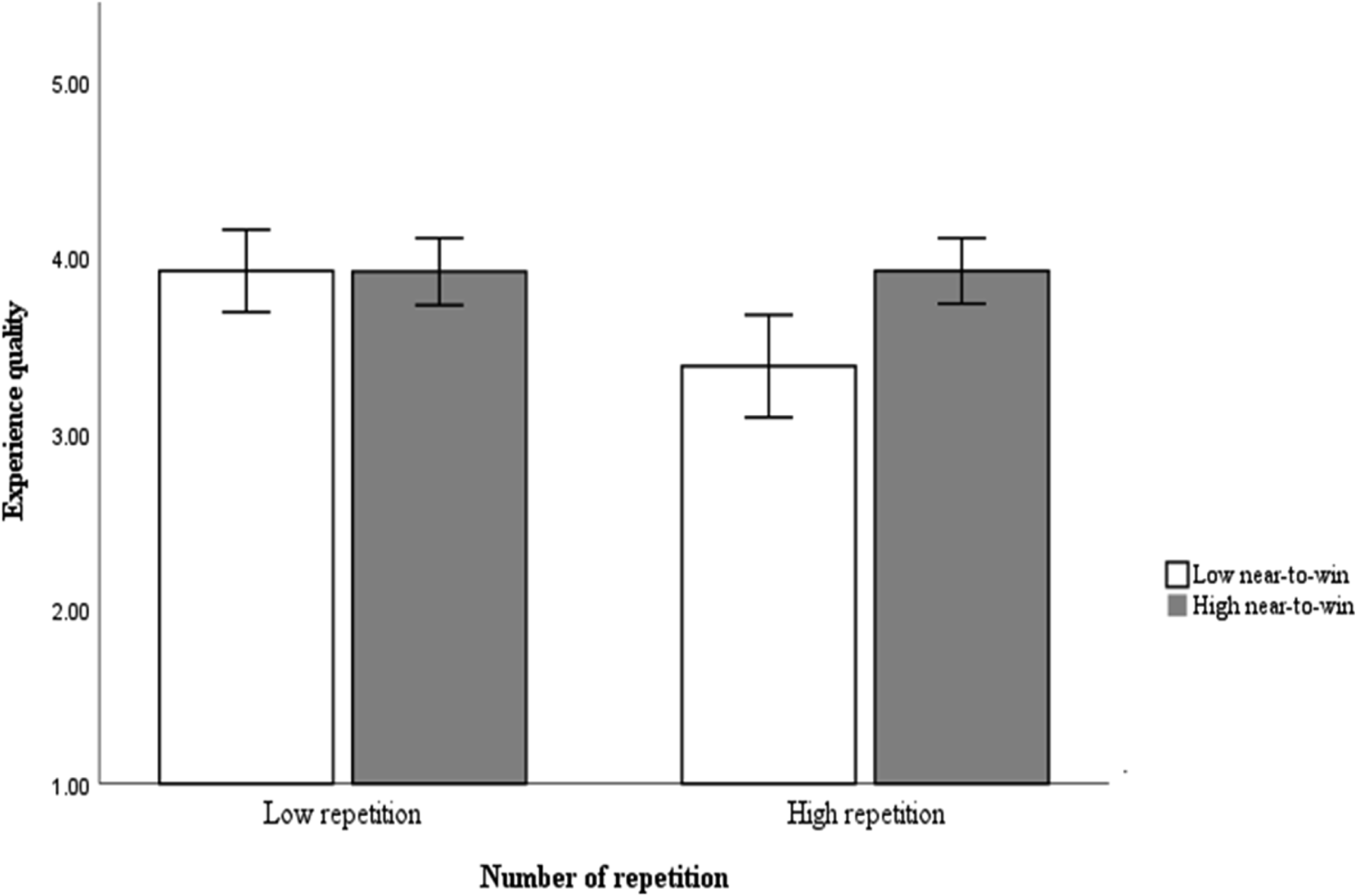
General Discussion
Several studies assume that gamification mechanisms provide customers with a high-quality experience, even for redundant activities (e.g., Cardador et al. 2017; Leclercq et al. 2020). However, empirical evidence of the effects of gamification mechanisms and their evolution across repeated participation remains limited (Ciuchita et al., 2023; Gutt et al. 2020, Wolf et al. 2020). To address this gap, our research investigates the impact of highly repeated participation in gamified activities on experience quality and behavioral engagement. Satiation explains the reduction in enjoyment associated with prolonged and repeated tasks (Galak et al. 2014) that occurs particularly during hedonic consumption activities (Galak and Redden 2018), such as playing video games (Galak et al. 2013; Haenlein et al. 2022). Gamification, defined as the integration of game mechanisms in nongame contexts, is subject to satiation effects. The findings from our 10 studies provide convergent evidence that the satiation effect on customer experience emerges during repeated gamified activities, while the high repetition of nongamified activities generates an increase in experience quality and results in behavioral engagement.
We show that highly repeated gamified activities trigger a satiation effect that decreases experience quality (varying from moderate to large effect sizes according to Cohen’s d). That is, experience quality mediates the impact of repeated gamified activities on customer behavioral engagement. We show the presence of the satiation effect in three service contexts that are commonly gamified—transformative services (Study 2A), retail (Study 2B), and online community management (Study 1 and Study 2C)—supporting H1 and H2. Accordingly, while prior reports positive effects after the first participation, our research spotlights a hedonic decline across repetition. This is in line with the inverted-U shape described by Galak et al. (2011).
We also ruled out alternative explanations in Study 3. In contrast, the high repetition of nongamified activities enables the customer to progressively learn the task and become immersed, thus creating a better experience and leading to higher behavioral engagement, as suggested by our results in Studies 1, 4A, and 4B. It is aligned with past literature on Flow (Novak et al. 2000).
To manage the satiation effect induced by gamified activities, we identify three strategies: (1) offer variety by alternating gamification mechanisms and types of prizes, (2) add a recovery period between gamified activities, and (3) foster a perception of increased odds of winning. First, the results of Studies 4A and 4B reveal the importance of varying both mechanisms and types of prizes, supporting H3a and H3b. These variations positively moderate the harmful effect of repeated gamified activities on experience quality and behavioral engagement. Variety can slow the onset of satiation (Galak et al. 2011). The positive effects on customer experience quality and behavioral engagement stem from the perceived complexity of the proposed stimulus. Regardless of actual task complexity, varying gamification mechanisms can influence the perceived complexity and intensity of experiences. Previous literature shows that the complexity of a stimulus can lead to more stimulation and therefore less satiation (Berlyne 1971). Shifting customer journeys from cyclic predictive patterns to varied, less predictable experiences can affect satiation (Siebert et al. 2020). We tested in Study 4C the possibility of varying the tasks performed repeatedly by the participants, but we did not find any effects. These results suggest that the gamification strategy tends to switch people’s attention from tasks to game-like interactions, as argued by Hammedi et al. (2017). Accordingly, participants focus on the variation of elements related to gamification (mechanisms or rewards) instead of the performed task itself.
Second, our findings show that offering recovery periods between gamified participation slows the onset of the satiation effect (Study 5), supporting H4. Galak et al. (2013) find that spreading repeated consumption activities over time results in reduced satiation. Recovery is especially effective when satiation occurs through habituation (Thompson and Spencer 1966). Although repeated exposures to stimuli result in diminished responses, the responses tend to recover to their initial levels of enjoyment when the stimuli stop for a while (Galak et al. 2009). Accordingly, despite the increasing attention devoted to designing more engaging gamification touchpoints, we propose restrained use of gamification if the goal is to enhance behavioral engagement.
Third, we found that the perception of increased odds of winning mitigates satiation effects (Study 6), supporting H5. Fostering customers’ perceptions that they have higher likelihoods of winning their gamified activities helps maintain the excitement induced by game-like interactions and is an effective deterrent to satiation. Increasing customers’ perceived likelihood of winning—and thus their feelings of goal proximity (Gutt et al. 2020)—reduces the uncertainty associated with gamified activities. Several scholars describe a similar sense of control over uncertainty induced by gamification (e.g., Leclercq et al. 2020; Shen et al. 2019).
Theoretical Contributions
Our research makes several contributions to academic knowledge on gamification, customer experience management, and engagement.
Capture the Effect of Gamification Across Repeated Participation
Whereas prior studies report short-term positive effects of gamification on customer experience and engagement (e.g., Wolf et al. 2020), investigations of gamification effects remain limited for repeated activities, while this strategy is frequently used consecutively across various customer touchpoints (Ciuchita et al. 2023; Leclercq et al. 2020). Accordingly, Gutt et al. (2020) and Lu et al. (2023) argue that customers increase their engagement across their consecutive participation because they progressively feel more competent and able to reach their objective. Our research nuances those findings. It outlines a negative impact through the satiation effect. We show that this effect occurs in services that are frequently gamified—online communities, mHealth apps, and retail—regardless of the gamification mechanism employed—badges, points, contests, and wheel of fortune.
Document Alternatives to Counter the Adverse Effects of Gamification
Gamification can be an effective engagement strategy to maximize behavioral engagement (e.g., Hwang and Choi 2020; Wolf et al. 2020). However, scholars call for caution and careful design, as this strategy can evoke negative experiences (e.g., Hammedi et al. 2021; Leclercq et al. 2020). Our research adds knowledge to the literature by documenting the harmful effect induced by highly repeated participation in gamified activities, as may be the case in service journeys including several touchpoints. To limit the risk of satiation during repetitive gamified activities, we point out several options. Informed by the satiation literature, we show that by varying gamification mechanisms and types of prizes, as well as providing recovery periods between gamified activities, brands can slow satiation effects. Inspired by existing research on gamification, we also show that fostering a perception of increased odds of winning mitigates the satiation effect.
Introduce the Satiation Effect to the Design of Service Touchpoints
We respond to the call to capture the dynamics of the customer experience (e.g., Becker and Jaakkola 2020; Stead et al. 2022). Scholars highlight the opportunity to provide an enjoyable experience to customers, making interactions with touchpoints fun and exciting (Siebert et al. 2020). However, we show that the repetition of fun interaction may become counterproductive. Accordingly, this research opens a debate on strategies aimed at providing enjoyable experiences, such as gamification, and their impact over consecutive interactions. Habituation or adaptation phenomena observe consumer responses following important changes in the environment (Brüggen et al. 2011; Epstein et al. 2005; Thompson and Spencer 1966). Similarly, boredom follows a similar negative trend as habituation but is not necessarily caused by an initial stimulus (Vafeas and Hugues 2021). In contrast with these theories, which have been investigated and applied to various services in the related literature (e.g., Brüggen et al. 2011), our research highlights that a decrease in enjoyment can appear in service designs that were initially intended to enhance positive customer experiences. In particular, we introduce the decrease in behavioral engagement in customers when facing prolonged hedonic stimuli, such as gamification, which was initially designed to enhance engagement. Satiation thus becomes an alternative conceptual phenomenon that occurs and is experienced differently than the phenomena of habituation or boredom. Therefore, we emphasize the potential satiation effect and argue that this effect should be considered when designing repeated service interactions aimed at being fun and enjoyable.
Managerial Implications
Our results also have managerial relevance. We find that gamification can be a double-edged sword if it is not managed carefully. Although the use of gamification to engage customers is a prevalent marketing strategy, repeated gamified tasks can induce satiation effects, resulting in no or even negative outcomes for customer experience and behavioral engagement. Companies that use such tasks (e.g., social media contests) should also plan to develop well-reasoned strategies for gamification techniques to avoid counterproductive effects. As part of this strategy, we suggest methods for limiting the negative consequences of repeated gamified techniques and consequently prolong customers’ behavioral engagement. First, we show that alternating gamification mechanisms—competition (e.g., contests) and lotteries (e.g., wheel of fortune)—or the type of rewards offered—badges and points—slow the satiation effect and thus keep the activity engaging. It appeals to the variety-seeking tension experienced by customers who participate in repetitive tasks. Additionally, we propose planning recovery periods between gamified activities. Our results support that imposing a weeklong period between gamified activities enables customers to restore their experience quality. Beyond carefully designing gamified interactions, managers can induce the perception of increased odds of winning to reduce the satiation effect, such as by informing customers about their progress toward their goals. Varying the level of uncertainty by revealing the level of progression may slow the satiation effect. For example, platforms might account for the frequency of participation and send personalized, encouraging messages to participants. These messages can restore customers’ initial enjoyment of their participation and consequently maintain their behavioral engagement.
Limitations and Further Research
Our research has limitations despite its convergent findings. First, our studies focus on competitions and lotteries. Generalizing our findings to other mechanisms may improve external validity. According to Feng et al. (2020), the commensurability of gamification mechanisms may influence our results by implying a sense of control over the odds of winning. Additionally, our findings also support “signposting” during gamification (Lavoué et al. 2018). Although we test the effect of posting a message about the likelihood of winning on experience quality and engagement, other signposting elements (e.g., greetings, suggestions, and tips for outstanding choices) may provide participants with other information or guidance. Also, our research suggests a satiation effect during highly repeated gamified activities, but other mechanisms may explain customer experience quality decline. Study 3 eliminated some alternative explanations. Gamification’s long-term negative effects should be studied.
Second, existing research emphasizes that participants' personal characteristics, such as customers' primary intrinsic motivations (Jang, et al. 2018), engagement with the community (Leclercq et al. 2018, 2020), and trait competitiveness (Höllig et al. 2020), may mitigate or magnify gamification’s effects. We expect tailored or customized gamification to create more personalized experiences and journeys without considering participants' personal characteristics. Tailored gamification should make satiation more dynamic, requiring different management strategies for different customer profiles. We encourage experimental designs that examine the effects of different game elements on repeated participation and different participant profiles. A longitudinal design may be needed to study user profiles and interactions/experiences over time.
Finally, scholars should keep studying experiences and engagement over time. This research supports the satiation effect when gamified activities are repeated through experience quality, but Study 2A shows a direct effect on customer behavioral engagement. This suggests alternative processes activated by frequent gamified activity. Scholars should study these alternative processes. Gamification may cause extreme engagement that puts customers at risk, so more research is needed. Hammedi et al. (2017) describe gamified health care patients who risk winning contests. To identify risks of prolonged gamified activities, consult game-addiction literature (Charlton and Danforth 2007). Additionally, in the service sector, customer/stakeholder engagement is a key concept that has attracted and continues to attract several researchers. It also poses an important challenge to managers. Despite its maturity as a research topic, we urge researchers in this field to address the understanding of long-term behavioral engagement. In contrast to hedonic decline, for example, we see great potential for studying hedonic durability (e.g., Tennant and Hsee 2017), that is, the extent to which pleasure over a gain or dissatisfaction over a loss/pain/incident lasts over time. This is of paramount relevance in a context of automated interactions that carry various risks of failure, pain, and incident. In such a context, understanding hedonic durability seems critical to maximizing long-term behavioral engagement.
Supplemental Material
Supplemental Material - Gamification Myopia: Satiation Effects in Gamified Activities
Supplemental Material for Gamification Myopia: Satiation Effects in Gamified Activities by Wafa Hammedi, Thomas Leclercq, and Nadia Steils in Journal of Service Research.
Supplemental Material
Supplemental Material - Gamification Myopia: Satiation Effects in Gamified Activities
Supplemental Material for Gamification Myopia: Satiation Effects in Gamified Activities by Wafa Hammedi, Thomas Leclercq, and Nadia Steils in Journal of Service Research.
Footnotes
Declaration of Conflicting Interests
The author(s) declared no potential conflicts of interest with respect to the research, authorship, and/or publication of this article.
Funding
The author(s) received no financial support for the research, authorship, and/or publication of this article.

Supplemental Material
Supplemental material for this article is available online.
Author Biographies
References
Supplementary Material
Please find the following supplemental material available below.
For Open Access articles published under a Creative Commons License, all supplemental material carries the same license as the article it is associated with.
For non-Open Access articles published, all supplemental material carries a non-exclusive license, and permission requests for re-use of supplemental material or any part of supplemental material shall be sent directly to the copyright owner as specified in the copyright notice associated with the article.
