




Abstract
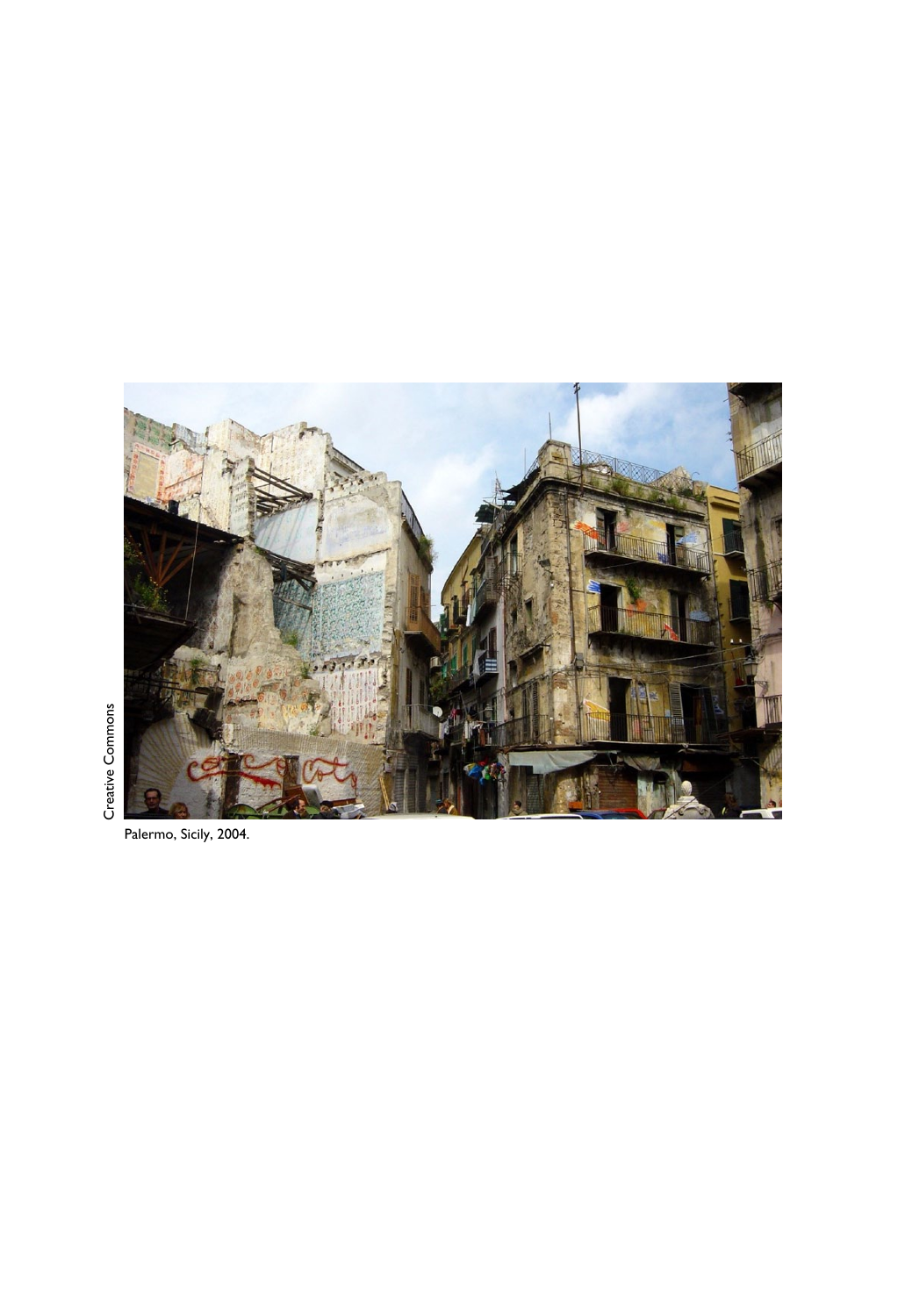
Palermo, Sicily, 2004.
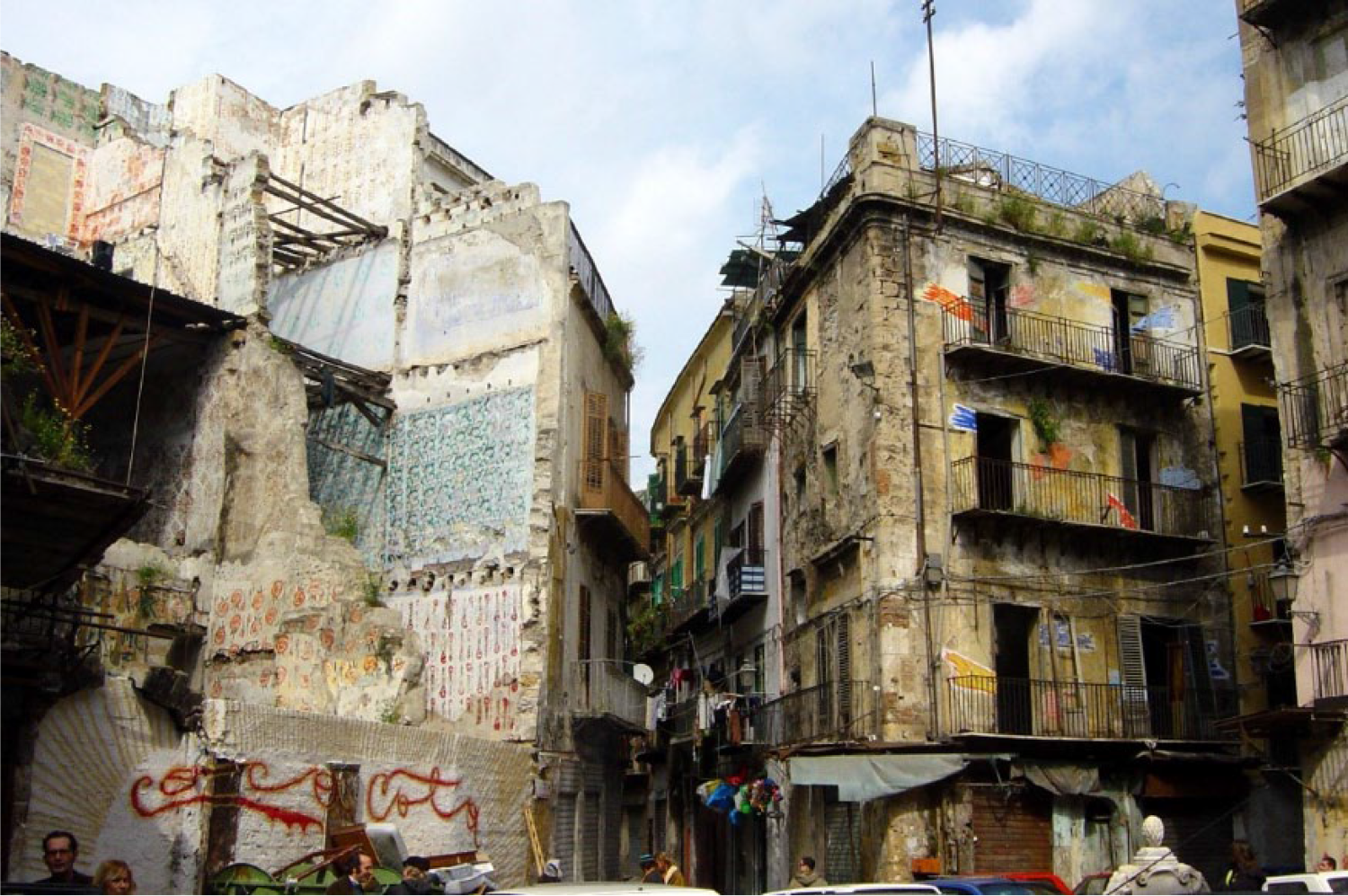
To understand why Italy’s economy is weak and patchy, and how its labor movement has failed to maintain its historic role and strength as a progressive force for redistribution, we must go back to that fabled period just before economic recession hit in the first decade of this century.
In the United States and some European countries—until the financial crisis brought a rude awakening—mainstream orthodoxy held that cyclical fluctuations and structural imbalances had finally been tamed. Variations in prices and production rates had become markedly less volatile, wages were contained, and there was less and less conflict about income distribution among social classes. The ensuing confidence led Nobel Prize winner Robert E. Lucas Jr. to declare during his 2003 presidential address to the American Economic Association that “the central problem of depression prevention has been solved.”
And such utopian confidence went beyond the management of business cycles; the production system was thought to be growing stronger in the medium to long term, and soon, it seemed, the principal market economies would no longer be plagued by distortions and by two-speed growth for different regions in a single country.
Italy, however, did not display a single one of those characteristic trends that neoliberal ideology then held to be universal. Instead, the country was riven by deep contradictions and unresolved imbalances. And ultimately, labor union weaknesses were part of the problem. The constant challenges to the unions, their difficulties in shaping a strategy, and their consequent decline have had a decisive impact up to this day in blocking the resolution of the many unhealthy economic conditions Italy has inherited.
The Southern Question
Several distinctive structural impediments have marked Italy’s economy. Most important is the deep divide in the levels of development between northern Italy and the south, a long-established problem known here as the Southern Question.
As far back as 1926, Antonio Gramsci first disputed the prevalent assumption that the Mezzogiorno, the Italian south, was the stumbling block “impeding more rapid social progress in Italy.” Only by defeating that kind of antisouthern prejudice, Gramsci believed, would it be possible to create common cause between the northern proletariat and the southern populace, the key to closing the north/south divide.
After World War II, the point was taken up once again by scholars such as Augusto Graziani, who argued that Italy’s development or lack thereof was limited by the weaknesses of the Mezzogiorno precisely because economic planning did not take off from the needs of the south. That situation persisted through the “economic miracle” of the 1970s up until Italy joined the European Monetary Union in 1992. Postwar Italian economic development was based on an exports-led growth model. That exports-led approach, however, results in a cumulative gap in favor of regions heavy in manufacturing industries where growth is powered by external demand. Not only was that not the economic situation in the Mezzogiorno, but the south’s large consumer demand (for nonessential, relatively inexpensive goods) compounded the distortionary effect. Rather than export, the south imported manufactured goods. The Mezzogiorno’s lagging growth could not be improved by a simple, across-the-board extension of the market. Dedicated economic policies targeted at the south were needed.
To flourish, the Mezzogiorno needed an industrial sector, and a strong labor movement was essential. Labor had to be able to negotiate agreements not merely about nuts and bolts but about the broad business strategies of major employers. At the beginning of the 1980s, both those things held true. Today, neither does.
Beginning in the 1950s, investment in the Mezzogiorno had been official government policy. Large industrial companies, most of them state enterprises, undertook major infrastructure projects and built huge factories and plants in the south. The logic that powered those companies was quite the opposite of the “small state” creed of today; they grew out of the social engineering pursuant to the Great Depression, when a group of far-sighted civil servants had refinanced and rescued many major Italian banks by acquiring shares in industrial enterprises on behalf of the state. Among the important investors in the Mezzogiorno were the state energy group ENI, and the state conglomerate for steel, shipbuilding, and engineering IRI, as well as several private companies.
Those investments have been the subject of a widespread politico-economic debate. Were these companies efficient? Could good profits be achieved in an economically disadvantaged region? What happened when a dominant political party, the postwar Christian Democrats, began to interfere in industrial decision-making? Despite the questions and the debate, there is no doubt in retrospect that these enterprises protected the south from the kind of economic desertification seen today in the Italian Mezzogiorno. Their impact was substantial; far from being so-called “cathedrals in the desert” that provided little employment or income, state enterprises in the south are being revalued today as the forces for progress they once were.
Beginning in the later 1980s, that changed. Neoliberal policies would do more damage to the economy of the Mezzogiorno than any measure ever undertaken in the first forty years after WWII. Blithely unconcerned with Italy’s uneven regional and social distribution, the neoliberal creed encouraged the dismantling of large factories and plants in the south, in favor of the supposed benefits of privatization, and the cliché that “small is beautiful.” Manufacturing was supposed to relocate to recently industrialized countries, and the future of lagging regions like the Italian south, it was theorized, could be based on art and tourism alone. In just a few years, steel production, engineering, and chemicals disappeared from the map of the Mezzogiorno, and industrial cities such as Naples became deserts, with all the related social distress familiar in rust belt regions of the Midwest of the United States and in the north of England.
The Effects of the European Monetary Union
But it was not just the south that suffered from the arrival of neoliberalism. Its most destructive effects—for the entire country—came as Italy prepared for and joined the European Monetary Union.
The single currency created under the Maastricht Treaty was designed in open opposition to the Keynesian model that had governed European policy-making after WWII. Policy-makers had not been able to achieve results, the consensus held, but the market would autonomously deliver them. Public spending, far from being a useful stimulant, depressed the economy. And so deficit spending, heretofore an instrument of economic policy, was jettisoned, and all the participants in the Euro pledged to sharply limit public spending. Meanwhile the objective of economic policy mutated as well: from full employment, the goal became monetary stability.
This shift had serious negative consequences for the Italian economy. In the short term, real demand, income, and employment shrank, and worse, prospects for long-term growth collapsed. The country’s industrial base, much of it state owned, was dismantled in the name of the mythical benefits of deregulation and private ownership. Italy was now riven by deep territorial imbalances, national productive capacity declined, and it was no longer possible to devalue the currency to maintain competitiveness, as had been done under the lira. When the economic crisis of 2007-2008 hit, the downward trend became relentless, and Italian industries were easy targets for foreign industrial and financial companies.
Some statistics: Between 2008 and today, 830 Italian companies, largely in the luxury and retail sectors, have been acquired by foreign buyers for a total value of more than a hundred billion Euros. Of these, about eighty were financial acquisitions, while the remainder were bought by predominantly industrial companies with plans to expand. Corporations from France, the United States, Germany, Russia, South Korea, and various Gulf states have all invested in Italy. The French company Lactalis paid 3.7 billion for 83 percent of Parmalat (4.3 billion sales). France’s multinational conglomerate LVMH paid two billion for 80 percent of Loro Piana, worth 630 million in sales. General Electric invested 1.9 billion in Avio; EDF Energy U.K. invested 1.6 billion in the energy company Edison; private-equity corporation First Reserve paid just over a billion dollars for a minority share of Ansaldo Energia. Finally, 60.4 percent of the household appliances company Indesit has recently been acquired by Whirlpool for a total projected price of $758 million.
Certainly, such cross-border acquisitions are difficult to prevent within a system that is fully globalized both in the financial and real economies. The fact remains, however, that when domestic companies are being bought by foreign interests on a large scale, the ability of the national state to temper the social consequences is very limited.
Two conditions could strengthen Italy’s ability to counteract the negative consequences of such acquisitions. But at present, neither pertain:
First, if the currency union were ever to change tack and decide its economic policies should compensate for the imbalances between weak and strong EU countries and regions rather than reinforce them.
Second, if the national labor movement were strong enough to combat the unbalanced rewards delivered by domestic and foreign neoliberalism and propose alternative distributive paths. That it is not might seem paradoxical in Italy, a country with a traditionally strong workers’ movement. Marxist-inclined in some cases (the Italian General Confederation of Labor [CGIL], Italy’s largest and most left-leaning labor federation), the Italian movement can boast of such actions as the Autunno Caldo of 1969-1970, the “hot autumn” of strikes that achieved major wage concessions and represented a milestone for income redistribution in the West.
Could Labor Have Changed Things?
Instead, the Italian union movement has seen a dramatic decline in influence over the course of the past fifteen years. Rates of union membership have remained relatively stable at around 30 percent, as the percentage of industrial workers has declined while membership in the public sector has risen. Meanwhile, however, levels of militancy and the broader political influence of the movement have shrunk. Still, some 85 percent of Italian workers are covered today by a collective bargaining contract negotiated by the unions.
In March 2002 the CGIL general secretary Sergio Cofferati spoke before a crowd of an estimated 2.5 to 3 million people at a rally in Rome’s Circus Maximus. The rally, to protest the proposed abolition of article 18 of the Worker’s Statute (a measure protecting Italian workers from being fired for trivial reasons or in response to the business cycle), was one of the postwar period’s most eloquent expressions of labor power. Today, neither the leader (Cofferati) nor the cause (article 18) has survived the test of time. From 2002 onward, the labor movement began to retreat on issues such as the Mezzogiorno, youth hiring, poverty, and disenfranchisement of rights.
With hindsight, it is evident that the workers’ movement should have been protesting the deflationary bias of the common currency. The unions should also have been bargaining over the strategies of the large industrial groups when these were undergoing savage restructuring processes. A case in point is the automaker FIAT, which thanks to Obama’s Troubled Asset Relief Program in 2009, was able to gain control of Chrysler and has nearly abandoned Italian production.
The labor movement did none of this, nor did academic labor economists assist by helping to analyze the issues. If anything, Italian academic economists have been even more conservative and doctrinal in their views than their anglophone equivalents. For example, Italian labor economists have embraced the figure of the “representative agent”—the individual offering his or her labor and the entrepreneur who seeks it—as the key element maximizing utility and profits. In this analysis, the labor market, rather than serving as a battleground for distribution between social classes, merely becomes a place where real wages have to respect marginal productivity. The more refined such an interpretation becomes, the less it has to say about the actual economic cycle, about unemployment, about any lack of real demand.
Such an interpretive framework—with its apparently simple trade-off between wage levels and employment, its assumption that the employed are selfish and the unemployed their victims, that young people offered reduced wages decline because they are “choosy”—clearly reflects the dominant consensus.
The same convenient obfuscation occurs when the labor market is considered the root of unemployment. Rather than look at aggregate demand (and its eventual deficiencies) as the driver of employment, the pertinent questions become training and employability, in a not very subliminal attempt to convince the young unemployed person that the lack of a job is his or her own fault. So-called labor policies—“active,” “passive,” and “mixed”—proliferate, and become institutional and bureaucratic structures in themselves.
The discouraging result is that between globalization, EU monetary policy, a labor movement in crisis and a timid, conformist economics profession, the decline of the old system has left nothing in its place. If anything, the situation has deteriorated. If previously Italy was divided between a prosperous north and a less flourishing south, today the country also faces a version of what the British writer Vera Brittain called the “Lost Generation” of WWI.
The lost are Italy’s NEET, “not in education, employment or training,” a term that first came into use in 1999 in a report from the British agency, the Social Exclusion Unit, to classify a particular segment of the population between the ages of sixteen and twenty-four. In Italy, that segment is usually defined as between the ages of fifteen and twenty-nine, but in some cases, the age range expands up to thirty-five for young Italians still living with their parents. Italy has the highest percentage of NEET in Europe, according to ISTAT (Italian National Institute for Statistics). The percentage of Italians aged fifteen to nineteen “not in education, employment or training” was 25.7 percent in 2015, and had grown from 19.3 percent in 2008, the agency reported.
Italy’s NEET population, at severe risk of poverty and marginalization, is made up of young people of various social origins: youth with poor educational credentials, some of whom have not completed compulsory schooling, young homeless people, university students who have dropped out without seeking work, university graduates discouraged by their inability to find employment, a few young people from prosperous families supported by their parents, unwed mothers, primarily in the south, the partners of offenders serving prison sentences.
This segment of young people receives few public benefits, which are in any case reduced under the present regime of austerity, and has little interaction with public authorities, in any case often considered undependable. Not by chance, the largest percentage of NEET in Italy are found in the south.
This group represents a phenomenon that the traditional Italian labor movement has proved singularly incapable of addressing. Trade unions have simply been unable to invent political strategies that encompass not only union members and the officially unemployed, but this assortment of outsiders who, discouraged or even despairing of work, no longer even seek it. Like the young Hikikomori in Japan who retire to their rooms and never come out, like young Americans who dream Into the Wild fantasies of escaping society and its demands, Italy’s NEET no longer want to be part of the larger social life.
Young southerners, utterly uninterested in collective action, young Italians caught in a condition of self-absorption that accompanies neoliberalism in many Western societies: such young people are different from other jobless generations. Previous generations of unemployed Italians tended to join together to make demands of the government and the institutions, the young NEET do not. Paradoxically, the role of the unions must be to demand “full unemployment” and combat this discouraged and passive segment of the youth population.
Twenty-first century Italy, in short, has become ever more divided along territorial and generational lines. Deregulation and privatization, a fiscal policy of austerity, an unwillingness to seek remedies for lagging growth in southern Italy, and the constraints of monetary union all combine to create a melancholy social environment, aggravated by subtle insinuations that individuals are personally responsible for their fates. It is a combination of circumstances that will be difficult for Italians to escape.
Footnotes
Editor’s Note
Frederika Randall translated this article from Italian. She is an American-born journalist and translator in Rome and has reported for the New York Times, the Wall Street Journal, the Nation, and many other U.S. and Italian publications.
Declaration of Conflicting Interests
The author(s) declared no potential conflicts of interest with respect to the research, authorship, and/or publication of this article.
Funding
The author(s) received no financial support for the research, authorship, and/or publication of this article.