



Abstract
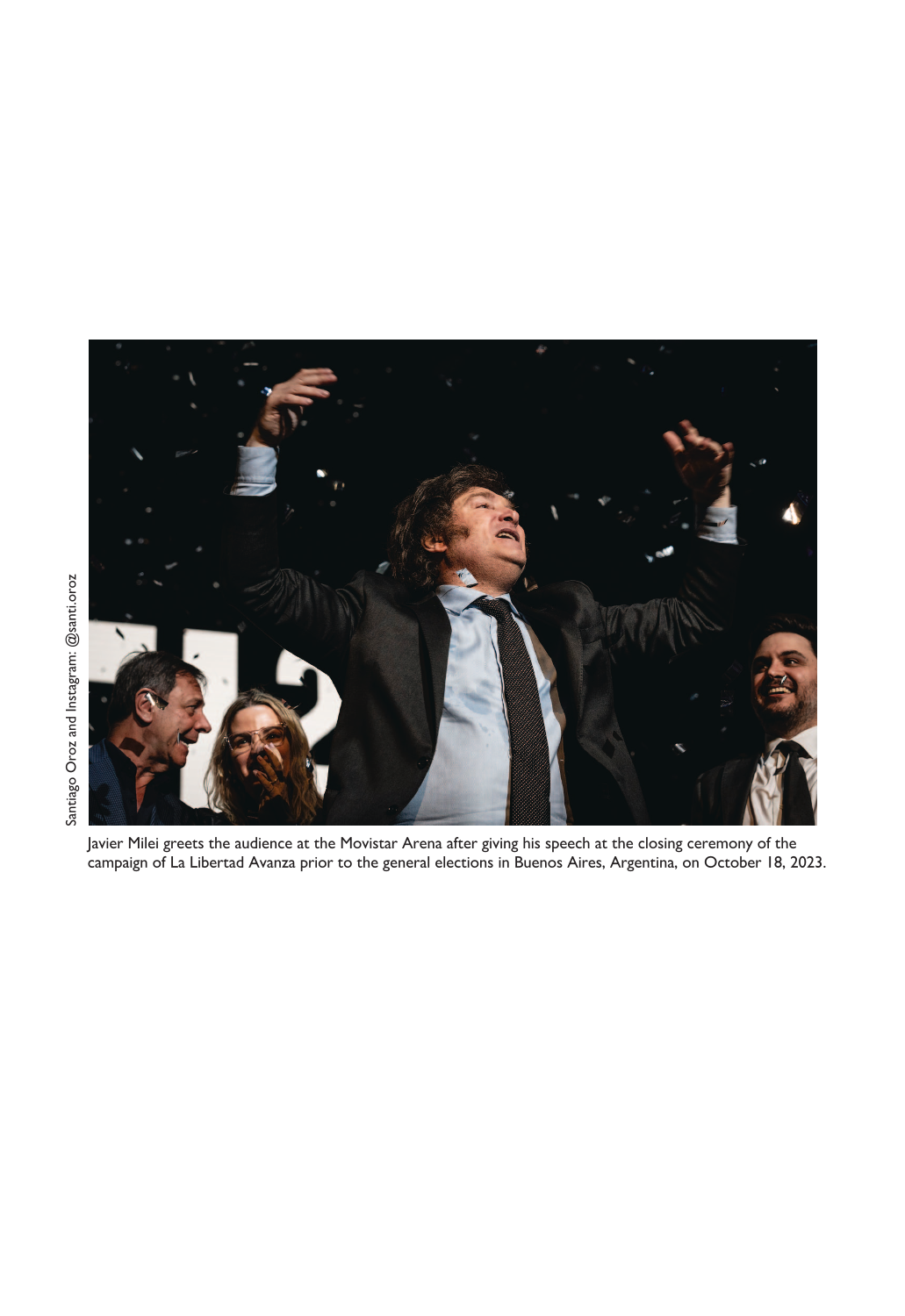
Santiago Oroz and Instagram: @santi.oroz
Javier Milei greets the audience at the Movistar Arena after giving his speech at the closing ceremony of the campaign of La Libertad Avanza prior to the general elections in Buenos Aires, Argentina, on October 18, 2023.
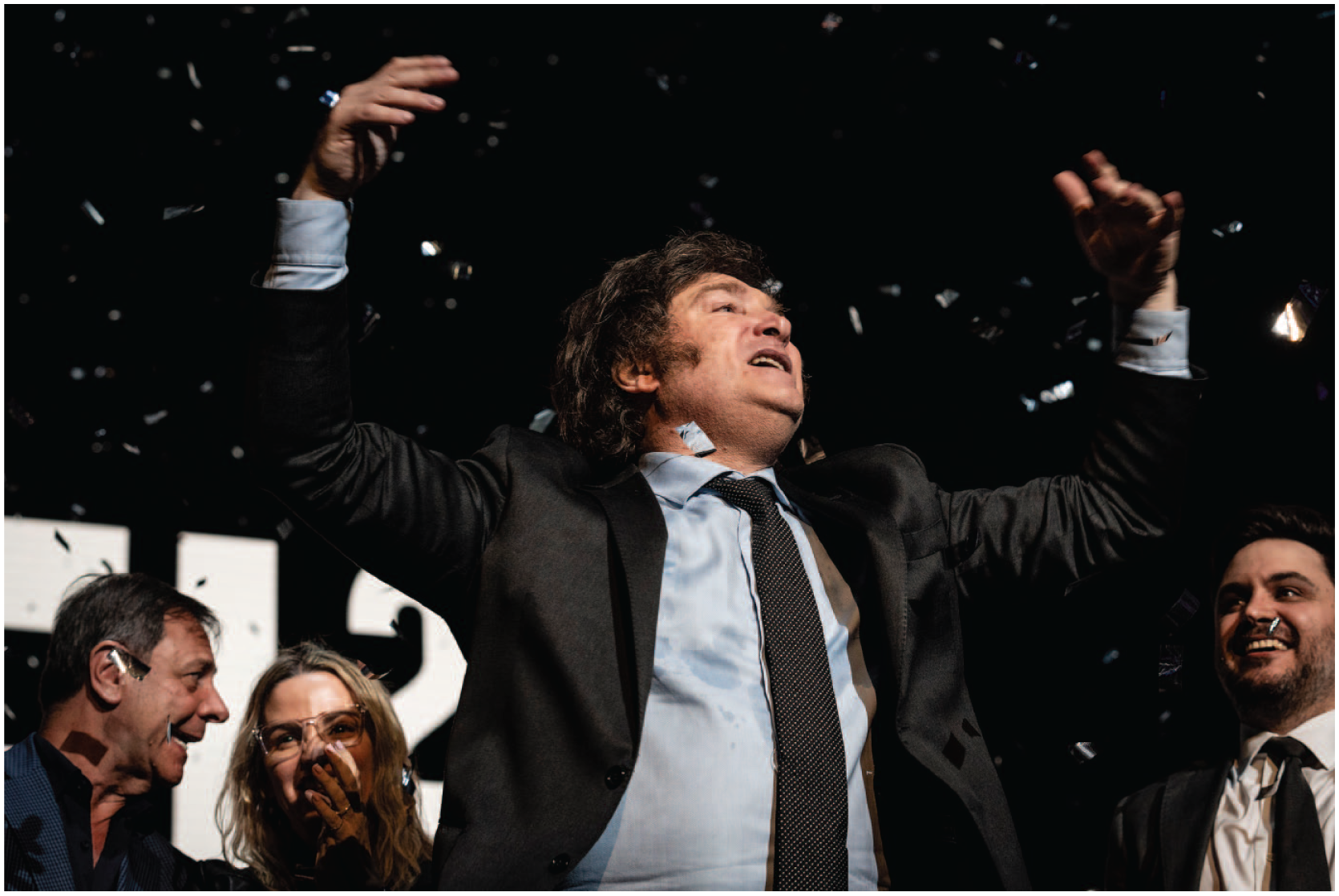
In November 2023, twenty years after the emergence of leftist governments throughout South America in response to years of neoliberalism, Argentina voted in Javier Milei as its next president, a rightwing former television personality who pledged to abolish the central bank, eliminate entire ministries and public institutions, and much more. Promising a radical, libertarian approach to governing, Milei won 56 percent of the vote against his center-left rival, the former Economy Minister Sergio Massa’s 44 percent. In just two years, he went from maverick outsider to the most highly voted national candidate since Argentina’s democratic restoration following the 1976-1983 dictatorship. 1 Only the country’s founder of labor-based populism, Juan Domingo Perón, achieved a higher vote share in the watershed 1951 elections. 2
For the past two decades, Argentina has been run by several populist left governments and a neoliberal right one, with neither type of government having enough support to remake or undo the policies of the other. In recent years, Argentina has been mired in cycles of rising foreign debt, perennial fiscal deficits, failures to generate formal sector employment, threats of mass impoverishment, and more recently, bouts of hyperinflation. As Argentines went to the polls, the central bank’s dollar reserves had evaporated, poverty had engulfed nearly half of the population, and year-on-year prices had risen by roughly 200 percent.
Milei’s victory is of a different kind; his extreme platform stands out even among the new crop of hard-right politicians emerging in the region over the past decade. And while his victory drew support from across the voter spectrum, he was backed heavily by decisive sections of the working-class, in particular young males in the informal sector. Indeed, more than a narrow counter-reformist backlash, Milei’s presidency may signal the transition to a new political and social regime in Argentina.
The Rise of Argentina’s Pink Tide Regime
The neoliberal, free-market order of the 1980s and 1990s in Latin America saw the abandonment of state-directed growth policies, the commodification of social services, and the deregulation and flexibilization of labor relations. 3 A surge of reformers critical of the costs of liberalization—known as the Pink Tide—followed. They included Hugo Chávez in Venezuela (1998-2012), Néstor Kirchner and Cristina Fernández in Argentina (2003-2015), Evo Morales in Bolivia (2006-2019), and Rafael Correa in Ecuador (2007-2017). 4 However, rather than dismantle the neoliberal order, they preserved the growth models of their predecessors, which depended largely on natural exports. And while they were able to adopt meaningful social reforms in governing and welfare arrangements, 5 they faced severe structural limits when it came to extending and deepening these changes. 6
Argentina’s first Pink Tide government came to power following the mass rebellion known as the Argentinazo. Under the extreme pro-market president, Carlos Menem, first elected in 1989, the economy stagnated, an unpayable foreign debt exploded and unemployment and poverty rose to unprecedented levels. A militant movement of unemployed workers, the piqueteros, organized mobilizations which escalated nationwide and ousted the floundering president in 2001. The revolt established two realities: first, incoming governments would need to enact meaningful reforms; and second, their survival depended on the support of the country’s militantly organized popular sectors.
Néstor Kirchner, a lawyer and member of the Justicialist or Peronist Party, won the 2003 elections but without winning even a plurality. 7 While Peronism—characterized by its empowerment of labor and the reliance on organized workers as its key social base—has been the most dominant force in Argentine politics since its founder erupted onto the scene in 1946, 8 Peronists have been chameleonic once in power, varying in their commitment to labor and welfare protections and to democratic civil rights. 9 Unlike Menem, who embraced free-market orthodoxy, Kirchner was relatively progressive, favoring an activist state that extended social protections, if minimally. From his weak political position, with continuing pressure from the streets, Kirchner constructed a new social pact that came to be called Kirchnerism, that has lasted into the present. It includes consolidating and expanding targeted welfare programs, incorporating segments of informalized work into the formal sector, and restoring industry-wide collective bargaining.
Underwriting Kirchner’s reforms was a bonanza of export earnings derived from a global trade boom fueled by Chinese demand for soy. Following the expansion of large-scale soy production by neoliberal governments, and the 2001 export-friendly devaluation, the Argentine state collected billions by taxing this swelling trade. 10 Under the Kirchners, soy production nearly doubled. The billions in export revenues were a powerful incentive to maintain the dominant growth model, rather than diversify and upgrade the economy’s production. 11 The revenue funded their social reforms and, by extension, mass popular support. However, it tethered Kirchnerism to a rigid growth regime that weakened prospects for autonomous and sustainable state-led development.
Kirchnerism’s Unsustainably Funded Social Policies
The Kirchnerist model was undeniably successful. Increasingly generous cash transfers offered families in the informal sector and young, formerly precarious professionals improved social protections, and growing numbers of unionized workers gained significant wage increases in yearly bargaining. 12 Several dissident unions certainly challenged the new and uneven model of hierarchical labor incorporation; but the powerful official unions, content to ride out the manufacturing recovery facilitated by devaluation, failed to push for broadening and diversifying the economy’s industrial base. Still, large Peronist unions and mass popular sector organizations reemerged as the backbone of Kirchnerist support. 13 When Cristina Férnandez, Néstor Kirchner’s wife, ran for president in 2007, her Frente Para la Victoria coalition doubled its vote share from the 22.5 percent eked out by her husband. In 2011, she was reelected with 54 percent of the ballots, a record level of support unsurpassed until Milei’s election. The Kirchnerist electorate had tripled from 4.3 million in 2003 to nearly 12 million voters, and Kirchnerism faced few challenges.
Over time, a pro-market center-right opposition emerged from the middle-class professional-managerial class, coalescing around the Propuesta Republicana (PRO) party and soccer tycoon Mauricio Macri who became mayor of Buenos Aires in 2007. Highlighting his entrepreneurial success, Macri ran on a program promising more efficient administration and an end to what he projected as Kirchnerist abuses: unaccountable and politically motivated public spending, heavy-handed demagoguery, and violations of civil rules and liberties such as proposed media reform legislation that allegedly restricted press freedoms. 14
These anti-Kirchner denunciations were not wholly unfounded. Total social spending expanded from 17.7 to 30.8 percent of GDP under the Kirchners. 15 The signature welfare program, Asignación Universal por Hijo (AUH), a conditional and means-tested per-child cash transfer program for low-income families instituted by Cristina Kirchner’s administration in 2009, grew to cover nearly one-third of all children by the end of Cristina’s first term. 16 During her second term, average benefits grew by nearly 20 percent. The program improved the lives of working-class Argentines battered by the consequences of liberalization and deregulation. Poverty fell by over one-sixth. These policies not only shored up the Peronist vote; they also contributed to forming a core political base that would defend the Kirchnerist regime that was taking shape.
Unsurprisingly, Cristina became embroiled in a legislative fight to raise tariffs, which had been cut to 3.5 percent and 0 percent on soy and corn, respectively, and succeeded in raising taxes on soy, the country’s largest earner, to 35 percent. Global soy prices nearly tripled during her first term and tariff revenue more than doubled to over 13 billion dollars. 17 But the tariff issue began drawing massive anti-Kirchner demonstrations, and the emergence of the elite and middle-class coalition which backed Macri in Buenos Aires. 18
When Chinese demand for soy and other primary goods slowed, and commodity prices fell, Argentine producers responded by reducing crop production, at times withholding harvested grains until conditions improved. Export revenue declined and poverty surged back up to one-third of the population. Faced with a dilemma to either continue funding cash transfers to the poor or maintaining debt service payments to its domestic and international creditors, the Kirchner government achieved neither adequately. Pressure on the peso grew, driving up inflation to nearly 40 percent in 2014.
The Return of Neoliberal Government
In the 2015 runoffs, Macri’s pro-market center-right Cambiemos coalition triumphed by expanding his vote beyond the country’s administrative and economic mainstays. 19 Macri reduced commodity tariffs and announced austerity in the form of cutbacks on social expenditures, utility subsidies, and public pensions. But he phased them in gradually, well aware of Kirchnerist congressional opposition and its ability to mobilize loyal movements.
But optimism for a market-friendly recovery faded, as yearly investments shriveled by 10 percent, pulling the economy into recession by late 2017. 20 Despite lowered tariffs incentivizing agricultural producers to increase cultivation, export revenue plummeted as Chinese demand stagnated. 21 The government was forced to rely more heavily on selling public bonds to investors to cover growing deficits. By 2018, Argentina’s debt had jumped from roughly half the gross domestic product (GDP) to almost 90 percent. 22 The social impact was felt immediately. In December 2017, over half-a-million protesters disrupted the capital city, battling the security forces in scenes reminiscent of 2001 piquetero mobilizations. 23 Austerity only exacerbated the crisis. Growing debt led to the peso losing over half of its value; a debt default loomed again. Inflation exceeded 50 percent. Macri’s final recourse was an unprecedented International Monetary Fund loan of over 50 billion dollars. 24 The bailout demanded more cutbacks; by 2019, the final year of Macri’s government, poverty and unemployment were at their highest point in over a decade.
Mass insurgency returned. Although Kirchnerism had splintered, its social base continued to coordinate and defy Macri’s presidency. Having failed to build an alternative growth model, the Macri coalition fell back on the main components of the Kirchner regime, including dependence on export revenues for social programs. When Chinese demand rebounded, the establishment neoliberal alliance did a turnaround, following the Kirchnerist playbook by raising export tariffs. Unable to generate the job growth he envisioned, Macri did another about turn, expanding Cristina Kirchner’s AUH program, after trimming its enrollees and cash benefits. 25 By the end of his term, the government that had vowed to end the abuse of populist patronage had expanded it to historic levels.
The Return—and Unraveling of Kirchnerism
A Kirchnerist return to power was inevitable. Its winning slate featured Alberto Fernández as president and Cristina as vice-president. But overarching social and economic trends continued to decline, and the economy shrunk by one-tenth. The government deepened its welfare programs to respond to the Covid-19 pandemic, funded by export revenues from soaring soy prices. 26 AUH households grew; unemployment and poverty fell. Growth eventually rebounded and capital investments grew by 33 percent. 27
The crisis faced by the Kirchnerist model, however, had reached an unprecedented level, and export revenues alone could not cover increasing social needs. Although Kirchnerism handily defeated its rightwing neoliberal rivals, it depended on a weak and fragmented base of clientelist supporters. Furthermore, the close alliance of unions with Peronist populists, as well as industrial contraction, undermined the unions’ capacity to push for new development strategies. Rather than invigorate national industry and productivity, the Fernández administration took on additional debt and printed more money to sustain its expenditures, leading to surging inflation, squeezed households, and deficit spending. 28 Poverty now engulfed half the population. 29 A new generation of workers, especially young labor market entrants, was thrust into precarious forms of work—ranging from independent micro-contractors in sectors like construction and maintenance, and skilled freelance gigs in services, to unregistered micro-businesses and street vendors—that lacked basic protections. 30 By early 2023, over two-fifths of wage earners were in the informal sector. 31 It was this constituency that was pivotal to the election of Javier Milei.
The Meteoric Rise of Javier Milei
Taking center-stage almost without warning, Milei blamed the political class on both sides for spending beyond the country’s means to artificially sustain dependent, unproductive followers. The self-styled anarcho-capitalist, also known as El Loco (“the crazy one”), promised to raze this political “casta” (privileged rentier “caste”), and slash state intervention and regulations. Brandishing a chainsaw, he pledged to abolish the central bank, dollarize the economy to preempt currency manipulation, and eliminate public institutions and entire ministries such as the ministries of Culture, Public Works, and Women and Gender. 32
Milei entered politics in 2021 when he won a congressional seat with his newly formed La Libertad Avanza (LLA). Then, in the first round of the 2023 national elections, the party won a stunning 30 percent of votes. Milei’s 500 percent growth in popular support in two years was historic. In the November runoffs, Milei trounced Sergio Massa, a moderate Peronist who had handily defeated a left-leaning Kirchnerist in the August primaries.
Peronist decline is revelatory: The party lost almost one million votes in Buenos Aires province alone and Massa’s votes fell by over three million nationwide compared to Peronist turnout in 2019. Generalized resentment toward the Kirchnerists particularly targeted Massa who, as Fernández’s Minister of the Economy, was viewed as primarily responsible for the recession. However, the Peronists will continue to control the largest blocs in both congressional chambers, and they have won key governorships, including Buenos Aires. Despite its collapse in the presidential elections, Peronism retains sufficient backing and institutional clout to operate as an effective opposition and compete again in 2027.
Working-Class Support for Milei
Milei’s votes came from several quarters: the millions of Peronist defections was one. Support from the center-right coalition Juntos por el Cambio (JPC)—which won nearly 11 million votes in 2019—nearly doubled his voting base. The late endorsement from former president, Mauricio Macri, and his PRO party proved crucial. 33 Parties from the latter alliance had seen the writing on the wall, following their failed neoliberal economic recovery efforts, and their loss of popularity and congressional seats, and hitched their fate to Milei’s. The result was that professionals and upper-middle-class voters migrated en masse to Milei’s candidacy, a seemingly unthinkable possibility just weeks prior.
But, above all, understanding Milei’s victory requires grasping how entire sections of the working-class voted for him. Why did growing hardship and disaffection with Kirchnerism not simply deliver a shift to the opposite political pole as before but instead a mandate against the whole order and social pact installed and reproduced by successive governments after the Argentinazo? The difference this time was the emergence of a mass base that, instead of valuing increased social spending predicated on commodity windfalls, experienced the model as a net detriment to their livelihoods. They consisted disproportionately of younger workers, mostly without families, who found employment only in the hyper-competitive, do-it-yourself world of precarious informal markets, and who saw public programs and regulations as impediments to their progress.
However troubling, in Milei they found a politician who embodied a policy package that aligned with their harsh survival strategies. Until now, Argentina had neither a mass anti-populist constituency nor a coherent ultra-liberal program to match it. Although Milei began peeling non-elite youth support from the Peronists as early as 2021, his appeal to this demographic exploded during the campaign. 34 In the end, 56 percent of the poorest voters cast their ballots for El Loco, while 78 percent of the youngest voters did so, according a recent study. 35 A 2022 survey by the Laboratorio de Estudios Sobre Democracia y Autoritarismos (the Laboratory for Studies on Democracy and Authoritarianism) in Buenos Aires helps explain why. 36
The survey revealed that among young first-time labor market entrants, joblessness or precarity has been the norm during both the Kirchner and Macri presidencies. Only 5.5 percent of those between ages 16 and 25 have stable employment. Nearly one-third have only sporadic and unstable work, while another 21 percent toil in unprotected jobs. A full 42 percent are fully unemployed. Similarly, for workers between ages 25 and 40, one-fourth have found only precarious work, while one-third are unemployed. Of the remainder, only three in ten have stable work, and another 15 percent are in and out of work. These figures exclude the growing numbers who have withdrawn from the labor market altogether, i.e., demoralized or otherwise non-employable people who are not even looking for work. (The unemployed represent those looking for work but have not found it.) This situation is a direct consequence of the failure of governments to expand national productive industries, relying on commodity export revenues instead.
The survey showed that a plurality of the 16 to 24 and the 25 to 40 age cohorts, segments that have leaned toward Kirchnerism since the 2000s, intended to vote for Milei. While 23 percent still supported Kirchnerism, over 28 percent preferred Milei. His harsh attacks on corrupt bureaucrats, public programs and spending, taxation and regulations, as well as his promise to allow free markets to unleash growth and unencumbered entrepreneurialism, resonated with their newfound distrust of the state and their alienation from regular employment. This contrasted with the leanings of those above 55—the sections of the workforce with a more stable footing in the labor market—for whom Peronism and center-right neoliberalism remained the top choices. The survey’s alarming findings underestimated the tectonic shift underway in Argentina’s political geography.
Implications for Argentina and Beyond
As the magnitude of the landslide became clear, Milei wasted no time defending his radical platform. He doubled down on his pledges to restore Argentine grandeur, rid the country of the casta and clientelism, abolish the central bank and dollarize the Argentine economy, and reinstitute a minimalist state, unhindered private property rights, business prerogatives and free trade. The same night that he reiterated these pledges at his victory celebration, a top advisor seemed to temper his extreme policy prescriptions, stating that the spending cuts would mainly target bloated bureaucracies. 37 But Milei has since denied moderating his platform. 38
What does his extreme package of measures—many of which will likely pass with support from the PRO-oriented neoliberal right and even some Peronists—signify? Most observers claim Milei embodies the latest instance of a rightward swing against a second wave of Latin American leftists. The neoliberal establishment holds that his election is an attempt to return to sound policies that align with basic market rules. 39 Observers on the left see his election as part of an extreme neoauthoritarian global surge. They point to his ultra-conservative response to changing gender roles and identities, to the reproductive rights recently won by mass feminist mobilizations, and the growing recognition of indigenous sovereignty. 40 They underscore his revisionist positions on Argentina’s 1976-1983 military dictatorship and the mass atrocities unleashed by state terror. They also point to his “law-and-order” promotion of gun ownership and vigilantism for confronting rising crime and alleged social chaos. 41 Others even see his rise as the embodiment of a new fascistic threat in the region. 42 Reformers from the first Pink Tide were ousted via coups, as in Bolivia, or electorally, as in Argentina and Brazil. Milei’s brand of politics is considered an extreme reaction against a second wave of progressives that has come to power, most notably in Chile and Colombia. 43
The authoritarian perils ushered in by Milei are undeniable. But worrisome as they are, his victory is more than just a political backlash. Typically, pro-market opponents who succeeded populist reformers have aimed to roll back their social policies, but, lacking mass support and an alternative social contract, left these policies in place while tinkering around their edges. A compromise resulted, with neither left reformers strong enough to deepen social transformations nor their rightist challengers capable of undoing them. This uneasy pact may now crumble, as Milei promotes extreme proposals, and enjoys social backing for them.
It is too early to foresee how effective Milei’s government will be in instituting these changes. There is no telling whether the shock policies he has already begun implementing will simply prolong Argentina’s recession and turmoil, or eventually generate the growth he promises. The depth of support from PRO’s parliamentary benches remains unclear, although early dealmaking suggests the neoliberal right will line up behind his program. Moreover, Milei currently enjoys the backing of powerful economic elites who, disappointed by the PRO’s inability to promote growth and profits, hope he will ensure a friendlier business climate. 44 Yet, a remobilization of the most organized sectors of the working class against Milei will not be surprising. Militant labor groups have begun protesting early cutbacks, and widespread resistance to the imminent social costs of intensified austerity is a near certainty. The outcome of all this is unpredictable. But one thing is clear: A new social constituency, drawing from the working class, has coalesced behind a free-market extremist, paving the road for a novel and dangerous alignment of social forces.
This level of support for unfettered markets, and hostility toward public goods and intervention has not been seen in Latin America for decades. It suggests that fighting to restore a leftwing variant of the Pink Tide is a losing battle. Instead, a transformed left and labor movement must propose an alternative that overcomes its limitations. It might start with Pink Tide’s main pillars: In lieu of dependence on commodity exports, it must develop new, dynamic industries founded on high-end green technologies capable of generating the surpluses needed to finance the provision of basic public resources and social goods for everyone, without conditions or special targeting. And instead of inadequate, narrow welfare programs that engender resentment among working people, it must champion universalist social provisions and protections. Accordingly, it must not merely seek to alleviate the worst conditions under the constraints imposed by business, but discipline economic elites into accepting a growth model that produces well-being and democratic influence for all laboring classes. For now, swaths of Argentina’s working class have moved further away from such a radical egalitarian development regime. Millions more across Latin America may follow suit. Milei’s victory is a wake-up call that should prompt progressives and the labor movement to reinvent themselves, and do so as quickly as possible.
Footnotes
Declaration of Conflicting Interests
The author(s) declared no potential conflicts of interest with respect to the research, authorship, and/or publication of this article.
Funding
The author(s) received no financial support for the research, authorship, and/or publication of this article.
