



Abstract
Aim:
A cryptoglandular anorectal abscess is a collection of purulent material around the anus, often leading to the development of an anal fistula after drainage. Although Escherichia coli and Bacteroides fragilis have been considered key bacteria in these conditions, recent evidence suggests the need to revisit this assumption. This work aimed to analyze the presence and role of bacteria in the development of anal fistulas following anorectal abscesses.
Patients and Methods:
A search was conducted using MEDLINE via PubMed, EMBASE, Cochrane Library, and Google Scholar. Articles reporting the microbiology of cryptoglandular anorectal abscesses and the resulting anal fistulas in human beings were included. The main outcome was to evaluate the presence of bacteria in cultures of anorectal abscesses or in patients who developed anal fistulas. Additional goals included identifying patient characteristics and assessing clinical outcomes on the basis of the isolated bacteria.
Results:
In total, 22 articles on anorectal abscesses and seven on anal fistulas met the inclusion criteria. Men were the most prevalent in both cases. Escherichia coli and the Bacteroides genus were the most isolated microorganisms in abscesses and fistulas, though inconsistently in the latter. Bilophila wadsworthia was newly isolated in abscesses, and Rothia sp. was notable in fistulas using new molecular techniques.
Conclusions:
Escherichia coli and Bacteroides sp. are involved in anorectal abscesses and anal fistula formation. Recently, using new technology non-well-known bacteria had been isolated involved in this clinical problem.
Introduction
An anorectal abscess is a collection of purulent material around the anus or rectum. It can drain through an opening in the perianal skin or rectal mucosa and potentially lead to an anal fistula. Most anorectal abscesses have a cryptoglandular origin (between 90% and 97%),1,2 and anal fistula formation is considered a primary complication or outcome after its drainage. 3
Escherichia coli is a frequent culprit in anorectal abscesses. It normally resides in the intestines but can cause infection when it enters the anal glands or surrounding tissues.4,5 Additionally, Bacteroides fragilis, a common anaerobic bacterium, can contribute to abscess formation. Various Streptococcus species, such as Streptococcus milleri, may also play a role in abscess development. Proper diagnosis and treatment are crucial to prevent complications.4,6
Anal fistulas are abnormal tunnels or tracts that connect the anal canal or rectum to the skin near the anus. They typically arise from cryptoglandular infection of the anal glands, which lie within the intersphincteric space. 7 Microorganisms involved in anal fistula development also include E. coli, Enterococcus species, and B. fragilis. 6 Interestingly, chronic inflammation in anal fistulas does not seem to be solely because of excessive numbers of organisms or unusual types of organisms. 8
Understanding the microbiology of anorectal abscesses and anal fistulas is crucial for effective management and treatment. Our hypothesis, like that of other authors, is to identify bacterial species that may be relevant in patients who develop anal fistula following an episode of anorectal abscess. However, there are new techniques for studying the presence and effect of bacteria in the development of anal fistulas during the follow-up of anorectal abscesses. Therefore, this systematic review aimed to analyze the specific presence and role of bacteria in the development of anal fistulas.
Patients and Methods
A systematic review was designed following a detailed protocol according to the PRISMA checklist and was registered in the PROSPERO registry under ID: CRD42024548060.
Search strategy and information sources
A literature search was conducted using the MEDLINE database via PubMed, EMBASE, and Cochrane Library, along with a manual search from Google Scholar. The keyword combinations using MeSH terms included anal abscess OR rectal abscess OR anorectal abscess OR perianal abscess OR anorectal sepsis OR anal fistula OR rectal fistula OR anorectal fistula OR perianal fistula AND bacteria OR microbiology OR culture.
Relevant articles from reviewed citations or secondary articles that were identified were also retrieved. Two reviewers evaluated the titles and abstracts of the articles focusing on bacteriology in anorectal abscess, anal fistula, or the development from anorectal abscess to anal fistula. A third reviewer resolved any discrepancies about inclusion. Consequently, a full-text article retrieval and evaluation were performed.
Inclusion and exclusion criteria
Inclusion criteria: Articles reporting the microbiology of cryptoglandular anorectal abscesses and the microbiology of anal fistulas developed from these abscesses in human beings.
Exclusion criteria: Articles reporting solely cases without follow-up were excluded. Articles in languages other than English or Spanish and those studies conducted entirely on children were also excluded. Additionally, studies in patients reporting complete clinical series of other causes of anal fistula other than cryptoglandular origin (e.g., Crohn disease) were excluded.
Outcomes
The primary endpoint of interest was to evaluate the presence of specific bacteria in cultures of anorectal abscesses or in patients who developed anal fistulas. Additional secondary goals included identifying patient characteristics and assessing clinical results according to the isolated bacteria. Articles and their information were classified into two endpoints: anorectal abscess or anal fistula development.
Quality methodology assessment
The quality of the retrieved scientific articles was assessed using a validated methodology to assess the quality score (MINCIR score). 9 Two investigators completed the quality evaluation independently and were blinded to each other’s results. A third reviewer resolved discrepancies between evaluations.
Results
Literature search
A total of 147 articles were found using the previously mentioned keywords to recruit microbiology data on anorectal abscesses. From these, 34 abstracts were selected concerning the research question. Ten studies included some cases of inflammatory bowel disease (IBD), which were excluded except for one because of having less than 10% of patients with IBD. Three studies included some cases in children, but in a low percentage (<10%); hence, they were included.
After all considerations, a total of 22 articles on anorectal abscesses and 7 on anal fistulas describing microbiologic outcomes were included and analyzed in detail for this review (Fig. 1 and Fig. 2). Regarding the quality evaluation of the studied articles, as shown in Table 1 and Table 2, none were assessed as high quality using the MINCIR score, as all rated a score of less than 18 points. 9
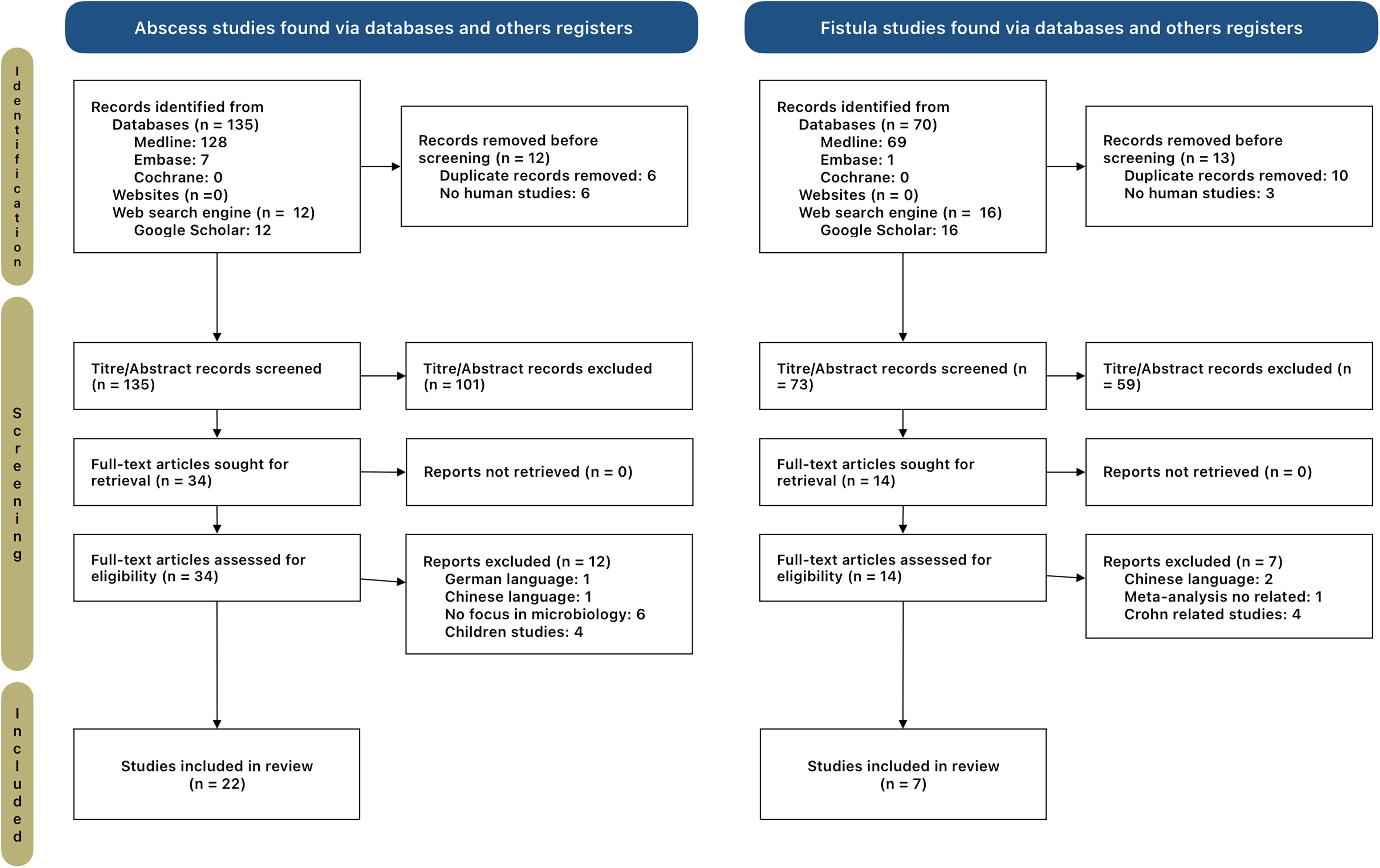
Flowchart of the selected articles.

Articles included per year.
Microbiologic Studies Performed in Anorectal Abscesses
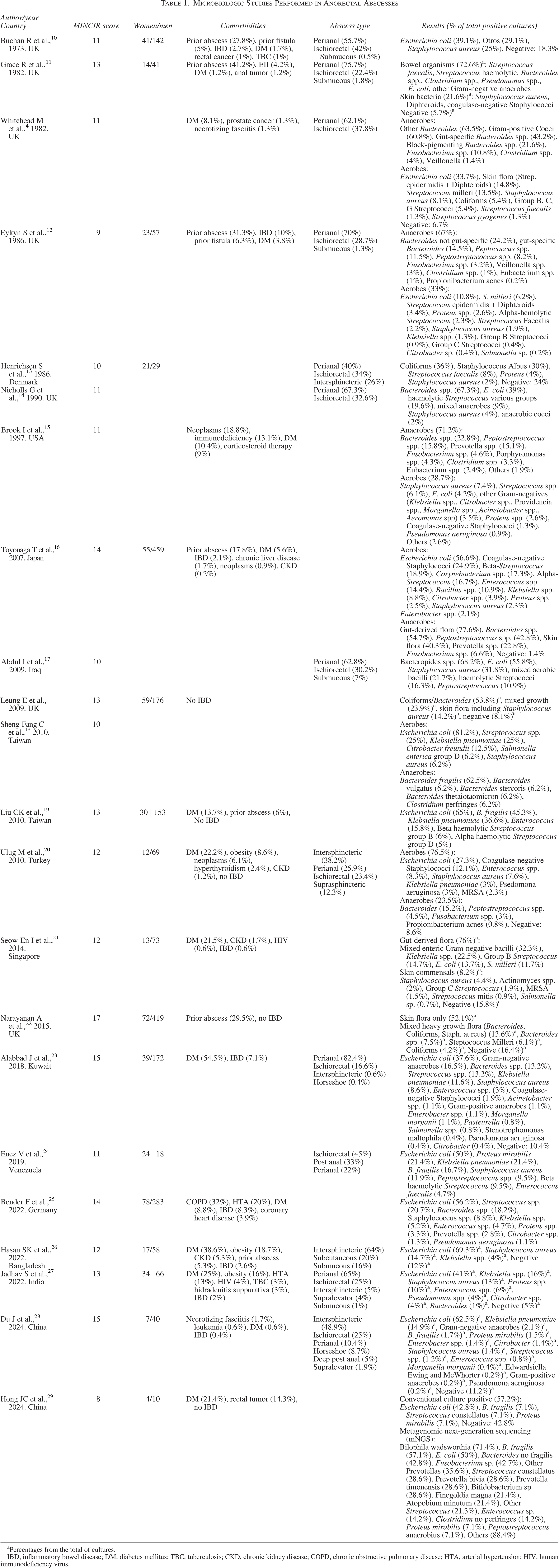
Percentages from the total of cultures.
IBD, inflammatory bowel disease; DM, diabetes mellitus; TBC, tuberculosis; CKD, chronic kidney disease; COPD, chronic obstructive pulmonary disease; HTA, arterial hypertension; HIV, human immunodeficiency virus.
Microbiologic Studies Performed in Chronic Anal Fistulas

Percentages from the total of cultures.
Bacteriology in anorectal abscess
To retrieve information regarding the rates and frequencies of each bacterium in anorectal abscesses or anal fistulas, we reviewed the cultures and outcomes in each selected article. Specifically, we looked at the total cultured samples taken or total patients for simple cultures and the total isolated specimens for polymicrobial cultures and/or genomic sequencing results.
In the series of anorectal abscesses, men were the most prevalent gender in the clinical series, with the exception of one article where women were predominant. 24 Thirteen articles described the clinical classification of anorectal abscesses, with the most frequent being the perianal location, followed by intersphincteric and ischiorectal abscesses according to the classical Park’s description. 1 In all reviewed studies, conventional cultures were performed; five used simple cultures identifying wide bacterial groups, and one added genomic sequencing to the investigation (see Table 1).
Enteric bacteria were widely described as the predominant bacteriology in all studies,10–21,35 except in Narayanan’s study, which described a high percentage of skin flora. 22 Escherichia coli was the most isolated microorganism in 11 of 22 studies, up to 80%. This was followed by the presence of Bacteroides sp., which was the most isolated bacteria (over E. coli) in five studies, especially B. fragilis (up to 63%). 35 Another important finding was the isolation of Staphylococcus aureus (in around 32% of cases), Streptococcus sp. from skin flora, and Peptostreptococcus sp., generally lower than 20% of cultures.17,23,25–28
Technological advances such as genomic sequencing were useful in one study where Bilophila wadsworthia and B. fragilis appeared isolated in a high percentage of patients (71% and 57%, respectively) in its described series. 29 In contrast, conventional culture in the same patient cohort yielded E. coli as the most predominant species (43%). 30 Notably, some studies had no bacterial growth described in 43% of the conventional cultures. 13
Bacteriology in anal fistula
The general clinical characteristics of the series published in the seven prospective studies showed a high proportion of male gender, with most describing cases of transsphincteric and intersphincteric anal fistulas. Regarding the techniques, four studies performed conventional cultures for aerobic and anaerobic specimens, and one of them also used complementary rRNA sequencing. 32 One study employed conventional cultures for aerobic specimens and PCR amplification only for the analysis of anaerobic species. Other reviewed series used fluorescence in situ hybridization (FISH) with rRNA sequencing and rDNA sequencing to quantify the presence of types of bacterial specimens (see Table 2). It is important to note that three studies reported a high percentage of no bacterial isolation. Specifically, Tozer et al. 8 reported up to 94.4% of no bacterial isolation even with the use of the FISH technique. Using other techniques, bacterial growth was not identified in 10% of conventional cultures, but through rRNA sequencing, this figure reached 90%. 32
In cases where bacteria were present, E. coli was the most isolated germ in four of seven studies using conventional cultures and in the study that used rRNA sequencing. Tozer et al. 8 used the FISH technique with specific targets to Bacteroides sp., Bifidobacteria, E. coli, and Faecalibacterium and confirmed its presence in only 5.6% of studied samples. In a recent study using rDNA sequencing, Acinetobacter guillouiae was identified in more than 80% of isolated germs, in addition to relevant colonies of Streptococcus anginosus, Anaerococcus sp., Staphylococcus sp., Caulobacteraceae sp., Alloprevotella sp., and Corynebacterium sp. 34 These findings suggested a microbiome similar to the skin. Notably, the isolation of the Rothia genus was more specific to the fistula tract than other cultured locations such as the anal canal, skin around the buttock, anal gland, and feces around anal fistulous openings.
A summary of the results is shown in Figure 3.

Summary of microbiology of anorectal abscesses and anal fistulas.
Discussion
Most anorectal abscesses and anal fistulas are considered to originate from a common cryptoglandular source in up to 90% of cases. Therefore, identifying specific bacteria involved in this clinical sequence is a matter of debate. However, few studies and reviews have thoroughly examined this hypothesis. Our review revealed a broad date range of articles showing differences in culture methods over time (Fig. 2). Additionally, the retrieved articles providing relevant clinical information did not meet high publication quality standards. 9
Older articles did not achieve the wide bacterial variety that can now be isolated using modern molecular techniques, such as mass spectrometry methods, matrix-assisted laser desorption/ionization, or time-of-flight mass spectrometry. These new techniques allow for the identification of microorganisms by creating a spectrum based on protein profiles.
We found more studies analyzing the microbiology of abscesses than of anal fistulas. The presence of bacteria in anal fistulas was not well reported, which should still be considered if we agree with the cryptoglandular origin. This discrepancy may be because of the feasibility of sampling enough purulent material from anorectal abscesses compared with the content of fistula tracts. In anal fistulas, histological cultures or specific techniques are required to achieve bacterial growth from the granulation tissue of the luminal surface.6,30
The main strength of our study was the information collected from a recent series of patients. However, this review also has limitations, including the different bacterial isolation techniques used in the published articles and the number of series in which no bacteria were found.10,14,25 Specifically, there are clear differences between culture-based techniques and modern methods such as 16S and shotgun metagenomics, which are far superior for characterization and will provide more information in the future.
To find relevant information on the anorectal abscess-anal fistula association, more articles addressed the role of bacteriology in each pathological case.4,11–13 The classical hypothesis suggests that anorectal sepsis originates from gut-derived bacteria, particularly anaerobes, infecting the anal glands, responsible for fistula formation. In contrast, skin-derived bacteria infecting apocrine glands in the perianal region are not believed to cause fistulas.4,11–14,16,24 Recent studies have questioned this hypothesis, showing evidence of both skin- and gut-derived bacteria in fistula and non-fistula patients. Bacteria such as those from the Peptostreptococcus genus and other anaerobic gut species were identified in significant proportions of cultures and were not associated with fistula formation. 16 Therefore, a possible synergistic polymicrobial effect rather than a specific bacterial species role has been proposed.4,15,17,18,22
This clinical and microbiological information is useful for patient management in daily practice. The role of antibiotics was also highlighted as an important factor in decreasing the rate of anal fistula formation after an episode of anorectal abscess. Previous antibiotic use in studied patients could induce bacterial selectivity reflected in the analyzed cultures.13,17 For example, some studies isolated more skin flora rather than gut-derived bacteria. 22 Although others presented opposite results, they dismissed the true role of antibiotics. 16 Another consideration is the contamination risk during sampling. 18
Anaerobes are the predominant bacterial type in the gastrointestinal tract, outnumbering aerobes in a ratio of 1,000:1.15,20 Escherichia coli and the Bacteroides genus, aerobic and anaerobic, respectively, were the most isolated bacteria in anorectal abscesses and anal fistulas. Some of these bacteria can form colonies and complex organized exogenous matrices called biofilms. The ability of many of these bacteria to produce biofilm mass is a new concept that could explain their difficult management. Gut-bacterial colonization and biofilm formation may play a role in fistula development without the need for a specific virulent pathogen.6,34 Some studies could not demonstrate this hypothesis and proposed that colonization in fistulas is only a simple finding without meaning.30–32 Therefore, another pro-inflammatory factor underlying colonizing bacteria could lead to the development of granulation tissue found on the luminal surface, acting as a fistulization trigger.8,32 Van Onkelen et al. 32 proposed the effect of peptidoglycan (a bacterial remnant) as a potential inflammation trigger, similar to the genesis of Crohn disease. Jaiswal et al. 33 proposed matrix metalloproteinases (MMP3, MMP9) as tissue mediators facilitating injury and fistula formation, although their role has not yet been demonstrated.
The treatment of anorectal abscesses traditionally involves deroofing/debridement without antibiotics, except in specific cases or patient conditions.19–21,25,28,35 Khan et al. identified that leukopenia is associated with an increased risk of complications, readmission, reoperation, discharge, and death after incision and drainage of anorectal abscesses. 36
Despite some clinicians considering postoperative antibiotherapy to reduce abscess recurrence rates, this approach has not shown statistical significance and could increase the prevalence of antibiotic-resistant bacteria.21,25 Inadequate antibiotic treatment could be associated with high recurrence rates in complex perirectal abscesses. 37 Systematic pus culture is not considered necessary for uncomplicated abscesses and would mean an unnecessary use of resources.21,38
New quantitative molecular techniques, such as genomic and DNA/RNA amplification, are promising tools for obtaining relevant clinical information on patients with anorectal abscesses and anal fistulas. These techniques have shown a more complex composition compared with conventional culture techniques.8,29,32–34 A recent study confirmed that E. coli and B. fragilis are the predominant species in anorectal abscesses, with the latter being the most virulent. 29 Interestingly, other species, such as B. wadsworthia, were identified. This bacterium has been linked to increased intestinal barrier defects, bile acid dysmetabolism, alterations in the functional microbiome profile, and systemic inflammation in these patients.29,39,40 These findings are valuable for advancing our understanding of the abscess-fistula clinical process.
The role of bacteria in anal fistula genesis has been a focus for clinical scientists and colorectal surgeons. Tozer et al., 8 using careful sampling to avoid contamination, did not identify enough information to conclude the bacterial role in the abscess-fistula clinical process. A more recent study using rDNA amplification at different sites concluded that the fistula microbiome could originate from perianal skin. Specifically, they highlighted the role of Rothia sp., a periodontal disease-related microorganism, as a new, non-studied bacterium potentially implicated in the fistulation process. 34
In addition, exploring a mechanistic link between bacteria in the anal canal and the development of anal fistula would be valuable. Fistulas, in fact, are aberrant structural processes resulting from epithelialization, and therefore, scientific information on the role of bacteria in the consideration of fistulas as a scaffolding structure is warranted.
The final rationale of the investigational effort has been to determine if any therapy, such as antibiotics or treatments against inflammation after anorectal abscess, could potentially reduce or stop the development of anal fistulas. However, recent blinded randomized clinical trials have shown inconclusive results, and we must wait for ongoing studies.41–43
In conclusion, it is clear that E. coli and Bacteroides are intestinal commensal bacteria involved in anorectal abscesses. The role of these bacteria in anal fistula formation still has to be investigated. Routine cultures should be taken only in specific cases to avoid complications and to choose an appropriate postoperative antibiotic course, as presented in clinical guidelines. However, the role of specific bacteria in anal fistula formation after anorectal abscess is still unknown. New insights into underlying pro-inflammatory triggers should be considered to explain the fistulation process. Large cohorts of patients and prospective clinical trials are warranted.
Authors’ Contributions
This work has been carried out within the framework of the PhD/Doctorate in Surgery from the department of Surgery of the Universitat Autònoma de Barcelona.
Footnotes
Acknowledgments
The authors would like to thank Dr. Miguel Angel Pacha, Dr. Javier Corral, Dr. Clara Gene, and Dr. Gamez for their efforts in supporting data recruitment. They also want to thank Universitat Autònoma de Barcelona for their support in the funding for the open access.
Author Disclosure Statement
The authors declare that they have no conflicts of interest and no disclosures.
Funding Information
No funding was received for this article.