



Abstract
This study identifies factors that affect trust in online tourism shopping, including transaction security, navigation functionality, and cost-effectiveness. It examines the effects of these factors on trust and the relationship between this trust and repurchasing intentions. Furthermore, this study investigates the moderating effect of gender in the context of the aforementioned constructs in a proposed research model. To this end, an online survey of Internet users who had shopped online for a tourism-related product or service within the past year was conducted. The results of this study indicate that transaction security, navigation functionality, and cost-effectiveness affect trust, which in turn influences repurchasing intentions. Gender was observed to have a significant moderating effect in that the thought processes of males strongly affected the influence of cost-effectiveness on trust and the impact of trust on repurchase intention in comparison with females. The thought processes of female online shoppers had a stronger impact on navigation functionality in comparison with those of the males. The results of this study may aid in the development of trust prediction methodologies and repurchasing intention of the tested constructs by directing the design of websites that effectively appeal to different genders.
Introduction
The rapid growth of online shopping has significantly affected the development of online tourism shopping. Online tourism shopping encompasses a varied range of product categories, such as airline tickets, travel accommodations, tour packages, and car rental services. In South Korea (hereafter Korea), the proportion of online tourism shopping increased by 18.3% in 2008 compared with a 1% increase in offline tour packages, thus indicating a rapid growth (Korea National Statistical Office, 2009). Consumers may prefer online tourism shopping to offline tourism shopping because the introduction of the Internet has reduced information asymmetries and search costs (Bakos, 1997), and, accordingly, price competition has intensified (Brynjolfsson & Smith, 2000).
Online shopping businesses are an extremely competitive industry. Only 10% of businesses that open online shops survive in Korea (J. M. Kim, 2009). Gender segmentation marketing strategies may improve the online tourism shopping industry because gender identity differences have been demonstrated to strongly affect travelers’ information search behaviors (Ramkissoon & Nunkoo, 2010). For the online shopping industry, the differences between male and female online shoppers are important because females have more shopping experience (70.3%) than their male counterparts (55.6%; Korea Internet & Security Agency, 2010). According to D. Y. Kim, Lehto, and Morrison (2007), “Gender has been and continues to be one of the most common forms of segmentation used by marketers in general and advertisers in particular” (p. 423). In the online environment, gender particularly plays a key role in moderating attitudes (Hasan, 2010) and behaviors (Ramkissoon & Nunkoo, 2010).
Because the products that are offered through online tourism shopping involve expensive goods, the transactions therein may be viewed as very risky in comparison with other popular goods, such as books, clothing, and music. For this reason, consumers prefer large-scale and reliable online tourism shopping websites to minimize transaction risks (D. Y. Kim et al., 2007). Though research has shed light on some online tourism shopping habits, overall it has not satisfactorily examined the factors that influence trust in transaction targets or that moderate effects because of gender differences. In light of this current lack of knowledge, this study seeks to explain online tourism shopping in Korea by first identifying factors that affect trust in online tourism shopping and then examining effects of these factors on trust and the trust/repurchase intention relationship. This study also tests the potential moderating effects gender has on causal relationships between the aforementioned constructs. Based on the results obtained in this study, marketing implications are presented with a focus on website design strategies for online tourism shopping.
Literature Review
Theoretical Background
Concept of Online Purchasing
The term online purchasing is defined as the motives or reasons behind a customer’s purchasing action as well as the customer’s attitudes and intentions with regard to purchasing behavior in an online environment (Yoon, 2002). Within tourism cyber environments, an intention to perform online purchasing is described as the commitment to perform a specified purchasing behavior via the Internet. Satisfactory and trusting relationships developed with online travel agents likely result in either positive or negative emotional feedback when performing online purchases (Chiu, 2009). W. G. Kim, Lee, and Hiemstra (2004) indicate that consumers’ loyalty affects the purchasing frequency of travel products from online tourism sites. Additionally, anxiety manifesting from uncertainties about security, privacy, credibility, and overall experience of online purchasing negatively affects the likelihood of repeated online purchasing behaviors (Janda, 2008). Sia et al. (2009) suggest that trust can directly or indirectly affect online purchasing intentions depending on the model system tested (Australian or Hong Kong models, respectively). Thus, online purchases may be related to both online shopping and online purchasing behaviors.
Transaction cost theory
In this section, we explore how the exogenous variables of transaction security, navigation functionality, and cost-effectiveness in this study are related to transaction cost theory. A consumer’s choice between online and offline tourism shopping may be approached from the perspective of the amount of value each of these channels provides. Considering decision making with respect to channel choice as a comparison between the costs and benefits that are associated with these channels, consumer channel choice involves choosing the Internet channel that offers lower transaction costs than any other.
Transaction costs include negotiating, monitoring, and enforcing costs that are incurred in transactions between two parties. This concept was established by Coase (1937) and developed by Williamson (1975, 1985). Previous studies of transaction costs have focused on the transactional structure between company-specific asset specificity, uncertainty, transaction frequency, and so on; however, the transaction costs that the present study addresses may be considered in terms of retail transaction costs that are incurred in the course of transactions between individuals and companies (Chircu & Mahajan, 2006). Although such costs can be incurred from both sellers and purchasers, this study deals with transaction costs from the perspective of consumers, focusing on users of online tourism shopping. In terms of consumers, transaction costs can be defined as transaction fees, time, and search effort. Constructs for the perceptions of retail transaction costs are drawn from previous studies of shopping, consumer purchasing, transportation, and buyer search costs (Liang & Huang, 1998). These transaction costs can be classified into price-type costs (such as parking fees, installation fees, taxes, transaction fees, and so on), time-type costs (e.g., travel time, waiting time, searching time, general shopping time, and delivery time), and psychological-type costs (ease of use, inconvenience, frustration, annoyance, anxiety, depression, dissatisfaction, disappointment, etc.; Chircu & Mahajan, 2006; Devaraj, Fan, & Kohli, 2002).
Such transaction costs may apply very differently to online and offline tourism shopping. Consumers are assumed to choose the channel with lower transaction costs over other channels after considering all the aforementioned transaction costs. Accordingly three factors that affect trust in online tourism shopping are focused on in this study. Specifically, psychological-type costs, time-type costs, and price-type costs (transaction security, navigation functionality, and cost-effectiveness, respectively), are studied and are thought to eliminate uncertainty in transactions.
Regarding the relationship between transaction cost and trust, previous research has reported the invaluable benefits of enhancing trust with transaction cost for online purchases (Bunduchi, 2005, 2008; Datta & Chatterjee, 2008; Zimmer, Arsal, Al-Marzounq, & Grover, 2010). Interorganizational relationships depend on the interaction among the three relational features, such as transaction costs, trust, and dependency (Bunduchi, 2008). In addition, Datta and Chatterjee (2008) contend that electronic markets represent certain inefficiencies (e.g., awareness, branding, and trust-created friction) that contribute toward heightening consumer uncertainty, especially under conditions of high information specificity: “Electronic market inefficiencies are instantiated by their growing share of problems: price dispersion, identity theft, repudiation, spoofing, hacking, network and system vulnerabilities, among many others” (p. 16). This, consequently, reduces consumer online trust. Thus, based on transaction cost theory, alleviating uncertainty can improve trust in online shopping.
Description of Constructs
Transaction security
Transaction security consists of guarantees and warranties, the discretionary use of private information, the clarity of refund policies, and the risk-free nature of online transactions. All are antecedents to online trust (Yoon, 2002). For consumers, concerns about online shopping include privacy infringement by online retailers (e.g., sharing personal information with other companies and tracking shopping habits), fraudulent behavior from third parties (e.g., unauthorized access to personal information and credit card information), and problems with online retailers (e.g., potential for nondelivery of ordered goods, misrepresentation, or fraud; Miyazaki & Fernandez, 2001). With regard to the perception that the security of electronic commerce can be effectively controlled, the strength of nonrepudiation, privacy protection, and data integrity both positively and significantly affect the development and presence of trust (Suh & Han, 2003). On the other hand, the intentions of home computer users to perform security-related behaviors is influenced by a combination of cognitive (concern regarding security threats), social (perceived effectiveness), and psychological components (security behavior self-efficacy; Anderson & Agarwal, 2010).
Gender-based concerns appear to be equally present with regards to the safety of paying online, information confidentiality, and money-back guarantees. This suggests that e-retailers could increase revenue and sales, by being more proactive in establishing trust with their customers (Kolsaker & Payne, 2002). One way to accomplish this would be to recognize the moderating role that gender has on the likelihood of making an online purchase in reference to privacy, security, credibility, and experience (Janda, 2008). Drawing on previous research, the present study adopts four items of transaction security: (a) online transaction security guarantees, (b) private information security guarantees, (c) refund guarantees, and (d) risk-free cancellation guarantees.
Navigation functionality
As an antecedent to trust, navigation functionality can be defined as the clarity of search-related words, the usefulness of help functions, level of technology of websites, and the overall operational efficiency in making online purchasing decisions (Yoon, 2002). Hazard indices that affect user interface and navigation abilities include items such as inoperable internal links, back-button degradation or deceleration, lack of navigation support and opening of new browser windows, and nonstandard usages of graphic user interface widgets, scrolling front pages, and link colors (Yeung & Law, 2006). A comparison of navigation conditions reveals that the enhanced global navigation system (e.g., Microsoft Internet Explorer’s left view of the navigation tree, the left-frame location of the site map and search forms, and navigation options that are always viewable when scrolling) yields less disorientation compared with simple and global systems (Webster & Ahuja, 2006).
In an analysis of the hotel industry, there was no significant difference between perceptions of online browsers and online purchasers for website attributes (e.g., up-to-date information on the site, presence of multilingual sites, website download time, site map, search function, and links to other related businesses; Law & Hsu, 2006). The ease of navigation resulting from these attributes (e.g., ability to navigate the site and to find the required information, the presence of a user-friendly interface, being able to easily find information about events, the availability of search options that help find information, and being able to easily find information about accommodations) is directly correlated with the intention to travel to particular destinations. This property can be used to predict website utility (Kaplanidou & Vogt, 2006). Drawing on the aforementioned studies related to navigation functionality, the present study adopts five items of navigation functionality: clear search-related words, useful help functions, level of website technology, overall efficiency in operation, and fast transmission of words and images.
Cost-effectiveness
In online environments, cost-effectiveness is the most frequently cited parameter (Tate, Finkelstein, Khavjou, & Gustafson, 2009). When comparing the cost-effectiveness between online and face-to-face instruction experiences, Bartley and Golek (2004) discovered that “online instruction is gaining an increasing presence because of its reported benefits, its ability to consolidate learning across geographical and time constraints, and the claim by many that online learning is cost efficient” (p. 174). Nicholas, Erbach, and Harris (1987) assert that “Many online users experience difficulties in determining which hosts or databases are the most cost-effective for a given search or service” (p. 109). Since fewer instructor hours are required for online instruction and since the maintenance of student performance is imperative, integrating online study guides saves labor costs and enhances student satisfaction (Buzhardt & Semb, 2005). For example, online weight-loss delivery may be a more cost-effective approach to obesity treatment because in online programs the participant’s time is included in the economic cost evaluation of behavioral weight-loss intervention (Krukowski, Tilford, Harvey-Berino, & West, 2011). In the context of online tourism shopping, as in cost-effectiveness, this study adopts three principles: (a) online tourism shipping is economical, (b) online tourism shipping is the most cost-effective shopping method, and (c) online tourism shipping offers more discounts than offline commercial transactions.
Trust
Trust is defined as the willingness to believe partners in a business contract (Moorman, Deshpande, & Zaltman, 1993), the credibility of and confidence in transaction targets and their honesty (Morgan & Hunt, 1994), and the perceived reliability and favor of the targets (Ganesan, 1994; Kumar, 1996). Trust is a concept that has been extensively studied in the fields of sociology and marketing, management information systems, and organizational behavior in the context of business administration over the past few years (Milne & Boza, 1999; Morgan & Hunt, 1994; Smith & Barclay, 1997; Stewart, 2003).
Trust tends to result in the formation of continuous relationships. Trust is crucial for online tourism shopping because securing trust enhances the intention to purchase (Lee & Turban, 2001). Trust is composed of multidimensional concepts such as ability, integrity, and benevolence (Lee & Turban, 2001; Mayer, Davis, & Schoorman, 1995).
First, ability comprises the skills and competencies that enable a party to have influence within some specific domain. Second, integrity is the trusting party’s perception that the trusted party will be honest and adhere to an acceptable set of principles. Finally, benevolence is the extent to which the trusting party believes that the trusted party wants to do good rather than just maximize profit (Lee & Turban, 2001).
In sum, consumers are willing to make transactions when uncertainty is reduced and trust is established through full assessment of the information that online tourism shopping websites provide.
Repurchase intention
Mittal, Ross, and Baldasare (1998) describe the concept of repurchasing intention as a behavioral component that is qualitatively different from the concept of satisfaction, which simply refers to a judgment made with cognitive and affective dimensions. These authors also explain that attribute performance has a direct impact on repurchase intention. In the context of restaurants, repurchasing intention is influenced by satisfaction from loyal customers, whereas in nonloyal customers, repurchasing intention is influenced by adjusted expectations (Yi & La, 2004). Repurchase intention can be measured with two indicators: repeat purchase intention (How often do you intend to revisit the restaurant?) and repurchase probability (How high is the probability that you will revisit the restaurant?). Other variables apart from satisfaction should be considered. For example, relationship commitment and switching barriers to best estimate repurchase intention are two important variables to consider (W. Kim & Ok, 2009). In their study, measurements for repurchase intention included the responses “I would keep dinning out at this restaurant in the future” and “I would dine out at this restaurant at least at the current frequency in the future.” In upscale hotels, revisit intention (“I consider this hotel as my first choice compared to other hotels” and “I have a strong intention to visit this hotel again”) are affected more strongly from trust parameters than satisfaction parameters (T. Kim, Kim, & Kim, 2009). Using results from previous studies, we have adapted the concept of repurchase intention and developed four items to assay this function: (a) strong intent to make future purchases at this particular online tourism site, (b) intent to recommend the online shop to others, including family and friends, (c) intent to talk positively to others about the online tourism products and services, and (d) intent to purchase more tourism products at the online tourism site in the future.
Relationships
Relationship between transaction security and trust
Because online purchases typically involve disclosing one’s credit card number, online shoppers are strongly concerned about security (Janda, 2008). Moreover, previous studies (Suh & Han, 2003; Yoon, 2002) have suggested that transaction security positively affects trust in online environments. Thus, it is hypothesized that transaction security positively influences trust in online tourism shopping. Additionally, based on findings from Kolsaker and Payne (2002) and Riedl, Hubert, and Kenning (2010), this study posits that the effects of transaction security on trust are different between males and females in online tourism shopping.
Relationship between navigation functionality and trust
Because purchasing tourism products and services requires highly involved purchasing procedures, navigation functionality is very important for online shoppers to develop trust. Yoon (2002) proposed that navigation functionality is positively related to online trust. An easy-to-use website for navigation elicits trust by reducing the time cost function for online tourism shopping (Gefen, Karahanna, & Straub, 2003). Therefore, this study posits that navigation functionality positively influences trust in online tourism shopping. Moreover, this study also proposes that the effect of navigation functionality on trust is different between males and females in the context of online tourism shopping.
Relationship between cost-effectiveness and trust
Cost-effectiveness is a major factor in online tourism shopping because tourism products and services are typically high-cost items. Transaction cost is used to analyze the relationship between the organization and customer (Zimmer et al., 2010). There is a significant difference in transaction costs as a function of gender differences with respect to online word of mouth (WOM; J. U. Kim, 2009). Gefen et al. (2003) find that the costs and benefits of calculative-based beliefs significantly and positively affect trust in online shopping. According to Ba and Pavlou (2002), online trust can reduce transaction-specific risks and generate price premiums for reputable sellers. Thus, “trust plays in mitigating the risks inherent in transactions that involve very expensive products” (Ba & Pavlou, 2002, p. 243). Based on previous studies, this study posits that cost-effectiveness positively influences trust in online tourism shopping. Additionally, this study hypothesizes that there are differences in the impact of cost-effectiveness on trust between males and females in online tourism–shopping environments.
Relationship between trust and repurchase intention
An essential element of a successful online transaction is the trusting relationship between the organization and the consumer. Some studies have suggested that trust consists of ability, integrity, and benevolence (Wu & Chang, 2005, 2006). In the online business-to-consumer (B2C) environment, the absence of physical cues increases the reliance on other elements (including trust) for both genders (Kolsaker & Payne, 2002). Because online shopping occurs at a distance rather than face-to-face, uncertainty, vulnerability, and dependence are all more prominent in online shopping in comparison with traditional shopping for both genders (Van Slyke, Comunale, & Belanger, 2002). Loyalty, which, in turn, affects purchasing intention, is influenced by trust within B2C e-services (Cyr, Hassanein, Head, & Ivanov, 2007; Sánchez-Franco, Ramos, & Velicia, 2009). In online environments, trust positively affects Internet shopping by consumers (Lee & Turban, 2001) through the use of a business to consumer website (Gefen et al., 2003), through online purchase intention (Kuan & Bock, 2007), by using consumer behavior (Chen & Barnes, 2007), and by using the intention to reuse (T. Kim et al., 2009). Also, Ba and Pavlou (2002) and Riedl et al. (2010) reveal that there is a positive relationship between trust and online buying behavior. Additionally, online trust is positively correlated with repurchase intention for both men and women, with the positive relationship between trust and repurchase intention significantly higher for women (Awad & Ragowsky, 2008). Therefore, this study posits that trust positively influences purchasing intention in the online shopping environment. Furthermore, this study also proposes that the effect of trust on purchase intention is different between men and women in online tourism shopping.
Gender Differences in the Context of Online Shopping
Gender differences are a complex concept in business environments. For example, depending on the individual and group, male and female shoppers significantly differ in terms of loyalty (Melnyk, van Osselaer, & Bijmolt, 2009). In the context of trust considerations in economic decision making, understanding gender differences provides valuable insights into the increasingly complex and growing environment of online shopping (Riedl et al., 2010). Thus, it is invaluable to academically explore gender differences in the context of online tourism shopping so that new marketing strategies can be developed.
In an online shopping environment, trust is one of the key determinants of purchase intention for individuals after controlling for gender. Perceptions of complexity, compatibility, relative advantage, feasibility, and trust significantly differ between males and females, whereas image perceptions do not (Van Slyke et al., 2002). In addition, males have been shown to perceive online shopping more positively than females (Van Slyke et al., 2002); however, both men and women appear to be equally aware of issues regarding payment security, information confidentiality, and returns and refunds (Kolsaker & Payne, 2002). This level of concern highly suggests that e-tailers need to be more proactive in their efforts to establish trust (Kolsaker & Payne, 2002). Women perceive the impact of hedonic elements on loyalty within a B2C e-services website environment more strongly than men because this relationship is insignificant for males (Cyr et al., 2007). Similarly, although a perceived social presence significantly affects enjoyment for both genders, its direct impact on e-loyalty has been confirmed for females but not for males (Cyr et al., 2007).
The effect of trust on the intention to shop online is stronger for women than men (Riedl et al., 2010). In addition, men value their ability to post content online, whereas women value the responses of other consumers to the content they have posted (Awad & Ragowsky, 2008). Furthermore, women have greater trust in retailers who allow other online WOM users to respond to their posts, whereas men have greater trust in online vendors when they are able to post their views (Awad & Ragowsky, 2008). Gender plays a moderating role; the influence of trust on commitment and the influence of commitment on loyalty are significantly stronger for females than males, whereas the effect of satisfaction on commitment and the effect of trust on loyalty are significantly stronger for males than females (Sánchez-Franco et al., 2009). Furthermore, online WOM more strongly affects trust for males than females, whereas online WOM has a significantly stronger effect on perceived cost for males than females. Accordingly, there may be similarities and differences across gender with respect to trust, which may apply to certain variables in the online tourism shopping context.
Based on Kolsaker and Payne (2002), though minor gender-based differences exist, an issue that affects consumer trust is the security of payment details. For example, both males and females expressed concern about exposure of credit card numbers and personal profiles. These concerns suggest that the success of B2C e-commerce largely depends on the emergence of guaranteed security for Internet transactions. Female subsamples have significant negative opinions toward online purchases with regard to issues such as security, privacy, and credibility. Male subsamples, however, only have significant negative opinions on security, which indicates the moderating power of gender (Janda, 2008). Hargittai and Shafer (2006) show that Internet ability was significantly related to self-perceived skills, and women tended to rate themselves as less skilled than men. For spatial navigation, during one experiment male participants more accurately pointed toward nonvisible objects and made fewer mistakes than their female counterparts (Castelli, Corazzini, & Geminiani, 2008). Online women shoppers (57%) use discount coupons and points more than online men shoppers (43%), and women check online benefits and cost-effectiveness more closely than men (J. U. Kim, 2009).
Predictors and concerns of online shopping between men and women are not the same. Women feel more insecure shopping online than men, and thus, female shoppers have less trust in online transactions than male shoppers. For example, Yang and Lester (2005) indicate that women felt anxious when using computers to make online purchases but men did not suffer from anxiety. Women were also significantly more concerned with assurance and how to deal with privacy and security, whereas men were not (Sebastianelli, Tamimi, & Rajan, 2008). According to Awad and Ragowsky (2008), online trust plays a more critical role in intention to shop for women than men. Sánchez-Franco et al. (2009) suggest that online managers take gender into account when allocating marketing efforts between satisfaction and trust initiatives. In decisions based on trust measured using eBay offers, Riedl et al. (2010) found that women activate more brain areas than men. When understanding perceptions of web-based shopping, gender differences highly influence trust, suggesting that men are more likely to use the web to make purchases than women (Van Slyke et al., 2002).
Based on previous literature, it can be assumed that online tourism shoppers are generally quite different from online shoppers because tourism products and services require significant information and processing for purchase decisions. In purchasing an intangible, perishable, experiential, and expensive tourism product or service, online consumers may be more sensitive to trust issues (Ba & Pavlou, 2002; H. B. Kim, Kim, & Shin, 2009). Additionally, competition is extremely high in the Korean online business environment, and market segmentation by gender may help online tourism companies to more effectively compete. Thus, this study proposes hypotheses for how purchasing intention between genders is related to transaction security, navigation functionality, cost-effectiveness, and trust. These hypotheses are proposed in the next section.
Research Hypotheses
Researchers of online shopping behaviors have discussed transaction security, navigation functionality, cost-effectiveness, trust, and repurchasing intention. The relationships among these constructs have been supported in both marketing and tourism literature (Awad & Ragowsky, 2008; Janda, 2008; D. Y. Kim et al., 2007; Riedl et al., 2010; Sánchez-Franco et al., 2009; Suh & Han, 2003; Van Slyke et al., 2002; Wu & Chang, 2005, 2006; Yoon, 2002; Zimmer et al., 2010). However, few studies have simultaneously examined all the related variables when gender is the independent variable. In other words, the relationships between these variables and their impact on purchase intention when gender differences exist have not been clearly explored in the tourism shopping environment. Thus, this study posits the following research hypotheses and investigates the relationships among these constructs as shown in Figure 1.

Proposed Research Model
Hypothesis 1: Transaction security positively influences trust.
Hypothesis 1a: The effect of transaction security on trust is different between men and women.
Hypothesis 2: Navigation functionality positively influences trust.
Hypothesis 2a: The effect of navigation functionality on trust is different between men and women.
Hypothesis 3: Cost-effectiveness positively influences trust.
Hypothesis 3a: The effect of cost-effectiveness on trust is different between men and women.
Hypothesis 4: Trust positively influences purchase intention.
Hypothesis 4a: The effect of trust on purchase intention is different between men and women.
Research Method
Measurements
In our study, a preliminary list of measurement items was originally developed using online shopping and online tourism literature (Awad & Ragowsky, 2008; Janda, 2008; D. Y. Kim et al., 2007; Riedl et al., 2010; Sánchez-Franco et al., 2009; Suh & Han, 2003; Van Slyke et al., 2002; Wu & Chang, 2005, 2006; Yoon, 2002; Zimmer et al., 2010). These items were then screened by online tourism shopping scholars who were asked to clarify them and then comment on whether the items were likely to be appropriate for evaluating the purchase intention of shoppers in an online tourism context. We developed a questionnaire in English, which was then translated into Korean by researchers who were proficient in both English and Korean. In addition, other Korean native speakers who were specialists in this area of research compared the translation with the original to identify any discrepancies in language. If discrepancies existed some items were rephrased.
A pretest was conducted by establishing two groups that each consisted of 40 respondents. Each group was composed of individuals who had shopped online for tourism products and services during the previous year. Based on the pretest, some items were reworded, eliminated, or clarified because they were deemed inappropriate, unnecessary, or ambiguous. We eventually selected 23 items based on the results of the above procedures, and these items represented various aspects of online tourism shopping that reflected trust and purchase intention. The final list of 23 items included the transaction security (four items), navigation functionality (five items), cost-effectiveness (three items), and purchase intention (four items). In addition, trust was measured according to subconstructs using a second-order model. The subconstructs for trust included ability (three items), integrity (two items), and benevolence (two items). These items were measured using a 5-point Likert-type scale with 1 = strongly disagree and 5 = strongly agree.
Data Collection
We conducted our survey with the assistance of a leading Internet research firm in Korea. The Internet research firm electronically distributed the questionnaire to randomly selected potential online tourism shoppers from November 3 to December 5, 2008. A screening question was used to select those who had experienced at least one instance of online tourism shopping in the past year. The screening question also included a note that said, “When answering the questions, please only consider one tourism shopping site that you have used in the past year.” In addition, a brief explanation of this study was provided in the opening instructions along with a definition of online tourism shopping (e.g., making reservations at hotels and buying tickets for airlines and other transportation). Based on the screening question, 340 out of the 988 respondents were collected and were found to have performed online tourism shopping in the past year. To examine the potential moderating effect of gender, the respondents were divided into two groups that consisted of 167 males and 173 females.
As shown in Table 1, 49.1% of respondents were male, and 50.9% were female, thus making gender evenly distributed; 68.2% of males and 72.8% of females fell into the 20- to 39-year age category; 65.9% of male and 59.5% of female respondents had university degrees; and 59.3% of male respondents were married, whereas 51.4% of female respondents were married. Monthly income was relatively evenly distributed, except for the 1- to 1.99-million Korean won income category (US$1 = 1,128 won). However, 23.4% of males and 26.6% of females fell into the 3- to 3.99-million won income category. The largest category of respondents was office workers (male: 38.3%; female: 26.6%).
Respondent Characteristics

US$1 = 1,128 Korean won (Korea Exchange Bank, 2011).
A total of 55.7% of male and 45.1% of female respondents had used the Internet for more than 10 years, and approximately 47.9% of males and 42.2% of females had spent more than 12 hours per week on the Internet. In terms of Internet surfing, males demonstrated the highest utilization, though each gender used the Internet more than six times per day (males 57.5% and females 42.8%). Men spent a maximum of approximately 110,000 to 500,000 Korean won (US$1 = 1,128 Korean won) on online shopping per access session, whereas females spent a maximum of approximately 510,000 to 1,000,000 Korean won.
Analysis and Results
PLS-Graph Version 3.0 was used to analyze the measurement and structural models. To enable the modeling of both formative and reflective constructs in the empirical test of our research model, we adopted a partial least squares (PLS) regression. In our research, we treated the “trust” construct as a second-order construct, wherein the three dimensions of ability, integrity, and benevolence served as first-order constructs on a formative scale. Also, PLS regression makes few assumptions about measurement scale, sample size, and distribution (Ahuja & Thatcher, 2005).
Measurement Model
The measurement model was separately assessed for the overall group and for each subgroup. The individual item reliability, composite reliability, Cronbach’s alpha, and average variance extracted (AVE) for each construct for the male and female groups indicated that all the constructs that were used in the model satisfied the requirements for reliability (i.e., a composite reliability of greater than .7), discriminant validity (i.e., an AVE of greater than .5), and convergent validity (see Tables 2 and 3).
Item Loadings and Cross-Loadings (Overall Group)
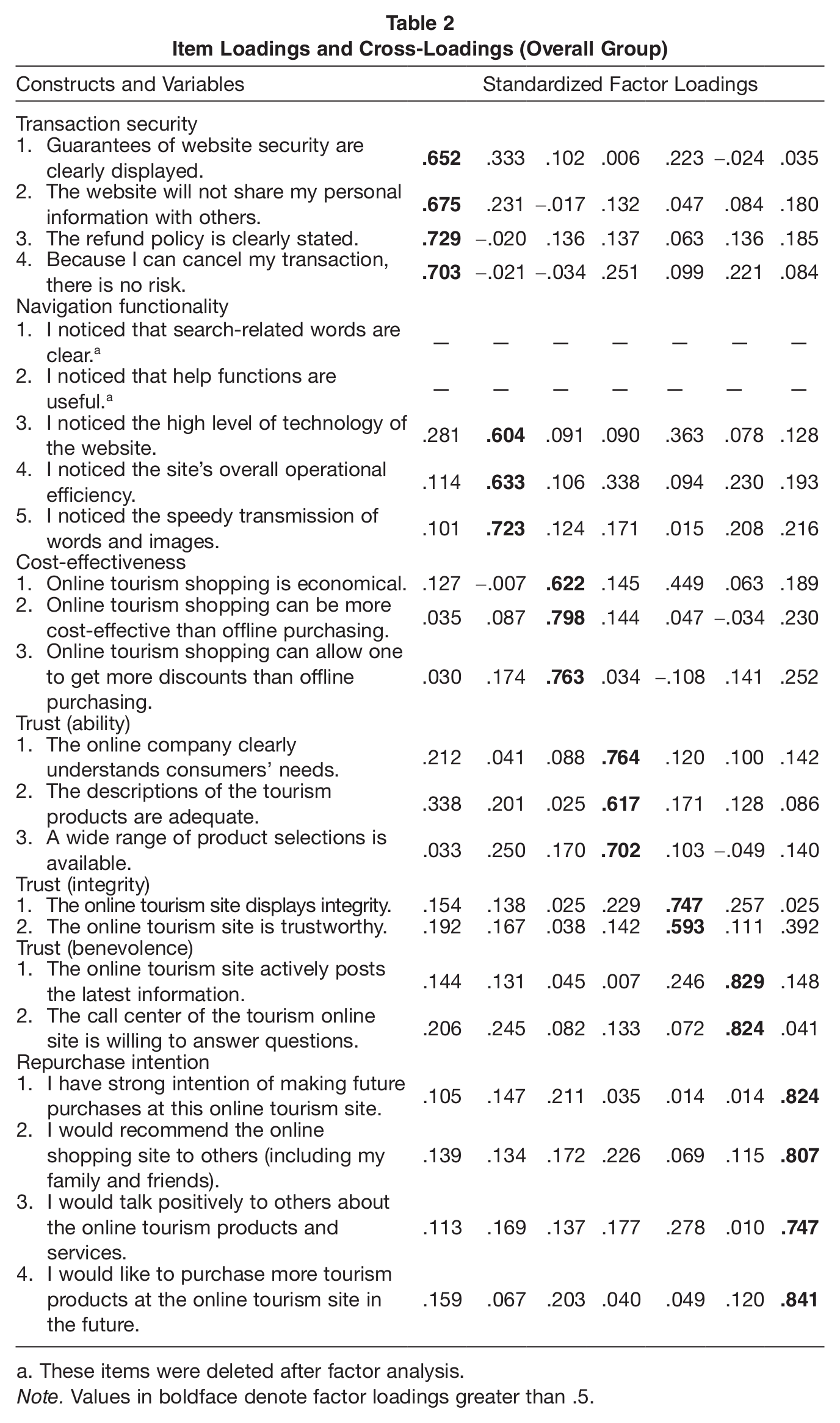
These items were deleted after factor analysis.
Note. Values in boldface denote factor loadings greater than .5.
Reliability and Discriminant Validity
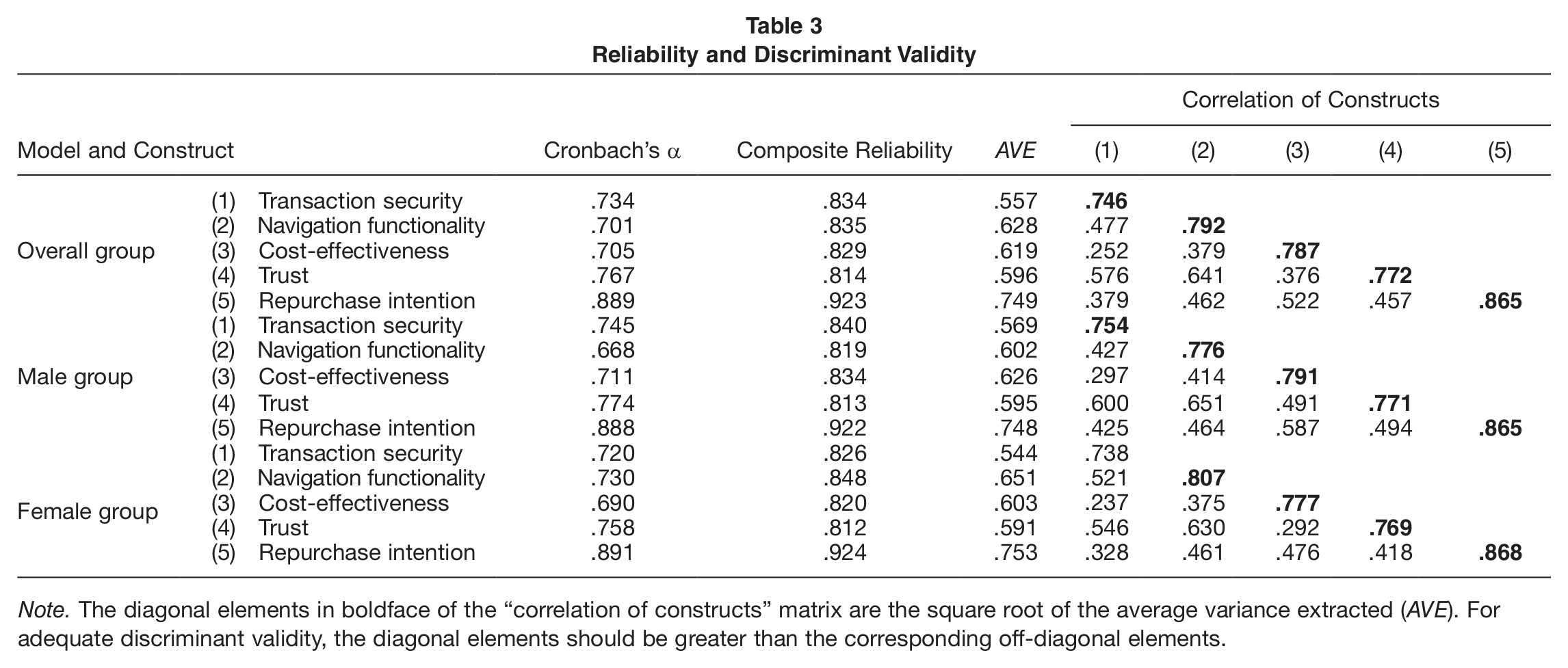
Note. The diagonal elements in boldface of the “correlation of constructs” matrix are the square root of the average variance extracted (AVE). For adequate discriminant validity, the diagonal elements should be greater than the corresponding off-diagonal elements.
The average values of the subconstructs were used as indicators for the formative constructs (i.e., trust). To check the validity of the formative constructs, we examined item weights that could be interpreted as beta (β) coefficients in a standard regression (Kuan & Bock, 2007).
Structural Model
The structural models were examined for their explanatory power and path significance using a bootstrapping technique. The size of the bootstrapping sample that was used in the PLS analyses was 500.
Figure 2 and Table 4 present the results of the hypothesis tests. All direct paths in the model (Hypothesis 1 to Hypothesis 4) were supported at p < .001. Tests for Hypotheses 1, 2, and 3 indicate that trust in online tourism shopping was significantly influenced by transaction security (β = .338, t = 7.161), navigation functionality (β = .421, t = 8.284), and cost-effectiveness (β = .158, t = 3.604). Also, the test for Hypothesis 4 indicates that repurchase intention was significantly affected by trust (β = .481, t = 11.179) in online tourism shopping. In addition, trust was significantly affected by ability, integrity, and benevolence.
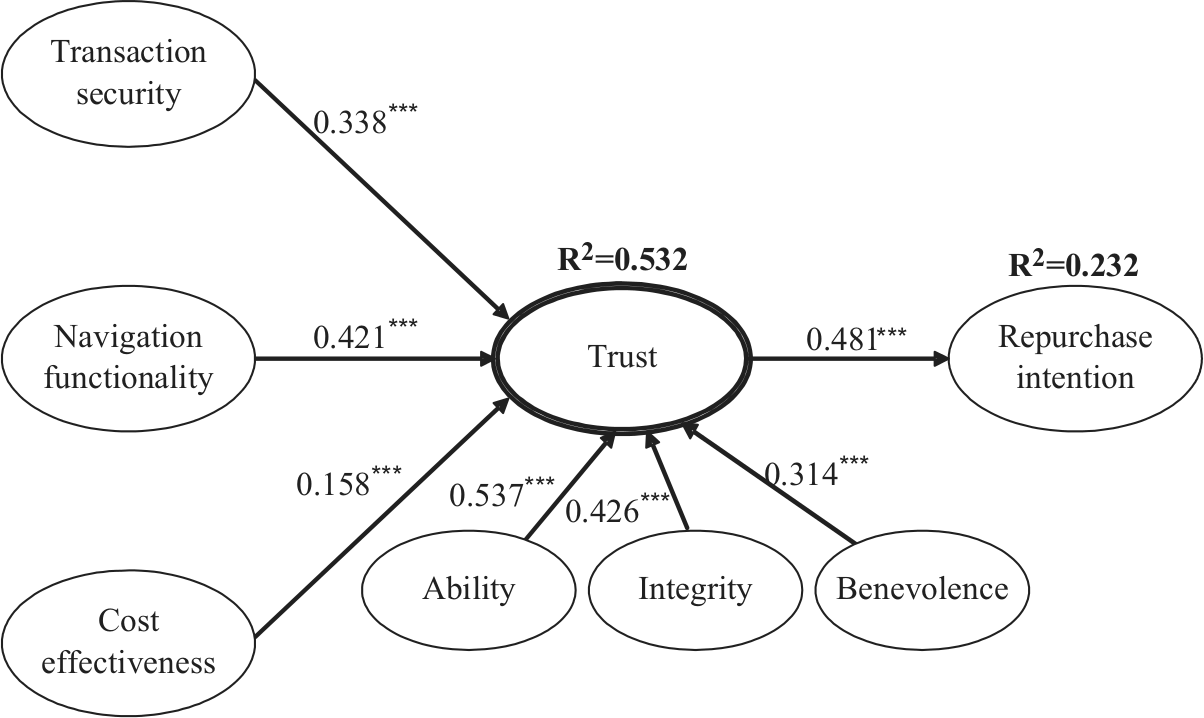
Overall Model: Path Estimates by Partial Least Squares Analysis.
Standardized Structural Estimates and Tests of the Main Hypotheses.
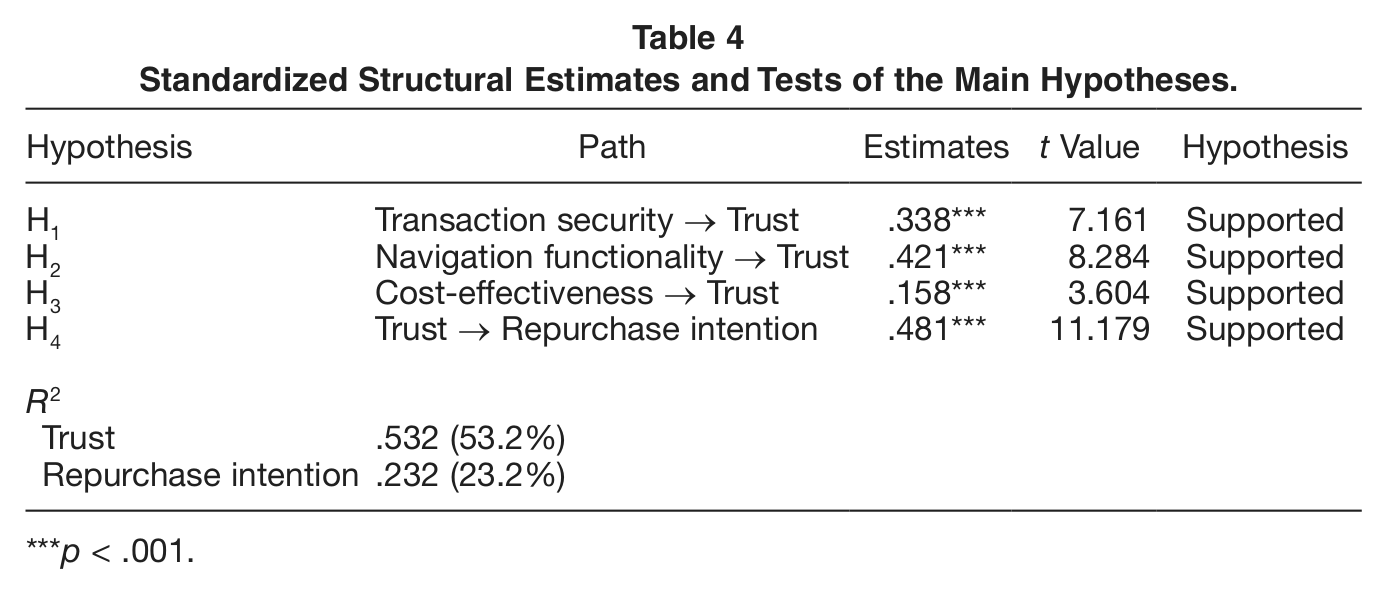
p < .001.
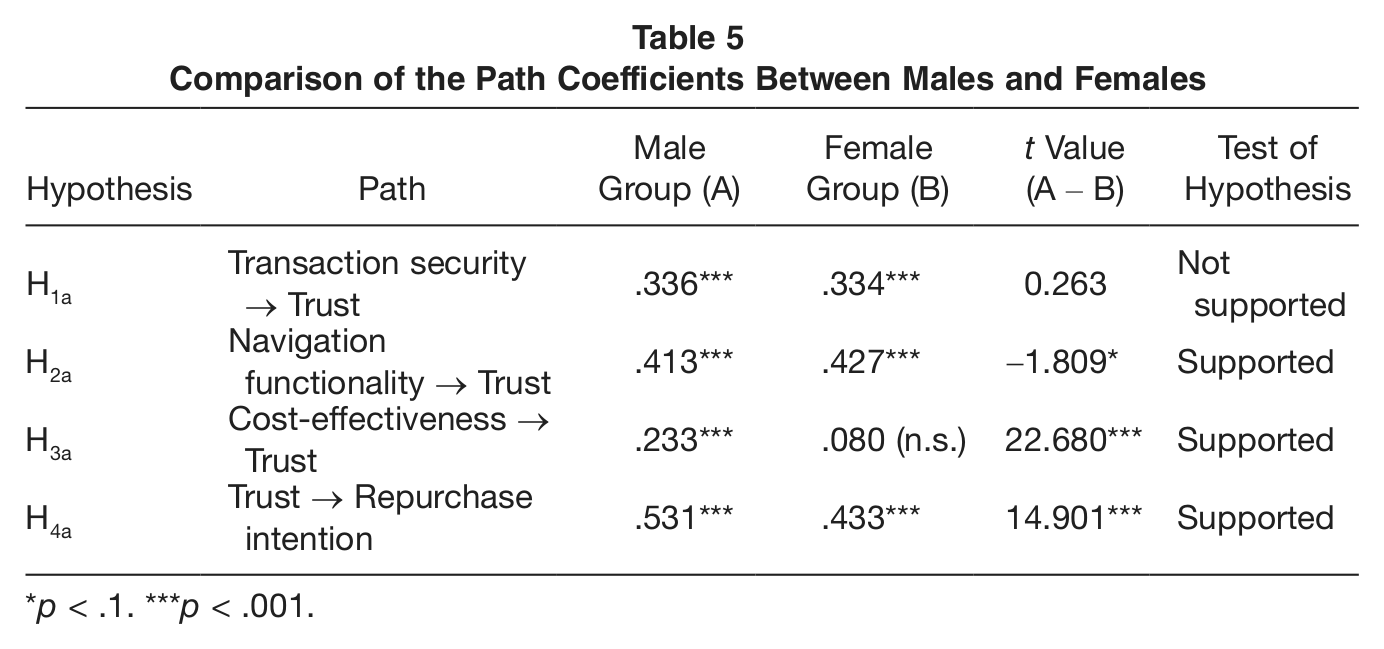
To examine the potential moderating effect of gender, we conducted a multigroup analysis using PLS by comparing differences in the coefficients of the corresponding structural paths for the male and female models (Chin, 2000; Keil et al., 2000). As shown in Table 5 and Figure 3, the results indicate that the coefficients from each path for navigation functionality, cost-effectiveness, and trust in online tourism shopping were significantly different between males and females. Tests for Hypotheses 2a, 3a, and 4a demonstrate that the impact of navigation functionality (t = −1.809, p < .1) and cost-effectiveness on trust (t = 22.680, p < .001), along with trust in repurchase intention (t = 14.901, p < .001), were statistically different between men and women. However, Hypothesis 1a was not different between men and women.
Comparison of the Path Coefficients Between Males and Females
p < .1. ***p < .001.
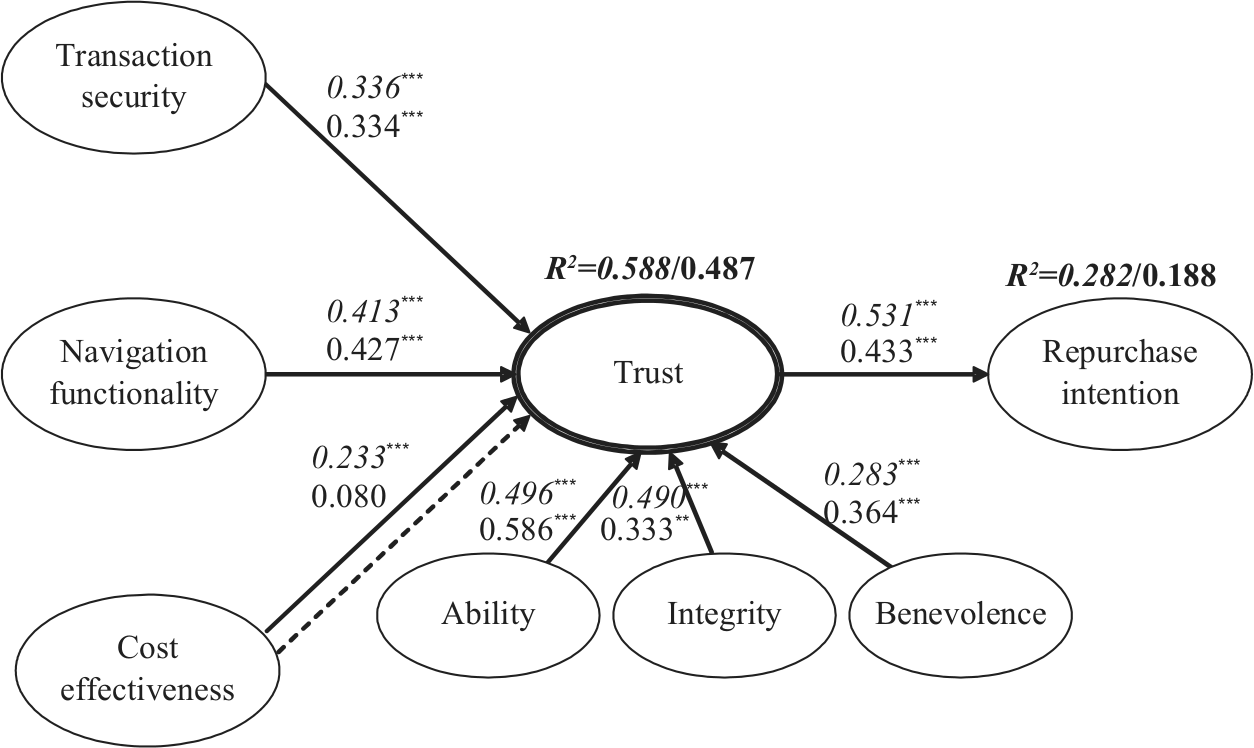
Path Estimates by Partial Least Squares Analysis Comparing Males and Females
Conclusion and Implications
This study proposed a theoretical model that includes exogenous variables (i.e., transaction security, navigation functionality, and cost-effectiveness) that are related to trust and repurchase intention. This study empirically tested these constructs that were likely to affect online shoppers’ trust and repurchase intention and investigated the moderating effects of gender.
The results of this study indicate that there were significantly greater effects of cost-effectiveness on trust (t = 22.680) and on the path from trust to purchase intention for men in comparison with women (t = 14.901). For women, navigation functionality exhibited slightly higher effects on trust (t = −1.809) in comparison with that observed for men. However, there was no significant difference between genders in terms of the path from transaction security to trust. The results of this study indicate that the three exogenous variables of transaction security, navigation functionality, and cost-effectiveness affect trust, which, in turn, influences purchase intention. In the same vein that previous studies confirmed the general relationship between trust and online shopping (Chen & Barnes, 2007; Gefen et al., 2003), the findings of this study prove that trust is a vital element in online tourism–shopping business success.
The findings of this study are consistent with past research (Suh & Han, 2003; Yoon, 2002). As in earlier studies, transaction security is seen in our experiments to significantly affect trust, which in turn, influences repurchasing intention across male and female groups. This finding suggests that transaction security is likely to affect an individual level of trust in online tourism–shopping companies. Thus, this finding indicates that transaction security is important for both male and female groups when predicting trust in online tourism shopping. In other words, online tourism companies should strive to improve transaction security in terms of warranties, privacy measures, refunds, and cancellation policies in order to enhance trust (T. Kim et al., 2009; Wu & Chang, 2006).
The results of how navigation functionality affects trust are consistent with the results of previous studies (Gefen et al., 2003; Yoon, 2002) in that navigation functionality significantly affects customer trust across both male and female groups. This result shows that navigation functionality strongly affects trust as compared with transaction security and cost-effectiveness in online tourism shopping. Specifically, women exhibited a slightly higher effect of navigation functionality on trust than that observed for men.
The impact of cost-effectiveness on trust that was observed in this study has similarly been reported by several other studies (J. U. Kim, 2009; Zimmer et al., 2010). In this study, the effect of cost-effectiveness on trust was found to be significant for men but insignificant for women. This finding implies that men develop trust by reducing transaction costs, whereas women do not. This result contradicts that of at least one other study (J. U. Kim, 2009) in that women are generally more sensitive to saving money (e.g., coupons, discounts, refunds, and exchanges) in comparison with men. This might be attributable to the fact that tourism products and services are different from normal commodities, and women might consider other factors to be more important than cost in developing trust (e.g., atmosphere, comfort, and quality).
The results of this study indicate that purchase intention is influenced by trust across both male and female groups. This finding suggests that trust is an important antecedent variable in predicting purchase intention in the context of online shopping. This finding is also consistent with previous studies on trust and online shopping (Chen & Barnes, 2007; Cyr et al., 2007; Sánchez-Franco et al., 2009). Furthermore, the effect of trust on purchase intention was different between men and women and has been reported elsewhere (Awad & Ragowsky, 2008; Kolsaker & Payne, 2002; Van Slyke et al., 2002). This finding implies that men are more likely to buy tourism products and services than women when they have trust in online tourism companies. Therefore, online tourism companies should consolidate customer trust to increase shoppers’ purchase intention, particularly when targeting male consumers.
Based on the findings of this study, some practical implications could be provided for marketers. First, because the effect of navigation functionality on trust was found to be the most significant among the exogenous variables, marketers should improve navigation functionality so as to enhance trust between consumers and online tourism companies. This can be improved by clearly describing search-related words, maintaining a high level of website technology, increasing operational efficiency, and speeding the transmission of words and images. Although men are more interested in cost-effectiveness, women are more concerned about navigation functionality. Thus, online tourism companies should reduce transaction costs to appeal to male customers, whereas they should provide better web design and functionality to appeal to female customers. In other words, online companies that target male shoppers should emphasize economic benefits. In contrast, those that target female shoppers should emphasize website functionality. Furthermore, Castelli et al. (2008) suggest that women are more susceptible to multispace navigation than their male counterparts in the online environment. To enhance female shoppers’ online purchasing experiences, it is recommended that online tourism companies focus on simple and easy navigation functionality, such as high levels of technology, operational efficiency measures, and high speeds of their website. On the other hand, men and women do not differ greatly in their online abilities. Women’s self-assessed skills are significantly lower than that of men (Hargittai & Shafer, 2006). To improve women’s self-assessment regarding their web-use skills, managers of online tourism sites should build user-friendly navigation functionality, such as applying social presences and using social networks.
In the current competitive online business environment, marketers should consider the differences and similarities in online tourism shopping behaviors between men and women when managing online tourism businesses. For example, online tourism shopping companies should provide reasonably priced products, a reliable transaction, and more benefits than offline competitors in order to target females who are less likely to exhibit the level of online trust that is associated with cost and repurchase in comparison with their male counterparts. The findings of this study suggest that online marketers would benefit from developing gender-sensitive tourism websites so that online companies can effectively appeal to consumers of different genders. Meanwhile, men and women share similarities in careers, education, and computer skills, so the gender difference in online shopping is not significant. Moreover, current computer programs have extremely user-friendly and convenient technologies that would benefit women in making them feel more comfortable shopping online. Thus, online tourism companies should focus on interests that are important to both genders, such as security.
We conclude by addressing some limitations of this study that may provide directions for future research. First, we hypothesize that using two items for each of the two subconstructs (integrity and benevolence) of the trust factor may be insufficient to build a robust model. Future researchers may need to conduct the same study with the inclusion of more trust-relevant items in order to improve the statistical power of the findings. Second, the proposed hypothetical model for online tourism shopping, which included exogenous variables that are related to trust and purchase intention for men and women, was tested in only one country, Korea. Thus, reproducing our study in other countries would be helpful in verifying the relationships among the constructs and gender that were examined in our study. In addition, future cross-cultural and longitudinal studies may also help researchers identify reliable indicators of trust among online tourism shoppers such that a more robust and stable model can be constructed. Furthermore, considering the rapid changes and advances in online tourism shopping, a comparison of the findings of our study with future research would be valuable for researchers and practitioners in confirming our results and predicting future directions for tourism marketing and research.
In future studies, researchers may want to analyze other constructs such as site properties, personal value, and loyalty as a function of gender for testing online trust behaviors. These actions may more clearly identify gender roles than this study. Researchers may also want to examine two additional subgroups of online and offline tourism businesses to test for gender differences between online and offline shopping habits. This type of analysis would provide insightful directions for the online tourism industry instead of traditional tourism shopping between men and women.
Footnotes
Authors’ Note:
This research was supported by a grant from the Kyung Hee University in 2010 (KHU-20100681).