




Abstract
Recent research conducted with humans demonstrated that red, relative to other achromatic or chromatic colors, led men to view women presented on a photograph as more attractive. The effect of color on behavior was tested in a tipping context. Eleven waitresses in five restaurants were instructed to wear the same tee shirt with different colors (black, white, red, blue, green, or yellow). The effect of color on tipping according to patron’s gender was measured. It was found that waitresses wearing red received more tips but only with male patrons. Waitresses color had no effect on female patrons’ tipping behavior. The relation between red and sexual attractiveness are used to explain the results. Managerial interests related with clothing appearance were discussed.
In many countries, whether in bars or in restaurants, waiters’ and waitresses’ wages depend on tips. Therefore, for these servers and their managers, knowledge about factors that affect customers’ tipping behavior is important. Research on tipping revealed that tip percentages were weakly related to customers’ ratings of service quality in restaurant settings (Lynn, 2001), and a host of experimental research found that tipping behavior was influenced by factors that were not related to service quality (Lynn, 1996, 2005; Lynn & McCall, 2009). Recent studies found that servers’ appearance and particularly waitresses’ physical appearance was associated with variations in customers’ tipping behavior. Lynn (2009) found that waitresses’ tips increased with breast size and with having blond hair and decreased with body size. Lynn and Simons (2000) also found that attractive waitresses earned large sales-adjusted tips than did less attractive waitresses, whereas attractiveness had no effect on the tips of waiters. Previous research also found that makeup or hair ornaments were associated with a greater level of tipping behavior. Guéguen and Jacob (2011) and Jacob, Guéguen, Boulbry, and Ardicioni (2009) found that male customers, but not female customers, in a restaurant gave more tips to waitresses wearing cosmetics. Stillman and Hensley (1980) found that diners left larger tips for waitresses who wore a flower in their hair than the same waitresses without a flower. This effect was found both with male and female customers but larger effect of ornamentation was found with male customers.
Although many aspects of appearance have been tested, one particular factor under the control of the server and/or manager is related to the dress of the servers: the color of clothing.
Studies have found that red increases the physical and sexual attractiveness of women. Elliot and Niesta (2008) observed that by varying the color surrounding a photo representing women, red, as opposed to white, green, grey, blue, or green, led men (but not women) to view women as more attractive and sexually desirable. Recent studies have also shown that romantic attraction toward women is influenced by the color red. Niesta-Kayser, Elliot, and Feltman (2010) showed that men who viewed an ostensible conversation partner in a red versus a green shirt chose to ask her more intimate questions (Experiment 1) or to sit closer to a woman with a red shirt rather than one in blue (Experiment 2). Guéguen (2012) found that women hitchhikers wearing red solicited a higher response in the number of male drivers who stopped to offer a ride whereas no color effect was found when observing the behavior of female drivers.
Given such results showing that red enhanced physical attractiveness of woman for men, and that waitresses’ physical appearance are related with greater tips received from men, we hypothesized that waitresses wearing red clothes would receive larger tips from men than those wearing other colors.
Method
Participants
A total of 722 restaurant customers (418 males and 304 females) who acted as participants were assigned to six groups. All of them were seated alone at a table in five restaurants in two medium-sized cities (both with about 75,000 inhabitants) in a very attractive spot in France. The restaurants proposed a sea-food menu (fish, shellfish, etc.).
Procedure
Eleven waitresses (aged 19-26 years), regularly employed, were used as confederates in this experiment. However, they were not aware of the goals of our experiment, and they were not given any information about previous studies on the effect of color on person perception or behavior. During the experiment, the number of customers served by each waitress ranged from 58 to 70, with nearly the same proportions of males and females.
The experiment was conducted daily for 6 weeks (excluding Saturdays and Sundays) during lunch hour because there were a sufficient number of patrons who ate alone at this time (the restaurants where the experiment was carried out drew sales representatives who lunch alone). Thirty observational periods were obtained for each waitress (5 days a week Ü 6 weeks) during which she was instructed to vary the color of the tee shirt. The same clothes were worn by each confederate: pair of neat blue jeans, sneakers of light color, and a figure-hugging tee shirt. Only the color of the tee shirt worn was varied according to the experimental conditions: black (HSL [Hue, Saturation, and Lightness] code = 0, 0, 0), white (HSL = 0, 0, 100), red (HSL = 16, 92, 68), yellow (HSL = 19, 100, 94), blue (HSL = 210, 100, 100), and green (HSL = 99, 66, 87). Tee shirts were plain and void of any logos, pictures, or writing. The order of the color of the tee shirt worn was randomized. Before beginning their service, each waitress received a word-to-word message on her mobile phone which instructed her as to which color she should wear.
The waitresses were instructed to act as usual and in a similar way and not to wear jewelry and cosmetics in each condition. Each waitress acted similarly in both conditions when she presented the bill to the patron. After the patron left, the waitress returned to clear the table. She reported in a notebook how the client had behaved, namely, whether he/she had left a tip or not and how much he/she gave.
Results
It is unusual to leave a tip in France because government legislation mandates that a 12% service charge be included in the price of the item on the menu. Thus, in this experiment, the number of patrons who left a tip was the first dependant variable, and the amount of the tip left by the patron was the second dependant variable. Preliminary data analysis was conducted for the waitresses and showed no interaction effect on both dependent variables according to the experimental conditions and gender of the patrons. Their data were combined and are presented in Table 1.
Percentage of Tippers and Monetary Value of Tips Received (in Euros) According to Experimental Conditions and Customer Gender
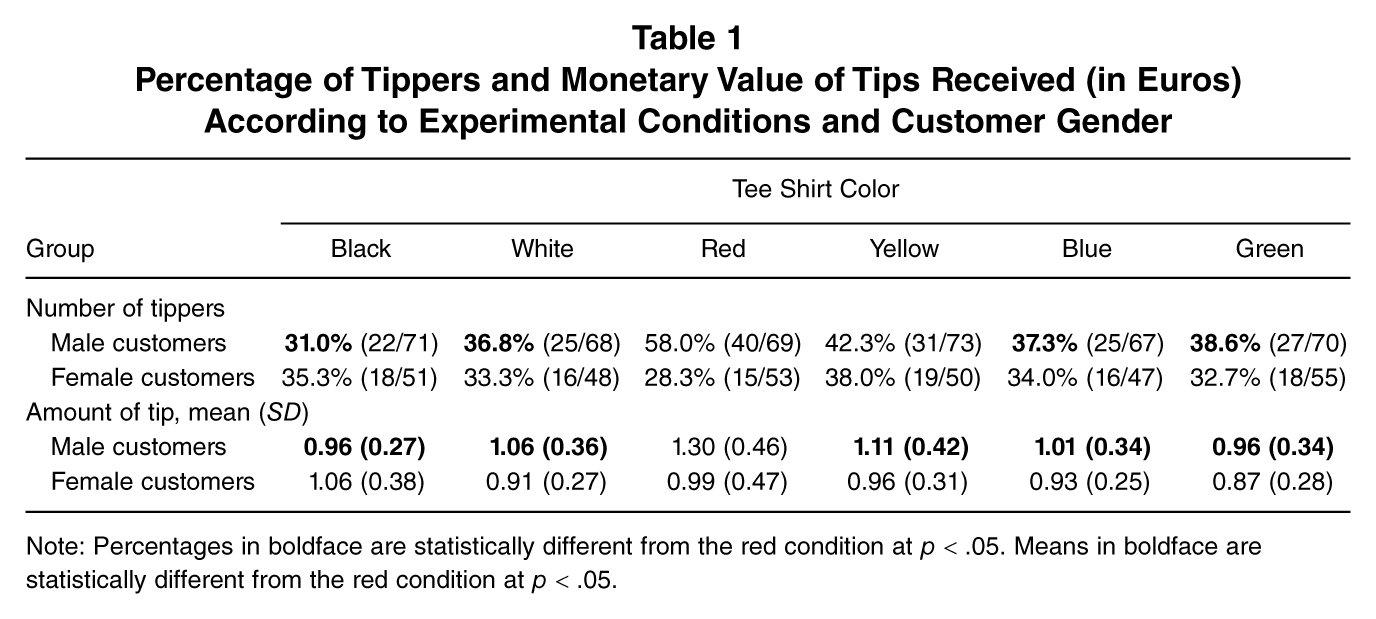
Note: Percentages in boldface are statistically different from the red condition at p < .05. Means in boldface are statistically different from the red condition at p < .05.
With the number of participants who gave a tip, a log-linear analysis of the 2 (patron gender) < 6 (experimental condition) design with tipping behavior as the dichotomous dependent variable was performed. A significant interaction effect between the experimental conditions and the gender of the patrons was found, χ2(5, N = 722) = 12.61, p = .03, thus ensuring that analysis was performed by gender. With male patrons an overall significant difference was found, χ2(5, n = 418) = 12.29, p = .03, r = .17. Pairwise comparison revealed that red color condition was significantly different from the black, the white, the blue, and the green color conditions (p <.03) and nearly significantly different from the yellow color condition (p < .06). With female patrons neither the overall color analysis, χ2(5, n = 304) = 1.19, p = .95, r = .06, or pairwise comparison (p > .40) was significantly different. A main effect of customers’ gender was found, χ2(1, N = 722) = 4.32, p = .04, r = .08, revealing that, overall, men gave more tips (40.7%) than women (33.1%).
With the 272 patrons (170 males and 102 females) who left tips, a 2 (patron gender) × 6 (color condition) ANOVA analysis was performed with the amount of money given as the dependent variable. A main effect of patron’s gender was found, F(1, 259) = 6.26, p = .02,
Discussion
The present findings showed that red color was associated with an increase in male patrons’ tipping behavior. Men gave tips more often to a waitress who wore a red tee shirt, and when they did, they gave her a larger amount of money. No color effect was found with female patrons.
Such results are congruent with research on tipping behavior showing that factors associated with employees’ appearance influence customers’ tipping behavior (Guéguen & Jacob, 2011; Jacob et al., 2009; Lynn, 2009; Lynn & Simons, 2000; Stillman & Hensley, 1980). These results also confirmed and extended previous studies that link color and women attractiveness (Elliot & Niesta, 2008; Guéguen, 2012; Niesta-Kayser et al., 2010). In our experiment, this greater attractiveness of our waitresses could explain why the male patrons gave tip more favorably, because unconsciously, they wanted to be noticed by the wait-resses.
Our findings have some practical interest for waitresses who want to increase their incomes by increasing the tips left by customers. Color clothing is an easy and inexpensive method to use. As red color has no negative effect on women customers, it could be in their interest to wear red clothes at work.
This experiment has some limitations. The waitresses were not informed about the real objective of the study and previous research on this topic. However, they may have unconsciously behaved differently, which in turn might have influenced tipping behavior. The fact that no difference was found between the black, white, green, yellow, and blue conditions seems to guard against this possibility but this bias remains in question. Only lone diners were tested in this experiment, and the generalization to groups of diners also remains in question. At least we found no effect of waitresses’ red clothing on women tipping behavior. However, we need to evaluate the effect of red clothing worn by male employees. Elliot et al. (2010) recently demonstrated that women perceive men to be more attractive and sexually desirable when seen on a red background and in red clothing. Thus it could be hypothesized that waiters in red could receive more tips from female customers in a restaurant.