




Abstract
This study explores the nature of knowledge sharing in online travel communities by proposing three types of antecedents: individual, community, and affiliation. These antecedents generate the formation of community identification and its influence on ongoing knowledge contribution. In addition, this study examines the moderating role of a traveler’s interaction mode on the proposed sharing paradigm. The findings reveal the following: (a) community identification is positively influenced by a member’s travel involvement and community benefits, (b) strong identification strengthens a member’s sharing intentions, and (c) the postulated relationships differ based on a member’s interaction mode. In short, community identification for travelers’ intent on seeking information is almost solely influenced by community benefits, whereas travelers inclined to relationship building are primarily influenced by travel involvement. In terms of knowledge sharing, relationship builders shared more frequently and to a greater extent than information seekers.
As with other forms of business, the rise and popularity of online communities has influenced the travel industry. The growth of online travel communities changed the way travelers communicate on a variety of travel topics. Travelers are now able to discover previously unknown travel options, seek clarification when needed, and build closer relationships with fellow travelers (Arsal, Woosnam, Baldwin, & Backman, 2010; Chung & Buhalis, 2008; W. G. Kim, Lee, & Hiemstra, 2004; Sanchez-Franco & Rondan-Cataluña, 2010; Zhang, 2003). Examples of online travel communities include Lonely Planet, IgoUgo, TripAdvisor, Home&Abroad, Traveller’s Point, Virtual Tourist, and Fodor’s.
Given the abundance and growth of online travel communities, it is surprising that the majority of such communities fail at growing beyond mere existence into powerful forms of social media (N. L. Chan & Guillet, 2011). These failures are attributed to the fact that only a small minority of travel members contribute information to their respective online travel communities (Hsu, Ju, Yen, & Chang, 2007). The contribution levels of group members who actually participate and share are as low as 10% to 20% (Beenen et al., 2004; Ip, Lee, & Law, 2010). These data demonstrate that the vast majority of member behavior can be categorized as “free riding” or “lurking” (Ip et al., 2010). The adequate sharing of travel information and knowledge is a fundamental concern for online communities since they cannot exist, let alone be vibrant or effective, without it. Knowledge sharing in travel communities is further complicated because there is a lack of social pressure compelling or facilitating member contributions as opposed to face-to-face communications (Sanchez-Franco & Rondan-Cataluña, 2010). Community managers are thus faced with the considerable challenges of recognizing the reasons why and how travelers share their travel knowledge and tips with other travelers (N. L. Chan & Guillet, 2011; Hsu et al., 2007; Ip et al., 2010). The important task of determining successful methods to encourage more robust member contributions can be facilitated by gaining an understanding of the knowledge sharing paradigm of online travel communities.
Another important element to consider is the travel group member’s interaction mode since different objectives of group participation would be reflected in different levels and structure of knowledge contribution. As Kozinets (1999) stressed, people show somewhat different interaction modes based on their reasons and expectations for participating in a community. Some are focused on information, simply seeking some travel tips or advice, whereas others seem primarily concerned with developing strong relationships with like-minded travelers (Dickinger, 2011; Füller, 2010; Grange & Benbasat, 2010; Wang & Fesenmaier, 2004). Such variance in interaction modes may explain the discrepancy in group contribution levels.
Remarkably, little attention is paid to knowledge sharing activities in travel community settings. Knowledge about what factors encourage travelers to participate and exchange knowledge within a community is fairly limited. With few exceptions (e.g., Qu & Lee, 2011; Sanchez-Franco & Rondan-Cataluña, 2010; Wang & Fesenmaier, 2004), most research focused more on expected business results, such as travel purchase or information adoption, and less so on the social dynamics of community, specifically sharing and communicating. This is not altogether surprising given the primary goal of travel firms is to focus on enhancing revenue potential. However, the success of social media such as Tripadvisor.com or Expedia.com is in part attributed to the active participation of online community members by providing detailed reviews of their previous travel experiences, which leads to attract more people to visit the site, which in turn results in financial success of the business model (Chung & Buhalis, 2008). It clearly indicates that successful travel communities, via members’ active participation, are an important driver of the financial performance of the travel industry. The existence of vibrant travel communities fulfilling their primary role as a social media is a prerequisite for the viability of online travel businesses who use the communities as travel references (Shen, Yu, & Khalifa, 2010; Tsai, Huang, & Chiu, 2012). Moreover, little research focuses on the possible differences of sharing behavior between information-seeking and relationship-building travelers despite the possibility that knowledge sharing paradigms may differ among travelers with different interaction modes.
Thus, this study attempts to fill this gap by identifying significant predictors that influence travel community members to share with others. Given the social nature of the travel community, social identity theory (SIT; Tajfel, 1978) is used as a theoretical basis for this study. Travel members’ identification to the community, referring to a psychological attachment process, is suggested as a precondition for ongoing knowledge contribution. Also, travel involvement, community benefits, and membership duration are proposed as critical factors leading to community identification as individual, community (organizational), and affiliational characteristics, respectively. This study further investigates how the sharing framework is influenced by the interaction mode of individual travelers, given that members with different communication objectives or orientations will be guided by different antecedents and show different sharing patterns.
Conceptual Model and Hypotheses
Knowledge sharing in online travel communities occurs when prospective travelers consult online communities to get first-hand information acquired and shared by other members regarding destinations to visit, hotels to stay at, methods of travel, as well as excursions and activities (Arsal et al., 2010; Feng & Morrison, 2007; Ip et al., 2010; W. G. Kim et al., 2004). Communication is interactive between two or more participants, allowing travel members to seek specific clarification by posting questions and interacting back and forth with the community. In addition to its role as a resource for travelers, knowledge sharing is a particularly important factor regarding the success of an online community (Hsu et al., 2007; Shen et al., 2010), which can be achieved by the accumulation of knowledge and information created by traveler contributions into a critical mass of reference material (Qu & Lee, 2011).
Examining how communities function through the lens of SIT (Tajfel, 1978; Tajfel & Turner, 1985) allows for a better assessment of the knowledge sharing paradigm of online travel communities. Introduced to explain in-group behaviors, SIT considers the process of community identification as the motivation for such behaviors. At its core, SIT states that, in varying degrees, people derive part of their identity and sense of self from the organizations or groups to which they belong (Hogg & Abrams, 2003). The development of such an identity is referred to as the social identification process, the product of which, identification, can be defined as the perceived sense of belonging to a particular group or organization. Although various definitions of identification were explored in past decades, it is generally accepted that identification is (a) a process of self-categorization (Ellemers, Kortekaas, & Ouwerkerk, 1999; Hogg & Abrams, 2003) and (b) an aspect of psychological attachment to a particular organization (Dutton, Dukerich, & Harquail, 1994). SIT maintains that, once identified with an organization, such attached members perform various forms of in-group favoritism or behaviors beneficial to the goals of the organization. Consequently, community identification is defined in this study as the perceived sense of belonging to a particular online travel community.
SIT has been applied to the travel and tourism context as a useful tool for understanding in-group favoritism in a traditional community or group context, such as residents’ support for tourism development or policies (Carrus, Bonaiuto, & Bonnes, 2005; Nunkoo & Gursoy, 2012; Williams, McDonald, Riden, & Uysal, 1995), serious leisure participants’ continued engagement in an activity group (Green & Jones, 2005; I. Jones, 2000; Shamir, 1992), and even hotel employees’ service performances (Solnet, 2007; Solnet & Paulsen, 2005). Attachment was revealed as a major contributor that enables the predication of certain inter-group behaviors based on the manner and extent to which a person is a member of a group.
Originally conceived for in-group behavior in traditional organizations, characterized by face-to face interactions, the application of SIT has been extended to the context of online communities. Although there are some differences between traditional (face-to-face) and online communities from the perspective of physical location, physical presentation, and cost for participation (Ridings, Gefen, & Arinze, 2002), recent studies acknowledge, on the basis of the underlying social nature of both types of communities, that they are quite similar (Pentina, Prybutok, & Zhang, 2008; Ren, Kraut, & Kiesler, 2007). Indeed, some recent travel-related research, by applying SIT to an online travel context, found that (a) the sense of community identification in both online and traditional community groups is quite similar (Casaló, Flavián, & Guinalíu, 2010) and (b) active communication among members of shared travel interests can lead to a sense of belonging (Qu & Lee, 2011). Thus, this study attempts to explicate the knowledge sharing paradigm based on SIT and the idea that community identification is a fundamental concept of communities. The conceptual model specifying the mechanism of travel members’ knowledge sharing activities is presented in Figure 1.
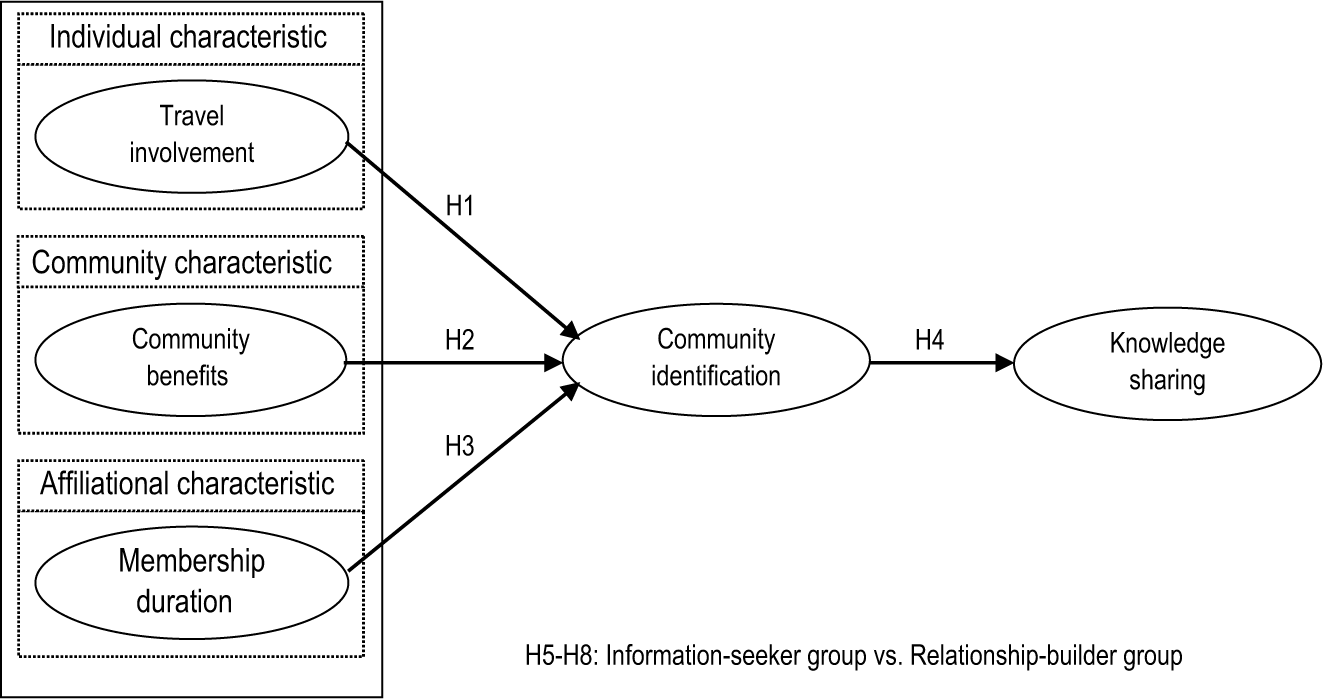
Conceptual Model
Antecedents to Community Identification
Although several antecedents to social identification have been proposed, they can be classified into three types: individual, community, and affiliational (Bhattacharya, Rao, & Glynn, 1995; Cornwell & Coote, 2005; Tsai et al., 2012). Each type of antecedent reflects features of the identification process from a different perspective. Individual antecedents are features of the individual that encourage identification with a community. Community antecedents are characteristics of the community that attract prospective members to identify. Affiliational antecedents are features of membership in the community that facilitate identification. Thus, this study proposes that travel involvement, community benefits, and membership duration are potentially individual, community, and affiliational antecedents to identification with an online travel community.
Travel Involvement
An important characteristic of an online travel community is the voluntary nature of participation (Qu & Lee, 2011; Wang & Fesenmaier, 2004). Such voluntary participation is an indication of a strong interest in the travel domain. Although there are a variety of travel themes, a basic interest in the field of travel is necessary to participate in an online travel community. The absence of such a basic interest leaves the traveler with no reason to invest time and effort in participating in online communication (Gwinner & Swanson, 2003). Travel involvement in particular refers to a person’s perceived relevance to an interest in travel and tourism based on inherent needs and values. Consequently, travel involvement can act as a strong precondition to a sense of identification by giving meaningful reasons to be a member of a community.
In essence, higher levels of involvement in the specific domain, such as travel and tourism, lead to a higher identification with an associated community, which then leads to positive community behaviors (Gruen, Osmonbekov, & Czaplewski, 2006; Gursoy & McCleary, 2004). Increased involvement is accompanied by a more intensive information procurement process and greater familiarity with choices, and if the community is successful in satisfying this behavior, there is a higher level of commitment to the community (Gruen et al., 2006; Sanchez-Franco & Rondan-Cataluña, 2010). Highly involved travelers tend to be more knowledgeable and become the predominant sharers in communities, on whom other members can rely for up-to-date travel information (Jamrozy, Backman, & Backman, 1996). Involvement can even become the central factor around which identification is maintained, particularly in cases when the specific domain of the community, such as travel destinations, is not of great interest to the general population (Fisher & Wakefield, 1998; Gursoy & McCleary, 2004). Therefore, the hypothesis to be tested is the following:
Hypothesis 1: Higher levels of travel involvement will lead to higher levels of community identification.
Community Benefits
Travelers generally anticipate various benefits from the participation in a certain community as a member. Membership in a community provides travelers with several different kinds of benefits, such as functional, social, psychological, and hedonic (Feng & Morrison, 2007; Wang & Fesenmaier, 2004). According to the social identity approach, to fortify their social identity, people tend to join groups that attract them with features that are important to them (Pentina et al., 2008). Such features and potential benefits are evaluated prior to an individual’s participation in a group. A person’s perception that community services are consistent with the benefits they seek leads to the person’s ongoing communication with the group. Without the perception of beneficial participation, an individual shows no interest in the community’s activities (Srinivasan, Anderson, & Ponnavolu, 2002). Thus, member attachment to the community group can be understood from a benefit perception aspect. In this study, community benefits are conceptualized as the degree to which community services are perceived as being valuable and superior to those of available alternatives.
A positive relationship between participants’ perceived benefits and a sense of identification is well documented in previous research. The more travelers view a community’s services as valuable, the more likely they are to modify their attitudes and behaviors based on the travel community’s values (Chung & Buhalis, 2008; Feng & Morrison, 2007). Members who perceive a certain community as valuable consider it as an attractive medium that satisfies their self-enhancement motive. Wang and Fesenmaier (2004) suggest even though several different types of benefits from community participation exist, the perception of various benefits encourage travelers to participate in travel oriented discussions, and this activity leads to higher levels of attachment. In addition, a favorable perception of the community is more important to those who have a basic interest in the travel domain, because such positive perception augments a traveler’s involvement level (Chen & Tsai, 2008; Sanchez-Franco & Rondan-Cataluña, 2010). Consequently, a travel member’s perception of benefits can be a prerequisite for a traveler to be affiliated with a travel community group. The hypothesis to be tested is thus the following:
Hypothesis 2: Higher levels of community benefits will lead to higher levels of community identification.
Membership Duration
A basic premise of online community research is that travelers need time to identify themselves as members of an online community. Although not all members may identify in the same way or at the same rate, their attachment to the community progresses over time. In this study, therefore, membership duration refers to the length of time members participate in ongoing communications about common travel interests.
A number of studies of online communities have regarded sufficient duration of engagement in the community as desirable (e.g., Li & Ho, 2008; Ridings et al., 2002; Wang & Fesenmaier, 2004). Increased contact time with a community improves the likelihood of identification (Cornwell & Coote, 2005; Gwinner & Swanson, 2003), although the rate of identification may slow over time (Bhattacharya et al., 1995). Identification is encouraged by prolonged exposure to community values and goals (Thompson & Sinha, 2008), such as when longer-term members provide not only topic-specific information but also social information to community newcomers (Dutton et al., 1994). Ultimately, increased membership duration enables travelers to identify themselves as a member of the online travel community (Bhattacharya et al., 1995; Wang & Fesenmaier, 2004). The hypothesis to be tested is thus the following:
Hypothesis 3: Longer membership duration will lead to higher levels of community identification.
Knowledge Sharing Through Community Identification
Because of its social influence, community identification has been considered as an important concept in the stability and vibrancy of the community (Algesheimer, Dholakia, & Herrmann, 2005; Shen et al., 2010). Attachment to their communities results in members not only acquiring positive attitudes but also exhibiting behaviors consistent with group values (Dutton et al., 1994). Also, attachment leads to the merging of group and self-interests as a rise in community success and prestige is accompanied by a rise in member self-esteem (Carlson, Suter, & Brown, 2008; Hughes & Ahearne, 2010).
Recent studies suggest that member identification enhances a variety of behaviors beneficial to the community, such as greater cooperation, loyalty, and the acquisition of group values and forms of communication. For example, knowledge sharing with other travelers is the most vital group-supportive behavior within an online community environment (Hsu et al., 2007; Shen et al., 2010). Qu and Lee (2011) revealed that within a travel community context, a member’s sense of identification is positively linked to a member’s knowledge sharing activities. Highly attached travelers are more likely to donate their travel expertise to new entrants, since their sense of identification encourages such supportive behaviors (Ren et al., 2007; Wang & Fesenmaier, 2004). By exhibiting in-group favoritism, such highly attached travelers actively encourage greater loyalty from less attached members (Algesheimer et al., 2005). Shared travel knowledge inspires future travelers to follow suggestions and see fellow members as reliable references. Consequently, as attached members validate their continued involvement in the community, the ability of the travel community to meet its goals is strengthened. The hypothesis to be tested is thus the following:
Hypothesis 4: Higher levels of community identification will lead to higher levels of knowledge sharing activities.
The Moderating Effect of Interaction Mode
Travel members in online communities participate for different reasons and exhibit different modes of interaction. Although a minority of members contribute, most members do not reciprocate (K. W. Chan & Li, 2010; Qu & Lee, 2011), and instead search for information they need. Kozinets (1999) identified four interaction modes, but there are two major interaction modes with seemingly opposite focuses. One mode consists of members who are almost solely intent on information seeking, whereas the opposite mode is composed of members who are more predisposed to relationship building.
Information seekers are focused on the needs of the individual and engage in communication merely to acquire necessary information (Grange & Benbasat, 2010; Novak, Hoffman, & Duhachek, 2003). Communication is largely passive and time spent online is confined to finding answers and information necessary to complete a predetermined task. For information seekers, time is perceived as work and users only engage other community members to solicit specific information or with the expectation that they will receive something in return (Füller, 2010; Mathwick, Malhotra, & Rigdon, 2002). Relationship builders, on the other hand, are more socially oriented and thus more inclined to share. Time online for these users is fun, emotionally satisfying, and longer in duration as they explore and build relationships rather than search. In a community setting, they are more inclined to share information by posting responses to questions and starting new threads (Füller, 2010; Souitaris & Balabanis, 2007).
Much anecdotal evidence suggests that travelers with such different interaction modes ought to have different sharing paradigms. Other studies have identified instances of opposing goals for visiting a website using terms such as recreational vs. non-recreational (Grange & Benbasat, 2010), exchange-oriented vs. communally-oriented (Mathwick, 2002), goal-oriented vs. experiential (Füller, 2010; Novak et al., 2003), and desire to get vs. desire to give (Ridings et al., 2002). Thus, this study intends to test whether this fundamental difference is reflected in different sharing paradigms and to what extent. The related hypotheses are the following:
Hypothesis 5: The relationship between travel involvement and community identification is different for the information-seeker and relationship-builder groups.
Hypothesis 6: The relationship between community benefits and community identification is different for the information-seeker and relationship-builder groups.
Hypothesis 7: The relationship between membership duration and community identification is different for the information-seeker and relationship-builder groups.
Hypothesis 8: The relationship between community identification and knowledge sharing is different for the information-seeker and relationship-builder groups.
Method
Sampling and Data Collection
Previous research guidelines suggest that to correctly gauge true interaction among community members, inactive online community members should be excluded (i.e., Q. Jones, 1997; Qu & Lee, 2011; Ridings et al., 2002). With this in mind, several hundred travel-related groups from three major portal sites (i.e., Cyworld, Daum, Naver) in South Korea were reviewed, resulting in a total of 64 that were deemed highly active. Online communities in South Korea, it should be noted, have features that may distinguish them from other markets. These features include the greater relative popularity of online communities in South Korea than elsewhere, the fact that communities in virtual space are transferred to offline settings, and the collectivistic nature of Korean culture that predisposes Koreans to put added weight on collective or communal decisions (H. Kim, Park, & Jin, 2008).
Nineteen of the 64 community managers contacted showed support by encouraging their communities to participate in the survey. An introduction explaining the purpose of the survey and a link to the web-based survey were posted to each participating group’s message board. Survey participants were requested to complete a self-administered web questionnaire concerning their experiences as a community member. Valid responses were received from a total of 321 community members from the 19 travel communities. Fifty of the responses were judged incomplete and discarded, leaving 271 questionnaires suitable for data analysis.
As a self-selected sample, comparisons of its demographic profile needed to be compared to known population data. This is to ensure that the sample is representative of the larger community of online members (Mathwick, 2002; Qu & Lee, 2011; Ridings et al., 2002). In the sample, those found to be more likely to seek online communities in which to share common interests tended to be higher income and higher educated young people, which largely conforms to the demographic profile of general online community members (e.g., Ip et al., 2010; Qu & Lee, 2011).
Measures
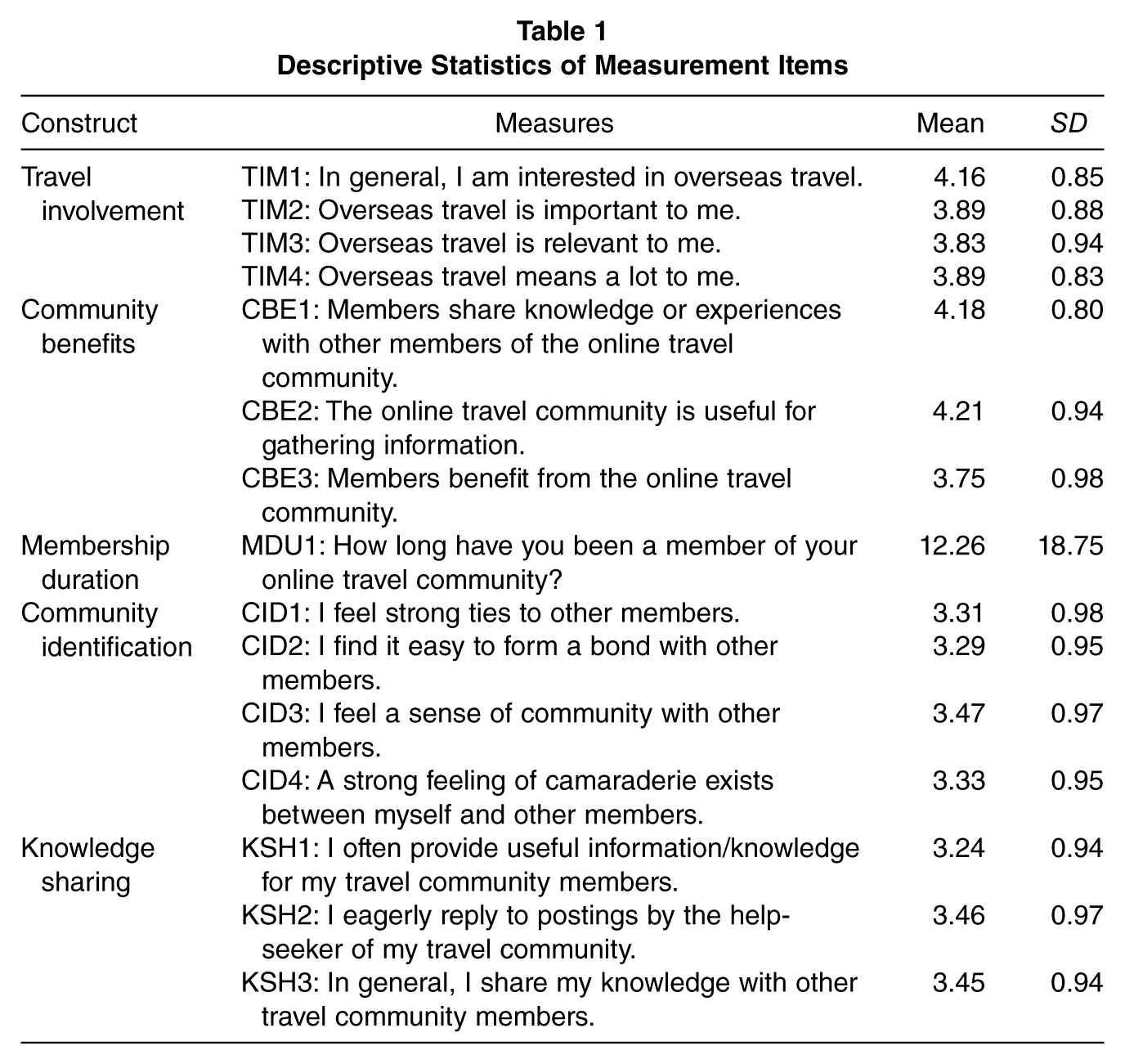
Based on the relevant literature, the instruments of the study were developed and then pretested with five online travel community members. Since the original questions were English-based, all items were carefully translated into Korean by the authors with necessary wording changes (see Table 1). All the measurement items, except membership duration, were measured using a 5-point Likert-type scale, with 1 being strongly disagree to 5 being strongly agree. Travel involvement was measured with four items adapted from Cho (2003) and Gruen et al. (2006). Respondents were asked how they consider travel to be important and relevant based on inherent needs, values, and interests. Community benefits were assessed by using three items proposed by Srinivasan et al. (2002), where subjects were asked how they value the community activities. For membership duration, participation length was assessed by the number of years members said they have participated in their travel community. Carlson et al.’s (2008) four items were employed to measure community identification, referring to a sense of membership. Respondents were asked to indicate the degree to which they see the community as part of themselves. Finally, knowledge sharing was measured by three items adapted by Hsu et al. (2007). The respondents were asked to indicate the level of willingness to share travel information and knowledge.
Descriptive Statistics of Measurement Items
Data Analysis
The hypothesized relationships were tested with LISREL 8.5 (Jöreskog & Sörbom, 1993). Following the two-step approach recommended by Anderson and Gerbing (1988), the measurement model was first estimated and the measurement and structural models were then estimated simultaneously. The existence of moderating effects was estimated by a multiple group analysis, given that it is one of the most useful procedures for testing the latent variable moderating effects under various circumstances (Rigdon, Schumacker, & Wothke, 1998). The baseline model in which all path coefficients are allowed to vary across the information-seeker and relationship-builder subgroups was first estimated, and then constrained models were compared in which each hypothesized path coefficient is constrained to be equal across the two subgroups (Jöreskog & Sörbom, 1993).
Results
Confirmatory Factor Analysis
The adequacy of the measurement component of the proposed model was first examined by performing confirmatory factor analysis (see Table 2). Model fit for the measurement model was good (χ2 = 133.41, df = 79, p < .001; comparative fit index [CFI] = .99; nonnormed fit index [NNFI] = .99, standardized root mean residual [SRMR] = .037). Because the proposed measurement model achieved an acceptable fit, each of the constructs was evaluated by (a) examining the statistical significance of each estimated loading and (b) assessing the reliability coefficients of the studied constructs. As shown in Table 2, all the indicator loadings exceeded .66 and were significant (p < .001), which suggests that the specified indicators are sufficient in their representation of the constructs (Hair, Anderson, Tatham, & Black, 1998). Construct reliability for each construct was then assessed. An examination of the construct’s reliability indicated that the s were all above Nunnally’s (1978) recommended .70 threshold. The composite reliability indices (ρc) of each scale were all greater than Bagozzi’s (1980) recommended level of .70, and all variance-extracted scores (ρv) were also .62 or higher and exceeded the .50 cutoff recommended by Fornell and Larcker (1981), which suggests that the measures are internally consistent. Taken together, these results demonstrate that the proposed measurement model is appropriate for further analysis.
Results of the Confirmatory Factor Analysis
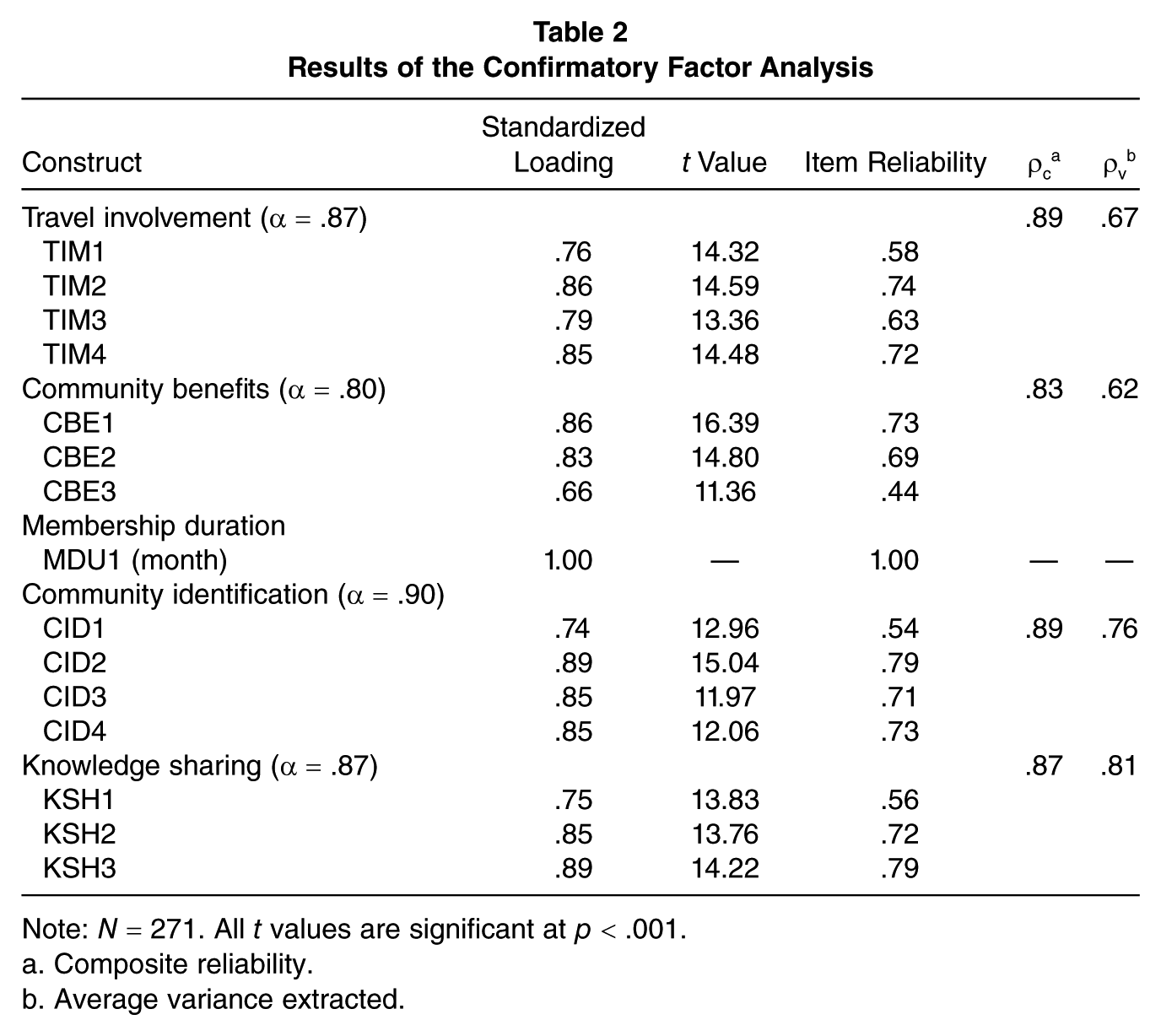
Note: N 271. All t values are significant at p < .001.
Composite reliability.
Average variance extracted.
Results of Structural Model
The full structural model was derived from hypotheses, since the proposed measurement relationships were consistent with the data (see Table 3). The model achieved a good level of fit: χ2 138.88, df 82, p < .001; CFI = .99; NNFI = .99; SRMR = .046. Also, the model accounted for a substantial proportion of the variance in two endogenous variables: 36% of the variance in community identification and 48% of the variance in knowledge sharing. Though not hypothesized and to further test the mediating effect of community identification, a proposed structural model (full mediation) was compared with the saturated (partial mediation) model in which the direct paths from three antecedents to knowledge sharing were added (Bagozzi & Lee, 2002). The resulting chisquare difference test was not significant (Δχ2 = 5.47, df = 3, n.s.), suggesting that the proposed model fits the data better than does the saturated model. None of three direct paths had significant effects on knowledge sharing (γ21 = .08, t = .84, n.s.;γ22 = .11, t = 1.16, n.s.;γ23 = .03, t = .65, n.s.). Indeed, the addition of three direct paths did not provide any additional explained power (Bagozzi & Lee, 2002; Morgan & Hunt, 1994).
Structural Results of the Proposed Model and the Saturated Model
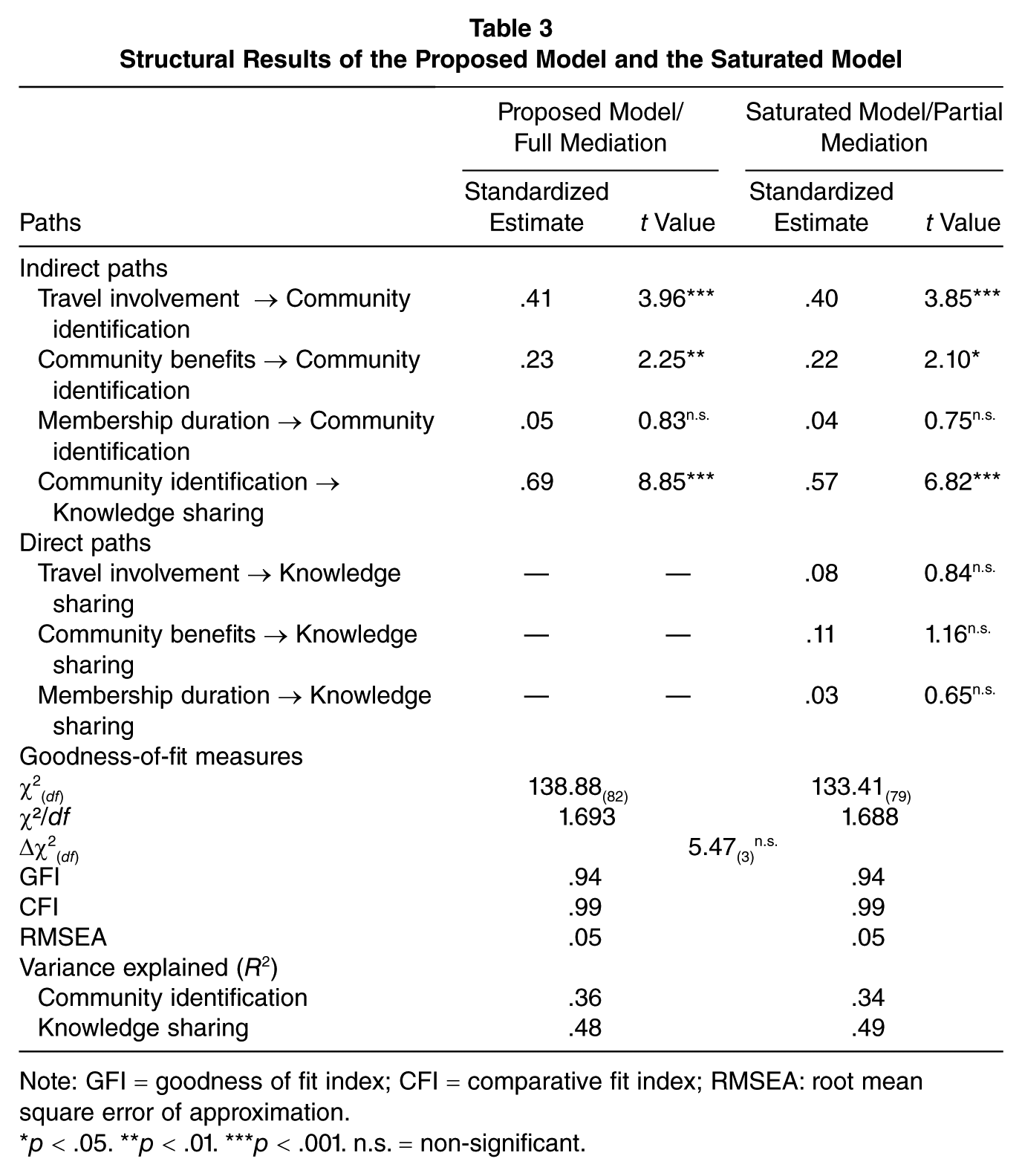
Note: GFI goodness of fit index; CFI comparative fit index; RMSEA: root mean square error of approximation.
p .05. **p .01. ***p .001. n.s. non-significant.
Hypotheses 1, 2, and 3 postulated the positive relationships between three antecedents of community activities and community identification. Travel involvement (γ11 = .41, t = 3.96, p = .001) and community benefits (γ12 = .23, t = 2.25, p = .05) had significant effects on community identification. However, the path from membership duration to community identification was not significant (γ13 = .05, t = .83, n.s.). Thus, Hypotheses 1 and 2 were confirmed by the data, whereas Hypothesis 3 was not supported. Hypothesis 4 posited the positive relationship between community identification and knowledge sharing. Community identification (γ21 = .69, t = 8.85, p = .001) had significant effect on knowledge sharing activities. Thus, Hypothesis 4 was also supported.
Moderation Tests
To assess how some of the hypothesized relationships vary according to a member’s interaction mode, two sub-group models were tested and compared. First, the sample was split to form the two subgroups of information seeker and relationship builder based on participant responses to one question regarding their primary reason to join an online travel community (“What was your primary motivation for joining an online travel community?”) (Cornwell & Coote, 2005; Mathwick et al., 2002). This resulted in 126 cases in the information-seeker group and 145 cases in the relationship-builder group. Chi-square differences (Δχ2) with one degree of freedom were then computed between an unconstrained model and four separate constrained models (Rigdon et al., 1998).
Results showed, among three paths, the path from travel involvement to community identification only differs across the two groups (Δχ2 = 7.03, df = 1, p = .01), thus supporting Hypothesis 5 (see Table 4). The chi-square statistic for the two models (unconstrained vs. constrained) were 255.03 (df = 184, p = .001) and 262.06 (df = 185, p = .001), respectively. Specifically, the path of the information-seeker group was not significant (γ = .04, t = 0.27, n.s.), whereas the path of the relationship builders did prove significant (γ = .53, t = 4.12, p = .001). However, the effects of community benefits and membership duration on community identification did not differ across groups (Δχ2 = .11, df = 1, n.s.;χ2 = .03, df = 1, n.s.), thus not supporting Hypotheses 6 and 7. For the relationship between community identification and knowledge sharing, a significant improvement in fit was found between two groups (Δχ2 = 5.38, df = 1, p = .05), thus supporting Hypothesis 8. The path from community identification to knowledge sharing was significant in both groups, but larger for the relationship-builder group (β relationship-builder group = .74, t = 8.88, p = .001) than the information-seeker group (β information-seeker group = .46, t = 4.51, p = .001). Please see Figures 2 and 3 below.
Chi-Square Difference Tests

The path was constrained to be equal across the two groups.
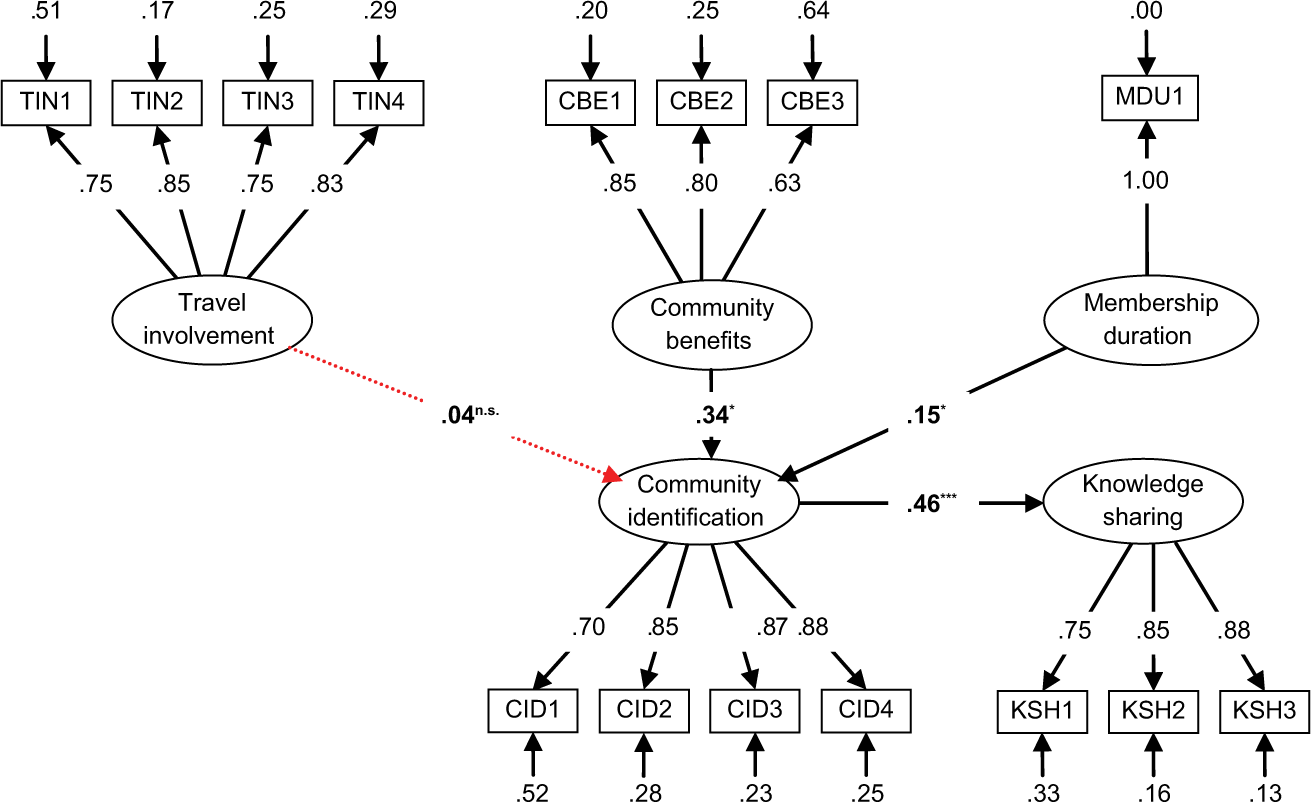
Structural Results for the Information-Seeker Group
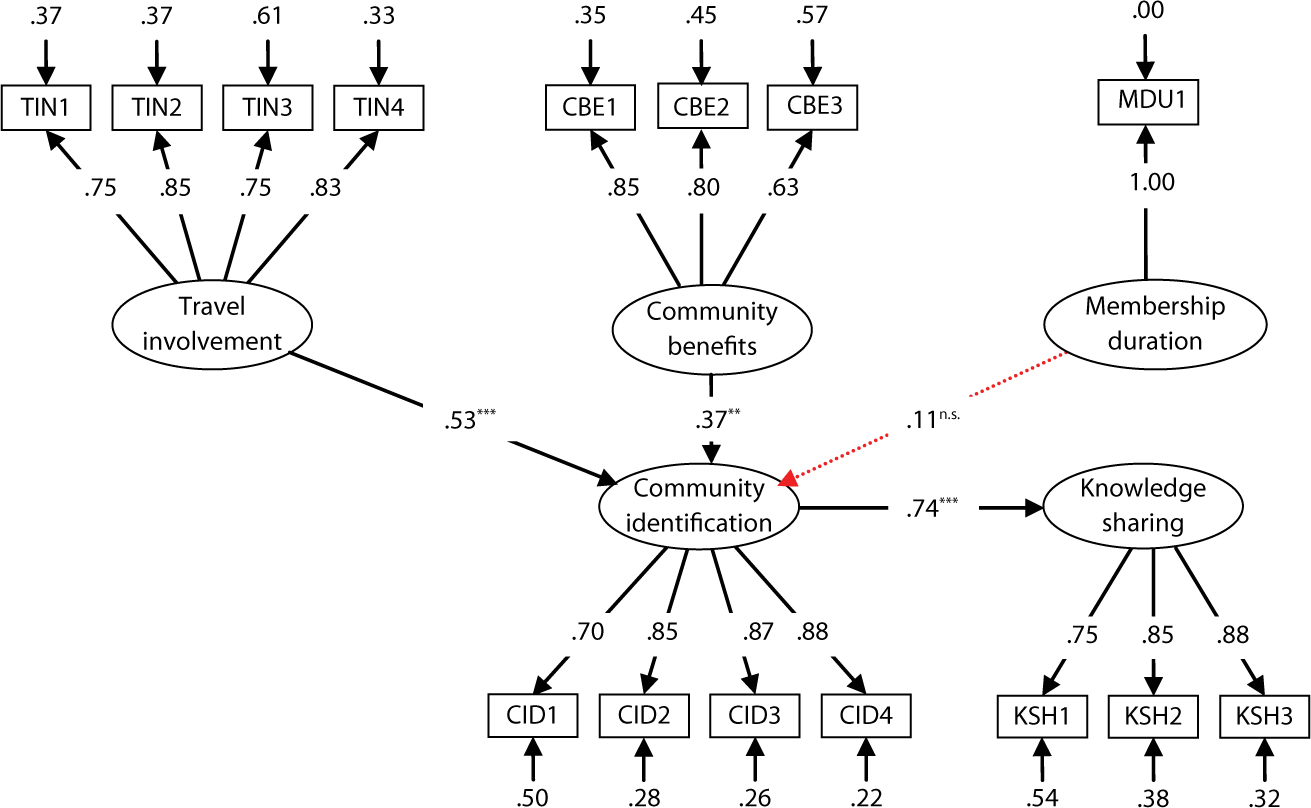
Structural Results for the Relationship-Builder Group
Discussion and Implications
Based on the belief that community identification positively influences knowledge sharing in an online travel community, this study examined three levels of identification antecedents, pro-posing that travel involvement, community benefits, and mem-bership duration to be individual-, community-, and affilia-tional-level characteristics that positively affect community identification. The study also considered the role of two polar opposite interaction modes since information seekers and relationship builders are expected to be influenced by different antecedents and exhibit different levels of knowledge sharing. By adding to the understanding of how online travel communities function, this article contributes to an online manager’s ability to develop better strategies in building a vibrant and successful online travel community.
This study’s findings were consistent with previous research linking SIT and community identification to improved levels of knowledge sharing. The three antecedents of this study did not have a direct impact on knowledge sharing and were in-stead mediated by community identification (Algesheimer et al., 2005). As a result, travel community managers concerned with the health and sharing activity of their communities need to con-sider ways to foster member identification and connectivity among travel members (Qu & Lee, 2011; Tsai et al., 2012).
Members’ travel involvement was determined to have the largest impact of the three antecedents proposed by this study, followed by community benefits. The affiliational-level membership duration, conversely, had no effect on community identification. Although this result differs from previous studies (e.g., Bhattacharya et al., 1995; Cornwell & Coote, 2005; Thompson & Sinha, 2008), recent research suggests that true community participation is best assessed through actual interaction hours rather than duration (Qu & Lee, 2011). Such an approach would use various forms of data as evidence of active participation, such as travel members’ logon time, number of postings, as well as activity trends. Travel members confirm their continued membership in the community with each visit (Wang & Fesenmaier, 2004), since online communities lack the dues and renewal process found in traditional communities.
When compared, information-seeking and relation-ship-building travelers displayed a different sharing structure through the identification process. Information seekers were mostly, if not solely, influenced by community benefits in pursuit of their immediate need and main reason to visit the website. Relationship builders, on the other hand, were mostly influenced by travel involvement, reflecting their personal interest in travel and an inclination to seek opportunities to discuss it.
The two modes also differed regarding the extent of knowl-edge sharing in which they engaged. Relationship builders tended to share more, as they were more inclined to social in-teractions and personally invested to share travel knowledge as it leads to satisfying their personal interest and motivation to participate in the community. However, information seekers were less likely to share, focusing instead on the easiest and most effective ways to acquire travel information (Ridings et al., 2002).
Implications
The positive link between identification and robust knowledge sharing may compel travel community mangers to consider ways of increasing a sense of identification. Community managers themselves can act as experts in the online community by leading ongoing travel discussions among members. Another suggestion focuses on ways to improve connectivity among members through detailed profiles and recognition of member interaction (Ip et al., 2010; Qu & Lee, 2011). Such a detailed profile could be expanded beyond personal information to include specific areas of interest and expertise, allowing travelers to reach out on their own. Community identification can also be encouraged through the use of a hierarchy of membership statuses conferred based on increasingly higher levels of interaction, thereby providing a community-wide recognition of member interaction.
Travel involvement was the primary antecedent to community identification for relationship builders, who tended to be large knowledge sharers. This finding may suggest that community managers concerned with improving overall knowledge sharing discover ways to entice highly involved nonmember travelers into joining the community. However, this should not be done at the expense of existing members, since community membership has been found to be more effective at retaining customers than at acquiring new ones (Algesheimer et al., 2005). Since an in-creased relevance leads to improved identification, and thus more robust sharing, community managers ought to focus on improving the relevance of travel to existing members.
While less so than travel involvement, community benefits played a role in community identification. To improve its effec-tiveness, the specific benefits travelers obtained need to be identified (Chung & Buhalis, 2008; Feng & Morrison, 2007). Such information can be acquired from detailed profiles and travel discussions and used to construct and modify themes and specific interests around which the travel community can function. Although membership duration proved to have no affect on identification, the prospect that more frequent member interaction might have a positive influence cannot be discounted and can perhaps be encouraged through the enticement of increased membership status.
The different sharing paradigms of information seekers and relationship builders require different strategies on the part of community managers. Although meaningful levels of knowledge sharing cannot be expected of information seekers, they can be enticed to return to the community with the promise of access to up-to-date travel knowledge and various tips through interaction (Mathwick, 2002). Relationship builders, already predisposed to knowledge sharing, would benefit from efforts to increase com-munity identification by making community interactions as close as possible to offline environments, stressing free communica-tion and positive feedback to their contributions.
Limitations and Future Research
One limitation of the study regards the self-reporting nature of the survey that allowed for some parts of the hypothesized rela-tionship to be inflated. The use of travelers’ true be-havioral data on knowledge sharing in future research may miti-gate this potential bias. Other types of data measuring actual interactions should be considered. A second limitation concerns the limited number of antecedents employed in this study. Trav-elers’ knowledge sharing through identification might be better understood if further investigation considered how other antecedents and specific bio data might affect the knowl-edge sharing paradigm. A third limitation is that the knowledge sharing paradigm was not fully explored in a variety of online community types (e.g., bulletin boards, chat rooms, news groups). Different travel community types may influence the proposed relationship in some way. A final limitation is that this study deals only with travel communities in South Korea. The findings of the study could be treated as specific evidence of the high diffusion rate of online travel communities. The proposed relationship can be examined and contrasted in a different cultural context (e.g., collectivism vs. individualism).
Footnotes
Authors’ Note:
This research was supported by Kyungsung University Research Grants in 2012.