




Abstract
In Base of the Pyramid (BoP) and subsistence marketplaces literature, a general consensus prevails that the process of creating solutions for the poor is most successful when marketers gain a local perspective. This paper highlights that, as companies seek this local perspective within impoverished communities, they can appropriate community knowledge. Drawing on research in the area of community knowledge, an area of growing importance that is all but missing from the marketing literature, this paper explicates key features of community knowledge. Appropriation of community knowledge can have potential benefits to communities, but also can cause social harm, including undermining financial, economic, and cultural safety, in the BoP community. The papers proposes a framework, bridging ethical and legal approaches, that guides marketers to consider consent, cognitive justice, capacity, and community impact in order to mitigate harm and generate social benefits.
Keywords
Introduction
The Base of the Pyramid (also known as Bottom of the Pyramid or BoP) literature seeks to change the way companies approach doing business with the world’s poor. This approach posits that companies can earn financial returns and alleviate poverty through selling products and services to the poor. Organizations, policy makers, and researchers have started to pay attention to the business-led opportunities present in this context (Agnihotri 2012). This is exemplified by the accolades for the Body Shop (Prahalad and Hart 2002): “The Body Shop’s creative CEO, Ms. Anita Roddick, built a business predicated on understanding the basis for local rituals and practices. For example, she observed that some African women use slices of pineapple to cleanse their skin. On the surface, this practice appears to be a meaningless ritual. However, research showed active ingredients in pineapple that cleared away dead skin cells better than chemical formulations” (p. 12-13).
This article is rooted in a macromarketing approach as it emphasizes the broader dimensions of marketing, including economic, social, and political aspects (Shapiro 2006). Further, it investigates and describes the potential consequences to society due to the activities surrounding a marketing system (Hunt 2012), by focusing on the marketing issue of community knowledge appropriation espoused by the BoP approach. Specifically, this study contributes to the extant macromarketing literature in three key ways.
First, the research explicates a particular form of knowledge, community knowledge, which has received little attention in marketing, but is particularly important when marketing in impoverished communities. Though multinationals have historically viewed community knowledge as different from scientific knowledge (Arora and Romijn 2012) or less valuable, awareness of the value of this locally-held knowledge is increasing (O’Bryan 2004) and more attention is being paid to the topic by academics (such as Hahn 2009). Nonetheless, despite increased interest in and the variety of examples of appropriated community knowledge, no broadly accepted and well-articulated definition exists for this type of knowledge (WIPO n.d.) and academic literature shows a dearth of research regarding community knowledge, especially in relation to the BoP and marketing. For example, with the notable exceptions of Mittelstaedt and Mittelstaedt’s (1997) and Arora and Romjin’s (2012) coverage of indigenous knowledge, a search of articles in Business Source Complete, peer-reviewed and otherwise, did not yield any BoP articles regarding community knowledge and its synonymous terms. We aim to rectify this gap.
Second, this article explores a central idea on which BoP strategies rest – that of knowledge acquisition and exploitation – by outlining the potential harm and benefits associated with utilizing community knowledge within the context of the BoP approach. With respect to discussing ways appropriation of community knowledge can harm poor communities, the article joins with a number of other critiques cautioning against wholesale adoption of BoP strategies as a panacea to poverty alleviation (i.e., Arora and Romijn 2012; Karnani 2007). The ways in which BoP strategies can cause harm and benefits are clarified through a conceptual framework that captures these effects in relation to unique systematic issues in the BoP. This is especially important as negative outcomes can and do occur in the marketing system if the broader systematic challenges are not considered, and these consequences need to be illuminated while respecting the diversity of humanity (Hill and Martin 2014). Unfortunately, marketing scholars too often ignore these systematic issues (Hill and Martin 2014).
Third, like Saatcioglu and Corus (2014), this analysis contributes to discussions of fair marketing systems. Through proposing a framework that bridges legal and ethical solutions which could be used to guide organizations in their engagement with the BoP, these recommendations go further than well-intended advice to be “respectful of traditions” (Prahalad and Hart 2002, p. 12) while using these traditions in the creation of new products and services. This framework is particularly warranted given recent scholarship arguing that marketing managers may lack “moral maturity” (Hill and Martin 2014).
The remainder of the article is structured as follows: First, the main developments in BoP approaches are described, including the emphasis on immersion within communities. A detailed discussion of the definition and key features of community knowledge is then presented, including the benefits of it to society and intellectual property protection considerations. This is followed by an overview of potential benefits of community knowledge appropriation, as well as a delineation of the processes by which its appropriation could lead to social harm. The penultimate section provides guidance to marketers regarding potential solutions to minimize harm and enhance benefits of community knowledge use by organizations. The implications of these solutions and directions for future research are then discussed.
Poverty and Developments of the Base of the Pyramid Approach
People at the BoP occupy the lowest rungs of the global economic pyramid, making less than $1500US a year in purchasing power parity (Prahalad 2005) and living in poverty. Estimates place the number of people living in poverty across the globe in the billions (World Bank 2013). Poverty is defined as a pronounced deprivation in well-being (World Bank 2000), where well-being is defined as the access to and command over resources (Haughton and Khandker 2009). As such, those in the BoP face situations of resource scarcity. Well-being “incorporates social, economic, and other aspects of what constitutes a fulfilled human life” (Lindeman 2014, p. 171). Additionally, well-being is related to capabilities, where Ansari, Munir, and Gregg (2012) argue that acquiring, developing, and retaining capabilities are essential components of well-being, as capabilities allow individuals to take advantage of social and economic opportunities. Life situations below the poverty line are also characterized by institutional gaps (Rivera-Santos, Rufín, and Kolk 2012), which include a lack of regulative institutions and legal protections.
The BoP theory emerged within this context. The first iteration, called BoP 1.0, described how companies can simultaneously make money and alleviate poverty through marketing appropriate products and services to impoverished people (Prahalad 2005). However, Simanis and Hart (2008) argue that this approach has and will fail in the long run because, under the BoP 1.0 theory, businesses remain separate from the BoP communities. It was in this context that BoP 2.0 was introduced. BoP 2.0 argues that companies, in particular multinational enterprises (MNEs), can work together with those in the BoP to create products, services, and processes aimed at poverty alleviation (Simanis and Hart 2009). Under BoP 2.0, companies work with the local communities through a “social embeddedness” process and become ingrained in the BoP community (London and Hart 2004; Simanis and Hart 2009) in order to “understand, leverage, and build on the existing social infrastructure…that relies on resources and knowledge in the external environment as sources of competitive advantage” (London and Hart 2004, p. 364).
The social embeddedness process entails members from the MNEs “living the local life” (Simanis et al. 2005, p. 8), such as homestays, living off local wages, and using local transportation (Simanis et al. 2005). For example, managers from Hindustan Lever Limited, which is a subsidiary of Unilever in India, “required new employees to spend six weeks living in these markets, and actively sought local consumer insights and preferences as they developed new products” (London and Hart 2004, p. 354). This knowledge acquisition process is undertaken to capture and generate innovative business ideas, with the end goal of creating a business endeavor, such as a business or a product (Simanis and Hart 2009). Through the social embeddedness process, the poor share their knowledge and understanding of their community. In return, MNEs provide the finances, business know-how, and global sales networks necessary to advance the business idea. For the people in the BoP, poverty alleviation arises from the community’s involvement as partial owner of the resulting product or service, capacity building, and infrastructure creation (Simanis and Hart 2009).
Beyond BoP 2.0, immersion as a means to foster deep understanding of the BoP community and facilitate learning about the community is advocated throughout the BoP literature. For example, Prahalad and Hart (2002) note the importance of examining and identifying “useful principles and potential applications from local practices” (p. 12), while others contend “success [in the BoP] will depend on knowing the BoP intimately” (Pitta, Guesalaga, and Marshall 2008, p. 400). Additionally, the closely related subsistence marketplace approach encourages deep understanding honed from social embeddedness in the field (Sridharan and Viswanathan 2008), such as through partnering with local entrepreneurs to “co-create customized solutions” (Viswanathan et al. 2014, p. 12). Indeed, purposeful listening in these contexts is thought to “lead to innovative solutions driven by individuals with expertise regarding the context” (Viswanathan et al. 2009, p. 419).
However, this social embeddedness approach has been criticized as a way for MNEs to tap into a previously inaccessible market through the “appropriation of grassroots resources and innovations” (Bonsu and Polsa 2011, p. 242), where appropriation, as a synonym for use, is defined as the “the act of…taking for one’s own use” (“Appropriation” 2011, n.p.). Given that the BoP context is characterized by a deprivation of well-being, including access and command of resources and capabilities (Haughton and Khandker 2009), at the very least individuals and organizations should avoid decreasing resources, capabilities, and opportunities for those in impoverished situations. As community knowledge could be appropriated by organizations in their quest to develop an innovation, a fuller assessment is needed about the potential harm and benefits of such an approach.
Community Knowledge
Recent business literature has noted that “the poor possess immense reserves of intellectual property” (Shivarajan and Srinivasan 2013, p. 382), or knowledge. One type of such knowledge is community knowledge, also known as traditional knowledge. Though related to collective memory, which is the “collective interpretation of the past” (Schwartz 1982), community knowledge differs in that, in addition to collective interpretation, community knowledge also span the material accomplishments of a community including the technical, ecological, scientific, or medicinal know-how and capabilities (WIPO n.d.) that are unique to a given group of people in a particular place (Turnbull 2009) and develops over generations (Sillitoe and Marzano 2009). For example, community knowledge includes knowledge about sustainable irrigation by communities of Iranians (WIPO n.d.) and the use of traditional viticulture techniques by Italian communities (Cannarella and Piccioni 2011), among many others. Community knowledge, while historically marginalized, still represents the prevailing paradigm in many communities. Indigenous worldviews, a form of community knowledge prevalent in indigenous communities, are still dominant for over 370 million people living in more than 90 countries (World Bank 2013).
Community knowledge is based on a community’s adaptation to their environment over a long period of time. A community’s long historical association within a given ecosystem of plants, animals, and other natural resources results in community members collecting exhaustive levels of information about their local habitats and environments (Subramanian 2010). Additionally, knowledge of the natural world cannot be separated from other dimensions of the social and cultural world, as it can have spiritual value in addition to being of functional utility. For example, “the management of sacred groves and sacred sites which are still common in many tropical countries… also serve as a refuge for biodiversity in the area” (Subramanian 2010, p. 227). Likewise, the functional aspects of traditional knowledge are often not separated from the artistic. Instead, they form part of a unified system of understanding (Alikhan 2000).
Community knowledge is characterized by the act of sharing, using, and creating a shared understanding and identity (Dutfield 2000). Though Shivarajan and Srinivasan (2013) argue that much of the intellectual capital of the poor is “dormant and in disuse because of their lack of access to and exclusion from global knowledge networks” (p. 389), this is not necessarily the case, as community knowledge is very much in use in communities. Traditional knowledge plays “a very important role in communal and individual decision-making about, for example, farming, health care, land use, local governance, family affairs, interpersonal relations and exchanges” (Haverkort and Reijntjes 2010, p. 21). As such, this type of knowledge reflects the accumulated knowledge of groups who share an intimate relationship with their local environments and is intertwined with a community’s way of life (Emery 2000).
Benefits of Community Knowledge
The outputs of traditional knowledge provide communities with tangible resources of economic value, including objects and services, and are used in exchanges both inside and outside the BoP communities. For example, Namibian communities gain economic income from their millennia old knowledge about the use of the marula tree in skincare and food products (WIPO n.d.). An estimate of the economic worth of traditional knowledge in the domain of pharmaceutical products is around $43 billion (Principe 1989). However, this number should be viewed with caution, given the assumptions that underlie these calculations (Dutfield 2000). Nonetheless, whatever the correct amount, traditional knowledge is of significant economic value for a community, especially in the areas of sustainable development (Dutfield 2000).
Further, as community knowledge is a means by which a community maintains, embodies, and develops its identity (Hansen and VanFleet 2003), it can be important for a community’s survival (Economic and Social Council 2013). Traditional knowledge and its expressions are important to maintaining the cultural heritage and vitality of communities, crucial elements for community wellbeing and development (WIPO 2013). For example, cultural continuity is integral to a community’s well-being, including reducing suicide rates among Aboriginal communities (Chandler and Proulx 2006; Fonda 2009). Given that an impoverished community consists of members who are, by definition, resource constrained, community knowledge and its ownership is an important resource to consider.
Protecting Community Knowledge
Since the community is the creator of this type of knowledge, community knowledge is considered the property of the community rather than that of any one individual (Hansen and VanFleet 2003). Though there has been previous work on shared resources in marketing (see Bardhi and Eckhardt 2012; Ozanne and Ozanne 2011), the community-owned nature of traditional knowledge has never been discussed in marketing literature. This omission creates the illusion that traditional knowledge lacks specific ownership. In comparing private ownership rights with communal ownership, Mathew (2013) asserts that “this system of exclusive and private rights is at odds with the traditional social and economic system in which local communities make use of, and develop and nurture, biodiversity. For example, seeds and knowledge on crop varieties and medicinal plants are usually freely exchanged within the community. Knowledge is not confined or exclusive to individuals but shared and held collectively, and passed on and added to from generation to generation, and also from locality to locality” (p. 34).
A key challenge that renders traditional knowledge incompatible with these conventional rights is that, “Western intellectual property protection is based on the twin premises that individual people can originate and own ideas” (Mittelstaedt and Mittelstaedt 1997, p.14). As noted, community knowledge is not attributable to any one individual. Additionally, traditional intellectual property rights are secured when the idea to be protected is not in the public domain, which is usually not the case with community knowledge. Free exchange of knowledge within a community has meant that traditional knowledge appears to be without ownership rights (Mathew 2013). Overall, the dominant intellectual property rights system is not designed to accommodate the collective nature of community knowledge (Mittelstaedt and Mittelstaedt 1997; Simeone 2004).
Further, community knowledge is not seen as novel, and therefore not protectable. This type of knowledge is often seen as antique, unchanging, and natural, where intellectual property is seen as modern, dynamic, and created by culture (Sunder 2007). This relates to other barriers inherent in protecting community knowledge under current systems, including the difficulty or impossibility of identifying the moment of invention as required by many jurisdictions, as well as the inability to show an inventive and non-obvious innovation, as this knowledge has been passed across generations (Andrzejewski 2010). Given these challenges, community knowledge is particularly vulnerable to appropriation.
However, over the last decade, major attempts have been made to address this lack of protection through international conventions and at national levels through specific laws. International recognition of the importance of traditional knowledge is illustrated by the adoption of the United Nations Convention on Biological Diversity (CBD), as well as the establishment of the World Intellectual Property Organization’s (WIPO) Intergovernmental Committee on Intellectual Property and Genetic Resources, Traditional Knowledge, and Folklore. These and other conventions aim to secure agreement to international legal protection for traditional knowledge and other knowledge forms. For example, the United Nations Declaration on the Rights of Indigenous People asserts that, “Indigenous peoples have the right to maintain, control, protect and develop their cultural heritage, traditional knowledge and traditional cultural expressions, as well as the manifestations of their sciences, technologies and cultures” (Article 31.1).
Despite a widespread lack of understanding and protection, community knowledge is nonetheless relevant in its own right and, in particular, for the subsistence marketplaces and BoP approaches. The following section clarifies how and why community knowledge is sought as a source of innovation in the unique context of the BoP and the potential benefits and harm of appropriating community knowledge. The subsequent section proposes approaches to capitalizing on these social benefits while proposing strategies to mitigate harm.
Community Knowledge Appropriation
Use of community knowledge can occur when marketers engage in the BoP. Innovation processes rely, in part, on outside sources of knowledge (Cohen and Levinthal 1990). Though invention is an important contributor to innovations, they also can result from “borrowing” (March and Simon 1958, as cited in Cohen and Levinthal 1990) and marketing can play a role in this regard. Importantly, just like other forms of knowledge, community knowledge can be learned and used by those outside of its originating community. For example, knowledge gleaned from Samoan healers about the mamala plant has been used in AIDS drugs developed by companies (WIPO n.d.). Further, companies are increasingly seeking out community knowledge as a source of ideas for products to sell on the global market (Brascoupe and Endemann 1999).
Under the BoP approach, marketers socially embed themselves in BoP communities in order to foster understanding. Marketers have an overarching goal of creating products or services for these communities that are “culturally-appropriate and environmentally sustainable” (Simanis and Hart 2009, p. 5). Community knowledge, being culturally appropriate as per its definition and borne from the interaction with environments over time, would likely be viewed as valuable input for the resulting product or service. Even when marketers do not aim explicitly to appropriate community knowledge, the access afforded by cultivating a deep understanding and “living the local life” will increase the likelihood of its use. In short, as this type of knowledge is rooted in a community, marketers would not have likely known about it unless they had engaged in such embedded activities. Given the opportunity for organizations active in the BoP to access and use traditional knowledge, a clear understanding of the potential benefits and harm is warranted. The following section articulates a conceptual model of both potential social benefits and social harm arising from appropriating community knowledge, including the factors that affect these outcomes (see Figure 1).
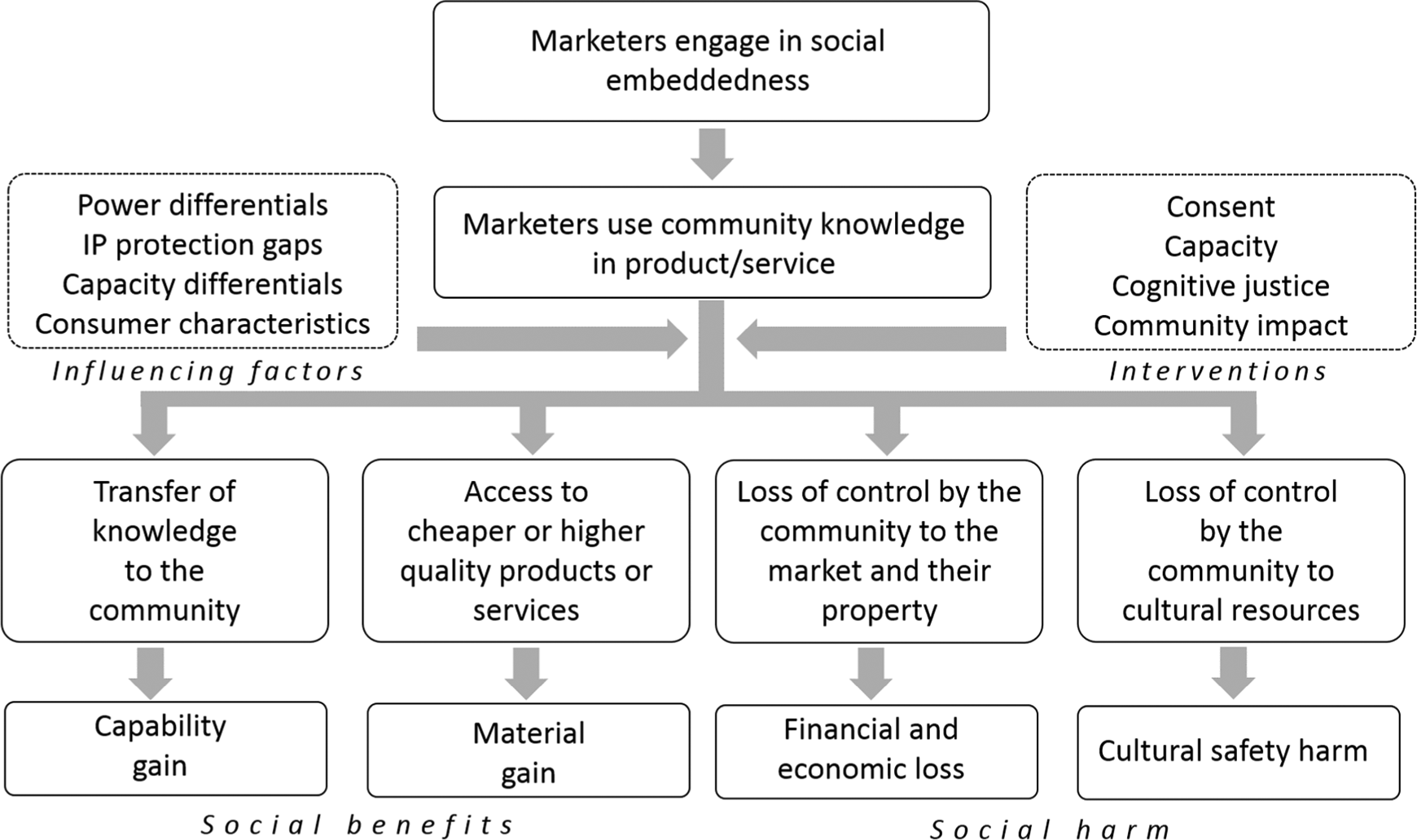
Potential social benefits and harm of community knowledge appropriation.
Social Benefits from Community Knowledge Appropriation
Though how communities could benefit from the social embeddedness process is not explicitly included in the BoP 2.0 literature (Bonsu and Polsa 2011), potential benefits for the community could accrue if community knowledge were appropriated. The community could, for example, gain access to cheaper or higher quality products or services based on traditional knowledge if an organization produces these goods more efficiently or effectively, resulting in material gains to consumers. For example, home-made snacks were made by thousands of BoP women in Venezuela and sold by street vendors, before they were displaced by Nestlé’s factory-packaged wafer cookie, driving a sales increase of $90US million per year for Nestlé, illustrating the success of the endeavor in terms of revenue (Ireland 2008). Further, large organizations possess a wealth of knowledge, resources, and capabilities in regards to marketing that many impoverished communities lack. Transfer of this knowledge from marketers towards BoP communities may be possible, thus “leading to capability building among these communities” (Ansari, Munir, and Gregg 2012, p. 828), which could help to alleviate deficiencies in well-being.
Additionally, a motivated company could profitably market community knowledge regarding medicinal interventions and ecological practices, providing economic returns to the community and wider benefits to people around the world. For example, a benefit sharing agreement between South African indigenous peoples, the San, and HGH Pharmaceuticals Ltd. involved the mood altering succulent plant, Sceletium tortuosum. It resulted in the development, patent protection, and commercialization of a pharmaceutical solution based on research that leveraged knowledge from two rural villages in South Africa (Wynberg and Chennells 2009). Pharmaceutical solutions such as these can improve the health of people around the world. As such, in addition to potential benefits to individual communities and companies, innovations based on traditional knowledge could potentially contribute to solutions to many thorny issues such as medical illnesses, eco-diversity, and agriculture, which could have local as well as wider social benefits.
Despite these benefits to communities, companies, and the wider society, assessing the harm, if any, associated with community knowledge appropriation is necessary, as per the recommendation of Hill and Martin (2014) to “consider the totality of positive and negative effects marketing has on material environments” (p. 29). The following section discusses how and why appropriation of this knowledge has the potential to also lead to significant social harm.
Social Harm from Community Knowledge Appropriation
Though the concept of social harm is one that has been debated heavily in economics literature (see Montesano 2002 for an overview), criminology literature has developed the study of zemiology, or the study of social harm. In particular, zemiology focuses on harm brought about by society on a structural level and does not include harm inflicted on individuals borne from the physical world (Pemberton 2007). Four main categories of social harm include physical, emotional and psychological, financial and economic, and cultural safety (Hillyard and Tombs 2004). Importantly, these aspects of social harm are often interrelated, where one social harm can bring about another (Pemberton 2007). Further, social harm are contextual in nature, and a primary task when defining social harm is to “identify the determining contexts that produce harms” (Pemberton 2007, p. 36).
Due to the unique context of the BoP, community knowledge appropriation by marketers engaging in the BoP has the potential to lead to two aspects of social harm including financial and economic loss and harm to cultural safety. Financial and economic loss include loss of physical property and cash (Hillyard and Tombs 2004), while, as noted by Alvesalo (1999), cultural safety encompasses a variety of notions including, “autonomy, development and growth, and access to cultural, intellectual and informational resources generally available in any given society” (Hillyard and Tombs 2004, p. 20). The following describes the potential financial and economic harm to the community that could occur, including the conditions under which they are likely to occur.
Financial and Economic Harm of Community Knowledge Appropriation
Appropriation of community knowledge can lead to financial and economic harm. As detailed above, a goal of companies under the BoP approach is to identify processes, products, or services that could be commercialized. Financial and economic benefits that a community could acquire from community knowledge appropriation could be undermined due to the lack of identification of specific beneficiaries (Bonsu and Polsa 2011), as well as lack of clarity around a mechanism by which to share profits (Arora and Romijn 2012).
As organizations monetize community knowledge, experience shows that the community is unlikely to receive equitable financial compensation. The United Nations estimates that “developing countries lose about $5 billion in royalties annually from the unauthorized use of [community] knowledge” (as quoted in Sunder 2007, p. 112). Additionally, indigenous groups often fail to receive financial compensation for the use of their intellectual property (Kennedy and Laczniak 2014). Key contextual factors can increase the likelihood of this kind of financial and economic harm to communities. These include the company’s lack of awareness or understanding that they are appropriating community knowledge, the power imbalances between BoP communities and companies, and lack of intellectual property protections for community knowledge.
Without a clear understanding that community knowledge is not free, but owned by a community, marketers may inadvertently appropriate knowledge that “appears” to be free for the taking. Indeed, a widespread lack of understanding and respect for community knowledge exists due to its reputation for being unscientific or antiquated (WIPO n.d., p. 8). More insidiously, even if marketers understand and acknowledge community knowledge, they have little incentive to equitability compensate communities for creating the knowledge, and communities often have little recourse. This lack of incentive is arguably exacerbated in light of companies often holding the balance of power in the relationship.
The BoP approach “hides a world of unequal power relations in its folds” (Arora and Romijn 2012, p. 482). A fundamental power imbalance exists between the well-educated, globally-aware, and literate marketers and the often less-educated, less-literate, and regionally isolated individuals from the BoP. Wolf (1990) describes different modes of power, including organizational power and structural power. The former is the power that operates within the setting of interpersonal relations, while the latter organizes the structure of social settings by making some kinds of behavior possible, while making others impossible (Wolf 1990). Marketers entering the BoP control both of these modes of power.
Organizational power is slanted in favor of companies since they set the agenda of activities. Further, marketers maintain the balance of structural power as they hold the funds necessary to engage in the BoP. This amounts to controlling which behaviors are possible and impossible within that setting, such as deciding which business ideas warrant investment and who will receive any gains for the initiative. For example, when SC Johnson engaged in the BoP using a social embeddedness process, their resulting service in the BoP was “based on a partnership with a local, although U.S.-funded nongovernmental organization…rather than on collaboration with the community at large” (Kolk, Rivera-Santos, and Rufín 2013, p. 18). SC Johnson controlled the activities and the outcome, and the community did not. Therefore, though those in the BoP can be partners or partial owners under the BoP 2.0 process, the partnership is often an unequal one.
Although those in the BoP have less organizational and structural power in comparison to companies, access to intellectual property rights for their community knowledge could mitigate the effects of this power differential. However, as described above, intellectual property protection of community knowledge is largely underdeveloped or nonexistent. This is compounded by the influencing factor of institutional gaps in the BoP. Further, those in the BoP may lack the experience, unified voice, and economic resources necessary to utilize any existing legal systems effectively. This puts those in the BoP at a decided disadvantage when using any protection mechanisms (WIPO n.d.).
Importantly, current intellectual property laws and the system for gaining these rights are not only inadequate for protecting community knowledge but favor companies, in particular multinational organizations (Simeone 2004). As such, intellectual property rights, when available, would likely be secured by the company rather than the community, especially given a company’s familiarity with intellectual property mechanism. Numerous examples of organizations securing intellectual property protections for information acquired from community knowledge can be found in the literature. Mitsubishi Chemical Corporation, for example, patented a plant called cunanini, which is used as a fast acting fish poison by indigenous peoples in South America (Bardi, Gutierrez-Oppe, and Rodolfo 2010). In this and other situations, community knowledge became the proprietary right of the organization.
In summary, lack of understanding about community knowledge by companies, power inequalities between communities and companies, and widespread dearth of intellectual property protection for community knowledge could potentially cause those in the BoP to lose control over their property and thus suffer economic harm.
Cultural Safety Harm of Community Knowledge Appropriation
Appropriation of community knowledge by marketers can also undermine the cultural safety of BoP communities. As marketers engage in community knowledge appropriation and create branded products and services aimed at the local community, the resulting product or service will likely displace traditional BoP offerings. This is an especially dire outcome in resource constrained BoP communities, given that access to community knowledge is important for their survival, cultural continuance, and overall well-being.
Cultural safety harm is more likely to occur if professional marketers are involved, given their ability to increase demand for branded (and non-local) products. Marketers, as per their profession, possess marketing skills, increased resources, and formalized business operations, as well as the technical acumen needed to develop a widely marketable product or service. Company marketed products can replace local products if they become more widely available, affordable, and accessible to consumers in comparison to community-offered products or services (Karnani 2007). Indeed, those in the BoP may have a greater susceptibility to advertising messages (Davidson 2009). Empirical evidence supports the contention that branded products can and do replace local products (Karnani 2007). For example, ITC Limited, a company based in India, convinced BoP “villagers to switch from low-priced products made by the cottage industry to the branded products carried by ITC” (Vachani and Smith 2008, p. 64). Using their proven marketing experience and bolstered by their deeper pockets, marketers can reach and entice customers more effectively and efficiently than those in the local community, thus displacing local products.
In addition to greater susceptibility to advertising, other specific contextual characteristics of the BoP could result in the displacement of local products. Individuals in impoverished situations have a smaller margin of error regarding their purchases given lower disposable incomes (D’Andrea et al. 2007), which may make branded products seem more appealing (Ireland 2008). Indeed, “corporations using sophisticated marketing tactics can … deceive poor people into believing they are better off ” (Arora and Romjin 2012, p. 484) than if they bought locally supplied options. Further, individuals in this context are believed to have a short-term planning orientation (Viswanathan and Sridharan 2009) that could lead them to purchase the branded goods even if they are aware of the potential harm to the wider community. This, in combination with the lack of products available in the BoP (Prahalad 2005), would largely derail any attempt to boycott the brand in protest, as might be done in wealthier contexts.
These displacements could harm the local community. As a product or service from a company replaces the traditional offering, the appropriated community knowledge will likely be lost through lack of use. Thus, beyond the obvious economic loss experienced by local suppliers, community knowledge itself would be lost. In particular, by displacing local offerings with branded products or services, individuals in the BoP may be forced to abandon their traditional activities (Sunder 2007) and seek work in other sectors or places. An example of this is the near loss of a traditional stone fence building techniques in southern Italy before its revival by locals (Cannarella and Piccioni 2011). Given the importance of community knowledge as a resource, lack of use could further diminish the community’s capacity to take advantage of other social and economic opportunities, and undermine cultural continuance. This could weaken the well-being of members of the community, thereby potentially exacerbating poverty or, at the very least, reducing the effects of poverty alleviation efforts.
To summarize, as companies become socially embedded in the BoP, community knowledge will likely be appropriated and transferred to a marketed product or service. This practice creates potential social benefits, such as capability and material gains, as well as possible social harm, including economic loss and diminished cultural safety. The unique characteristics of the BoP community and its people, which include institutional gaps, short-term orientation, and smaller margins of error, make loss more likely, as does the existence of capacity and power differentials, and inadequate intellectual property protections.
Given the potential benefits to be derived from traditional knowledge appropriation, as well as potential social harm, is it possible to develop meaningful collaboration that could fulfil the aspirations of the BoP goals? Although addressing this is no easy task, the following sections present legal and ethical approaches towards an equitable solution.
Legal and Ethical Solutions
If the unique features of community knowledge are recognized and if the contextual issues involved – such as power differentials, intellectual property gaps, capacity differentials, and consumer characteristics – are addressed, marketing organizations could mitigate social harm and improve the likelihood of social benefits. Towards this aim, a framework bridging both legal and ethical solutions that marketers could use when engaging with BoP communities is presented in the section below.
Legal Solution of Benefit Sharing
International protocols have been developed to provide minimum standards for firms in relation to traditional knowledge protection. Such developments provide ways to overcome power differentials, institutional voids, and weak intellectual property protection. Benefit sharing, defined as the fair and equitable sharing of benefits (The Nagoya Protocol 2010, Article 5), is increasingly being adopted as an ideal for ensuring that owners of community knowledge share in the gains from the development and commercialization of this knowledge. In particular, benefit sharing is about justly providing part of the profits and other advances gained from the use of traditional knowledge to the original source (Schroeder 2007). In other words, “in essence, benefit-sharing holds that countries, farmers, and indigenous communities that grant access to their plant genetic resources and/or traditional knowledge should share in the benefits that users derive from these resources” (De Jonge 2011, p. 127).
Various international legal protocols have been and are being developed for assessing and guiding benefit sharing. These are most evolved in the area of bioprospecting under the Convention on Biological Diversity (CBD), adopted in 1993 (Chennells 2013). The overall aim of this convention, with 198 parties and 168 countries as signatories, is to provide for just and equitable sharing of the benefits that derive from genetic resources and the related traditional knowledge, while conserving and ensuring the sustainable use of biodiversity. Subsequently, the Nagoya Protocol on Access to Genetic Resources and the Fair and Equitable Sharing of Benefits Arising from their Utilization to the Convention on Biological Diversity, a supplementary agreement to the CBD, came into effect in 2014. This protocol lays out the legal framework and core principles to implement benefits sharing and provides guidance to all parties regarding the use of biological resources and genetic materials.
Importantly, the protocol includes explicit provisions on the “access to traditional knowledge held by Indigenous and local communities when it is associated with genetic resources” (The Nagoya Protocol 2010, p. 1). As such, the aim of this protocol is to “strengthen the ability of these communities to benefit from the use of their knowledge, innovations and practices” (The Nagoya Protocol 2010, p. 1). Though this focuses on only a subset of the community knowledge that relates to genetic (biological) resources, this protocol is based on wide consultation and scholarship assessing its application, general principles, and provisions regarding community knowledge. Therefore, though it can by no means provide clear and unambiguous direction for marketers, it can nonetheless provide a valuable guide for marketing behavior regarding the use of community knowledge even when genetic materials are not involved. However, when traditional knowledge associated with genetic materials is involved, the wide support for this protocol places a legal obligation on marketers.
Three principles are at the heart of the Nagoya Protocol, which recognizes the rights of communities over their resources. The first requirement is to seek prior informed consent from the communities that are the knowledge holders, while the second and third principles are the requirement for the sharing of benefits between users of the knowledge and its holders and that the sharing of benefits must be mutually agreed upon (The Nagoya Protocol 2010). There remains much debate and development necessary in order to fully implement these requirements even in the ambit of the CBD. Therefore, even if a marketer wishes to implement these policies, there will remain ambiguities. Nonetheless, given the potential stakes and gains to both marketers and communities, these requirements would be a prudent start. The following discusses the components of these requirements in more detail.
Prior Informed Consent
Marketers are well advised to seek prior informed consent for the use of community knowledge. This requirement is of growing importance in regards to access and benefit sharing provisions both in developing and developed countries (Nijar 2010). Prior informed consent has become characteristic of treaties and soft law related to access to community knowledge (Nijar 2010).
Though no universally accepted definition of prior informed consent exists, Schroeder (2007) offers the following useful definition in the context of indigenous communities: “Prior informed consent is the voluntary, uncoerced decision made by a subgroup that legitimately represents an Indigenous community, on the basis of adequate information and deliberation, to accept rather than reject some proposed course of action that will affect the community” (Schroeder 2007, p. 31). As such, prior informed consent requires that consent be secured from knowledge holders prior to the access and use of community knowledge. This would ensure that the community and the company act with full understanding of their respective rights and responsibilities and that the community is fully aware of the potential uses of their knowledge and can exercise agency over this knowledge.
Schroeder (2009) outlines specific guidelines for securing consent, including the “legitimization to consent, full disclosure, adequate comprehension, and voluntary agreement” (p 28). In particular, legitimization of informed consent involves knowing who to get consent from and which community members are qualified as legitimate representatives. Communities are not heterogeneous and community knowledge in the BoP is “produced and interpreted within a set of unequal social relations” (Arora and Romijn 2012, p. 493). Therefore, the power imbalances within a community need to be acknowledged as an important part of the local context. This is an issue that can present tremendous difficulties even when prior informed consent is being sought in good faith (Schroeder 2009, p. 27), and can be supported through providing access to procedural and cognitive justice, described below.
Requirement of Sharing of Benefits and Mutual Agreements
The goal in any benefit sharing program is the fair and equitable distribution of gains to be derived from the venture. However, what is fair and equitable is clearly open to differing interpretations. De Jonge (2011) suggests that two prerequisites need to be met in order to ensure fairness and equity: The first relates to the need to ensure procedural justice by addressing the social and political power differences that may exist between, for example, marketers and the community. To ensure procedural justice, marketers could assist the local community in attaining the capacities, capabilities, and legal support necessary to allow the relevant community to negotiate on more equal footing (De Jonge 2011). This solution can aid in mitigating power differentials, and ultimately help decrease the likelihood of social harm.
The second issue relates to cognitive justice, which underscores the need to acknowledge the existence and legitimacy of differing worldviews as “a starting point for debate and genuine dialogue” (De Jonge 2011, p. 140). Of critical importance in the drive for cognitive justice is understanding that benefit sharing goes beyond economic considerations. In discussing ecological knowledge, Williams and Hardison (2013) highlight “the implications of the multiple cultural, legal, risk-benefit and governance contexts of knowledge exchange” (p. 521) while pointing to fact that “the failure to consider these contexts of knowledge exchange can result in the promotion of benefits while failing to adequately address adverse consequences” (p. 521). As such, deepening and widening understanding of the community’s lived experience, and how it relates to community knowledge, can identify potential inequalities within and between communities and companies. This is where the suggestions around cultivating a deep understanding of the community, as is currently instructed by the BoP literature, is particularly useful. For example, partnering with local nongovernmental organizations can facilitate understanding of the local context (Prahalad 2005).
Though overarching international protocols are useful, major challenges remain in establishing ownership of the knowledge, identifying appropriate bodies or individuals to provide prior informed consent, and developing the best strategy to protect knowledge and innovations that derive from this knowledge into the future. As such, achieving equitable and mutually agreed upon benefit sharing clearly present challenges for marketers, which are shared by local, indigenous, regional, national, and international communities. In this regard, further reflection on actual case studies can provide guidance regarding identifying potential pitfalls and best practices in benefit sharing agreements.
The most widely covered case on the transfer of traditional knowledge relates to the hoodia (Hoodiagordonii xhoba) plant used as an appetite suppressant by the San people, the oldest human inhabitants of southern Africa. In 1996 and 1998, unbeknownst to the San people, the Council for Scientific and Industrial Research in South Africa received patents on the plant (Wynberg and Chennells 2009). Subsequent licenses were awarded to Phytopharm, a British pharmaceutical company, which ultimately entered into an agreement in 1998 with Pfizer, the American pharmaceutical giant, for further development and commercialization (Wynberg and Chennells 2009). In a public relations backlash in 2001, the patent was challenged by the San who claimed this used their traditional knowledge.
In contrast, a more promising case of benefit sharing for South African indigenous peoples involves the South African company HGH Pharmaceuticals Ltd, which entered a benefit sharing agreement with the San people regarding the development and commercialization of the plant Sceletium tortuosum. Crucially, HGH Pharmaceuticals Ltd. acknowledged the San as the primary knowledge holders and the benefit sharing agreement provides royalties to them. Two communities identified as joint holders of the knowledge will share in the benefits of a resulting product that launched in the North American market in 2013 (Wynberg and Chennells 2009) and collaborations have been secured in other international markets (Tshitwamulomoni 2011). This appears to be a landmark agreement.
The lessons learned from these cases studies are as follows: First, obtaining prior informed consent of communities is critical (Wynberg and Chennells 2009). Second, ideally communities should be engaged as early as possible and considered active participants. Third, “the importance of relationship building and of having in place a policy climate conducive to fair deliberation” is key (Wynberg and Chennells 2009, p. 90). Finally, conditions that are conducive to fair deliberations are imperative, including ensuring that the communities have the capacity to negotiate on even footing (Wynberg and Chennells 2009). In the case of Sceletium tortuosum, a well-known human rights lawyer represented the community in the negotiations from the outset, thereby enhancing procedural justice.
Despite these key learnings, difficulties executing benefit sharing agreements remain (Wynberg and Chennells 2009). One of the most problematic issues revolves around identifying ownership rights to traditional knowledge. Importantly, guardianship can accrue to families or specific individuals in a community, held by one gender, or credited to a defined group or across a region (Elvin-Lewis 2007). Further, marketers need to be aware that not all traditional knowledge is available for commoditization. For example, the ways shamans in the Amazon use psychotropic drugs are often prohibited for others (Elvin-Lewis 2007).
Community knowledge serves as agents for the formation of communitas, a shared sense of camaraderie or common connectedness (Baker and Hill 2013). However, even when community knowledge is clearly identified, groups are not univocal and power can differ within a community. This inequality can undermine decision-making within a group. There can be competing interests within groups, as well as a range of individual identification with the group (Baker and Hill 2013), including tensions between collective and self-identity. As such, engagement with groups comprised of a limited representation of the community can undermine efforts (Baker and Hill 2013), underscoring the importance of inclusive representation. Nonetheless, even with full adherence to the proposed legal solutions, including inclusive representation, these considerations are at best incomplete. As such, the following ethical considerations are seen as crucial to finding more complete solutions that will minimize harm while maximizing benefits to communities.
Ethical Solution of the Integrative Justice Model
Santos and Laczniak (2009) constructed an ethical framework called the Integrative Justice Model. This normative framework describes norms and standards for companies in impoverished contexts that can be used to guide decision making towards fair outcomes (Santos and Laczniak 2009). These standards, based on grounds of fairness and equality, include five elements, as follows: “authentic engagement with consumers, particularly impoverished ones, with nonexploitative intent; cocreation of value with customers, especially those who are impoverished or disadvantaged; investment in future consumption without endangering the environment; interest representation of all stakeholders, particularly impoverished customer; [and] focus on long-term profit management rather than short-term profit maximization” (Santos and Laczniak 2009, p. 6).
Bridging Legal and Ethical Solutions: The 4 Cs
When considered together, the legal and ethical perspectives coalesce around four common principles that can provide guidance to firms in their engagement with the BoP (see Table 1).
Bridging Legal and Ethical Solutions.
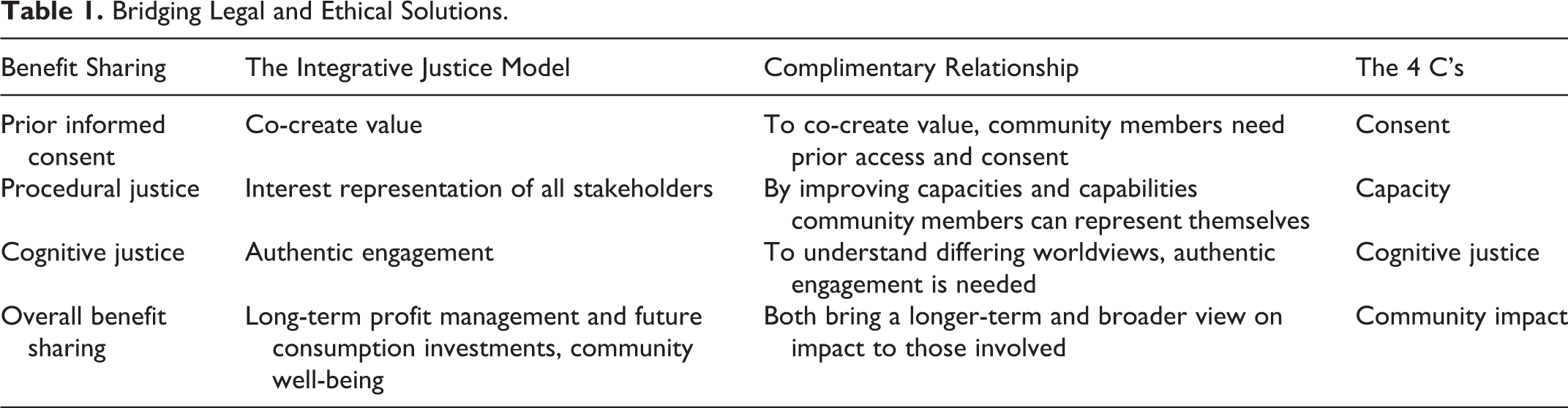
First, with consent, firms are advised to seek the involvement of BoP communities from the start. Prior informed consent from a legal perspective is consistent with the ethical approach that calls for co-creation and collaboration between companies and communities. Working together, companies could potentially help communities secure intellectual property protections in an equitable way. Second, procedural justice from the legal perspective and the need to ensure representation of all relevant stakeholders from the ethical perspective require that communities have the capacity to negotiate and represent themselves on an equal footing to the company. This could help overcome power differentials and may require that companies invest in capacity building in these communities. Third, companies need to ensure cognitive justice and authentically engage with the BoP community. Importantly, to understand differing worldviews that may be present in the BoP communities, authentic engagement is needed, as articulated by the ethical perspective. Fourth, the actual content of the negotiations needs to explicitly consider a longer-term and more expansive view that includes the social, cultural, environmental, and economic realities that underlie community knowledge. This can help overcome cultural safety harm, as a longer-term view taken by involved communities and companies can potentially help to avoid using community knowledge in a way that does not integrate the well-being of the community. This would, ideally, enable the development of mutually beneficial products.
To increase the likelihood of achieving social benefits and mitigate social harm, firms need to consider the 4 Cs when engaging with BoP communities – Consent, Cognitive Justice, Capacity, and Community Impact. These dovetail with the suggestions of Shultz (2007) who noted that conflicts can and do arise over resources and how they are managed. Minimizing these conflicts requires constructive engagement that facilitates understanding and cooperation based on ideas of ethics and justice (Shultz 2007). Further, through bridging legal and ethical solutions into the 4 Cs, communities and companies may be able to overcome the issues involved in community knowledge appropriation, such as power differentials, intellectual property protection gaps, capacity differentials, and consumer characteristics that can contribute to social harm or undermine social benefits, thereby leading to improved well-being in impoverished communities.
Discussion and Directions for Future Research
A macromarketing objective is to “optimize outcomes for the largest number of stakeholders in a marketing system not only now but also for future generations” (Shultz 2007, p. 294). This article discusses the potential benefits and harm of community knowledge appropriation, including highlighting when these outcomes are more likely to happen, such as during the social embeddedness process. By acknowledging these potential outcomes, macromarketers can become more aware of the impact their actions can have on the marketing system. Further, rather than free-riding on the inventions of others, marketers can work towards more equitable outcomes for those involved in community knowledge appropriation and hence optimize outcomes for stakeholders through the 4 Cs of Consent, Cognitive Justice, Capacity, and Community Impact.
Marketers and policy makers in the BoP are advised to develop internal and external approaches to support the 4 Cs. Two issues of relevance arise regarding Consent: What constitutes consent and from whom must consent be acquired? Legal principles for translating informed consent as an ethical principle into concrete plans for action (Berg et al. 2001) provide the clearest guidance. Marketers have a duty to disclose relevant information regarding harm, benefits, and alternatives as well as the duty to obtain consent from the appropriate entity. In getting community consent, companies need to avoid essentializing and neutralizing the heterogeneity of opinions and voices, as well as the ambiguities, that surround the boundaries of communities (Dempsey 2010). One approach is for marketing managers to set up internal policies that mandate working with a myriad of community groups, such as local governing bodies, as well as nongovernmental, grassroots, and religious groups. Not only will this help facilitate consent and potentially help overcome power imbalances, it also helps to support the idea of co-creation through active collaboration with these other organizations.
For Capacity, local communities need to achieve “justice in exchange,” which aims to establish fairness and equity in transactions (Arnason and Schroeder 2013
On the issue of Community Impact, many indices (see Felix and Garcia-Vega 2012) are available to marketers and policy makers following the influential Stiglitz report, including multidimensional measures of well-being (Stiglitz, Sen, and Fitoussi 2009). This shifts the focus from simple economic and short-term impact to requiring a deep and broad understanding of the longer-term implications and outcomes of activities. This report identified eight dimensions that should be considered including material living standards, health, education, personal activities including work, political voice and governance, social connections and relationships, present and future environment, and economic and physical insecurity (Stiglitz, Sen, and Fitoussi 2009). Measurements of such depth at the macro-level would require institutional support from governments and may benefit from companies developing partnerships with universities and other research institutes. At the micro-level, an adapted multi-dimensional focused approach would be warranted.
How benefits derived by the community are to be used or shared are necessarily the prerogative of the community. While investments into communal infrastructure and shared cultural artefacts would likely positively impact the greatest numbers, differing contexts and the types of benefits involved require that these decisions reside at the local level. Much of the caution in this study about the use of community knowledge shares parallels with the critique of the impact and uses of research conducted on indigenous people since colonial times. While the enterprise was different, aiming at academic gains rather than commercial ones, researchers, institutions, and scientific societies similarly embedded themselves in indigenous communities and sought to use this for academic glory elsewhere while creating harm and providing little, if any benefit, to communities (Tuhiwai Smith 1999). The effect was a disenfranchisement and dehumanization of indigenous peoples (Tuhiwai Smith 1999). In response, approaches that involve more ethical, respectful, and useful research with indigenous communities can result in benefits and limit harm. However, to accomplish this calls “for a collaborative social sciences research model that makes the researcher responsible, not to a removed discipline, but rather to those studied” (Denzin, Lincoln, and Smith 2008, p. 15). This article also asks marketers to be accountable to local communities in the BoP if they wish to create benefits and minimize harm.
The elements introduced herein will hopefully act as an impetus for future academic research, including exploration through empirical work. Future research can investigate empirically whether other potential benefits or harm can occur during community knowledge appropriation, whether interdependencies exist between these outcomes, if the introduced 4 Cs help to overcome these in practice, and which other solutions have been or could be used in regards to community knowledge appropriation.
Further, important questions remain about whether outcomes change depending on which organizational type is involved, such as for-profit multinational enterprises, small, or medium enterprises, non-profits, or social enterprises, or a combination of these. Do outcomes change depending on how these groups interact within a marketing system? Importantly, these organizational forms could have differing power differentials with the BoP community, which could influence the outcome. Further, who is considered to be part of the community and who is not? Could outsiders, such as marketers from companies, become insiders and under what circumstances would this occur? This would be particularly interesting to explore, as it would provide insight into possible solutions. Additionally, investigation into different community contexts would also facilitate a more nuanced understanding of the issues at play here. There may be differences between relative and absolute poverty (see Madden 2000 for measurement issues), and between those living in conflict zones, deep rural areas, or urban slums (Anderson, Markides, and Kupp 2010). Empirical work could help assess whether the outcomes of community knowledge appropriation change across these diverse situations and if these differing situations impact the efficacy of the solutions proposed in this study.
This article describes an important form of knowledge, community knowledge, and outlined the benefits and harm that can occur when community knowledge is appropriated in the BoP. The 4 Cs introduced give credence to the idea that, through a deep understanding of the positive and negative effects of marketing (Hill and Martin 2014), steps can be taken to achieve equitable benefits. Though a myriad of future research questions remain, community knowledge appropriation is an important topic of discussion for macromarketing academics and practitioners as we strive to find solutions that improve the well-being of the billions currently living in poverty. As more people view community knowledge as a potential source of innovation and engage in social embeddedness in the BoP, it will become even more important to overcome free-riding and find a balance between protecting the rights of communities, engaging in benefit sharing, and selling products and services derived from community knowledge.
Footnotes
Acknowledgements
The authors wish to thank Editor Terrence Witkowski, Associate Editor Ann-Marie Kennedy, as well as the three anonymous reviewers at the Journal of Macromarketing. The comments and guidance we received helped to greatly improve this manuscript. The authors are also grateful for the feedback from Andrew von Nordenflycht, Pek-Hooi Soh, Monica Semeniuk, and Karen Robson on earlier versions of this paper. Finally, thanks to our parents and grandparents who kept alive traditions and pointed us to the importance of this type of knowledge.
Declaration of Conflicting Interests
The author(s) declared no potential conflicts of interest with respect to the research, authorship, and/or publication of this article.
Funding
The author(s) received no financial support for the research, authorship, and/or publication of this article.