



Abstract
This study integrates the environmental attitude–behavior theory and the upper echelons theory to examine hotel companies’ environmental behavior. This study hypothesizes that top managers’ environmental attitudes have a positive effect on perceived advantages of the environmental program, which in turn leads to hotel companies’ involvement in environmental management. An online survey brought responses from 206 top managers (e.g., general managers, owners, CEOs, presidents, etc.) in U.S. hotels. The contact information of the participating hotels was taken from the websites of 11 state lodging associations in the United States. The results of structural equation modeling indicate that top managers’ perceived advantages, derived from environmental management, mediate the proposed relationship. In other words, top managers’ environmental attitudes influence hotels’ environmental management activities through perceived benefits of the environmental program. Managerial implications are discussed based on the study results.
Keywords
Environmental management (EM) has risen as an important component of corporate social responsibility and a firm’s strategic agenda. EM scholars argue that companies’ EM is largely determined by upper managers’ interpretations of environmental issues (Banerjee, 2001; Sharma, 2000). In the hotel industry, although management companies and the headquarters of hotel chains often establish corporate-level environmental policies and provide individual owners or franchisees with guidelines to promote environmental initiatives, the EM practices are likely to be affected by local factors. Local government regulations or incentives, local environmental infrastructure (e.g., recycling or composting facilities), the age and the size of properties, and the amount of resources available are some of the important local factors (Álvarez Gil, Burgos Jiménez, & Céspedes Lorente, 2001; Rivera, 2004). All these issues are typically dealt with by hotel top managers such as general managers (GMs) and owner managers. Thus, top managers’ managerial discretion in the hotel business is likely to play an essential role in cultivating environmental discourse and subsequent actions in their individual properties.
Previous research on EM in varying industry sectors has underscored the influence of top management on proactive organizational responses to environmental issues (e.g., Banerjee, 2001; Banerjee, Iyer, & Kashyap, 2003; Henriques & Sadorsky, 1999; Sharma, 2000). Much research has focused on top managers’ perceptions regarding environmental issues and their leadership for proactive EM. Although previous research has contributed to an understanding of corporate EM driven by top management, little is known about the precursors of managerial perceptions toward environmental issues. Managers’ interpretations of various pieces of information are inherently imperfect and influenced by their personal psychological bases and characteristics (Hambrick & Finkelstein, 1987). A recent, notable study by Sampaio, Thomas, and Font (2012) reports top managers’ desire to learn, higher self-efficacy beliefs, and positive context beliefs as the predictors of sound environmental involvement for small firms in the tourism sector. Thus, it is critical to understand the psychological factors that may guide top managers’ interpretations of EM issues and practices.
Although it is commonly acknowledged that top managers’ personal concerns or beliefs about the natural environment are among the main drivers of corporate EM (Bansal & Roth, 2000), empirical evidence about the effect of top managers’ environmental attitudes is scarce. To fill this gap, this study proposes top managers’ environmental attitude as an influential psychological characteristic and examines its impact on corporate EM in the lodging industry context. Furthermore, in the process of how top managers’ environmental attitude influences hotels’ environmental involvement, perceived advantages of the environmental program are put forward as a mediator.
In summary, the purposes of this study are twofold: to examine the role of hotel top managers’ environmental attitude in hotel companies’ EM activities and to explain the link between hotel top managers’ environmental attitude and organizational EM involvement via perceived advantages of EM. The proposed model of this study is based on the upper echelons theory in strategic management and the theory of environmental attitude–behavior consistency. These theories are described in detail in the following literature section.
Conceptual Framework
The Upper Echelons Theory
Daft and Weick (1984) argue that an organization is characterized by its process of interpreting the business environment the organization faces. These organizational interpretations are shaped by a small group of powerful individuals in an organization. Through the exercise of managerial discretion, the powerful actors influence organizational strategic choice and actions (Hambrick & Finkelstein, 1987). This view has been widely adopted by previous scholars in order to address corporate responses to environmental issues (e.g., Banerjee et al., 2003; Ramus & Steger, 2000). For example, Sharma (2000) found top managers’ interpretations of environmental issues as opportunities rather than threats are significantly linked to organizations’ voluntary proenvironmental strategy. In other words, the way top managers see environmental issues affects the proactivity of corporate EM. Furthermore, organizational commitment to EM is largely associated with top management being directly involved in and responsible for EM (Aragón-Correa, Matías-Reche, & Senise-Barrio, 2004). The lack of consistent support from top management is one of the main barriers to adopting environmental practices (Chan, 2011).
The upper echelons theory (Hambrick & Mason, 1984; Hambrick, 2007) provides a theoretical framework to address organizational interpretations and strategic choice driven by top management. The fundamental logic of this theory has two interconnected points: “(1) executives act on the basis of their personalized interpretations of the strategic situations they face, and (2) these personalized construals are a function of the executives’ experiences, values, and personalities” (Hambrick, 2007, p. 334). That is, a top manager’s perception of the business environment is limited and interpreted through “a filter woven by one’s cognitive bases and values” (Hambrick & Mason, 1984, p. 195) and strategic decisions made by top managers on behalf of their organization reflect enduring and intrinsic values, beliefs, and a worldview of the managers. In the context of EM, environmental policies formulated and endorsed by top managers, therefore, are influenced by their perceptions about environmental issues, and more fundamentally, their environmental attitudes and values. In summary, top managers’ perceptions and interpretations of environmental issues that direct their personal commitment to EM may be a function of their attitudinal bases with regard to the natural environment.
Environmental Attitude and Behavior
Environmental attitude frequently is used to predict environmental behavior (Kaiser, Wölfing, & Fuhrer, 1999). Environmental attitude is defined as “the collection of beliefs, affect, and behavioral intentions a person holds regarding environmentally related activities or issues” (Schultz, Shriver, Tabanico, & Khazian, 2004, p. 31). As implied in the definition, attitudes toward environmentally friendly behavior and toward the natural environment itself have both been used to predict environmental behavior in previous research (Hines, Hungerford, & Tomera, 1986; Kaiser et al., 1999; Kaiser, Oerke, & Bogner, 2007).
Attitude toward ecological behavior often has been adopted in conjunction with the theory of reasoned action (Ajzen & Fishbein, 1980) and its revised version, the theory of planned behavior (Ajzen, 1985). The theory of reasoned action assumes that people are rational, and attitude toward a specific behavior, along with other factors (e.g., social pressure), predicts people’s behavioral intention to that particular behavior. The narrowness of the attitude measure focusing on the specific behavior has been criticized because much information can be lost, although it increases the correlation between attitude and behavior (Kollmuss & Agyeman, 2002). In the context of environmental behavior, attitude toward specific ecological behavior is seen as the most proximal antecedent of environmental behavioral intention, which in turn leads to actual environmental behavior (Fielding, McDonald, & Louis, 2008; Kaiser et al., 1999).
Attitude toward the natural environment is used interchangeably with environmental concern, value, beliefs, or worldview (e.g., Gooch, 1995; Kaiser et al., 1999; Luo & Deng, 2008; Schultz et al., 2004; Stern, 2000). It refers to general concerns about the natural environment (Kaiser et al., 1999). Among numerous environmental attitude measures, the new environmental (Ecological) paradigm (NEP; Dunlap & Van Liere, 1978; Dunlap, Van Liere, Mertig, & Jones, 2000) is most popular because it evaluates general attitudes toward the environment rather than attitudes toward specific ecological behavior or some aspects of the environment (Fielding et al., 2008). NEP was developed with emerging ecocentric awareness, challenging anthropocentric beliefs prevalent in the Western society in the mid-1970s. The instrument has been used to assess individuals’ environmental concerns and generalized beliefs about human–environment relationships (Dunlap et al., 2000).
The predictive power of NEP on ecological behavior has been well documented in a number of studies (e.g., Dunlap et al., 2000; Johnson, Bowker, & Cordell, 2004). Steel (1996), for example, discovered significant effects of NEP on self-reported environmental behavior and political participation in environmental issues among the U.S. public. Dunlap et al. (2000) also found that NEP correlates significantly with support for proenvironmental policies among the U.S. public. NEP has been a valid measure to predict proenvironmental orientation among youngsters. Rauwald and Moore (2002) found that NEP is significantly related to policy support for environmental protection among college students. Overall, previous research suggests that general environmental attitudes operationalized by NEP are positively related to one’s support for environmental policy and protection measures.
Advantages of Environmental Management in the Hotel Industry
While studying the environmental decision-making process, Bonilla-Priege, Najera, and Font (2011) found that many hotels are engaged in EM for resource-based, internally driven reasons rather than legitimization, externally driven reasons; and among hotels (strategic leaders, followers, greenwashers, and laggers), strategic leaders are most capable of grasping the full benefits of EM. The authors, however, note a recent industry shift for pursuing EM from internal economic reasons to external legitimization reasons, encouraged by a number of stakeholder pressures.
Based on the extensive literature, this study highlights the four common benefits of EM: improved stakeholder relations, enhanced marketing benefits, increased operational efficiency and profits, and fulfilled social responsibility. First, environmental stakeholders identified by previous studies include community members, organizational stakeholders (e.g., customers, employees, suppliers etc.), regulatory stakeholders, and the media (Henriques & Sadorsky, 1999). Kirk (1995) notes that improving relationships with the local community is the most widely perceived advantage derived from EM. Bohdanowicz (2005) points out customers as the central organizational stakeholders who drive hotel companies to adopt environmentally friendly practices as they are increasingly concerned about the environmental degradation. Along with customers, employees are important organizational stakeholders (Bohdanowicz, Zientara, & Novotna, 2011; Buysse & Verbeke, 2003; Kirk, 1995). Employees are affected by the operational change resulting from EM and they are the organizations’ functional hub in implementing environmental initiatives (Chan & Hawkins, 2010).
Second, marketing advantages such as enhanced corporate image and reputation are regarded as salient incentives to institute a proenvironmental policy in the hotel industry (Bohdanowicz, 2005; Kirk, 1995, 1998). In Kirk’s (1998) study examining European hoteliers, marketing advantages over competitors are shown to be important motivations for adopting environmental initiatives. Similarly, Bohdanowicz (2005) demonstrates that enhancing hotel image through environmental initiatives is among the crucial reasons to introduce EM in European hotels.
Third, internally, economic benefits by reducing operating costs and increasing resource efficiency are the top-ranked advantages, derived from the environmental program in the hotel sector (Bohdanowicz, 2005, 2006; Tzschentke, Kirk, & Lynch, 2004). For instance, one common green practice such as replacing old light bulbs with energy efficient ones has been reported to create 10% to 25% of energy saving, depending on the age and the size of the hotel (Bohdanowicz, 2006).
Fourth, social responsibility has been identified as another motivation for adopting green initiatives (Garay & Font, 2012; Tzschentke, Kirk, & Lynch, 2008). Environmental awareness and ethical concerns about the natural environment among hotel operators have accentuated environmental stewardship in the hotel industry. Tzschentke et al. (2008) found that personal ethics of “doing good for all” by owner managers serves as a critical reason to pursue environmental schemes, in particular for small independent hotels. Because many green practices in the hotel industry (e.g., recycling program) are relatively simple measures without significant operational changes and resource deployment, top managers’ sense of social responsibility and personal concerns about the natural environment can be instrumental in determining environmental proactivity of individual properties.
Environmental Management Involvement in the Hotel Industry
In this study, organizational involvement in EM refers to the extent to which a hotel seeks to implement environmental initiatives. We focus on two dimensions of hotel EM practices: technical practices and system practices (Álvarez Gil et al., 2001; El Dief & Font, 2012). Technical practices are defined as operational practices to reduce the negative impact on the natural environment. System practices apply to organizational activities that monitor and support environmental technical practices.
Technical practices are categorized into three main areas: water conservation, energy saving, and solid waste reduction (Kirk, 1995; Stipanuk, 1996). Hoteliers are increasingly aware of cost-saving opportunities through water conservation. Most water usage in a hotel originates from showers, toilets, and kitchens, accounting for 85% of total hotel water consumption (InterContinental Hotel Group, 2009). Various water conservation practices have been developed and implemented in hotels. A linen-and-towel reuse program is one of the best water-saving practices in hotels (Bohdanowicz, 2005; Erdogan & Baris, 2007; Mensah, 2006). The program contributes to 11% to 17% of hot water saving (Marriott International, 2009). More specifically, a 100-guest room property with 75% occupancy may save an estimated $25,000 per year through the linen-and-towel reuse program (Brodsky, 2005).
Energy saving is considered an essential EM area in hotels because, in general, hotels consume considerably more energy than average buildings (Bohdanowicz, 2005), and therefore, provide more opportunities to reduce operational expenses. According to the U.S. Environmental Protection Agency (2010), the energy consumption of Energy Star–rated hotels is 35% less than traditional hotel properties with no such scheme.
Waste management aims to reduce the volume and toxicity of solid waste that are generated from guest room areas and food and beverage services (Iwanowski & Rushmore, 1994). Waste management efforts focus on recycling solid waste and composting organic waste. Previous research reveals that most hotels are involved in waste sorting and recycling programs (Bohdanowicz, 2005; Erdogan & Baris, 2007; Mensah, 2006).
As for system practices, chain hotel companies have developed their own environmental auditing and reporting systems for company-owned and franchised hotels in an effort to gauge and improve sustainability of individual properties (see InterContinental Hotel Group, 2009; Hilton Worldwide, 2009). In addition to a formal environmental auditing and reporting system, other system practices identified in previous studies are environmental training programs for employees, a formal environmental policy, and the formation of environmental teams or managers within the organization (Álvarez Gil et al., 2001; Bohdanowicz, 2005; Bohdanowicz et al., 2011; Erdogan & Tosun, 2009; Mensah, 2006).
Research Hypotheses
Integrating two theories (i.e., the environmental attitude–behavior theory and the upper echelons theory) into environmental strategic decisions in an organizational context, we expect environmental attitudes of top managers to play a central role in their perceptions regarding specific environmental issues such as advantages of EM; and top managers’ interpretations of a variety of advantages derived from EM are likely to be translated into their organizations’ involvement in EM. The above process implicitly suggests that top managers’ perceived advantages of EM function as a mediator between top managers’ environmental attitudes and their organizations’ environmental responsiveness. In summary, the following three hypotheses are posited in the hotel industry context:
Hypothesis 1: Hotel top managers’ environmental attitudes are positively related to their perceived advantages of EM.
Hypothesis 2: Hotel top managers’ perceived advantages of EM are positively related to their companies’ involvement in EM.
Hypothesis 3: Hotel top managers’ perceived advantages of EM mediate the effect of hotel top managers’ environmental attitudes on their companies’ involvement in EM.
Method
Sample and Procedure
To reach out to various types of lodging properties in different geographical locations, we searched lodging associations with the contact information of member hotels publicized. Eleven U.S. state lodging associations provided the e-mail addresses of member hotels on their websites at the time of this project. The total number of member hotels amounted to 3,699 properties in the 11 lodging associations. Online survey invitation e-mails were sent to the hotels, soliciting responses from top management, including GMs, owners, CEOs, and presidents. Respondents were asked to provide their job titles at the end of the questionnaire. A couple of reminder e-mails were sent after initial invitation.
Out of 3,699 online invitations, 275 surveys were returned (response rate: 7.4%). Approximately, one fifth of the responses came from the positions other than top management (e.g., front office managers, reservations managers, rooms division managers, food and beverage managers, etc.). These responses were excluded prior to statistical analyses because the focus of this study was on top managers’ perspective. Several responses with many missing values were also eliminated. After all these adjustments, 206 surveys remained as valid responses in the final data set. Low response rates to online surveys are due to the proliferation of junk mail (Sax, Gilmartin, & Bryant, 2003). The invitation e-mail of this study may have been perceived in a similar manner and soon deleted the moment the e-mail had appeared. Also, note that we used responses from top management only who we think are likely to make an ultimate decision on hotels’ EM activities, thereby further lowering the number of useable questionnaires.
Respondents consisted of 137 male (66.5%) and 69 female (33.5%) top managers. They have worked for their hotels for an average of 9.8 years. Sixty upscale hotels (29.1%), 122 midscale hotels (59.2%), and 24 economy hotels (11.7%) participated in this study. Small- (fewer than 100 rooms), medium- (100-399 rooms) and large-sized (400 or more rooms) properties accounted for 49% (n = 102), 42% (n = 86), and 9% (n = 18) of the sample, respectively. For ownership type, participating hotels were evenly divided into independent hotels (49.1%, n = 101) and chain-affiliated hotels (50.9%, n = 105). The number of years in EM involvement varied. In detail, 42 hotels (21.9%) indicated their EM involvement for less than 1 year, 63 hotels (32.9%) were engaged in EM between 1 and 3 years, 37 hotels (19.4%) participated in EM between 3 and 5 years, and the remaining properties (25.7%, n = 49) were involved in EM for more than 5 years with a maximum of 12 years. In comparison with the overall U.S. lodging industry, dominated by chain-affiliated hotels (about 80%) with a significant portion of economy/budget hotels (about 50%; Lattin, 2009), our sample is composed of a lower percentage of chain hotels and a higher percentage of upscale and midscale hotels. In particular, the underrepresentation of economy hotels may be partly attributed to the fact that many small, budget hotels (e.g., bed and breakfast) are perhaps nonmembers of the lodging associations.
Blair and Zinkhan (2006) contend that nonresponse bias is just one source of sampling bias and a high response rate does not guarantee a good sample. The authors rather emphasize the importance of achieving diversity in the sample. Academics study relationships and the measures of relationships (e.g., correlation) are resistant of sampling bias as long as the sample is diverse, but it is not true if the sample is restricted. The authors illustrate a mathematical example. If the sample includes members from all diverse groups, although disproportionate, correlations between variables tend to remain the same (as correlations in the unbiased sample) primarily with mean values of the study variables being different; however, if members from a specific group are entirely omitted, it affects both correlations and means. Given the diversity of participating hotels in terms of sizes, grades, and ownership style (despite the low response rate), it seems reasonable to think that the present data are good enough to conduct meaningful analyses to test the proposed relationships. More important, a wide distribution of the participating hotels’ EM experience alleviates the concern over the self-section bias that perhaps only enthusiastic EM supporters responded to this study, although we acknowledge the possibility of self-section bias to a certain extent.
Measures
Study variables were measured with scales adopted from or developed based on previous research (see Table 2). Before the questionnaire was finalized, measurement items were content-validated by an industry practitioner and three academics who are familiar with the area of environment management. The four experts evaluated all items of the scales, focusing on whether the items properly tap the domains of the variables of interest. Based on their comments, minor wording changes were made throughout the questionnaire to enhance the clarity of the survey.
First, for top managers’ environmental attitudes, a short form of the NEP scale with six items (α = .85) was used (Dunlap et al., 2000). Each item was measured on a 7-point Likert-type scale: 1 = strongly disagree and 7 = strongly agree. Agreement on three odd number items (e.g., “We are approaching the limit of the number of people the earth can support”) and disagreement on three even number items (e.g., “The earth has plenty of natural resources if we just learn how to develop them”) indicate proenvironmental attitudes.
Next, quantitative (e.g., Bohdanowicz, 2005; Mensah, 2006) and qualitative (e.g., Tzschentke et al., 2008) works were reviewed to develop an instrument for advantages of hotel EM. The six-item scale (α = .87) that we developed includes EM advantages, ranging from marketing benefits to fulfillment of social responsibility (e.g., “EM improves our hotel image”). Respondents were asked to rate each EM advantage using a 7-point Likert-type scale: 1 = strongly disagree and 7 = strongly agree.
For hotel companies’ involvement in environmental technical and system practices, two separate measures were constructed based on previous academic research (Bohdanowicz, 2005; Claver-Cortes, Molina-Azorin, Pereira-Moliner, & Lopez-Gamero, 2007; Erdogan & Baris, 2007) and industry reports (American Hotel and Lodging Association, 2008). Each scale had four items (technical practices α = .71; system practices α = .87). Technical practices include green practices such as water conservation, solid waste reduction, energy saving, and green purchasing (e.g., “Our hotel uses energy efficient equipment and products”); and system practices encompass support systems of EM and monitoring and controlling of EM performance (e.g., “Our hotel implements employee environmental training programs”). Respondents were asked to indicate the extent to which their hotels are involved in both technical and system practices on a 7-point scale similar to the scales used by Erdogan and Baris (2007) and Álvarez Gil et al. (2001). The end points of the scale are labeled: 0 = no extent and 6 = very great extent.
Last, hotel sizes, grades, and ownership type were used as control variables. For example, large, upscale, and chain-affiliated hotels may be more engaged in EM, because they may have more resources or information on green programs (Álvarez Gil et al., 2001).
Results
Preliminary Analyses: Measurement Model and Common Method Variance
The study hypotheses were tested using structural equation modeling (SEM) with Mplus 6.1 (Muthén & Muthén, 2010). In comparison with other multivariate techniques (including regression), SEM has several strengths. Other multivariate analyses are typically based on observed variables, and assume observed variables are errorfree in their measurement. By neglecting measurement error, parameter estimates may not be accurate. SEM has the ability to incorporate latent (unobserved) variables that are each approximated by a set of observed variables. SEM with latent variables estimates theoretical models while accounting for measurement error. In addition, SEM provides a number of model-fit indices to ensure that the proposed, structural model is an adequate representation of the entire set of causal relationships (Quintana & Maxwell, 1999).
Following the two-step approach (Anderson & Gerbing, 1988), we first assessed the measurement model and then the proposed structural relationships. Because moderately skewed and nonnormal distributions were observed in three items of technical and system practices, the measurement model was assessed with maximum likelihood estimation with robust standard errors (denoted as MLR in Mplus). MLR in Mplus uses the asymptotic covariance matrix and a scaled test statistic (Satorra–Bentler [SB]-scaled χ2) to correct for nonnormality of the data (Satorra & Bentler, 2001).
The measurement model included four latent variables: environmental attitude, advantages of EM, technical practices, and system practices. The fit of the four-factor model was satisfactory: SB-scaled χ2(164) = 286.20, p < .05; comparative fit index (CFI) = .92; Tucker–Lewis index (TLI) = .91; root mean square error of approximation (RMSEA) = .061; standardized root mean square residual (SRMR) = .066. The composite reliabilities for the four constructs and factor loadings of measurement items are presented in Table 2. All composite reliability coefficients are greater than .70 suggesting the evidence of internal consistency of the four constructs: .85 for environmental attitude, .87 for advantages of EM, .70 for technical practices, and .87 for system practices. The items of the four factors loaded significantly at the .05 level on the latent variables with which they are associated and standardized loading values ranged from .49 to .81. These results indicate adequate convergent validity of the measurement model (Anderson & Gerbing, 1988).
It also is critical to examine discriminant validity of study constructs. Discriminant validity was assessed in two ways: comparisons of correlations among latent variables and formal testing of the chi-square difference between nested models and the proposed model. First, as shown in Table 1, correlations among latent variables ranged from .21 to .67, implying that the constructs are not highly correlated with each other.
Descriptive Statistics and Correlations Among the Measurement Scales
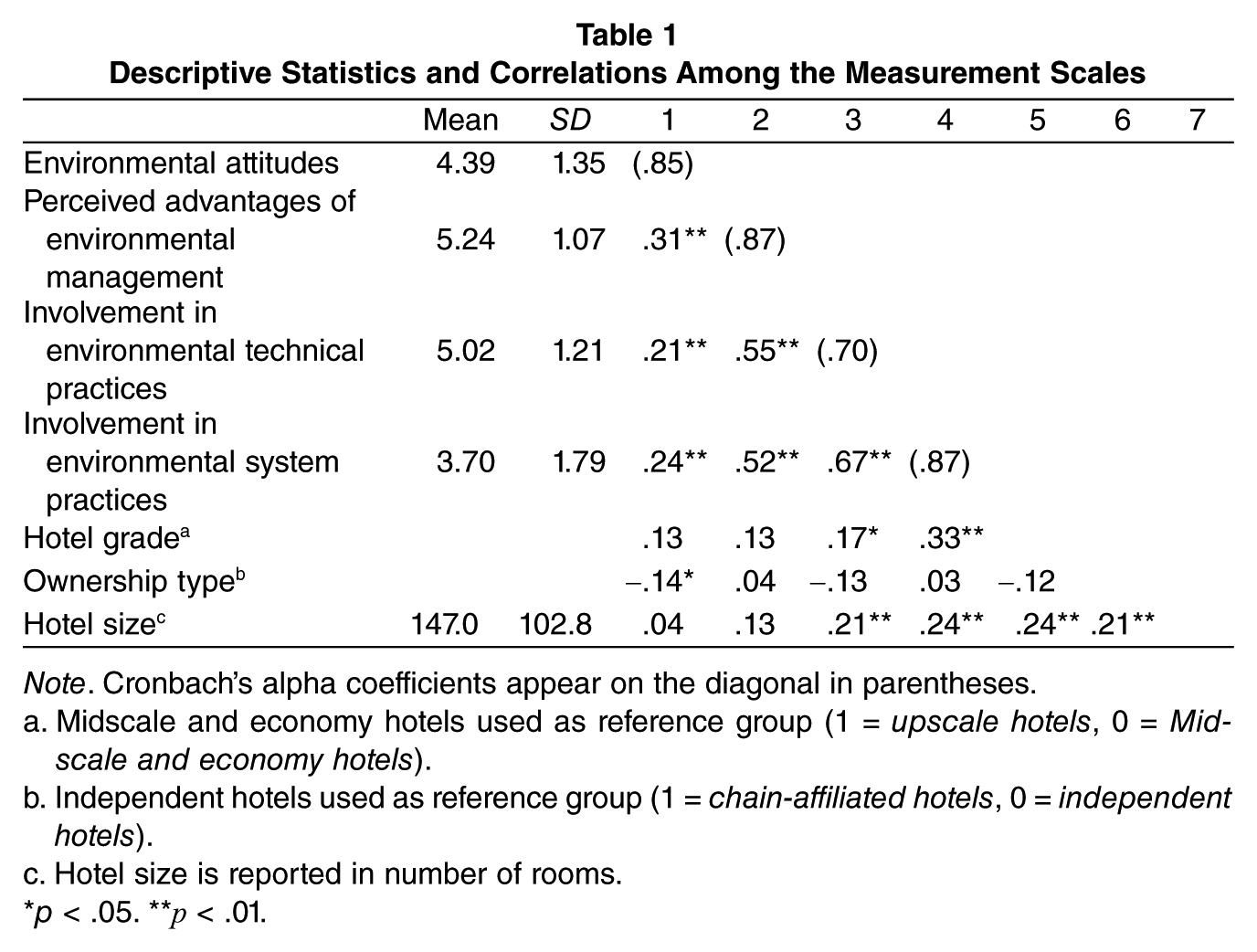
Note. Cronbach’s alpha coefficients appear on the diagonal in parentheses.
Midscale and economy hotels used as reference group (1 = upscale hotels, 0 = Midscale and economy hotels).
Independent hotels used as reference group (1 = chain-affiliated hotels, 0 = independent hotels).
Hotel size is reported in number of rooms.
p < .05. **p < .01.
Confirmatory Factor Analysis for Measurement Items
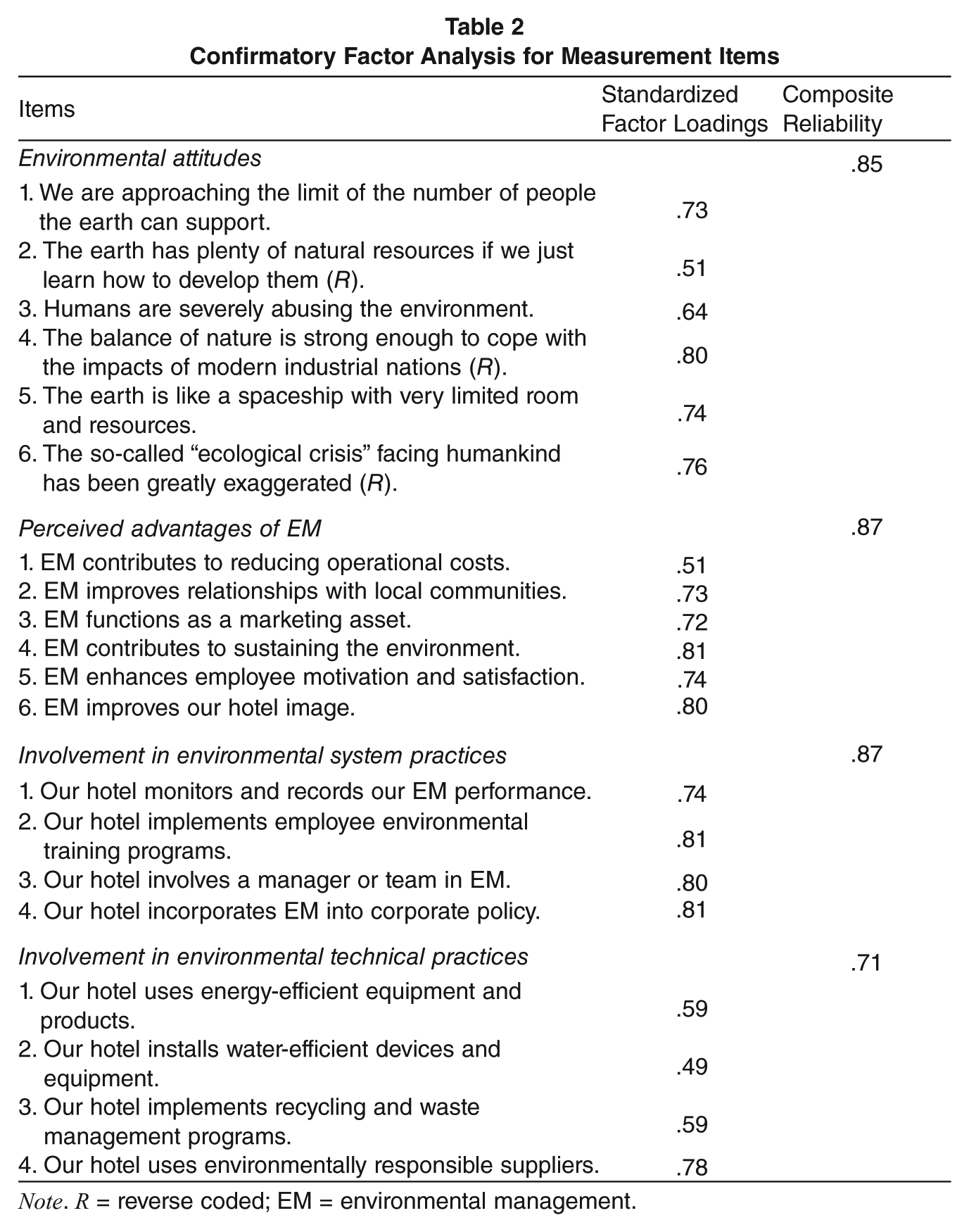
Note. R = reverse coded; EM = environmental management.
However, three correlations were moderately high: between technical and system practices (r = .67), between advantages of EM and technical practices (r = .55), and between advantages of EM and system practices (r = .52). For these occasions, it is worth conducting formal χ2 difference tests. SB-scaled χ2 difference tests were used because of the identical reason explained earlier (nonnormal distributions of selected items; Muthén, & Muthén, n.d.; Satorra & Bentler, 2001). To perform χ2 difference tests, three nested models were estimated and compared to the proposed four-factor model. In the first nested model, technical and system practice constructs were loaded on a single factor, thereby producing a three-factor measurement model. The fit indices of this nested model were significantly worse than the original four-factor model with a significant chi-square difference (SB-scaled Δχ2 = 21.13, Δdf = 3, p < .001). The above results indicate that the two constructs (technical and system practices) are rather distinct. Similarly, the second nested model (EM advantages and technical practices as one factor) and the third nested model (EM advantages and system practices as one factor) were estimated. Significant chi-square differences were found between the second nested model and the initial measurement model (SB-scaled Δχ2 = 58.48, Δdf = 3, p < .001) and between the third nested model and the original model (SB-scaled Δχ2 = 133.99, Δdf = 3, p < .001). The fit indices of the second and third nested models (three-factor models) were worse than the original model (four-factor model), suggesting distinctiveness between EM advantages and technical practices and between EM advantages and system practices, respectively. Altogether, discriminant validity of the study constructs was supported.
Because the data in this study were collected from a single source (i.e., common rater) per unit of analysis, common method variance may present a problem. Harman’s single-factor test is one of the most widely used approaches to diagnose common method variance (Podsakoff, MacKenzie, Lee, & Podsakoff, 2003). To perform Harman’s single-factor test, all observed variables in the study are subject to exploratory factor analysis. Common method variance is assumed to exist if (a) a single general factor emerges from unrotated factor solutions or (b) a first factor accounts for the majority of variance in the measures. For the present data, in Harman’s test, four factors, with eigen values greater than one, emerged and the first factor explained only 25% of the total variance, indicating that common method variance is not the major source of the variance in the measurement items.
Structural Model and Hypotheses Testing
In the structural model, environmental attitudes have six indicators and perceived advantages of EM also have six indicators, both using the scores of their own measurement items. For hotel companies’ EM involvement, using a partial aggregation technique (Bagozzi & Edwards, 1998), the item scores of environmental technical and system practices were each averaged and used as two indicators of EM involvement. The two parceled items (technical practices and system practices) loaded significantly on the associated factor (hotel companies’ involvement in EM) with standardized factor loadings of .80 and .82, respectively.
The structural model was tested using SEM with maximum likelihood estimation because the item parceling corrected for nonnormality of the data. The proposed, structural model provided an adequate fit to the data: χ2(114) = 213.43, p < .05; CFI = .93; TLI = .91; RMSEA = .066; SRMR = .07. Table 3 displays the results of structural path estimates. First, three control variables (sizes, grades, and ownership style) had significant (p < .05) or marginally significant (p < .10) relationships with hotels’ involvement in EM (sizes, β = .21, p < .01; grades, β = .15, p < .05; and ownership type, β = −.11, p < .10). Larger hotels, upscale hotels, and independent hotels were found to be more involved in EM activities.
Structural Path Estimates for the Proposed Model
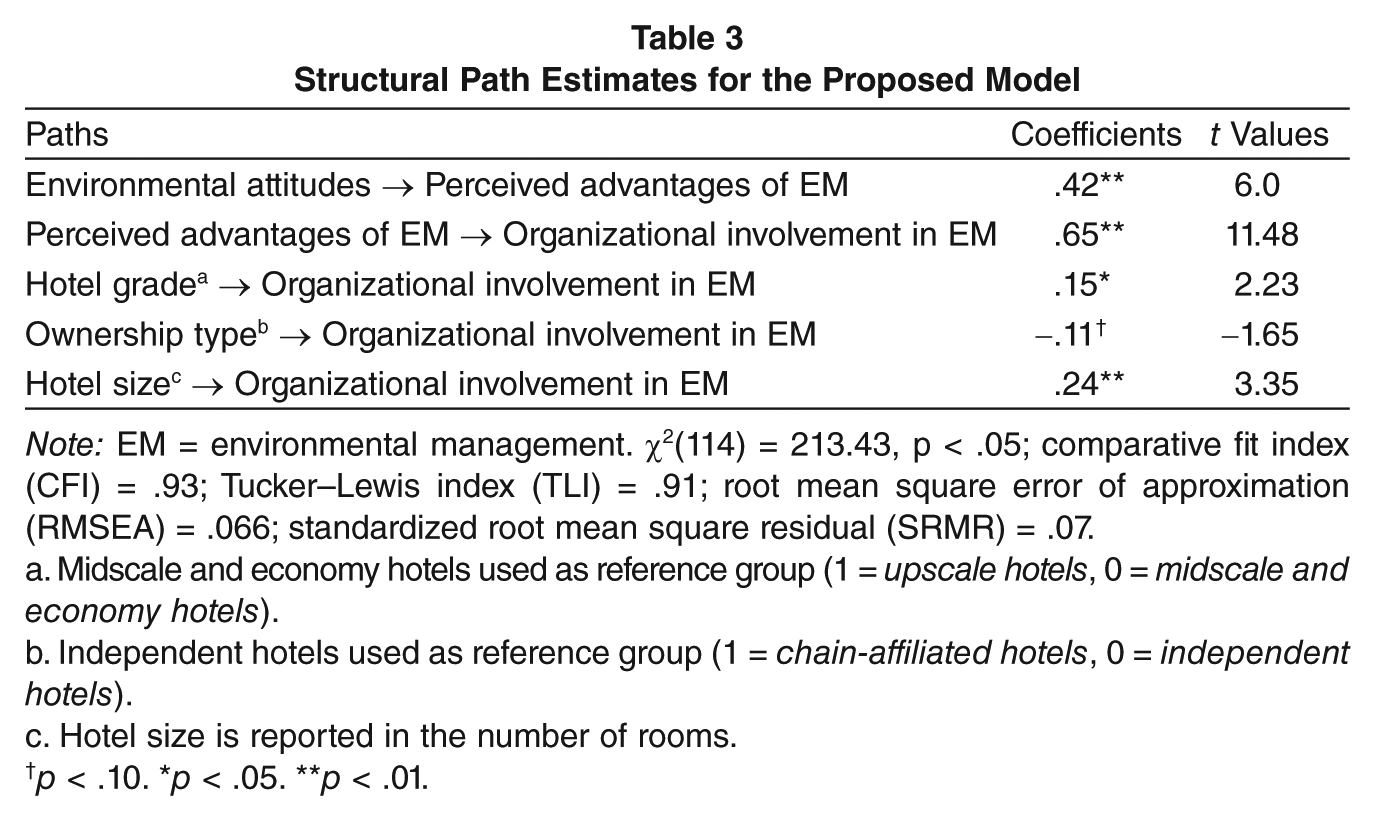
Note: EM = environmental management. χ2(114) = 213.43, p < .05; comparative fit index (CFI) = .93; Tucker–Lewis index (TLI) = .91; root mean square error of approximation (RMSEA) = .066; standardized root mean square residual (SRMR) = .07.
Midscale and economy hotels used as reference group (1 = upscale hotels, 0 = midscale and economy hotels).
Independent hotels used as reference group (1 = chain-affiliated hotels, 0 = independent hotels).
Hotel size is reported in the number of rooms.
p < .10. *p < .05. **p < .01.
The first hypothesis predicts a positive relationship between top managers’ environmental attitudes and perceived advantages of EM. Hypothesis 1 was supported as environmental attitudes were significantly related to perceived advantages (β = .42, p < .01). The second hypothesis concerning a positive relationship between top managers’ perceived advantages of EM and hotel companies’ EM involvement was also supported. After controlling for the effect of three control variables (sizes, grades, ownership style) on organizational EM involvement, the path coefficient from perceived advantages to organizational EM involvement was significant (β = .65, p < .01). In total, the five explanatory variables (three controls, environmental attitudes, and perceived advantages) explained 52% of the variance of organizational involvement in EM (R2 = .52, p < .01).
Hypothesis 3 states the mediating role of perceived advantages of EM between top managers’ environmental attitudes and organizational EM involvement (attitudes → advantages → EM involvement). This hypothesis was tested by comparing the proposed model (full mediation) with an alternative model (partial mediation). For the alternative model, a direct path from environmental attitudes to organizational EM involvement (attitudes → EM involvement) was added (see Figure 1). If the direct path from the predictor (attitudes) to the outcome (EM involvement) is significant, a partial mediation holds true; and if the direct path is not significant, a full mediation is true (Baron & Kenny, 1986). The direct path from environmental attitudes to EM involvement was not significant and primarily, the indirect effect of environmental attitudes on EM involvement (via advantages) was significant (β = .28, p < .01). A nonsignificant χ2 difference between the alternative model and the original model (Δχ2 = .04, Δdf = 1, p > .05) further signified no or minimal contribution of the additional direct path to the model fit. Consequently, the original full mediation model (Hypothesis 3) was supported.
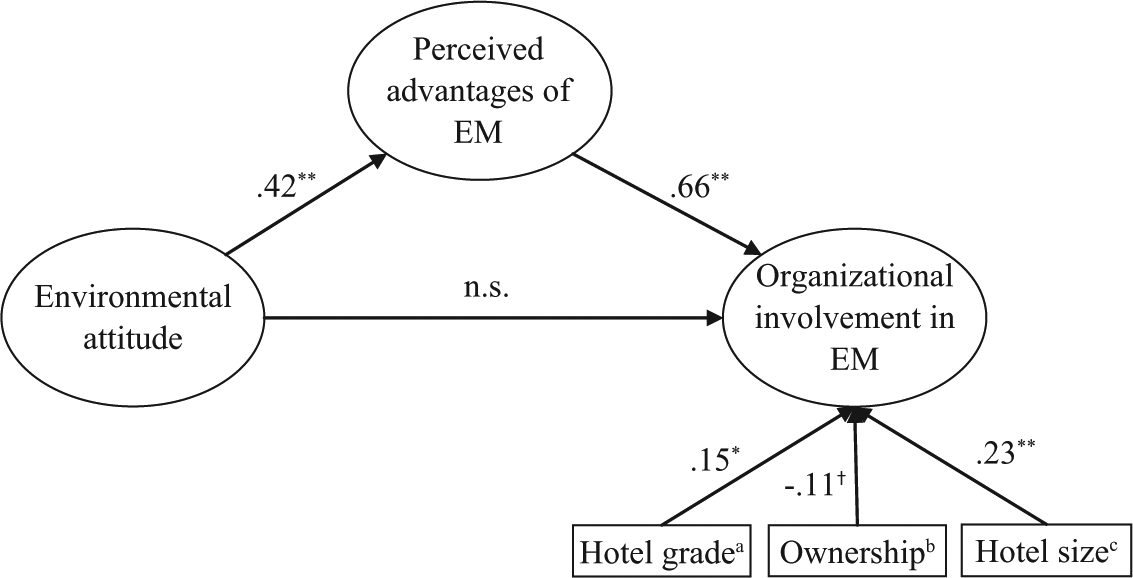
Test of the Mediation Model
Discussion
Despite a common belief that the perceptions of environmental issues by top managers are a primary force for organizational environmental responsiveness (Sharma, 2000; Starik & Rands, 1995), top managers’ perceptions regarding environmental issues have not received enough empirical scrutiny. Because of the difficulty to approach top managers, previous research has relied on the information obtained from more accessible managerial positions such as operations managers, marketing managers, or environmental managers of the company (El Dief & Font, 2010, 2012; Henriques & Sadorsky, 1999; Murillo-Luna, Garcés-Ayerbe, & Rivera-Torres, 2008). Although these managers may be able to provide the information on the current status of EM in their organizations, what has triggered environmental discourse and initiatives within their organizations may not be fully understood without considering the discretion of top managers. In spite of the low response rate, the number of responses collected from top managers is pretty substantial and the hard-to-obtain nature of the top managers’ data makes the result of this study valuable. This study also makes a contribution to the existing hospitality and tourism EM literature by providing the perspective of U.S. senior hotel managers as most published articles have disclosed European hoteliers’ perspective on EM (e.g., Bohdanowicz, 2005; Bonilla-Priege et al., 2011; Kirk, 1998).
Although extensive research in the field of environmental psychology has long supported the idea that one’s general belief about the natural environment guides environmental behavior (Stern, Dietz, Abel, Guagnano, & Kalof, 1999), limited research has been conducted to test the applicability of the theory of environmental attitude–behavior consistency in the large organizational context. This study shows the theory as a viable framework for addressing organizational environmental behavior using hotel companies, which is another contribution of this study.
The theory of environmental attitude–behavior consistency is applicable in the large organizational context through the upper echelons perspective. Simply put, the personal characteristic of upper echelons, namely environmental attitude in this study, leads to organizational environmental behavior. Finkelstein and Hambrick (1990) contend that the effect of managerial discretion is more salient in the industries with higher demand instability, more product differentiability, and less government regulation. Lodging operations fit into the category. The hotel industry is loosely regulated and consists of many small businesses, competing fiercely under a high level of demand fluctuations and trying to offer differentiated services. This study reveals that 52% of the total variance is explained by the proposed model. Although the total variance encompasses the effect of control variables, the large percentage of the variance explained suggests a fairly solid empirical support for the theory of upper echelons, which is the backbone of this article. In other words, as with many other strategic judgments, the decision on hotels’ EM appears to be affected by managerial discretion of upper echelons. This outcome, in a sense, goes along with the finding of Tzschentke et al. (2008): Hotel owner managers’ ethical concern for the environment is one of the main drivers for adopting EM. Both (Tzschentke et al.’s study and this study) fundamentally address the central role of upper echelons in hotel companies’ EM involvement.
Third, this study adds to the literature by further introducing a feasible mediator (perceived advantages of EM) between top managers’ environmental attitudes and hotels’ EM involvement. According to the result of this study, top managers with a higher level of proenvironmental attitude seem to be more receptive to the benefits of EM, thereby leading their organizations to a greater level of involvement in EM. At the same time, the logic suggests that although the benefit of adopting EM is evident, top managers who are insensitive to the environment with a high level of anthropocentricism may discount the benefits. Basically, top managers’ responses to the information on likely benefits or positive consequences of green programs may differ depending on intrinsic personal beliefs about the natural environment.
Last, it is not the focus of this study, but it is worth discussing the relationships between EM and three control variables (sizes, grades, and ownership type). To ensure the results of SEM, we performed additional analyses (analysis of variance and post hoc tests) and the results of analysis of variance and SEM are comparable. As for hotel sizes and grades, their effects on EM are consistent with the previous research (e.g., Álvarez Gil et al., 2001). Specifically, larger hotels show more EM involvement than smaller properties (large hotel > medium hotel > small hotel) and upscale hotels are more active in EM than midscale and economy hotels (upscale > midscale and economy).
The puzzling outcome comes from ownership type. Unlike our expectation, independent hotels showed more engagement in EM than chain-affiliated hotels. Further analyses revealed a slightly higher distribution of upscale hotels among independent hotels than chain-affiliated hotels although overall, independent hotels are somewhat smaller sized than chain hotels. We speculate that a moderate effect (p < .10) of ownership style in the opposite direction may be the reflection of a slightly larger portion of upscale properties among independent hotels. Chain hotels may not necessarily initiate EM unless there is a directive from the headquarters. Independent hotels embracing EM, however, most likely volunteered it. From that perspective, independent hotels may more polarize in terms of interest in EM and because of the nature of this study, more upscale, independent hotel practitioners, who have higher interest in EM, may have participated.
Managerial Implications
This study presents a couple of practical implications for hotel companies and governing bodies for greening activities. Currently, many hotel chains are making strong endeavors to promote environmental proactivity in order to differentiate themselves from competitors. Local governments also are encouraging hotels to be more responsive to environmental initiatives by offering incentives or legislating environmental regulations. Hotel top managers such as GMs or owners in small properties are the ones who make the final decision on business policies pertaining to EM for their company. The direct effect of top managers’ perceived advantages of EM on hotels’ EM involvement sends a crucial message. For hotel top managers to act on EM more favorably, they should be given plenty of information. Detailed and practical information about the feasibility and benefits of different green practices likely are helpful. For example, learning success stories of peer hotels and speaking to other peer hoteliers regarding dos and don’ts of EM can be effective.
However, as noted earlier, top managers’ personal environmental attitudes influence their perceptions (i.e., perceived advantages of the green program). Therefore, the foremost question remains as to how to foster or shape proenvironmental attitude. Arcury and Christianson (1990) assert that “critical environmental experience can accelerate change in environmental worldview” (p. 404). For hoteliers to become more ecocentric and sensitive to the natural environment, well-structured education, designed by hotel associations, local governments, or the headquarters of hotel companies, is recommended. Top managers may never experience it, but can imagine the negative consequence the damaged natural environment may bring to our lives. It is difficult to change one’s attitude. However, ongoing environmental education is likely to keep hoteliers alert to the environmental issue and move them slowly to develop a more ecocentric attitude.
Limitations and Future Research
Despite all the merits of this study presented in the “Discussion” section, the first limitation of this study originates from a low response rate. The low response rate from top managers indicates that it may be necessary to provide suitable incentives to encourage participation of top managers in the future. Top managers’ daily schedule is busy and hectic so that they may feel that the survey is not worth their time. Monetary or gift incentives may be used to attract managers in a low–EM interest group, and along with monetary or gift incentives, sharing results of the EM study after the project ends can be an appealing incentive for managers in a high–EM interest group.
As shown in our data collection procedure, we appear to fail to reach all proper respondents. Quite a few surveys were returned by lower level managers rather than top decision makers. To identify proper respondents in the future, it may be a good idea to seek support from regional lodging associations. Lodging associations are likely to have detailed information on the key contact person’s name and title (mostly top managers of the organization) for their member hotels in addition to the typical information posted online for general viewers. Furthermore, if the invitation e-mail can be sent in conjunction with local lodging associations, the e-mail would be less likely to be perceived as junk mail by appearing more official.
A low response rate limits the generalizability of the findings. The proposed model of this study is based on sound theories and our empirical data seem to support it. However, in the future it is worth conducting replication studies to validate the findings of this study and also possibly in different countries and cultures. The upper echelons theory basically implies a top-down approach to EM in the organization. Chan and Hawkins (2010) assert that a top-down approach to EM is more suitable for a hotel with a Chinese workforce because of Chinese cultural characteristics and, low employee involvement in the planning stage does not affect employees’ commitment to EM in Chinese hotels. Thus, it would be interesting to see if the upper echelons theory is more effective for organizational EM in Asian countries that bear Chinese culture than Western countries.
There may be a cultural difference as mentioned, but for EM to be successful in the organization for a long time, all members of the organization should continue to work together and agree on the EM policy. This indicates that in the mature stage of EM, a bottom-up approach is feasible or even necessary along with a top-down approach. As time goes, line employees are likely to build up their expertise regarding EM and turn themselves into a driving force of EM for the company, making suggestions to top managers. It would be interesting to conduct a longitudinal study using the same organization or make a cross-sectional comparison between EM beginners and EM mature companies to develop further insight into the dynamics of EM in the different stages.
Last, common method variance is one of the most frequently stated concerns in behavioral research because it may inflate the relationships among study variables (Podsakoff et al., 2003). Although common method variance is not found to be a major issue for this study using Harman’s single-factor test, it may be wise to use multiple sources or raters whenever possible to minimize the effect of common method variance. For example, instead of asking top managers about their hotel’s EM involvement, other measures showing hotels’ EM involvement (e.g., Leadership in Energy and Environmental Design certification) can be used to assess individual hotels’ environmental activities.