



Abstract
Customers, increasingly, seem concerned about social and environmental issues that often affect their buying behavior and attitudes toward the quality of goods and services purchased. Despite this trend, there exists little empirical research regarding how socially responsible consumers evaluate services and service quality. In this study, we investigate the role that consumer attitudes toward social responsibility play in evaluating service quality. The results of factor analysis show that social responsibility is a salient dimension of service quality and that high socially responsible customers use the concept of social responsibility more pronouncedly than others when evaluating service quality. Our study contributes to the current literature on the evaluation of service quality by a growing customer segment and outlines implications for managers and for future research.
Keywords
Introduction
Numerous books and articles have been written on socially responsible consumers, who comprise a growing segment of the economy. Nielsen reports that two thirds (66%) of consumers around the world say that they prefer to buy products and services from companies that have implemented programs that give back to society (Nielsen, 2012). These consumers are concerned not only with embedded product or service attributes but also issues such as ethical conduct toward employees and customers and environmental matters like global warming and pollution. Some authors claim that the green consumer is now not only mainstream but that 84% of general consumers have purchased some form of green products in the past 3 years and that not only companies but also venture capitalists, media, and the government are highly encouraging of green initiatives (Ottman, 2011). Others claim that the ethical consumer is a myth, that consumers may think that they desire ethical products and services but do not necessarily vote for such products with their wallets (Devinney, Auger, & Eckhardt, 2010). Although there is little consensus on this issue, extant research focuses on products that have tangible attributes (fair trade coffee, green cleaning products, clothing produced via fair labor practices), and we know little about how consumers, especially socially responsible consumers, evaluate services produced and consumed. Not only are services, like hospitality and tourism, a major sector of the U.S. economy, but services are increasingly gaining importance even as part of the product offering (Vandermerwe & Rada, 1988). Executives often understand the need to maintain good service quality but find it difficult to do so, due to the absence of a universal benchmark that service performance can be compared with because of varying levels of customer expectations. In this article, we explore and attempt to provide a scale that can be used to measure the dimension of social responsibility as a part of service quality.
To judge whether an organization provides a good quality of service, customers will compare what they perceive with what they expect (Oliver, 1980; Parasuraman, Berry, & Zeithaml, 1991; Parasuraman, Zeithaml, & Berry, 1988, 1994). Many models and theories to measure service quality have been introduced in the past 30 years. Parasuraman et al. (1988) originally developed the most commonly used model known as “SERVQUAL,” which consisted of five dimensions. Several scholars since then have challenged and refined the SERVQUAL model, although the degree and direction of the challenge varied. Some believed that this model was not reliable and valid enough to measure service quality (Cronin & Taylor, 1992, 1994; Teas, 1993), whereas others argued that there should be more or fewer dimensions in the model (Finn & Lamb, 1991; Kasper, Helsdingen, & Vries, 1999). Sureshchandar, Chandrasekharan, and Anantharaman (2002), while identifying the critical factors of service quality from the customer’s perspective, find that SERVQUAL instrument does not address certain important constituents of service quality such as “the image or goodwill a service firm could establish for itself in terms of being responsible to the society in which it operates” (p. 9). Many scholars agreed with the principle of SERVQUAL dimensions and scales, but proposed that there should not be a universal instrument to measure service quality for all types of companies in the service sector. Specifically, Augustyn and Seakhoa-King (2005) evaluated the potential of the scale and concluded that SERVQUAL is necessary but insufficient in assessing the quality of complex services such as those found in the leisure, tourism, and hospitality sectors, which require the application of a range of measures that collectively contribute to the identification of quality levels. As a result of the latter, many adapted and modified SERVQUAL models can be found in the literature that are applied to diverse industries including hospitality sectors ranging from casinos (Wong & Fong, 2012), to travel agents (Lam & Zhang, 1999), to theme parks (Tsang, Lee, Wong, & Chong, 2012), and to hotels (Juwaheer, 2004).
We contend that SERVQUAL, although useful and adaptable across a wide range of service industries (via modification of terminology used in the survey instrument as originally suggested by Parasuraman et al., 1988), lacks a dimension that some customers, whom we refer to as “socially responsible,” currently utilize to measure service quality. In particular, one apparent concern of these customers is how companies take care of their stakeholders (e.g., employees, community, environment, and customers). Although it may be a reasonable assumption that customers in general perceive service quality based on similar dimensions, research has shown that certain factors, like culture, for example, may influence customer evaluations of service quality (Mattila, 2000). Similarly, we believe that there may be a unique segment of customers who may evaluate service quality with additional criteria based on their beliefs. That is, customers who are socially responsible are likely to expect services performed by service providers in a socially responsible manner, and the traditional service quality dimensions may not capture the full expectations of such customers. Therefore, we seek to determine whether the dimensions depicted in service quality measures can be used across customer segments differentially. Specifically, we postulate that customers who are highly (high) socially responsible evaluate service quality such that they use a higher social responsibility dimension when judging the quality of services provided when compared with consumers who are less (or not) socially responsible. Based on confirmatory factor analysis (CFA), we find support for our hypotheses that predict that social responsibility is a salient dimension of service quality and that high socially responsible customers evaluate service quality with a stronger magnitude of social responsibility than low socially responsible customers.
Our study makes several contributions to the literature. We explore the nuances of what it means to manage services responsibly and from a consumer perspective what socially responsible purchasing and evaluation of services looks like. That is, we uncover the specific aspects of ethical or social attributes that customers pick up on regarding the myriad activities that firms perform, and the brand promises that companies make about their services. Our nuanced, empirically based testing of customer perceptions is novel not only because we introduce the dimension of social responsibility to the measurement of service quality and its perception by customers, but by differentiating between high and low socially responsible customers, we offer another base for market segmentation that can help managers reach target markets. In addition, researchers can test the measures we provide in different industries to serve service providers that vary based on their social and environmental impact.
The rest of the article is organized as follows: we review the literature and develop the hypotheses in the next section; then we describe our methodology and report the results of the empirical analyses; finally we discuss the study’s implications, limitations, and the extensions for future research.
Literature Review and Hypotheses
Service Quality
With respect to service quality, researchers have suggested various dimensions as criteria for evaluation. Gronroos (1990) suggested that there are six dimensions of good perceived service quality: professional and skills, attitudes and behavior, accessibility and flexibility, reliability and trustworthiness, recovery, and reputation and credibility. Perhaps the most widely accepted dimensions are those introduced by Parasuraman, Zeithaml, and Berry (1985, 1988), who suggested in 1985 that there are 10 dimensions customers use to evaluate services quality. Later in 1988, Parasuraman et al. redefined their proposed dimensions, collapsing them to five dimensions: Tangibles, Reliability, Responsiveness, Assurance, and Empathy. In addition, they developed an instrument to measure service quality through these five dimensions, called “SERVQUAL.” Scholars have proposed several models that have modified, adapted, or completely revised the models proposed by Parasuraman et al. (1985) based on service attributes, delivery, performance, and sector, improving on the gaps and limitations of the original model (for a review of 19 such models, see Seth, Deshmukh, & Vrat, 2005). Cronin and Taylor (1992) developed a performance-only measurement model of service quality called SERVPERF by illustrating that service quality is a form of consumer attitude, and the performance-only measure of service quality is a better means of measuring service quality. They argued that SERVQUAL may confound the constructs of customer satisfaction and attitude, maintaining that performance instead of the “performance-expectation” gap determines service quality. Despite criticisms, SERVQUAL, with its various modifications and derivations for industry sectors, is still the most commonly used instrument in the service industry today.
Social Responsibility
Carroll (1999) stated that the notion of corporate social responsibility (CSR) has a long and varied history, although no one has been able to identify the origin of the term. Defining CSR has been as controversial as determining its origin. Scholars have tried for years to develop a good definition and measure, but there is still no consensus on either issue (Lee, 2008; Whitehouse, 2006). Two schools of thought exist regarding to whom companies should be socially responsible. Proponents of the shareholder theory regard owners or shareholders of companies as the most important group. In other words, maximizing profits is considered the main responsibility of any business (Post, 2003). This school of thought has led to studies investigating the linkages between CSR and firm performance/profitability (Aupperle, Carroll, & Hatfield, 1985; Cochran & Wood, 1984; Wu, 2006). Proponents of the competing stakeholder theory suggest that all stakeholders of the firms, that is, employees, shareowners, customers, suppliers, are important (Carroll & Buchholtz, 2006; Heath & Norman, 2004). Even though not all stakeholder groups receive equal attention, they are all groups for which companies need to be responsible. The concept proposed in this research draws from previous literature on the latter group, specifically, the customer stakeholder (Drumwright, 1994; Mohr, Webb, & Harris, 2001).
For the purposes of this study, social responsibility of a service firm is defined as an obligation to perform the promised or contracted service legally, ethically, in an environmentally friendly manner, and at a fair price. This definition is based on two major concepts: First, social responsibility is considered an obligation, not an option (Davis & Blomstrom, 1975; J. W. McGuire, 1963). Although CSR is not universally accepted as obligatory, recent research in Bloomberg Law Reports (2008) states that CSR is a global trend, here to stay, redefining the business landscape creating new corporate obligations and risks. Similarly, Trudel and Cotte (2009) state that the era of self-interested companies trying to maximize shareholder wealth at any cost appears to have been supplanted by an era of CSR that cares for customers, employees and the environment.
Second, we used a modified version of Carroll’s (1979) four perspectives model that includes legal, economic, ethical, and discretionary dimensions of responsibility. According to this model, society sanctions business to operate according to the profit motive but at the same time expects compliance with the laws enacted by the authorities—thus businesses are expected to pursue their economic mission within the framework of the law that embodies notions of fairness and justice. Beyond that, the ethical responsibility category captures those standards, norms, or expectations that society holds regarding the treatment of stakeholders like consumers, employees, and the environment. Finally, the discretionary/philanthropic responsibilities encompass those corporate policies and actions that render the business a good corporate citizen such as engaging in programs to promote human welfare or goodwill like financial contributions.
Carroll’s (1979) model was reconceptualized as a pyramid (Carroll, 1991) where the relative weightings of the different dimensions are discussed with emphasis laid on the economic dimension. The model was further streamlined into the three core domains, that is, the economic, legal, and ethical, by Schwartz and Carroll (2003) with the philanthropic domain merged into the ethical domain. Although the legal and the economic dimensions can be seen as mandatory, that is, the law may set the minimum standard of activities, and noneconomic performance can lead to dissolution of the firm, the ethical and discretionary components are considered the more voluntary dimensions of Carroll’s model. Carroll and Buchholtz (2006) state that “economic responsibility means that each company should produce goods or services that society wants and sell them at
Scholars have developed a number of CSR measures based on varying definitions (Carroll & Buchholtz, 2006; Hopkins, 2005). Instruments such as the Fortune data (J. B. McGuire, Sundgren, & Schneeweis, 1988), the Domini Social Index (Statman, 2000), the PRESOR Index (Singhapakdi, Vitell, Rallapalli, & Kraft, 1996) have all been used as measures of social responsibility. Moreover, researchers in different countries tend to measure CSR in different ways (Márquez & Fombrun, 2005). Despite this plethora of CSR measures, some researchers still believe that more reliable and valid instruments need to be developed (Panwar, Hansen, & Kozak, 2014).
There is research that links a firm’s CSR initiatives to perceptions of service quality. For example, Poolthong and Mandhachitara’s (2009) study on the Thai banking sector demonstrated that social initiatives play an important role in perceived service quality, which in turn, influenced trust and brand loyalty. Similarly, de los Salmones, Crespo, and del Bosque (2005) found that in the Spanish mobile service market perceptions of socially responsible behavior positively affected the overall evaluation of service, whereas He and Li’s (2011) study, based on a survey of customers, also in the telecommunications sector, found that that both CSR and service quality had direct effects on brand identification and customer satisfaction, and service quality enhanced the effect of CSR on brand identification. Although these studies have tried to link perceptions of service quality with socially responsible actions of the company, social responsibility has not been conceptualized as a dimension of service quality based on which consumers can be segmented (Sureshchandar et al., 2002). Since socially responsible consumers are a growing and important stakeholder group that consumes a variety of goods and services, they will evaluate service quality in unique ways; specifically, they will expect firms to provide services produced in a socially responsible manner.
Socially Responsible Consumers
Socially responsible customers are not a new customer segment. Studies investigating the customer group date back to the 1970s (Berkowitz & Lutterman, 1968). Research focusing on profiling this segment has extended over the past 40 years (Vassilikopoulou, Siomkos, & Mylonakis, 2005). Since this interest in socially responsible customers appears dominantly in the discipline of marketing, most, if not all, studies on the topic tended to revolve around customers’ decision and buying behaviors (Creyer, 1997; Singhapakdi, 1999). Very little research has been conducted regarding this socially conscious segment in the management and the service quality literature. Bastič and Gojčič (2012) investigated tourist ecological expectations of spas and hotel wellness services and found that hotel staff’s ecobehavior, environmentally friendly and healthy equipment, efficient use of energy and water, and bio-food were four dimensions of the eco-component of service quality. Khan (2003) examined service quality expectations of eco-tourists and reported that eco-tourists expected businesses to be environmentally friendly and preferred services that were courteous, informative, and trustworthy.
Many scholars have defined socially responsible or socially conscious customers. Webster (1975) defined the socially conscious customers as “a customer who takes into account the public consequences of his or her private consumption or who attempts to use his or her purchasing power to bring about social change” (p. 188). Mohr et al. (2001) defined a socially responsible customer as “a person who is basing his or her acquisition, usage, and disposition of products on a desire to minimize or eliminate any harmful effects and maximize the long-run beneficial impact on society” (p. 47). Roberts (1995) viewed ecologically concerned customers as a subset of socially responsible customers. As such, he defined the socially responsible customer as “one who purchases products and services which he or she perceives to have a positive (or less negative) impact on the environment or uses his/her purchasing power to express current social concerns” (p. 98). This ecological-conscious group is concerned about the impact of services or products on the environment and other social issues. A more recent and comprehensive definition comes from Devinney et al. (2010), who define consumer social responsibility as the “conscious and deliberate choice to make certain consumption choices based on personal and moral beliefs” (p. 9). The authors parse out two components of this definition, the “social” component of the company’s products and processes and the “consumerism” component that refers to the preferences and desires of consumer segments that affect the social factors.
Although this socially responsible customer segment was believed to be small, Webster (1975) suggested that its size was, even then, large enough to warrant investigation. Webster’s idea has been supported by continuing studies on this customer segment that marketing researchers and practitioners have conducted over the past five decades (Memery, Megicks, & Williams, 2005; Webb, Mohr, & Harris, 2008). For market segmentation purposes, researchers have tried to profile socially responsible customers for higher profitability (Ottman, 2011). Although the relationship between demographic characteristics and socially responsible attitudes has been studied, results have shown that demographic attributes alone cannot be used as predictors of socially responsible customers (Roberts, 1996). Nevertheless, many researchers have found that socially responsible customers share certain attributes including having a high level of education, high income, a prestigious occupation, and belonging to the upper middle class (Memery et al., 2005).
Additionally, a number of scales have been developed to identify socially responsible customers. The first widely used scale in the literature of socially responsible customers was the Socially Responsible Scale developed by Berkowitz and his colleagues (Berkowitz & Daniels, 1964; Berkowitz & Lutterman, 1968). More recent scales include the Socially Conscious Customer Index (Webster, 1975), the Socially Responsible Customer Behavior Scale (Roberts, 1996), and the Self-identified Socially Responsible Customer Behavior Scale (Webb et al., 2008).
Another approach that can be used to identify socially responsible customers is through measuring their attitudes toward the company from which they buy products or services. Singhapakdi and LaTour’s (1991) study suggested that social responsibility behavior can be predicted by socially responsible consumption behavior. In other words, a customer who only patronizes socially responsible organizations is more likely to be a socially responsible individual. Many studies have been conducted using this approach to identify socially responsible customers and to explore their intentions to buy based on their attitudes (Reich, 2002). Most recently, using the psychographics segmentation approach, Barber (2013) identified “shades of green” consumers in hotels and found that they are distinct; they display identifiable characteristics and behavior patterns, such that, targeting specific strategies to particular green consumer segments can be a powerful operational tool in attracting and retaining more guests.
Based on the review of the literature, we propose two hypotheses that emanate from the twin research questions that motivate this study:
Research Question 1: Is social responsibility a salient dimension of service quality?
Hypothesis 1: Social responsibility is a salient dimension of service quality.
Research Question 2: Do high socially responsible customers use the same criteria in evaluating quality of services they receive as those utilized by their low socially responsible counterparts?
Hypothesis 2: High socially responsible customers use social responsibility in a different (higher) magnitude when evaluating service quality than low socially responsible customers.
Our conceptual model is provided in Figure 1.

Proposed Additional Dimension of Service Quality
Methodology
Population and Sample
The target population of this study was socially responsible customers. However, there is no complete list of such customers available, nor is it easy to identify them. Thus, as a starting point, a convenience sample of middle to high-end consumers residing in the south-eastern region of the United States was used. These customers shared certain attributes with socially responsible customers in terms of demographic characteristics including a high level of education, high income, and prestigious occupation as well as belonging to the upper middle class (Memery et al., 2005). Since demographic characteristics cannot be used as sole predictors of socially responsible customers, the Consumer Social Responsibility (CSR) scale (Creyer, 1997) was adopted to further identify socially responsible customers in this study. Thus, we tried to match consumers on their income, education, class, and occupation, and then compared their social responsiveness using CSR scale values. It may be noted that we call consumers high and low socially responsible even if some of the consumers may display no level of social responsibility preference.
Study Design
The study was conducted in two phases. In the first phase we posed open-ended questions to respondents identified via snowball techniques mentioned earlier to develop our social responsibility scale; we used focus groups, in-depth and semistructured interviews, and also asked several business professors who are experts in the area of social responsibility to review the scale to ensure content validity. The focus was given to the new social responsibility dimension scale because the other instruments used were validated via prior research.
In the second phase, we conducted two studies: a pilot study and the main study. The pilot study was conducted by sending out random 500 questionnaires online to persons 21 years or older via SurveyMonkey, a user-friendly web survey platform. This pilot study, which received a 13% response, aimed at verifying the reliability of the scale items as well as testing the potential response rates for the main study. Based on the comments received, the original questionnaire was revised and an invitation to complete the revised survey was sent out to 5,000 individuals randomly selected as in the pilot study. Respondents were asked to recall services, including the use of hotel and restaurant services, they had purchased within the past 3 months and evaluate the services based on the items asked on the self-administered questionnaire. A modified Dillman’s technique (Dillman, 2007) was utilized in the data collection process. Invitation e-mails with a link to the questionnaire were sent out to the selected sample, and two follow-up e-mails with a survey link were sent 1 and 2 weeks after the invitation e-mail.
Measures
The unit of measurement was customers and the unit of analysis was their perceptions toward services they have consumed. To identify socially responsible customers, the Consumer Social Responsibility scale, originally developed by Creyer (1997) and later revised by Reich (2002), was used. It consisted of five items, which were measured using a 5-point Likert-type scale (refer to Appendix Part A for a full listing of the items). The traditional five dimensions of services were measured using the SERVPERF instrument introduced by Cronin and Taylor (1992, 1994). SERVPERF is related to SERVQUAL, originally developed by Parasuraman et al. (1988), and refined in 1991, which consists of 22 seven-point Likert-type scale items. We use SERVPERF over the traditional SERVQUAL as later studies that compare the two scales have reported that the SERVPERF scale finds a more convergent and discriminant explanation of the service quality construct (Brady, Cronin, & Brand, 2002; Jain & Gupta, 2004; Landrum, Prybutok, Zhang, & Peak, 2009). In addition, a meta-analysis by Carrillat, Jaramillo, and Mulki (2007) found that SERVQUAL scales required more adaption to study contexts than SERVPERF, although both instruments had equal predictive validity.
We developed a new scale to measure the social responsibility dimension, which consisted of eight items measured on a 7-point Likert-type scale (refer to Appendix Part B for a full listing of the items). The scale items fully covered the construct of social responsibility as defined in this study. Finally, a single item was used to measure an overall service quality perception. All scales used in the main study were tested for their reliabilities and exceeded the suggested value of 0.70 (Hair, Black, Babin, & Anderson, 2010; Nunnally & Bernstein, 1994).
Data Analysis
A total of 803 surveys were returned, yielding a response rate of about 16.0%. Even though most (795) respondents completed the Consumer Social Responsibility scale, only 449 completed the items regarding service quality evaluation and personal characteristics. Of the 449 respondents, 63.3% were female and 36.7% were male. The highest percentage of respondents was between 41 and 50 years of age. Most respondents held at least a master’s degree (57.5%). A total of 136 individuals (30.6%) indicated that they had researched the social responsibility of service providers.
To test the first hypothesis, data from all completed surveys were used. Since the comparison between high and low socially responsible customers was required in the second hypothesis, the collected data were divided into four quartile groups based on scores on the CSR scale. Only the highest and lowest quartile groups were used to represent high (n = 117) and low (n = 140) socially responsible customers, respectively. Table 1 depicts t-test scores indicating that the average values of responses for each dimension between the two groups were statistically significantly different, thus suggesting that the high and low socially responsible groups were different.
The Correlations Coefficient and Descriptive Statistics
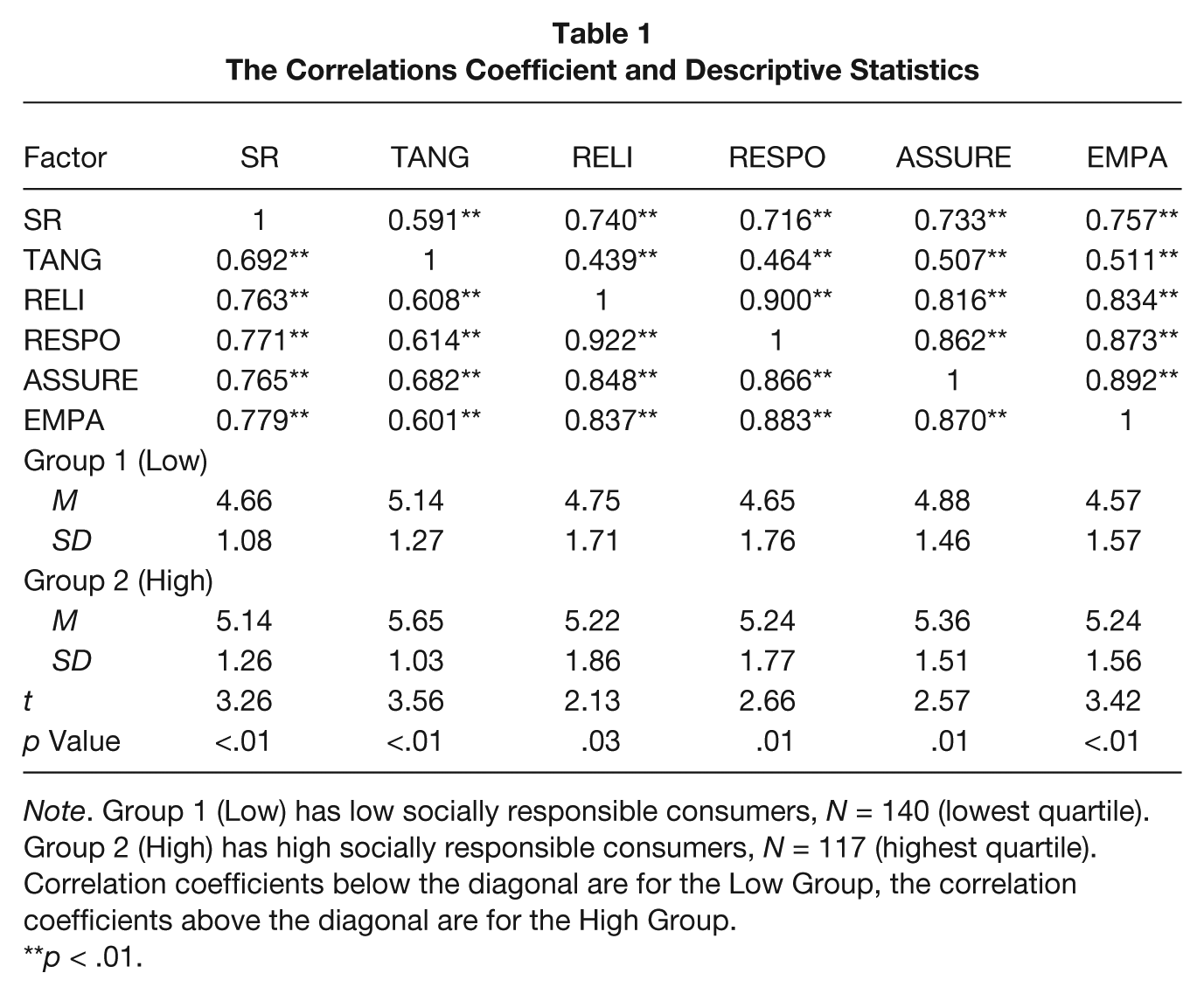
Note. Group 1 (Low) has low socially responsible consumers, N = 140 (lowest quartile).
Group 2 (High) has high socially responsible consumers, N = 117 (highest quartile).
Correlation coefficients below the diagonal are for the Low Group, the correlation coefficients above the diagonal are for the High Group.
p < .01.
Results and Discussion
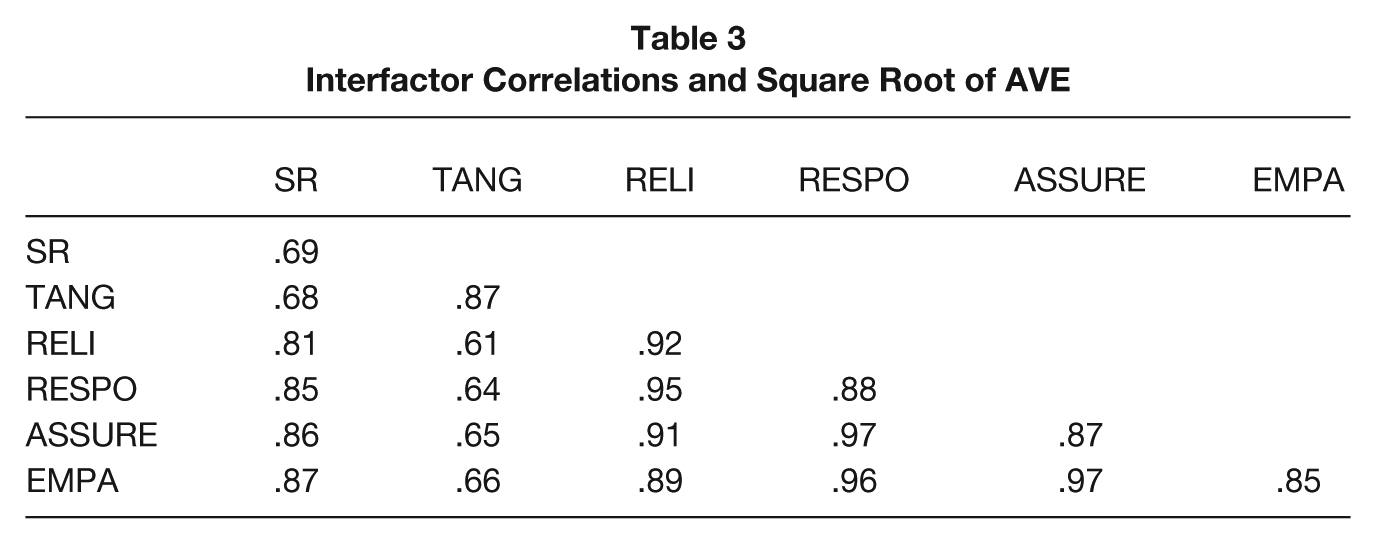
To test Hypothesis 1, which stated that social responsibility is a salient dimension of service quality, a second-order confirmatory analysis was employed. 1 The structure and measurement model is presented in Figure 2; all indicators belonged to their proposed dimensions. After some errors were correlated, the solution from the CFA revealed an acceptable model fit with χ2 = 285.18 (p = .12; df = 258); standardized root mean square residual (SRMR) = 0.022; root mean square error of approximation (RMSEA) = 0.015. The acceptable model fit is confirmed by MacCallum, Browne, and Sugawara (1996), who suggest that an RMSEA value of around 0.01 represents an excellent fit of the model, and Hu and Bentler (1998), who consider SRMR values of less than 0.08 represents a good fit of the model. The standardized estimates for all indicators were relatively large (0.55 to 0.97), which provided support for convergent validity. Table 2 shows the results of the CFA. All item parameter estimates were statistically significant at the p < .01 level. Furthermore, composite reliability for each of the six constructs (0.88 to 0.97) met the recommended level for instrument development, between 0.6 and 0.7. The average variance extracted values for all dimensions were acceptable at more than 0.50 (Hair et al., 2010), except the social responsibility dimension (0.48). Given the overall scores of these indices, the overall measurement model had high construct reliability and convergent validity (see Table 3).
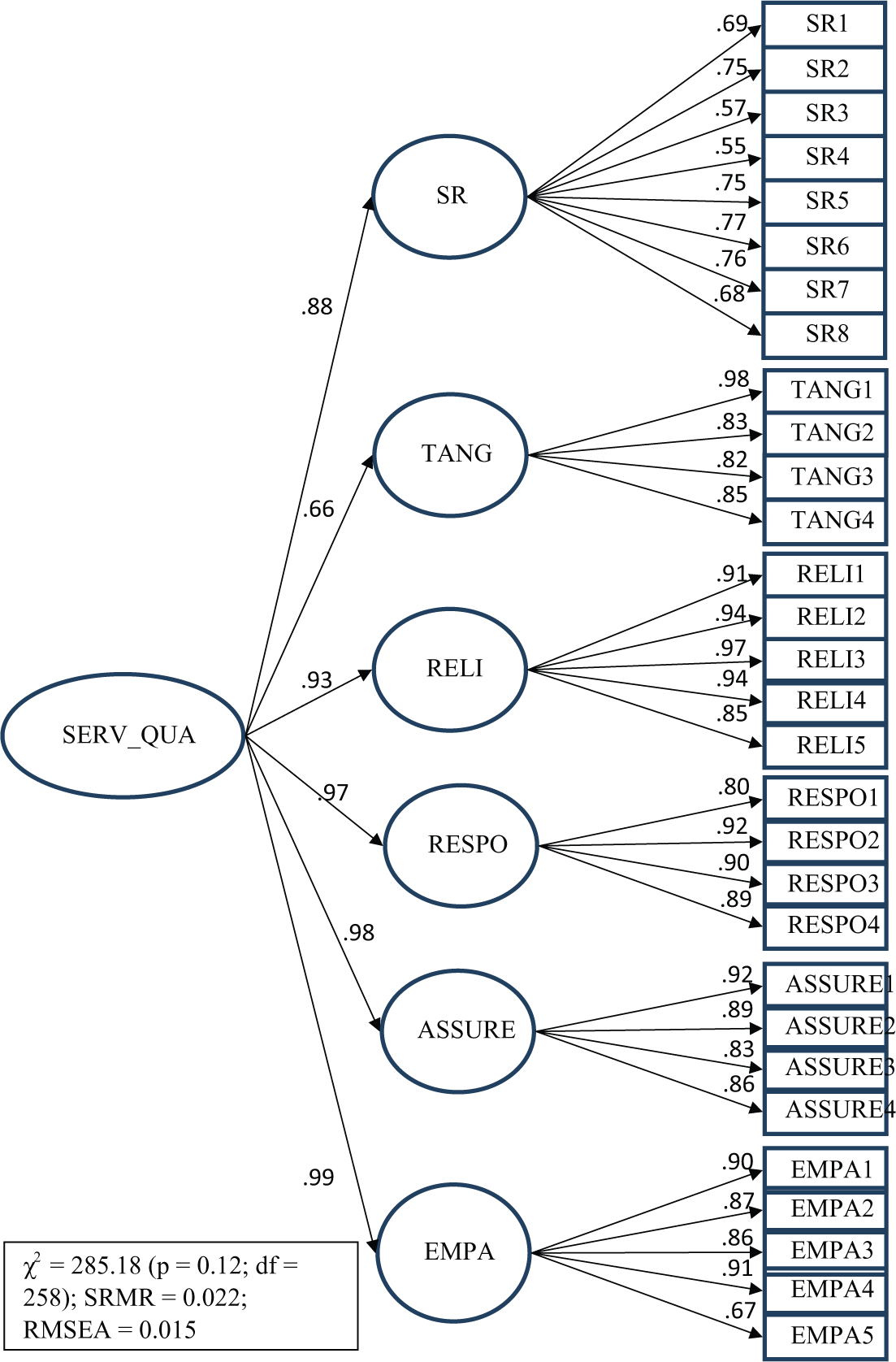
Diagram for the Second-Order Confirmatory Factor Analysis
Results of Confirmatory Factor Analysis of the 30-Item SERV_QUAL-
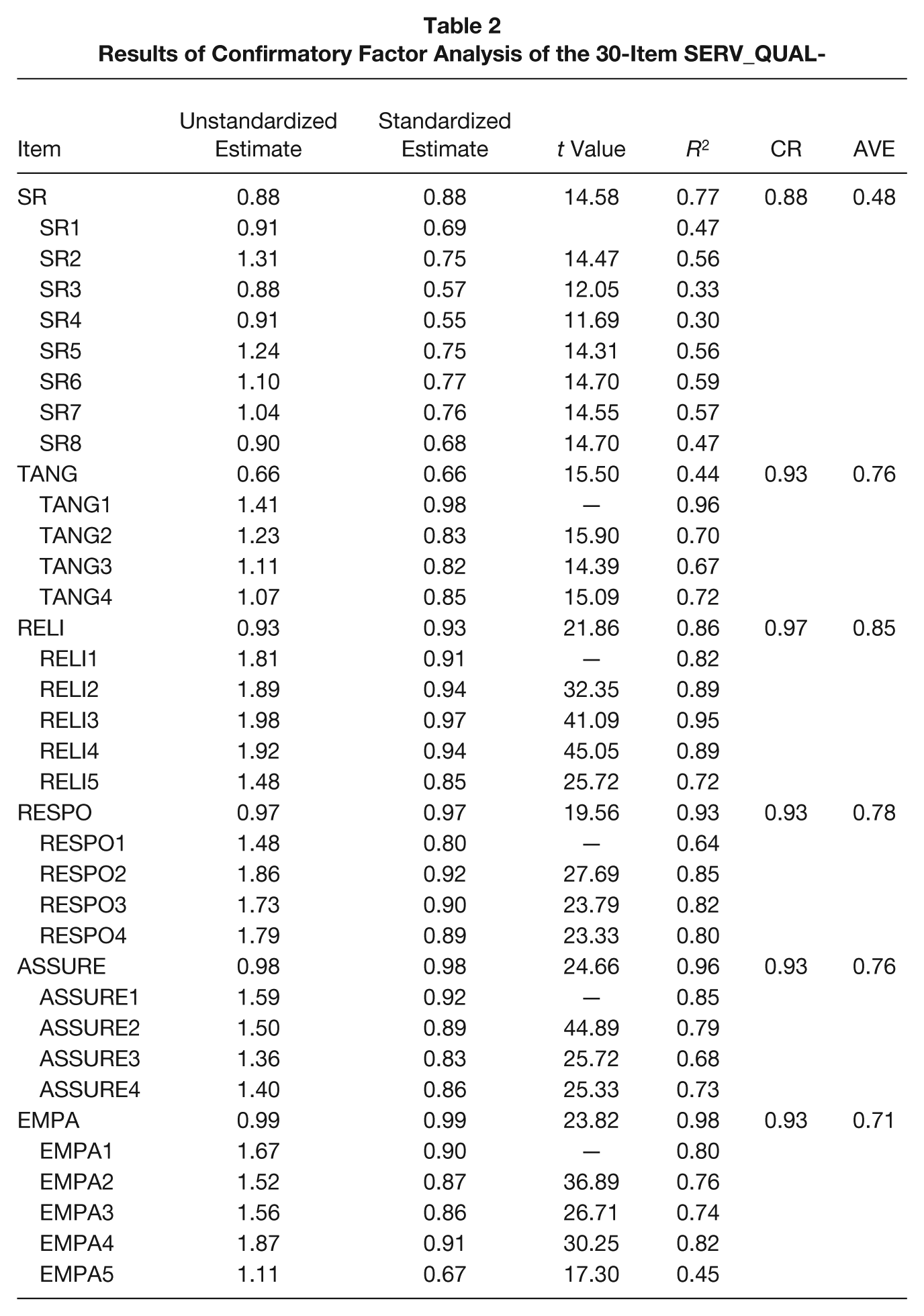
Interfactor Correlations and Square Root of AVE
Additionally, the fit statistics and measurement scale properties of the final model indicate that all the loadings of the higher factor (Service Quality) to the lower factors (six dimensions) were all statistically significant. This is supported by the high values of completely standardized solution of the loadings ranging from 0.66 to 0.99. Social responsibility dimension had a loading of 0.88. Hair et al. (2010) suggested that any loadings above 0.70 were indicative of a well-defined factor structure. All the 30 indicator loadings (scale items) were also statistically significant suggesting that they did belong to their hypothesized dimensions and all six dimensions were isolated dimensions of service quality. As such, the first hypothesis was supported. Social responsibility appears to be a salient dimension of service quality.
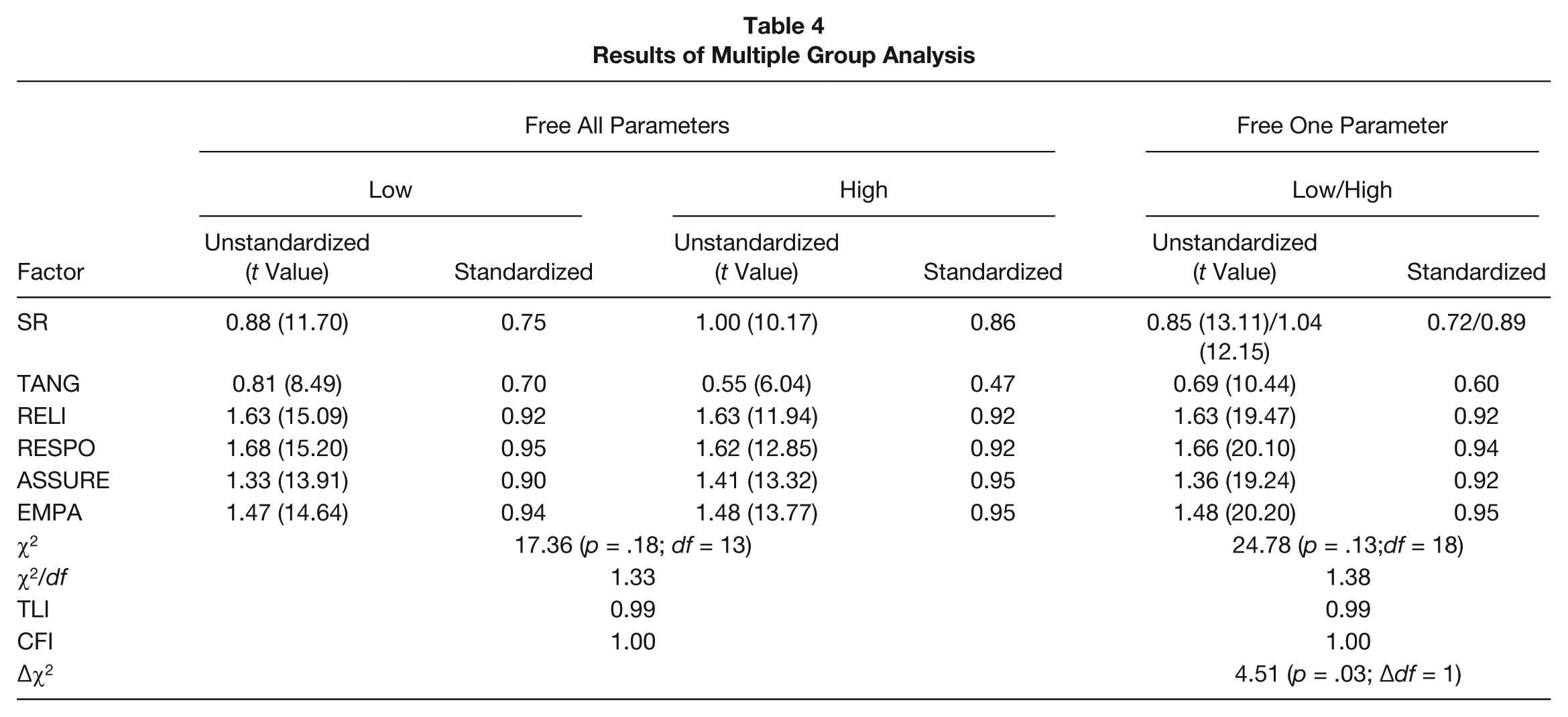
To test Hypothesis 2, which stated that high socially responsible customers use social responsibility in a different (higher) magnitude when evaluating service quality than low socially responsible customers, a multisample, second-order confirmatory analysis was employed. The first model was estimated to ascertain whether both subsamples met the condition of invariance of the measurement model. The multiple group CFA confirmed that both samples shared the same model structure supported by the good fit indices, χ2 = 17.36 (p = .18; df = 13), χ2/df = 1.33, Tucker-Lewis index = 0.99, and comparative fit index = 1.00. Then a second model was estimated where the parameters of all dimensions except social responsibility were fixed. In other words, we wanted to test if all other dimensions parameters were the same in both groups, would the parameter of socially responsible dimension significantly vary between the high and low groups? The statistically significant chi-squared change, Δχ2 = 4.51 (p = .03; Δdf = 1), supported that there was a different magnitude in social responsibility dimension between the two groups. Specifically, the high socially responsible customers (0.89) used social responsibility dimension in a stronger magnitude than their low social responsibility counterparts (0.72), providing support for Hypothesis 2 (see Table 4).
Results of Multiple Group Analysis
Implications of the Study
The numbers of socially responsible customers are growing. Their concerns affect their attitudes toward the quality of goods and services (Hurst, 2006) as well as their buying behaviors (Mohr et al., 2001; Reich, 2002). This study explored whether high socially responsible customers use different dimensions in judging service quality when compared with low socially responsible customers. We developed new scale items, with high reliability scores, to measure the social responsibility construct introduced in prior research, which can be used by other researchers conducting studies in this area. Results of our study also indicate that social responsibility is a salient dimension of service quality. That is, there are more than the five commonly understood dimensions that customers use to evaluate service quality of the service providers (based on SERVQUAL or SERVPERF). More important, the results showed that when evaluating service quality, high socially responsible customers use the concept of social responsibility more pronouncedly than low socially responsible customers.
Besides the contribution to the service quality literature in the context of socially responsible customers, the results of this study also shed more light on the extant literature regarding service quality measurement instruments like SERVQUAL and SERVPERF. First, the measurement scale for each dimension had high reliability, supported by Cronbach alpha coefficients ranging from 0.93 to 0.97. Reliability was found to be the most important dimension in the evaluation of service quality, confirming earlier studies conducted by Parasuraman et al. (1988, 1991). Additionally, though the sampling frame utilized in this study is almost equally divided between males and females, there were significantly more females (63.3%) than males (36.7%) among the respondents; women may perhaps be more socially responsible but at the very least, they are more likely than men to respond to an online survey regarding service quality.
Limitations of the Study
There are several limitations to this study that can serve as avenues for further research. First, it is very difficult to identify socially responsible customers. Due to self-perception bias even when consumers identify themselves as socially responsible, intention and behavior may differ. Although we tried to capture both high and low socially responsible consumers in the study, and socially responsible consumers in our study shared similar characteristics of socially responsible customers as suggested in the extant literature, it might not truly represent the whole population of socially responsible customers, giving rise to some concerns regarding generalization. Using a web survey platform encountered the issue of accessibility for some people. Despite having high levels of education and income, not all socially responsible customers may be computer savvy or access computers on a regular basis. A paper survey may have reached a larger portion of the group. A recall design employed by the study might be problematic as what customers remembered might not be exactly what they actually experienced at the time of service encounters. Details such as employee appearance and store accessibility might not be correctly recalled. However, we hope this exploratory study on socially responsible consumers and their evaluation of service quality based on an additional dimension will encourage further research to validate or disconfirm our findings, thus resulting in both a refinement and extension of our work, and a stream of research that will benefit socially responsible consumption of services.
Suggestions for Future Research
Future studies should consider varying some elements of the research design. For example, data may be collected right at the point of the service transactions while the customer’s service experience is still fresh in memory. Unlike in recall research, respondents could then remember details of the service encounters including servicescapes such as store accessibility. As a result, the reliability and validity of the data can be strengthened.
We also measured social responsibility as a unidimensional construct, while it is possible that different dimensions of social responsibility relate to service quality differentially. Furthermore, although service quality has been measured both reflectively and formatively in the literature (Collier & Bienstock, 2006; Dabholkar, Shepherd, & Thorpe, 2000; Parasuraman, Zeithaml, & Malhotra, 2005), we used a reflective measurement model, since the attitudes of the consumers (toward social responsibility) can affect perceptions, and thus the evaluation of service quality. It is possible that a formative measurement model in the first-order and a reflective second-order relation may result in higher model fit indices.
Additionally, researchers may choose a sample from only one sector of the service industry when conducting the study or compare across only two industries for better customer segmentation. We suggest that the hospitality and tourism industries, with their several subsectors like entertainment, leisure, airlines, hotels, restaurants, casinos, and so on, provide a fertile ground for such testing. Past research has explored consumer behavior by the impact of green initiatives on willingness to pay for green hotels and restaurants (Choi, Parsa, Sigala, & Putrevu, 2009; Namkung & Jang, 2012), or the influences of personal factors like gender, purpose of stay, and star rating of the hotel on expectations of hospitality services (Ariffin & Maghzi, 2012) but neglected customer social responsibility preference as a determinant of service quality evaluation. Similarly, while several researchers have suggested that customers use different dimensions and scale items to evaluate service quality of different service types (Khan, 2003; Thompson, Cook, & Heath, 2001), the social responsibility dimension may be more pronouncedly used in service industry types that require a long period of service encounters or intense personal interactions such as hotel stays and catering services. This issue is especially important in sectors like hospitality and tourism due to the sector’s huge economic impact where its total contribution in 2012 comprised 9% of global GDP (US$6.6 trillion) and generated more than 260 million jobs—1 in 11 of the world’s total jobs (World Travel and Tourism Corporation, 2013).
Future research can also explore the role of the discretionary or philanthropic dimension of social responsibility to capture the “halo effect” mechanism—where the sense that the brand is ethical, a symbolic attribute, moves to a more utilitarian perception of service quality and its evaluation.
Conclusion
This study provided insights into the construct of social responsibility in service quality evaluation within the context of socially responsible customer segment. Our analysis found that social responsibility is a salient dimension in the evaluation of service quality and can be used to predict variance in perceptions of service quality. Additionally, the dimension of social responsibility was used in a stronger magnitude by high socially responsible customers in evaluating service quality as compared with those indicating low social responsibility.
Providing excellent customer service along the socially responsible dimension thus will become even more important than before as consumers increasingly place a greater premium on quality customer service and especially so in industries that are subject to discretionary spending like hospitality and tourism. Consumers are increasingly asking for local foods and sustainable farming practices as evidenced by the success of the farm-to-table restaurants. Similarly, green and eco-friendly hotels and resorts where employees are treated well command higher prices and attract customers. This trend has not gone unnoticed by corporate decision-makers. An IBM survey of 1,130 global CEOs in 2007-2008 found that they planned to spend 25% more to satisfy customers concerned with social issues as a competitive necessity (Wiseman, 2008). Similarly, an American Express survey found that 70% of consumers are willing to spend an average of 13% more with companies they believe provide excellent customer service (“American shoppers spend,” 2011). Thus, if excellent customer service is evaluated via socially responsible standards by more and more customers, it behooves companies not only to train their service staff to deliver according to higher expectations but also to communicate with target customers regarding this dimension of service. Knowing how consumers will evaluate and perceive service quality is an important first step for service providers. We hope this study that has provided an initial platform will inform companies and help them initiate action to assess their service quality with respect to socially responsible customers.