



Abstract
This research presents an examination of literature written within hospitality and tourism studies and within other disciplines pertaining to virtual and hybrid meeting genres over a 10-year period (2002-2012). While 15 articles were found within hospitality and tourism journals, 67 articles were included within this review, with the majority published within refereed journals outside of hospitality and tourism. Articles were categorized by journal, year, methodology, and theme. Using the diffusion of innovation theory, five themes emerged: comparison of virtual and/or hybrid meetings with face-to-face meetings, perceptions and attitudes toward virtual and hybrid meetings, management and design of virtual and/or hybrid meetings, specific audiences for virtual and hybrid meetings, and uses of technology within virtual and hybrid meetings. These articles have been accumulated to identify gaps in the literature and provide future research recommendations within hospitality and tourism to be addressed.
Introduction
The Meetings, Expositions, Events, and Conventions (MEEC) industry significantly influences local, state, and national economies (Fenich, 2012; Lee & Back, 2005). The most recent Economic Significance of Meetings to the U.S. Economy study stated that in 2012, a total of 1.83 million meetings were held in the United States, attended by 225 million people, and adding more than $115 billion to the U.S. gross domestic product. The total economic output of these meetings totaled $770.4 billion and generated $88 billion in federal, state, and local taxes (PricewaterhouseCoopers, 2014). This information highlights the importance of the MEEC industry on the economy.
As one of the largest and fastest growing segments of tourism, meetings and conventions are advancing and adapting technology to enhance their competitiveness (Kim & Park, 2009). Meetings are therefore changing quickly as new and innovative communication and information technologies are incorporated (Chudoba, Watson-Manheim, Crowston, & Lee, 2011).
Face-to-face (F2F) meetings are still on the forefront, and virtual and hybrid meetings are quickly bringing innovative technology into the mix. Projected to increase to an $18.6 billion industry by 2015, the virtual world is greatly influencing the MEEC industry with hybrid meetings noted as the future of the meeting industry (Fryatt, Janssen, John, Mora, & Smith, 2012). Regardless, few academic studies have been conducted within this area of the meeting industry, particularly within hospitality and tourism (Pearlman & Gates, 2010).
Virtual and hybrid meetings are being seen as an enhancement to F2F meetings and are now being viewed as acceptable ways of doing business (Cain, 2011). In further support of technological acceptance within meetings, the Professional Convention Management Association (PCMA) partnered with the Virtual Edge Institute (VEI) in 2011 to launch the first certification program for the Digital Event Strategist. This certification was created due to the need for expertise in this area and for creating a standard of practice within the industry (VEI, 2011).
Meetings are defined as “events where the primary activity of the attendees is to attend educational sessions, participate in meetings/discussions, socialize, or attend other organized events” (Fenich, 2012, p. 323). Virtual meetings are defined through technology uses such as “digital events, meeting and learning technologies which include: Webcasting (streaming media), virtual environments (2D and 3D) such as virtual events, virtual trade shows, conferences, campuses, learning environments and perpetual (365 days per year) business environments” (PCMA, UBM Studios, & VEI, 2011, p. 3). A hybrid event “involves a mixture of physical events with elements of a virtual event usually running simultaneously and with overlapping content and interactive elements” (VEI, 2011, p. 1).
While hybrid meetings are the newest meeting genre, virtual meetings have been in existence for a longer period of time. In 1980, the first videoconferencing technology was offered to the commercialized market (Sheahan, n.d.), but virtual meetings did not take hold until 2002 due to improvements that were made to the technology in 2001. In 2002, virtual meetings were noted as the world’s fastest growing industry (Line, 2002). In an effort to capture this wave, this research analysis will begin with literature from 2002 and cover a 10-year span of literature through 2012.
While technology is evolving quickly, academic research is needed to fill the gaps within the literature surrounding the use of technology within meetings and events. This article addresses the current literature published within peer-reviewed academic journals between 2002 and 2012 pertaining to virtual meetings, hybrid meetings, and the use of technology within meetings. While this article is not specifically about online education, according to the industry-accepted definition of meetings, learning environments are included. According to the virtual meetings definition, virtual campuses and virtual learning environments are considered to be components, so there will be some applicable educational literature included within this article that relates to virtual or hybrid meetings. Online learning is defined as “the use of technology (software and hardware) to provide assistance to learners to enable them to achieve the set level of learning through continuity and interactions” (Crews, Wilkinson, Hemby, McCannon, & Wiedmaier, 2006, p. 147). Pertaining to meetings, the “learners” could be seen as the attendees.
Both hospitality and tourism journals as well as journals outside of tourism and hospitality were reviewed for this analysis. There is extant literature pertaining to virtual and hybrid meetings found outside of hospitality and tourism studies. As noted in this article, for example, virtual meetings are discussed in journals such as Academy of Management Learning & Education, American Journal of Business Education, and Accounting Education.
As this is an emerging area of meeting research, it is important to have a foundation and understanding of the scholarly works that have been published to date. To amass the expertise of virtual and hybrid meeting planners, a catalog and analysis of the academic articles published on these subjects has been accumulated to more specifically identify gaps in the literature and make appropriate recommendations for future research within hospitality and tourism studies. To further explain the process and factors that have influenced the adoption of virtual and hybrid meetings (Rogers, 2003), the diffusion of innovations (DOI) theory has been employed to help define the process that has been followed as these new innovations within the meeting industry have emerged.
Theory
While the literature surrounding event studies in general is growing quickly, it is unlikely that one theory can cover all aspects of planned events. Using an interdisciplinary approach, many integrative theories can be incorporated to explain various aspects of planned events (Getz, 2012). This research uses Rogers’s (2003) DOI theory as a framework to offer a structure for the themes that emerge from this mixed research synthesis approach (Chigona & Licker, 2008). The DOI theory strives to review and clarify the process and factors influencing the adoption of new innovations (Rogers, 2003). While the innovation does not necessarily have to be new, it can be a concept or product that is perceived as new by those adopting it (Mark & Poltrock, 2001) . While virtual meetings, for example, are not necessarily new, they are currently being used more than they have in the past, and often appear to be new technology to those engaging in them for the first time. Hybrid meetings could be considered to be new as they are still an emerging meeting format (Fryatt et al., 2012).
The DOI advocates an innovation is more likely to be adopted depending on the attributes of relative advantage, compatibility, complexity, observability, and trialability (Rogers, 2003). Relative advantage indicates that the new innovation is superior to similar preceding innovations. Compatibility is the extent to which an innovation is considered or perceived to be consistent with adopters’ values, needs, and former experiences. Complexity is the extent to which an innovation is perceived or considered as challenging to use and understand. Observability is the extent to which the innovations’ results are visible. Trialability is the extent to which an innovation can be adopted in progressive stages (Chigona & Licker, 2008). These attributes will be further explored as they provide the framework for the emerging themes within this research.
Methodology
Mixed Research Synthesis
The purpose of a mixed research synthesis is to review and summarize the quantitative and qualitative research about a specific phenomenon and abridge the findings in an effort to direct both practice and forthcoming research (Sandelowski, Voils, & Barroso, 2006). Employing an integrated design, the findings of both qualitative and quantitative research are assimilated and one mixed-methods analysis of the findings is created (Heyvaert, Maes, & Onghena, 2011).
While a mixed-methods approach in research is used to explain and interpret, complement strengths or overcome weaknesses of a specific design, and/or explore questions on different levels (Biddix, 2009), the same idea can be applied to a mixed-methods systematic review of a research topic. By implementing a mixed research synthesis, which falls into the category of mixed-methods systematic reviews, integrating both qualitative and quantitative findings, the utility and impact of the research is enhanced (Harden, 2010) . In addition, a more transformative framework for this theme can then be identified, especially since this theme is currently evolving. Oftentimes, a systematic review does not include enough good-quality evidence to provide answers to the questions being asked. Including a mixed-methods review, however, offers an opportunity to make the conclusions more relevant and maximize the results (Harden, 2010).
Data Collection
Using an integrated design of a mixed research synthesis, the studies targeted for inclusion are addressing the same subject of virtual and hybrid meetings (Sandelowski et al., 2006). Articles on virtual and hybrid meetings published between January 2002 and November 2012 were collected and categorized. The integrated computer databases search included tourism and hospitality complete; academic search complete; business source complete; communications & mass media complete; communications abstracts; computer sources; education full text; library, literature, and information science full text; and library, information science, & technology abstracts with full text. Search terms included the following keywords: “virtual,” “hybrid,” “meeting,” “event,” “conference,” “convention,” “e-learning,” and “blended learning” and their combinations (Stepchenkova & Mills, 2010).
The criteria applied during the search included consideration of peer-reviewed publications (although there are mentions of industry publications within the articles themselves). Following the methods of Stepchenkova and Mills (2010), the categories of editor and reader comments and book reviews were excluded. Research in journals outside of hospitality and tourism was also included to develop a wider spectrum of publications. Due to the inclusion of “virtual campuses” and “virtual learning environments” within the industry definition of virtual meetings, the search produced a large number of articles within the field of education with these keywords tagged in the database. Not all of these articles are included within this study; only those that pertain specifically to the setup or specifics of “meetings” and/or “events.”
For the first step of data reduction, articles were speed read, which included reading the abstract, first paragraph, and text from relevant segments to tabulate and categorize the articles according to best fit with regard to theme (Crawford-Welch & McCleary, 1992). If the article pertained to more than one of the themes noted, a best fit was determined, and it was included into one of the themed categories. This approach allowed the articles to be tabulated and displayed throughout the categorization process, which assisted with continued development of each themed category. As the classification process continued, the categories were confirmed and the articles were then categorized according to journal, discipline, and research method. Miles and Huberman (1994) explain verification as the process of revisiting and reconfirming the data to confirm the conclusions.
While a few of the articles included do not reference virtual or hybrid meetings specifically, they do address the adoption and use of technology within these types of meetings, so they are included within this analysis. Table 1 provides an overview of articles separated by virtual or hybrid and includes them under the following categories: N/V (N = number, V = virtual), N/H (N = number, H = hybrid), and N/T (N = number, T = technology). The category of N/T was included when the article addressed the use of technology in a meeting but did not specifically address the meeting in either a virtual or hybrid context. The articles are categorized according to theme and topic and according to the journals in which they are published and also categorized in terms of qualitative and quantitative methodologies. Research trends are then identified. The findings result in a sample of 67 applicable articles with only 15 of the articles regarding virtual and hybrid meetings, or technology used within these meetings, found in hospitality and tourism journals, and 52 appearing outside of the discipline (see Table 1).
Sample Publications by Journal Source

Note: N/H = number/hybrid; N/V = number/virtual; N/T = number/technology.
The largest grouping of articles is comprised of journals involving an educational aspect (and contained “education,” “educational,” “teacher,” or “teaching” within the title of the journal). This grouping includes 26 articles within the following 18 academic journals:
Academy of Management Learning & Education
American Journal of Business Education
Accounting Education
British Journal of Educational Technology
Computers & Education
Education & Training
Education Management Administration
Educational Media International
English Teaching Forum
Innovations in Education and Teaching International
Journal of Educational Technology and Society
Journal of Hospitality, Leisure, Sport & Tourism Education
Journal of Information Systems Education
Journal of Management Education
Journal of Teaching in Travel & Tourism
Marketing Education Review
Medical Teacher
The Quarterly Review of Distance Education
The second largest category contained 19 articles each and pertained to virtual and/or hybrid meetings, or the use of technology within these meetings. The 16 journals in which the articles were found contained “computer,” “technology,” “IEEE,” or “electronics” within the title. The journals involving a technological aspect were the following:
Behaviour & Information Technology
Computers & Education
Computers in Human Behavior
IEEE Computer Society
IEEE Transactions on Professional Communication
International Journal of Electronic Commerce
Journal of Educational Technology & Society
Journal of Information Systems Applied Research
Journal of Information Systems Education
Journal of Organizational Computing and Electronic Commerce
Journal of Organizational and End User Computing
Journal of Transport Geography
International Journal Human-Computer Studies
Learning Media and Technology
Presence
Universal Access in the Information Society
There are four articles located in three journals that were included within both of the previously mentioned groupings due to an educational component and a technological component with their titles:
Computers & Education
Journal of Educational Technology & Society
Journal of Information Systems Education
Using a technique for content analysis reduction, adopted from Baloglu and Assante (1999), the data were categorized according to theme in order to determine trends. Strauss and Corbin (1990) identify themes as categories of discrete concepts. Themes are further explained as concepts that when compared refer to a similar or a like phenomenon, and grouped under one category. The themes found within this research were identified through repetition—an acceptable method identified by Ryan and Bernard (2003).
Data Analysis
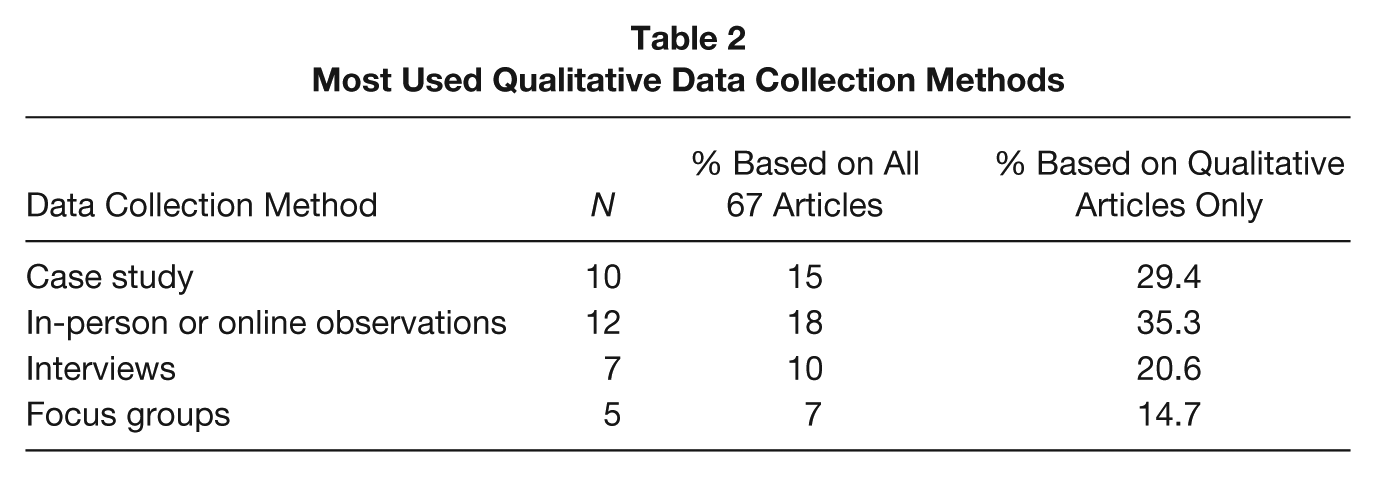
After analysis of the articles, four of the publications fell into the categories of conceptual and empirical due to the proposition of the theoretical model and then the testing of that model (Stepchenkova & Mills, 2010), and four of the publications were categorized as conceptual papers with no data collected. All remaining articles were categorized under empirical studies. After categorizing these articles into qualitative and quantitative data, it was found that while some of the studies (7) incorporated both qualitative and quantitative methods, 27 used qualitative methods and 25 used quantitative methods within their research. The majority of quantitative studies (28) use a survey methodology (41.7% of all 67 articles). A larger percentage of studies use qualitative research methods. Table 2 provides a list and percentage of articles for each research category.
Most Used Qualitative Data Collection Methods
Initial formulation of themes within the research emerged (Stepchenkova & Mills, 2010). As these articles were categorized and tabulated, themes were further solidified. Through this multistep process of analyzing the articles, the five themes included the following:
Comparison of virtual and/or hybrid meetings with F2F meetings
Perceptions and attitudes toward virtual and hybrid meetings
Management and design of virtual and/or hybrid meetings
Specific audiences for virtual and hybrid meetings
Uses of technology within virtual and hybrid meetings
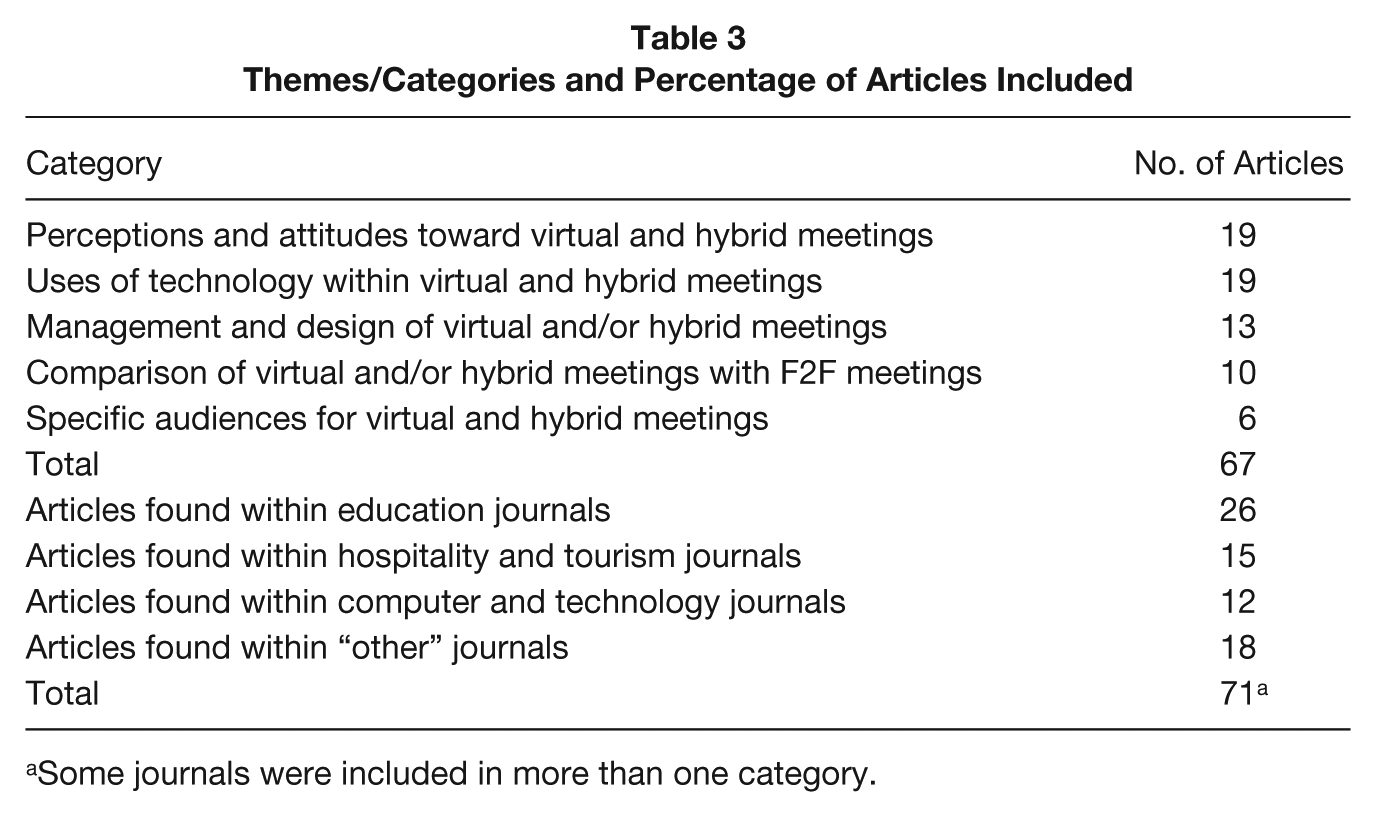
As noted in Table 3, the majority of articles were categorized within the categories of “uses of technology within virtual and hybrid meetings” (28%) and “perceptions and attitudes toward virtual and hybrid meetings” (28%). See Table 3 for the number of articles that are in each category.
Themes/Categories and Percentage of Articles Included
Some journals were included in more than one category.
Limitations
While a thorough review of literature was conducted within and outside of hospitality and tourism, some publications may have been missed. The database searches were limited to specific keywords and finite number of databases. In addition, while the definitions of meetings, virtual meetings, and hybrid meetings were given, meetings types and meeting specifics (size, location, etc.) beyond these definitions were not indicated. Offering more specific guidelines for these meetings may have changed the articles included within this analysis.
Results and Discussion
The themes that emerged as the data were analyzed and the numbers are shown in Table 3. These themes follow the progression of implementing virtual and hybrid meetings: beginning with investigating the perceptions of virtual and hybrid meetings, then determining what technology can be incorporated into virtual and hybrid meetings, moving toward the management and design of these meetings, comparing them with F2F meetings, and finally, investigating what audiences are best suited for virtual and hybrid meetings.
Comparison of Virtual and/or Hybrid Meetings With F2F Meetings
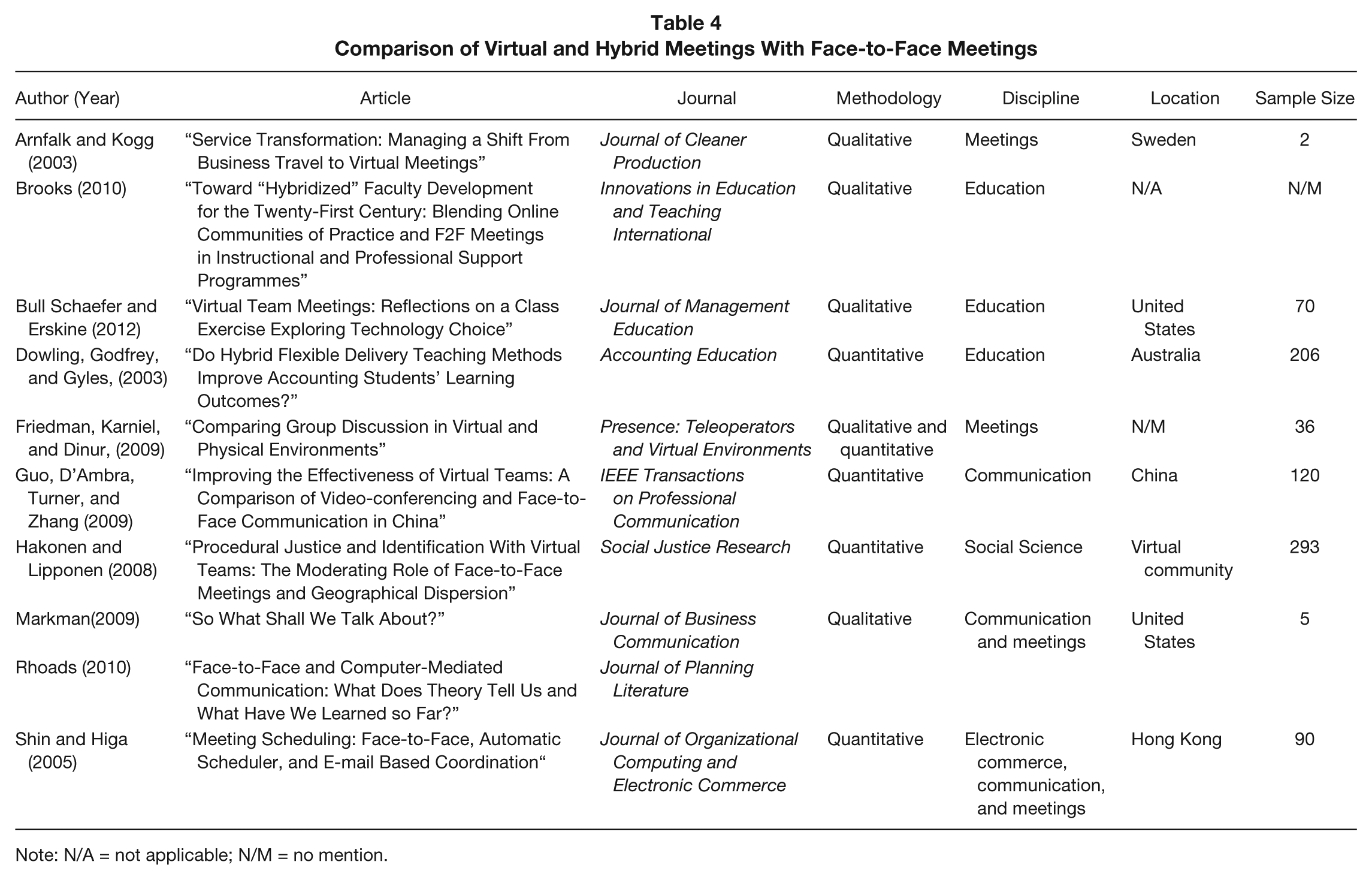
The theme of comparing virtual and/or hybrid meetings to F2F meetings within academic literature could be viewed as logical since F2F meetings are still the preferred way of gathering and exchanging information (PCMA et al., 2011). Virtual and hybrid meetings, however, are gaining in popularity (Pearlman & Gates, 2010). As the framework for this research begins to emerge, this theme appears to be compatible with the first attribute of the DOI: relative advantage. Relative advantage is the extent to which an innovation is considered to be superior to existing alternatives (Chigona & Licker, 2008). Since F2F meetings are the more tradition meeting format, virtual and hybrid meetings are compared to F2F formats in order to investigate benefits and advantages (see Table 4) .
Comparison of Virtual and Hybrid Meetings With Face-to-Face Meetings
Note: N/A = not applicable; N/M = no mention.
Arnfalk and Kogg (2003) investigated the barriers and drivers with regard to virtual meetings replacing business travel. Two Swedish companies were included in this research, both having advanced communication and information technologies in place for employees. This research concluded that virtual meetings are best suited for specific meeting types, such as informative, follow-up, short, and/or repetitive meetings (Arnfalk & Kogg, 2003). Driving factors and barriers were identified while better preparation was noted as a requirement for the success of virtual meetings. Within this study, negative attitude was acknowledged with regard to virtual meetings being less efficient.
The first mention of hybrid also appears in 2003 in educational (academic) literature and compared hybrid teaching methods with F2F teaching methods while investigating their effectiveness (Dowling, Godfrey, & Gyles, 2003). This study concluded that the final grades of students were positively associated with the hybrid teaching method employed and encourages further use of these types of delivery methods. In a study comparing F2F meetings in China to virtual meetings, specifically videoconferencing, it was concluded that videoconferencing was as effective as F2F communication and that videoconferencing communication can enhance F2F outcomes for teams (Guo, D’Ambra, Turner, & Zhang, 2009).
Markman (2009) investigated communication, specifically chat-based virtual meetings, in comparison to F2F meetings. Markman concluded that virtual meeting participants have more difficulty beginning and ending these meetings than in F2F meetings and that a structured agenda is important for a virtual meeting’s success.
A communication comparison (within groups) between virtual and F2F meetings was investigated by Friedman, Karniel, and Dinur (2009). In this study the dynamics and content of discussions (in groups) were reviewed in the virtual environment, Second Life. Within Second Life, participants communicated through the use of avatars. Research found that within this environment many discussions were unrelated to the main topic of the meeting. Also, conversations among participants were much shorter than F2F conversations. While the group dynamics of this setting and F2F meetings was shared, it was also noted participants were frequently engaged in behavior that cannot or would be less likely to take place in F2F settings, such as flying in the air, taking their clothes off, and standing on tables (Friedman et al., 2009).
Shin and Higa (2005) explored F2F meeting scheduling as compared to e-mail scheduling, automated scheduling, and calendar-based scheduling. Respondents favored coordinating and scheduling meetings F2F when compared with the other options. Overall, communication approaches to decision making were favored over technology-enhanced communication that was more decision oriented (e.g., automated scheduler).
Rhoads (2010) found mixed results when investigating the differences between F2F and computer-mediated communication. Computer-mediated technology allows individuals and organizations to conduct business electronically, thus removing the need for the physical location of those involved (Rhoads, 2010). While concluding that F2F communication is the preferred method for organizational and business communication, Rhoads noted that computer-mediated communication is continually growing, and meeting planners should understand how to operate both to best accommodate a progressively international society.
Brooks (2010) reintroduced the hybrid format with regard to professional and instructional support and compared this format with a F2F format of communication. This study concluded hybrid communication formats are favored regarding socialization, faculty support, and mentoring opportunities as online communication can be used to compliment F2F interactions.
Bull Schaefer and Erskine (2012) asked students, viewed as meeting attendees for this research, to replace F2F meetings with virtual meetings. This study concluded that the choice by instructors to use virtual meetings as part of the classroom format should be carefully considered and given as an option for tasks and the dissemination of information. It was concluded that not all classes benefit from an online format (Bull Schaefer & Erskine, 2012).
Based on the articles included within this section, it appears that while virtual meetings are gaining favor, F2F meetings are still preferred, but hybrid meetings are an acceptable combination of the two and are suggested as the future of meetings. Travel industry leaders appear to agree both virtual and F2F meetings have their place, depending on the format and objectives of the meetings. Industry publications indicate virtual meetings are appropriate for informative tasks and/or can serve nicely as a backup plan with regard to risk management, but the F2F meetings remain steadfast for meetings with more complex objectives (Carlson Wagonlit Travel, 2010).
Perceptions and Attitudes Toward Virtual and Hybrid Meetings
Fenich (2012) noted that “most people attend meetings for three reasons: education, networking and to conduct business” (p. 183). Content, connections, networking, and experience have been noted by PCMA et al. (2011) as the three factors necessary to create a successful event. While important, the same entities are noted in a 2011 study highlighting collaboration and networking as two of the main reasons F2F events still remain in the forefront over virtual meetings. Based on the articles reviewed, there is a current theme of researching the perceptions and attitudes toward both virtual and hybrid meetings by planners as well as attendees.
Within the DOI framework, the theme of perceptions and attitudes toward virtual and hybrid meetings appears to be compatible with the second DOI attribute: compatibility. The compatibility attribute is the “degree to which an innovation is perceived to be consistent with existing social cultural values, needs, and past experiences of potential adopters” (Chigona & Licker, 2008, p. 60). The articles included within this theme explore the perceptions of various groups as they participate in virtual and hybrid meetings, and address the values, needs, or experiences of those adopters as possible influential factors or outcomes (see Table 5).
Perceptions and Attitudes Toward Virtual and Hybrid Meetings

Note: ICT = information and communications technology; IT = information technology; N/A = not applicable; N/M = no mention.
Reviewing these articles in order of date indicates that attitudes and perceptions are progressing and evolving into more positive experiences with regard to the use of technology within meetings as time progresses.
Crawford (2002) addressed the need to better understand the leader’s role in virtual learning communities and investigated influencing factors for participation within a virtual community in addition to the role of the leadership within those communities. Crawford acknowledged the growth of the virtual community and the perceptions of educational leaders with regard to these experiences. An enhanced conceptual framework is presented within this article to assist educational leaders working within these environments.
Litvin (2003) found that respondents viewed cyber-conferencing as being a step ahead of videoconferencing, and indicated although it would be widely accepted in the future, it would not replace in-person meetings and/or events. Haven and Botterill (2003) reviewed the qualitative outcomes that examined the exploitation of virtual learning environments within the fields of hospitality, leisure, sport, and tourism within United Kingdom higher learning institutions. The results indicated differences in motivations for the implementation of virtual learning environments, barriers to acceptance, and possible areas for future development. The article also includes recommendations for the further application and implementation of virtual learning environments.
Molesworth (2004) found mixed results with regard to students’ attitudes pertaining to using technology for communication. This study also found that students were not happy with online seminars. Lectures that could be downloaded received a more positive response from students. Ausburn (2004) investigated the most valued blended learning course design elements by adult learners. The results indicate that 67% of adult learners ranked online course features and instructional design goals as the most important factors in this environment. The adult learners valued course designs that are personalized, self-directed, offer options, offer variety, and provide a learning community.
Bailey and Morais (2004) investigated the rapid increase in Internet use within educational settings and explored the impact of perceptions of F2F and online interactions on satisfaction and performance in a blended learning marketing assignment within a hospitality curriculum. Results of this study showed that satisfaction was influenced by online interactions with those in the classroom but had no impact on grades. The findings recommend that instructors use online tools within the classroom to increase student satisfaction.
Dale and Lane (2007) explored the opinions and experiences of student engagement (or nonengagement) in e-learning activities. This study recommended learning and teaching strategies to further enhance student engagement and e-learning activities. Findings of this research recognized issues related to student awareness, motivation, behavior, and learning methods; assessment; and technical factors with regard to student engagement and e-learning activities.
N. Singh and Myong Jae (2008) explored computer-based simulated virtual environments, such as Second Life. This study investigated students’ perceptions of Second Life as an educational tool within tourism and hospitality courses. The technology acceptance model was applied and tested (through multiple regressions). The technology acceptance model is a theory that illustrates how users accept and use a technology. The results of the study indicated that students have positive perceptions of using these tools within tourism and hospitality courses. As the field of education works to effectively prepare the 21st-century community, one opportunity is to use next-generation technology tools, such as Second Life.
Chen, Chen, and Kinshuk (2009) found that the opinions of friends, teachers, and classmates assisted with creating an environment that encourages participating in online learning communities. Therefore, the perceptions of others influence those around them with regard to this experience. This study integrated the theory of planned behavior to create their research model. The theory of planned behavior premise is based on how behavioral intentions serve as motivational factors indicating how hard individuals are willing to work to perform a specific behavior.
Huang, Backman, and Backman (2010) reported that the quality of student interaction and engagement and how pleasant the experience was, involved, among other factors, the perception of interaction and engagement within the virtual environment. The platform of Second Life was used to investigate the flow theory. The flow theory has been defined as “the holistic sensation that people feel when they act with total involvement” (Csikszentmihalyi, 1975, p. 36).
Within the MEEC industry, the number of virtual conferences and trade shows more than doubled in 1 year between 2009 and 2011, which indicates the perceptions and attitudes with regard to these meetings may be gaining favor (Market Research Media, 2012). Pearlman and Gates (2010) also noted that hybrid meetings and events incorporate the best of both virtual and F2F meetings and are also gaining in popularity.
Huang et al. (2010) focused on Second Life and used the flow theory to better understand the impacts of Second Life on students’ attitudes with regard to e-learning. The finding showed 3D virtual flow experiences had a significant impact on the respondent’s attitudes toward virtual learning. The quality of participation and pleasant experiences were influenced by the skills available to undertake difficult tasks, the perception of interactivity, and the extent of “presence sensation” recognized by students. Also noted was the idea that factors related with the success of flow experience in Second Life can have both direct and indirect influence on attitude toward e-learning through the mediation of flow.
Bekebrede, Warmelink, and Mayer (2011) conducted research based on the idea that Generation Y has been immersed in technology since they were born and focused on how technology and gaming impact their preferred learning styles, social engagement, and use of technology in general. The findings proposed gaming as a new component in learning that assists in addressing all these preferences for this generation. In addition, there was statistically no significant difference in collaborative and technological learning preferences between the representatives and nonrepresentatives of Generation Y. Both members of Generation Y and nonmembers of Generation Y favored collaborative and technological learning environments and considered gaming to be a valuable teaching method.
Chudoba et al. (2011), noted while meetings are essential to organizations that prize teamwork, the face of these meetings is evolving through the use of technology. Redpath (2012) acknowledged the preference and attitudinal bias in favor of F2F interactions, although research indicates that online and blended teaching are becoming more accepted. Redpath (2012) stated part of this bias is due not only to the quality of the material being delivered but how the material is delivered.
Gomezelj and Čivre (2012) identified and presented the advantages and disadvantages of introducing an online study process. The level of students’ satisfaction with online learning was also analyzed. The results of the study indicated students are mostly satisfied with their lessons when using an online environment. The factors influencing their satisfaction include: personality of students, e-learning properties, and e-classroom properties. This study used exploratory factor analysis and structural equation modeling to develop and test this new model.
While generational cohorts were not identified in many of the studies, ages of participants were included as part of the research. Jelfs and Richardson (2013) explored access and attitudes toward technology when reviewed across the adult life span. They determined while all students had access to computers and Internet, younger students were more likely to access other technologies. Younger students spent more time using technology and their attitudes were more positive. Older students were more likely to use strategic approaches to learning. Students of all ages with more positive attitudes toward technology adopted strategic approaches to learning. The students’ use and attitudes of technology varied across the adult life span and their age and attitudes (toward technology) were predictors of their learning approaches. Older students appeared to be more likely to complete online surveys. All students had positive attitudes toward technology and considered technology as vital to their learning experience.
Ninety-six percent of meeting and event planners have used virtual meetings and 80% have reported moderate to high increases in their usage between 2008 and 2010 (Carlson Wagonlit Travel, 2010). This information supports the academic trend of changing perceptions of virtual meetings and acknowledges the acceptance of them as indicted by the increase in their use. While there appears to be an overwhelming industry opinion virtual meetings will not replace F2F meetings, many meeting planners appear to think virtual meetings can be used in place of smaller (20-30 attendees) meetings (Carlson Wagonlit Travel, 2010).
Management and Design of Virtual and/or Hybrid Meetings
Since the introduction of virtual and hybrid meetings as optional platforms for offering meetings, there has been research conducted on the best ways to plan, hold, or design this genre of meetings. This theme is compatible with the DOI attribute of complexity. While the attribute of complexity is designed to consider the extent to which an innovation is considered a challenge, it is applicable to this theme if one considers management and design as tools to bring order and ease to a challenging situation. The articles within this theme investigate how to manage and design virtual and hybrid meetings for optimum performance (see Table 6).
Management and Design of Virtual and/or Hybrid Meetings

Note: CIP = continuous improvement process; IT = information technology.
N/A = not applicable; N/M = no mention.
Çakir (2002) states virtual communities had already been in existence for approximately two decades previously, supported by computers and communication facilities. Virtual communities are groups of individuals that can maintain connectivity via links, and they are together due to common interests, not by common space (Çakir, 2002). Virtual communities connecting due to common interests fall under the category of meetings based on the definition of events where the primary attendee activity can include socializing (Fenich, 2012).
Edgar (2002) addressed exhibitors and provided an overview of the options available for an exhibitor within a virtual event. Edgar notes virtual formats offer additional marketing opportunities to vendors, however, partnering with a F2F format (hence a hybrid format) would offer even more possibilities. In addition to offering information on the design and management of virtual and hybrid meetings, most of the articles categorized into this section offer positive support for virtual and hybrid meetings. Koh and Kim (2003) determined the utilization of multimedia support (e.g., videoconferencing) offers the virtual community the impact of F2F meetings. The sense of virtual community constructs are important to consider when designing these types of meetings as they aid in supporting the behaviors of the participants (Koh & Kim, 2003).
A study by Wasson (2004) discusses how multitasking can also be used to enhance the productivity of the organization hosting the meeting. It was also found multitasking does not affect the productivity of the meeting itself, but the organization benefits due to the increased productivity of the individual. This conclusion implies there is room for multitasking within these meeting formats, and there may be a way to incorporate multitasking into the design of the meeting so there is more productivity for all.
Chang (2004) explores a virtual classroom exercise facilitated by the University of Hawaii, Manoa, and the National University of Singapore. This study investigates the prospect of substituting virtual explorations for conventional fieldtrips within the classroom. The results indicate that traditional field trips can be simulated through online experiences although traditional fieldtrips offer multisensory experiences that better permit participants to comprehend a foreign culture, society, and environment.
Hodge, Tabrizi, Farwell, and Wuensch (2007) investigated course material delivery through a virtual platform. This article highlights the benefits of this delivery method including offering “interactivity, real-time interaction and social presence” with particular focus on Generation Y. Social presence is defined as the “ability of learners to project their personal characteristics to their group members and classmates” (Hodge et al., 2007, p. 106). Generation Y uses these learning communities to enhance their social and educational connections. Virtual learning environments allow for students and professors to better collaborate and interact. This promotes more interaction between the two and encourages more positive relationships to develop. This study investigated student satisfaction and course delivery effectiveness within a virtual environment.
Wagenaar and Hulsebosch (2008) used the communities of practice theory to determine if members within these meeting groups deepen and enrich their experiences through the interaction with other members. Communities of practice theory is defined as “groups of people interacting regularly to share knowledge and experiences about the domain in which they are engaged” (Wagenaar & Hulsebosch, 2008, p. 14). This study deducted 11 principles that should be considered when running a learning community that were a result of a case study involving a hybrid learning community. These 11 principles are (1) act as learning facilitator–practitioner, (2) cofacilitate to reduce blind spots, (3) embed learning in actual practice, (4) simulate self-organization, (5) facilitate conversations in public and private spaces, (6) use the variety in the community, (7) balance the focus on tangible and intangible products, (8) guide meta-level reflections, (9) distinguish between two layers of practice, (10) manage sponsor relationships, and (11) manage the boundaries (Wagenaar & Hulsebosch, 2008, p. 25).
Hybrid models for meetings have received attention throughout a number of publications reviewed, and while many recent articles tout them as the direction of future meetings, Tabor (2007) concluded the hybrid model needs to consider the content of material and maturity level of the participant to be successful. This thought again echoes a few of the implications discussed in previously mentioned articles (Bull Schaefer & Erskine, 2012).
Linderman, Reiners, and Steed (2009) conducted a feasibility test to determine if Second Life is a viable meeting alternative. This study identified four observations including: F2F meetings offered more attendee engagement opportunities, engagement protocol fared better within Second Life, it proved to be easier to speak with familiar individuals on Second Life, and scheduling meetings proved to be difficult when using this platform. Mueller and Strohmeier (2010), investigated design characteristics best suited for virtual learning environment training and development purposes. The findings provided 55 (reduced to 31) design characteristics prioritized according to environment and implications as discussed.
Gaming has recently been added as an option for design within virtual meeting environments (Gresalfi & Barab, 2011). By including a gaming component, these meetings and/or learning environments can highlight procedural, critical, consequential, and conceptual forms of participant engagement. This article specifically reviews students’ use of gaming as a component of classroom learning similar to meeting attendees’ use of gaming within a meeting.
Flowers and Gregson (2012) use of qualitative interviews with hosts of virtual meetings investigated the decision to use virtual alternatives for meeting attendees. The findings identified practical implications on the unique attributes found in a 3D virtual environment. The opportunities of using a three-dimensional (3-D) virtual environment included encouraging fun, playfulness, and innovation while the challenges included the attendees’ learning curve and risk factors (e.g., security and privacy).
While the articles within the category of “management and design of virtual and/or hybrid meetings” all offer various options to include while designing or facilitating a virtual or hybrid meeting, they are options that can enhance the success of these meetings and the experience of both the meeting planner and meeting attendee. Therefore, full consideration should be given to all planning aspects as the planning process continues.
Specific Audiences for Virtual and Hybrid Meetings
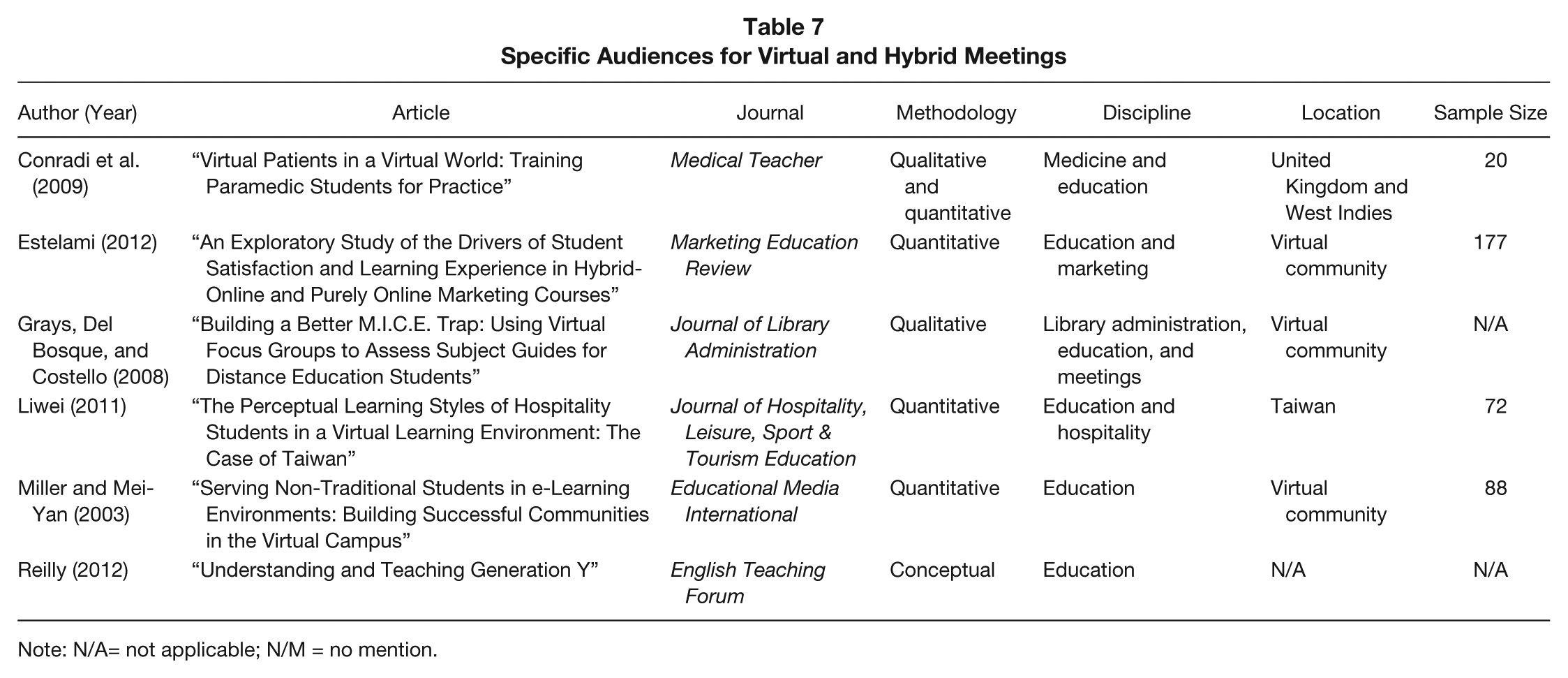
Within those articles addressing specific audiences for virtual and hybrid meetings, a variety of very specific audiences and their use or need for virtual and/or hybrid meetings were addressed. Audiences such as generational cohorts, nontraditional students, distance education learners, paramedic students, marketing students, and dance performers were investigated. This theme is compatible with the DOI attribute of observability. Observability is considered as the extent to which an innovation is visible (Chigona & Licker, 2008). Within this theme, various groups are tested and investigated pertaining to their use of virtual and hybrid meetings (see Table 7).
Specific Audiences for Virtual and Hybrid Meetings
Note: N/A= not applicable; N/M = no mention.
Miller and Mei-Yan (2003) researched virtual campuses serving nontraditional students. This research concluded that (online) faculty recognize differences between traditional and nontraditional students in how they learn and work within virtual learning environments. Most faculty work to accommodate these differences. Traditional students are defined as individuals between 18 and 24 years and who are enrolled on a full-time basis at a college or university. Nontraditional students are those who fall outside of that realm (Miller & Mei-Yan, 2003.) Specific to distance education students, Grays, Del Bosque, and Costello (2008) address how effective the online courses are to distance education students who are meeting online in order to complete coursework.
The concept of using the virtual environment to train paramedic students was performed through the use of virtual patients in Second Life; it was determined that the level of learning offered through a virtual setting was an effective experience for students (Conradi et al., 2009). Estelami (2012), however, supports that the type and components of the course being taught determine the most effective learning format. This study reports that the most effective approach to teach marketing students learning qualitative information is the hybrid-online approach.
Research examining the interaction between lecturer and student in an online virtual environment was conducted using the Barsch Learning Style Inventory (Liwei, 2011). Data were collected from 72 hospitality students in Taiwan who participated in an English course through a virtual environment setting. The findings of this research identified six types of perceptual styles that were then used to predict 95.83% of the learning style classification.
Reilly (2012) acknowledged today’s teachers understand that today’s learners think and behave differently than learners from past generations. This article addresses characteristics of Generation Y and presented a few classroom strategies to help better engage this generation. When reviewing educational literature from a meetings and events perspective, by considering the students as the meeting attendees, the results become applicable to this area of study.
Uses of Technology Within Virtual and Hybrid Meetings
This theme, uses of technology within virtual and hybrid meetings, is compatible with the DOI attribute of trialability. Trialability is considered as the extent to which an innovation is experimented on before adoption (Chigona & Licker, 2008). Within this theme, the articles investigate uses of specific technology within these meeting genres. These articles tend to investigate particulars of what technology works within these meeting formats and explores technological options (see Table 8).
Articles Included Within Uses of Technology Within Virtual and Hybrid Meetings
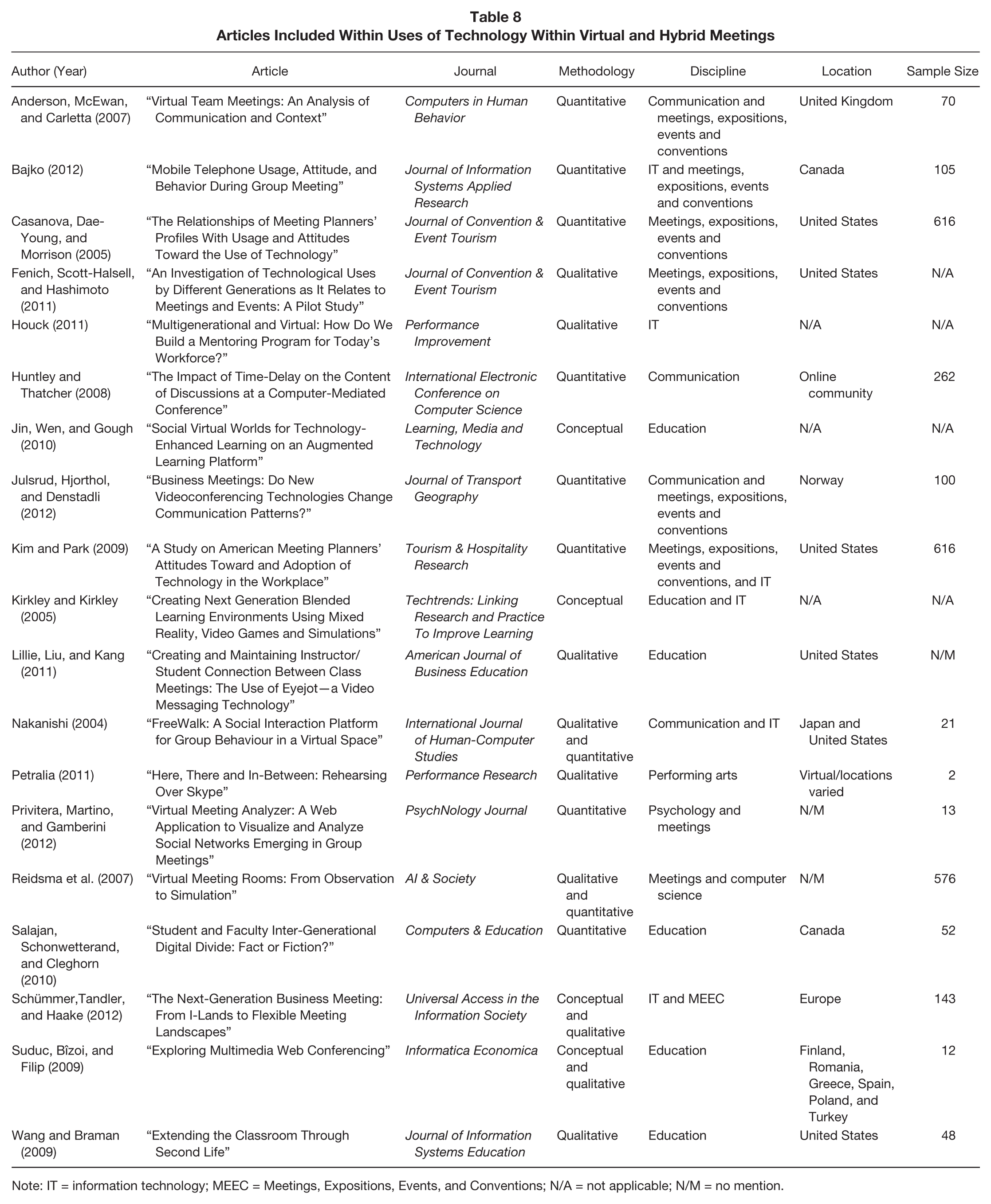
Note: IT = information technology; MEEC = Meetings, Expositions, Events, and Conventions; N/A = not applicable; N/M = no mention.
Within this theme, three subthemes also emerged and include articles reviewing the perceptions or attitudes toward the utilization of technology, articles specifically addressing virtual components of both virtual and hybrid meetings, and articles on the utilization of specific virtual products (i.e., Second Life and Eyejot).
Within the first subcategory, perceptions or attitudes toward the use of technology within meetings, three out of the seven articles from hospitality and tourism journals are included. Casanova, Kim, and Morrison (2005) investigate the profiles of meeting planners and the adoption and usage of technology within meetings. This study revealed even though the corporate meeting planners within the United States are noted as being young (30-44 years old), they are still hesitant to plan and coordinate virtual meetings.
Kirkley and Kirkley (2005) investigate learning environments and training technologies and the learning and design questions surrounding them. Within the article, theoretical and design philosophies of constructivist learning environments are discussed. The implementation of progressive technologies and their potential use within learning environments and the challenges they present were also investigated. The article offers tools to assist the design teams and assist with the management of these complexities.
Kim and Park (2009) indicate that corporate and private/independent meeting planners are more likely to incorporate technology into their meetings than association meeting planners. The findings indicate an increase in technology use within meetings in conjunction with the more technological experience of the meeting planner. Fenich, Scott-Halsell, and Hashimoto (2011) investigate how different generations, specifically Generation Y, use technology within meetings. Addressing how hotels can better target guests from Generation Y through incorporating technology within meeting options, this study notes the lack of available academic literature within this area. This article states there is a need for large empirical studies to be conducted on the preferences of technological use within meetings, specifically regarding Generation Y.
Houck (2011) wrote a conceptual article considering the generational differences with regard to virtual mentoring programs. Specifically, technological preferences and communication styles are addressed. Best practices are offered addressing the needs of each generation in addition to an overview of the literature with regard to the perceptions of each generation. This article contains information with regard to generational perceptions and the use of technology and communication.
Salajan, Schonwetter, and Cleghorn (2010) investigate the differences between students and faculty and the use of technology within curriculums. A slight intergenerational difference was found, but further research is recommended. This article was included within this research due to the definition of hybrid meetings, which includes the use of technology within campuses or learning environments.
The second subtheme that emerged within this sections includes articles specifically addressing virtual components of both virtual and hybrid meetings. Within this section, videoconferencing or Web conferencing was a recurrent topic of discussion (Anderson, McEwan, & Carletta, 2007; Julsrud, Hjorthol, & Denstadli, 2012; Suduc, Bîzoi, & Filip, 2009). Anderson et al. (2007) investigates how technology influences communication within meetings. It was concluded that the person who ran the chosen technology (i.e., videoconferencing) dominated the meeting communication. It was suggested that careful consideration be given to how technology is used within virtual meetings to achieve the most productive and effective platforms for open communication.
Reidsma et al. (2007) also focus on communication within virtual meetings. This study reviewed how controlled communication (in the form of gestures, gaze, distance, speech, etc.) improves the meeting participation of remote attendees. The article discussed how virtual meetings can be further used to study social interaction among meeting participants.
Suduc et al. (2009) reviewed the benefits and pitfalls of Web conferencing as a form of communication. Within this study virtual teams were addressed, and how they communicated with each other through Web conferencing. Advantages and disadvantages of Web conferencing are listed, with the most important advantages being noted as saving on expenses and saving time.
Jin, Wen, and Gough (2010) explore the impact of social networking technologies with regard to virtual worlds in learning environments. Social networking “emphasizes social interaction and share of user-generated content in a collaborative environment” (Jin et al., 2010, p. 141) .The findings of this study indicated that social virtual worlds have a positive impact on active student learning activities when compared to traditional virtual learning situations. In an additional study about the communication patterns through the utilization of different videoconferencing systems, it was determined that different types of video technologies are best suited for different meeting types (Julsrud et al., 2012). Room-based videoconferencing is noted as better suited for more limited meetings where the attendees know each other. Internet-based videoconferencing is more suited to meetings with attendees outside of the organization located in remote locations and often abroad.
The third subcategory within this section addresses the utilization of specific virtual products (i.e., Second Life and Eyejot) and their inclusion within virtual and hybrid meetings. Nakanishi (2004) investigated the use of a social interaction platform called FreeWalk and how it influences behavior within virtual meetings. FreeWalk is an application that allows people to interact with one another socially and spatially. Within the study, FreeWalk is compared to videoconferencing, and it is concluded the 3D environments encourage participants to communicate more comfortably (Nakanishi, 2004).
Second Life is introduced and included within two of the publications within this section. Wang and Braman (2009) offer best practices and lessons learned from using this platform. It was also concluded the use of Second Life within the classroom improves the learning experiences of the participating students (Wang & Braman, 2009). Jin et al. (2010) researched virtual worlds and Second Life specifically. This article concluded that these types of learning platforms add new dimensions to virtual learning environments. These augmented platforms offer advantages including enhancing the motivation and participation of students.
Other technology products, such as Eyejot, a video e-mail service, and a virtual meeting analyzer, an application that analyzes social networks within meetings, have also been the focus of academic studies (Lillie, Liu, & Kang, 2011; Privitera, Martino, & Gamberini, 2012). Eyejot provides the option of more interactive communication between participants (Lillie et al., 2011). The Virtual Web Analyzer is described in the article by Privitera et al. (2012) and allows users to follow or trace their interactions through social networks.
As technology advances and more products are introduced into the market, academic studies appear to reflect these innovative tools by including them within or as the main topics of research, with regard to virtual and hybrid meetings. Bajko (2012) investigates using Smartphones as replacements for meeting devices (i.e., laptops). This article also discusses the ease of multitasking while using these devices, which supports the finding in an earlier discussed article that multitasking could be used to enhance the productivity of a meeting (Wasson, 2004).
Skype technology is a tool used in meetings for participation, synchronization, and collaboration purposes. Although an option, Petralia (2011) was not an advocate of replacing F2F meetings with this type of technological tool. While helpful when meetings cannot take place in person, F2F allows for better and quicker communication, offering a more effective platform for meetings (Petralia, 2011).
Another technological tool used within virtual and hybrid meetings is LivingAgendas. This tool was created for meeting attendees to use throughout the life cycle of the meeting. The findings provided three dimensions that should be considered when using this tool within the meeting format. They include (1) the roomware dimension, (2) the groupware dimension, and (3) the peopleware dimension (Schümmer, Tandler, & Haake, 2012).
Hospitality Versus Education
As noted by Fenich (2012), education is one of three important reasons that attendees participate in meetings. It is a major motivator to attend meetings and is included in many meeting and event programs Therefore it is not surprising that education figured heavily in the literature review, and 26 articles were found within the realm of educational studies. This information indicates an overlap between virtual meetings and online learning, and hybrid meetings and blended learning. Before addressing the similarities, it should be noted that there are differences between the learning environment and the meeting environment. The primary purpose of meetings is to reach objectives, and the primary purpose of educational environments is to facilitate learning (Shepherd, 2009). There is usually a peer relationship between meeting attendees and presenters, whereas in learning environments, there exists a teacher–student relationship (H. Singh, 2011). While these examples highlight just a few of the differences, this research highlights the similarities due to the educational components included within the meeting definitions.
From this overlap, it can be deducted that researchers within the field of hospitality should be reaching out to the field of education to use existing research in an effort to further advance the meeting industry literature. This overlap of content offers an opportunity for the field of hospitality to further build the foundation and research stream pertaining to virtual and hybrid meetings. Extant research within educational studies should be acknowledged and built on within the realm of the study of meetings. Through applying educational research within this area to the study of meetings, researchers can advance the knowledge within this area of study at a much more rapid pace. This rapid pace is necessary as technology is continuing to quickly evolve and the need is great for immediate and current information within this area. In return, researchers within the field of education can use and further expand the information provided by researchers within hospitality pertaining to virtual and hybrid meetings. Sharing and using research between disciplines also offer great opportunity for partnerships between the researchers within each of these disciplines to further advance this body of knowledge.
Conclusion
Based on this research, the hospitality literature on virtual and hybrid meetings appears to be extremely limited, especially when compared to the focus and outpour of industry literature and initiative within this area. While there is literature available with regard to these genres of meetings within other disciplines, such as education and management, there is a definite overall gap in this area of hospitality research.
As the world of virtual and hybrid meetings continue to gain popularity within hospitality and tourism, there is an immediate need for additional literature within this area of study. Researchers can begin by looking outside of hospitality and tourism using an interdisciplinary approach to advance the knowledge within this area, but ultimately, a constant research stream should be developed and continued within hospitality and tourism studies. This is especially important to hospitality and tourism studies since meetings and conventions are one of the largest and fastest growing segments within tourism today (Kim & Park, 2009). As virtual meetings are quickly becoming commonplace and hybrid meetings have been noted as the future of meetings and events (Fryatt et al., 2012), it is imperative for academic research to keep abreast of these developments.
Underpinning the DOI theory, five categories emerged from this research: perceptions and attitudes toward virtual and hybrid meetings, comparison of virtual and/or hybrid meetings with F2F meetings, management and design of virtual and/or hybrid meetings, uses of technology within virtual and hybrid meetings, specific audiences for virtual and hybrid meetings, and examination of virtual and hybrid learning.
Environments allow for expansion within and outside of these areas to further enhance the body of knowledge within this area. There are several benefits of these themes following a theoretical framework, including offering the opportunity to make predictions. Frameworks also offer a more logical and procedural outline of the literature. Theoretical framework offers the opportunity to better explain the research topic as well as an opportunity to improve the research and the theory itself (Chigona & Licker, 2008).
Based on this research, one area to further explore and address is the overlap between educational studies and hospitality studies. Understanding the overlap of articles, applicable to both fields, offers the opportunity for researchers to better use the research between fields, in addition to encouraging possible partnerships between these two areas of study. Working together to advance this body of knowledge would benefit both areas of study and should be considered by researchers representing both education and hospitality.
In addition, the majority of articles written within tourism and hospitality journals (56%) fell into the theme of uses of technology within virtual and hybrid meetings. When reviewing the literature solely within hospitality and tourism, it appears that the research is limited, offering great opportunity to investigate this theme in greater depth. Qualitative research was the most popular research methodology used. Therefore, there is an opportunity for researchers in hospitality to further explore this area using quantitative research methodology. Combining more quantitative research with the existing qualitative research would result in a more comprehensive analysis of this theme.
Incorporating a mixed-methods approach in research would further enhance the explanation and interpretation of the data, complement the strengths or overcome the concerns of a specific research design, and/or offer a more thorough exploration of the questions on a wider variety of levels (Biddix, 2009). By integrating both qualitative and quantitative findings, the practicality and effectiveness of the research are greatly improved (Harden, 2010). This integration also leads to a more functional framework for a particular theme, offering the opportunity to advance a theme ever further. Integrating a mixed-methods approach offers the prospect of making more applicable conclusions from the research (Harden, 2010). Expanding or building on existing research through another approach would complement the extant literature and add to an even more comprehensive analysis of the data.
Through employing the framework of the DOI theory, it is apparent that the existing literature is following the process and factors influencing the adoption of these meeting genres. The literature, therefore, supports the preconceived industry notion that virtual and hybrid meetings are the wave of the future. The outline provided by the DOI allows us to see the communication process for these innovative meeting formats as they are adopted over a 10-year period with the meetings industry.
Future Research
Since research is lacking with regard to virtual and hybrid events within hospitality and tourism, one area to further explore is how the existing research outside of hospitality and tourism is applicable to this field. If existing research outside of this field is used, the foundation within this field can be further expanded within a much quicker time frame. For example, the educational research discusses teachers and students, which directly relates to meetings and events via the definition of a meeting and the components included within a virtual meeting. Due to the fast pace of technology, this research will provide a more stable foundation for knowledge advancement.
While there were a number of research studies addressing the differences of technology adaptation with regard to age, very few articles break down the adaptation process by generation. This is an area that can be further expanded as generational cohort stereotypes are noted to be at various stages with regard to technology use and savvy. Once age differences are identified with regard to virtual and hybrid meeting engagement, planners can better accommodate these audiences within their meetings and create optimal engagement opportunities for all meeting attendees.
Within the research, opportunities and barriers pertaining to virtual and hybrid meetings were noted. These highlights offer areas of focus that could be investigated further and could also be explored within the area of hospitality as the meeting component is introduced. Highlights of these opportunities included the following:
Features and instructional design goals are important (Molesworth, 2004).
Adult learners prefer personalization, self-direction, options, and a learning community (Ausburn, 2004).
Satisfaction is influenced by online interaction (Bailey & Morais, 2004).
Online communities are influenced by those around them (Chen et al., 2009).
Structured agendas are important for a virtual meetings’ success (Markman, 2009).
Multimedia offers the virtual community the impact of F2F meetings (Koh & Kim, 2003).
Social virtual worlds have a positive impact on learning activities (Jin et al., 2010).
Highlights of the barriers included the following:
Acceptance (Litvin, 2003)
Participation and pleasant experiences influenced by the skills available to undertake difficult tasks, the perception of interactivity, and the recognized presence sensation (Huang et al., 2010)
Quality of material and how it is delivered (Redpath, 2012)
F2F meetings offering more attendee engagement opportunities (Linderman et al., 2009)
Familiarization with Second Life enhancing communication within that platform (Linderman et al., 2009)
Meeting professionals hesitant to plan virtual meetings (Casanova et al., 2005)
Virtual meetings best suited for specific meeting types (Arnfalk & Kogg, 2003)
In addition, there is an ongoing need to understand what planners are currently using within their virtual and hybrid meetings in order to then determine if the audience is benefitting from the strategies. As technology evolves and continues to change how meetings are planned and executed, this area should be readdressed often as the state of current technology is always progressing. Further research should be conducted to determine what planning and management strategies are being currently used to then compare that information with the audiences’ perceptions using virtual and hybrid meetings.