




Abstract
This study proposes and empirically tests a holistic framework of organizational citizenship behavior (OCB) motivation that uses an altruistic–egoistic continuum. It also tests the structural relationships between altruistic and egoistic motivations and different dimensions of OCB. Analysis of questionnaire data from 398 hotel employee respondents supported eight of nine proposed relationships. Study results indicate a continuum incorporating multiple altruistic and egoistic motivations and suggest that OCB can be stimulated by both altruistic and egoistic motivations. The findings show that managers should facilitate positive social exchange in the hotel, provide constructive feedback regarding the desired performance, and encourage employees to engage more often in OCB directed toward the organization.
Introduction
Service organizations such as hotels and restaurants rely greatly on customer satisfaction and loyalty (Zeithaml, 1987). The creation of an excellent service experience often requires employees to surpass the job description and engage in organizational citizenship behavior (OCB), which refers to individual employee contributions in the workplace that exceed role requirements and contractually rewarded job achievements (Bateman & Organ, 1983; Smith, Organ, & Near, 1983). OCB is important because it enhances organizational effectiveness and fosters customer satisfaction (Organ, 1988), and it can bring awards and promotion to individual employees (Motowidlo & Van Scotter, 1994). OCB also indicates employees’ commitment and intention to stay (Ma, Qu, Wilson, & Eastman, 2013).
Owing to OCB’s proven effect in improving organizational performance, individual productivity, and customer satisfaction, researchers and practitioners want to know why individuals engage in OCB (Lemmon & Wayne, 2015). Uncovering the underlying motives for OCB has concerned researchers for some time, and studies reflect two distinct views of the fundamental motives of OCB. In fact, debate is ongoing as to whether OCB is altruistic (e.g., Batson & Shaw, 1991; Ilies, Scott, & Judge, 2006; Organ, 1988; Rioux & Penner, 2001) or egoistic (Bolino, 1999; Eastman, 1994; Flynn, 2003; Salamon & Deutsch, 2006). Altruism refers to “a motivational state with the ultimate goal of increasing another’s welfare,” whereas egoism is “a motivational state with the ultimate goal of increasing one’s own welfare” (Batson & Shaw, 1991, p. 108).
Numerous researchers consider OCB to be altruistically motivated. For example, Organ (1988) suggested that OCB is undertaken by “good soldiers” who are seeking to help others and the organization. Batson and Shaw (1991) also confirmed a strong link between altruism and OCB. Empirical studies have suggested that altruism and traits such as empathy and conscientiousness are significant predictors for OCB (Ilies et al., 2006; Kamdar, McAllister, & Turban, 2006; Rioux & Penner, 2001). In contrast, other researchers believe that OCB is motivated by more egoistic, self-centered concerns (e.g., Cialdini, Brown, Lewis, Luce, & Neuberg, 1997; Dovidio, Piliavin, Gaertner, Schroeder, & Clark, 1991). For example, Bolino (1999) found that employees may engage in OCB to create favorable images of themselves (impression management), which is self-serving or egoistic. Eastman (1994) found that employees can use OCB to enhance their status in organizations. Eisenberger, Huntington, Hutchison, and Sowa (1986) and Ma and Qu (2011) suggested that OCB is motivated by social exchanges with unspecified future returns, implying that egoism plays a role.
As a result of the ongoing debate, no one holistic framework exists for the motivational mechanism of OCB. Similar behaviors may stem from different motives (Eastman, 1994), and “OCB, like most human behavior, is caused by multiple and overlapping motives” (Organ et al., 2006, p. 7). As OCB is a multidimensional construct (Organ, 1988), could certain behaviors be altruistically motivated and others egoistically motivated? Answering this question helps address theoretical gaps and aids organizations in distinguishing “good soldiers” from “good actors.” While hotel employees need to display positive emotions in service, faking or “painting on” positive emotions will evoke negative reactions from customers and coworkers (Ekman, Friesen, & O’Sullivan, 1988) and lead to a number of negative consequences, such as burnout and depression (Brotheridge & Grandey, 2002).
If OCB consists of both altruistic and egoistic behaviors, then organizations can develop different strategies to effectively manage employees who are motivated by different values. Therefore, this study has two purposes: (1) to develop a holistic theoretical model that describes the motivational mechanism of hotel employees’ OCB, integrating the altruistic and egoistic motivations of OCB, and (2) to empirically test the theoretical model and the relationships among the constructs in the context of hotels in China.
Literature Review
The Multidimensionality of the OCB Construct
OCB was first defined as “individual behavior that is discretionary, not directly or explicitly recognized by the formal reward system, and that in the aggregate promotes the effective functioning of the organization” (Organ, 1988, p. 4). Researchers generally agree that OCB is a multidimensional construct (e.g., Graham, 1989; LePine, Erez, & Johnson, 2002; Moorman & Blakely, 1995; Organ, 1988; Podsakoff, MacKenzie, Moorman, & Fetter, 1990) and categorize the dimensions of OCB according to either the nature of OCB or the targets of OCB (Ma & Qu, 2011). The most widely accepted approach to the nature of OCB is the five-dimensional framework, in which OCB is further categorized into altruism, conscientiousness, sportsmanship, courtesy, and civic virtue (Smith et al., 1983). However, this framework was proposed for the banking industry, and variations in dimensions were observed when the framework was applied in other disciplines (e.g., George & Brief, 1992; Graham, 1989), especially in different cultural contexts (Farh, Earley, & Lin, 1997).
The second approach categorized OCB dimensions on the basis of targets. Williams and Anderson (1991) first suggested that OCB should be divided into OCB-O, which refers to OCB that benefits the organization in general, and OCB-I, which refers to OCB relating primarily to individuals (employees) within the organization. Later, Bettencourt and Brown (1997) suggested that the importance of service-oriented OCB should be considered for the service industry. Ma and Qu (2011) proposed a three-dimensional framework of OCB-O (the organization), OCB-I (the coworker), and OCB-C (the customer) for the hospitality industry. This framework has gained increasing popularity in OCB studies in the hospitality and tourism contexts owing to its attention to OCB toward customers (OCB-C; e.g., Chen, 2013; Loi, Ao, & Xu, 2014; Tang & Tang, 2012). The framework also has an apparent advantage over the five-dimensional framework in terms of cross-cultural stability because the targets of OCB in hospitality organizations remain consistent (Ma et al., 2013), which is particularly important as many hospitality groups have gone global.
In addition, using this target-specific framework of OCB makes better sense when OCB motives are viewed from the altruism–egoism perspective. First, the target is used to distinguish whether a behavior is altruistic or egoistic. When the ultimate goal is to benefit others, OCB is altruistic, and when the goal is to benefit self, OCB is egoistic (Batson & Shaw, 1991). As a result, knowing the target of OCB is essential for understanding the phenomenon of the altruism–egoism motives of OCB. Second, people may be more likely to engage in altruistic behavior when they feel empathy for the person who is in need (Batson, Duncan, Aekerman, Buckley, & Birch, 1981). This response implies that different targets may trigger different levels of empathy, which is a major motive for OCB. The theory of kin selection also suggests that people are more inclined to help those who are related or are close friends (Gardner, West, & Wild, 2011), implying that targets may influence employees’ OCB. Third, and in contrast, employees who use OCB as an impression management tactic may be selective in choosing their OCB targets, because they want to make the best use of their investment. For the above reasons, this study used the three-dimensional framework of OCB, categorized by targets.
The Altruistic–Egoistic Continuum of OCB Motivation
Eastman (1994) suggested that similar behaviors may stem from different motives, and “OCB, like most human behavior, is caused by multiple and overlapping motives” (Organ et al., 2006, p. 7). Empirical studies on OCB motivations support this statement and have identified multiple motivations of OCB, such as social exchange (e.g., Konovsky & Pugh, 1994; Ma & Qu, 2011), impression management (Rosenfeld, Giacalone, & Riordan, 1995), empathy (Batson, 1987), and conscientiousness (Barrick & Mount, 1993). These findings, in conjunction with the ongoing debate regarding the underlying motive for OCB, indicate that looking at OCB motivations from the altruism–egoism angle is reasonable.
The key to distinguishing egoistic motivation from altruistic motivation is whether the ultimate goal is self-serving (Batson, 1987). Through impression management, people attempt to influence the image others have of them, which is self-serving in nature (Rosenfeld et al., 1995). From this perspective, impression management is an egoistic motivation for OCB. In contrast, certain personal traits, such as empathy (Batson, 1987), are altruistic because empathy has an affective focus on the person in need and promotes truly selfless motivation to provide help (Batson, 1998). Empirical evidence also supports a strong positive correlation between empathy and altruism (Zaskodna, Simek, & Micak, 2013). Conscientiousness is another important personality trait and refers to being dependable, responsible, achievement-oriented, and persistent (Barrick & Mount, 1993). Conscientiousness motivates people to engage in OCB owing to the internal drive of dutifulness and self-discipline (Barrick & Mount, 1991). On the basis of Batson’s (1987) framework, conscientiousness is altruistic in nature.
Social exchanges, as an important set of OCB motivations, cannot be simply classified as altruistic or egoistic in nature. Social exchanges are voluntary actions of individuals who are motivated by the returns they expect from others (Blau, 1986). That is, as social exchanges generate an expectation of some future return for contributions, they are in this sense egoistic (Batson, 1987). However, unlike economic exchange, social exchange does not occur on a quid pro quo or calculated basis, but it is based on individuals’ trust that the other side of the exchange will fairly fulfil its obligations in the long run (Holmes, 1981). That is, employees engaging in OCB (motivated by social exchanges) are aware that they may not receive an immediate and equivalent benefit, which gives social exchanges an altruistic flavor. In addition, social exchanges have been well documented as reciprocal altruism in evolutionary biology (e.g., Cosmides & Tooby, 1992; Trivers, 1971). Reciprocal altruism is a behavior whereby an organism or individual acts to temporarily reduce its fitness while increasing others’ fitness, with the expectation that the others will act in a similar manner in the future (Trivers, 1971). From this perspective, social exchanges have an altruistic root. Furthermore, social exchanges can take multiple formats. For instance, in hotel contexts, social exchanges could occur between employees and leaders, between coworkers, and between customers and employees (Ma & Qu, 2011). The altruistic and egoistic levels of these exchanges could be varied.
One may argue that degrees of egoism differ between impression management motivation and social exchange motivation. Impression management would be a much stronger egoistic motivator than would social exchange. Social exchange with leaders could be more egoistic than social exchange with coworkers, as the former involves a more specified future return (Blau, 1986). Social exchanges with coworkers are more reciprocally altruistic in nature (Trivers, 1971), as employees often need to help each other in the service process. Social exchanges between customers and employees would be more altruistic in nature as a customer would have difficulty reciprocating to an employee. Likewise, empathy can be a stronger altruistic motivation than conscientiousness because conscientiousness involves reducing stress through OCB (Barrick & Mount, 1991).
We propose that a continuum of OCB anchored by egoism and altruism would explain multiple motivations for employees’ OCB (Figure 1). Based on their nature and strength, we can locate previously identified OCB motivations on the continuum. For example, impression management is highly egoistic in nature, and so it can be located close to the egoistic end of the continuum. Social exchanges are less egoistic and can be located close to the middle of the continuum. Each type of social exchange—leader–member, coworker, and customer–employee—can also be located according to its egoistic and altruistic nature. In a similar vein, empathy and conscientiousness can be located on the basis of the strength of this form of altruism. As noted above, the variations in OCB motivations have fostered substantial debate over whether OCB is altruistically or egoistically motivated, and we propose the continuum as a starting point for developing a holistic framework for OCB motivations.
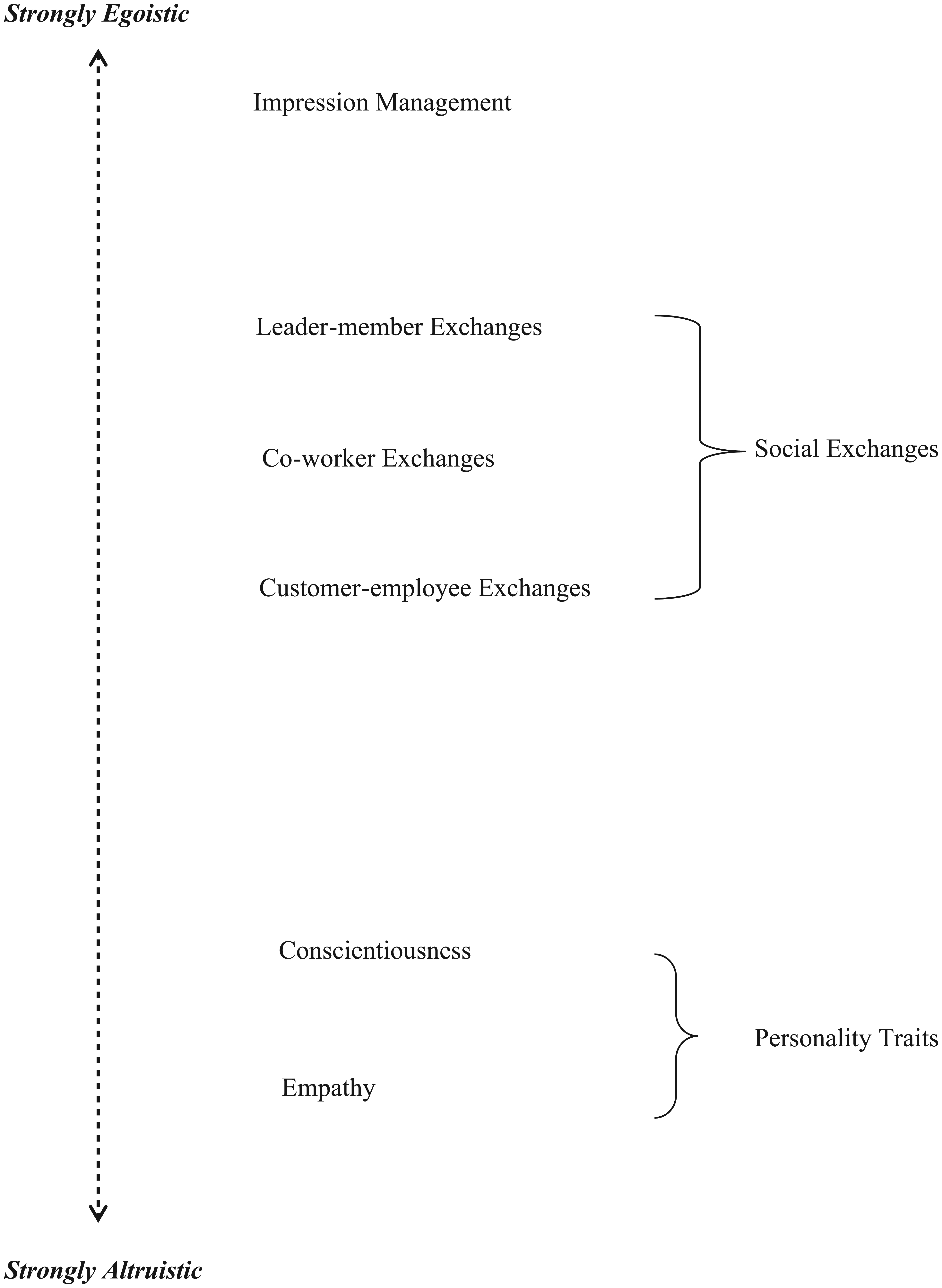
The Altruistic–Egoistic Continuum of Organizational Citizenship Behavior Motivation
Researchers have found that certain motivations of OCB are target-specific (Ma & Qu, 2011). For example, coworker exchange was a significant motivator for employees’ OCB-I but not for OCB-O and OCB-C. As we discuss in the following section, we propose that the altruistic and egoistic motivators of OCB would also affect different types of OCB differently.
Egoistic Motivations and OCB
Impression Management and OCB
A primary human motive is to be seen by others in a favorable light and to avoid being judged negatively (Rosenfeld, Giacalone, & Riordan, 1995). Impression management refers to the process by which individuals attempt to control others’ impressions of them (Leary & Kowalski, 1990; Rosenfeld et al., 1995). Five tactics for impression management include (1) ingratiation, or doing favors and using flattery to be seen positively by the target; (2) self-promotion through emphasizing one’s accomplishments and disregarding one’s failures to be seen as competent; (3) exemplification, or going above and beyond what is expected so as to be seen as dedicated; (4) intimidation, or showing the potential ability to punish in order to be seen as a threat; and (5) supplication, which involves promoting one’s weaknesses to be seen as needy (Bolino, 1999). As engaging in citizenship behaviors is a viable means of achieving favorable impressions, it could be seen as motivated by self-promotion strategies.
Individuals are more likely to engage in impression management activities when they perceive that impressions are relevant to their goals (Leary & Kowalski, 1990). Making good impressions on supervisors and coworkers may help employees achieve a favorable image, a superior performance evaluation, or promotion opportunities. Therefore, employees are likely to engage in impression management through OCB targeted to impress supervisors and coworkers. This reasoning leads to the following hypotheses:
Hypothesis 1: A significant positive relationship exists between employees’ impression management behavior and organizational citizenship behavior toward the organization (OCB-O).
Hypothesis 2: A significant positive relationship exists between employees’ impression management behavior and organizational citizenship behavior toward coworkers (OCB-I).
Social Exchanges and OCB
Social exchanges in the workplace are important motivators for OCB (e.g., Ilies, Nahrgang, & Morgeson, 2007; Ma & Qu, 2011). Leaders or employers using the social exchange approach seek a long-term relationship with employees and show concern about employees’ well-being. In response, employees who are treated with respect and care are more likely to engage in OCB (Cho & Johanson, 2008). When high-quality social exchange happens between leaders and subordinates, subordinates perceive an obligation to reciprocate (Blau, 1986; Gouldner, 1960), and one way to reciprocate is by extending their roles beyond normal role requirements and performing OCB (Hofmann, Morgeson, & Gerras, 2003). By engaging in OCB, subordinates in high-quality leader–member exchange relationships “pay back” their leaders (Liden, Sparrowe, & Wayne, 1997; Settoon, Bennett, & Liden, 1996).
Similarly, an employee receiving support and help from a coworker would be under pressure to give back to that coworker by helping with his or her job or by performing other types of OCB toward that coworker (OCB-I; Ilies et al., 2007; Ma & Qu, 2011; Rhodes & Eisenberger, 2002).
Recent research has provided more support for treating the interaction between customers and employees as a social exchange process, particularly in the service context (e.g., Lawler, 2001; Ma & Qu, 2011; Sierra & McQuitty, 2005). From this perspective, customers are no longer merely recipients of employees’ service but are actively involved in it. Customers’ courtesy and positive attitude toward employees can influence a hotel employee’s service performance, which in turn forms the basis for employees’ OCB-C (Ma & Qu, 2011). Interestingly, employees experience strong reciprocal pressure to perform OCB toward the source of social exchanges (Scott, 2007). Thus,
Hypothesis 3: A significant positive relationship exists between leader–member exchange and employees’ organizational citizenship behavior toward the organization (OCB-O).
Hypothesis 4: A significant positive relationship exists between coworker exchange and employees’ organizational citizenship behavior toward coworkers (OCB-I).
Hypothesis 5: A significant positive relationship exists between customer–employee exchange and employees’ organizational citizenship behavior toward customers (OCB-C).
Altruistic Motivations and OCB
Empathy and OCB
Empathy is an “other-oriented, emotional response elicited by and congruent with the perceived welfare of someone else” (Batson, 1987, p. 93). Perspective-taking is the major predictor of empathy (Yuan, 2006), since by taking the other person’s perspective, one is more likely to develop empathetic feelings for that person. Ladd and Henry (2000) proposed that empathy is positively related to employees’ OCB toward individuals. Empirical evidence has also confirmed that empathy can lead to helping behaviors reflected in the altruism dimension of OCB (e.g., Eisenberg & Miller, 1987). McNeely and Meglino (1994) found that empathy is positively related to OCB-I but not to OCB-O. However, they did not separate the individuals from organizational members and customers. Coincidently, one dimension of service quality is also termed empathy and is defined as the ability to provide the customer with caring and individualized attention (Parasuraman, Zeithaml, & Berry, 1985). An employee with a high level of empathy is more likely to engage in OCB toward customers and coworkers, leading to the following hypotheses:
Hypothesis 6: A significant positive relationship exists between employees’ empathy and organizational citizenship behavior toward coworkers (OCB-I).
Hypothesis 7: A significant positive relationship exists between employees’ empathy and organizational citizenship behavior toward customers (OCB-C).
Conscientiousness and OCB
Conscientiousness refers to an individual being dependable, responsible, achievement-oriented, and persistent, and it is relatively stable over time (Costa & McCrae, 1995). Empirical evidence has shown that conscientiousness affects individuals’ performance on the job (Barrick & Mount, 1991). Researchers have consistently found that conscientiousness is the strongest personality dimension that predicts employees’ OCB (Digman, 1990; Hogan & Holland, 2003; Organ & Ryan, 1995). Conscientiousness is not directed to a specific person but constitutes commendable, constructive forms of support to the organization (Konovsky & Organ, 1996). Consequently, highly conscientious employees are more likely to engage in OCB for the benefit of the whole organization (OCB-O). In the hotel setting, customer satisfaction has been emphasized as the most important goal that employees should try to accomplish through services. Thus, a conscientious employee would be expected to engage in citizenship behavior toward customers (OCB-C), and we propose the following hypotheses:
Hypothesis 8: A significant positive relationship exists between employees’ conscientiousness and organizational citizenship behavior toward the organization (OCB-O).
Hypothesis 9: A significant positive relationship exists between employees’ conscientiousness and organizational citizenship behavior toward customers (OCB-C).
Proposed Model
The literature review leads to the proposal of a conceptual model on the motivational mechanism of OCB that includes both egoistic and altruistic motivators (Figure 2). Egoistic motivations include social exchange and impression management, while altruistic motivations include empathy and conscientiousness. The model relies on the three-dimensional framework of OCB consisting of OCB-O, OCB-I, and OCB-C, and the conceptual framework proposes the relationships among the motivators and different types of OCB.

Conceptual Framework of the Study
Method
Questionnaire Development
Structure and Procedure of Questionnaire Development
A questionnaire was developed, based on previous measurements, which comprised three sections. Section I was designed to collect information on employees’ altruistic and egoistic motivations, including impression management, three types of social exchanges, empathy, and conscientiousness. Section II collected information on hotel employees’ performance on three types of OCB. A 7-point Likert-type scale (where 1 = strongly disagree and 7 = strongly agree) was used for these two sections. Section III collected employees’ demographic and work-related information, such as gender, age group, and annual income.
All measurements used in the questionnaire were based on previously established scales. However, some scales were not from the hospitality and tourism discipline, so necessary modifications were made to suit hospitality contexts. In addition, negatively worded items were removed if there was a positively worded one, as negatively worded items may harm reliability (Sauro, 2011). The major reason for alternating item wording (positive and negative) is to minimize extreme response bias and acquiescent bias (Sauro & Lewis, 2011). Sauro and Lewis (2011) found little evidence for response biases, and these bias effects are, at best, small and outweighed by the real effects of miscoding and misinterpretation by users. Repeated items were removed after checking with a panel of four hospitality researchers to avoid respondent fatigue (Carmines & Zeller, 1979). However, a minimum of three items were kept to ensure adequate internal consistency and reliabilities (Cook, Hepworth, Wall, & Warr, 1981; Kline, 2005). The questionnaire was then translated into Chinese using the “translation/back-translation” procedure (Brislin, 1976; Lo, 2007) and was pilot-tested with 30 hotel employees in China, using convenient sampling. The pilot test results showed that all constructs’ Cronbach’s alphas exceeded the threshold value of .6 (Hair, Anderson, Tatham, & Black, 2006), ranging from .646 to .891 (see Table 3).
Measurements for Each Construct
Leader–member exchange was measured using six items adapted from Graen and Uhl-Bien (1995). One statement “I have enough confidence in my leader that I would defend and justify his/her decision if he/she were not present to do so?” was dropped because it was not very relevant to the hospitality context. Coworker exchange was measured using six items adapted from Ladd and Henry (2000). Two negatively worded items, “Even if I did the best job possible, my co-workers would fail to notice” and “My coworkers show very little concern for me,” were dropped due to repetition with two positively worded items. One statement was kept for two similar items, “My coworkers really care about my well-being” and “My coworkers care about my general satisfaction at work.” Customer–employee exchange was measured using five items developed by Ma and Qu (2011). The Cronbach’s alpha for leader–member exchange was .891; coworker exchange was .896 and customer–employee exchange was .847.
OCB-O, OCB-I, and OCB-C were measured using 20 items developed by Ma and Qu (2011), based on the OCB-O and OCB-I measures by Williams and Anderson (1991) and the Service-oriented OCB measures by Lin et al. (2008). The Cronbach’s alpha for OCB-O was .765; OCB-I was .863, and OCB-C was .876.
Conscientiousness was measured using four items from Saucier (1994). The original measures had four positively worded statements and four negatively worded statements, capturing the same aspects of conscientiousness, including organized, efficient, systematic, and practical. The study only kept the four positively worded statements to avoid repetition and interpretation mistakes that might occur with respondents (Sauro, 2011). The Cronbach’s alpha for conscientiousness was .799.
Empathy was measured using three items from Bettencourt, Gwinner, and Meuter (2001). The original scale used four items to measure cognitive empathy and three items to measure affective empathy. However, all four cognitive empathy items measured perspective-taking, so one item was kept. Repetition was also found on two out of three items of the affective empathy dimension, including “Seeing warm, emotional scenes melts my heart and makes me teary-eyed” and “When I watch a sad, ‘tear-jerker’ movie, I almost always have warm, compassionate feelings for the characters.” So one item of the two was removed, and a total of three items were kept from the original scale with one cognitive empathy and two affective empathy items. The Cronbach’s alpha was .744.
Impression management was measured using three items from Rioux and Penner (2001). Although the original scale had 9 items, the panel agreed that five items were actually motivations for engaging in impression management behaviors (see the appendix). Repetitions were found on three items, “avoid looking lazing,” “looking busy,” and “avoid looking bad,” and therefore one item was kept. Therefore, a total of three items were kept from the original scale. The Cronbach’s alpha was .646. The appendix provides detailed information of original items and items used by the study.
Data Collection and Data Analysis
Data were collected in China using convenience sampling in 2011. A total of 10 hotels participated in the study: 5 hotels in Beijing and 5 in Guangzhou. All 10 hotels are full-service hotels with a four- or five-star rating. Drawing on existing connections, the primary researcher made initial contact with human resources (HR) managers of potential participant hotels. The researcher stopped making additional contact when 10 hotels agreed to participate. Each hotel was given 40 to 80 questionnaires, and the HR managers assisted with the distribution of the questionnaire. Each questionnaire was distributed with a sealable envelope to ensure respondents’ anonymity, and drop boxes were provided to ensure confidentiality of information as well as to eliminate possible power imbalance issues in the data collection process (Bryman & Bell, 2011). In total, 630 questionnaires were distributed, and 398 valid responses were received and used for the final data analysis, representing a response rate of 63%.
To better understand hotel employees’ demographic profile and their work-related information, descriptive analysis was performed using SPSS 21.0. Structural equation modeling (SEM) using AMOS was performed to uncover the relationships among the constructs.
Findings
Profile of the Respondents
Table 1 offers a profile of respondents. Employees participating in the survey covered most of the frontline positions, with the majority (30.2%) of the responses coming from the housekeeping department. In terms of position level, 51.6% of the employees were in entry-level positions, and 48.4% were working at the supervisory level. Most employees (79.6%) were contract employees, and 16.6% were permanent employees. Furthermore, 32.4% of the employees had worked in their current hotel for less than 1 year, 32.7% had been with their current hotel for 1 to 3 years, and about 33.4% had been with their current hotel for more than 4 years.
Descriptive Profile of the Respondents (N = 398)

Note: Annual income was converted to U.S. dollars from Chinese Yuan.
Of the respondents, 66.1% were females. More than half of the employees (57.5%) were between 19 and 29 years, and 22.4% were between 30 and 39 years. About 27.1% of the employees had a university qualification, and about 26.6% had received college education. In terms of annual income, 25.4% of the employees earned less than ¥10,000, with 20.4% having an annual income of ¥10,000 to ¥29,999 and 35.4% having an income of ¥30,000 to ¥49,999. Only 17.6% of the employees had an annual income over ¥50,000.
Model Fit
SEM was performed using AMOS 21. The structural model was evaluated using a series of fit indices. The absolute fit indices included the χ2 test, root mean square error of approximation (RMSEA), and standardized root mean square residual (SRMR). The incremental fit indices included the comparative fit index (CFI) and the incremental fit index (IFI).
The absolute fit indices are direct measures of the fitness of a model, as they offer information on the extent to which the model as a whole provides an acceptable fit to the data (Reisinger & Turner, 1999). The χ2 test determines whether a relationship exists between two measures. In SEM, the lower the χ2 value, the more representative the model is of the data. The recommended level for the normed χ2 parsimony index is between 1.0 and 5.0. The RMSEA is used to correct for the tendency of the χ2 test to reject models with large samples or a large number of observed variables. A value of less than 0.05 indicates good fit, a value from 0.05 to 0.08 indicates a reasonable fit, values between 0.08 and 0.10 indicate a mediocre fit, and a value larger than 0.10 indicate poor fit (Hair et al., 2006). RMR represents the average amount of variance and covariance not accounted for by the model. A better fitting model should have an RMR value that is close to zero. A standardized RMR value of 0.10 or lower indicates good fit (Hair et al., 2006).
The incremental fit indices assess the incremental fit of the model compared with a null model (Reisinger & Turner, 1999). A CFI value of 0.90 or above is considered good; CFI >0.93 is better, and CFI >0.95 is great (Brentler, 1990). These fit indices suggest that the overall fit of the measurement model is reasonably good. Table 2 summarizes the fit indices as well as the cutting values of the fit indices as recommended by previous researchers (e.g., Hair et al., 2006; Kline, 2005).
Fit Indices of the Structural Model
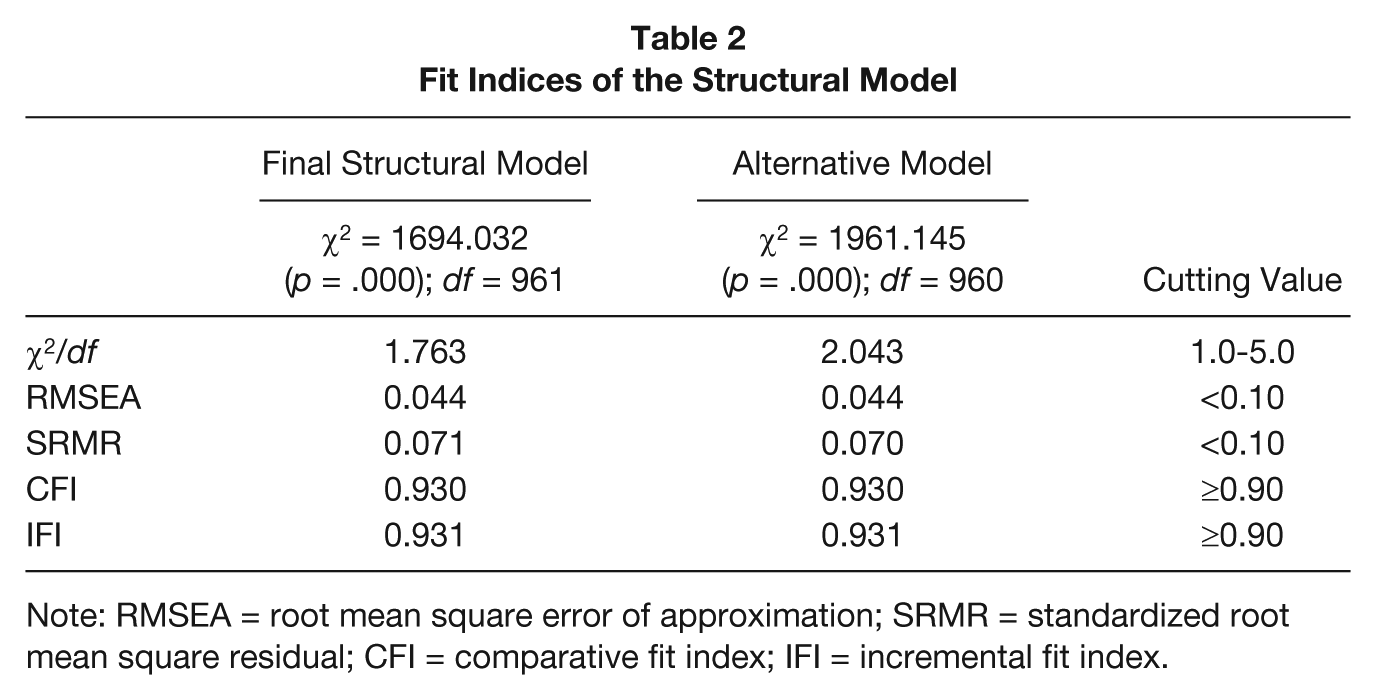
Note: RMSEA = root mean square error of approximation; SRMR = standardized root mean square residual; CFI = comparative fit index; IFI = incremental fit index.
The factor loadings of the five constructs range from .51 to .92, showing that the indicators captured a large percentage of the variance in each construct. The composite reliability (CR) values and the average variance extracted values (AVE) were also calculated and are shown in Table 3. The CR values of the five constructs ranged from .74 to .93, and the AVE values ranged from .44 to .70, all exceeding the threshold values (Dillon & Goldstein, 1984; Fornell & Larcker, 1981). In addition, the Cronbach’s alphas of the latent constructs ranged from .646 to .896, indicating a good reliability of the measurements (Nunnally & Bernstein, 1994; see Table 4).
Reliability, CR, and AVE Values of the Measurements
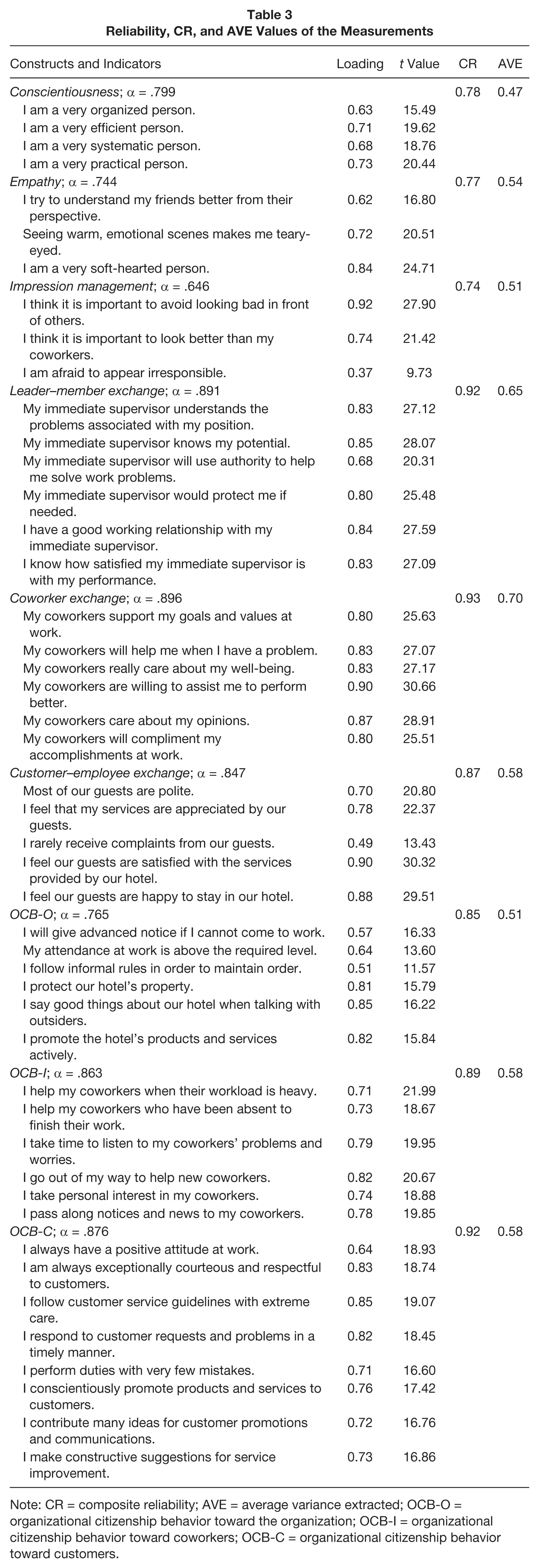
Note: CR = composite reliability; AVE = average variance extracted; OCB-O = organizational citizenship behavior toward the organization; OCB-I = organizational citizenship behavior toward coworkers; OCB-C = organizational citizenship behavior toward customers.
Correlations of Constructs

Correlation is significant at the .01 level (2-tailed).
Hypotheses Testing
With the overall fit of the structural model achieved, each individual parameter/path was analyzed and Hypotheses 1 to 9 were tested by evaluating the relationships between the exogenous and endogenous variables. Both the signs and the magnitudes of the parameters were examined. Table 5 presents the standardized coefficients and t values of the paths in the model. The signs indicate positive or negative relationships between two latent variables, and the t values indicate whether the path coefficients are statistically significant.
Summary of the Hypothesis Testing

Note: OCB-O = organizational citizenship behavior toward the organization; OCB-I = organizational citizenship behavior toward coworkers; OCB-C = organizational citizenship behavior toward customers.
**Significant at p < .01. ***Significant at p < .001.
As Table 5 and Figure 3 show, eight of the nine paths were statistically significant (p < .01). For egoistic motivations, the coefficient between impression management and OCB-O was .435, suggesting a strong positive relationship between the two variables. The coefficient between impression management and OCB-I was .266, suggesting a medium positive relationship between the two variables. The coefficient between leader–member exchange and OCB-O was .191, suggesting a medium positive relationship between the two. The coefficient between coworker exchange and OCB-I was .257, suggesting a medium positive relationship between the two. The coefficient between customer–employee exchange and OCB-C was .418, suggesting a strong positive relationship between the two variables. In summary, all six relationships motivated by egoistic motivators are significant and, accordingly, Hypotheses 1 to 5 are supported.
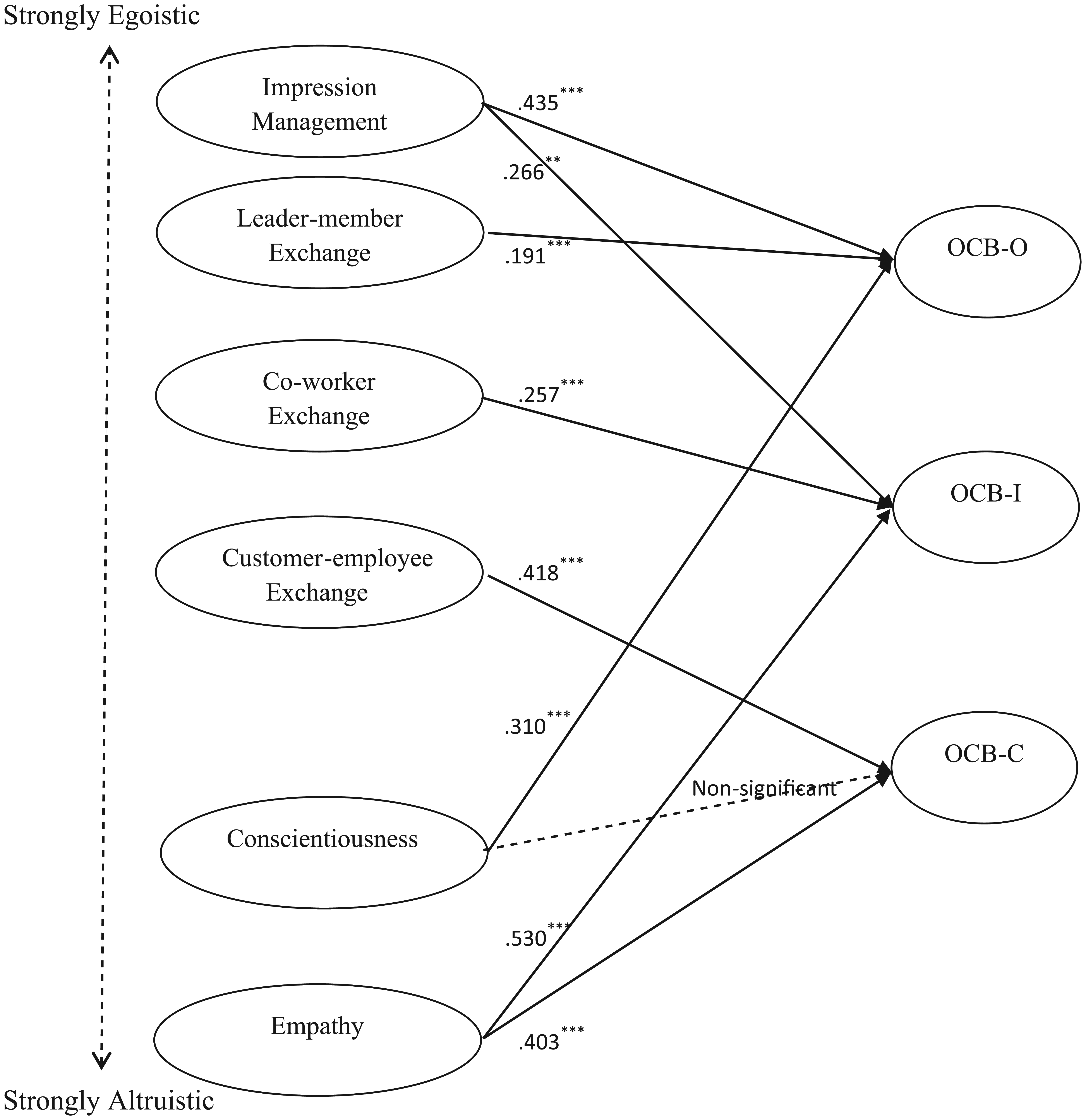
Testing of the Hypotheses
With respect to the strength of the relationships linking with the continuum, impression management had a much stronger impact on employees’ OCB-O than on OCB-I. This result occurs because from the employees’ perspective, impression management toward leaders or supervisors would make more sense than that to coworkers. In terms of the relationships between social exchanges and OCBs, customer–employee exchange has the strongest relationship compared with the other two types of social exchange and OCB. As customer–employee exchange is considered to be a less egoistic motivation, employees would not expect to receive the same level of benefits from customers as from coworkers or organizations. However, owing to the service-intensive nature of the hotel job and the inseparability of the service process, customers treat employees with respect and positive social exchanges occur, fostering employees’ reciprocal OCB to customers.
For altruistic motivations, the coefficient between empathy and OCB-I was .530, suggesting a strong positive relationship between the two variables. The coefficient between empathy and OCB-C was .403, suggesting a strong positive relationship between the two variables. The coefficient between conscientiousness and OCB-O was .310, suggesting a medium positive relationship between the two variables, and the coefficient between conscientiousness and OCB-C was not significant. In summary, three of the four relationships motivated by altruistic motivators were supported, and thus Hypotheses 6 to 8 were supported.
In terms of the strength of the relationships linking with the continuum, empathy had a stronger impact on employees’ OCB-I than on OCB-C, possibly because the levels of helping behaviors (one important form of OCB) increase with increasing relational closeness (e.g., Neyer & Lang, 2003). Empathy is often experienced most powerfully for members of one’s immediate family and groups (e.g., Aron, Aron, Tudor, & Nelson, 1991). Employees have a much closer relationship with their coworkers than they do with customers, providing for a higher level of empathic concerns. Conceivably, empathetic concern might be especially likely to promote OCB in close relationships. Similarly, conscientiousness was a significant predictor for employees’ OCB-O but not for OCB-C. Being conscientious is more likely to generate employees’ OCB toward organizations rather than toward customers. In other words, empathy is a more sensitive motivator for OCB-C than is conscientiousness.
Theoretical and Managerial Contributions
The complexity of OCB motivations has fostered a debate over whether OCB is genuinely altruistic or egoistic (e.g., Batson, 1998). This study proposed and empirically tested a holistic framework on OCB motivations along an altruistic and egoistic continuum, and contributes to theories in the following ways.
Getting Below the Surface of OCB Motivation
Researchers have made significant progress in uncovering OCB motivations. Social exchanges (e.g., Ma & Qu, 2011), impression management (e.g., Rosenfeld et al., 1995), personality traits (e.g., Zaskodna et al., 2013), and job satisfaction and commitment (e.g., Foote & Tang, 2008) have all been shown to be significant antecedents or motivations of OCB. However, most studies examined OCB motivation only at the surface level. Limited attempts have been made to uncover the underlying motivations of OCB or the nature of OCB motivations. In an important step in theory development, this study reassessed OCB motivations from the altruistic–egoistic perspective, proposed a continuum, and successfully allocated existing OCB motivations to the continuum. The findings of this study confirmed the complex nature of OCB as suggested by previous researchers (e.g., Organ, 1988) and also has important practical implications in recruiting and motivating hospitality employees. Knowing that some employee behaviors can be triggered by different motivations is an important step in understanding employees and motivating them.
A Continuum Rather Than a Debate
By looking at the nature of OCB, rather than engaging in debate about that nature (e.g., Bolino, 1999; Eastman, 1994; Organ, 1988; Salamon & Deutsch, 2006), this study discovered and justified links among multiple motivations and proposed a continuum of altruistic and egoistic motivations for OCB. The continuum incorporated the majority of OCB motivations that have been reported by previous research, and it employed these in a holistic framework. For example, in placing empathy as a highly altruistic motivation and impression management as a highly egoistic motivation, the framework reflects good progress toward the knowledge mapping of OCB motivations.
Linking Underlying Motives With OCB Targets
Despite its growing popularity (e.g., Chen, 2013; Loi et al., 2014; Ma & Qu, 2011; Tang & Tang, 2012), the three-dimensional target-specific OCB framework is still less recognized than the five-dimensional framework (e.g., Organ, 1988). This study has helped validate the robustness of the target-specific framework, adding additional empirical evidence.
The study also provides empirical evidence that the target-specific framework is more appropriate when looking into the underling motives of OCB. Specifically, discerning the target of behavior is critical to assessing whether a behavior is altruistic or egoistic (Batson & Shaw, 1991). The closeness of relationship between the OCB performer and the target is a key determinant of the frequency and depth of OCB, as implied by the theory of kin selection (Gardner et al., 2011). In addition, previously identified motivations for OCB, such as impression management and social exchange, are based on the roles and interaction of OCB targets. This study makes a further theoretical contribution by using the target-specific framework and drawing links between targets and the altruistic–egoistic continuum.
Good Soldiers Versus Good Actors
The study also has important managerial implications. People tend to believe that employees who go beyond and above are good soldiers, who are altruistically motivated to perform OCB (e.g., Bateman & Organ, 1983; Kamdar et al., 2006; Rioux & Penner, 2001). This study’s examination of the underlying motives for OCB suggests that employees may also perform OCB because of both altruistic and egoistic motivations. Hospitality managers should therefore look below the surface of employees’ performance. By knowing the underlying motives of employees, managers can use appropriate strategies to motivate employees, since employees who are altruistically oriented might not be motivated by egoistic gains.
The study also found that altruistic and egoistic motivations work differently on each type of OCBs. For example, empathy is an important motivator for OCB-I and OCB-C but not for OCB-O due to the perceived closeness of relationships (e.g., Neyer & Lang, 2003). Conscientiousness is a good predictor for OCB-O. Therefore, managers should use empathy to facilitate OCB-C and OCB-I employees, and they should motivate OCB-O employees by emphasizing the responsibility and obligations of their roles.
It is worth noting that social exchanges between customers and employees are an important source of employees’ OCB-C. This suggests that customers are not passive receivers of employees’ service but also can affect employees’ behaviors. In hospitality organizations where customer service is an important component of service delivery, employees should be trained with skills and tactics to facilitate positive service experiences. Managers should also pay attention to how employees feel about the exchange process with customers. When employees experience negative experience with customers, managers should guide employees toward attitudes and skills to cope with these encounters and respond appropriately so that employees’ negative emotions do not affect future service encounters.
Limitations and Future Research
First, this study integrates previously identified altruistic and egoistic motivations of OCB, and findings show that OCB is a complex phenomenon that depends on both altruistic and egoistic motivators. As this study adopted a cross-sectional research design using convenience sampling, caution is in order when generalizing the findings to other contexts and cultures. Future research might look at whether the altruistic–egoistic continuum works differently in collectivist and individualistic societies. Owing to the stability of targets across different cultures, the target-specific framework of OCB also offers the possibility of extending the study to cross-cultural contexts. Additionally, the study focused on the motivational mechanism of OCB of hotel employees, and future research might look into OCB’s impacts on customers.
Second, the study did not test the long-term effects of OCB motivations. As previous investigations have suggested that altruistic motivations for giving seem to be more predictive of sustained giving than egoistic motivations (Hogan & Holland, 2003), future studies might compare the persistence of altruistic and egoistic motivations over time. The study also did not investigate other personality trait variables, such as openness to experience and extraversion, because of limited literature support between their link with the altruistic–egoistic motivation and OCB and the focus of this study. This area may also be a promising future research direction. In addition, the simultaneous presence of altruistic and egoistic motivations may suggest an existence of moderating effects owing to demographic differences.
Third, not all measurements used by the study were from hospitality contexts. Partial scales were used for some constructs after modifications to suit hospitality contexts, which may pose a measurement bias in the study. Future research possibilities include the developments of measures specifically for hospitality contexts. Validating measures adapted for this study would be highly desirable.
Finally, future studies could explore other possible relationships among existing constructs and develop alternative models to further enrich the theories and literature on the altruistic–egoistic motivations of OCB.
Footnotes
Appendix

| Constructs | Measures Used by Current Study | Original Measures Adapted |
|---|---|---|
| Leader–member Exchange | My immediate supervisor understands the problems associated with my position. | Do you usually know how satisfied your leader is with what you do? |
| My immediate supervisor knows my potential. | How well does your leader understand your job problem and needs? | |
| My immediate supervisor will use authority to help me solve work problems. | How well does your leader recognize your potential? | |
| My immediate supervisor would protect me if needed. | Regardless of how much formal authority he/she has, what are the chances that your leader would use his/her power to help you solve problems in your work? | |
| I have a good working relationship with my immediate supervisor. | Regardless of the amount of formal authority your leader has, what are the chances that he/she would “bail you out” at his/her expenses? | |
| I know how satisfied my immediate supervisor is with my performance. | I have enough confidence in my leader that I would defend and justify his/her decision if he/she were not present to do so? | |
| How would you characterize your working relationship with your leader? (Graen & Uhl-Bien, 1995) | ||
| Coworker Exchange | My coworkers support my goals and values at work. | My coworkers are supportive of my goals and values at work. |
| My coworkers will help me when I have a problem. | Help is available from my coworkers when I have a problem. | |
| My coworkers really care about my well-being. | My coworkers really care about my well-being. | |
| My coworkers are willing to assist me to perform better. | My coworkers are willing to assist me to perform my job to the best of my ability. | |
| My coworkers care about my opinions. | Even if I did the best job possible, my coworkers would fail to notice. | |
| My coworkers will compliment my accomplishments at work. | My coworkers care about my general satisfaction at work. | |
| My coworkers show very little concern for me. | ||
| My coworkers care about my opinions. | ||
| My coworkers are complimentary my accomplishments at work. (Ladd & Henry, 2000) | ||
| Customer–employee Exchange | Most of our guests are polite. | Most of our guests are polite. |
| I feel that my services are appreciated by our guests. | I feel that my services are appreciated by our guests. | |
| I rarely receive complaints from our guests. | I rarely receive complaints from our guests. | |
| I feel our guests are satisfied with the services provided by our hotel. | I feel our guests are satisfied with the services provided by our hotel. | |
| I feel our guests are happy to stay in our hotel. | I feel our guests are happy to stay in our hotel. (Ma & Qu, 2011) | |
| Impression Management | I think it is important to avoid looking bad in front of others. | To avoid looking bad in front of others. |
| I think it is important to look better than my coworkers. | To avoid looking lazy. | |
| I am afraid to appear irresponsible. | To look better than my co-workers. | |
| *Note: The original scale has 9 items, the panel agreed that five items were actually motivations for engaging in impression management behaviors. Three statements including “avoid looking lazing,” “looking busy,” and “avoid looking bad” repeat each other. Therefore, three items were kept from the original scale. Appendix 1 listed original scales and the measurement scales used by the study. | To avoid a reprimand from my boss. (motivation) | |
| Because I fear appearing irresponsible. | ||
| To look like I am busy. | ||
| To stay out of trouble. (motivation) | ||
| Because rewards are important to me. (motivation) | ||
| Because I want a raise. (motivation) | ||
| To impress my co-workers. (motivation) (Rioux & Penner, 2001) | ||
| Conscientiousness | I am a very organized person. | Organized |
| I am a very efficient person. | Efficient | |
| I am a very systematic person. | Systematic | |
| I am a very practical person. | Practical | |
| *Note: The original measures had four positively worded statements and four negatively worded statements, capturing four aspects of conscientiousness, including organized, efficient, systematic and practical. The study only kept the four positively worded statements to avoid repetition and interpretation mistakes that might occur with respondents (Sauro, 2011). | Disorganized | |
| Sloppy | ||
| Inefficient | ||
| Careless (Saucier, 1994) | ||
| Empathy | I try to understand my friends better from their perspective. | Cognitive Empathy |
| Seeing warm, emotional scenes makes me teary-eyed. | 1. I believe that there are two sides to every question and try to look at them both. | |
| I am a very soft-hearted person. | 2. I try to look at everybody’s side of a disagreement before I make a decision. | |
| *Note: All four cognitive empathy items repeatedly emphasized the importance of perspective-taking, which is a key feature of empathy (Yuan, 2006). Repetition was also found on two items of the affective empathy dimension. | 3. I sometimes find it difficult to see things from the “other guy’s” point of view. (R) | |
| 4. I sometimes try to understand my friends better by imagining how things look from their perspective. | ||
| Affective Empathy | ||
| 1. Seeing warm, emotional scenes melts my heart and makes me teary-eyed. | ||
| 2. When I watch a sad, “tear-jerker” movie, I almost always have warm, compassionate feelings for the characters. | ||
| 3. I would describe myself as a pretty soft-hearted person. Bettencourt et al. (2001). | ||
| OCB-O | I will give advanced notice if I cannot come to work. | I will give advanced notice if I cannot come to work. |
| My attendance at work is above the required level. | My attendance at work is above the required level. | |
| I follow informal rules in order to maintain order. | I follow informal rules in order to maintain order. | |
| I protect our hotel’s property. | I protect our hotel’s property. | |
| I say good things about our hotel when talking with outsiders. | I say good things about our hotel when talking with outsiders. | |
| I promote the hotel’s products and services actively. | I promote the hotel’s products and services actively. (Ma & Qu, 2011; adapted based on Williams & Anderson, 1991) | |
| OCB-I | I help my coworkers when their workload is heavy. | I help my coworkers when their workload is heavy. |
| I help my coworkers who have been absent to finish their work. | I help my coworkers who have been absent to finish their work. | |
| I take time to listen to my coworkers’ problems and worries. | I take time to listen to my coworkers’ problems and worries. | |
| I go out of my way to help new coworkers. | I go out of my way to help new coworkers. | |
| I take personal interest in my coworkers. | I take personal interest in my coworkers. | |
| I pass along notices and news to my coworkers. | I pass along notices and news to my coworkers. (Ma & Qu, 2011; Williams & Anderson, 1991) | |
| OCB-C | I always have a positive attitude at work. | I always have a positive attitude at work. |
| I am always exceptionally courteous and respectful to customers. | I am always exceptionally courteous and respectful to customers. | |
| I follow customer service guidelines with extreme care. | I follow customer service guidelines with extreme care. | |
| I respond to customer requests and problems in a timely manner. | I respond to customer requests and problems in a timely manner. | |
| I perform duties with very few mistakes. | I perform duties with very few mistakes. | |
| I conscientiously promote products and services to customers. | I conscientiously promote products and services to customers. | |
| I contribute many ideas for customer promotions and communications. | I contribute many ideas for customer promotions and communications. | |
| I make constructive suggestions for service improvement. | I make constructive suggestions for service improvement. (Ma & Qu, 2011; adapted based on Lin et al., 2008) |