



Abstract
This study investigated the structural relationships among destination social responsibility (DSR), tourism impacts (i.e., positive and negative impacts), residents’ support for tourism, and their perceived quality of life. A structural model was empirically tested with a sample of 272 residents living in the Phoenix Ancient Town in China. The results indicated that DSR enhanced residents’ perception of positive tourism impacts but did not influence their perception of negative impacts. Concurrently, DSR was found to have direct and positive effects on residents’ support for tourism and perceived quality of life. It also had indirect and positive effects on residents’ support for tourism and perceived quality of life, mediated by positive tourism impacts. While residents’ perceived positive tourism impacts increased their support for tourism and perceived quality of life, negative impacts would undermine support for tourism and proved to be disruptive to quality of life.
Introduction
Globally, sustainable business practices have been an increasing concern to firms and their stakeholders, giving rise to the concept of corporate social responsibility (CSR). According to Kotler and Lee (2004), CSR is “a commitment to improve community well-being through discretionary business practices and contributions of corporate resources” (p. 3). It requires an ethical standing point in business practices to take considerations of not only business profitability but also individual and societal collective well-being (Sheldon & Park, 2011). In the tourism industry, responsible business practices is essential (Sheldon & Park, 2011), because tourist destination development is heavily reliant on environmental and cultural resources. These resources need to be maintained and developed in a responsible way to achieve sustainable development for a tourist destination.
In recent years, with increasing concern for the issues of environmental degradation, climate change, depletion of natural resources, human rights issues, and fair trade, CSR in the travel industry has received increasing attention (Sheldon & Park, 2011). Scholars explored the issues of CSR in various tourism-related industries, such as hotels (e.g., Inoue & Lee, 2011) and restaurants (e.g., Kang, Lee, & Huh, 2010). Sheldon and Park (2011) examined how travel industry members in the United States perceived the concept of CSR and how they were involved in CSR activities. However, most of the literature focused on CSR practice of individual business firms; there were limited studies investigating social responsibility from the perspective of the entire destination. The relationship between a destination’s overall engagement with social responsibility and its impact on destination community remains unknown.
In the definition of CSR, the responsibility subject is apparent, that is, the focal corporation under discussion. However, in the case of tourism development, much of the impact on residents’ life is the result of collective activities of all stakeholders involved (e.g., government, tourists, and tourism enterprises). These impacts include, for example, overcrowding, inflation, degradation of natural resources, and erosion of the cultural heritage, among others. In this regard, although the role of a single firm may be negligible, the combined effects of the stakeholders in the destination are significant. While the identity of the responsibility subject is elusive in the destination context, the aggregate level and status of the stakeholders’ responsible behaviors can be conceptualized and evaluated. It is the collective behavior of the industry stakeholders that determines the aggregate impact of tourism development on a destination, and the aggregate impact as perceived by residents in turn shapes their attitude, and consequently support or opposition toward tourism development. Therefore, it is vital to examine the social responsibility from a destination’s perspective.
Tourist destinations can be defined as geographical locations that include all services and infrastructure needed for the arrival and stay of visitors and offer tourist experience (Buhalis, 2000). It has a more complex structure in terms of management and coordination (Buhalis, 2000; Ritchie & Crouch, 2003), but needs to manage its reputation as a single entity to compete successfully in the tourism market (Inversini, Cantoni, & Buhalis, 2009). Previous CSR literature focused on the responsibility of individual firms, thus neglecting the collective impact of the industry in its entirety. On the other hand, most of the tourism literature conceptualized the impact of tourism and residents’ support for tourism as the aggregate outcomes of the industry. Therefore, the concept of CSR in the field of organizational behavior is not completely suitable to the destination context. In light of this, the current study proposed the destination social responsibility (DSR) concept and examined its relationships with perceived tourism impacts, residents’ support for tourism, and quality of life (QOL). We define DSR as the collective ideology and efforts of destination stakeholders to conduct socially responsible activities as perceived by local residents.
Drawing on the literature, this study focused on developing and testing a theoretical framework that postulated DSR not only as a direct predictor to residents’ support for tourism and QOL but also indirectly exerting its influences on the latter two through perceived tourism impacts. Specifically, this study aimed to fill the following gaps. First, it attempted to incorporate social responsibility into the destination development context and modelled DSR as the key antecedent of tourism impacts, support for tourism, and QOL. Second, the study examined QOL of residents as the outcome of DSR and tourism impacts. It tested the causal relations between resident QOL and its antecedents in the destination context; in so doing, it responds well to the call for further studies on the noneconomic outcome of tourism development (Wang & Pfister, 2008). Third, based on social exchange theory and bottom-up spillover theory (Sirgy, Efraty, Siegel, & Lee, 2001), this study examined the mediating role of tourism impacts (both positive and negative) between DSR and support for tourism, as well as between DSR and QOL.
Literature Review
Tourism Impacts
Tourism has great potential to influence the lives of local residents (Andereck & Nyaupane, 2011), and it is difficult to sustain a destination’s development without community support and participation (Gursoy & Rutherford, 2004; Lee, 2013). Tourism development can lead to both positive and negative impacts to destination communities (e.g., Andereck & Nyaupane, 2011; Nunkoo & Ramkissoon, 2011a). Many studies have examined tourism impacts perceived by residents and community support for tourism development (e.g., Lee, Kang, Long, & Reisinger, 2010; Long, Perdue, & Allen, 1990; Nunkoo & Ramkissoon, 2011a). Early destination studies mainly focused on the economic issues, such as revenues and job creation (Perdue, Long, & Kang, 1999). However, as noted by Wang and Pfister (2008), noneconomic perspectives should be explored in identifying tourism impacts as perceived by residents. Nunkoo and Ramkissoon (2011a) suggest that tourism projects are not only “an economic development tool” but also “a means of community development” (p. 982). Similarly, Kim, Uysal, and Sirgy (2013) argue that much research is needed to “better understand how tourism impact affects community residents’ overall sense of well-being (i.e., perceived quality of life)” (p. 529).
Residents’ perceived QOL is a valid concern among the noneconomic outcomes of tourism development (Andereck & Nyaupane, 2011; Perdue et al., 1999). In this regard, it is important to understand how residents’ perception of specific destination development aspects influences their perceived QOL (Perdue et al., 1999). Such research would improve our understanding of the relationship between a tourist destination’s development characteristics (e.g., stages, local participation, and tourism policy) and its residents’ life quality and satisfaction. Understanding QOL as an outcome of tourism impacts is fundamental to broadening the scope of tourism literature. As Morgan (2012) noted, successful tourism destinations should be places that enhance the well-being of their populations and enable new ways of sustainable living.
Destination Social Responsibility
In a destination, tourism-related sectors, such as tour operation, ground transportation, airline, accommodation, restaurants, and travel agencies, face challenges in relation to social responsibility as major stakeholders that can influence the destination’s economy, environment, culture, and society. Industry associations often initiate self-regulatory guidelines to promote socially responsible business practices. In the restaurant sector, Sheldon and Park (2011) found that associations are active in CSR initiatives. Ravinder (2007) examined the ethics issues related to airline industry and proposed that new guidelines to direct airlines’ CSR activities be developed. Jones, Comfort, and Hiller (2006) revealed that the top 10 food retailers in the United Kingdom commonly recognized CSR’s multifaceted and long-term benefits to both businesses and the society.
Tourism-related companies currently engage in various CSR activities in relation to community involvement, environmental management, customer relations, and employee relations (Inoue & Lee, 2011). CSR activities are not only sources of innovation and competitive advantage to individual companies; they can also improve the destination’s overall sustainability and competitiveness (Sheldon & Park, 2011). Sustainable destination development requires common understanding and coordination among all relevant stakeholders. Although the private sector may not fully appreciate the public sector’s planning efforts, good CSR practices can bring the two sectors together. Therefore, a destination may be perceived as socially responsible if all stakeholders in the public and private sectors can take socially responsible actions in tourism development. Such collective responsible behaviors in the destination can be perceived by relevant stakeholders, particularly local residents as constituents of the society in the destination. Therefore, it is important to look into the CSR activities at the whole destination level as perceived by local residents. In such a context, following the definition and conceptualizations of CSR, we introduce the concept of DSR and define it as the collective ideology and efforts of destination stakeholders to conduct socially responsible activities as perceived by local residents. The rationale behind DSR is that destination sustainability can be achieved if the stakeholders work together with a common goal to act for the benefit of the society at large. DSR captures the collective outcome of the tourism industry and echoes with industry associations and trade unions’ call for collaboration in socially responsible conduct.
DSR and Tourism Impacts
Tourism impacts can be analyzed in various aspects including economic, sociocultural, and environmental; in each aspect both positive and negative impacts could be derived (Kim et al., 2013). Similar to the dimensions of CSR identified by Dahlsrud (2008), DSR includes economic, social, environmental, and stakeholder responsibilities, which mostly correspond to the aspects of tourism impacts. DSR represents the responsibility for all the relevant stakeholders in the destination to minimize negative economic, environmental, and social impacts; generate economic benefits for local people; and enhance the well-being of local residents. The collective engagement of the destination stakeholders in socially responsible activities can generally enhance positive impacts from tourism development and reduce its negative impacts. Thus, we propose the following hypotheses.
DSR and Residents’ Support for Tourism
The general marketing literature has examined the outcomes of CSR from the perspective of individual firms. Studies have demonstrated that companies engaged in CSR activities elicited favorable responses from stakeholders (Bhattacharya, Korschun, & Sen, 2009), as stakeholders (e.g., customer, employees, and investors) can obtain benefits from such CSR activities. Sen and Bhattacharya (2001) found that a firm’s record in CSR positively influenced customer evaluation of the firm, which in turn increased customer intention to purchase the firm’s products. In the tourism literature, studies have explored the determinants of support for tourism, and most of them focused on tourism-related community changes and the level of residents’ support for tourism development (Andereck & Nyaupane, 2011). In this line of research, the study subjects were mainly individual firms rather than the destination entity as a whole. However, in the destination context, it is the overall status of the industry’s devotion to the benefits of the society as a whole that determines the level of residents’ support for tourism development. Based on the above discussion, we postulate that DSR could bring benefits to community residents in the destination. According to social exchange theory, when residents make favorable evaluation of destination development, they may form positive intentions to support tourism. Thus, the following hypothesis was formulated.
DSR and QOL
The World Business Council of Sustainable Development (WBCSD) defines CSR as “the continuing commitment by business to contribute to economic development while improving the quality of life of the workforce and their families as well as of the community and society at large” (Source: www.wbcsd.org). Based on this conceptualization, the linkage between CSR and QOL are apparent. However, to our knowledge, no study has directly examined the relationship between CSR and QOL in the general management and marketing literature.
In the tourism field, tourism development was recognized to have great potential to influence the lives of community residents. A number of studies have explored the effects of tourism on QOL (Andereck & Nyaupane, 2011; Aref, 2011; Jurowski & Brown, 2001; Khizindar, 2012; Perdue et al., 1999). According to Spradley (1976), QOL can be defined as “an overall state of affairs in a particular society that people evaluate positively” (p. 100). As Andereck and Nyaupane (2011) suggested, improved QOL could be realized through the development of tourism products that could also be enjoyed by residents (e.g., festivals, restaurants, natural and cultural attractions, and outdoor recreation opportunities). Perdue et al. (1999) examined the relationship between community characteristics and QOL and found that the key community characteristics influencing residents’ QOL included community safety, social environment, and community involvement. Undoubtedly, these characteristics exemplifying an ideal destination would be difficulty if not impossible to attain without the collective efforts of all stakeholders in the industry.
Based on the above discussion, we propose the following hypothesis.
Tourism Impacts and Residents’ Support for Tourism
Research has shown that tourism development could bring various benefits to community residents, such as creating employment opportunities (Dyer, Gursoy, Sharma, & Carter, 2007; Nunkoo & Ramkissoon, 2011a), improving standard of living (Nunkoo & Ramkissoon, 2011a), stimulating more business and investment opportunities for local people (Dyer et al., 2007; Kwan & McCartney, 2005; Nunkoo & Ramkissoon, 2011a), and improving infrastructure (Nunkoo & Ramkissoon, 2011a). Previous studies indicated that resident perceptions of positive impacts of tourism positively influenced their support for tourism (e.g., Gursoy, Jurowski, & Uysal, 2002; Gursoy & Rutherford, 2004; Lee, 2013; Lee et al., 2010; Long et al., 1990; Nunkoo & Ramkissoon, 2010). Nunkoo and Ramkissoon (2011a) empirically demonstrated that resident support for tourism was affected by perceived benefits and costs of tourism development. Based on social exchange theory, Ap (1992) argued that residents’ perceptions are good predictors of their behavior toward tourism. Therefore, we propose the following hypothesis.
Although numerous studies confirmed that tourism development could bring positive impacts to local community, its negative impacts were also commonly recognized. Negative impacts are generally demonstrated in environmental pollution (Gursoy & Rutherford, 2004), rising land and property price, and rising levels of crime (Gursoy & Rutherford, 2004; Milman & Pizam, 1988). In summary, previous studies indicated that residents’ perceptions of negative tourism impacts adversely influenced their support for tourism development (Gursoy et al., 2002; Gursoy & Rutherford, 2004; Lee, 2013; Nunkoo & Ramkissoon, 2010, 2011a). Thus, we formulated the following hypothesis.
Tourism Impacts and QOL
Tourism development may affect resident QOL in many ways. Previous studies have confirmed the numerous positive impacts of tourism, for example, creating job opportunities, increasing tax revenues, and improving service facilities for residents, thereby contributing to a higher standard of living (Andereck & Nyaupane, 2011). These positive impacts could lead to heightened self-esteem (Stronza & Gordillo, 2008) and QOL of residents (Milman & Pizam, 1988; Perdue et al., 1999). Specifically, Khizindar (2012) found tourism had a rather direct impact on the QOL of the residents in the Markkah region of Saudi Arabia. In a recent study, Woo, Kim, and Uysal (2015) confirmed that perceived value of tourism development was positively related to residents’ material life satisfaction, non–material life satisfaction, and overall QOL. The contribution of tourism impacts to QOL can be well understood through the lens of bottom-up spillover theory (Sirgy et al., 2001), which posits that satisfaction with particular life domains spills over to the overall life satisfaction, which in its essence resembles perceived QOL. In the destination context, residents live with the tourism system and form their perceptions of the tourism impacts. Their perceptions of tourism impacts could well spill over to affect their overall perception of QOL.
On the other hand, tourism could also cause a wide range of negative impacts. All these negative impacts may contribute to reducing residents’ QOL or life satisfaction (Andereck & Nyaupane, 2011; Kim et al., 2013). Specifically, negative environmental impact could result in decreased sense of health and safety, which are two domains of the QOL construct (Kim et al., 2013). Minimizing the negative social and environmental costs of tourism development can optimize the well-being of destination communities (Sharpley, 2014). Few studies have directly examined the relationship between tourism impacts and QOL of residents. An exceptional study by Andereck and Nyaupane (2011) showed that tourism had positive impact on six QOL domains: recreation amenities, community pride and awareness, economic strength, natural/cultural preservation, community well-being, and way of life. At the same time, they found two domains (i.e., urban issues, and crime and substance abuse) had negative scores, indicating that tourism negatively influenced residents’ QOL in these domains. Based on the above discussions, we developed the following hypothesis.
Considering Hypotheses 1a, 1b, 2a, 2b, 3a, and 3b together, we also developed the following Hypotheses (4a-4d) with regard to the indirect effect of DSR on support of tourism and resident QOL through the mediation of positive and negative impacts. Two relevant theories also serve as the foundation for the indirect effect of DSR on support of tourism and resident QOL through tourism impacts. The social exchange theory supports that DSR as perceived by residents can function as a social input in the process of social exchange, which forms perceived impacts and then support for tourism as a behavioral outcome. On the other hand, the bottom spillover theory supports the path from DSR to QOL through perceived impacts. DSR represents one domain of residents’ social perceptions, which will affect their perceived impacts of tourism development, which in turn “spill over” to the superordinate domain of QOL. While there is some indication in the literature that QOL may predict support for tourism (e.g., Woo et al., 2015), the relationship between QOL and support for tourism is less established. Prior studies show that this relationship may be contingent on residents’ involvement or employment in the tourism industry (Harrill, 2004; Jurowski & Brown, 2001), and community’s economic dependence on tourism (Harrill, 2004; McGehee & Andereck, 2004). Therefore, it is postulated that support for tourism and QOL parallel each other as outcomes of tourism impacts.
The conceptual model underlying the relationship of the key constructs is depicted in Figure 1.

The Proposed Model
Method
Measures
Construct measurements for this study were adapted from previous studies. Specifically, the measure of DSR contained four items adapted from the CSR instruments in the studies of Walsh and Beatty (2007); Lichtenstein, Drumwright, and Braig (2004); and Walsh and Bartikowski (2013). It captures facets of environmental, social, economic, and stakeholder responsibility. As the current study is to test the structural relationships among the concerned constructs, the measurement of DSR is therefore not specific to the subdimensional levels of social responsibility. Measurements of positive impacts and negative impacts, each including three items, were adapted from Gursoy and Rutherford (2004), Gursoy et al. (2002), and Nunkoo and Ramkissoon (2011b). The three items measuring residents’ support for tourism were adopted from Oviedo-Garcia, Castellanos-Verdugo, and Martin-Ruiz’s (2008) and Nunkoo and Ramkissoon’s (2011b) studies. For the above-mentioned measurements, respondents were asked to state their level of agreement on a 5-point Likert-type scale, from 1 for strongly disagree to 5 for strongly agree.
Resident QOL was measured with a three-item global QOL scale adapted from Aaronson, Ahmedzai, and Bergman’s (1993) study. This scale has been extensively tested, exhibiting high reliability and validity across multiple study contexts (e.g., Aaronson et al., 1993; Dagger & Sweeney, 2006). Respondents were asked to evaluate their life quality on a 5-point Likert-type scale, from 1 for very poor to 5 for excellent.
To establish translation equivalence of the measurements, the back-translation process was used to identify content or wording errors. The questionnaire was first prepared in English, and then translated into Chinese with back-translation to identify inconsistencies.
Study Site, Data Collection, and Study Sample
The study site of this research is the Phoenix Ancient Town located in the Xiangxi Tujia and Miao Autonomous Prefecture, Hunan Province, China. Detailed description of the study site is provided in the online supplement file of this article (available online at http://jht.sagepub.com/supplemental). The sampling frame of the study consisted of individuals who reside in the Phoenix Ancient Town. As we did not have the access to a household list of the town, we used a systematic sampling approach by selecting every second household on each street in the town. Data were collected from January 10 to 30, 2013. Of the 400 distributed questionnaires, 326 were returned, for an 81.5% response rate. After removing incomplete questionnaires, 272 completed questionnaires were subsequently used in the data analysis. The removal of the incomplete questionnaires was mainly due to missing values on demographic variables, not on the construct measurements. As the final sample size (n = 272) is regarded adequate for analysis and there is no particular pattern for the missing values, deleting these cases would not cause any bias in the subsequent data analysis.
The demographic profile of the respondents is provided in a table in the online supplement file (available online at http://jht.sagepub.com/supplemental). The sample had a balanced ratio of gender. The age of participants ranged mainly from 15 to 44 years. We extended the lower age threshold to 15 years as residents above this age would be able to understand the questionnaire items well and evaluate the impacts of tourism on their life. In any tourism impacts study, it is also important to include young generation’s views. Because of the fact that questionnaires were more likely to be completed by a younger member of the household who is better educated than older household members, the sample also appears to be heavily skewed to the age cohort of 15 to 24 year olds. About 38.6% of the respondents had a household income of less than 2,000 RMB per month. Most of the respondents had resided in the area for more than 10 years. The majority of the respondents had an educational level of high school/technical school and undergraduate/associate degree.
Analysis and Results
Measurement Model Test
A confirmatory factor analysis with a maximum likelihood method was initially conducted to estimate the measurement model and verify the underlying structure of the constructs in the proposed model. The fit indices of the measurement model suggested that the model fitted the data well. The χ2/df was 2.045 (<3; p < .001), and the root mean square residual (RMR) and root mean square error of approximation (RMSEA) values were 0.047 and 0.062, respectively. The values of goodness-of-fit index (GFI), nonnormed fit index (NFI), incremental fit index (IFI), Tucker–Lewis index (TLI), and comparative fit index (CFI) were all greater than .90, and the adjusted goodness of fit index (AGFI) was .885 (close to .90). According to the model evaluation criteria suggested by Hu and Bentler (1999), all the indices were acceptable. This test also addressed the issue of common method variance (CMV). As it shows that all the measurement items are not likely to load on one single factor, we claim that CMV is not a pervasive issue in this study (Chang, Witteloostuijn, & Eden, 2010).
All constructs in the proposed model were then subjected to reliability tests, using indices of Cronbach’s alpha coefficient and composite construct reliability. The Cronbach’s alpha coefficients ranged from .798 to .903, all of which exceeded .70 and were acceptable. The composite reliability ranged from .806 to .904, greater than the threshold suggested by Fornell and Larcker (1981), ensuring adequate internal consistency of multiple items for each construct.
Validity analysis included checking both convergent validity and discriminant validity. Convergent validity was assessed by the contribution of measurement items to the latent constructs. Standardized factor loadings of all items were greater than .643 and significant at the .001 level. Meanwhile, the average variance extracted (AVE) of all constructs ranged from .512 to .758, higher than the threshold value of .50, indicating that a large portion of the variance was explained by the constructs (Fornell & Larcker, 1981). The results suggested good convergent validity of measurements. Discriminant validity signifies that a construct differs significantly from the other constructs. It is tested by comparing the square roots of the AVE values with the correlation coefficients between constructs. According to Fornell and Larcker (1981), if the square roots of the AVEs are greater than the correlations between any pair of constructs, it indicates that discriminant validity is satisfied. All correlation coefficients were found to be less than the square roots of the AVEs, suggesting satisfactory discriminant validity. Detailed measurement model test results and indicators can be found in the online supplement file.
Structural Model Test
Once the measurement model was validated, subsequent structural equation modelling analyses were conducted to validate the proposed structural model and test the hypotheses. The fit indices of the structural path model (χ2/df = 2.436, p < .001; RMR = .084, RMSEA = .073, GFI = .905, AGFI = .866, NFI = .904, RFI = .881, IFI = .941, TLI = .926, CFI = .941) showed that the structural model fit the data fairly well (Hu & Bentler, 1999).
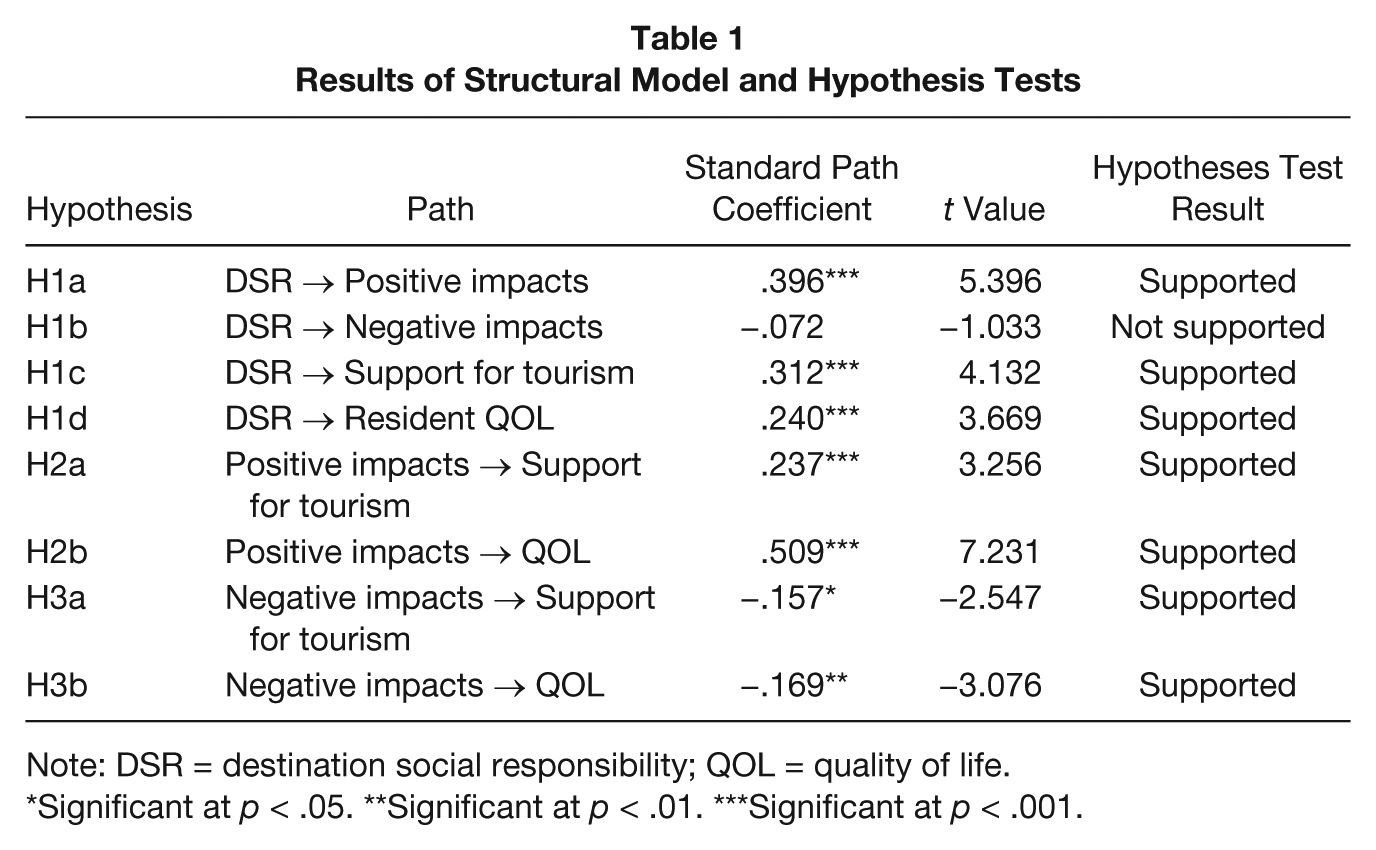
Table 1 shows the results of structural model test. The effect of DSR on positive impacts (.396, p < .001), support for tourism (.312, p < .001), and QOL (.240, p < .001) were significant, suggesting that Hypotheses 1a, 1c, and 1d were supported. However, the influence of DSR on perceived negative impacts was not significant. Thus, Hypothesis 1b was not supported.
Results of Structural Model and Hypothesis Tests
Note: DSR = destination social responsibility; QOL = quality of life.
Significant at p < .05. **Significant at p < .01. ***Significant at p < .001.
Perceived positive impacts had a significant effect on support for tourism (.237, p < .001) and QOL (.509, p < .001), respectively, indicating that Hypotheses 2a and 2b were supported. Meanwhile, perceived negative impacts also had significant effects on support for tourism (−.157, p < .05) and QOL (−.169, p < .01), respectively. Therefore, Hypotheses 3a and 3b were supported.
Explanatory Power of the Model
According to Cohen (1988), R2 values could be used to demonstrate the predictive power of a model. The model explained, respectively, 45.3% and 24.6%, of the variances of QOL and support for tourism (Figure 2). Therefore, a reasonably large portion of the effects on support for tourism and QOL were captured in the model, suggesting that the model had good explanation power.
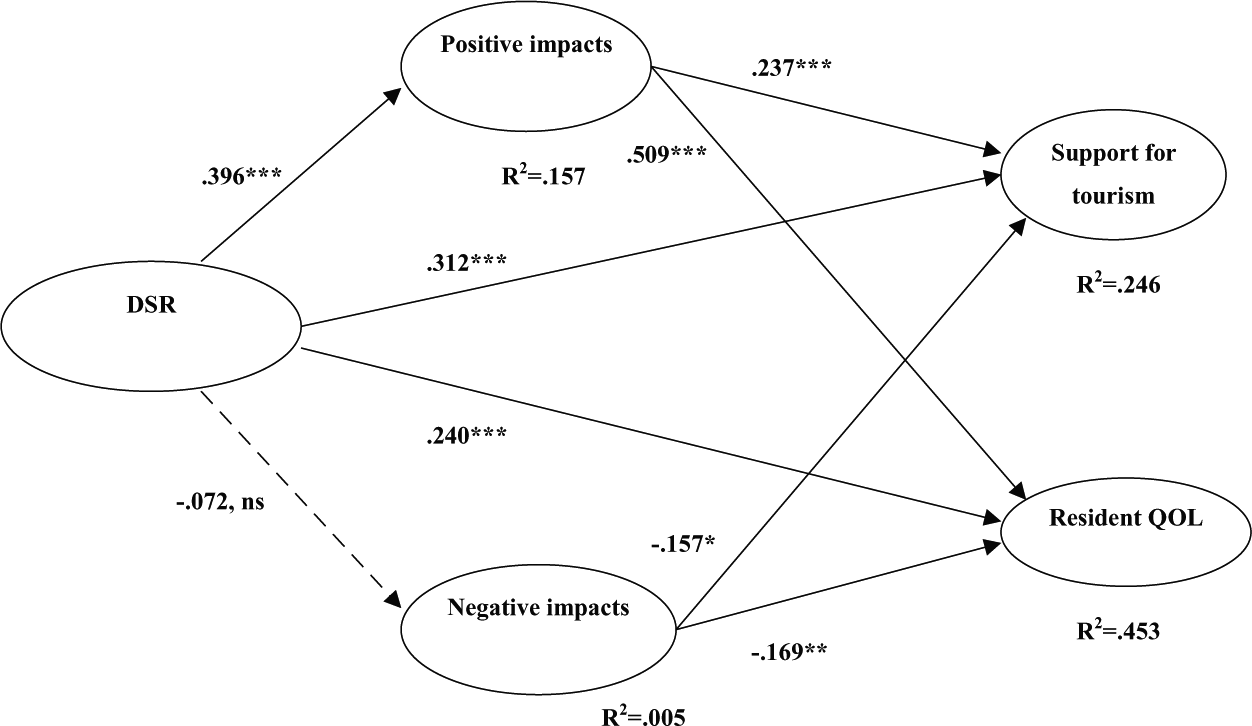
The Results of Structural Model Test
Effect Analysis
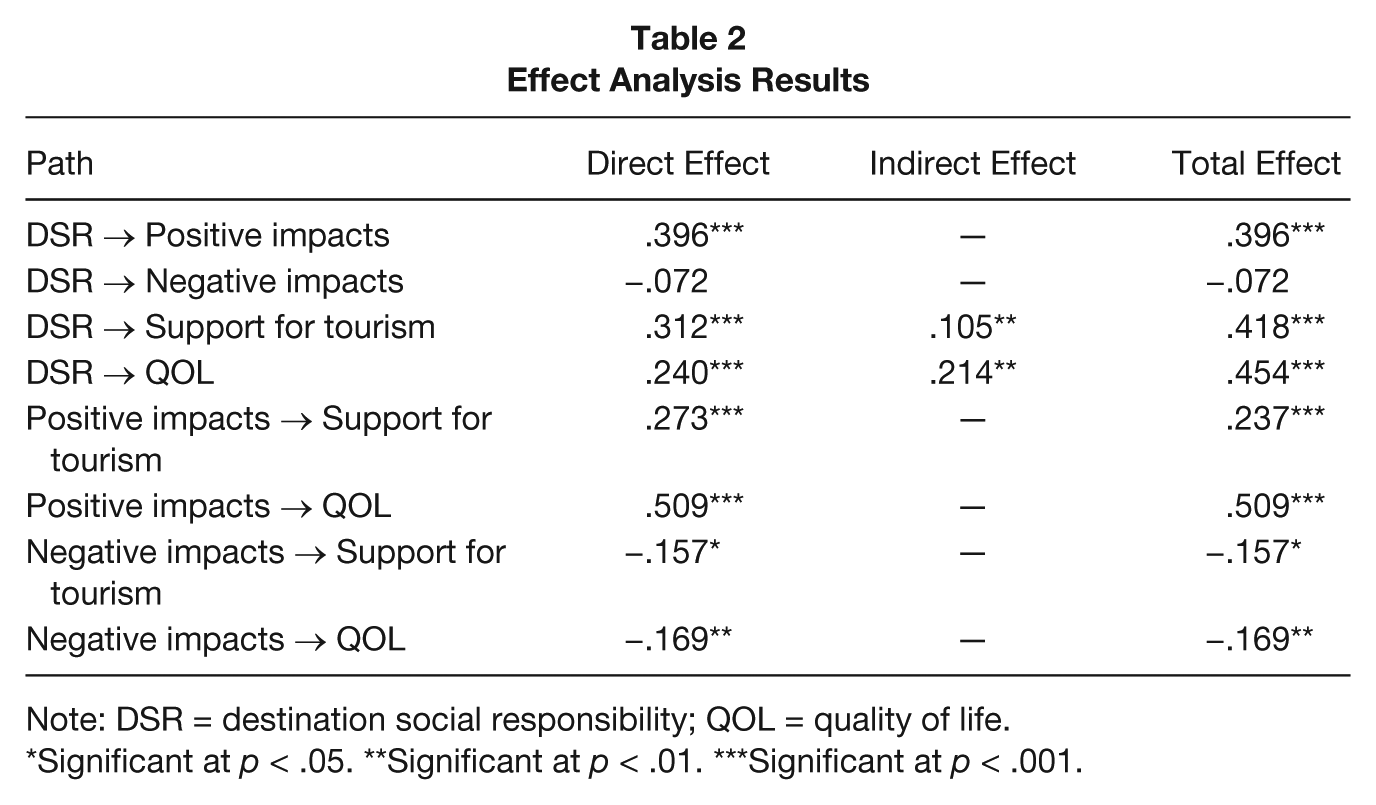
The direct, indirect, and total effects in the model are shown in Table 2. DSR had significant direct effects on perceived positive impacts, support for tourism, and QOL, respectively; however, DSR’s direct effect on perceived negative impacts was not significant. DSR also had significant indirect effects on support for tourism and QOL, respectively, due to the mediation of positive impacts. However, as DSR was found to have no significant relationship with negative impacts, the indirect effect between DSR and support for tourism/resident QOL through negative impacts was nonexistent. Besides, the results showed differentiating effects of perceived positive and negative impacts on support for tourism and QOL. The effects of positive impacts on support for tourism and QOL were stronger than those of negative impacts.
Effect Analysis Results
Note: DSR = destination social responsibility; QOL = quality of life.
Significant at p < .05. **Significant at p < .01. ***Significant at p < .001.
Mediation Effects of Tourism Impacts
To further explore the mediating effects of tourism impacts, we analyzed the direct and indirect effects of tourism impacts (positive and negative) on support for tourism and QOL. We used bootstrapping method to test the mediating role of tourism impacts (Jose, 2013). Analysis details are provided in the supplement file. Results show that positive impacts partially mediated the effects of DSR on support for tourism and QOL, but negative impacts had no mediating role between DSR and support for tourism/QOL. Thus, while Hypotheses 4a and 4b were supported, Hypotheses 4c and 4d were not.
Discussion
Theoretical Implications
This study developed and tested a theoretical model to examine how DSR contributes to support for tourism and resident QOL. It confirmed that residents’ DSR evaluation is important in shaping their support for tourism and QOL. The study makes the following theoretical contributions. First, it found a significant relationship between DSR and tourism positive impacts. This finding demonstrates the importance of DSR in destination management. DSR can positively contribute to positive impacts of tourism development perceived by local residents. Previous studies (e.g., Lee, 2013) have examined the antecedents of perceived impacts of tourism development; however, no specific study seems to have attempted to examine the links between DSR and perceived impacts of tourism.
Second, the current study may be claimed the first to formulate DSR as an antecedent of support for tourism. It confirmed that DSR had a positive impact on support for tourism, indicating that DSR activities were important ways to gain resident support for tourism. This is an important finding in terms of destination management and its link to community support. It indicates that by applying socially responsible destination management measures and procedures, destinations can be developed in a more sustainable way with resident support.
Third, tourism development has great potential to influence the lives of community residents (Andereck & Nyaupane, 2011), and the relationship between tourism and QOL has become a new heated research topic (McCabe & Johnson, 2013). However, few studies have examined QOL of residents as an outcome of tourism development. To fill this gap, this study explored the effect of DSR on resident QOL. The empirical results showed that DSR could improve QOL of residents. The findings demonstrated that DSR activities could not only bring economic outcomes, but also social benefits to residents by improving resident QOL.
Fourth, the results indicate that perceived positive impacts leveraged residents’ support for tourism, while perceived negative impacts would reduce residents’ support. In addition, this study found that perceived positive impacts had a higher effect on support for tourism than that of perceived negative impacts in reducing the support for tourism. This was consistent with previous studies in the field (e.g., Gursoy & Rutherford, 2004; Lee et al., 2010; Nunkoo & Ramkissoon, 2010, 2011a, 2011b; Oviedo-Garcia et al., 2008). For instance, in the Western culture context, Vargas-Sanchez, Plaza-Mejia, and Porras-Bueno (2009) noted, “Among the perceived effects, those that are positive impacts have a greater influence on attitude toward more tourism development than the negative effects” (p. 384). In the Eastern culture context, Lee’s (2013) finding also proved that positive impacts had a greater effect on support for tourism than negative impacts. As most of the previous studies were conducted in Western countries (Lee, 2013), the findings of the present study add to the multicultural perspectives regarding residents’ support for tourism. Moreover, the results demonstrated that positive impacts had a mediating effect between DSR and support for tourism development. Thus, the positive link of “DSR → tourism positive impacts → support for tourism development” was confirmed.
Finally, regarding the effects of tourism impacts on QOL, this study confirmed that positive impacts could improve QOL, but negative impacts could decrease QOL. The results were consistent with Andereck and Nyaupane’s (2011) in that tourism could enhance community well-being and had an overall positive influence on local residents’ way of life. Moreover, the positive and significant link of “DSR → tourism positive impacts → QOL” was also confirmed. Thus, the mediating role of tourism positive impacts between DSR and QOL was established.
Managerial Implications
The results of this study are meaningful to destination management organizations. To be successful in destination development, tourism administrators should advocate DSR that improves residents’ QOL. This study confirmed that DSR and tourism impacts (positive and negative) are key determinants of residents’ support for tourism. Therefore, socially responsible destination management actions and behaviors should be encouraged and formulated in destination policies. Destination planners and administrators should develop marketing plans aiming at the benefits of the tourism development to local community residents.
Specifically, the findings indicate that residents’ perceived DSR is a determinant of perceived positive impacts, support for tourism, and QOL, evidencing its importance in sustaining destination development and residents’ QOL. Authorities should establish policies that promote social responsibility activities in destination development. For example, planning projects should be evaluated not only for economic value but also for proposed CSR initiatives. Improving QOL of residents could be a primary goal for a socially responsible strategy of destination development.
Limitations and Future Research
This study has the following limitations, which also signify future research. First, it measured DSR as a one-dimensional construct. In the marketing literature, studies have confirmed the multidimensional nature of CSR (Lichtenstein et al., 2004). Thus, future research could conceptualize and operationalize DSR as a multidimensional construct, and conduct more refined tests on the structural relations.
Second, this study modelled DSR and tourism impacts (positive and negative) as determinants of support for tourism and resident QOL. However, previous studies revealed that other sociopsychological constructs like community attachment, involvement, and overall community satisfaction are good predictors to support of tourism and QOL. Future research could capture these constructs in an integrated model with DSR.
Supplemental Material
Online_supplement_file – Supplemental material for Effects of Destination Social Responsibility and Tourism Impacts on Residents’ Support for Tourism and Perceived Quality of Life
Supplemental material, Online_supplement_file for Effects of Destination Social Responsibility and Tourism Impacts on Residents’ Support for Tourism and Perceived Quality of Life by Lujun Su, Songshan (Sam) Huang and Jue Huang in Journal of Hospitality & Tourism Research
Footnotes
Authors’ Note:
This research was supported by the National Science Foundation for Young Scholars of China (No. 71203240), the Foundation for Innovative Research Groups of the National Natural Science Foundation of China (No. 71221061), Key Projects of Philosophy and Social Science Research of Ministry of Education (No. 13JZD0016), Social Science Foundation of Hunan Province (No. 13YBA339), China Postdoctoral Science Foundation (No. 2013M531820), and the Postdoctoral Science Foundation of Central South University.
References
Supplementary Material
Please find the following supplemental material available below.
For Open Access articles published under a Creative Commons License, all supplemental material carries the same license as the article it is associated with.
For non-Open Access articles published, all supplemental material carries a non-exclusive license, and permission requests for re-use of supplemental material or any part of supplemental material shall be sent directly to the copyright owner as specified in the copyright notice associated with the article.
