




Abstract
With the growing number of customers engaged with social networking sites (SNSs), scholars have started investigating the effects of SNSs’ activities on customers’ well-being perceptions. However, the extant literature has not fully investigated SNSs’ activities that influenced customers’ well-being perceptions when customers shared their hotel experiences. This study explored the effectiveness of the well-being marketing to investigate SNSs’ activities that influenced customers’ psychological needs and impact of a sense of well-being on customers’ brand usage intent, based on self-determination theory in the context of the hotel industry. Results from this study provided theoretical and practical implications on the roles of SNS activities that led to customers’ well-being perceptions.
Introduction
Travel and hospitality experiences contribute to people’s well-being perceptions. People develop a greater sense of well-being perceptions when they spend money on life experiences (e.g., taking a vacation) compared with when they spend money on material products (e.g., a Rolex watch; Carter & Gilovich, 2012). The experience recommendation has supported people’s needs to purchase more experience-related items than material products to achieve their happiness (Nicolao, Irwin, & Goodman, 2009). Customer well-being refers to “a desired state of objective and subjective well-being involved in the various stages of the consumer/product life cycle in relation to consumers” (Sirgy & Lee, 2008, p. 378). With customers’ increased interests in their well-being, many hotels have opened their eyes to the concept of “well-being” to promote their service offerings, to distinguish their brands from competitors, and to attract more customers. For instance, Westin Hotels & Resorts launched a well-being movement and Intercontinental Hotels & Resorts launched a new hotel brand, Even Hotels, to promote their brands through meeting customers’ well-being needs. Scholars have also responded to increased interests in well-being, by investigating employees’ and customers’ perspectives (K. Lee, Cho, & Hyun, 2016; D. J. Lee, Kruger, Whang, Uysal, & Sirgy, 2014).
With customers’ frequent interactions to social networking sites (SNSs), the importance of well-being perceptions has expanded to the context of SNSs. SNSs refer to “web-based applications that allow their users to construct a profile that other users can see and also list connections with other users” (Oh, Ozkaya, & LaRose, 2014, p. 70). Previous research (Oh et al., 2014) investigated factors that influenced customers’ well-being perceptions when they engaged with SNSs. For instance, the number of friends on SNSs influenced people’s psychological outcomes, such as life satisfaction (J. H. Kim & Lee, 2011). Previous hospitality and tourism literature has examined the role of SNSs on customers’ behaviors (e.g., Tussyadiah, Kausar, & Soesilo, 2018); however, it was still puzzling what made customers fulfill their psychological needs that fostered their well-being perceptions when customers engaged with SNSs to share their hotel experiences.
Building on prior SNSs and well-being research, this study investigated how SNSs’ activities of sharing customers’ hotel experiences contributed to the fulfillment of their psychological needs related to a sense of well-being and their hotel brand usage intent, based on self-determination theory (Ryan & Deci, 2000). Specifically, this study examined (a) different SNSs’ activities that influenced customers’ psychological needs, (b) the relationship between customers’ psychological needs and their sense of well-being, and (c) the relationship between well-being perceptions and customers’ brand usage intent. In this study, the focus was on SNSs as a holistic phenomenon, rather than one specific SNS platform (e.g., Facebook). A holistic approach was a more realistic approach because SNS was continuously evolving, generating new platforms (VanMeter, Grisafee, & Chonko, 2015).
Results from this study contributed to well-being and SNS marketing literature. This research was the first attempt to explore the relationship among customers’ SNSs’ activities, their psychological needs, and their well-being perceptions derived from self-determination theory. This study also investigated how customers’ sense of well-being was related to their brand usage intent that could prolong the relationship between customers and hotels. Moreover, this study suggested how hotel marketers could develop SNSs’ marketing activities to enhance customers’ well-being. Hotel marketers could provide meaningful SNS platforms to customers when they shared their hotel experiences.
Literature Review
Customer Well-Being in SNSs
Marketing has the potential to enhance customers’ well-being by providing customers with goods and services that fulfill their inner needs (Sirgy & Lee, 2008). Well-being marketing is a business philosophy that guides companies to develop marketing strategies to enhance customer well-being through the customer/product life cycle (Sirgy & Lee, 2008). The idea of well-being has become important in the hospitality and tourism literature. Its importance has been investigated through employees’ perceptions (K. Lee et al., 2016) and customers’ perceptions (D. J. Lee et al., 2014); however, its role has not been extended to the SNSs’ context in the hospitality and tourism literature.
Previous research identified psychological outcomes of SNSs, such as life satisfaction. However, not all SNSs’ activities positively led to users’ psychological outcomes (Burke, Marlow, & Lento, 2010). Burke et al. (2010) compared person-directed communication SNSs’ activities with consumption-focused content SNSs’ activities. They identified person-directed communication resulted in positive psychological outcomes, confirming the importance of social interactions for users’ psychological outcomes, as the mere use of SNSs did not result in positive psychological outcomes. Since results of SNSs’ activities on users’ psychological outcomes represented inconsistent results, Oh et al.’s (2014) study called for more research to investigate users’ online interactions to better understand psychological outcomes of SNSs’ activities. Therefore, this study investigated different types of SNSs’ activities that influenced customers’ psychological needs when they shared their hotel experiences.
SNSs’ Activities and Customers’ Psychological Needs
SNS is a place where prospective customers review previous customers’ experiences and where customers post their own experiences, influencing customers’ hotel-booking decisions (Leung, Bia, & Stahura, 2015). Explaining customers’ motivations to engage in a virtual community, Balasubramanian and Mahajan’s (2001) framework proposed three types of social interaction utility—(a) focus-related utility, (b) consumption utility, and (c) approval utility. Hennig-Thurau, Gwinner, Walsh, and Gremler (2004) further extended the social interaction utility typology model by including (a) moderator-related utility and (b) homeostase utility to identify eWOM (word-of-mouth) motivations. Each utility explained different types of SNSs’ activities. Based on Balasubramanian and Mahajan’s framework and Hennig-Thurau et al.’s study, this study proposed three SNSs’ activities—(a) focus-related utility, (b) approval utility, and (c) homeostase utility—related to customers’ motives to share their hotel experiences.
Focus-related utility refers to “the utility the customers receive when they add value to the SNSs through their contributions” (Hennig-Thurau et al., 2004, p. 42). An example of this utility is concern for others (Hennig-Thurau et al., 2004). Customers might feel contributing in SNSs by posting their experiences to help prospective customers’ decision-making processes. D. Lee, Kim, and Kim (2012) investigated how consumers’ self-construal instigated their motivations to participate in eWOM behavior. They identified customers’ interdependent self-construal instigated their eWOM behavior, compared with their independent self-construal. Jeong and Jang (2011) also investigated concern for others as one of the eWOM motivations to post restaurant experiences. In addition, Wolny and Mueller (2013) viewed concern for others as “other involvement” to investigate customers’ motivations on fashion brand-related eWOM.
Approval utility is related to a customer’s satisfaction that comes “when other constituents consume and approve of the constituent’s own contributions” (Balasubramanian & Mahajan, 2001, p. 126). An example of approval utility is self-enhancement (Hennig-Thurau et al., 2004). The hyperpersonal model explained people tended to select information that represented positive effects on their self-esteem (Walther, 1996). Individuals hold a strong desire to present the positivity of their self-concepts to others (Banister & Hogg, 2004). For instance, Dunning (2007) proposed the importance of self-concept on any social judgment or consumer decision. Sedikides, Gregg, Cisek, and Hart (2007) also advocated the importance of self-image motives in consumer choices. In addition, Follows and Jobber (2000) viewed self-enhancement as the individualistic value, explaining individuals were motivated to enhance their personal interests. In the context of SNSs, Wolny and Mueller (2013) viewed self-enhancement as self-involvement of customers’ motivations on their eWOM and Hennig-Thurau et al. (2004) identified the relationship between self-enhancement and positive WOM. When customers felt good about themselves by sharing their hotel experiences, they were expected to fulfill their psychological needs.
The homeostase utility explains venting negative feelings (Hennig-Thurau et al., 2004). This homeostase utility was supported in the balance theory. Balance theory explained people had a basic desire to keep balance in their lives (Heider, 1958). For a business, social media could be a double-edged sword (VanMeter et al., 2015), since it could attract potential customers with positive WOMs and could erode the hotel’s brand image, due to negative WOMs. By posting negative experiences, customers reduced their frustration and anxiety levels (Hennig-Thurau et al., 2004). Customers shared their hotel experiences, based on these different SNSs’ activities. These customers’ SNSs’ activities were expected to positively influence their needs for autonomy and relatedness. Based on previous literature, the following null and alternative hypotheses were proposed.
Customers’ Psychological Needs
Customers’ psychological needs were advocated in self-determination theory (Ryan & Deci, 2000). Self-determination theory explained that “humans are active, growth-oriented organisms who are naturally inclined toward integration of their psychic elemnts into a unified sense of self and integration of themselves into larger social structures” (Deci & Ryan, 2000, p. 229). According to self-determination theory, three psychological needs were associated with the fulfillment with one’s existence. These needs were (a) relatedness (e.g., intimate and long-lasting relationships to important others), (b) autonomy (e.g., perceptions of power over one’s actions), and (c) competence (e.g., beliefs toward his or her capabilities to perform tasks; Ryan & Deci, 2000). These psychological needs served as essential needs for customers to develop well-being perceptions. Since the focus of this research was not related to users’ capabilities of performing tasks, but related to customers’ sharing activities, this study examined customers’ needs for relatedness and those for autonomy. Martin and Hill’s (2012) study also limited their study’s focus to the needs for autonomy and those for relatedness, tailoring to the context of their study.
A person felt autonomous “when his or her behavior is experienced as willingly enacted and when he or she fully endorses the actions in which he or she is engaged and/or the values expressed by them” (Martin & Hill, 2012, p. 1158). Autonomy occurred when customers were able to choose their behavior and make their decisions. For instance, if customers were free to share their experiences, they tended to be autonomous. A person felt less autonomous when she or he had pressure from external forces beyond her or his control. Since customers were not limited to share their experiences, customers were expected to satisfy their needs for autonomy when they were engaging with SNSs’ activities. When customers met their needs for autonomy, they were more likely to have enhanced well-being perceptions as supported in self-determination theory.
Relatedness referred to a need for belonging to a group. Customers fulfilled the psychological need for relatedness when they were able to develop an intimate, long-term relationship with others (Ryan & Deci, 2000). One of the most important features of SNSs was engaging in social interactions (Burke et al., 2010) to foster feelings of social bonding. The need for relatedness positively influenced life satisfaction (Jorgensen, Jamieson, & Martin, 2010); thus, when customers met the need for relatedness through SNSs’ activities, they tended to develop a sense of well-being. Since meeting these needs was fundamental for customers’ well-being perceptions, this study proposed the following null and alternative hypotheses.
Customers’ Well-Being
Customer well-being indicated how consuming a brand’s product/service contributed to enhancing a customer’s quality of life (Sirgy & Lee, 2008). With this logic, customer well-being explained how customers sharing their hotel experiences in SNSs contributed to their well-being perceptions. This study defined a sense of well-being related to a global judgment of one’s overall well-being perceptions through SNSs’ activities of sharing their hotel experience. A sense of well-being could be developed when customers’ needs for autonomy and relatedness were fulfilled. Customers’ perceived well-being further influenced how they perceived companies/brands.
As outcomes of customers’ perceived well-being, it was assumed there was a positive relationship between their well-being and their hotel brand usage intent. For instance, I. Kim, Jeon, and Hyun (2012) identified customers’ well-being perceptions influenced their behavioral intentions in the context of the chain restaurant industry. When customers perceived high levels of well-being perceptions, they were more likely to have positive effects on their responses because perceived well-being was related to enhanced life satisfaction and happiness (Sirgy & Lee, 2008). Thus, this study predicted that when customers had well-being perceptions, they were more likely to represent higher brand usage intent, proposing the following null and alternative hypotheses.
Based on the above discussions, Figure 1 described the proposed conceptual model in this study.
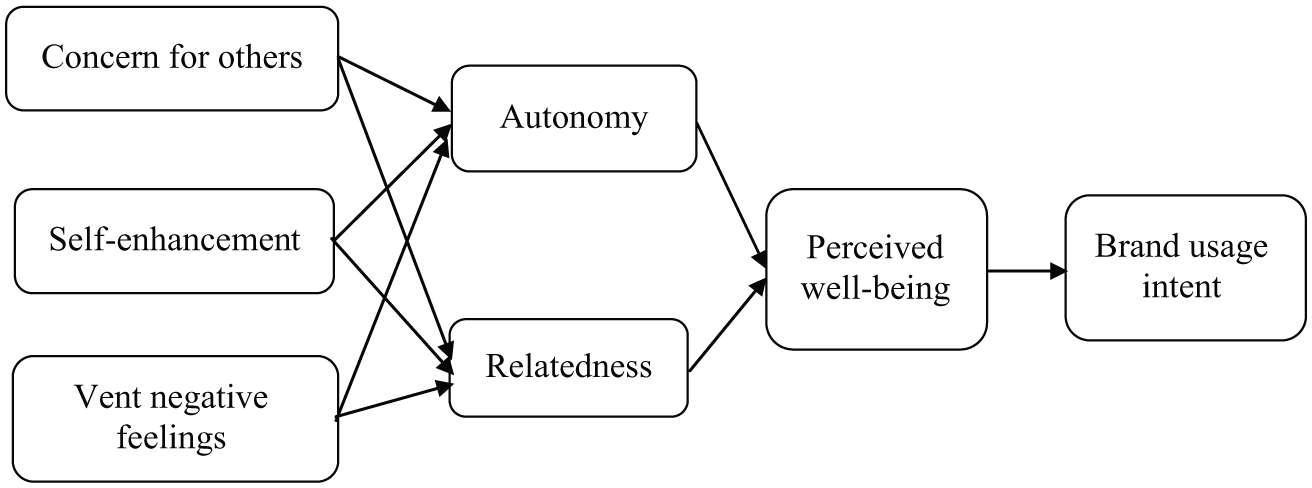
Proposed conceptual model
Methodology
Data Collection
A cross-sectional, online, self-administered survey was utilized for data collection in this study. The professional online research company, Qualtrics, is hired to collect the data. Qualtrics was established in 1997 and its panel members include almost 4 million individuals within the United States. An invitation e-mail was sent to the panel members, who represent the general population of the United States. Three screening questions were asked in the beginning of the survey—(a) Have you stayed in a hotel within the past 12 months? (b) Have you read a message on SNSs related to hotel information within the past 12 months? and (c) Have you posted your hotel experience on SNSs within the past 12 months? If respondents did not meet any of these screening questions, they were directed to the end of the survey and excluded from the data analysis. A total of 321 responses were collected within a week of data collection; however, seven responses were excluded from the analysis because of a high percentage of incomplete responses. Therefore, a total of 314 responses were utilized for data analysis.
For the preliminary test, a pilot test was conducted with 32 students enrolled in a Midwestern university. Results from the pretest confirmed the internal validity for each construct. Results indicated values of α were close to .90 (representing .95, .94, .94, .87, .95, .87, .93, respectively), meeting the acceptable cutoff value of .70 (Hair, Anderson, Tatham, & Black, 1998). In addition, two experts in information technology and service marketing reviewed the survey to enhance the quality and clarification of the questions in the survey. Results from the preliminary test and expert reviews led to minor adjustments of the survey to improve the flow and reduce any confusion of the questions, based on the context of this study.
Measurement Development
The survey consisted of six parts: (a) screening questions, (b) previous SNS experience, (c) different types of SNSs’ activities, (d) psychological needs for autonomy and relatedness, (e) perceived well-being and brand usage intent, and (f) participants’ demographics. Respondents were asked to recall their experience with SNSs at a particular hotel before they answered the proceeding survey questions. All measurement items were measured with a 7-point Likert-type scale (1 = strongly disagree to 7 = strongly agree), adopted from previous studies to ensure validity and reliability issues.
Measurement items of concern for others, self-enhancement, and venting negative feelings were adopted from Hennig-Thurau et al.’s (2004) study. Customers’ psychological needs for autonomy and relatedness were adopted from La Guardia, Ryan, Couchman, and Deci’s (2000) study. Items of well-being perceptions were from Hedhli, Chebat, and Sirgy’s (2013) study and those of brand usage intent were from Hollebeek, Glynn, and Brodie’s (2014) study. To control quality of the responses, seven validation questions, such as “Please click agree for your answer,” were included throughout the survey.
Data Analysis
Anderson and Gerbing’s (1988) two-step approach—confirmatory factor analysis (CFA) and structural equation modeling—was used for data analysis, using the LISREL 8.80 structural equation analysis package (Jöreskog & Sörbom, 1989). Common method bias was expected, due to the inherent weakness of using the survey method. To deal with foreseeable problems from common method bias, precautions were practiced and posttests were conducted, based on Podsakoff, MacKenzie, Lee, and Podsakoff’s (2003) suggestions. During data collection, confidentiality of responses was guaranteed and respondents were fully informed that there were no correct or incorrect answers when they participated in the survey to minimize their perceptions of being evaluated.
In addition, Harman’s one-factor test and CFA with a single factor were performed to ensure common method bias was not an issue in this study (Podsakoff et al., 2003). First, results from the Harman’s one-factor test indicated seven principal components were extracted, accounting for 90.1% of the variance. The first three factors accounted for 45%, 18%, and 12% of the variance, respectively. Since a single dominant factor did not emerge and one factor did not account for most of the variance, the probability of common method bias was insignificant. Second, results of CFA with a single factor indicated a poorer fit, compared with the multifactor models, representing χ2(152) = 4644.76, comparative fit index (CFI) = 0.76, normed fit index (NFI) = 0.75, incremental fit index (IFI) = 0.76, and root mean square error of approximation (RMSEA) = 0.307. Based on the results from these statistical tests, common method bias was not an issue in this study.
Results
Sample Characteristics
More than half of this study’s participants were female (63.7%). A majority of the respondents were between 25 and 34 years of age (34.4%), followed by 18 and 24 years (16.2%), and 35 and 44 years (15.9%). Sample characteristics for this study were relatively consistent with the characteristics of SNSs’ users in the United States. For instance, the demographics of SNSs’ users indicated slightly higher percentages of female users than male users (Duggan, 2015). The biggest age groups in SNSs were 18 to 29 years, followed by 30 to 49 years (Duggan, 2015). A summary of the participants’ demographics and background information are described in Tables 1 and 2.
Profile of Respondents (n = 314)

Background of Respondents (n = 314)
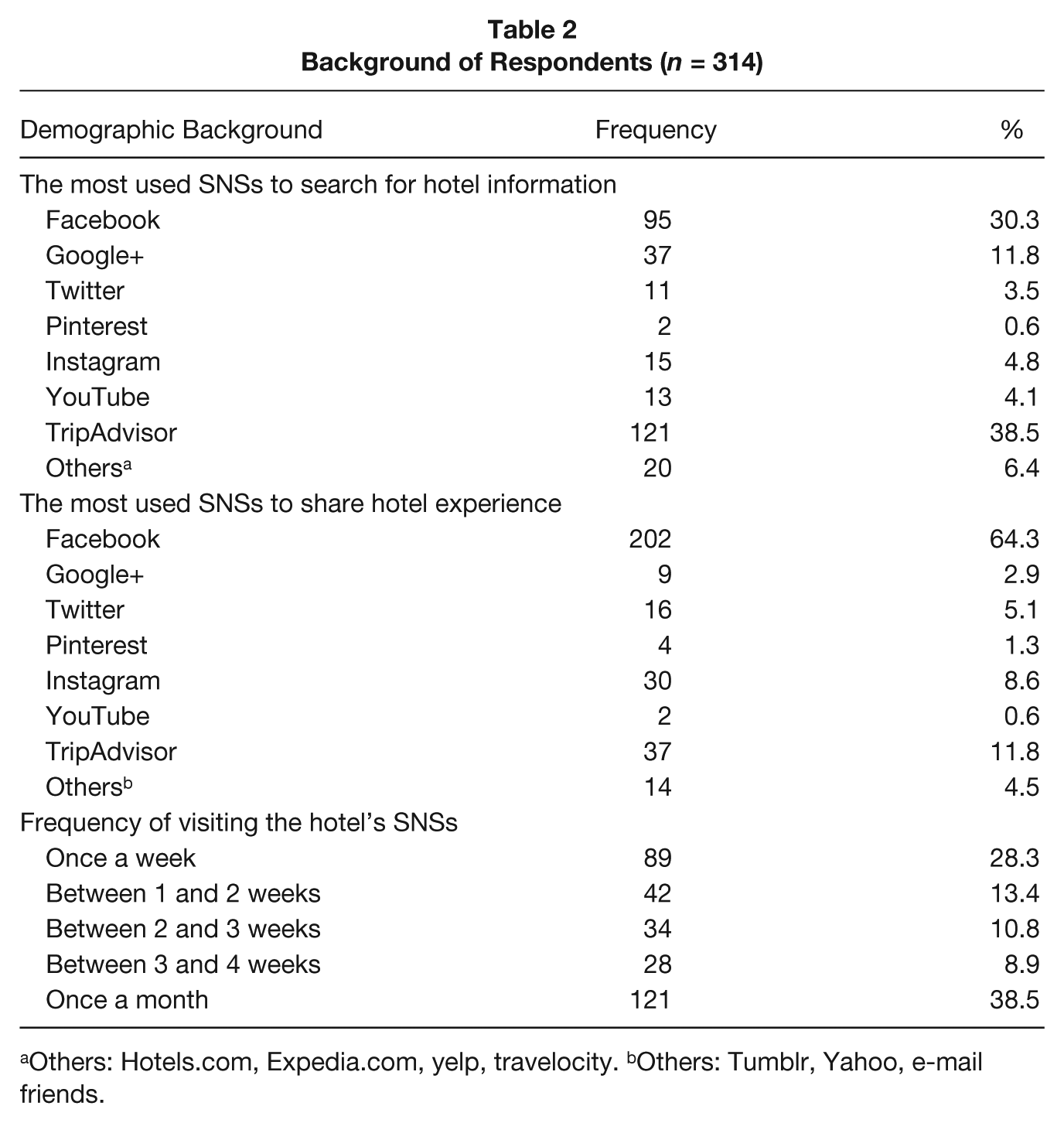
Others: Hotels.com, Expedia.com, yelp, travelocity. bOthers: Tumblr, Yahoo, e-mail friends.
Measurement Model
According to the results from the CFA, the goodness-of-fit indices (GFIs) were χ2(131) = 275.32, p = .00; χ2/df = 2.10; NFI = 0.99; non-normed fit index (NNFI) = 0.99; IFI = 0.99; CFI = 0.99; GFI = 0.92; standardized root mean square residual (SRMR) = 0.031; and RMSEA = 0.059, indicating an acceptable value for each model fit index and an acceptable model fit (see Table 3). The measurement model was assessed, based on Bagozzi and Yi’s (1988) recommendation, concluding the measurement model fit well with the data.
Measurement Item Descriptive and Results (n = 314)

Note: CR = composite reliability; AVE = average variance extracted.
Convergent and Discriminant Validity
Convergent validity was investigated through factor loadings, average variance extracted (AVE), reliability, including interitem reliability and composite reliability. The factor loading for all items exceeded the recommended level of 0.6 (Hair et al., 1998). Meeting the recommended cutoff values, values of AVE were greater than 0.5 and values of reliabilities were close to 0.9 (Hair et al., 1998). In addition, discriminant validity was investigated by comparing the squared correlations between constructs and variance extracted from a construct (Hair et al., 1998). All AVE estimates were larger than the corresponding squared interconstruct correlation estimates, indicating discriminant validity (see Table 4). Results for validity and reliability tests supported a theoretically meaningful, statistically acceptable model.
Validity Analysis

Note: The values in boldface represent the average variance extracted of the latent constructs and the values below the diagonal represent the squared interconstruct correlations.
Hypothesis Testing
The goodness-of-fit statistics for the structural model were χ2(140) = 401.46, p = .00; χ2/df = 2.86; NFI = 0.97; NNFI = 0.98; IFI = 0.98; CFI = 0.98; GFI = 0.88; and RMSEA = 0.077, confirming an acceptable value for each model fit index. In addition, nested models were compared with one another (Kline, 2010). The proposed conceptual model was compared with models that included additional paths accounting for the variance explained by the general domain of the item (Kline, 2010). When additional direct paths were included in the proposed model, the results of the χ2 difference tests did not show any significant differences between the proposed model and competing models. Therefore, the proposed model was accepted with its parsimoniousness and previous theoretical supports.
Summarized in Table 5, concern for others did not have positive effects on customers’ needs for autonomy (β = −. 23, p < .000) and for relatedness (β = −.49, p < .000); thus, null Hypotheses 10 and 20 were fail to reject and alternative Hypotheses 1A and 2A were not accepted. SNSs’ activities of concern for others were related to other-centered motivations (Wolny & Mueller, 2013), but customers’ autonomy and relatedness psychological needs focused on each customer’s intrinsic motivations (Deci & Ryan, 2000). Thus, SNSs’ activities of concern for others might not positively influence customers’ autonomy and relatedness needs. Self-enhancement (β = .65, p < .000; β = .42, p < .000) and venting negative feelings (β = .29, p < .000; β = .84, p < .000) had positive effects on customers’ autonomy and relatedness; thus, null Hypotheses 30, 40, 50, and 60 were rejected and alternative Hypotheses 3A, 4A, 5A, and 6A were accepted. Results from this study confirmed sharing customers’ hotel experiences for self-enhancement and for venting negative feelings fulfilled customers’ needs for autonomy and relatedness in SNSs.
Results of Structural Model (n = 314)
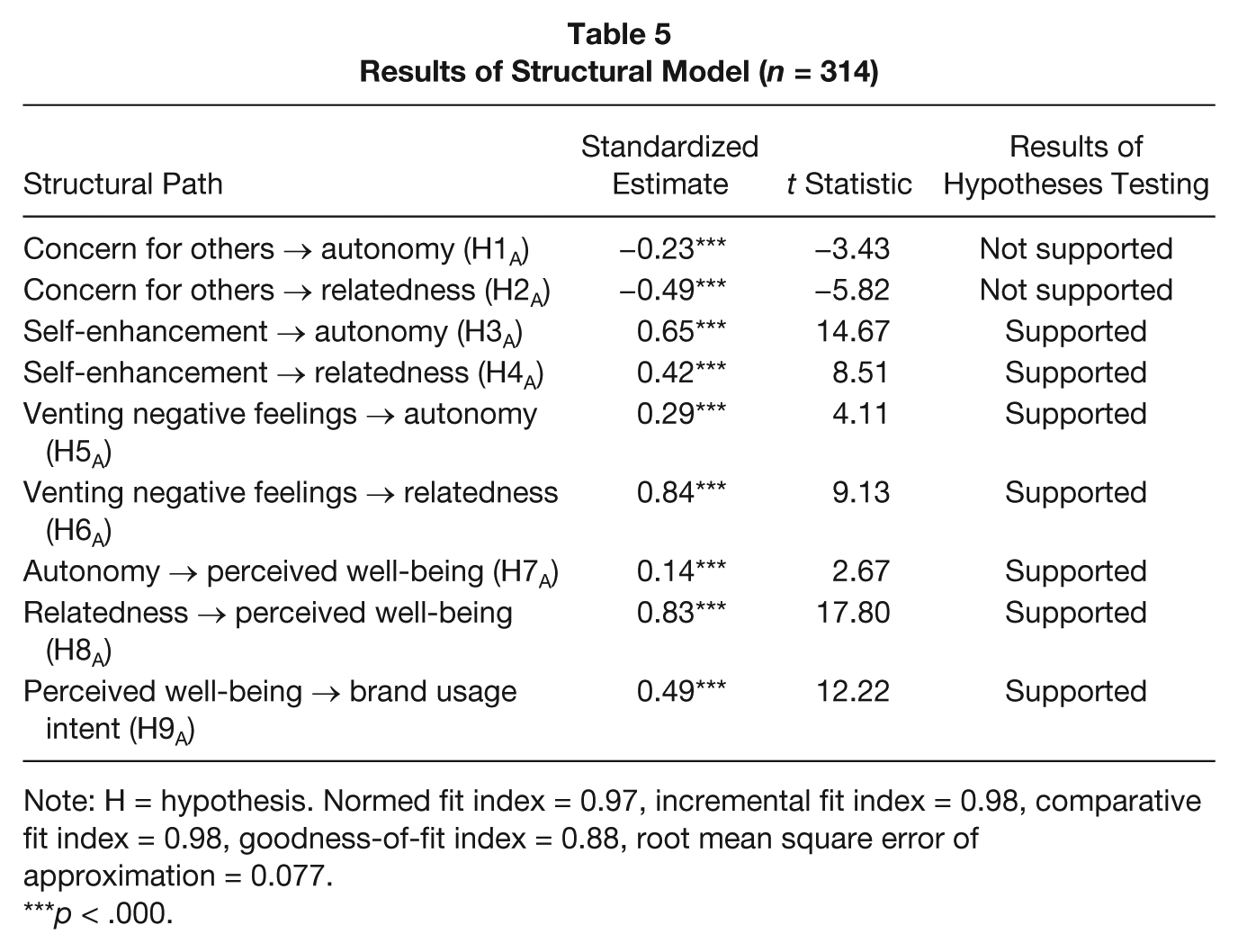
Note: H = hypothesis. Normed fit index = 0.97, incremental fit index = 0.98, comparative fit index = 0.98, goodness-of-fit index = 0.88, root mean square error of approximation = 0.077.
p < .000.
Results also revealed a positive relationship between customers’ psychological needs and their well-being perceptions, accepting alternative Hypotheses 7A (β = .14, p < .000) and 8A (β = .83, p < .000), rejecting null Hypotheses 70 and 80. Advocated in the self-determination theory (Deci & Ryan, 2000), the relationship between psychological needs and well-being perceptions was supported in this study. Hypothesis 9A (β = .49, p < .000) proposed the positive influence of well-being perceptions on customers’ hotel brand usage intent. Consistent with previous studies (D. J. Lee et al., 2014), this study confirmed the positive outcome of customers’ perceived well-being, rejecting the null Hypotheses 90 and accepting the alternative Hypothesis 9A.
Discussion
This study explored the relationships among SNSs’ activities, customers’ psychological needs, perceived well-being, and their brand usage intent. Different from previous SNSs’ studies that investigated the network externalities, marketing effectiveness, or consumer engagement (Kang & Young, 2016; Leung et al., 2015; Tussyadiah et al., 2018), this study examined the relationships between customers’ SNSs’ activities and their psychological needs. Results identified a possible mechanism that explained a positive influence of SNSs’ activities on customers’ well-being and their brand usage intent.
Results revealed that not all customers’ SNSs’ activities had positive effects on their autonomy and relatedness needs. When customers engaged with SNSs’ activities for self-centered motivations, such as self-enhancement and venting negative feelings, they fulfilled their autonomy and relatedness needs. However, customers did not positively fulfill their psychological needs when they posted their hotel experiences with other-centered motivations, such as concern for others; thus, Hypotheses 1A and 2A were not accepted. One of the main motivations for customers to engage with SNSs’ activities was to add values to others (Hennig-Thurau et al., 2004). However, customers might not be able to fulfill their psychological needs when they post comments of concern for others, since SNSs’ activities of concern for others were related to other-focused motivations (Wolny & Mueller, 2013). Burke et al. (2010) identified the importance of person-directed communications to lead to positive psychological outcomes. Wolny and Mueller (2013) also identified that self-enhancement influenced customers’ fashion brand-related eWOM engagement; however, concern for others did not influence their eWOM engagement. They viewed self-enhancement as self-involvement and concern for others as other involvement.
In addition, results identified that customers’ self-enhancement activities fulfilled their autonomy and relatedness needs, accepting Hypotheses 3A and 4A. As explained in the hyperpersonal model, customers were motivated to enhance their personal interests by presenting positive self-concepts. This self-centered SNSs’ activity was expected to enhance one’s self-concepts. Customers were able to create positive self-concepts by sharing their hotel experiences on SNSs, which then satisfied their needs for autonomy and relatedness. Customers’ venting negative feelings activity was also related to their autonomy and relatedness needs, accepting Hypotheses 5A and 6A. Customers were more likely to engage with sharing their experiences when they were dissatisfied than satisfied (J. U. Kim, Kim, & Park, 2010). Customers tended to show their frustration and anger by sharing their negative experience with the purpose of balancing their inner organism (S. Kim, Wang, & Malthouse, 2015). Viewing negative WOMs was different from positing negative WOMs. For instance, Ladhari and Michaud (2015) identified that users tended to have lower trust and booking intentions toward a hotel when they were exposed to negative comments, compared with positive reviews. On the other hand, S. Kim et al. (2015) identified positive effects of venting negative feelings. Consistent with previous studies (S. Kim et al., 2015) that advocated positive effects of venting negative feelings, this study added an additional support that customers were able to be themselves and feel related to significant others (e.g., close friends or family members) by voicing their negative feelings.
Moreover, results identified a positive relationship between customers’ autonomy and relatedness needs, and their perceived well-being, accepting Hypotheses 7A and 8A. Explained in self-determination theory, customers had needs for being autonomous and related to be themselves. When people were autonomous and related to others, they represented higher creativity (Koestner, Ryan, Bernieri, & Holt, 1984), healthier lifestyles (Pelletier, Dion, Slovinec-D’Angelo, & Reid, 2004), and well-being perceptions (Jorgensen et al., 2010). Consistent with previous studies that showed positive outcomes of well-being perceptions (Hedhli et al., 2013; D. J. Lee et al., 2014), Hypothesis 9A was accepted. When customers experienced high levels of well-being related to their SNSs’ activities, they tended to represent their intentions to use the brand.
Conclusion
Findings from this study contributed to the growing body of knowledge on customer well-being in SNSs, providing theoretical contributions. Despite such a growth of interest in customer well-being, previous studies have not addressed how customers’ SNSs’ activities were related to the sense of well-being when customers shared their hotel experiences. This study examined how SNSs’ activities influenced customers’ sense of well-being when customers shared their hotel experiences and how hotel brands could benefit from customers’ well-being perceptions in SNSs.
In addition, this study extended self-determination theory by relating to the SNSs’ marketing. Self-determination theory supported the basic psychological needs of autonomy and relatedness necessary for the integration of values in life contexts (Deci & Ryan, 2000). This study applied the self-determination theory as an underlying mechanism to explain customers’ SNSs’ activities and develop their well-being perceptions when customers shared their hotel experiences. Moreover, this study investigated effects of well-being marketing on brand-related responses. Scholars have called for research on how SNSs were related to customers’ relationships with brands (Hudson, Huang, Roth, & Madden, 2016). This study examined the relationships between well-being perceptions in SNSs and customers’ brand usage intent, confirming the importance of well-being to prolong the brand relationship.
For industry implications, hotel marketers need to promote their well-being marketing in SNSs. Even though SNSs could help hotels expand their networks, these platforms might not be meaningful nor last long if they do not fulfill customers’ inner needs. As customers positively fulfill their psychological needs through self-centered SNSs’ activities, hotels need to provide a place where customers share their experience to resolve any dissatisfied incidents and promote themselves to enhance their self-concept. To address customers’ needs, hotels should incorporate a variety of contents and different platforms where customers can fulfill their needs. For instance, hotels need to provide SNS platforms that enhance customers’ self-oriented intrinsic values, such as enjoyment and entertainment (Teichmann, Stokburger-Sauer, Plank, & Strobl, 2015). Even though SNSs’ activities of concern for others did not influence customers’ psychological needs, these comments might influence prospective customers. Jeong and Jang (2011) identified that customers spread positive WOM to concern for others when they had pleasant experiences. Positive WOMs enhance hotels’ image and reputation, so these comments should be promoted not to fulfill customers’ needs but to enhance the hotel’s image and provide useful information to prospective customers.
In addition, hotels need to develop proper response strategies to customers’ negative comments. Before customers book the hotel, they tend to visit the hotel’s SNSs to understand whether the hotel has a good reputation, to seek advice from previous customers, and to check whether the hotel is responsive to its customers. Customers’ positive comments can enhance the reputation of the hotel, improving performance (Cantallops & Salvi, 2015), whereas negative comments harm the image of the hotel (Ladhari & Michaud, 2015). Even though venting negative feelings positively fulfilled customers’ psychological needs, negative comments might negatively influence prospective customers. Hotels need to adopt proper response strategies to develop a positive relationship with customers. For instance, C. Lee and Crange (2014) identified the importance of adopting proper accommodative response strategies to deal with complaints, such as providing a sincere apology.
Moreover, hotels need to embrace the SNSs’ platform as a place where customers develop their perceived well-being that enhances their brand usage intent. Evaluations of SNS marketing should extend beyond counting the number of followers or of “liking” responses to include measurements of the different levels of customers’ well-being perceptions to sustain long-term relationships with customers. When hotels manage an SNSs’ environment that enhances customers’ well-being, their efforts will be rewarded, since customers tend to use the hotel brand in the future.
Limitations and Suggestions for Future Research
This study empirically investigated the effects of SNSs’ activities on customers’ well-being; however, it entailed limitations, suggesting for future research. Even though the sociodemographic characteristics of the respondents in this study were similar to those of SNSs users in the United States (Duggan, 2015), future research could be conducted in other countries, since this study was conducted with the general U.S. population, based on the convenience sampling method. Cultural differences (Y. Kim, Sohn, & Choi, 2011) or construal level (D. Lee et al., 2012) might influence customers’ antecedents and outcomes of well-being perceptions. In addition, this study focused on customers’ SNSs’ activities that influenced their psychological needs. Future research can investigate the mediating role of customers’ psychological needs or moderating variables, such as cultural differences, in the proposed conceptual framework to investigate how these effects influence customers’ behaviors.
Moreover, future studies can investigate changes in customers’ responses after hotels’ response strategies. Customers post their negative eWOM in the SNSs, so the SNSs become another arena for service recovery. Customers might have different perceptions of their well-being on SNSs, depending on how hotels adopt organizational service recovery strategies (C. Lee & Crange, 2014).