




Abstract
This article examines the meaning and significance of screen tourism location authenticity. The article analyses the interrelationship among places (real vs. substituted historical sites associated with tourists’ favorite films and TV programs) and activities (reenactment of photo shootings and costume rentals). The study finds a number of visitor segments go to screen tourism locations. For Screen Authentic Tourists, objective and existential authenticity do not matter as long as the destinations are associated with their favorite films. Screen tourism is a rapidly growing sector; this article examines its dynamics and evaluates various approaches to screen tourism authenticity, particularly theoplacity.
Keywords
Introduction
Previous research has established that screen tourists are not homogeneous (Chhabra, 2010), therefore, tour operators need to understand the diverse interests and motivations of their clientele (Mohsin & Alsawafi, 2011). This study aims to investigate if outbound Thai tourists who travel to screen locations are homogeneous or whether appropriate diverse tour programs can effectively target the needs of different segments.
This study also contrasts the meaning of two types of screen-shooting locations: real historical sites and substituted screen locations. Tooke and Baker (1996) note that if the screen location is the true setting, the visitor visits the location; if the screen location represents a fictional setting, the visitors go to the location; but if the screen location represents a different actual setting, the visitors go to the place represented. It is not clear whether they also visit the location. (p. 93)
Connell and Meyer (2009) suggest that authentic locations may be even less important to tourists than created locations. Beverland and Farrell (2010) consider that the choice of cues regarding authenticity may be purposive. Tourists’ motivations and the experiences they seek in visiting screen locations require clarification if the study of screen tourism is to develop (Riley, Baker, & Van Doren, 1998), particularly, if it is to be applied to cross-cultural issues of authenticity.
In our study, we refer to the cluster of tourists who were disinterested in screen-related visits as “Screen Uninterested Tourists.” This is similar to serendipitous tourists for whom a screen location visit during a standard package tour is merely incidental (Croy & Heitman, 2011; Macionis & Sparks, 2009). We refer to tourists interested in film and screen sets as Screen Authentic Tourists.
Literature Review
Conceptualization of Authenticity
Authenticity is a key but contested concept in tourism research (Pearce & Moscardo, 1986; Waitt, 2000), with objective, existential (Steiner & Reisinger, 2006), and constructive approaches to authenticity (Chhabra, 2010; Lau, 2010). Objective authenticity refers to visiting historically correct and meaningful cultural displays such as period costume and weapons, or the actual buildings where historical events occurred (MacCannell, 1973; Reisinger & Steiner, 2006). Existential authenticity is a state of being triggered by tourism activities, also known as activity-related authenticity (Brown, 2013; Kim & Jamal, 2007; Shepherd, 2015; Wang, 1999).
The main contribution to tourism of authenticity lies in its potential to explore the dynamics of cocreated value in experiences when the place visited is professionally interpreted (Wong, 2015), and where the value derives from the authenticity of the objects observed (Chhabra, 2005), in certain circumstances described in quasireligious terms. This type of high-involvement mode (Prayag & Ryan, 2012) contrasts with the way that screen tourists experience locations, similar to what Pearce and Moscardo (1986) described as interest in pseudoevents; tourists’ behavior and tourists’ experiences that are superficial and peripheral to the concerns of modern industrial society.
Authenticity in screen tourism often centers on the places where a screen production was filmed, and is therefore constructive in nature (Ram, Björk, & Weidenfeld, 2016). In screen tourism (Yen & Teng 2015), constructed or symbolic authenticity is defined as visiting the sets or locations that were shown on screen as opposed to where the historical event occurred. Film locations differ from actual historical sites for a variety of technical considerations such as limited access or safety (Buchmann, 2010; Butler, 2011; Frost, 2010). Existential authenticity results when a visit to the screen location has helped the viewer–tourists to establish or extend their self-identity, and enjoy meaningful connections with the place, era, or characters depicted on screen (Connell & Meyer, 2009; Rickly-Boyd, 2012). Hyperreality is a characteristic of “an ahistorical, consumerist society and involves a strong focus on the spectacular and ‘non-ordinary’” (Buchmann et al., 2010, p. 231). If the film tourist’s actual experience matches his or her hyperreal expectations, an (existential) authentic experience is achieved (Carl, Kindon, & Smith, 2007). Authenticity is a socially constructed concept which can be managed commercially to exploit tourists’ expectations and provide satisfying experiences (Chhabra, 2005).
Authenticity in the Screen Tourism Context
Screen tourism is a dynamic, emergent industry sector. The locations vary from purpose-built studio sets to historical theme parks to ancient castles where historically important events occurred. Theme parks such as Disneyland have been successful in Asia (Wu, Li, & Li, 2016) and some screen production companies use historically themed parks for a ready supply of replica buildings, appropriate costumes, and cultural activities (Kim, Long, & Robinson, 2009). A more complex form of authenticity is when a theme park replicates film studio sets, stages action scenes, and provides a variety of thrilling experiences for visitor to view or even participate in. Screen-related theme parks have the special feature of being designed to host visitors without interfering with the technical processes of screen production, the production company also benefits by generating revenue from a range of paid-for activities which visitors can enjoy (Kim, 2012).
Theoplacity and Hyperreality in Screen Tourism
Belhassen, Caton, and Stewart (2008) define theoplacity as the interrelationship among action (pilgrimage), tourist belief, and toured place which results in experienced authenticity in the context of fundamentalist U.S. Christian pilgrimage visits to Israel and the (Christian) Holy Lands. Here, pilgrimage is performed within one’s religious, cognitive and emotional framework, and is about visiting sacred places for spiritual reasons (Szmigin, Bengry-Howell, Morey, Griffin, & Riley, 2017). Theoplacity has also been used to explain existential authenticity in screen tourism (Buchmann et al., 2010), heritage tourism (Chhabra, 2010), and festival tourism (Chhabra, Healy, & Sills, 2003).
Screen-related theme parks are at the intersection of tourism and the screen industries, creating new touristic places and activities (Laws & Scott 2015). Some substituted screen-shooting locations can be better than originals and provide tourists with hyperreality (Buchmann et al., 2010).
However, many tourists, particularly pilgrims, are keen to experience objective authenticity (Belhassen & Caton, 2006). Without belief in the objective quality of historical sites, pilgrimage to sacred sites would not have occurred (Belhassen et al., 2008). Theoplacity requires an ongoing significance of and need for objective authenticity (Chhabra, 2010). Existential authenticity emerges from the tourists’ actions rather than from the originality of the toured objects (Belhassen et al., 2008). Whether a place is a real or substituted, historic location is not a major influence on their perceptions of authenticity. “What is staged is not superficial since it contains elements of the original tradition” (Chhabra et al., 2003, p. 715). The tourist perception of authenticity is controlled partly by media, partly by site managers, and partly by the tourists themselves (Chhabra et al., 2003; Leask, 2016; Terzidou, Stylidis, & Terzidis, 2017).
Authenticity in screen tourism is a fuzzy concept (Hogg, 2016). Hyperreality and authenticity in screen tourism occurs where tourists might not be able to distinguish fake from real, where real geography and fantasy merge geographical names into one. Buchmann et al. (2010, p. 239) reports an interviewee as saying to them “New Zealand is, indeed, Middle-Earth.” Thus, screen tourists experience both the real world of New Zealand and the real world of Middle-earth. For most screen tourists, there is a connection between scenery and film that makes the visit to a selected location special. Tourists attribute value to their personal judgments of authenticity, screen tourists seek authentic experiences which depend on place and the interpretations of the experience (Buchmann et al., 2010). Hence, there is no unique objective experience which every visitor shares, they each interpret their own experience subjectively. What they do often share is the heightened expectations and the excitement typical of fans travelling in groups (da Silva & Las Casas, 2017; Moscardo, 2017; Wakefield, 2016).
Theoplacity is best applied in overtly ideologically driven tourism contexts in which tourists’ perception and experiences are mediated by a shared set of beliefs about the toured place and shared personal experience of authenticity by tourists (Belhassen et al., 2008).
Theoplacity can also be used to explain the search for authentic experiences at screen-shooting locations as groups of both screen tourists and pilgrims share the meaning of the journey toward a site (Buchmann et al., 2010). However, the emotional attachment of screen tourists to screen locations is only superficially similar; specifically it lacks the pilgrims’ spiritual commitment and focus. Additionally, fundamentalist pilgrims present a coherent image of their beliefs and culture to nonbelievers (Sizer, 1999; Tzanelli, 2008). Screen fan behavior on the other hand is postmodern in its forms and involvement (Beeton, 2016). “As places become ‘attractions,’ as historical events become today’s tourist ‘experiences,’ and as every facet of the real is reconfigured for the ‘tourist gaze’ reality becomes one with hyper reality—at least for the tourist” (Buchmann et al., 2010, p. 231). The concept of hyperreality may therefore be more insightful for screen tourism researchers, our research indicates that these dynamics are relevant to screen tourism.
Investigation of Theoplacity
Screen tourists may experience intense personal, emotional attachment with both substituted and real historical sites associated with their favorite films and TV shows. Authenticity is shaped by audience involvement which stimulated their visit to places shown in films, and their participation in screen tourism activities at film tourist destinations. Hence, this study hypothesized that
Methodology
Data were collected in this study through a combination of quantitative (Phrase 1) and qualitative research (Phrase 2). Phrase 1 respondents were Thai tourists visiting screen-shooting locations in Korea (n = 942). The qualitative phase consisted of discussions with Korean tourism experts (two Korean tour managers operating outbound tours from Thailand and a manager from the Korean Tourism Organization [KTO] office in Bangkok), participant observation, and five in-depth interviews during eight visits to screen locations in Korea.
The quantitative phase surveyed Thai outbound tourists interviewed at the check-in desks and departure gates of Bangkok International Airport with permission from Thai outbound tour operators, the Airport Authority of Thailand and airlines. A sampling frame was derived from the schedule of flights of low-cost and national flag carriers. To be eligible to answer the questionnaire, respondents had to be at least 18 years of age. In the case of a family, or a couple, only one respondent from the travel party was asked to complete the survey. The purpose of the research was explained to respondents and their agreement to proceed obtained.
The self-administered questionnaire was based on previous research on the impact of film sets on tourists’ decision making (Bolan, Boy, & Bell, 2011: Buchmann et al., 2010; Butler, 2011; Tooke & Baker, 1996) and film tourism motivation (Macionis, 2004; Rittichainuwat & Rattanaphinanchai, 2015). The questionnaire contained three sections. The first section asked the respondents about how frequently they watched Korean films or television shows. We adopted the concept of Kim, Agrusa, Chon, and Cho (2008) level of media exposure. While Kim and Wang (2012) measured level of media exposure with two questionnaire items (i.e., number of episodes viewed and number of repeat viewings), we measured frequency of film watching with the question: Have you watched a Korean TV series? The second section of our survey asked about respondents’ preference for screen locations following Bolan et al. (2011) and Butler (2011). We posed the following questions: “I prefer to visit substitute filming location scenes rather than real historical sites” and “I want to visit real historical sites associated with my favorite films.” The responses were measured on a 7-point Likert-type scale ranging from 1 (strongly disagree) to 7 (strongly agree). The last section consisted of standard questions to establish relevant features of respondents’ demographic profile.
Data from the questionnaire were entered into the Statistical Package for the Social Sciences (SPSS) V.21. Descriptive statistics were used to determine frequency distributions and two-step cluster analysis and cross tabulation used to profile the cluster membership. Unlike most multivariate data analysis, which requires normality and linearity, cluster analysis focuses primarily on the sample representativeness among the clustering variables (Hair, Black, Babin, & Anderson, 2010). A two-step cluster analysis procedure designed to handle large data sets (Norušis, 2012) was used to segment tourists as determined by their travel motivations in visiting screen locations and historically authentic sites.
Participant observation and in-depth interviews were used during eight visits accompanying Thai film tourism student groups to Korean screen locations, and during independent visits to MBC Yongin Studio (a historic film studio) and Shilla Millennium Park (a replica of ancient city theme park), popular with Thai viewers. In addition five Thai tourists on these tours were engaged in semistructured interviews and probed specifically about their perception of these locations’ authenticity. Each interview took about 10 to 30 minutes and answers were noted in Thai by the native Thai-speaking interviewer. Questions were asked about expectation and experience of authenticity at the screen location, and preference for visits to studios and theme parks or the real historical sites associated with favorite films. These interviews were transcribed and the main points verified with the respondents by phone after the tour. The interviewees agreed to allow results to be published as a journal article and to be shared with the tour operator.
Results
Phase 1: Predeparture Survey in Thailand
Profile of Tourists
A total of 942 travelers participated in the survey, their demographic profile is summarized in Table 1.
Profile of Cluster Analysis

Note: Mean rating is measured on a 7-point Likert-type scale: 1 = strong disagree, 4 = neutral, 7 = strongly agree.
Cluster Analysis of Thai Tourists’ Interest in Screen Locations
Data contained only continuous variables and cases were assigned to a two-step cluster analysis using a Euclidean distance measure (Norušis, 2012). The Schwarz Bayesian information criterion was used to specify a two-cluster distribution. The first cluster is composed of 857 observations (91% of the total) as shown in Table 1. Cluster 1 was labelled “Screen Authentic Tourists” as it consists of tourists who reported that they were keen to visit a location they had previously seen on screen. Cluster 2 (85 observations, 9%) consists of tourists whose travel was not particularly motivated by the opportunity to visit a screen location; these were labelled “Screen Uninterested Tourists,” in line with their response “I prefer to visit substitute filming location scenes rather than real historical sites.”
There was no significant difference between the Screen Authentic Tourists and Screen Uninterested Tourist clusters based on demographic criteria. Similar to Chhabra (2010), no significant gender difference in authentic perspectives was found. However, frequency of film watching (Pearson χ2 = 14.13, p = .001) and self-identification as type of screen tourists (Pearson χ2 test = 34.5, p = .000) are significant discriminators. Most of the people in Cluster 1: Screen Authentic Tourists stated that they sometimes (64%) or often (28%) watched Korean films.
In contrast, Cluster 2 contained no specific screen tourists. Out of 85 people in Cluster 2, 6 people described themselves as general screen tourists, and most of them (n = 79) perceived themselves as serendipitous tourists whose visit at the screen location was incidental. While 72% (n = 59) sometimes and 15% (n = 12) often watched Korean films, they showed little interest in either real or substituted screen-shooting locations. Hence, we labeled them as Screen Uninterested Tourists. Our result is consistent with Buchmann et al. (2010) that most tourists on film tours did not see themselves as fans of the films. Figure 1 shows the frequency distribution of “I prefer to visit filming location scenes than real historical sites,” and “I want to visit historical sites associated with my favorite films” of the uninterested group. Only 2.4% of the Screen Uninterested Tourist group indicated that they prefer to visit filming location scenes than real historical sites. None of the Screen Uninterested Tourists wanted to visit real historical sites.
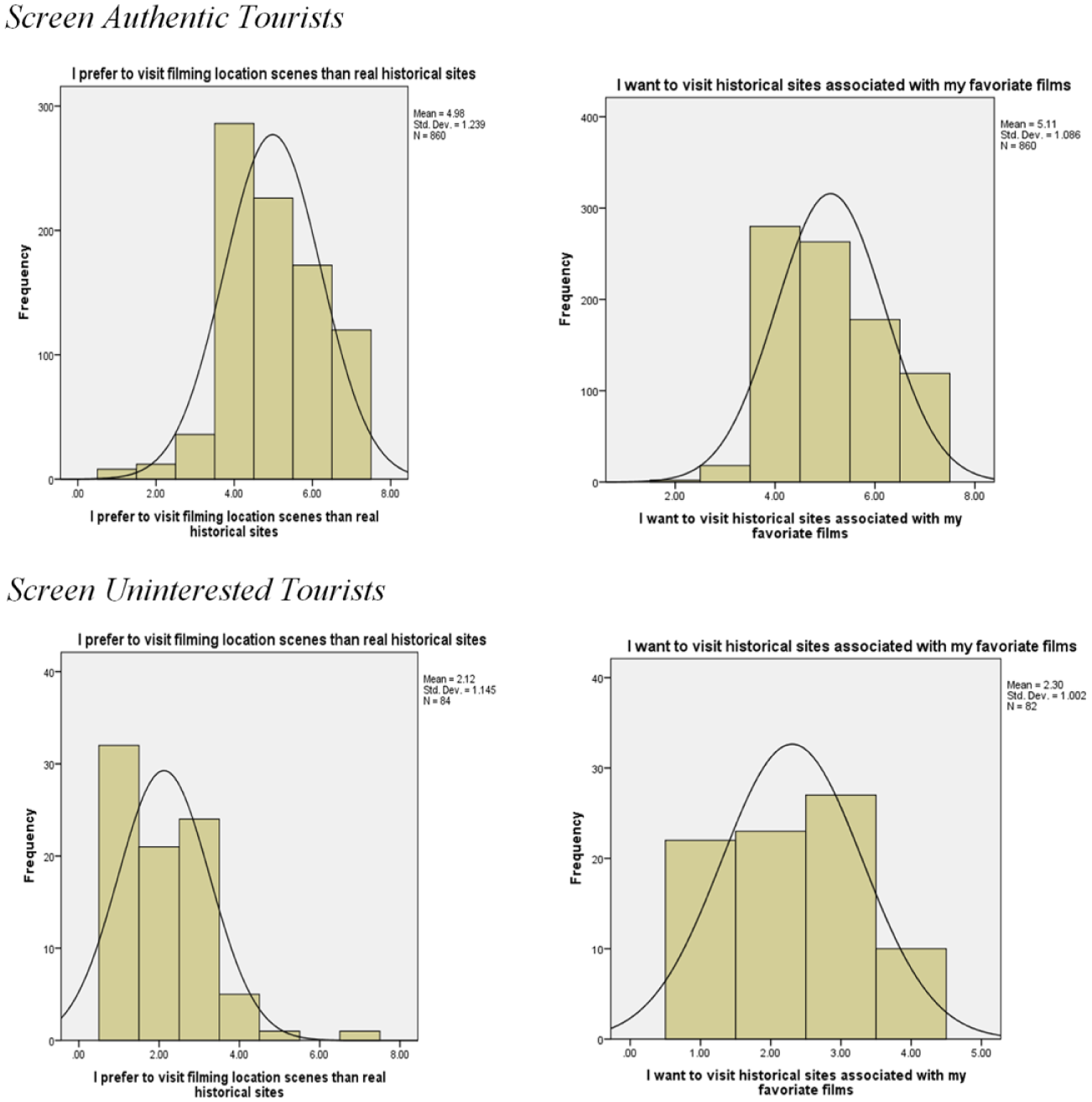
Frequency Distributions: Screen Authentic Tourists and Screen Uninterested Tourists
When asked their travel motivation respondents classified as Screen Authentic Tourists were more likely to express general or specific interest in films. Screen Uninterested Tourists were more likely to describe themselves as serendipitous tourists. The small Screen Uninterested Tourist cluster (9%) regard a film destination as an incidental travel experience included as a part of a standard tour package, confirming previous studies (Buchmann, 2010; Croy & Heitmann, 2011; Macionis & Sparks, 2009; Rittichainuwat & Rattanaphinanchai, 2015).
Phase 2 Research: Thai Tours to Screen Location Tours in Korea
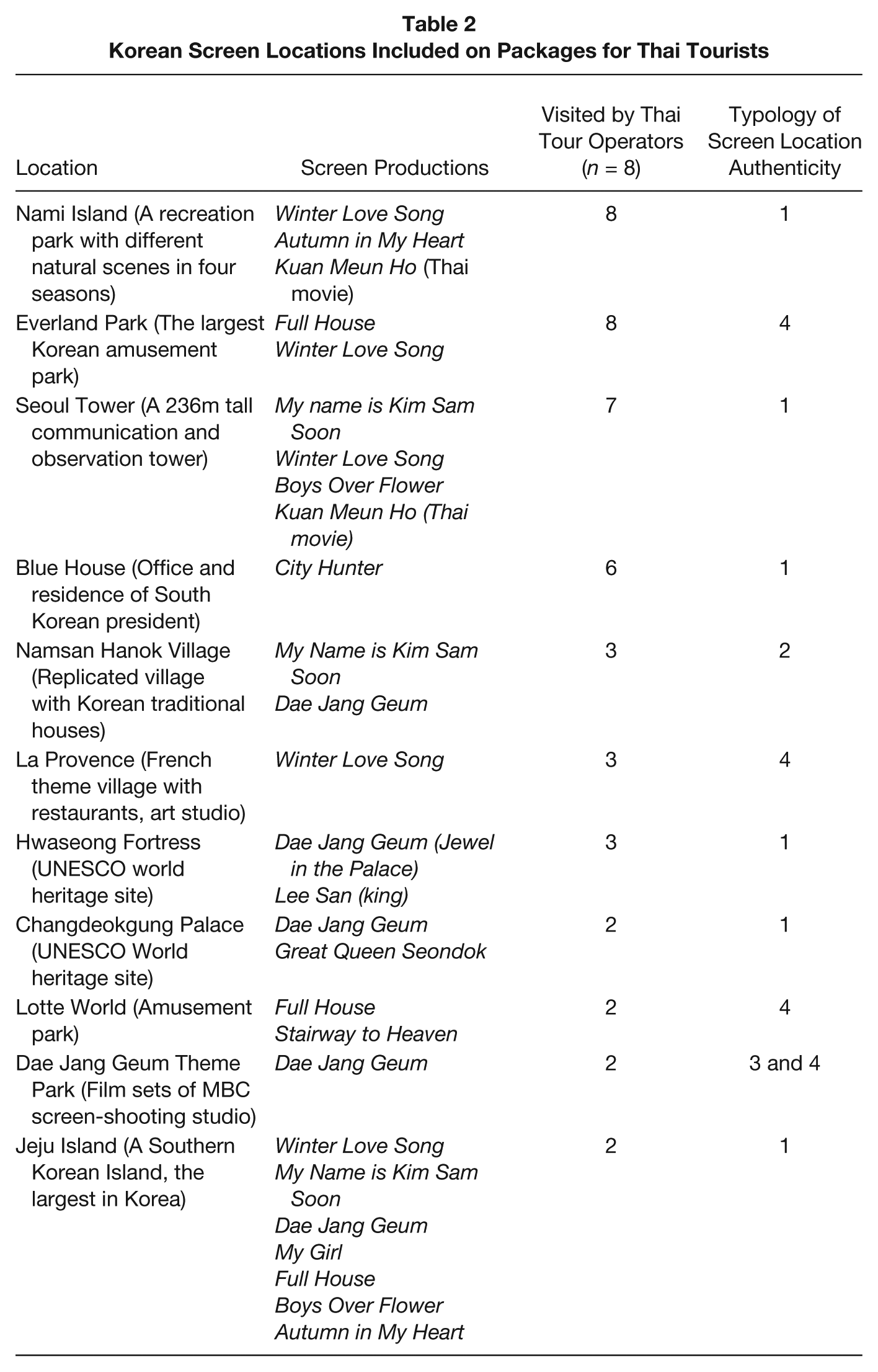
Data collected during the qualitative phase of the research allow the characteristics of the film tour market to be determined. The outbound tour operators interviewed have separate leisure and group divisions, using similar travel itineraries recommended by the KTO consisting of visits to major Korean tourist attractions including screen locations, as well as opportunities for shopping and tasting local cuisine. The Thai tour operators are able to modify these itineraries. Typically, a potential tourist visits travel fairs to collect brochures from tour operators and travel agencies, or searches for outbound tours on the web. Tour brochures feature a range of inclusive holidays combining a direct flight between Bangkok and Seoul, accommodation, and guided visits to attractions. The brochures describe the main attractions of each place and illustrate them with photographs. Tour operators’ brochures and websites clearly show the travel itinerary. Tour brochures list the filming locations to be visited (see Table 2). The inclusive packages range from economy (three stars hotels, and low-cost airlines) to luxury packages (using four to five stars hotels and flying with national flag carriers). Some specialist tour operators target screen fan clubs although the KTO discourages Thai tour operators from including photos of celebrities and prohibits use of the KTO name in these travel promotions. KTO has a website detailing the locations used for Korean TV dramas. Fans of these dramas can obtain information on how to get there by visiting the VisitKorea website.
Korean Screen Locations Included on Packages for Thai Tourists
Tourists assemble at the departure airport, and check in as a group under the supervision of a tour operator representative. The group is met on arrival by a Thai guide and transferred by coach to the tour hotel. This guide speaks both Thai and Korean so can communicate with tourists and coach drivers, restaurant staff, and so on, explains the daily schedule to group members, and may offer additional excursions or activities. The Thai guide ensures the timely running of the tour and also provides interpretation of the sites visited. Generally, Thais travelling on an inclusive tour stay together, and participate in most excursions, including those to screen locations. This means they will visit film sites whether that was their main motivation for travel.
Most tour operators included visits to screen-shooting locations which were easily accessible (from Seoul) or on a circular route linking three places (typically Nami Island, Everland, and Hwasoeng). Travel brochures described the connection of each site to a particular film. Customized tour packages to remote screen location could be created for the more specialized incentive travel, site inspection, and field trips groups.
Studio Visits
One of the highlights of a visit to MBC studio was the costume rental service. Tourists choose the costumes and wigs of the main characters of MBC TV series and wear them to have photos taken at 20,000 won per set (approximately US$18). The pleasures tourists derive from having photographs taken of themselves in significant places is a growing topic of study (Kim, 2010). According to the tour group leader, “the costume, the scene, the props were authentic as shown in film.” Visitors could pose as the main characters shown in photos next to the stage. The studio provided visitors with unique experiences and a satisfying degree of emotional engagement (Kim, 2010), by allowing them to be photographed in costume along with cardboard cut outs of the main characters at the authentic place where TV series had been filmed.
After probing, the researchers established that in this context authenticity means viewing sets and clothing worn by the actresses. These were not presented as costumes from the period, but as replicas made for the TV series production. Taken together, the promotion of screen locations, the organization of visits and the explanations offered by guides indicate that the screen industry, at least in Korea, is orchestrating the tourists’ gaze (Urry, 2002) by selecting what they see during visits and how it is explained, and by involving them in “performances,” that is, wearing costumes as shown in Figure 2.

Reenacting in the Same Costumes as Main Historic Characters at MBC Yongin Studio
Offering a costume rental services at the screen locations with reenactment opportunities provides an exciting link between touristic experiences and their previous viewing experiences on the screen. This suggests that there may be further entrepreneurial opportunities in combining screen and tourism experiences.
Discussion
A Proposed Typology of Screen Location Authenticity
Typologies are a useful way of categorizing knowledge of a complex subject at a particular point in time (Luff, Byatt, & Martin, 2015; McKercher & du Cros, 2003). However, the varied approaches to authenticity and the sometimes contradictory use of terminology are a source of concern to researchers (Reisinger & Steiner, 2006). Table 3 presents our proposed typology of screen location authenticity.
Typology of Screen Location Authenticity


Film Sets With Photos Displaying Scenes at Shilla Millennium Theme Park
Screen Tourism Clusters
This research has investigated the motivations and experiences of Thai tourists visiting screen locations in Korea as part of an inclusive tour. We have found various degrees of interest in visiting screen locations with differing types of authenticity. The first (quantitative) phase of research identified two clusters; the second qualitative phase enabled us to probe the experiences of selected Screen Authentic Tourists.
Screen Authentic Tourists
The first (largest) cluster was strongly motivated to travel by the films and TV series they had seen. In line with previous studies (Buchmann et al., 2010; Carl et al., 2007; Couldry, 1998, Karpovich, 2010), they prefer visiting substituted or studio screen locations over real historical sites where filming was not carried out. These results indicate that many screen tourists want to see the sets used in historical dramas rather than to visit the original historic site. The finding is also consistent with previous studies that authenticity for screen tourists refers to authentic or iconic film sets (Bolan et al., 2011; Buchmann et al., 2010; Butler, 2011; Frost, 2010; Tooke & Baker, 1996). Kim et al. (2009) and Peters, Schuckert, Chon, and Schatzmann (2011) have noted an emotional bond between film fans and film set locations. For these Screen Authentic Tourists, the places which they have seen on screen are personally relevant and “authentic” (Buchmann et al., 2010; Connell & Meyer, 2009; Croy & Buchmann, 2009). We have discussed this above in relation to the theoplacity concept, but found theoplacity added little to an understanding of screen tourism motivations and experiences.
Film sets, for example, the interiors of a palace recreated in a studio, have touristic authenticity when they are similar to the reality (Couldry, 1998) as explained through interpretive material (Buchmann et al., 2010). The findings of this study confirm the statement by Butler (2011, p. 93), “some visitors, perhaps the majority, go to a location because they have seen that location in a film, so in that sense there is no issue about authenticity, because the location they are visiting is the authentic place.” Similarly, Tooke and Baker (1996) note that tourists visit whether the screen location is historically correct or fictional setting. This study also finds that Screen Authentic Tourists are drawn to screen locations irrespective of their authenticity. This confirms that an authentic location is less important to Screen Authentic Tourists than created locations, as was noted by Buchmann et al. (2010) and Connell and Meyer (2009). The meaning of the site is determined by the film (Bolan et al., 2011; Butler, 2011; Rittichainuwat & Rattanaphinanchai, 2015) and it is the film that creates the core tourism experience (Buchmann et al., 2010; Couldry, 1998; S. Kim, 2010, 2012; Kim et al., 2009; Kim & Wang, 2012; Macionis & Sparks, 2009).
Screen Uninterested Tourists
This study empirically identified the minority Screen Uninterested Tourist segment (9%) who regarded a visit to screen-shooting locations as incidental to other tourism activities and experiences. The finding that films were a minor motivational factor for Screen Uninterested Tourists has also been noted by Buchmann (2010), Croy and Heitman (2011), Macionis and Sparks (2009) and Rittichainuwat & Rattanaphinanchai (2015). For Screen Uninterested Tourist, screen tourism is a subsidiary activity during the holiday (Croy & Buchmann, 2009). Our study extends the screen tourism literature by identifying the existence of Screen Uninterested Tourists. Marketing promotions targeting these screen uninterested tourists could focus on a variety of activities during the tour. Unlike Chhabra (2010), the subsegment of uninterested tourists does not desire objective authenticity of screen-shooting locations. Hence, screen tourism is particularly appropriate for destinations lacking heritage sites.
Further Discussion: Some Dynamics of Screen Tourism
Screen tourism is an emergent nexus (Connell & Meyer, 2009) between two established industries, film and TV program making and distribution, and leisure travel. The experiences and interests of viewers stimulate screen tourists and their partners, but often tourists’ motivations are wider than visits to screen locations. While tourists’ needs for transport, accommodation, food, and other items drives the development of a range of destination facilities at various scales, although the presence of visitors can be disruptive to film production and to residents. Destination authorities can use the interest in screen entertainment to promote areas where films or TV programs have been made, but sometimes find it difficult to provide a coordinated response to the new screen tourism industry which is often located in relatively remote areas lacking infrastructure.
Another dynamic arises from the process of authentication which is emerging as an important area of tourist destination experience research (Szmigin et al., 2017). The roles, methods, and influences of guides have been extensively studied (Kuflik, Wecker, Lanir, & Stock, 2015; Tsaur & Teng, 2017). The guide’s role should also be considered in the context of the tour group’s internal dynamics. Buchmann et al. (2010) draws attention to “‘the fellowship of the tour group’ . . . as ‘pivotal to understanding tourists’ sense of what is and is not an authentic experience”(p. 236).
New cultural meanings can also be attached to places by the global screening of images (Busby, Ergul, & Eng, 2013) in a process of commodification interpreted differently by different stakeholders (Rickly-Boyd, 2012; Tzanelli, 2008). Lundberg, Ziakas, and Morgan (2017) discuss how destination assets can be effectively exploited through six strategies including mediatization and branding. The popular cultural heritage of a screen destination may be reinterpreted within a coconstruction process from which visitors gain meaning (Lundberg et al., 2017; St-James, Darveau, & Fortin, 2017; Tegegne, Moyle, & Becken, 2016). Thus, the process through which authenticity is established is postmodern, complex, dynamic, and nondeterministic. Our research indicates that the full development potential also depends on how the screen location visit is resourced and managed. The values and perceptions of residents may also be changed by a process aimed more at influencing visitors, with potentially harmful consequences for host–guest relations (Beeton, 2016; Mordue, 2009).
Conclusion
Screen tourists are not a homogeneous group. Our cluster analysis found two major segments of tourists who visited screen locations: Screen Authentic Tourists and Screen Uninterested Tourists. Our research found that for Screen Authentic Tourists, objective and existential authenticity do not matter as long as the destinations are associated with their favorite films, confirming Buchmann et al. (2010). Belhassen and Caton (2006), Belhassen et al. (2008), and Chhabra (2010), Screen Authentic Tourists did not perceive the original locations as better than the modified or substituted sites. Interestingly, regardless of type of authenticity, Screen Uninterested Tourists were not motivated either by real or substituted historical sites. While both types of authentic film locations matter for Screen Authentic Tourists if the locations were associated with films neither type of screen locations motivated Screen Uninterested Tourists. Hence, the result partially supports the Null Hypothesis H0.
The primary target of Korean screen tourism is domestic tourists (Kim, 2010; Zeng, Chiu, Lee, Kang, & Park, 2015). In contrast to Moscardo and Pearce (1986), Chhabra et al. (2003), and Chhabra (2010) whose samples were domestic tourists, we studied international tourists who were not familiar with local history. This lack of knowledge about local authenticity (and local safety conditions) may be an important basis of future research (Rittichainuwat, 2011).
Contribution to Theory
This study extends the literature of screen tourism, finding varied attitudes to authenticity. Tourists are not homogeneous but seek different kinds of authentic experiences (Chhabra, 2010; Croy & Buchmann, 2009). While being aware of the inauthenticity of film sets, Screen Authentic Tourists enjoyed the locations of their favorite TV series. This segment sought pseudoevents (Buchmann et al., 2010) and enjoyed staged displays (Cohen & Cohen, 2012; Guttentag, 2010; MacCannell, 1973) which matched their own expectations of authenticity (Chhabra, 2010). In contrast, neither objective nor existential authenticity motivated Screen Uninterested Tourists.
This article demonstrates that the concept of theoplacity can be applied to Screen Authentic Tourists as they are very keen to visit places where films and TV programs were filmed and particularly enjoy visiting constructed sites or studios, existential authenticity in screen tourism occurs when the elements of places, belief, action, and self-act together. However, theoplacity adds little to detailed understanding based on existential and objective authenticity approaches. The benefit of these is that they link directly to the wider social sciences literature and engage with postmodern concepts of hyperreality (Carl et al., 2007).
While objective authenticity remains important in heritage tourism (Chhabra, 2010), authenticity perception in screen tourism is mainly based on the pseudosettings associated with films (Buchmann et al., 2010). Screen Authentic Tourists want to experience both the real geographic location and the fictional location.
Since some historic TV series used both real and substituted historical locations, mentioning both types of authenticity can enhance destination marketing values. If the destinations are the real historical sites, objective authenticity associated with film episodes should be the highlight. If the destinations are substituted screen locations, stressing that the places are the actual shooting locations of TV series also can provide existential authenticity and thereby attract a different tourist segment. Both real and substituted locations can provide Screen Authentic Tourists with objective authenticity and existential authenticity.
The combined quantitative and qualitative methods used in this study complement each other (Rittichainuwat & Rattanaphinanchai, 2015) by extending the understanding of the authenticity of screen locations. While the quantitative research distinguished two clusters of tourists, our qualitative results showed the detail of the screen tourist activities and provided detail of all-inclusive-packages which include real and substituted screen locations in the itinerary. This provides the basis for a film tourist typology proposed in Table 3.
Screen-related tourism appears to be an expanding and evolving sector offering potential financial benefits to screen production companies, tourism enterprises, destination management organizations, and destination residents (Zhang, Ryan, & Cave, 2016). Research such as that reported here may assist in better designing, marketing and delivering future itineraries and venues for screen tourists, and enhance the enjoyment of the increasing number of screen fans and general tourists. More research could be useful in better understanding this mode of engagement between tourists and screen locations, and provide guidance to managers about how visits can be structured to create such opportunities (Rajaguru, 2014).
Future Research
If replicated elsewhere the two categories of Screen Authentic Tourist and Screen Uninterested Tourist may provide useful comparative insights into the screen-tourism nexus.
The research reported here suggests that it might be useful to investigate further aspects of the nexus between the screen and tourism industries. For example, the prospect of meeting famous and charismatic film stars emerged during our qualitative research as a significant draw for film and TV fans.
Footnotes
Acknowledgements
Dr. Sam Seongseop Kim at Hong Kong Polytechnic University is acknowledged for having given a ride to the first author to MBC screen-shooting location at Daejanggeum Theme Park and also gave us his articles and suggestion. We are grateful to the anonymous reviewers for their careful and detailed comments on an earlier draft. We also acknowledge the assistance and hospitality of Stella H. Choi and Mr. Jeawon Hwang, Mr. Diego Choo from Chess Tours, Mr. Clint Won during our field trips in Korea, Khun Punmate Na Ranong, and Mr. Joo from the Korea Tourism Organization Bangkok Office. Thank you for sharing your expertise. Daichi Fujiwa, Ei The Nge, Feng Lin, Htoo Myat Aung, Han Min Htun are acknowledged for their collaboration.