



Abstract
Extensive studies were conducted to understand package tour participants, but little is known about the selection and trade-off for a specific tour versus another. A stated choice experiment was conducted in this study with 270 prospective mainland Chinese outbound tourists, aiming to identify their heterogeneous preferences for package tours that involved eight attributes, each with varying levels. To identify the sources of preference heterogeneity, a latent class choice model was estimated to segment each of the three predetermined budget groups into two subgroups, and profile these subgroups by sociodemographic characteristics and consumption values. Different preference patterns for tour attributes were revealed among the subgroups, whereas majority of the respondents reported common preferences for fewer designated shops and direct flights. The results provide researchers and practitioners with innovative insights into the preferences and trade-offs of mainland Chinese package tour participants, as well as practical guidance for package tour design and pricing.
Keywords
Introduction
According to the China Tourism Academy (CTA 2018), the number of outbound trips taken by Chinese tourists in 2017 increased by 7% over the past year, which is equivalent to 130 million. Along with this growth, the expenditure of Chinese travelers during international trips soared to a record US$109.8 billion, making China the number one global tourism source market since 2012 (United Nations World Tourism Organization 2017). The growing trend of taking international trips is expected to continue given the new leadership supporting outbound tourism, the relaxed visa restrictions around the globe for Chinese travelers, and the problems of overcrowding and pollution in domestic destinations. Group package tours (GPT) has traditionally been the preferred mode of travel for Chinese tourists, especially when going abroad, because of its convenience, economic pricing, and reduced language barriers (K. C. Wang et al. 2007). All-inclusive GPTs incorporate almost every aspect of a trip (e.g., transportation, accommodation, meals, and sightseeing) and often come with an escort/guide (Wong and Kwong 2004). Guided all-inclusive tours serve the purposes of travel (e.g., adventure, novelty, and cultural experience) while offering psychological security (Schmidt 1979). Today, despite the removal of travel barriers, such as visa policies toward independent travelers, approximately 72.8% of mainland Chinese outbound tourists (MCOTs) still choose to join all-inclusive GPTs when planning an overseas trip (CTA 2017). They are mostly inexperienced outbound travelers, thus rely on tour operators for booking and visa application assistance, and seek packages that maximize value for money. This study, therefore, focuses on MCOTs who participate in all-inclusive GPTs to long-haul destinations, where higher psychological risks, as well as language and cultural barriers, are expected.
Previous research on Chinese group tourists mainly revolved around their pretrip expectations (e.g., T. Jin, Lin, and Hung 2014) and posttrip evaluations of service dimensions (e.g., K. C. Wang et al. 2007), satisfaction, and subsequent behaviors (e.g., Chan, Hsu, and Baum 2015). Particular attention has been given to the performance of tour leaders/guides (e.g., Huang, Hsu, and Chan 2010) and tour operators (e.g., Heung and Chu 2000), or to specific phenomena, such as zero-commission tours (Xu and McGehee 2017). While these insights have contributed considerably to the quality enhancement of GPTs and tourist satisfaction, tour operators also need to apprehend the preferences of potential travelers and how they choose among the alternatives, thereby enhancing their purchase probability. However, studies investigating pretrip motivations, constraints, and decision making of MCOTs have mostly examined the choice of a particular destination (e.g., Sparks and Pan 2009), instead of itinerary or GPTs.
The limited research on GPT selection/expectation focused on the importance ranking of GPT attributes (e.g., Lee et al. 2012) or reduction of attribute dimensions through factor analysis (e.g., T. Jin, Lin, and Hung 2014). Little attention has been paid to travelers’ preferences among a series of GPT alternatives, even less has concerned GPT attributes with varying levels. Modifying the quality or levels of a given set of service attributes (i.e., up/downgrading customization) is more cost-effective and operationally feasible than adding or subtracting service attributes from a GPT (L. Jin, He, and Song 2012). Hence, to offer attractive GPTs, tour operators must accurately recognize preferred attributes and associated levels, and how these factors are traded-off by potential customers to reach a purchase decision. Therefore, the following research question is proposed.
Research question 1: How do MCOTs select a specific all-inclusive GPT from a number of alternatives?
A stated choice experiment (SCE) is employed to identify the preference pattern of MCOTs with their choice of GPTs that involve various attributes with varying levels. As an advanced stated preference microeconomic valuation technique, SCE cannot only identify the preferred attributes and associated levels but also evaluate the marginal rate of substitution between relevant attributes and levels (Crouch et al. 2009; Lyu 2017). SCE has advantages over other methods because it allows researchers to evaluate trade-offs that a prospective traveler makes when deciding between alternative GPTs.
Previous studies on MCOTs tend to treat them as a homogeneous group-oriented source market (Cai, Li, and Knutson 2008). However, MCOTs are becoming increasingly diversified in terms of motivations, preferences, and travel behaviors (X. Jin and Wang 2015). Various criteria have been adopted to segment MCOTs, such as demographics (e.g., T. Jin, Lin, and Hung 2014), psychological characteristics which include motivation/expectation, perceived constraints/risks, values, satisfaction, destination familiarity (e.g., X. Li et al. 2013), and travel-related features/behaviors (e.g., Kau and Lim 2005). Different segments with varying demographic and psychographic profiles would have different choice criteria and preference patterns when selecting travel modes or destinations (Kozak 2002). However, a comprehensive literature review did not reveal any attempt to explore GPT preference heterogeneity among different tourist segments. Therefore, the following research question is proposed.
Research question 2: How do MCOT segments vary in their preferences for all-inclusive GPT attributes?
A latent class choice model (LCCM) is specified to investigate the preference heterogeneity of MCOT segments for GPTs. The advantage of the LCCM is the ability to identify and quantify potentially different segments (i.e., latent classes) from seemingly homogenous groups based on intrinsic and unobservable characteristics (Figini and Vici 2012). Although individuals process their choices by assessing the attributes of competing products, their preferences are also influenced by attitudes, values, and perceptions (McFadden 1986). Several approaches were introduced to incorporate psychological factors in discrete choice models (Ben-Akiva, Walker, et al. 2002). In particular, the integration of psychological factors in LCCM (Swait 1994) facilitates the ability to explain choice behaviors and profile segment members (Beck, Rose, and Merkert 2017; Boxall and Adamowicz 2002; Crouch, Huybers, and Oppewal 2014). In the current study, class membership of the proposed LCCM is modeled as a function of sociodemographics and consumption values.
Literature Review
Tourist Preference and Choice of GPTs
The decision to join a GPT has been extensively studied, indicating that tourists select this travel mode because of its various benefits. The recognized advantages associated with GPTs that cannot be enjoyed when traveling independently include price (Enoch 1996), convenience (Lo and Lam 2004), and safety (Schmidt 1979). Moreover, being on a tour with other tourists and a guide who has expert knowledge may foster within-group relationship building and facilitate learning (Pearce et al. 2013). Additionally, GPTs include visits to multiple destinations and sites within a fixed amount of time; this feature is of particular interest to Chinese tourists who wish to obtain the most out of the expenditure and limited time (Guo, Kim, and Timothy 2007).
The expected or obtained benefits from GPTs were identified, but the factors that determine the selection of one specific GPT versus another remain unclear. All-inclusive GPTs not only combine multiple destinations and sites, but also offer many additional elements, such as accommodation, ground transportation, and leisure opportunities. Therefore, the mental process involved in GPT selection can be more complicated than a destination selection, and likely to be a function of the interaction among attributes of GPT and preferences of prospective tourists (Mühlbacher and Botschen 1988). The varying range and diversity of attributes within a GPT further add to the complexity of the decision because each option represents a trade-off between costs and benefits relevant to specific attributes and their associated levels in different GPTs (Loban 1997). Despite the apparent need to understand this complicated decision, research that examined GPT attributes that draw potential tourists to a particular GPT has been limited.
Previous studies that focused on GPT choice can be classified into two categories (Albayrak et al. 2016). The first category is adaptation of the SERVQUAL model to GPTs by identifying important or satisfactory service dimensions. The attribute lists were mostly developed by researchers or derived from literature review, covering a wide range of service dimensions that cannot be controlled by tour operators, such as hospitality services provided by local suppliers. The second category involves exploratory studies that use different techniques, such as the critical incident technique or the customer comment card, to generate measurement items for GPTs (Wang et al. 2007). Both types of research with fragmented findings have made incremental contributions to our understanding of the importance of various GPT attributes.
By using factor analytic techniques based on evaluation of one Likert-formatted attribute at a time, few studies provided plausible explanations of tourist selection of GPTs (e.g., Wong and Kwong 2004). This traditional approach fails to reveal inherent trade-offs of respondents among a list of attributes. In real life, consumers tend to jointly compare multiple GPT attributes and implement intricate trade-offs for their optimal decisions (Lyu 2017). To reveal the preference pattern of consumers with their choice among alternatives and assess trade-offs between various attributes, SCE is adopted in the present study. SCEs are rooted in random utility theory and are widely used to evaluate product preferences and willingness of purchase by designing choice scenarios that highly imitate real product options (Rose and Bliemer 2009). This method has not been applied to tourism research until recently (e.g., Crouch et al. 2009; Lacher et al. 2013), and has not yet been used to examine tourist choice of GPTs.
Preference Heterogeneity for GPTs and Consumption Values
Personal preference, which can be intrinsic (reflecting individual likes and dislikes) and extrinsic (socially conditioned), has been viewed as a precise filter of customer choices (Goodall 1991). The preference heterogeneity of consumers is thus determined by observed and unobserved variates. Values, which are recognized as the ultimate driver of consumer behavior, have received extensive research interests in marketing and consumer behavior literature. However, this concept has often been misused or not clearly conceptualized and operationalized due to the complexity of human value system (Kostelijk 2017). Sheth, Newman, and Gross (1991) developed a meta-theoretical framework of consumption values to explain consumer choice behavior; they identified five dimensions, namely, functional, social, emotional, epistemic, and conditional values, which specifically relate to the perceived utility of a choice. The choice may pertain to a decision to buy or not to buy or a selection of one product or brand over another—no matter what, choice is regarded as a function of the five value dimensions. This framework serves as a sound theoretical basis for guiding the current study because of its well-validated and widely accepted predictive and explanatory capacity (Sánchez-Fernández and Iniesta-Bonillo 2007).
The five-dimensional consumption value model has been adapted in various contexts, including tourism; corresponding measurement scales have also been developed for the consumption values under investigation (e.g., Sánchez et al. 2006). Although the multiple value dimensions have been verified to explain consumer choice better than a single “value-for-money” item (Sweeney and Soutar 2001), little is known about the different contributions of these dimensions to consumer choice in a given choice situation. This study provides an opportunity to examine the role of multidimensional consumption values in GPT selection.
Consumption values vary across cultures (Overby, Woodruff, and Gardial 2005). Many tourism researchers have advocated that Chinese travelers differ from their Western counterparts in numerous travel-related characteristics, perceptions, attitudes, and behaviors, including expectations, preferences, decision-making processes, and activity engagements (e.g., X. Li et al. 2011). These variations are believed to stem from their unique cultural values (Wong and Kwong 2004). For example, the preference for GPTs of Chinese travelers reflects not only their collectivist cultural value, which is characterized by group orientation and seeking within-group harmony (Hsu and Huang 2016), but also their inclination to avoid high uncertainty and reduce perceived risks (T. Jin, Lin, and Hung 2014). The strong interest of Chinese travelers in shopping is generated from their tradition of gift-giving (Cai, Li, and Knutson 2008). The results of empirical studies have demonstrated that Chinese cultural values can effectively account for differences in tourist motivations, choice criteria, experience evaluations, and behaviors (T. Jin, Lin, and Hung 2014; Lee et al. 2012).
Although values are regarded as one of the fundamental elements in decision making (M. Li and Cai 2012), the influence of values on Chinese tourist preferences remains severely understudied (X. Jin and Wang 2015). The limited number of studies exploring Chinese outbound travelers’ expectations or selection criteria for GPTs were conducted with either Hong Kong Chinese (e.g., Lee et al. 2012) or Taiwanese (e.g., K. C. Wang et al. 2007). However, Chinese communities in Hong Kong and Taiwan are significantly different from mainland Chinese, especially in terms of political ideology and cultures. Thus, these research findings may not be generalized to MCOTs. Little is known about how the unique values of MCOTs direct their preference and selection of GPT.
The current study addresses the research gap in GPT selection by considering the unique consumption values of MCOTs. Hsu and Huang (2016) identified 40 cultural values that prevail in contemporary Chinese society and examined the linkages between these values and MCOTs’ travel-related features. Specifically, modern values, such as convenience, indulgence, liberation, and ostentation, demonstrated relationships with travel behaviors. Traditional values associated with travel behaviors include courtesy and morality, honesty, respect for history, thrift, horizon broadening/novelty, knowledge and education, stability and security, conformity, and family orientation/kinship. The values related to tourism consumption can be well categorized under Sheth, Newman, and Gross’s (1991) five-dimensional consumption value model. By integrating psychological factors (i.e., consumption values) in an LCCM, the present study examines how the preference of MCOTs for GPT attributes may differ across segments and explains the source of preference heterogeneity. This integrative approach not only allows researchers to assess the probability that each individual falls into a certain segment (Boxall and Adamowicz 2002), but also links preference heterogeneity to sociodemographics and unobservable consumption values (Swait 1994).
Research Method
Stated Choice Experiment and Questionnaire Development
Attributes and Levels Used in the Experiment
The authors carried out the following structured selection procedure for the attributes and attribute levels to be included in the SCE (Jeanloz et al. 2016): (1) identifying stakeholders (i.e., supply and demand sides) and characteristics of long-haul all-inclusive GPTs; (2) creating an attribute list and developing a semistructured interview guide to prompt a first-level free, undirected preferences by asking what matters most for MCOTs when selecting an all-inclusive long-haul GPT; (3) conducting four in-depth expert interviews with reputable travel agency managers and four focus-group interviews with potential GPT buyers who have taken or will take an outbound trip within 12 months, with each group consisting of seven to nine participants; and (4) analyzing interview data and finalizing the attribute list and levels for inclusion in the SCE by a further expert consultation. This qualitative process ensured an emic and grounded selection of attributes and levels for SCE, thereby reflecting the perspective and experience of the respondents.
Both interviewed travel agency managers and potential GPT buyers advocated that MCOTs could be divided roughly into three groups based on consumption levels and travel experiences, namely, low-, medium-, and high-budget tourists. Each budget group has demonstrated distinctive preferences for GPT attributes or attribute levels. For example, low-budget MCOTs prefer GPTs that contain as many must-see attractions as possible. They neither know what specific requests they can make to service providers nor do they want to pay for business class or a high-star hotel. Medium-budget MCOTs are more experience-oriented and prefer an immersive and relaxed holiday. Thus, they dislike intensive and exhausting itinerary with a tight schedule, but request additional free time. They also consider airline reputations and the location and facilities of hotels. High-end MCOTs pursue customized unique travel experiences and consider detailed service requirements, such as the service life of tour buses and the meals provided by airlines. In general, all interviewees agreed that the “best value for money” was the predominant criterion for selections of destination, itinerary, and travel mode. Ideal GPTs should provide safe international flights and comfortable local transportation, and also cover must-see attractions because most MCOTs that travel with GPTs are first-time visitors. As for shopping and optional tours/activities with additional costs, interviewees indicated strong desire for freedom of choice, which can be attributed to their (in)direct experiences with GPTs that include designated shopping stops and add-on activity fees.
The attribute selection process was guided by inclusion-exclusion criteria, such as not overlapping other attributes to avoid inter-attribute correlation; demand-relevant; measurable; and limited to six to eight to avoid difficulty in understanding trade-offs (Jeanloz et al. 2016). For example, accommodation was excluded from SCE because most interviewees only reported basic requirements, such as a clean, safe, and quiet environment. Accommodation was considered a factor that could be compromised for lower price in most occasions. The choice experiment was modified and improved on the basis of the results of two preliminary tests with a combined sample size of 170. The iterative process led to the retention of eight attributes (see Table 1). Each attribute was assigned two or three levels to describe a range of possible values that the attribute could take on. These values were defined numerically and/or verbally.
Attributes and Their Levels.
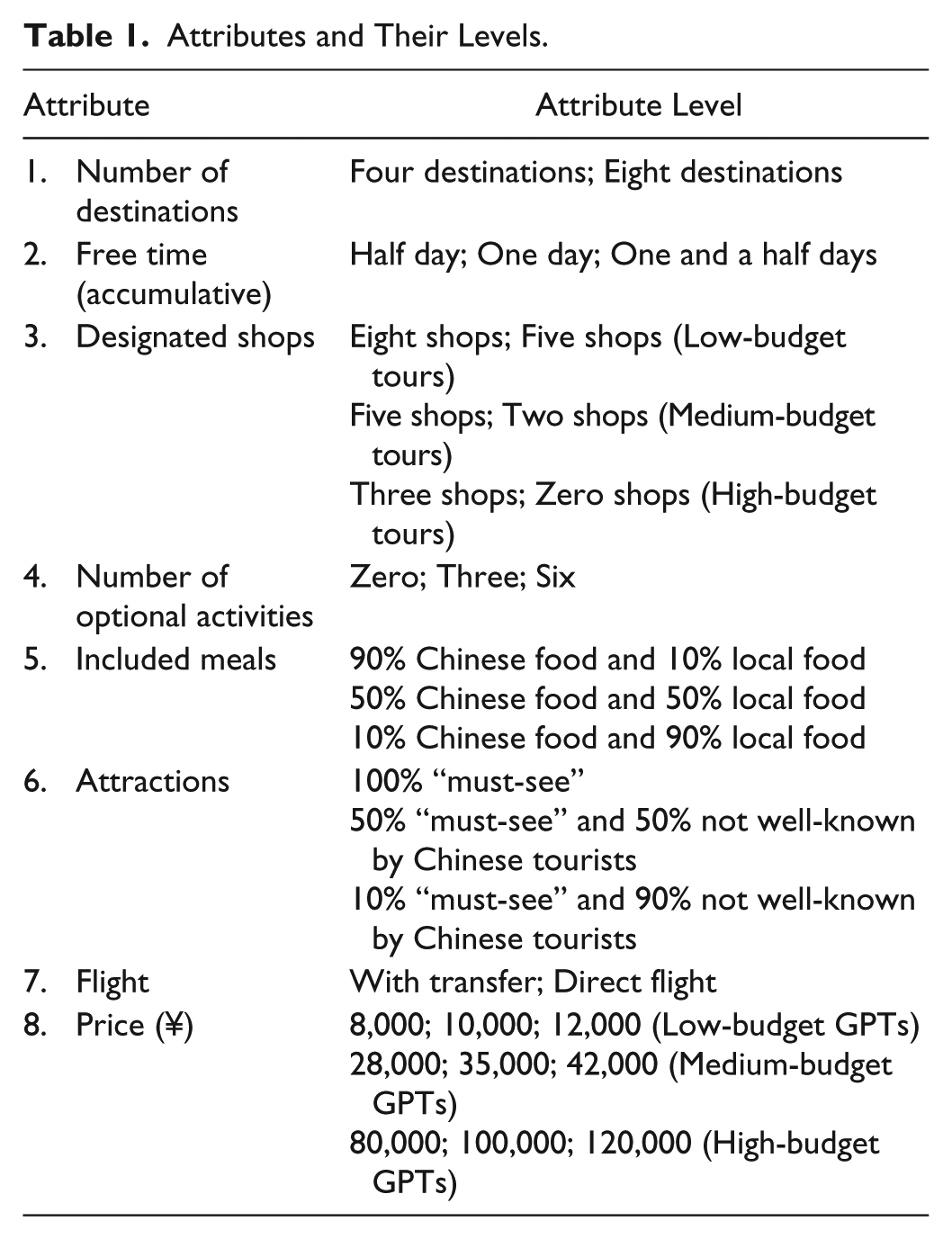
The SCE was designed to reflect the choice of GPTs for three popular long-haul destinations for Chinese, namely, the United States of America (USA), Europe, and Australia (CTA 2017). Alternative GPT options were labeled with the destination names because of the following considerations. First, the labeled GPT alternatives can be more realistic and less abstract than unlabeled alternatives. Thus, response may better reflect the real preference structure, and the main effect of the labels can be examined (Hensher, Rose, and Greene 2005). Second, the attributes used in the experiment characterized GPTs rather than destinations. There was no risk of unrealistic combinations between attributes and destination names (Huybers 2005). Third, respondents of the two rounds of preliminary tests indicated that the three labels did not exert a dominant influence over attribute preferences. The length (i.e., 11 days) and the three average price levels of the GPT (i.e., ¥10,000, ¥35,000, and ¥100,000) were decided by referring to the results of the focus-group interviews, as well as the average length and price of popular GPTs to these three continents on the existing market.
Questionnaire Design
The questionnaire used in the main survey consists of a screening question and three sections. The screening question asked which price level potential respondents were willing to pay for an 11-day long-haul outbound GPT. Based on their response, participants were given the low-, medium-, or high-budget GPT version of the questionnaire. The first section was designed to gather general outbound travel-related information, such as previously visited overseas destinations, experiences with outbound GPTs, preferred outbound travel partners, and group size.
The second section displayed stated choice tasks. Respondents were instructed to consider purchasing an 11-day overseas all-inclusive GPT provided by a five-star travel agency with good reputation and trustworthy brand. They were told to assume that other attributes (e.g., airline, tour bus, accommodation, and tour guide) are the same, except for the listed GPT attributes. Respondents were then asked to indicate their most preferred GPT from each of the choice sets that contain three competing options.
The last section focused on GPT consumption values of MCOTs that may influence their final choice of a GPT product. Respondents were asked to rate the importance of 24 perceived benefits of joining a GPT on a seven-point Likert-type scale that ranged from 7 (very important) to 1 (very unimportant). The 24 items were developed based on Hsu and Huang’s (2016) Chinese cultural values relevant to travel behaviors, as well as a thorough literature review of important GPT attributes, to reflect MCOTs’ desired benefits from joining a GPT underpinned by their unique cultural values. Sociodemographic characteristics, including age, gender, marital status, education level, and household monthly income, were also collected.
Data Collection Procedure
Two preliminary tests were conducted to verify the clarity and applicability of the SCE and gather preliminary model estimates, which can facilitate the generation of an efficient experiment design. In fact, although efficient experiment designs can increase the reliability of model estimates, their specification requires the analysts to have prior knowledge about the parameter to be estimated (Rose and Bliemer 2009). A fractional orthogonal design was generated for the preliminary tests with 170 respondents, each facing 15 choice tasks. The efficient design adopted in the main survey was generated using Ngene software (edition 1.1.1; ChoiceMetrics). Finally, each respondent of the main survey was asked to respond to six choice tasks, wherein each one was composed of three hypothetical destination alternatives (i.e., USA, Europe, and Australia). A sample of a choice card for the medium-budget GPT is illustrated in Figure 1.
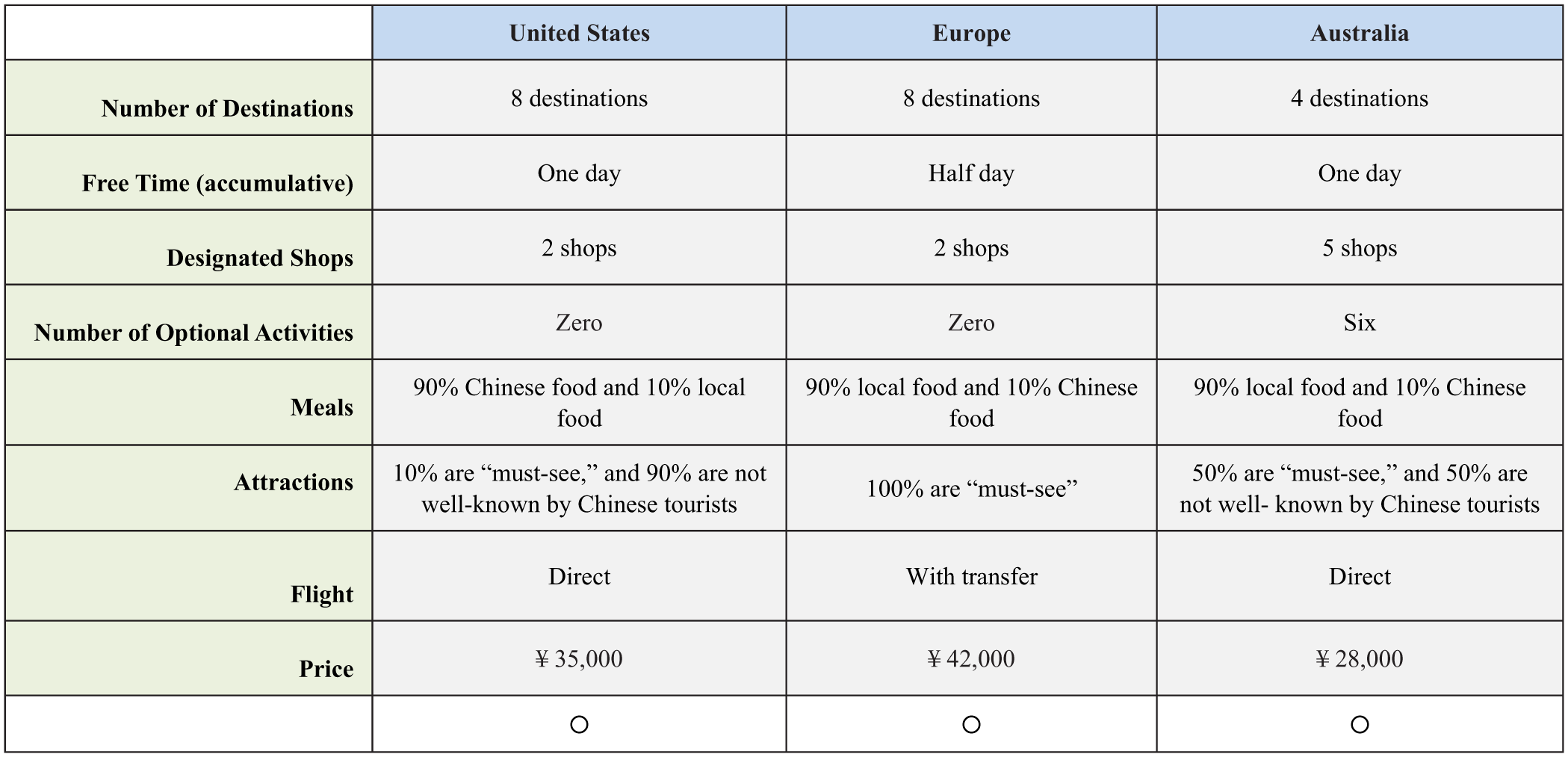
Sample of choice card for medium-budget MCOT segment.
The formal survey distribution took place in Shanghai, Beijing, and Guangzhou, the top three outbound tourist-generating cities (Miao and Fanomezantsoa 2014) with representative geographic locations and regional cultures. Purposive and snowball samplings were employed to recruit a demographically representative sample with diverse backgrounds and travel experiences. Quota on age and gender were imposed to reflect the MCOT population. To allow meaningful statistical analysis and comparison, the total sample size was set at 270 (30 participants per budget group and per city), representing 1,620 valid choice observations.
Data Analysis and Model Specification
Discrete choice models are formulated within the random utility model framework, which states that the utility (U) an individual (i) obtains from selecting an alternative (j) is formed by a systematic and observable part (V) and an unobserved error component (ε) as follows:

where the error component is assumed independent and identically distributed type 1 extreme value. The systematic utility is a function of k observable alternative attributes (xk), which are assumed linear in parameters as follows:

where coefficients βk represent the average taste of individuals.
To improve the ability of the model to capture diversity in individual tastes, analysts can divide the sample population into groups according to observable characteristics. These characteristics include purpose of travel, nationality, or budget category (as practiced in the current study). This method is referred to as observed heterogeneity and is typically modeled through interaction terms or predefined segmentation (as practiced in the current study for budget category). However, the presence and importance of taste heterogeneity due to unobserved factors (i.e., unobserved heterogeneity) was recognized in several contexts, including tourist destination choice (Barros, Butler, and Correia 2008). Unobserved heterogeneity in discrete choice models can be modeled by either parametric or nonparametric methods. The mixed logit model provides a parametric approach because heterogeneity among individuals in the sample is captured by a predefined continuous distribution for the coefficients (i.e., random coefficients), which is typically the normal distribution (McFadden and Train 2000). LCCM isolates the source of unobserved heterogeneity in a discrete manner by identifying latent segments in the sample. Since assumptions about the distribution of the coefficients are no longer necessary, LCCM provides a nonparametric specification of the heterogeneity across the sample (Greene and Hensher 2003). Therefore, an LCCM allows the classification of the sample population into groups having homogeneous preferences (i.e., fixed coefficients within each class). In particular, the class q probability associated with alternative j for individual i in choice situation s is defined as follows:
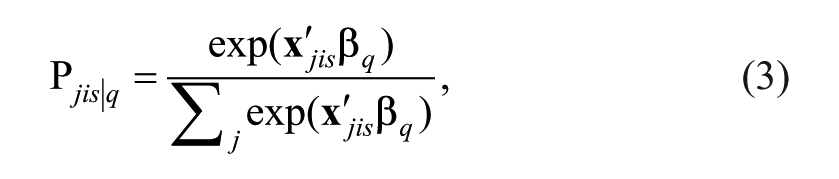
where
The classification of individuals into one of the q classes can be associated with observable individual characteristics and/or latent constructs, and modeled in a probabilistic form as follows:
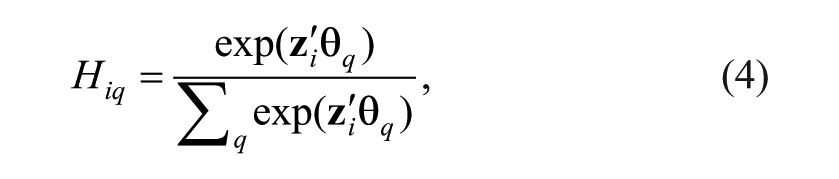
where θ refers to the set of coefficients associated with observable and/or latent factors (
Figure 2 illustrates the framework for the LCCM with consumption value indicators, which is consistent with the model proposed by Swait (1994) for the integration of attitudes or values into a latent class choice model (Boxall and Adamowicz 2002). The preferences of MCOTs vary with sociodemographic characteristics (T. Jin, Lin, and Hung 2014) and consumption values (Sheth, Newman, and Gross 1991). While sociodemographic characteristics are directly observable, consumption values are latent and, hence, measured through indicators. Following the path diagram representation described by Ben-Akiva, Walker, et al. (2002) for sequential estimation, the top right corner of Figure 2 depicts the first stage of the empirical application. This stage consists of a factor analysis performed on MCOTs’ consumption value indicators revealed by the respondents in the entire sample. Factor scores associated with the dimensions of the consumption value construct are then used in the second stage of the estimation. Estimation is performed separately on the three predefined budget segments. In particular, the second stage of the empirical application involves the simultaneous estimation of (1) the probabilistic membership of each MCOT into different latent classes as a function of sociodemographics and consumption values (class membership model), (2) MCOT preferences as a function of latent classes and perception of tour package attributes (class-specific choice model).

Conceptual framework.
The coefficients for the class membership model (θ) and the class-specific choice model (β) are estimated simultaneously by maximizing the following likelihood function.

where the class membership coefficients (θ) are estimated for Q – 1 latent classes, while being normalized to zero for the remaining class.
Results
Sample Characteristics
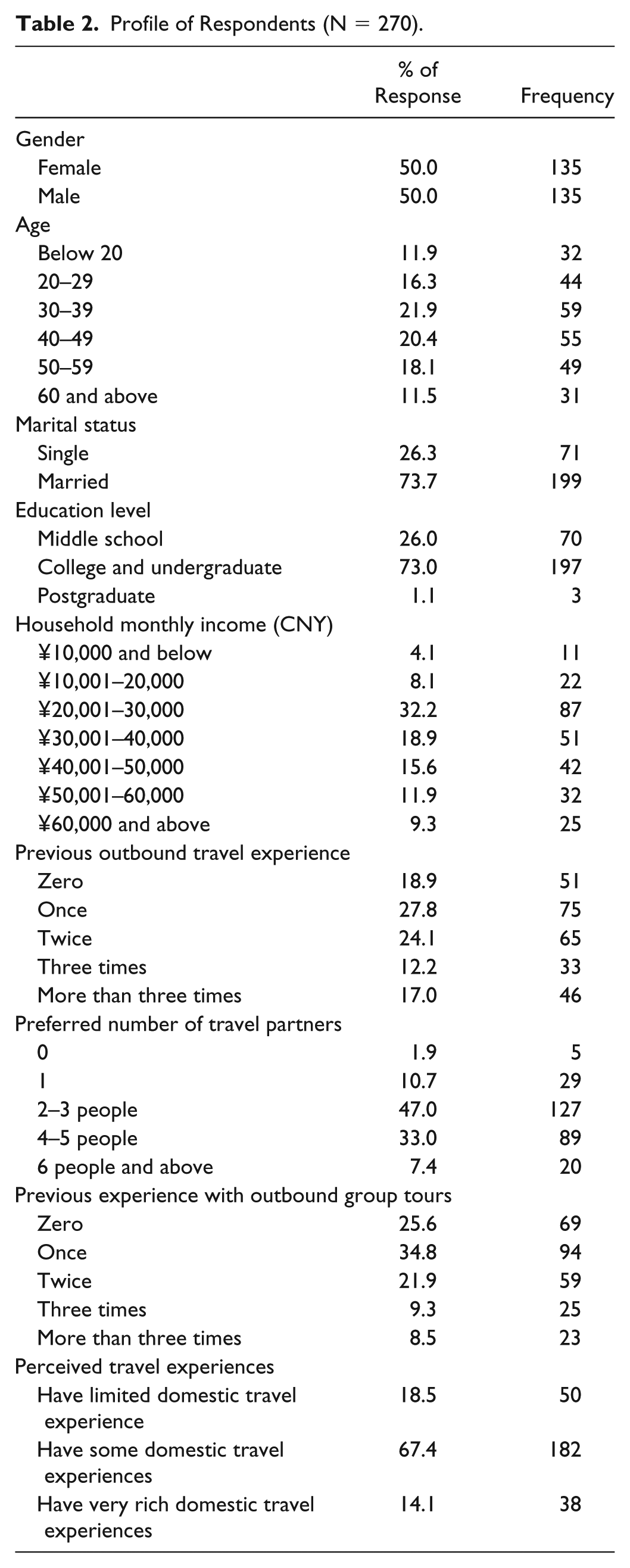
Table 2 presents the sample composition. The demographic breakdown of the sample was 50% female and 73.7% married, with 77% between 20 and 59 years old. The majority (73%) completed undergraduate education, and more than half (55.7%) reported a monthly household income above 30,000 RMB, which is higher than the average income level of the sampled cities and can be classified as middle class (Song et al. 2016). Only 18.9% reported lack of previous outbound travel experience, and 25.6% never participated in an outbound GPT. Approximately 10.4% visited the USA, 8.9% visited Australia, and 10.4% visited Europe. More than half of the respondents preferred to travel with spouse (58.9%) or family members (51.5%), and more than 40% would like to travel with friends. Only 7.8% were willing to travel with colleagues.
Profile of Respondents (N = 270).
Factor Analysis of Consumption Values
Table 3 presents the factor analysis results of the GPT consumption values. Factors were extracted using the generalized least squares method with oblique (Promax) rotation to allow correlation among factors. The number of factors extracted was decided according to Kaiser’s rule (eigenvalues >1). Two items were excluded because of low factor loadings (“Not repeating the same destinations I visited before” and “Broadening my horizon”). Three items were removed to increase the internal consistency of the scale (“Experiences for the whole family,” “Visiting destinations with natural sceneries,” and “Feeling safe throughout the trip”). Six factors were identified, explaining 63% of the original variability. The KMO measure of sampling adequacy (0.76) and the Bartlett’s test of sphericity (probability < 1%) supported the appropriateness of the factor analysis. Factor loadings greater than 0.33 were considered statistically significant on a sample size of 270 respondents (Hair, Black, and Babin 2010). Moderate correlations were observed between factors 1 and 2 (0.42), factors 1 and 3 (0.41), and factors 4 and 5 (0.33). Four cross-loadings were detected and retained in the analysis due to meaningful interpretation. The first five factors had satisfactory scale reliability (Cronbach’s alpha ⩾ 0.6), whereas the sixth factor showed a low value (0.53), although the correlations between each item and the overall score from the scale (> 0.3) supported the reliability of the scale (Field 2013).
Factor Analysis of Travel-Related Values (N = 270).
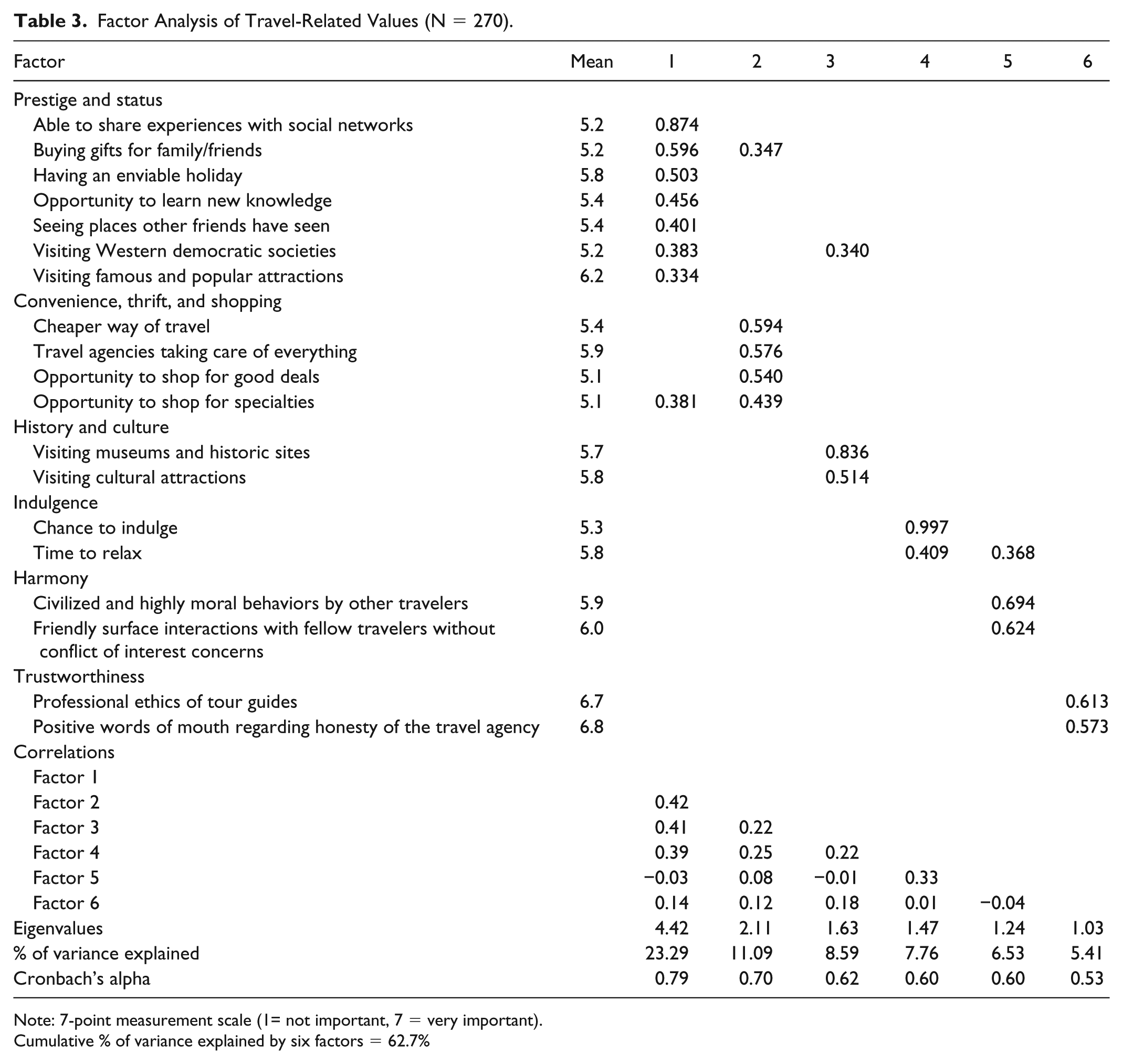
Note: 7-point measurement scale (1= not important, 7 = very important).
Cumulative % of variance explained by six factors = 62.7%
As shown in Table 3, factor 1 consisted of the seven items reflecting a desire for status and prestige through an overseas trip that covers famous touristic attractions, Western democracy, new knowledge, and an enviable holiday, which can be shared and showed off in social circles. Therefore, this factor was labeled “Prestige and Status.” The second factor was concerned about the general benefits of participating in a GPT and was labeled “Convenience, Thrift, and Shopping.” The third and fourth factors were labeled “History and Culture” and “Indulgence,” respectively. The fifth factor focused on moral and friendly behaviors of stranger participants in the same GPT and was named “Harmony.” The last factor contained items that measure the reputation and reliability of service providers, and was thus labeled “Trustworthiness.” These six GPT values perceived by MCOTs correspond with the five consumption values identified by Sheth, Newman, and Gross (1991). Factors 2 and 6 are related to functional/utilitarian value. Factor 1 is related to social value, and factor 3 is an epistemic value. Factor 4 is an emotional value, and factor 5 is related to the conditional value which can enhance functional or social values.
Result of Latent Class Choice Modeling
Three LCCMs were estimated for the three predefined budget groups. Models with two to four latent classes were estimated and compared in terms of model fit through the BIC. Coefficients that are not statistically different across classes were constrained to be the same in all classes to preserve model parsimony. A solution with two latent classes was preferred for each of the three budget groups because it provided the lowest BIC measure. Table 4 presents the utility coefficients in each of the two latent classes (i.e., class-specific choice model), the average class probability, and the probabilistic characterization of the latent classes with respect to a set of sociodemographic characteristics and GPT values perceived by MCOTs (i.e., class membership model). Indicators of model fits included the likelihood-ratio test for the comparison between the fit of the estimated LCCMs (ln L(β)) and their restricted version (i.e., multinomial logit model, ln L(MNL)), the corresponding log-likelihood chi-square statistic (G2), and the information criterion BIC for the selected and tested models. Collinearity diagnostic was performed to exclude the presence of multicollinearity in the class membership model estimates. For all variables included in the models, the variance inflation factor was considerably lower than 3, which is the most conservative threshold value used to detect potential multicollinearity issues (Field 2013). For the class membership model, only coefficients associated with significant (p < 0.05) and potential (p < 0.10) relationships were included in the final models.
Latent Class Choice Model Results.
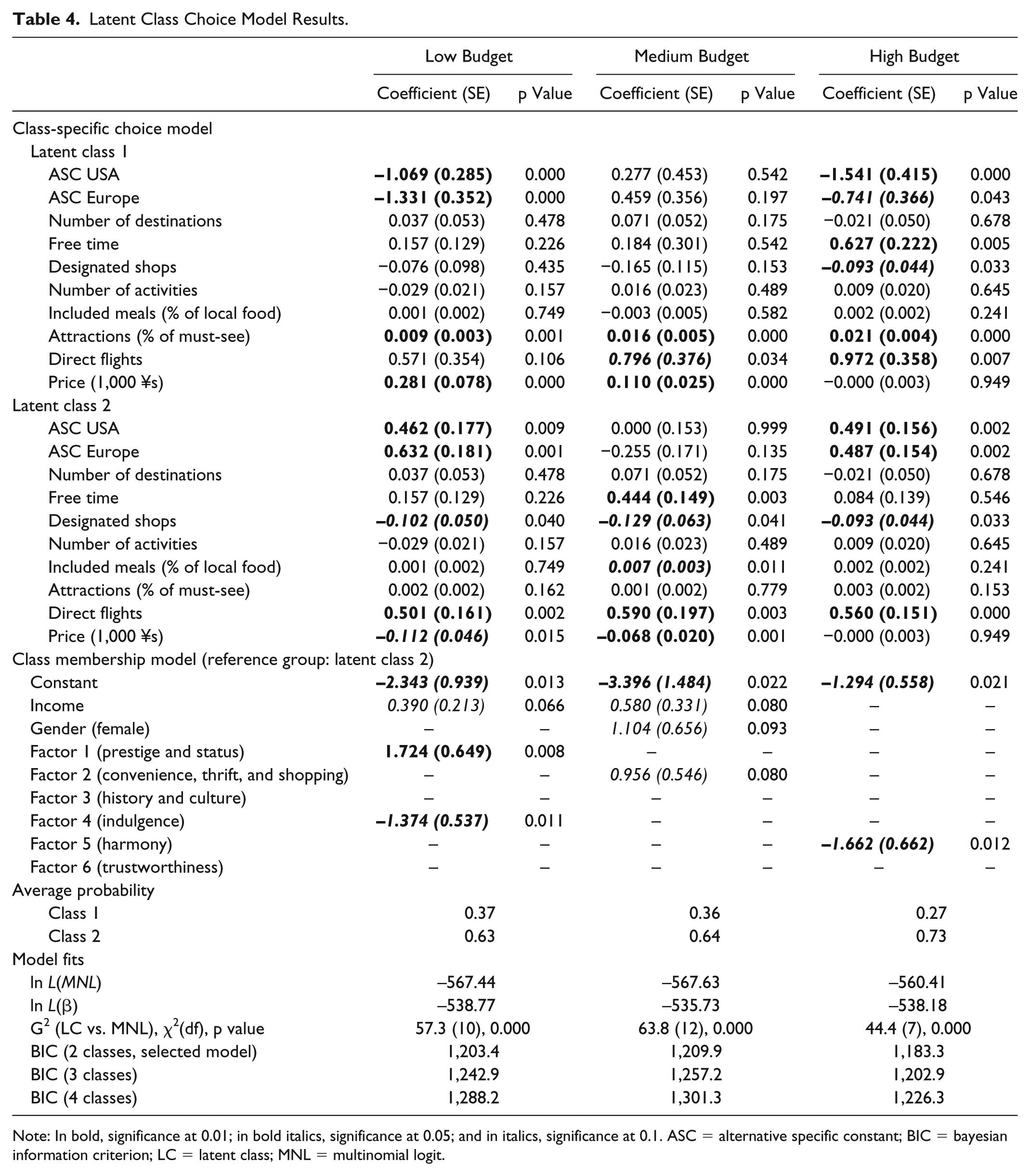
Note: In bold, significance at 0.01; in bold italics, significance at 0.05; and in italics, significance at 0.1. ASC = alternative specific constant; BIC = bayesian information criterion; LC = latent class; MNL = multinomial logit.
By viewing the model results across the three GPT groups, the two classes in the low- and medium-budget groups indicated different perceived meanings of the “price” attribute. Individuals in class 1 regarded “price” as an indicator of quality (i.e., utility increases as price increases), whereas those in class 2 considered “price” as an undesirable attribute (i.e., utility decreases as price increases). However, the high-budget group showed indifference towards the price in both classes. Furthermore, the alternative specific constants (ASC) associated with the USA and Europe in class 1 for low- and high-budget groups are significant and negative, which indicates preference for Australia (all other attributes held constant). The opposite was observed in class 2 for the same budget groups, where all other attributes held constant, the USA and Europe were preferred over Australia. Instead, the medium-budget group did not exhibit any destination preference.
Specifically, the low-budget group was composed of 63% of individuals in class 2 and 37% in class 1. Class 2 exhibited significant disutility for the price of the GPT and the number of designated shops, while registering a positive effect for GPTs that offer a direct flight to the destination. Class 1 in the low-budget group showed a significant preference for GPTs that provide higher proportions of “must-see” attractions and, more importantly, attached a positive value to price. The class membership model supported the latter finding by indicating higher probability (p value of 0.066) for individuals with higher income to belong to the first class. Additionally, individuals placing higher importance on “Prestige and Status” and lower importance on “Indulgence” were more likely to belong to class 1 than class 2.
Similarly, the majority (64%) of the medium-budget group belonged to class 2, which indicated significantly negative effects for the price and number of designated shops but significantly positive effects for additional free time, local food, and direct flight. Class 1 represents the remaining 36% of the medium-budget group, which was composed of individuals who perceived price as a desirable feature, and favored GPTs with a higher proportion of “must-see” attractions and direct flight. The characterization of class 1 (with respect to class 2) indicated higher probability for respondents with higher income and female (p values of 0.080 and 0.093, respectively). Moreover, the probability for individuals to be members of class 1 would increase as the importance of “Convenience, Thrift, and Shopping” increases (p value of 0.080).
Neither class 1 nor 2 of the high-budget group was significantly sensitive to price, but the two classes differed with respect to other attributes. Class 2 was composed of a larger proportion (73%) of high-end MCOTs whose preferences were positively affected by the availability of direct flights but negatively affected by the number of designated shops. While similar impacts from these two attributes also applied to the smaller class 1 (27%), the choice of these subgroup members was positively influenced by two additional attributes, namely, the amount of free time and the proportion of “must-see” attractions. The class membership model attributed heterogeneity across the two classes to the importance of “Harmony” for which members of class 1 had an average lower value than class 2.
Compensation Measures
The model estimates allow for the calculation of compensation that potential GPT buyers expect when trading two different attributes. The ratio between two coefficients of the models (i.e., marginal utilities) represents the marginal rate of substitution and indicates how much of an attribute has to be compensated (or sacrificed) to forgo (or obtain) one unit of another attribute while maintaining the same level of utility. Table 5 reports the marginal rates of substitution across the three budget groups calculated only for those significant and relevant attributes. If one of the attributes is expressed in monetary value and perceived as a cost (i.e., undesirable attribute), the marginal rate of substitution reflects the willingness to pay. Therefore, willingness-to-pay measures were calculated for class 2 in low- and medium-budget groups. Individuals in class 2 of low-budget group were willing to pay an additional ¥900 for a GPT, which includes one less designated shop, and ¥4,500 for a GPT that flies directly to the destination. Similarly, individuals in class 2 of medium-budget group were willing to pay an additional ¥6,500 for another half day of free time, ¥1,900 for one less designated shop, ¥1,030 for a 10% increase in the provision of local food (instead of Chinese food), and ¥8,600 for a direct flight to the destination.
Compensation Measures.
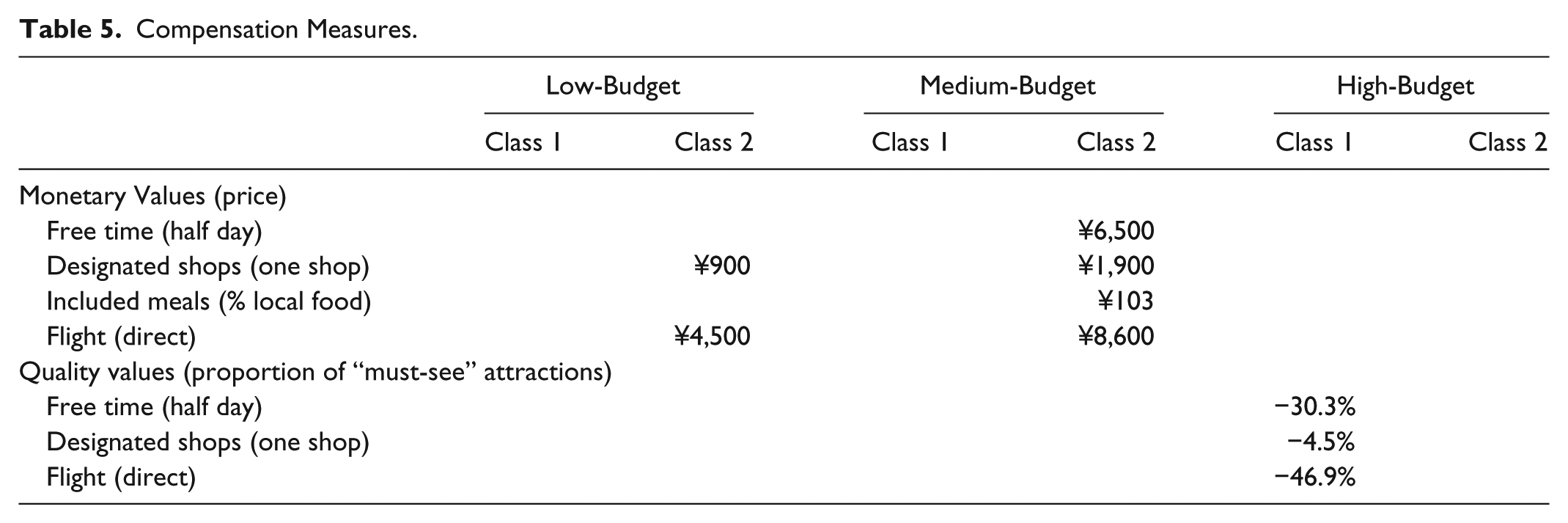
Compensation measures for individuals in the high-budget group were exclusively performed with respect to quality attributes as this group was not significantly sensitive to any price change. Considering the attribute associated with the type of attractions included in GPTs, members of class 1 were willing to trade 30.3% or 4.5% of the “must-see” attractions for another half-day of free time or one less designated shop, respectively. Therefore, GPTs with one more designated shop should include an additional 4.5% of “must-see” attractions to be equally perceived. Likewise, a considerable proportion (46.9%) of the “must-see” attractions could be traded for a GPT with a direct flight to the destination. Therefore, GPTs with layovers should include an additional 46.9% of “must-see” attractions to be equally perceived to a GPT with direct flight.
Conclusions and Implications
The findings of this study demonstrated that MCOTs consist of individuals with diverse preferences. Their selection heterogeneity for all-inclusive long-haul GPTs was modeled through an LCCM. Two latent classes were identified for each of the three budget groups according to unobserved preference heterogeneity. The probability of being classified into each of the two classes was explained as a function of different consumption values and sociodemographic characteristics. Specific discussions on the results and the conclusions for the two research questions are elaborated as follows.
Preference Heterogeneity across Latent Groups
More than 60% of the low-budget respondents regarded price as an undesirable attribute. They preferred GPTs that provide direct flights and fewer designated shops. By contrast, a minority of low-budget respondents who believed higher prices indicated better quality preferred GPTs that offer higher proportions of must-see attractions. The preference heterogeneity between the two subgroups of low-budget MCOTs could be well explained by their different consumption values and socioeconomic backgrounds. Compared with respondents who highly value self-indulgence (i.e., driven by emotional value) and thus request direct flight and fewer designated shops, the minority group with higher income demonstrated stronger desire to show off their prestige and status (i.e., driven by social value) through overseas trips. Visiting famous attractions caters to this psychological need more easily because of the symbolic meanings associated with the sign value of must-see attractions (Urry 1990). This result provides evidence for Hsu and Huang’s (2016) statement that the enthusiasm of Chinese travelers in visiting famous touristic sites might be underpinned by interpersonal values of conformity and ostentation.
The majority of the medium-budget respondents indicated a preference for GPTs that offer not only direct flights and fewer designated shops, but also additional free time and higher proportion of local food. The medium-budget MCOTs who were sensitive to price but did not select the cheapest GPTs in the market might have higher expectations or requirements for the offerings, due to higher cautiousness on extra expenditure compared with the other subgroup that viewed price as an indicator of quality. Unlike previous generations of MCOTs who pursued a sense of appetizing assurance, contemporary medium-budget MCOTs are more willing to take the risk of tasting unfamiliar local cuisine, thereby seeking a “peak touristic experience” that satisfies experiential needs (Chang, Kivela, and Mak 2010). Similarly, desiring for additional free time in the itinerary allows travelers to participate in their favorite activities. These preferences reflect a shift in the consumption values of MCOTs who selected medium-priced GPTs: they become increasingly keen to explore and experience authentic culture and learn from others. They also pursue more freedom and personalized travel experiences.
By contrast, the minority subgroup of the medium-budget respondents only demonstrated preference for more must-see attractions and direct flight. Female and the respondents with relatively higher income were more likely to belong to this subgroup, which could explain why they viewed price as an indicator of quality, and attached higher importance to convenience, thrift, and shopping (i.e., driven by functional values). Female travelers are generally concerned more about relaxation, shopping, security, and prestige (including self-respect and being respected by others) (Meng and Uysal 2008). Moreover, Chinese females are found to feel more social pressures from reference groups than males (Sparks and Pan 2009), which may explain their preference for additional must-see attractions. As a top traditional Chinese cultural value, thriftiness indicates a high degree of moral self-regulation (C. L. Wang and Lin 2009). Thus, even high-income MCOTs regard it as a virtue. By contrast, convenience is a modern value that indicates the emergence of individualism from MCOTs (Xu and McGehee 2017) who wish to indulge themselves in a comfortable and expedient trip and are not overly concerned about price.
The high-budget group was not significantly sensitive to price, but they were concerned about the price–performance ratio of alternative GPTs. They preferred GPTs with direct flights and fewer designated shops so they can enjoy a more comfortable, relaxed, and immersive holiday. This desire is also reflected in the higher importance that the majority of high-end respondents attached to a harmonious in-group relation throughout the trip (i.e., driven by a conditional value). Moreover, the smaller subgroup of high-budget respondents preferred GPTs providing additional benefits—more free time and must-see attractions, which may be due to the increasingly busy work and fast-paced life of Chinese people.
Regardless of budget, the majority of respondents reported common preferences for fewer designated shops and direct international flights. MCOTs are documented to have strong interests in retail shopping, especially luxury brands, and have demonstrated astonishing purchasing power abroad (Chow and Murphy 2008; X. Li et al. 2011). However, the growing number of negative reports on forced shopping by GPT guides have aroused antipathy from Chinese travelers toward shopping at designated stores, being cheated, or forced to make purchases. Therefore, respondents requested additional free time in the itinerary for independent shopping or sightseeing. This result is consistent with Pan and Laws’s (2003) finding that MCOTs visiting Australia reported unhappiness with frequent stops in duty-free shops even though they have a tradition of taking gifts home to family and friends. In addition, the universal preference for direct flights may be derived from MCOTs’ considerations of safety, convenience, and comfort. Recognized advantages of direct flights include lower travel costs, as well as saving time and energy (Guo et al. 2006). Moreover, Chinese consumers believe direct flights are safer because take-offs and landings are minimized (Fleischer, Tchetchik, and Toledo 2012). Safety concern has been reported as a major constraint for MCOTs, which significantly influences their choices and travel behaviors (Lai, Li, and Harrill 2013). Finally, the “number of destinations” did not exert significant influence on the GPT selection of any budget group, indicating that contemporary MCOTs do not blindly pursue the numbers even though they prefer GPTs involving multiple destinations (Guo, Kim, and Timothy 2007). This result is consistent with Money and Crotts’s (2003) report that tourists from national cultures with higher levels of uncertainty avoidance are inclined to travel in larger groups, prefer shorter stay, and visit a fewer number of destinations.
Academic Contributions and Practical Implications
The use of SCE distinguishes the present study from previous survey-based research by examining how respondents make trade-offs between different GPT attributes, and between the levels associated with each attribute. The SCE approach allows the researchers to simulate various GPTs as realistically as possible while giving them control over different factors that may influence tourist decision making (Grigolon, Kemperman, and Timmermans 2012). Thus, the present study avoids the ambiguity and open-endedness of previous GPT studies, wherein respondents were not required to make trade-offs (Crouch et al. 2009).
Moreover, this study takes advantage of latent class model estimation that allows the preference parameters to differ between the discrete but unobserved classes of respondents, and predicts the probability that each respondent may fall into a certain class. No previous study was found utilizing LCCM to examine tourist preferences for GPTs. The estimation of an LCCM facilitated the identification of two latent classes that differ in GPT attribute preferences and willingness-to-pay, and are characterized by different consumption values and sociodemographics. The explanations for the source of preference heterogeneity are more useful than merely capturing heterogeneity, for both academia and industry practitioners (Boxall and Adamowicz 2002). In conclusion, the current study fills a substantial research gap in the GPT and Chinese outbound tourism literature by conducting a SCE to reveal preferences and trade-offs of MCOTs for GPT attributes. By employing an LCCM, this study contributes new knowledge to the pretrip GPT selection by prospective MCOTs, and improves the understanding of potential segments of MCOTs with varying preferences, sociodemographic characteristics, and consumption values.
The influence of four consumption value dimensions on MCOTs’ GPT choice revealed by this study verifies the fundamental propositions of Sheth, Newman, and Gross’s (1991) theory: consumer choice is a function of multiple consumption values, which make differential contributions in any given choice situation. For low-budget MCOTs, the majority subgroup was more likely driven by emotional values, whereas the minority subgroup was more likely driven by social values. The minority group of medium-budget MCOTs was driven by functional values, thus may be the most rational MCOT segment. The larger subgroup of high-budget MCOTs was driven by conditional values, demonstrating special attention on the added value of GPTs occasionally provided by other participants in the tour group. Additionally, the SCE approach effectively breaks through the limitation of the theoretical framework in capturing the cost/sacrifice aspect of customer values (Smith and Colgate 2007) by investigating the complex tradeoffs of MCOTs among the GPT attributes. Moreover, the present study is the first to integrate travel-related Chinese cultural values developed by Hsu and Huang (2016) into the meta-theoretical framework of consumption values and empirically test those values’ influences on MCOTs’ GPT choice.
The findings of this study have important managerial implications for travel operators in GPT design and pricing. The majority of respondents preferred direct international flights and less designated shopping, thereby demonstrating desires for safety, convenience, time-saving, comfort, and freedom. Although the respondents still indicated a strong desire and demand for shopping, they were not willing to shop in designated stores and felt aversion to promotion by tour guides. Therefore, tour agencies should avoid long-haul flights with too many transfers, and strictly monitor the number of designed shops in the itinerary. Direct flights and limited number of designated shops can be highlighted to attract potential customers. Despite being the minority, certain respondents from all three budget groups indicated a desire for GPTs with more must-see attractions. Thus, travel agencies should consider heterogeneous preferences of different market segments and design itineraries to the same destination with varying proportions of must-see attractions.
Specifically, travel agencies should provide more flexibility and autonomy in the itinerary arrangements for medium- and high-budget MCOTs given their declared preference for additional free time. This option can be arranged by reducing the number of destinations, which is not a significant attribute. Reducing scheduled destinations can free up time in the itinerary and reduce operating costs correspondingly. Moreover, travel agencies should provide medium-budget MCOTs more opportunities to taste local cuisine to improve their authentic experiences. These suggested changes can be accompanied by price increases because respondents reported willingness to pay for additional free time, fewer designated shops, increased local food, and direct flights to different extents by different market segments.
The impact of values on GPT preferences also provides insights for tour operators. For example, indulgence is important to most low-budget travelers, and harmony is important to most high-budget travelers. Convenience, thriftiness, and shopping are important to medium-budget female travelers with higher income. With this information, tour operators can develop appropriate sales and marketing activities to target specific subgroups of MCOTs. Moreover, the different interpretations of price can be used to effectively segment the market. For low- and medium-budget MCOTs, their different perceptions of price determined the subgroup to which they belong. These pieces of information are particularly useful because the conventional demographic and behavioral characteristics are becoming less effective in segmenting and understanding the increasingly diverse MCOTs (Bloom 2005).
Limitations and Future Research
Three limitations of this research should be acknowledged. First, the generalizability of research findings is limited because data were collected only in the three top-tier Chinese cities and from a relatively small sample. Future studies should expand the scope to include MCOTs from second- and third-tier cities, who are less experienced tourists with limited knowledge about long-haul destinations, and thus may be more dependent on GPTs. Second, the eight attributes adopted in this study may not be comprehensive in assessing criteria for joining outbound GPTs. Other important attributes and their varied levels should be examined in further SCE studies, such as indirect flights with different lengths of transfer time, or hotels having the same star rating but different locations. Destination-specific attributes should also be considered (X. Li et al. 2013). To accommodate the a priori segmentation of tourists into different budget levels, we adopted a sequential estimation approach of the latent class choice model with latent consumption values. Future applications can focus on the specification of hybrid latent class choice model, where the latent variable measurement model, the class membership model, and the class-specific choice model are estimated simultaneously (Ben-Akiva, McFadden, et al. 2002; Walker 2001). Finally, the results should be interpreted with caution because of the hypothetical SCE approach. Nonhypothetical or real choice experiments should be conducted in the future to avoid hypothetical bias (Moser, Raffaelli, and Notaro 2014).
Footnotes
Declaration of Conflicting Interests
The author(s) declared no potential conflicts of interest with respect to the research, authorship, and/or publication of this article.
Funding
The author(s) disclosed receipt of the following financial support for the research, authorship, and/or publication of this article: The work described in this paper was fully supported by a grant from the School of Hotel and Tourism Management at The Hong Kong Polytechnic University (Project No.: G-UC87).
