




Abstract
At the core of the resident attitude literature is the general understanding that the more residents economically benefit from tourism, the more they support tourism. While a central tenet, previous research has measured resident perceptions of economically benefiting from tourism somewhat haphazardly, using four disparate directions without a common cross-culturally reliable and valid scale. To bring clarity to the literature, this study develops and presents the Economic Benefit from Tourism Scale as a reliable and valid measure for the resident attitude literature to embrace. The scale’s development follows Churchill’s recommendations and uses three separate data collections across the United States of America and Poland to purify the scale and demonstrate its validity within an international context. Both samples prove the scale to be construct valid with maximum weight alphas in the .85 to .90 range, standard factor loadings all above 0.60, and average variance extracted estimates between 57% and 69%.
Keywords
Research on resident attitudes toward tourism is one of “the most systematic and well-studied areas of tourism” (McGehee & Andereck, 2004, p. 232). Belisle and Hoy (1980) recognized that residents have the ultimate power to halt tourism and that their support is essential to making tourists feel welcomed and to providing a quality experience. Murphy (1985) substantiated this point by writing, “If residents resent or fear tourism, their resistance and hostility can destroy the local industry’s potential” (p. 153). Furthermore, Nunkoo, Smith, and Ramkissoon (2013) have acknowledged that without the support of residents, “It is difficult to develop tourism in a sustainable and socially compatible manner” (p. 6).
At the core of the resident attitude literature is the generally accepted understanding that the more residents benefit economically from tourism, the more they tend to support it. Madrigal (1993) wrote that, “Perhaps the most persistent finding over the years has been the positive relationship between perceptions of tourism and economic reliance on the tourism industry” (p. 337). Coupled with this strong empirical support is theoretical support from social exchange theory (SET). Residents evaluating the costs and benefits of tourism are at the foundation of SET’s application within tourism (Ap, 1992; Nunkoo & Ramkissoon, 2011), and this is demonstrated in the seminal work by Perdue, Long, and Allen (1990) concerning resident attitudes toward tourism.
While the relationship between residents economically benefiting from tourism and the positive perceptions of the industry is a central tenet of the resident attitude literature, previous research has approached the measurement of perceptions of economically benefiting from tourism somewhat haphazardly. Evidence of this can be found by researchers measuring the construct in four disparate directions without a common reliable and valid scale to unite the literature. The first approach has been to measure resident perceptions of economically benefiting from tourism through underdeveloped scales that use only one or two items to measure the latent construct (see Madrigal, 1993; Nunkoo & So, 2016). While this has helped understand how residents evaluate the economic benefits of tourism and how these evaluations influence other variables such as support for tourism, the underdeveloped nature of this past research is problematic because one’s perceptions of economically benefiting from tourism are too complicated to be measured with only one or two items. Hence, a fully developed reliable and valid scale is needed to minimize any potential measurement error (Churchill, 1979).
The second approach has been to steer away from measuring perceptions of economically benefiting from tourism by using residents’ employment within the industry as a proxy for their perceptions of economically benefiting (Ward & Berno, 2011). Employment, as a dichotomous (e.g., yes/no) variable, is a far less powerful measure of economically benefiting from tourism than measuring one’s actual perceptions using self-reported interval-level data. This is for multiple reasons. The first is the limited ability to employ multivariate statistical analyses when categorical variables are used. Second, and arguably more important, is that tourism is frequently criticized for providing marginal employment (Faulkenberry, Coggeshall, Backman, & Backman, 2000; Lacher & Oh, 2012). If researchers use only employment as a proxy for economically benefiting from tourism, then they are not able to examine the nuances of whether or not residents perceive their employment as beneficial. By being able to measure perceptions of economically benefiting from tourism, researchers are closer to answering the question of whether residents are economically empowered from tourism (Cole, 2006; Scheyvens, 1999).
The third approach has been for some to blur the distinction between the general personal benefits from tourism and the personal “economic” benefits from tourism through the generic verbiage used within the name of the scale and individual items (Ko & Stewart, 2002; McGehee & Andereck, 2004; Perdue et al., 1990). This has occurred through authors labeling their scales as “personal benefits from tourism” and using the language of “personal benefits” within their measurement items while their discussion and interpretation of the findings assume that these benefits are considered “economic” rather than an overarching cost–benefit analysis of all the benefits of tourism. This lumping of the economic benefits from tourism with all of the other benefits of tourism into one scale has led to some of the present confusion within the resident attitude literature and many of the criticisms behind (SET. For instance, Woosnam et al. (2009) have critiqued SET for gravitating toward economic exchange theory (Bimonte & Punzo, 2016) and for solely treating the relationship between residents and tourists as a function of money. When the personal economic benefits from tourism are combined with all other personal benefits from tourism and measured using phrases like “I would benefit from more tourism development in this community” (McGehee & Andereck, 2004; Perdue et al., 1990), it prevents researchers from partitioning out which economic and noneconomic benefits from tourism are the most influential to residents. A pure measure of residents’ perceptions of economically benefiting from tourism remedies this problem and opens the door for researchers to include noneconomic constructs within structural models such as emotional solidarity (Woosnam & Aleshinloye, 2015), trust (Nunkoo & Ramkissoon, 2012), and empowerment (Boley & McGehee, 2014) to see which constructs are the best predictors of resident attitudes toward tourism. It also allows for using different theoretical perspectives like Max Weber’s Theory of Formal and Substantive Rationality that explains resident support for tourism as a function of both the economic and noneconomic costs and benefits incurred (Boley, McGehee, Perdue, & Long, 2014). Without clearly distinguishing personal economic benefits from noneconomic benefits, researchers are handicapped from taking this approach that partitions out the economic and noneconomic influences on resident attitudes toward tourism. It also prohibits destination managers from identifying exactly where problems lie and from developing solutions to fix them because all the benefits are effectively lumped together and cannot be disentangled.
The last approach has been to switch the focus from measuring the personal economic benefits of tourism to measuring tourism’s economic impacts within the community using a triple bottom line (TBL) perspective that accounts for tourism’s environmental, social, and economic impacts within the community (Choi & Sirakaya, 2005; Upchurch & Teivane, 2000). This TBL perspective shifts the focus from personal economic benefits to the community’s economic development as a whole. This TBL perspective aligns with sustainable tourism’s broad emphasis on “enhancing the welfare of those affected by it, through increased economic opportunity, preservation of the local community’s cultural and natural heritage, and an enhanced quality of life” (McCool & Lime, 2001, p. 385). While it is certainly important to understand resident perceptions of how tourism is affecting their community’s economy, impacts within the community are inherently different from personal impacts. This focus on the community strays away from SET’s original focus, which is on the individual and his or her perceptions of the cost and benefits of engaging in tourism. This is precisely why it is best to separate the two and clearly measure personal perceptions of economically benefiting from tourism separately from tourism’s impact on the community at large.
Even though these four different approaches each have their benefits, a reliable and valid scale measuring resident perceptions of economically benefiting from tourism is still needed for multiple reasons. First, it would provide a psychometrically vetted scale for researchers to employ in future resident attitude studies. This would help the body of literature on resident attitudes mature by being able to perform large meta-analyses across the literature to see how perceptions of economically benefiting from tourism influence support for tourism across different destinations and different contexts (Deci, Koestner, & Ryan, 1999). As of now, researchers are using disparate measures, which make it difficult to formulate broad conclusions in various contexts. Second, a reliable and valid measure of resident perceptions of economically benefiting from tourism is needed to help remedy some of the criticisms of SET (Nunkoo & Ramkisson, 2009; Woosnam, Norman, & Ying, 2009). By having a reliable and valid scale that specifically measures resident perceptions of economically benefiting from tourism, it effectively partitions out economic benefits from the other “personal” benefits, allowing researchers to hone in on what has the most significant influence on resident attitudes toward tourism. This is not currently possible when measurement items are worded toward overarching “personal benefits.” The partitioning of benefits into different scales also provides destination managers with the ability to pinpoint resident perspectives on the various types of benefits of tourism (or lack thereof) and work to develop solutions in order to remedy any problems that may arise.
Last, the literature lacks a cross-culturally valid scale to measure resident perceptions of economically benefiting from tourism. While the scope of the past research on the subject has been international in nature, these studies have measured the construct in disparate directions neglecting to examine whether psychometric properties remain strong across cultures. The mainstream marketing literature has discussed in detail the many pitfalls of conducting international research without ensuring that constructs are “construct equivalent” across cultures (e.g., Choudhry, 1986; Malhotra, Agarwal, & Peterson, 1996). Prior to considering the construct in meta-analysis research, a cross-culturally valid scale needs to be developed and proven in order to be “construct equivalent” across cultures.
With this gap in mind, this study seeks to develop the Economic Benefit from Tourism Scale (EBTS). The development of the scale follows Churchill’s (1979) recommendations and uses three separate data collections across the United States and Poland to purify the measure as well as to demonstrate its usability within an international context. The Poland sample from Choczewo in Pomerania is novel because it provides the ability to test the international validity of the scale and to see if the postcommunist influence of Poland’s past changes the psychometric properties of the scale. The article proceeds by walking through how Churchill’s (1979) eight steps for scale development were followed to create, test, and validate the EBTS.
Development of the EBTS
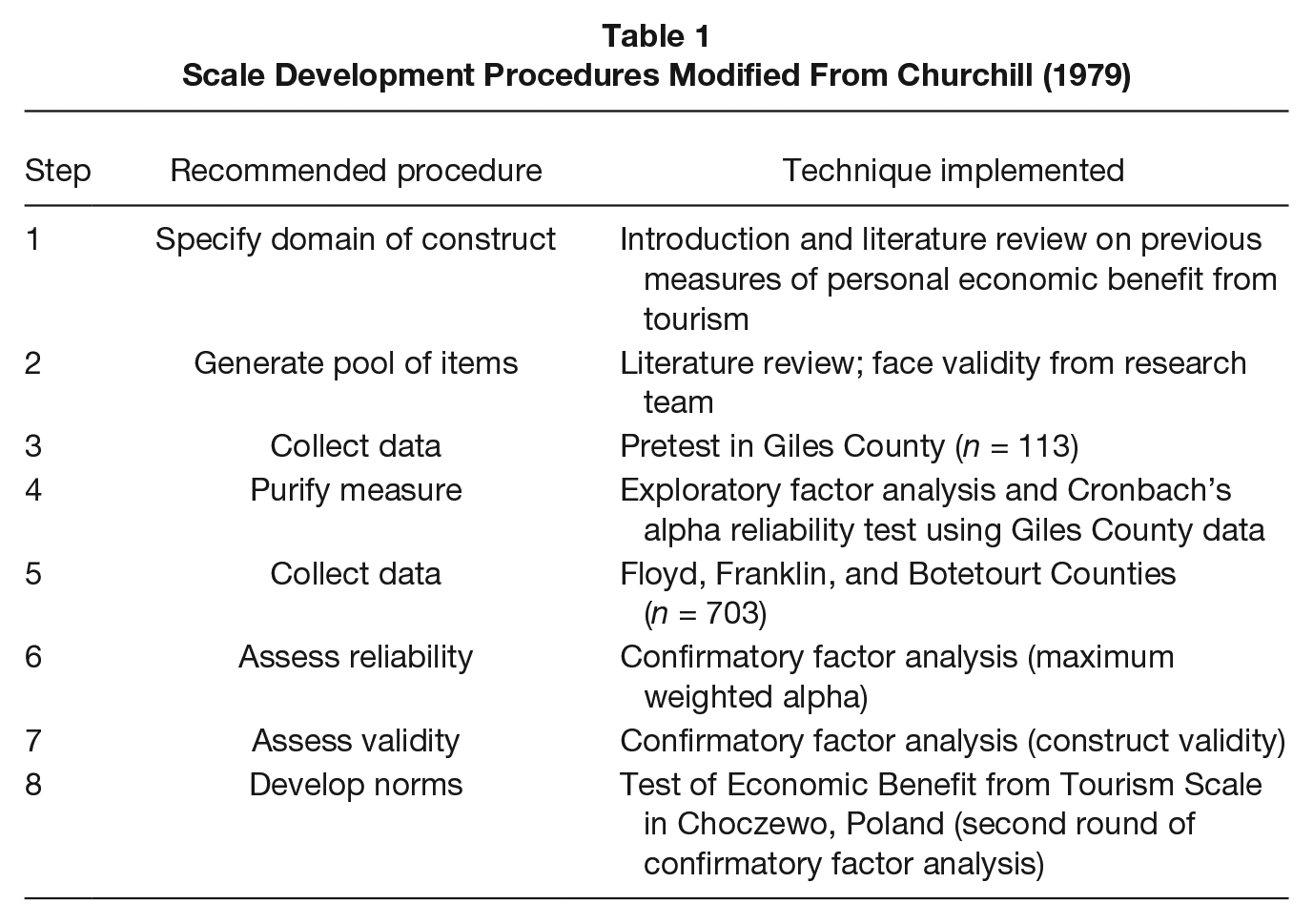
To develop the EBTS, Churchill’s (1979) eight steps for developing reliable and valid scales were closely followed and combined with Rossiter’s (2002) strong emphasis on establishing content validity. This combination provides for a more stringent development of the EBTS because both psychometrics and content validity are emphasized. According to Rossiter, no other validity matters if the items do not appear to be grounded in rationalism. Churchill’s (1979) recommendations for scale development are considered the gold standard for scale development within the marketing and tourism literature and have been recently used by Boley and McGehee (2014) and Marzo-Navarro, Pedraja-Iglesias, and Vinzón (2016) for the development of their scales. Each of Churchill’s (1979) recommended steps for scale development, as well as how each step was implemented for this study, is included in Table 1.
Scale Development Procedures Modified From Churchill (1979)
Steps 1 and 2: Specifying the Domain and Item Generation
Churchill’s (1979) first recommendation is to “specify the domain of the construct” (p. 67). This step essentially calls researchers to perform an extensive review of the literature in order to delineate what is exactly to be measured. This type of rigorous review of the literature was performed within the introduction. It is important to note that the proposed EBTS deliberately strays away from previous research that has examined the topic using a generic approach to “personal benefits” (e.g., Perdue et al., 1990) or employment as a proxy for perceptions of economically benefiting (e.g., Ward & Berno, 2011). The proposed EBTS specifically applies these economic benefits at the personal rather than community level and calls them economic benefits rather than leaving it undefined and up to the resident’s interpretation. It is believed that this strict interpretation of personal economic benefits satisfies Churchill’s criteria of “specifying the domain” and enables the items generated to be grounded in this strict interpretation so that they are content-valid and reflect the construct they are intended to measure.
The second step in Churchill’s recommendations is to generate a pool of items to measure the construct. This step was undertaken by a team of academics conducting an extensive review of pertinent literature. The main emphasis of the team was to focus on adapting divergent extant measures of personal benefits and personal economic benefits into a set of content valid items reflecting personal economic benefits from tourism (e.g., Andereck, Valentine, Knopf, & Vogt, 2005; Ko & Stewart, 2002; McGehee & Andereck, 2004; Nunko & So, 2016; Perdue et al., 1990). Specific items were generated by the research team to focus on tourism helping residents pay bills, the economic future of the resident being tied to tourism, and the resident benefiting economically from increased tourism.
Steps 3 and 4: Pilot Survey and Purification of the EBTS
Before testing the scale’s construct validity through confirmatory factory analysis, Churchill’s (1979) third and fourth recommendations are to pilot test the generated items in order to purify them using exploratory factor analysis (EFA) and reliability analysis. In accordance with Churchill’s recommendations, a pilot test of the EBTS was conducted in Giles County, Virginia. Giles County was chosen as an appropriate site for the pilot test based on its similarity to the selected counties for the main data collection (Floyd, Botetourt, and Franklin Counties) with regard to tourism product, as well as being a rural county in close proximity to the Blue Ridge Highland Area. In February 2013, 129 questionnaires were distributed door-to-door to residents residing within Giles County. Of the 129 questionnaires distributed, 113 were returned and analyzed.
The 113 returned questionnaires from Giles County were entered into SPSS (v. 23) for analysis. EBTS items were analyzed using Kaiser–Meyer–Olkin measure of sampling adequacy (KMO) and Bartlett’s test of sphericity to assess the level and significance of correlations between items. The Bartlett test was significant at the .05 level, and the KMO coefficient was 0.88. These two tests indicated adequate correlations among the items to be scaled and that it was appropriate to proceed with EFA.
Principle components EFA using varimax rotation was then used to illuminate ways to purify the EBTS. Special attention was given to items that adversely affected the reliability and validity of the scale. Specifically, items were considered for deletion based on the (1) strength of their factor loading, (2) how the item affected dimensionality, (3) how the item’s deletion affected Cronbach’s alpha, and (4) whether the item seemed too redundant.
The EFA of the five items indicated unidmensionality with only a single Eigenvalue over the 1.0 threshold and 85% of the variance explained by the one factor. Factor loadings ranged from 0.90 to 0.97 and the Cronbach alpha reliability coefficient was .96. The item, “Tourism in ____ provides me with financial gain” was deleted because it shared many similarities with the other items and was deemed too repetitive. The revised 4-item scale had a Cronbach Alpha of .93 and explained 83% of the variance in the construct (Table 2).
Results From the Exploratory Factor Analysis of the Economic Benefit from Tourism Scale in Giles County, Virginia
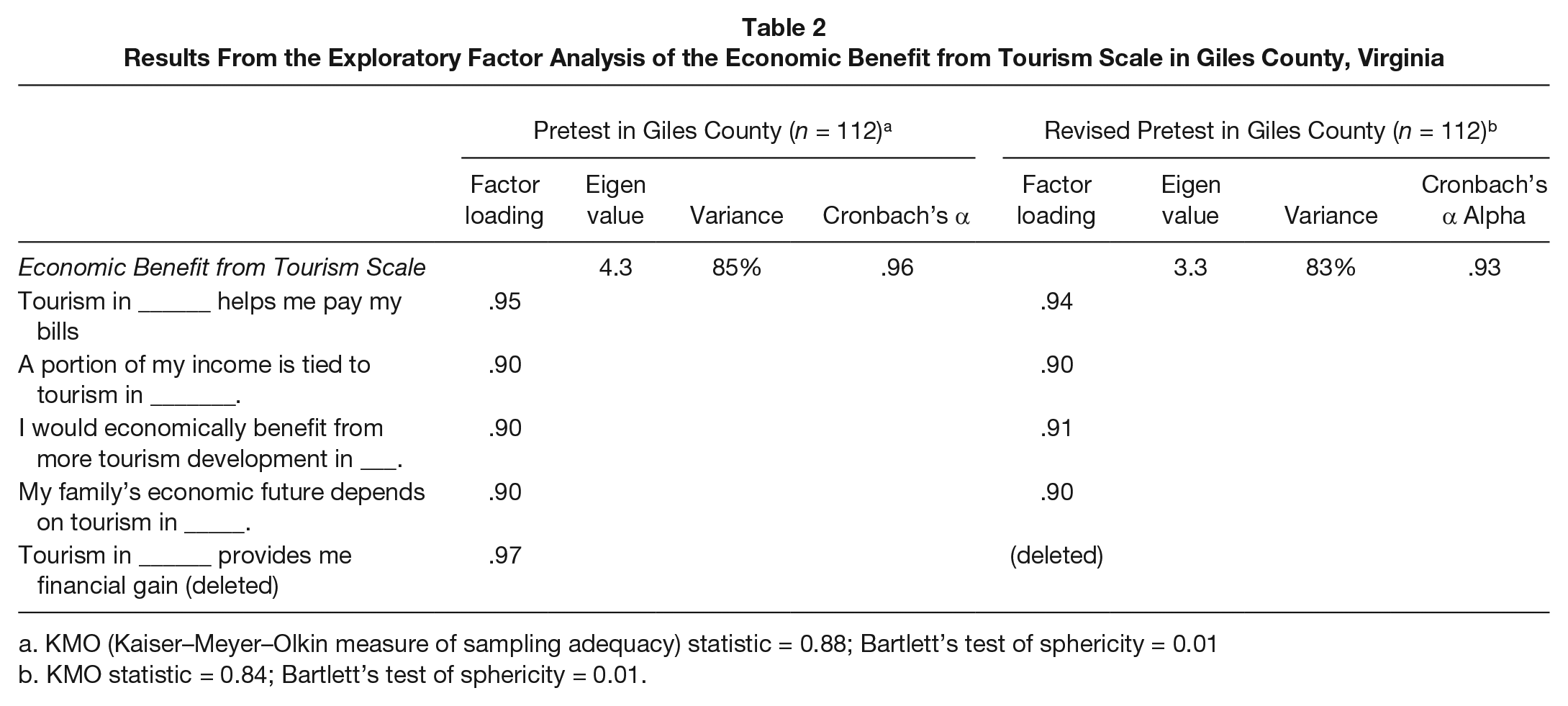
KMO (Kaiser–Meyer–Olkin measure of sampling adequacy) statistic = 0.88; Bartlett’s test of sphericity = 0.01
KMO statistic = 0.84; Bartlett’s test of sphericity = 0.01.
Primary Data Collection
After the scale’s initial purification from the pilot test, Churchill (1979) recommends a larger data collection to further test the scale’s reliability and validity through confirmatory factor analysis (CFA). In accordance with this recommendation, the remaining four items of the EBTS were administered to residents within Floyd, Botetourt, and Franklin Counties, Virginia. These three counties were chosen for data collection based on their similarities in tourism product (e.g., blend of nature-based and cultural heritage tourism), per capita tourism expenditures ($1400-$1600 per resident), and unemployment levels. The three counties also border the Blue Ridge Parkway, which is a 469-mile economically important scenic driving route that connects “the Great Smoky Mountains National Park in North Carolina to the Shenandoah National Park in Virginia” (Blue Ridge Parkway, 2017).
Data collection consisted of a self-administered, door-to-door, pen-and-paper questionnaire using census-guided systematic random sampling. This type of sampling scheme was chosen based on its ability to garner a representative sample of community residents, increase response rates, and include minority groups that may be left out from other sampling methods (Woosnam & Norman, 2010). The census-guided systematic sampling procedure began by identifying the various census tracts and block groups within Floyd, Botetourt, and Franklin Counties. Second, the number of households within the census tracts and block groups were divided by the county’s overall number of households to calculate what percentage of the county’s total households were located in each jurisdiction. This allowed for calculating how many questionnaires were needed within each census tract and block group to accurately represent the county’s household population distribution. Following these calculations, every third household on the right side of the road was chosen to be surveyed until the block group was fully represented. Questionnaires were distributed to residents in the spring of 2013. Residents were randomly selected within the sampled households based on the individual with the most recent birthday. If individuals agreed to participate, a packet including an information sheet about the project and the survey instrument was left with them to complete.
Throughout the 6-week period of data collection, 1784 households were visited, with 1021 individuals answering the door. Out of the 1021 individuals intercepted, 37 were not permanent residents and/or heads of the household. At the remaining 984 households, 900 residents were willing to participate, with 84 declining. Of the 900 survey questionnaires distributed, 777 were returned. After cleaning for missing data, the number of usable questionnaires was reduced to 703. This resulted in 71% of the 984 intercepted residents participating in the study.
Validation of the EBTS
With the development of the EBTS presented in the previous section, the attention now shifts to Churchill’s (1979) sixth and seventh steps focused on assessing reliability and validity. CFA was chosen for these steps because such an analysis provides a rigorous test of how well the measure’s items represent the latent construct (Hair, Black, Babin, & Anderson, 2010). It goes beyond EFA’s examination of the underlying structure and dimensionalities within the scale by providing a stringent test of model fit and construct validity.
The statistical modeling program, EQS (v. 6.2), was used to develop the measurement model adding (using Lagrange Multiplier, or LM, tests) each error term (i.e., cross-loading items or error covariances) and then assessing whether such terms can be safely removed (using Wald tests) without compromising the Δχ2/df critical value of 3.84 that Tabachnick and Fidell (2013) suggests. Such an approach has been put forth by Byrne (2013) and first utilized in the tourism literature by Woosnam and Norman (2010).
Following two LM tests, six error terms (all covariances) were identified. Each was safely dropped from the measurement model after four Wald tests were undertaken, yielding a Satorra-Bentler χ2(2, N = 703) = 15.69, p < .001, with a comparative fit index (CFI) = 0.99 and root mean square error of approximation (RMSEA) = 0.10. A CFI in excess of 0.95 is considered to reflect good fit, while an RMSEA between 0.08 and 0.10 indicates mediocre fit (Hair et al., 2010). While the RMSEA was slightly elevated (0.10), Kenny, Kaniskan, and McCoach (2015) recommend disregarding RMSEA for models with small degrees of freedom. Considering internal consistency of the EBTS, the maximal weighted alpha (as provided by EQS) was high with a value of .90. This reliability measure was requested given that alphas were weighted by factor loadings. Each standardized factor loadings for the observed items exceeded a critical value of 0.70, which according to Fornell and Larcker (1981) is considered “ideal.”
Numerous forms of construct validity—such as convergent, discriminant, and nomological—can be assessed with CFA to determine if the measure is truly measuring what it is intended to measure. For the purposes of this article, the main emphasis was placed on examining convergent and nomological validity since only one proposed dimension of the EBTS existed and discriminant validity pertains to each dimension within a scale being unique from the others. Convergent validity was assessed in two distinct ways. First, in examining Table 3, all t-test values associated with each loading on the single factor were significant (p < .001) as they exceeded the critical value of 3.29 (per Tabachnick & Fidell, 2013). Second, the average variance extracted (AVE) was calculated and found to surpass the 0.50 threshold per Hair et al. (2010) recommendations. This indicates that at least 50% of the variance is captured by the single factor. Taken together, these estimates demonstrate convergent validity for the EBTS. While Churchill (1979) maintains that convergent and discriminant validity are “two sides of the proverbial coin,” assessing the former in this context is a moot point given that EBTS is unidimensional in its structure and no intercorrelations beyond a single dimension exist.
Results From the CFA of the Economic Benefit from Tourism Scale Using the Virginia Sample
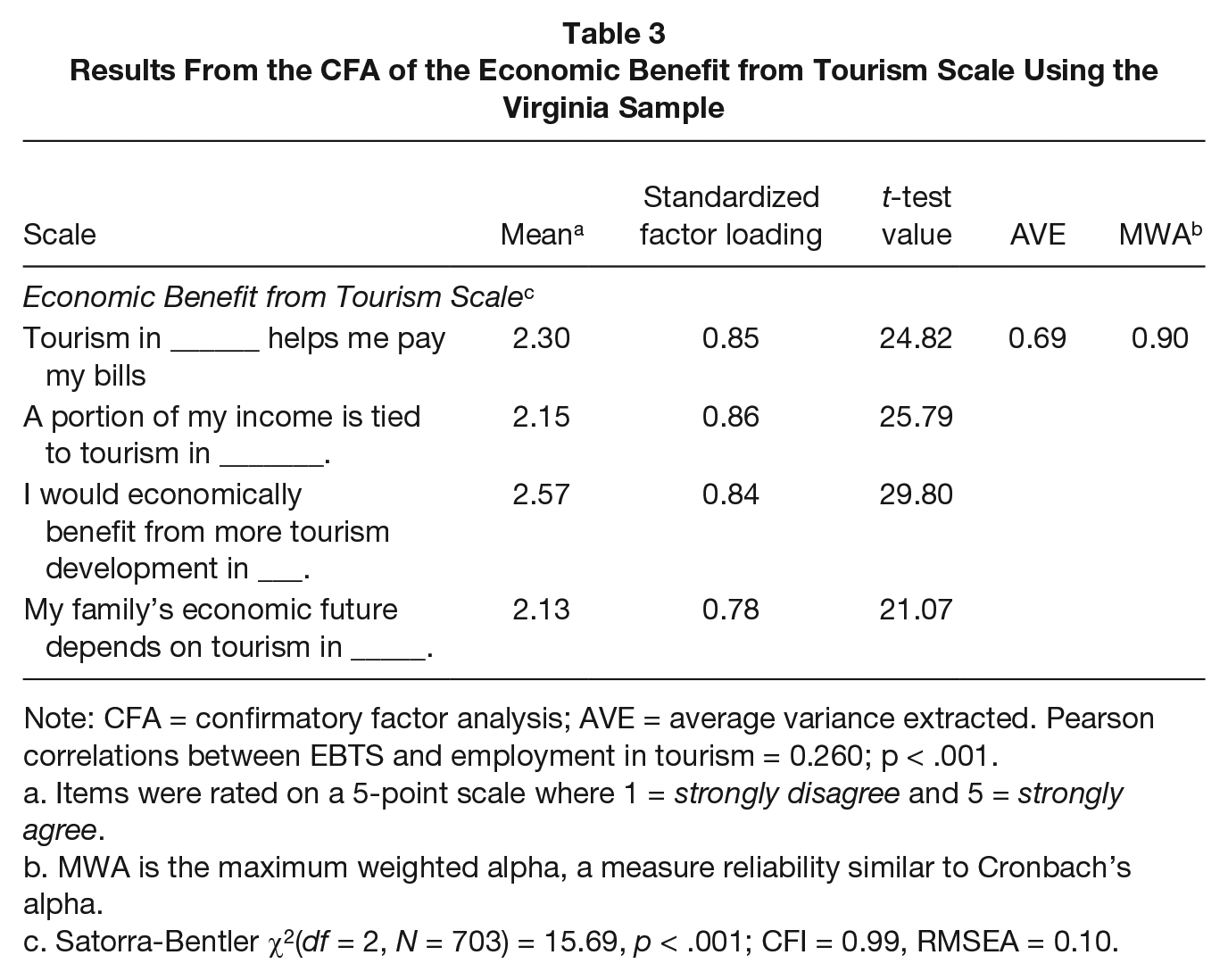
Note: CFA = confirmatory factor analysis; AVE = average variance extracted. Pearson correlations between EBTS and employment in tourism = 0.260; p < .001.
Items were rated on a 5-point scale where 1 = strongly disagree and 5 = strongly agree.
MWA is the maximum weighted alpha, a measure reliability similar to Cronbach’s alpha.
Satorra-Bentler χ2(df = 2, N = 703) = 15.69, p < .001; CFI = 0.99, RMSEA = 0.10.
Nomological validity tests whether or not the construct correlates to other constructs that should be theoretically related (Hair et al., 2010). With this in mind, nomological validity was assessed by looking at the correlation between the EBTS and employment in tourism. 1 A significant, but weak, correlation was found between the EBTS and employment in tourism (r = .26; p < .001), providing evidence of nomological validity. It should be noted that while discriminant validity was not formally assessed, the weak correlation between the EBTS and employment in tourism suggests that while the constructs are related, they are in fact measuring different facets of economically benefiting from tourism. This is precisely why resident attitude researchers need to include a measure of perceptions of economic benefits from tourism within their data collections; employment in tourism is not synonymous with economically benefiting from tourism.
Validating the EBTS in Choczewo, Poland
Churchill’s (1979) eighth and final step is to develop norms for the validated scale. While Churchill’s recommendation is more aimed at developing explicit standards of performance, the development of norms can also be applied to testing the scale internationally. Ensuring that the scale is internationally valid is, in essence, a step toward developing norms because the research is testing the psychometric properties of the scale to make sure that people respond to items within the scale in the same way regardless of situational factors. In an attempt to move toward developing the EBTS as a normative measure of residents’ perceptions of economically benefiting from tourism, the EBTS was included in a data collection of resident attitudes toward tourism in Choczewo, Poland. A back-translation procedure was also adopted based on recommendations made by Malhotra et al. (1996). The bilingual Polish researcher translated the questionnaire directly from English to Polish. A bilingual professional translator then translated that version back into English. The multinational research team also checked for translator errors and made any necessary corrections before administering the translated questionnaire.
Cross-cultural research is important for its ability to depict cultural differences that could influence the measurement of different constructs (Boley et al., 2015). The mainstream marketing literature has discussed in detail the many different methodological issues associated with conducting this type of international research (e.g., Choudhry, 1986; Malhotra et al., 1996). To ensure that the EBTS is cross-culturally valid and can be labeled as “construct equivalent,” functional and conceptual equivalence were ensured through having two native Polish academics lead the back translation and data collection process. The researchers and a professional translator rigorously looked over the items of the EBTS to ensure that they were functionally and conceptually equivalent within a Polish context.
Data Collection in Choczewo, Poland
Data collection for this stage was undertaken in the rural municipality of Choczewo, Poland. Choczewo was chosen as a novel destination to examine the international validity of the EBTS given its communist past and current postcollective, farm-based economy, which has recently turned to tourism as a means to revitalize its economy (Strzelecka, Boley, & Woosnam, 2017). Choczewo, like so many other rural municipalities in Poland, is drawn to tourism because of its promised revitalization as well as tourism being what Hegarty and Przezborska (2005) call an attractive “natural development path” that meshes well with the process of agricultural restructuring associated with the EU’s Common Agricultural Policy (Strzelecka, Boley, & Strzelecka, 2017). Hence, it is of interest to gauge Choczewo residents’ perceptions of whether or not tourism development is providing the anticipated economic benefits often associated with rural tourism development. Choczewo also provides an additional setting with a different culture and economic history to test the international validity of the EBTS.
Choczewo is located in the Kaszuby Seacoast region in the northern part of the Pomeranian Province. It attracts a number of domestic as well as some international tourists. Local tourist attributes include direct access to the Baltic Sea, a 17-km-long coastline with popular beaches, such as Lubiatowo, Sasino-Stilo, and Słajszewo, and a clean rural environment, which became the basis for establishing agrotourism farm holdings. The data collection method within the municipality consisted of a self-administered, door-to-door, pen-and-paper questionnaire coordinated by one of the authors of this study.
The translated EBTS was administered in 17 of the 29 rural towns and villages within the municipality boundaries of Choczewo during the summer of 2015. According to Poland’s statistical office, Choczewo’s population in 2015 was composed of 5,630 residents, 1,197 of whom were younger than 18 years. Surveys were distributed in accordance with the number of residents in each of the locations provided by Municipal Office-Choczewo with the goal to use a census-guided systematic random sampling scheme following previous work conducted by Boley and McGehee (2014) and Woosnam and Norman (2010).
Starting in randomly selected locations within each area, every household was visited by the research team. If no one answered the door, the researcher visited the next immediate house. The head of the household or their spouse was asked to participate in the survey, and if the resident agreed, a questionnaire was left with the participant and picked up later that day or the following day by the research team.
The investigator experienced some difficulties accessing residents from a few of the villages in Choczewo. Therefore, the actual percentage of questionnaires distributed in each of the rural locations differed from the original plan laid out in the census-guided systematic random sampling scheme. Data collection occurred throughout a 3-week period (on weekends and weekdays), beginning the last week of July 2015 and concluded on the second week of August 2015. Of the 400 distributed surveys, 301 were usable and were included in the analysis.
CFA of the EBTS
With the goal of assessing the scalar/metric equivalence of the EBTS, an identical CFA to that which was undertaken with the Virginia samples was conducted. Data from the Poland sample were subjected to a two-step procedure to identify and address any error terms that may result in the process (Table 3). The same six error covariances were identified following two LM tests. Each was removed after running five Wald tests in such a way as not to exceed the Δχ2/df critical value of 3.84 per Tabachnick and Fidell (2013). The final CFA model resulted in a Satorra-Bentler χ2(2, N = 301) = 5.10, p = .08, with a CFI = 0.99 and RMSEA = 0.07 (Table 4). Such results indicate good fit of the data (Hair et al., 2010).
Results From the CFA of the Economic Benefit from Tourism Scale (EBTS) Using the Poland Sample

Notes: CFA = confirmatory factor analysis; AVE = average variance extracted. Pearson correlations between EBTS and employment in tourism = 0.25; p < .001.
Item were rated on a 5-point scale where 1 = strongly disagree and 5 = strongly agree.
MWA = maximum weighted alpha, a measure reliability similar to Cronbach’s alpha.
Satorra-Bentler χ2(df = 2, N = 301) = 5.10, p = .08; CFI = 0.99, RMSEA = 0.07.
In further examining the psychometric properties of the EBTS in an international context, an MWA of 0.85 revealed that the scale continued to demonstrate high internal consistency. Standardized factor loadings were all above the 0.50 threshold considered adequate by Comrey and Lee (1992) and Hair et al. (2010), but they were noticeably lower than in the Virginia samples (Table 4). As with the Virginia samples, t-test values corresponding to each standardized factor loading were significant (p < .001), and the average variance extracted was once more in excess of 0.50. With regard to nomological validity, the EBTS was significantly correlated with employment as expected (r = .25; p < .001). Such measures continue to demonstrate construct validity for the EBTS in an international context.
Discussion and Conclusions
The importance of resident perceptions of economically benefiting from tourism has long been at the center of the resident attitude literature (Madrigal, 1993). Despite the widespread agreement that accounting for resident perceptions of economically benefiting from tourism is important to understanding their support for tourism, tourism researchers and destination managers have taken a somewhat haphazard and nonchalant stance toward the measurement of these perceptions. This is evidenced by the four disparate approaches to the measurement of the construct that include using (1) underdeveloped scales that use only one or two items to measure the latent construct (Madrigal, 1993; Vargas-Sánchez, do Valle, da Costa Mendes, & Silva, 2015), (2) employment as a proxy for residents’ perceptions of economically benefiting (Ward & Berno, 2011), (3) measures of the personal benefits of tourism with the assumption that these personal benefits are interpreted by residents to be economic benefits (Ko & Stewart, 2002; McGehee & Andereck, 2004), and (4) a TBL perspective that focuses on resident perceptions of tourism’s economic impacts within the community (Upchurch & Teivane, 2000). In an attempt to unify the literature, this study specifically used Churchill’s (1979) suggestions to develop and validate the EBTS.
Managerial and Theoretical Implications
With the reliability and validity of the EBTS confirmed, many practical and theoretical implications exist for practitioners and researchers interested in destination management. For destination managers, the EBTS can be used to gauge their residents’ perceptions of whether or not they economically benefit from tourism. With the economic promises of tourism being one of the biggest selling points used by governments to convince residents why they should support the industry, it is important to see if the promised economic benefits are materializing into positive perceptions of economically benefiting. In addition to the EBTS’ ability to take a pulse of a community with regard to the economic benefits of tourism, applications of the EBTS could provide destination managers with important information on the satisfaction of residents with their current employment in the tourism industry. Tourism has been historically criticized for bringing low wages, long hours, and seasonal employment with limited potential for upward mobility (Faulkenberry et al., 2000; Lacher & Oh, 2012). If the findings from applying the EBTS reveal that tourism’s economic benefits are perceived as marginal by residents and those within the industry, destination managers would need to either seek out ways to better economically empower their residents or may want to switch the community’s attention away from tourism and toward other sectors of the economy that appear to be more promising, such as manufacturing or technology. Baum (1998) refers to this as “taking the exit route” because the destination has made the conscious decision to abandon any public support for marketing the destination. A less controversial path could be to embrace demarketing certain aspects of the destination and marketing others to appeal to a new type of clientele who will help provide the economic benefits sought by residents and those within the industry (Beeton & Benfield, 2002).
From a theoretical perspective, a cross-culturally validated scale to measure resident perceptions of economically benefiting from tourism has many positive implications for tourism researchers. The first implication pertains to the ability to perform large meta-analyses (Deci et al., 1999). With the previous literature approaching the measurement of the construct in disparate directions, the literature has been handicapped from performing meta-analyses of the relationship between residents’ perceptions of economically benefiting in tourism and their support for the industry. By having one unified measure, researchers can look at the effect size of these structural relationships across different types of tourism destinations that vary by size, product, climate, and activities (e.g., nature based vs. cultural heritage based).
The second implication pertains to the plethora of resident attitude studies that have developed from Perdue et al.’s (1990) seminal work and SET (Ap, 1992). The EBTS provides academics with a direct measure of residents’ perceptions of economically benefiting from tourism. By having a clear measure of resident perceptions of economically benefiting, it opens the door for researchers to look at and compare the influence of noneconomic constructs such as empowerment, trust, and solidarity with resident perceptions of economically benefiting. To date, the comparison of economic versus noneconomic influences on resident attitudes toward tourism has been muddled with the four disparate directions taken to measure resident perceptions of economically benefiting from tourism. The EBTS allows researchers to effectively partition the economic exchange portion of the host-guest interaction away from the noneconomic components (Bimonte & Punzo, 2016). This provides researchers with the opportunity to add an extra layer of theoretical depth by combining SET with theories such as Weber’s theory of formal and substantive rationality that allow for looking at the wide range of economic and noneconomic factors that influence residents’ attitudes toward tourism.
Limitations and Areas for Future Research
As with all studies, potential limitations exist with the development of the EBTS. The first is the lack of testing the EBTS for discriminant validity. To test for discriminant validity, the EBTS would need to be used in conjunction with other relevant constructs (e.g., positive impacts of tourism, support for tourism, emotional solidarity, empowerment, place attachment, trust, etc.) to see if the scale is unique from other similar resident attitude constructs. It is recommended that researchers use the EBTS in future data collection efforts to see if the scale demonstrates discriminant validity and is able to predict important dependent variables such as support for tourism as theory suggests it should.
An additional limitation pertains to the sampling in Choczewo, Poland. While the data collection effort was designed after other census-guided systematic sampling methodologies (Boley & McGehee, 2014; Woosnam, 2012), the researchers were not able to complete the survey quotas in certain districts. This does not affect the test of the EBTS’ cross-cultural validity because the main requirement is to administer the scale to people of a different culture to see if the psychometric properties of the scale remain strong. Future research should continue to test the EBTS’ reliability and validity in other international settings.
Although Poland and the United States have distinct political histories, both are currently considered “Western” nations. It is suggested the EBTS be applied in emerging economies across the world to see if the psychometric properties of the scale are consistent across different regions and political structures. Weber’s theory of formal and substantive rationality suggests that cultures approach economic transactions such as tourism with a range of economic and noneconomic motivations. More rigorous tests of the EBTS’s reliability and validity across continents such as Africa and Asia will help solidify the measure and allow for the types of meta-analyses common in more mature bodies of research.
Additionally, future research needs to be conducted focusing on the demographic characteristics that influence perceptions of economically benefiting from tourism. Age, gender, and length of residency within the destination will likely influence how residents perceive the economic benefits of tourism or lack thereof. Another factor to consider is the season during which data collection took place. The U.S. sample was collected during a shoulder season (late winter-spring), while the Poland sample was taken during their peak season (summer). While both samples of this study perceived the economic benefits of tourism as relatively low with a mean score of 2.3 in the American sample and a mean score of 2.5 in the Polish sample (on a 5-point Likert-type scale), the seasonal nature of tourism expenditures could influence how residents respond to questions about the economic benefits of tourism. Researchers should consider applying the EBTS across different seasons to see if there is a significant difference in how residents perceive the economic benefits of tourism by season.
In conclusion, the EBTS is presented as a cross-culturally validated scale capable of unifying the resident attitude literature around the disjointed and disparate measurement of one of its most theoretically and empirically important constructs, resident perceptions of economically benefiting from tourism. Until the resident attitude literature is able to unite behind common measurement scales for its most important constructs (e.g., support for tourism, positive and negative impacts of tourism, personal economic benefits from tourism, etc.), results will remain largely disjointed and researchers will be hindered from uncovering patterns in how residents respond to tourism development across different scales, cultures, and product offerings. This is just one attempt to unify the literature around one important construct. It is suggested that researchers begin to think about other important constructs that have been measured in a myriad of ways, so that reliable and valid scales can be developed to propel the maturing process of the resident attitude literature.