



Abstract
High levels of trust, reciprocity, and togetherness embedded within entrepreneurial networks are believed to facilitate cooperation that enables success among individual business owners. This study examines the effects of social influence, network characteristics, and entrepreneurial motivations on trust, reciprocity, and togetherness in a network of wildlife tourism microentrepreneurs. Thirty-seven wildlife tourism microentrepreneurs from North Carolina’s Pamlico Sound Region were recruited for in-person structured interviews. Data were analyzed using social network analysis, specifically a series of linear network autocorrelation models in conjunction with supportive qualitative assessment. Microentrepreneurs expressing a high level of trust were connected with microentrepreneurs expressing a low level of trust in their peers. Conversely, microentrepreneurs with strong feelings of reciprocity were connected with microentrepreneurs having similar feelings. These findings illustrate that the presence of equally reciprocal relationships is not an indication of equally trusting relationships. The findings also suggest that higher numbers of business ties tend to diminish the levels of trust, reciprocity, and togetherness toward connected peers.
Keywords
Introduction
Growth in the tourism industry has allowed development of different tourism niche markets. One of these significant niche markets is nature-based tourism, such as wildlife tourism. “Wildlife tourism primarily consists of tourists’ consumptive (e.g., fishing and hunting) and non-consumptive (e.g., wildlife watching) interactions with non-domesticated animals in natural environments” (KC, Morais, Seekamp, Smith, & Peterson, 2018). In the context of the United States, the U.S. Fish and Wildlife Service (2011) estimated that there were 90.1 million people (16 years old and older) enjoying wildlife-related activities, representing an annual expenditure of approximately $145 billion. There is a lack of quantitative data on wildlife tourism at the global level; however, wildlife tourism is a significant component of the global tourism industry (Liu, Zhang, & Tang, 2004). With wildlife tourism being an important economic component of the tourism industry, the livelihoods of local individuals are directly dependent on their abilities to attract tourists to see, photograph, and/or catch wildlife species in many tourism-dependent economies throughout the world (Pienaar, Jarvis, & Larson, 2013). Entrepreneurial engagement in wildlife tourism businesses has become a potential strategy to support rural livelihoods (Zander, Austin, & Garnett, 2014); however, success in the entrepreneurial environment is dependent on multiple factors, including an ability to create social networks with similar businesses. Often, tourism businesses participate in network relationships (Ying & Norman, 2017) that enable the utilization of resources embedded in those relationships (KC, Morais, Peterson, Seekamp, & Smith, 2017). For a wildlife tourism business owner, the ability to locate wildlife resources significantly enhances the business outcome by ensuring the provision of enriching tourism experiences to their clients and this also plays a major role in increasing customer return rate (KC, 2015). As the scope of wildlife tourism continues to grow, its development and impact on rural livelihoods demands context-based empirical research to understand entrepreneurial engagement, networking behavior, and the factors affecting outcomes from wildlife tourism entrepreneurial networks.
Tourism entrepreneurship is considered a lifestyle entrepreneurship with noneconomic motives being significant stimuli (Ateljevic & Doorne, 2000). The entrepreneurial process in wildlife tourism is relatively unknown and unexplored despite its huge potential to support rural livelihoods (KC et al., 2018). Existing literature on wildlife tourism features the importance of wildlife tourism on a global scale (Liu et al., 2004), focuses on examining the relationship between wildlife tourism experiences and conservation issues (Ballantyne, Packer, & Hughes, 2009), and emphasizes the importance of wildlife tourism and community engagement in wildlife tourism microentrepreneurship in enhancing proconservation behaviors (Morais, Bunn, Hoogendoorn, & KC, 2018; Morais, KC, Mao, & Mosimane, 2015; Udaya Sekhar, 2003). Zander et al. (2014) explored the indigenous communities’ interests in wildlife-based enterprises and found them to be a viable employment option generating a strong interest among the communities. Existing studies are still limited to understanding the scope of wildlife tourism and perceived interests among communities to pursue such an entrepreneurial venture. KC et al. (2017) explored the entrepreneurial process in wildlife tourism and the necessity to network among peer businesses and found that factors such as trust and reciprocity are important components of network relationships. Wildlife tourism has been explored from a few different perspectives, mostly focusing on its growing potential in the tourism industry and its relationships to rural livelihoods or conservation issues, but empirical studies on the functionality of wildlife tourism microentrepreneurship are not plentiful; therefore, a significant gap remains in wildlife tourism microentrepreneurship and its body of knowledge.
The activities of wildlife tourism microentrepreneurs, like the behaviors of all other entrepreneurs, are dependent on the sociocultural environment in which they operate (Casson & Giusta, 2007; Yetim, 2008). Entrepreneurial networks are integral to the exchange of the ideas, information, and resources necessary for business growth and success (KC et al., 2017). Well-connected individuals can easily mobilize resources to pursue their desired outcomes (Burt, 2000; Neergaard, Shaw, & Carter, 2005; Zhao, Ritchie, & Echtner, 2011). It is believed that well-connected individuals are more likely to achieve entrepreneurial success; however, Leenders (2002) suggested that the behavior of an individual entrepreneur is affected by how other members behave in a network (i.e., effect of social influence). Moreover, individual traits are likely to affect the entrepreneurial process as well. For example, Smith, Anderson, and Moore (2012) stated that a decision to place trust on other network ties is contingent on individual entrepreneurs’ motivations and needs.
In general, entrepreneurs are considered to be driven by common motivational factors such as passion, independence, income, and role modeling (Alstete, 2008; Carter, Gartner, Shaver, & Gatewood, 2003; Hessels, van Gelderen, & Thurik, 2008; Krishnan & Kamalanabhan, 2013; Shane, Locke, & Collins, 2003). Passion is described as a selfish love of work (Shane et al., 2003) that refers to investing oneself in a business due to personal interests and a desire to have fun. Likewise, independence is widely recognized as a primary entrepreneurial motivation; for example, having freedom to be able to schedule work at one’s convenience and flexibility for personal and family life can be widely noted in entrepreneurship motivation literature (Alstete, 2008; Carter et al., 2003; Hessels et al., 2008). Money may not be a strong reason for an individual to participate in the entrepreneurial process, but it is frequently cited as a reason for becoming self-employed (Alstete, 2008). Role modeling is described as an individual’s desire to follow a family tradition or emulate someone as an example (Carter et al., 2003). Often, individual decisions to engage in certain behaviors are influenced by the behavior of others, where an entrepreneur identifies a role model as a reference from whom they can obtain certain career goals (Bosma, Hessels, Schutjens, Praag, & Verheul, 2012). People differ in their willingness and ability to pursue an entrepreneurial career and these factors influence the entrepreneurial process (Shane et al., 2003). Differences in entrepreneurial motivations can have a significant effect on the network structure and its functions, because entrepreneurs are likely to have differences in priorities for each of the entrepreneurial motivations.
The purpose of this study is to understand the roles of social influence, network characteristics (i.e., number of business ties and length of business establishment), and entrepreneurial motivations on how wildlife tourism microentrepreneurs perceive and evaluate their peers within the same network. In this study, a wildlife tourism microentrepreneur is defined as an entrepreneur who runs a standalone business entity related to recreational fishing, hunting, or wildlife viewing, and employs fewer than five full-time employees (KC et al., 2017). Tourism entrepreneurs tend to possess both economic and noneconomic motivations for starting a business (Ateljevic & Doorne, 2000), and this makes it challenging to measure entrepreneurial success. In an effort to overcome this challenge, we also collected data on entrepreneurial satisfaction, considered as a self-reported indicator of entrepreneurial success. This allowed us to examine entrepreneurial success’ association with social capital embedded within a network. We used the construct of “cognitive social capital” to describe wildlife tourism microentrepreneurs’ perceptions of their relationships with their peers. Cognitive social capital captures the perceptions of support, reciprocity, and trust among connected individuals (Jones, 2005). When trust is high and individuals reciprocate and share, they are more likely to engage in mutually beneficial collective actions and individual behaviors that lead to achieving business success (Krishna & Shrader, 2000). The existence of a network of small business owners does not automatically result in positive affective ties among network owners (Grootaert & van Bastelaer, 2001). If individual microentrepreneurs believe they are competing for the same consumer market, trust development and resource sharing may still be lacking, in spite of the presence of network ties. Nordin and Westlund (2009) suggested that social capital is expected to develop over time. There is a lack of empirical research examining these details in entrepreneurial networks. This study offers strong theoretical and practical implications with a significant contribution to the underresearched area of wildlife tourism microentrepreneurship.
Social Capital and Theory of Social Influence
Social capital theory has gained wide acceptance as a successful theoretical perspective to understand and predict social phenomena (Narayan & Cassidy, 2001); however, its application in tourism is considered recent (McGehee, Lee, O’Bannon, & Perdue, 2010). Coleman (1990) explained that social capital exists in the structure of relations between and among people. The author elaborated on characteristics of social capital as (a) consisting of some aspect of social structure and (b) facilitating certain actions of individuals who are part of the structure. Furthermore, social capital is also defined as the collective linkages inside social networks and the value of all the tangible and intangible resources embedded in those networks (Greve & Salaff, 2003; Neergaard et al., 2005).
Social networks are considered as structural social capital, whereas trust and reciprocity are categorized as cognitive social capital (Jones, 2005). Structural social capital refers to the overall connections within the network, or network ties, which are the source for social interaction and information exchange. Cognitive social capital encapsulates the perceptions of support, trust, reciprocity, and sharing embedded within the network (Jones, 2005). Although social networks provide a platform to access information and resources, cognitive social capital enhances the optimum use of those connections by facilitating cooperation among network ties in favor of entrepreneurial success (Chen, Chang, & Lee, 2015; Jones, 2005). Trust is defined as a mutual confidence in one another’s moral integrity or goodwill (Ring & Van de Ven, 1994; Ulhøi, 2005). Opportunity identification is a first and significant step in entrepreneurship, but trust could become a major issue after opportunity identification (Casson & Giusta, 2007). Trust controls the flow of information and resources among entrepreneurs (Zhao et al., 2011). Yetim (2008) argued that entrepreneurs tend to rely on trusted relations in shaping their network ties. Reciprocity is characterized by short-term altruism and long-term self-interest (Putnam, 2000). People usually intend to help others when they feel assured that their own altruistic actions will be rewarded at some point in the future (Stathopoulou, Psaltopoulos, & Skuras, 2004). Last, togetherness indicates rapport and how well entrepreneurs get along with each other within a given setting (Narayan & Cassidy, 2001).
Cleaver (2005) suggested that people with vulnerable livelihoods (i.e., unsuccessful entrepreneurs) have fewer expectations of cooperation and reciprocity. Their network ties are generally fragile and dependent on heavy investments of time and effort, yet result in limited benefits. Successful entrepreneurs tend to have more resources to exchange with their ties, while aspiring, but less successful, entrepreneurs tend to lack the resources needed to enable them to earn trust, reciprocity, and togetherness from their peers. Therefore, limitations exist when it comes to using social capital for the enhancement of entrepreneurial success (Cleaver, 2005). Baird and Gray (2014) suggested that reciprocity is an important component of household security and social well-being in rural areas. Rockenbauch and Sakdapolrak (2017) emphasized that reciprocity between rural households is a way of pooling scarce resources and a means of household risk management. Social networks and cognitive social capital factors are less prominent theoretical concepts in tourism entrepreneurship literature, and empirical research exploring such theoretical concepts is still lacking. Moreover, tourism entrepreneurship is viewed as a passion-based affiliation (Ateljevic & Doorne, 2000) rather than a viable strategy for providing a livelihood. Entrepreneurial engagement in wildlife tourism as a means of livelihood sustenance is still a distant concept; however, the growing popularity of wildlife tourism is allowing for a gradual break in this paradigm. Rural tourism entrepreneurship, specifically wildlife tourism microentrepreneurship, possesses significant potential to support rural livelihoods. It is important to understand the networks, state of cognitive social capital, and various factors that influence the state of cognitive social capital in the field of rural tourism entrepreneurship.
The theory of social influence explains that an actor adapts one’s behavior, attitude, or beliefs based on the behaviors, attitudes, or beliefs of other actors in the network (Leenders, 2002). This effect of social influence occurs through communication when an actor adapts one’s behavior based on direct communication with peers (Leenders, 2002). In the context of entrepreneurship, where an individual relies on other actors in the network for resources, every individual’s behavior tends to be unique based on how their connected peers reciprocate. Thus, the levels of trust, reciprocity, and togetherness held among individuals are not independent, but rather, they are influenced by the levels of trust, reciprocity, and togetherness exhibited by other actors in the network connection. This study examined social influence among wildlife tourism microentrepreneurs for trust, reciprocity, and togetherness that occurs within a network structure.
Method
Data Collection
This study was carried out in North Carolina’s Pamlico Sound region. The Pamlico Sound is the largest lagoon along the east coast of the United States and it contains abundant wildlife and natural resources. The region also provides an excellent platform for local communities to participate in small-scale wildlife tourism businesses creating plenty of wildlife tourism opportunities for travelers. Wildlife-related recreational activities take place in the Pamlico Sound and surrounding river systems. Both consumptive and nonconsumptive forms of wildlife tourism services are offered throughout the year. The shallow water level of the Sound allows opportunities for guided fishing trips that are suitable for small-sized boats. The Pamlico Sound and the surrounding regions allow guided hunting trips for waterfowl, bear, and deer, along with guided tours for dolphin watching, bird watching, and wildlife photography.
Information regarding community involvement in different types of tourism businesses was not easily available. These wildlife tourism businesses operate at different levels of visibility with some businesses using online platforms for marketing and advertising, while others use word of mouth advertisement. Therefore, the recruitment process of the study participants was rigorous, and this is discussed later. Study participants were recruited based on their business affiliation to the Pamlico Sound region, as it allows for collaboration opportunities for wildlife tourism businesses due to their overlapping interests. Participants did not belong to the same community, but they were from multiple communities and counties.
Multiple field trips were conducted from May through August 2014 as a preliminary assessment of the project. During this assessment process, investigators used online searches and informal meetings with cooperative extension agents and key informants, such as employees of the museum, wildlife refuges, and local bait and tackle shops, to create a participant list for the study. This preliminary assessment was necessary to understand the scope of wildlife tourism microentrepreneurship in the region because of the different levels of marketing and advertising visibility among businesses. Data were collected between November 2014 and February 2015 through in-person structured interviews based on the list of study participants created from the preliminary assessment. Each of the study participants fit the definition of a wildlife tourism microentrepreneur. Later, a referral process was used to capture and saturate the wildlife tourism business network. Each participant was asked to name three to five microentrepreneurs offering wildlife tourism services in the Pamlico Sound region. A point of saturation was determined based on lack of new referrals for wildlife tourism microentrepreneurs operating in the region. A total of 37 microentrepreneurs were interviewed.
In-person structured interviews were conducted using a survey instrument that included quantitative (e.g., questions regarding a social network analysis to identify structural pattern, as well as items on cognitive social capital factors and entrepreneurial motivations) and qualitative (e.g., underlying processes of social network analysis) components. For the social network analysis component, the survey instrument was designed to identify a list of network ties for each individual participant, specifically network ties that support business growth and success. In social network analysis, a list of network ties enables the formation of a matrix indicating connections between individuals that create networks. All the participants were allowed to list network ties which they perceived to be supportive. As a part of the quantitative component, the survey instrument also included three items for each dimension of cognitive social capital (trust, reciprocity, and togetherness) and entrepreneurial motivations (i.e., passion, independence, income, and role modeling). These dimensions and item scales were adapted and modified from existing literature on social capital (Jones, 2005; Narayan & Cassidy, 2001; Yetim, 2008) and entrepreneurial motivations (Alstete, 2008; Carter et al., 2003; Hessels et al., 2008; Krishnan & Kamalanabhan, 2013; Shane et al., 2003). Items for cognitive social capital and entrepreneurial motivations were measured on a 5-point Likert-type scale (i.e., 1-5, 5 being strongly agree). One item was included to assess self-reported entrepreneurial success in terms of entrepreneurial satisfaction measured on a 5-point Likert-type scale (i.e., 1-5, 5 being very satisfied). Dolnicar, Grun, Leisch, and Rossiter (2011) suggested that 5- and 7-point Likert-type scales are not always effective ways to measure human beliefs due to response bias introduced via individual response styles and cross-cultural response styles. In this study, participants were specifically tied to wildlife tourism microentrepreneurship from a specific region, representing similar characteristics (i.e., scale and nature of entrepreneurial environment) and thereby minimizing the response bias. Besides the collection of quantitative data on network structure, cognitive social capital, entrepreneurial motivations, and self-reported entrepreneurial success, qualitative data were collected using open-ended questions in order to understand the process of maintaining network ties and resource exchanges among network members (i.e., How are network ties maintained? Do you have to do anything to maintain that relationship? What type of information do you share with members of your wildlife-related business? What type of resources are exchanged?). Demographic data were collected on job status, length of business establishment, gender, and education.
Coviello (2005) argued that a network consists of both quantitative and qualitative dimensions (i.e., structure and processes); therefore, one should consider mixed methods to understand network issues. The use of quantitative and qualitative methods in social network analysis can provide in-depth details on network structure and relationships (Hwang, Chi, & Lee, 2016). According to Creswell (2009), there are several types of mixed-method designs based on the timing of data collection, weighting (i.e., prioritization of quantitative or qualitative research), and mixing (i.e., the process of combining the quantitative and qualitative data). The methodology of this study falls under the realm of concurrent embedded design where quantitative data weighs heavily; however, qualitative data were collected at the same time in the form of descriptive field notes to support the quantitative data (Creswell, 2009). The interviews were audio recorded to support the descriptive field notes. On average, interviews took 1 hour 20 minutes to complete.
Linear Network Autocorrelation Model
The linear network autocorrelation model incorporates the social influence process. Following Doreian, Teuter, and Wang (1984) and Leenders (2002), it can be presented as:

where y is a (N × 1) vector for values of a dependent variable; X indicates a (N × k) matrix of values for the N actors on k covariates (independent variables); β is a regression coefficient; and ρ is a scalar estimate of autocorrelation parameter. If ρ = 0, then the linear network autocorrelation model reduces to the ordinary least squares (OLS) regression model (i.e., y = Xβ + ε). The linear network autocorrelation model, unlike OLS, assumes that the observations are independent, which can be a concern when observations are interdependent (Doreian et al., 1984). For the linear network autocorrelation model, Wy indicates a (N × N) weight matrix with its elements representing the degree to which yi depends on yj, which often refers to the structure of the influence process in the network. The use of W specification is a crucial aspect of the linear network autocorrelation model because the influence process completely depends on it. There are various ways of specifying the weight matrix (W). The best possible method of specifying the weight matrix can be chosen based on the research questions and the context of the study. This study used an asymmetric binary matrix, where entries were coded as “1” if an actor reported to receive support and “0” if an actor did not recognize any connection in terms of receiving support (Mizruchi, Neuman, & Marquis, 2005).
Data Analysis
Data were entered into Microsoft Excel, where each study participant was assigned an identification number from 1 through 37 (e.g., EID1-EID37) to maintain confidentiality. A list of network ties identified for each individual participant was utilized to create a matrix to visualize the network structure, as well as to examine the effect of social influence. While creating the matrix, “1” was populated to indicate connection (receiving support) and “0” was used if there was no connection. Visualization of the network structure was performed using UCINET social network analysis software (Borgatti, Everett, & Freeman, 2002). Exploratory factor analysis (EFA) was performed to assess the soundness of the scales used for dimensions of cognitive social capital and motivation factors. Factor loadings with less than 0.45 and cross-loaded items were removed to ascertain the required number of items per factor. Cronbach’s alpha was used to test the internal consistency between item scales for each factor involved (Cortina, 1993). Due to the lower number of items per construct and the small sample size, a Cronbach’s alpha value of >.50 was used as a benchmark to assess internal consistency (Chui & Chan, 2012).
The statistical software R was used to run the linear network autocorrelation model to examine social influence and the association between the variables involved in this study. Various options (e.g., symmetric vs. asymmetric matrix, weighted vs. unweighted matrix, as well as presence or absence of isolates in the network) were considered while specifying the weight matrix (W) in to examine the effect of social influence. Since isolates in the network negatively affect the social influence parameter (Mizruchi et al., 2005), only connected ties were used for the linear network autocorrelation model. An asymmetric matrix (e.g., directed graph) was used so that the influence process would only involve business ties for each microentrepreneur if they mentioned that they received support. An assumption behind the asymmetric matrix is that microentrepreneurs’ levels of trust, reciprocity, and togetherness are influenced if they report a direct connection in terms of receiving support. All of the business ties that received support were weighted equally; that is, “1” if connected and “0” if not connected (Mizruchi et al., 2005). Finally, an unweighted asymmetric matrix without isolates was used in the network autocorrelation models, where Equation (1) was expanded to include covariates:

where
Trust, reciprocity, and togetherness are dependent variables
ρ is a social influence parameter
X1 to X7 are covariates (i.e., X1 = Number of business ties, X2 = Passion, X3 = Independence, X4 = Income, X5 = Role modeling, X6 = Length of business establishment (in years), X7 = Entrepreneurial satisfaction)
β1 to β7 are regression coefficients for each corresponding covariate
Wy indicates a weight matrix (i.e., simple binary asymmetric weight matrix of 28 × 28)
Descriptive field notes were used to support quantitative findings. The audio recordings were selectively transcribed verbatim to provide additional support for the field notes, as the qualitative component was included to obtain richer interpretations of the quantitative findings.
Results
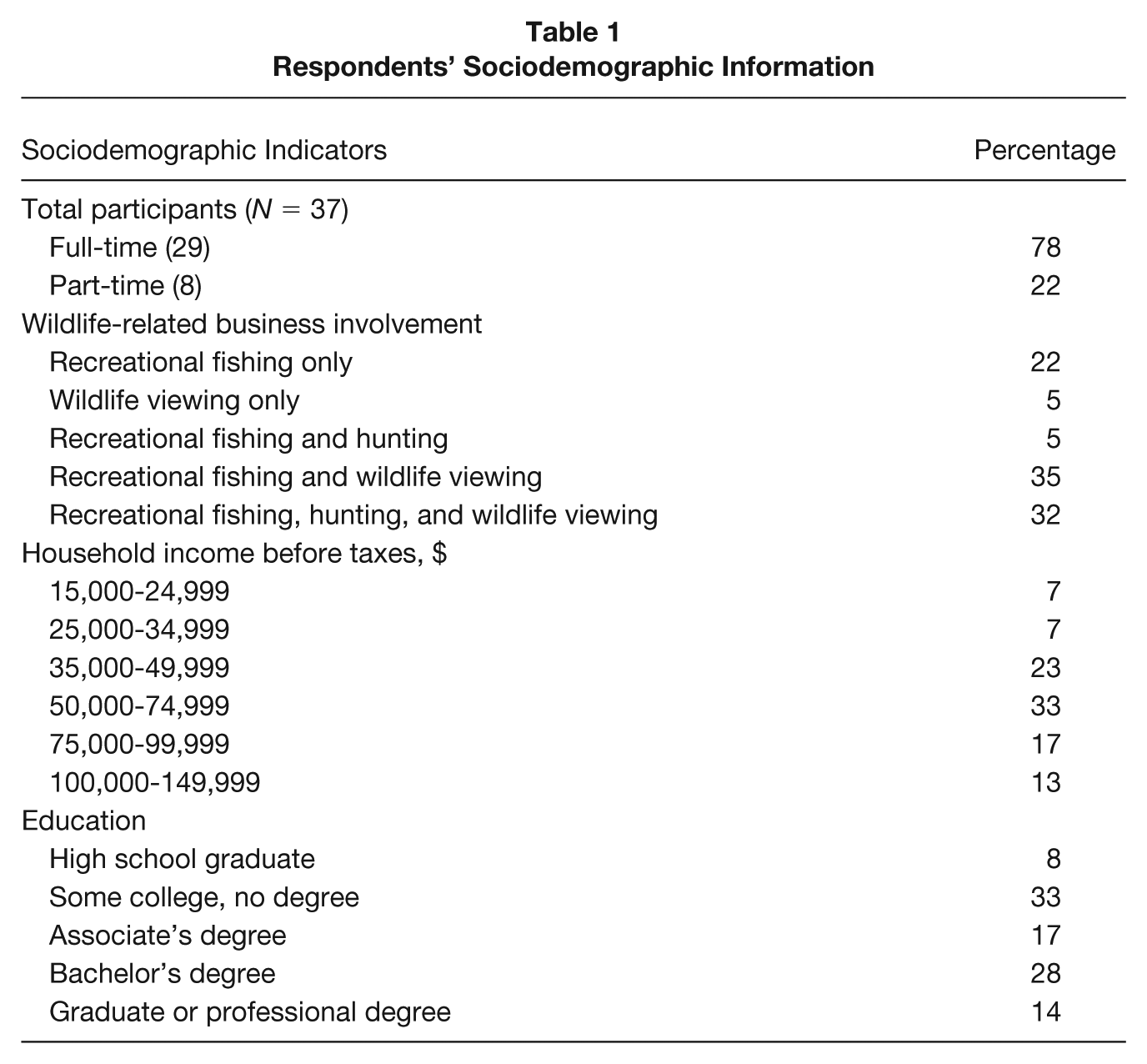
The majority of microentrepreneurs were employed full-time (Table 1). All of the participants were male except for one. Most of the microentrepreneurs were associated with more than one form of wildlife tourism. The number of years since the businesses were established ranged from 6 months to 36 years, with an average of 13 years. The average age of respondents was 50 years, ranging from 27 to 75 years. All participants were at least high school graduates and the highest percentage of participants fell within the income range of $50,000 to $74,999.
Respondents’ Sociodemographic Information
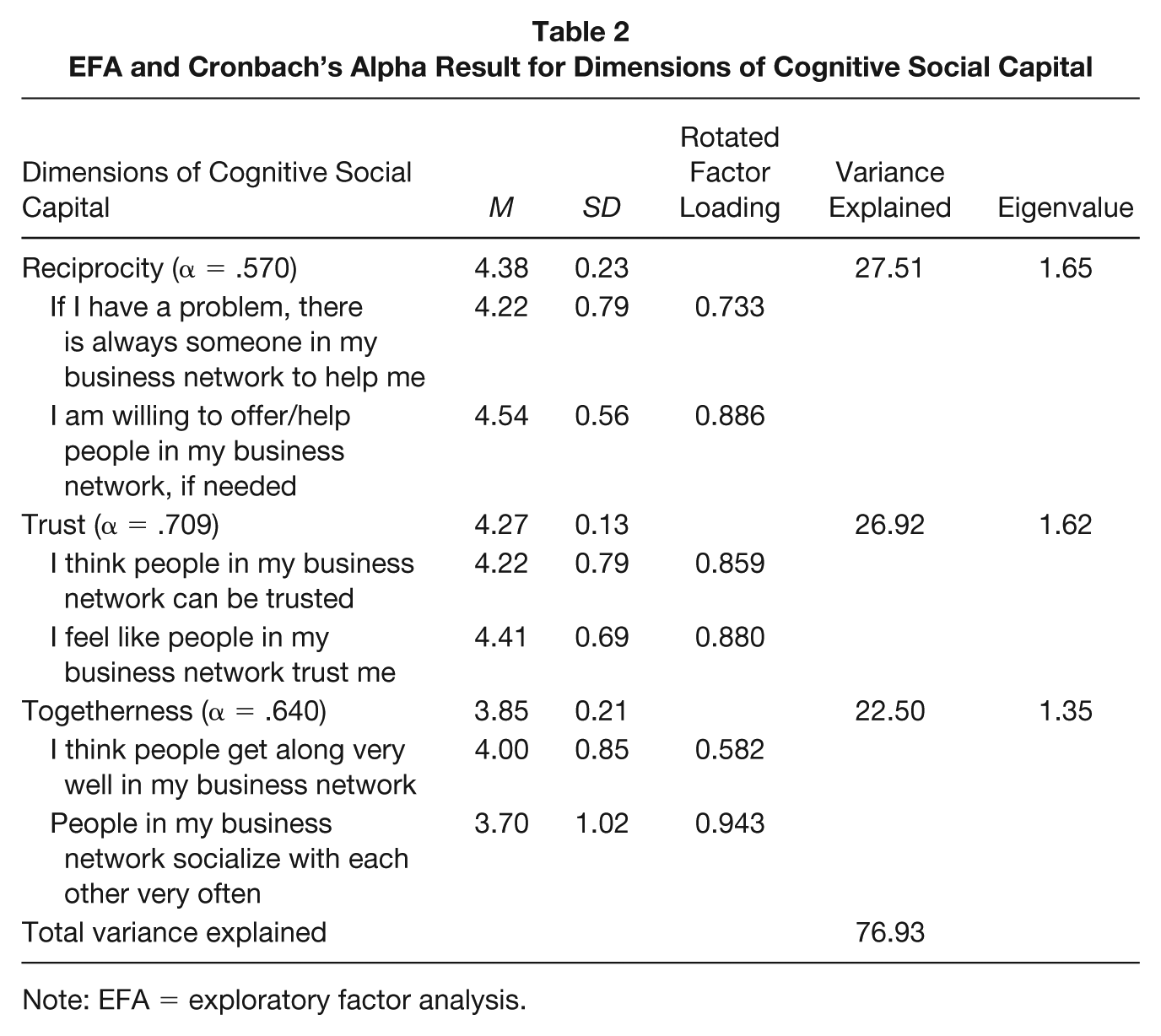
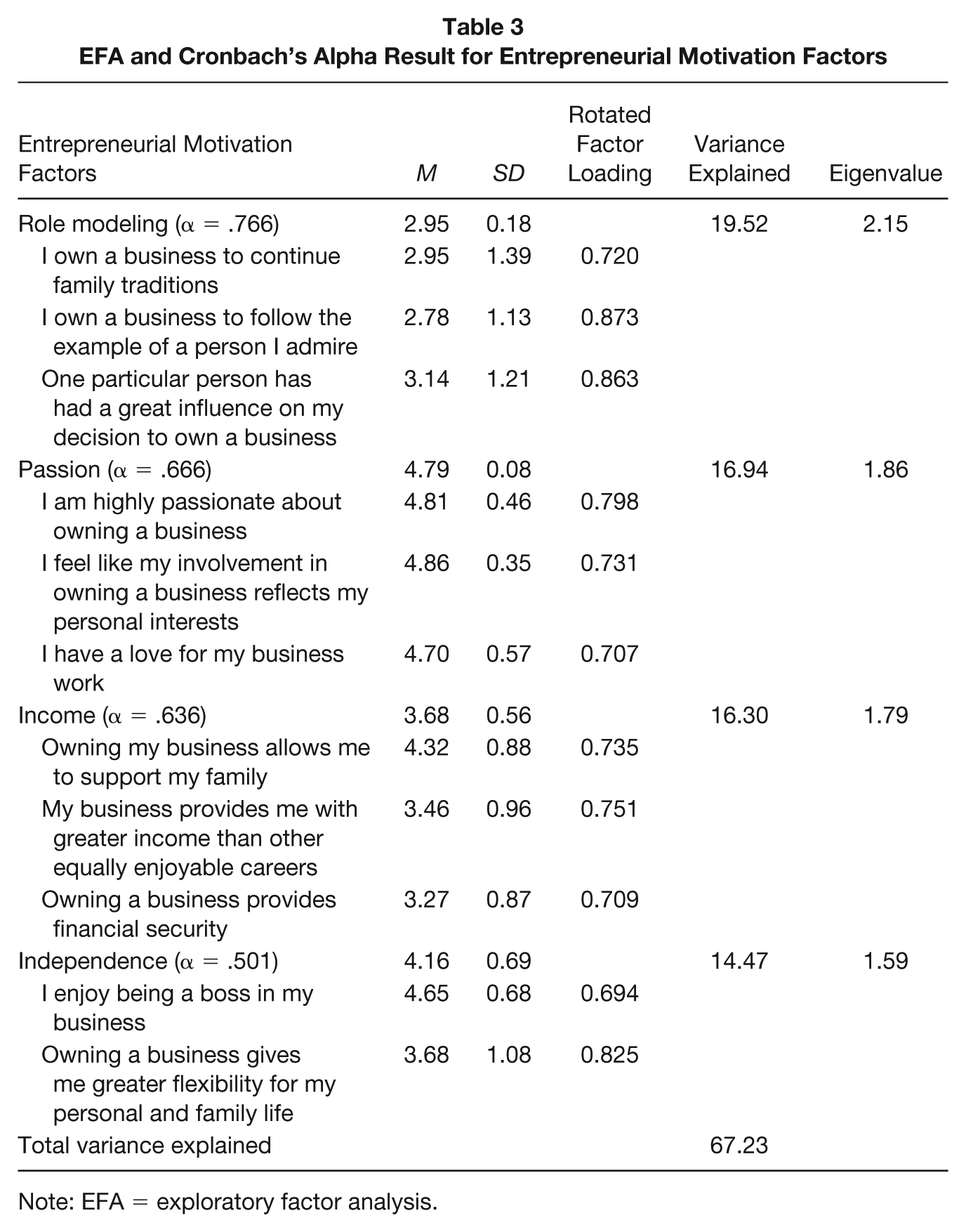
Results for EFA and Cronbach’s alpha tests are presented in Tables 2 and 3. Based on these results, composite scores were calculated for each dimension of cognitive social capital and the entrepreneurial motivation factor, which were then used for the linear network autocorrelation model. Visualization of the network (Figure 1) included 28 microentrepreneurs connected to each other, while 9 microentrepreneurs reported that they did not receive support from other members in the network. The major types of support received by microentrepreneurs included marketing and advertising (which includes customer exchange with peers), information sharing (e.g., location of fish, baits used for catching fish, or location of waterfowls and direction of their movement), and product support (e.g., in the form of discounts or free equipment).
EFA and Cronbach’s Alpha Result for Dimensions of Cognitive Social Capital
Note: EFA = exploratory factor analysis.
EFA and Cronbach’s Alpha Result for Entrepreneurial Motivation Factors
Note: EFA = exploratory factor analysis.

Divergent Social Influence Among Microentrepreneurs for Trust
Trust
The social influence parameter (ρ) was statistically significant for trust (β = −.034, p = .005; Table 4); however, the effect of social influence is negative, suggesting that microentrepreneurs were in disagreement with their respective connected peers on the levels of trust they had with each other (Figure 1). Wildlife tourism microentrepreneurs often echoed the importance of trust among business networks. They reported that they shared information regularly about the location of fish, bait used to catch fish, type of fish caught, and location and direction for the movements of ducks (e.g., for hunting). Furthermore, customer exchange was a usual practice, especially during the overflow of clients, where microentrepreneurs refer their clients to another peer. During client referral, microentrepreneurs reported that they felt bound by the notion of a “gentlemen’s agreement” where they do not exchange e-mail or phone numbers with the clients coming from another peer’s referral. Trust obviously appeared to play a critical role while exchanging information and customers with other business peers. One microentrepreneur stated the importance of trust as, “If you cannot trust people whom you are talking to, then you would not talk to them, if they are not going to be honest with you, then I do not have any interest in having relationships with them” (EID 21). On the other hand, another microentrepreneur stated, “We get misinformation, it has nothing to do with money or business, but pride and ego. But, if other people are in a problem, I end up helping them and put ego aside” (EID 28). Disagreement among wildlife tourism microentrepreneurs in terms of trust is possible as the results showed a negative social influence parameter in this study (Figure 1). Hence, the existence of highly, as well as equally, trusting relationships among all the participants is debatable.
Summary of the Results From the Linear Network Autocorrelation Models

p < .05. **p < .01. ***p < .001.
The number of business ties was also statistically significant for trust (β = −.027, p = .017), indicating that a high number of business ties is likely to negatively affect the level of trust (Table 4). Similarly, independence (β = .321, p = .008) and role modeling (β = .278, p = .002) as motivation factors had positive associations with trust and were statistically significant. Due to the complexity associated with the term, “success,” entrepreneurial success was measured in terms of entrepreneurial satisfaction associated with the business. Entrepreneurial success was statistically significant for trust (β = .594, p = 2.29e-05), with a positive association.
Reciprocity
The social influence parameter (ρ) was statistically significant for reciprocity (β = .034, p = .005; Table 4), and the effect of social influence is positive. This suggests that microentrepreneurs were in agreement with their respective connected peers on the levels of reciprocity they had with each other. As discussed earlier, exchanging and referring clients to another peer during the overflow was very common in wildlife tourism businesses, especially among fishing guides. Microentrepreneurs frequently reported their reciprocal relationships to other peers by saying, “It is a two-way street” (EID29). One microentrepreneur described the working environment and reciprocity among wildlife tourism microentrepreneurs in the following way: We share information a lot, our companies are competitors, but we try to help each other out. By the same token, we are not hoping that they have a bad business. We want them to do good as well as us. We call each other during the day [emulating the conversation in a humorous way]: you caught 2 fish? I caught 5; I caught 5, you caught 10? It is a competitive thing, but it is a friendly competition. (EID6)
The number of business ties was statistically significant for reciprocity (β = −.025, p = .033), indicating a negative association with reciprocity. For entrepreneurial motivation factors, independence (β = .345, p = .006) and role modeling (β = .264, p = .004) were also statistically significant for reciprocity.
Togetherness
Wildlife tourism microentrepreneurs expressed that a sense of togetherness existed among the group; however, the social influence parameter (ρ) was statistically insignificant for togetherness (β = −.006, p = .698; Table 4). Most of the microentrepreneurs mentioned meeting and talking to other peers during their business activities in the water, running into one another at the marinas, or sometimes meeting at the grocery shop while picking up customers. Some microentrepreneurs recognized a sense of togetherness through their friendship and constant communication. For example, one microentrepreneur stated, “I get along with everybody, we do not go for a dinner and swap beers, but keep in touch. I treat them like friends” (EID31). Microentrepreneurs mentioned workshops and seminars as formal environments where they can socialize, meet new people, and create networks.
The number of business ties was statistically significant for togetherness (β = −.029, p = .017), but with a negative association, indicating that a high number of business ties tends to negatively affect the level of togetherness. Income (β = .304, p = .024) and role modeling (β = .523, p = 2.75e-09) were also statistically significant for togetherness, with positive associations.
Discussion and Conclusions
Findings showed statistically significant results for the presence of social influence among wildlife tourism microentrepreneurs for trust and reciprocity; however, the social influence parameter (ρ) was negative for trust, while positive for reciprocity. Social influence can be convergent or divergent (Leenders, 1997). In most cases, an individual is expected to behave similarly to their connected peers, but sometimes, they tend to behave differently, thus moving in the opposite direction of their connected peers. This phenomenon results in positive (if behave similarly, ρ > 0) or negative (if behave oppositely, ρ < 0) values for social influence (Leenders, 1997).
Trust seemed to be a critical factor for information sharing and customer exchange/referral among wildlife tourism microentrepreneurs. Highly trusting relationships may not always exist because they also reported that they occasionally receive misinformation; therefore, disagreement for trust can be expected. Uniformity of behavior can be seen in highly cohesive groups due to high-density ties (Mizruchi et al., 2005), but this study examined a microentrepreneurial support network that reduced the network density by limiting their network ties. It can also be assumed that the support network should possess trusted peers. The negative result for trust and the positive result for reciprocity suggest that microentrepreneurs who are willing to engage in highly reciprocal relationships may not necessarily agree to involve in equally trusting relationships due to the issue of being misinformed or being skeptical about breaching an implicit “gentlemen’s agreement.”
The number of business ties as a network characteristic was of specific interest for this study because extensive social networks are perceived as a positive resource for entrepreneurial success (Burt, 2000). The number of business ties was statistically significant for trust, reciprocity, and togetherness, but surprisingly, the estimates were negative, indicating that a higher number of business ties likely diminishes trust, reciprocity, and togetherness among wildlife tourism microentrepreneurs. These findings provide evidence that the extent of network ties is not a primary factor driving entrepreneurial success, because cognitive social capital factors control the levels of cooperation among network members. This is implied in the literature (KC et al., 2017; Narayan & Cassidy, 2001), but not explicitly articulated through empirical research. This study concludes that the extent of network ties itself is not a panacea for entrepreneurial success.
Entrepreneurial satisfaction was measured as a self-reported indicator of entrepreneurial success, and that was a significant predictor for trust. Trust was a critical component among wildlife tourism microentrepreneurs in terms of sharing ideas related to marketing and advertising, as well as exchanging information about entrepreneurial activities. Microentrepreneurs with higher levels of entrepreneurial satisfaction were likely to retain higher levels of trust in the network. This may be due to a greater investment of time and effort in strengthening relationships with their respective peers and the resulting outcome. This finding supports the previous assertion that unsuccessful microentrepreneurs with limited resources likely face challenges to creating trusted networks, whereas microentrepreneurs that are more successful develop higher levels of trust with their business peers due to availability of resources for exchange, as well as their ability to focus on long-term returns from their investments into the network (Cleaver, 2005).
Human motivations play a critical role in the entrepreneurial process (Shane et al., 2003), and are argued to affect social capital (Smith et al., 2012); however, their effects on trust, reciprocity, and togetherness are still unknown. Results from this study showed that microentrepreneurs motivated by independence were more likely to have both trusting and reciprocal relationships. Such results for independence may be because these entrepreneurs seek freedom and flexibility toward personal and family life (Carter et al., 2003), and as such they participated in customer and information exchange behaviors more often, thus promoting reciprocity and trust. Although entrepreneurs enjoy financial success (i.e., income), nonmonetary aspects, such as independence, are considered to be greater incentives for entrepreneurs (Alstete, 2008). Even though entrepreneurial success was positively associated with trust, income was only significant for togetherness. Socialization and getting along with other peers in the network captured the meaning of togetherness. Wildlife tourism microentrepreneurs often reported socializing with other peers during fishing and hunting seminars or workshops as a way of creating networks. Perhaps microentrepreneurs with income as a motivation were more likely to attend these seminars and workshops to develop trusting relationships.
In the context of social networks, it is critical to understand how role modeling can affect the reciprocal relationships within the network, because network members are considered to influence the decision to become an entrepreneur or serve as a role model (Bosma et al., 2012). The results showed a positive association of role modeling with trust, reciprocity, and togetherness. Although role modeling was not rated very highly among microentrepreneurs, some of them mentioned being inspired by parents or grandparents to own family properties for business, being influenced by their previous employers to start their own business or being inspired by working with a group of fishing guides who they considered as successful. Carter et al. (2003) also reported that entrepreneurs tend to rate independence and financial success higher than role modeling. Nevertheless, it can be argued that role modeling as a motivation among network members has a positive impact in the entrepreneurial process due to its influence on trust, reciprocity, and togetherness. Role modeling as a motivation possibly increased trust, reciprocity, and togetherness among wildlife tourism microentrepreneurs because they work closely with people they appreciate and who are already successful, thereby making them more likely to establish meaningful relationships.
Social capital is argued to develop over time (Nordin & Westlund, 2009). In spite of this, the length of business establishment as a network characteristic showed no significant effect on trust, reciprocity, or togetherness in this study. This finding is inconclusive. In the context of entrepreneurship, changes in network structure can be expected because effort is often put toward seeking opportunities through new network ties causing relationships to constantly change. Therefore, the length of time a business has been established does not always imply that the relationships are as old as the business. Network ties were created at different times than when the businesses were started; therefore, the length of business establishment was not equivalent to the years of business connection to each network tie. Wildlife tourism microentrepreneurs’ respective networks were more likely to comprise both new and old business ties. In this study, the levels of trust, reciprocity, and togetherness were measured for the entire business network and not for individual network ties.
Overall, this study offers strong theoretical and practical implications regarding the functionality of wildlife tourism microentrepreneurship. It is important to understand the effect of social influence in a network. However, the effect of social influence can vary based on the dimensions of cognitive social capital (i.e., trust and reciprocity) embedded within the network. Entrepreneurial success was positively associated with trust only, while reciprocity existed in network ties, but there was no association with perceived success. Therefore, besides the importance of cognitive social capital factors, the effect of social influence should be considered when examining whether network structure is promoting a positive or negative social influence. Positive social influence phenomena are more likely to promote better outcomes from the network structure as network members are likely to behave similarly. It is important to understand the potential factors promoting the development of negative social influence phenomena and the potential alternatives to mitigate negative social influence. Obviously, there can be an existence of trust among microentrepreneurs, and equally trusting relationships are more favorable and should be promoted to ensure entrepreneurial success. Furthermore, network characteristics (i.e., number of business ties) and entrepreneurial motivations play significant roles in the entrepreneurial process and its outcome. This information was lacking in the previous literature. Understanding these phenomena can greatly enhance the ability of tourism planners and extension professionals to influence the outcome of tourism microentrepreneurship. It also helps guide future research to better understand the entrepreneurial network functions. Wildlife tourism microentrepreneurship holds a significant potential to support rural livelihoods. It also offers a promising career that can be well-defined and provide a viable livelihood strategy beyond just lifestyle entrepreneurship. Scholarly contributions in the area of rural tourism microentrepreneurship, such as wildlife tourism microentrepreneurship, are crucial to providing consultants with the tools they need to support wildlife tourism microentrepreneurs in creating meaningful livelihoods.
Limitations and Future Research
This study captured the support network of microentrepreneurs involved in fishing, hunting, and wildlife watching. Future studies can be designed for a larger population beyond the support network to include communication or familiarity networks with peers and other entities. This will allow for the assessment of different scenarios so that effective strategies that promote entrepreneurial success can be further developed. The social influence process was considered to occur through communication (Leenders, 2002), and in the linear network autocorrelation model, isolations in the network negatively affect the measurement of social influence (Mizruchi et al., 2005). For this reason, isolated members were removed from the data analysis; however, as the network size increases, network connectivity can be expected to decrease, eventually resulting in isolation. In addition, W specification is crucial to indicate the social influence process within the network. A simple binary matrix was used to examine social influence, but future studies can examine the effect of social influence by utilizing a different W specification explained by Leenders (2002). Since the effect of social influence was positive for trust and negative for reciprocity, conducting a qualitative assessment for an in-depth understanding of the dimensions of cognitive social capital seems prudent to better understand the functionality and outcome from a particular network structure. It would be interesting to delve into understanding the factors involved in promoting trust among these microentrepreneurs and ways to transform highly reciprocal relationships into equally trusting relationships.
The results are confined to the study region since social networks and social capital functions are more contextual (Ramirez-Sanchez & Pinkerton, 2009). Network studies must set boundaries to create a scenario where individuals can network. This study only recruited microentrepreneurs involved in wildlife tourism businesses, leading to a lower number of participants. The issue of sample size was beyond the researchers’ control. The results are not generalizable due to small sample size (de Winter, Dodou, & Wieringa, 2009). Entrepreneurship is an opportunity-seeking behavior that necessitates networking to access ideas, information, and resources (van der Veen & Wakkee, 2004; Zhao et al., 2011); therefore, the need to network and the importance of trust, reciprocity, and togetherness within the network remain common in entrepreneurship, regardless of the context. Thus, the findings from this study can be used to design similar studies despite their lack of generalizability.
Entrepreneurial engagement can be expected to increase with the growing scope of nature-based forms of tourism, such as wildlife tourism. To achieve a successful business outcome, the development of social networks is critical in these entrepreneurial settings. Clearly, there is a lack of empirical studies to understand and promote these forms of entrepreneurial engagement. This study concluded that the outcome from entrepreneurial engagement is dependent on cognitive social capital, but the state of cognitive social capital is affected by social influence phenomena, as well as by network characteristics (e.g., number of business ties) and entrepreneurial motivations. Understanding these nuances can support theorizing rural tourism microentrepreneurship and future research scenarios.
Besides a theoretical understanding of wildlife tourism microentrepreneurship within the scope of cognitive social capital, network characteristics, and entrepreneurial motivations, this study also offers practical implications. Understanding the factors affecting the functionality of entrepreneurial activities can assist regional tourism planners, extension professionals, and other external agencies (e.g., chambers of commerce) to foster entrepreneurial success in supporting rural livelihoods. For example, as trusting relationships are crucial to entrepreneurial success, efforts from local agencies can be geared toward facilitating the development of trusting relationships by organizing seminars and workshops that provide opportunities for entrepreneurs to connect with new network ties and reconnect with existing network ties. Likewise, a higher number of network ties does not necessarily promote cognitive social capital while entrepreneurial motivation factors also affect cognitive social capital factors in different ways. Incorporating these intricate details can greatly assist related agencies in fostering a successful entrepreneurial environment in rural tourism destinations.
