



Abstract
The hotel industry has grown rapidly in recent years, becoming the most competitive environment. As a result, industry players strive to outsmart competitors by creating brand equity to enhance brand loyalty; however, the impact of brand equity and demographic characteristics on brand loyalty is sketchy. In this study, we assess this impact in United Arab Emirates’ hotel industry by using customer experience as the mediating role. We selected a total of 694 participants at three 3-star hotels and two 5-star hotels in the United Arab Emirates. The Mann–Whitney test showed no statistically significant differences in brand loyalty (p < .05) by gender, and the Kruskal–Wallis test showed a moderately statistically significant difference (p > .05) and a highly statistically significant difference (p > .07) in brand loyalty by age and income groups, respectively. A positive correlation was found between customer experience and the different dimensions of brand equity. Similarly, a positive relationship (R = .716) was found between customer experience and brand loyalty using linear regression analysis. These findings will benefit managing authorities and key decision makers who seek to increase the productivity and profitability of their hotels.
During the past few decades, the hotel industry has seen rapid growth worldwide, creating strong competition among industry players. Therefore, industry players must gain a competitive edge with the aim of increasing their market share to maintain their position in a competitive business environment (Bailey & Ball, 2006; Su et al., 2016). To achieve this goal, managing authorities of hotels must focus on introducing new and advanced facilities and services, improving existing facilities and services, and creating brand equity (BE; Doostar et al., 2012).
BE can be defined as the marketing and monetary value associated with the strength of the brand in the industry: it includes the actual proprietary assets of the brand, public awareness of the brand name, brand loyalty (BL) among consumers, brand association, as well as the perceived quality of the products and services provided by the brand (Pride & Ferrell, 2003).
The concept of BE is important for the healthy life cycle of any brand in any market or industry (Engeset et al., 2016). For instance, a high level of BE associated with a hotel facility enables its managing authorities to reduce marketing expenses, because consumers of the brand are already aware of, and are loyal to, the products and services that the brand provides (Doostar et al., 2012; Kayaman & Arasli, 2007). Once consumers become loyal to a brand, they search for its offerings, and this minimizes the marketing and promotion efforts (Prasad & Dev, 2000). In addition, the company can attract new customers through word-of-mouth (WOM), which can add to the company’s revenues (H. Kim et al., 2003; Zaman et al., 2016).
BE is generally considered to be one of the prime ways of gaining a competitive edge in any industry. In the hotel industry, for example, BE is regarded as an essential element for the success of any hotel, including the number of consumers it already has and the new ones it has the potential to attract (Bailey & Ball, 2006). Moreover, BE is considered to be the most essential of the intangible assets, particularly for those brands that deal with a large number of consumers (Erenkol & Duygun, 2010; Hao et al., 2007; Krishnan & Hartline, 2001).
In the service-based hotel industry, role players have increasingly focused on BE (Doostar et al., 2012) because the market has become saturated and the key players are investing more into customer service (Kayaman & Arasli, 2007). This is imperative, as the services offered by hotels are similar and sometimes hard to differentiate. Such a lack of differentiation is also seen in other service-based industries such as airlines, telecommunications, trading, and banking (H. Kim & Kim, 2005).
It is, therefore, necessary to create a strong brand that focuses on delivering a more satisfactory customer experience (CE) that not only meets but also exceeds the expectations of consumers (Erenkol & Duygun, 2010). For competitors in a service-based industry, a strong brand image and BE are very important, as they ensure that a remarkable CE is delivered (Kimpakorn & Tocquer, 2010). Getting to know BE from the perspective of a consumer helps elucidate the consumption patterns of existing and potential consumers. This ultimately guides the decision-making process, enabling marketing managers to design and implement better marketing approaches (Hao et al., 2007; Kimpakorn & Tocquer, 2010; Pride & Ferrell, 2003).
BE has become increasingly important for the hotel industry in the United Arab Emirates (UAE), where competition has become very strong. Not only does BE help determine CE and satisfaction, but it also helps to position the brand in the industry (Pikkemaat & Zehrer, 2016; Xu & Chan, 2010). Moreover, BE and good CE, combined with an improved quality of products and services, could be used to gain customer loyalty, thus securing a strategic competitive edge over the other players in the hotel industry (Nam et al., 2011).
The main goals of this research are (a) to assess the impact of BE on BL; (b) to examine the impact of CE on BL; and (c) to assess the relationship between BE and the quality of a customer’s experience with some of the prominent players in the hotel industry in the UAE.
Our findings will benefit the managing authorities and key decision makers in hotels in the UAE. The results will add to the body of knowledge and will help them make well-informed decisions, leading to a continued development of the hotels. The study equips managers with great strategies to ensure that the best options for upgrading facilities and services can be identified and executed in business operations (Shen at al., 2018; Xu & Chan, 2010). Not only would such an examination help to identify the best approaches to ensuring a better CE and maintaining the BL of current consumers but it would also help attract new consumers. This clearer understanding, combined with more effective and relevant strategies, would prove extremely beneficial for the players of the hotel industry and would help to enhance the overall outlook for the entire travel industry.
Literature Review
Brand Equity
Different scholars have examined BE from various perspectives. The frameworks of Aaker (1991) and Bong et al. (1999) have been acknowledged as the two key components of BE. These researchers have described BE in different ways, while considering the consumers’ standpoint. Bong et al. (1999) recognized that the brand’s customer information relies on relations such as benefits, features, consumers, and general attitude; this information relies on a previous investment in marketing and promotion activities, including advertising. Furthermore, BE is associated with customers’ responses to promotional activities and a differential effect of brand information based on former promotion initiatives (Doostar et al., 2012). Methods used to gauge BE can be classified into one of three groups: customer, financial, and combined groups (Kayaman & Arasli, 2007). In the present research, we have adopted the first method, which takes into account different dimensions of CE such as service quality, price, and environment.
Brand Loyalty
Oliver (1999) defined BL as the deep and persistent commitment of consumers to the products or services offered by a brand. According to Oliver, consumers pass through a series of stages in order to reach the level of BL to a product or service. In the first stage, consumers develop “cognitive loyalty,” whereby they focus on and act upon their positive evaluation for the price and value of a brand’s offerings. In the second stage, “effective loyalty,” consumers develop positive feelings for the product or service provider; this association is formed as a result of all the favorable interactions they have had with the product or service (Xu & Chan, 2010). The third stage, “conative loyalty,” is characterized by the behavioral intentions of consumers to repurchase from the same manufacturer or supplier of goods or services (Lam et al., 2015; Oliver, 1999); this intention is developed after repeated exposure to positive experiences. In the fourth stage, consumers develop “action loyalty,” whereby they exhibit their preference for a particular brand in the form of actual repeated purchases. Furthermore, in this stage, consumers tend to promote the product through a positive WOM. The subsequent stages of this systematic process represent even higher levels of commitment, during which consumers become less likely to switch to any other brand (Nam et al., 2011; Oliver, 1999).
Customer Experience
Kandampully and Suhartanto (2000) examined the effect of CE on BL by using cobranding as the independent variable and experience as the dependent variable in Korean’s restaurants. These researchers showed a substantial impact of positive CE on loyalty to the restaurant. They also found that combined promotion was a barrier to switching brands, increasing satisfaction and achieving an efficient promotion approach. Kayaman and Arasli (2007) examined the moderating effect of image and experience on drivers of loyalty (assortment, service quality, price, and store location). Their study supports the moderating effect of price and service quality.
Relationship Between Brand Equity, Customer Experience, and Brand Loyalty
BE, CE, and BL have a strong impact on the overall functioning and profitability of a hotel. As far as the association between BE and BL is concerned, as per the literature, customers with a positive brand image purchase from the same manufacturer repeatedly; they are seldom influenced by the price, promotions, and incentives proposed by the competitors (Dimitriades, 2006). Kayaman and Arasli (2007) collected data from North Cyprus hotels to explore the relationship between BE and different constructs, including BL. These authors established a customer-based hotel BE model and discovered a positive relationship between BE and BL. Çetin (2016) examined how BE influences customers’ loyalty and their intention to revisit a hotel. Using a regression model, he found a positive relationship between BE and BL and therefore concluded that a positive brand image leads to customer loyalty. By satisfying a customer’s requirements and by building a positive image, firms aim to develop customer loyalty and have long-standing relationships with them (Mohamad et al., 2017).
Previous studies have also found a significant relationship between CE and BL. Consumers who receive good quality of service enjoy positive CE are willing to pay higher prices for the brand’s offerings, thus leading to more BL. This results in a stronger relationship between the brand and its consumers, who are then more likely to recommend the brand to others (W. G. Kim et al., 2008; Tuan, 2012). This is also true within the hospitality sector, where CE influences BL (Nguyen & Leblanc, 2001). Mohamad et al. (2017) explored the impact of service quality on loyalty and customer satisfaction in the hotel industry in the UAE. They concluded that customer satisfaction depends on different variables such as reliability, assurance, empathy, tangibility, and responsiveness. Consumers who receive quality services tend to be loyal and more satisfied compared with those who receive a compromised quality of services.
Relationship Between Demographic Characteristics and Brand Loyalty
Demographic characteristics such as age, gender, and income play a substantial part in BL. Klopotan et al. (2016) established that there is a substantial statistical difference in the loyalty of customers according to their demographic characteristics.
Brand Loyalty and Age-Group
Several studies have explored the relationship between age-group and BL in different contexts. For example, in the context of sales and management literature, Raimondo et al. (2008), using consumer panel data, found a similarity in BL between older and younger customers. An analysis of consumer panel data by Martins Gonçalves and Sampaio (2012) found substantial brand switching between genders and among all age-groups.
Brand Loyalty and Gender
The literature suggests that the psychological temperament of women might result in their being more loyal to a brand, particularly in (social) service contexts, than their male counterparts are (Melnyk et al., 2009). This is because women are thought to place a greater value on long-standing relationships, have more feelings, and make decisions based on social principles and by considering the effects of their decisions on others. In the United States, 65% of women display an inclination for “feelings” over “thinking,” meaning they make decisions based on impersonal, unbiased, and rational contemplations (Das, 2014). As service loyalty is entwined with constant social interactions, it is possible that women may display more robust loyalty behavior than do men (Melnyk et al., 2009).
Brand Loyalty and Income Level
Wallace et al. (2004) emphasized the association among brand selection and socioeconomic and demographic characteristics. They revealed that social class (income level) affects the attitudes of customers toward brand selection. A study by Bowen and Chen (2001) maintained that a high income is a significant factor in the selection of brands with premium products and services. However, Klopotan et al. (2016) maintained that the level of income is irrelevant in defining the brand selection process, while Mohamad et al. (2017) posited that middle income families select luxury brands more often than do families with higher incomes.
Research Gap
The previous literature has dealt with CE as a subconstruct of BE. Given their importance in the hospitality sector, both constructs should be dealt with individually. Most of the research studies have examined either the impact of BE on BL or the impact of CE on BL. CE can play a mediating role between BE and BL (Kandampully & Suhartanto, 2003). Nevertheless, an examination of the mediating role of CE and demographic characteristics, especially within the UAE hotel sector, is lacking in the literature.
Conceptual Framework and Research Hypothesis
The conceptual framework (Figure 1) of this research comprises examining the mediating role of CE on the relationship between BE and BL (Back, 2005; Kandampully & Suhartanto, 2003). The framework also comprises an examination of the effect of gender, age, and income on BL.
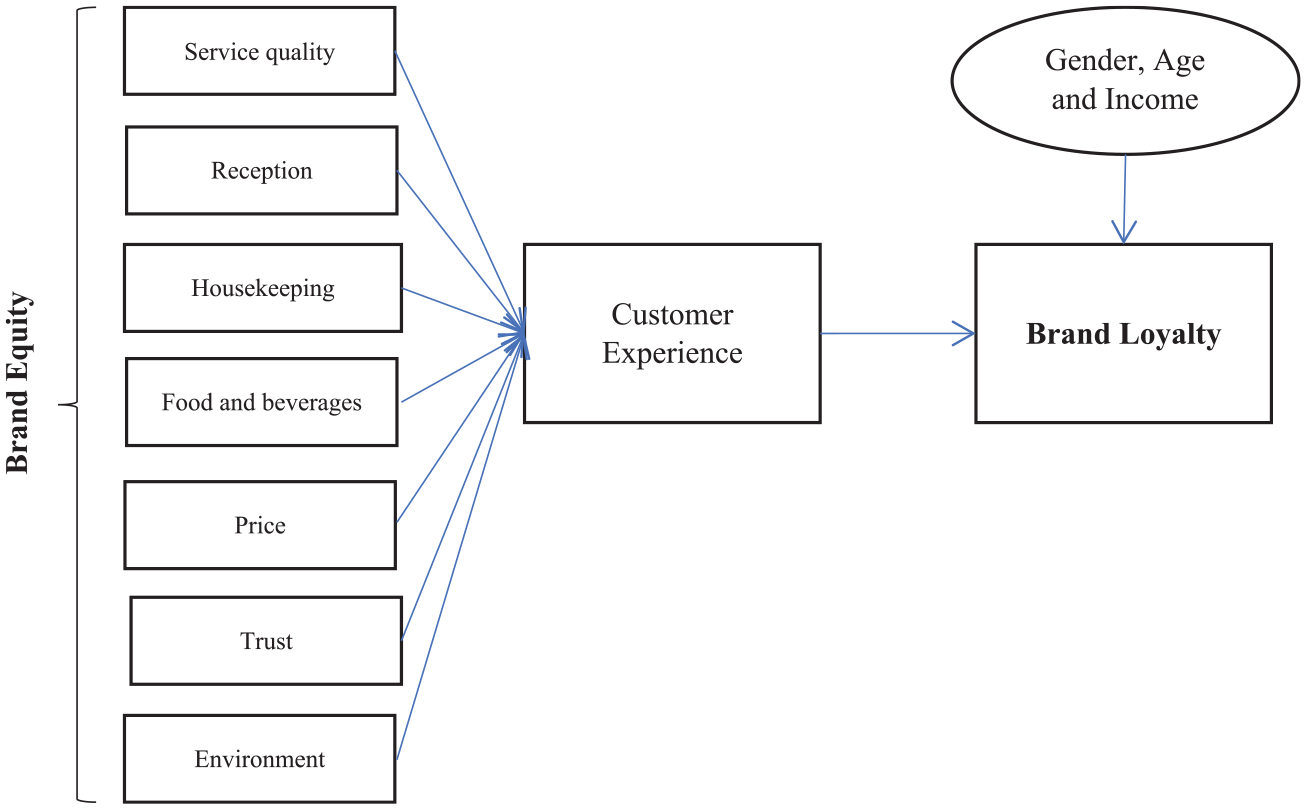
Theoretic Framework
We divided BE into seven different dimensions: service quality, reception, housekeeping, food and beverages, price, trust, and environment, in line with the research methodology of Kandampully and Suhartanto (2003).
To study the impact of BE on the development of BL for the services offered by a hotel facility, as well as the impact on BL of gender, age, and income, the following null hypotheses were proposed:
Additionally, to explore the effect of BE on the development of BL, the following hypotheses were proposed:
Method
Study Design
We used a quantitative study design involving data collection and analysis to test the hypotheses mentioned above. To collect the data, we used convenience sampling, enabling us to overcome the limitations associated with a narrow period and limited resources. To make the sample adequately representative, we selected participants from five hotels located in UAE, three of which are 3-star hotels and two are 5-star hotels. These hotels were selected using the popular web platform TripAdvisor, Inc., which is an American online travel firm that displays customer reviews of, and facilitates reservations for, restaurants, lodging, and various modes of transportation. We refined our search by selecting only hotels with more than 2,000 reviews. The 3-star hotels are Golden Sands Hotel Apartments, Rove Downtown Dubai, and Al Khoory Executive Hotel, and the 5-star hotels are St. Regis Abu Dhabi and Radisson Blu Resort Sharjah.
In the second stage, we contacted hotel administrations via telephone, informing them of the purpose of the study, and asking for permission to invite their guests to participate in the survey study. Once clients had shown willingness to participate in the research, the hotels provided us with their email addresses and information about their respective durations of stay. Overall, more than 1,000 participants agreed to participate in the study. We selected only those participants with more than a 2-week stay in UAE for either leisure or business purposes, thereby reducing the sample to 694 participants (N = 694).
In the third stage, we sent a questionnaire survey (see the appendix) to the participants via email, along with a consent form detailing the purpose of the research, the required ethical standards, and the conditions of voluntary participation. Participants were asked to respond to the questions as truthfully as possible so that we could make reliable conclusions. We received 600 completed survey forms, yielding a response rate of 85%.
After the data were collected, they were compiled and coded appropriately for statistical analysis. We used SPSS (Version 17) to apply the appropriate statistical tests and techniques to test the research hypotheses.
Measurement
The first part of the questionnaire captured the demographic characteristics of the study participants, namely, gender, age, nationality, and monthly income, and the second part included the questions designed to measure the three main variables of the study, namely BE and BL, with CE as the mediating variable.
BE and CE were measured using variables adapted from Ali and Muqadas (2015) and Kandampully and Suhartanto (2003). Based on a 5-point Likert-type scale, the questionnaire included five statements whose response options were 1 = strongly disagree, 2 = disagree, 3 = neutral, 4 = agree, and 5 = strongly agree.
Table 1 shows the reliability results of the three study variables assessed using Cronbach’s alpha.
Reliability Results for the Questionnaire Measuring the Study Variables

Results
Demographics
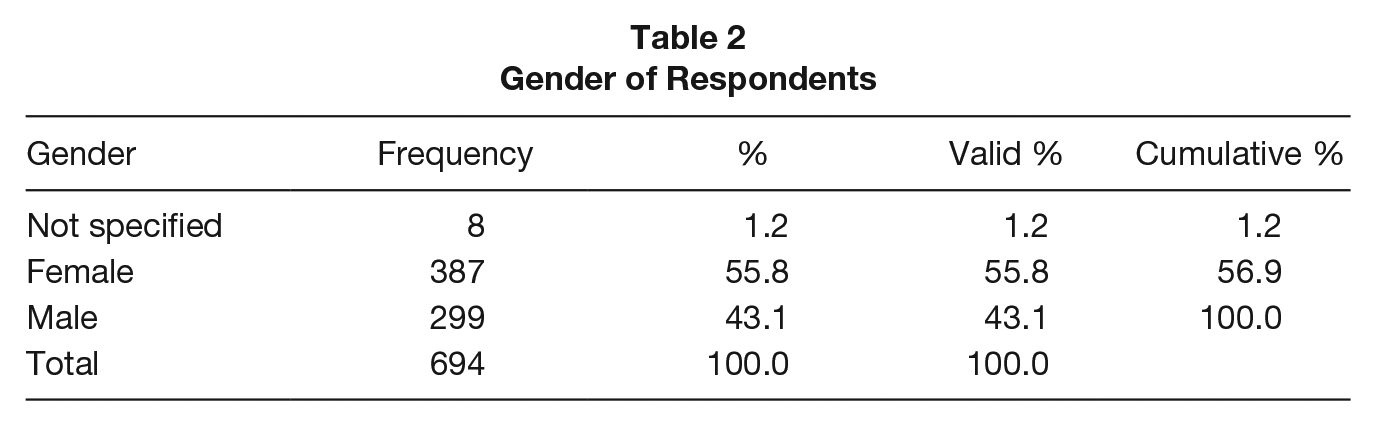
The study had a total sample size of 694 (N = 694), of whom 43.1% identified as male and 55.8% as female (Table 2).
Gender of Respondents
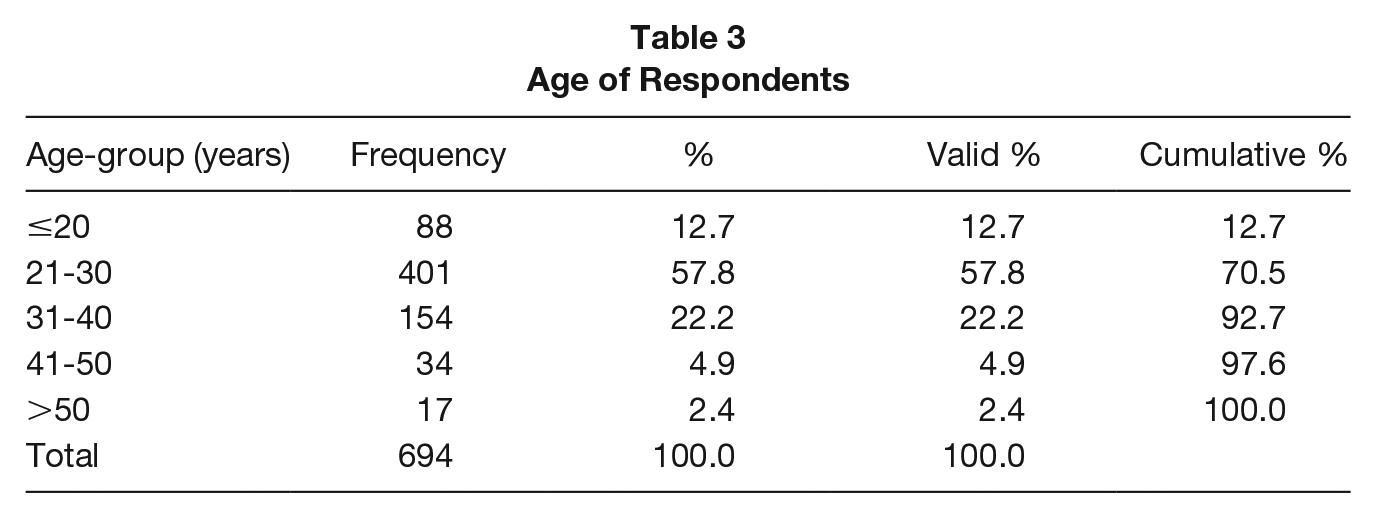
Participants’ ages ranged from 18 to 75 years, the majority (57.8%) of whom ranged from 21 to 30 years old; 12.7% and 2.4% of participants were less than 20 years of age and more than 50 years of age, respectively (Table 3).
Age of Respondents
Almost 50% of respondents had a monthly income between $1,500 USD and $2,999 USD; 28.7% had a monthly income of $1,000 USD to $1,499 USD (low income), while 14.6% had a monthly income of more than $4,500 USD (very high income; Supplemental Table 1, available online).
All participants were residents of the UAE. There were 14 different nationalities, the dominant of whom were the Emirati (16.3%), followed by British (13.7%), French (11.7%), and American (9.5%; Supplemental Table 2, available online).
Effect of Gender, Age, and Income on Brand Loyalty
To examine the impacts of gender, age, and income on BL, we employed the Mann–Whitney test for gender and the Kruskal–Wallis test for age and income. We used these nonparametric tests because the data were skewed (uneven distribution).
Results from the Mann–Whitney test (Supplemental Table 3, available online) showed a negative value of z score and a statistically insignificant p value (p < .05). Because there was no statistically significant difference between the mean BL of males and females, the Null Hypothesis H0.1 was rejected.
Results from the Kruskal–Wallis test (Supplemental Table 4, available online) showed a highly statistically significant p value (p > .05) for income and a moderately statistically significant p value for age. There were statistically significant differences between the mean BL of the different income and age-groups, thus supporting the Null Hypotheses H0.2 and H0.3.
Comparison of Mean Responses for Different Dimensions of Brand Equity
Supplemental Table 5 (available online) shows the results of applying an independent sample t test to compare the means of the different dimensions of BE. The average mean value exceeded 4 for most of the items. Most participants agreed that service quality is the most important dimension.
Correlation Between Brand Equity and Customer Experience
Supplemental Table 6 (available online) shows the correlations between the mediating variable CE and the different dimensions of BE. The correlation was significant at the 0.01 level. All the dimensions were significantly associated with CE.
Impact of Customer Experience on Brand Loyalty
To examine the moderating effect of CE, a linear regression analysis was conducted. The variable BL was considered to be the dependent variable, while the variable CE was considered to be the independent variable. Supplemental Table 7 (available online) shows that CE had an impact of 51.2% on BL. A positive relationship between both variables was also found (R = .716).
Discussion and Implications
Our findings address the gaps in the existing literature pertaining to the hotel industry in the UAE. The study investigated the impact of BE on BL using CE as the mediating role. We first examined the significance between different dimensions of BE and CE; subsequently, we examined the significance of the relationship between CE and BL. On overall, we found a significantly positive association between BE and BL irrespective of the respondents’ choice of stay in either 3-star or 5-star hotels. Thus, Hypotheses Ha.1 to Ha.7 were fully supported, and the Null Hypothesis H0.0 was rejected. Of the different dimensions of BE, we found service quality, reception, price, and environment to be highly significant, while housekeeping, food and beverages, and trust were found to be moderately significant.
Our findings corroborates the existing literature that enunciate that consumers who receive quality services from a brand tend to develop a more favorable image of it and derive greater satisfaction by purchasing from such a brand (Nguyen & Leblanc, 2001; Peter & Anandkumar, 2014). Our results also highlight the need for hotel managers to deliver quality services. Not only do quality services have an effect on BE among hotels but they also influence BL, consumers’ intentions to repurchase, and brand recommendations to others (Aghaei et al., 2013; Hansemark & Albinsson, 2004; W. G. Kim et al., 2008; Lee et al., 2017; Tasci, 2017; Yoo & Donthu, 2001).
Other dimensions such as the hotel receptionists’ willingness and ability to provide service, the physical appearance of the reception area, and its ambience play an important part in creating positive CE (Hansemark & Albinsson, 2004). Lee et al. (2017) argued that the value of the price paid for accommodation, food and beverages, and other services enhance CE. The price might be an especially important indicator for customers staying in 3-star hotels. Another key dimension that influences the assessment of the aesthetics of a hotel by customers is that of environment (Aghaei et al., 2013). Aghaei et al. (2013) maintained that a clean, nice, and visually appealing environment would generate a positive valuation of the hotel and would be an influential part of the BE of the hotel.
Put simply, customers in a particular hotel who have had a satisfactory user experience tend to develop a positive image (high BE) of that hotel. In addition, they develop an adequate level of satisfaction and generally feel positive about the hotel’s services in their subsequent visits (Hammad et al., 2017).
Furthermore, we found demographic characteristics such as income and age to be significantly associated with BL, while gender has no association with BL. Customers with a high income tend to be more loyal than customers with a low income, because low-income customers are more concerned with price, whereas high-income customers prefer service quality and an aesthetically pleasing environment (Wallace et al., 2004).
Additionally, we found that the respondents in the 21 to 30 years age-group were more loyal to the brand. These findings corroborate Martins Gonçalves and Sampaio (2012) who argued that members of the millennial generation show loyal behavior toward brands that offer high-quality products or services. Ali and Muqadas (2015) found older consumers to be more traditional and less eager to try new brands and argued that reduced mobility in later life restricts brand choice.
Contrary to the previous literature, which maintains that BL varies for males and females (Das, 2014; Melnyk et al., 2009), we found that gender had no association with BL. Melnyk et al. (2009) found gender differences in perception and usage of leisure activities and products. Das, too, determined that females have more robust brand and interpersonal relationships than males do, and posited that females are more loyal than males.
Managerial Implications
Not only does the present research study contribute to the theory and literature in the hotel industry in the UAE, but it also provides some significant implications for the managing authorities of hotels. The findings highlight how crucial it is for managers to ensure that the quality of hotel services is maintained; not only does this quality influence the current perceptions of the consumers but it can also have long-term implications. It is these experiences that determine whether a consumer would repurchase as a consequence of BL, which also has an impact on the productivity and profitability of the hotel (Mokhtar et al., 2011; Muller, 1991; Oliver, 1999).
Consequently, hotel managers should enhance service quality to improve the reputation and success of their respective brands. They should also focus on enhancing the reception services, balancing price with the different services offered, and maintaining an aesthetically pleasing physical environment. As the quality of CE is reportedly associated with housekeeping, food and beverages—essential factors for repeat purchasing behavior (Muller, 1991)—hotel managers should ensure adequate room amenities and room comforts. They should set the opening hours of restaurants and bars to accommodate guest preferences, maintain the atmosphere of the food and beverages area, and uphold the quality of the food and beverages.
In a country like the UAE where the travel, tourism, and hospitality industries hold much significance, it is important to invest heavily in the hotel industry and to make sure that the expectations of consumers are not just met but are exceeded. High-quality service results in a greater likelihood of positive WOM, which increases the customer base and adds further value to the hotel and the industry as a whole (Harris & De Chernatony, 2001; Mokhtar et al., 2011; Oliver, 1999; Tepeci, 1999).
Limitations and Delimitations
There are a number of limitations and delimitations of the present research study. First, respondents were selected from only five hotels, which might have an impact on the generalizability of the study results. For future studies, it would be beneficial for researchers to select a range of categories of hotels and resorts to effectively elicit the opinions of customers about the different dimensions of BE.
In addition, we only employed a quantitative research methodology whose limitation include the inability to shed light on the human experience attached to the BL phenomenon. For this reason, qualitative and quantitative methods should be combined as a mixed-method approach to future studies, to obtain a more profound understanding of BE, CE, and BL.
Regarding delimitations, CE was studied only as a mediating variable (Cronin et al., 2000). Therefore, it was not possible for the researchers to understand the possible subsets of this variable such as comfort level, the manageability of respondents’ budgets and expenses, and the fulfillment of their desired preferences. Future studies should look into this subset of factors to enable them to propose additional, thoughtful managerial implications for the hotel industry.
Conclusions
The past decade has witnessed an exponential growth within the UAE hotel industry. This study assessed the impact of BE on BL, CE on BL, and the relationship between BE and the quality of a customer’s experience. The Mann–Whitney test for gender showed no statistically significant difference in BL (p < .05) by gender and the Kruskal–Wallis test for age and income showed a moderately statistically significant difference in BL (p > .05) by age-group and highly statistically significant difference in BL (p > .07) by income group. Regarding the impact of BE on BL, the study found significant positive relationship, irrespective of whether the respondents stayed in either 3-star or 5-star hotels. Likewise, BE was found to be significantly correlated with the quality of a customer’s experience. Additionally, a positive correlation was found between CE and the different dimensions of BE: service quality, reception, housekeeping, food and beverages, price, trust, and environment.
Supplemental Material
Supplemental_material – Supplemental material for Assessing the Impact of Brand Equity and Demographic Characteristics on Brand Loyalty: The Mediating Role Played By Customer Experience in United Arab Emirates’ Hotel Industry
Supplemental material, Supplemental_material for Assessing the Impact of Brand Equity and Demographic Characteristics on Brand Loyalty: The Mediating Role Played By Customer Experience in United Arab Emirates’ Hotel Industry by Mohammed T. Nuseir in Journal of Hospitality & Tourism Research
Footnotes

References
Supplementary Material
Please find the following supplemental material available below.
For Open Access articles published under a Creative Commons License, all supplemental material carries the same license as the article it is associated with.
For non-Open Access articles published, all supplemental material carries a non-exclusive license, and permission requests for re-use of supplemental material or any part of supplemental material shall be sent directly to the copyright owner as specified in the copyright notice associated with the article.
