



Abstract
Hotel brand quality itself may not guarantee to increase hotel brand value and loyalty, but the combination between brand quality and brand personality will be significantly associated with brand value and brand loyalty (Boo et al., 2009). The purpose of this study was to explore the relationship between hotel brand quality and hotel brand personality in order to find an effective way for hotel brand managers to develop their brand value and loyalty. The results of the study demonstrated that the five dimensions of hotel brand quality construct (assurance, tangible, empathy, reliability, and responsiveness) are significantly related to preferences on the five dimensions of hotel brand personality (competence, excitement, sincerity, sophistication, and ruggedness), respectively. In addition, effects of hotel prices on brand quality are significant. These findings suggest that in order to develop a successful brand value and loyalty, hotel brand managers should (1) increase high-assurance performance for a competence hotel brand, (2) strengthen tangibles for an excitement hotel brand, (3) develop empathy performance for a sincerity hotel brand, (4) escalate reliability performance for a sophistication hotel brand, and (5) advance responsiveness for the ruggedness hotel brand. This could be an effective way to develop hotel brand value and loyalty. It may be postulated that the interaction between brand quality and brand personality of the hotel experience directly affects brand value and loyalty. Hotel brand managers may then specify their hotel designs and packages such that the congruence between brand personality and perceived quality develop brand value and loyalty.
Keywords
Introduction
Failure to appropriately understand the relationship between hotel brand personality and hotel brand quality is a critical concern for researchers and practitioners. In the marketing literature, Nam et al. (2011) reported that debate exists whether the principles of branding within goods marketing could be directly applied to service dominant brands such as hotels and restaurants. Aaker’s (1991) study about brand did not specify whether the quality dimension in the brand equity model refers to goods or services. Nam et al. (2011) questioned whether the brand equity model is suitable for assessing service dominant brand equity models in the hotel and restaurant industry. Boo et al. (2009) reported that applications of the goods-based brand equity models show poor validity in the tourism industry when brand quality is separated from brand personality. In hotel business reality, Joie de Vivre (2012) has designed its brand combining both brand quality and brand personality to reflect its San Francisco location and to engage the five senses. This firm manages the largest collection of boutique hotels and resorts in California and is expanding outside the state with openings in Scottsdale, Arizona, Chicago, and Honolulu, and this brand value due to its appropriate combination of brand quality and brand personality has been successful with its annual sales of around US$240 million.
Hospitality has become a mature industry so that “there are not many new inventions that affect the way we eat and sleep away from home” (Angelo and Vladimir, 2011: 4). When the functional characteristics of a hotel are not substantially differentiated, a hotel brand that establishes a set of promises to hotel guests and reflects guests’ desires through its brand personality, the outcome can be critical. Since physical and product differences of hotels have become less of a factor, consumers have changed their attitude into other ways to evaluate hotel performance, not based on hotel functions but based on hotel brand quality. Consequently, brand personality and brand quality may be the salient reasons for selecting one brand over another (Boo et al., 2009; Siguaw et al., 1999). It may be that hotel brand managers are looking for the most effective ways to develop their brands based on their customers’ attitude.
In addition, when researchers and practitioners focus more on hotel branding, Kim and Kim (2004) reported that there is a biggest misconception in branding strategies in which people focus on market share rather than consumer’s emotion “share” in a brand equity. In one study conducted in Atlantic City and Las Vegas, Boo et al. (2009) reported that the interaction between brand personality and brand quality correlates with brand value. The interaction between brand personality and brand quality can be critical to predict brand value and brand loyalty.
The interaction between brand personality and brand quality is not established in the literature although the importance of this relationship to brand value and loyalty has been recognized (Boo et al., 2009). This study attempted to examine this relationship to contribute to the development of the brand equity model. The purpose of this study is thus to explore the relationship between brand personality and brand quality in the hotel business to propose the most effective way to develop a hotel brand value and loyalty.
Literature
Brand equity
Researchers have included brand personality and brand quality in a construct of brand equity. Keller (2003) noted that brand equity is “a multidimensional concept and complex enough that many different types of measures are required. Multiple measures increase the diagnostic power of marketing research” (p. 477). Although brand equity is viewed from different perspectives (Aaker, 1996; Keller, 2003; Lassar et al., 1995; Motameni and Shahrokhi, 1998; Yoo et al., 2000), it is a core concept in brand management. Brand equity is recognized as the overall utility that customer places in a brand compared to its competitors (de Chernatony and McDonald, 2003; Vazquez et al., 2002). In this study, we used a conceptual model of brand equity from Boo et al. (2009) to explain five concepts: brand awareness, brand loyalty, brand value, brand image, and brand quality, in which we focused on the two concepts regarding this study: brand quality and brand image that are part of brand personality (Hosany et al., 2006; Patterson, 1999; Phau and Lau, 2001; Upshaw, 1995).
The brand equity model of Boo et al. (2009) includes brand awareness, brand loyalty, brand value, brand image, and brand quality. Brand awareness includes cognitive image of consumers. How often consumers use the “name” and “characteristics” of the hotel or tourist destination measures the brand awareness (Konecnik and Gartner, 2007). Brand loyalty is the attachment a customer has to a brand (Aaker, 1991). This attachment is critical since it makes the consumers to pay a premium price (Odin et al., 2001). Brand value, which is the market share of a brand, is a customer choice of a brand depending on a perceived balance between the price of a product and its utilities (Lassar et al., 1995).
Brand image and brand personality
Brand image is the social image and self-image of brand personality (Boo et al., 2009). If brand awareness helps consumers to know the name and characteristics of a brand, brand image will create emotional feelings about the brand within the consumers (Dobni and Zinkhan, 1990; Keller, 2003). Brand image, which is a main dimension in tourism and hospitality (Kim and Kim, 2005; Konecnik and Gartner, 2007), is an element in brand personality (Hosany et al., 2006; Patterson, 1999; Phau and Lau, 2001; Upshaw, 1995). Brand personality is “the set of human characteristics associated with a brand” (Aaker, 1997: 347). Brand personality traits such as sincerity, excitement, competence, sophistication, and ruggedness enable a consumer to express his own self (Belk, 1988) or his ideal self (Malhotra, 1988) through the use of a brand (Aaker, 1997).
Brand personality, developed by Aaker (1997), is based on the assumption that a brand name has its own unique personality. Aaker (1997) posited, “In this research, a framework of brand personality dimensions is developed. By isolating these distinct dimensions versus treating brand personality as a unidimensional construct, the different types of brand personalities can be distinguished, and the multiple ways in which the brand personality construct influences consumer preference may be understood better.” (p. 348).
The researcher combined symbolic, utilitarian, and symbolic/utilitarian types of varieties of products and services including food and beverage companies, sports, supermarkets, cars, communications, insurances, computers, hotels, commodities, telephones, and banks. Aaker (1997) used all adjective words to describe a business brand as a person and ask a nonstudent sample (56% of the sample was female, 20% was 18–24 years of age, 34% had a household income of more than US$50,000, 10% was African American, and 20% lived in the Northeast) to select which adjective is fit for each business brand.
Those procedures generated a preliminary list of 309 discrete traits, which the researcher reduced to 114 based on respondents’ ratings of how descriptive the traits are of brands. The researcher then conducted a series of studies to ask consumers to rate how well the traits described each of 59 brands selected to represent a wide array of product and service categories including McDonald’s, Marriott, and Holiday Inn. Finally, Aaker used principal analysis to find the five dimensions of brand personality across all brands after testing their validity and reliability. The five dimensions including 42 characteristics are sincerity, excitement, competence, sophistication, and ruggedness.
Applying Aaker’s 42 characteristics (Aaker, 1997) to hotel brands, the authors of this study assumed that the following brands might attach to their own brand personality. Kimpton hotels created a sincerity brand through providing “new in town,” cheerfulness, and honesty. The Wyndham branch creates Howard Johnson hotel as a sincerity brand through providing genuine and originality when Howard Johnson and his son set out on their mission to create comfortable, affordable, and friendly hotels with unmatched amenities that would serve both vacationers and business travelers alike. Marriot, Hilton, Accor, and InterContinental branches created excitement hotel brands through selling “discovery” and “explore” experience. The excitement hotel brands such as Autograph Collection created by Marriott, Double Tree created by Hilton, Mercure created by Accor, and Candlewood created by InterContinental indicate the hotels with imagination and up-to-date.
The competence brand indicates the hotels with efficiency and success. LaQuinta is created as a competent hotel brand through its reliability and success with the vision “We know that travel can be challenging. That’s why we are here to help both business and leisure travelers find their inner optimist.” MGM is considered as a competence brand because “Everything you need for a flawless event is under one roof.” The brand Holiday Inn is created by InterContinental for successful business with “Holiday Inn Express” and efficient leisure with “Holiday Inn Resort.” Choice hotels, Best Western, and Wyndham hotels including Ramada, Days Inn, Super 8, Howard Johnson, Baymont, Travelodge, and so on are competing with each other to create a ruggedness brand when they focus on free nights and rugged. Wynn Las Vegas creates “elevate your expectations” and “timeless luxury” related to a sophistication brand. The CEOs and employees of Ritz Carton use their motto, “Ladies and gentlemen serving ladies and gentlemen” to create two facets: upper class and charming for their sophistication brand. Accor branch creates Sofitel as a sophistication brand through its romantic and feminine characteristics. The hotel guests who are searching for upper class, glamorous, good looking, charming, feminine, and smoothness might attach to the above-stated brands.
Brand quality
There have been several literature studies on hotel quality. Oberoi and Hales (1990) assess hotel quality through 54 adjectives to describe hotel facilities, catering, pricing, and activities. Tsaur et al. (2002) evaluate hotel quality through eight dimensions—responsiveness, tangibles, meal service, location, reliability, empathy, reputation, and business service. Ekinci and Riley (2001) assess 35 attributes of hotel services through seven dimensions: decoration, cleanliness, staff behavior and attitude, output quality, accessibility, timeliness, and reliability. Erto and Vanacore (2002) evaluate hotel quality brand through a probabilistic approach. The above researchers have measured hotel quality for different purposes. In this study, we used a more appropriate approach to evaluate hotel quality brand. Brand quality, perceived quality by customers (Aaker, 1991; Zeithaml, 1988), is related to the ways in which the destination attempts to meet tourists’ functional needs (Boo et al., 2009; Keller, 2003). Perceived quality is the consumer’s judgment about an entity’s overall excellence or superiority (Zeithaml, 1988).
Parasuraman et al. (1988, 1991) have measured the perceptions of customers, who are in a shopping mall in the southwest and then retested it in the east of the country, during the 3-month period in five service categories (appliance repair and maintenance, retail banking, long-distance telephone, securities brokerage, and credit cards). The researchers selected a sample size of 200 adult respondents (25 years of age or older) for an instrument containing 97 items for the first test. Coefficient alpha was computed separately for a group of 10 dimensions to ascertain the extent to which items making up each dimension shared a common core. Oblique rotation was applied in principal component analysis based on the intercorrelations among dimensions to reduce and reassign the first 97 items in order to facilitate easy interpretation. After repeating a few times using recomputation of alphas and items to total correlations, 22 items among five dimensions including tangibles, empathy, assurance, reliability, and responsiveness were selected after deleting some items to increase the test’s reliability. Tangibles indicate physical facilities and personnel appearance. Reliability shows brand name promises to provide a service. Responsiveness implies the fact that the employees are never too busy to respond to guests’ requests. Assurance shows employees’ skill, knowledge, and safety. Empathy includes employees’ attitudes of having guests’ best interest at employees’ heart. The reliability and validity of these five psychological dimensions were regulated (Parasuraman et al., 1988).
In order to measure the perceived quality, it is necessary to have a valid measurement through surveys. Schall (2003) reported that hoteliers use survey questions, scales, and methods to measure consumers’ attitude without careful consideration that can result in misleading data and interfering survey’s validity. According to Schall (2003), the purpose of the question for hotel perceived quality is to measure (a) service (empathy), (b) quality and standards assurance (responsiveness, assurance, and reliability), and (c) assessment of the property’s furniture, fixtures, and equipment choices (tangibles). Many of the questions used in hospitality industry surveys are invalid. For example, “Was your room’s carpet clean?” is misplaced when this question intends to measure quality assurance. As a result, the question implied that guest’s responsibility was to judge whether the hotel is meeting its standards (Schall, 2003: 53).
In Europe, service quality is measured through two constructs. One is physical quality including the image projected by the design, equipment, facilities, and materials of the hotel or restaurant and the other is staff behavior including the image projected by competence, helpfulness, friendliness, and responsiveness of the hotel or restaurant employees (Ekinci et al., 2008; Madanoglu, 2004). In the United States, most research has used 22 dimensions of Service Performance originated from Service Quality to measure service quality. Service Performance focused on perceptions of service, whereas Service Quality included a widely utilized measurement instrument for assessing service recipients’ expectations and perceptions of service deliveries. Nyeck et al. (2002) note that the Service Quality measurement tool remains the most complete attempt to conceptualize and measure service quality. There has been some debate over the usefulness of the Service Quality’s gap measure (perceived service quality minus expected service quality) pertaining to the conceptual and empirical relevance of Service Quality versus performance only service scores (Service Performance).
Hypotheses development
Both Aaker’s (1997) brand personality and perceived quality measured by Service Performance (Cronin and Taylor, 1992) have five dimensions. Each of them has shared the similar characteristics as follows:
Sincerity versus empathy
Aaker’s sincerity dimension includes 11 items: down-to-earth, family-oriented, small town, honest, sincere, real, wholesome, original, cheerful, sentimental, and friendly. Service Performance’s empathy includes five statements: (1) excellent branded hotels will give hotel guests individual attention, (2) excellent branded hotels will have operating hours convenient to all their hotel guests, (3) excellent branded hotels will have employees who give hotel guests personal attention, (4) excellent branded hotels will have the hotel guests’ best interest at heart, and (5) the employees of excellent branded hotels will understand the specific needs of their hotel guests.
Comparing the sincerity items and empathy statements, we argued that when hotel employees serve their guests’ best interests by heart, the hotel would develop its sincere hotel brand. Thus, the following hypothesis is proposed.
Excitement versus tangible
Aaker’s excitement dimension includes 11 items: daring, trendy, exciting, spirited, cool, young, imaginative, unique, up-to-date, independent, and contemporary. Service Performance’s tangible includes four statements: (1) excellent branded hotels will have modern-looking property, (2) the physical facilities at excellent branded hotels will be visual appealing, (3) employees of excellent branded hotels will be neat appearing, and (4) materials associated with the hotel service will be visually appealing in an excellent branded hotel.
Comparing the excitement items and tangible statements, we argued that when hotel physical appearances are cool and exciting, the hotel would develop its exciting hotel brand. Thus, the following hypothesis is proposed.
Competence versus assurance
Aaker’s competence dimension includes nine items: reliable, hard working, secure, intelligent, technical, corporate, successful, leader, and confident. Service Performance’s assurance includes four statements: (1) the behavior of employees of excellent branded hotels will instill confidence in customers, (2) hotel guests of excellent branded hotels will feel safe in their transactions, (3) employees of excellent branded hotels will be consistently courteous with hotel guests, and (4) employees of excellent branded hotels will have the knowledge to answer hotel guests’ questions.
Comparing the competence items and assurance statements, we argued that when knowledge and courtesy of hotel employees create guests’ trust and confidence, the hotel would develop its competent hotel brand. Thus, the following hypothesis is proposed.
Sophistication versus reliability
Aaker’s sophistication dimension includes six items: upper class, glamorous, good looking, charming, feminine, and smooth. Service Performance’s reliability includes five statements: (1) when excellent branded hotels promise to do something by a certain time, they will do so, (2) when hotel guests have a problem, excellent branded hotels will show sincere interest in solving it, (3) excellent branded hotels will perform the service right the first time, (4) excellent branded hotels will provide their services at the time they promise to do so, and (5) excellent branded hotels will insist on error-free records.
Comparing the sophistication items and reliability statements, we argued that when a hotel shows interest in solving the problem its guests have, the hotel would develop its sophisticated hotel brand. Thus, the following hypothesis is proposed.
Ruggedness versus responsiveness
Aaker’s ruggedness dimension includes five items: outdoorsy, masculine, western, tough, and rugged. Service Performance’s responsiveness includes four statements: (1) employees of excellent branded hotels will tell hotel guests exactly when services will be performed, (2) employees of excellent branded hotels will give prompt service to hotel guests, (3) employees of excellent branded hotels will always be willing to help hotel guests, and (4) employees of excellent branded hotels will never be too busy to respond to hotel guest requests.
Comparing the ruggedness items and responsiveness statements, we argued that when a hotel give prompt service to its guests, the hotel would develop its responsive hotel brand. Thus, the following hypothesis is proposed.
Method
Sample
The respondents in the study were 400 hotel guests (206 females and 194 males), sunbathing on the Pensacola beach. These guests stayed in six hotels of different brands located in the same location on the Pensacola beach (Holiday Inn Resort Pensacola Beach by InterContinental, Hilton Pensacola Beach Gulf Front by Hilton, Margaritaville Beach hotel by InterContinental, Springhill Suites by Marriott, Holiday Inn Express by InterContinental, and Hampton Inn Pensacola Beach by Hilton). The average age of the respondents was 50 years and the average household income was US$76,000. In addition to demographic information, the survey card included 42 items that measured five dimensions of brand personality (Aaker, 1997) and 22 statements that measured five dimensions of service performance (Cronin and Taylor, 1992).
Data collection
In this study, the sample of 400 guests was randomly selected two times (high and low seasons) in order to control seasonal factors. These requirements are necessary for the validity of a model of five relationships. The first 200 survey samples were distributed to the guests of six hotels on the hotel’s designated beach during the high season (May 2011) and the other 200 were distributed during the Blue Angels event in the low season (November 2011).
Survey
Participants were volunteers to fill out a survey card, while enjoying beach and Blue Angel event. Each survey card includes five demographic questions, 42 items for brand personality and 22 statements for service quality.
Measurement scales
In order to select a right method for this study, the authors of this study assessed the hotels’ personalities using Aaker’s 42-item, five dimension brand-personality scale (Aaker, 1997). This survey also tested brand quality in each hotel using Service Performance 22-item, five dimension service performance scale (Cronin and Taylor, 1992). Each card includes a Likert scale from 1 (strongly disagree) to 7 (strongly agree).
Data analysis scheme
The two sets of variables (brand personality and brand quality) are continuous in the design. In order to examine the relationship model of the two sets of continuous variables in which independent variables include five factors of brand personality and dependent variables are five factors of brand quality, canonical variate analysis for two sets of variables is the best approach to avoid type 1 errors for the model. The “canonical” term indicates that the technique is extracting from a square matrix. Canonical analysis simultaneously calculates a linear composite of all brand personality variables and a linear composite of all brand quality variables. Each linear combination is called a canonical variate and takes the general linear form. It is a form of latent variables. If the canonical correlation function is significant, it represents an orthogonally separate pattern of relationships between the two latent variables (brand personality and brand quality). In order to test the above five hypotheses, five canonical analyses would be conducted and Wilks’ lamda (Λ) would be used to measure the significance of each function.
Results
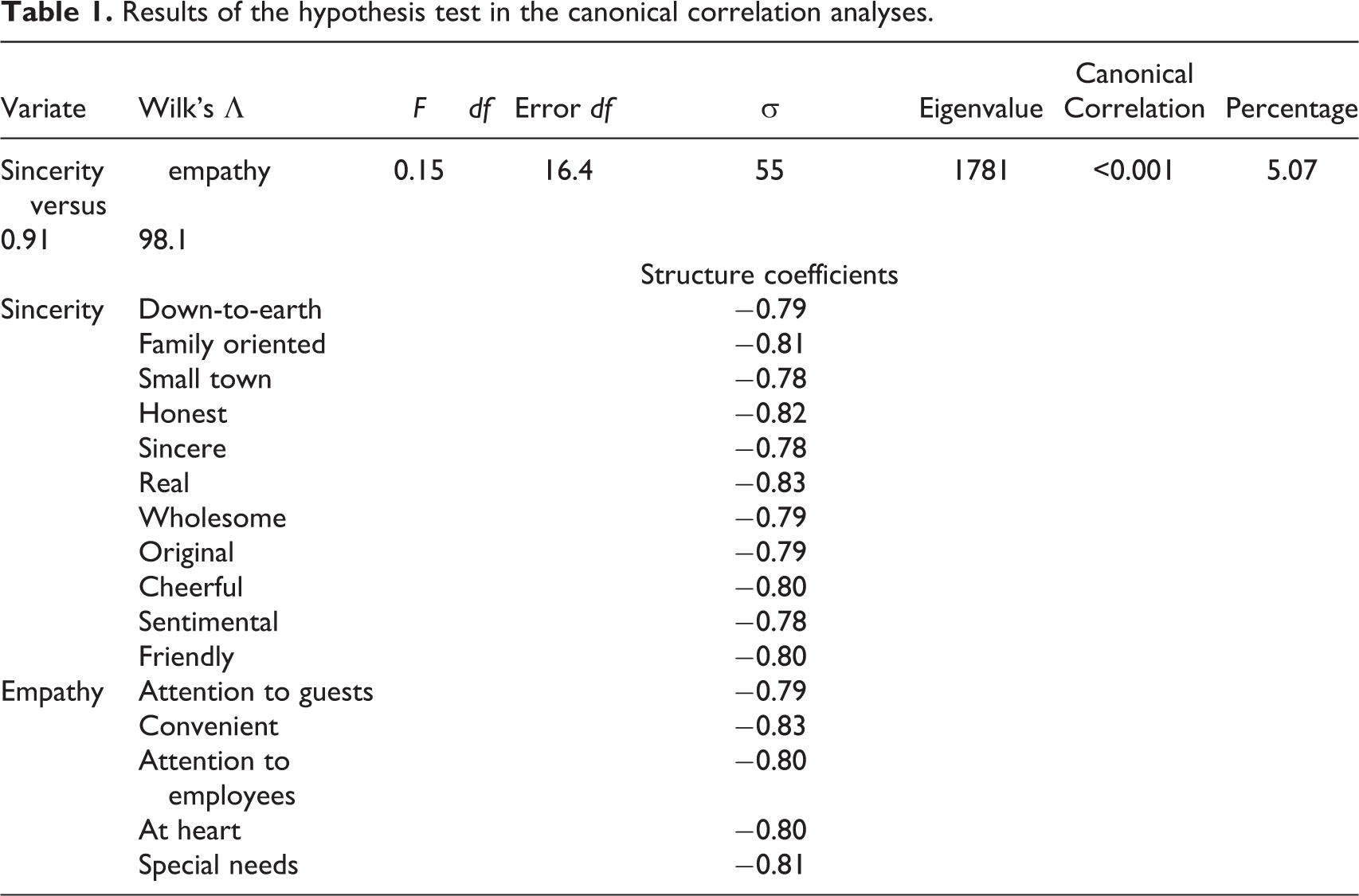
The first canonical correlation analysis was conducted to test the relationships between empathy and sincerity. The first canonical correlation function was calculated and explained 98% of the variance in the empathy variables. Wilks’ lamda was significant for the combined function (L = 0.15, p < 0.001). In this study, the first pair of variates that significantly shared 98% of variance revealed two very strong relationships between sincerity (down-to-earth (−0.79), family-oriented (−0.81), small town (−0.78), honest (−0.82), sincere (−0.78), real (−0.83), wholesome (−0.79), original (−0.79), cheerful (−0.80), sentimental (−0.78), and friendly (−0.80)) and empathy (attention to guests (−0.79), convenient (−0.83), attention to employees (−0.80), at heart (−0.80), and special needs (−0.81)). The canonical correlation indicates how well the groups of sincerity factors could predict empathy qualities. H1 hypothesis was supported. These variables are summarized in Table 1.
Results of the hypothesis test in the canonical correlation analyses.
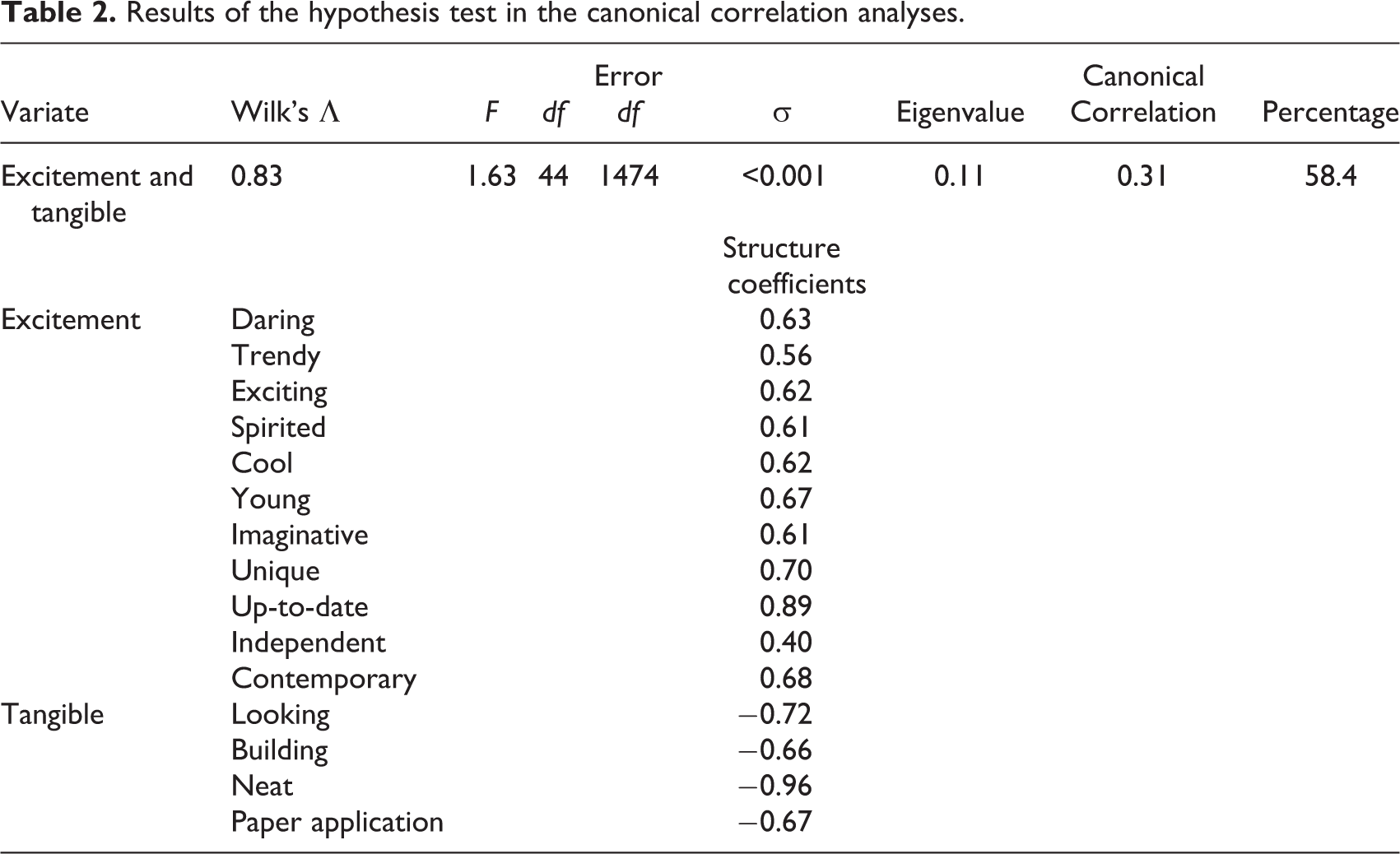
The second canonical correlation analysis was conducted to test the relationships between excitement and tangible and explained 58.4% of the variance in the tangible variables. Wilks’ lamda was significant for the combined function (Λ = 0.83, p < 0.001). In this study, the first pair of variates that significantly shared 58% of variance revealed two strong relationships between excitement (daring (0.63), trendy (0.56), exciting (0.62), spirited (0.61), cool (0.62), young (0.67), imaginative (0.61), unique (0.70), up-to-date (0.89), independent (0.40), and contemporary (0.68)) and tangible (looking (−0.72), building (−0.66), neat (−0.96), and paper application (−0.67)). The canonical correlation indicates how well the groups of excitement factors could predict tangible qualities. H2 hypothesis is supported and illustrated in Table 2.
Results of the hypothesis test in the canonical correlation analyses.
From the third canonical analysis between assurance variables with competence brands, the first function of competence explained 58.7% of the variance in the assurance variables. Wilks’ lamda was significant for the combined function (Λ = 0.87, p < 0.05). In this study, the first pair of variates that significantly shared 58% of variance revealed two strong relationships between competence (reliable (−0.68), hardworking (−0.61), secure (−0.58), intelligent (−0.69), technical (−0.74), corporative (−0.62), successful (−0.57), leadership (−0.93), and confident (−0.71)) and assurance (confidence (0.76), safe (0.77), consistence (0.93), and knowledge (0.63)). The canonical correlation indicates how well the groups of competence factors could predict assurance qualities. H3 hypothesis is supported and illustrated in Table 3.
Results of the hypothesis test in the canonical correlation analyses.

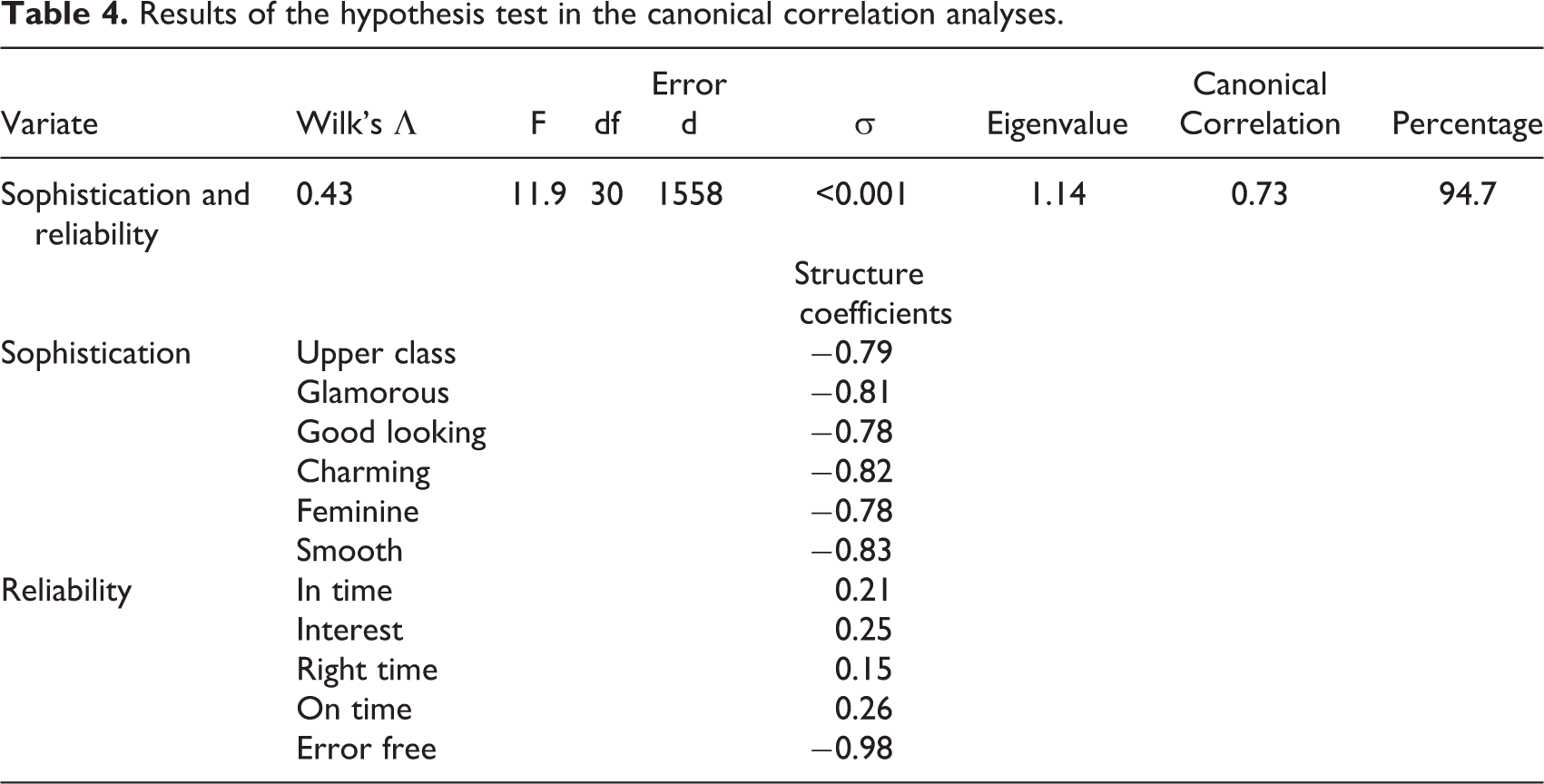
In the fourth canonical analysis between sophistication and reliability, the first canonical function explained 73% of the variance in the reliability variables. Wilks’ lamda was significant for the combined function (Λ = 0.43, p < 0.001). In this study, the first pair of variates that significantly shared 73% of variance revealed two strong relationships between sophistication (upper-class (−0.79), glamorous (−0.81), good looking (−0.78), charming (−0.82), feminine (−0.78), and smooth (−0.83)) and reliability (in time (0.21), interest (0.25), right time (0.15), on time (0.26), and error free (0.98)). In order to achieve a stable outcome, the canonical correlations and structure coefficient correlations must exceed 0.3 (Lambert and Durand, 1975). In the reliability variate, only error-free variable met this requirement with a high structure coefficient (0.98), so that it is the only variable representing reliability variate to correlate with sophistication variate. The canonical correlation indicates how well the groups of sophistication factors could predict error-free quality. H4 hypothesis is supported and illustrated in Table 4.
Results of the hypothesis test in the canonical correlation analyses.
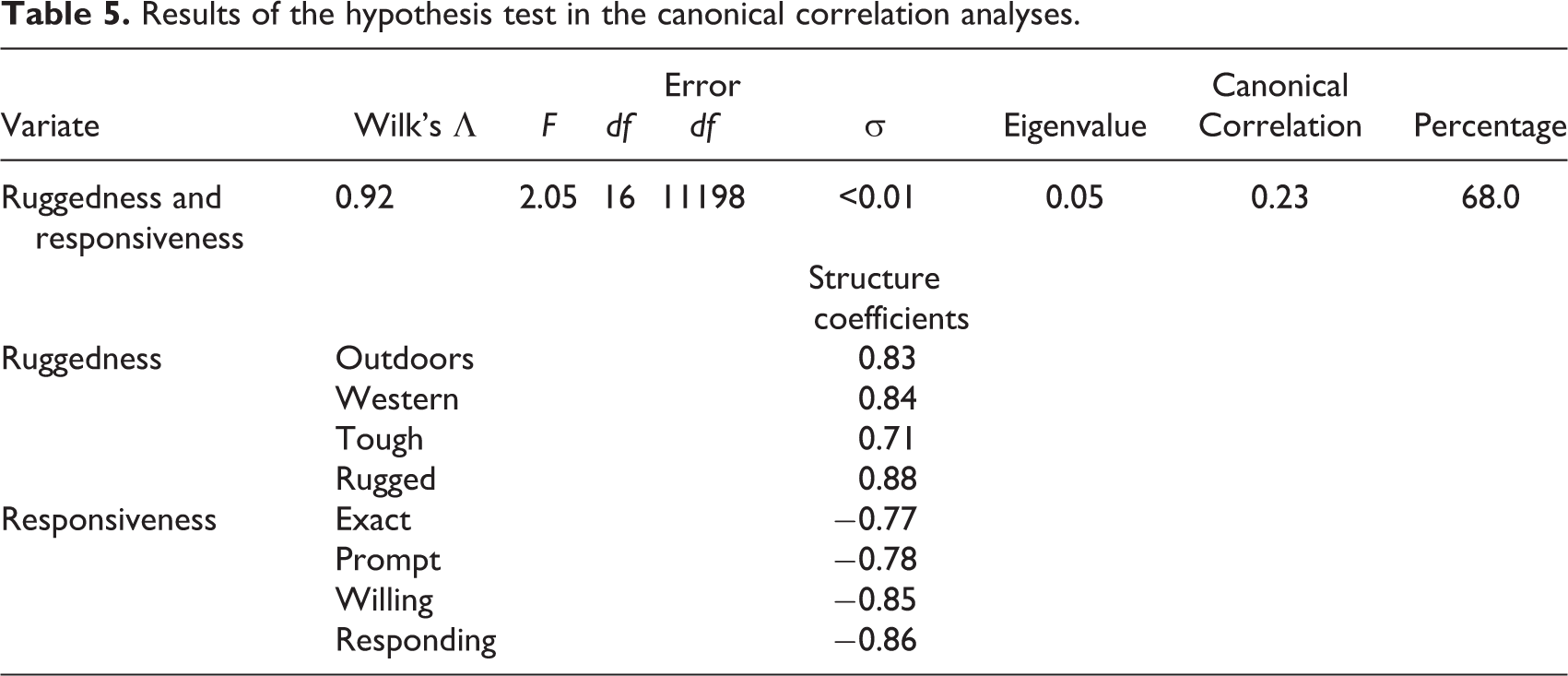
The fifth canonical analysis for ruggedness and responsiveness was conducted and the first canonical function of the independent variables of ruggedness explained 68% of variance of the dependent variable responsiveness with a significant Wilk’s lamda (Λ = 0.92, p < 0.01). In this study, the first pair of variates for four functions that significantly shared 68% of variance revealed two strong relationships between ruggedness (outdoors (0.83), western (0.84), tough (0.71), and rugged (0.88)) and responsiveness (exact (−0.77), prompt (−0.78), willing (−0.85), and responding (−0.86)). The canonical correlation indicates how well the groups of ruggedness factors could predict responsiveness qualities. H5 hypothesis is supported and illustrated in Table 5.
Results of the hypothesis test in the canonical correlation analyses.
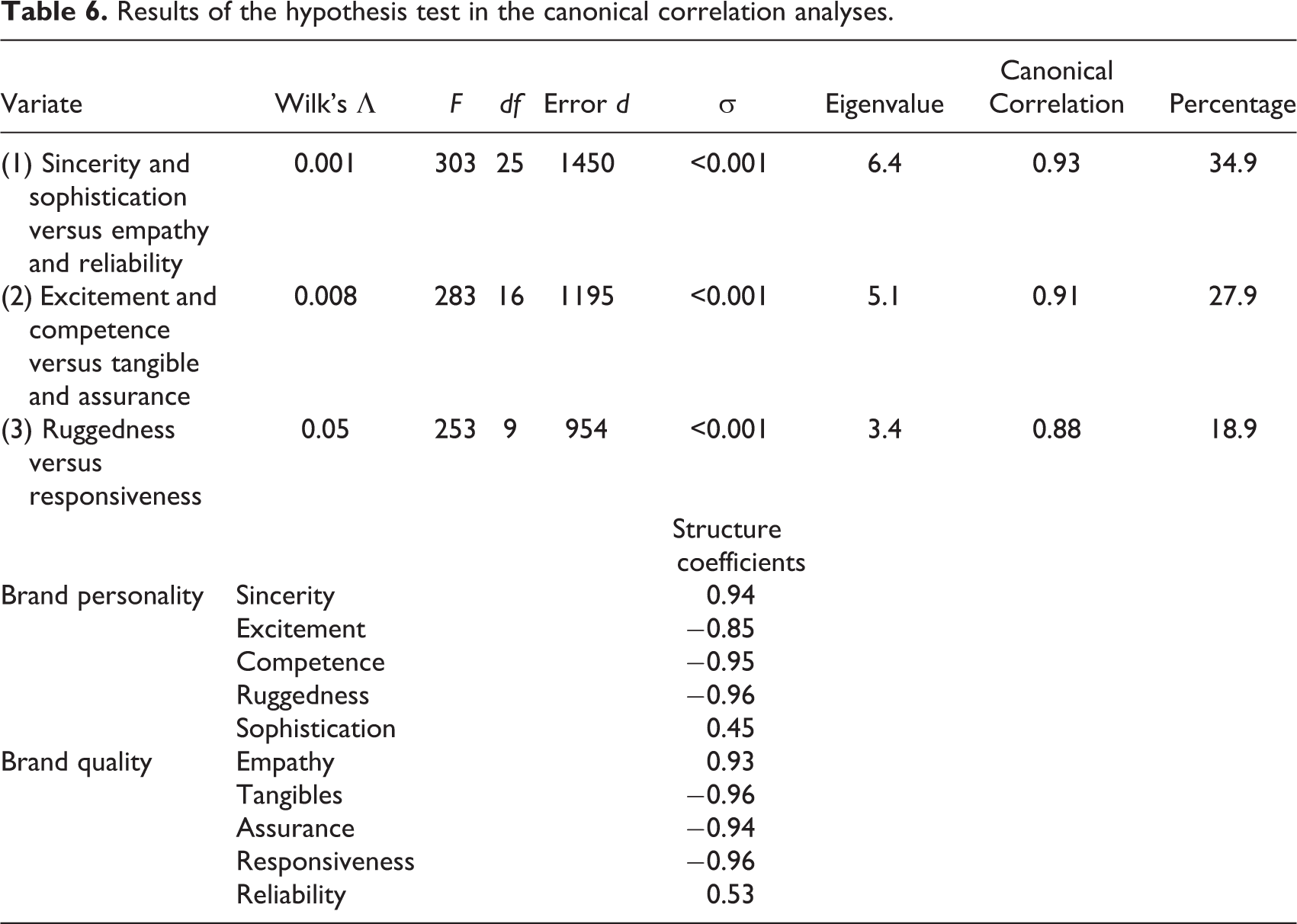
After testing the significance of the relationships between 42 items of brand personality and 22 statements of brand quality individually, this study examined the relationships between five dimensions of brand personality and five dimensions of brand quality by averaging the values of all variables in each dimension and using canonical variate analyses. As a result, the sixth canonical analysis for brand personality and brand quality was conducted and the first three canonical functions of the independent variables of brand personality explained 81.8% of variance of the dependent variable brand quality. Three Wilk’s lamdas for the first three canonical functions were significant (Λs = 0.001; 0.008; and 0.05, p s < 0.001, respectively). In this study, the first three pairs of variates that significantly shared 81.8% of variance revealed two strong relationships between brand personality (sincerity (0.94), ruggedness (−0.54), competence (−0.95), sophistication (0.45), and ruggedness (−0.96)) and brand quality (empathy (0.93), tangible (−0.96), assurance (−0.94), reliability (0.53), and responsiveness (−0.96)). The canonical correlation indicates how well the groups of brand personality factors could predict brand qualities. These variables are summarized in Table 6.
Results of the hypothesis test in the canonical correlation analyses.
In sum, the relationships between hotel brand quality dimensions as dependent variables and hotel brand personality dimensions as independent variables are significantly correlated. The congruencies between characteristics of image emotion and characteristics of quality in these relationships support the validity of self-congruity theory.
In addition, one-way analyses of variance of the hotel personality–quality combination dimensions for six different hotel prices were conducted to find whether hotel personality–quality combination dimensions were different or not. Post hoc tests were used to see which hotel price made the difference.
There was a significant effect of hotel price on sincerity–empathy at the p < 0.05 level for the six hotels (F(5, 392) = 169.2, p < 0.001). Empathy hotel price showed the greatest empathy (M = 5.3, SD = 1.5). Post hoc comparisons using the Tukey’s honestly significant difference (HSD) test indicated that the mean score for the sincerity–empathy hotel price differed significantly from each of the other five groups.
There was a significant effect of hotel price on competence–assurance at the p < 0.05 level for the six hotels (F(5, 392) = 66.1, p < 0.001). Assurance hotel price showed the greatest assurance (M = 6.2, SD = 0. 51). Post hoc comparisons using the Tukey’s HSD test indicated that the mean score for the competence–assurance hotel price differed significantly from each of the other five groups.
There was a significant effect of hotel price on ruggedness–responsiveness at the p < 0.05 level for the six hotels (F(5, 392) = 42.7, p < 0.001). Responsiveness hotel price showed the greatest responsiveness (M = 4.6, SD = 1.1). Post hoc comparisons using the Tukey’s HSD test indicated that the mean score for the ruggedness–responsiveness hotel price differed significantly from each of the other five groups.
There was a significant effect of hotel price on sophistication–reliability at the p < 0.05 level for the six hotels (F(5, 392) = 52.8, p < 0.001). Reliability hotel price showed the greatest reliability (M = 4.9, SD = 1.6). Post hoc comparisons using the Tukey’s HSD test indicated that the mean score for the sophistication–reliability hotel price differed significantly from each of the other five groups.
There was a significant effect of hotel price on excitement–tangible at the p < 0.05 level for the six hotels (F(5, 392) = 112.5, p < 0.001). Tangible hotel price showed the greatest tangible (M = 6.2, SD = 0.35). Post hoc comparisons using the Tukey’s HSD test indicated that the mean score for the excitement–tangible hotel price differed significantly from each of the other five groups.
Discussion
Boo et al. (2009) indicated that the combination between brand quality and brand personality would be significantly associated with brand value and brand loyalty but they did not show the detailed structure of this combination. This study has identified the detailed structure between brand personality and brand quality and indicated that the reliability–sophistication and assurance–competence are less sensitive to price than any other structures in the model. The combination between brand quality and brand personality would be most effective to brand value and loyalty when it belongs to one of the five relationships: (1) empathy quality in a sincere hotel brand, (2) assurance quality in a competent hotel brand, (3) tangible quality in an exciting hotel brand, (4) responsiveness quality in a rugged hotel brand, and (5) sophistication quality in a reliable hotel brand.
Our findings indicate that in order to develop a successful brand value and loyalty, individual hotel brand managers should (1) increase high-assurance performance for a competence hotel brand, (2) strengthen tangibles for an excitement hotel brand, (3) develop empathy performance for a sincerity hotel brand, (4) escalate reliability performance for a sophistication hotel brand, and (5) advance responsiveness for a ruggedness hotel brand. In addition, the study has found significantly different effects of hotel price on hotel brand quality. These findings would make an important contribution to marketing when hotel managers plan to change price controlling for different personality and quality segments.
In this study, an exciting hotel brand such as Holiday Inn Resort Pensacola Beach with its great Mermaid activities in a lazy pool has attracted a lot of family and leisure groups. A competent hotel brand such as Springhill Suites created by Marriott has served guests by professionals to develop its personalized loyalty programs. Sophisticated hotel brands such as Hilton Pensacola Beach Gulf Front created by Hilton and Margaritaville Pensacola Beach hotel brands created by InterContinental have appealed upper-class people in their personalized consumer programs. A rugged hotel brand such as Holiday Inn Express Pensacola Beach created by InterContinental has signified fast service in its personalized consumer programs. A sincere hotel brand such as Hampton Inn Pensacola Beach created by Hilton has hired motivated employees to serve guests’ best interest at heart.
In order to develop a competence hotel brand, marketers should focus on the best assurance performance and price of the hotel rather than four other service qualities. Springhill Suites by Marriott should advertise its professional staff to increase its competence brand. In order to develop a sophistication hotel brand, marketers should advertise their well-known reputation rather than any other service qualities. Hilton Pensacola Beach Gulf Front should place their “most expensive room in Pensacola” in their brochures to position the upper class of their guests in a sophistication hotel. In order to develop an excitement hotel brand, marketers should advertise the hotel property magnificence rather than any other qualities. In order to promote a family-friendly environment in an excitement hotel brand, Holiday Inn should introduce a “mermaid for the kids in the lazy pool” in their brochures. In order to develop a sincerity hotel brand, marketers should stress on their relationship marketing rather than any other qualities. Hampton Inn Pensacola Airport should stress on “100 percent satisfaction guarantee” to fully refund guests who are not satisfied to promote its sincerity. In order to develop a ruggedness hotel brand, marketers should focus on the express service of the hotel rather than any other qualities. Holiday Inn Express should place “To-go breakfast” or “Self-checkout” in their brochures to promote its ruggedness brand.
Limitation of this study is that the sample is only in the southwest area of the United States, the future research will be the longitudinal study across different cultures. No matter what the limit is, the current study is critical to the development of Boo et al.’s (2009) brand equity model including brand awareness, brand personality, brand quality, brand value, and brand loyalty. Separating or inappropriately combining brand personality and brand quality would not develop brand value and loyalty. The current study is also important for practitioners, such as hotel managers and owners, because it allows them to explore the strengths of brand image and personalized consumer programs in order to design and create strong impressions for their hotels. The results of this study suggest that combined brand personality and service quality can be applied in marketing and hotel planning and designed to create personalized consumer programs. A hotel with expensive amenities and motivated employees would not guarantee to be successful if guests could not find any distinguished personality from the hotel brand. Finally, this study may contribute to the efficiency of the policies of local and national tourism organizations.
In sum, the study findings have contributed to the explanation of the previous model of Boo et al. (2009) that the separation of each factor (brand personality and brand quality) could not significantly predict the value of the brand. Instead, brand quality controlled by brand personality would predict the price of the brand. Regardless of that the sample was obtained in the northwest area of Florida, the present study provides an effective approach to develop hotel brand value and loyalty. As such, researchers may find the interaction between brand quality and brand personality contributes to the hotel experience directly to affect brand value and loyalty. Individual hotel brand managers may gain knowledge on how to specify their hotel designs and packages such that the congruence between brand personality and perceived quality develop brand value and loyalty.
Footnotes
Funding
This research received no specific grant from any funding agency in the public, commercial, or not-for-profit sectors.