




Abstract
The peer-to-peer sharing accommodation features a high level of asymmetric information and a series of uncertainties and risks. Therefore, trust plays a critical role in shaping consumer behavior. Previous studies have frequently emphasized the direct effect of trust during the prepurchasing stage while disregarding its role in shaping customer satisfaction/return intention at the postpurchasing stage. Based on the attribution theory, in this study, we model the formation of return intention by incorporating the moderating effects of trust. A sample of 500 peer-to-peer sharing accommodation participants in China was collected to test the extended model based on the moderated structural equation modeling. Furthermore, users of Airbnb and Chinese domestic platforms were compared. Results demonstrated the existence of the moderating role of trust for domestic platform users but not for Airbnb users.
Keywords
Introduction
The sharing economy has revolutionized the tourism and hospitality industry with various online peer-to-peer (P2P) accommodation services. By 2019, Airbnb was offering accommodation in more than 34,000 cities worldwide, and the approximately 7 million rooms in its inventory render its service larger than any branded hotel chain (Airbnb, 2020). In China, the total revenue of P2P online accommodation rentals reached CNY22.5 billion (approximately US$3.35 billion) in 2019 (State Information Center of China, 2020).
The sharing economy adopts a significantly different business model from that of conventional businesses, as reflected in P2P accommodation, which brings consumers together to avail of their excess property capacity (Tussyadiah, 2016). The avoidance of business-to-customer exchange can significantly change customer behavior patterns (e.g., expectation, attitude, and intention formation) in the P2P consumption setting (Tussyadiah, 2016; Tussyadiah & Pesonen, 2016). Therefore, despite being overexamined in conventional tourism businesses, the question of “what factors drive customer satisfaction and return intention” is still open to new insights in the sharing economy sector (Möhlmann, 2015).
Extant studies on the sharing economy have mostly relied on the classic value–satisfaction–return intention framework to model consumer behavior, where the perceived customer value is supposed to shape return intention through customer satisfaction (e.g., Hamari et al., 2016; Tussyadiah, 2016; Tussyadiah & Pesonen, 2016). However, this archetypical model exhibits deficiencies: although the model fully accounts for the determining effects of the cognition process of customers (i.e., perceiving and acknowledging service-related values), the attribution process (i.e., interpreting the causes of these values) is not considered. Attribution theory suggests that people’s attitudes and behavior are not only affected by their perception of others’ performance but also by their understanding and interpretation of the causes that underlie such performance (Weiner, 1986). Therefore, the value–satisfaction–return intention framework should be improved by incorporating other critical factors that can capture the effects of the attribution process.
One such factor is trust—believed to profoundly affect customer behavior in the sharing economy, which is prone to various risks such as financial loss and personal safety issues (Ert et al., 2016). These risks result from the high degree of information asymmetry, which is primarily caused by web mediation that sets barriers to prevent customers from gaining accurate information, thereby leaving room for deception, distortion, or misunderstanding (Hong & Cho, 2011), and are further enhanced by the intangibility and inseparability of service (Zeithaml et al., 2006).
Following the attribution theory, sociopsychologists and management researchers (e.g., Dirks & Ferrin, 2001; Innocenti et al., 2011; Neeraj, 2009) suggest that trust shapes the cognition process at “weak structure” situations (such as the prepurchase stage) where individuals lack clear perceived clues of others’ performance, and influences the attribution process during “moderately strong structure” situations (such as the postconsumption stage) where information about other’s behavior is available but the underlying meaning of the behavior (e.g., motivation, persistency) remains ambiguous. In this regard, trust can be modeled as either a direct effect (during the prepurchase stage) or a moderating effect (during the postpurchase stage). The direct effects of trust on customer attitude and purchase intention during the prepurchase stage have been widely confirmed in the extant literature on marketing, tourism, and sharing economy (e.g., Agag & Eid, 2019; S. Ye et al., 2020). By contrast, the moderating role of trust during the postconsumption stage, although confirmed in micro-organizational behavior and social psychology studies (e.g., Innocenti et al., 2011; Neeraj, 2009; Wang et al., 2013), has received scant attention in consumer behavior research. Thus, whether trust can moderate the relationship between customer values, satisfaction, and return intention remains unknown.
In large economies such as China, the P2P accommodation market is typically dominated by both international giants (e.g., Airbnb) and local leading platforms (e.g., Xiaozhu.com, Tujia.com). Compared with local platforms, Airbnb features various accommodation products worldwide, offers exotic holiday experiences, and has a different business culture and market strategy, commonly found in international companies. The cultural gap can lead to Airbnb’s less familiarity with the local consumers, especially given that it entered the local market several years after the local platforms had already established their market share. As such, consumers can behave differently when they use Airbnb versus local platforms. Therefore, it is necessary to investigate whether the formation of return intention and the role of trust differ between Airbnb and local platform users.
We aim to answer the aforementioned questions by examining the role of trust in the formation of return intention. A revised model where trust moderates the relationships among customer values, satisfaction, and return intention was tested via moderated structural equation modeling (MSEM), based on data collected from 500 Chinese P2P accommodation users. Furthermore, users of Airbnb and Chinese domestic platforms were compared to understand the likely different user patterns in these two settings.
Literature Review
P2P Sharing Accommodation
The sharing economy can be broadly defined as a socioeconomic system in which assets or services are shared between private individuals through the internet for free or for a fee (Finck & Ranchordás, 2016). It has emerged and gained momentum in the tourism marketplace, with various P2P accommodation services as its leading manifestations. Typical P2P accommodation comprises individuals with excess property capacity and tourists who need accommodation, with an online platform maintained by a third-party company (Tussyadiah, 2016). Recently, companies (and some individuals) have been found to purchase properties and rent them through a P2P platform intentionally for profit (Bakker & Twining-Ward, 2018).
Consumer behavior has been a central topic in P2P accommodation research, emphasizing motives and constraints to consumers’ participation (De Canio et al., 2020; Pung et al., 2019), their experience, satisfaction, and repurchase behavior (S. Ye et al., 2020; Zhu et al., 2020). The use of P2P accommodation was found to be driven by its unique values. In this regard, Hamari et al. (2016) suggested sustainability (e.g., environmental benefits) as a critical value created by the sharing economy. Zhang et al. (2018) distinguished between emotional value (e.g., enjoyment, relaxation), functional value (e.g., convenience), and social value (e.g., making friends). Zhang et al. (2019) added economic value (e.g., having a low price) as the fourth value. These customer values have been used to predict customer attitude/satisfaction and purchase/repurchase intention (Tussyadiah, 2016; S. Ye et al., 2020), engendering the popular value–satisfaction–return intention framework. However, this framework emphasizes the cognition process (i.e., how customers perceive and acknowledge values). The potential effects of the attribution process (i.e., how customers interpret the causes of these values) have not been incorporated.
Another critical issue for the sharing economy is trust. Researchers generally agree that the sharing economy involves various types and levels of risks, and thus, lack of trust can hinder consumer participation in the first place (Tussyadiah & Pesonen, 2016). Many studies have confirmed the direct effect of trust on consumer decision making during the prepurchasing stage (Agag & Eid, 2019; Pung et al., 2019; T. Ye et al., 2017). Therefore, the establishment of customer trust becomes another concern. For example, Park and Tussyadiah (2020) and Ert and Fleischer (2019) examined the formation and evolution of trust between hosts and guests. Furthermore, several studies also model the determinants and consequences of consumer trust at the prepurchase stage. For example, Ert et al. (2016) examined the impact of sellers’ photographs on customer trust. T. Ye et al. (2017) and S. Ye et al. (2019) investigated the role of race similarity and social presence in shaping consumer trust. Agag and Eid (2019) proposed and tested a systematic model where consumer trust is shaped by website features, personality, interpersonal interaction, and institutional features, and can further affect purchasing intention. The effect of customer trust after purchase, however, has received extremely limited attention.
Customer Value: Experiential Perspective
Customer value has been one of the core concepts in economics, marketing, and management research. Gallarza et al.’s (2017) review summarizes four perspectives to derive customer value, namely, the trade-off perspective, dynamic perspective, means-end perspective, and experiential perspective (Table 1).
Perspectives of Value Definition
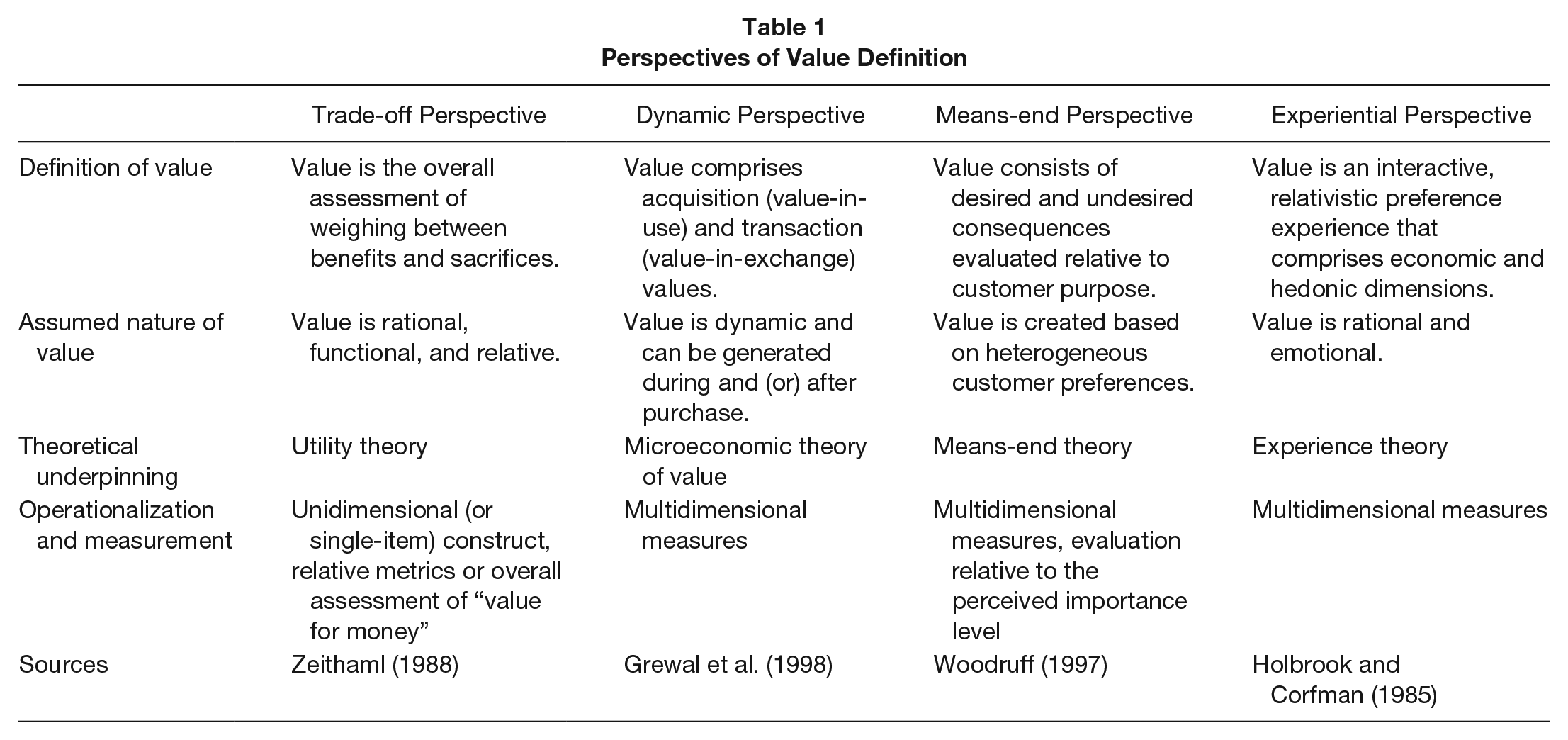
The experiential perspective provides the most comprehensive value model and has gained increasing acceptance (Leroi-Werelds et al., 2014). This perspective defines customer value as an interactive relativistic preference experience that involves hedonic/emotional and cognitive/economic dimensions (Holbrook & Corfman, 1985). Consequently, other functional and affective benefits are aligned with economic value (value for money) as the composition of value construct. In this regard, the most widely adopted PERVAL (perceived value) model (Sweeney & Soutar, 2001) specifies four value dimensions embedded into a market offering: (1) emotional value, created through feelings or affective states; (2) social value, created through the ability to enhance an individual’s social self-concept; (3) functional value, provided through expected performance and perceived quality; and (4) economic value (price/value for money), evaluated by weighing utility over costs.
The experiential view of value can be adapted to different contexts (including tourism) by adding or removing dimensions (e.g., Pura, 2005; Tussyadiah, 2016). In this study, we adopt the experiential definition of customer value because it overcomes the excessive focus on the economic value that is evident in tradeoff-based perspectives, echoes the growing relevance of emotions in consumer behavior research (Sánchez-Fernández et al., 2009), and is more valid for capturing the conceptual richness of customer perceived value (Sweeney & Soutar, 2001).
General consumer studies commonly suggest that at the postpurchasing stage, an increase in perceived value may lead to the emotive state of satisfaction, which results in future repurchasing intention (Pandža Bajs, 2015). By adopting the experiential perspective, the multiple value dimensions suggested by the PERVAL model (i.e., economic, social, emotional, and functional values) can be incorporated as determinants into the value–satisfaction–return intention framework, with each value contributing to customer satisfaction and future behavior in varying degrees (Pura, 2005). Similar modeling efforts can be found in the general sharing economy literature (e.g., Kim et al., 2015; Möhlmann, 2015) and in several P2P accommodation studies (e.g., Hamari et al., 2016; Tussyadiah, 2016).
Trust as the Moderator: The Attribution Process
Trust is typically defined as a psychological state that “leads one to assume that the trustee’s actions will have positive consequences for the trustor’s self” (Bakker et al., 2006, p. 598). Social psychologists and management researchers generally model the impacts of trust on human attitude and behavior as either a direct effect or a moderating effect (Dirks & Ferrin, 2001). The direct effect model suggests that trust can reduce risk perception, thereby directly increasing consumer’s attitudes and intention to engage with the seller. By contrast, the moderating effect model suggests that trust serves as a conditional factor that will enhance/weaken the causal relationship between cognitive determinants and attitudinal/behavioral outcomes.
Dirks and Ferrin (2001) cited attribution theory as the foundation for the moderating effect, which suggests that people’s behavior and attitude are not only affected by their perception of others’ behavior (the cognition process) but also by their understanding and interpretation of the causes that underlie such behavior (the attribution process; Weiner, 1986). On this basis, Dirks and Ferrin (2001, p. 456) provided two further explanations for the moderating effect: (1) “trust affects how one assesses the future behavior of another party,” and (2) “trust also affects how one interprets the past (or present) actions of the other party, and the motives underlying the actions.”
In particular, in high-trust situations, an individual tends to attribute the causes of good performance to the internal characteristics of the other party (e.g., capability, goodwill) and bad performance to external situational characteristics (e.g., environment, luck, or chance); whereas in low-trust situations, a good action tends to be attributed to external factors and a bad action to the characteristics of the other party (Jones & Nisbett, 1971). In this regard, the present causal relationships among perceived performance, attitude, and behavior toward another party can be strengthened by increasing trust and weakened by decreasing trust. Wang et al. (2013) agreed that the trustor tends to be more sensitive to the performance of the trustee when they hold the latter in high trust; by contrast, the trustor will bother less about the trustee’s performance if they hold the latter in low trust.
Dirks and Ferrin (2001, p. 461) further suggested that the role of trust is contingent on the present “situational strength.” Trust functions as a direct effect in “weak structure” situations where individuals lack clear guidance or other perceived clues regarding others’ performance because trust beliefs in such situations can fill in information gaps, reduce uncertainty, and eventually cause attitudinal or behavioral outcomes. The moderating effect of trust is activated in “moderately strong structure” situations where informational clues about others’ performance are well perceived, but the underlying meaning of the other party’s behavior remains ambiguous (motivation, persistency, and future behavior). In such situations, trust can shape the attribution process and serve as the lens through which these factors are interpreted.
In the entire consumption process, most postconsumption stages can be regarded as “moderately strong structure” situations where consumers have already collected abundant clues regarding the performance of the seller/service but are yet to be certain about the underlying causes/meanings of the service performance (Dirks & Ferrin, 2001). In other words, even a consumer encountering good service performance may not doubt the performance itself, but they can pose questions such as: Is the performance out of goodwill? Is the good service quality accidental? Will other P2P accommodation offer a similar level of services?
Therefore, trust is likely to play a moderating role during the postconsumption stage where the cognition of customer values is present to directly affect satisfaction (and consequently, return intention). Specifically, trust can strengthen relationships in the value–satisfaction–return intention model through the attribution process (Figure 1). Customers with higher trust tend to attribute the values provided by P2P accommodation (e.g., better value for money, better entertaining experience) to its internal capabilities such as more advanced technology, and professional operation and management, thereby enhancing their satisfaction level that has been formed based on the cognized value. By contrast, low-trust customers tend to attribute those good values to situational factors (e.g., chance, good luck), and thus, will be concerned about receiving low-quality products or services in the subsequent consumption (Hershberger, 2012). Accordingly, cognized value cues may not be transferred fully to attitude change and return intention (Chang & Wong, 2010). Similarly, satisfied customers with high trust in sellers tend to relate the reason for their satisfaction to the latter’s good performance, and thus, will be more willing to return than satisfied customers with low trust.
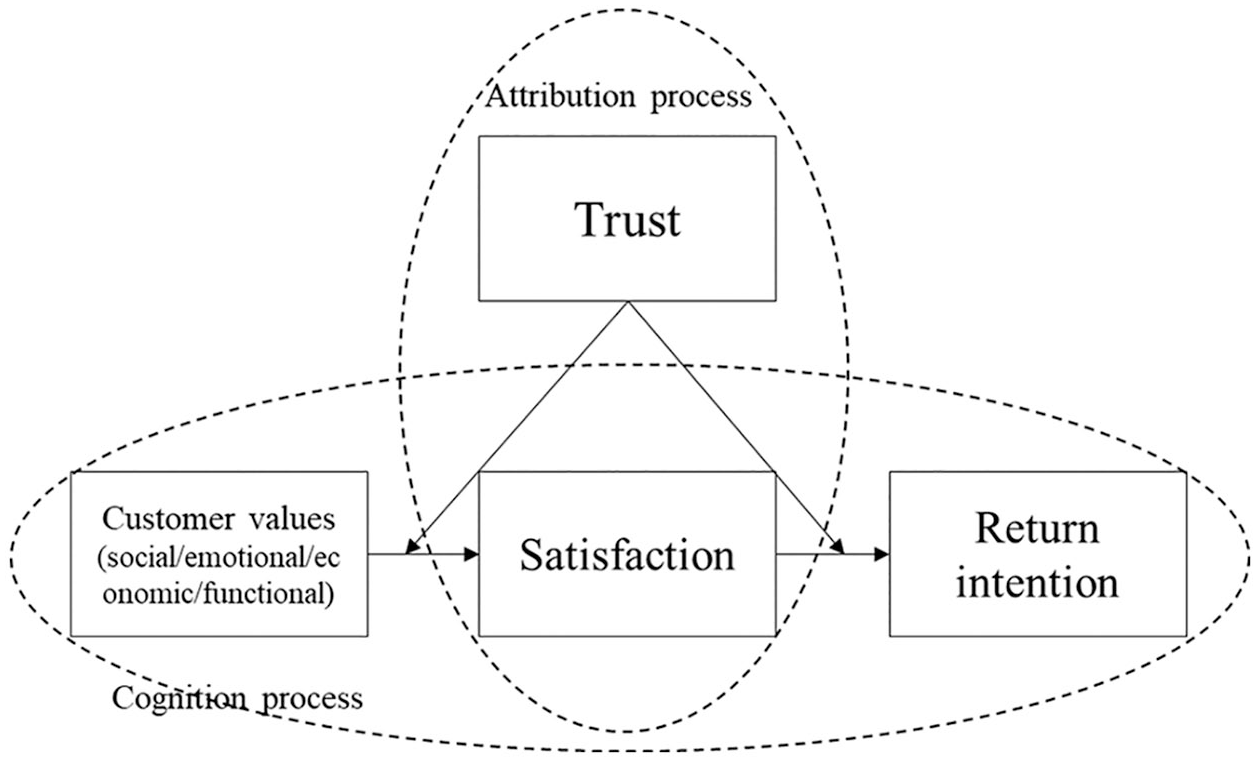
Theoretical Framework
Hypothesized Model
The hypothesized model is proposed based on the aforementioned theoretical framework. Return intention is operationalized as customers’ tendency to reuse P2P accommodation (rather than other forms of accommodation such as hotels and motels). A thorough literature review identifies four customer value dimensions that can account for customer satisfaction and return intention in the P2P sharing economy: economic benefits, social connection, enjoyment, and sustainability.
Economic benefit (economic value) refers to deriving good value for money. Many experts believe that the sharing economy is an appealing alternative to consumers because it enables them to acquire a desired product or service at a lower price (Guttentag, 2015; Möhlmann, 2015). Social connection (social value) refers to the experience of building social relationships or becoming integrated into local communities by availing of P2P accommodation (Guttentag, 2015). Enjoyment (emotional value) represents the extent to which P2P consumption (e.g., staying at a P2P accommodation unit) is perceived as personally enjoyable. Scholars believe that customers can perceive enjoyment in sharing activities and find the use of P2P accommodation interesting. Sustainability (environmental value) refers to the degree to which customers perceive that P2P services can benefit the sustainable development of human society by reducing consumption-induced resource depletion. The sharing economy features sharing, bartering, and other exchanges of idle assets, and thus, decreases the development of new products and the consumption of raw materials.
The aforementioned quaternary dimensionality of P2P customer value reflects the PERVAL model and has already been applied to predict customer satisfaction and return intention in various models in extant sharing economy research (e.g., Tussyadiah, 2016; Tussyadiah & Pesonen, 2016). Therefore, the following hypotheses are formulated:
Trust in web-based exchange contexts (including the P2P sharing economy) can be operationalized as either a unidimensional or multidimensional construct. As a multidimensional construct, trust can be divided into trust on the vendor, platform, and product/service (e.g., Han et al., 2016; Tussyadiah & Pesonen, 2016), based on the type of trustees. As a unidimensional construct, trust can represent a general, combined attitude of optimism about the goodwill and capability of the exchange partner, platform, or technology (as a whole) to fulfill his or her promised obligations (McKnight & Chervany, 2001; Mittendorf, 2016). For simplicity, the model used in this study follows the unidimensional approach and regards trust as a combined impression, which can be reflected as the trust toward a host, platform, and service. The unidimensional approach has been adopted by many e-business researchers, such as Leonard and Jones (2009), and Yoon and Occeña (2015), and has been used in organization studies that model the moderating effect of trust.
Extant sharing economy studies have mostly emphasized the direct effect of trust during the prepurchase stage (e.g., Guttentag, 2015; Keymolen, 2013). By contrast, the moderating effect model during the postconsumption phase has received relatively scant attention, and most empirical studies on this topic have focused on organizations and social settings (e.g., Innocenti et al., 2011; Neeraj, 2009; Wang et al., 2013). Although few scholars have noted the moderating effect of trust in the e-commerce setting (Chang & Wong, 2010; Riemenschneider et al., 2009), empirical evidence remains scarce. Therefore, the following hypotheses concerning this effect are proposed:
Trust can strengthen/weaken the relationship between value, satisfaction, and return intention because it can shape how people interpret the P2P accommodation service performance (Chang & Wong, 2010; Riemenschneider et al., 2009). However, such moderating effects of trust are contingent on the situational strength (Dirks & Ferrin, 2001). In other words, the moderating effects of trust may not exist in weak structures where a customer is much less familiar with the vendor/platform. The P2P accommodation market in China has witnessed the rise of various domestic platforms (e.g., Tujia, Xiaozhu), as well as the entry of international giants such as Airbnb. The domestic and international platforms can operate very differently; consumers may be more familiar with domestic than foreign platforms, rendering the latter as “weak structures.” Therefore, it is reasonable to hypothesize the following:
Methodology
Instrumentation, Sample, and Data
All constructs were measured using items adapted from previous scales (see Appendix 1 in the online supplement). The English items were translated into Chinese by two native Chinese speakers. The English items of the questionnaire designed for this research were translated into Chinese by two native Chinese speakers. The two versions were then compared and mismatches were identified and subsequently modified. Last, a panel that comprised a professor and several students majoring in hotel and tourism management assessed the validity of the questionnaire. All confusing expressions were addressed before data collection.
Data were collected through an online survey conducted on a Chinese survey platform, Sojump (www.sojump.com). Sojump is currently the largest online survey platform targeted at Chinese respondents with more than 26 million users. The platform has a panel of survey respondents, which has millions of members. The profile of the survey panel can be found on its official website (https://www.wjx.cn/sample/service.aspx). To ensure that the participants’ memory of the P2P accommodation experience is not distorted over time, the survey was targeted at tourists who had used P2P accommodation in the previous three months.
To familiarize participants with the concept of P2P accommodation, the questionnaire provided its definition and characteristics in the introduction and listed three of the most popular platforms as examples, namely, Airbnb, Xiaozhu.com, and Tujia.com (State Information Center of China, 2020). The main body of the questionnaire comprised three parts. Part A included screening questions to identify a target sample (“Have you ever used a P2P accommodation?” and “When was your most recent visit to a P2P accommodation?”). Respondents without a P2P accommodation experience in the past 3 months were excluded automatically by the system. Respondents were also required to indicate the specific platform used. Part B included questions that measured all related constructs on a 5-point Likert-type scale. The participants were asked to answer these questions based on their most recent P2P accommodation experience. Last, Part C comprised a series of questions on the sociodemographic and trip attributes of the participants.
A pilot test was conducted on August 17 and 20, 2016. A total of 30 participants were recruited through the internet to complete the questionnaire and assess its quality. Feedback was collected and the design of the questionnaire was slightly revised accordingly. The main survey was conducted over 3 weeks (September 3-25, 2016). The questionnaire was pushed to the panel member respondents randomly by the online survey platform. A total of 500 valid questionnaires were collected and enrolled into data analysis.
MSEM and Interaction Terms
Previous studies have commonly assessed the moderating effects of latent variables by either using regression analysis with product terms generated from the summed indicants of independent variables or multiple group SEM, which divides cases into subgroups using the summed indicants of moderators and then tests for significant coefficient differences among the groups. However, product term regression analysis has been criticized for its lack of statistical power for latent variables that are measured with errors (Aiken & West, 1991), while, multiple group SEM has been criticized for its information loss and power reduction when detecting interaction effects (Type II errors) resulting from artificial grouping.
To address these concerns, MSEM has been suggested as a substitute. MSEM creates latent interaction variables using the products of indicants (Kenny & Judd, 1984). Measurement errors can be controlled, the continuous nature of the moderator can be retained, and the underestimation problem can be rectified. Ping (1995) proposed a simplified MSEM approach that generates only one indicant for each interaction term, and thus, avoids creating excessive additional variables that produce convergence problems and infeasible solutions in large models. This study follows the three-step approach proposed by Cortina et al. (2001) based on Ping’s work (1995) to create a single-indicant interaction term. The calculation of interaction terms, as well as their path coefficients and error terms, is presented in online supplement Appendix 2.
Common Method Bias
Data were collected from a single source in this study; thus, the occurrence of the common method bias should be determined. Several recommendations were followed during the research design and data analysis phases (Podsakoff et al., 2012). First, the total anonymity of the survey was assured. Second, we randomly placed anchor questions, such as “if you are reading this question, then please select agree to a very large extent,” to ensure the quality of responses of the online survey. Responses that did not pass these test questions were counted as invalid and automatically excluded. Third, the survey questions in Part B were divided into four subsections: antecedents (customer value dimensions), moderator (trust), mediator (satisfaction), and outcome (return intention). Respondents who completed one subsection of questions were required to take a break and perform several unrelated tasks before they could proceed to the next section. Last, confirmatory factor analysis (CFA) was conducted during the analysis phase to assess the bias.
Results
Descriptive Analysis
Table 2 presents the profile of the 500 respondents and their trips. The respondents were young, with 50% between the ages of 21 and 30 years. This percentage is reasonable, given that most internet and P2P accommodation users are young people. Members of the younger generation in China are considered “digital natives,” who have spent most of their lives in an online environment, are more willing to accept new products via the internet, and are more proficient in this realm (Stanat, 2006). The majority (71.8%) of bookings were for leisure trips. Airbnb was the most frequently used P2P accommodation platform, which accounted for 40.2% of the trips. Most accommodation costs ranged from CNY100 to CNY500 (approximately US$15 to US$75). This range is reasonable because tourists who choose P2P accommodation are generally price sensitive.
Profile of Respondents and Their Most Recent Trips (N = 500)

Note: 1 CNY = 0.15 US$.
Measurement Models
The reliability and validity of the measurement scales were first assessed (Table 3 in the online supplement material). The Cronbach’s α values for all the seven constructs surpassed the critical value of .70, thereby suggesting good internal consistency of the measurement scales (Bagozzi & Yi, 2012). Indicator reliability was assessed by examining each factor loading. The result demonstrated that factor loadings were higher than .70 for all the constructs, which implied good indicator reliability for all the measurement scales (Hair et al., 2011).
CFA was conducted to establish the convergent and discriminant validities of the seven scales. A full measurement model was constructed and tested, and all the factors were allowed to correlate. The seven-factor model achieved good overall fit, except for the significant χ2 values, that is, χ2 = 1044, degrees of freedom [df] = 329, root mean square error of approximation (RMSEA) = 0.06, root mean square residual (RMR) = 0.06, normed fit index (NFI) = 0.908, and comparative fit index (CFI) = 0.935. However, considering the complexity of this model due to the number of indicators (Cortina et al., 2001) and given that χ2 values are highly sensitive to large sample size (Bentler, 1990), this high value is within expectations and reflects the results of published studies (Nishii et al., 2008).
The average variance extracted (AVE) values were calculated using the equation proposed by Fornell and Larcker (1981) and used to establish convergent validity. All AVE values for the constructs were higher than 0.5, except that of trust (which was lower than but close to 0.5). This result implied that the measurement scales exhibited good convergent validity (Hair et al., 2011). Discriminant validity was established based on the rule of thumb proposed by Fornell and Larcker (1981), in which the AVE value of each latent construct and its squared correlations were compared with the remaining constructs. The AVE of each latent construct was higher than the highest squared correlation with any other latent variable, which implied good discriminant validity. The common method bias may not be a problem because each variable in this study is distinct.
Structural Model and Moderating Effect
After conducting CFA, a full structural model was constructed and estimated based on the hypotheses. The moderating effects of trust between perceived value components and satisfaction and between satisfaction and return intention were represented by five single-indicant interaction factors, which were directly incorporated into the structural model. Error terms were not allowed to correlate and the parameters were estimated using the default maximum likelihood method. With the exception of the χ2 statistic, the model achieved good overall fit, that is, χ2 = 991, df = 390, RMSEA = 0.056, standardized RMR (SRMR) = 0.046, NFI = 0.919, and CFI = 0.949. Figure 2 (available in the online supplement material) presents the results of the structural model.
The results of the SEM modeling generally supported the fitness of the perceived value–satisfaction–return intention framework in the context of P2P accommodation. This model consists of four alternative hypotheses that depict the indirect effects of four perceived values on return intention via satisfaction. As shown in Figure 2 (available in the online supplement material), all the alternative hypotheses were supported. Perceived enjoyment exerted a direct, positive, and significant effect on satisfaction (0.820, p < .01) and an indirect, positive, and significant effect on return intention (0.820*0.845 = 0.693, Sobel test statistic = 0.820, p < .01). Thus, Hypothesis 1a was supported. Perceived sustainability exerted a direct, positive, and significant effect on satisfaction (0.111, p < .05) and a significant indirect effect on return intention (0.111*0.820 = 0.091, Sobel test statistic = 2.039, p < .05). Hence, Hypothesis 2a was supported. Similarly, perceived economic benefit positively, directly, and significantly affected satisfaction (0.134, p < .05) and indirectly affected return intention (0.134*0.845 = 0.113, Sobel test statistic = 3.06, p < .01), which supported Hypothesis 3a. Perceived social connection exerted a positive, significant, and direct effect on satisfaction (0.153, p < .01) and a positive and indirect effect on return intention (0.153*0.845 = 0.129, Sobel test statistic = 2.696, p < .01). Thus, Hypothesis 4a was supported. Last, the direct effect of satisfaction on intention was significantly positive (0.845, p < .01). Therefore, Hypothesis 5a was supported.
The hypotheses regarding the moderating effects of trust were represented by five interaction terms. The interactivity analysis is presented in Figure 3. The product term of trust and perceived enjoyment exerted a positive effect on satisfaction (0.136, p < .01), thereby implying that trust had a positive moderating effect on the relationship between perceived enjoyment and satisfaction. Thus, Hypothesis 6a was supported. Similarly, the interaction terms of trust and sustainability (0.168, p < .01) and trust and economic benefit (0.186, p < .01) exerted positive effects on satisfaction, which implied that trust may positively moderate the effects of perceived sustainability and economic benefit on satisfaction. Therefore, Hypotheses 7a and 8a were supported. Notably, the interaction term of trust and social connection had no significant effect on satisfaction, thereby suggesting that trust exerted no moderating effect in this case, and thus, Hypothesis 9a was not supported. Last, the interaction term of trust and satisfaction had a positive effect on return intention (0.270, p < .05), which provided support for Hypothesis 10a.
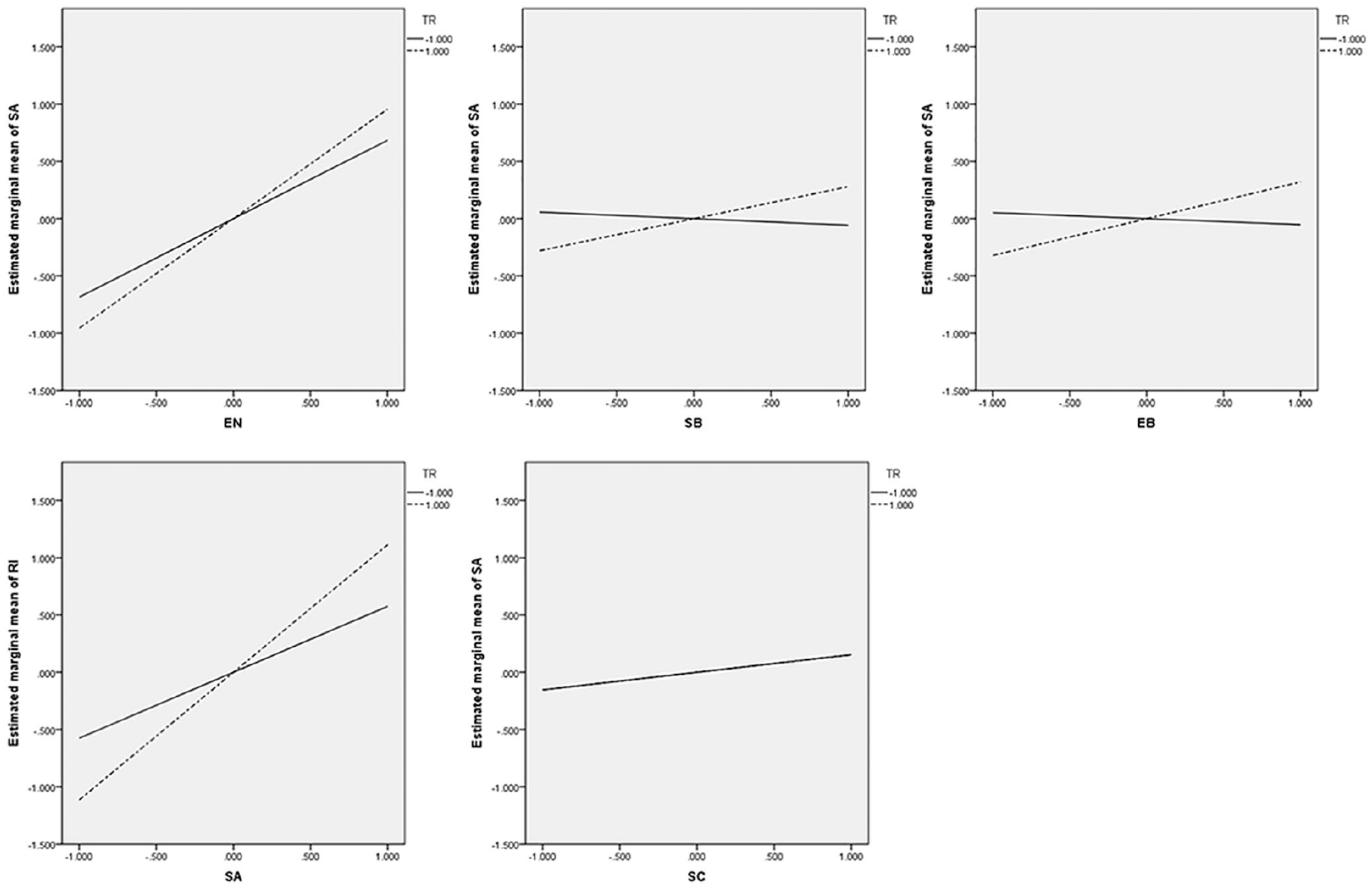
Interactivity Analysis
Comparison Between Airbnb and Domestic Platforms
Airbnb customers (N = 201) and domestic platform users (N = 299) were compared to further investigate the hypothesized model. The MSEM model achieved good overall fit for the Chinese platform group (χ2 = 557.276, df = 324, SRMR = 0.056, CFI = 0.968, and RMSEA = 0.049). However, it demonstrated poor fit for the Airbnb group (χ2 = 965.615, df = 336, SRMR = 0.08, CFI = 0.881, RMSEA = 0.097). Therefore, a regular SEM model without moderation terms was implemented, which generated improved fit (χ2 = 688.710, df = 235, SRMR = 0.065, CFI = 0.900, and RMSEA = 0.058). Accordingly, the nonmoderation model was adopted for the Airbnb group. The result of the comparison is presented in Figure 4.
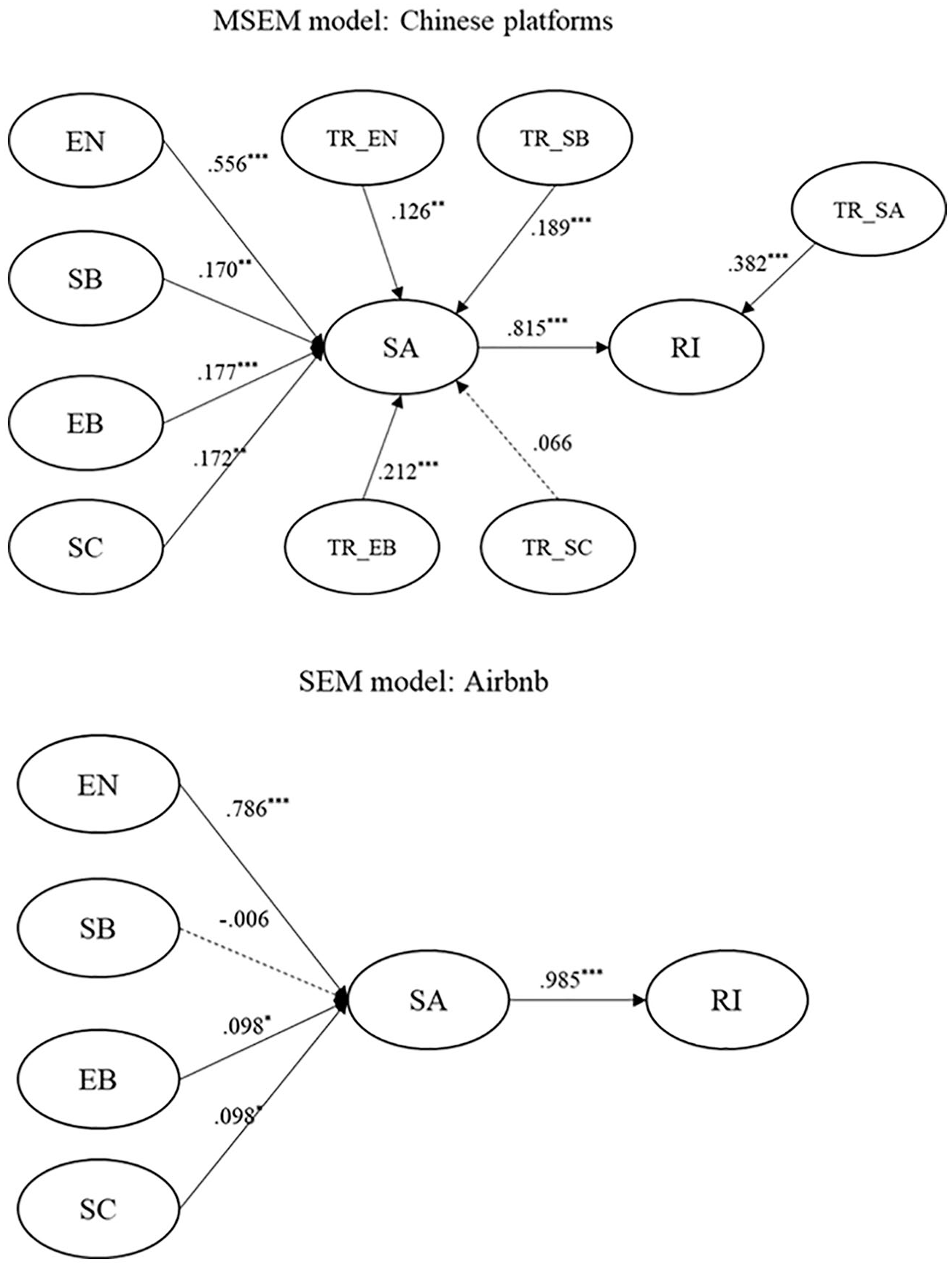
Comparison Between Airbnb and Chinese Domestic Platforms
The MSEM model in the Chinese platform group demonstrates results similar to those in the aggregated group. Nearly all the alternative hypotheses were supported, except for Hypothesis 8a. However, the SEM model in the Airbnb group only supported Hypotheses 1a, 3a, 4a, and 5a. The direct effect of sustainability on satisfaction and the moderating effect of trust were not confirmed for Airbnb customers. As such, Hypothesis 11 was supported.
Discussion
The four perceived values exert positive indirect effects on repurchasing intention via satisfaction. These findings are generally consistent with conceptual and empirical studies on the sharing economy. For example, studies with samples from the United States (Tussyadiah, 2016) and Finland (Hamari et al., 2016) demonstrated that perceived economic benefit is a good predictor of user satisfaction in the Western context. Chinese consumers are typically price conscious about hotel services (Guo et al., 2007); thus, the finding that good value for money strongly influences their satisfaction and repurchase intention is expected.
The positive effect of perceived social connection is also consistent with previous findings (Kim et al., 2015; Tussyadiah, 2016). Notably, the effect of perceived social connection can be strengthened by the collectivist orientation of the Chinese, which is characterized by a preference for close relationships (Hofstede, 1984). China scored 20 in the individualism dimension of its culture, which is considerably lower than those typical of Western countries, including the United States, which scored 91, and the United Kingdom, which scored 89 (Hofstede Insights, 2017). The strong desire of Chinese customers toward socialization and a sense of belonging is unsurprising. Enjoyment is associated with interest, curiosity, and novelty seeking. The identified positive effect is also reasonable, given that P2P accommodation is emerging as an innovative form of hospitality in China. Consequently, customers are likely to expect that adventurous enjoyment and pleasure are associated with this new accommodation style.
The effect of sustainability is worth discussing. P2P accommodation users have been widely assumed to pursue sustainable experiences. However, research regarding the effect of perceived sustainability has generated conflicting results. Tussyadiah (2016) found that sustainability exerts negative effects on satisfaction and return intention and explained that customers may not value efforts toward environmental protection that will influence their P2P accommodation experiences. Palgan et al. (2017) determined that although customers are aware of the sustainability of P2P accommodations, they do not participate in such a service because of environmental reasons. By contrast, Hamari et al. (2016) reported that sustainability exerts a positive effect on user attitude. The conflicting effects of sustainability can probably be attributed to varying cultural backgrounds, ideologies, and social norms. Following the self-determination theory, sustainability can only influence attitude when this value is highly internalized (Hamari et al., 2016). For customers who are concerned about the environment, sustainability can be a benefit from their perspective, which will not be the case for customers who care less about the environment.
The moderating effect of trust is the core interest and the most significant finding of this study. The results support the notion that trust positively moderates the effects of nearly all the perceived values on satisfaction, except for social connection. Thus, if a consumer holds P2P accommodation in high trust, then positive perceptions of economic benefit, enjoyment, and sustainability may strongly influence satisfaction. Moreover, trust positively moderates the effect of satisfaction on intention, which indicates that satisfaction may exhibit a strong predictive power for return intention among consumers with high trust. These findings empirically reflect the results in organizations and social settings (e.g., Innocenti et al., 2011; Neeraj, 2009; Wang et al., 2013).
However, the moderating effect of trust on the relationship between social connection and satisfaction is insignificant. A possible explanation is that social benefit is related to interpersonal interaction and the relationship and sense of belonging developed during this process are generally manageable. This concept differs from enjoyment, economic benefit, or sustainability, in which consumers’ judgment is mostly based on information related to the service provider. Therefore, the neutralizing effect of trust derogation may not be as significant for social connection as those for the other three perceived values.
The comparison between Airbnb and Chinese domestic platform customers generates contrasting findings that should be discussed. The sustainability value significantly affects Chinese platform customers but does not affect Airbnb customer satisfaction. Similarly, trust does not exert a moderating effect on Airbnb customers’ perceived value–satisfaction–return intention framework. As a global platform, Airbnb features various accommodation products worldwide, and its users are mostly international travelers. Chinese tourists, therefore, can be less familiar with it (compared with other domestic platforms). Therefore, it can be perceived as fraught with uncertainties. In this sense, the use of Airbnb belongs to a “weak structure,” in which customers have insufficient clues to completely evaluate its products/services, even after consumption. Therefore, trust in this context does not shape the attribution process, which results in insignificant moderating effects.
Implications
This study contributes to customer behavior studies and sharing economy knowledge in several aspects. First, it identifies the determinants of both consumer satisfaction and return intention that are associated with P2P accommodation. These determinants represent the distinguishing features of internet-based accommodation, such as Airbnb, and are distinct from previous findings dominated by service or experience quality indices.
Second, this study considers the moderating role of trust, and thus, provides at least two major theoretical contributions to consumer knowledge beyond the sharing economy context: (1) It improves the extant knowledge regarding how trust can shape consumer behavior during the postconsumption stage, given that previous studies have rarely examined the moderating effect of trust in the sharing economy. Building on this study, future studies can further investigate how trust can moderate the effects of customer cognition, apart from the value (e.g., service quality and perceived experience), and whether various forms of trust (e.g., trusts on the vendor, platform, or product) can function differently; (2) It enhances the explanation of the value–satisfaction–return intention framework by simultaneously modeling the cognitive and attribution processes. As a pioneering study in this aspect, the current work paves the way for future studies to consider additional factors that can shape the attribution process, such as personality and expectation.
Based on the above findings, platforms should further enhance their image of being playful, interesting, and exciting to distinguish themselves from traditional accommodations. Creating an image of sustainability may also be helpful and can be achieved by providing recyclable products in accommodations and encouraging customers to sort garbage and save energy during their stay. To facilitate the social connection between hosts and guests (or between guests), the platform can significantly improve their website design. For example, a module that allows both hosts and guests to create and “follow” each other’s updates would be conducive to such connection. To build trust, the platform also has various options. The primary measures would be completing personal profiles (e.g., education, hobbies) for both hosts and guests, establishing a strict trust policy including background checks of hosts and ocular inspections of listed rooms, and guaranteeing a secure online transaction environment for customers. Technological measures are also suggested to improve the platform–customer interface to create a sense of trust during the human–computer interaction. In this regard, one effective method is to imbue the website with a high social presence (S. Ye et al., 2020) by integrating multimedia elements of the interface to facilitate actual or imaginary interactions. The website design should be polished so that users can change its characteristics (e.g., language, page arrangement) or interact with it through its given form; by contrast, these nonverbal cues should be added into host–guest communications, such as gestures, humorous content and emoticons, and timely self-disclosure of messages including one’s thoughts, feelings, and experiences. The development of augmented reality/virtual reality technology offers more opportunities to improve trust. The platform can reshape its interface with more augmented reality/virtual reality settings to create a sense of face-to-face interaction, which can be conducive to trust building.
Limitations
Despite its contributions, this study has several limitations. The online survey and convenience sampling resulted in the centralization of the respondents’ ages (over 50% were between the ages of 21 and 30 years), with middle-aged and elderly P2P accommodation customers being less represented. A more diverse demographic profile should be adopted in future studies. Moreover, the determining mechanism of consumer behavior can assume different forms due to the unique attributes of platforms. Therefore, the model examined in this study can be moderated by brands and other factors, such as trip traits (e.g., single or group tours). Finally, the research findings of this study can only be generalized for Chinese consumers (and at its best, to some other Asian developing countries). Due to cultural differences and gaps in economic development level, consumers in developed countries such as the United States are very likely to display different behavior patterns. Therefore, future studies should be carried out in diverse research contexts to validate the moderating effects of trust.
The outbreak of the coronavirus disease of 2019 (COVID-19) has significantly affected the global tourism industry and tourist behavior patterns were expected to change afterwards. Tourists might pay more attention to the health risks during their stay in a P2P accommodation unit, and thus, functional values (safety, hygiene) may have much stronger effects on satisfaction and return intention. The pandemic can also add to the uncertainty of living in a P2P accommodation, and thus, the role of trust could be even more significant. Despite such limitations, the theoretical value of this study will be not undermined. It provides baseline findings for future comparison with postpandemic research, and thereby can reveal how the pandemic can reshape tourist behavior. Moreover, changes in behavior patterns brought by the pandemic are unlikely to last forever. The pandemic will end someday and the global tourism will go back to the normal track, and so will tourists’ behavior modes. In this sense, findings by this study are still benefiting in the long-run.
Concluding Summary
In this study, we extended the classic value–satisfaction–loyalty framework by incorporating the moderating effect of trust and compared the users of Airbnb and Chinese domestic platforms. Four perceived values (social connection, enjoyment, economic benefit, and sustainability) were found to exert positive indirect effects on repurchasing intention via satisfaction. Trust positively moderated the effects of nearly all the perceived values on satisfaction, except for that on social connection. Moreover, trust also positively moderated the effect of satisfaction on intention. However, the modeling effects differed significantly between Airbnb and Chinese domestic platforms. The sustainability value significantly affected Chinese platform customers but did not affect Airbnb customer satisfaction. Similarly, trust did not exert a moderating effect on Airbnb customers’ perceived value–satisfaction–return intention framework.
Supplemental Material
sj-docx-1-jht-10.1177_10963480211014249 – Supplemental material for Moderating Effect of Trust on Customer Return Intention Formation in Peer-to-Peer Sharing Accommodation
Supplemental material, sj-docx-1-jht-10.1177_10963480211014249 for Moderating Effect of Trust on Customer Return Intention Formation in Peer-to-Peer Sharing Accommodation by Shun Ye, Siyu Chen and Soyon Paek in Journal of Hospitality & Tourism Research
Footnotes
Acknowledgements
The first author acknowledges the support from National Natural Science Foundation of China (NSFC; Grant No. 72004195).

Supplemental Material
Supplemental material for this article is available online.
References
Supplementary Material
Please find the following supplemental material available below.
For Open Access articles published under a Creative Commons License, all supplemental material carries the same license as the article it is associated with.
For non-Open Access articles published, all supplemental material carries a non-exclusive license, and permission requests for re-use of supplemental material or any part of supplemental material shall be sent directly to the copyright owner as specified in the copyright notice associated with the article.
