



Abstract
This study investigates the prospects of using electroencephalography (EEG) in tourism and hospitality research. It first discusses the concept and importance of EEG. Then, it systematically reviews articles that have used EEG to measure psychophysiological responses in business and management. The review mainly discusses EEG themes/theories/concepts and EEG methods and indices. Based on the review, this study analyses main challenges of applying EEG and suggests solutions to solve them. It finally proposes some future applications of EEG in tourism and hospitality. This study is one of the first to offer a better understanding of the literature, analysis methods, and theories/concepts associated with EEG, informing future EEG applications in tourism and hospitality research.
Introduction
Electroencephalography (EEG) refers to brain activity variations produced by the cortex and measures emotional and cognitive responses (Khushaba et al., 2013; Ohme et al., 2009). Compared with traditional approaches, EEG has the advantage of measuring emotions in real time by monitoring second-by-second changes in brain activity (Ohme et al., 2009). EEG analysis makes it possible to reveal the black box of the brain to deeper understanding the cognition and emotional process (Minas et al., 2014). EEG has often been applied in market research, with the first studies appearing in the 1970s and 1980s (Ohme et al., 2009). By using EEG, Krugman (1971) evaluated consumer engagement with advertising and Alwitt (1985) examined advertising content. Our review indicates that there has been a growing interest in the application of EEG in business and management in the past decade. However, the application of EEG in tourism and hospitality is still in its infancy, with only one study using EEG based on primary research (i.e., Bastiaansen et al., 2018). Nevertheless, technological improvements and the relevance of emotion studies in tourism and hospitality are likely to increase the use of EEG in this field.
With increasing criticism against self-report methods applied in the current body of knowledge of tourism research (Hadinejad et al., 2019), it is of particular importance to improve the understanding and utilization of EEG analysis as a rigorous method in the tourism field. The benefits of using EEG over traditional self-report surveys or questionnaires in marketing and consumer research have been well explained in the literature (e.g., Lin et al., 2018). While consumer verbal responses are relatively simple and easy to collect, analyze and monitor, self-reported data are usually collected after the event under study, which may lead to cognitive distortions and a lack of real-time emotional responses (Matukin et al., 2016). The EEG method is considered as an alternative that is capable of providing more objective and convincing evidence of the topics studied (Lin et al., 2018). Using EEG can prevent cognitive distortions and measure emotions by examining brain activity.
People can be seen as bounded rational when they rely on heuristics to simply complex decisions or make decisions not purely based on achieving self-interest (Wilkinson & Klaes, 2012) and when their decision-making process is affected by their internal emotional changes. Consumers in the tourism and hospitality industry are more likely to make decisions based on bounded rationality, which is affected, for example, by emotions (Boz et al., 2017; Bastiaansen et al., 2018). In other words, tourists’ emotions that are generated by particular stimuli such as images can influence their decisions. For example, Moyle et al. (2018) examined how various images were used to induce positive/negative emotions to influence tourists’ behavior. Tourists are not usually consciously aware of their feelings or they may wrongly recall their emotions (Bagozzi, 1991). Therefore, applying EEG to study tourists’ real-time emotions and the influence of emotions on behavior is appropriate.
This study investigates the prospects of using EEG in tourism and hospitality research. It comprehensively and critically reviews studies that have used EEG in the business and management field to highlight its potential use in tourism and hospitality research. There are three main research objectives. First, it critically reviews studies using EEG to measure psychophysiological responses in business and management research. Second, the main challenges of using EEG are identified along with suggestions for overcoming them. Third, it proposes future EEG applications in tourism and hospitality research. This study makes two contributions. First, it is one of the first studies to comprehensively review the use of EEG in business and management research, which helps understand the theories/concepts associated with EEG and informs future EEG applications in tourism and hospitality research. Second, this study has useful and important implications for the operation of EEG experiments in tourism and hospitality.
Background: The Concept and Importance of EEG
EEG is a powerful research tool in neuroscience and more specifically in neuromarketing. The application of neuroscience to human decision making has attracted attention (Hubert, 2010). The advantages of applying neuroscience in in business and management studies include to better predict relevant theories and generate more accurate measures (Waldman et al., 2017). For example, using EEG to map brain activity can help determine the neurological profile of ethical leadership when investigating leaders’ ethical behavior (Waldman et al., 2017). Another strength of neuroscience is that it can capture subconscious and emotional responses that are difficult to capture accurately using traditional self-report methods, such as surveys. Neuromarketing, derived from neuroscience, uses psychophysiological and neuroscientific techniques such as EEG to measure consumer responses to specific stimuli (Hubert & Kenning, 2008). The transdisciplinary research area of neuromarketing contributes to the understanding of consumer attitudes and behavior, such as decision making, by combining knowledge of business, management, and brain research (Hubert, 2010). First proposed by Ale Smidts (2002), neuromarketing refers to the application of neuroscience methods and knowledge in the context of marketing (Hubert & Kenning, 2008), and more specifically in advertising (Matukin et al., 2016), branding (Yoon et al., 2006) and consumer decision making (van Zeeland & Henseler, 2018).
Compared with conventional market research methods such as surveys and interviews, neuromarketing has two main strengths that contribute to a more accurate examination of consumer behavior. First, traditional methods that rely on people’s self-reports of their thoughts and feelings can be biased due to poor memory or a reluctance to reveal their true feelings (Bagozzi, 1991; Hetland et al., 2016). This limitation can be overcome by neuromarketing research using technological devices and collecting real-time neural data such as electrodermal activity, brain activity, blood pressure, heart rate, eye movement, and facial expression (Fortunato et al., 2014). Second, traditional methods capture people’s conscious responses, but the majority (95%) of the decision-making process is unconscious and can only be measured by the neuromarketing approach (Zaltman, 2003). Therefore, neuromarketing is considered to be crucial in the development of marketing strategies (Ariely & Berns, 2010). Despite the usefulness of neuromarketing, it has rarely been applied in the tourism and hospitality field although has applied to many other industries, such as automotive, beverage, and advertising (Touchette & Lee, 2017).
EEG is commonly used to measure brain activity. To better understand this concept, EEG is discussed in the broader context of measuring brain activity associated with the nervous system. It is difficult to analyze the human brain because it is the most complex biological system. As the main component of the nervous system, the central nervous system, formed by the brain and spinal cord, integrates and processes the information received and then coordinates the actions stimulated by this information (Eftaxias, 2015). There are different techniques for mapping brain signals (Vaid et al., 2015), including EEG, fMRI (functional magnetic resonance imaging), MEG (magnetoencephalography), NIRS (near-infrared spectroscopy), PET (positron emission tomography), and EROS (event-related optical signal).
Compared with other tools measuring brain activities, EEG has two main advantages (Matukin et al., 2016). First, it is a noninvasive and relatively inexpensive technique (Minas et al., 2018). Second, EEG can measure electrical signals in submillisecond intervals, which has the highest temporal resolution among all the neuroimaging techniques (Minas et al., 2018). fMRI has a longer resolution time of several seconds (Boshoff, 2017). Compared with fMRI, the disadvantage of EEG is that it has limited spatial resolution, meaning that it is hard to localize the source of the brain wave (Boksem & Smidts, 2015); thus, EEG research has mainly focused on the frequency domain analysis among which the alpha band has been most used (Minas et al., 2018).
Literature Review: The Application of EEG in Business and Management Research
Methodology
A two-stage approach to select relevant articles applying EEG in business and management research was adopted. For the purpose of this study, the first stage focused on business and management articles not related to tourism/hospitality and the second stage emphasized tourism and hospitality articles. As EEG has rarely been used in tourism and hospitality research, the review of general business and management studies can inform EEG theories and approaches in tourism and hospitality research. Relevant articles published between 1986 and 2019 were searched for in the 2019 Social Science Citation Index (SSCI) database. This publication range was chosen because the SSCI database provides articles that have been published since 1986. SSCI is a widely used and internationally recognized source of humanity and social science journals due to its quality standard (Law & Chon, 2007). The literature search was conducted by searching the Web of Science electronic databases, which contains the SSCI database.
At Stage 1, a search was conducted using the category of business and management journals in SSCI, containing a total of 364 journals. Articles were selected if the word “Electroencephalogram” or its abbreviation “EEG” existed in the title, abstract, or keyword sections. The search retrieved 46 articles (10 more articles published in 2019 were newly retrieved). Each retrieved article was read to eliminate unqualified articles. Specifically, one article on EEG in tourism and hospitality was removed because Stage 1 sought to identify articles not related to the field of tourism and hospitality. For the purpose of this review, 11 articles that did not apply EEG in their primary research were also excluded. In addition, as there was no access to Entrepreneurship Research Journal, one article published in this journal was not included following Hung and Law (2011). As a result, 33 articles from 21 journals were retained for further analysis (see Table 1).
Retrieved Articles
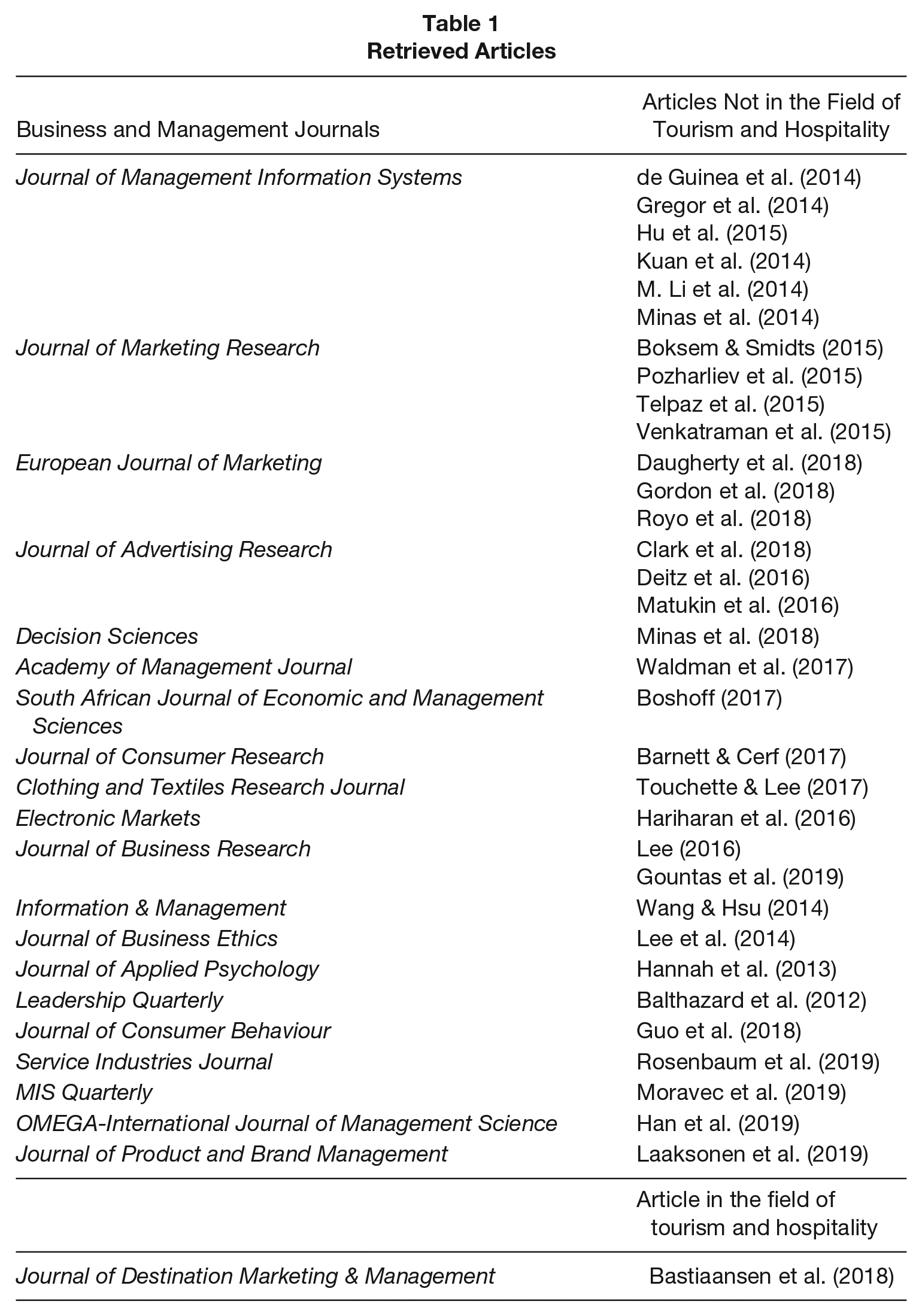
At Stage 2, the steps of Stage 2 were similar to those of Stage 1. The Hospitality, Leisure, Sport, and Tourism category in SSCI contained a total of 52 journals, from which 31 articles were retrieved. As the review of Stage 2 focused on tourism and hospitality, articles in the field of sports or leisure were removed. Moreover, articles with the keyword “EEG” indicating “Evolutionary Economic Geography” instead of “Electroencephalogram” were deleted. In the end, only one article used EEG in tourism research (see Table 1).
Results
The review of the articles using EEG in business and management research is summarized and discussed in three aspects: EEG themes/theories/concepts, EEG methods and indices, and the article applying EEG in tourism and hospitality research (supplemental material).
EEG themes/theories/concepts
There are probably five aspects that the neuroscientific approach, including EEG, can be applied to in order to improve the understanding of marketing theories and consumer behavior (Plassmann et al., 2015). The first is to identify the underlying mechanism of the cognition and emotional processes, which can help better understand associated consumer behaviors. For example, Lee et al. (2014) found that frontal theta EEG activation is a neural indicator of green consumers’ cognitive engagement with environmentally friendly product messages. Second, neuroscientific techniques can be applied to measure implicit processes, which it is hard capture by using traditional approaches. When social context, such as the presence of others, was presented, passive viewing of luxury branded products induced greater late positive potential amplitude measured by EEG than viewing basic branded products (Pozharliev et al., 2015). The third is to dissociate between psychological processes. Pozharliev et al. (2015) identified that being alone or with another person when viewing luxury versus basic branded products involved different neural processes for the P2 and P3 components over visual cortex sites. Fourth, individual differences in consumer behavior and the source of heterogeneity can be evaluated by using neuroscientific methods. Balthazard et al. (2012) found significant correlations between transformational leadership and EEG variables, including amplitude asymmetry, coherence, and phase lock duration, based on which transformational and nontransformational leaders can be classified. Fifth, neuroscience measures can improve predictions regarding consumer behavior. Neural similarity calculated by alpha oscillations is a predictor of recall of movie trailers and population-level sales (Barnett & Cerf, 2017). It should be noted that one study may involve more than one aspect.
The behavioral inhibition system/behavioral activation system (BIS/BAS) theory has been widely applied in EEG studies. Introduced by Gray (1982), the BIS/BAS theory is also known as reinforcement sensitivity theory in psychology. The BIS refers to avoidance or withdrawal behavior when responding to threats, which may lead to punishment or novelty (van Zeeland & Henseler, 2018). The BAS is associated with motivation in responding to rewarding incentives. Davidson et al. (1979) proposed a theoretical framework that links emotions with EEG measures: The left frontal area of the brain measures positive or approach-related emotions, and the right frontal area measures negative or withdrawal-related emotions. According to Davidson’s (2003) model, EEG can measure hemispheric activity in the prefrontal cortex. If the activity of the left hemisphere is greater than that of the right hemisphere, it leads to higher BAS scores. Conversely, if the activity of the right hemisphere is greater than that of the left hemisphere, it leads to higher BIS scores (Sutton & Davidson, 1997). Emotion regulation refers to conscious and unconscious processes when negative or positive emotions are increased or decreased (Gross, 1998). Research on emotion regulation has shown that emotion-focused coping can reduce the experience of negative emotions by avoiding negative information (Mogg et al., 2004), which has also been observed in EEG studies (e.g., Denson et al., 2012).
A number of studies have used EEG to study emotion. Emotion can be defined as “any brief conscious experience that intense mental activity and an elevated level of pleasure or displeasure characterises” (Gordon et al., 2018, p. 96). Emotion is considered to be one of the main factors that violates the “rational man” rule of traditional economics, as it is likely to affect consumers’ decision-making processes (LaBarbera & Tucciarone, 1995). Thus, it is important to capture the emotional responses in marketing research. It is widely accepted that brain activity patterns are closely linked to consumers’ cognition and behavior (Matukin et al., 2016). Therefore, using neurophysiological measurement methods, such as EEG, can capture more objectively the psychophysiological responses of consumers that they cannot control or manipulate (Burns et al., 2010). The concept of affect is associated with emotion as affect can be seen as the outward expression of an emotion, which consists of two dimensions, valence, and arousal (Venkatraman et al., 2015). Venkatraman et al. (2015) found that higher values of frontal asymmetry are related to affect in response to more effective ads.
Attention, which refers to people’s ability to focus on certain parts of the environment or objects, has also been widely studied using EEG (Venkatraman et al., 2015). In marketing research, attention has been used to study attitudinal and behavioral outcomes in consumers (Pieters & Warlop, 1999). By recording the EEG data associated with attention to visual stimuli, Barnett and Cerf (2017) examined whether cross-brain correlation can predict movie trailer recall and future ticket sales. They found that neural similarity can be a predictor of free recall. Attention is also seen as a type of emotional state by Rosenbaum et al. (2019). They examined the effects of the presence of greenery in consumption settings on consumers’ brain activation data associated with six emotional states such as attention, excitement, and interest. Specifically, attention restoration theory was applied to explore the effects of the incorporation of biophilic design elements in consumption settings (i.e., shopping malls) on reducing stress.
Another concept that links to emotion is empathy, which reflects people’s social nature and includes cognitive and emotional components. It can be defined as the ability for people to feel others’ emotions, which enables them to predict others’ behavior and to motivate altruistic behavior (Smith, 2006). It is believed that empathy relates to the neural mechanism that is involved in altruistic prosocial behavior (Lee, 2016). Using EEG, it has been shown that the neural mechanism of customer empathy plays a key role in responding to corporate social responsibility messages, in terms of reducing price sensitivity to prosocial products and increasing consumers’ willingness to pay for these products (Lee, 2016).
EEG has also been widely applied to memory theories. There are two types of memory processes: long-term memory and working memory. Long-term memory “stores an individual’s fundamental knowledge organised into central concepts that have features and linkages to related concepts” (Minas et al., 2018, p. 791). Working memory as short-term memory retrieves knowledge from long-term memory and applies it to a new domain through deliberate conscious cognition (Minas et al., 2018), by processing the results of idea generation guiding behavior in the very near future (Lee et al., 2014). Many of the studies reviewed linked working memory with attention, suggesting that consumer behavior can be influenced when they pay continuous attention to marketing stimuli and transfer their working memory to long-term memory (Gordon et al., 2018). More recent research has set out to explore various theories/concepts in one study. For example, Laaksonen et al. (2019) evaluated the effects of media brand knowledge on not only consumers’ emotional and attentional responses to but also their memory of news messages.
Other less used concepts considered to be related to neural activity include preferences and self-control. The frontal asymmetry theory has also been used to explain the relationship between hemispheric asymmetry in EEG signals and preferences/choice behavior (Sutton & Davidson, 2000). EEG activity has been found to be related to a trait of preference (Telpaz et al., 2015). Self-control has been defined as “resistance to temptation” in the neuroscience literature (Lopez et al., 2014). It is believed that self-control is connected with the prefrontal cortex, in particular its right region (Hu et al., 2015).
EEG methods and indices
Most of the reviewed articles used a mixed-methods approach, which can overcome the weakness of each method and thus generate more reliable outcomes. Also, different methods are able to process various information, which can generate rich and comprehensive research results compared with single method research (Gountas et al., 2019). Three types of mixed approaches are identified.
First, EEG data can be integrated with traditional self-reported approach including quantitative and/or qualitative data to explore people’s cognitive and emotional responses when expressing attitudes toward marketing or management issues (Clark et al., 2018). For example, the results of EEG and a postexperiment survey were applied, both showing that attractive apparel products triggered positive emotions, while unattractive apparel products triggered negative emotions (Touchette & Lee, 2017). Traditional methods that capture subjective attitudes and opinions are useful complements for psychophysiological methods that explore arousal, affective valence, cognitive effort, and motivation associated with brain activation (Clark et al., 2018). For example, Gountas et al. (2019) evaluated the effects of an anti-binge-drinking campaign and how young people react to binge-drinking. They discovered that focus group discussions were able to capture consumers’ deeper opinions regarding the messages while EEG was capable of identifying cognitive and affective engagement.
The second type of mixed methods involve using EEG with other psychophysiological sensors. As a consumer neuroscience measurement tool, EEG can be used with physiological metrics such as heart rate and skin conductance to evaluate levels of emotion and arousal (Stikic et al., 2014). The results generated by each method can be compared with those measured with other methods, thus increasing the validity of the study. Moreover, EEG research has generally been supplemented by eye tracking and facial expression measurements (Clark et al., 2018). Eye tracking, which measures participants’ fixation and period of gazing, can be used to identify objects that evoke participants’ emotional responses (Kamienkowski et al., 2012; Matukin et al., 2016). Real-time facial expressions can help determine emotional valence related to motivation (Ohme et al., 2009).
The third type of mixed approach refers to the use of EEG, other psychophysiological sensors and traditional self-report methods (e.g., Clark et al., 2018; Laaksonen et al., 2019). Boshoff’s (2017), for example, used both neurophysiological measures (EEG and Galvanic Skin Response) to measure subconscious responses and a traditional pencil-and-paper experiment to measure conscious responses to the attractiveness of frontline employees in a service failure and recovery situation. The results showed that while the answers were neutral at the conscious level, the responses varied depending on the attractiveness of the service provider at the subconscious level. This implies that using EEG to measure neural data can avoid effort and conscious reporting biases. Figure 1 summarized the number of articles retrieved using various EEG approaches, and showed that EEG with quantitative methods is the most commonly used combination.
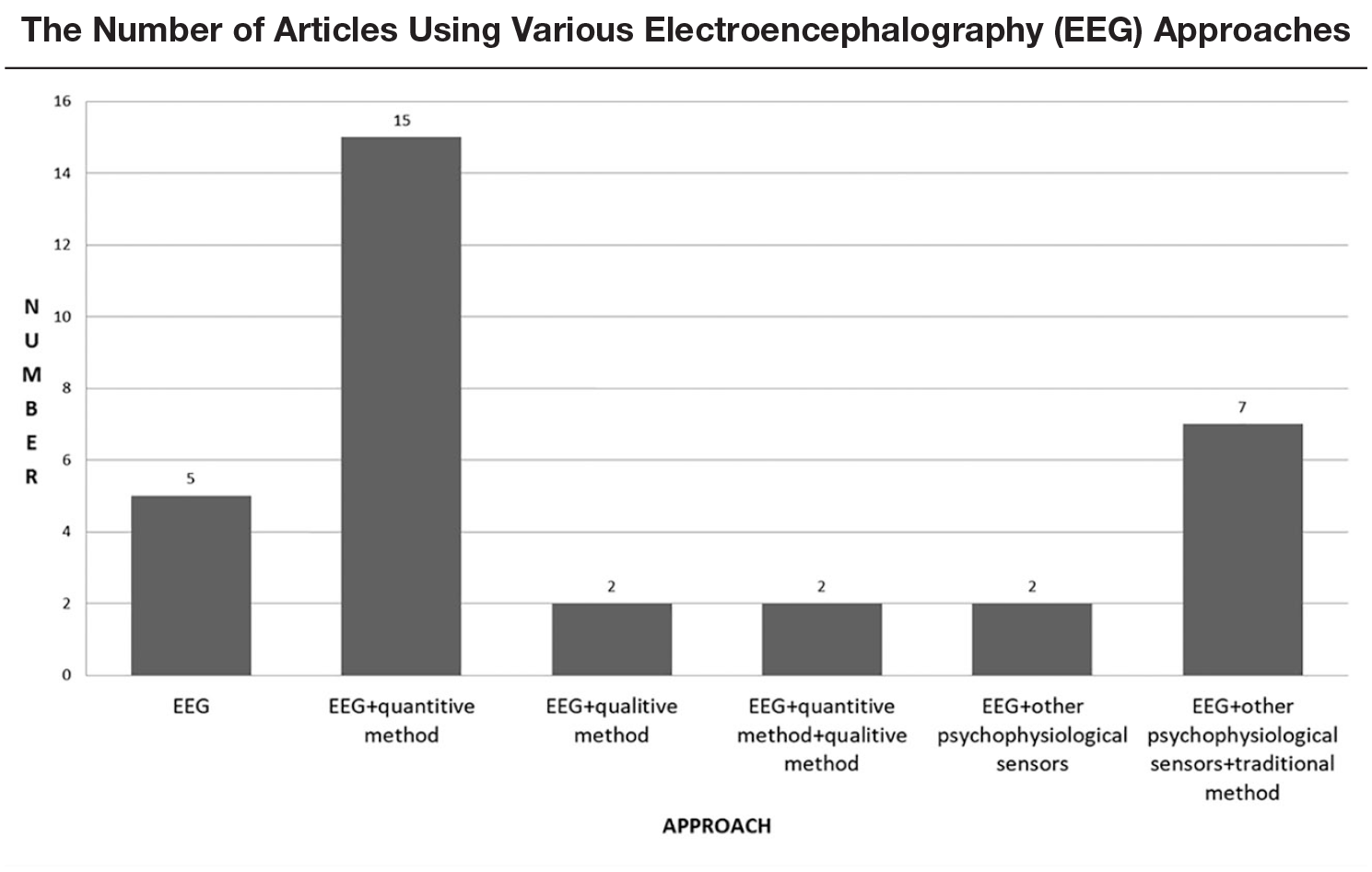
The Number of Articles Using Various Electroencephalography (EEG) Approaches
EEG is ‘a neurophysiological measurement of postsynaptic electrical potentials on the surface of the scalp’ (Minas et al., 2018, p. 796). Electrodes collect the summation of the synchronized activity, which is compared either with a reference electrode or a common average reference (Harmon-Jones & Peterson, 2009). Oscillations of brain activity collected by electrodes are “complex waveforms that can be decomposed into simple waveforms of different periodicity at varying amplitudes” (Minas et al., 2018, p. 796). There are two basic analytical approaches to analyze EEG signals: time domain analysis and frequency domain analysis. Time domain analysis is mainly used to analyze the geometric characteristics of EEG waveforms, such as amplitude, mean, variance, skewness, and kurtosis, while frequency domain analysis can be used to estimate all frequency-related features when a signal is represented by its frequency component (Harpale & Bairagi, 2016). The two analytical approaches will be further discussed in the following paragraphs.
First, the event-related potential (ERP) method, a useful derivative of EEG as a time domain analysis method, can be applied to evaluate brain activity that is time-locked to a stimulus presentation (Deitz et al., 2016). ERP measures “the changes in the voltage level in response to a stimulus presented as a function of time” (Telpaz et al., 2015, p. 513). The two most frequently used ERP components are the P300 wave with P, meaning a positive deflection in the scalp, and 300, meaning the deflection potential appearing 300 ms after the stimulus; and similarly the N200 wave, indicates a negative deflection starting after 200 ms since stimulus has been presented (Telpaz et al., 2015). The advantage of ERP is that it can capture rapid processing brain activity and investigate relevant cognitive and affective processes (Luck, 2005). A limitation of ERPs is that the signal-to-noise ratio is low, which implies that the results can be largely affected by “noises,” that is, task-unrelated brain activity (Lin et al., 2018). Therefore, it is crucial to include a sufficient number of trials through presenting iterations of stimuli in order to improve the results.
Regarding the second analytical approach—frequency domain analysis, EEG studies have usually focused on five frequency bands: delta (<4 Hz), theta (4-8 Hz), alpha (8-13 Hz), beta (13-20 Hz) and gamma (>20Hz; Harmon-Jones & Peterson, 2009). Among these, the alpha band has received a lot of attention because of its cortical “idling” process (Minas et al., 2018). It is believed that the alpha band is related to relaxation, contemplation, internal focus, and mental performance (Hannah et al., 2013). Synchronization occurs when a brain region is at rest, while desynchronization occurs when a brain region is activated, reducing the alpha frequency (Potter & Bolls, 2012). Studies on attention and working memory have shown that the alpha band is negatively associated with intensive attention and working memory resources inputting into completing a task (Guo et al., 2018). Gamma power has also been found to be positively related to memory encoding (Guo et al., 2018). The theta band has been linked with the inhibition of elicited responses and the beta band with alertness (Telpaz et al., 2015). However, it should be noted that because each band is related to different cognitive processes, caution should be exercised when judging a mental process by observing changes in a frequency band (Poldrack, 2006).
The cerebral cortex of the brain, which contains four lobes, the frontal, the parietal, the occipital and the temporal lobes, “controls higher order functions, such as planning, organizing and decision-making” (Touchette & Lee, 2017, p. 6). The frontal lobe has the largest number of neurons that “control the pleasure chemical dopamine, which has a crucial effect on emotion” (Touchette & Lee, 2017, p. 6), and thus attracts the most attention from neuromarketing. The two parts of the frontal lobe, the right and left hemispheres, show a lateralization relationship, which has been described by Richard Davidson’s theory of frontal asymmetry (Morin, 2011). Davidson’s (1995) theory suggests that the left frontal area is associated with positive emotions, related to approach motivation, and the right frontal area is connected to negative emotions, related to withdrawal motivation. Among the different frequency bands in frontal asymmetry research, compared with the other bands, the alpha band was used by the majority of the reviewed articles, as it can show the respondents’ attentiveness (Touchette & Lee, 2017). For example, Minas et al. (2018) showed that an achievement prime led to a greater alpha wave desynchronization compared with a neutral prime, suggesting an increase in cognitive activity in the right frontal areas.
Lee (2016) evaluated the neural correlates of empathy, focusing on the anterior cingulate cortex (ACC). The ACC, a part of the brain’s frontal and limbic connectivity, is connected to various affective responses believed to be associated with empathy (Lloyd et al., 2004). By analyzing the theta band (4-8 Hz), Lee (2016) found an increase in brain activation in the ACC among consumers choosing a prosocial product in response to a corporate social responsibility–related message. Boksem and Smidts (2015) showed that medial frontal beta power was positively related to individual preferences: the higher the beta power when watching the movie trailer, the higher the participants ranked that trailer. In addition to analyzing the power of different bands, such as the alpha and beta bands, the articles reviewed applied ERP analysis. For example, it was shown that different N200 components were presented when comparing highly and less preferred goods, while the P300 component was not significant (Telpaz et al., 2015). Pozharliev et al. (2015) also found an emotional effect in luxury brand product pictures based on the parietal distribution of late positive potentials, demonstrating strong positivity.
In EEG-based neuromarketing experiments, stimuli are developed to reflect changes in brain patterns and indices relevant to the research aims. The EEG stimuli used in the retrieved articles can be divided into three categories: visual materials, scenario-based materials and at-rest assessments. Eighteen articles used visual materials, including videos (e.g., Guo et al., 2018; Boshoff, 2017), pictures (e.g., Minas et al., 2018; Touchette & Lee, 2017) and websites (e.g., Clark et al., 2018; Gregor et al., 2014). Twelve articles used scenario-based materials as stimuli (e.g., Hariharan et al., 2016; Lee, 2016; M. Li et al., 2014). Finally, three articles conducted at-rest assessments using an eyes-closed resting (but alert) procedure (e.g., Hannah et al., 2013; Waldman et al., 2017).
Literature applying EEG in tourism and hospitality research
Although EEG has been used in the business and management field over the past decades, its application in tourism and hospitality research is scarce with only one article identified. Bastiaansen et al. (2018)’s EEG experiments found that watching movies related to the destination images induced a positive emotional response to these destination pictures. While shed some light on the future research, Bastiaansen et al. (2018) used the EEG method alone, so it was not possible to further assess the correlation between tourists’ emotional responses to the destination pictures and their intention to visit or purchase behavior. Second, it used a between-subjects design, which may lead to error variance in the between-subjects effects due to individual differences, criticized in most EEG-based experiments.
Discussion: Challenges and Suggestions for Using EEG in Tourism and Hospitality
Challenges of Using EEG
Based on reviewing general EEG literature, three potentially major challenges of applying EEG in tourism and hospitality studies were identified: small sample size, no assumptions about the underlying causal relationship and the advancement of knowledge. The three challenges and the relevant suggestions are discussed in more detail.
First, most neuroscience studies using EEG experiments have used relatively small samples of between 20 and 30 participants, which is also observed in our reviewed articles. This is mainly because of the high costs and complexity of the experiments (Plassmann et al., 2015). Although the use of small samples has been criticized, the problem of a small number of subjects in psychological experiments is mainly related to the use of between-subjects experiments (Fong et al., 2016). The variance of individual differences can lead to error variance in the between-subjects effects when one group of participants is treated as an experimental group and the other is treated as a control group. This limitation of between-subjects designs can be overcome by using within-subjects designs, which evaluate participants in each treatment condition (Charness et al., 2012).
In EEG studies, the independent variables are normally transitory and vary easily. Thus, within-subjects designs allowing independent variables to vary within participants can largely increase statistical power compared with between-subjects designs (Charness et al., 2012). Between-subjects designs can also be appropriate when research aims to compare two groups of research subjects with different attributes, such as to classify transformational leaders versus nontransformational leaders through evaluating the viability of using neurological imaging (Balthazard et al., 2012). In addition, neuroscience data involve repeated designs and are often aggregated across multiple repetitions of the stimuli to increase the signal-to-noise ratio (Huettel & McCarthy, 2001). When each condition includes 30 trials, the data should be adequate for statistical analyses such as t tests and analysis of variance (Fong et al., 2016; Myers & Hansen, 2012). Therefore, dependent on research aims, future research in tourism, and hospitality field could try to use within-subjects designs with smaller samples than would be recommended for between-subjects designs.
As to the second challenge, most neuroscience studies using EEG have evaluated the relationship between brain activity and behavioral response, which may involve the limitation of making no assumptions about the underlying causal relationship (Kappenman & Luck, 2012). Only a correlational relationship rather than a causal relationship can be inferred between brain activity and specific behavior (Plassmann et al., 2015) if only EEG tool is used. For example, one of our previous studies evaluated the role of various landscapes in reducing tourists’ negative emotions. The EEG experiment showed that the natural landscape activated a larger early posterior negativity (EPN) than the historical architectural landscape. EPN is one of ERP components that is used to evaluate brain activity. The literature found that higher positive emotion normally induces a higher EPN (Schupp et al., 2006). We can conclude a correlational relationship, that is, that the natural landscape rather than the historical landscape was associated with the reduction of negative emotions among female tourists but not a causal relationship for two reasons. First, the reduction of the negative emotional state may occur if other ERP components or other parts of the brain region are activated. Second, it is not known (and it is difficult to test) whether an increase in the frequency of visiting the natural landscape is also followed by an increase in the amplitude of the EPN component. It means the frequency rather than the types of landscape might be an influential factor.
There might be two ways to overcome this limitation of making no assumptions about the underlying causal relationship between brain activity and behavioral response. First, the reliability of the study can be improved by using multiple methods such as other biometrics, for example, eye tracking and skin conductance, for manipulation tests. Second, an additional traditional behavioral measure, such behavioral experiments, can be applied to further test causality (Plassmann et al., 2015). Moravec et al. (2019) examined the relationship between headline of social media that was aligned with users’ beliefs and their cognitive attention using EEG. To establish the causal relationship, behavioral experiments were also conducted to evaluate the effects of the alignment of a headline with users’ (the confirmation bias) on credibility.
The third challenge, which is also an opportunity to use EEG, is to verify the validity and reliability of the current theories previously investigated using “less objective and non-behavioral” traditional measures, such as questionnaires and interviews, or to extend earlier EEG studies (Daugherty et al., 2018, p. 183; Hubert, 2010). Moreover, changes in brain data measured by EEG, such as activation of brain activity, inform a certain perception or behavior induced by stimuli. This process can guide the development of new hypotheses, which can be further tested using behavioral experiments (Plassmann et al., 2015).
This has some implications for tourism and hospitality research, as the application of EEG enables the validation of theories through two different approaches (Camerer et al., 2005). First, in the short term, an incremental approach emphasizes conceptual replication by applying EEG to test current models. Second, in the long term, a radical approach may move away from current theories by establishing new systems of interactions of cognition and affect. Moreover, since EEG method can build relationship between brain activity and behavior, it can be argued that using EEG is likely to contribute to tourism and hospitality theories through identifying new hypothesis. In example of the relationship between landscape category and emotion discussed in the previous paragraph, the neural process of reducing negative emotions by visiting the natural landscape was assessed. A new hypothesis that natural landscapes can affect people’s mental well-being can be proposed and tested using behavioral experiments as a longitudinal study.
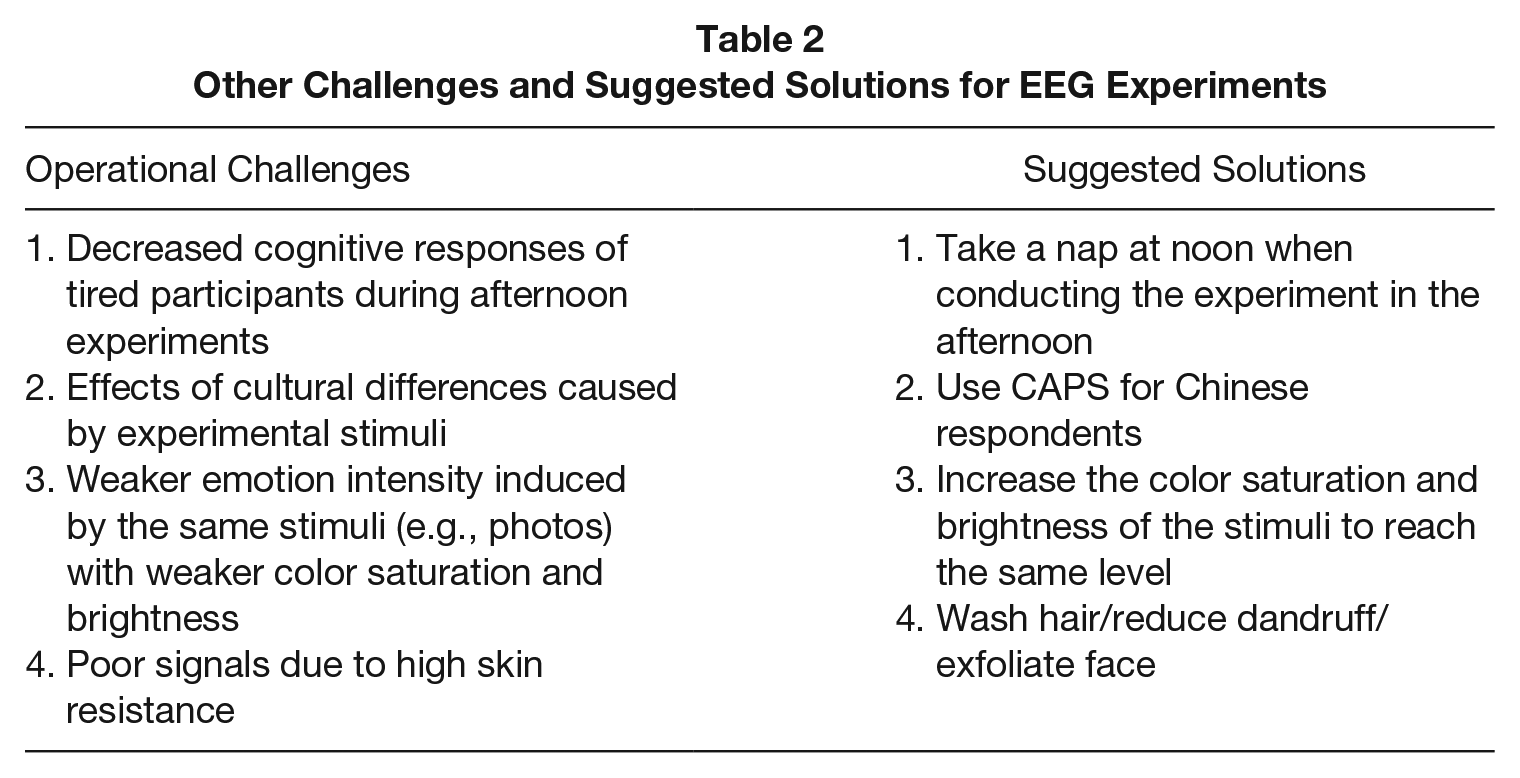
Table 2 summarizes other relatively minor challenges and suggested solutions regarding the operation of EEG experiments. These minor challenges can mainly affect the experimental results and therefore require special attention.
Other Challenges and Suggested Solutions for EEG Experiments
Future Application of EEG in Tourism and Hospitality
Similar to consumer behavior in general business and management, tourists’ decision making is largely influenced by the emotion systems and automatic processes of the brain, making EEG a suitable tool for investigating the relationship between brain data and tourist behavior (Camerer et al., 2005). The number of EEG studies may increase along with the development of the technology when less expensive and more simplified EEG devices with fewer electrodes are available (e.g., Rosenbaum et al., 2019). Market research, which evaluates the effects of marketing stimuli on particular cognitive responses, may become one of the main areas in which to apply EEG in tourism and hospitality.
Inspired by the articles reviewed in business and management, this article proposes that EEG can be applied in the examination of various themes in the tourism and hospitality field. Some examples include engagement with tourism marketing and promotion, tourists’ attitude to online service perceived value, tourists’ perceptions of tourism products’ attractiveness, tourists’ purchase behavior, tourists’ choices among various tourism products, hotel guests’ ethical behavior, niche markets, for example, film tourism, and decision-making process of leader and team members in tourism organizations. Furthermore, neuroscience tools such as EEG are considered to be particularly useful to examine sensitive issues (Gountas et al., 2019) such as willingness to pay for environmental protection in tourism destinations, and ethical issues such as reuse of towels in a hotel. A self-reported approach is likely to generate biased results because respondents may be reluctant or unable to reveal their true feelings and opinions (S. Li et al., 2018), while EEG is capable of capturing more objective and even unconscious responses of participants in real time (Telpaz et al., 2015).
EEG is suitable to explore emotions, memory and empathy of tourists. First, emotions could be one of most suitable concepts in tourism and hospitality research since tourists’ perceptions and behaviors are likely to be influenced by various emotions. For example, to study the connection between the emotions and behavioral intentions of tourists, such as willingness to pay, tourists’ destination loyalty and intention to visit are central areas in which prefrontal cortex (PFC) indices can be applied. It has been shown in the literature that left PFC dominant responses, associated with approach behavior, reflect positive reactions and right PFC dominant responses, related to avoidance behavior, reflect negative reactions (Matukin et al., 2016). Therefore, EEG can be used to record brain activity connected to different emotional responses.
Second, as tourists are always looking for memorable experiences (Tung & Ritchie, 2011), memory is another theoretical area to which EEG can be applied in tourism and hospitality studies, particularly to explore the relationship between working memory and tourist experiences/satisfaction. Attention has also been studied in relation to memory to examine tourist experiences. Both memory and attention are cognitive responses, which include the evaluation of sensory and perceptual qualities (Minas et al., 2018). It has been found that alpha waves in the left frontal cortex are associated with working memory and attention, in which the lower the level of alpha waves, the higher the level of attention. In contrast, visual attention is linked with alpha waves in the occipital lobe (Minas et al., 2018). Visual attention to tourist photographs or to destination landscapes can also be examined by combining EEG with other measures, such as eye tracking and virtual reality. Through identify regions of interest activation using EEG, it can capture the highest level of attention or memorization when viewing an advertisement which can imply advertising strategies (Gountas et al., 2019).
Third, empathy has been widely studied in tourism and hospitality research, such as firms’ sustainability motivations and actions (Font et al., 2016) and hotel guests’ emotional service experiences (Umasuthan et al., 2017). In fact, EEG can be a useful tool to examine the association between brain activity, empathy, and tourists’ sustainable actions, such as willingness to pay for environmental ethical attributes and marketing related to corporate social responsibility. Regarding the corresponding brainwaves associated with empathy, the literature has shown that frontal theta recorded with EEG can be used to measure responses to environmentally friendly products (Lee, 2016). Other areas, such as preferences and self-control explored in business and management studies, can also be examined in the context of tourism and hospitality research.
Conclusions
This study first analyzed the concept of EEG and identified its two main strengths, measuring real-time neural data and subconscious responses, based on which most consumer decisions are made. A review of the literature using EEG in business and management was conducted to shed light on the potential application of EEG in tourism and hospitality research. Based on the review, the study discusses main challenges of using EEG and proposed some suggestions for future application of EEG in tourism and hospitality.
Supplemental Material
sj-pdf-1-jht-10.1177_1096348021996439 – Supplemental material for The Prospects of Using EEG in Tourism and Hospitality Research
Supplemental material, sj-pdf-1-jht-10.1177_1096348021996439 for The Prospects of Using EEG in Tourism and Hospitality Research by ShiNa Li, Ting Lyu, MengXin Chen and PuYue Zhang in Journal of Hospitality & Tourism Research
Footnotes

Supplemental Material
Supplemental material for this article is available online.
References
Supplementary Material
Please find the following supplemental material available below.
For Open Access articles published under a Creative Commons License, all supplemental material carries the same license as the article it is associated with.
For non-Open Access articles published, all supplemental material carries a non-exclusive license, and permission requests for re-use of supplemental material or any part of supplemental material shall be sent directly to the copyright owner as specified in the copyright notice associated with the article.
