



Abstract
The present study examines the role of death anxiety as an important mechanism underlying the relationship between fear of Covid-19 and hotel frontline employees’ (FLEs) sense of work alienation. Importantly, the study proposes FLEs’ intrinsic spirituality as being a relevant boundary condition. Results, based on time-lagged survey data (three rounds, 2 weeks apart) from 203 FLEs in 91 hotels and analyzed using structural equation modeling, reveal that death anxiety mediates the association between fear of Covid-19 and work alienation. In addition, FLEs’ intrinsic spirituality moderates the direct relationship between fear of Covid-19 and death anxiety and the indirect relationship between fear of Covid-19 and work alienation, such that the relationships are weak when intrinsic spirituality is high (vs. low). The study offers several important suggestions that can help hospitality managers address FLEs’ sense of work alienation during traumatic conditions.
Highlights
Death anxiety mediates the relationship between fear of Covid-19 and work alienation.
Intrinsic spirituality moderates the link between fear of Covid-19 and death anxiety.
Intrinsic spirituality moderates the indirect fear of Covid-19-work alienation link.
The findings can help hotel managers address FLEs’ sense of work alienation.
Keywords
Introduction
The novel coronavirus disease (Covid-19) has posed severe threats to human existence (Akhtar et al., 2020; DeMicco et al., 2021; Zhang et al., 2020) and disrupted the patterns of our economic and social lives (Lee, 2020; Menzies & Menzies, 2020; Sigala, 2021; Smith, 2021; Wu et al., 2021). Although its health-related impacts have been the most observable and devastating, the economic crisis unfolding because of Covid-19 sets this pandemic apart from other catastrophes in living memory (DeMicco et al., 2021; Karatepe et al., 2021). Current endeavors worldwide to deal with Covid-19 through various infection-control strategies have been remarkable (Atadil & Lu, 2021; Ozili & Arun, 2020; Smith, 2021). Likewise, studies (e.g., Ahorsu et al., 2022; Carnevale & Hatak, 2020; Karatepe et al., 2021; Wu et al., 2021) have explored the psychological consequences of Covid-19 fears, with key evidence suggesting greater uncertainty, depression, psychological distress, turnover intentions, and stress. Indeed, the hospitality industry has been portrayed as one of the most vulnerable industries to Covid-19 transmission (Atadil & Lu, 2021; Liu et al., 2021; Hugo, 2021; Ozili & Arun, 2020; Sigala, 2021). Travel and mobility restrictions, lockdowns, social distancing, and stay-at-home orders resulted in a substantial decrease in hotel occupancies and profits and the closure of several hospitality-related businesses (Jiang & Wen, 2020). Moreover, it has been predicted that Covid-19 will have an extended impact on the hospitality industry even after the pandemic has been controlled, mainly due to its long-lasting effects on tourists’ risk perception and the operational aspects (e.g., cleaning protocols; Ozili & Arun, 2020).
Additionally, Turan and Özkan (2019) suggest that traumatic situations (e.g., fear of Covid-19) positively influence employees’ sense of work alienation (Turan & Özkan, 2019). Likewise, Kozhina and Vinokurov (2020) show that work alienation increased during Covid-19. Yet, our knowledge as to how and when fear of Covid-19 affects employees’ sense of work alienation is scarce. Indeed, to the best of our knowledge, there is no study on the link between fear of Covid-19 and frontline employees’ (FLEs) sense of work alienation in the hospitality context. This constitutes a critical gap for the following reasons. First, FLEs play a central role in the service delivery process, as they directly interact with customers who help them to understand customers’ idiosyncratic demands (Kim et al., 2012; Kim & Qu, 2019). FLEs’ feedback helps managers to develop appropriate interventions to deal with the customers’ challenging demands and enhance customer satisfaction (Usman et al., 2021a). FLEs’ proactive engagement with customers enables them to identify customers’ tacit needs (Chen et al., 2019), ultimately helping the organization win customers’ hearts and earn their loyalty (Choi et al., 2022; Usman et al., 2021a).
Second, work alienation—individuals’ sense of being estranged, detached, or disassociated from work and its context (Seeman, 1972, Usman et al., 2020)—is a common phenomenon in the hospitality industry (DiPietro & Pizam, 2008). It leads to emptiness, meaninglessness, and negative behaviors (Nair & Vohra, 2009; Rokach, 2004), triggers emotional exhaustion and burnout, and impedes learning (Conway et al., 2020; Shantz et al., 2014). Work alienation has deep effects on individuals’ self-concept, identity, ways of thinking, daily activities, and their perception of humans and the universe (Turan & Özkan, 2019; Usman et al., 2020). It can also have destructive effects on individuals themselves, as well as their relationships with others (Ali, Usman, Soetan et al., 2022; Turan & Özkan, 2019; Usman et al., 2021b). Thus, work FLEs’ sense of work alienation can impede their proactive engagement with customers and hamper hotel managers’ endeavors targeted at customer satisfaction and loyalty. As such, our knowledge as to how and when fear of Covid-19 leads to FLEs’ sense of work alienation can help managers understand the complexities involved in the fear of Covid-19-FLE work alienation and develop a more comprehensive strategy to counter fear of Covid-19 and its psychological repercussions. Our focus on work alienation is also in line with Turan and Özkan (2019) for further research on the antecedents of individuals’ sense of work alienation during traumatic situations.
To address this critical gap, the present study proposes that death anxiety acts as a mediator of the association of fear of Covid-19 with FLEs’ sense of work alienation. The present work also introduces intrinsic spirituality as a moderator of the association of fear of Covid-19 with death anxiety and the indirect (via death anxiety) association of fear of Covid-19 with work alienation. Thus, the essence is to foreground the important roles that death anxiety and intrinsic spirituality play as a mediating mechanism and a boundary condition, respectively. We use the conservation of resources (COR) theory (Hobfoll, 1989; Hobfoll et al., 2018) as a basis for theorizing the aforesaid interrelationships. The theory posits that individuals possess innate motivation to protect and foster valued resources. The theory also speculates that resources have a web-like interconnectedness and, therefore, that resource gain or loss occurs in spirals (Hobfoll, 2001). The consistent loss of or threat to resources results in several psychological outcomes: stress, anxiety, and burnout. Importantly, COR theory suggests that traumatic events act as contextual stressors that lead to or have the potential to cause the loss of resources, leading to several psychological repercussions (Hobfoll, 1991). Indeed, traumatic events (e.g., Covid-19) attack individuals’ fundamental values, occur unexpectedly and outside the realm of existing strategies, produce excessive demands, and leave severe psychological effects (Hobfoll, 1991), such as death anxiety and a sensed disconnect from work and its context. Additionally, the theory speculates that individuals who have rich personal resources (e.g., intrinsic spirituality) are less vulnerable to stressors (e.g., Covid-19), and thus less likely to lose personal resources and develop psychological issues. As such, we understand that COR theory can explain the interrelationships between fear of Covid-19, death anxiety, intrinsic spirituality, and work alienation.
We consider death anxiety in the present study because existing scholarship on death anxiety in the work domain (e.g., Belmi & Pfeffer, 2016; Boeuf, 2019; Sliter et al., 2014) suggests that death anxiety results in several negative outcomes, such as reducing work drive and impairing job performance and innovative behavior. Moreover, based on COR theory, we argue that consistent threats to one’s salient resources—one’s own life and the lives of close relatives—result in a resource-draining state—death anxiety (Stein & Cropanzano, 2011)—which, in turn, can reduce other resources, such as energy, meaning in life, and a sense of value, and thus lead to a sense of work alienation. However, despite its likelihood to explain why fear of Covid-19 positively affects work alienation, its link with work alienation has not been studied yet. Our focus on death anxiety also concurs with a recent call by Menzies and Menzies (2020), who have urged scholars to foreground the consequences of death anxiety in the work domain.
We consider intrinsic spirituality, as it entails individuals’ internal faith in—and connectedness with—God or ultimate Transcendence that guides their decisions, personal growth, and all other facets of their lives, and contributes to a salutary human experience (Hodge, 2003) that, we contend, has had significant implications for FLEs’ attitudes and behaviors during the current pandemic. For instance, seen through the lens of COR theory, a sense of connectedness to God or Transcendence, meaning in life, and thoughtfulness (the fundamental attributes of intrinsic spirituality; Farmaki et al., 2020; Hodge, 2018; Weathers et al., 2016) are important resources that can enable FLEs to maintain a positive outlook when confronted with life-threatening and adverse situations (e.g., fear of Covid-19). Consequently, we argue that intrinsic spirituality can help individuals to compensate for the loss of resources due to fear of Covid-19. More importantly, studies suggest that although spirituality can exist independent of religion (Henningsgaard & Arnau, 2008; Sprung et al., 2012), religiosity is one of the key determinants of spirituality. Given that most Pakistanis are Muslims, studying the role of intrinsic spirituality as a moderator is relevant and can foreground important theoretical and practical implications.
Our study makes important contributions to different literature streams. First, by theorizing and empirically investigating the indirect path of fear of Covid-19 to FLEs’ sense of work alienation via death anxiety, the work at hand foregrounds the importance of death anxiety as a mechanism that explains how fear of Covid-19 evokes feelings of work alienation among FLEs in the hospitality industry and contributes to the literature on fear of Covid-19 in the hospitality industry. Although previous studies bring to the fore several psychological consequences of fear of Covid-19 (Atadil & Lu, 2021; Ozili & Arun, 2020), as well as the direct association of fear of Covid-19 with work alienation (Kozhina & Vinokurov, 2020), there is little known about how fear of Covid-19 leads to work alienation. Thus, we contribute to these studies by establishing death anxiety as a mechanism through which fear of Covid-19 shapes work alienation. In so doing, the present work also contributes to the scarce literature on death anxiety (Belmi & Pfeffer, 2016; Sliter et al., 2014) in the work context. Second, by highlighting the role of intrinsic spirituality as a boundary condition of the indirect relationship between fear of Covid-19 and FLEs’ sense of work alienation—via death anxiety—we not only extend the scarce literature (e.g., Kozhina & Vinokurov, 2020) on the link between fear of Covid-19 and work alienation but also contribute to the hospitality literature on intrinsic spirituality (Farmaki et al., 2020). Although previous research on intrinsic spirituality suggested that it contributes to a salutary human experience (Farmaki et al., 2020; Hodge, 2003), its role in addressing the psychological repercussions of fear of Covid-19 was overlooked. Our findings are critical, given the negative repercussions of fear of Covid-19 for employees’ psychological wellbeing and the hospitality industry and the argued imperativeness of FLEs’ behaviors in shaping service delivery and customer satisfaction. Our proposed model is presented in Figure 1.
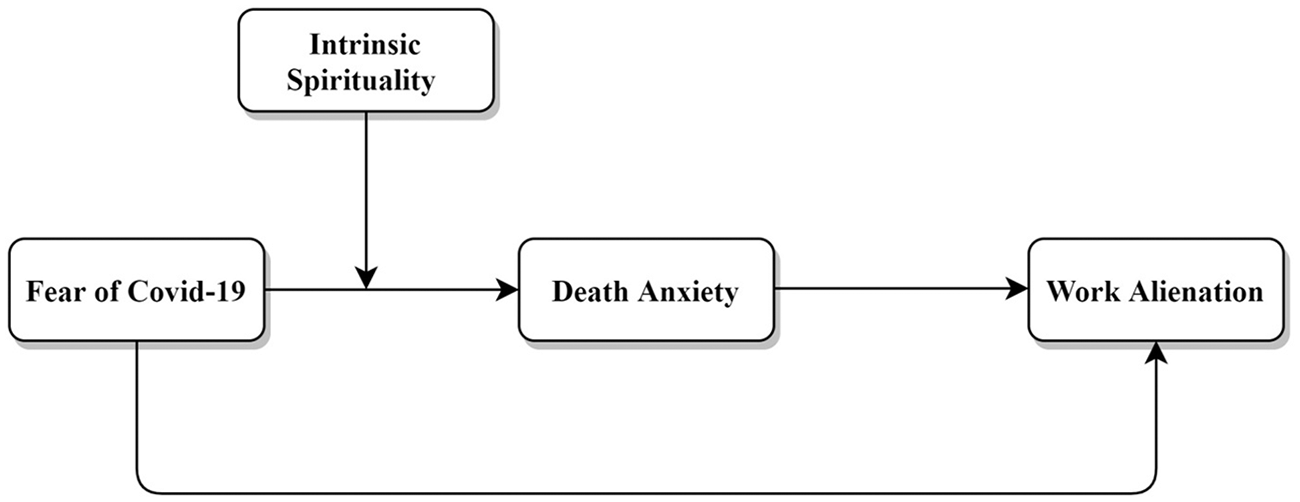
The Proposed Model.
Theory and Hypotheses Development
COR Theory
We have used COR theory to theorize the relationships among different variables of our study. We used COR theory because it posits that people are motivated to protect and foster valued resources, such as objects, conditions, social support, energy, and personal characteristics. Moreover, individuals invest resources when future resource gains are expected; however, they adopt defensive behaviors when there is a fear that they can lose resources. The theory further speculates that resource loss and gain occur in spirals, as resources have a web-like interconnectedness, and “resource loss is disproportionally more salient than resource gain” (Hobfoll, 2001, p. 343). Importantly, COR theory also proposes that traumatic events lead to or have the potential to cause the rapid loss of resources, leading to several psychological repercussions (Hobfoll, 1991). Traumatic events attack individuals’ fundamental values, occur unexpectedly and outside the realm of existing strategies, produce excessive demands, and leave severe psychological effects that can be easily triggered by cues related to the events (Hobfoll, 1991).
Fear of Covid-19 and Work Alienation: Death Anxiety as a Mediator
Death anxiety is a different concept from job-related anxiety. Job anxiety refers to one’s anxious feelings at work resulting from concerns about work-related factors, such as job demands, inadequate support, and a toxic work environment. Death anxiety refers to a dreadful emotional state triggered due to individuals’ overwhelming concerns about human mortality (e.g., Covid-19), resulting from events that either threaten one’s own life or human survival (Atadil & Lu, 2021; Menzies & Menzies, 2020). It encompasses psychological elements (e.g., feelings of helplessness, frustration, and panic) as well as maladaptive social behaviors (e.g., suspicion regarding others’ behaviors and actions, social withdrawal, and aggression towards others; Iverach et al., 2014; Sliter et al., 2014).
In times of traumatic events, one’s most salient resources—one’s own life and the lives of family, relatives, and friends—are endangered, resulting in a state that causes the rapid drain of resources, such as physical and psychological energy, and evokes stress (Hobfoll et al., 2006). As individuals strive for self-preservation and protecting the lives of their loved ones, they may, in the process, consistently lose their personal resources, indicating that the consistent presence of such threats to one’s most salient resources spurs feelings of helplessness and loss of control over the traumatic event and its repercussions (Hobfoll et al., 2006). Hotel FLEs and their loved ones are especially vulnerable to Covid-19 because of the high-contact nature of their work activities (Vo-Thanh et al., 2022; e.g., checking guests in and out, taking food orders, serving, processing payments, and clearing tables). As such, hotel FLEs may feel more threatened, and thus are more likely to lose salient resources. Thus, based on COR theory, we infer that consistent threat to hotel FLEs’ and their loved ones’ lives leads to excessive resource drain, thereby triggering a dreadful emotional state (death anxiety), embodying panic and feelings of helplessness in the face of the current pandemic and its consequences.
Past research suggests that the unprecedented visibility of death cues, such as wearing a mask, use of sanitizers, and daily updates on death tolls related to Covid-19, have created an unusual scenario that may trigger death-related anxiety among individuals (Menzies & Menzies, 2020). Studies also point out that traumatic events (e.g., Covid-19) can trigger panic and individuals’ feelings of suspicion and anger towards themselves and others (Monfort & Afzali 2017; Turan & Özkan, 2019). Since hotel FLEs are in consistent contact with guests, they are more likely to feel fear of being infected (Vo-Thanh et al., 2022), and thus may develop suspicion toward guests and demonstrate anger through their behaviors. As feelings of suspicion, anger towards oneself and others, and helplessness in dealing with events and daily activities are the key aspects of death anxiety (Grant & Wade-Benzoni, 2009; Menzies et al., 2019; Stein & Cropanzano, 2011), we argue that fear of Covid-19 can create death anxiety among hotel FLEs. Given the nature of their job, hotel FLEs are particularly exposed to such cues.
Furthermore, as a resource-draining state, death anxiety evokes stress-related responses, such as enhanced physical and mental fatigue (Iverach et al., 2014), panic sensations, and the downward modification of levels of energy (Toker et al., 2015), leading to individuals’ loss of interest in daily activities (Sliter et al., 2014) and a sensed lack of value in themselves (Anser et al., 2021; Shantz et al., 2014). Hotel FLEs facing such conditions also struggle to comprehend their role in the larger system of inputs and outputs, interrelate effectively with others, and exercise control over life events (Conway et al., 2020). As such, we infer that as a resource-draining state, death anxiety may spur a sense of meaninglessness and powerlessness and thus feelings of estrangement from work, the work context, and organizational affairs in general among hotel FLEs. Thus, we posit that death anxiety leads to FLEs’ sense of work alienation. Together, we developed the following hypothesis:
Intrinsic Spirituality
Intrinsic spirituality is a broader concept than religiosity, as it
refers to an individual’s relationship with God (or perceived Transcendence), while religion is defined as a particular set of beliefs, practices, and rituals that have been developed in the community by people who share similar existential experiences of transcendent reality. (Hodge, 2001, p. 36)
That is, religiosity entails socially shared beliefs and practices that are framed under social and institutional settings, while spirituality is considered as an individual’s internal belief in connection with God or Transcendence, indicating that it can be a part of religiosity, but its scope is more diverse and can extend beyond the conceptual boundaries of religiosity (Hodge, 2018). According to Henningsgaard and Arnau (2008), religion entails beliefs and behaviors linked with an organized group, whereas spirituality reflects experiences/perceptions associated with the quest for purpose and meaning in life.
Spirituality is ‘‘a search for the sacred’’ (Zinnbauer et al., 1999, p. 909), indicating that it is not limited to the traditional concepts of the divine or God. Instead, it reflects a closeness to “anything of significance to a person can be sacred (e.g., an object, intimacy, job)” (Sprung et al., 2012, p. 931). Thus, spirituality can exist beyond religion (Sprung et al., 2012). Nelson et al. argue that “spirituality can exist in people who consider themselves very religious, slightly religious, or not at all religious” (p. 106). Nevertheless, although religiosity and spirituality can operate as distinct entities, both concepts overlap, and religion plays an important role in shaping spirituality (Hodge, 2018, Nelson et al., 2009).
Intrinsic Spirituality as a Moderator
Individuals high on spirituality demonstrate compassion and care and concern for others and exhibit thoughtfulness through their behaviors and actions in the face of adversity and risks (Norman et al., 2010). A sense of connectedness with Transcendence, which is a fundamental aspect of intrinsic spirituality, offers a “master motive for life,” guiding attitudes and behaviors (Hodge, 2003, p. 45), and enables individuals to maintain a positive outlook when confronted with life-threatening events (Weathers et al., 2016), such as Covid-19. As such, as compared to their counterparts, FLEs high on intrinsic spirituality are expected to handle the threatening and unpredictable situation created by Covid-19 more effectively and therefore are less likely to panic and develop feelings of helplessness. We, therefore, infer that FLEs high on intrinsic spirituality will be less susceptible to the fear triggered by Covid-19, thus attenuating the influence of fear of Covid-19 on death anxiety. Indeed, an internalized faith in Transcendence helps individuals to uphold positive appraisals about life irrespective of the nature of circumstances and events (Weathers et al., 2016), suggesting that FLEs high on intrinsic spirituality are more likely to maintain a positive outlook and remain hopeful in the face of fear of Covid-19. Thus, we expect that the effect of fear of Covid-19 on death anxiety will be weaker when intrinsic spirituality is high rather than low.
Additionally, COR theory suggests that personal resources (e.g., intrinsic spirituality) can help buffer uncertainty, thus preventing detrimental emotional and cognitive responses, such as developing death anxiety in the face of traumatic events (e.g., Covid-19). Seen through the lens of COR theory, intrinsic spirituality provides individuals with critical resources in the form of the internalized faith in—and the sense of connectedness with—Transcendence that enables them to cope with the traumatic stressor, Covid-19. We, thus, argue that, as compared with their counterparts, hotel FLEs high on intrinsic spirituality have excessive personal resource reserves that provide them with a better ability to buffer the effect of fear of Covid-19 on their feelings of death anxiety. In support, extant literature suggests that intrinsic spirituality is a source of strength that helps individuals effectively handle stress-related situations and events, compensate for the loss of resources due to stressful events, and avoid developing negative attitudes and behaviors (Hodge, 2018). Against this backdrop, we developed the following hypothesis:
In our previous arguments, we presented a framework within which we proposed that death anxiety transfers the influence of fear of Covid-19 on hotel FLEs’ sense of work alienation. We also theorized that FLE intrinsic spirituality moderates the relationship between fear of Covid-19 and death anxiety. Based on these arguments, we further contend that the indirect association between fear of Covid-19 and FLEs’ sense of work alienation via death anxiety is weaker when FLEs’ intrinsic spirituality is high. People with high intrinsic spirituality cope with the traumatic stressor, Covid-19 more effectively because of their stronger connection with Transcendence (Norman et al., 2010) and an enhanced better ability to maintain a positive outlook during traumatic situations (Weathers et al., 2016). Therefore, hotel FLEs high on intrinsic spirituality are less likely to develop feelings of death anxiety due to fear of Covid-19 and, in turn, are less likely to feel alienated from the work and its context.
In contrast, hotel FLEs low on intrinsic spirituality will be more vulnerable to fear of Covid-19 and thus more likely to develop feelings of death anxiety (Hodge, 2018). Consequently, the indirect effect of fear of Covid-19 on work alienation through death anxiety will be stronger for hotel FLEs low on intrinsic spirituality. Thus, we propose that intrinsic spirituality moderates the mediating effect of death anxiety on the link between fear of Covid-19 and work alienation, such that the mediating effect will be weaker when FLE intrinsic spirituality is high rather than low. Seen from a statistical point of view, this represents a moderated mediation case (Hayes, 2015), whereby intrinsic spirituality interacts with fear of Covid-19 to negatively moderate the positive indirect effect of fear of Covid-19 via death anxiety on hotel FLEs’ sense of work alienation. Thus, we developed the following hypothesis:
Methods
Sample and Procedures
To test our hypotheses, we contacted the managers of 100 hotels operating in Pakistan, but we were allowed to collect data on site in 91 regular hotels. We used time-lagged survey data (separated by a lag time of 2 weeks). The time-lagged strategy was used to reduce the common method bias (Podsakoff et al., 2003). Studies suggest that due to a time lag, respondents often are unable to recall their previous responses and relate them to the current responses, thereby reducing common method bias (Ali, Usman, Shafique et al., 2022; Raza et al., 2022; Usman et al., 2021c). We also included trap items as attention checks in the questionnaires used in different rounds. A sample of 350 hotel FLEs (selected from the list provided by human resource managers) was initially contacted to participate in the study. The selected respondents received an information sheet that provided information about the confidentiality promise, the voluntary nature of the participation, and a chance to win several gifts (e.g., smartphones, USB devices, and Wi-Fi devices) through a draw. The translated questionnaire was translated into Urdu using a back-translation technique. Then the questionnaire was pilot tested with four academics and 20 respondents. All recommended precautionary measures, such as social distancing and wearing masks were strictly followed during data collection from hotel FLEs.
In the first round, 255 respondents responded, providing data on fear of COVID-19, intrinsic spirituality, and the control variables (including demographic characteristics). In the second round, 234 respondents provided data on the mediator, death anxiety, while 215 respondents provided data on a sense of work alienation in the third round. Unique eight-digit codes were used to match the data collected in three different rounds. The codes were developed by asking the respondents (in each round) to write “the first two letters of your first name, the last two letters of your father’s name, the last two letters of your organization’s name, and the first two letters of your hometown.” After screening the responses for negligence and missing values, our final sample size was 203 FLEs in 91 hotels.
The final sample consisted of 53.2 % males and 46.8% females. Although women’s representation in the workforce in Pakistan remains low (21%) (World Bank, 2022); in some professions, such as in healthcare, women’s participation is nearly equal to men’s (Shaikh et al., 2018). Likewise, women are preferred to men in some roles, such as front-desk roles in hotels, possibly because women are more welcoming and score higher on emotional intelligence than their male counterparts (Schutte et al., 1998), and that can help them better deal with guests’ demands. Regarding gender, our data is consistent with previous studies on hotel FLEs in Pakistan (Alessa et al., 2022; Ali et al., 2020; Usman et al., 2021a). The average age and work experience of the sample were 39 and 12.5 years, respectively. Data were collected between March and April 2021 after hotels were opened after the second wave of Covid-19.
Measures and Variables
All constructs were measured using a 5-point Likert scale ranging from 1 (strongly disagree) to 5 (strongly agree).
Fear of Covid-19 was measured using a 7-item scale (α = .90 for the present study) from Ahorsu et al. (2022). Sample item: “I am afraid of losing my life because of coronavirus-19.”
Death anxiety was measured by using nine items (α = .94 for the present study) from Thorson and Powell (1992). Sample item: “The idea of never thinking again after I die frightened me.”
Work alienation was measured by using an 8-item work-alienation scale (α = .90 for the present study) from Nair and Vohra (2009). Sample item: “I do not feel connected to the events in my workplace.”
Intrinsic spirituality was measured by adapting a 6-item scale (α = .93 for the present study) from Hodge (2003). Sample item: “My spiritual beliefs affect absolutely every aspect of my life.”
Control Variables
Past research indicated that age, gender, education, and neuroticism can influence death anxiety and a sense of work alienation (Belmi & Pfeffer, 2016; Chiaburu et al., 2014; Owens et al., 2016) and thus we controlled for these demographics. We assessed neuroticism using four items from Donnellan et al. (2006). Sample item: “I often make a mess of things (R).” Our inclusion of neuroticism as a control variable served to distinguish death anxiety from other pre-existing negative psychological tendencies.
Data Analysis
We analyzed our data using the robust maximum likelihood estimator in Mplus (Version 8.6). Structural equation modeling was used to test the hypothesized relationships. In Hypothesis 1 (the mediation hypothesis), work alienation was regressed on death anxiety and fear of Covid-19, and the indirect effect syntax is based on the product-of-coefficients approach, which overrides the shortcomings (e.g., the normality violations) of the traditional causal steps approach (MacKinnon et al., 2002). Hypotheses 2 and 3 were examined simultaneously by a single moderated mediation model (Edwards & Lambert, 2007), in which the indirect effect of fear of Covid-19 on work alienation via death anxiety was moderated by intrinsic spirituality.
Results
Non-Independence of the Data
As 203 FLEs belonged to 91 hotels, data were tested for non-independence. Following Bliese’s (2000) recommendations, ICC1 values of death anxiety and work alienation were calculated. ICC1 values of death anxiety and work alienation were .01 (ns) and .008 (ns), respectively. As such, non-independence was not a problem and thus we treated the variables at the individual level.
Correlations, Means, and Standard Deviations
The values of correlations, means and standard deviations (SD) are presented in Table 1.
Means and Correlations.

Note. Sample size (N) = 203.
p < .05. **p < .01.
Measurement Model
We performed a series of confirmatory factor analyses to assess the model fitness, discriminant validity, and convergent validity. Our proposed model comprising our factors—fear of Covid-19, death anxiety, work alienation, and intrinsic spirituality—showed a better fit than the alternative models: the two-factor model and the single-factor model. The fit indices of our proposed model were as follows: χ (399) = 502.05, χ2/df = 1.25, RMSEA = .04, SRMR = .05, CFI = .97, and TLI = .97. The fit indices of the two-factor model were: χ (404) = 2258.66, Δχ2 = 1756.61, χ2/df = 5.34, RMSEA = .15, SRMR = .17, CFI = .55, and TLI = .51, while the fit indices of the single-factor model were χ (404) = 2812.90, Δχ2 = 553.24, χ2/df = 6.94, RMSEA = .17, SRMR = .20, CFI = .38, and TLI = .34. All unrestricted factor loadings were above .60 and statistically significant. We also calculated average value extracted (AVE), maximum shared variance (MSV), and average shared variance (ASV). It is evident from Table 2 that, for all the main variables of the present study, AVE > .50,
Discriminant and Convergent Validity.

Note. N = 203. MSV = maximum shared variance. ASV = average shared variance. AVE = average variance extracted. Bolded values on the diagonals of Columns 2 to 3 are the square root values of AVE.
Hypotheses Testing
We tested the hypotheses both with and without control variables and found no significant difference between the results. For the sake of parsimony, we reported the results related to hypotheses testing without control variables. Our results (Table 3) show that fear of Covid-19 was positively related to hotel FLEs’ sense of work alienation (B = .18, SE = .06, p < .01). The results further revealed that the indirect association of fear of Covid-19 with hotel FLEs’ sense of work alienation via death anxiety (B = .06, SE = .02, p < .01) was also significant. Thus, Hypothesis 1 was supported. Furthermore, the interaction between fear of Covid-19 and intrinsic spirituality was negatively associated with death anxiety (B = -.16, SE = .05, p = .01). The nature of these interaction effects plotted at +1/-1 SD from the mean of intrinsic spirituality is illustrated in Figure 2. A simple slope test revealed that the positive effect of fear of Covid-19 on death anxiety was significant (B = .26, p < .01) when intrinsic spirituality was low; while the effect was insignificant (B = .03, ns) when intrinsic spirituality was high. Thus, Hypothesis 2 was supported.
Direct, Indirect, and Moderation Results.

Note. N = 203 (bootstrapping by specifying a sample of size 2,000).
p < .05, **p < .01.

Intrinsic Spirituality as Moderator of the Link Between Fear of Covid-19 and Death Anxiety.
The index of moderated mediation was also significant for the hypothesized indirect relationship between fear of Covid-19 and hotel FLEs’ sense of work alienation via death anxiety (index = -.05, SE = .02, CI [-.09, -.02]). Moreover, the indirect relationship between fear of Covid-19 and work alienation via death anxiety was found to be insignificant for FLEs high on intrinsic spirituality (B = .01, ns), while the relationship was significant for FLEs low on intrinsic spirituality (B = .12, SE = .04, p < .01). Thus, we conclude that hotel FLEs’ high (vs. low) on intrinsic spirituality are less likely to fall prey to death anxiety and consequently are less likely to develop feelings of work alienation. Thus, Hypothesis 3 was supported.
Discussion and Theoretical Contributions
Building on COR theory, the present study has examined the positive indirect (via death anxiety) relationship between fear of Covid-19 and hotel FLEs’ sense of work alienation. The study also examined the role of intrinsic spirituality as a boundary condition in terms of the direct relationships between fear of Covid-19 and death anxiety. Finally, the study proposed and tested the possibility that intrinsic spirituality moderates the indirect (via death anxiety) relationship between fear of Covid-19 and hotel FLEs’ sense of work alienation. Time-lagged survey data from 203 hotel FLEs working in 91 hotels in Pakistan supported the hypothesized relationships.
The present study makes several important contributions to the literature. First, using COR theory to theorize, and then providing empirical evidence of the indirect relationship between fear of Covid-19 and hotel FLEs’ sense of work alienation, we contribute to the literature on fear of Covid-19 and work alienation. Previous research has identified several factors as the key determinant of employees’ sense of work alienation, including work structure characteristics (e.g., formalization and centralization; Mottaz, 1981; Sarros et al., 2002), laissez-faire leadership (Usman et al., 2020), and employees’ sensed lack of control and freedom (Chiaburu et al., 2014; Conway et al., 2020; Khan et al., 2019; Nair & Vohra, 2009). However, little is known about how and why fear of Covid-19 is linked with work alienation. In doing so, we also respond to the call for research on the psychological aspects of fear of Covid-19 (Ahorsu et al., 2022; Carnevale & Hatak, 2020) and individuals’ sense of work alienation during traumatic events (Turan & Özkan, 2019). In the present situation, when different sectors have been opened, following the standard operating procedures, the fear of Covid-19 would be the most prevailing aspect of work-life, and, importantly, hotel FLEs’ behaviors can play a vital role in dealing with this fear and reviving the hospitality industry (Im et al., 2020). Given the economic and social impacts of Covid-19 in general and on the hotel industry in particular (Ozili & Arun, 2020), as well as the scarcity of research on work alienation in the hospitality industry (Isralowitz et al., 2012), our findings are timely and relevant. While the present work has been carried out in Pakistan, our findings can be generalized to different contexts, as spirituality can exist beyond religiosity (Hodge, 2003; Nelson et al., 2009).
Second, we contribute to the scant literature on death anxiety (Belmi & Pfeffer, 2016; Grant & Wade-Benzoni, 2009; Sliter et al., 2014; Stein & Cropanzano, 2011) by focusing on the effects of the growing public health crisis due to the Covid-19 pandemic in the hospitality industry and highlighting death anxiety as a pathway through which a life-threatening stressor (fear of Covid-19) might enhance individuals’ sense of work alienation. Prior research has predominantly focused on death anxiety in the work contexts where work activities are closely associated with life-threatening events, such as firefighters and healthcare professionals (Sliter et al., 2014), and has glossed over other important but vulnerable sectors, including the hospitality industry. Thus, the present work adds to the literature by contextualizing the theoretical links between fear of Covid-19, death anxiety, and work alienation in the hospitality industry. Accordingly, based on COR theory (Hobfoll, 1989), the present study provides a more comprehensive understanding of how and why fear of Covid-19 shapes hotel FLEs’ behaviors.
Third, the present work shows that hotel FLEs high (vs. low) on intrinsic spirituality are less likely to experience a sense of work alienation due to fear of Covid-19 during this pandemic. In this regard, the present study contributes to the literature on death anxiety (Belmi & Pfeffer, 2016; Grant & Wade-Benzoni, 2009; Sliter et al., 2014; Stein & Cropanzano, 2011), and work alienation (Conway et al., 2020), and intrinsic spirituality (Hodge, 2019) by offering a nuanced view of when fear of Covid-19 is less influential in shaping hotel FLEs’ feelings of death anxiety and thus their sense of work alienation. By showing intrinsic spirituality as an important boundary condition of the direct and indirect links between the fear of Covid-19 and hotel FLEs’ sense of work alienation, we also extend the hospitality literature on spirituality (e.g., Farmaki et al., 2020; Michopoulou & Jauniškis, 2020). These findings are particularly significant because FLEs who have a deeper understanding of self, an enhanced understanding of the broader purpose of life, and are better connected to the higher self, are less likely to develop death anxiety and a sense of work alienation due to Covid-19 or other traumatic events. Finally, we extend the scope of COR theory by using it as a theoretical basis for developing our model that explicates how and when fear of Covid-19 leads to FLEs’ sense of work alienation.
Practical Implications
The present work offers several practical implications. We provide novel suggestions that can help managers in adopting and promoting positive behaviors during and beyond a public health crisis such as the Covid-19 pandemic. Although managers cannot control traumatic situations such as Covid-19, they can take care of employees’ well-being and endeavor to address other psychological repercussions, such as employees’ sense of estrangement from work. We especially draw hospitality managers’ attention towards intrinsic spirituality as this can help their FLEs avoid the negative psychological implications of fear of Covid-19, may offer them an important source of strength and enable them to effectively counter the fear of Covid-19.
Studies suggest that even though religion is an important determinant of intrinsic spirituality, “religious affiliation does not guarantee spirituality” (Nelson et al., 2009, p. 106). Indeed, many people, despite being actively involved in religious practices and rituals, are not able to develop spirituality (Nelson et al., 2009). Moreover, studies suggest that religion can be politicized, as well as used as a marketing tool (Nelson et al., 2009). Thus, the idea of relying on religion for developing employees’ intrinsic spirituality may not be very effective. Fortunately, spirituality interventions (other than religiosity) have proved effective in increasing people’s confidence, hope, and optimism when faced with traumatic events, and in enhancing their ability to recover quickly from adversity (Hodge, 2018). Indeed, a deep understanding of self, meaningfulness in life and work, inner stability, and connecting to the higher self are the key components and manifestations of intrinsic spirituality. Managers, by demonstrating, through their behavior, a transcendent vision and altruistic love—such as empathy and care and concern for employees’ personal and professional needs—can shape FLEs’ understanding of self, instill meaning in their lives and work roles (Ali et al., 2020; Fry et al., 2005), and help them cope with traumatic situations.
Managers might incorporate into their roles the assessment of FLEs’ spiritual beliefs and needs and then offer personalized attention to fulfill those needs (Hodge, 2015). Personalized attention, including regular meetings (using technology or in-person) that are centered around employees’ well-being, not only affirms their social and emotional support but also helps them to develop and maintain a strong connection with the work and its context (Becker et al., 2022). Consistent social and emotional support improves employees’ hope and grit (Becker et al., 2022) and helps them cope with traumatic events, such as Covid-19 (Belkin & Kong, 2021; Waizenegger et al., 2020).
Hotel managers can also use motivational training sessions to educate their FLEs about the negative repercussions of being over-anxious about death, and to inspire them to take maximum precautionary measures and protocols. Such sessions would also help them to re-examine the meaning of life, self-worth, and thoughtfulness that would encourage them to deal with the fear of Covid-19 more positively. This may not only help hotel FLEs to overcome fear of Covid-19 but also inspire them to face other life-treating situations with courage and care. Finally, hospitality organizations should formulate positive virtual community groups and organize public health conferences to enhance FLEs’ sense of connectedness, engagement, and support. This sense of connectedness and engagement would not only enhance their feelings of connection with the world of work but also help them to mitigate their death-related anxiety and its psychological consequences.
Limitations and Future Research
The present study has some notable caveats. For instance, although time-lagged data helps mitigate the common method bias, it precludes the causal inferences. Future research should use the experimental design or longitudinal designs for strong causal insights. Moreover, a dynamic approach to explore the link between the fear of Covid-19 and death awareness in the organizational context (Grant & Wade-Benzoni, 2009) would provide more comprehensive insight into the hypothesized relationship. Thus, future research should focus on the daily dairy method, which allows scholars to collect data daily and offer a more comprehensive understanding of the understudied model. Future studies should also empirically test this model in other service sectors, such as the health and banking sectors, as this would enhance the generalization of our findings.
Moreover, in past research (e.g., Grant & Wade-Benzoni, 2009), life-threatening events have been portrayed as having double-edged effects, as they can trigger two types of responses: death anxiety and death reflection. Death reflection carries positive valence that enables individuals to overcome the negative feelings and emotions that may emerge due to the life-threatening events, and enhance their cognitive ability to extract positive implications from their mortality fear (Grant & Wade-Benzoni, 2009). We suggest that future studies should gauge both possible outcomes simultaneously to offer a more complete understanding of the phenomenon of fear of death due to traumatic events.
Finally, positive leadership styles, such as spiritual leadership (Fry et al., 2005; Usman et al., 2021a) and ethical leadership (Ali, Qu, Shafique et al., 2022; Brown et al., 2005) can also enhance FLEs ability to cope with stressful events, such as Covid-19, and positively influence their sense of connectedness with work. For instance, spiritual leadership, through its different components—such as a transcendent vision and hope/faith—can shape employees’ sense of transcendence and help them to develop trust-based interpersonal relationships at work, which are considered critical resources for dealing with stressful situations. It can also shape their feelings of inclusion (Ali et al., 2020). Thus, we suggest that future studies should examine the influence of different positive leadership styles on death anxiety and work alienation.
Footnotes
Authors’ Note
We have not received any funding or financial support from any organization.
Data Availability Statement
The corresponding author will provide the data set used in the present work on a reasonable request.
