



Abstract
The COVID-19 pandemic has restricted both business and social life over the last two years. Stop-and-go policies enacted as containment measures have further impacted the global economy, and tourism in particular. Tourism demand shows only weak signs of a sustainable recovery. The medium-term outlook remains highly uncertain, and yet few studies have addressed the development of the tourism and leisure industries in the years ahead. In this context, we forecast demand in selected EU countries in terms of total expenditure on outbound travel (tourism imports) using a panel pooled Fully Modified Ordinary Least Squares (FMOLS) approach. Baseline and downside scenarios are elaborated to project demand for foreign travel until 2025.
Introduction
The COVID-19 pandemic led to a severe economic downturn and triggered significant negative impacts on the tourism industry. In 2020, global GDP decreased by 3% (International Monetary Fund [IMF], 2022; Organization for Economic Co-Operation and Development [OECD], 2021b). Rough estimates of the total economic costs of the pandemic approximate 100% of global GDP in 2019 when factoring in the recession costs in 2020, growth losses for the period from 2021 to 2030, fiscal impulses, changes in government debt, and the statistical value of deaths related to COVID-19, as well as losses in education and human capital (Yeyati & Filippini, 2021).
Tourism has been hit particularly hard, with international (overnights-related) arrivals decreasing by 73% in 2020 (World Tourism Organization [UNWTO], 2022), the main reasons for this development being lockdowns, travel restrictions, and the income losses triggered by the pandemic. Data for 2020 show that countries such as France, Italy, and Spain—which have a relatively high tourism share—suffered more substantial GDP losses than countries with a lower dependency on contact-intensive services, including Germany, the Netherlands, and Sweden (Figini & Patuelli, 2022). We analyzed the relationship between GDP losses in 2020 (in percent compared to 2019) and the tourism shares of GDP (in percent of 2019 GDP) for selected European countries: Austria (AT), Belgium and Luxembourg (BELUX), the Czech Republic (CZ), France (FR), Germany (DE), Italy (IT), the Netherlands (NL), Portugal (PL), Spain (SP), Sweden (SW), and the United Kingdom (UK). A strongly negative correlation between the two variables can be seen in Figure 1, thereby replicating the findings of Figini & Patuelli (2022).
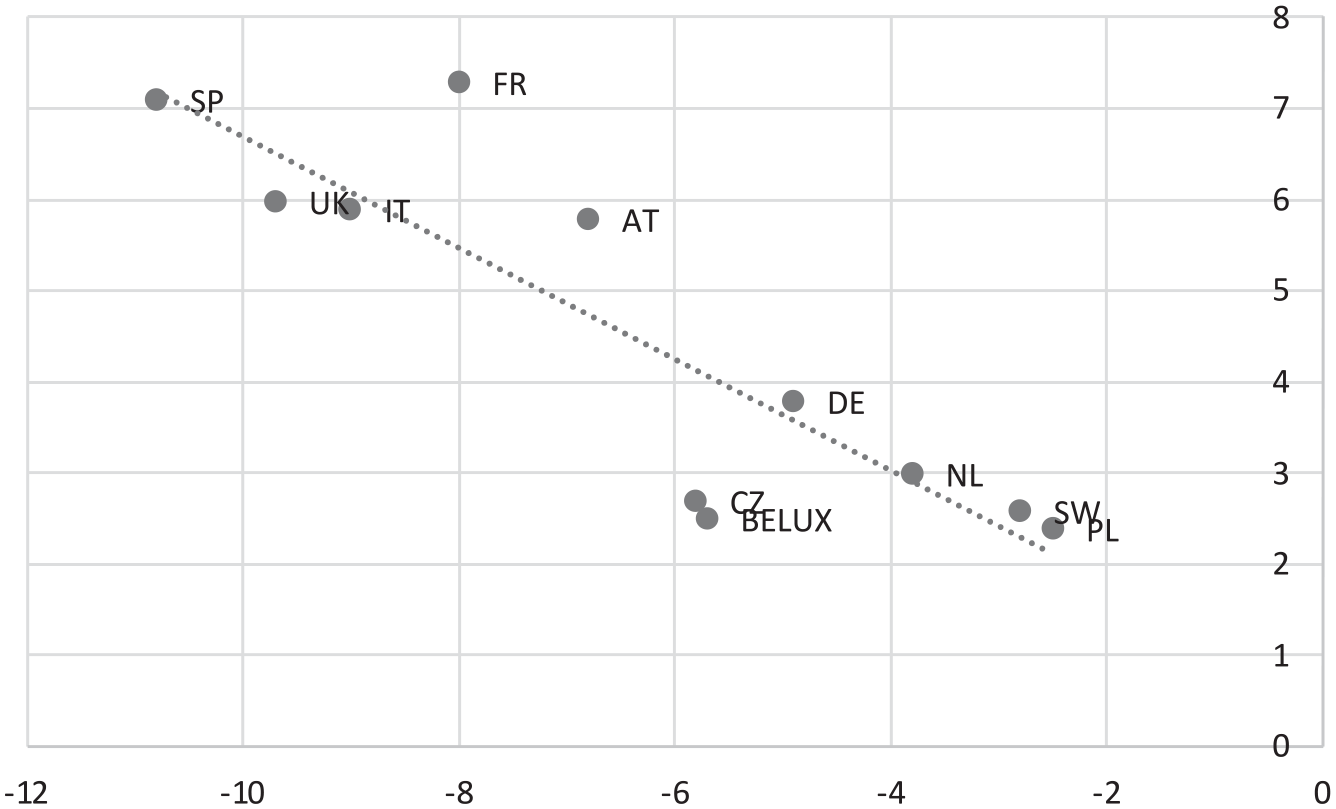
GDP Losses in 2020 (Negative Values, Horizontal Axis) Against Tourism Shares of GDP (Positive Values, Vertical Axis).
Despite gradual improvement of the general health situation through the rollout of vaccination programs, 2021 witnessed further waves of infections which endangered the economic recovery. Although the economy currently shows some positive momentum and the level of pent-up demand with sufficient savings is high, demand for travel has recovered much slower than expected, increasing in 2021 by only 5.25 % on the low level of 2020 to reach only around 30% of the pre-crisis values recorded in 2019 (UNWTO, 2022). As well as reflecting the new infection waves during the fall of 2021 and the beginning of 2022, the sluggish recovery of tourism demand also reflects the persistence of doubts regarding travel safety. A high vaccination quota is important for containing dangerous virus mutations and for supporting the recovery of tourism demand. Although the EU managed to relatively quickly vaccinate around 70% of the population by summer 2021, it appears difficult to raise this percentage to 85% or 90% because of strong resistance among vaccination-skeptical parts of the population.
The COVID-19 pandemic has taught us many lessons. In terms of tourism forecasting, we had never before been confronted with such a bottomless fall. Meanwhile, savings quickly increased to high levels, partially forced by businesses being closed during lockdowns and partially voluntary as precautionary savings increased in preparation for an uncertain future. It is presently unclear when and how much of the saved money will return to the market.
Studies about the consequences of the COVID-19 pandemic for the global economy and the medium-term impact on the global tourism and leisure industries are relatively rare. Therefore, this study aims to shed light on the impact of the pandemic on tourism by forecasting the demand of selected European Union (EU) countries in terms of total expenditure on outbound travel (tourism imports). We exclusively analyze tourism imports as this approach minimizes potential biases which could be introduced when including domestic tourism demand into the analysis because of the substitutional relationship between the two demand categories (Smeral & Song, 2015; Song & Witt, 2000). Regarding outbound tourism in times of economic uncertainty, tourists are likely to forego long-distance destinations and opt instead for neighboring countries of the specific source markets, as has been the case in Europe (Smeral, 2009, 2012). Real spending on outbound travel is heavily influenced by the real income of tourists, as indicated by the country-specific GDP at constant prices and exchange rates. In general terms, tourism expenditures are affected by income and are related to a country’s economy and budget allocation (Wang, 2014), with increases in income—as typically proxied by the GDP of the origin country—resulting in increases in outbound tourism and tourism import expenditures (Rudez, 2008; Smeral, 2012). The same positive correlation between the demand for international travel and the income of the origin country is supported in the study by Lim et al. (2009).
Price measures have been excluded from the analysis because the primary determinants of tourism imports during the COVID-19 pandemic have been the direct influence of travel restrictions and lockdowns and the indirect influence of decreasing disposable incomes during the associated economic turbulence. Considering the increasing inflation pressure due to the Russian invasion of Ukraine—mostly triggered by energy, raw material, and semi-finished product prices—we assume that these price effects are captured in the subdued development of real incomes. In case of war-related GDP losses, we see these effects being balanced out in the medium-term forecasting period.
To maximize the availability of observations, we employed a panel approach including annual data from 2004 to 2020 from 10 EU countries (see the Data section for the list of countries). We started the estimation with 2004 as the Eastern Enlargement of the European Union represented a severe structural break from preceding years (Gunter & Smeral, 2016). To the best of our knowledge, this is the first study using a panel pooled Fully Modified Ordinary Least Squares (FMOLS) approach for analyzing and forecasting tourism demand in the medium-term based on an aggregate economic framework.
The literature review that follows focuses on recent tourism economic contributions on the COVID-19 pandemic before we describe recent macroeconomic and tourism development trends and analyze the effects of the key macroeconomic factors on tourism demand. In the methodology section, we develop a forecast model to project country-specific demand for foreign travel until 2025. Besides a “baseline scenario,” we also develop a “downside scenario” featuring a less favorable development path. We then interpret and discuss the results before finishing the paper with several important conclusions. One of the main contributions of this research is that it develops realistic ex-ante forecasting scenarios, which has not been regularly performed in tourism demand forecasting research to date (Liu et al., 2022). Such scenarios are especially relevant during crisis times, when only a limited number of observations is available, and the crisis event needs to be adequately modeled at the same time (Smeral, 2010).
Literature Review
Since early 2020, the COVID-19 pandemic has been wreaking havoc and dominating all spheres of life. It should come as no surprise that it has also evoked interest among tourism researchers and resulted in numerous special issues dedicated to the topic. Thus, the related body of literature has grown substantially over the past 2 years, especially regarding the impacts on tourism, policy responses, forecasting attempts, recovery prospects, and future tourism research agendas. The phrase “COVID-19 research gap spotting” was consequently coined by Zenker and Kock (2020), who urge for more rigor and deliberateness in the tourism research agenda and less purely descriptive studies. Accordingly, the remainder of this chapter is structured along the COVID-19-related research streams that are of particular relevance to the present study, namely tourism impacts and forecasting.
The impacts of COVID-19 on tourism were of interest to Payne et al. (2021), who examined the persistence in the Croatian tourism indicators using recursive estimation of a fractional integration model and advise rethinking of tourism policies. Pham et al. (2021) focus on the short-run impacts of inbound tourism on the Australian economy and call for governmental support for tourism due to the spillover benefits. Mariolis et al. (2021) delve into the pandemic multiplier effects of tourism on the Greek economy, whereas Kitamura et al. (2020) go beyond economic impacts and additionally evaluate the environmental and social impacts of COVID-19 on Japanese tourism. Spanish tourism vulnerability to COVID-19 was analyzed in the study by Duro et al. (2021), who conclude that destinations must reduce their vulnerability since future shocks are inevitable.
Škare et al. (2021) estimate the impacts on the global tourism industry using panel structural vector auto-regression (PSVAR) and highlight that, since COVID-19 is different from past pandemic crises, it will likely lead to longer recovery periods. Another interesting contribution on a global level is the study by Karabulut et al. (2020), who were the first to apply a new version of the World Economic Uncertainty index to capture the effect of the pandemic on arrivals, while acknowledging that COVID-19 is unlike any other pandemic and that its effects are difficult to estimate. This notion prevails throughout the literature. An alternative approach explored travelers’ reactions on TripAdvisor using text mining techniques to inform a cross-regional comparison and enable the interpretation of consequent industry effects (Uğur & Akbıyık, 2020). One of the pioneering research studies into COVID-19 impacts on tourism comes from Yang et al. (2020), who propose a dynamic stochastic general equilibrium (DSGE) model that is generalizable to any epidemic. Arguably, one of the most substantial contributions within this stream is by Yang et al. (2021) with their analytical tool for monitoring the global impact on tourism: the COVID19 tourism index.
The ongoing pandemic is described as an economic super-shock by Dolnicar and Zare (2020), who limit their investigation to one major supplier in the tourism system—Airbnb. The impacts of COVID-19 on peer-to-peer accommodation platforms were also investigated by Farmaki et al. (2020), yet their study places the focus on host perceptions and responses. In a similar vein, Gerwe (2021) discusses the reasons for disruption of the accommodation-sharing sector and proposes avenues for its recovery. The crippling impact of COVID-19 on the global restaurant industry was analyzed by Dube et al. (2021), who outline several recovery measures for the sector and emphasize the importance of small- and medium-sized enterprises (SMEs). Lastly, Sharma and Nicolau (2020) addressed multiple sectors using an open market valuation approach to assess the impacts on airlines, hotels, cruise lines, and rental cars.
Given the turbulence evident across the entire tourism system, it is not surprising that travelers’ preferences have changed as a consequence of COVID-19. For instance, during the pandemic, travelers have a diminished preference for crowded options (Park et al., 2021). Further evidence comes from a study conducted in China, which revealed that travelers avoid destinations with a higher number of COVID-19 cases and choose those close to their homes (Li, Gong, et al., 2021). Similar conclusions are drawn in the studies on Chinese nationals’ tourism preferences, which find that many would opt for rural, nature-based destinations (Huang et al., 2021), with slow and smart tourism possibly becoming more widely accepted (Wen et al., 2021).
Another interesting avenue of research is the exploration of “travel fear” according to theories of protection motivation, coping, and resilience (Zheng et al., 2021). The impact of COVID-19 on the demand side reflects risk perceptions (Li et al., 2020), as it has been found that fear and perceived risk have a significant negative impact on one’s attitude towards travel (Rather, 2021). There are also studies that attempt to identify proximal and distal post-pandemic travel behavior (Miao et al., 2021) and to model the intra-pandemic perceptions and post-pandemic planned travel behavior (Li, Nguyen, & Coca-Stefaniak, 2021).
Given the gravity of the unprecedented COVID-19 impacts, evidence-based forecasts that can accurately predict the recovery are of immense value to tourism stakeholders. However, conventional forecasting methods will not produce useful forecasts in times of high uncertainty and external shocks (Liu et al., 2021). The extant (i.e., pre-COVID-19) literature on forecasting offers limited insights on the modeling of crises, but not ones of the magnitude of the current pandemic. Nonetheless, some progress has also been made in this domain over the past 2 years (Provenzano & Volo, 2022).
Various forecasting approaches were tested side-by-side in a tourism forecasting competition requiring teams to develop forecasts of visitor arrivals for 20 destinations worldwide: the Europe team proposed a scenario-based judgmental forecast based on the definition of a COVID-19 Risk Exposure index (Liu et al., 2021); the Africa team (Kourentzes et al., 2021) offered their own judgmental adjustment of model-based forecasts; and a two-stage three-scenario framework was contributed by the Asia and Pacific team (Qiu et al., 2021). Similarly, Zhang et al. (2021) advocate for combining econometric and judgmental methods in their forecasts of tourism recovery in Hong Kong.
A different approach was adopted by Bi et al. (2021), who introduce a forecasting model based on deep learning with time series imaging. Li et al. (2022) emphasize the importance of spatiotemporal features in tourism demand forecasting and develop a deep learning model applicable to data with varying time granularities and periods (i.e., before and during COVID-19). The role of disaggregated search data in improving tourism forecasts is investigated in the case of Sri Lanka by Wickramasinghe and Ratnasiri (2021), yet the main merit of their study is estimation of foregone economic benefits due to the pandemic. Furthermore, a multisource internet data approach is recommended for predicting international tourist arrivals to Indonesia during COVID-19 because of its higher forecasting accuracy (Andariesta & Wasesa, 2022).
Yang et al. (2022) find insufficient evidence regarding the usefulness of Google Tends data in their forecasts of daily tourism demand across 74 countries in 2020 and therefore highlight the only relative effectiveness of such data in tourism forecasting. Another study employs a learning machine approach to forecast the pandemic effect on Chinese arrivals to the United States and Australia. The findings suggest that recovery to pre-pandemic figures may take from 6 to 12 months (Polyzos et al., 2021). On a related note, the forecast losses may set tourism growth back by 15 years (Fotiadis et al., 2021).
Additionally, affective forecasting is researched in the context of travel decision-making and alleviation of a perceived risk (Karl et al., 2021). Zhang and Lu (2022) were among the first to make a contribution regarding the sector forecasting, namely, Hong Kong’s hotel room demand forecasting, by employing the autoregressive distributed lag error correction model for baseline forecasts, followed by compound scenario analysis—all done with the aim of helping the hotel sector during this crisis. Similarly, mixed data sampling (MIDAS) models are found to be effective in monitoring and forecasting COVID-19 impacts on hotel occupancy rates in Macau by Wu et al. (2022), who use high-frequency data: daily visitor arrivals and search queries. The same authors also highlight the need for new tourism demand forecasting research amid COVID-19.
The studies by Provenzano and Volo (2021) and Plzáková and Smeral (2022) are of particular interest for our endeavors, as they both investigate impacts and provide forecasts. The former focuses on tourism recovery in Lombardy, Italy, and implements a model-based approach in forecasting overnight stays up to December 2023. The latter study, somewhat comparable to the present research endeavor, analyzes the impacts of COVID-19 on European tourism (Euro area). More specifically, it forecasts demand for international travel in terms of tourism imports until 2022 by employing a model that considers asymmetric income elasticities of tourism demand.
As is evident, different forecasting approaches have been explored by tourism researchers in attempts to optimize tourism recovery. However, the very notion of a return to normal is challenged nowadays by researchers who raise questions about the overall future of tourism (and consequently of tourism research). It has been noted that “changes to tourism as a result of COVID-19 will be uneven in space and time” (Hall et al., 2020, p. 591). Brouder (2020) discusses possible pathways towards industry transformation, while Romagosa (2020) reaffirms the opportunities for sustainable and proximity tourism granted to us by the pandemic. There are also studies that explore the linkages between the pandemic, tourism recovery, and the climate crisis (e.g., Gössling et al., 2021; Prideaux et al., 2020). The reality is that some destinations will take up the transformational opportunity, whereas others will continue with business-as-usual (Hall et al., 2020). Irrespective of which path is ultimately taken, destination stakeholders and policymakers will need guidance in the tourism recovery and resilience building efforts. This is also where the present study comes in, with the aim to shed light on post-COVID-19 European tourism in terms of medium-term forecasting scenarios.
Data
This study employs annual data on real tourism imports (
Descriptive statistics are given in Table 1. The same table also provides panel unit root (Phillips-Perron Fisher test; EViews, 2019) and panel co-integration (Kao test; Kao, 1999) test results. The null hypothesis of the variables containing country-specific unit roots cannot be rejected for either of the two variables, leading to the conclusion that they are both integrated of order
Descriptive Statistics, Including Panel Unit Root and Panel Co-Integration Test Results.

Note. (p values of test statistics in parentheses). Own calculations using EViews (Version 11).
Methodology
Given that the data have both a time-series and a cross-sectional dimension, panel-data estimation techniques are suitable. As confirmed by panel unit root and panel co-integration tests (see the Data section), the variables tourism imports (

In Equation (1),
We estimate Equation 1 using the panel pooled FMOLS approach by Phillips and Moon (1999), which itself is an extension of the original pooled FMOLS estimator for time-series data by Phillips and Hansen (1990). This estimator is asymptotically unbiased and features fully efficient mixture normal asymptotic properties (EViews, 2019). The long-run covariance matrix is estimated using a Bartlett kernel with Newey-West fixed bandwidth, while allowing for heterogeneous first-stage long-run coefficients, and the coefficient covariance is computed using the sandwich method. As argued by Gunter and Smeral (2016), the Eastern Enlargement of the European Union by 10 countries in 2004 represents a severe structural break. Consequently, Equation 1 is estimated for a sample running from 2004 to 2020.
Estimation Results
The estimation results are based on the panel pooled FMOLS approach using N • T = 170 observations, thereby covering the period from 2004 to 2020. Generally speaking, the estimation results look very favorable in both statistical and economic terms: the Adjusted R2 as an overall goodness-of-fit measure is very high and all coefficient estimates are statistically significant at the 1% level; they are also within plausible elasticity ranges. The estimation results are summarized in Table 2. Moreover, it should be noted that the deterministic components (
Panel Pooled Fully Modified Ordinary Least Squares (FMOLS) Estimation Results Based on N • T = 170 Observations From 2004 to 2020.

Note. Dependent variable:
R2 = 0.984084 Adj. R2 = 0.982976.
Based on these estimation results, medium-term forecasts for tourism imports over the period 2021 to 2025 are calculated, while the real GDP forecasts are based on data from the EC, IMF, OECD, and our own estimates. These scenario forecasts are completely ex-ante, thereby following the call of Liu et al. (2022) for more ex-ante forecasting in tourism demand forecasting research. While a good in-sample model fit as indicated by a high Adjusted R2 value is not a sufficient condition for accurate out-of-sample forecasting accuracy, splitting the sample into a training set and a test set was not possible since the estimation window (i.e., the training set) sensibly needs to incorporate the year of the pandemic outbreak.
Hence, a pseudo out-of-sample forecasting evaluation would have only been possible for the year 2021 with a maximum of 10 historical observations, provided that all 10 sampled EU countries could have provided final data. However, the usefulness of such an evaluation would not have been very high. We therefore follow the literature on tourism demand forecasting in turbulent times, such as during the Financial Crisis of 2008/2009 (Smeral, 2010), which necessitated the development of realistic forecasting scenarios without the possibility of conducting a traditional forecasting evaluation.
Forecasting Development From 2021 to 2025
The Present State
The global recovery continues, but momentum has weakened because of the ongoing pandemic. In a strong rebound, the world economy expanded at a relatively high average growth rate of almost 6% in 2021 but this growth rate will decrease in 2022, depending also how long and intense the conflict between Ukraine and Russia will be (IMF, 2022; OECD, 2022). The EU and the Euro Area recovered from the pandemic recession faster than expected in 2021, realizing a 2021 growth rate of 5.3%, yet similar to the global economy, the expansion rate will decrease in 2022 (EC, 2022a; IMF, 2022). This damper on the recovery speed resulted from a strong increase in infection rates in the fall, causing the economic recovery to lose momentum. The situation was further hampered by the stagnation of vaccination rates in the EU at approximately 70% after relatively fast progress to raise the vaccination quota to this level during the first part of 2021. Further raising the vaccination quota to the necessary 85% to 90% is politically challenging, as it requires convincing vaccination-skeptical parts of the population.
The war effects are difficult to estimate. Using a simulation model, the OECD estimates that the conflict between Russia and Ukraine will result in an average growth loss of at least 1.1 percentage points for European countries in 2022 (OECD, 2022). Almost three quarters of the loss is due to the strong increase in raw material prices, the remainder is caused by the breakdown of Russian domestic demand and by financial shocks (OECD, 2022). For the medium-term development—and similar to international organizations—we assume that the growth losses of 2022 will be balanced out during the forecasting period.
Although spring to fall 2021 showed strong signs of economic recovery and the level of pent-up demand as well as the available excess savings were high, demand for travel recovered significantly slower than expected and is still far below 2019 levels. In other words, savings forced by lockdowns and those precautionary savings accumulated in preparation for an uncertain future have only partly returned to the market. It is uncertain when and how much of the remaining saved money will be spent.
Tourism was very strongly affected by the pandemic and the economic downturn in 2020. The year 2021 showed similar fluctuations as the previous year, whereby a decline in tourism demand at the beginning of 2021 was followed by a very strong recovery in the summer, but the dynamic again weakened significantly in the fall with increasing infection rates. Preliminary data for 2021 show that international arrivals increased by only 4% compared to the low 2020 levels (UNWTO, 2022).
Figures 2 to 4 in the Online Supplement are based on data collected until February 2022 through the EU business survey for accommodations, restaurants, and travel agencies and tour operators, respectively, and show seasonally adjusted monthly balances of positive and negative responses regarding expected turnover development for the next 3 months, measured as the percentage of the businesses polled (EC, 2021b). After the dramatic slump in the first half of 2020, expectations improved during the summer before worsening again in the fall with the second wave of the pandemic and the imposition of new containment measures, which were generally not lifted before spring 2021 except for some temporary easements.
According to these measurements, enterprises showed no expectations of recovery until March 2021, when expectations began to improve alongside progress in vaccination programs and a general economic recovery. However, new infection outbreaks, virus mutations, and stagnation in vaccination rates again depressed expectations at the end of summer and the beginning of fall. The beginning of 2022 saw expectations improving again with the end of winter in sight and hopes for healthy spring business as both infection rates and the likelihood of lock downs decreased. However, March data (which were not available to us by the time of manuscript submission) would presumably show the Russian invasion of Ukraine strongly deteriorating the business expectations.
The Forecasts
For our baseline forecasting scenario, we assume that the effects of the pandemic will gradually recede during the forecasting period, supported by an increasing vaccination quota, but will not fade away completely. Rather, society will learn to live with the virus as it becomes endemic and to avoid strong outbreaks of infection. Parallel to the decline of the pandemic, containment measures will be gradually lifted so that consumption and travel behavior will show normalizing tendencies. The growth losses in 2022 due to the Russian invasion will be balanced out during the forecasting period. In the medium term, as the health situation improves and fears of lockdowns dissipate, the investment climate will improve and the economies of the 10 selected countries will realize an average GDP growth rate, throughout the 2021 to 2025 forecasting period, of 2.2% per year, considering a reduced inflation pressure. The GDP growth forecasts are taken directly from various international organizations (EC, 2022a; IMF, 2022; OECD, 2021b). The sampled countries will grow a bit stronger than those in the broader EU and Euro Area (2.1% per year). From among the selected 10 countries, the economies of Austria, Belgium (including Luxembourg), the Czech Republic, Poland, Spain, and Sweden will show above average growth rates (see Table 3).
Medium-Term Forecasts From 2021 to 2025 Based on Equation 1

Note. Sources: 1Own calculations using EViews (Version 11). 2EC (2022a), IMF (2022), and OECD (2021b). Belg. = Belgium, Lux. = Luxembourg.
Equation 1 is employed for the medium-term tourism forecasts (see Table 2). The forecast values for growth in real tourism imports average 2.7% per year across the 10 countries and range from 2.3% (France) to 3.7% per year (Poland and the Czech Republic; see Table 3). Only Spain, Poland, and the Czech Republic realize an annual growth rate in real expenditures for outbound travel above 3%, while Austria achieves 3% and Sweden is also slightly above average. Belgium (including Luxembourg) just hits the average of 2.7%, while below average tourism import growth rates are realized in France, Italy, the Netherlands, and Germany.
The conditions underlying the baseline scenario are not guaranteed, however, and we must acknowledge that many looming risk factors could dampen the growth rates forecasts above. The main risks are:
New variants of the COVID-19 virus: the emergence of new virus variants, particularly ones more transmissible and lethal, would prolong the pandemic and may necessitate further containment measures, which could have a negative impact on the economy in terms of trade and supply chain disruptions causing supply shortages and slowing demand recovery (IMF, 2022).
War and inflation: the conflict between Russia and Ukraine will not end before summer 2022 and will last until the end of 2022 at least, with the result that more critical links in supply chains will be destroyed and more severe shortages of important production factors will appear. Although we can expect supply shortages to fade out by 2023, thereby reducing upward pressure on prices, it must be considered that a longer conflict between Russia and Ukraine could be an additional factor pushing up energy prices.
Global distribution problems: the distribution of vaccines to countries that do not have sufficient supplies has been inefficient and sluggish, while the resistance of vaccine-skeptical parts of populations in more developed countries continues to delay broad vaccine coverage of the global population, leaving open the possibility of new infection waves.
Social unrest: social tensions are evident in many populations because of frustration with governments’ handling of the pandemic, increasing consumer prices, slow employment growth, and the vaccination resistance of some groups, which have been attributed responsibility for extending the duration of the pandemic and causing shortages in hospital intensive care units. A further intensification of these tensions could broadly damage public sentiment and negatively impact the sustainable recovery of the economy.
These four main risk factors can be summarized as key drivers in our downside forecasting scenario. In contrast to the baseline scenario, the downside scenario describes a society that faces war effects, stronger breakouts of infection, as well as travel and other restrictions damaging supply chains, causing supply shortages which further feed inflation. Together with social tensions and unrest in society these eventualities would dampen economic growth.
To quantify the effects of the downside scenario, we could assume that the medium-term growth rates of the 10 sampled countries will be 0.5 to 1 percentage points lower than in the baseline scenario. This downside directed correction range follows the assumptions and model calculations of the IMF for advanced industrialized countries and the recent OECD simulation results (IMF, 2021, 2022; OECD, 2022). For our particular country sample, however, we evaluate a growth rate reduction by 1 percentage point as being too high and by 0.5 percentage points as too low, so we use a value midway between the upper and lower bounds (0.75 percentage points) for our calculations. This average value does not reflect the country-specific growth losses and only has an approximate character indicating the direction. However, we have to point out that country-specific simulation results were not available.
According to our model calculation based on Equation 1 for the downside scenario, the average yearly growth rate of tourism imports across the 10 sampled countries would decrease from 2.7% per year in the baseline scenario to around 1.7% (see Table 3). The medium-term growth rates for the single countries would show a similar structure as in the baseline scenario in terms of which countries perform above or below the group average (see Table 3).
Conclusions
Studies about the consequences of pandemics such as COVID-19 for the global economy and the global tourism and leisure industries remain relatively rare, yet there is strong agreement that we cannot rely on traditional approaches and experiences from dissimilar events to estimate the medium-term consequences of such phenomena. In developing our model to forecast tourism imports for the 10 selected EU countries until 2025, we employed a panel pooled Fully Modified Ordinary Least Squares (FMOLS) approach using annual data. Besides a modestly optimistic “baseline scenario,” we also developed a more pessimistic “downside scenario” featuring a less favorable development path.
The COVID-19 pandemic has imparted many lessons for tourism researchers. In terms of tourism forecasting, we had never been confronted with such strong demand fluctuations and such a bottomless fall in the market resulting from the stop and go policies employed to contain the various waves of infection. We have realized that the notion that “tourism is a resilient industry” does not hold in the case of pandemics and that countries with high tourism shares suffered from particularly strong decreases in GDP. Tourism suffered more than most industries from the imposed containment measures and the general economic downturn they triggered, and it is becoming clear that the industry may need some years to return to pre-crisis levels.
An evaluation of our forecast must consider many uncertainties including monetary policy, which must now traverse the fine line between tackling inflation triggered by supply shortages and war effects and supporting the economic recovery while managing financial risks. Although central banks can generally look through transitory inflation pressures and avoid tightening until there is more clarity on underlying price dynamics, they should be prepared to act quickly if the recovery strengthens faster than expected or risks of rising inflation expectations become tangible.
Rising inflation could present a trade-off situation in which monetary policy must select between either supporting the recovery of the economy or getting ahead of price pressures by tightening money markets, even if that delays the recovery of the labor market. The alternative of waiting for stronger employment outcomes runs the risk that inflation increases in a self-fulfilling way, undermining the credibility of the policy framework and creating more uncertainty. Growing uncertainty could hold back private investment and lead to a slower employment recovery. By contrast, monetary policy can remain accommodative when inflation expectations are still below the central bank target and the labor market has not yet fully recovered.
Our results highlight important managerial implications, for instance, by indicating which of the analyzed countries may be the fastest to recover. In tourism terms, this information is certainly of interest to destination managers and other tourism stakeholders who are eager to increase foreign overnights at their destinations; they may opt to particularly target these countries (i.e., source markets) and adapt their current marketing strategies accordingly.
As always, this study is not without limitations. The biggest question marks stem from the quantification of the Russian–Ukraine conflict. Our assumption that growth losses will be balanced out, supply shortages will fade out, and inflationary pressure will be reduced in the medium-term is in some way optimistic. A less optimistic view could lead to the scenario that this war will lead to a more severe destruction of supply chains with additional impacts on price pressure, thereby eroding real incomes of households and hindering the production of important goods persistently. Consequences would be a strong declining private consumption and travel demand, leisure industries and other businesses facing significant sales losses, and investments being reduced in the tourism industry and beyond.
A limitation of this study is that the sample includes only 10 European countries for which only annual data were available to the authors. Although these countries are important players in European tourism, heterogeneity in the sample is evident, both in terms of their individual tourism contributions and their COVID-19 policies. The latter has certainly had, and will continue to have, an impact on the speed of tourism recovery in the individual countries. Finally, not having access to country-specific simulation results from OECD, and not being able to perform a pseudo out-of-sample forecasting evaluation exercise due to the recentness of the COVID-19 pandemic, represent two further important limitations.
Further research should focus on the short-term tourism effects of COVID-19 using quarterly data at more disaggregate geographical levels, as the containment measures differed in timing, duration, characteristics, and intensity from one geographical area (e.g., city or region) and administrative region to the next. Addressing broad questions about the effects of the pandemic requires such studies to compare specific scenarios between countries, the different time lags between the imposition of containment measures and direct impacts on import demand, and the indirect impacts flowing from GDP effects. Another challenge involves determining whether saving behaviors have shifted to include a higher amount of precautionary savings and predicting when and to what extent the excess savings will re-enter the market.
Moreover, it would also be interesting to study changes in consumer and travel behaviors with the objective of developing new business models using innovative approaches to deal with the “new normal.” Other research endeavors might focus on whether experiences with virtual meetings during the COVID-19 crisis will transform old meeting patterns and restrict conference, business, and event tourism, which might severely impact city tourism, as already discussed by Önder and Gunter (2022).
Supplemental Material
sj-docx-1-jht-10.1177_10963480221125130 – Supplemental material for Forecasting Tourism in the EU after the COVID-19 Crisis
Supplemental material, sj-docx-1-jht-10.1177_10963480221125130 for Forecasting Tourism in the EU after the COVID-19 Crisis by Ulrich Gunter, Egon Smeral and Bozana Zekan in Journal of Hospitality & Tourism Research
Footnotes
Acknowledgements
The authors appreciate the comments and suggestions for improvement raised by the associate editor and the three anonymous reviewers of this journal, as well as by the participants of the 8th Conference of the International Association for Tourism Economics (Perpignan, France) and of the 42nd International Symposium on Forecasting (Oxford, United Kingdom). Finally, the authors thank David Leonard for proofreading the manuscript.
Declaration of Conflicting Interests
The authors declared no potential conflicts of interest with respect to the research, authorship, and/or publication of this article.
Funding
The authors received no financial support for the research, authorship, and/or publication of this article.

Supplemental Material
Supplemental material for this article is available online.
Author Biographies
References
Supplementary Material
Please find the following supplemental material available below.
For Open Access articles published under a Creative Commons License, all supplemental material carries the same license as the article it is associated with.
For non-Open Access articles published, all supplemental material carries a non-exclusive license, and permission requests for re-use of supplemental material or any part of supplemental material shall be sent directly to the copyright owner as specified in the copyright notice associated with the article.
