



Abstract
The COVID-19 pandemic caused significant business disruptions around the world, with travel and tourism being particularly impacted. In response, governments and businesses implemented drastic responses to reduce the impact of the virus and mitigate the corresponding loss in business. Through nine semi-structured interviews with senior hotel managers in Dubai, the pattern of response was understood, along with participants’ perceptions of the long-term consequences of such responses. Through a variety of responses to handle this specific crisis, general crisis management – to cope with low demand – and efforts to recover – attracting new customers – the nature of responses appear to match those of previous crises, with some variations. In terms of the long-term impacts of these responses, it was felt that numerous properties would permanently close, the nature of international hospitality would become more consolidated and there would be long-term changes in operations and efficiency improvements.
Introduction
COVID-19 is an infectious acute respiratory virus, first reported in China, that has severely affected day-to-day life of individuals all over the world (Garrido-Moreno et al., 2021; Sigala, 2020). In response to COVID-19, governments turned to various policies to slow the contagion, including the encouragement and enforcement of cleaning hands, wearing face masks, social distancing and lockdowns (Carlsson-Szelak et al., 2020; Garrido-Moreno et al., 2021). The virus has stunted market growth around the world and has led to the most extensive loss in worldwide stock markets since the 2008 financial crisis. The global economy has come to a standstill and has left investors unsure about the current market. Projections vary from a 9% drop to a 1% drop in GDP, making it the worst recession since the great depression (UNIDO, 2020). The travel and hospitality sector has been one of the most negatively impacted industries due to repeated lockdowns and social distancing practices.
In addition to social distancing, many countries also implemented travel restrictions to limit the spread of the virus, which have significantly impacted global travel. Global projections estimate a loss of 100.8 million jobs and a US$2.7 trillion decrease in GDP in the travel and tourism sector (Garrido-Moreno et al., 2021), making the impact of COVID-19 five times worse than the 2008 financial crisis (UNIDO, 2020).
While certain markets have had to contend with similar pandemics, such as SARS and H1N1 (Gu and Wall, 2006; Henderson and Ng, 2004; Hung et al., 2018; McKercher and Chon, 2004; Pine and McKercher, 2004; Tew et al., 2008), this is the first global pandemic to hit hospitality in such a manner (Jiang and Wen, 2020). Consequently, the lessons learnt from earlier pandemics have limited generalizable application for COVID-19 (Garrido-Moreno et al., 2021).
While research on hotels’ strategic responses to the pandemic is growing (Garrido-Moreno et al., 2021), the consequences of these responses require consideration. It is important to explore the possible long-term effects of these strategic responses so when hotels attempt to ‘return to normal’ and undo some of their responses, there is guidance on what can be changed, at what rate, and given what considerations. The study’s findings will give the hotel industry better knowledge of the different strategies that are being used to respond to COVID-19 and their perceived long-term impacts. This analysis will offer insight that will explain the consequences of the changes in the hotel sector in a post–COVID-19 world. Furthermore, the analysis will consider the longevity of these changes which will be beneficial to both hotel investors and employees as it will show how the industry has changed due to the virus. Several articles are available which offer detailed insights and suggestions into crises in general, as well as COVID-19. However, there is a notable dearth in empirical studies which are needed to explore specific and applied strategies (Garrido-Moreno et al., 2021; Herédia-Colaço and Rodrigues, 2021; Lai and Wong, 2020) and prepare for the long-run consequences of such strategies.
The research questioned ‘What are the long-term impacts of the strategic response to COVID-19 in the hotel industry?’ The research set out to (a) investigate how pre-existing strategic crisis management systems supported the hotel industry during the COVID-19 pandemic, (b) investigate how COVID-19 has changed the hotel industry and (c) understand how the strategic response to COVID-19 has changed the hotel industry.
Literature review
Crises defined
Literature has defined crisis management in various ways, frequently focusing on specific examples of crises. However, there are three common elements defining crisis management: a danger to an organization’s survival, a surprised or unpredictable occurrence and a short amount of time to develop a response (Garrido-Moreno et al., 2021; Mehr and Jahanian, 2016) which can only occur after the event (Kim et al., 2005). The most common definition of crisis management offered by Preble (1997: 773) states ‘the process that attempts to identify and predict areas of crises, the development of actions or measures designed to prevent crises from occurring, or from an incident evolving into a crisis, and minimizing the effects of disruption from a crisis that could not be prevented’. Crisis management is, therefore, the means employed by a company to prepare for and recover from crises. This encompasses the precautionary actions and the reactionary measures taken to safeguard the company from harm (Vargo and Seville, 2011; Wang and Ritchie, 2012). Crises have been differentiated from disaster due to the degree of organizational control over and prepared response to the event, where organizations have some control over crises and little to no control over disasters (Garrido-Moreno et al., 2021; Ritchie and Jiang, 2019).
Tourism crises can be defined as ‘event[s] of sufficient magnitude to give rise to circumstances in which the routine functioning of the tourism industry is severely upset’ (Ghaderi et al., 2014: 613). Over the past two decades, the global tourism industry has been exposed to several crises, including terrorism attacks (11 September 2001 airline hijacking, the Bali Bombings in 2002 and 2005 and Paris terror attacks of 2015), civil unrest (i.e. Egypt, Greece, Israel, Thailand, Tunisia and Turkey)(Selmi, 2017), natural disasters (i.e. earthquakes, hurricanes, tsunamis and volcanic eruptions), global financial downturns (2008–2010) and pandemics (i.e. SARS, H1N1 and MERS) (Garrido-Moreno et al., 2021; Gurtner, 2016). These events frequently lead to reduced tourism numbers, with the degree varying on the severity of the crisis, and can even lead to long-term impacts on destination image, depending on their handling of the crisis (Garrido-Moreno et al., 2021; Selmi, 2017).
Given the extensive literature analysing and recommending solutions to respond to crises in general and specific health crises (Wenzel et al., 2020), there are grounds to argue that COVID-19 is a crisis; organizations failed to respond appropriately and control the issues as they arose (Garrido-Moreno et al., 2021; Ritchie and Jiang, 2019). While many business did respond to COVID-19 following similar practices as SARS and MERS etc. (Carlsson-Szelak et al., 2020; Garrido-Moreno et al., 2021), the longevity, globalized nature and severity of COVID-19 suggests that these solutions were inadequate and, therefore, business was not fully prepared for this significant external event, making this a ‘disaster’ rather than a ‘crisis’ (Garrido-Moreno et al., 2021; Ritchie and Jiang, 2019). Although literature treats the response to disasters and crises similarly and applies similar frameworks (see Garrido-Moreno et al., 2021; Hystad and Keller, 2008; Ritchie and Jiang, 2019), the difference between the two could imply varying degrees of reliance upon external bodies to support recovery. Such a reliance can further compound the complexity of the event and its longevity.
Crisis management
The susceptibility of tourism to such situations means it is essential to take urgent action to control and recover (Garrido-Moreno et al., 2021). Faulkner (2001) proposed a frequently cited model used for developing and analysing crisis management strategy in tourism. The framework is broken down into 5 phases: pre-event, prodromal, emergency, intermediate, long-term recovery and resolution.
The Pre-event phase refers to established plans to prepare for various crises (Faulkner, 2001), which can include the necessary crisis trainings and risk or vulnerability assessments (Kaushal and Srivastava, 2021). The Prodromal phase occurs when warning systems have indicated that a disaster is imminent, and command centres have been established to enact the crisis plans (Faulkner, 2001). The Emergency phase is when the crisis is in full swing (Faulkner, 2001), where communication and quick decision-making is important to help survive the crisis (Hirudayaraj and Sparkman, 2019). The fourth phase, Intermediate, focuses on restoring impacted services to return to ‘normal’ (Faulkner, 2001; Gössling et al., 2021). This includes communication with the media (Selmi, 2017) to manage customer perceptions and help businesses move into the fifth phase – Long-term Recovery – to reconstruct business infrastructure (Faulkner, 2001). The final Resolution phase aims to adjust existing contingency models to prepare for future crises (Faulkner, 2001).
Beyond a simple crisis response, businesses can be presented with opportunities to improve from the implementation of new early warning systems (Vargo and Seville, 2011), to adopting new business practices, government policies or even research directions (Brouder, 2020; Hall et al., 2020; Sigala, 2020). Some Thai resorts, for example, were able to use the 2004 Tsunami as an opportunity to restructure their operations by updating their resources to fit new market segments (Scott et al., 2008). In fact, a crisis may not offer an opportunity insomuch as a need to change rather than trying to return to the status quo (Sigala, 2020).
Previous global public health emergencies crisis management
The SARS pandemic is one most cited examples of a virus which caused significant impact on travel. Areas affected by the disease were quarantined, and travel restrictions constrained the tourism industry (Pine and McKercher, 2004). Cooper (2006) states that regions without the virus also saw a decrease in airlines and hotel sales, particularly in Asia. There is some debate, however, in terms of the degree of damage caused by the virus, versus an overreaction to the virus. In the case of SARS, this has been referred to as SARS Induced Panic (SIP) (McKercher, 2003). The effect pandemics have on the hotel industry primarily revolve under the psychological impacts that deter tourists from travelling and government restrictions on flights (Hung et al., 2018).
The SARS virus caught Singapore off guard, and tourism sharply declined. During the height of the outbreak in May 2003, visitor numbers saw a year to year reduction of over 70% (Henderson and Ng, 2004). Due to the sudden nature of SARS, businesses were unable to properly prepare in the pre-event and prodromal phase (Chien and Law, 2003; Henderson and Ng, 2004; Pine and McKercher, 2004; Tew et al., 2008). To control the virus, hotels in Singapore implemented frequent temperature checks for staff and customers, and an optional ‘COOL’ certification was developed by the Tourism Board for hygiene certification (Henderson and Ng, 2004), along with additional staff hygiene training (Israeli and Reichel, 2003). Several additional practices were implemented throughout affected areas, including terminating external contracts, reducing salaries, encouraging the use of employee leave or unpaid leave and the lobbying of government for a relief fund (Chien and Law, 2003; Henderson and Ng, 2004; Pine and McKercher, 2004; Tew et al., 2008). These practices were often supported by marketing campaigns targeting domestic travellers (Henderson and Ng, 2004). While China recovered quickly, with room rates increasing by 12.61% about 2 weeks after the WHO lifted the travel alert on China, the national government was able to focus long-term recovery around the upcoming Olympics and Shanghai Expo (Gu and Wall, 2006). The extent of H1N1 swine flu pandemic’s impact on tourism, while clearly detrimental, is less clear as the pandemic coincided with the worldwide recession (Lee et al., 2012).
From their experience with SARS and swine flu (H1N1), most businesses and governments in Asia developed new guidelines for handling similar pandemics should they occur again (Gu and Wall, 2006; Hung et al., 2018). However, research does not show if these preventive guidelines had a proactive effect on the response to H1N1, yet past research has still called for better measures to prepare for future pandemics in the hotel industry (Chien and Law, 2003; Gu and Wall, 2006; Henderson and Ng, 2004; Hung et al., 2018; Lee et al., 2012; Pine and McKercher, 2004; Tew et al., 2008), and COVID-19 appears no different.
Research method
Interviewees demographic data.
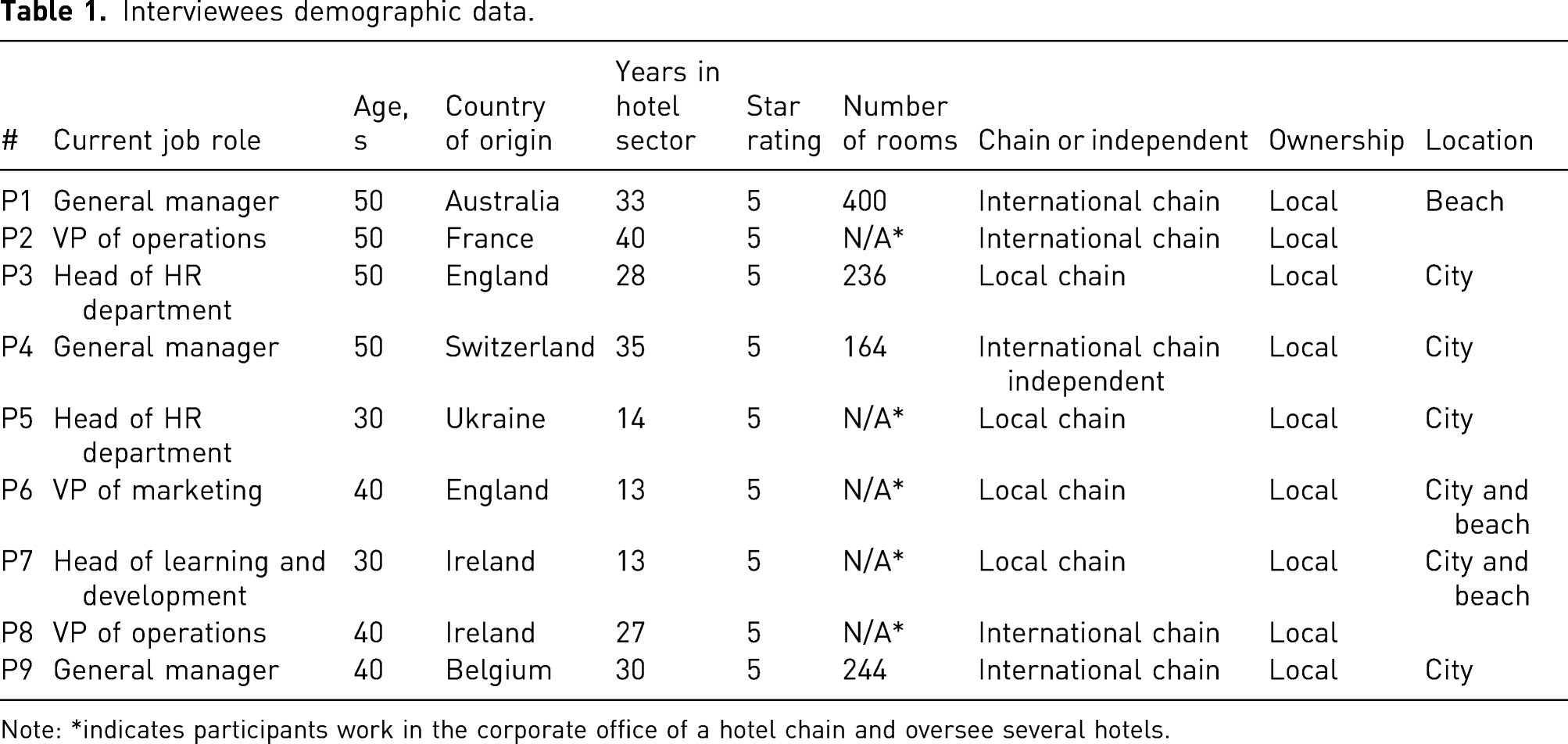
Note: *indicates participants work in the corporate office of a hotel chain and oversee several hotels.
Before the interviews began, participants were provided with consent forms which identified their rights throughout the research such as the right to refuse to be interviewed, to withdraw consent at any point and permission to deny tape recording. These consent forms were collected and stored separately from transcripts to ensure the anonymity and confidentiality of participants. After collecting basic demographic information, exploratory questions addressed the first-hand experience of senior hotel managers in terms of their response to the COVID-19 pandemic. Specifically, the questions explored participants’ knowledge of crisis management strategies used in their hotel and their opinions on the long-term effects of their response to COVID-19. The questions were designed based upon the research objectives and literature topics and structured to allow interviewees to explain their experiences of the pandemic and elaborate on their perceptions of the future of the industry partially due to the response to the pandemic. The list of questions posed to participants is provided in Appendix A.
The questions were cross-checked by domain experts to ensure their validity and ensure that the questions were appropriate for discussion and if anything was missing. A pilot study was then conducted with an individual from the sample. Based on the results of the pilot, two similar questions, which provided repetitive answers, were merged. No other adjustments were made, allowing data collection proceeded as planned. An average interview length of 35 min was found between all nine interviews, and the interview times ranged from 29 min to 50 min.
Interviews were conducted and recorded, with participants’ permission, through Zoom, and immediately transcribed with using Otter.ai to expedite the process and provide more accurate transcriptions (Nam et al., 2020).
Transcripts were analysed through content analysis, looking for existing and emerging themes (Creswell, 2009; Jennings, 2010; Saldaña, 2016). Transcripts were read thoroughly multiple times by the researchers to uncover appropriate themes and supporting quotations. A mixture of emerging and existing themes were searched for by the researchers independently. The researchers later compared their analyses to ensure coding validity. A total of four themes and ten sub-themes emerged from the data analysis process. Each central theme found was directly associated with one of the research objectives and assisted in generating the required data to understand the research topic. For example, when asked, participants described various measures that their hotel had implemented to combat COVID-19. These included social distancing, the use of sanitizer, and staff layoffs or salary reductions, to name but a few. When analysing these measures, they were grouped depending on their intended outcome, to combat the health-related nature of COVID-19 (social distancing and sanitizer), to support the businesses’ survival (staff layoffs and salary reductions). In the following analysis, these were placed under the themes of specific response and generic response, respectively.
Study context
The study was conducted in Dubai, one of the seven emirates of the United Arab Emirates. As of December 2019, Dubai reported 16.73 million visitors (a 5.09% growth from 2018) and a total of 741 hotel and hotel apartments (up by 3% from 2018) (DTCM, 2021). Dubai and the wider United Arab Emirates cater to a majority international market, of which an estimated 80% are leisure travellers (Euromonitor, 2021). In 2019, 20% of Dubai’s tourists came from Western Europe, followed by 18% GCC, 16% South Asian and 12% North and South East Asia (DTCM, 2021). As of March 2021, this has changed to favour South Asia at 30%, Russia and CIS at 20% and Europe at 17%. Specifically, India was the top source market, accounting for about 25% of Dubai’s tourists from January to March 2021, with Russia second at about 8% and France third at about 4% (DTCM, 2021). On the 26th March, the UAE government announced the start of a sterilization programme aimed to control the spread of COVID-19 (UAE, 2021: national disinfection programme). At first, this programme meant movement was restricted at night while the sterilization programme was in effect, with a permit required if individuals wished to visit pharmacies or grocery stores, unless they worked in an ‘essential service’ (UAE, 2021: national disinfection programme). From the 4th April until the 24th April, Dubai residents’ movements were restricted 24/7, with permits required if residents wished to leave their homes (UAE, 2021: movement permits). Most restrictions ended on the 24th June however; throughout the period 26th March to 24th June, regulations varied slightly across different emirates, with Dubai usually reflecting slightly more relaxed rules (UAE, 2021: movement permits). As of June, UAE hotels reported a 46.3% drop in occupancy, a 24.2% reduction in the average room rate and a 59.3% decrease in RevPAR year-on-year (STR, 2020). While this is a negative trend, the UAE as a whole reported the second-highest average hotel occupancy in 2020, globally, at 54.7%, beaten only by China’s 58% (Hotelier Middle East, 2021). As of May 2021, most restrictions were lifted, with hotels allowed to return to full capacity and events allowed to operate again. Some restrictions such as the wearing of face masks and 2-m social distance remain (Reuters, 2021).
Findings
Several themes occurred from the analysis of the interviews. Some themes were novel to this research, while others have occurred previously in existing literature. Firstly, participants described factors that influenced their response, which included Government Regulations and corporate Crisis Management Plans. The second theme which arose related to hotels’ response to the pandemic and was divided into three sub-themes covering the response to the specific health-related nature of this crisis, more general crisis management practices and business continuity methods. The final theme addressed participant’s perceptions of the long-term impacts of their responses. This was divided into three sub-themes of closure, business consolidation and development and operational improvements.
Influencers of response
When asked about what hotels did and why they chose such methods to respond to the pandemic, participants described two sources of governance: Government Regulations and corporate Crisis Management Plans.
Government regulations
Participants described the most important and frequent factor which affected their decision-making process concerning their response was based upon government regulations. When determining what course of action to take, hotels first needed to address relevant and constantly changing government regulations which included the closing of borders, new hygiene practices and enforcing social distancing policies: The government says yeah, close the airport. No tourists cancel all the bookings. No choice… Close the bars and restaurants, no more banqueting, events, gatherings, entertainment, alcohol to be served in restaurants, swimming pools, close the beaches, parks, shopping centres, lock down your city. What do you do? (Participant 1)
Furthermore, these regulations also required a response from the hotel; as well as responding to the crisis to restore business, hotels also needed to respond to government regulations which resulted in a loss of business for hotels as they saw their markets stop travelling and forcing many hotels to close: In our business as soon as you stop people giving them the opportunity to commute and travel, our business is on the decline…We have today already about 30 hotels, which are set right and open. We still have, unfortunately, about 40% of our network, which is closed. (Participant 2)
In a similar light, businesses’ ability to recruit staff with different skills was hurt by the closure of international borders: I see the challenge of hiring people from abroad the nearest time, so we will need to manage with that manpower that we currently have. (Participant 5)
Participant’s also commented on the lack of flexibility and constantly changing nature of such regulations: The biggest challenge we have is following the guidelines…I had a municipality inspect the inside the hotel this morning. There was a husband and wife inside the swimming pool, and the [inspector] said they have to be four meters apart… family members, adults, have to look out to their children, there’s no way you’re going to swim with your kid and be four meters apart. Because all the inspectors do is read the guideline, one person every four-square meters. Now, this is nonsense. (Participant 1)
Government regulations therefore influenced hotels in two main areas. Firstly, the regulations dictated a specific response to hotels such as enforcing social distancing and greater sanitization practices. Secondly, the regulations acted as a secondary crisis which required a response by the hotels. For example, government regulations reducing capacity and closing borders forced hotels to respond to reduced demand and supply.
Crisis management planning
The second factor which affected their response and decision-making process was the presence of and details relating to the company’s crisis management plan. As the crisis began to take shape, participants described how they would use their existing crisis management plans to guide their response. However, while all participants did have crisis management plans in place, not all addressed pandemic situations and those that did were more regionally focused around past instances of SARS or MERS: We had business continuity plans, that account for things like floods, acts of terror, the usual things. Pandemics?... when you look back at the documentation with a pandemic, it really the last sort of major thought on this was back when SARS hit right… there was maybe a little revision with MERS, but not much since then… plans were in place, but not to the level that’s required today. (Participant 8)
Another significant concern raised by participants was that the plans rarely addressed continuous or ongoing crises. In the case of COVID-19, existing crisis management plans are unable to guide hotel response to a pandemic that is still affecting businesses a year after its initial spread: [If] there’s a fire, you evacuate the building, you re-house the people, you give them all their money back, the building burns down, you put out the fire…and then you know, done. But this one is continuous. (Participant 1)
Crisis management plans formed the basis, after government regulations, for how hotels planned their response to the crisis. However, many of the participants found that their plans either did not specifically address pandemics or did not take into account the longevity of crisis as exemplified by COVID-19.
Response
To respond to the COVID-19 outbreak, hotels implemented various strategies which can be categorized as Specific Crisis Response, General Crisis Response and Business Recovery.
Specific response
Since the COVID-19 pandemic was originally a health and safety crisis, the first response was specifically related to addressing health concerns. This was not only a need for the business to alleviate customer concerns, but also, partially, a government-mandated response. Beyond the regulated use of masks, and/or face shields, sanitizer, gloves and reminding staff and guests about social distancing, some participants also described how they had to adjust their trainings and guest services: The cleanliness and deep cleaning of bedrooms is now enhanced. It takes longer to clean a room because it’s more thorough from a sanitization perspective… things have been removed from rooms to try and avoid cross contamination and things like that. (Participant 3)
In terms of staff, additional training were needed to educate staff on the new procedures. These trainings, themselves, had to be delivered differently to remain compliant with regulations, using platforms such as Facebook (Participant 3) or via external MOOCs (Participant 7): We’re able to do small training sessions you can have training of up to 10 people now, as long as you respect the social distancing and guidelines… we also share everything with the staff via a private Facebook group. (Participant 3)
Other participants attempted to embrace their specific response to the pandemic as an opportunity to differentiate themselves: We worked together with an international organization who conducts mystery shopping tests on businesses to identify how hygienic they are… we’re awarded accreditation through this third-party…Guests who stay in an [our] hotels will have access to one of the 840,000 doctors on the [insurance] network worldwide. (Participant 6)
These responses were specifically focused on the nature of this crisis, that is, a health pandemic. Other responses referred to more general business continuity.
General crisis response
As with most other crises, beyond the actual issue, there are further impacts upon a business, mostly in terms of reduced demand and the need to save costs. Participants frequently described actions they were required to implement to cut costs as demand vanished: So, the first thing we did… [was to] ask to all employees to take all the clear balance of vacation… The second thing is to ask them to take some unpaid leaves. And the third things we did, we paid on only 20% [salary]. (Participant 4)
Another method four interviewees used to cut cost in their hotels were to review contacts with suppliers, contractors and outsourced employees: Every contract was revised and looked at. And a lot of them were put into dormant mode… for instance, staff food, instead of having outside catering we did it inside the hotel… same with staff transportation, instead of having a bus which costs thousands each month, we put that contract on hold… we removed the valet company, and we started using our own staff to do valet… we have chefs who are now working in valet, we have waiters who are now working in doing the temperature checks. (Participant 3)
Hotels had to readjust demand forecasting numbers for the next three business cycles: This year we will do 50 percent less revenues then plan... More than likely we have zero profit, maybe not a loss but your profit 2021 will be maybe at 60 percent of 2019, 2020 to 75 percent [of 2019] … 2023 100 percent of 2019.
Three participants also said that their organization reallocated company funds, such as shareholder payment, to support the business: As a company, we stop the payment to the shareholders…we cancel the dividend, we ask them to put a sum of money to help out the members… the team members were suffering from [COVID-19] and not being able to pay rent or whatever. (Participant 3)
Business recovery
The final strategy hotels implemented looked at increasing demand. In the case of this crisis, this frequently meant turning to the domestic market and promoting staycations: So, if we take the UAE for example, we would have continued to place our keywords in the UAE market, people searching for staycations vacations, those sorts of things and kept that going, but would have stopped that for international market. (Participant 6)
Five interviewers said that they began catering more to long-term customers: I’ll be the most flexible landlord. If you come for a month and then all of a sudden want to go after two weeks, I’ll say no problem and give your money back. Because there’s an opportunity… [potential customers] don’t want to renew with the landlord because they want three months up front. (Participant 1)
Three interviewers said that the extended-stay customer segment had also been made up of guests who were stuck in the UAE due to the closure of international borders: A lot of people got stuck here. So those were the people who we shifted from our luxury hotels, five-star hotels, to the midscale hotels, where the prices are affordable. (Participant 5)
Long-term impacts
As a result of COVID-19 and the hotels’ responses to the pandemic, participants believed there would be three major long-term consequences; Business Closure, Business Consolidation and Development and Operational Improvements.
Business closure
Due to the low demand, many hotels had to temporarily close. Most of the participants believed that businesses that are closing now might stay closed for longer than anticipated and possibly event shut down: …will not be able to reopen…because they went bankrupt and they just don’t have enough cash to restart the business. (Participant 2)
It was felt that the permanent shut down would mostly affect smaller companies since bigger chains would have larger cash flows to sustain them. Participants therefore felt that a number of hospitality related business would close permanently and reduce the overall level of competition in the sector once recovery from COVID began to pick up speed. The effects of these closures would become particularly noticeable as other establishments may look to merge.
Business consolidation and development
Participants explained that as a result of this crisis, the industry would look more consolidated with more mergers taking place:
From the top 20 hotel chain 50% of them will be absorbed by one because they will not have the financial needs to survive this crisis. (Participant 9)
This consolidation would also continue from a demand perspective; companies that were adopting an asset-light strategy would be able to continue hotel developments, while those owning hotels would struggle: [business] hasn’t slowed down from a development perspective. We are still getting an awful lot of leads. If you're developing a hotel, that’s a long-term decision. This is not something you do that is going to be disrupted by an annual blip. (Participant 8)
This perspective was debated, with other participants expressing more difficulty and anticipating a delayed recovery: We are building a hotel and we have a management contract with [third parties]. And for few of them they will not be able to able to reopen the hotel… we slow down the development of our company. Because it’s more complicated to find partners who wants to invest into hotel. (Participant 2)
Overall, participants described an industry with greater rivalry; some businesses would consolidate and merge with others, chains would take over more individual hotel units and search for more units to operate and fewer investors would be willing to move into travel and tourism at the moment. This would create a sector with expanding chain hotels and fewer independent operators and investors to support further growth.
Operational improvements
The final impact addressed operational improvements to improve efficiency or adjust the guests’ experience. All participants thought that hotels needed to learn from the COVID-19 crisis and become more efficient in the future: We cannot continue the same way as it was before COVID-19. To allow ourselves to be overstaffed and then let people go just because we’re overstaffed… instead of having big department heavy departments, we will be going to have more lean departments. (Participant 5)
In a similar light, Participant 9 expected executive management to be more involved in day-to-day operations, reducing staffing needs and, potentially, reducing bureaucracy: [GMs] be more directly involved in the daily operation, there will not be such so many mid-management levels… instead of in front of house and a housekeeper, you have operation manager which would run two departments at once.
The MICE business for hotels was expected to be particularly affected. While some expected the sector to return to some degree: I think there’s been a lot of speculation around [MICE]… I think business gets done by being by sitting face to face in front of someone… I think from a from a business perspective, people are still going to want to meet on an individual and on a group basis, so I don’t see it going away at all. (Participant 8)
Others anticipated greater impact: I definitely think that is going to be the biggest impacted segment is the mass gatherings… we can believe is that it's going to be really complicated for the MICE business in our trade, exhibition, large conference, that kind of stuff going to be very complicated for the future. (Participant 3)
Great use of online conferencing software such as Zoom and Microsoft Teams was expected to have more long-term consequences of the size of the MICE market: …via Zoom and via Teams for four months, and I think a lot of companies will continue to do meetings like this. (Participant 4)
Another area of change was expected in the guests’ experience, with greater digital tools being adopted to reduce re-usable magazines, pens, paper, etc.: In the rooms you will not find any more pens, cards, and any more paper… we are working with the digital. So, this is this was also a good pretext, this crisis to go faster and quicker to the digital….We ask you your mobile number and we send you a WhatsApp, and you will have the opportunity to see the menu… you can communicate directly for WhatsApp… we don’t have any more menus (Participant 4)
Health and safety equipment was also expected to be more available throughout hotels: I think COVID-19 and the fear of another pandemic or the fear of another virus like this will keep people, you know it’s kind of like, after 911, security trumped everything. People want to stay in a hotel with security. After COVID-19 people are gonna want to stay in a hotel that’s clean. (Participant 8)
The final impact upon operations, which would also impact guest experience, was the learning and development department. Participant 7, the head of learning and development for their brand, said that virtual training had been adopted during the COVID crisis. Furthermore, their brand is looking to apply ‘artificial intelligence’ systems that adapt to learner’s need. When speaking on the subject of how technology has impacted learn and development, participant 7 said: I think COVID has really put the nail in the coffin of the death of the classroom. It’s just not as relevant as it was ten years ago… there will be no more one size fits all. I think [classrooms] are the thing of the past… I don’t think we’ll ever go back to training the way it used to be.
The combined effect of these three themes offered by participants all suggest a more competitive sector in the short-to-medium term, with the potential for greater innovations in the future. In the short-to-medium term, fewer customers, investors, competitors and independent operators would see greater competition and rivalry between established chains striving to appeal to a similar customer and investor segment. This along with the operational changes brought about by COVID would result in long-term innovations to drive efficiency in operational practices. These results and their relationships have been reflected in the following Figure 1. COVID strategic response and consequences.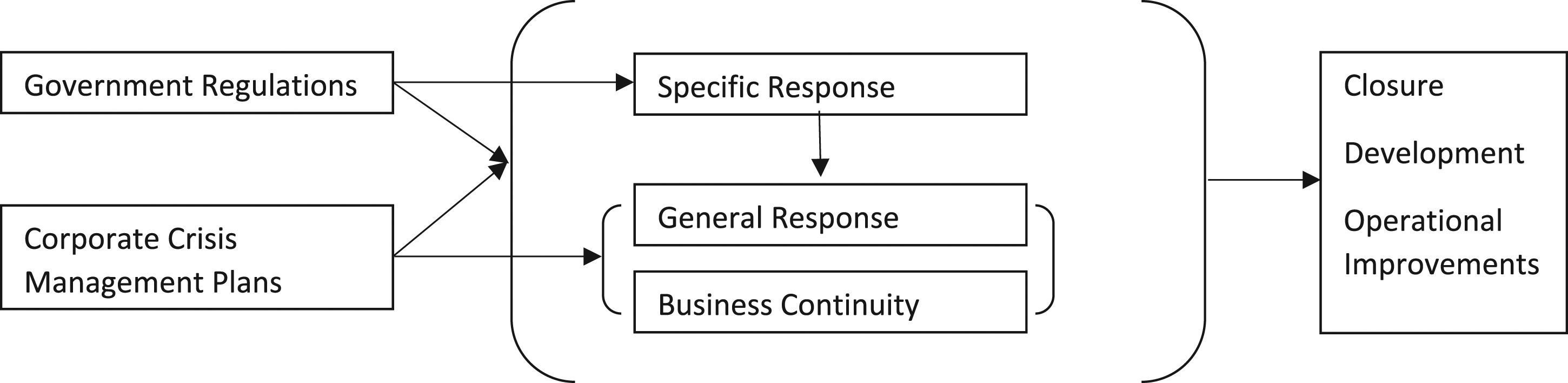
Figure 1 demonstrates the role played by government regulations and corporate crisis management plans which significantly influenced hotel responses to COVID-19. While both influenced hotel responses, government regulations seemed to particularly affect hotels specific response to the crisis, that is, social distancing and the wearing of masks. Corporate crisis management plans seemed to have a more influential role upon the general response and business continuity efforts. The specific responses had a further affect upon the general response and business continuity strategies. While participants did believe that common long-term consequences were the closure of businesses, business development and operational improvements, they did not identify if certain types of strategy would result in a particular consequence.
Discussion
Hotel companies preparation for COVID-19
A high degree of similarity was found between the literature and interview findings in terms of the nature and purpose of crisis management, with both agreeing that it was a tool to aid the recovery of businesses (Vargo and Seville, 2011; Wang and Ritchie, 2012), and help to identify potential opportunities (Scott et al., 2008). While participants were aware of such plans and they did support the decision-making process (Balakrishnan, 2011; Faulkner, 2001; Frandsen and Johansen, 2011; Kaushal and Srivastava, 2021), participants explained that the plans fell-short of reality because they did not consider the continuous and ongoing nature of the crisis. This mirrors the opinion found in Singapore hotels during the SARS outbreak; hotels did have crisis management plans for pandemics, but these plans did very little to aid in the hotel’s response to the virus (Henderson and Ng, 2004). This had been an area of concern for many authors who studied the effect of an infectious virus on the hotel industry in the past (Chien and Law, 2003; Gu and Wall, 2006; Henderson and Ng, 2004; Hung et al., 2018; Lee et al., 2012; Pine and McKercher, 2004; Quang et al., 2020; Tew et al., 2008). Participants who experienced the SARS pandemic in 2002 felt that there was a lack of proactive measures to learn and adapt from the pandemic, suggesting a failure to conduct a complete audit (Balakrishnan, 2011; Faulkner, 2001). Given the ongoing nature of this crisis, it is possible that even more health-orientated plans would not have been as effective as hotels required. Future plans should not only consider health-related crisis but also prepare for crises to be more enduring.
The response to the COVID-19 crisis
COVID-19, as with the SARS pandemic, was a sudden and unforeseen event which caught most business off guard. As a result, most of Faulkner’s (2001) pre-crisis preparations were not possible, forcing businesses to make most decisions ‘on the run’. The dynamic nature of the COVID crisis meant that new information on the shifting dynamic of the crisis was continually being sent to company headquarters, with strategies needing to be adjusted accordingly (Frandsen and Johansen, 2011; Hirudayaraj and Sparkman, 2019).
Strategic response
The strategic response to the COVID-19 pandemic can be categorized into three subgroups: Specific Crisis Response, General Crisis Response and Business Recovery, which can be likened to Faulkner’s (2001) emergency, intermediate and long-term (recover) phases, respectively. However, given the nature of participant’s responses and the ongoing nature of this pandemic, these sub-groups cannot be categorized into only one phase.
The first group, Specific Crisis Response, covered hotels’ responses to this particular crisis, namely, their hygiene actions (Kaushal and Srivastava, 2021). These included the provision of PPE (Personal Protective Equipment), providing access to doctors and insurance programmes, and obtaining health certifications. Such actions have occurred during previous health-related crisis, such as SARS and H1N1 (Chien and Law, 2003; Henderson and Ng, 2004; Pine and McKercher, 2004; Tew et al., 2008). A hygienic practice that was not commonly discussed during crises was the removal of items that may be easily contaminated from guest rooms and public spaces. These included magazines, newspapers, pens and pads, reusable menus, shavers, shaving cream and combs. Given the ‘continuous’ nature of this pandemic (Participant 1), while these actions were implemented during the emergency phase (Faulkner, 2001), they are still being implemented and enforced whilst businesses recover. These particular actions are focused on the health-orientated nature of this shock event (Aliperti et al., 2019).
The second group of responses covered General Crisis Management actions. These addressed the secondary crisis, the loss of business, and sought to cut costs and refocus activities to aid business continuity, with the possibility of compensating for lost revenue (Gössling et al., 2021; Kaushal and Srivastava, 2021; Yeh, 2012). These actions as reported by participants and in previous studies (Chien and Law, 2003; Henderson and Ng, 2004; Pine and McKercher, 2004; Tew et al., 2008) asked staff to take leave, unpaid leave, cut salaries, cancelled contracts and ended ‘unnecessary’ expenses. The consistency found between literature and participants’ responses suggests that these actions are not crisis-specific and are regularly employed to help business when they face difficulty, in contrast to the Specific Crisis Response. Where this study did differ slightly from literature, was in terms of the refocus of business targets and conducting more financial planning. Unlike the SARS pandemic, which saw a decline in the Asian market for around one business cycle (Cooper, 2006; McKercher and Chon, 2004), the study found that hotel brands are forecasting a decrease in global tourism demand until the year 2023, which therefore required a more long-term correction. Given the longer-term impact of the crisis, many of these general crisis responses have provided more time for businesses to adjust to the new operating procedures, new demand patterns, and establish more effective strategies to prepare for the cliched ‘new normal’. This makes these responses more focused on addressing Faulkner’s (2001) emergency stage of crises to provide time for business to develop more meaningful responses.
The final set of responses looked at Business Recovery and addressed hotel’s efforts to restore business. Participants in this study described two key approaches: switching to target the domestic and long-term-stay markets. The switch to the domestic market is a common action which has been reported during other crises (Henderson and Ng, 2004; Israeli and Reichel, 2003; Quang et al., 2020). The focus on the long-term-stay market was, however, not found in literature before. This could be down to the constitution of the UAEs population, being largely expatriate, and therefore expressing greater demand for rental properties. Some participants cited residents as a potential target in this light, offering hotel apartments to residents as a more flexible alternative to renting an apartment (Yeh, 2020). The essence of both recovery strategies was the same, however, targeting new markets (Quang et al., 2020; Sigala, 2020), a frequently applied response, suggesting its versatility. The common use of this approach suggests it should be better documented in company crisis management policy to encourage its more rapid implementation and promote more strategic applications. It is interesting to note that other than setting regulations and policies, participants rarely spoke of governmental support for business (Khalid et al., 2021), despite the government working to avoid a second lockdown and significant economic stimulus packages (UAE, 2021).
The long-term impact of COVID-19 in the hotel industry
Interviewees believed that the closure of hotels would be a long-term problem since some of these hotels may not open again, due to insufficient cash flow, bankruptcy or insufficient demand. This phenomenon was not identified in previous literature on SARS or H1N1, possibly due to the prolonged and global nature of the COVID-19 pandemic (Garrido-Moreno et al., 2021). It is also important to mention that the study found that smaller hotel brands and independent hotels were more likely to go out of business, while larger brands would have more financial strength and resources to outlast the pandemic. In Dubai, such closures could force a market correction, given the oversupply of hotels prior to 2020. Participants also believed that larger hotel brands, who had stronger financial positions, would be able to maintain a suitable development pipeline, building new and buying existing hotels. Taken together, this would suggest a market dominated by mostly large hotel brands who not only have been able to survive the pandemic, but have been able to buy their smaller, struggling rivals. Such a predication has not been frequently discussed in the literature, most likely due to the long-term nature of this crisis, therefore taking a significant toll on the market.
Participants expected significant operational and efficiency improvements as a long-term outcome of hotel’s response to COVID-19. One efficiency improvement expected was to have a lower staff count, with several participants explaining that prior to COVID-19, hotels were overstaffed and that this crisis would reset this practice. Similar crises, such as SARS, suggest that this has not happened before and business practice returned to ‘normal’ once the crises abated (Henderson & Ng, 2004). However, COVID-19 has impacted travel longer than SARS, possibly suggesting that a change to business practice could occur. Furthermore, new technologies are being made available which have the potential to replace staff, such as AI. Although this is more likely in the non-luxury segment of the market (Nam et al., 2020), the desire to return to business during the pandemic and find more cost-effective methods of operating may make technologies such as AI more appealing to customers and managers (Gössling et al., 2021). Participants also described changes to events with varying degrees of technology and VoIP integration. While arguments arose concerning VoIP replacing physical or if physical will replace VoIP once the crisis is ‘over’, others suggested a more likely opportunity (Sigala, 2020). Such an eventuality would impact attendance, event duration, attendee numbers and degrees of interactivity at events.
The impact upon industry competitiveness described by participants is similar to the impact described by Porter (1996) in reference to operational efficiency. Porter describes operational efficiency as performing similar activities better than rivals and that when efficiency gains are no longer possible, the only way for companies to perform better than another is to buy the other. At this point, industry consolidation and merges will be witnessed (Porter, 1996). While the sector is not necessarily at this stage yet, COVID-19 and hotels’ responses have limited the gains to be made from efficiency and, as predicted by participants, brought about an industry consolidation, much in the manner explained by Porter. There are two potential consequences of this. Firstly, if this is a pseudo-consolidation activity, this will likely end once the ‘new normal’ is established. At which point, the industry could become more fragmented and competitive as new competitors open and new investors enter hotel ownership. Secondly, the consolidation could drive innovation as businesses attempt to find a more unique and sustainable competitive advantage. Participants have described situations which suggest that the early stages of this are starting better integration of technology, exploring new styles of event management, new staffing levels, etc. This could be the start of significant innovations in hospitality and tourism, leading to the adoption of new processes and technologies. Whether these provide long-term competitive advantages akin to Kim and Mauborgne’s (2015) blue ocean strategy remains to be seen. However, given these are likely to be incremental adjustments to existing practices, as per participant’s current examples, this is unlikely.
The support for many of the participants’ comments found in literature suggests that there are lessons to be learnt from previous crisis which can aid recovery (Cooper, 2006; Henderson and Ng, 2004; McKercher and Chon, 2004). However, some comments appear to be contradictory to literature or have not been discussed before – such as the mixed assessment on the future of events, or the impact upon the industry’s competitiveness. There are two main possibilities to explain differences between the literature and participants’ comments. Firstly, the extent of COVID-19 is greater than previous crisis cited, both geographically and temporally, affecting more of the globe and over a longer period of time than previous tourism shocks, such as 9/11, SARS and H1N1. This has meant that the impact to business is greater, possibly creating more extensive long-term change (Gössling et al., 2021; Uğur and Akbıyık, 2020). The second difference is the development of technologies, such as AI and VoIP, providing a feasible alternative to pre–COVID-19 business practices. COVID-19 could therefore be the catalyst to encourage businesses to put aside earlier concerns over these technologies (Nam et al., 2020) and embrace these new opportunities (Sigala, 2020).
Conclusion
The COVID-19 pandemic threw businesses into disarray around the world and is expected to have a drastic impact upon the global tourism industry (UNIDO, 2020). In response to the pandemic, hotels adopted numerous strategies to ensure some degree of business continuity.
The long-term impacts of these changes to the industry were evaluated through qualitative interviews with nine senior hotel managers in Dubai. Participants felt that this pandemic was more complex than previous crises they have faced because of the global reach and long duration of the pandemic, with recovery not expected until 2023. Hotels in Dubai responded with a mixture of strategies which aimed to cope with the specific crisis – improving hygiene and health standards – and the secondary crisis – cost control and financial planning and to promote recovery – by targeting mostly local and long-stay markets. It is expected that numerous small hotels would close because of pandemic, whilst larger chains would be able to consolidate their position by continuing to open new properties and buying small hotels. Improvements in operations and efficiency were expected, although some more drastic changes – such as the end of in-person events – were more debated.
The results are mostly supported by literature which have explored similar crisis, notably SARS (Cooper, 2006; Gu and Wall, 2006; Henderson and Ng, 2004; Hung et al., 2018; McKercher and Chon, 2004; Pine and McKercher, 2004; Tew et al., 2008) and H1N1 (Hung et al., 2018; Lee et al., 2012), suggesting a degree of guidance from past crises. However, several new aspects have arisen, such as more drastic impacts upon hotel closure, staffing and the future of events, which is likely due to the globalized and continuous nature of this pandemic (Gössling et al., 2021; Uğur and Akbıyık, 2020).
Further research could explore the generalizability of such responses across other geographies, other crisis, and explore whether these types operate in notable stages or not. That is, does Specific Crisis Management always come first and is there a distinct transition to General Crisis Management. Future research should consider a more extensive qualitative or, preferably, quantitative study to understand the generalizability of these results more thoroughly. Furthermore, some participants were reluctant to share more specifics of their crisis response, due to business confidentiality reasons. A quantitative study may be able to compensate here by providing participants with more anonymity and non-specific responses to questions relating to their crisis response plans.
While it is too early to comment on the long-term consequences of COVID-19, especially since the pandemic is still ongoing, the results offer insight into the process of handling the crisis and possible long-term consequences of these strategic responses. For industry, the results document the reactions of hotels to a globalized pandemic which can provide guidance for future pandemics, particularly in terms of the category of response and examples of responses. The findings can be used by hotel managers and owners to recommend a course of action for hotel operations to help identify possible opportunities arising from such hardships (Sigala, 2020) and provide greater preparedness for future similar events (Aliperti et al., 2019). Academically, the categorization of crisis response into Specific Crisis Management, General Crisis Management and Business Recovery is a novel perspective on how businesses handle crisis. The results in this study suggest that in light of various actions taken by governments and businesses in response to COVID, hospitality and tourism is likely to see a period of consolidation before process and technological innovations proliferate. This could introduce the industry to a new ‘new normal’.
Footnotes
Declaration of Conflicting Interests
The author(s) declared no potential conflicts of interest with respect to the research, authorship, and/or publication of this article.
Funding
The author(s) received no financial support for the research, authorship, and/or publication of this article.
