



Abstract
This article compares and contrasts the attitudes of Polish and Swedish fathers to individualized or gender-neutral parental leaves popularly referred to as “daddy quotas.” The comparisons of two distinctively different societies that are characterized by very different family policy systems and gender-equality policies allow the article to explore how family policies help to shape men’s attitudes to parenthood and gendered parenting roles. Polish family policy is mother oriented and only recently started to address the social citizenship rights of fathers. Polish men’s role in the family is still normatively coded in terms of male breadwinning. Whereas in Sweden, there is a long tradition of gender-neutral parental leave and a normative and institutionalized social policy tradition of encouraging fathers into greater engagement with care work. This study shows that institutional contexts, in particular parental-leave provisions, impact how men perceive their own parental roles and their own interpretations of prevailing models of masculinities.
Introduction
This article explores fathers’ attitudes to gender-neutral parental leave and nontransferable months of a parental leave for men. This research focuses on parental leave policies’ functions as a pretext to discuss broader issues, including the decline of patriarchal fatherhood, diverse hegemonic masculinities, and the role of state feminism played within social policy. Since 1990s, fatherhood studies have been allied to critical studies on men and masculinities (CSMMs) and gender studies and have concentrated on the social construction of fatherhood and masculinity as well as changing fatherhood models in the context of theorizing gender orders (Andreasson and Johansson 2016). CSMMs show that men are not genderless and generic individuals and their experiences are also gendered (Hearn 2004, 2015). Thus, male perspectives should be included in empirical and theoretical studies on the idea of gender orders. Changing masculinity models are of key importance for understanding prevailing patriarchal social norms and traditions. Recently, an important significance in debates on gender inequality has been given to the concept of caring masculinities, which comprise a critical form of men’s engagement in gender equality and a dynamic shift in possibilities of actual social change (Elliott 2016; Scambor et al. 2014). This issue is relevant not only from the perspective of gender studies or sociology but especially for comparative social policy and welfare state debates. Therefore, this article analyses three elements: (1) family policies, (2) masculinity models, and (3) fathering experiences. By showing fathers’ attitudes to gender-neutral parental leaves and the introduction of daddy quotas, the role of family policy in shaping men’s engagement in care and in reconstruction of masculinity models is explored across the divergent welfare state regimes of Poland and Sweden.
The article begins with the description of the methods used to gather the data presented in this article. Next, I proceed to the three elements mentioned above. First, the family policy systems, in particular parental leave schemes, of Sweden and Poland are presented. I argue that they are grounded in two distinctively different parenting discourses, which have an impact on men’s involvement in fatherhood. I then turn to the concept of caring masculinities that helps in the further analysis of the relation between fathering, family policy, and gender order. It is shown here how changing masculinity models overlap with different family policy discourses. I continue with a description of men’s actual usage of parental leave by providing official statistics from Sweden and Poland and then present Swedish and Polish fathers’ opinions gathered in qualitative interviews about gender-neutral parental leave and the instrument of daddy quota. Finally, all these elements are linked within an overall analysis of the powerful role of social policy grounded in feminism in the reconstruction of the patriarchal gender order.
Methods
The study is of comparative character and is based on fieldwork conducted in Swedish and Polish societies in 2012 and 2013. 1 The data were collected through in-depth interviews conducted with middle-class fathers with children younger than seven years. All men were heterosexual, lived in big cities (e.g., Stockholm, Malmö, Warsaw, and Krakow), and shared households with their children and female partners. The aim of choosing such a homogenous sample consisting of men functioning in traditional families was to examine how men get involved in fatherhood in the context of traditional gender roles. There were thirty-two interviews conducted with Polish fathers and twenty with Swedish fathers. Men’s age ranged from twenty-one to forty-nine years. Men varied in occupation, level of education, number of children, length of parental leave taken, and their partners’ occupations and education.
Both Swedish and Polish interviews were based on semi-structured guides with similar themes. They focus on such issues as definitions of parental roles, differences between fathering and mothering, social expectations, parenting practices, division of paid and unpaid work, opinions about family policy systems, accordingly in Sweden and Poland. All interviews were recorded and transcribed with confidentiality to ensure that none of sensitive issues shared during an interview might be connected with a particular father. All names in quotations were changed, and occupations of the interviewees and gender of their children were purposively hidden. The analysis was conducted using a mixed strategy of open and thematic coding (Ayres 2008; Benaquisto 2008). The first codes were created based on themes from the semi-structured guides, yet during the process of coding, new themes and codes appeared which were added to the code tree. The coding was conducted using the qualitative research software—HyperResearch (version 3.5.1).
Fathers and Family Policy Systems—the Case of Sweden and Poland
In the late twentieth century, parenthood became a political and social policy issue. At the beginning, welfare states started to develop different policies that aimed to protect mothers in the labor market (Korpi, Ferrarini, and Englund 2013). Today the main goal of family and labor market policy is to help people reconcile family life with paid work in the labor market. Its instruments are addressed to special group of people—parents, yet the gender dimension ought not to be omitted here. Jaana Vuori (2007) distinguishes two types of parenting discourses adopted in family policy: (1) the exclusive mothering discourse and (2) the shared parenting discourse. In the first discourse, women are perceived as innately nurturing and consequently as primary caregivers in parental relationship. This approach is based on the conviction that there is a clear division of parenting practices between men and women. The second discourse is more characteristic across European welfare states, which increasingly respect gender equality and reject traditional gender roles within families and labor markets. Instead, welfare states promote the equal division of paid employment with shared parenting practices and obligations.
Most family policy systems in Western welfare states started to be developed based on the exclusive mothering discourse (Jenson 1986), yet in times of increasing recognition of gender-equality values, more and more welfare states began to redesign family policy in favor of gender-neutral terms to make men more involved in parenthood and domestic sphere. The shared parenting discourse is historically a newer phenomenon, and it takes into account that men can be competent caregivers. Comparisons between Sweden and Poland provide an opportunity to explore perceptions and experiences of fathers who are parenting and caring in systems based on two different discourses.
Sweden is an example of the system grounded in the shared parenting discourse. Current family policy is characterized by a generous parental leave scheme and an extensive public day-care system (Bergman and Hobson 2002; Lundqvist 2011; Lundqvist and Roman 2010). Parental leave prerogatives are described in gender-neutral terms, and there are additional instruments enhancing men to take longer periods of parental leave (a three-month daddy quota and gender-equality bonus which is in a form of tax reduction if parents share their parental leave equally). The public day-care systems help parents to return to work after using parental leave. All family policy reforms introduced in the last few decades were accompanied by high-profile media campaigns encouraging men to become more engaged fathers (Klinth 2008).
In contrast, the Polish family can be described in terms of the exclusive mothering discourse (Saxonberg 2011; Suwada 2013, 2017). Women are still seen as the main caregivers, and the aim of the family policy is to help women to reconcile family life with paid work, yet mothers are still expected to leave the labor market in connection to motherhood for two to three years. Till 2013, the parental leave scheme was oriented on mothers. Women had a right to six-month fully paid maternity leave. Additionally, parents could take up to three years of extended parental leave paid only on low-level income replacement (for parents with the better financial situation, there was no benefit). 2 For fathers, there was one special type of leave introduced in 2010—one-week paternity leave (in 2012, extended only to two weeks) that could be used at the same time when the mother is on maternity leave. In 2013, this parental scheme was extended with additional six months of paid parental leave. Yet even though it was officially formulated in gender-neutral terms and fathers can be its recipients, it was (and still is) seen as an extension of maternity leave, since it is paid under the same conditions as maternity leave and can be used directly after maternity leave (and before the extended leave). In the Polish debate, the need of men’s greater engagement in fatherhood is not recognized, thus there are no mechanisms that would encourage men to take longer periods of leave. Furthermore, the traditional family model is reinforced by the fact that in Poland there is a problem with an access to public day-care institutions, especially for children under three years (in 2015, only 10.5 percent of children under three years were enrolled to a nursery, yet this number is still high in comparison with 2010 when only 2.6 percent of children under three years had a place in a nursery).
Fatherhood and Caring Masculinities
The relations between fatherhood and masculinity seem not always to be obvious. In many publications on fatherhood, masculinity is not even mentioned. On sessions devoted to fatherhood on sociological conferences, some researchers seem to be surprised that others are linking these two phenomena. 3 The argument here is that it is impossible to fully understand changing models of fatherhood and its role in reconstructing the patriarchal gender order without referring to the concept of masculinity models. It is also useful if we want to assess the role of fatherhood instruments of family policy.
In the context of fatherhood and changing gender roles, the concept of caring masculinities helps to provide a fruitful analysis. For analytical reasons, it is helpful to distinguish two contrasting models of masculinity that can be located at two ends of one continuum. At the one end, there is a model of traditional masculinity. After Eric Anderson, it is called here the model of orthodox masculinity (Anderson 2009, 2011; Anderson and McGuire 2010). On the other side of the continuum, the model of caring (or inclusive) masculinities is located. Not getting into details, I concentrate here only on what kinds of fathering these two ideal types represent. The orthodox masculinity model indicates that the role of the father is built around breadwinning. As Susan Faludi (2006) notes in her book Backlash, being a real man means simply being a good provider for his family. This model implies the strict division on male and female parental obligations and to some extent pushes out men from the family sphere. It is congruent with the exclusive mothering discourse adopted by the welfare state and upholds patriarchal gender order.
The caring masculinities models would be rather characteristic for post-patriarchal society, in which men’s domination is no longer taken for granted. Its central features are the rejection of domination and integration of value of care, which is traditionally regarded as a female value. What is more, men accepting the model of caring masculinities understand that as human beings we are entangled in different relations of interdependence and relationality (Brandth and Kvande 1998; Elliott 2016; Hanlon 2012; Scambor et al. 2014). Not without a reason, the concept is formulated in plural—the aim is not to homogenize the experiences of caring men. It is a practice-based model, which assumes that during their lives men engage in many forms of caregiving, and these experiences have a potential to change men’s attitudes to masculinity and femininity, gender order, and power relations.
Fathering should be seen as one way to adopt caring masculinities values in men’s lives. In this model, the role of the father is understood in terms of men’s engagement in care work and strong relationships with children that are based on positive emotions and mutual respect. Such fathering requires the rejection of the traditional model primarily based on breadwinning and moral authority as well as taking on parental responsibilities that used to be regarded as female ones. It is a model in which there is no division on maternal and paternal obligations, and both parents are seen as competent and reliable carers. Thus, the shared parenting discourse adopted in the family system seems more appropriate for welfare states promoting the egalitarian model of caring masculinities.
Structural Dimension of Fathers’ Involvement
As underlines Erin M. Rehel (2014), becoming a parent is a dramatic change for a couple. One of the important aspects is a relation of new parents with the labor market. Women usually experience an exit from the workforce, for a shorter or longer period of time. For men such exit is not so obvious. In contrary, many men in connection to fatherhood intensify their paid work and extend their working hours (Kuhhirt 2012; Dotti Sani 2014). Consequently, “men and women experience structurally different pathways to parenthood” (Rehel 2014, 111) that leads also to different understanding of parental roles and engagement in parenting practices.
Also different research and statistics show that these different pathways to parenthood are characteristic for Swedish and Polish parents. Since in the next parts of the article, fathers’ attitudes to parental leave are examined, let’s have a closer look at how many men actually take the leave and for how long.
In Sweden in 2014, men accounted for 45 percent of all recipients of parental benefit, which might be regarded as a good achievement in terms of gender-equality policy. Yet, if we look at the percentage of leave days used by men, then the number is much lower—in 2014, fathers used only 25 percent of parental days taken by all parents (the statistics provided by the Swedish Social Insurance Agency). It suggests that men spend less time than their female partners on parental leave.
In Poland, the situation is even more unequal. Gender-neutral parental leave was introduced in 2013. The statistics from 2014 shows that only 1.6 percent of the recipients of benefit due to parental leave were men. Women accounted for 98.4 percent of all recipients. In case of maternity leave, 7.4 percent of recipients were men. 4 The use of two-weeklong paternity leave was initially very low, in 2012 only 28,600 of men used their paternity leave days, but this number is increasing; and in 2014 and 2015, it was accordingly 129,400 and 148,429 (Michoń and Kurowska 2016). 5
The lower use of parental leaves by fathers is also connected with their lower engagement in care work. In the International Social Survey Programme in 2012, the question was asked how many hours a week do you spend looking after family members? The answers clearly show that mothers spend more time than fathers on care work (see Figure 1).
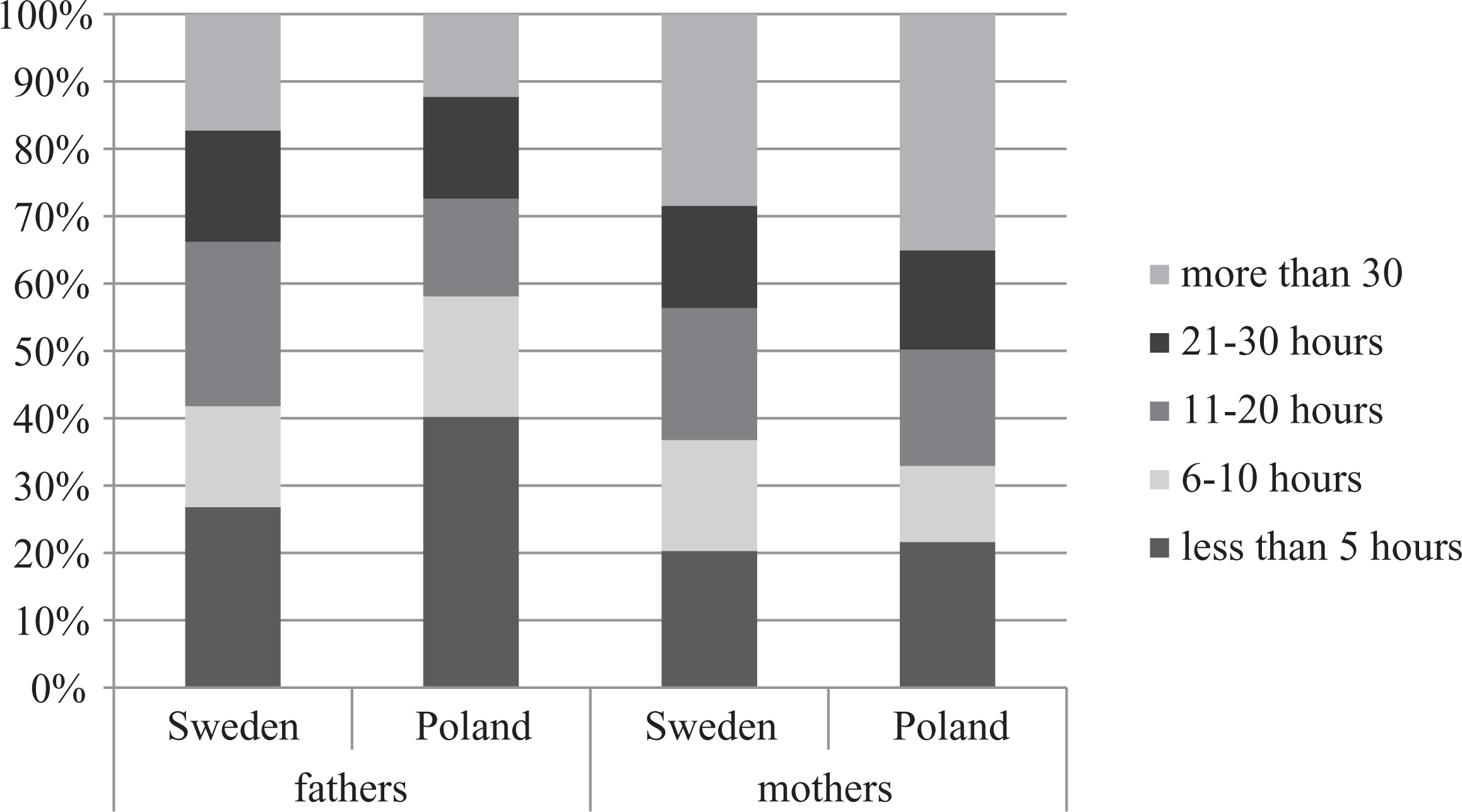
On an average, how many hours a week do you spend in looking after family members (e.g., children, elderly, ill, or disabled family members)? Sources: ISSP 2012. Prepared by the author.
Figure 1 shows that the situation of Swedish and Polish mothers is quite similar—almost 50 percent of mothers spend more than twenty hours a week on care work, one-third of women spend more than thirty hours. Although it can be observed that Swedish mothers spend less time than Polish mothers looking after family members. The discrepancies between experiences of Swedish and Polish men are bigger. In all, 40 percent of Polish father spend less than five hours a week looking after family members. In Sweden, this number is lower (27 percent) and more comparable to the situation of Swedish mothers (20 percent). These data indicate that even though Swedish fathers’ engagement is lower than Swedish mothers’ engagement, in Sweden men are more engaged in care work compared to men in Poland.
Gender-neutral Parental Leave and the Role of a Father
Men’s decisions on engagement in fathering and care work are connected with the preferable cultural models of fatherhood that can be reproduced or reconstructed by the family policy system. These models can be clashing, especially in times of changing gender roles and changing family policy discourses. It is assumed here that the way men perceive gender-neutral parental leave indicates which model of fathering is gaining more social support in a particular institutional context. Important questions appear—what do men think about gender-neutral parental leaves? Do fathers want to use long periods of such leaves? Do they regard them as necessary? Parenthood and its gender dimension is a controversial topic, yet since most people have their own experiences, it is hard to find someone who has no opinion on this issue. The analysis of in-depth interviews suggests that gender-neutral parental leave, as well as father’s quota, can evoke mixed feelings. In general, two main approaches among Swedish and Polish fathers to gender-neutral parental leave can be distinguished.
In the first approach, parental leave formulated in gender-neutral terms is regarded as something normal and unquestioned. Such opinions prevail in Sweden, where it is often underlined that men should have the same right to parental leave as women, yet there are also Polish fathers who would like to have an opportunity to take a long leave (the interviews were conducted before introducing parental leave in Poland). There is no reason why one of genders should have a privileged position of having a right to parental leave. (Poland, Łukasz, 26 years old, 2-year-old child)
This approach is characteristic not only for men who are openly supporting gender equality and think in a feminist way but also for men who simply want to be present in their children’s lives and not only concentrate on breadwinning. Such men recognize the need of establishing strong relationship with their children, which is based on love and mutual respect. They want to integrate the value of care into their lives.
The second approach is favored by men with a more traditional vision of family life. For them, gender-neutral parental leave is something strange, unreasonable, or unnatural, since the role of a father is primarily to economically provide for their families. Some interviewees regarded it as a feminist idea, but feminist in the negative sense. Such opinions are primarily characteristic of interviewees in Poland, where gender equality is not a commonly shared value, and it is rather seen as a value imposed by the European Union, which does not accord to Polish culture and tradition (Duda 2016; Zespół 2014). In the Swedish context, since gender-neutral parental leaves were introduced in 1974, such instrument was not surprising. Whereas some Polish fathers never heard about it.
These two ways of thinking overlap to some extent with two different ways of perceiving the role of a father. The opinion that parental leave as an instrument addressed to both men and women is unquestioned and natural is congruent with the conviction that a father is able to be a competent caregiver who can provide a full-time care alone without the help of a woman. In this case, parental leave serves an important role for a man—it helps him to become an engaged father and to establish a strong relation with his child(ren). Often such beliefs arise from men’s own experiences of being (for a least one or two months) a stay-at-home dad. I think, I don’t say that you need to take 50/50, but I think that both mother and father should take relatively long time with their child, because you get to learn to know your child and the child gets to know you…better than if you just see them only during the weekend. He’s now used to being alone with me or my wife and it’s not a problem for him when she goes to work for example, he’s left here with me. And if she took all parental leave and I worked all the time, then of course I would spend time with him on evenings and on weekends, but my wife would be then too, so he would not spend a lot of time alone together with me and I think that is important. (Sweden, Magnus, 38 years old, 13-month-old child)
The second approach refers to the traditional model of family life, in which a woman is seen as the main caregiver. The role of a father is limited to being an additional carer who should help a mother to take care of a child. In such case, caregiving is not an obligation of a father and there is a strong division on female and male parental tasks. It is a completely different situation if the father is on a parental leave to be with the mother and the child, and quite different is situation in which we have to choose—the mother or the father. In case of such a choice the decision is easy, because the father, of course, can feed from a bottle or be with a child for a while, but…the child needs mother. And the father can take a leave only to be with the mother, to cook for her and take care for her, because those first months are very tiring. (Poland, Robert, 35 years, 5- and 8-year-old children)
What is characteristic of the second approach is that men are not supposed to be totally withdrawn from the domestic sphere, but rather that they should assist tired mothers in completing domestic and caring duties. Not surprisingly, such opinions are characteristic of men who never had an opportunity to fully engage in care work and provide it for a longer period of time without the help of their female partners or other women (e.g., grandmothers or babysitters).
Daddy Quota—Interventionist Family Policy
Gender-neutral parental leave alone does not necessarily make men into involved fathers. The experience of Sweden shows that men have to be actively encouraged to take longer periods of parental leave through family policy incentives that appeal and are affordable to the parenting and career preferences of both mothers and fathers in families. Maternity leave was transferred to high-paid gender-neutral parental leave in 1974. However, in the 1970s, this social policy was quite unique and did not lead to fundamental societal change, because of its failure to actively encourage caring fatherhood with individualized incentives. Thus, the Swedish government took additional measures, which were influenced greatly by an alliance of feminist activists, politicians, and scholars, to encourage the Swedish welfare state to recognize men’s social citizenship rights as fathers and encourage individual fathers to take more days of paid parental leave (Bergman and Hobson 2002; Ekberg, Eriksson, and Friebel 2013; Klinth 2008). A real breakthrough was accomplished with the popularly named “daddy month” reform introduced in 1995. This reform introduced the so-called daddy quota—a month of parental leave reserved only for fathers. In 2002, this reserved period was prolonged to two months and in 2016 to three months. This positive influence of women’s political activism and feminist scholarship on the enhancement of men’s social citizenship roles as fathers in Sweden is understood within comparative welfare state debates as a form of state feminism with increasing moral and political influence across the European Union (Rush 2015).
The daddy quota should be seen as an interventionist mechanism that actively encourages and more importantly affords parents the choice to adopt a more equal division of parental leave. Adopted in parental family scheme, it clearly indicates the expectation of welfare state (and the society represented by it) formulated toward fathers. Its aim is not only to help men and women share their parental obligations but also to equalize their situation and career prospects in labor markets. With the introduction of daddy quota, in theory, employers should expect that men might also leave the labor market for sustained periods in connection to parenthood. In this context, the instrument of daddy quota is consciously intended to change the private patriarchal gender order in families and the public hierarchical gender order in labor markets. As such it is revolutionary, since it radically reconstructs gender roles and the gender relations between children and parents. In Poland in 2013, despite the perfect conditions for such move, the quota was not set up in connection to the introduction of twenty-six weeks of highly paid parental leave. President Bronisław Komorowski and Ministry of Labor and Social Policy Władysław Kosiniak-Kamysz clearly stated then that in their opinion Polish society was not ready for such interventionist mechanisms and defended the right of family to choose how parents divide parental leave.
Yet, daddy quota is not only controversial in more conservative societies, as the interviews for this study indicated that it evoked mixed feelings among Swedish men. On the one hand, there are men who believe that daddy quota is a good and useful mechanism and would even like to make it longer than two months. What I was kind of thinking, it [the quota] is probably good, because I think that both parents should take responsibility for the child for at least two months.…You should probably spend that with your child and if you don’t like to do that, there is no punishment if you don’t do that. The only thing that is happening is that you cannot use those days. If it helps in any way, it is good. (Sweden, Olof, 36 years old, 2.5-year-old child)
On the other hand, there are men who are skeptical. The recurring objection refers to the category of choice—some Swedish men underline that parents should have a right to choose how parental leave is shared and that the state should not interfere too much in the private sphere. What is more, it is often underlined in the interviews that Swedish men have already learned how important it is to take parental leave and they do not have to be forced anymore by the state. Personally I am not very fond of quotas and an attempt to regulate this by making laws instead of leaving it up to parents themselves depending on their situation. But then again back to old times fathers were not staying home very much with their kids. Maybe it is more or less still necessary to have legislation in order to try to shift this position from the past. (Sweden, Johan, 44 years old, 6-year-old child)
This approach is connected to the conviction that new generations of Swedes want to share parental leave with their female partners, and institutional mechanisms were needed only at the beginning—just to start the whole process of changes that continues till today. This is even more noticeable in case of Christian, who believes that the quota is needed now, only because of migrant families (interestingly, he did not take any week of parental leave, since he had his own company and did not want to leave it for two months in connection to parenting). So people don’t want government to have a policy forcing fathers to take a number of days out or they loose these days, they want the right to choose between themselves how to do it. But then there is another question what happen with migrants, in whose families fathers are not doing anything and mothers are having many children and they are like…very hard to do any kind of career or…studies or anything. (Sweden, Christian, 36 years old, 16-month-old child)
What is significant, the negative opinion about the mechanism of daddy quota is not connected with the support for the traditional model of family and gender roles. It is rather based on the assumption that today in Sweden, men and women understand how important it is for a father to take parental leave and that Swedish men would take it, even if it were withdrawn. 6 In this context, it can be assumed that the normative shared parenting discourse adopted by the Swedish welfare state has been embraced, institutionalized, and practiced by individual men, women, and Swedish society generally.
In the Polish interviews, the topic of daddy quotas did not appear. The idea of gender-neutral parental leave was controversial enough for many Polish interviewees. And since interviewed fathers had no right to parental leave at all, the idea of reserved months only for them was usually too abstract to hold opinion about it. Yet the mixed, sometimes even negative, feelings about gender-neutral parental leave may indicate that interviewed men think about parenthood in terms of the exclusive mothering discourse and consequently do not see much space for themselves in caring area, especially when a child is very small.
Fathers, Family Policy, and Masculinity Models
The fathers’ attitudes to gender-neutral parental leave and daddy quota indicate the dominating models of mothering and fathering in particular institutional settings. The comparisons between two distinctively different societies reveal the links between the organization of family policy and men’s engagement in fatherhood. It also suggests that there is also a link between family policy systems and men’s performance of prevailing masculinity models. The interviews show that fatherhood gives men an opportunity to engage in care work practices, which according to the theory of caring masculinities helps men to reject values characteristic of orthodox masculinity and incorporate in male identity some features traditionally regarded as female ones. It suggests that the reconstruction of new masculinity models toward caring values should be seen as an essential step in the process of creating a society based on actualizing gender equality. In this context, the role of men’s use of parental leave is a critical factor.
The instrument of daddy quota actively encourages men to use at least a few weeks of parental leave, to stay home (often alone) with a little child and engage in all kinds of caring practices and domestic duties. There are many studies on stay-at-home dads (Brandth and Kvande 1998, 2016; Chesley 2011; Doucet 2004, 2009; Doucet and Merla 2007; Dunn, Rochlen, and O’Brien 2013). They show that men who are at home foster complex sets of relations with other people, unpaid and paid work, community but also their own male identity. It is sometimes claimed that fathers who engage in nurturing reconstruct parenting practices to give them a more masculine character (Plantin, Månsson, and Kearney 2003). Thus, it is clear that men’s engagement in care work help to rebuild prevailing masculinity models. The question is what is the role played by family policy instruments, such as gender-neutral parental leave and daddy quota? Can they be regarded as instruments changing masculinity models and consequently gender order based on men’s domination?
To, at least partly, answer these questions we can turn to the men’s opinions offered in this study about the consequences of staying at home for men and the organization of family life. These include the experiences of Polish fathers, because even though they did not have the opportunity to use parental leave, some of them organize their paid work in a way they actually undertook or shared care work with their female partners. The following quotes can serve as an illustration of the role of staying at home for fathers. To be honest, until I decided to resign from work and took care of Janek, I had no idea why my wife was so angry and what was going on when for example I was not home on time. And then, when my wife was late for example half an hour and was home at 6 PM, not 5:30 PM, I really felt these thirty minutes. Because I was waiting for her, expecting her to take care of Janek, I wasn’t thinking she might be tired after work. I was tired. And me, for instance, before when I was back home from work, I was angry that she didn’t prepare the dinner. And then I realised it is very difficult to prepare dinner. (Poland, Grzegorz, 29 years old, 21-month-old child) Let’s say I wouldn’t be at home at all at the beginning, I think we would have very unmodern and stereotypical gender roles at home nowadays, where she would basically be a mum and I would be like…reading newspaper, I don’t read newspapers, but…no I would do stuff I would like to do and she would take care of the kid, but because we attacked pretty early, I took a little bit of this role, so it still works. (Sweden, Markus, 29 years old, 5-year-old child) So we’re like this old couple now “Look how he drives!”, because we know we have a kid in a back seat and…. I think that switches personality. Some Swedish journalist wrote once about it (…), I almost started crying when I was reading this, it was like “I understand that you are in real rush on your way to work, I just wanted to say that I’d be so sad if my son would…,” I can’t really say, but. I understand the mentality and I don’t know if I would, if I didn’t have a kid. (Sweden, Trols, 33 years old, 3-year-old child)
The experiences of staying-at-home fathers clearly show that the actual practices of taking care of children have a potential to change men’s attitudes to care and domestic work. First, such practices play an educational role—they make men aware of the importance of taking care of children for establishing a strong relationship with them and for becoming a parent who children need. Such practices change fathers’ attitudes to domestic and care work and consequently have an impact on the organization of everyday life—they help to introduce partnership in the relationship. Second, it helps men to recognize the burden of care work. The undervaluation of care work is one of the main obstacles for getting rid of gender inequalities (Hanlon 2012; Kittay 1999). Men who concentrate solely on paid work tend not to perceive care and domestic work in terms of actual, tiring work, which should be done. It is no longer perceived as a women’s main obligation but as a common one. And in fact this is the kind of work without which our society could not simply function and reproduce. Third, the experience of becoming a father is often described by my interviewees as an important turning point in their lives that made them more responsible but at the same time more sensitive and emotional. Men discover that they are not independent, but their decisions and behaviors have consequences for other people—especially their children and partners. Discovering the sensitive and relational part of their identities allow to reconsider and revaluate what it means to be a man in contemporary times and what flaws prevailing models of masculinity have.
In such context, the actual engagement in care work by fathers during parental leave has a potential to change masculinity (and femininity) models, gendered parental roles, and gender order. Yet the experiences of many welfare states show that men need to be actively encouraged through family policy supports to get more involved in the domestic sphere. Keeping this in mind, gender-neutral parental leave together with the instrument of daddy quota can serve as one of the instrument to fight with gender inequalities, not only in the domestic sphere, in which men learn the value of unpaid work, but also in the labor market, where men as employees should also be recognized as parents taking long leaves in connection with the birth of a child.
Conclusion
It might be assumed that contemporary times are characterized by a historic process of depatriarchalization. Patriarchy is a social system based on male domination and women’s subordination in various spheres. This article focuses on family sphere—the question is whether we can observe the actual decline in patriarchal family and what role is played by the family policy system in this process. The patriarchal society characterizes using a structural male domination and female subordination legitimized and reproduced by orthodox model of masculinity in which being a real man indicates being a good provider for his family. In such society, there is a strict division on female and male practices and because of that men are rather withdrawn from the domestic sphere. Today we can observe the renegotiation of gender roles. It also includes the renegotiation of men’s presence and practices at home as well as of the boundaries between male and female tasks. The model of involved fatherhood, which suits to male identities based on the concept of caring masculinities, is gaining more and more recognition and is more often adopted by men in different societies.
The concept of caring masculinities provides potentials for societal change into a direction of a society based on gender equality. The adoption of caring masculinities values, such as ethic of care, relationality, interdependence, and positive emotion, into masculine identities is connected with the rejection of male domination and as such the rejection of patriarchal organization of a society. Research on fatherhood, as well as on men and masculinities, clearly shows that there are some signs of societal changes among men and there are some small symptoms of the decline of patriarchal society. Yet these changes are small and slow. The experiences of societies more advanced in gender equality, and the results of feminists research show that such change never occurs spontaneously, but it is rather catalyzed.
In this context, the role of family policy instruments should not to be underestimated. The comparisons between Swedish and Polish societies clearly show that fathers tend to think about their parental roles in accordance with the models of parenting that are promoted by their welfare state. Swedish men living in the system based on shared parenting discourse recognize parental leave as their privilege and accept the aim of father’s quota—even though they do not always agree whether it is still needed in contemporary Sweden. Such change does not take place immediately, but it is possible. As Øystein Gullvåg Holter (2003) indicates, only a few generations ago, the Nordic societies were very conservative and organized around heavily gendered labor market. Without the state’s engagement for gender equality grounded in the feminist perspective, this change could not happen (Connell 2009). For Polish men functioning in the system grounded in the exclusive mothering discourse, the introduction of gender-neutral parental leave is not always reasonable. The mother is usually seen as the main carer and the father’s role is to help and support her when she needs that. The nontransferable parental leave for fathers is for Polish men an abstract idea.
Yet it does not mean that Polish society is not ready for such mechanism. In fact, as we compare Swedish society at the time of introduction of daddy quota and Polish society today, it should be noticed that the settings are friendlier now than a few decades ago. Surveys indicate that almost 50 percent of Poles support family model based on partnership and over 90 percent believe that men and women should be treated equally in the labor market and in the family life (CBOS 2013a, 2013b). Polish men function in the globalized world and are perfectly aware of changing gender roles and masculinity models. They are also more eager than previous generations to engage in parental practices and many of them, even those who have traditional vision of family, cross gender roles and overtake maternal obligations. They are aware that the model of fatherhood based on breadwinning is no longer accurate in the contemporary times. They just need an encouragement to take parental leave for a longer period of time. The nontransferable parental leave for fathers would help recognize themselves as competent caregivers who are able to provide similar care as their female partners. In this context and keeping in mind Swedish experiences, it might be carefully assumed that the role of political and academic feminism in Poland in forcing the government into introducing fatherhood incentives, such as daddy quota, would help Polish society in reconstructing prevailing gender order and in fighting with gender inequalities.
Footnotes
Declaration of Conflicting Interests
The author(s) declared no potential conflicts of interest with respect to the research, authorship, and/or publication of this article.
Funding
The author(s) disclosed receipt of the following financial support for the research, authorship, and/or publication of this article: This research has been funded by the National Science Centre in Poland (No. 2011/03/N/HS6/01110).