




Abstract
In fatherhood research, there is an ongoing question of how to measure fathers’ engagement in childcare. Recent studies mainly use (1) the amount of time spent on childcare and/or (2) the use of paid parental leave as core indicators of paternal involvement. To examine how these two indicators of fathers’ engagement have to be understood differently, this study juxtaposes the determinants of these indicators, also differentiating between absolute and relative (i.e., compared to their partner) measures. Four negative binomial regression models are conducted with German Socio-Economic Panel data on 712 fathers with a child born between 2007 and 2013. The results indicate that there are distinct relationships behind the four different measures of fathers’ engagement. Fathers’ absolute and relative time for childcare is mostly explained by other time-use measures and a couples’ employment participation. With regard to fathers’ parental leave use, the absolute rather than the relative measures might be more suitable to explain fathers’ constraints to take up parental leave that are aligned to their work situation.
In recent decades, gender relations in Germany have been changing, with a steady increase in women’s labor market participation. At the same time, men are showing a growing interest to engage in childcare beyond being a male breadwinner or a weekend father. With the introduction of a new German parental leave policy in 2007, the developments toward a more gender equal division of paid and unpaid labor even seem to have accelerated, as fathers are now entitled to two exclusive bonus months of generously paid parental leave. Since the new legislation was introduced, the share of fathers who take parental leave has been increasing year by year, reaching 34.2 percent (Destatis 2016a).
To examine changes in fatherhood, it is crucial to consider that the way we conceptualize and assess how father involvement reflects historical and social trends (Day and Lamb 2004). That is, both the posed problems and the choice of indicators are embedded in contemporary discourses. Thus, in the analyses of changes in fatherhood, there has been an ongoing question of how to measure changes in fathers’ levels and types of childcare practices. Lamb et al.’s (1987) differentiation between the three components of fathers’ involvement, which are (1) paternal engagement, (2) accessibility, and (3) responsibility, laid the foundation of the development and discussion of indicators for measurement changes in fatherhood. New research points to the necessity to differentiate between differences in the quality of paternal childcare (Craig 2006; Craig and Mullan 2011; Doucet 2006, 2015; Pleck 2010) and to the particular importance of measuring “responsibility” in order to account for differences in fathers being either coparents or mothers’ helpers (e.g., Craig 2006; Doucet 2006, 2015; Pleck 2010).
In recent studies, it is still paternal engagement that is analyzed most frequently (e.g., La Rossa 1988; Pleck 2010). Here, there are mainly two indicators used: (1) the amount of time fathers spent on childcare and (2) fathers’ use of paternity or parental leave. These two indicators are meant to measure the fathers’ engagement with their children as opposed to the fathers’ engagement for their children, as the male breadwinner model implies. In some studies, paternal engagement in childcare is simply equated with fathers’ use of parental leave (e.g., Fox, Pascall, and Warren 2009; Lappegard 2008; O’Brien and Moss 2010; O’Brien 2009; Sundström and Duvander 2002). However, for assessing and understanding contemporary paternal practices precisely, it may also be important to differentiate between time for childcare and parental leave use. In some studies, the relationship between fathers’ parental leave use and their time for childcare is analyzed (e.g., Almqvist and Duvander 2014; Haas and Hwang 2008; Huerta et al. 2013; Seward et al. 2006). But in these analyses, the possible similarities between the two indicators are mainly discussed only with regard to limitations for interpreting the observed relationships and the character of such overlaps is not systematically examined. Besides, it is important that changes in fathers’ engagement have to be understood in the context of changes in overall parental engagement by differentiating between proportional and absolute figures (e.g., Craig and Mullan 2011; Grunow 2007; Lamb 1987). That is, it is important to assess not only the differences between these two indicators of fathers’ engagement but also the differences between fathers’ practices in absolute and in relative terms (i.e., compared to the mother/the partner).
Up to now, there were no systematic analyses that examine how far fathers’ time for childcare and fathers’ use of parental leave as two dimensions of paternal engagement have to be understood differently. However, this is important to precisely assess and understand changes in the gendered division of labor and developments toward gender equality. This study addresses this gap by comparing the two indicators of paternal engagement in absolute as well as in relative measures. In this way, this study addresses the question of how German fathers’ use of parental leave and their time for childcare as measurements of paternal practices, which have to be understood differently.
For the analyses, this study uses German panel data (German Socio-Economic Panel [GSOEP]) on employed fathers who live in the same household with the mother of their child(ren). In four negative binomial regression models, fathers’ socioeconomic factors, their workplace factors, and their partner’s employment data serve as explanatory variables to examine how these factors mediate (1) fathers’ (a) absolute and (b) relative daily amount of childcare and (2) fathers’ (a) absolute and (b) relative use of paid parental leave months. All regression models are conducted for the same cases, therefore allowing a comparison between the coefficients. The analyses and the accompanied systematic comparison of results make it possible to reflect on the relationship between two different indicators of paternal engagement by interpreting how individual, household, partner, and workplace factors mediate the two forms of paternal engagement differently, both in absolute and in relative terms.
With this analysis, the study provides evidence on the question how the two indicators might have to be understood differently in the context of measuring and assessing changes in fatherhood. The results provide a more accurate grasp of the possibly distinct meaning of fathers’ time for childcare and fathers’ use of parental leave and therefore form a further basis for research on fatherly practices.
Changing Fatherhood
Studies on fathers’ wishes reveal that men do want to take on a greater share in childcare and that they consider being an active father not only as their responsibility but also as a personal need (Bundesministerium für Familie, Senioren, Frauen und Jugend 2015). Men contribute to a change in fatherhood; however, we still have little systematic knowledge about the dimensions and determinants of fathers’ care (Ostner 2005).
International comparisons in changes of paternal engagement show that fathers’ time for childcare has increased over time (Sullivan, Gershuny, and Robinson 2015). However, mothers’ time has also increased, although with gender differences still persisting which makes the gender convergence in work patterns incomplete (Kan, Sullivan, and Gershuny 2011). Women still spend more than two times as much as men caring for children (Craig 2006).
Regarding fathers’ parental leave-taking, fathers’ take-up seems to be strongly related to the design of parental leave policy: where the benefits are based on an income-related calculation at a high percentage level and where exclusive entitlements for the second parent are provided, fathers are more likely to take up some leave (e.g., Eydal and Gislason 2015). However, also in countries with such “father-sensitive” (O’Brien 2009) generous parental leave entitlements, there is a gender gap, being the smallest in Iceland with a fathers’ share of nearly one-third of all leave months taken (Thevenon, Adema, and Clarke 2016).
Even more than ever before, it is a contested question if the aim of gender equality in care, especially of younger children, meets the interests of (both) parents. This is mirrored for example in discussions about freedom of choice (e.g., Ellingsæter and Leira 2007) or the notion of “embodiment” (Doucet 2006, 2009, 2015; Ranson 2015) that entail an understanding of differently motivated and situated parents with accompanied diverse interests. In most literature, however, gender equality is understood as a 50 percent share of paid and unpaid work along a dual earner/dual carer model and the “social ideal of the coparent” (Craig 2006, 261), which up to now has not been accomplished.
In the literature, contemporary changes of fatherhood often are characterized as showing a gap between fathers’ (more modern and egalitarian) attitudes and (more traditional and inequal) practices (Bergmann and Hobson 2002; Bühlmann, Elcheroth, and Tettamanti 2010; Cyprian 2005; Grunow 2007; LaRossa 2012; Meuser 2009). The reasons for this gap are mostly seen as originating in constraints for fathers caused by mothers’ gatekeeping (e.g., Gaunt 2007; Kulik and Sadeh 2014), by structural and cultural factors at their workplace (e.g., Bygren and Duvander 2006; Haas, Allard, and Hwang 2002; Hallberg and Klevmarken 2003; Reimer 2015), or by economic considerations at the level of the family (e.g., Geisler and Kreyenfeld 2011) and the level of policies (Gornick and Meyers 2003) that codify the fathers’ role as the main breadwinner. The explanation of changes in fatherhood still is a contested question which might in part, however, stem from ambiguity in different measures of paternal engagement (e.g., Lamb 1987).
Measures of Fathers’ Involvement
To examine changes in fatherhood, it is crucial to consider that the way we conceptualize and assess father involvement reflects historical and social trends (Day and Lamb 2004). That is, both the posed problems and the choice of indicators are embedded in contemporary discourses. Not long ago, in analyses of changing fatherhood rhetoric continued to outweigh serious analyses (Lamb 1987) and the choice of problems and interpretation of results often entailed a normative overload (Cyprian 2007) with the demand that fathers should engage more in childcare to unburden mothers from the “second shift” (Hochschild and Machung 2003). Another research strand developed that particularly focuses on the fathers’ perspective and stresses fathers’ wishes and attitudes and how they evolved over time (e.g., Zulehner and Volz 1999; Volz and Zulehner 2009). Here, different types of fathers are often identified. More recently, analyses on fathers’ practices with accompanied discussions of the meaning of these practices are becoming increasingly prominent.
In analyses of changes in paternal practices, there has been an ongoing question of how to measure the amount and the type of fathers’ childcare practices adequately. Lamb et al. (1987) introduced a differentiation between three components of fathers’ involvement, which laid a foundation of the further development and discussion of indicators to measure changes with regard to fatherhood. The first of their components is paternal engagement or interaction, which involves time that is actually spent in one-to-one interaction with the child and does not include child-related housework or just being present (Lamb 1987). The second component is accessibility, which comprises activities at a less intense degree of interaction by just being available to the child if needed (Lamb 1987). The third component is responsibility, which according to Lamb (1987) might be the most important of all. Being responsible for childcare relates to knowing and organizing the child’s needs as opposed to just helping out when it is needed. These three dimensions of paternal involvement establish important analytical lines of differentiation; however, in practice, these three components are partly overlapping.
New research on changing paternal engagement points to the necessity not only to measure the amount of fathers’ engagement but to distinguish additionally between differences in the quality of paternal childcare (Craig 2006; Craig and Mullan 2011; Doucet 2006, 2015; Pleck 2010) or also grades of “intimacy” (Dermott 2003). To understand changes in gender relations, the importance of measuring responsibility to account for differences between fathers being coparents or rather mothers’ helpers (e.g., Craig 2006; Doucet 2006, 2015) is emphasized. Pleck (2010) proposed a revised conceptualization of paternal involvement that includes positive engagement activities, warmth, and control and emphasizes the need for more studies on indirect care (both material and social) and of process responsibility.
However, recent studies use mainly two indicators of paternal engagement: the amount of time spent on childcare and the use of paid parental leave. In some studies, paternal engagement in childcare is simply equated with fathers’ use of parental leave (e.g., Fox, Pascall, and Warren 2009; Lappegard 2008; O’Brien and Moss 2010; O’Brien 2009; Sundström and Duvander 2002). However, these two indicators have a very different character, which becomes visible when aligning them to Lamb et al.’s (1987) different components of father involvement. With regard to fathers’ take-up of parental leave, fathers might be involved in interaction with the child, are accessible for the child, and might even establish a more intimate relationship with their child. Having some responsibility might occur particularly in situations where the father takes his leave without the mother being on leave at the same time. In contrast, fathers’ amount of time with children might include to some degree all three components and intimacy as well; however, in its most restricted sense, it would only indicate a father’s presence. That is, for understanding paternal engagement precisely, it is important not to simply equate these two indicators but instead examine how they have to be understood differently. In this analysis on the comparison of two different indicators of paternal engagement, the determinants of (1) fathers’ take-up rates of parental leave and (2) fathers’ amount of time spent with their children are therefore systematically juxtaposed.
There are multiple factors that are likely to mediate fathers’ engagement (e.g., Marsiglio et al. 2000 in Hooke and Wolfe [2012] and Vogt and Pull [2010]). Lamb et al. (1987) introduced a model of the determinants of father involvement, where they included fathers’ (1) motivation, (2) skills and self-confidence, (3) social support and stresses, and (4) institutional and workplace factors and practices. Building on this model, four levels of factors are included into this analysis to examine the influence of factors on different levels, which are fathers’ individual characteristics, their household characteristics, their couple constellations, and their workplace conditions. Since it is important that paternal engagement has to be understood in the relation to maternal engagement (e.g., Craig and Mullan 2011; Grunow 2007; Lamb 1987), proportional and absolute figures are included as dependent and as explaining variables as suggested by Haas, Allard, and Hwang (2002). The research questions of how fathers’ parental leave use and fathers’ time for childcare are related to individual, household, and workplace characteristics in different ways will be conducted for the German case only to control for differences due to divergent national contexts (e.g., Hook and Wolfe 2012).
Parental Leave and Time for Childcare: The Case for German Fathers
In West Germany, fathers have a long tradition of being the male breadwinner (Pfau-Effinger 2010). Since the 1970s, the ideal of the male breadwinner family has changed to a male breadwinner/female part-time carer model (Pfau-Effinger and Smidt 2011). At the same time, in East Germany before 1991, the dual earner model has been already in place. In the mid-2000s, new family policies and a new parental leave legislation in keeping with the Nordic model, as well as gender policy in East Germany before 1991 (Erler 2009; Rush 2015), were introduced which now provide the basis for a dual earner/dual carer family, where both the mother and the father are working and caring equally supported by the right to public childcare. However, at the same time, German legislation entails contradictory signals for families, since fiscal regulations in part still imply hierarchies in men’s and women’s employment participation.
The new German parental leave legislation (Elterngeld) 1 introduced new leave benefits for parents in 2007, which is per se gender neutral in design, but at the same time, explicitly intended to foster gender equality by increasing fathers’ engagement in childcare. Before, one parent was eligible to receive €300 per month (Erziehungsgeld) for two years or €450 per month for one year on the basis of a household-based means test. With the new legislation, parental leave payments have changed substantially, since they are now calculated on the individual parent’s former net income at 65 percent of former net earnings. 2 Specifically, two features of the new parental leave entitlements are designed as incentives to foster fathers’ take-up of leave months: The first aspect is a generous wage replacement rate, where the benefits are intended to allow fathers to take parental leave without incurring too serious a loss of family income; the second feature is the introduction of two exclusive “partner months,” which with their use-it-or-lose-it logic are meant to encourage fathers to take at least two months of leave (Reimer 2013). In Germany, these bonus months are often referred to as “daddy months,” revealing that the new German parental leave policy, despite its gender neutral terminology, still carries underlying gendered assumptions (e.g., Ray, Gornick, and Schmitt 2010). The new parental leave benefits contain both incentives for fathers’ take-up of parental leave months and new opportunities for fathers to engage in the care of their children. By now, nearly one-third of all fathers take up some parental leave. However, most of them only take the two bonus months as proposed by an “unwritten norm” (Trappe 2013) of the exclusive partner months. Since 2008, the division of parental leave months between men and women remains rather constant with women taking an average of about eleven months and men an average of about one month (Figure 1). A closer look reveals that the mean amount of months of fathers who take parental leave even decreases.

Mean months of parental leave for men (fathers with parental leave/all fathers) and women. Source: Destatis (2016b), own calculations.
Also, fathers’ proportional take-up of leave months is only very slightly increasing over time and was in 2014 at a level of only 8.59 percent (Figure 2). That is, besides the steady increase of fathers who take some parental leave, their share compared to mothers is rather small and barely increasing over time.
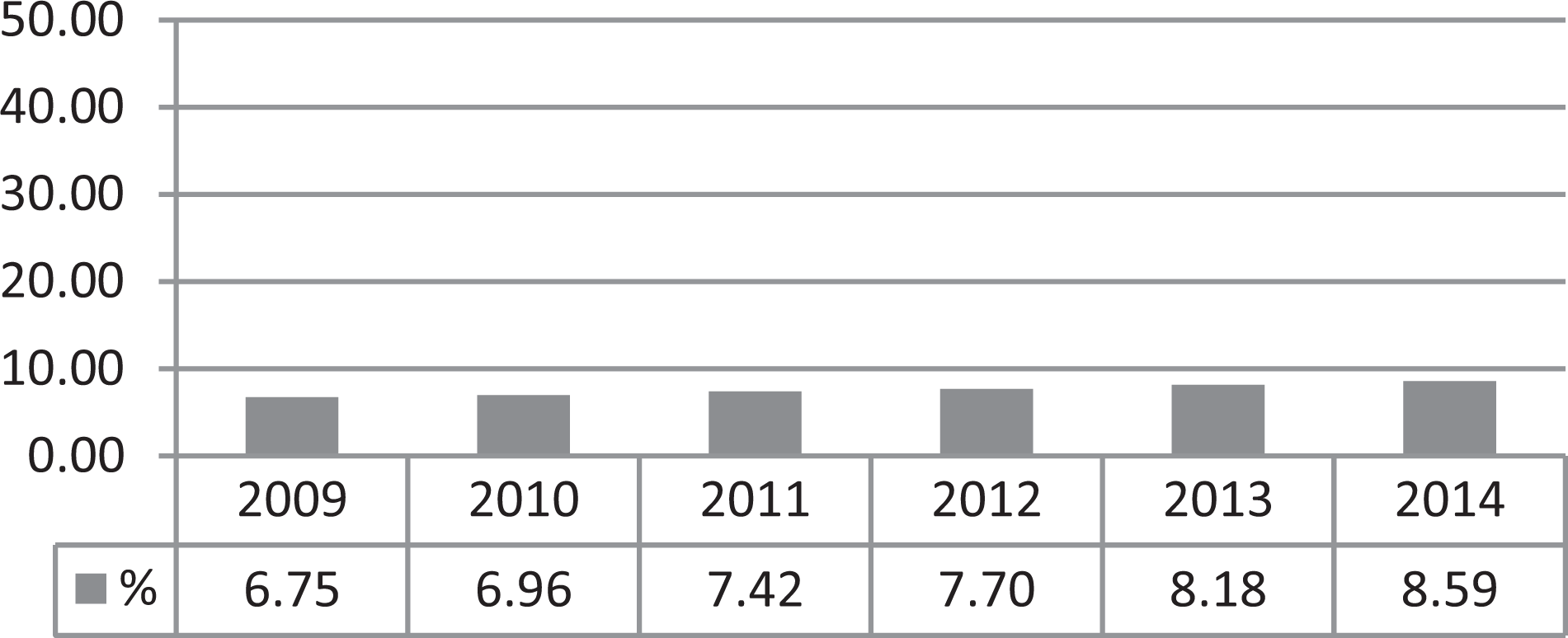
Fathers’ share of parental leave months (leave months taken by fathers/all leave months taken). Source: Destatis (2016b), own calculations.
With regard to changes in paternal time for childcare, data of the German Time Use Survey study reveal that in couple households with young children both men and women spend on average more time on childcare in 2012/2013 than in 2001/2002 (Figure 3). Also, men’s share has increased being at 42.2 percent in 2001/2002 and 45.8 percent in 2012/2013.
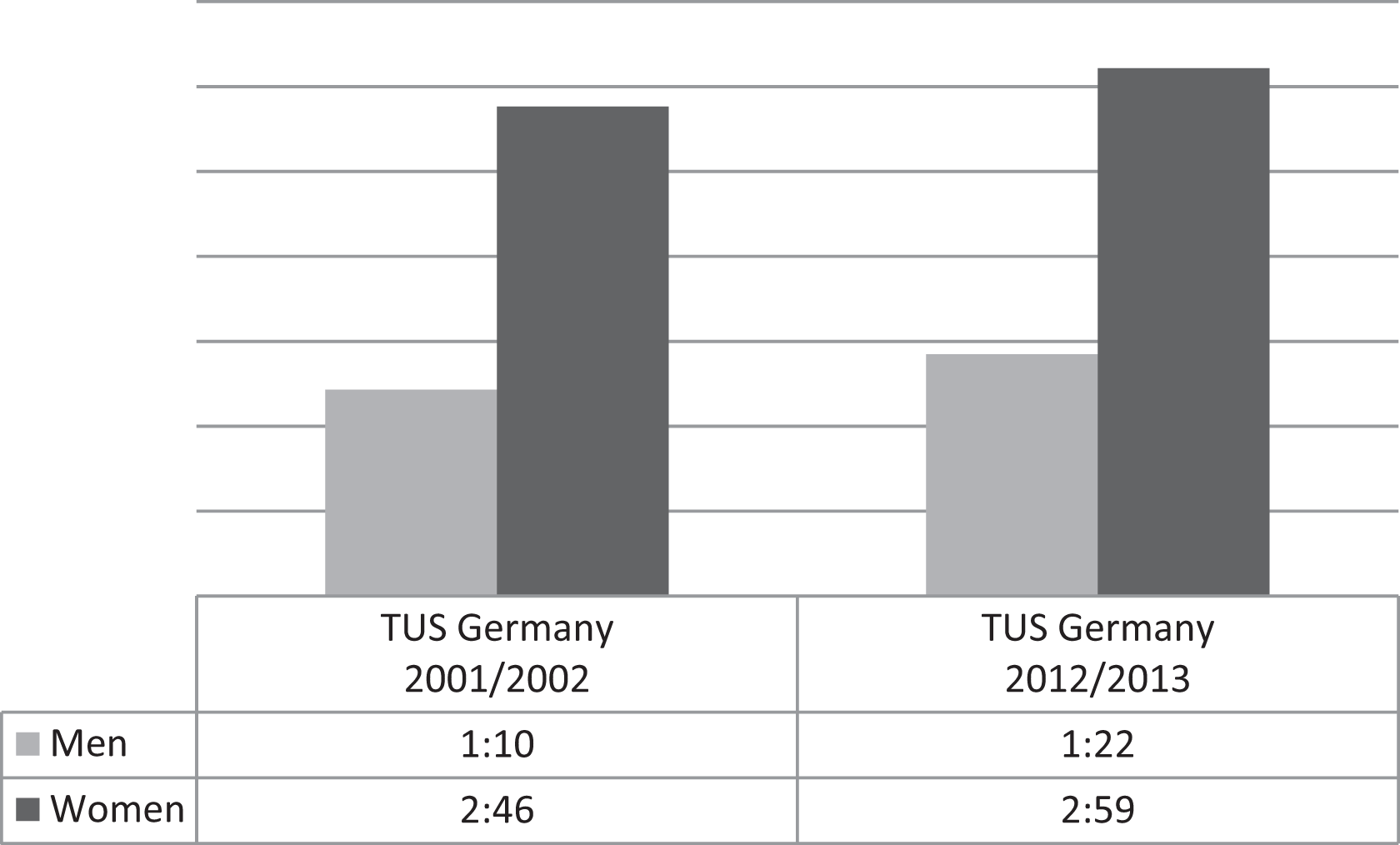
Men’s and women’s time for childcare (in hours) in couple households, with children younger than six years. Source: Destatis (2016b), own calculations.
Altogether, both fathers’ take-up of parental leave and fathers’ time for childcare are increasing over time in absolute as well as in relative terms. However, at the same time, the very small tendencies toward gender equal proportions are strikingly suggesting that German fathers either still favor traditional gender relations or are exposed to obstructive conditions to achieve active participation in childcare.
Literature Review: Determinants of Factors for Fathers’ Take-up of Parental Leave and Time with Their Children
What do we know by now from research that analyzes the relationship between fathers’ engagement and individual, household, or workplace factors?
Regarding time for childcare, there is evidence that the educational level of the father is positively related to more time for childcare (Sayer, Gauthier, and Furstenberg 2004). Also, the couples’ division of labor is shown to be influential: if both parents have a higher income (Sundström and Duvander 2002), if the couples’ income is more equal (Lappegard 2008), if the mothers’ working time is higher (e.g., Brayfield 1995; Norman, Elliot, and Fagan 2013), or the father works less (e.g., Coverman 1985), the fathers’ amount of time with children is higher. Also, work time arrangements, as well as particular organizational work settings, are likely to explain the variance in fathers’ possibilities to engage in childcare (Gornick and Meyers 2003; e.g., Haas and O’Brien 2010). Here, especially the role of work hours as a constraint for fathers’ time for childcare in the workweek is discussed (Coverman 1985; Hallberg and Klevmarken 2003; Hook and Wolfe 2012; Klenner and Schmidt 2007; Reimer and Andernach 2015; Tanaka and Waldfogel 2007). Also, when mothers work more hours, fathers are more likely to engage in childcare (Coverman 1985; Fagan and Norman 2016; Kitteröd and Pettersen 2006; Reimer and Andernach 2015). Furthermore, work cultures with their corresponding implicit work–time regimes are seen as crucial factors impinging on fathers’ time organization on weekdays (Allard, Haas, and Hwang 2011; Burke 2000; Haas, Allard, and Hwang 2002; Puchert, Gärtner, and Höying 2005). In this regard, Seward et al. (2006) show that especially employers’ tendency to equate working late with employees’ commitment makes them stay longer at work. Regarding the influence of fathers’ workplace, it was also found that job security and job flexibility are relevant for fathers’ time with children (e.g., Craig and Mullan 2011) as well as the possibility to use flexible work arrangements like flextime or working from home (Reimer 2015).
Research has shown that fathers’ use of parental leave is mainly determined by economic factors and when the mother has a lower income, the father is less likely to use parental leave (e.g., Almqvist 2008; Lappegard 2008; Sundström and Duvander 2002; Trappe 2013; Vogt and Pull 2010; Yeung et al. 2001). When fathers have entitlements for exclusive leave, they are more likely to take some parental leave, especially when the payment level is generous (e.g., Haas and Rostgaard 2011; Fox, Pascall, and Warren 2009; Brandth and Kvande 2009; Lappegard 2008). Altogether, this indicates that as long as the father is in a (main) breadwinner position, the take-up of leave between parents might remain unequal. Besides fathers’ working time (Haas and Hwang 2007), particularly organizational culture is discussed to mediate fathers’ take-up of parental leave (Haas, Allard, and Hwang 2002; Haas and Hwang 2007; Murgia and Poggio 2013), which shows to be different for white-collar fathers than for blue-collar fathers (Haas and Hwang 2009). The workplace culture implicates in how far fathers may have to anticipate career penalties when claiming parental leave and is therefore a decisive factor for a fathers’ decision (Pfahl and Reuss 2008). Beyond economic factors and conditions at the workplace, also fathers’ age (Sundström and Duvander 2002; Trappe 2013) and men’s advocacy of shared parenting have been identified as correlates of leave-taking (Haas, Allard, and Hwang 2002; Vogt and Pull 2010).
In some recent studies, the relationship between the two indicators of fathers’ engagement have shown that fathers’ leave use and their later engagement in childcare are positively related (Almquist and Duvander 2014; Brandth and Kvande 2015; Duvander and Jans 2009; Haas and Hwang 2008; Huerta et al. 2013; Nepomnyaschy and Waldfogel 2007; Reimer and Andernach 2015; Seward et al. 2006; Wall 2014). However, we do not know how to understand these two indicators differently. When comparing the findings for the two factors of paternal engagement, we barely find differences between them, which leads to the following hypotheses for the analysis: Fathers’ individual characteristics due to age, education, time use, or gender role attitudes determine both fathers’ leave use and their time for childcare. A couples’ relative resources determine both fathers’ leave use and their time for childcare. A couples’ relative working time determine both fathers’ leave use and their time for childcare. Job insecurity and temporary contracts affect both fathers’ leave use and their time for childcare negatively. Autonomy at the workplace or being self-employed is positively related to both fathers’ leave use and their time for childcare.
Data and Methods
The cross-examination of two indicators of fatherly involvement uses German panel data (GSOEP) from the waves 2007 to 2013. These data make it possible to derive information also on the relative counts on fathers’ engagement, by matching the fathers’ data with their partners’ data. The analysis includes only full-time employed fathers (thirty-five hours/week and more) with at least one child below the age of seven, who are living together with their partner in one household.
Since the choice of statistical models should primarily be made on the grounds of data properties (Warton et al. 2016), the analyses are conducted with negative binomial regression, which is suitable for analyses with overdispersed and discrete counts (Warton et al. 2016; Hilbe 2011). Robust estimators are used to increase the reliability of standard errors, confidence intervals, and significance tests (e.g., Baltes-Götz 2016).
Four models are estimated with different dependent variables, each including the same cases (a total of 712 fathers) as well as the same explaining factors into the analyses. The four dependent variables are (1A) fathers’ absolute take-up of paid parental leave, (1B) fathers’ relative take-up of paid parental leave, (2A) fathers’ absolute time for childcare on weekdays, and (2B) fathers’ relative time for childcare on weekdays (Figure 1).
Fathers’ parental leave is derived from calendar data, where the use of leave is documented for each month. It is measured for the first fourteen months after the child is born and varies between zero and twelve months. Fathers’ time for childcare is derived from time estimates based on the question how much hours they spend on childcare on an average weekday. 3 It is measured for second year after the child is born and the numbers vary between zero and twelve hours a day. 4 The relative measures are calculated as differences to the partners’ numbers and therefore indicate the gap between fathers’ and mothers’ time for children on working days and may vary between −12 and 12. For the regression, these numbers are computed into positive values with a possible range between zero and twenty-four.
The fathers in the sample use on average less leave months and report spending more time for childcare than all fathers in Germany (Table 1). Also, the gap in take-up of leave months and time for childcare relative to their partner differs: with regard to parental leave months, the difference is higher in the sample than for all German fathers, and with regard to childcare, it is higher than for the fathers of the sample of the German Time Use Study in 2012/2013. These larger differences between the amounts of time for childcare might be explained by the differences between the time use measures of survey estimates (GSOEP) and diary data (TUS).
Number of Cases for the Dependent Variable.

Source: aGerman Socio-Economic Panel, own calculations; b Destatis (2016c; parental leave statistics for children born between 2007 and 2013), own calculations and mean hours for childcare of fathers with children below the age of six (data derived from the German Time Use Study 2012/2013; data available at https://www.destatis.de/DE/Publikationen/Datenreport/Datenreport.html/).
Several variables with information on individual characteristics (age, education, migration background, living in East Germany, hours for housework on weekdays, and hours of leisure on weekdays), household characteristics (number of children in the household), couples’ characteristics with regard to the division of labor (working hours of the partner, difference in working hours between father and mother, net income of the partner, and the difference in individual net income between a father and his partner), and workplace characteristics (having a secure job, having a temporary job contract, expecting difficulties of finding a new job, having autonomy at the workplace, having fixed working hours, being self-employment, and working for a large company) are included into the model.
Results
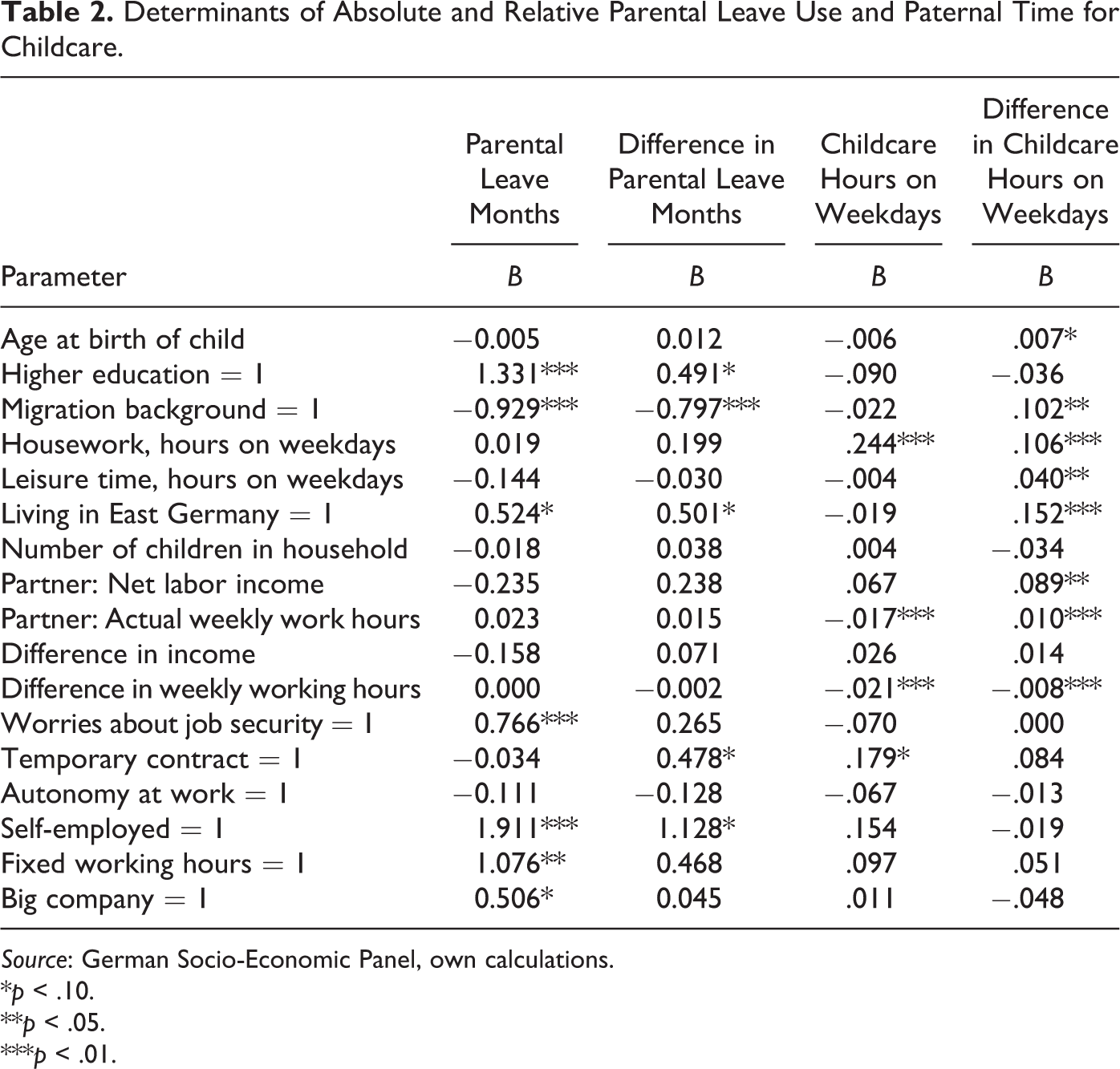
The regression results show that all four indicators of fathers’ engagement are explained by a different set of factors. The greatest differences are between parental leave use and childcare (Table 2). However, there are also differences between absolute and relative measures of fathers’ engagement.
Determinants of Absolute and Relative Parental Leave Use and Paternal Time for Childcare.
Source: German Socio-Economic Panel, own calculations.
*p < .10.
**p < .05.
***p < .01.
German fathers’ absolute parental leave use is positively related to their academic education, living in East Germany, having no migration background, having worries about job security, being self-employed, having fixed working hours, and working in a big company. That is, fathers who do not worry about their job security, who are not self-employed, who have no fixed working hours, and work in smaller companies are less likely to take (more) parental leave. There is no evidence for significant influences due to couple relations regarding working time or economic resources. Together, this indicates that fathers’ use of paid leave months is explained by education, cultural background, and workplace factors. For the relative engagement in parental leave use of fathers, quite similar patterns as for the absolute measures are visible for the individual characteristics. However, the relative parental leave of fathers is explained only by two workplace indicators, namely, having a temporary contract or being self-employed. Again, for the relative measures, there is no evidence for influences of the relative work hours or income. Absolute and relative parental leave use is in part explained by similar (individual) determinants. With regard to workplace factors, however, there are some differences. Surprisingly, insecure work relationships do on average not lead to fathers’ refraining from parental leave: for fathers’ absolute leave, anticipated job insecurity enhances their leave use; for fathers’ relative leave use, having a temporary contract affects fathers’ leave-taking positively.
When looking at the factors that are related to fathers’ absolute time for childcare, there are only four factors in the set of determinants that are significant, which are mainly related to the fathers’ or the mothers’ time use and the circumstance of a temporary contract. Fathers who engage more in childcare are also engaging more in housework. Higher absolute working hours of the mother are negatively correlated with fathers’ engagement. However, when mothers’ working time is higher than the fathers’ working time, fathers on average spend more time for childcare. For fathers’ relative time for childcare, individual, couple, and workplace factors show to be significant predictors. Here, fathers’ higher age is modestly positive related to more time for childcare relative to the partner. Also, fathers with migration background and living in East Germany are positive related to more relative engagement in childcare. Fathers who engage more in childcare (in relation to their partner) are on average also engaging more in housework and spend more time on leisure activities. Higher income of mothers is positively correlated with fathers’ relative engagement in childcare. Also, when mothers’ working time is higher and when they work more hours than the fathers, fathers’ relative childcare hours on average are higher. Absolute and relative time for childcare is explained by two similar determinants, which are hours for housework and mothers’ higher working hours. For the relative time for childcare of fathers, individual characteristics of the fathers are important. Besides these individual, cultural, and time use factors, especially the mothers’ higher engagement in employment explains fathers’ higher relative engagement in childcare.
When comparing the coefficients of fathers’ absolute parental leave use and fathers’ absolute time for childcare, the set of significant factors is entirely distinct from each other. Whereas fathers’ parental leave use is related to education, cultural, and workplace factors, fathers’ absolute time for childcare is significantly related only to other measures of time use and having a temporary work contract.
By comparing fathers’ relative engagement measures, the findings indicate that fathers’ relative parental leave can be explained by the determinants relating to fathers’ individual characteristics and some workplace factors. In contrast, fathers’ relative time for childcare shows a significant relationship to individual characteristics, cultural factors, time for housework and leisure, and mothers’ higher engagement in employment.
With regard to the former stated hypotheses, the findings show that fathers’ individual characteristics determine only partly paternal engagement, with being education, migration background, and living in East Germany solid predictors for fathers’ absolute and relative parental leave use but not for fathers’ time for childcare. As stated in the second hypotheses, it was expected that a couples’ relative resources determine both fathers’ leave use and their time for childcare. This assumption must be rejected, since only for fathers’ relative time for childcare, a relationship to the mothers’ earnings was found. Another hypothesis stated that a couples’ relative working time would determine both fathers’ leave use and their time for childcare. However, this was only the case for fathers’ absolute and relative time for childcare. Also, other than expected, no negative influence of anticipated job insecurity and temporary contracts on paternal engagement was found. Instead, those states were partly positive related to fathers’ engagement. With the last hypotheses, it was assumed that autonomy at the workplace or being self-employed is positively related to both fathers’ leave use and their time for childcare, since the higher degree of self-determination might be connected to less restrictions to realize wishes in line with active fatherhood. However, no effect of autonomy was found and being self-employed was positively related only to fathers’ absolute and relative parental leave use.
Conclusion
In this analysis, the relationship between the two indicators of paternal engagement (1) fathers’ parental leave use and (2) fathers’ time for childcare were examined, contrasting also their absolute as well as their relative measures. On the basis of a systematic comparison of the significant predictors of these indicators, similarities and differences were discussed to ascertain an accurate understanding of the disparate meanings of the two forms of paternal engagement.
In summary, the comparison of the influence of different factors on four different indicators of fathers’ engagement has shown that the two indicators of paternal engagement—parental leave use and time for childcare—have to be understood differently, with barely being explained by the same determinants. Also, the examination of fathers’ absolute opposed to their relative engagement revealed that there are some overlaps, but even more major differences.
From a methodological perspective, this implies that for analyses of paternal engagement, it is important to use adequate measures that are suitable for a particular research question to make a reasonable interpretation of the findings possible. From a sociological perspective, the results indicate that there are distinct coherences and (causal) relationships behind different measures of fathers’ engagement. That is, for the analyses of changes in fatherhood or the gender division of labor, diverse measures have to be applied, being precisely aligned to the research question. As Lamb (1987) already proposed, rather relative than absolute measures are adequate to identify changes in fatherhood, because they are aligned to changes in motherhood as well. However, absolute measures might be a better fit to explain fathers’ constraints to take-up parental leave that are aligned to their work situation.
The analyses of fathers’ time for childcare were conducted with survey estimates, measured in whole hours. Here, further analyses with time diary data are desirable to assess the determinants of different qualities of fathers’ time with children more precisely.
This analysis further revealed that in Germany, the gender gap in time for childcare and parental leave use is still persisting. Mothers spend on average more than two times more for childcare than fathers and less than 10 percent of parental leave entitlements, though being gender neutral in design, are used by fathers. To increase fathers’ leave take-up, extended exclusive entitlements might be a reasonable strategy, as the case of Iceland shows. In addition, a more gender equal division of childcare seems to be enhanced specifically through mothers’ higher employment participation. However, particularly in West Germany, the male breadwinner/female part-time care model is still the dominant cultural model (Pfau-Effinger 2010), and in both parts of Germany, it is still the norm that the mother is the primary carer for the baby in its first year. This might indicate a ceiling for gender equality or “gender squeeze” (Gíslason 2011) at least for the baby’s first year.
Footnotes
Declaration of Conflicting Interests
The author(s) declared no potential conflicts of interest with respect to the research, authorship, and/or publication of this article.
Funding
The author(s) received no financial support for the research, authorship, and/or publication of this article.