




Abstract
I recall a time as an undergraduate student in Sydney, Australia, when I was on a night out with other university students. A bartender asked me what I was studying, and I replied, “I’m becoming a primary school teacher”. Without much expression in her voice, she responded: “I can’t imagine they would let you teach the little ones. That would be a bit risky”. There was a sting in her words and I knew immediately that she was referring to my gender; I was one of only three male students in my cohort. I wondered if others might share her view. As it turned out, the “little ones”, Kindergarten and Year One, were my favorite grades to teach. That one fleeting interaction stayed with me and became the focus of my scholarly work. Ten years later, and having since left the teaching profession altogether, in this essay I return to the question: Is teaching “too risky” for men in Australia?
The notion that teaching young children comprises inherent risks for men is persistent in the media, public opinion, and research literature. These risks range from the possibility of being perceived negatively by family and friends for choosing a career commonly regarded as “women’s work” (Foster and Newman 2005) to potential accusations of inappropriate physical contact or sexual interactions with students (Davis and Hay 2017). In Australia, the potential for teachers to face allegations of child sexual abuse has become a popular and uncomplicated explanation for a shortage of male teachers. Here, the media literature has asserted that male teachers “face sexism and child abuse claims” (Rubinsztein-Dunlop 2017) and “fear being called a paedophile” (Harris 2019). Such comments are occasionally accompanied by anecdotal evidence. For example, one columnist wrote, “I know a young male primary teacher who talks among his colleagues about how allegations of sexual misconduct have destroyed many good men’s teaching careers” (Roberts 2017). In light of my recent forecast that male teachers in Australian government primary schools will reach an “extinction point” in the year 2054 (McGrath and Van Bergen 2017), better understanding of these claims is becoming increasingly important.
In this article, I explore the notion of “risk” for men who choose to work in the Australian teaching profession. I seek to examine how perceived risk may limit male participation, and deal specifically with the belief that a fear of allegations of inappropriate conduct is driving men away from the teaching profession. I argue that the idea that teaching is “too risky” for men in Australia is a symptom of competing forces that function to protect the moral order, uphold the masculine hegemony, reject conjecture linking male representation to the status of the profession, and serve the economic interests of the media.
Despite media sensationalism, it is not clear if a genuine fear of being accused of child sexual abuse, or being perceived as a paedophile, is preventing men who want to become teachers from enrolling in teacher education degrees. In addition, despite hearsay, no evidence exists to support claims that allegations of child abuse are contributing to Australia’s decline of male teachers. Although some male teachers may have concerns regarding how physical contact with students may be perceived by others, this does not appear to have deterred those men from the profession (Pollitt and Oldfield 2017). Indeed, there are some indications that male teachers in Australia experience longer average career durations than female teachers (NSW Department of Education 2015). While the legitimacy and reliability of the impact of allegations on male teacher representation is rarely contested, in the absence of critical discussion and empirical evidence, repeated claims suggesting that male teachers commonly face accusations of child sexual abuse are likely to become perceived as truthful (see Unkelbach and Rom 2017). In effect, the position perpetuated by the media and social commentary may have a devastating impact on men who wish to teach young children, with far reaching consequences for the Australian education system as a whole.
Male Teachers, Masculinities, and Risk
Paradoxically, current rhetoric in Australia has positioned male teachers as being both “at-risk” (e.g. of extinction) and “risky” (e.g. potential pedophiles). This is problematized further by a conceptual contradiction between “masculinity” and “risk”: masculinity is typically associated with domination and violence (Bourdieu 2001), whereas risk suggests vulnerability and uncertainty (Papastephanou 2006). Consequently, it may be easier to conceive of a male teacher being risky, than it is to consider him being at-risk. Men may become vulnerable, however, when their actions, decisions, or behavior knowingly do not conform with the dominant gender order or worldview (see Giritli Nygren, Öhman, and Olofsson 2015). For male teachers, this vulnerability stems from pursuing a career often regarded as “women’s work” (Crisp and King 2016). This decision may nonetheless be made when the perceived rewards (e.g. competitive employment because of the perception that male teachers are in “high demand”) outweigh the perceived risks (e.g. negative perceptions from others), or when no risk is perceived (see Pollitt and Oldfield 2017).
Where risk is recognized, it may not be seen or experienced equally by all men who wish to work as teachers, and may vary depending on intersectional characteristics (Olofsson and Rashid 2011; Olofsson et al. 2014). Connell (2005) describes a hierarchy of masculinities (hegemonic, complicit, marginalized, and subordinate), each with differing power and social status, suggesting that masculinity is not free from inequality. Extending upon this model, Coles (2007) suggests that interactions between hegemonic (dominant) and subordinate masculinities take place within each level of Connell’s hierarchy. Applying this model to teachers suggests that a single, young, homosexual man may face greater (or different) risks when working as a teacher than a married, older, heterosexual man (see King 2004). Whilst the latter may hold a socially constructed position of dominance over the former within the realm of teaching, within the broader masculine hegemony, both occupy positions of low status and, having deviated from the hegemonic norm, engage with risk.
The Risk of (False) Accusations of “Inappropriate Conduct”
Arguably, the most persistent and damaging assumption behind Australia’s shortage of male teachers is that a fear of allegations of child sexual abuse is driving men away from the teaching profession. Taken at face value, this rationale reflects a common-sense argument that men do not want to be accused of sexually abusing a child and that working in proximity with children increases the likelihood of such accusations. As one father speaking about a shortage of male primary school teachers explained, The reasons why there’s lesser and lesser of them is because of that fear factor - being a male adult, dealing with other peoples’ kids. It’s not difficult to put your foot the wrong way and have things perceived to be dodgy or whatnot. I know if I were dealing with other peoples’ kids on a daily basis I’d be concerned about that.…You obviously get some bad people that did some things but I’d be concerned. Definitely. (McGrath 2011, 49).
Although sexual abuse is the least common form of abuse or neglect for children living in Australia (Australian Institute of Health and Welfare 2018), available statistics only reflect cases that have been detected and reported to authorities. Given indications that it takes survivors an average of 22 years to disclose sexual abuse perpetrated against them when they were a child (Commonwealth of Australia 2015), it is difficult to know the prevalence of this crime. In many cases, victims of sexual abuse may never disclose the abuse to authorities (Australian Bureau of Statistics 2006). This is complicated further by multiple fragmented data sets and differences in the recording and reporting practices of crimes of sexual abuse (or assault) between Australian states and territories. Though available evidence indicates that sexual abuse of children aged 10–19 years is most often perpetrated by a “non-family member known to the victim” (see Figure 1), this category of perpetrators includes, for example, partners and ex-partners, foster parents, members of religious institutions, persons from recreational and performing arts organizations, school personnel, acquaintances, colleagues, and friends. The prevalence of sexual abuse that is perpetrated solely by teachers cannot be determined from this publicly available data, and the rate of allegations made against teachers is unknown.
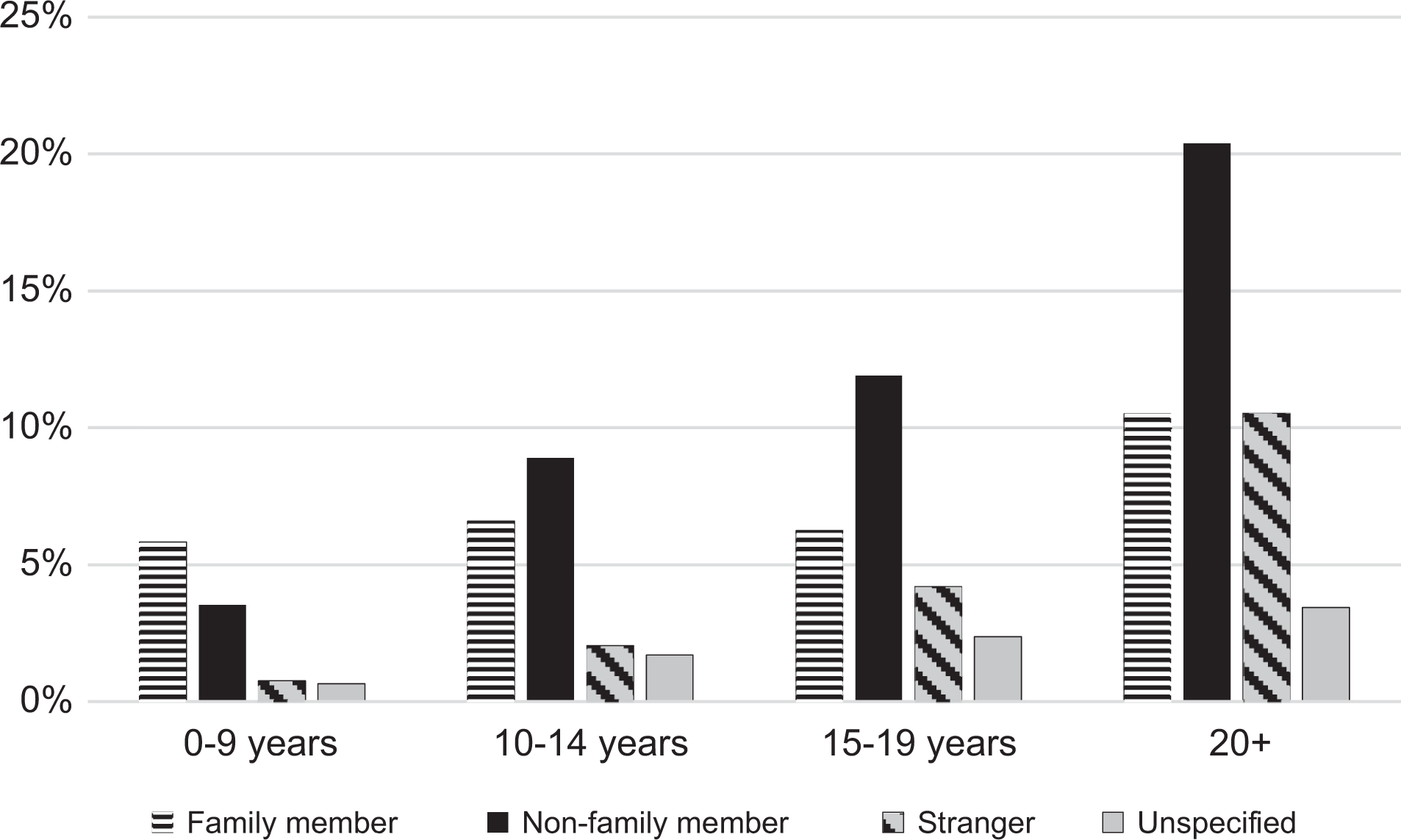
Relationships of offender to victims of sexual abuse by age of victims in Australia, 2014–2017. Source: Australian Bureau of Statistics (2017). Note. Data from different States and Territories has been combined but may not be comparable due to differing administrative systems. Data from Western Australia was not available. Data shown indicates 2,469 victims aged 0–9 years, 4,445 victims aged 10–14 years, 5,685 victims aged 15–19 years, and 10,315 victims aged 20+ years.
It is possible, if not probable, that perceptions of male teachers as potential sexual predators has recently intensified in Australia following the report of the Royal Commission into Institutional Responses to Child Sexual Abuse (Commonwealth of Australia 2017). Of the survivors who took part in the inquiry (aged 7–93 years old), 31.8% (n = 2,186) said they were abused in a school setting as a child. Most of those survivors (85.6%) spoke about abuse that occurred before 1990, prior to Australia’s ratification of the United Nations Convention on the Rights of the Child, and when welfare provision was poorly resourced (Swain 2014). Where information was provided about the perpetrator, 58.4% of those who said they were abused in a school setting as a child identified their abuser as a teacher, 39.9% as a person in a religious ministry, and 14.1% as another child. Ninety-six percent of perpetrators were male and 74.5% of victims were also male (Commonwealth of Australia 2017). The findings of this inquiry highlighted a historic problem of abuse and poor reporting practices in institutions responsible for the care of children in Australia.
An unintended outcome of this inquiry, however, may be the subtle vilification of current male teachers—a sort of social retaliation for the invisible suffering that persisted for decades in institutions responsible for the care of children—and an amplified perception that allegations of sexual abuse are now common in schools. Indeed, arguably, the dominant portrayal of a male teacher in contemporary Australian culture is that depicted in the popular podcast series The Teacher’s Pet, which has been downloaded more than 28 million times. The podcast series, presented by investigative journalist Hedley Thomas, reports the investigation into the disappearance of Lynette Dawson in Sydney in 1982, whose husband—a former rugby player and teacher—was having an affair with a 16-year-old school student. This podcast has since revealed a culture of abuse and sexual relationships between teachers and students in the 1970s and the 1980s at a now infamous Sydney high school. In the absence of other presiding portrayals of male teachers to challenge these negative representations, perceptions of male teachers in Australia have become distorted by a dominant narrative of male teachers who are conspicuous, deviant, and dangerous. This effect may be explained by a perceptual tendency for members of a “token” group to be perceived in ways that fit with familiar stereotypes (see Kanter 1977). In contrast to the contemporary construction of male teachers as risky, however, schools may be more accurately characterized as sites that promote safety for children. Indeed, school personnel are the second-most common source of notification to child protection authorities in Australia (see Figure 2).
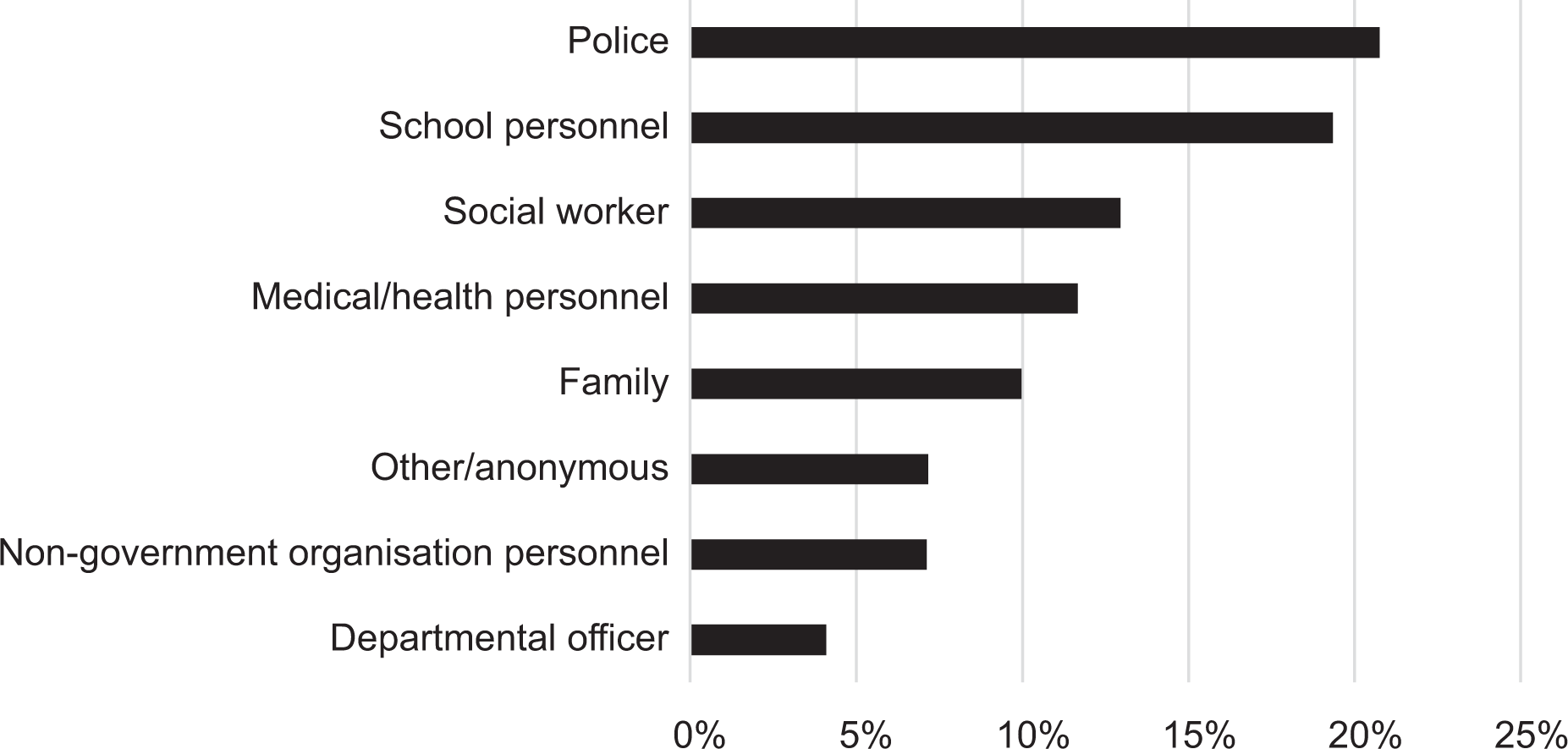
Child protection source of notification (2016–2017). Source: Australian Institute of Health and Welfare (2018).
Demystifying Social Forces Constructing Risk for Male Teachers
Though it is of paramount importance that schools promote safety for students, popular discourse suggests that teaching is not a safe career choice for men. Given that the prevalence of accusations of “inappropriate conduct” against male teachers is unknown, I argue that the idea that teaching children is “too risky” for men in Australia is a symptom of competing social forces associated with (a) morality and the media, (b) the masculine hegemony, and (c) the status of the profession.
First, the notion that teaching children is “too risky” for men may function as a social gatekeeping mechanism to defend morality and deter men who might have ill intentions for wanting to work with children. Given Australia’s abysmal track record of responding to institutional child sexual abuse, such gatekeeping may appear to serve an important purpose, albeit at the cost of the psychological well-being of male teachers. Although it may be unlikely that men who seek to sexually abuse children will choose a profession that requires routine criminal record checks, and where they would experience heightened visibility and scrutiny, maintaining the perception that the prevalence of sexual abuse in schools is high also serves the economic interests of the media by sustaining a level of panic that triggers engagement from the public moral conscience (Fox 2012). The media then, in turn, exacerbates the use of risk discourse as a gatekeeping mechanism in public opinion by positioning the general public as “concerned citizens”—an incontestable position. Consequently, rather than modelling caring and nurturing traits, male teachers may demonstrate caution, uneasiness, and physical and emotional detachment from children. Furthermore, an “exaggerated perception of risk produces undue restrictions on children’s freedom and on their interactions with teachers and other adults” (West 2000, 511), emphasizing a need for students to interact with male and female teachers in fundamentally different ways.
Second, perpetuating the view that working with young children is “too risky” for men serves to protect the masculine hegemony whilst simultaneously devaluing the predominantly female teaching profession. Through discourse of risk, men who may deviate (or who have deviated) from the hegemonic norm feel pressured to conform to the perception that masculine performance is superior to nurturing, childrearing practices (for “caring masculinities”, see Elliott 2016). To lessen such pressure, male teachers may either seek promotion, where interactions with children reduces and managerial work increases, or leave the profession. The devaluing of the teaching profession further serves to reinforce this structure, extending beyond portrayals of risk to include enduring political and media criticism of the effectiveness of the education system, low tertiary entry requirements compared to other disciplines (suggesting that teaching is “easy”), an overuse of casual teaching positions for ongoing appointments, and greater financial incentives for female than for male tertiary graduates to choose teaching compared to other careers in Australia (Carroll, Parasnis, and Tani 2018). Such devaluing is implicit in discourse regarding the “feminization” of the teaching profession (Skelton 2002), which has aided the construction of teaching as “women’s work”, suggesting that teaching is a low paying, nurturing occupation and is therefore better suited to women (Cushman 2007). Notably, such discourse ignores stereotypically masculine qualities (e.g. being assertive or authoritative) that teaching requires.
Third, while women continue to face greater adversity in employment and promotion more broadly, the idea that teaching is “too risky” for men may serve to protect conditions that implicitly and explicitly favor women in the Australian teaching profession. Such conditions grew from initiatives that originated in Australia in 1975, the United Nations International Year of Women. In New South Wales, for example, these initiatives include the NSW (New South Wales) Teachers Federation Women’s Program and Women’s Conference, the Springboard Women’s Development Program and the Women in Educational Leadership Network supported by the Department of Education, and a scholarship program for female members of the Australian Education Union (NSW Teachers Federation n.d.). Though male-only teacher scholarships were proposed in 2004, these were deemed unlawful (McGrath 2016). Discourse linking the low representation of male teachers to the perceived low salary and status of the teaching profession has inadvertently created conditions that suggest that if male representation increases so too will the salary and status of the profession, or vice versa. Consequently, an increase in male teacher representation may be perceived to threaten female promotions and the representation of women in leadership roles. This became evident when, in 2018, NSW became the first state in Australia to include male teachers as a key focus area for workforce diversity (NSW Department of Education 2018). The NSW Teachers Federation publicly objected to this focus on the basis that “there is a higher percentage of men in promotions [sic] positions when compared to the cohort for women” (2018). Though such conditions may not directly promote risk for men, if an increase in male teachers is perceived to threaten promotions for women or the representation of women in leadership positions, it may be unlikely that education bodies will address the notion that teaching is “too risky” for men.
Conclusion
Taken together, and without intervention, these competing social forces create a “perfect storm” that may see male teachers vanish from Australian schools altogether. Successful interventions must therefore combat each of these forces to manage and mitigate risk for male teachers: restoring public faith that schools can protect students, presenting positive representations of male teachers, challenging the masculine hegemony, and highlighting the role of men in the lives of children, whilst simultaneously ensuring that male teacher representation does not threaten promotions for women or the representation of women in leadership positions. Although an elevated perception of risk may be a symptom of such competing social forces, false allegations of “inappropriate conduct” are likely to have a devastating impact on male teachers, their careers, their families, and their mental health (potentially leading to suicide; see West 2000). Media speculation about the decline of male teachers that emphasizes sexual abuse may also negatively impact survivors of institutional child abuse who may then relive traumatic experiences. Particular sensitivity is therefore needed when discussing these matters in public debate.
All teachers are at considerable risk of burnout (Chang 2009), however, and many leave the profession within the first five years. The reasons teachers leave the profession in Australia are typically to do with a lack of support, high workloads and disproportionate salary, managing disruptive behavior, and the low prestige teaching is held to (Buchanan 2010). Hence, addressing each of these factors is equally important to ensure that high quality teachers are retained. Although the risk that male teachers will be wrongly accused of inappropriate conduct may be low, the perception that teaching is “too risky” for men in Australia may be strong enough to create a self-fulfilling prophecy and an entirely female workforce of teachers.
Footnotes
Declaration of Conflicting Interests
The author(s) declared no potential conflicts of interest with respect to the research, authorship, and/or publication of this article.
Funding
The author(s) received no financial support for the research, authorship, and/or publication of this article.