



Abstract
Persons with disabilities make up at least 15% of the population, yet advertising has, until recently, virtually ignored this audience. We report findings from a survey with 126 students enrolled in advertising classes to gauge awareness, knowledge, and perceptions of disability and advertising. Results show that the majority of students were largely unfamiliar with terminology and with web accessibility guidelines; only 22% learned about disability in any class. Students believed they had some knowledge but indicated that they would like to learn more about disability and advertising for their careers. Students perceived that the advertising industry does not make enough effort to consider disability in advertising. However, they listed brands (e.g., Nike, Apple) that were doing a good job with respect to disability. Results suggest that more content related to persons with disabilities and accessibility should be included in advertising curriculum; ideas and resources are shared.
Introduction
For a long time, advertisers did not consider people with disabilities (Timke, 2019). Now, Josh Loebner, an advertising professional who is blind and an expert on disability and advertising, argues that “Disability in advertising is a key emerging and evolving topic that is critical and important for students, faculty, professionals and consumers to understand and act on” (Loebner, 2021). Yet, there is limited research on disabilities in advertising focusing on representation (e.g., Houston, 2019) or how people with disabilities respond to advertising (e.g., Houston, 2021; Kaufman-Scarborough, 2001). Increasingly, scholars and professionals across fields are concerned with usability and accessibility through inclusive design (e.g., Ludi et al., 2018; Patrick & Hollenbeck, 2021); some advertisers are beginning to address accessibility by including audio descriptions (e.g., P&G, Roderick, 2017). There is also a small but growing body of research related to disabilities relevant for advertising education (Ellis et al., 2021; Haller, 2021; Loebner, 2021; Timke, 2019), but we do not know what our students, as future advertising professionals, know about accessibility, disabilities, and inclusive design in advertising. Therefore, the purpose of this article is to (1) review this topic in the advertising education literature; (2) gauge awareness, knowledge, and beliefs about disability and advertising among students who are studying advertising; and (3) provide resources for advertising educators to incorporate disability and accessibility content into their classes.
Understanding Disability
Definition and Scope
“Disability is complex, dynamic, multidimensional, and contested” (WHO, 2011, p. 3). The term has been measured and defined in multiple ways (Loebner, 2021), which makes quantifying the number of persons with disabilities difficult. In some cultures, write Mitra and Yap (2021), “the word [disability] and the notion do not exist” (p. 13), with many countries not measuring for disability. Across 41 countries, the median share of the adult population with any functional disability stands at 12.6% (Mitra & Yap, 2021). In the U.S., disability status has been tracked on the American Community Survey since 2008; the Centers for Disease Control and Prevention indicate that 26% of adults have some kind of disability (CDC, 2022).
Historically, the medical model of disability presented a narrow definition that focused on health impairments or medical limitations in need of interventions (Officer & Groce, 2009). Disability activists and scholars re-framed disability and broadened the concept to focus on structural, societal, and environmental perspectives, which present disability as a mismatch between society and the person (“social model”; Oliver, 1990). This concept of disability helped shape and fuel the disability rights movement, which led to the Americans with Disabilities Act (ADA) of 1990 (Heller et al., 2019). These models are often presented as being dichotomous. A newer, compromise model—the “bio-psycho-social model” —adopted by the International Classification of Functioning, Disability and Health (ICF) and the World Health Organization for the World Report on Disability (2011) includes the interaction between person and environment. Thus, disability could be defined as “an interactional notion, one that results from an individual with a health condition interacting with the environment” (Mitra & Yap, 2021, p. 13). In the legal aspect, the ADA defines a person with a disability “as a person who has a physical or mental impairment that substantially limits one or more major life activity” ADA National Network, 2022).
Persons with disabilities are heterogenous; everyone may experience a disability at some point in their lives whether temporary, situational, or permanent (WHO, 2011). Typically, a physical impairment or wheelchair is associated with the word disability, yet there are also disabilities where there may be no physical signs or cues that are noticeable, referred to as “invisible disabilities” such as “learning, reading, concentrating, thinking, communicating and working” (Adams et al., 2010, p. 459) as well as other chronic health conditions.
There has been much progress as a result of the disability movement, including the interdisciplinary field of disability studies (Ellis et al., 2019); attention to invisible disabilities (e.g., Invisible Disabilities Association); development and popularization of concepts critiquing the idealization of neuro-normativity (e.g., neurodiversity: idea that brains are wired differently; Milton, 2020) and ableism, which celebrates a certain “perfect” self and body that is essential (Campbell, 2001) or assumes ablebodiness in society so that persons who do not conform to ablebodied stereotypes are viewed as “less than” (Chouinard, 1997). Calling out these assumptions in promotion of invisible disabilities, neurodiversity, and defying ableism expands our views of disability and persons with disabilities. We were interested to know if students had been exposed to disability in class and whether they were aware of these ideas.
Disability and Advertising
Advice to advertisers is to design with representation and inclusion in mind. It is estimated that one in four people have some kind of disability in the U.S., but there are few advertisements that show this; therefore, people assume that there are few people with disabilities (Loebner, 2021). As with other audiences, persons with disabilities like to see themselves reflected in media; however, it is important to do this right. For a long time, the advertising industry virtually ignored people with disabilities. A study of magazine ads revealed that less than 1% contained any mention or inclusion of people with disabilities (Parashar & Devanathan, 2006). Nearly 20 years later, ability-integrated advertising is improving in the U.S., in terms of quantity and quality. Prime-time commercials including images of disability (Nielsen Insights, 2021), diverse depictions of differently abled people as major characters (Farnall & Lyons, 2012), and positive portrayals of empowerment and pride (Haller & Ralph, 2006; Loebner, 2021) are more common than ever before. Nevertheless, negative portrayals with the medical model of disability (e.g., “Supercrip” stereotypes; Haller & Ralph, 2006; tokenism, othering; Loebner, 2019, 2021) continue in the media.
Despite the size of this potential target audience, historically, people with disabilities felt left out of advertising and, as a result, ignored messages while also being keenly aware of and supportive of advertisements with positive images of disability (Hardin, 2003). Interviews with people with color deficiencies revealed that they were indifferent and frustrated by advertising that was not accessible to them (Kaufman-Scarborough, 2001). Houston’s (2021) interviews with visually impaired women revealed insights about how advertisers reflect their identities as a woman and a woman with a disability, which challenges advertisers to consider an intersectionality approach to identity and targeting.
Since the U.S. Bureau of Labor Statistics does not measure disability, it is unknown how many people with disabilities are working in the advertising industry (Loebner, 2019), but the “Nothing About Us Without Us” movement invites people with disabilities into the process of message creation (Loebner, 2021). In our research we were interested in students’ perceptions of disability in advertising and the advertising industry.
Inclusive Design and Accessibility
Ensuring that everyone can access communication messages adheres to the idea of considering all abilities in the design process (Patrick & Hollenbeck, 2021). The inclusive design approach uses the social model of disability where there is a perceived mismatch between audience needs and product or service offerings. Design in this sense goes beyond graphic design (Ellis et al., 2021b) to include product designers and creatives who employ a process where inclusive design is factored into all creative work. For example, Tommy Hilfiger’s “Tommy Adaptive” features designer clothing adapted to hide medical devices or fasten with Velcro; Guide Beauty and Kohl Kreatives offer all-inclusive beauty products with braille, audio guides, and more (“All-Inclusive Beauty,” 2021); Google Creative Lab won the 2019 Cannes “Design Grand Prix” for their “Creatability” campaign of accessible music tools; and Ikea received the “Health and Wellness” award for their “ThisAbles” campaign, which featured affordable product modifications for all users. Accessibility in advertising should be part of marketing and communications, such as the McDonald’s Happy Meal app, which shows users how to enable accessibility settings for larger text, high-contrast, or dyslexia-friendly font. We explore what students know or have learned about accessibility and their level of personal exposure or use of accessibility tools.
Public Policy and Law
There are good business reasons, along with ethical and legal ones, for brands to employ inclusive design principles. In the U.S., accessibility is covered in the Americans with Disabilities Act (ADA), which is a civil rights law that “prohibits discrimination on the basis of disability in employment, state and local government, public accommodations, commercial facilities, transportation, and telecommunications” (ADA.gov, 2020). Title III provides anti-discriminatory and accessibility standards for public accommodations and services operated by businesses and commercial facilities. It ensures the “right to effective forms of communication” mandating that “businesses take steps necessary to communicate effectively with customers with vision, hearing, and speech disabilities” (ADA.gov, 2020). The American Federation for the Blind points to the ADA Accessibility Guidelines (an appendix to Title III) which provide specific guidance for public accommodation. Title IV relates to accessibility in Telecommunications. As explained by the Dreamscape Foundation, a non-profit organization dedicated to accessibility advocacy, Title IV includes digital communications with guidelines for web accessibility and requirements for closed captioning. The Web Content Accessibility Guidelines (WCAG 2.0) provide a standard for Web accessibility internationally. As of 2018, the U.S. Department of Justice has considered these web guidelines as the “gold standard” of ADA website compliance. If brands’ websites are not compliant, they are at risk for lawsuits, as was the case for Domino’s Pizza, which was successfully sued by a blind person who could not order pizza due to Domino’s web accessibility issues (Domino’s Pizza v. Guillermo Robles, No. 18–1539; Higgins, 2019).
Gap and Research Questions
Thus far, disability, advertising and accessibility, and public policy were reviewed. But what do students who study advertising know or think about these topics? To our knowledge, this is the first study to assess students’ knowledge and beliefs about disability and advertising. We focused on these questions:
What is the level of familiarity or knowledge of disability and (web, advertising) accessibility among students?
What is the level of knowledge about and desire to learn more about accessibility, disability, and advertising?
What are students’ attitudes toward and beliefs about disability and advertising/branding in the industry and accessible design?
What is the level of exposure to material about disability in classes?
What is the frequency of students’ personal use of accessibility features/tools?
Method
Participants and Procedures
To address our research questions, an online survey was conducted with 126 undergraduates from a “participant pool” consisting of students enrolled in advertising courses at a large university. The majority of students were advertising majors and received extra credit for participating in the 15-minute survey. The study was approved by the university institutional research board and ethical procedures were followed (e.g., informed consent, anonymity).
Measures
Familiarity With Disability
The survey asked students’ (1) familiarity with key concepts; and (2) knowledge or personal experience with people with specific disabilities. The terms were associated with disability studies and the disability movement (e.g., ableism: Bogart & Dunn, 2019; invisible disabilities: Ysasi et al., 2018; neurodiversity: Milton, 2020). Other questions were based on previous research conducted with undergraduate students in computing programs (Ludi et al., 2018). Familiarity was gauged on a 5-point scale (1 = not at all familiar; 5 = extremely familiar; Hardesty et al., 2002). Radio button options were used to indicate either a) knowledge of or b) personal experience with each case. See appendix for full survey.
Familiarity With Web/Advertising Accessibility and Frequency of Web Accessibility Exposure
We were interested in students’ level of familiarity with web/advertising accessibility guidelines. Familiarity was gauged on a 5-point scale (1 = not at all familiar; 5 = extremely familiar; Hardesty et al., 2002). We showed a restaurant website with an accessibility menu, including how the website would change if visitors chose options (e.g., “contrast”). Participants were asked to rate frequency in response to statements related to exposure or use for self or others: (1) “How often would you say that you have seen an ‘Accessibility Menu' such as this one on other websites you browse?” (2) “How often do you think that you would use one of these features on the ‘Accessibility Menu' for your own internet browsing?” and (3) “How often do you think that other people would use one of these features on the ‘Accessibility Menu' for internet browsing?”
Attitudes and Beliefs About Disability and Advertising Industry and Accessible Design
Students were asked their perceptions of the advertising industry and disability: “To what extent do you believe that the advertising/marketing industry makes an effort to consider disability in advertisements?”; “To what extent does the advertising industry consider visible or physical disabilities in creating advertisements?” and “To what extent does the advertising industry consider invisible disabilities?” on a 5-point scale where 1 = very poor and 5 = excellent, which is a scale used to assess general perceptions (e.g., health: Hays et al., 2015; performance of a bank: Colgate et al., 2000).
Two questions were asked about representation of disability in advertising on a 7-point agreement scale where 7 = strongly agree (“I think advertising could help normalize disability by featuring disabled people from all walks of life” and “I would like to see advertising that featured disabled people as equal to able-bodied people”). The two items were highly correlated, r = .76 and Cronbach’s Alpha = .86, so a mean variable was created (M = 5.55, SD = 1.29).
Three items related to students’ perceptions and attitudes about accessible or inclusive design (“Good accessible design is not just good for people with disabilities - it is good for everybody,” “I think we should design products and advertisements with everyone in mind,” and “I think accessible advertising is good for everyone”) on a 7-point scale, where 7 = strongly agree. Cronbach Alpha = .75 showed good reliability so a mean score was calculated with these three items (M = 5.65, SD = 1.11).
Perceived Knowledge and Desire to Learn About Disabilities
We measured perceived knowledge and desire to learn more by asking students to indicate their agreement (7-point scale) with: “I feel like I know enough about accessibility and inclusion for people with disabilities” and “I wish I knew more about accessibility and inclusion for my career.”
Awareness of Brands Known for Inclusive Design or Disability Advertising
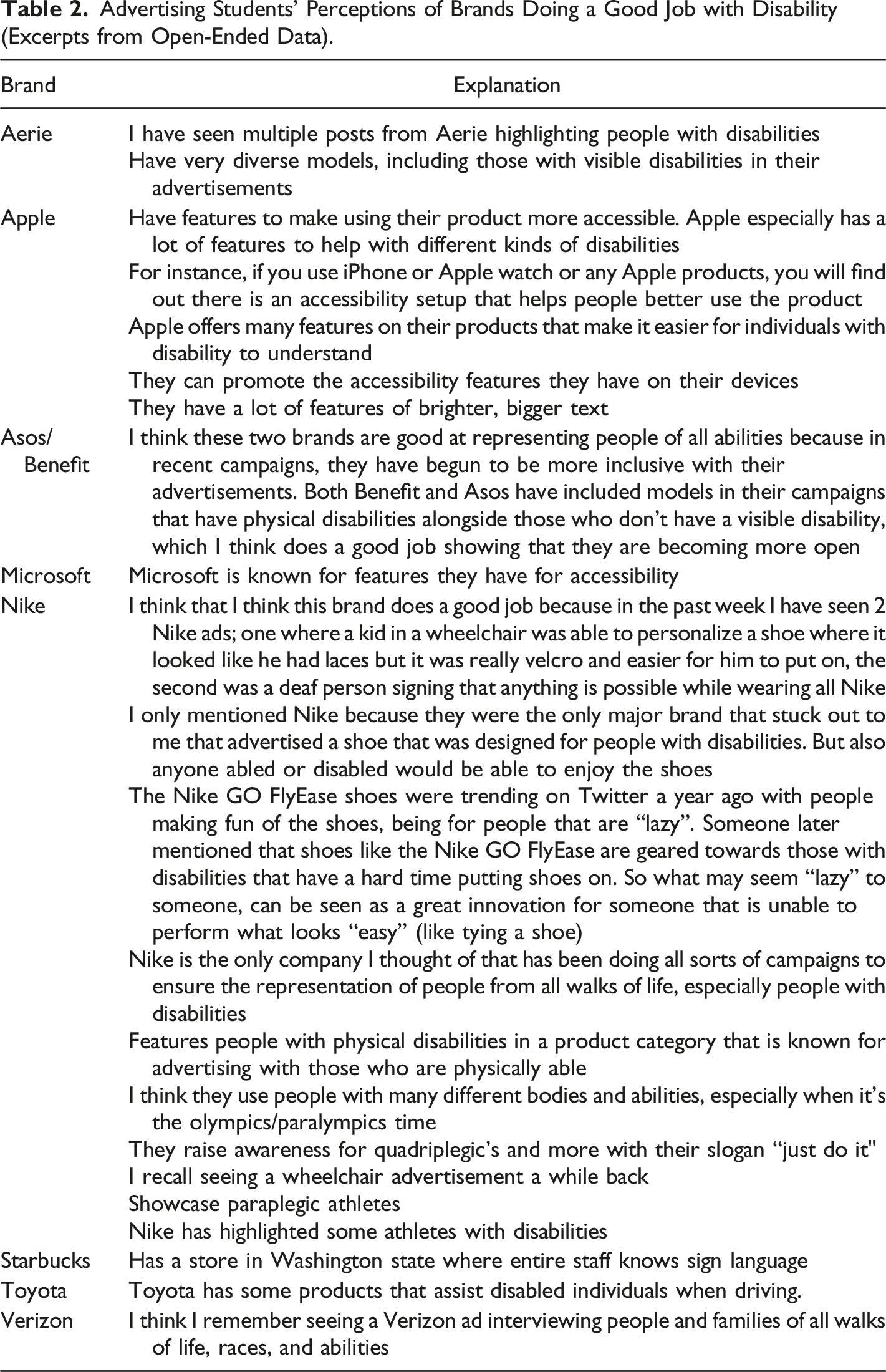
Top-of-mind awareness of brands associated with disability was assessed with: “Please list any brands or companies that you can think of that do a good job of representing people of all abilities or you think design their products or advertising with disability mind,” with the option to explain.
Student Use of Accessibility Tools
Accessibility tools were drawn from web accessibility guidelines (W3C: “tools and techniques”) and an accessibility e-book (“Modern Marketing”, 2019).
Results
RQ1: What is the level of familiarity or knowledge of disability and (web, advertising) accessibility among students?
Advertising Students’ Familiarity with Disability Terms.

When asked about awareness of different forms of disabilities, the familiarity levels were higher overall. About 75% were very or extremely familiar and only .8% were not at all familiar with visual impairment (M = 4.07, SD = .98); about 80% were very or extremely familiar and .8% were not at all familiar with color blindness (M = 4.23, SD = .91); 74% were very or extremely familiar and 5% were not at all aware of dyslexia (M = 4.05, SD = 1.13); and 89% were very or extremely familiar and .8% were not at all familiar with deaf or hard of hearing (M = 4.4, SD = .78). We also asked if students had knowledge or personal experience (related to self or others) with different disabilities. Students reported personal experiences with various disabilities: low vision (23%), blindness (6%), deafness (20%), autism (25%), learning disabilities (29%), dyslexia (18%), ADD/ADHD (40%), intellectual disabilities (20%), and motor/movement disabilities (17%).
We asked students about their familiarity with practices in advertising and web accessibility. With respect to “Compliance rules for web accessibility”, (M = 1.92 SD = 1.5), 51% were not at all familiar and 14% were very familiar. On “Accessibility checkers”, (M = 1.78, SD = 1.0), 54% of students were not at all familiar whereas 8.9% were very familiar. Lastly, when asked about “accessibility considerations in advertising”, (M = 2.08, SD = 1.0), 36% were not at all familiar and 9.7% were very familiar.
With respect to a restaurant website with an accessibility menu, 46% indicated that they had never seen an “Accessibility Menu” on websites (M = 2.01, SD = 1.29); 42% indicated they would never use the menu (M = 2.22, SD = 1.36) even though they believed that “other people” would use the accessibility features once a week (21%) or every day (23%); (M = 3.99, SD = 1.61).
RQ2: What is the level of knowledge about and desire to learn more about accessibility, disability, and advertising?
Only 33% of the sample agreed (agree, moderately agree, strongly agree) with the statement, “I feel like I know enough about accessibility and inclusion for people with disabilities” (M = 3.62, SD = 1.14). This is in contrast with 83% of the sample who agreed with the statement, “I wish I knew more about accessibility and inclusion for my career” (M = 5.44, SD = 1.22). See Figure 1. Advertising students’ self-efficacy about disability knowledge and advertising. Note: Mean scores on 7-point scale where 7=strongly agree.
RQ3: What are students’ attitudes toward and beliefs about disability and advertising/branding and accessible design?
We explored how students felt about disability in the advertising industry. In response to the question, “To what extent do you believe that the advertising/marketing industry makes an effort to consider disability in advertisements?,” the most frequent response was “poor” at 48%, with only 15% of students believing that the industry does a good or excellent job (M = 2.57, SD = .88). Next, students were asked the extent to which the advertising industry considers visible or physical disabilities in creating advertisements. Here, the most frequent response was “poor” (44%), and only 17% of students believed the industry does a good or excellent job. The students were also asked about invisible disabilities. The most common response here was also “poor” at 40% with 12% agreeing that the industry does a good or excellent job. Overall, students did not believe that the advertising industry is currently doing a good job of considering this population.
Two questions were asked about representation of disability in advertising. Overall, the majority (75%) of students indicated that advertising should feature more people with disabilities in advertising (M = 5.55, SD = 1.29). Students’ perceptions and attitudes about accessible or inclusive design showed high agreement (M = 5.65, SD = 1.11), with the most frequent response being “strongly agree” (21%).
Advertising Students’ Perceptions of Brands Doing a Good Job with Disability (Excerpts from Open-Ended Data).
RQ4: What is the level of exposure to material about disability in classes?
Only 22% of the students indicated that they had learned about disabilities in a class (e.g., educational psychology, media studies, recreation/sport/tourism, special education, speech and hearing, kinesiology, informatics, advertising and society, and journalism). The remaining 78% indicated they did not learn about disability or could not remember.
RQ5: What is the frequency of students’ personal use of accessibility features/tools?
Students indicated high agreement with use of spell/grammar check and subtitles/closed captions (82% agreed that they used a spell/grammar checker: M = 5.61, SD = 1.4, 73% indicated they would watch social media/TV content with subtitles/closed captions: M = 5.09, SD = 1.77). 45% of students agreed they would like to adjust colors on the web to increase legibility (M = 4.24, SD = 1.68) or preference to “adjust the font style or size while reading on mobile devices/the internet”; on this question, 40% agree/moderately agree/strongly agree, with 11% indicating they strongly agree; (M = 4.03, SD = 1.70). Less commonly used tools related to the “talk (speech) to text” feature of phones or computers or the “read-aloud” function. See Figure 2. Advertising students’ use of accessibility tools. Note: 7-point scale, where 7 = strongly agree. Questions were phrased in terms of use.
Discussion of Results and Ideas for Including Disability into Advertising Curriculum
The results of our survey of students in advertising courses reveal that there is not much familiarity with disability or accessibility issues on the web or advertising. Only 22% of the students indicated that they had learned about disability in their classes, and of those, only a handful mentioned advertising classes (e.g., Advertising and Society). The results found here mimic the observations that Professor Haller has had in her classes when she introduces accessibility assignments; she reports that “many admit that they have ‘never, ever thought about the access needs of blind people for media’” (Haller, 2021). Students in our survey indicated a desire to learn more for future advertising careers; that they used several tools to enhance accessibility and aid learning (e.g., spell/grammar check, subtitles) in their own lives; and that they also agreed that accessible (inclusive) design was good for everyone.
Survey results suggest that there is room for improvement in the advertising industry with respect to disability and accessibility. Our sample of future advertising professionals found that the majority did not believe the industry was doing a good job and thought more representation of disability in advertising was needed. However, more than half of the students were able to recommend at least one brand they felt was doing a good job on disability, with the most common brands being Nike and Apple. Furthermore, many students were able to articulate why these brands fared well on disability, citing commercials or products that showed the benefits of disability inclusion for brands.
Resources and Ideas for Including Disability and Accessibility in Advertising Classes.

Scholars might investigate what advertising educators know or teach with respect to disability and accessibility. Researchers could also provide ideas on how to make classroom content more accessible and how to help students with various abilities in group projects (e.g., see Geske, 2018). Evaluating the accessibility of existing advertising content and exploring potential barriers to adopting accessible advertising are additional ideas. We hope our study inspires others to consider this area of research and that our resources are useful to educators.
Footnotes
Declaration of Conflicting Interests
The author(s) declared no potential conflicts of interest with respect to the research, authorship, and/or publication of this article.
Funding
The author(s) received no financial support for the research, authorship, and/or publication of this article.
