




Abstract
The Labin et al. logic model describes the why, how, what, and potential outcomes of evaluation capacity building (ECB). Getting To Outcomes offers a frame and empirical results for operationalizing the ECB logic model of Labin et al. and for deepening the science and practice of ECB.
In this article, I will briefly provide an example that illustrates the rationale, science, and practice of evaluation capacity building (ECB). Getting To Outcomes® (GTO®)1 is a results-based approach to accountability. GTO involves asking and answering 10 accountability questions or “steps” (See Table1): assessing needs and resources (GTO Step 1); setting goals and desired outcomes (GTO Step 2); selecting evidence-based (or promising) practices, for example policies, programs (GTO Step 3); assessing fit (GTO Step 4); assessing individual/organizational/community capacity for an innovation (GTO Step 5); planning (GTO Step 6); implementation and process evaluation (GTO Step 7); outcome evaluation (GTO Step 8); continuous quality improvement (GTO Step 9); and sustainability (GTO Step 10).
Rationale
GTO was developed as a “how-to” for empowerment evaluation. Interest in empowerment evaluation arose out of the dissatisfaction that came with many evaluations showing a lack of outcomes. A major motivation for the development of empowerment evaluation was the rationale that the logic and tools of evaluation could be useful to key stakeholders of a program/initiative “up-front” (Fetterman & Wandersman, 2005). In other words, if key stakeholders including program staff had the capacity to use the knowledge and tools of evaluation to help them plan more systematically, implement with quality, self evaluate, and use the information for continuous quality improvement, then they would be more likely to achieve outcomes. This rationale is clear in the expanded definition of empowerment evaluation (Wandersman et al., 2005):
An evaluation approach that aims to increase the probability of achieving program success by: (1) providing program stakeholders with tools for assessing the planning, implementation, and self-evaluation of their program, and (2) mainstreaming evaluation as part of the planning and management of the program/organization. (2005, p. 26)
Science
The science of ECB using GTO can be illustrated in several ways: logic models, strategy, measurement, and empirical results of using GTO.
Logic models and theories
There are many logic models and theories of ECB (e.g., Preskill & Boyle, 2008; Taylor-Ritzler, Suarez-Balcazar, Garcia-Iriarte, Henry, & Balcazar, 2013). Labin, Duffy, Meyers, Wandersman, and Lesesne (2012) presented an ECB logic model (on the How, Why, What, and Outcomes of ECB) to guide their research synthesis (Figure 1). I suggest that the Labin et al.’s logic model can be reorganized into a “hands-on” practical approach to building ECB using the 10 GTO steps to plan, implement, evaluate, continuously quality improve, and sustain an ECB initiative (Figure 2). GTO builds organizational capacity to be comprehensive and accountable.
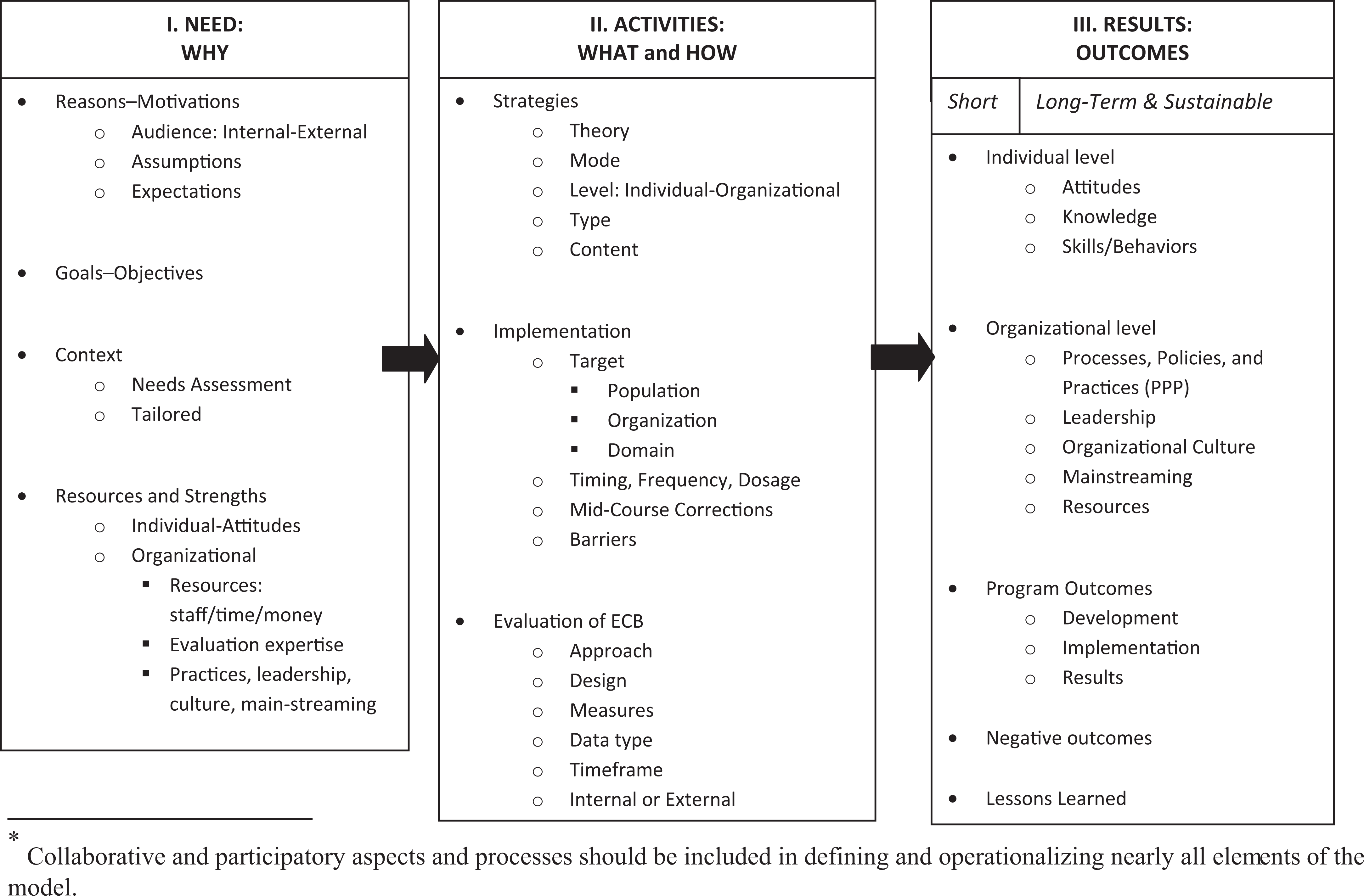
Integrative evaluation capacity-building model. *Collaborative and participatory aspects and processes should be included in defining and operationalizing nearly all elements of the model.

Using GTO to operationalize the Why, What, How, and Outcomes of evaluation capacity-building.
A strategy for building ECB
Since 1999, my colleagues and I have been developing and implementing strategies to build capacity to use GTO to achieve outcomes (Wandersman, Imm, Chinman, & Kaftarian, 2000). We have developed tools (GTO manuals) in several content areas including substance abuse prevention (Chinman, Imm, & Wandersman, 2004), positive youth development (Fisher, Imm, Chinman, & Wandersman, 2006), preventing underage drinking (Imm et al., 2007), teen pregnancy prevention (Lesesne et al., 2007, 2012), and homeless veteran programs (Hannah, McCarthy, & Chinman, 2011). We found that providing manuals is necessary but not sufficient. We have added key support components of training and technical assistance to our approach (e.g., Chinman et al., 2008; Lesesne et al., 2008). More recently, we proposed an evidence-based approach to innovation support that includes tools, training, technical assistance, and quality assurance/quality improvement (Wandersman, Chien, & Katz, 2012).
Measurement
Chinman et al. (2008) have used measurement approaches based on the work of Hall and Hord (2010) to assess gains from using tools, training, and TA to build capacity to implement GTO at the individual and program level. For example, innovation configuration (IC) maps are a framework that can be tailored to evaluate the quality of use of any innovation (Hall & Hord, 2010). The GTO-IC Map has 14 items (called components) tied to the 10 steps of the GTO model. Each component has seven possible response choices that include the ideal performance of prevention practices targeted by GTO and six other possible variations ranging from “highly faithful to” to “highly divergent from” what is specified in the GTO model. Each component’s seven response choices are also accompanied by descriptions of observable behaviors. The steps of the GTO model (e.g., conducting outcome evaluation) are good prevention practices in general; thus, it is possible that the comparison programs may demonstrate varying levels of performance, making the GTO-IC Map applicable for assessment of both intervention and comparison programs.
Empirical results
Several studies have empirically studied the effects of using GTO. For example, Chinman et al. (2008) tested the effectiveness of using GTO to improve prevention capacities and prevention programming outcomes of community coalitions in a 2-year longitudinal trial funded by the Centers for Disease Control and Prevention (CDC). Results indicated significant improvements in staff capacity and program performance among programs using GTO versus comparison programs. A dose–response relationship trend between GTO and improved capacity to engage in prevention activities was observed. In other words, greater exposure to GTO was associated with greater gains in prevention capacity, at the individual and program levels. In addition, programs that used GTO documented greater outcomes.
In a formative evaluation, Chinman, Tremain, Imm, and Wandersman (2009) found that programs using a web-based application of GTO (iGTO) demonstrated an increase in the quality of performance of key prevention practices over non-iGTO programs.
Chinman et al. (2013) presented interim findings from a randomized trial testing Assets-Getting To Outcomes (AGTO), a 2-year intervention to build prevention practitioners’ capacity to implement positive youth development-oriented prevention practices in 12 prevention coalitions in Maine. The results show that opportunity to learn AGTO was not enough. Those who used the opportunities offered improved their prevention capacity, for example, improvement was associated with the number of technical assistance hours received.
The GTO 10 Steps.
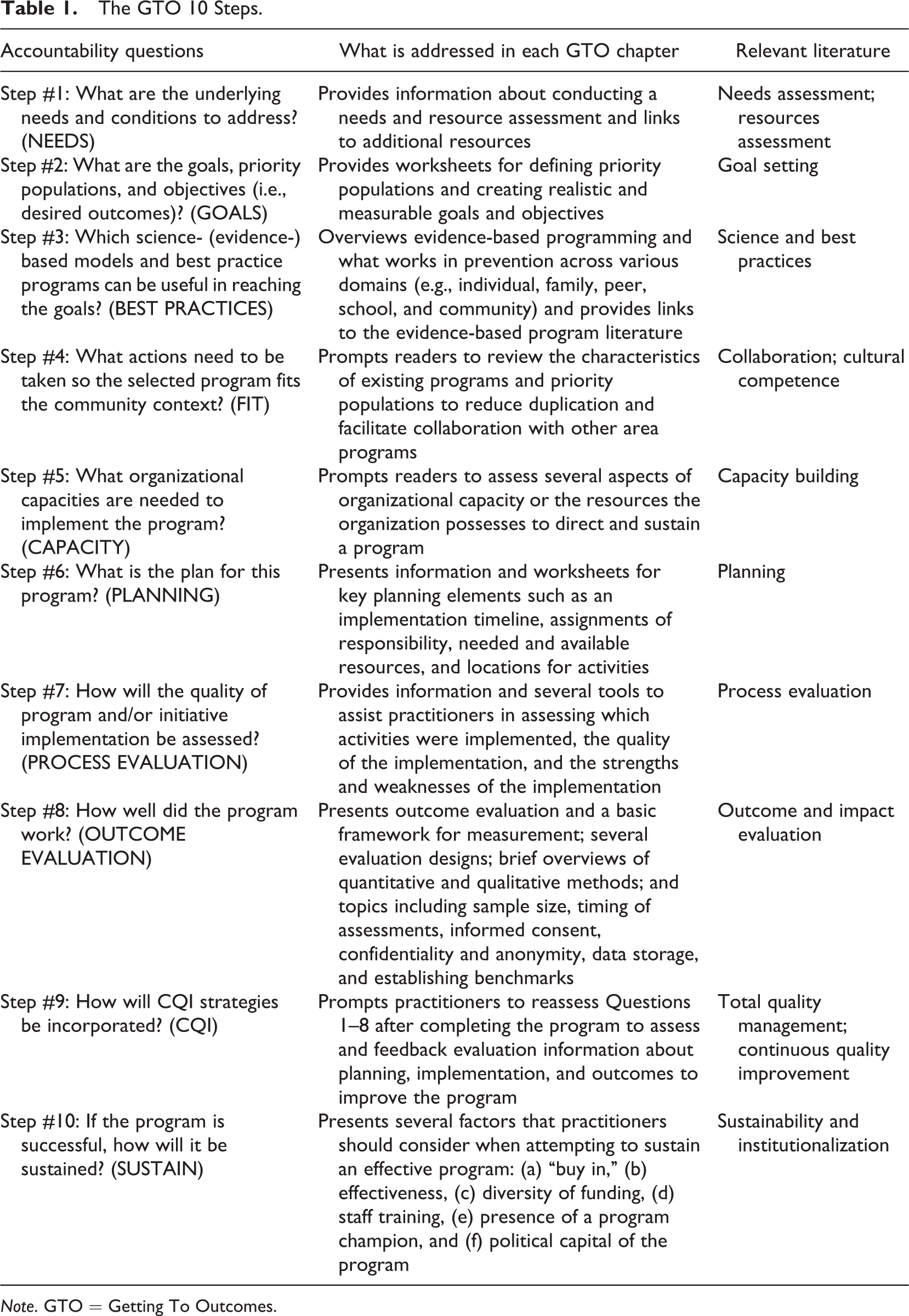
Note. GTO = Getting To Outcomes.
Practice
GTO is being widely used. Several of the manuals (Chinman, Imm, & Wandersman, 2004; Imm et al., 2007) are available for free downloading from the RAND website http://www.rand.org/health/projects/getting-to-outcomes.html, and there have been over 80,000 downloads of the manuals. An example of the use of GTO is in a CDC-funded initiative on teen pregnancy prevention http://www.cdc.gov/TeenPregnancy/PreventTeenPreg.htm. GTO is being used to help community-based organizations plan, implement, evaluate, use continuous quality improvement, and sustain evidence-based programs.
Concluding Comment
There are many articles written about ECB, but the bottom line appears to be that the research and practice of ECB is very limited (Labin, Duffy, Meyers, Wandersman, & Lesesne , 2012). GTO offers a frame for operationalizing the ECB logic model of Labin et al. (2012) and for deepening the science and practice of ECB.
Footnotes
Declaration of Conflicting Interests
The author(s) declared no potential conflicts of interest with respect to the research, authorship, and/or publication of this article.
Funding
The author(s) received no financial support for the research, authorship, and/or publication of this article.