



Abstract
Researcher–community partnerships are a necessary but not sufficient facet of effective research and evaluation with community-based projects and in clinical settings. This article describes two approaches that we have integrated into a multiyear, multiphase research and evaluation initiative supporting the health and well-being of vulnerable families. Specifically, we adopted a relational approach, intentionally and consistently focusing on building relationships, and a trauma-informed approach, highlighting safety across all levels. These innovative approaches have facilitated success in conducting safe, meaningful research and evaluation with community partners. Based on these approaches, we outline specific strategies and key considerations used in the context of the initiative, with the goal of encouraging others to adopt relational and trauma-informed methodological approaches and use these frameworks in research and evaluation efforts in applied settings.
Keywords
Research and evaluation in community or clinical settings and with community partners is both challenging and rewarding (Campano, Ghiso, & Welch, 2015; Kennedy, Vogel, Goldberg-Freeman, Kass, & Farfel, 2009; Kue, Thorburn, & Keon, 2015). Community-based research requires aligning the researchers’ needs and questions with the needs and questions of community members, service providers, or stakeholders; involving community voices in decision making; and ensuring that the results of research are useful to community members (Campano et al., 2015; Green, Daniel, & Novick, 2001; Janzen et al., 2017). Many have expressed the importance of such applied work (Green et al., 2001; Johnston & Woody, 2008; Kennedy et al., 2009), yet others note that there are significant challenges associated with conducting truly integrated community-based research that supports the needs of all those involved (Campano et al., 2015; Stoecker, 2008). For instance, researchers have cited inherent power inequities between researchers and community members or service providers, a devaluing of community perspectives and experiences, difficulty fostering trust and openness, and issues of confidentiality, ownership, and information use as significant challenges to community-based research (Campano et al., 2015; Kennedy et al., 2009; Stoecker, 2008). For psychologists, community-based settings can provide access to otherwise difficult-to-reach populations and avenues to applied psychological inquiry. Nevertheless, methodologies and techniques for conducting effective community-based research and evaluation are not well defined.
This article describes two innovative, integrated approaches—a relational approach and a trauma-informed approach—that we used to conduct research and evaluation with community-based projects and to mitigate the challenges described above. We have developed a model outlining key considerations for effective community-based research and evaluation, which include developing awareness through outreach, considering project readiness, engaging and building relationships, supporting the training of project staff in research and evaluation, embedding relational and trauma-informed approaches in research, providing ongoing mentoring for sustainability, and enhancing project capacity for trauma-informed work. Using concrete examples, we discuss our experiences using these innovative methodological approaches in a specific community-based research and evaluation initiative called Building Connections: Supporting Community-Based Programs to Address Interpersonal Violence and Child Maltreatment, and we address how we used these approaches to overcome some of the common challenges associated with community-based research (see Table 1).
Specific Strategies Used to Overcome Common Challenges of Community-Based Research and Evaluation Across Stages of the Building Connections Initiative.

The overarching aim of Building Connections is to enhance community capacity to identify and respond to women’s experiences of interpersonal violence (IPV). Building Connections is a multiphase, multiyear intervention dissemination. This initiative is supported by the Public Health Agency of Canada, which also provides support to over 800 community-based projects within Canada serving pregnant women and mothers of young children. The Building Connections initiative includes outreach and early engagement to these 800 community-based projects, a readiness assessment to select 30 of these projects from across Canada (including urban, rural, and remote communities), a 3½-day intensive training, delivery of an IPV intervention with women in each community, and evaluation of the intervention. Although the initiative is ongoing, we have had many successes thus far including forming relationships and engaging with diverse community projects (Zuberi, Motz, Leslie, & Pepler, 2018). In this article, we share the approaches, considerations, and concrete strategies that have facilitated our success and that will be useful to other researchers engaging in community-based research, prevention, and intervention work. Although not all strategies and considerations will be applicable, we contend that the methodological approaches and model we have developed can be applied broadly across a variety of research and evaluation designs. Below, we present the key approaches and considerations that have facilitated our success in building relationships, ensuring safety, and conducting meaningful research and evaluation in applied settings.
Approaches to Community-Based Research and Evaluation
For over 20 years, we have been conducting clinical, community-based research with a population of vulnerable women with substance use issues and their young children. Through this research, we have learned that it is necessary, but not sufficient, to develop strong research–practice partnerships and include community partners and service providers in the decision-making process. Our experiences have led to the development of foundational relational and trauma-informed approaches in the current research–practice project.
A Relational Approach to Developing Partnerships and Conducting Research
A relational approach suggests that people, institutions, and systems change through relationships with one another (Jordan, Walker, & Hartling, 2004; Walker & Rosen, 2004). We have recognized the importance of consciously and deliberately forming and supporting positive relationships with community partners. Such relationships are essential for deep collaboration and effective community research (Campano et al., 2015; Cousins, Whitmore, & Shulha, 2013; Crooks et al., 2018; Green et al., 2001; Shulha, Whitmore, Cousins, Gilbert, & al Hudib, 2016). In addition, we understand that a relational approach to research and evaluation with community partners requires a focus on relationships at all levels (Andrews, Motz, Pepler, Jeong, & Khoury, 2018; Motz, Leslie, Pepler, Moore, & Freeman, 2006; Thurman & Berry, 1992). This approach includes highlighting and supporting relationships at multiple levels: among researchers, between researchers and community partners, among community partners, between organizations and communities, and across systems (see Figure 1).
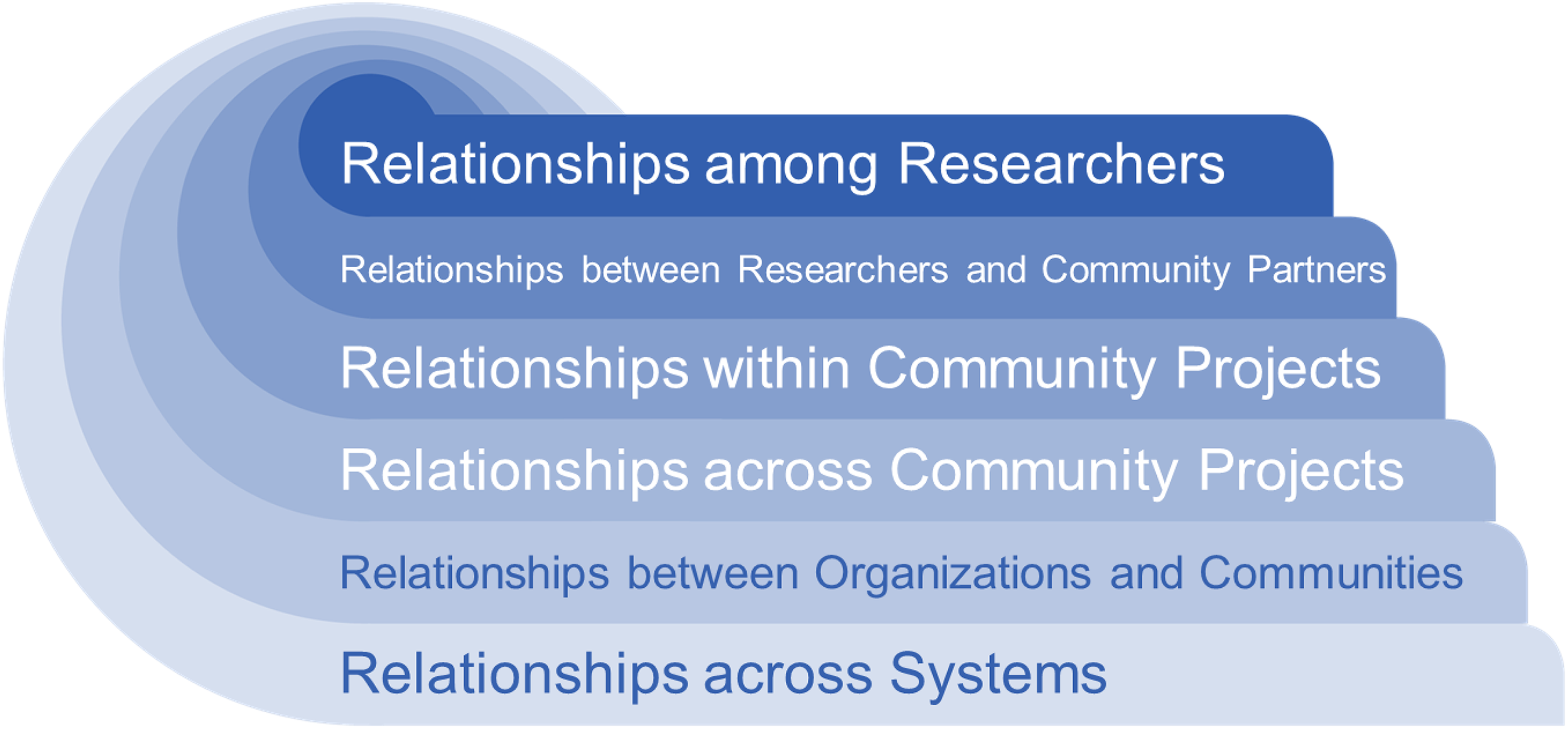
Conceptual framework for multilevel relational approach in the Building Connections initiative.
A Trauma-Informed Approach: Focusing on Safety
A trauma-informed approach involves understanding that individuals may have complex trauma histories that can impact their current behavior and functioning (Brave Heart & DeBruyn, 1998; Savage, Quiros, Dodd, & Bonavota, 2007). Being trauma-informed involves understanding the impact of trauma; being able to recognize signs of trauma; responding appropriately through the integration of trauma knowledge, policies, practices, and procedures; and actively resisting retraumatization (Leslie, Reynolds, Motz, & Pepler, 2016; Substance Abuse and Mental Health Services Adminitration, 2014). From a service provider perspective, community-based projects can provide trauma-informed support by (among other things) creating safe spaces and services, modeling safe and healthy relationships, and working collaboratively with other services to support families (Leslie et al., 2016). Trauma-informed approaches are often used in clinical settings (Emerson & Ramaswamy, 2015; Ko et al., 2008; Savage et al., 2007), yet a trauma-informed approach is also important and conducive to research methodologies. In a review, Emerson and Ramaswamy (2015) found that, although trauma-informed approaches were well integrated in terms of therapy and treatment, it was less clear whether or how trauma-informed theory and approaches played a role in research methodology and evaluation. Within the Building Connections initiative, we consider the potential trauma histories of all those involved in the initiative and the impact that the readiness assessment, training, and intervention, as well as the research and evaluation component of the initiative, might have on those involved. As such, we adopt a trauma-informed approach by highlighting safety at all levels of research and engagement with community partners. In the sections that follow, we highlight how an acknowledgment of trauma histories and safety plays a critical role in all stages of the community-based research and evaluation project.
Key Considerations and Strategies
Developing Awareness Through Outreach
As the first step in the Building Connections initiative, we developed and distributed a resource manual. The manual was mailed to over 800 community-based projects across Canada and is openly available online. We also invited over 800 community projects to participate in a training webinar. The resource manual and accompanying training webinar (both available online at http://mothercraft.ca/index.php?q=ei-connections) provided a context and knowledge base that was particularly important for those who might continue participating in Building Connections (see Table 1, developing awareness). Through this outreach process, we enhanced awareness of IPV and of our relational and trauma-informed approaches among community-based projects. We shared our knowledge and resources widely and openly to provide community projects with free and helpful resources and to garner interest in our initiative. We used participation in the national training webinar to solicit applications for further participation in Building Connections. As such, through outreach, we developed awareness of the initiative, started to align community needs and perspectives with our own, and began the process of engagement and relationship building with community-based projects.
Considering Readiness to Participate in a Research and Evaluation Project
For staff members from community projects, participation in Building Connections involved attending the intensive training, delivering the intervention focused on IPV to women in their community (called Connections: A Group Intervention for Mothers and Children Experiencing Violence in Relationships; Breaking the Cycle, 2014), and supporting the evaluation of the Connections intervention. Given the sensitive subject matter, the extended nature of this multipart initiative, and the requirement for involvement in both the delivery and evaluation of the intervention, we assessed community projects’ readiness to participate. Indeed, in any community-engaged research, having the right community partners is crucial (Drahota et al., 2016). Based on our relational and trauma-informed approaches, as well as our years of clinical and research integration experience and program evaluation in community settings, we developed a readiness tool called Your Starting Point Story (Andrews, Motz, & Pepler, 2019). Acknowledging the project staff as experts of their own work and experiences, this screening and assessment tool guided community project staff to reflect on their own awareness, competencies, collaborations, and safety, with respect to potential participation in the initiative (see Table 1, considering project readiness). Given the importance of having layers of safety in place, we considered and evaluated readiness across four levels: the community level (e.g., community need for an intervention focused on IPV; whether there were relevant social service sectors available in the community), agency level (e.g., policies around crisis management, staff safety), project level (e.g., relevant training, collaborative partnerships with other community agencies, capacity for research and evaluation), and at the individual level (e.g., individuals’ prior experiences with families who struggle with IPV, supports for staff who deliver the intervention; see Andrews, Motz, & Pepler, 2019 for more details about what was included in the Your Starting Point Story Readiness Assessment Tool). This tool was coded and scores were used to select community-based projects to participate in future phases of Building Connections. We also had a commitment to geographic representation across Canada, as well as diversity across urban, rural, and remote communities. Given the complexity of participation in this intervention and evaluation project, considering readiness across these four levels was essential to ensure that participating community projects had the capacity to deliver and evaluate the intervention in a way that was safe for project staff, intervention participants, and their families. This process also gave us a better understanding of community needs and priorities to ensure that their priorities and perspectives aligned with the Building Connections initiative (Drahota et al., 2016; Green et al., 2001; Kennedy et al., 2009).
Building Relationships: Engaging With Participating Projects
Once projects were selected (based on the safety and readiness considerations outlined above), we engaged in a process of relationship building prior to the training, intervention, and evaluation components of Building Connections. A barrier to research with community-based projects can arise when the research process is rushed before adequate trust is established (Campano et al., 2015; Drahota et al., 2016); therefore, we recognized this step as critical to our success in building relationships with project staff. As this initiative involved 30 community-based projects across Canada, we recognized the diversity across communities, projects, and individuals. Before asking participating project staff to attend training in Toronto, Canada, we engaged in in-person site visits with all selected projects (see Table 1, engaging and building relationships). Through early and intentional relationship building, we started to build trust with project staff who would become trained facilitators and later deliver the Connections intervention and support the research and evaluation. We used these visits to learn about the communities, about the projects, and about the individuals who were participating in Building Connections. We also used this time to explain the initiative more fully, including answering questions and increasing staff members’ confidence in their continued participation in the initiative. Meeting in the project’s own space and asking project staff to act as leaders and teachers in helping us understand their community and project also helped to decrease the sense of power imbalance between researchers and community partners (see Belone et al., 2016; Ragavan et al., 2018). We recognize that travel to facilitate face-to-face contact is a luxury; thus, we suggest a series of online “face-to-face” meetings as a substitute if travel is not a possibility. We found these visits essential to understand the diverse community-based projects and the families they serve and to begin to build trust with our community partners (Belone et al., 2016; Campano et al., 2015; Green et al., 2001). It also allowed facilitators to be more comfortable attending the upcoming intensive training, as they had already begun to build a relationship with at least one member of the Building Connections team. Through this early engagement, we began the process of long-term relationship building that would become essential as individuals continued their participation in Building Connections (Drahota et al., 2016; Ragavan et al., 2018).
Supporting Facilitators to Incorporate Research and Evaluation
Because facilitators would be delivering the intervention in their own communities, they had the added role of supporting the research and evaluation of the Connections intervention. We asked facilitators to discuss the research component with intervention participants, collect informed consent and administer surveys (completed electronically using tablet computers provided by the Building Connections initiative), and answer questions related to the research (with support, if needed). As such, an important goal of the intensive training was to enhance the capacity of facilitators to be community-based researchers themselves. As part of the 3½-day training, we took a half day to talk with facilitators about research; we discussed what research is, why we engage in research, and how activities they may have already taken part of in their projects were, indeed, research. We recognized this as an essential step in aligning perspectives, improving facilitators’ understanding of the importance of research methods and evaluation, and ensuring that research and evaluation priorities corresponded with community needs and priorities (Crooks et al., 2018; Green et al., 2001; Janzen et al., 2017; Swartz, 2010; see Table 1, supporting the training of facilitators in research and evaluation).
The remainder of the 3½-day training included one day to discuss trauma-informed approaches and how to practice trauma-informed work. Facilitators all came in with a base level of knowledge of trauma-informed practice by viewing the training webinar and reading the resource manual (discussed above), but professional backgrounds of the facilitators were nonprescribed and varied based on community needs, priorities, and resources. The training also comprised a half-day discussion of relationships and collaborations with service providers in the community, including partnerships that can sometimes be difficult to manage (e.g., child protective services). A full day was spent on training specifically related to the Connections intervention, talking week by week about Connections and specifics of facilitating the intervention. Finally, a half day involved inviting facilitators to join a clinical case formulation wherein clinical staff and representatives from partner agencies engaged in a discussion and service planning meeting about a particular client.
All activities during the training reflected our theoretical approaches. Particularly during the research component but also throughout all other components, we spent time discussing safety, including but not limited to ethics associated with research and evaluation, confidentiality, and informed consent. In order to support facilitators in the evaluation component, we provided a handbook that included everything facilitators might need related to the research and evaluation component of the initiative while delivering the intervention. This handbook included sample scripts that could be used to discuss research and evaluation with participants, schedules on when and how to administer surveys (use of tablets and evaluation time lines), information on how to explain identification codes (used to ensure anonymity), and questions that families may have about the evaluation and answers to these questions. Comprehensive training, along with documents to reinforce important topics, is an essential intervention dissemination strategy (Wolf, Bailey, & Keeley, 2014).
Finally, the training—in its entirety—was conducted in a relational manner. This includes running the training in small groups (approximately 10 people), allowing facilitators to begin forming relationships and a community of support with one another. These relationships continue to be supported by our community of practice (described below). Time was built into the training for facilitators to engage with one another and with research staff (both formally and informally) to promote relationship building. The training was held in situ at an early intervention program that operates using the same relational and trauma-informed theoretical approaches (Motz et al., 2006). Clinical staff in the center modeled the relational approach with each other and with clients in the center to facilitators. During the clinical case formulation, facilitators were able to see how relational and trauma-informed approaches are integrated into clinical discussions to support families. Having the training embedded in this clinical program allowed facilitators to experience a relational, trauma-informed clinical program in action.
Embedding Relational and Trauma-Informed Approaches in the Research and Evaluation
During delivery of the intervention itself, there were several key strategies we used to embed our relational, trauma-informed approach into the evaluation of the intervention. First, and most importantly, we considered the safety of the women participating in the intervention. We ensured that all women provided informed consent and knew they could refuse to participate in some or all aspects of the evaluation and still take part in the intervention. We gave community projects tablet computers to facilitate electronic data collection. This technology-facilitated data collection increases the validity of the data (particularly for sensitive topics) and eases measurement burden for participants (Bliven, Kaufman, & Spertus, 2001; Granello & Wheaton, 2004; Tourangeau & Smith, 1996; Wall, Jenney, & Walsh, 2018). We also considered the benefits of electronic data collection in terms of safety. That is, through this means of collecting data, we could ensure women’s anonymity. Women completed questionnaires electronically on the tablet. Once complete, questionnaires were automatically sent to the Building Connections team and unavailable to the local facilitators. As such, women were known to their facilitators, but facilitators could not see women’s responses, and women were anonymous to the researchers (women entered in an identification code so that we could link questionnaires across time, with no identifying information). With this method, we held the responsibility of keeping data safe, protected, and confidential rather than burdening the community facilitators with the responsibility (see Table 1, embedding relational and trauma-informed approaches in research).
The survey questions were carefully selected. The majority of measures were selected from those used for many years internally within the community-based project from which Building Connections was based (and for which clients had previously provided feedback). Additional measures were added in consultation with clinical staff. All measures were piloted with five community-based projects, and we requested feedback on both facilitators’ and participants’ comfort with these measures. Efforts were made to avoid retraumatization and to ensure a balance of problem-oriented and strength-focused measures. For example, knowing that the participants in the Connections intervention would likely have histories of violence and trauma, we made the decision not to include measures assessing experiences of IPV or symptoms of depression/anxiety. Instead, we included strengths-based measures such as self-esteem, self-efficacy, and relationship capacity. We also considered the cultural safety of women who might be participating. This article reports on strategies used for our general “English language” training and intervention delivery. However, in consultation with Indigenous advisors and partners, we are also engaging in an adapted training and intervention delivery (including an adapted intervention manual) for community-based projects serving Indigenous communities. Additional efforts to support women’s safety at this phase included ensuring that facilitators understood that trauma-informed practice and working with women to understand healthy and unhealthy relationships does not require a disclosure of IPV (Leslie et al., 2016). Further, as part of our assessment of readiness (discussed above), all community-based projects were required to have a relationship with a women’s shelter and women’s counseling services to ensure that participants would have access to these services if needed.
Based on a relational approach to the research, we recognize that community projects are eager to learn with us about the effectiveness of their own Connections delivery. Given that the Building Connections initiative extends over several years, it does not benefit community projects to wait several years for results from a 6- to 8-week intervention. Sharing research results with communities should be considered an integral part of the research process (Swartz, 2010). After each project finished delivering Connections, we shared a summary of results with facilitators and offered to have phone consultations to discuss and interpret the results and facilitate our mutual learning (Belone et al., 2016). To keep participants safe and ensure confidentiality, we only reported group-level results and only reported results when we had information from at least four participants. Giving a summary of results to the community is important to ensure that the research and evaluation processes are meaningful for those involved and serve as part of our long-term commitment to supporting the needs of the community (Swartz, 2010). When the initiative is complete, we will share the knowledge more broadly at conferences, in articles, books, or book chapters, reports, policy papers, exhibitions, educational tools, resources, and web-based materials.
Providing Ongoing Mentoring for Sustainability
From a relational approach, we strive to maintain deep, lasting partnerships with the community-based projects. Ongoing mentoring, along with frequent and effective communication, is critical not only to maintaining strong partnerships but also to the success of an intervention and the associated research (Drahota et al., 2016; Harkavy & Hartley, 2012). As part of the Building Connections initiative, we offered a weekly online community of practice consultation meeting, during which members of the Building Connections team met virtually with trained facilitators (see Table 1, providing ongoing mentoring for sustainability). Facilitators could ask questions, share successes and challenges, and receive support and mentorship from the Building Connections team. Having online meetings facilitated communication and allowed remote participation (Jessell, Smith, Jemal, & Windsor, 2016). By providing the essential processes of lasting support, reinforcement, and feedback to communities (Noell, Witt, Gilbertson, Ranier, & Freeland, 1997; Wolf et al., 2014), we were able to mentor facilitators to increase in their confidence and capacity to deliver the Connections intervention and evaluation. Further, these online meetings encouraged ongoing relationship building between the community projects and the Building Connections team as well as long-term supportive relationships among community projects (Drahota et al., 2016; Janzen et al., 2017). We also had instances when we asked for specific advice and feedback from facilitators in planning and modifying future phases of the initiative (e.g., in one of many steps toward planning training and intervention delivery for Indigenous communities, we asked facilitators to share their experiences delivering Connections to Indigenous members of their own communities). Sharing their experiences and expertise allowed facilitators to cocreate with us learnings from this initiative.
Enhancing the Capacity of Projects for Trauma-Informed Work
Based on a trauma-informed approach within Building Connections, we recognized that facilitators needed access to support from within their own agency and community. In the readiness assessment, the training, and online community of practice meetings, we discussed the importance of reflective supervision. Reflective supervision or reflective consultation is an approach that provides facilitators the opportunity to receive support from a more experienced colleague and to reflect on the work being done and potential challenges in the work (Tomlin, Hines, & Sturn, 2016; Tomlin, Weatherston, & Pavkov, 2014). Having regular supervision with someone who understands the complex work being done by facilitators and using that supervision time to improve relationships and collaboration can be critical to ensure a successful intervention but also to support staff in all aspects of their work. Further, we emphasized the need for partnerships within community. To participate in Building Connections, we required that projects have working relationships with a women’s shelter, counseling services, and child protective services. When supporting vulnerable families who are often involved with multiple service sectors, the more that services can be integrated at the agency or organizational level, the better supports can be offered to families. Integration not only improves services for families but also supports staff within these projects. Therefore, we encouraged projects to grow and leverage their existing partnerships and build new connections with community agencies (see Table 1, enhancing project capacity for trauma-informed work).
Challenges and Lessons Learned
There are significant challenges associated with conducting community-based research and evaluation. One challenge we encountered in this initiative was how to select community projects with whom to partner. Depending on the intervention or initiative, this may be prescribed, or researchers/evaluators may have some choice in forming these partnerships. Regardless, it is important to consider readiness of potential partners in terms of not only their ability and capacity to facilitate and lead an intervention but also capacity in terms of the research and evaluation (see Andrews, Motz, & Pepler, 2019 for more information regarding assessment of readiness). We carefully considered that community-based projects may have limitations in terms of research familiarity and capacity. To overcome this challenge, we used the readiness assessment tool to understand projects’ research capacity and used this as one consideration when selecting sites with whom to partner. In addition, we used our phased approach to enhance capacity for both research and implementation of the intervention. We offered resources, training, and mentoring support to improve understanding of research approaches, ethical considerations, and practical activities related to research.
Particularly when conducting research with vulnerable populations and in communities, considering the clinical implications of research methods and design is critical. For instance, it may be seen as a limitation that we selected community-based projects to participate based on several readiness considerations rather than employing any type of randomized design or including a control group. We deliberately made the decision not to include a control group and carefully select sites based on the ethical and clinical issues associated with (1) introducing a sensitive intervention in a community-based project that may not have the capacity or resources to support women attending the intervention or (2) denying women who have experiences of violence in relationships the chance to receive support from trained service providers and get connected with other community supports. We also had to consider clinical implications when deciding what measures to use to evaluate the intervention and the methodology with which to gather the information. Although we might have liked to get information about changes in women’s experiences of violence or child maltreatment, for instance, this would not be clinically sensitive and would not have aligned with our trauma-informed approach. Working from a trauma-informed foundation not only in the implementation of the intervention but also in the research and evaluation component is essential to working with and supporting the safety of vulnerable populations.
A significant challenge in community-based research and evaluation is in building strong, positive, and trusting relationships. Through our experiences in this initiative building relationships with service providers from 30 community-based projects, we learned the importance of extending time lines to allow for deliberate trust and relationship building. Our experiences helped us appreciate the importance of face-to-face contact. Meeting face-to-face (both in site visits and during training) facilitated trust and relationship building in a significant way. We also had to allow for adequate time to get in contact and communicate with projects. We recognize that project staff are fully employed in delivering programming within their communities, and the Building Connections initiative demanded additional time and resources. Flexibility in time lines, being understanding of scheduling challenges, and reaching out many times were necessary to grow these partnerships.
Finally, we acknowledge that an evaluation of this magnitude requires significant financial resources. For others wishing to engage in this type of research, we recommend approaching a university-based researcher with whom to partner, who is willing to engage in this type of embedded scholarship. We also recommend offsetting costs by leveraging partners (e.g., office space and information technology support may be available through a community-based project or university partnership). Finally, we recommend seeking funding opportunities through government or private foundations to support hiring at least one project coordinator or research assistant, as well as having funds for travel (if applicable), community-based project honoraria (if applicable), and supplies (e.g., computers, statistical software, tablet computers, or paper copies of surveys).
Implications and Conclusion
Integrating a relational approach that highlights relationship building at all levels and a trauma-informed approach that considers safety across multiple levels is essential for psychological research in community or clinical settings. By reviewing key considerations and strategies across seven stages of our initiative (see Table 1), we have outlined how these innovative approaches can be integrated into research and evaluation in the context of a multiphase intervention dissemination with community-based projects across Canada. Importantly, this article describes a process wherein we have used clinical and theoretical approaches to inform our research and evaluation methodology. Several evaluation theories (e.g., utilization-focused evaluation theory, theory-driven evaluation theory, and empowerment evaluation theory; Chen, 1990; Fetterman & Wandersman, 2007; Patton, 1984) argue for the use of theory as a guide to methodology rather than designing evaluation around methodology itself (see also Sabarre, n.d.). In this article, we have described how we used tenets of our clinical and theoretical approaches—and combined these approaches—to address challenges associated with community-based research and guide all aspects of the process of evaluation. This has important implications for the field of evaluation, in that others can see the process through which theoretical approaches are translated into specific evaluation activities. We hope that others can use these recommendations through the lens of relational theory, trauma-informed theory, or theories relevant to their own research to conduct effective, safe, and collaborative work with community-based partners.
Our initial successes (Zuberi et al., 2018) helped to validate the integration of relational and trauma-informed approaches—approaches that have been adopted by clinicians and service providers but are less well integrated into research and evaluation (Emerson & Ramaswamy, 2015; Savage et al., 2007; Walker & Rosen, 2004). We have incorporated these approaches at each phase of the Building Connections initiative, and in doing so, have identified key considerations and strategies that have facilitated our success. By sharing these strategies, we guide others to apply relational and trauma-informed approaches to psychological inquiry, research, and evaluation activities both intentionally and consistently. Although applied research can be challenging (Campano et al., 2015; Kennedy et al., 2009; Kue et al., 2015), these innovative approaches and strategies may contribute to overcoming some of the challenges and conducting meaningful, mutually beneficial research and evaluation with community-based projects. Research with vulnerable populations is of the utmost importance and can only be done through a deeply collaborative, sensitive, and relevant scientist–practitioner partnership pathway.
Footnotes
Acknowledgment
The authors would like to express their gratitude to the entire Building Connections research team which also includes Samar Zuberi, Camilla Singh, and Lisa Howarth for their support throughout the initiative, as well as a special acknowledgment to Margaret Leslie for her invaluable guidance and leadership.
Declaration of Conflicting Interests
The author(s) declared no potential conflicts of interest with respect to the research, authorship, and/or publication of this article.
Funding
The author(s) disclosed receipt of the following financial support for the research, authorship, and/or publication of this article: Funding for this research was provided by the Public Health Agency of Canada as part of an initiative called “Supporting the Health of Victims of Domestic Violence and Child Abuse Through Community Programs.”
