




Abstract
In this study, we examined the contribution of the extinction procedure in function-based interventions implemented in the general education classrooms of three at-risk elementary-aged students. Function-based interventions included antecedent adjustments, reinforcement procedures, and function-matched extinction procedures. Using a combined ABC and reversal phase design (A-B-A-B-C-B), a functional relation between the full intervention and dramatically improved levels of on-task behavior were clearly established. On removal of the extinction procedure, on-task behavior rapidly dropped to lower levels. Reinstatement of the full intervention occurred following the partial intervention condition. In every case, on-task levels rapidly improved. Using the Intervention Rating Profile–15 and Children’s Intervention Rating Profile, acceptability ratings were highest for full intervention. Limitations and implications for further research are presented.
Keywords
Function-based intervention is a strategy used to improve behavior by developing intervention components based on prior assessment of the function of a challenging, or target, behavior (Sugai et al., 2000). Typically, the intervention includes at least three components (Dunlap et al., 2006; Iwata & Wordsell, 2005; Umbreit, Ferro, Liaupsin, & Lane, 2007; Wood, Blair, & Ferro, 2009). First, antecedent adjustments take place so the target behavior is less likely to occur and an appropriate replacement behavior is more likely to occur. Second, reinforcement procedures are provided for occurrences of the replacement behavior. The reinforcement is usually the same consequence that had previously reinforced the target behavior. Finally, function- matched extinction procedures occur so that the target behavior no longer receives reinforcement.
In the past decade or so, several reviewers have analyzed the outcomes of this research. These reviews were often population specific, focusing on young children (Wood et al., 2009), students with or at risk for emotional or behavioral disorders (Heckaman, Conroy, Fox, & Chait, 2000; Kern, Hilt, & Gresham, 2004; Lane, Umbreit, & Beebe-Frankenberger, 1999), middle or high school students (Lane, Kalberg, & Shepcaro, 2009), and individuals with severe developmental disabilities (Carr et al., 1999). Reviewers have consistently concluded that function-based interventions effectively reduce target behaviors and increase replacement behaviors. However, these interventions include multiple components applied concurrently within a function-based intervention package.
Some reviewers (e.g., Fox & Gable, 2004; Sasso, Conroy, Stichter, & Fox, 2001) have suggested that the three components that typically comprise a function-based intervention package be examined to determine the contribution of each component on behavioral change. To date, researchers have devoted limited attention to the individual contribution of any particular intervention component. Lerman, Iwata, and Wallace (1999) suggested that extinction procedures within function-based intervention packages enhance positive behavioral change and increase the likelihood of successful outcomes. If this is indeed the case, then removing the extinction procedure should reduce the effectiveness of an intervention. Therefore, the extinction procedure provides a logical starting point for component analysis of function-based intervention packages.
In this study, we examined the contribution of extinction procedures within a function-based intervention package. Participants were three elementary school–aged students who often engaged in off-task behaviors and were at risk for emotional and/or behavioral disorders (EBD). The study consisted of two phases. During Phase 1, a descriptive functional behavioral assessment (FBA) was completed for each student. During Phase 2, a function-based intervention was systematically designed and implemented for each student. In the Method section, we describe the FBA procedures, outcomes of the FBA yielding the hypothesized function of the target behavior, and intervention design. In the Results section, we report student outcomes, treatment integrity data, and perceptions of social validity.
Method
Participants and Setting
Ullapool Elementary was located in a midsized city in the southwestern United States. The school served approximately 250 students in grades pre-K–5, met adequate yearly progress, and was in the third year of providing the primary level of Positive Behavioral Interventions and Supports. Ninety-six percent of students were eligible for free or reduced-price meals. The school received schoolwide Title I services, and was a Reading First school.
On approval by the school district to conduct the study, the first author contacted the administrator at Ullapool and obtained site authorization. Participants were student–teacher dyads identified by the principal and school psychologist. Student–teacher dyads had to meet the following criteria: (a) the student displayed behavioral and academic challenges during the previous and current academic year, as operationally defined by having earned more than three office discipline referrals (ODRs) and/or earned grades reflecting that the student was falling far below academic standards in at least one content area (i.e., language, mathematics, or writing) on a quarterly progress report, (b) the current teacher requested assistance from the Student Behavior Intervention Team (SBIT) in developing interventions to improve student behavior and academic performance, and (c) there was an absence of sustained behavioral and academic improvement after implementation of SBIT-developed interventions.
Before providing identifying information for potential teacher–student dyads, the administrator invited classroom teachers who had at least one student who met the inclusion criteria and provided each with a letter from the first author inviting teacher participation in the study. The letter included information about the purpose of the study, participant rights, and participant roles. If a teacher was interested in participating in the study, she or he would send a similar letter home to the parent of potential student-participants, along with a parent permission form. On teacher receipt of the parent permission form, the teacher would contact the parent via telephone to schedule a meeting between the arent, teacher, and first author to discuss the study and obtain informed written consent from the classroom teacher and parent. Three teacher–student dyads were eligible and agreed to participate in the study.
After obtaining informed written consent from each classroom teacher and parent and informed assent from each student, each teacher received a copy of the Social Skills Rating System (SSRS; Gresham & Elliott, 1990) Teacher Form. Completion of this tool confirmed the presence of behavior and social skill problems associated with EBD. The Teacher Form of the SSRS consists of statements related to three domains: Social Skills (i.e., cooperation, assertion, and self-control), Problem Behaviors (i.e., externalizing, internalizing, and hyperactivity), and Academic Competence.
Hugo, age 6, was a boy in Miss Campana’s first-grade class of 14 students. Miss Campana had 5 years of teaching experience. Within the Social Skills and Problem Behaviors domains of the SSRS, Hugo’s teacher rated him as having fewer social skills, more problem behaviors, and below average on the Academic Competence scale. Tomas was a 7-year-old boy in Mrs. Laguna’s second- grade class of 14 students. Mrs. Laguna had 10 years of teaching experience. Based on the SSRS, Tomas had fewer social skills, more problem behaviors, and below average on the Academic Competence scale. Eric, age 8, was a boy in Miss Barrajas’s third-grade class of 21 students. Miss Barrajas had 2 years of teaching experience. Eric received a teacher rating of average for Social Skills; however, Miss Barrajas rated him as having more problem behaviors and below average on the Academic Competence scale. All three boys met inclusion criteria and were at risk for EBD (see Table 1).
SSRS Standard Scores and Percentile Ranks.
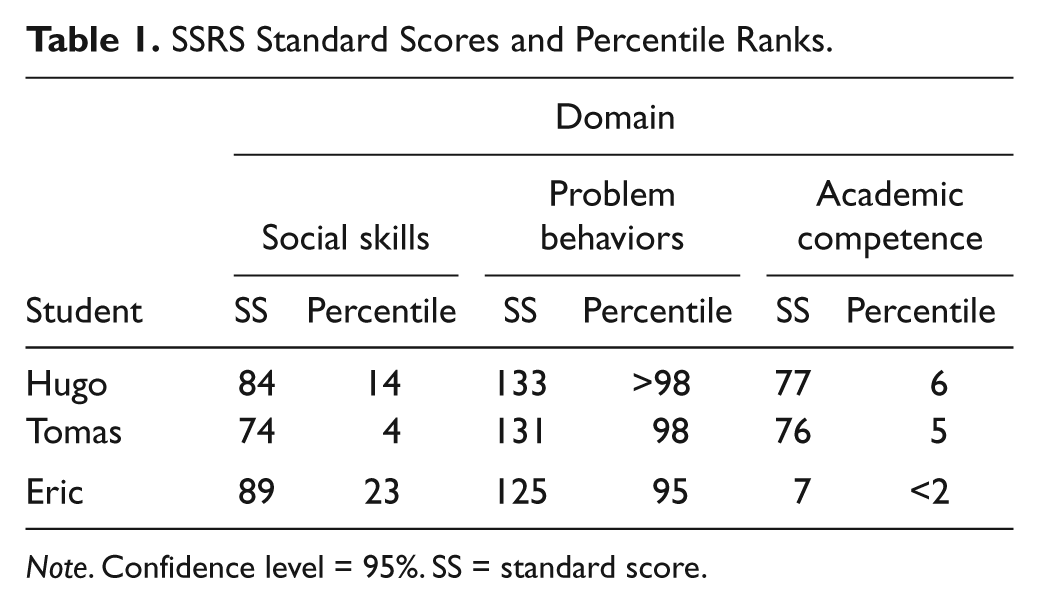
Note. Confidence level = 95%. SS = standard score.
The study occurred in the primary classroom of each student–teacher dyad. A primary classroom was the general education setting where each student received the majority of instruction.
Behavioral Definitions
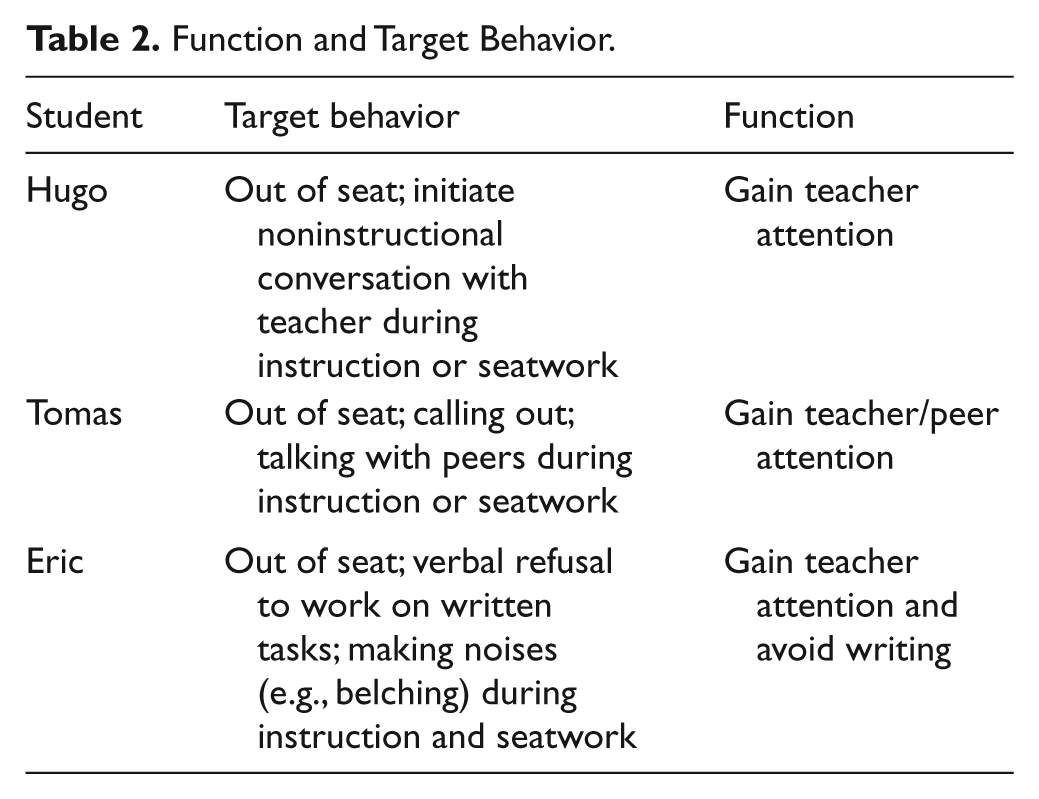
All three students displayed off-task behaviors disruptive to learning and classroom instruction (see Table 2). Although the topography of each student’s off-task behavior varied, all off-task behaviors were incompatible with participation and task completion. Hugo’s off-task behaviors included leaving his seat during large group instruction or independent seatwork, and initiating nonacademic-related conversations with his teacher. For Tomas, off-task behaviors occurred during large group instruction or independent seatwork and included calling out comments or initiating conversations with peers unrelated to instruction, walking around the classroom, and placing supplies needed for task completion in his desk or backpack. Eric’s off-task behaviors varied and became progressively disruptive. The behaviors ranged from slumping down in his chair, tapping objects on the table, walking around the classroom during instruction or independent seatwork related to writing, to verbally refusing to work on an assignment. The replacement behavior for all three students was on-task behavior and required each of the three boys to remain in an assigned seat, look at the teacher or materials during instruction, and comply with task-related teacher requests (e.g., engaging in the assigned task).
Function and Target Behavior.
Functional Behavioral Assessment Procedures
Data obtained via a descriptive FBA identified antecedent conditions that occasioned and consequences that maintained each student’s off-task behaviors. Each assessment included record reviews, individual interviews with teacher and student participants, and the collection of A-B-C data (Bijou, Peterson, & Ault, 1968). Direct observations occurred in the primary classroom during instructional periods the teachers identified as the time when the off-task behaviors occurred most frequently.
Record review
A comprehensive record review of each student’s cumulative folder was attempted using the School Archival Records Search (SARS). Given the age of the students and limited content in the cumulative folders, it was not possible to complete the majority of the SARS Student Profile Form, which prevented use of the SARS to code information contained in the cumulative folder. Information located in the cumulative folder of each student-participant consisted of frequency of and reason for ODRs, anecdotal comments, attendance history, and academic assessment results.
Teacher interview
The first author conducted interviews using the first section of the Functional Assessment and Motivation Interview/Questionnaire (FAMIQ; Janney, 2008). The first section of the FAMIQ is a structured interview consisting of 34 items intended to define behaviors of concern, determine past interventions, the effects of those interventions, and identify causal factors related to the teacher-identified behaviors of concern. The FAMIQ was developed for the purpose of this study and was based on questions typically asked in two types of protocols: those normally used as a preliminary functional assessment interview (e.g., Preliminary Functional Assessment Interview; Dunlap et al., 1993), and those used to determine teacher perception of the causes of problem behaviors (e.g., Irby, 1982; Smith, 2003). Each interview took between 45 and 60 min to complete. (For a copy of the FAMIQ, contact the first author.)
Student interview
Each student participated in an interview using the Student Assisted Functional Assessment Interview (SAFAI; Kern, Dunlap, Clarke, & Childs, 1994). The SAFAI is a structured interview consisting of questions intended to elicit student responses related to preferred activities, opinions about specific content areas and school tasks, areas in which the student believes he performs successfully or unsuccessfully, and the antecedents and consequences related to the student’s behavior.
Direct observations
An observer took notes related to specific antecedent (A) and consequent (C) conditions that preceded and followed occurrences of the target behavior (B) while sitting in a part of the room that did not interfere with normal classroom practices. Data were collected until a clear pattern of antecedents and consequences related to the off-task behaviors was evident. A-B-C data collection occurred during four or five observations of each student. Each observation occurred on a different day, in each student’s primary classroom, and lasted 8 to 10 min. During observations, nothing within the primary classroom was changed.
Identification of function
Descriptive data were compiled and analyzed using the Function Matrix (Umbreit et al., 2007). The Function Matrix is a six-celled table in which information is organized into two columns allowing one to determine whether a behavior is positively or negatively reinforced, and three rows, to identify specific types and frequency of reinforcement provided (i.e., attention, tasks/tangibles, and sensory). The identification of multiple functions is possible.
Experimental Design
Intervention phases were introduced systematically to each student using a combined ABC and reversal design (A-B-A-B-C-B). This design permitted evaluation of the effectiveness of the interventions across conditions and identified the contribution of the extinction procedures within the full intervention package. Baseline consisted of regular classroom practices. Full intervention (B) included antecedent adjustments, reinforcement, and extinction. Partial intervention (C) consisted of only antecedent adjustments and reinforcement. Following the final full intervention phase, a follow-up phase was conducted that consisted of continued use of the full intervention. Observers collected data within the follow-up phase on a weekly basis during the last full month of the academic year. The A-B-A-B phases allowed for replication of intervention effects, thereby demonstrating a stronger degree of experimental control (Cooper, Heron, & Heward, 2007). The B-C-B phases allowed for analyses of data collected in the different intervention phases to determine whether behavioral change occurred because of the different interventions (i.e., the contribution of extinction procedures to behavioral change).
Functional Behavioral Assessment Outcomes
Descriptive data obtained during record review, teacher and student interviews, and direct observations are presented for each student, along with analyses of these data. Table 2 summarizes the function of each student’s target behavior.
Hugo
A review of Hugo’s cumulative records revealed that, in kindergarten, he had six office discipline referrals (ODRs). During the first semester in first grade, Hugo had no ODRs, nine absences, and nine tardies. According to anecdotal records, he had a history of eloping, physical aggression against peers, and self-abusive behavior (e.g., banging head against desk, choking self, and stating he wanted to kill himself). A school entrance screening identified Hugo’s areas of need as social-behavioral (i.e., problems in unstructured environments and transition), psychomotor (i.e., short attention span), and academic/cognitive (i.e., attention problems and below grade-level abilities in reading, mathematics, and writing). Informal academic assessment results one year later corroborated the findings from the screening report. Hugo’s progress report reflected that he was falling far below grade-level expectations in language arts and writing, and approaching expectations in mathematics, science, social and emotional growth, and learner qualities.
Miss Campana believed Hugo’s off-task behaviors occurred to obtain one-on-one attention from her, especially during reading. Hugo believed he had the most problems in school during spelling, when peers yelled at him. He identified teacher praise as his preferred reinforcer. During the A-B-C observations, all 45 instances of off-task behavior occurred during reading, with teacher attention as the identified consequence. Using the Function Matrix, interview results and A-B-C data confirmed Miss Campana’s identification of antecedent conditions and consequences for target behaviors.
Tomas
Record review revealed that Tomas had no ODRs, one absence, and two tardies during the first semester of second grade. Anecdotal records and progress reports reflected that Tomas was falling far below grade-level expectations in reading, writing, social and emotional growth, and learner qualities, and was approaching expectations in mathematics and science.
Interventions Mrs. Laguna had previously used included a group contingency plan, stickers, and verbal prompts. She experienced inconsistent results with all interventions attempted. Mrs. Laguna believed Tomas displayed off-task behaviors when he had difficulty with academic tasks and preferred one-on-one teacher attention, especially during reading. Tomas reported he had the most problems in school during math because the work was too hard. His preferred reinforcer was a note or telephone call from Mrs. Laguna to his father.
A-B-C observation data confirmed Mrs. Laguna’s identification of antecedent conditions and consequences for target behaviors. Twenty-three of 29 instances of off-task behavior occurred during reading and received teacher attention. Peer attention accounted for the remaining six instances. Using the Function Matrix, interview results and A-B-C data indicated teacher or peer attention reinforced Tomas’s off-task behavior.
Eric
File review revealed Eric had six ODRs, nine absences, and four tardies during the first semester of third grade. Woodcock–Johnsons® III Tests of Achievement (WJ-III ACH; Woodcock, McGrew, & Mather, 2001) results indicated that Eric’s grade-level scores were 1.4 in Brief Achievement, 1.1 in Brief Reading, 2.0 in Brief Math, and 1.4 in Brief Writing. Progress reports indicated Eric was falling far below grade-level expectations in reading, and approaching expectations in writing, social and emotional growth, and learner qualities. Anecdotal records suggested Eric displayed the most disruptive behaviors when requested to read or write.
To manage Eric’s off-task behaviors, Miss Barrajas had used behavioral contracts, phone calls home, and talked with the counselor, but Eric’s behaviors did not improve. She believed Eric displayed off-task behavior when he had difficulty with or believed he was unable to complete academic tasks. The behaviors occurred most frequently during writing activities, especially in the morning. Eric believed he had the most problems in school after lunch, when he was tired and had “had enough.” His preferred reinforcer was a note or telephone call from his teacher to his grandparents.
During A-B-C observations, teacher attention was the function of 29 of 75 instances of off-task behaviors occurring during writing activities. During 45 of 75 instances of off-task behavior, Eric avoided writing activities. Escape from teacher attention was the function of the remaining one instance. Using the Function Matrix, interview and A-B-C data indicated that Eric engaged in off-task behavior during writing activities to avoid written tasks and to gain teacher attention.
Intervention Development and Implementation
Using the Function-Based Intervention Decision Model (Decision Model; Umbreit et al., 2007), a systematic approach for developing function-based interventions, each teacher and the first author collaboratively developed a function-based intervention for each student. Teachers implemented the interventions. Each intervention was tested experimentally using brief reversal conditions. During phases in which interventions were implemented, teachers were provided with daily feedback on their implementation of the components within each intervention. In addition, the primary observer provided signals (e.g., reaching both arms above head to stretch) to the teachers when it was time to provide reinforcement for on-task behavior. During implementation, observers collected data on student behavior, treatment integrity, and social validity.
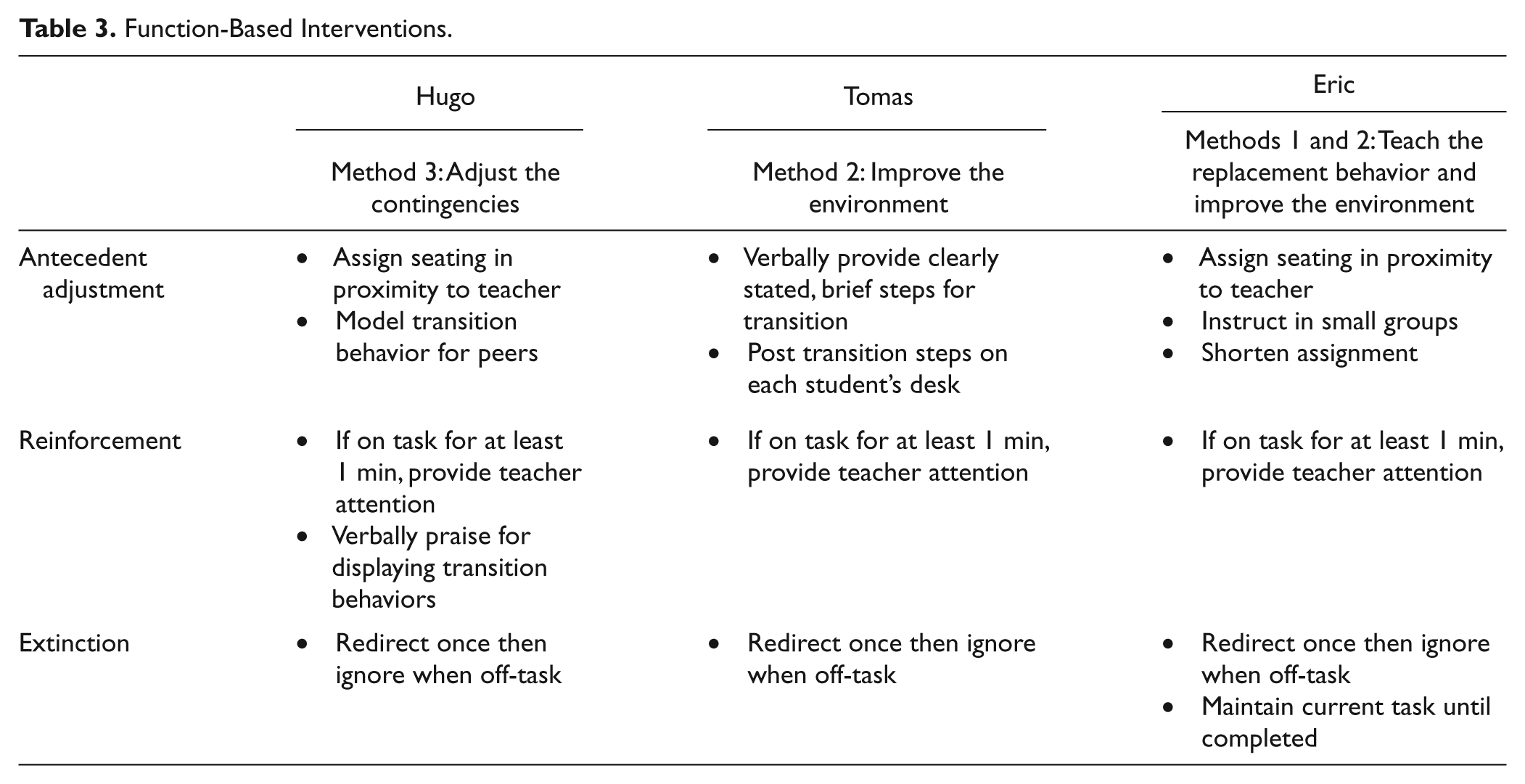
Using the Decision Model, two questions were answered: (a) Can the student perform the replacement behavior? and (b) Do antecedent conditions represent effective practice? Based on responses to those two questions, an intervention development method is selected. The three possible methods consist of three common components: (a) adjustment of antecedent conditions, (b) appropriate reinforcement for replacement behavior, and (c) extinction procedures. The difference between the methods is the manner in which the antecedent and consequence intervention elements address the target behavior. Method 1 (Teach the Replacement Behavior) is used when antecedent conditions represent effective practice, but the student needs to be taught the replacement behavior. When antecedent conditions do not reflect effective practice, but the student can perform the replacement behavior, Method 2 (Improve the Environment) is used. When antecedent conditions represent effective practice and the student can perform the replacement behavior, Method 3 (Adjust the Contingencies) is used.
Hugo
Hugo could remain in his assigned seat on the large group instructional area of the carpet or at his desk during independent seatwork, look at the teacher during instructional activities, and keep conversations with the teacher during instructional activities focused on the topic of instruction or an assignment. Miss Campana had created a classroom in which antecedent conditions represented effective practice across all content areas. Classrooms routines during instruction were well established, appropriate reinforcement was provided for expected behaviors, and academic content was grade appropriate. Method 3 (Adjust the Contingencies) was the intervention method used to guide development of Hugo’s function-based intervention.
Tomas
Tomas occasionally followed teacher-stated directions and remained on-task during large group instruction and independent seatwork. However, antecedent conditions required adjustment to eliminate opportunities for the target behavior to occur and to increase the likelihood Tomas would display the replacement behavior more frequently. Method 2 (Improve the Environment) was the intervention method used to guide development of Tomas’s function-based intervention.
Eric
Eric was not observed displaying the replacement behavior (i.e., in assigned seat, looking at the teacher during directions/instruction or paper/whiteboard when writing), and antecedent conditions required adjustment. Therefore, both Method 1 (Teach the Replacement Behavior) and Method 2 (Improve the Environment) were used to develop Eric’s intervention. Miss Barrajas was in her second year of teaching and had specifically requested assistance in developing a classroom environment that would benefit all students, especially Eric. Table 3 briefly describes the intervention developed for each student.
Function-Based Interventions.
Measures
Behavior and treatment integrity
Observers collected direct observation data for the replacement behaviors (i.e., on-task behaviors) using 15 s whole-interval recording during sessions lasting 10 min for Hugo and Tomas, and 15 min for Eric. Intervals scored with a “+” reflected intervals during which replacement behavior was observed throughout the entire 15 s interval. Treatment integrity data were collected simultaneously during all observation sessions, using the same measurement system. Treatment integrity data were collected during baseline to determine whether intervention components were being used. This was necessary as the teachers each assisted in development of the intervention and all taught at the same school. Intervals scored with a “+” indicated that all intervention components required during the interval were correctly implemented throughout the 15-s interval. If any required intervention component was missing or was implemented incorrectly, a “–” was scored for the interval.
Interobserver agreement
Two observers, the first author and a research assistant, collected data concurrently and independently. Before commencing baseline data collection, the two observers trained by simultaneously collecting data until a minimum of 90% accuracy over three consecutive observation sessions was obtained in each of the three classroom settings. Observers collected and calculated interobserver agreement (IOA) data for behavior and treatment integrity during 20% to 75% of observation sessions. Interobserver agreement was computed using the interval-by-interval method (Kazdin, 1982). Percentage of agreements were calculated by dividing the number of agreements by total number of agreements and disagreements and multiplied by 100. Mean reliability across all phases for all participants was 87.27% (range = 65%–100%) for behavior and 95.27% (range = 85%–100%) for treatment integrity.
Social validity
To assess teacher perceptions of the efficiency and effectiveness of an intervention, each teacher completed the Intervention Rating Profile–15 (IRP-15; Martens, Witt, Elliott, & Darveaux, 1985). The IRP-15 is a survey consisting of 15 items. Responses are indicated on a 6-point Likert-type scale (1 = strongly disagree, 6 = strongly agree), with possible scores ranging from 15 to 90. Higher scores indicate higher social validity. Each teacher completed the IRP-15 during baseline, following implementation of the second full intervention phase, and after completion of the partial intervention phase.
The Children’s Intervention Rating Profile (CIRP; Witt & Elliott, 1985) was used in a discussion between each student-participant and the first author during the follow-up phase. The CIRP, a parallel survey to the IRP-15, is intended to obtain student opinion of an intervention. Responses are indicated on a 6-point Likert-type scale (1 = strongly disagree, 6 = strongly agree), with possible scores ranging from 7 to 42. Higher scores indicate higher social validity. Wording of the seven items on the CIRP were modified to meet the developmental age and/or English fluency level of each student participant.
The first author met with each student during a time identified by each teacher as the least disruptive for student learning (e.g., during independent practice related to a skill the student had previously mastered). Each student chose to have the interview held outside in the school’s quadrangle. The interviewer rephrased the seven statements on the CIRP as questions, with wording adjusted to allow for student understanding, and incorporated elements of each student’s individual intervention. For example, Item 5 on the CIRP states, “The method used by this teacher would be a good one to use with other children.” During the interviews, the interviewer rephrased this item as, “When your teacher pays attention to you when you are working well, do you think this helps you work better? Do you think other students might work better if they had teacher attention when working?”
Results
In this section, we report results pertaining to each student’s intervention outcomes, treatment integrity data, and perceptions of social validity. For each student, there was a clear demonstration of a functional relation in the first four conditions. During those phases, implementation of the full intervention produced a marked improvement in on-task behavior. During the partial intervention phase, each student’s level of on-task behavior decreased.
Hugo
During initial baseline, Hugo’s on-task behavior reflected a rapidly decreasing stable trend line (slope = −18.50) ranging from 23% to 60% (M = 41%, SD = 18.52). Teacher implementation of the function-based intervention was at 0%. When the full intervention was initially implemented, Hugo’s on-task behaviors increased to a mean score of 74.40% (SD = 12.29, range = 55%–100%). Treatment integrity averaged 88% (SD = 12.20, range 63%–100%). During withdrawal of the full intervention package, a rapidly decreasing trend line (slope = −17.5) leveled off during the second and third of three observation sessions with Hugo displaying on task behaviors during 30% of the observed intervals (SD = 20.21, range = 30%–65%). Treatment integrity was 0% during the observed intervals. When the full intervention package was reinstated, on-task behaviors immediately increased to 78% (SD = 11.44, range = 73%–95%). Treatment integrity averaged 96.50% (SD = 4.04, range = 93%–100%).
During the partial intervention phase, Hugo displayed a rapidly decreasing occurrence of on-task behaviors (slope = −16.4), with a mean of 58.50% (SD = 21.86, range = 30%–83%). Integrity data for the partial intervention averaged 94% (SD = 1.15, range 93%–95%). When the full intervention was again reinstated, the mean level of on-task behavior increased to 75.50% (SD = 7.58, range = 65%–85%). Treatment integrity during this phase averaged 95.50% (SD = 3.39, range = 90%–100%). During the follow-up phase, mean on-task behavior was 86% (SD = 13.53, range = 73%–100%) and integrity data averaged 92.67% (SD = 7.51, range 85%–100%). For Hugo, mean IOA across all phases was 86.28% (range = 78%–100%) for behavior and 94.79% (range = 85%–100%) for treatment integrity (see Figure 1).
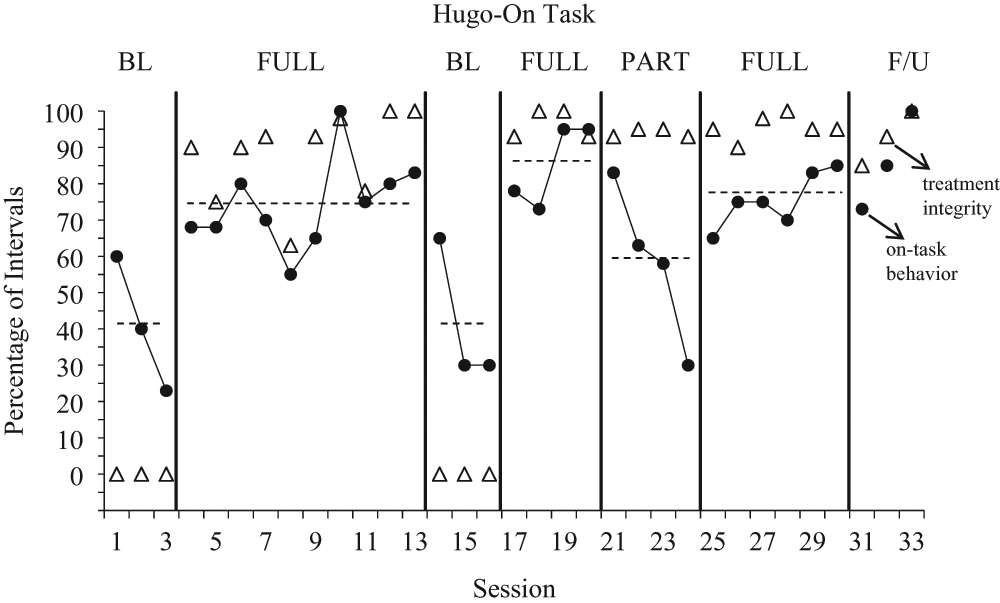
Hugo—Percentage of on-task behaviors and treatment integrity.
On completing the IRP-15, Hugo’s teacher rated the full intervention significantly higher than baseline and the partial intervention phase (baseline = 18, full = 90, partial = 35). Hugo completed the CIRP following the second full intervention phase and rated the intervention 42 of 42 possible points.
Tomas
During initial baseline, Tomas’s on-task behavior reflected a gradually decreasing trend line (slope = −6.50) ranging from 15% to 28% (M = 23.67%, SD = 7.51). Teacher implementation of the function-based intervention was at 0%. With initial implementation of the full intervention package, visual analysis of on-task behaviors resulted in no observable trend because of high variability (slope = 0.77); however, Tomas’s on-task behaviors increased to a mean score of 75.55% (SD = 14.40, range = 50%–98%). Teacher implementation of the full intervention package also reflected high variability ranging from 53% to 100% (M = 90.73, SD = 14.31). During withdrawal of the full intervention package, a gradually decreasing variable trend line (slope = −7.0) was observed, with Tomas displaying on-task behaviors during an average of 36% of the observed intervals (SD = 14.83, range = 18%–58%). During this phase, implementation of the function-based intervention ranged from 0% to 3% during the observed intervals. When the intervention was reinstated, on-task behaviors immediately increased to a mean of 82.75% (SD = 11.44, range = 73%–98%). Treatment integrity averaged 97% (SD = 3.56, range = 93%–100%).
During the partial intervention phase, Tomas displayed no meaningful trend because of high variability followed by high stability. Tomas’s average on-task behavior during this phase was 67.29% (SD = 13.85, range = 45%–88%). Integrity data for the partial intervention averaged 89.14% (SD = 5.27, range 83%–98%). When the full intervention was again reinstated, the mean level of on-task behavior increased to 84.80% (SD = 4.66, range = 78%–90%). Treatment integrity during this phase averaged 97.80% (SD = 1.79, range = 95%–100%). During the follow-up phase, mean on-task behavior was 88.80% (SD = 12.40, range = 68%–100%) and integrity data averaged 99.00% (SD = 2.24, range 95%–100%). For Tomas, mean IOA across all phases was 86.63% (range = 65%–100%) for behavior and 96.25% (range = 85%–100%) for treatment integrity (see Figure 2).
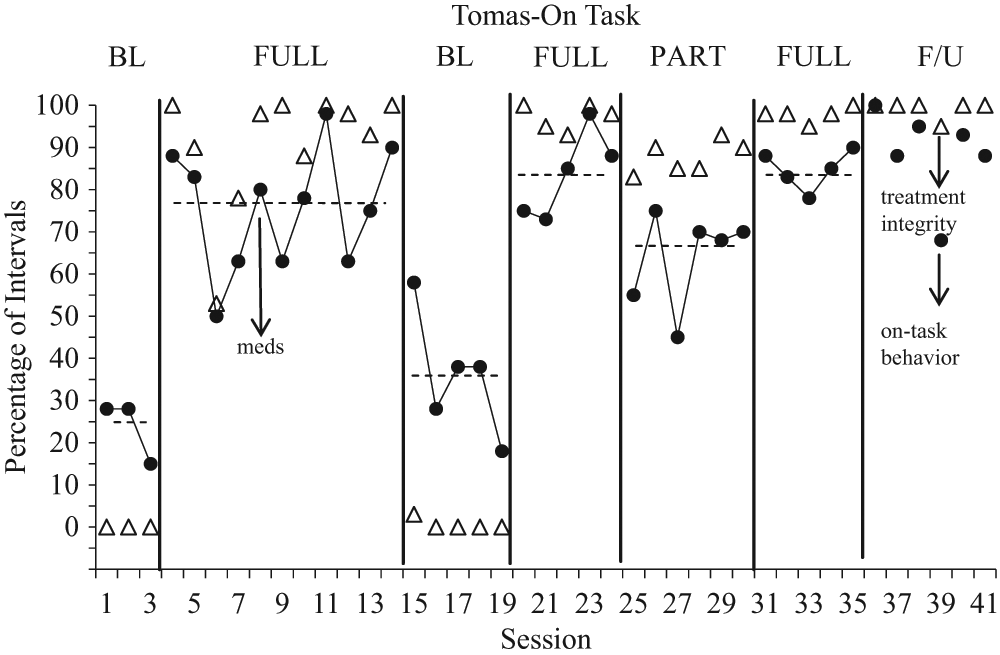
Tomas—Percentage of on-task behaviors and treatment integrity.
On the IRP-15, Tomas’s teacher rated the full intervention higher than baseline and the partial intervention phase (baseline = 75, full = 90, partial = 83). Tomas completed the CIRP following the second full intervention phase and rated the intervention 42 of 42 possible points.
Eric
During initial baseline, Eric’s mean level of on-task behavior was 2.25% (SD = 3.30, range = 0%–7%). Teacher implementation of the function-based intervention was at 0%. When the full intervention was initially implemented, Eric’s on-task behaviors increased to a mean score of 56.67% (SD = 12.33, range = 43%–80%). Treatment integrity averaged 81.11% (SD = 16.56, range 42%–97%). During withdrawal of the full intervention package, Eric’s on-task behaviors immediately decreased to 8% (slope = −4.0), with average on-task behavior at 2.67% (SD = 4.62, range = 0%–8%). Implementation of the function-based intervention was 0% during this phase. With reinstatement of the full intervention, on-task behaviors immediately increased to 55%, with average on-task behaviors displayed during 71% (SD = 11.46, range = 55%–82%) of observed intervals. Treatment integrity averaged 91.25% (SD = 3.95, range = 88%–97%).
During the partial intervention phase, Eric displayed a decreasing stable trend line (slope = −8.5), with a mean of 42% (SD = 8.54, range = 33%–50%). Integrity data for the partial intervention averaged 94.33% (SD = 3.21, range 92%–98%). When the full intervention was again reinstated, the mean level of on-task behavior increased to 75.20% (SD = 15.55, range = 57%–98%). Treatment integrity during this phase averaged 91.20% (SD = 5.26, range = 85%–98%). During the follow-up phase, mean on-task behavior was 58% (SD = 14.42, range = 42%–70%) and integrity data averaged 82% (SD = 8.54, range 73%–90%). For Eric, mean IOA across all phases was 88.87% (range = 78%–100%) for behavior and 94.67% (range = 85%–100%) for treatment integrity (see Figure 3).
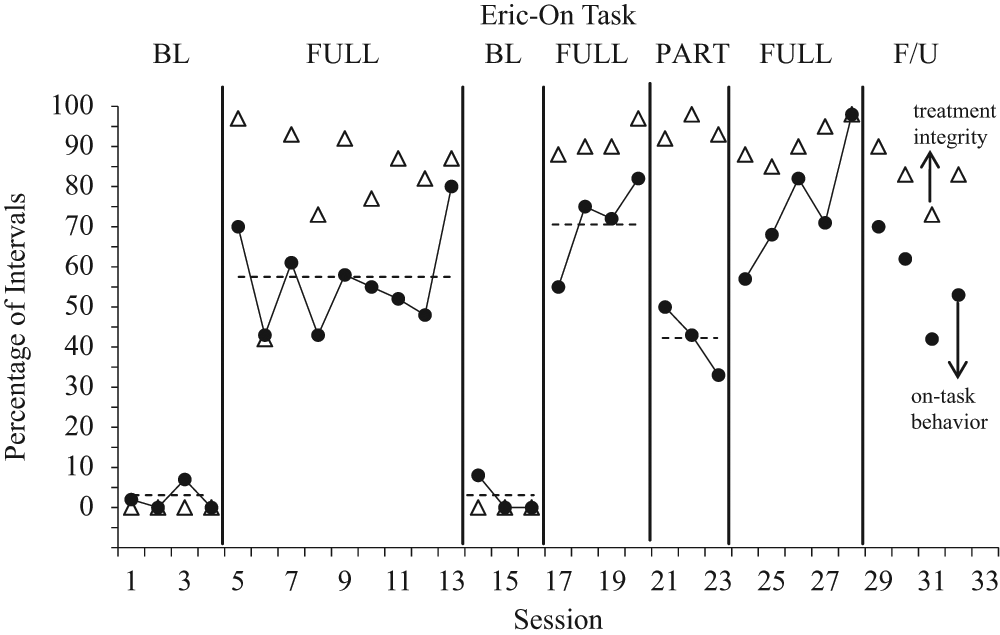
Eric—Percentage of on-task behaviors and treatment integrity.
On the IRP-15, Eric’s teacher rated the full intervention significantly higher than baseline and the partial intervention phase (baseline = 38, full = 78, partial = 28). Eric completed the CIRP following the second B phase and rated the intervention 40 of 42 possible points, stating that he thought there might be better ways to handle problem behavior because sitting on the floor during writing workshop hurt his legs; however, he agreed it was a good intervention.
Discussion
This study examined the contribution of the extinction procedure in function-based intervention. Functional behavioral assessments were conducted in the general education classrooms of three at-risk elementary-aged students. Based on the FBA results, the Decision Model (Umbreit et al., 2007) was used to construct interventions that included antecedent adjustments, reinforcement procedures, and function-matched extinction procedures. Reversal conditions clearly established a functional relationship between the function-based intervention and dramatically improved levels of on-task behavior. On removal of the extinction procedure, on-task behavior rapidly dropped to lower levels. For one of the students (i.e., Eric), the on-task level was no better than that seen during baseline. These data clearly suggest that a function-matched extinction procedure is a critical component in function-based intervention. By extension, interventions that fail to include an extinction procedure should be expected to produce less than optimal results.
Results in this study are consistent with previous research and add to the growing literature in which the Decision Model has been shown to be an effective and acceptable method of developing function-based interventions (e.g., Lane, Smither, Huseman, Guffey, & Fox, 2007; Liaupsin, Umbreit, Ferro, Urso, & Upreti, 2006). In addition, this study extends the work of Iwata, Pace, Cowdery, and Miltenberger (1994) to an applied setting and to a comprehensive intervention in which extinction is one component. It also provides additional confirmation for Horner and Day’s (1991) principle of behavioral efficiency. During the partial intervention condition, reinforcement was available for both the replacement behavior and the target behavior. Because the target behavior had a much longer reinforcement history, its continued occurrence should be expected until reinforcement is available only for the replacement behavior, a situation that was created during the full intervention conditions. Despite that reinforcement history, it is noteworthy how rapidly these students’ behaviors were improved by the combination of reinforcement and function-matched extinction procedures.
After the partial intervention condition, the full intervention was reinstated. In every case, on-task levels rapidly improved. These improvements maintained during follow-up, with occasional lower levels coinciding with occasional lower levels of teacher implementation. The overall high level of implementation that occurred, especially during follow-up, is consistent with the high social validity ratings each teacher gave the full function-based intervention. The fact that each student gave high social validity ratings to the full function-based intervention is also an important outcome.
A post hoc review of each student’s grades showed consistent improvement in key academic areas. As on-task levels improved, grades also improved. Although this outcome is desirable, it cannot be attributed to the function-based interventions that were implemented. The same teachers who collaborated in the FBA and in designing and then implementing the intervention assigned the grades. Independent evidence of corollary academic and social improvement would be desirable in future investigations.
Certain limitations are noted. First, this initial study included only three students and used convenience sampling to identify the student–teacher dyads. Participants may have been more interested and willing to participate in the study than those not identified or those who declined to participate. Future studies should use random sampling within a larger population. Future studies should also include various types and functions of behavior, gender, cultural and linguistic diversity, grade level, instructional activities, and settings.
Second, although descriptive analyses for Hugo and Tomas reflected the primary function as attention, previous research (e.g., Thompson & Iwata, 2007) has demonstrated that the use of functional analysis may reflect a function that differs from the function obtained using descriptive analysis. According to teacher and student interviews and SSRS results, problem behaviors occurred more often during academic instruction, which may suggest an escape function. The use of functional analysis in addition to the use of descriptive analysis to determine function of problem behavior would be more laborious when developing function-based interventions in natural environments. However, verifying function would increase the effectiveness of interventions, thereby warranting the use of both forms of analysis.
Third, the FAMIQ was specifically developed for use in this study and lacks evidence to support its validity as an interview/questionnaire. Although evidence is lacking, it must be noted that the function identified when using the FAMIQ corresponded with the function identified through record review and A-B-C observations. Analyses should be conducted to determine the usefulness of the FAMIQ as an interview/questionnaire within functional behavioral assessment.
Fourth, although all three students demonstrated rapid decreases in the replacement behavior when the extinction procedure was removed from the intervention package, the effect on Tomas’s behavior was neither as great nor as immediate as that observed with Hugo and Eric. This difference may be explained by the drop in levels of treatment integrity displayed by Tomas’s teacher. During those intervals in which Tomas’s teacher was incorrectly implementing the partial intervention, she was providing the extinction procedure. It is also possible that Tomas had acquired skills allowing him to participate successfully in academic activities and that he was reinforced naturally for these behaviors. Thus, successful completion of academic tasks in a manner similar to that of his classroom peers may have reduced Tomas’s need for teacher attention related to the academic task.
Fifth, none of the students was taking any medications when the study began. Tomas began taking medication for ADHD during the initial full intervention phase (between Sessions 7 and 8). Given the time between the introduction of the medication and the absence of an immediate and significant effect during the first four phases, consistency in the dosage provided, and the fact that the partial intervention phase commenced 2 full months after Tomas began taking the medication, it is unlikely that the medication significantly affected his results. Nevertheless, given previous findings (e.g., Northup, Fusilier, Swanson, Roane, & Borrero, 1997), future studies should assess the contribution of function-based interventions with and without pharmacological treatment.
In addition the SSRS Teacher Form was used solely to determine eligibility for student participation. It would have been helpful to assess teacher rating of the students both pre- and postintervention, to determine whether teachers’ ratings had changed in any meaningful way in relation to items within specific scales or across scales. For the same reason, it would have been beneficial to have parents complete the SSRS Parent Form both pre- and postintervention.
Finally, although the IRP-15 provides a good means by which to measure teacher rating of the appropriateness and acceptability of intervention packages, it does not allow for precise measurement of the elements within intervention packages that promote sustained use at high levels of integrity. Although teacher preference for intervention elements may be idiosyncratic, it is certainly worthwhile to look further into the development and use of social validity measures that provide precise information about the social significance of intervention goals, social acceptability of intervention procedures, and social importance of intervention outcomes (Lane & Beebe-Frankenberger, 2004; Wolf, 1978).
Despite the noted limitations, the results of this study clearly demonstrate (a) an increase in the occurrence of replacement behaviors when extinction procedures are included within function-based intervention packages, and (b) higher levels of teacher acceptability of function-based intervention packages that include extinction procedures, when compared to non-function-based interventions and function-based interventions lacking extinction procedures. Although it has long been accepted that FBA is an evidence-based practice, an increased research emphasis on the contribution of the three common components of function-based interventions (i.e., antecedent adjustment, reinforcement of replacement behavior, and extinction procedures) is needed.
Footnotes
Acknowledgements
The authors would like to thank David L. Gast, David P. Wacker, and Mark Wolery for their contributions to the design of this study. They would also like to give special thanks to Seong A. Koh for assisting with data collection.
Authors’ Note
Donna M. Janney is now at the Department of Special Education, Towson University. Kathleen L. Lane is now at the School of Education, University of North Carolina at Chapel Hill.
Declaration of Conflicting Interests
The author(s) declared no potential conflicts of interest with respect to the research, authorship, and/or publication of this article.
Funding
The author(s) disclosed receipt of the following financial support for the research, authorship, and/or publication of this article:
Preparation of this manuscript was supported in part by a U.S. Department of Education grant H325D040019.