



Abstract
The purpose of this study was to assess the perceived importance of specific contextual variables for initial implementation and sustainability of School-Wide Positive Behavior Support (SWPBS). A large, national sample of 257 school team members completed the School-Wide Universal Behavior Sustainability Index: School Teams, a research-validated measure of variables influencing sustainability of schoolwide behavior interventions. Quantitative and qualitative analyses were used to assess perceptions of the most and least important variables for initial implementation and sustainability, as well as variables perceived as more important to sustainability than initial implementation. Across quantitative and qualitative analyses, results indicated that administrator support and school team functioning were rated as the most important features for both initial implementation and sustainability, whereas barriers to SWPBS were rated as relatively less important. Staff support, integration into typical practice, and parent involvement were rated as significantly more important to sustainability than initial implementation. These results were consistent across types of raters and schools. Implications for enhancing implementation and sustainability of SWPBS are discussed.
The effects of School-Wide Positive Behavior Support (SWPBS; Sugai & Horner, 2009) on school climate and problem behavior have been demonstrated through a broad base of research spanning more than 15 years (e.g., Bradshaw, Mitchell, & Leaf, 2010; Colvin, Kame’enui, & Sugai, 1993; Luiselli, Putnam, Handler, & Feinberg, 2005; Taylor-Greene et al., 1997). These positive student outcomes are contingent on adequate fidelity of implementation (Horner et al., 2009), and continued positive student outcomes depend on sustained implementation by school personnel (Fixsen, Naoom, Blase, Friedman, & Wallace, 2005). As a result, it is vital to examine how quality implementation and sustainability occur and what conditions enhance or inhibit sustained implementation of evidence-based school practices such as SWPBS.
Perceptions of School Personnel Regarding SWPBS
Because school personnel are the core implementers of SWPBS, understanding their perceptions and beliefs is critical to enhancing sustainability (Bambara, Nonnemacher, & Kern, 2009). For example, discrepancies may exist between school personnel and researcher perceptions of and attention to the most critical variables for promoting sustainability. Thus, examining perceptions may identify promising approaches or strategies with more face validity. Although there have been many years without much attention to sustainability of school-based practices (McIntosh, Filter, Bennett, Ryan, & Sugai, 2010), five recent studies (including qualitative analyses and surveys of school teams) have examined perceptions of SWPBS implementation or sustainability at the school personnel level (see Table 1). Two focused on initial implementation, and three focused on sustainability.
Facilitators and Barriers Identified in Previous Research.

Kincaid, Childs, Blase, and Wallace (2007) used group interviews to identify perceived facilitators and barriers to initial implementation of SWPBS. A total of 70 respondents, representing 26 schools implementing SWPBS with either high or low fidelity of implementation, participated in the interviews. A number of themes emerged from the responses, including school and district administrator support (e.g., the priority placed on the practice by the administrators), external support (from the state SWPBS project), staff buy-in, and use of data for decision making. Overall, district and external support were the most frequently reported facilitators, whereas staff buy-in, use of data, and misperceptions about SWPBS were the most frequently reported barriers. When responses from high- and low-implementing schools were compared, more teams in schools implementing with high fidelity noted communication and training as facilitators, whereas low-implementing schools more often emphasized plan implementation and teaming. For barriers, respondents from both types of schools noted staff buy-in most often, although high-implementing schools reported the use of data as the second most common barrier, whereas low-implementing schools noted opposition to reward systems just as often as buy-in.
Lohrmann, Forman, Martin, and Palmieri (2008) examined barriers to initial SWPBS implementation by studying school personnel resistance to SWPBS. Using qualitative semistructured interviews, the authors analyzed the perceptions of 14 technical assistance providers representing 10 U.S. states. Similar to results from Kincaid and colleagues (2007), their findings revealed that lack of administrator support and staff buy-in, including skepticism about the necessity of the practice and feelings of hopelessness about its potential effectiveness, were the primary themes regarding resistance to SWPBS. In addition, perceived philosophical differences with SWPBS (specifically preferences for punitive responses to misbehavior, perceptions that students are primarily responsible for changing their own behavior, and opposition to using tangible rewards) were perceived as core barriers.
Examining conditions leading to sustainability of SWPBS, Coffey and Horner (2012) surveyed 117 SWPBS school team leaders from six U.S. states. Their research examined differences in implementation of critical features between sustaining and nonsustaining schools. Although administrator support, communication, use of data, and coaching were each significantly related to sustainability, the strongest predictors of fidelity of implementation were administrator support and communication, along with use of data for decision making. Responses from open-ended questions indicated that the most frequently reported facilitator of sustainability was administrator support, whereas the most frequently reported barrier was resources, particularly funding.
Andreou and McIntosh (2013) used qualitative interviews of 17 teachers and administrators in a district sustaining SWPBS for over a decade. The analysis revealed 13 categories perceived as either facilitators or barriers to sustained SWPBS. Most were consistent with the previously reviewed research, such as administrator support, use of data, and access to coaching. The category regarding staff buy-in focused on the importance of staff ownership and the belief that the practice was not strictly a top-down (i.e., administrator driven) initiative. Efficiency (i.e., the extent to which SWPBS fit into daily instructional responsibilities) and adaptation (i.e., the extent to which SWPBS fit into existing initiatives) were also seen as important facilitators. Similar to the previous studies (Kincaid et al., 2007; Lohrmann et al., 2008), mistaken beliefs about SWPBS and philosophical differences were perceived as barriers to sustainability but not by all respondents. Interestingly, a category emerged regarding the positive aspects of regularly bringing new personnel onto the SWPBS team. Respondents noted the importance of assigning new personnel to the school SWPBS team, bringing them into the culture and as allowing them to contribute new ideas and energy, thus enhancing sustainability.
Bambara and colleagues (2009) used in-depth interviews to examine facilitators and barriers to implementation and sustainability of individual student SWPBS systems (i.e., Tier 3 support). The authors investigated the perceptions of 25 individuals, including school and district team members, classroom teachers, school administrators, and parents. In keeping with all of the previous studies, the vast majority of participants noted the importance of administrator support for the success of the practice. Ongoing coaching was noted as a significant facilitator (i.e., access to coaching) but an even stronger barrier (i.e., lack of coaching). Similar to the findings from universal SWPBS, school culture, defined as the importance of ensuring a common understanding of the practice and minimizing differences between school personnel beliefs and the SWPBS approach, emerged as the most robust theme. The extent to which the team members were able to fit individual SWPBS support into daily routines coincided with findings of Andreou and McIntosh (2013) regarding the efficiency of the practice. Finally, involvement of students and families in behavior support was perceived as a facilitator of sustainability.
Overall, Table 1 shows that the themes identified by each of the five studies were generally consistent in terms of facilitators and barriers for the implementation and sustainability of SWPBS. Some common themes across the studies highlight the importance of school administrator support, staff buy-in (including promoting a common understanding of the practice), the use of data for decision making, and access to ongoing coaching. These themes are consistent with descriptive studies on SWPBS (Barrett, Bradshaw, & Lewis-Palmer, 2008; McIntosh et al., 2010; Taylor-Greene & Kartoub, 2000), but the relative importance of each theme is difficult to discern with these studies.
Although the themes identified were similar across the studies, there were some variations in emphasis that indicate potential patterns based on the schools’ stage of implementation (e.g., installation, full implementation; Fixsen et al., 2005). In the initial implementation studies, philosophical opposition to SWPBS was reported as a strong barrier in studies of initial implementation but less so in the sustainability studies. Conversely, district support was noted as relatively more important in the sustainability studies as opposed to the initial implementation studies, where the school administrator was noted more often as critical. However, none of the studies examined the relative perceived importance of these themes for both initial implementation and sustainability. As a result, it is unknown whether these variables have varying influences on SWPBS based on the stage of implementation. If such differences can be documented, district and state personnel would have empirical guidance for how to target technical assistance to school teams, thereby enhancing both initial implementation and sustainability in a more efficient, targeted manner. As such, further research into perceptions of school personnel during both of these phases could be worthwhile.
Purpose of the Study
The objective of this study was to survey a large, national sample with a research-validated measure to identify differences in perceived importance of contextual and practice variables for both initial implementation and sustainability of SWPBS. Although high-quality initial implementation is necessary for sustainability, certain features may be more important for sustainability than initial implementation (Fixsen et al., 2005). A mixed-method study, using both quantitative and qualitative analyses of survey data, was used to capitalize on the benefits of each approach in understanding variables that enhance or inhibit initial implementation and sustainability of SWPBS. Results examining the effects of the presence of these variables with the same sample are reported in another article (McIntosh et al., 2013), but the perceptions of the relative importance of these features at both stages of implementation have not been empirically studied to date. The following research questions were addressed:
Research Question 1: What features are perceived as the most and least important for (a) initial implementation and (b) sustainability?
Research Question 2: What features are perceived as significantly more important for sustainability than for initial implementation?
Research Question 3: Are there differences in perceptions by role, years implementing, or school demographics (grade levels and urbanicity)?
Method
Participants and Settings
The participants were 257 school team members or district personnel with knowledge of their school’s SWPBS systems. The majority (43%) of participants identified themselves as a school SWPBS team leader/facilitator/internal coach, followed by school administrator (29%), school SWPBS team member (15%), district/external coach (9%), and not specified (5%).
Responses representing at least 234 different schools in 14 U.S. states were included in the analyses (five participants did not provide names or demographic information for their schools, and some schools had multiple respondents). Of these, 49% were elementary schools (Grades K–3, 5, or 6), 16% were middle schools (Grades 6–8), 5% were high schools (Grades 9–12), and 30% were other (e.g., K–8) or not specified. The schools were diverse in terms of urbanicity (17% urban, 65% small to medium city/suburban, and 18% rural/semirural). Of schools reporting free and reduced-priced meal data, just more than half (53%) had 50% or more students receiving free or reduced-price meals. Schools had begun implementation of SWPBS an average of 5 years before the study (SD = 3.3, range = 1–15).
Measure
The School-Wide Universal Behavior Sustainability Index: School Teams (SUBSIST; McIntosh, Doolittle, Vincent, Horner, & Ervin, 2009) is an instrument designed to assess the critical features that enhance or inhibit sustainability of universal behavior support interventions. The measure was validated through ratings from an expert panel indicating strong content validity for measuring sustainability (content validity index = .95) and a pilot study indicating strong internal consistency (α = .87), interrater reliability (r = .95), test–retest reliability (r = .96), and moderate concurrent validity with SWPBS fidelity of implementation (r = .68; McIntosh, MacKay, et al., 2011).
The SUBSIST is composed of 50 critical features of the context and practice, such as “A vast majority of school personnel (80% or more) support SWPBS” and “Data are reviewed regularly at team meetings,” and perceived barriers, such as “There are high levels of school personnel turnover (i.e., 50% of staff).” Respondents provide four ratings per critical feature. The two ratings used in this study assess perceived importance of each critical feature for (a) initial implementation and (b) sustainability. Responses are indicated through a 5-point Likert-type scale (strong negative impact, negative impact, no impact, positive impact, and strong positive impact). The measure also includes three open-end questions: (a) “What is the most important factor for sustaining SWPBS?” (b) “What is the most significant barrier to sustaining SWPBS?” and (c) “What factors are more important for sustainability than initial implementation?”
Procedure
Participants were recruited to complete the SUBSIST through two methods. First, state SWPBS coordinators were contacted, requesting that they forward an invitation to participate to school and district personnel that might be interested in participating. To include a wide range of schools and participant experiences, no additional criteria, including length of time implementing or adequate fidelity of implementation, were imposed. A total of 109 schools were recruited through this method. Second, the authors invited a list of 383 schools reporting at least 5 years of fidelity of implementation data to the national Center on Positive Behavioral Interventions and Supports to participate. Emails or hard copy letters were sent to schools. From the list of schools contacted, a response rate of 32% was obtained, above the suggested minimum criterion for survey responses (Dillman, 1983). In addition, responses from the 25 SUBSIST pilot study participants (McIntosh, MacKay, et al., 2011) were included in the study.
Design and Analyses
The design was a mixed-methods approach, incorporating descriptive and quantitative analyses of the item responses and qualitative analyses of the open-end questions. Descriptive analyses included calculating mean item scores to determine which critical features were considered most and least important for initial implementation and sustainability. Quantitative analyses included two sets of analyses. First, Wilcoxon signed-rank tests were conducted to determine differences in individual respondents’ ratings of importance of critical features between initial implementation and sustainability. Second, t tests, correlations, and ANOVAs were conducted to assess any differences in item-level ratings by respondent role (school vs. district personnel, school personnel vs. school administrators), years implementing SWPBS, and school demographics (grade levels and urbanicity). Because analyses were conducted on all 50 items, all analyses used a Bonferroni-corrected alpha value (p < .001).
Qualitative analyses were included to allow respondents to indicate features perceived as singularly most important, provide critical features not included in the measure, and share authentic responses in the absence of specific critical features that may bias responding (Baron, 2008). Responses from the open-ended questions generated themes representing facilitators or barriers to sustainability using an open coding procedure, informed by Grounded Theory (Patton, 2002; Strauss & Corbin, 1998). Of the 73% of respondents who answered the three open-ended questions, 950 total units (i.e., critical features) were identified and coded into 21 themes, which were generated independently from the quantitative results. Themes were identified if they were represented by at least 3% of respondents. The second author then independently coded a randomly selected 20% of total responses to ensure reliability of coding. The point-by-point interrater agreement was 89% for number of units per response and 85% for coding of themes.
Results
Most and Least Important Features
All features on the SUBSIST were rated as having an impact on implementation and sustainability, but some were rated as relatively more important than others. Table 2 presents the mean ratings for each feature on initial implementation and sustainability. As seen, features related to administrator support and school team functioning were rated as having the strongest impact on both implementation and sustainability. All mean ratings for these items were nearest to the strong positive impact anchor (a score of 5). Although the items rated as most important were remarkably consistent across initial implementation and sustainability, district support and initiative alignment were rated slightly higher for initial implementation, and the extent to which SWPBS becomes viewed as typical practice and school personnel understanding of SWPBS were rated slightly higher for sustainability. The features consistently rated as having the least impact on both initial implementation and sustainability were the perceived barriers. Each of these features was rated as having a negative impact but not a strong negative impact.
SUBSIST Items and Perceived Importance for Implementation and Sustainability.

Note. SUBSIST = School-Wide Universal Behavior Sustainability Index: School Teams; SWPBS = School-Wide Positive Behavior Support; ODRs = office discipline referrals; SET = School-Wide Evaluation Tool.
To address a formatting error, scores for this item were converted from a 4-point to a 5-point scale score. bItems are reverse scored so that higher scores indicate stronger negative impact.
p < .05. **p < .01. ***p < .001 (Wilcoxon signed-rank test); n range = 213 to 254.
The themes generated through the qualitative analyses are presented in Table 3. Results from the open-end question regarding the most important factor for sustaining SWPBS are presented in Figure 1. In keeping with the quantitative results, the theme reported most often was administrator support, followed by staff buy-in, and fidelity of implementation. Teaming was also noted as a prominent theme. Results from the question regarding the most significant barrier are shown in Figure 2. By far, the barrier with the most responses was resources (with specific responses evenly split between time and money), representing one third of total responses. Turnover, fidelity of implementation (i.e., low fidelity), and staff buy-in were other commonly reported barriers.
Themes Generated From Open-Ended Responses and Corresponding Definitions.

Note. SWPBS = School-Wide Positive Behavior Support; ABA = applied behavior analysis. n = the number of codes generated from all of the open-ended responses.
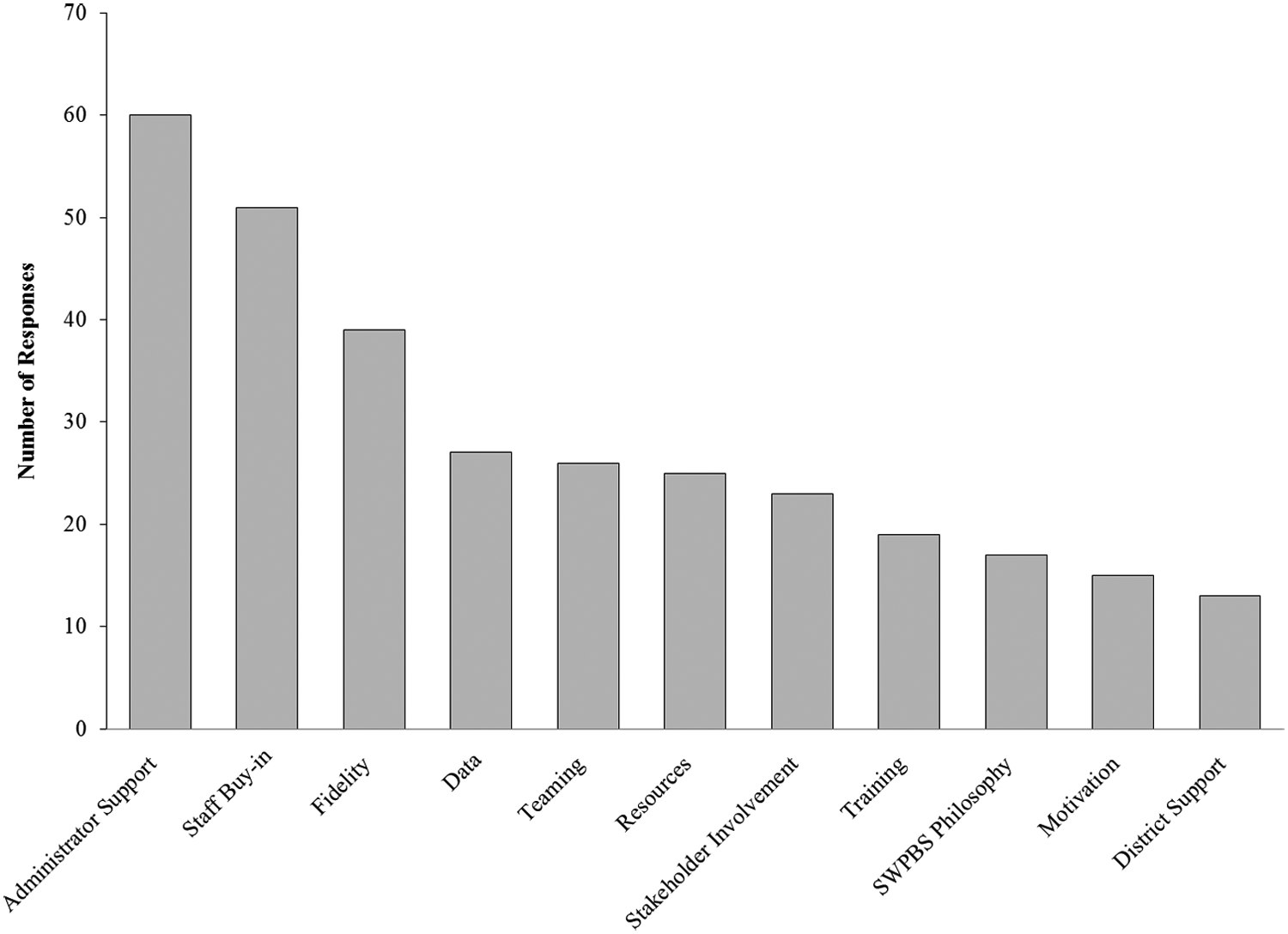
Number of coded responses by theme for the question: “What is the most important factor for sustaining SWPBS?”

Number of coded responses by theme for the question: “What is the most significant barrier to sustaining SWPBS?”
Features Rated as More Important to Sustainability
Wilcoxon signed-rank tests revealed that two critical features were rated as statistically significantly more important to sustainability than initial implementation (see Table 2). These features were active parent involvement (z = 5.085, p < .0001) and SWPBS being viewed as part of systems that are already in place in the school (z = 4.33, p < .0001). Two other critical features, integration into new initiatives (z = 3.22, p = .001) and a vast majority of school personnel support (z = 2.63, p = .009), also were rated as more important to sustainability but not to the level of statistical significance.
Qualitative results from the question regarding factors more important for sustainability than initial implementation are presented in Figure 3. The theme with the most responses was administrator support, followed by data, fidelity of implementation, and teaming. These results were generally consistent with the question regarding the most important feature, with an increased emphasis on data (27–38 responses).

Number of coded responses by theme for the question: “What factors are more important for sustainability than initial implementation?”
Differences in Ratings by Role and School Demographics
Scores for each feature for initial implementation and sustainability were compared to assess differences in ratings of importance by role (i.e., school vs. district personnel, school personnel vs. school administrators), years implementing SWPBS, grade level, and urbanicity. No statistically significant differences were found based on role, years implementing SWPBS, or grade level for implementation or sustainability. Statistically and marginally significant overall differences in item scores for sustainability by urbanicity were found for the items SWPBS serves a critical need in the school, F(4, 200) = 5.48, p < .001, and Data are reviewed regularly at team meetings, F(4, 198) = 4.42, p = .002. Post hoc comparisons using Tukey’s Honestly Significant Difference (HSD) test showed that participants from rural schools rated both items as statistically significantly more important for sustainability than participants from urban schools (p < .001).
Discussion
Although several previous studies have examined perceptions of factors surrounding successful implementation and sustainability of SWPBS, most have examined only one stage of implementation or relied on small samples. This study combined both quantitative and qualitative inquiry to analyze the perceptions of a national sample of 257 school teams. Results showed that all features were perceived as important to both implementation and sustainability, confirming the validity of the SUBSIST for measuring variables related to implementation and sustainability of schoolwide interventions. Across both quantitative and qualitative responses, school administrator support, effective teaming, and use of data for decision making were rated as most important to both initial implementation and sustainability. Barriers were rated as relatively less important, and lack of resources was a commonly noted barrier in the open-ended questions, although it was not rated as important as other features in the item responses. Items such as active parent involvement and being viewed as a part of systems commonly in place were rated as significantly more important for sustainability than initial implementation. In general, perceptions of importance of these items were similar across roles and types of schools.
Important Features Identified for Implementation and Sustainability
Administrator Support
Although it is important to recognize that all features in the SUBSIST survey were rated by participants as important to both implementation and sustainability, participants indicated that having an administrator who actively supports SWPBS, ensures time for and regularly attends and participates in SWPBS team meetings, and describes SWPBS as a top priority for the school had the strongest impact on implementing and sustaining SWPBS. These results are consistent with previous research regarding administrator support for school-based interventions (Andreou & McIntosh, 2013; Bambara et al., 2009; Coffey & Horner, 2012; Kincaid et al., 2007; Lohrmann et al., 2008). It is interesting to note, however, that these perceptions did not match results from an empirical test of the SUBSIST variables with the same schools (McIntosh et al., 2013). In that study, administrator support was strongly correlated with sustained implementation, but when compared with effective teaming and use of data, it did not make a statistically significant independent contribution. Taken together, these studies indicate that administrators are most effective when they empower the school team to implement effectively and use data for decision making. Such an implication is consistent with literature indicating that a strong principal alone is unlikely to implement lasting change without building a broad base of staff support and expertise (Farkas, Johnson, Duffett, Foleno, & Foley, 2001).
Fidelity of Implementation
The results also highlight the critical importance of adequate fidelity of implementation for sustainability. As with any social behavior intervention (Domitrovich et al., 2008), the effect of SWPBS on student outcomes has been shown to be mediated by its fidelity of implementation, with higher implementing schools seeing greater improvements in student outcomes (Bradshaw et al., 2010; Horner et al., 2009; McIntosh, Bennett, & Price, 2011). As a result, ensuring adequate implementation produces a positive feedback loop, as the observed effects on student outcomes reinforce teacher and administrator implementation of the practice (Andreou & McIntosh, 2013). Without adequate implementation, the effects may not be observed, and the risk of practice abandonment increases.
Effective and Efficient Teaming
Both quantitative and qualitative results highlighted the importance of the quality of teaming in implementation and sustainability. Specific features of SWPBS team functioning, including regular meetings (i.e., at least monthly), knowledge and skills of the team, and meeting organization and efficiency, were also rated as among the most important features. These results are not surprising, considering prior research showing that SWPBS team functioning is strongly related to fidelity of implementation (Coffey & Horner, 2012; Cohen, 2006; McIntosh et al., 2013). The results of this study extend these findings on the importance of effective and efficient teaming to sustained implementation.
Barriers As Less Important
Across both the ratings and open-ended responses, participants perceived that barriers, such as philosophical opposition, competing initiatives, and personnel turnover, were less important to implementation and sustainability than facilitators. In the open-ended responses, inadequate resources was most often reported as an important barrier, but when asked about the most important factors and those more important for sustainability than initial implementation, barriers were named far less often than facilitators. Moreover, in the ratings, the item assessing adequate resources was rated as less important to sustainability than 20 other critical features.
When viewed together, the results indicate that some barriers (e.g., competing initiatives, turnover, lack of adequate resources) are omnipresent and will always exist in schools, threatening the sustainability of any practice. However, the results also reflect the perception that a number of concrete steps and strategies can be used to overcome these barriers. For example, having a committed administrator and skilled school team was consistently perceived as more important than adequate resources or opposition to SWPBS. Encouragingly, such perceptions indicate that factors within the control of school personnel—rather than less malleable variables—can be more critical for implementing and sustaining SWPBS.
Features More Important for Sustainability
As can be seen in Table 2, almost all items were rated as just as important or more important for sustainability. Among these items, a number of items were rated as significantly more important for sustainability than initial implementation. Maintaining a high level of fidelity of implementation was rated as more important to sustainability than initial implementation. This finding was consistent with the findings from the open-ended responses, in which fidelity of implementation appears in responses to all questions as both a facilitator and a barrier. Furthermore, envisioning SWPBS as part of systems already in use in the school, having active parent involvement, and integrating new initiatives with SWPBS were also rated as more important for sustaining SWPBS than for initial implementation.
These findings provide tentative support for the notion that some aspects of SWPBS considered as critical to full implementation may not be required as a precondition for initial implementation. For example, parent involvement was viewed as less critical to initial implementation but highly important for sustainability. As such, school personnel may choose to gain experience implementing without significant parent involvement, but neglecting to involve parents after initial implementation may damage its durability and effectiveness. In addition, it is probable that SWPBS would be viewed as an “add-on” initiative at the start, but integrating it into daily school activities and other initiatives is perceived as critical to its future success. Likewise, a criterion of 80% staff support has been viewed as a necessary (but not empirically validated) readiness requirement for SWPBS implementation (Horner, Sugai, Todd, & Lewis-Palmer, 2005). It is possible that some skeptical staff may only buy in once they see positive outcomes after initial implementation. If there is a sufficient base of support (especially among a committed team and administrator), those initially resistant to the practice may become more supportive through gaining experience implementing the practice (Gersten, Chard, & Baker, 2000) or experiencing firsthand the effects of implementation (e.g., improved student behavior; Andreou & McIntosh, 2013). However, these preliminary findings require further research.
Challenges for Rural Schools
Respondents rated the importance of the items similarly, regardless of their role or school, indicating that perceptions are generally robust across roles and types of schools. Perceptions were consistent across school demographics, except for two sustainability items based on urbanicity. Respondents from rural schools, which generally have fewer resources at their disposal (Darling-Hammond & Post, 2000), reported the strong importance of SWPBS serving a critical need and using data at team meetings for sustainability. The relatively higher importance of these two variables may indicate that they are linked. It is possible that rural school teams viewed the regular use of data as a strategy to ensure that the staff see SWPBS as important in meeting their valued outcomes.
Study Limitations
There are several noteworthy limitations to be considered when interpreting these results. First, the respondents generally rated all features as important, which limited the range of responses, and many respondents provided multiple features in their open-ended responses. As a result, the responses do not provide an unequivocal picture of the relative importance of each of these features on implementation and sustainability. Second, although we assessed the number of years that the schools were implementing SWPBS, we did not assess experience of the individual respondents. Their perceptions may have been affected by their experiences implementing SWPBS in other schools. Third, responses regarding initial implementation were based on retrospective recall, which may not be accurate. Finally, the unequal subgroup sizes in the quantitative analyses indicate that results should be interpreted with caution.
Implications
This study provides some potential implications for practice, particularly regarding steps schools can take that may enhance implementation and sustainability of SWPBS and other schoolwide behavior support practices. First, it is encouraging that school teams may worry less about barriers and focus more specifically on a small number of active strategies for enhancing implementation, such as implementing all features of SWPBS, ensuring effective and efficient team functioning, and enhancing administrator support. For example, it may be more beneficial to focus on strategies for ensuring strong implementation with the school’s existing resources, as opposed to working to secure more resources before implementing. Essentially, many of the common obstacles noted by participants could be addressed by focusing on quality implementation through a team-based approach. Further in-depth qualitative research could help identify how schools overcome these barriers. For example, interviews or focus groups could examine schools that rated barriers as less important to identify what specific steps they took to overcome them.
The results also provide an indication that some aspects of the context or practice have less of an influence at initial implementation but deserve attention to enhance durability over time. It may be acceptable at first for SWPBS to feel like an “add-on” initiative that consumes high levels of energy at initial implementation, but it may be endangered if it does not become more efficient over time. As a result, it would be a wise use of the high levels of funding and enthusiasm to make the practice more efficient and integrated into daily teaching responsibilities (Gersten et al., 2000). These potentially beneficial strategies require future research.
Finally, these results indicate the value of assessing variables related to the context and practice that are related to implementation and sustainability but not captured by existing SWPBS fidelity of implementation measures. Teams can use the SUBSIST Sustainability Checklist (McIntosh, 2010), which includes the same items assessed in this study but in a checklist and action planning tool format, to self-assess their systems’ potential for sustained implementation. Future research may indicate the extent to which using this tool as formative assessment may lead to improved implementation and sustainability.
Footnotes
Authors’ Note
Opinions expressed herein are those of the authors and do not necessarily reflect the position of the agency, and such endorsements should not be inferred. This study was conducted while the first author was affiliated with the University of British Columbia.
Declaration of Conflicting Interests
The author(s) declared no potential conflicts of interest with respect to the research, authorship, and/or publication of this article.
Funding
The author(s) disclosed receipt of the following financial support for the research, authorship, and/or publication of this article: This work was supported by the Social Sciences and Humanities Research Council of Canada (F09-05052).