



Abstract
Functional communication training (FCT) is a well-established, evidence-based practice used to address challenging behavior among individuals across settings, ages, and disability categories. However, the research is limited on the implementation of FCT in inclusive school settings for students with intellectual and developmental disabilities. The purpose of this review was to summarize FCT intervention studies implemented in inclusive K–12 school settings for students with intellectual and developmental disabilities. We synthesized studies to summarize study characteristics, quality, and intervention effectiveness. Our findings suggest that FCT was most often implemented as part of a multi-component intervention package and delivered by education team members. Furthermore, the quality of most studies was either acceptable or strong. The overall effect size estimate for primary dependent measures as measured by Tau-U suggested large to very large changes in student behavior. We present implications for practice specific to educational teams that support the behavioral needs of students with intellectual and developmental disabilities in inclusive settings and offer avenues for future research.
Keywords
Over the past several decades, the number of students with disabilities who are educated in inclusive school settings alongside their same-age peers without disabilities has increased, with 64.8% spending 80% or more of their school day in inclusive settings during the 2018–2019 school year (U.S. Department of Education, 2021). However, the subgroup of students with intellectual and developmental disabilities (IDD; e.g., intellectual disability [ID], autism spectrum disorder [ASD], multiple disabilities) continues to spend a majority of their day in separate special education settings (U.S. Department of Education, 2021). Only 17.3% of students with ID, 40% of students with ASD, and 14.2% of students with multiple disabilities were included in inclusive school settings for 80% or more of their school day during the 2018–2019 school year (U.S. Department of Education, 2021).
Education received primarily in separate special education settings is problematic as students with IDD may benefit from inclusive education in a number of ways, including more time engaged in academic tasks (e.g., Kurth & Mastergeorge, 2012), greater academic achievement (e.g., Gee et al., 2020), improved communication skills (e.g., Kleinert et al., 2015), and greater access to opportunities for interaction with peers and social skills practice (e.g., Feldman et al., 2016). Likewise, students with IDD may experience improvements in challenging behavior when behavioral supports are implemented in inclusive school settings (Lory et al., 2020; Walker, Chung, & Bonnet, 2018).
Despite these potential benefits, several barriers to accessing inclusive school settings for students with IDD have been identified, including negative adult perceptions of student competency, district policy, disadvantaged socioeconomic status, and race (Agran et al., 2020; Kurth et al., 2016). In addition, challenging behavior—a factor most relevant to this study—is often cited as a barrier to inclusive school settings for this student population (Roberts & Simpson, 2016; Walker, Loman, et al., 2018). Attitudinal barriers related to challenging behavior also may play a role in access to inclusive settings. For example, Bambara et al. (2009) found that some education team members may not view students with disabilities who engage in challenging behavior as valued members of the school community and may believe these students are better served in separate special education settings. Likewise, Lohrmann and Bambara (2006) found that some general education teachers reported that “severe” challenging behavior cannot be addressed appropriately in the inclusive, general education classroom. More recently, Jury et al. (2021) found that middle and high school teachers’ attitudes toward the inclusion of students with ASD were the most negative when students exhibited challenging behavior.
The current research base offers compelling evidence suggesting that challenging behavior can be addressed successfully in inclusive school settings for students with IDD through the implementation of well-established, evidence-based practices (EBPs), such as a function-based interventions. For example, Walker, Chung, and Bonnet (2018) conducted a review of studies in which function-based interventions were delivered in inclusive school settings to students with disabilities. Results indicated that interventions were largely effective at decreasing challenging behavior and increasing appropriate behavior and were viewed as socially valid among educational team members. In a more recent review, Lory et al. (2020) examined studies involving a range of interventions, including function-based interventions, to address challenging behavior displayed by students with IDD in inclusive school settings. The authors reported favorable student outcomes, indicating that behavioral interventions for students with IDD can be successfully delivered in these settings.
Although these reviews provide the field with important information about a range of behavioral interventions, including function-based interventions, delivered in inclusive school settings, they did not specifically examine functional communication training (FCT), an EBP for addressing challenging behavior among individuals with IDD (Gerow et al., 2018). Functional communication training is a function-based intervention that relies on differential reinforcement procedures whereby specific desirable behaviors are reinforced while challenging behavior is placed on extinction (Cooper et al., 2020). This process is implemented to teach socially appropriate communicative behavior to replace challenging behavior (Carr & Durand, 1985). This replacement behavior, known as a functionally equivalent communication response (FCR), serves the same function as challenging behavior as identified through a functional behavior assessment (FBA). Functional communication training can be implemented as an intervention in isolation (i.e., FCT only) or as part of a multi-component intervention package implemented in conjunction with other interventions (e.g., FCT + self-monitoring, FCT + visual schedule).
Reviewing the existing research on FCT for students with IDD, specifically in inclusive school settings, is important because FCT is a highly effective intervention, it works quickly to improve behavior, and it is applicable to all behavioral functions (Tiger et al., 2008), making it broadly applicable for students with IDD. Functional communication training also can be developed and implemented successfully in schools by educational team members (i.e., teachers, paraprofessionals, related services providers; Andzik et al., 2016; Walker, Lyon, et al., 2018). As such, it is important to examine whether FCT is effective across a range of school settings, particularly in inclusive settings that offer a host of benefits to students with IDD. Furthermore, teaching socially appropriate behavior and developing interventions based on FBA outcomes—two critical aspects of FCT—are considered high-leverage practices that are important for effective teaching and student success in inclusive classrooms (McLeskey et al., 2022). Finally, information about the specific conditions under which FCT has been successfully implemented for students with IDD in inclusive school settings, including the role of educational teams in planning and implementing FCT, should be explored to inform implications for planning FCT interventions and future research initiatives.
Given the benefits of education in inclusive school settings for students with IDD and the importance of implementing EBPs to support the behavioral needs of students in inclusive school settings, we conducted a systematic literature review of FCT interventions implemented in inclusive school settings for students with IDD. Our research questions were as follows:
Method
The purpose of this systematic literature review was to summarize research studies in which FCT was implemented in inclusive school settings for students with IDD. Each phase of the review is described in detail in the following sections. Figure 1 presents an overview of the literature search and screening processes.

Summary of the Literature Search and Screening Processes
Literature Search Process
We conducted a literature search in June 2021. First, we searched four relevant online databases using search terms related to students with IDD (e.g., intellectual disab*, severe disab*, extensive support need*, developmental disab*) and FCT (e.g., functional communication training, functionally equivalent, mand training). These search terms are outlined in Supplemental Table 1 available in the online supplemental materials. Our search parameters were limited to articles in English, including dissertations and theses to reduce concerns of publication bias (Gage et al., 2017). We placed no parameters on the year of publication and applied our search terms to the entire text (i.e., not just the title or abstract). The online database search yielded a total of 1,582 potentially relevant references as follows: (a) PsycINFO (n = 740), (b) ERIC (EBSCO; n = 303), (c) Medline (ProQuest; n = 401), and (d) ProQuest Dissertations and Theses Global (n = 138).
Second, we conducted a hand search of 23 relevant journals with potential content pertaining to behavioral interventions for individuals with IDD (e.g., American Journal on Intellectual and Developmental Disabilities, Journal of Applied Behavior Analysis, Journal of Positive Behavior Interventions, Journal of Special Education). Using the same search terms, we used each journal’s online search feature to identify additional references. In total, the hand search yielded 951 references. These results are outlined in Supplemental Table 2 in the online supplemental materials. Third, we conducted a review of reference lists from 15 prior systematic literature reviews and meta-analyses related to students with IDD and/or FCT. In total, we identified 220 additional references to consider for inclusion. Details of these search results are outlined in Supplemental Table 3 available in the online supplemental materials. Finally, throughout this process, we contacted 50 authors who had expertise and a publication history in the area of FCT to request article recommendations for inclusion in the review. Sixteen authors responded to our query and recommended 13 articles for consideration. After eliminating duplicates and references not relevant to the purpose of the review (e.g., studies conducted in non K–12 settings, books and book chapters), a total of 870 references remained for inclusion consideration.
Inclusion Criteria
We applied the following inclusion criteria to the abstract and, when necessary, the full text of each of the 870 references to determine whether they were eligible for inclusion in the review: (a) the intervention included FCT, (b) the FCT intervention was implemented in a K–12 inclusive school setting, and (c) the FCT intervention was implemented with at least one student with IDD. Studies were included if the intervention involved FCT as the sole intervention or FCT as part of a multi-component intervention package (e.g., FCT + choice making). Any school setting where peers without disabilities were present (e.g., general education classroom, recess, cafeteria, specials) was considered an inclusive school setting. We excluded studies when generalization and maintenance data were collected in an inclusive setting, but the FCT intervention did not take place in an inclusive setting. We also excluded studies that did not take place in school settings (e.g., clinics, hospitals, home). We calculated inter-rater agreement (IRA) across 32.5% of references. The first and second authors coded 50% of the references as primary coders and the third and fourth authors coded 15% of the references selected at random as secondary coders. Agreement was 99.3%. Based on the application of the inclusion criteria, a total of seven studies were eligible for inclusion in the review.
Data Analysis
We coded each study at the student participant level, only including those students who met the previously described inclusion criteria. In this section, we describe the descriptive coding and intervention effect estimate processes.
Descriptive coding
The first three authors (i.e., a doctoral student in special education, an associate professor of special education, a postdoctoral researcher in special education) each served as primary coder for approximately one third of the included studies and as secondary coder for another third. Coders used a coding form developed by the research team (available upon request) as described in the following sections. We analyzed descriptive data using descriptive statistics (i.e., mean and range for open-ended and percentages for closed-ended categories). In some cases, we selected multiple responses under a given coding category, and thus percentages may exceed 100%.
Student characteristics
The student characteristics coding categories were as follows: student grade level (i.e., Grades K–5, Grades 6–8, Grades 9–12), gender, race and ethnicity, disability category based on the Individuals with Disabilities Education Improvement Act (2004) eligibility categories, description of educational placement, communication level (i.e., pre-linguistic, emerging, multiword), communication mode prior to FCT (i.e., aided augmentative and alternative communication [AAC], unaided AAC, speech), and form of challenging behavior prior to FCT (i.e., destructive, disruptive, distracting).
Functional communication training intervention characteristics
The FCT intervention characteristics coding categories included dependent measures reported (i.e., challenging behavior, FCR, FCT implementation fidelity, other), form of challenging behavior, FCR communication mode, research design, FBA tool (i.e., experimental functional analysis, descriptive FBA [record review, interview, direct observation, scale/questionnaire]), function of challenging behavior, establishing operations (i.e., contrived, natural), FBA assessors and contributors and those involved in developing the FCT intervention (i.e., experimenter, teacher [special education, general education], therapist, other), prompt and prompt fading procedures (e.g., most-to-least, time delay), consequences for challenging behavior (i.e., reinforcement, punishment, extinction), whether reinforcement schedule thinning procedures were reported, and whether FCT was part of a multi-component intervention package or a standalone intervention. In addition, we coded the following: FCT implementation context (i.e., contextualized, decontextualized), a description of the physical setting in and/or routine during which FCT occurred (e.g., general education math classroom), whether trials were massed or distributed, dosage (i.e., FCT trials per session, sessions per day or week, duration of FCT implementation), and the role of those who implemented FCT (i.e., experimenter, teacher [special education, general education], paraprofessional, other school professionals [e.g., therapist, related services providers]).
Functional communication training implementer training characteristics
The FCT implementer training characteristics coding categories included the following: whether FCT implementers were trained, the role of those who delivered training to the FCT implementers (i.e., teacher [general education, special education], therapist, experimenter including researcher or graduate assistant), training dosage (i.e., number of training sessions, duration of training in days, weeks, or months), training context (i.e., contextualized, decontextualized), and training type (i.e., didactic, experiential).
Study quality
We coded the following quality indicators: social validity, dependent measure reliability, implementation fidelity, generalization data, and maintenance data both on the FCT intervention and the FCT implementation training. We also determined whether the included studies met the What Works Clearinghouse (WWC, 2020) standards for single-case research, following the guidelines from Maggin et al. (2013). We first determined whether studies met the design standards using the following criteria: independent variable was systematically manipulated, dependent measures were repeatedly measured over time by more than one observer, inter-observer agreement was measured across 20% or more of the data points in each condition and met minimal thresholds (i.e., 80% for percentage of agreement, 0.60 for kappa), and at least three attempts to demonstrate an intervention effect at three or more different points in time were present with a minimum of three data points per condition. For those studies meeting the design standards with or without reservations, we then determined the overall strength of the evidence using the following criteria: at least three points per condition were present (score of “2” = five or more data points, “1” = three to four data points, “0” = fewer than three data points); at least three demonstrations of intervention effect were present (score of “2” = yes, “0” = no); and the ratio of effects to non effects was acceptable (score of “2” = no instances of non effects, “1” = ratio is equal to or less than 3:1, “0” = ratio is greater than 3:1).
Intervention effect estimates
Following the visual analysis guidelines described by Ledford and Gast (2018), the second and third authors visually analyzed the graphed data to determine whether there were no effects, mixed effects, or positive effects for the primary dependent measures across studies. To supplement visual analysis, the first and fourth authors calculated Tau-U (Parker et al., 2011) for the primary dependent measures across all eligible student participants and the paraprofessional implementation fidelity measure for Walker et al. (2021). Tau-U is a nonoverlap effect size metric that addresses undesirable trends in baseline conditions and is commonly used to estimate intervention effect for single-case research (Parker et al., 2011). Tau-U scores can be interpreted as a small (<0.20), moderate (0.20–0.60), large (0.60–0.80), or large to very large (>0.80) change (Vannest & Ninci, 2015). We first extracted the raw data values from participant graphs using WebPlot Digitizer Version 4.5 (Rohatgi, 2021). Second, we calculated Tau-U in a free, online calculator (Vannest et al., 2016) by conducting phase contrasts between baseline and intervention conditions and combining contrasts to produce a weighted, aggregate Tau-U score for each study.
Inter-rater agreement
We calculated IRA for all included studies. The first three authors each served as primary coders for one third of the included studies and as secondary coders for another one third. After independently coding, the primary and secondary coders met to compare coding forms and discuss any discrepancies. Upon initial comparison, the average IRA was 92.9% (range = 81.3%–100%). Consensus discussion resulted in 100% agreement across articles and coders.
Results
In the following sections, we present findings from the descriptive coding with the student participant treated as the unit of analysis and intervention effect estimate analyses. Tables 1 to 3 present data at the study level.
Summary of Participant Characteristics for the Reviewed Studies.
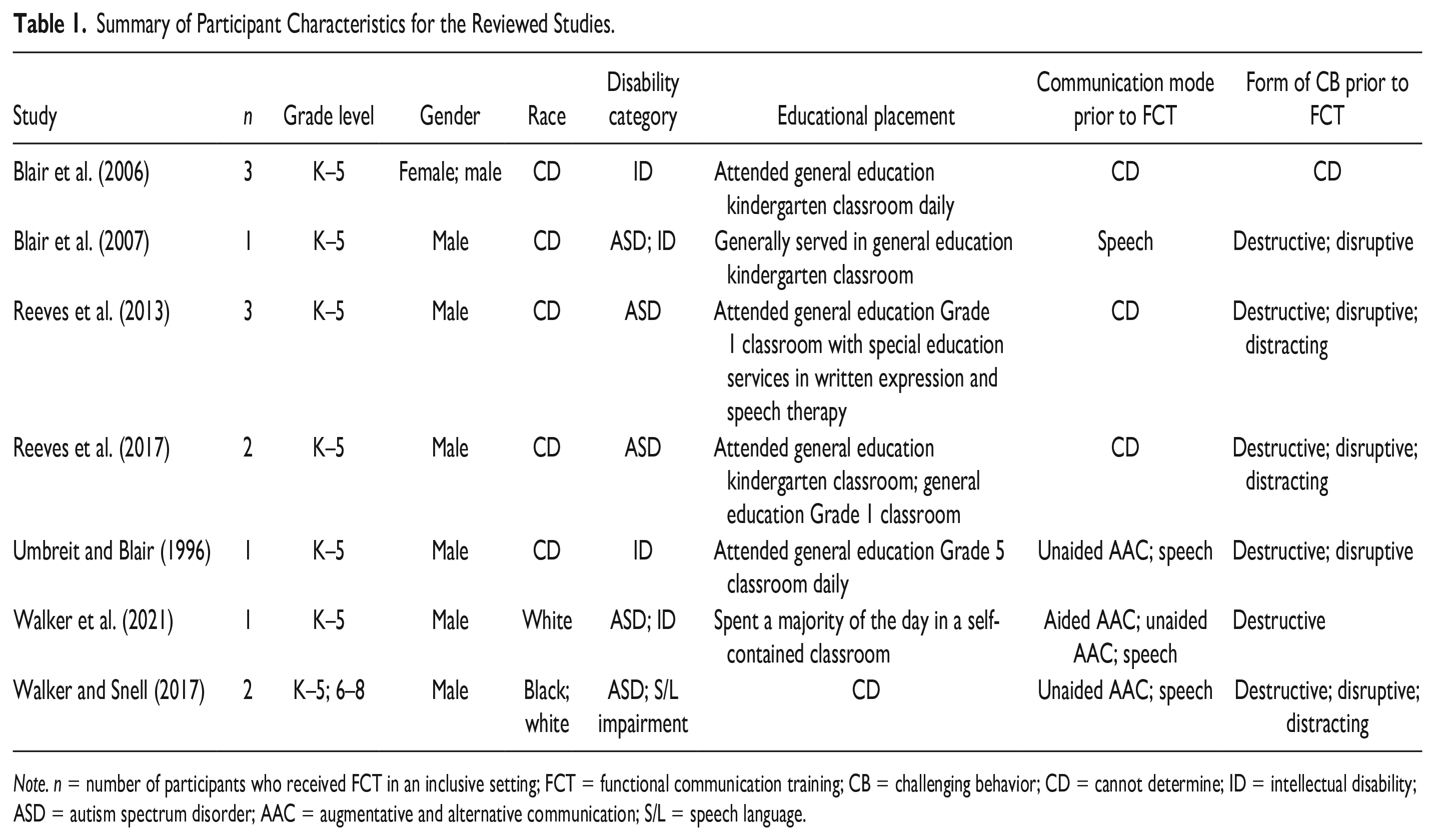
Note. n = number of participants who received FCT in an inclusive setting; FCT = functional communication training; CB = challenging behavior; CD = cannot determine; ID = intellectual disability; ASD = autism spectrum disorder; AAC = augmentative and alternative communication; S/L = speech language.
Summary of Intervention Characteristics for the Reviewed Studies.

Note. CB = challenging behavior; FCR = functionally equivalent communication response; FCT = functional communication training; CD = cannot determine; AAC = augmentative and alternative communication.
Summary of Outcomes for and Quality of the Reviewed Studies.

Note. WWC = What Works Clearinghouse; DS = design standards; ES = evidence standards; CI = confidence interval; FCT = functional communication training; N/A = not applicable.
Effects questionable given the low number of data points for two of the three participants.
Student Characteristics
Table 1 provides information about student characteristics for each study. Across the seven included studies, 13 students with IDD received FCT within an inclusive school setting. A majority of students (92%) attended an elementary school, whereas only one (8%) attended a middle school at the time of the study. Students were primarily male (85%); only one female student received FCT (15%). Student disabilities included ASD (69%), ID (46%), and speech language impairment (8%). Two students (15%) were described as White and one was described as Black (8%). However, for most students, race and ethnicity (77%) were not reported.
Prior to the FCT intervention, students received special education services in various inclusive settings. Most students (77%) spent a majority of the school day in inclusive settings, whereas the student in the Walker et al. (2021) study spent a majority of the day in a self-contained setting; the extent of inclusion was not reported in the Walker and Snell (2017) study. Students were eligible for FCT intervention based on their histories of engaging in disruptive behavior (54%), destructive behavior (46%), and/or distracting behavior (46%). In over half of the cases (54%), communication level was not described. Likewise, student communication mode prior to FCT intervention was not reported for eight students (62%). For those students whose communication level was described, five (38%) communicated at an emergent level and one (8%) communicated at the multi-word level. In terms of communication mode, five students (38%) communicated with speech, one (8%) used a non-electronic aided AAC system, and three (23%) used unaided AAC, including gestures (23%) and sign language (8%).
Functional Communication Training Intervention Characteristics
Table 2 provides information about FCT intervention characteristics for each study. Functional communication training interventions addressed disruptive (85%), destructive (62%), and/or distracting (62%) challenging behavior. For most students (62%), the communication mode of the FCR was not described; in other cases, students were taught to use aided AAC (23%), unaided AAC (15%), and speech (8%). In all but one case, students received FCT as part of a multi-component intervention package in a range of inclusive settings. Multi-component interventions always included antecedent strategies (e.g., embed preferences, provide choices, use visual schedules) and consequence strategies (e.g., extinction of challenging behavior, reinforcement of appropriate behavior). The FCT interventions were most often implemented in a contextualized setting (e.g., within an inclusive classroom during naturally occurring routines; 92%) and, in one case (8%), the specific context in which FCT was implemented was not reported. General education teachers (54%), paraprofessionals (54%), and special education teachers (31%) primarily were responsible for FCT implementation, with one student (8%) receiving FCT from educational team members whose roles were not specified.
All FCT interventions (and other components of the multi-component intervention package) were developed based on FBA outcomes. A descriptive FBA, whether used alone or in conjunction with a functional analysis, was used to inform intervention development for all students. Both interviews (100%) and direct observations (100%) were conducted for all students, with questionnaires or rating scales used less often (23%). In two cases (15%), an experimental functional analysis was used to guide the FBA. All FBAs were conducted by experimenters (100%), with fewer also conducted by teaching staff not otherwise specified (15%) or a caregiver (8%). The following educational team members participated in the FBA process by providing information through interviews, questionnaires, and/or rating scales: teachers (69%; 77% not described, 22% special education, 11% general education), teaching staff not otherwise specified (62%), paraprofessionals (54%), caregivers (38%), and other team members (i.e., administrator, student teacher; 15%). Hypothesized functions resulting from FBA were as follows: attention (46%), tangible (23%), escape (15%), and multiple functions (15%); in one case (8%), the function was unclear. The FCT interventions primarily were developed by experimenters (46%) and teaching staff not otherwise specified (38%) and, in one case (8%), a special education teacher; FCT developer role could not be determined for 53% of FCT interventions.
Overall, descriptions of the FCT procedures were limited. For seven students (54%), FCRs were taught using natural establishing operations, meaning that implementers waited for the maintaining reinforcer to become valuable as opposed to setting up conditions to increase the value of the reinforcer. However, in nearly half of the cases (46%), information about whether contrived or natural establishing operations were used to teach the FCR was not described. In terms of prompting procedures, students were taught the FCR through least-to-most prompting (8%), most-to-least prompting (8%), reminders (8%), and examples and nonexamples (8%); in nine cases (69%), the prompting procedures were not reported. For eight students (62%), challenging behavior was placed on extinction as part of the FCT intervention, and in only one case (8%), time delay was used as a delayed reinforcement procedure once the student acquired the FCR. Functional communication training dosage also was unclear for most students. The number of trials per session was not described at all, and the number of sessions per day or week was described in only four cases (31%) as either one session per day or one to three sessions per week. The total duration of the FCT interventions was described for five students (38%; range = 4–19 weeks). Finally, a multiple baseline or probe design (62%) or a reversal/withdrawal design (38%) was used to examine intervention effectiveness.
Functional Communication Training Implementer Training Characteristics
In seven cases (54%), FCT implementer training was reported. Among those who received training, a majority of implementers were trained by an experimenter (86%), with fewer trained by their district’s behavior team member (43%) or a special education teacher (29%). Training took place in both contextualized (57%) and decontextualized (57%) scenarios and reflected experiential (100%) and didactic (57%) training practices. Common practices included delivering instructions, modeling, rehearsing, and providing performance feedback to the FCT implementer. Implementer training lasted between 1 and 3 days depending on the study with training duration not reported in 43% of cases. The number of sessions varied between one and three initial training sessions with follow-up support (e.g., weekly coaching) provided in 43% of cases.
Quality Indicators
Both the social validity of the FCT interventions and reliability of student dependent measures were measured and found acceptable across all but one case; because Walker et al. (2021) focused on paraprofessional training outcomes, student dependent measures were not reported. Implementation fidelity was reported and acceptable across 12 cases (92%). Table 3 provides information specific to measures of generalization, maintenance, and social validity for each study. Measures of generalization across settings or behaviors and maintenance for student dependent measures were reported for four (33%) and six (50%) cases, respectively. Maintenance probes were collected anywhere between 1 and 6 weeks post intervention. For those cases in which implementer training was reported, social validity of the training procedures and reliability of implementer dependent measures (i.e., implementation fidelity) were measured in three cases (75%) and acceptable in each case. Generalization of implementation fidelity was not measured, but in one case (25%), maintenance data were collected 1 month post intervention.
Results pertaining to the WWC standards are provided in Table 3. In terms of the design standards, one study met the standards without reservations, four met the standards with reservations, and two did not meet the standards. It should be noted that, because Reeves et al. (2013) included a reversal design replicated across three participants, and one of the three replications did not meet standards, we coded the study as not meeting the standards. Of the five studies that met the WWC design standards with or without reservations, four studies demonstrated moderate evidence and one study demonstrated strong evidence.
Intervention Effects
Visual analysis and Tau-U outcomes are presented in Table 3. Visual analysis indicated that positive effects were demonstrated for primary dependent measures across all eligible student participants and the paraprofessional participant for Walker et al. (2021). Likewise, the Tau-U scores for the primary dependent measures represent a large to very large change (range = 0.96 – 1.00) in outcomes (Vannest & Ninci, 2015).
Discussion
The purpose of this systematic literature review was to summarize intervention studies in which FCT was delivered to address challenging behavior among students with IDD in inclusive school settings. Despite the evidence base supporting the effectiveness of behavioral interventions delivered in inclusive settings for students with IDD (Lory et al., 2020; Walker, Chung, & Bonnet, 2018), the current status of research on FCT implementation, specifically in inclusive school settings for this population, has not been explored. Because FCT is an EBP for individuals with IDD (Gerow et al., 2018) and reflects existing high-leverage practices for inclusive classrooms (McLeskey et al., 2022), understanding the conditions under which it has been successfully implemented in inclusive school settings has important implications for intervention planning for students with IDD who engage in challenging behavior. This is particularly important for supporting students whose challenging behavior may serve as a barrier to placement in inclusive school settings or that interferes with learning and social opportunities in these settings (Walker, Loman, et al., 2018). In this section, we highlight several key findings that have important implications for future research and practice.
In our review, we identified seven studies that met the inclusion criteria. All FCT interventions were implemented in elementary school settings, with the exception of one that was implemented in a middle school; this finding may reflect the barriers to inclusion in secondary settings (e.g., Carter & Hughes, 2006) that may lead to fewer inclusive opportunities for secondary students with IDD. Similar to previous reviews focused on behavioral interventions in inclusive school settings (Lory et al., 2020; Walker, Chung, & Bonnet, 2018), our findings suggest that students with IDD experienced positive outcomes in response to FCT in inclusive school settings, with Tau-U effect size estimates for primary student dependent measures representing large to very large changes in behavior. Encouragingly, we also found that most of the reviewed studies were of acceptable quality based on the WWC analysis. Although these findings are promising, it is important to note that, in all but one study (Walker et al., 2021), the FCT intervention was part of a larger, multi-component intervention package that included other antecedent- and consequence-based strategies in addition to FCT that aligned with the identified behavioral function(s). This is not surprising, as behavior intervention plans developed by educational teams typically have multiple components, including FCT to teach an FCR (e.g., Goh & Bambara, 2012; Walker, Chung, & Bonnet, 2018).
We also found that students in our review engaged in a wide range of challenging behavior topographies in the inclusive setting, including high-priority destructive behaviors (62%) such as aggression toward adults or peers, property destruction, and self-injury. However, regardless of the form of challenging behavior, students demonstrated positive outcomes. These findings are encouraging, as they indicate that educational team members who support students with complex behavioral needs in inclusive settings may be able to implement interventions that produce positive student outcomes. Similarly, Lory et al. (2020) reported positive student outcomes across a range of behavioral topographies and significantly greater improvements in behavior among students who engaged in “severe” challenging behavior in inclusive settings. This contradicts some teachers’ perceptions that “severe” challenging behavior cannot or should not be addressed in inclusive classrooms (Bambara et al., 2009; Lohrmann & Bambara, 2006). Implementing FCT with or without additional intervention may reduce the risk of student behavior resulting in removal from inclusive settings to more restrictive settings, where most students with IDD spend a majority of their school day (U.S. Department of Education, 2021).
Also notable is that student participants who used a range of communication modalities during FCT, including aided and unaided AAC, experienced positive outcomes. This finding is particularly noteworthy, as previous research has indicated that students who use AAC may be at risk for exclusion from general education settings (Kleinert et al., 2015) despite mounting evidence that challenging behavior among students with complex communication needs can be addressed through communication-based interventions, like FCT, in inclusive school settings (Walker, Lyon, et al., 2018).
Across the reviewed studies, educational team members who regularly support students with IDD in inclusive school settings were primarily responsible for FCT implementation, a finding consistent with previous research on behavioral interventions in inclusive school settings (Lloyd et al., 2019; Lory et al., 2020; Walker, Chung, & Bonnet, 2018). In fact, Lory and colleagues (2020) found that the role of the interventionist moderated student outcomes, with behavior change significantly greater when natural school interventionists (e.g., teachers, paraprofessionals) implemented behavioral interventions in inclusive settings. Together, these findings highlight the importance of providing general education team members, particularly general education teachers and paraprofessionals, adequate training to implement function-based interventions (Samudre et al., 2020; Walker et al., 2021).
Although implementer training was described in several studies, only one study in the current review experimentally examined effectiveness of implementer training (Walker et al., 2021). In this study, special education teachers delivered an initial training session and follow-up coaching consisting of instructions, models, role-play, and performance feedback to support paraprofessional-implemented FCT. Like other research focused on training team members in function-based intervention (Lloyd et al., 2019; Walker et al., 2021), results from this particular study suggest that these training methods can be effective in supporting educational team members in delivering FCT interventions.
Although the WWC appraisal resulted in positive quality ratings, our findings suggested limited quality in other areas. For example, measures of maintenance and generalization were limited and only one study reported reinforcement schedule thinning procedures after initial FCT implementation. This is a critical aspect of FCT implementation (Hagopian et al., 2011) and especially relevant to the general education setting where it may not be practical to reinforce every instance of the FCR. In addition, information about whether contrived or natural establishing operations were used to teach the FCR was often missing.
Limitations and Future Research Directions
Although findings from this review provide important information about FCT implementation in inclusive settings for students with IDD, there are a few limitations that must be considered and addressed through future research. Few studies met our inclusion criteria and, as noted earlier, only one study explored the effectiveness of FCT as a standalone intervention, thus limiting knowledge claims about the effectiveness of FCT in inclusive settings for this student population. The small number of studies also limited our ability to conduct moderator analyses to determine whether study characteristics moderated participant outcomes. A final limitation was our inability to extract critical information about participant and intervention characteristics across each student participant. For example, student communication level, student communication mode, and FCR mode were not always reported in the included studies. Given that teaching a communicative response is central to FCT, is it important to understand these particular characteristics, as they may moderate the effectiveness of FCT, and this information has the potential to inform guidelines for FCT development and implementation. Clear descriptions of student participants and FCT intervention characteristics will be important to include in future research.
Based on our findings, it is evident that additional research is needed to examine FCT implementation in inclusive school settings for students with IDD who have varying characteristics across grade levels. In addition, future research will need to examine how to adequately train and support educational team members, including general education teachers and paraprofessionals, to implement FCT in these settings. Finally, there is a need for continued work to explore how establishing operations are used to teach the FCR in the inclusive setting and the extent to which behavior change persists after FCT is removed and transfers to other conditions (e.g., other inclusive school settings).
Implications for Practice
Although there were a limited number of studies that met our inclusion criteria, the results of this review have potential implications for practice. As previously noted, our findings indicate that students with IDD experience positive outcomes in inclusive settings when educational team members deliver FCT as part of a multi-component, function-based intervention (e.g., FCT + self-monitoring, FCT + visual schedule, FCT + choice making). This further supports the evidence base establishing function-based interventions as highly effective compared with interventions that are not aligned to behavioral function (e.g., Goh & Bambara, 2012; Jeong & Copeland, 2020). Given that challenging behavior may serve as a significant barrier to academic instruction, social opportunities, and access to inclusive settings (Roberts & Simpson, 2016; Walker, Loman, et al., 2018), it is critical for educational teams to prioritize function-based interventions, including FCT, to promote meaningful access and participation in these settings.
Another implication relates to how FCT interventions are developed and implemented specific to the inclusive context. In all but one study, educators (e.g., paraprofessionals, teachers) implemented FCT in the inclusive setting. However, fewer educators were involved in conducting the FBA or developing the intervention plan. It will be necessary for educational teams to ensure that behavioral interventions are socially valid from the perspectives of multiple stakeholders (e.g., general education teachers, paraprofessionals, students receiving FCT) and have good contextual fit for the inclusive setting. Collaborative teaming and effective training also will be necessary to support effective FCT intervention development and implementation in the inclusive setting. Because factors related to the values and abilities of educational team members, classroom needs, and resources available in the inclusive setting may affect implementation success (Monzalve & Horner, 2021), educational team members will need to take these into careful consideration as they plan FCT interventions. Educational teams should include those who will directly support students (e.g., general education teacher, paraprofessional) and have expertise in FCT and/or a clear understanding of student characteristics (e.g., behavior specialist, school psychologist, special education teacher).
By including all stakeholders, educational teams can benefit from diverse perspectives and expertise needed to understand a student’s learning history and FCT goals to select the appropriate communication mode and instructional approaches to teach the FCR. The FCR should not only be more efficient than student challenging behavior but also align to the student’s communication abilities and needs (e.g., communication level, communication mode). As such, educational teams may find it valuable to include a speech language pathologist who can lend their expertise in this area. Unfortunately, the specific prompting strategies used during FCT were not reported in most of the reviewed studies and thus, we are unable to recommend specific instructional strategies based on our findings. However, teams should consider the range of instructional approaches that have been successfully implemented in previous FCT research (e.g., system of least prompts, time delay; Tiger et al., 2008; Walker, Lyon, et al., 2018). Because the presence of an establishing operation is critical to FCT implementation, teams will need to determine whether natural establishing operations (i.e., waiting for the maintaining reinforcer to be valuable) and/or contrived establishing operations (i.e., setting up conditions to increase the value of the reinforcer) is contextually appropriate for the inclusive setting. Although using natural establishing operations can enhance generalization, education teams may need to plan for additional opportunities to implement FCT using contrived establishing operations to increase speed of acquisition (Tiger et al., 2008). Furthermore, after the educational team develops the FCT intervention, implementers unfamiliar with FCT will require training to support their implementation efforts. Prior research suggests that implementers may require ongoing support before reaching acceptable levels of implementation (Walker, Lyon, et al., 2018). Educational teams will need to determine who will deliver this training and select training approaches (e.g., behavioral skills training, coaching with performance feedback) that are both effective and contextually appropriate.
Conclusion
Given that students with IDD can benefit from access and meaningful participation in a range of inclusive school settings, it is important to ensure that EBPs are implemented in these settings to support students’ behavioral needs. This review focused on describing the characteristics of studies involving implementation of FCT, an EBP for individuals with IDD (Gerow et al., 2018), in inclusive school settings. Our findings provide preliminary evidence that FCT as part of a multi-component intervention package can produce positive student outcomes when implemented by educational team members in these settings. However, given that few studies have examined this particular topic and only one study explored effective training practices for those responsible for FCT implementation in inclusive settings, additional research is needed to expand the current literature base.
Supplemental Material
sj-docx-1-pbi-10.1177_10983007221126530 – Supplemental material for Functional Communication Training in Inclusive School Settings for Students With Intellectual and Developmental Disabilities: A Literature Review
Supplemental material, sj-docx-1-pbi-10.1177_10983007221126530 for Functional Communication Training in Inclusive School Settings for Students With Intellectual and Developmental Disabilities: A Literature Review by Andy B. Masud, Virginia L. Walker, Megan E. Carpenter and Ashley Anderson in Journal of Positive Behavior Interventions
Footnotes
Declaration of Conflicting Interests
The author(s) declared no potential conflicts of interest with respect to the research, authorship, and/or publication of this article.
Funding
The author(s) received no financial support for the research, authorship, and/or publication of this article.

Supplemental Material
Supplemental material is available on the Journal of Positive Behavior Interventions webpage with the online version of the article.
References
Supplementary Material
Please find the following supplemental material available below.
For Open Access articles published under a Creative Commons License, all supplemental material carries the same license as the article it is associated with.
For non-Open Access articles published, all supplemental material carries a non-exclusive license, and permission requests for re-use of supplemental material or any part of supplemental material shall be sent directly to the copyright owner as specified in the copyright notice associated with the article.
