



Abstract
The majority of scholarly research on graffiti and street art has examined this phenomenon in terms of its distribution and the nature of the perpetrators. Rarely has the law enforcement response been investigated. To better understand this neglected aspect, the investigators constructed a survey that they administered to a sample of officers in a large Mid-Atlantic police department to determine their attitudes, in particular their perceptions, regarding graffiti, street art, and perpetrators of this behavior. The survey takes into consideration important police-related variables and situational factors to provide a portrait of officer perceptions. The major finding indicates that the shift and race of police officers might have an influence on their decisions to stop, question, and arrest suspects on graffiti and street art vandalism-related charges. This is consistent with other studies of police perceptions of illegal behavior.
Introduction
Over the past four decades, graffiti and unsanctioned street art have been frequent occurrences in major urban centers throughout the United States and elsewhere. 1 Although some property owners, especially local business owners, community activists, and politicians complain that graffiti/street art contributes to urban blight and disorder (e.g., Schacter, 2008), and law enforcement officers sometimes stop, question, and arrest those they suspect of committing this kind of vandalism, individuals who engage in this sort of activity often say they are simply expressing their artistic talents and creativity. Alternatively, if graffiti is done by a gang member, then it is typically used as a means of expressing neighborhood power (Ley & Cybriwsky, 1974). Although an increasing body of scholarly research has examined the reasons why graffiti writers and street artists engage in their activities (e.g., Ferrell, 1996; Macdonald, 2001; Snyder, 2009), this study is focused on law enforcement perceptions of graffiti/street art. 2
To begin with, there are multiple definitions of graffiti/street art. At a bare minimum, graffiti typically refers to words, figures, pictures, caricatures, and images that have been written or drawn on surfaces where the owner of the property has not given permission for this activity. Unsanctioned street art (hereafter, street art), on the other hand, refers to stencils, stickers, and wheat-pasted posters (e.g., noncommercial images) that are affixed to surfaces where the owner of the property has not given permission for this activity (Ross, 2013). 3 Needless to say, the world of graffiti and street art is more complicated than these basic distinctions (e.g., Waclawek, 2011), and it includes numerous subtypes and participants, but in the context of this article, this differentiation will serve our basic purpose. At the very least because of its illegal nature, graffiti and street art are acts of vandalism.
One of the least explored areas of scholarly research in connection to graffiti/street art is official perceptions and reactions, in particular law enforcement attitudes and behaviors. Among the most important questions are how police officers make decisions to stop, question, search, and arrest individuals whom they suspect of engaging in graffiti and street art. Examining officers' perceptions regarding these kinds of crimes may help us understand their decision-making process and provide important insights with respect to their inclination to stop, question, search, and arrest alleged graffiti/street artists. Why is this important? When property owners complain about graffiti and street art on their property, they may call one or more of the following: their local law enforcement agency, the department of public works, or their local elected officials. Thus, if police do not believe that graffiti and street art are serious crimes or incivilities, then this may explain their reactions to this type of vandalism. To answer these questions, the authors surveyed a select group of police officers from a major urban police department in the Mid-Atlantic area to primarily gauge their perceptions in connection with graffiti/street art. 4
Literature Review
Introduction
Three types of scholarly literature are directly relevant to this study. One concerns the content of graffiti/street art; another is the scholarly work on the causes of graffiti/street art; and the balance pertains to official reactions to this kind of vandalism. Below is a brief review of this literature.
Since the mid-1970s, there has been a steady stream of scholarly literature on graffiti/street art. Some of that research has included ethnographies focusing on different cities, including Los Angeles (Philips, 1999) and Denver (Ferrell, 1996). 5 One of the most popular urban locales for ethnographic study is New York City (NYC) (e.g., Snyder, 2009). Graffiti in the NYC subway has been the source of a handful of scholarly books (e.g., Austin, 2001; Castleman, 1984; Miller, 2002) and numerous articles. These ethnographies typically include interviews with graffiti/street artists, observation of their work, and, in some cases, participant observation. Much of the scholarly research is couched in the theories of youth subculture. In this context, there is some attempt to understand the motivation of graffiti artists, seeing their work as a means of communication or as attention-seeking behavior among their subcultures. Other work sees graffiti more in the context of masculine traits (e.g., Macdonald, 2001; Monto, Machalek, & Anderson, 2012). Little of this research touches on official reactions to the presence of graffiti/street art.
Deconstructing Graffiti and Street Art
A number of relevant theoretical threads can be examined in relation to graffiti/street art. One of them focuses primarily on the result, the graffiti/street art, in an attempt to deconstruct it. For example, Gottlieb (2008), building on Panofsky's model of iconographical analysis (1939/1972), has developed a classification scheme that categorizes different types of graffiti/street art. Taylor, Cordin, and Njiru (2010) have developed a classification method that they argue would assist municipal authorities in making decisions about graffiti removal.
Causal Factors
A second strand of scholarly research looks at the causes and motivations of graffiti writers. Most notable are a handful of ethnographies, which tend to see graffiti/street art as an expression of youth subculture (Ferrell, 1995; Lachmann, 1988; Snyder, 2009). In this manner, graffiti/street art is intimately tied to juveniles' and young adults' desire to achieve sneaky thrills (e.g., Katz, 1988). The argument here is that their lives are otherwise boring and that engaging in low-level crime, in this case vandalism, gives them a rush that other age-appropriate activities cannot give them. Others have taken this idea one step further and argued that graffiti/street art is an expression of masculinity (Macdonald, 2001). Some of this work sees graffiti/street art as a stage in an individual's development after which he/she graduates into less deviant kinds of pursuits (Lachmann, 1988; Macdonald, 2001; Snyder, 2009). Still others (Taylor, Marais, & Cottman, 2012) argue that graffiti offenses are a step toward more serious kinds of criminal activity; however, they caution that graffiti production is not a causal predictor in other kinds of crime and that crime does not lead to tagging. Some, like Halsey and Young (2002), suggest that those who engage in graffiti are possibly exposed to and have a greater likelihood of learning the techniques of other kinds of crime. Taylor (2012) sees the production of graffiti as an attempt by its perpetrators to gain recognition and as a by-product of the rush of committing the act. She bases this argument on reputation enhancement theory.
Official Reactions to Graffiti/Street Art
Graffiti and street art provoke a number of reactions. Three major actors typically respond to graffiti and street art: the public, municipalities, and law enforcement agencies. With respect to municipalities, a handful of scholars have looked at how cities have responded to the presence and/or increase in graffiti in their jurisdictions.
One of the earliest studies covering this aspect was conducted by Halsey and Young (2002). In addition to looking at the legitimacy of graffiti as a subject for criminological study, these researchers administered a survey to selected city councils in Australia to gauge the seriousness of graffiti. This included “whether they had a formal policy for dealing with graffiti, which types of graffiti were viewed as most prevalent and problematic, how much they spent on graffiti removal, to what extent was offense displacement an issue of concern” (p. 174). Responses included “removal, criminalization, welfarism, acceptance of graffiti culture” (p. 175).
Alternatively, Kramer (2010) reviewed how various political constituencies in NYC reacted to graffiti between 1990 and 2005. In general, he interpreted the reaction as a moral panic. Building on the work of Goode and Ben-Yehuda (1994), Kramer identified four stages/indicators (i.e., concern, consensus, hostility, and disproportionality) to characterize the response by NYC authorities to the graffiti problem in that city. He then contextualized this reaction to the presence of efforts toward privatizing public space and concerns over the direction of urban growth. Young (2010), in a somewhat similar vein, looked at the presence of graffiti in Melbourne (Australia) and the various strategies that both the municipal government and law enforcement agencies considered and ultimately used in dealing with the graffiti and street art in this city. Although strategies were developed for negotiated consent and zones of tolerance with graffiti and street artists self-regulating their behavior, the city opted for a zero tolerance approach. Young traced the history of these developments in an autobiographical fashion.
Finally, Iveson (2010) examined how a number of municipalities throughout the world have responded to graffiti (and street art) in a militaristic fashion. Not only has this included the adoption of rhetorical communication techniques, but the purchase and use of new equipment and methods to aid in the prevention and removal of graffiti and street art, and the deterrence of individuals engaging in graffiti and street art. The article also reviewed how the private sector has benefited economically from manufacturing products sold to municipalities that help those responsible for preventing, arresting, and abating graffiti.
Police Discretionary Behavior and Graffiti
The last and least studied area is law enforcement reactions to graffiti and street art (e.g., Graycar, 2003). To begin with, multiple forms of police behavior have been studied by scholars. Some of the research has been at the general level (e.g., Wilson, 1968). Other work has looked at specific types of police behavior, such as excessive force, coercion, corruption, and response time. It is not the goal of this article to review this copious literature. In general, the most relevant type of police behavior to this study is law enforcement officer discretion. Police discretion (i.e., the power to invoke/use a legal sanction) has been examined in a number of contexts in connection with police stopping, questioning, searching, and arresting individuals. In particular, in-depth studies of police discretion have been conducted in connection with, but not limited to, excessive force (e.g., Paoline & Terrill, 2004, 2007), arrest (Black, 1991; Chappell, Macdonald, & Manz, 2006; Worden & Myers, 1999), and court referrals (McCluskey, Varano, Heubner, & Bynum, 2004). More recently, police discretionary behavior has been examined in relationship to its effect on the official crime rate (Boivin & Cordeau, 2011).
The only study looking at police discretionary behavior that relates to graffiti was conducted by Taylor and Khan (2013). The researchers were given access to the processing paperwork of 3,741 juveniles in Western Australia who were arrested and eventually charged with graffiti-related offenses. Taylor and Khan were also given a matching set of case reports for juveniles without graffiti charges to determine whether there are any differences. They did not find any “significant differences in the processing reports recorded for male and female juvenile offenders. However the recorded offences committed by 10–12 year old preteen offenders differ significantly from those of 13–14 year old adolescent and 15–17 year old late adolescent offenders” (p. 1) These studies, however, do not measure the complicated decisions that officers make during their work to stop, question, search, and arrest suspects on graffiti- and street art-related kinds of charges. This is why perhaps police perceptions are an important and easy-to-access sort of data.
Police Perceptions and Attitudes
The final area of research that is relevant to this study concerns police perceptions of graffiti and street art. Over the past four decades, a number of researchers have examined police perceptions (including attitudes and orientations) toward crime, deviance, and appropriate law enforcement behavior. The majority of this literature focuses on police perceptions of family, domestic, and intimate partner violence (e.g., Schuller & Stewart, 2000; Stewart & Maddren, 1997; Waaland & Keeley, 1985). A handful of methodologies are used to assess officers' perceptions, ranging from presenting a series of hypothetical scenarios/vignettes, usually derived from case files to posing an array of questions regarding the incident, perpetrators, victims, and their (the police officers') proclivity to arrest. Other scholars use more complicated methods where narrative data are collected from officers after each call for service (DeJong, Burgess-Proctor, & Elis, 2008). Some of this literature has looked at the officer's gender in relationship to their attitudes and behavior on the streets (DeJong, 2004; Rabe-Hemp, 2008).
Less typical are studies that ask officers to judge the seriousness of crime. Levi and Jones (1985), for example, investigated police officers' (in England and Wales) perceptions about a variety of crimes and matched these data with individuals who lived in the same geographic area that the police were responsible for monitoring. Alternative studies have surveyed police officers on their attitudes regarding use of force (e.g., Holmes, Reynolds, Holmes, & Faulkner, 1998). They surveyed 662 police officers who were undergoing training at the Ohio Police Academy. None of these studies, however, have looked at police officers' attitudes toward graffiti and street art.
Nevertheless, just because a police officer has a perception regarding a particular kind of offense or offender does not mean that he or she will act on it. This is the classic attitude–behavior dilemma (Zanna & Rempel, 1988). For example, a police officer may believe that all sex offenders should be castrated, but because he/she is required to enforce the law in an impartial manner, he/she cannot be simultaneously judge, jury, and executioner. That is why some scholars (e.g., Worden, 1989) believe that the attitudes of police officers are weak predictors of their behavior in the field. Similarly, the personality of the police officer and situational dynamics cannot be ignored. Needless to say, this does not mean that officer attitudes are not important, and thus, we have chosen to investigate this issue as it relates to graffiti and street art.
Finally, police behavior is mediated by numerous factors, including perceived seriousness of the crime, factors connected to the alleged suspect and victim of the crime, the presence or absence of witnesses, organizational norms and policies, and attributes of individual officers (e.g., Blumberg & Niederhoffer, 1985; National Academy of Sciences, 2004; Ricksheim & Chermak, 1993; Wilson, 1968). These factors shape officers' decisions to stop, question, search, and arrest suspects.
Method
The following section outlines data, study participants, the survey instrument, and variables that were used to determine the officers' perceptions of graffiti and street art. (The survey is provided in Appendix A.)
Data
Data for this study were collected from active duty police officers at a Mid-Atlantic police department. An accidental nonprobability sample of 132 police officers, who were available and consented to complete the survey, was the primary mode of data collection. Although the researchers wanted representation from all police districts, data collection occurred during the time that officers were completing a week of in-service training at the police department's education and training center. Thus, officer representation from all of the police districts could not be achieved. In some instances, only one work shift from one specific district was available during the data collection period. To ensure that study participants' rights were not violated, the research proposal was submitted to and approved by the researchers' university institutional review board (IRB). The consent form, study voluntariness, and the survey instrument were found to meet the university's IRB standards. Data were collected from these officers after roll call but before the start of their in-service training. This information was retrieved between April 2012 and June 2012.
Study Participants
Descriptive Statistics of the Independent Variables.

Survey Instrument
A survey instrument was adapted from the graffiti study conducted at Victoria University of Wellington, New Zealand (Cox, Hutton, & Rowe, 2009). The questions for the current study are similar to the Cox et al. (2009) survey instrument but with some modifications to make the instrument suitable for the current study's police department. Questions were designed not only to determine what the officers' perceptions were of graffiti as a criminal act, but also to assess their perceptions of graffiti as an art form. The assumption was that if an officer's first perception of graffiti was as an art form, then their first response may not be a law enforcement reaction (e.g., stop, question, search, and arrest). Essential background information was collected for each officer who participated in the study. Demographic information included the officer's age, race/ethnicity, gender, rank, education attainment, and time on the job. Other information requested of the officers dealt with their work shifts.
Data were collected on the work shift to determine whether there was a difference in the officers' perceptions regarding their approach to enforcing graffiti violations based on whether (i.e., at the time of the study) they were assigned to a day, evening, or night shift. The other item of interest was related to which police district was an officer assigned during the study period. Knowledge of the officers' primary work assignments was included to determine whether the police response to graffiti differs depending on in what type of neighborhood the act was committed. The Mid-Atlantic city's police districts are distributed throughout the city, and the amount of crime and urban decay varies from one police district to the next.
Variables
For the present study, demographic variables such as age, race/ethnicity, gender, rank, educational attainment, and time on the job were correlated with the survey questions to determine whether the personal characteristics of the officer could explain their official responses to graffiti and street art. These demographic variables were used in the study as independent variables. The dependent variables for the study were the 21 questions about graffiti and street art. The majority of the dependent variables (17 questions) were measured using a 5-point Likert scale (e.g., strongly agree = 5, agree = 4, not sure = 3, disagree = 2, and strongly disagree = 1), and the other four questions asked the study participants to list how many times they engaged in some job-related activity (e.g., how many times have you stopped and questioned someone about engaging in graffiti).
Results
The independent variables for the present study included personal descriptions of each officer who participated in the study. Critical demographic variables such as the officer's age, race/ethnicity, gender, rank, educational attainment, and time on the job were self-reported by each officer on the survey instrument during data collection. Other descriptive variables used to understand the officers' perceptions of graffiti were the work shift that they were assigned to during the data collection phase of the study and their assigned police district. See Table 1 for a full description of each independent variable utilized in the study.
Bivariate Analysis
Bivariate Tests Between the Independent Variables and the Dependent Variables.
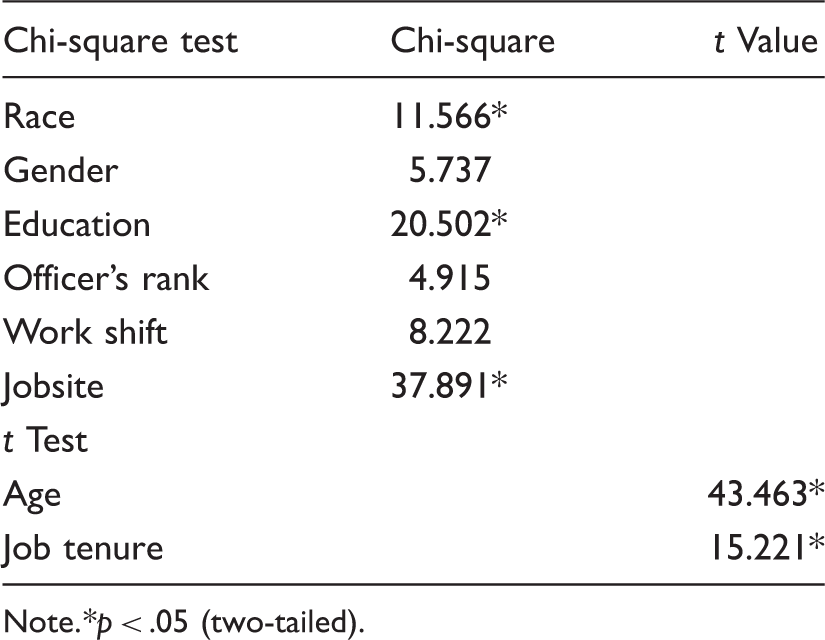
Note.*p < .05 (two-tailed).
The nonsignificant findings for officer's rank were consistent across all of the survey questions. Although more than two thirds of those who responded were designated as police officers, it was interesting that this variable did not have a more substantial impact on the way that the officers agreed or disagreed on the question of graffiti/street art. Based on the police department's rank structure, a police officer is a person who patrols the neighborhoods on a regular basis during a work shift and who would be presented with increased opportunities to respond to issues associated with managing graffiti and street art on a daily basis (see Appendix A for survey questions). However, for reasons difficult to explain, there were no statistically significant differences in the way that the officers responded to the survey questions based on their rank. So, this variable was eliminated from consideration for the multivariate analysis phase of the current study.
Another variable that was found to be nonsignificant was work shift. However, there is a sufficient body of research literature that indicates that police officers who work during the nighttime hours may experience heavier workloads, especially during certain seasons of the year and times of day (Nickels, 2007; O'Brien, 1996; Terrill & Paoline, 2007). For the current study, about 23% of the respondents did not indicate their work shift on the data collection instrument. That reduces the sample size from 130 to about 102, which may have led to the nonsignificant findings for the variable work shift.
Other researchers have found that petty and nuisance crimes, like graffiti, occur during the nighttime hours (Alpert, Macdonald, & Dunham, 2005; Chappell, Macdonald, & Manz, 2006; Smith, Frank, Novak, & Lowenkamp, 2005). There is enough substantive evidence to include this variable in the multivariate analysis when the other independent variables are controlled. Thus, work shift was included in the multivariate analysis. Also, a correlation matrix is displayed in Appendix B, which provides support that the independent variables are not highly intercorrelated.
Multivariate Analysis
The inferential statistical analysis was derived from the multivariate analysis of variance (MANOVA). Independent variables Age and Job Tenure were used as continuous variables while conducting the bivariate analysis. They were converted to categorical variables for MANOVA, such that Age and Job Tenure were transformed to variables with three categories. The second requirement to use MANOVA was two or more continuous dependent variables. The study relied on 17 dependent variables for analytical purposes. The variables are the questions that the police officers responded to, indicating whether they agreed, disagreed, or were not sure how to respond to various questions about graffiti and street art (see Appendix A for survey). Several tests were conducted to ensure that the data met the minimum assumptions for MANOVA. The independent/dependent variable relationships that were found to be statistically significant did not violate the assumption of homogeneity of variance (i.e., Box's M significance) or the assumption of equality of variance (i.e., Levene's test). The independent variables that remained statistically significant when paired with selected questions as dependent variables were Race and the Work Shift that the police officers were assigned to during the period of data collection.
Between-Group Question Differences Based on Officer's Race.
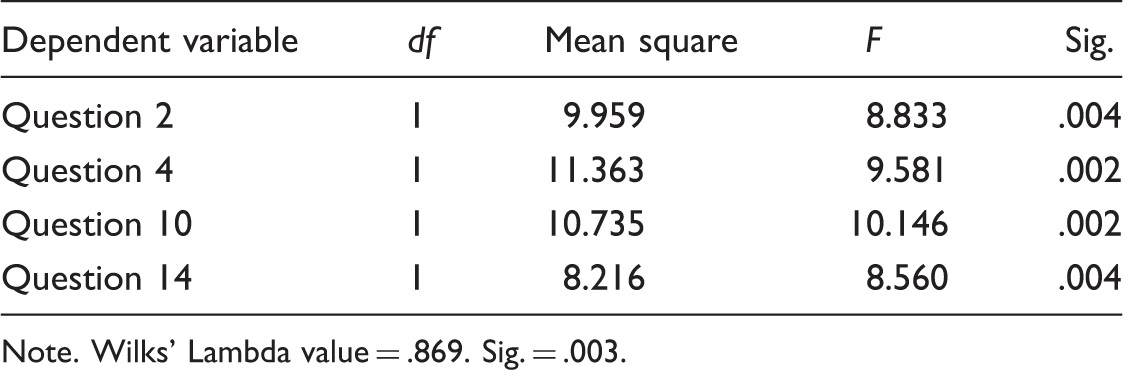
Note. Wilks' Lambda value = .869. Sig. = .003.
Also displayed in Table 3 are the findings related to Question 10 (To what extent do you agree that people who live around graffiti and street art treat their neighborhood in a disrespectful manner?), which indicated that non-Whites were more likely to respond that they were not sure whether they agreed or disagreed with the question, while Whites were more likely to agree with the question. The responses for Question 14 (To what extent do you agree that the following action would work to stop people from doing graffiti and street art—require those convicted to pay a sizable fine?) were similar to the way that the racial categories responded to Question 10, where non-Whites were not sure of their position on the question and Whites expressed their agreement with the question.
Between-Group Question Differences Based on Officer's Work Shift.
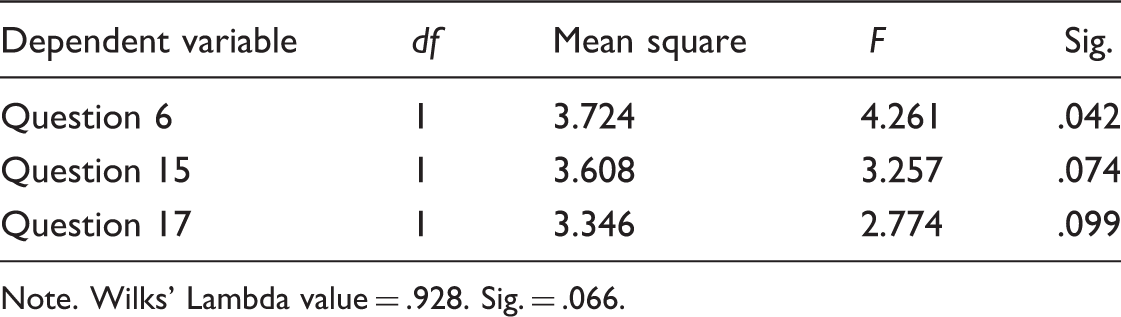
Note. Wilks' Lambda value = .928. Sig. = .066.
An examination of Question 15 mean differences indicated that officers who worked the midnight shift were more likely to respond not sure, indicating that they neither agreed nor disagreed with the question, while those working other times of the day were more likely to agree that there should be a jail sentence for people who commit graffiti acts. And for the final independent variable results for Work Shift, the Question 17 findings are statistically significant. The findings for Question 17 (To what extent do you agree that the following action would work to stop people from doing graffiti and street art—provide places where people could legitimately do graffiti and street art?) indicated that those who worked midnights were more likely to agree with the question, while officers who worked other times of the day were not sure of whether they agreed or disagreed with the question.
As noted in the findings, only two of the independent variables that were statistically significant during bivariate analysis remained available for multivariate analysis. The other significant bivariate variables, such as Education, Age, Job Tenure, and Job Site, did not attain significance at the inferential analysis phase of the study.
At the time of this writing, little research existed on how police officers perceive acts that involve graffiti and street art. The goal of the present study was to add to the scholarship on the topic, to determine how serious police consider graffiti/street art to be, to identify police perceptions of graffiti/street art and the individuals whom they encounter who engage in this activity, and to determine whether they (the police officers) are most likely to respond in a formal legal way (e.g., stop, question, search, and arrest) or in an informal way, such as a verbal warning. And while there is no direct research literature on how police officers respond to acts of graffiti, there may be some clues as to the reasons why officers responded to the specific questions in this study in the broader research literature on police officer use of discretion. The police discretion literature will be relied upon in the next section to help explain why only Race and Work Shift were useful in explaining how police officers responded to a select subset of questions that were defined as dependent variables.
Discussion
The results in the present study related to the key independent variables of officer's race and officer's work shift provide some insights into how these variables affected each officer's perceptions of graffiti and street art. These two independent variables were not significantly related to the same group of questions. There are two plausible explanations for the current findings. First, as it relates to the officer's race, non-White officers were more likely to take a neutral stance on Question 2 (that graffiti and street art is an urban art form), Question 4 (that graffiti and street art is a harmless recreational activity), Question 10 (that people who live around graffiti and street art treat their neighborhood with disrespect), and Question 14 (that people would stop doing graffiti and street art if they got caught and had to pay a sizable fine). The non-White officers, at least as related to their use of discretion, were less likely to be either in favor of or against graffiti and street art. This position parallels the research literature on police use of discretion (Brown & Frank, 2006; Lundman & Kaufman, 2003; Sun & Payne, 2004). Non-White officers may take a wait-and-see attitude, as opposed to strict enforcement of the law. Their approach may reflect the uneven policy approach that their police department has taken in the past in regard to quality-of-life types of crimes. Most of the research on racial differences in police use of discretion has revolved around more serious crimes, like felony offenses (Brown & Frank, 2006; Klinger, 1997; Warner, 1997).
Many of those studies found that non-White and White officers approach the decision to make an arrest differently, especially for crimes like burglary and assault (Warner, 1997). The racial differences may be even more pronounced with crimes like graffiti/street art, where the officer does not have to make a swift life or death decision. Second, as it relates to the officer's work shift, individuals who worked the midnight shift responded in a significantly different manner than those who worked other shifts and were presented with the possibility of catching someone engaged in the act of graffiti or street art. Both Question 15 (To what extent do you agree that the following action would work to stop people from doing graffiti and street art—require those convicted to serve a mandatory jail sentence?) and Question 17 (To what extent do you agree that the following action would work to stop people from doing graffiti and street art—provide places where people could legitimately do graffiti and street art?) asked officers to make a decision based on the legal and policy options available to them.
Officers who worked the midnight shift were more neutral on the legal action mandated in Question 15 and more likely to agree with the informal action identified in Question 17. These findings seem to relate more to whether the officer was working a shift where the majority of the work was completed during the nighttime hours. The officers on the midnight shift probably encountered more instances of graffiti and street art on their work shift than the officers who worked a shift where the majority of the work was completed during the daytime hours. Although placing graffiti and street art on private property violates the law, an urban police officer who responds to mostly violent crimes at night may decide to use more informal and less time-consuming ways to respond to acts of graffiti/street art. Even though there are no relevant research findings to support this perspective, it is an issue that should be explored more closely in future research.
The findings from the present study indicate that an officer's race and work shift may influence how he/she responds to people committing an act of graffiti or street art. These results suggest some guidance for those engaging in future research on this topic. Some elements of an officer's background characteristics seem to influence what type of action (i.e., particularly discretionary action) he/she would take if he/she encountered someone committing an act of graffiti or street art. Future research should examine the officer's race and the time of day that he or she worked to see whether these variables remain significant across various geographical locations.
Conclusion
This study examined police officers' perceptions of graffiti and street art, and their proclivity to stop, question, and arrest individuals who are engaging in this type of vandalism. Although the problem of graffiti and street art is not as important as other salient police discretionary behavior and important calls for service that law enforcement officers can encounter in large metropolitan cities, graffiti/street art, and how law enforcement should respond to this kind of vandalism, remains a significant challenge in large cities both in the United States and elsewhere.
The fact that graffiti/street art is a less salient type of crime may have led to many of the nonsignificant findings. In other words, police officers have unformulated opinions about this type of offense because of its less salient aspects in their daily routine. The other findings, that non-White officers respond differently and that timing of shift is important, seem to be consistent with previous research done on police perceptions and discretionary behavior. Future research on this subject could involve focus groups conducted with police officers, and interviews with officers who work on graffiti task forces. This may produce additional insights that the survey used in this study might not have captured.
The writers recommend that, to best educate and train police officers, a series of in-service workshops led by local graffiti and street artists might be offered to local law enforcement agencies. At a minimum, this could include discussions regarding legal versus illegal graffiti/street art, the role of murals and legal walls, and appropriate sanctions. The aim is not to turn law enforcement officers into connoisseurs of fine art but to sensitize them with respect to the nuances of this type of vandalism and art.
Footnotes
Declaration of Conflicting Interests
The authors declared no potential conflicts of interest with respect to the research, authorship, and/or publication of this article.
Funding
The author received no financial support for the research, authorship, and/or publication of this article.