




Abstract
The present study examined the effect of field supervisor behavior modeling on patrol officer use of unassigned patrol time. Specifically, the study explored whether field supervisor engagement in proactive stops and checks resulted in an increased frequency of proactive stops and checks among patrol officers. Hierarchical analyses of computer-aided dispatch data from two municipal police departments were conducted with 320 shifts and 1,385 individual patrol officer tours of duty. After controlling for call for service workload, shift, agency, and officer demographic characteristics, the findings suggested that when field supervisors engage in proactive investigative activities, the volume of proactive activity by patrol officers approximately doubles. The policy implications and limitations of this study are then discussed.
Police officers are afforded a great degree of discretion when performing their jobs (Davis, 1975; Goldstein, 1960). One area in which patrol officers exercise great discretion is in how they use their free patrol time (Famega, Frank, & Mazerolle, 2005). Previous studies have revealed that most patrol officers have several hours of free patrol time during each tour of duty (Famega, 2005) that could be used to engage in activities that are likely to reduce crime, such as directed patrols at specific locations or proactive stops targeting firearms (Skogan & Frydl, 2004). The prior research, however, has suggested that few patrol officers utilize this free patrol time to engage in proactive policing activities (Famega, 2005; Moskos, 2008; Smith, Frank, & Novak, 2001), and that patrol officers are rarely given clear or specific directions about how to use this free patrol time (Famega et al., 2005; Johnson, 2010).
The prior literature has also revealed the difficulties in directing the work of patrol officers. The mandates given to patrol officers are very broad, vague, and often contradictory (Lipsky, 1980; Wilson, 1968). Patrol officers are mobile in their vehicles and spread across large geographic areas, making the direct observation of their work by a supervisor very difficult (Baker, 2006; Wilson, 1968). Agency priorities and enforcement directives tend to differ from supervisor to supervisor (Johnson, 2010). Furthermore, due to civil service rules and collective bargaining agreements, first-line supervisors generally have little ability to formally reward or punish their subordinates (Lipsky, 1980; Wilson, 1968). This suggests a need to discover effective methods to assist police supervisors in improving their patrol officers’ use of free patrol time.
Supervisor modeling of the behaviors expected of patrol officers may be one way supervisors can encourage patrol officers to engage in proactive efforts to prevent crime. Some research has suggested that followers tend to look to their leaders for cues about how to behave, and that they usually imitate the behavior they see in their leaders (Arbak & Villeval, 2013; Bruttel, 2001; Bruttel & Fischbacher, 2013; Dufwenberg & Gneezy, 2000). The quantity of this research, however, is limited and generally not been tested in a policing context. The present study, therefore, sought to examine the effect of supervisor modeling of proactive investigative activities on the proactive crime prevention activities of patrol officers. Using hierarchical, computer-aided dispatch (CAD) data from two municipal law enforcement agencies, the present study examined whether leadership by example by field supervisors increased the frequency of proactive stops and checks by the patrol officers under their supervision.
Contemporary Police Leadership
Hersey and Blanchard (1982) defined leadership as the “process of influencing the activities of an individual or a group effort toward achieving a goal” (p. 83). One of the challenges facing leaders, however, is getting followers to do something they otherwise would not do (Gachter, Nosenzo, Renner, & Sefton, 2012). This challenge appears to be even more significant in a policing environment. Patrol officers are constantly on the move in their vehicles, patrolling and responding to calls, and are deployed across wide geographic areas. This makes directly observing and supervising officers extremely difficult (Lipsky, 1980; Wilson, 1968).
Patrol officers act alone in most of their interactions with the public and are permitted wide latitude in determining how best to resolve the problems they encounter (Lipsky, 1980; Wilson, 1968). Their mandates are vague (such as maintain order) or contradictory (such as control crime but also protect individual rights). Patrol officers do not produce a product that can be easily measured in terms of quantity or quality. These things make it extremely difficult for supervisors to objectively critique their work except in extreme cases when things have gone very well or very poorly (Lipsky, 1980; Wilson, 1968). Finally, because of civil service rules and union contracts, police supervisors are extremely limited in their ability to formally reward the good performance, or punish the bad performance, of officers (Lipsky, 1980; Wilson, 1968).
Apparently, some police supervisors must see these limitations on their ability to manage as almost insurmountable as some evidence exists that few police supervisors actively manage in the field. For example, while conducting participant observation research with Seattle police officers in the 1970s, Van Maanen (1983) revealed that most supervisors stayed in the station house, preferring to manage officers by simply reviewing their paperwork. The few supervisors who did venture out into the field to check up on their officers, however, drew the attention of their subordinates who often gave these supervisors their respect and branded them with macho nicknames. In an ethnographic study of police officers in one city in Colorado, however, Pogrebin and Poole (1988) found that patrol officers criticized the only supervisor who frequently did venture into the field and engaged in patrol work by stopping cars or attending routine calls. One officer was quoted as asking, “Why doesn’t he sit on his ass in the station and pretend he’s busy like the rest of the lieutenants do?” (Pogrebin & Poole, 1988, p. 190).
Wycoff (1992) found that patrol sergeants on the Minneapolis Police Department only spent 11% of their time in face-to-face contact with their subordinates and most of this contact occurred during roll call shift briefings, not out in the field. Engel (2001) studied sergeants and lieutenants in Indianapolis, IN, and St Petersburg, FL. Conducting surveys and systematic social observation of field supervisors in these two cities, she identified four different supervisory styles among these supervisors. One style of supervisor, the supportive style, tended to stay in the police station, preferring to handle paperwork. The traditional style would occasionally venture out into the field but would usually only observe officers doing their work.
The innovative style would also spend some time out in the field but more often used this field time to engage with citizens for the purpose of improving community relations and rarely came into contact with officers. The last style, however, called the active style, frequently ventured into the field responding to calls, making stops, and backing up officers. Officers tended to show the greatest respect toward the active style supervisors (Engel, 2001) and produced more citations and arrests when working for this type of supervisor, but these increased productivity levels failed to reach statistical significance (Engel, 2000).
Finally, Famega et al. (2005) conducted a systematic social observation study within the Baltimore Police Department and found that field supervisors rarely directed officers how to use their unassigned free patrol time. In the few instances when supervisors did provide officers with direction, the instructions were generally vague and difficult to apply (such as “crack down on the drug dealing”).
Nevertheless, the general public, governmental leaders, and police executives expect field supervisors in law enforcement to supervise, manage, and direct the work activities of patrol officers. Police field supervisors are also legally accountable for their officers’ behaviors while at work (Baker, 2006). As police officers are given great discretion to exercise their authority in the course of their duties, it is extremely important that this use of discretion does not go unsupervised (Davis, 1975; Goldstein, 1960). Despite the many barriers to supervising and leading police patrol officers, it is crucial that effective leadership strategies and techniques be identified for the police work environment. Modeling desired work behaviors in the field may be one possible method for effectively leading in the police work environment.
Leadership by Example Literature
Role modeling, or leading by example, has been an important feature of several leadership theories over the past few decades. The economic theory of leadership (Hermalin, 1998) suggested that leaders could gain followers by taking actions that supported the greater good of the organization, so long as the leader’s actions were observable to the rest of the team members. Charismatic and transformational leadership theories (Bass, 1985; House, 1977; Shamir, House, & Arthur, 1993) suggested that a leader’s achievement of charisma with subordinates came from demonstrating a willingness to be “one of them” and help subordinates with their work. In self-sacrificial leadership theory (Choi & Mai-Dalton, 1999), leaders encourage followers to transcend self-interests on behalf of the organization as a whole by modeling such self-sacrificial behavior themselves.
It is surprising, therefore, that there have been few field studies that have directly tested the premise that supervisor activities that model good work behaviors encourage followers to do the same. To date, most of the evidence to support this premise has come from laboratory experiments under contrived conditions. Many of these experiments have involved what has come to be known as the Bertrand Pricing Game (Dufwenberg & Gneezy, 2000). This game involves a group of research participants being directed to each select a number. After the numbers are chosen, the numbers selected by each participant are revealed and whoever selected the lowest number receives a monetary reward. As the game is repeated with the same participants, the mean number selected continues to decrease with each round of play.
Where a paradox arises, and leadership by example appears to occur, is that when a leader selects an abnormally high number, knowing that he or she is sacrificing any chance of monetary reward, other participants always follow the leader’s example. After this self-sacrificial action on the part of the leader, most of the players begin bidding higher while knowing there is little likelihood of obtaining the financial reward. This paradoxical behavior has been found repeatedly by different experimenters in different countries and has been argued to provide evidence of the influential effects of leading by example through self-sacrifice (Arbak & Villeval, 2013; Bruttel, 2001; Bruttel & Fischbacher, 2013; Dufwenberg & Gneezy, 2000).
Other laboratory experiments that have been offered as evidence of leadership by example involve voluntary contribution games. In this type of an experiment, a group of research subjects are each given a stack of tokens and individually asked to contribute these tokens to a charity. For every token a participant donates to the charity, all of the participants receive a small monetary reward, but for every token a participant keeps, that participant (and only that participant) will receive twice the compensation available if the token was donated. This game creates a situation in which the incentives should entice the participants to keep all of their tokens and not contribute to the greater good of the group or the charity (Moxnes & Van der Heijden, 2003).
In the leadership version of the game, a designated leader goes first, and his or her contribution is revealed to the other participants before they are asked to make their own contributions. In every study reviewed here, the contribution made by the leader was strongly correlated with the subsequent contributions of the rest of the players (Gachter et al., 2012; Guth, Levati, Sutter, & Van der Heijden, 2007; Moxnes & Van der Heijden, 2003; Potters, Sefton, & Vesterlund, 2007). If the leader was self-sacrificial and made a significant contribution to the charity, most of the other players followed suit. If the leader contributed few (or no) tokens, so did most of the other players. This finding was not influenced by the participants’ attitudes about cooperation measured before or after the experiment (Gachter et al., 2012). Furthermore, the findings were consistent no matter whether the leader was appointed or elected (Guth et al., 2007). The behavior of the leader appeared to signal to the followers how to behave within the given situation.
Outside of these laboratory experiments, only a few field studies of leadership by example exist. Vesterlund (2003) found that when a well-known celebrity publicly contributes to a charity, overall contributions to the charity tend to increase for a period of weeks after the celebrity’s publicized contribution. Rich (1997) surveyed 183 salespersons from 10 companies in the United States about their job satisfaction, sales performance, and their sales manager’s work behavior, including behavior modeling. The modeling behavior of the sales manager was measured through several survey items about how often the manager handled sales calls, helped salespersons with their paperwork, provided salespersons with new customer leads, and demonstrated sales techniques. The findings revealed that higher scores of manager behavior modeling were correlated with higher levels of salesperson job satisfaction, overall sales performance, and trust in the manager (Rich, 1997).
In Israel, Yaffe and Kark (2011) measured attitudes about organizational citizenship behavior among 683 employees and their 67 supervisors in a telecommunications company. Organizational citizenship behavior was defined as discretionary behaviors that, in the aggregate, promoted the effective functioning of the organization, including trying to get along with coworkers, not abusing breaks or sick days, and putting forth one’s best effort at work. Yaffe and Kark found that the organizational citizenship behavior attitudes of the supervisors were highly predictive of the organizational citizenship behaviors of their subordinate employees.
Finally, using observational data from the Police Services Study, Johnson (2008) examined the amount of time officers spent on meal breaks and conducting other personal business while on duty. Examining 922 patrol officers and 27 field supervisors from 24 municipal police departments, he found a weak but positive correlation between the amount of time the supervisors spent on personal business and the amount of time the officers on the same department spent on personal business.
Hypothesis
The findings from the previous literature on leading by example suggest that the behavior of the leader signals the followers how to behave. This leads to the expectation that when police field supervisors engage in work behaviors in the field, and the officers on duty are aware of the supervisor’s actions, the patrol officers will follow suit and copy the supervisor’s behavior. In the present study, proactive officer-initiated activities are examined as the behavior being modeled by the supervisor. The prior literature, therefore, leads to the following research hypothesis.
Method
Descriptions of Community Demographics (2010).
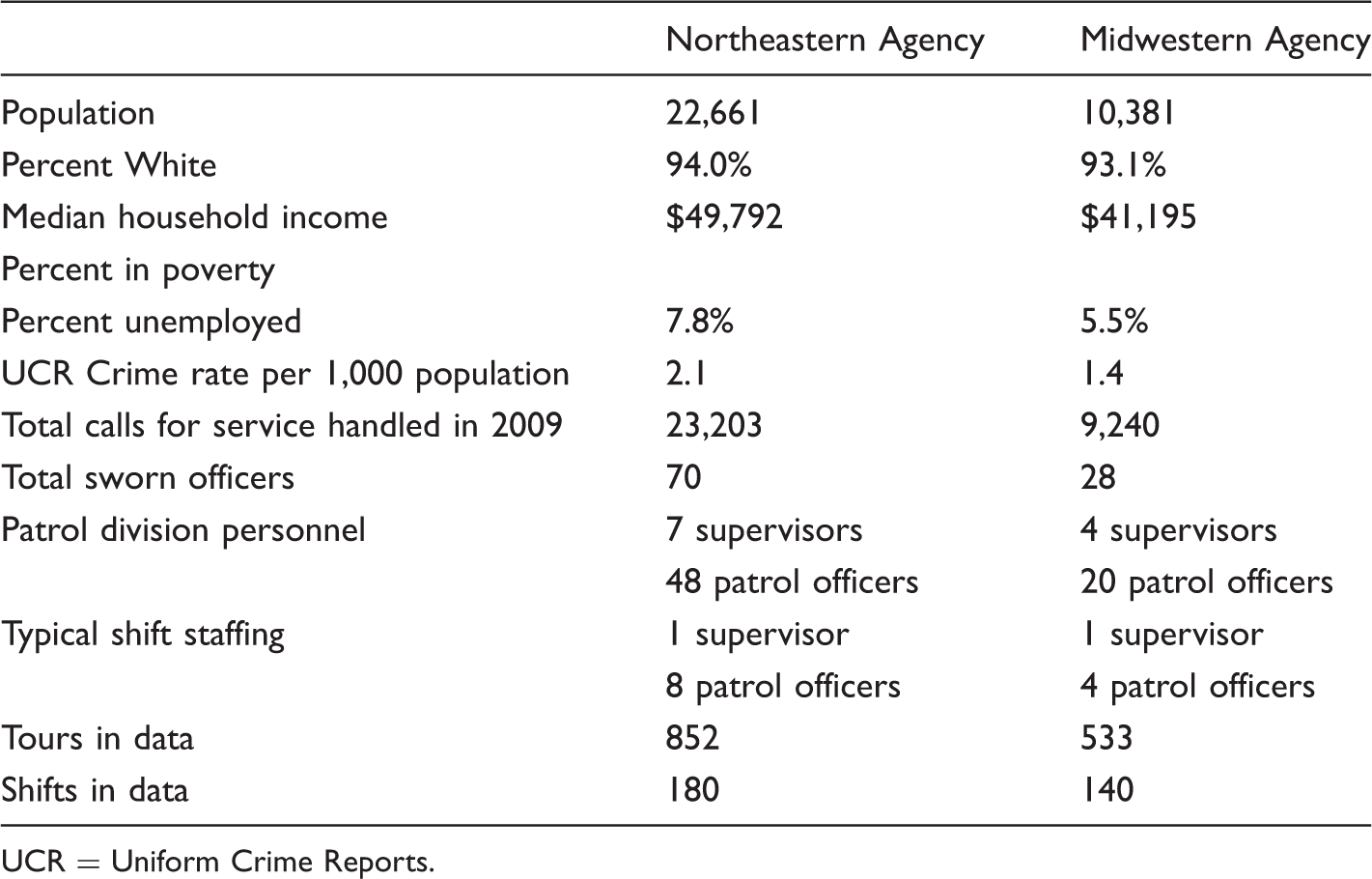
UCR = Uniform Crime Reports.
Sample
CAD files within these two agencies record data on individual officer and supervisor activity including calls assigned, administrative tasks, meal breaks, officer-initiated activities, and the times each of these activities began and ended. CAD data permitted the examination of each officer’s tour of duty activities, aggregate tours of duty to the shift level, and examination of the activities of the supervisor assigned to each shift. CAD data from both agencies were downloaded for a 60-day period from June 1 through July 30, 2010. 1 These data were organized into a two-level, hierarchical framework with shifts at the higher level and individual officer tours of duty at the lower level. Each agency utilized three shifts per day, for 180 shifts per agency.
At the shift level, data on the assigned supervisor for the shift were gathered. In the data for Northeast Agency, 27 shifts were discovered when more than one supervisor within the patrol division worked the same shift. In these cases, however, only one of the supervisors was formally assigned responsibility for the shift and its paperwork. In cases where multiple supervisors worked, only the activities of the supervisor officially assigned the role of shift supervisor were recorded. It was also discovered that during 40 of the Midwest Agency shifts, no supervisor was assigned due to supervisors being on regular days off, attending court or training, and taking vacation time. These 40 shifts, therefore, were deleted from the sample, as there was no shift supervisor activity to be matched to the patrol officers’ tours of duty. The final sample of shifts, therefore, was 320 shifts, with 180 shifts for Northeast Agency and 140 for Midwest Agency.
The Level 1 of data consisted of the individual patrol officers’ tours of duty, to be matched with the 320 shifts (Level 2 of the hierarchical model). Initially, the data included 1,973 tours (1,440 for Northeast Agency and 533 for Midwest agency), but examination of assignment rosters revealed that several of the Northeast Agency tours did not consist of a normal patrol officer assignment. One of the officers assigned to the patrol division was also assigned a canine and performed other duties (such as drug searches, human tracking, assisting other agencies, and care for the dog) beyond those of a normal patrol officer. Two other officers were designated school resource officers who, when school was not in session, reverted back to patrol officer responsibilities. These officers, however, still assisted with summer school programs and camps and therefore had other duties that distracted them from their duties as patrol officers.
Furthermore, on every day and evening shift, one officer was assigned as a traffic unit with the primary responsibility of proactive traffic enforcement. This duty rotated among the officers, and the one assigned as traffic unit for the day was free from the obligation of handling dispatched calls for service, with the exception of traffic accidents. Although not given a specific quota for stops, this assignment was mandated to perform proactive traffic stops and aggressively hunt for drunken drivers. Thus, these cases were also excluded from the analysis. After the exclusion of these atypical cases, the final tour-level sample consisted of 1,385 tours (852 for Northeast Agency and 533 for Midwest Agency).
Measures
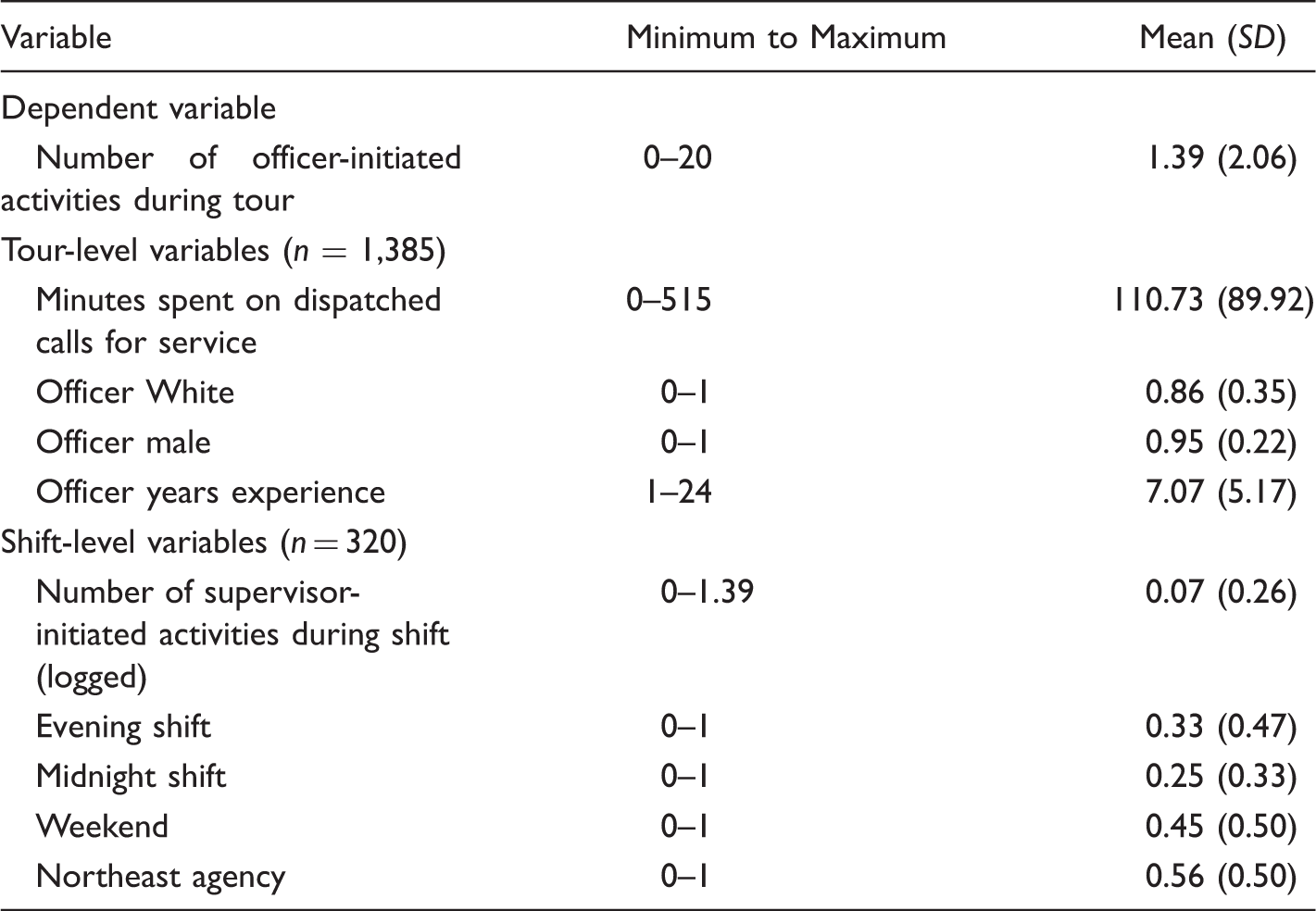
The dependent variable was the number of proactive, officer-initiated activities in which the individual officer engaged during a tour of duty. Officer-initiated activities are generally subject to officer discretion during the shift, so it was determined that this would be a sufficient measure of officer level of officer-initiated work activity. For both police departments in the sample, a formal written policy required officers to record all of their proactive and reactive activities in the CAD system. This was accomplished either by radioing the dispatcher who would enter the activity into the CAD system for them or by the officers entering the activities themselves via their in-car computers. All entries for proactive stops of vehicles or pedestrians, proactive investigations of suspicious circumstances, and security checks of buildings to ensure that they had not been vandalized or burglarized were summed to create the measure of officer-initiated activities during each tour.
The CAD systems for these two agencies recorded 1,925 proactive activities conducted by patrol officers. Of these proactive activities, 75.7% were vehicle or pedestrian stops, 12.5% were investigations of other suspicious circumstances, and 11.8% were building security checks. The supervisors conducted a total of 136 proactive activities, of which 65.7% were vehicle or pedestrian stops and 34.3% were building security checks.
Because of the hierarchical nature of the data, independent variable measures were created at both the tour and shift levels. These independent variables will be discussed by each level.
Tour-level measures
Among the 1,385 tours, four different characteristics were measured as controls on officer-initiated activities. The most important control was assumed to be officer workload during the shift. Regardless of supervisor influences, or officer intentions, the less free time an officer has between calls, the less likely she is to engage in many proactive activities during the shift. In Johnson’s (2008) examination of supervisor influences on officer personal business while on duty, it was revealed that the number of minutes officers spent on assigned calls was the strongest predictor of officer shirking, with officers who handled more calls engaging in less personal business while on duty. In the present study, officer workload was also defined as the number of minutes during the tour that the officer was out of service handling a call or task that was assigned by the dispatcher. This included calls for which the officer was assigned as the primary officer and calls in which the officer was assigned to assist as backup. It was predicted that workload would demonstrate a negative relationship to proactive activities, as tours during which the officer spent more time handling assigned calls would result in fewer officer-initiated proactive activities.
Three officer demographic characteristics—race, sex, and experience—were also included as controls, as these three characteristics are included in most studies of law enforcement officer work activities (Riksheim & Chermak, 1993; Sherman, 1980; Skogan & Frydl, 2004). Race was coded as 1 for White officers and 0 for non-White officers, and sex was coded 1 for males and 0 for females. In previous studies, officer race and sex have shown inconsistent relationships with various work productivity measures (Skogan & Frydl, 2004), so no relationship direction was hypothesized here. The prior literature, however, has generally revealed a negative relationship between officer experience and work productivities, as more experienced officers tend to produce fewer arrests, citations, and use-of-force incidents than less experienced officers (Riksheim & Chermak, 1993; Sherman, 1980; Skogan & Frydl, 2004). Thus, it was hypothesized that the more years of experience an officer had, the less likely the officer was to engage in proactive activities during the tour.
Shift-level measures
The 1,385 tours of duty were nested within 320 shifts. The primary variable of interest at the shift level was the supervisor-initiated activities that occurred during each shift. This variable was measured as the sum of the number of all proactive stops of vehicles or pedestrians, proactive investigations of suspicious circumstances, and security checks of buildings that were conducted by the supervisor assigned to each specific shift. It was hypothesized that higher levels of supervisor-initiated activities would correspond with higher levels of officer-initiated activities during the shift. It is also important to note that these supervisor activities would be known by the officers working on the shift as the CAD displays for them the work activities of all the personnel currently on duty, as well as overhearing radio communication from the supervisor.
The remaining shift-level variables were controls for confounding influences on officer-initiated productivity. The time of day of the shift was controlled through dichotomous, dummy variables for the evening shift and the midnight shift, with the day shift serving as the reference category. Prior research has revealed temporal patterns for criminal activity and calls for service to the police, with evening shifts being the busiest and midnight shifts being the lowest for calls for service (Cohn, 1993, 1996; Ratcliffe, 2002). It was hypothesized that evening shifts would be associated with lower levels of officer-initiated activities because of the higher volume of calls for service and reduced opportunities for officer-initiated work. It was also expected that midnight shifts would be associated with higher levels of officer-initiated activities simply because of the lower call for service volume and elevated expectations for criminal activity (Cohn, 1993, 1996; Ratcliffe, 2002). Likewise, police agencies tend to see an increased volume of calls for service on weekends (Cohn, 1993, 1996; Ratcliffe, 2002), reducing opportunities for officer-initiated activities. Shifts on Saturdays and Sundays, therefore, were coded 1 for weekends, and shifts on all other days were coded 0.
Finally, specific agency or community culture was controlled. Strong evidence has suggested for some time that different law enforcement agencies, and the communities they police, have characteristics that influence the overall enforcement activities of officers (Groeneveld, 2005; Liederbach & Travis, 2008; Slovak, 1986; Wilson, 1968). As a simple control for differences by agency in enforcement culture, shifts from the Northeast agency were dummy coded and shifts from the Midwest agency served as the reference category.
Procedure
The analyses of the data took place in several steps. First, descriptive statistics were calculated for all of the variables involved and closely reviewed. Second, tests were conducted for multicollinearity among the independent variables. Third, hierarchical multiple regression models were estimated and examined for evidence supportive of the research hypothesis. Finally, if evidence was found to support the research hypothesis, examination was made of the average influence each supervisor-initiated activity had on officer-initiated productivity.
Results
Variable Descriptive Statistics.
Pearson’s Bivariate Correlations.
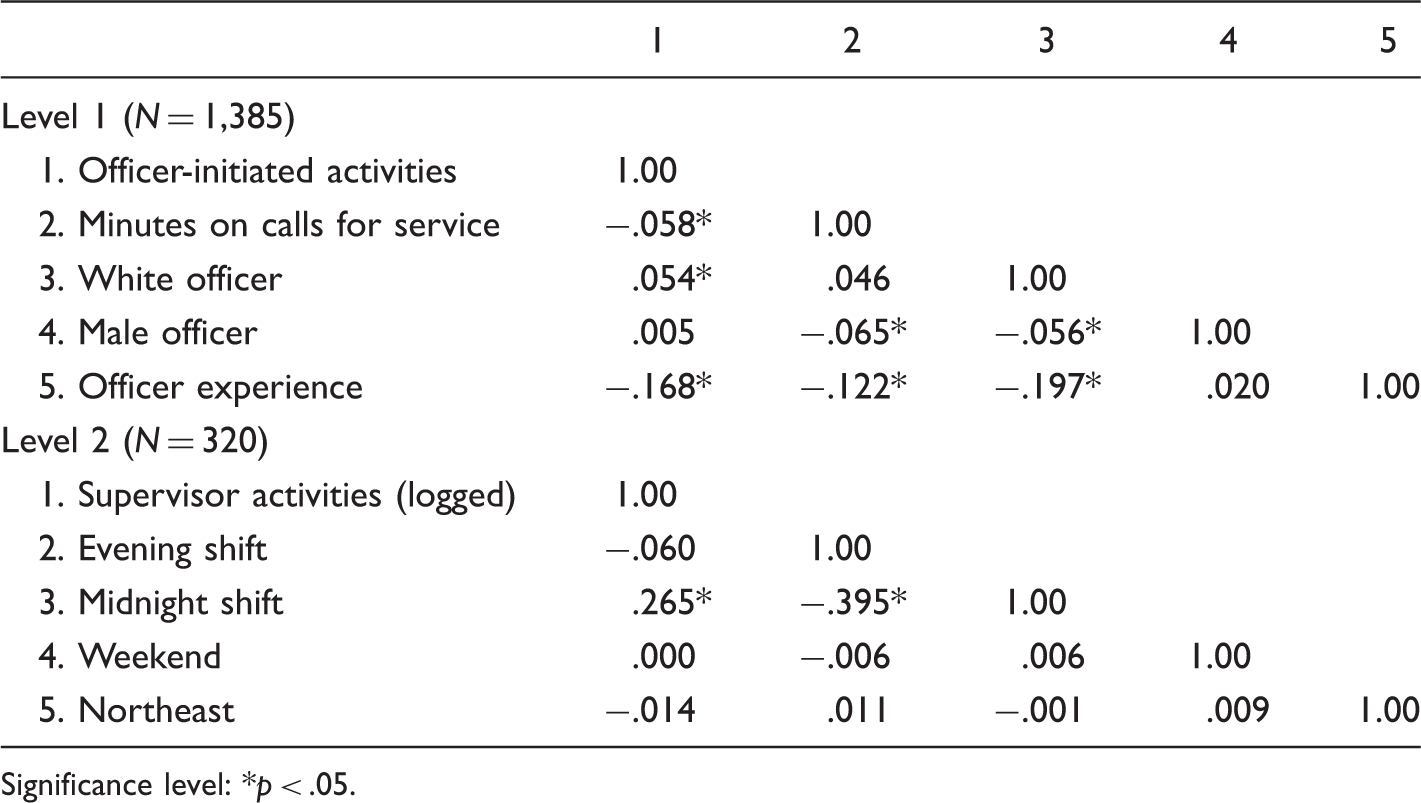
Significance level: *p < .05.
Table 3 revealed no strong correlations (Pearson’s r > .500) among the independent variables, suggesting no multicollinearity. To confirm this, however, variance inflation factors were calculated at the tour level and at the shift level. The variance inflation factor values of the independent variables ranged from 1.15 to 1.48, all well below the conservative threshold of 5.0 (Kutner et al., 2004). These facts confirmed collinearity among the independent variables was not an issue of concern.
Poisson Hierarchical Linear Models.

Significance levels: *p < .05, **p < .01, ***p < .001.
In the first model in Table 4, officer-initiated activities were regressed by only the tour-level independent variables. Three of these four independent variables demonstrated statistically significant relationships with the dependent variable. The number of minutes spent on assigned calls displayed a negative relationship with the dependent variable, with increases in time on dispatched calls corresponding with decreases in officer-initiated activities during the tour of duty. Likewise, higher levels of police experience corresponded with lower levels of officer-initiated activity. White officers were again associated with higher levels of officer-initiated activity within these two police departments, even after controlling for officer experience level. Finally, officer sex failed to produce a statistically significant main effect on officer-initiated activities. Combined, these four variables explained approximately 30% of the variance in the dependent variable.
Model 2 of Table 4 is a two-level hierarchical model using both the tour- and shift-level independent variables. Inclusion of the shift-level variables doubled the amount of variance explained over simply the tour-level variables. In this full model, the tour-level variables maintained the same pattern of statistically significant relationships and directions of these relationships. At the shift level, four of the five independent variables produced statistically significant relationships with the dependent variable after holding the effects of the tour-level variables constant. For example, the Northeast Agency officers generally engaged in more proactive, officer-initiated activities per tour than the Midwestern Agency.
Some of the directions of the statistically significant relationships, however, were not in the directions anticipated. It was expected that the high call volumes on evening shifts and weekends would lower officer-initiated activity, and the low call volume on midnight shifts would increase officer-initiated activities. The findings here, however, revealed the exact opposite. Tours on weekends were associated with more officer-initiated activities than weekdays. Tours on evening shifts were associated with more officer-initiated activities than the daytime shift, and tours on the midnight shift were associated with fewer officer-initiated activities than the day shift.
These findings may be explained by the small, suburban, homogeneous populations of these two communities. Being suburban communities with low unemployment, there may have been fewer vehicles or pedestrians to stop on weekdays when most of the residents were at work or school. On weekends, when more residents are at home and engaged in recreation or entertainment activities near their homes, there may have been more vehicles and pedestrians to observe. The routine activities of the community residents may also explain why fewer stops occurred during midnight shifts. When residents are asleep, there are likely fewer vehicles and pedestrians on the street. If no one is on the street, then there are few opportunities to conduct stops. These two findings, therefore, may have been an artifact of the types of communities examined.
The most important variable at the shift level for this study was the logged supervisor-initiated activities. This variable demonstrated a statistically significant relationship in the direction hypothesized. Higher levels of proactive, supervisor-initiated activities corresponded with higher levels of officer-initiated activities after controlling for all of the potentially confounding influences in the model. This finding supported the research hypothesis that supervisor modeling of proactive stops and checks resulted in increases in officer-initiated proactive stops and checks.
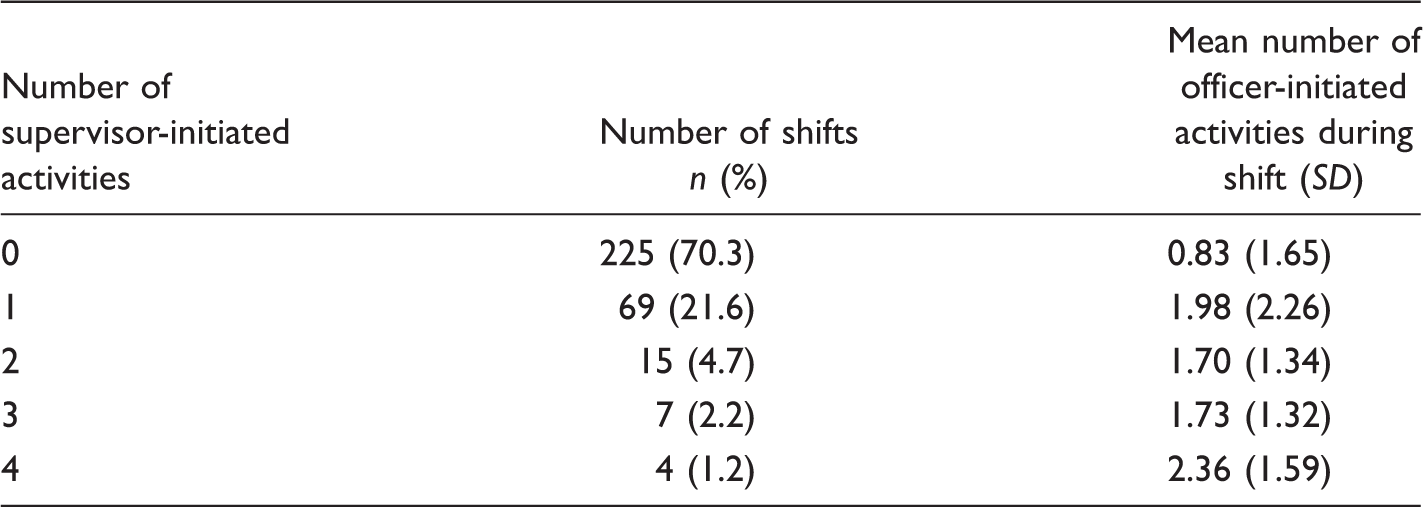
Mean Officer-Initiated Activities by Supervisor-Initiated Activities.
Discussion
In the beginning of this article, it was established that leading and supervising patrol officers’ discretionary free patrol time behavior appeared very difficult for a number of reasons. Evidence was then offered that few field supervisors in policing actively attempt to direct their officers’ actions in the field. A review of the literature on leadership by example, however, suggested that supervisor modeling of worker behavior might result in improved officer performance in these areas. The present study tested this hypothesis using proactive, officer-initiated activities as a measurable work output and led to three major conclusions.
First, field supervisors rarely engaged in proactive activities in the field that are assumed to be the responsibilities of patrol officers. In more than two thirds of the shifts in the data, the field supervisor never engaged in any proactive activities. In a quarter of the shifts, the supervisor engaged in proactive activities, but no more than once or twice during the shift. Supervisors engaged in more than two proactive activities in only 3.4% of the shifts. This provided additional evidence that within police work, field supervisors rarely venture out into the field to directly supervise their officers or model expected performance.
Second, the officers on these two police departments generally did not engage in very many proactive activities during their tours of duty. The officers on these two departments worked 8.5-hr shifts and were permitted a 60-min meal break at some point during the shift. Roll call shift briefings also occupied another 30—to 60 min at the beginning of each shift. The mean number of hours the officers spent on assigned calls was approximately 2 hr per tour of duty, including calls assigned as simply the backup officer. This suggested that, on average, these officers had approximately 4.5 hr of unassigned time during each tour of duty to complete their reports from the calls that they had handled and to engage in proactive activities. Even so, they tended to average only one proactive activity per tour of duty.
Third, and most importantly, the findings here supported the research hypothesis that when shift supervisors engaged in proactive investigatory stops of vehicles or persons, or conducted security checks of businesses or residences, the patrol officers working the same shift also engaged in higher levels of proactive officer-initiated activities. Even though proactive supervisor-initiated activities had only a modest overall effect on officer-initiated activities (1 vs. 2 activities per tour), it is important to remember that productivity doubled per officer and note that this effect was multiplied across all of the officers on duty during the shift.
It appeared that supervisor behavior acted as a signaler to patrol officers, communicating to them that proactive activities were expected, at least at this time. Patrol officers are called upon to perform a myriad of duties by nature of being one of the few government entities available 24 hr a day, 7 days a week (Fyfe, 1993). The diversity of patrol officer responsibilities makes it difficult for officers to know which of their duties their supervisors expect them to prioritize during their free patrol time on any given tour (Johnson, 2010). Patrol officers, therefore, may need signals from their supervisors about which of these tasks to prioritize at any point in time. They may look to their immediate supervisors to indicate, in some manner, which activities most need their attention on this shift.
Like all studies, however, this one had its limitations. First, this study utilized data from a nonrandom sample of only two law enforcement agencies. This makes generalization of the findings to other law enforcement agencies difficult. Nevertheless, this level of access to law enforcement agency data is difficult to garner, and this was an initial exploratory study into this issue. Furthermore, as the agencies in this study were small and policed communities that were suburban, fairly homogeneous, and low in crime, these agencies were representative of the typical law enforcement agency in the United States in terms of size and community characteristics (Bureau of Justice Statistics, 2011). Future studies, however, should utilize larger samples with a greater diversity of communities and agency sizes.
Second, the study design was nonexperimental, lacking random assignment or control over the dosage level of supervisor proactive activities. Future research should attempt to experimentally manipulate supervisor-initiated activities by randomly assigning supervisors to a set number of proactive stops and checks. Third, the dependent variable selected for study was a measure of quantity, but not necessarily quality, of patrol officer activity. Good police work involves much more than simply proactive stops and checks. The dependent variable used here also did not account for patrol officer time spent proactively driving around or parking at known hot spots, which can also deter crime and disorder (Skogan & Frydl, 2004). Future research in this area should involve a more diverse array of dependent variables.
Fourth, the present study did not examine whether the specific proactive supervisor activity encountered resulted in the exact same sort of activity from patrol officers. In other words, if a sergeant performed a traffic stop, did the officers respond by also performing only traffic stops, or were their proactive activities more diverse? Fifth, the present study was unable to control for any directives for proactive activities the supervisors may have issued to their officers at roll call or during the shift, even though the previous research suggests these directives are unlikely (Famega et al., 2005). Finally, because supervisor-initiated investigative activity was so rare on these two agencies, when sergeants did engage in these activities, their behavior may have been very conspicuous to their patrol officers. Perhaps these supervisor activities would not have been as noticeable to the patrol officers if they were more common, and perhaps the officers would have responded differently. Nevertheless, the findings of the present study are consistent with the previous findings from laboratory experiments (Arbak & Villeval, 2013; Bruttel, 2001; Bruttel & Fischbacher, 2013; Dufwenberg & Gneezy, 2000), field studies in industry (Rich, 1997; Vesterlund, 2003; Yaffe & Kark, 2011), and field studies in policing (Johnson, 2008).
In conclusion, the present study identified a few policy implications for the direction and leadership of patrol officers. The present study, and the previous findings from Johnson (2008), suggested that patrol officers do look to the behavior of their field supervisors to determine what behaviors are expected or permitted. The first policy implication, therefore, is the importance of field supervisor behavior in the management of patrol officer behavior. Police field supervisors should be educated about this fact and constantly reminded that their officers will watch and imitate their behavior. Second, as all of the potential theoretical underpinnings suggested (Bass, 1985; Choi & Mai-Dalton, 1999; Hermalin, 1998; Shamir et al., 1993), to be effective, supervisors need to ensure that their subordinates observe the behaviors that they are modeling. In the present study, all of the officers and supervisors on duty were kept informed of each other’s activities through radio communication and updates in the CAD system. For agencies with such CAD monitoring systems in everyone’s patrol car, this may be sufficient, but for agencies lacking such systems, or officers on foot patrol, supervisors may need to find other ways to give their activities more visibility.
Third, the findings revealed that field supervisors may not have to work very hard in order to motivate their officers to engage in proactive, officer-initiated work. Only one or two proactive activities on the part of the supervisor during the shift proved sufficient to double the efforts of their officers in this study. This suggests that many officers are motivated to please their supervisors (or at least want to avoid conflict with their supervisors), and they need only cues about what activities the supervisor expects from them. Fourth, police executives need to ensure that their field supervisors have opportunities to get out into the field to model behavior for their officers. Paperwork burdens on field supervisors must be kept manageable and assigning supervisors to duties that prevent them from venturing out into the field (such as manning the front desk at the station house or working in dispatch) eliminate opportunities for these supervisors to lead by example.
Fifth, the present study joins prior studies (Famega, 2005; Famega et al., 2005; Johnson, 2008; Moskos, 2008; Smith et al., 2001), suggesting that officer free patrol time is being underutilized in many law enforcement agencies today. This is time that could be better spent on officer-initiated activities that have shown some success in reducing crime and improving public safety, such as directed patrols at hot spot locations, proactive stops looking for guns, proactive stops looking for drunk drivers, and stops and surveillance on known repeat offenders (Skogan & Frydl, 2004). Perhaps routine engagement in these types of activities by field supervisors could motivate patrol officers to improve the use of their free patrol time.
Footnotes
Declaration of Conflicting Interests
The author declared no potential conflicts of interest with respect to the research, authorship, and/or publication of this article.
Funding
The author received no financial support for the research, authorship, and/or publication of this article.