




Abstract
Technology has become a major source of expenditure and innovation in law enforcement and is assumed to hold great potential for enhancing police work. But does technology achieve these expectations? The current state of research on technology in policing is unclear about the links between technologies and outcomes such as work efficiencies, effectiveness in crime control, or improved police–community relationships. In this article, we present findings from a mixed-methods, multiagency study that examines factors that may mediate the connection between technology adoption and outcome effectiveness in policing. We find that police view technology through technological and organizational frames determined by traditional and reactive policing approaches. These frames may limit technology’s potential in the current reform era and cause unintended consequences.
Introduction
Technology has become a major source of expenditure and innovation in law enforcement in the last four decades and is often assumed to hold great potential for enhancing the ability of police to do their work. At the most basic level, technology is seen as a means to increase an organization’s technical efficiency, defined as maximizing outputs using the lowest cost, time, and resources possible (see Rutgers & van der Meer, 2010; see also McGowan, 1984a). For example, police adopted license plate readers to detect stolen vehicles because the readers could enable them to automatically scan hundreds of vehicle license plates in minutes, as opposed to manually entering selected plates into computer databases one-by-one. Computerized records management systems replaced the hand reporting, shelving, and analysis of paper police reports so that information could be more easily searched, retrieved, and analyzed. Police cars and radios were purchased so officers could react to citizen 9-1-1 calls more quickly.
However, aside from technology making the police more technically efficient, technology is also thought to improve the outcome effectiveness of the police. Although arguably a complementary component to efficiency (see Hatry, 1978, 2014), outcome effectiveness is distinguished from efficiency in the public administration literature by its emphasis on achieving specific outcomes (see, e.g., Goodman & Penning, 1977; Quinn & Rohrbaugh, 1981; Rutgers & van der Meer, 2010). In policing, for example, technology is believed to improve the ability of police to identify and monitor offenders or bolster evidence collection to resolve cases. Information technologies help facilitate the identification of hot places and people to target them for crime prevention with the goal of reducing crime and recidivism. Agencies have also acquired new social media technologies to enhance communication between themselves and citizens to strengthen that relationship.
One important question for policing that we explore in this article is whether technology helps police to be more effective in achieving outcomes or whether it primarily increases organizational efficiencies (Lum, 2010; Maguire, 2014). Of course, efficiency and effectiveness are not zero-sum trade-offs; scholars have long discussed the interaction between efficiency, effectiveness, and cost-effectiveness (see, e.g., Hatry, 1978; McGowan, 1984a, 1984b). Hatry (1978, 2014) in particular has discussed the need to track performance in terms of outcome efficiency rather than output efficiency (see Hatry, 2014, p. 21), an idea which combines notions of technical efficiency and outcome effectiveness in performance measurement. Nonetheless, questions about the effectiveness and efficiency of police technology are far from settled in empirical research. Some research as well as technical and vendor assessments assert that technologies can make policing processes faster and easier, as illustrated by the aforementioned license plate reader example. At the same time, research and police practice reveal that using technology can sometimes reduce efficiency and may not help achieve outcomes such as the prevention or reduction of crime or the improvement of citizen trust, confidence, and satisfaction with the police.
The difficulty in linking technological advances in policing with outcomes such as crime prevention, improved community relations, or accountability may have several causes. Independently, technology does not create outcomes in policing. Rather, technology outcomes depend on the way that officers, civilians, and analysts use technology to achieve outcomes. Organizational subcultures, systems, leadership, and officer behavior and cultures might also distort and impede the intended uses (and outcomes) of technologies. Resource limitations, legal concerns, and technical problems can also impede technology’s full potential. Technology can therefore have unintended consequences, undermining an agency’s broader objectives or the specific goals they have for adopted technologies.
Thus, whether technology adoption and use lead to specific outcomes that technology purports to produce is an important question law enforcement agencies face. Not only is more evaluative evidence needed to inform these choices, but we also need more contextual and qualitative knowledge about why technologies may or may not be linked to their promised outcomes. In this study, we explore technology effectiveness by presenting findings from a mixed-methods (interviews, focus groups, and surveys), multiagency technology analysis that examines various factors which may mediate the links between technology adoption and outcome effectiveness in policing. We primarily focus on two major and related technologies in policing: information technologies and crime analytic systems.
Technological Frames and Their Impact on Outcomes
Most research on policing technology focuses on the technical efficiencies that it yields, which is often the motivation behind technological adoption (Allen & Karanasios, 2011). Information technologies (e.g., computer-aided dispatch [CAD], records management, mobile computer terminals [MCTs], etc.) are cases in point. These technologies have the greatest potential to impact policing, especially in speeding up processes (Boudreau & Robey, 2005; Chan, 2001, 2003; Ericson & Haggerty, 1997; Harris, 2007; Manning, 1992b; Mastrofski & Willis, 2010; Rosenbaum, Graziano, Stephens, & Schuck, 2011). For example, Colton (1980) discovered that CAD systems can reduce police response times. Groff and McEwen (2008) found that information technology (IT) can enhance reporting speed and accuracy as well as the ease with which officers can identify suspects, vehicles, or places of interest. Agrawal, Rao, and Sanders (2003) compared MCTs with radios and telephones, arguing that MCTs increased communications and saved time (see also Brown, 2001; Ericson & Haggerty, 1997; Ioimo & Aronson, 2004).
However, research also shows that technology can reduce agency efficiency and produce unintended and negative consequences (Chan, Brereton, Legosz, & Doran, 2001; Colton, 1980). Case studies have provided uncertain results as to whether new information and other technologies (such as license plate readers, surveillance cameras, and forensics technologies) improve case clearances or reduce crime, even though they may improve other productivity measures (see, e.g., Danziger & Kraemer, 1985; Ioimo & Aronson, 2003; Koper, Taylor, & Woods, 2013; La Vigne, Lowry, Markman, & Dwyer, 2011; Lum, Hibdon, Cave, Koper, & Merola, 2011; Nunn, 1993, 1994; Roman Reid, Reid, et al., 2008; Zaworski, 2004).
Technologists and organizational theorists hypothesize possible reasons for this inconsistency between technology and intended outcomes. In particular, Orlikowski and Gash (1994) theorize that technological frames mediate the impact of technology on outcomes. Similar to organizational frames or schema (see also Bandura, 1986; Goffman, 1974), and akin to sensemaking (see Weick, 1995), Orlikowski and Gash define technological frames as involving “the assumptions, expectations, and knowledge [members of an organization] use to understand technology in organizations. This includes not only the nature and role of the technology itself, but the specific conditions, applications, and consequences of that technology in particular contexts” (1994, p. 178; see also Orlikowski, 2000). Such frames reflect the members’ experiences, values, objectives, and roles within an organization, as well as the organization’s history of technology use. In turn, these frames can shape technology uses and products in an organization and, therefore, the outcomes associated with those technologies (see also Boudreau & Robey, 2005; Orlikowski, 1992; Robey, Boudreau, & Rose, 2000). Technological and organizational frames may also vary across members and units of a police service. Such incongruence (Orlikowski & Gash, 1994, p. 180) can result in conflicts about the development, use, and meaning of technologies in a police organization, as well as different outcomes of technology (see Rocheleau, 1993, for further discussion). For example, a police chief may view a new information system as increasing efficiency and accountability. However, patrol officers and detectives may see the same innovation as threatening their discretion or autonomy or making their daily work more difficult and time-consuming (e.g., see Chan et al., 2001; Harris, 2007; Manning, 1992a).
Manning’s (1977, 1992a, 1992b, 2008) ethnographic work illuminates these frames for policing. Manning argues that technology’s interpretation and use is shaped by policing’s structures and cultures (rather than vice versa), which have been stable and dominant for decades despite the introduction of many technological advances. In particular, he identifies the reactive nature of policing as a strong cultural aspect, which structures policing and “confers sanctity upon traditional strategies and tactics” (2008, p. 251). This reactive nature of policing, characterized and fostered by an incident-based, response-oriented, and procedures-dominated approach, is often referred to as the standard model of policing (see Kelling & Moore, 1988; Weisburd & Eck, 2004). Manning and others (see Harris, 2007; Sanders & Henderson, 2013; Sanders, Weston, & Schott, 2015) suggest that the technological and organizational frames that are nurtured by the standard model filter technology adoption. In turn, this filtering process influences the way technology is used and therefore, the outcomes achieved with technology.
A related argument was put forth by Ioimo and Aronson (2004), invoking Goodhue’s (1988, 1995) task-technology-fit theory. They emphasize how technology is fit to policing’s existing frames. Officers likely fit technology use and expectations to their daily tasks, which are much more focused on reaction and arrest. They argue that if a particular technology is not viewed by officers as related to daily tasks, or if officers are asked to use technologies in ways they believe are unrelated to their work, then less effective outputs and outcomes result.
These observations about the influence of technological and organizational frames are important in today’s policing context. Adopting new technologies such as information and records management systems, body-worn cameras, license plate readers, analytic tools, or forensics technologies might produce benefits in administrative efficiency, accuracy, and timeliness of crime data, response to calls, and detection and apprehension capabilities. Yet, these changes may not be sufficient to produce substantial improvements in police performance without congruent technological frames and practices that promote technology use in strategic ways. Garicano and Heaton’s (2010) national study, for instance, found no direct relationship between IT systems and police performance (as measured by reductions in crime and improvements in case clearances) at the agency level (see also Brown, 2014). However, they did find that greater use of IT was linked to improved performance when complemented with other organizational changes including Compstat (a strategic management and accountability system) (Willis, Mastrofski, & Weisburd, 2007).
Similarly, some police leaders, scholars, and reformers may see technology as a means to facilitate innovations (e.g., problem/community-oriented policing; hot spots policing, and third-party policing) that can reduce crime or improve citizen trust, rather than just as a means to react to crime or increase arrests and detections. However, these expectations might be overly optimistic if these innovations are not part of daily police work or are inconsistent with the technological frames of officers, detectives, or supervisors. Hence, the potential benefits of technological innovations may not be realized if, due to organizational and technological frames, officers throughout the organization—including line-level personnel—do not fully capitalize on the aspects of technology that enable them to do things that could make them more effective (i.e., proactive, preventive, targeted, or problem-oriented policing). Indeed, this may help to explain why case studies have yielded mixed findings with respect to the effects of IT on proactive policing, community policing, and problem solving (Agrawal et al., 2003; Brown, 2001; Brown & Brudney, 2004; Chan et al., 2001; Colvin, 2001; Ioimo & Aronson, 2003, 2004; Nunn, 2001; Nunn & Quinet, 2002).
Our study explores technology’s interplay with police discretion, efficiency, and effectiveness that may help unveil these technological frames, and in doing so explain the general disconnect between technological advancement and improved outcomes in policing. First, we examine how police use information and analytic technologies and how they shape officers’ discretionary activities in the field. In particular, we consider whether police across various units and ranks tend to view and use technology in ways that reinforce traditional policing styles or whether they do so in ways that might best promote more strategic and prevention-oriented styles of policing. Second, we investigate officers’ views on whether and in what ways technology makes them more—or perhaps less—productive in their work. And, finally, we consider the relationship between these views, their links to policing outcomes, and the role of technological frames in mediating those linkages.
These deeper organizational issues have been discussed by police and organizational scholars (e.g., Brown & Brudney, 2003; Chan, 2001; Ericson & Haggerty, 1997; Manning, 1992a; Mastrofski & Willis, 2010; Orlikowski, 2000), but empirical studies of these issues in policing (and in the public sector more broadly—see discussion in Brown, 2014) have been limited in number and scope. Our study extends this line of research by examining these issues with extensive qualitative and quantitative data from two agencies. As described later, these agencies provide sharp contrasts in their technological sophistication and management style, which helps us to illuminate how technology frames, uses, and outcomes can vary across organizational contexts. Our examination of these issues in a contemporary time frame (our fieldwork was conducted over the course of 2011–2013) also updates a generally older literature.
Unveiling Technological Frames Using a Mixed-Methods Case Study Design
We investigate these issues drawing upon results from a large multiagency, multimethod study that examined various behavioral, social, and organizational aspects of implementing police technologies. Using agency-wide surveys of all sworn officers as well as targeted focus groups and interviews from two large police agencies, we examined how officers throughout these organizations thought about technology and perceived its effects. We were particularly interested in assessing to what extent technology appeared to be delivering important outcomes (such as crime prevention, improved community relations, police accountability, etc.) and to what extent officers shared similar perspectives or interpretive frames on how technology influenced their everyday discretion. Did they conceive of it primarily in terms of efficiency or effectiveness? Was technology being adapted to the traditional police culture’s reliance on knowledge acquired through experience to respond to individual incidents or was it being used in new or innovative ways? Did personnel share similar perspectives on technology’s role and function across different assignments and ranks? And to what extent did perspectives on technology and experiences with technology overlap or vary across organizational contexts?
To explore these questions, we examined IT systems as well as related crime analytic technologies. IT systems are central to core policing functions and have high potential to transform police work. IT systems include an array of data systems and their supporting hardware and software used for storing, managing, retrieving, sharing, and analyzing information. These systems have become more advanced in recent years and include integrated CAD and records management, mobile computing technology, and global positioning systems (including automatic vehicle locators). Related to these systems are analytic technologies, which include computerized mapping, advanced crime analysis, analytic software, and analysts themselves. These also have great potential for enhancing police effectiveness, especially in targeted patrols, problem-oriented policing, and investigative work (Boba-Santos, 2014; Ratcliffe, 2008; Taylor & Boba, 2011). By examining how officers in these agencies perceived and reported using these technologies—and how those perceptions and uses varied within and across agencies—we sought to reveal technological frames that might influence the links between technology and police outcomes. 1
Study Sites
We selected two case study sites—“Avalon Police Department (PD)” and “Greenvale Police Department (PD)” 2 —to carry out our analysis. The selection of Avalon and Greenvale PDs was purposeful as each agency had very different histories with information and crime analytic technologies, which we hypothesized might reveal different technological frames. Avalon PD serves a diverse (two-thirds White and one-third multiethnic mix) and affluent, low-crime, urban-suburban county with a population of more than 1 million and slightly under 1,500 sworn officers. This agency recently implemented a new automated IT system in 2010 to upgrade from a paper-based, manual reporting system. Officers now have the ability to file reports from the field for the first time in the agency’s history, and they have in-field access to a wider variety of data on crime reports, citizen contacts, and other information. For Avalon PD’s leadership, a primary motive for establishing the new IT system—in addition to greater efficiency in report writing—was to improve the accuracy and timeliness of the agency’s crime statistics and analysis, increase connectivity with the agency’s previously disjointed information systems, and transition to the state’s incident-based reporting system for uniform crime reporting. New analytic tools were also associated with this technology that enhanced the agency’s crime analysis capabilities and gave managers the ability to monitor agency performance. This recent technological change was turbulent for the agency despite concerted efforts to train and prepare officers for the new system. New reporting requirements, difficulty with wireless and remote access, and the perceived cumbersome nature of the technical interface itself were chief among officers’ complaints.
Greenvale PD is an urban law enforcement agency with more than 1,500 sworn officers serving a densely populated city with between 500,000 and 1 million persons (60% White, 30% African American, and 10% other ethnicities) with relatively higher crime rates. Unlike Avalon PD, Greenvale PD converted from a paper-based IT system to an automated report writing and management system in the late 1990s and also had a well-developed and advanced crime analysis system, which was developed in 2002. The command staff in Greenvale PD emphasized the use and integration of advanced crime analysis in the agency’s operational decisions. At the time the research team visited, the crime analysis unit had already developed its own systems to find, systematize, collate, manage, and analyze data. The crime analysis unit was also highly integrated into the agency’s problem-solving specialized units as well as its investigative units. Greenvale PD, therefore, provided an opportunity to examine how IT and crime analysis were received and used at both the managerial and line levels in an agency with more advanced technological and analytic capabilities and a greater managerial emphasis on the use of data-driven decision-making.
Methods and Data
We conducted in-depth case studies in these agencies, employing a convergent parallel design with embedded mixed-methods elements (see Creswell, 2014; Creswell & Plano-Clark, 2011). These included targeted interviews and focus groups and agency-wide surveys, conducted in concert, and used together for interpretive analysis. This organizational case study approach is a bedrock approach for understanding the relationship of technologies and organizations more generally (see, e.g., Boudreau & Robey, 2005; Robey et al., 2000; Strauss & Corbin, 1990). Conducting in-depth case studies in a small number of sites enabled the research team to develop a detailed and nuanced understanding of the technological capabilities of the agencies studied, as well as their organizational structure, culture, history, and external environment (key contextual factors that shape the uses and impacts of technology).
Participants for our targeted interviews and focus groups were selected by the police agency based on our specific requests for representatives from various units, assignments, shifts, geographic areas, and ranks and officer availability. They included patrol officers, detectives, officers in specialized units, first- and second-line supervisors, command staff, crime analysts, research and planning staff, and other administrative and support personnel. Because of the varied shift schedules of officers, we relied on each police agency to facilitate participant availability. In the case where more than one individual was interviewed at the same time, we ensured that individuals were not from different ranks, and interviewers took pains to ensure each member of the focus group had an opportunity to answer questions. The interviews also took place on multiple days, so that members of different shifts would be represented.
Number of Participants in Interviews and Focus Groups for Each Site and Proportions Within Types of Personnel.
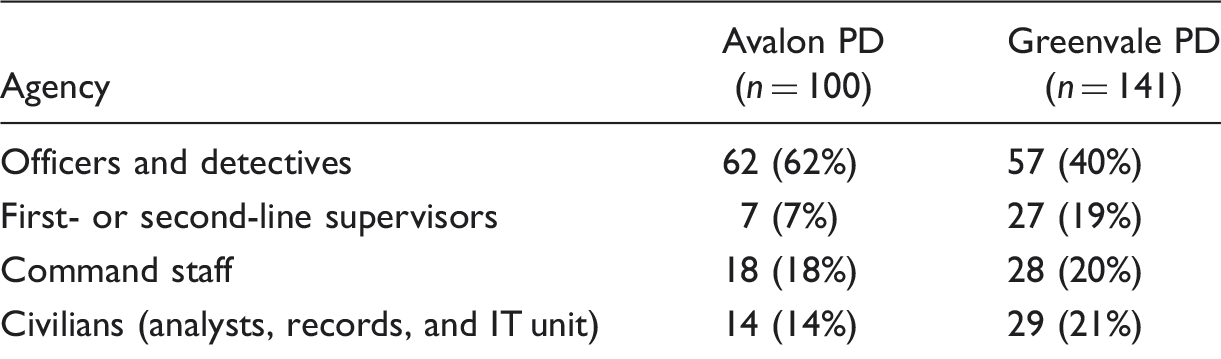
Note. PD = police department; IT = information technology.
The interviews used a semistructured instrument that was developed for this project and grounded in the literature on policing and technology. Of particular interest to this study were questions focused on discretion, technical efficiency, and outcome effectiveness. For example, with regard to how police used technology and whether it affected their daily discretion and decision-making, we asked officers to describe how they used information and crime analytic technologies, and how technology and crime analysis changed (if at all) the way they respond to calls for service, carry out proactive activities, or engage with the community. To gauge the impact that technology had on technical efficiency and work productivity, we asked officers to describe ways in which technology allowed them to do their work faster, with greater ease, or less effort. We also asked officers whether they had specific requirements that they had to fulfill with the use of technology and whether technologies presented burdens to their work. Finally, with regard to outcome effectiveness, we asked officers whether and how information technologies and crime analysis helped them to reduce, deter, prevent, or detect crime. We also asked officers to talk about other outcomes (such as improved interactions with citizens) that resulted from their use of technology.
Our approach was anchored in grounded theory (Strauss & Corbin, 1990), where we first examined and coded material to find commonalities and themes. Given the richness and intricacies of our interviews, we chose to take a manual approach, rather than use computer software to analyze our findings. Specifically, we built content through deep analysis, reading, and discussion of the interviews. This allowed revelations to emerge, which ultimately helped to illuminate technological frames in the police agency. We developed our conclusions through an iterative process to strengthen their reliability and validity. One member of the research team took the lead on drafting conclusions in regard to our key themes. The other authors then reviewed these drafts to provide further elaboration and identify additional issues for discussion or potential points of disagreement. This approach allowed us to assess convergence and divergence of participant views across units, ranks, and agencies.
In addition to our targeted interviews and focus groups, our convergent design included agency-wide surveys administered to all sworn staff in both agencies by e-mail to assess technology uses and perceptions, with a focus on information and analytic technologies. These were conducted concurrently and independently of the above qualitative interviews and focus groups, and we chose not to analyze the survey results until the qualitative work was completed. Once both sets of data were collected and analyzed, we then brought these sources together to compare and contrast using descriptive and interpretive analysis. The survey data are used here descriptively to provide an interpretive context for our qualitative findings. Although we do discuss some notable differences in the survey patterns across agencies, particularly as they relate to our qualitative findings, we did not use the survey data to formally test hypotheses about differences across or within agencies. Rather, using the survey data in this study allowed us to come to a more complete understanding of the uses and perceived impacts of technology in these agencies.
Similar to the interviews, the survey questions used for this analysis examined the uses of technology for discretionary activities and the perceived impacts of technology on efficiency and effectiveness. To probe technology’s impact on officer discretion, patrol officers were asked how often they used technology for different types of activities (e.g., to “locate suspects, wanted persons, and other persons of interest” or to “collect and search for information during a field interview”) on a 5-point scale: never, rarely, sometimes, often, and very often. We also asked supervisors about their use of technology in managerial tasks (e.g., to “monitor the daily activities of officers, detectives, or supervisors who work for you” or to “identify crime trends and problems in your area of responsibility”) using the same 5-point scale. A final set of items on discretion and decision-making asked all respondents to indicate their level of agreement or disagreement (on a 4-point scale of strongly agree, agree, disagree, and strongly disagree) with a few additional items reflecting the role of technology in making decisions about discretionary activities (e.g., “when making decisions about crime problems, I tend to rely more on my own experience than using information technologies to help me to engage in proactive, self-initiated activities”).
Questions related to technology’s impact on efficiency included those that asked respondents whether IT systems were easy to use, helpful, and made them more or less productive. Questions related to technology’s impact on effectiveness asked about whether an agency’s technology systems helped them in addressing crime-related issues and assisting citizens. The survey also had an additional effectiveness item that asked patrol officers only about whether IT increased their capacity to prevent crime when not answering calls. The efficiency and effectiveness items were based on the 4-point agreement scale described earlier.
Requested participation was voluntary and anonymous. 3 In Avalon PD, 40% of sworn personnel (529 of 1,327) answered the survey while in Greenvale PD, 42% of officers (674 of 1,616) responded. With some exceptions, differences between the respondent characteristics and those of the agencies overall tended not to be large (even if statistically significant). For example, in Avalon PD, line-level officers accounted for 77% of survey respondents and 83% of all officers, first-line supervisors accounted for 11% of survey respondents and 5% of all officers, and higher level managers accounted for 12% of both survey respondents and all officers. In Greenvale PD, line-level officers accounted for 80% of survey respondents and 84% of all officer, 4 first-line supervisors accounted for 13% of respondents and 10% of all officers, and higher level supervisors and commanders accounted for 8% of respondents and 6% of all officers.
Findings
Technology and Discretion
The most common uses of both information and crime analytic technologies in Agencies 1 and 2 were for retrieving information when reacting or responding to a call for service, situation, stopped individual, or a criminal investigation. To officers and detectives, these activities define their everyday work and are viewed as central to policing. Data from mobile computer systems, databases, and crime analysis were also seen as valuable in increasing officer safety and reducing uncertainty about what to expect when attending to a call. This finding aligns with Ioimo and Aronson’s (2004) task-technology-fit and Manning’s empirical findings discussed earlier. For example, interviewees stated that technology allows them to determine the domestic violence history of a location before responding or lets them run a quick criminal history check on persons they are questioning in the field. Mostly, information was obtained from information technologies to find wrongdoing or warning signs of problems within existing situations to which officers had responded, which could then shape their subsequent decisions. One officer in Avalon PD stated, “If you make a traffic stop for speeding and see that someone has been arrested four times for drugs, you will pay a lot of attention.” Some officers also suggested that having such information helped guide their discretion about not pursuing an arrest: “If you are going to cut somebody a break,” one officer pointed out, “you are more informed on their background [because of the information technology].”
Survey Results for Technology, Discretion, and Decision-Making Among Patrol Officers.
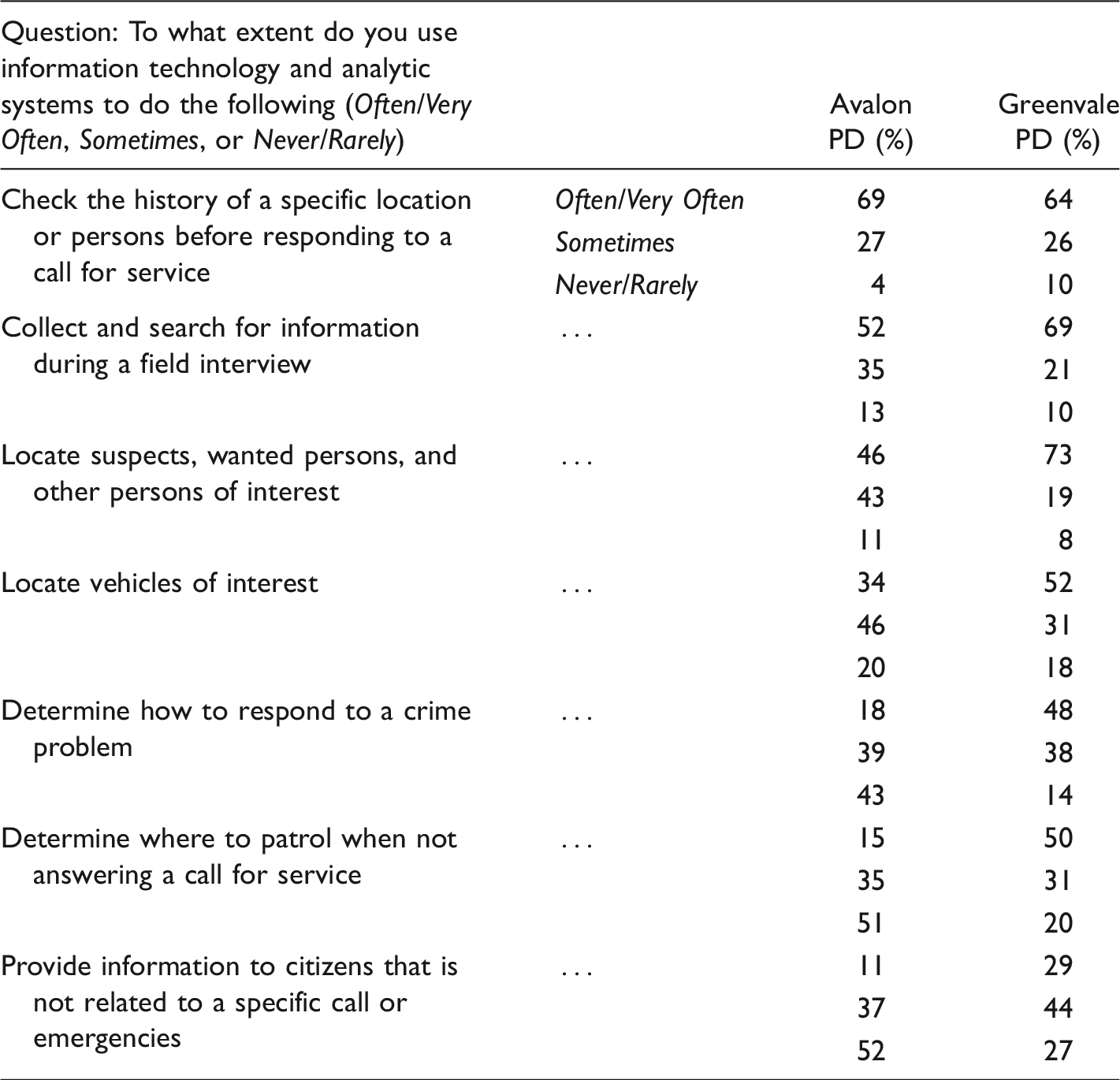
Note. PD = police department. The sample size varies for each item listed above and for each agency. The sample size range is 267–268 for Avalon PD and 153–157 for Greenvale PD.
Thus, technology was less often used to proactively identify or address problems during an officer’s noncommitted time (see Kelling, Pate, Dieckman, & Brown, 1974) and more often used in response to experiential and visual cues during their reactive response to calls. Officers in both agencies frequently mentioned that there was little systematic guidance or encouragement for using technology during their noncommitted time. Consequently, more proactive technology uses appeared dependent on the will and skill of individual officers. For example, an officer in Greenvale PD mentioned that while he checked the crime analysis unit’s website at the beginning of his shift to guide his patrol work, he did not believe this to be the norm with other officers.
One of his colleagues remarked that officer activities during noncommitted time were often guided by the “flavor of the week” as opposed to systematic analysis. A patrol officer in Avalon PD said that officers do not regularly perform such proactive activities unless they get bored or are personally motivated. In general, technology’s influence on the noncommitted, discretionary time of those with whom we spoke appeared very modest.
We found similar patterns in our discussions with detectives. In both agencies (and especially in Greenvale PD), detectives most heavily used and valued crime analysis for tracking leads in cases they were investigating (in both agencies, crime analysts conducted geographic analyses to support patrol operations but also supported detectives with analyses of cases, patterns, persons, and groups). One exception was provided by detectives in Greenvale PD, who stated that sometimes they would use information on a crime series to anticipate future events or to determine patterns within a modus operandi. However, the use of crime analysis for proactive decision-making that might help to prevent crime was rare.
Impact of Technology on Proactive Discretion Among Patrol Officers.
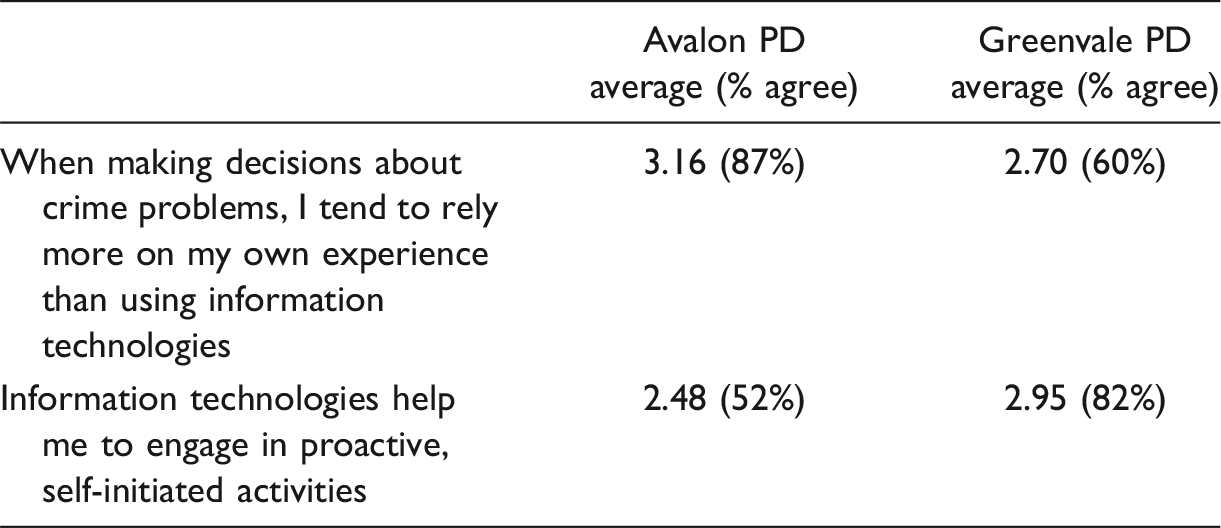
Note. PD = police department. The sample size for Avalon PD is 255 and for Greenvale PD is 147.
Some of these differences may reflect longer exposure to advanced information systems in Greenvale PD as well as better functioning systems in that agency (see Discussion and Conclusion section). However, managerial approaches, agency leadership, and culture also appeared to play a significant role in shaping the technological frames and behaviors of line-level officers. For instance, although both agencies used crime analysis to identify crime hot spots and patterns, Greenvale PD commanders placed a greater emphasis on using crime analysis to guide operational decisions. This managerial emphasis was apparent in our fieldwork as well as in our survey results. Supervisors and commanders from Greenvale PD who answered our survey reported being much more likely than those in Avalon PD to use information and analytic technologies often or very often to identify crime trends and problems (63% vs. 48%, respectively), determine what to do about crime trends and problems (51% vs. 34%), focus the activities of personnel on specific problematic locations (58% vs. 48%), and share information with community and business leaders (41% to 24%). In contrast, managers in Avalon PD would often or very often use technology for more traditional purposes and administrative tasks, such as monitoring the activities of officers (57% in Avalon PD to 43% in Greenvale PD) and identifying problem behaviors among subordinates (40% in Avalon PD to 26% in Greenvale PD).
Discretion and the Contradictions of Efficiency
Officers in both agencies judged the value that technology brings to discretion through the technological frame of efficiency. By efficiency, we specifically mean technical efficiency as described by the maximizing of outputs with the fewest resources or costs as possible. Officers often verbalized these outputs as gaining information fasteror with greater ease. However, it should be noted that officers did not necessarily discuss efficiency in terms of maximizing outputs against minimizing costs and resources, as would be described in the performance management literature, above. 5 Rather, they focused on (most often) how quickly technology helps them achieve a task, with the greatest ease of effort. For example, mobile computer terminals (MCTs) were positively viewed as providing officers with information quickly (as opposed to calling in to a dispatcher and waiting for information to be returned), thereby giving them greater ability to retrieve information in the field than in the past, when they would have to call dispatch or conduct a manual search of files at the records management division.
Greenvale PD detectives were especially supportive of crime analysis because of such efficiencies that analysts brought to their work. One detective remarked that crime analysis was “very useful, and frees us to do actual detective work—knock on doors, interview people, and talk to folks.” Another also added that “information that would have taken a whole team in homicide to collect over several weeks can take a couple of guys a few days now.” One commander remarked that technology “allowed for more data connectivity” and that “certain things are now done faster, such as DNA or fingerprinting.” Regional databases and the Internet were also seen by Avalon PD detectives as facilitating their investigations.
Because efficiency is the lens (or frame) through which officers perceive and use technology, problems with efficiency have significant ramifications for how technology influences discretion. In some cases, these problems reduce or constrain discretion and discretionary time (similarly found by Chan, 2001). This point was emphasized by officers from Avalon PD, which, as noted, had just undergone a major change from a paper-based system. Many complained that the new automated system increased the time required to write reports, distracted them from other duties, and reduced their job satisfaction. These changes were compounded by new reporting codes that officers had to learn for incident-based reporting and by connectivity problems with the new system that sometimes delayed their ability to file reports or caused them to lose their work. As one officer summarized: “Bottom line is that it is taking us longer to do our job and document what we do—whether we are tech savvy or not.”
Sometimes technology use challenged efficiency so much that officers avoided using it altogether. For example, at the beginning of the transition to the new system, Avalon PD experienced a significant drop in traffic citations, which in the past were used as proactive activities conducted in-between calls for service. Some officers stated that writing traffic citations “wasn’t worth it” given the burdens of the computerized report writing system. One commander, reflecting about this move, stated that it “may sound good at the strategic level, but on the ground it may be more difficult … Paper is part of a larger system; when you go from paper to digital, it disrupts that system” (as illustrated by Ericson & Haggerty, 1997).
Officers in Greenvale PD, on the other hand, were much more positive about their technology systems and the ability of those systems to enhance productivity. Hence, the impact of the technological frame of efficiency on discretion may diminish over time (or be replaced by alternative frames (i.e., outcome effectiveness and proactivity) depending on how long an agency has been using information technologies, how well those systems function, and the degree to which they are user-friendly). Figure 1 shows the differences between patrol officers in Agencies 1 and 2 on a series of efficiency-related survey questions. Large majorities of respondents in the survey for Greenvale PD agreed or strongly agreed that technology was easy to use (74%) and improved productivity (86%), compared with only 27% and 38%, respectively, in Avalon PD. Avalon PD officers, in contrast, overwhelmingly reported that the use of technology creates extra work (86% vs. 49% in Greenvale PD), and they were less likely to be satisfied with the quality of information in their systems (49% were satisfied vs. 76% in Greenvale PD). These differences in perceptions of the efficiency gains of technology seemed to be another factor contributing to the differences in technology use described earlier. Officers in Avalon PD had difficulties adapting to and using their technology systems, which in turn reduced their time for proactive prevention-oriented work and also seemed to worsen their perceptions of the utility of using technology for these purposes.
Percentage of patrol officers who agreed or strongly agreed about the efficiency aspects of technology. The sample size range is 267–268 for Avalon PD and 136–152 for Greenvale PD.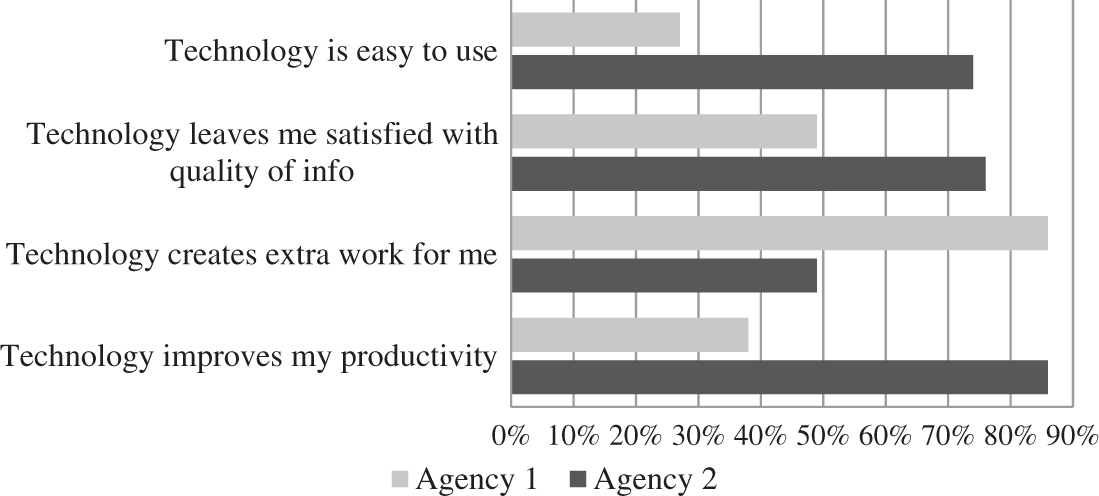
Perceptions of how technology impacted efficiency and work productivity (and further, discretion) also varied across ranks and units within each agency, producing the incongruencies mentioned by Orlikowski and Gash (1994). Higher ranking commanders, in general, tended to view technology and analysis more favorably from the standpoint of efficiency and productivity than did unranked officers and detectives and even first-line supervisors, who felt more burdened by reporting requirements and were somewhat suspicious of management using technology or analysis as a mechanism for monitoring them. This division was primarily the case in Avalon PD, where 74% of second-line supervisors and higher level command staff reported in the survey that technology made them more productive, in contrast to 42% of line-level staff and first-line supervisors. Higher ranking officers in Avalon PD also found reports easier to read and share with other shift supervisors as a result of the new system, and many were able to more quickly account for completed reports.
Incongruence was also found between detective units and patrol. Detectives were much more likely to value crime analysis than their patrol counterparts and view information systems as useful to their daily work. They were able to articulate why they valued crime analysis and provide examples of using that resource. In contrast, patrol officers questioned the analysts’ role in policing and either did not understand the purpose of analysis or saw it as unhelpful. Differences in the views of detectives and patrol officers were most pronounced in Avalon PD, where 50% of detectives agreed that technology made them more productive in comparison to 38% of patrol officers. Detectives and patrol officers in Greenvale PD reported fewer and smaller differences in their views in the survey and were much more positive than their Avalon PD counterparts (80% and 86% agreeing, respectively). Overall, views about technology and efficiency were much more consistent across ranks and assignments in Greenvale PD. This consistency suggests that perception gaps between units and ranks may become less pronounced as an agency becomes more accustomed to its IT and crime analytic systems and when agency leadership places a more consistent emphasis on the strategic use of these technologies.
How Frames Affect Perceptions of Effectiveness
The technological and organizational frames discussed earlier affect not only discretionary behavior (which in turn impacts outcomes) but also influence definitions and expectations about outcomes themselves. For example, the term effectiveness was most often defined by officers (and used interchangeably) to mean efficiency or the ability to respond to crime and to quickly identify suspects, victims, witnesses, and other aspects of crimes to resolve cases. Less often did officers define effectiveness in terms of their ability to achieve specific outcomes of interest to the police department, such as preventing crime or improving their relationship with community members.
Some evidence of how technological frames impact perceptions of effectiveness can be seen in our agency-wide survey results. As shown in Figure 2, when asked about whether information and analytic technology made them more effective, patrol officers were most likely to agree that it made them more effective in “identifying and locating suspects, wanted persons, and other persons of interest” (75% agreed or strongly agreed in Avalon PD and 94% agreed or strongly agreed in Greenvale PD). Officers in both agencies were considerably less likely to agree that technology enhanced their ability to reduce crime when not responding to calls for service (47% and 69%), to understand and respond to crime problems (56% and 86%), to interact and communicate with citizens (30% and 55%), and to provide assistance to crime victims (37% and 78%). This pattern was also apparent for detectives in both agencies (results not shown). Across the board, officers in Greenvale PD were much more likely to believe that technology made them more effective in these regard, which would again seem to reflect their higher levels of comfort and experience in using their IT systems, as well as Greenvale PD’s greater overall emphasis on technology and data-driven decision-making. However, our qualitative work suggested that these survey differences may not have reflected large differences between the agencies in strategic, preventive uses of technology at the street level.
Percentage of patrol officers who agreed or strongly agreed that technology could help them with proactive or community-oriented tasks. The sample size range is 266–268 for Avalon PD and 137–150 for Greenvale PD. Note: PD = police department.
Our interviews were especially insightful in probing the effectiveness issue. Detectives saw crime analytic technology as effective because it helped them catch offenders and close cases, while patrol officers discussed being able to quickly run information on stopped individuals to see if they were wanted. Officers and detectives were much less likely, on the other hand, to associate technology with improving crime control effectiveness or crime prevention effectiveness related to proactive policing. Although crime analytic, information-sharing, and records management technologies have been central to the development of strategies that target patrol and investigative activities to proactively reduce and prevent crime, sworn personnel at all ranks who were interviewed were much less likely to view technology as making the police more effective in these ways—except insofar as these enhanced their ability to screen people when making proactive stops. When discussing effectiveness, officers in both agencies tended to emphasize anecdotal examples of identifying and apprehending suspects by searching for and piecing together information from various police and nonpolice databases that they could access in the field. Similarly, analysts from both agencies asserted that information technologies could assist with closing individual cases. However, they were more cautious when asked about the causal connection between the use of these technologies and clearance rate trends.
Most individuals who discussed how technology contributed to crime reduction strategies in patrol were high-level commanders or civilian crime analysts. An exception was officers and supervisors of a specialized unit within Greenvale PD, who were responsible for proactive policing tactics. They directly and consistently interacted with the crime analysis unit and found crime analysis technology to be valuable to their work in a very different way than the detectives did. However, these officers were also trained in conducting problem-solving and using crime analysis. They also defined good police work differently than other officers in their agency, focusing more on an officer's ability to be proactive and prevent crime. In other words, the organizational frames and technological through which this unit received technology differed from frames of other officers, allowing them to view the effectiveness of technologies in different ways. One officer’s statement in that unit reflects this atypical state of mind: “[Using crime analysis to solve problems] is really the way of the future. It is not about getting more people or resources, but we have to be smarter and use what we have in a more intelligent way.”
Aside from that unit, the lack of connection between technology and outcomes such as crime prevention, reductions in calls for service, or even improvements in community-oriented outcomes (i.e., community trust and satisfaction) was a common theme in our interviews and focus groups. When we asked officers how they used their mobile terminals, for example, they rarely mentioned problem-solving strategies such as using them to select specific areas to proactively patrol or to study crime problems in hot spots. This trend was true among officers in Greenvale PD as well as those in Avalon PD, despite the survey ratings discussed earlier (see the higher scores for Greenvale PD officers in Figure 2). Indeed, our discussions suggested that survey respondents may have largely interpreted the questions about preventing crime and problem solving through the lens of using technology to investigate people and incidents. Likewise, when we asked analysts in Greenvale PD about the requests they receive from officers and detectives, they reported that a majority relate to searches for vehicles, names, criminal histories, witnesses, arrest information, or partial descriptors (e.g., scars, nicknames, and tattoos) to help solve cases. They acknowledged that it is less often the case that officers asked them about hot spots, trends, patterns, or how to use analysis proactively (to prevent crime). In a related study, Koper, Lum and Hibdon (2015) found that even when officers were directed to proactively patrol hot spots, they still primarily used technology for enforcement and surveillance, rather than problem solving or prevention.
At the command level in both agencies, there was a much better understanding of how crime analytic and information technologies could help agencies identify places and people for purposes of proactive problem solving or crime prevention; yet, some also expressed skepticism. When the team asked one commander in Avalon PD how optimistic he was about officers on the street understanding the value of crime analysis for crime prevention and using it toward those goals, he stated, “[T]he number one barrier to this approach were people’s attitudes, especially those who fight the system or think that [the new records management system] is garbage.” The same high-level official was unsure whether information technologies were connected with crime reduction or case clearances. Similarly, an unranked officer remarked, “There is no substitute to ‘good police work’ (emphasis added) and a certain amount of being in the right place at the right time.”
Our discussions also sometimes revealed officers’ skepticism about the links between technology, analysis, and crime prevention, including a lack of explanation for why they were being directed to certain areas for preventative patrol. Patrol officers in Greenvale PD, for instance, pointed out that sometimes crime analysis forced them to “fight dots with cops.” They gave the example of field interview reports. Officers said that once hot spots are established through crime analysis, they are required to go to the hot spots and conduct field interview reports, with little understanding as to why. One officer stated, “Crime analysis just tells us what we already know.” Another stated, “We know where crimes are—we don’t need a computer to tell us or Compstat meetings to tell us where they are.” Yet another remarked that using crime analysis to guide their patrol efforts “wasn’t worth the effort” but also acknowledged that they do not know the results of their efforts, nor do they get feedback.
In addition to the impact that the efficiency frame had on perceptions of technology outcomes, we also found that officers held views about how technology can reduce outcome effectiveness. Some officers associated technology with increasing officer distraction, reducing officer situational awareness, or reducing the amount of time doing what they viewed as real police work. One officer remarked as follows: Ever since I have been on, you learned your area, you knew roads, road names, etcetera. Now we have GPS in the car. Before you had to be more aware of exactly where you are. Now, I think that officers have to almost force themselves to have to think “this computer is not here.”
Discussion and Conclusion
Police reformers and leaders place big hopes on technology to improve efficiency in police organizations and also effectiveness in a variety of outcomes. However, our examination of how technology impacts police effectiveness suggests complex linkages between the acquisition, implementation, and uses of technology, and desired outcomes like crime prevention, case clearances, or better police–community relations. Both organizational and technological frames mediate the relationship between the adoption, implementation, and use of technology, and outcomes sought. Specifically, the reactive standard model of policing that continues to dominate law enforcement practice creates strong organizational and technological frames, which powerfully mediate the effects of technology on discretion, efficiency, and effectiveness. These frames influence what police think technology should be used for, and they also contribute to officers equating efficiency with effectiveness (and not in the way that Hatry, 2014 envisioned). These perspectives can thereby limit the potential of technological use in recent reforms such as community policing, problem solving, intelligence-led policing, or other innovations. In the agencies we studied, technology was not used systematically throughout the organization to identify crime patterns, to learn how to best respond to crime problems (see Willis et al., 2007), or to facilitate other innovations.
In particular, police officer views on technology are strongly shaped by the value they place on technical efficiency, which is a dominant technological frame. Efficiency is such a powerful frame that other important effects such as crime reduction, proactivity, and outcome effectiveness are swallowed into the frame and its meaning. When technologies are introduced that are not regarded as efficient or do not contribute to what officers believe to be their primary tasks, then those technologies are resisted, even if their use may make officers more effective. This resistance is especially acute among those who are disproportionately affected by its implementation, evidencing incongruence mentioned by Orlikowski and Gash. This explains why commanders, supervisors, and detectives who used records management and report writing systems less (particularly in Avalon PD) were more positive about technology’s cost benefits than patrol officers who had to struggle with laborious data entry processes. Incongruence of technological frames across ranks or units within an agency can also impede a strong connection between technology and outcome effectiveness and lead to cynicism and frustration among lower ranks.
However, comparing Avalon PD with Greenvale PD, such incongruence can be moderated by management practices, agency culture, and other contextual factors. We discovered large differences between our two agencies on the impact of these frames attributed to ease of use/familiarity with technology, to what degree management used and advocated for technology, and other aspects of the organization that facilitated technology use. Indeed, officers in Greenvale PD were more likely to see the value of technology in accomplishing valued outcomes. This was especially true of specialist units who had direct experience with how technology could be used for proactive policing and crime prevention. Further, comparing Avalon and Greenvale PDs illustrates how desired effects from technology (such as improving clearance rates and reducing crime) may take considerable time to materialize, if they do at all, as agencies adapt to new technologies and refine their designs, operations, and uses over time.
All of these factors may contribute to the absence of a clear and consistent relationship between technological advances and improved performance in policing. Of course, generalizing from our findings should be done cautiously, as they are based on the study of two police agencies with experiences that may be different from those of many other agencies. Further, our surveys and interviews assessed agency personnel’s experiences with and perceptions of technology; as such, they help to illuminate the dynamics of technological change in police agencies but do not provide a basis for causal inferences. Nonetheless, we speculate on the implications of the patterns revealed here, patterns that echo themes found in other theoretical and empirical work, as they might be instructive to those seeking to use technology to impact change (see, e.g., Chan et al., 2001; Garicano & Heaton, 2010; Manning, 1992a, 1992b).
For example, our findings are provocative because a great deal of research now suggests that the standard policing model that so strongly shapes policing frames is not as effective in reducing, preventing, or even clearing crime than models which are proactive, problem-oriented, targeted, and place-based (e.g., Lum, Koper, & Telep, 2011; National Research Council, 2004; Sherman & Eck, 2002; Weisburd & Eck, 2004). However, despite the interest of some police chiefs and scholars in advancing a more proactive and problem-oriented policing model, police are still very much focused on reacting to individual incidents, leading officers to judge the immediate gains and losses of technological change on efficiency in the context of their position within the agency and their perceived roles and responsibilities. This is why introducing technological innovations such as crime analysis and information technologies may not produce expected returns for new policing paradigms that incorporate these approaches (i.e., problem solving, evidence-based policing, and community policing) unless officers see these alternative approaches as “real police work”. Hence, strengthening these frames and cultures through training about proactive and evidence-based strategies and the development of training, organizational infrastructures, and reward systems for the use of technology in support of these strategies would be important adjustments that could help agencies receive and use technology in more innovative ways and reap greater benefits from technological advancements.
Although our discussion has focused on information and analytic technologies, we can also see these same difficulties playing out with other technologies in the law enforcement arena. Body-worn cameras, for example, are touted as a technology that will improve police accountability and police–community relationships. However, police often view them as a way to protect themselves from the community (as their insurance against frivolous or false complaints, for example. Or, officers may view body cameras as restricting their discretion, perhaps causing them to shy away from proactive activities or to become more legalistic and rigid in their decision-making. In other words, how police officers perceive and use body-worn cameras may be quite different from the community’s intended objectives (e.g., reducing implicit bias or increasing accountability) because of the technological frames by which they are filtered.
From a policy and practice perspective, adjusting those frames (e.g., through training, technical support, and organizational incentives) becomes important to adjusting the outcomes that agency leaders or citizens want from technology. Consequently, developing more insight about frames may be very helpful to police in planning for and implementing technological changes. In particular, anticipating outcomes by understanding the filters through which technology is implemented can focus a commander’s attention on adjusting those filters (or frames), rather than on simply implementing technology and hoping for an innovative outcome.
In conclusion, technological adoption can not only be a challenging and continuous process, but one that is connected to many other aspects of policing, including daily routines and deployments, job satisfaction, interaction with the community, internal relationships, and crime control outcomes. Consequently, technological changes may not bring about easy and substantial improvements in police performance without significant planning and effort to adjust technological and organizational frames. In turn, managing technological change in policing is closely connected to managing other organizational reforms that attempt to adjust those frames, such as improving professionalism and changing accountability mechanisms. Strategizing about technology application is thus essential and should involve careful consideration of the specific ways in which new and existing technologies can be designed, deployed, and used at all levels of the organization to meet goals for improving efficiency, effectiveness, and agency management. Further attention to these issues may help police to more fully realize the potential benefits of technology for policing.
Footnotes
Declaration of Conflicting Interests
The authors declared no potential conflicts of interest with respect to the research, authorship, and/or publication of this article.
Funding
The authors disclosed receipt of the following financial support for the research, authorship, and/or publication of this article: This work was supported by the National Institute of Justice, U.S. Department of Justice (grant number 2010-MU-MU-0019).