



Abstract
Despite job satisfaction being among the most commonly studied constructs in the organizational behavioral literature, few studies have examined predictors of job satisfaction among police officers. Even more, much of the stress and policing literature has focused primarily on frontline officers. As a result, less is known about the development of work-related attitudes among police administrators. The present study used a sample of 315 police chiefs to identify the personal and work-related factors associated with job satisfaction among police chiefs. Findings indicated that organizational factors, such as the size of the organization and chiefs’ overall commitment to their organization, were the two strongest predictors of job satisfaction. Implications and future avenues of research are discussed.
Introduction
Policing is a career that can be both rewarding and distressful. On any given day, officers can save someone’s life on one call and take another’s on the next. Decades of policing research has been dedicated to identifying the causes and consequences of stress, or whether policing is inherently stressful or more stressful than other occupations (Abdollahi, 2002; Kirkcaldy, Cooper, & Ruffalo, 1995; Violanti & Aron, 1993). Notably absent from the conversation are discussions about the aspects of policing that bring satisfaction to officers. Understanding the underlying mechanisms of job satisfaction (JS) can not only help with officer retention but also boost officer morale and commitment to their profession by reminding them of aspects that bring them satisfaction with being a police officer (Allisey, Noblet, Lamontagne, & Houdmont, 2014; Brough & Frame, 2004; Brunetto & Farr-Wharton, 2003).
According to Locke (1976), JS is defined as “…a pleasurable or positive emotional state resulting from the appraisal of one’s job or job experiences” (p. 1304). JS has been a popular area of study in the management and organizational psychology literatures. Spector (1997) claimed that “[job satisfaction] is the most frequently studied variable in organizational behavioral research” (p. 1). Indeed, a recent keyword search on “job satisfaction” from the PSYCINFO database in May 2017 revealed over 41,575 articles and monographs, which is nearly 7 times more studies than the 6,000 reported in Jayaratne (1993).
To date, however, only a handful of studies have explored JS among law enforcement personnel (Brunetto & Farr-Wharton, 2003; Dantzker & Kubin, 1998; Howard, Donofrio, & Boles, 2004; Ingram & Lee, 2015; Johnson, 2012; Zhao, Thurman, & He, 1999). Most of these have focused primarily on JS among frontline officers, while some studies have used sampling frames of officers in specialized assignments, such as school resource officers (Rhodes, 2015), community-oriented policing officers (Halsted, Bromley, & Cochran, 2000), conservation officers (Eliason, 2006), and midlevel police managers (Ercikti, Vito, Walsh, & Higgins, 2011). Far less is known about the factors associated with JS among law enforcement executives, particularly police chiefs.
JS is an important work-related attitude to study among police chiefs, as previous studies have linked it to productivity, officer receptivity to change, absenteeism, burnout, organizational commitment (OC), and turnover (Bowling, 2007; Burke, Shearer, & Deszca, 1984; Cohen & Golan, 2007; Jaramillo, Nixon, & Sams, 2005; Matz, Woo, & Kim, 2014; Pelfrey, 2007). To our knowledge, however, no study to date has examined the personal and work-related factors associated with JS among police chiefs. This is problematic considering police chiefs have a demanding responsibility to ensure the efficiency and effectiveness of one of the most important and visible municipal agencies in every community. More importantly, research has shown that the attitudes and leadership styles of police supervisors influence the attitudes and behaviors of their subordinates (Ingram & Lee, 2015; Krimmel & Lindenmuth, 2001; Sarver & Miller, 2014).
Previous studies have linked JS among police personnel to personal (e.g., education and tenure), operational (e.g., work-family conflict [WFC], job stress), and organizational correlates (e.g., collegial support and burnout; Burke et al., 1984; Howard et al., 2004; Jaramillo et al., 2005; Johnson, 2012; Zhao et al., 1999). However, less is known about the major determinates of JS among police chiefs. Given that police chiefs are responsible for shaping the work environment, they may be able to manage organizational stressors more effectively than frontline officers or other employees who are bound to policies and procedures within a paramilitary, bureaucratic structure. As a result, police chiefs may enjoy higher levels of JS than their subordinates.
The purpose of the current study is to use a multidimensional analysis to isolate the key personal, operational, and organizational characteristics associated with JS among police chiefs. We begin with a brief overview of the literature on JS, including the personal and work-related factors that have been found to influence JS among police personnel. Next, findings are presented, and we conclude with a discussion of the practical implications and avenues for future research.
Job Satisfaction
To date, a uniform definition of JS has not come to fruition. Locke (1976) defined JS as “…a pleasurable or positive emotional state resulting from the appraisal of one’s job or job experiences” (p. 1304). Others have defined the construct as “…simply how people feel about their jobs and different aspects of their jobs” (Spector, 1997, p. 2). Scholars have argued that JS is the product of the juxtaposition of individual and work-related characteristics (Johnson, 2012; Zhao et al., 1999). Indeed, Locke (1976) noted that job dissatisfaction stems from a discrepancy between the realities and expectations of one’s job responsibilities. Thus, it is important to use a multidimensional analysis to understand how the personal and work-related factors influence the development of JS among police chiefs.
The dearth of information on JS among law enforcement executives is particularly problematic, considering previous studies have shown that higher levels of JS positively impact work-related outcomes (Yang, Yen, & Chiang, 2012; Zhao et al., 1999) and officers’ personal lives (Howard et al., 2004; Singh & Nayak, 2015). Previous studies have found a direct negative relationship between WFC and JS (Howard et al., 2004; Singh & Nayak, 2015). JS has also been found to be associated with recruitment and training strategies (Loo, 2004), worker productivity (Bowling, 2007; Judge, Thoresen, Bono, & Patton, 2001), receptivity to change and supporting new policing innovations (Pelfrey, 2007), and absenteeism (Cohen & Golan, 2007). More importantly, JS has been associated with OC and turnover behaviors (Jaramillo et al., 2005; Matz et al., 2014). Mowday Using a sample of 150 Florida police officers from six agencies, JS was found to be the strongest predictor of OC (Jaramillo et al., 2005). In a recent meta-analysis of 13 studies of turnover intentions, low JS was ranked the second strongest predictor of turnover among law enforcement officers (Matz et al., 2014).
It is important to note, however, that much of the research on the correlates and consequences of JS among policing officials has used sampling frames of rank-and-file officers (Zhao et al., 1999). Previous management, psychological, and criminological studies have focused primarily on understanding how employee demographics relate to JS (Buckley & Petrunik, 1995; Jayaratne, 1993). Fewer studies have assessed how the work environment, in addition to employee demographics, influences employees’ satisfaction (Herzberg, 1968; Johnson, 2012; Regoli, Crank, & Culbertson, 1989; Zhao et al., 1999). For example, Johnson (2012) noted that JS is a construct shaped by the juxtaposition of individual, operational, and organizational characteristics. To understand how to improve JS among police officers overall, more research is needed to identify factors associated with JS among those who shape the work environment: police chiefs. Toward that end, we seek to identify and isolate the individual, work-related, and organizational factors associated with JS among police chiefs.
Personal Characteristics
Studies exploring individual-level correlates of JS among police officers have focused primarily on the individual demographics of the employees, their personality characteristics, their career characteristics, and factors associated with their life outside of work (Howard et al., 2004; Johnson, 2012; Miller, Mire, & Kim, 2009; Singh & Nayak, 2015). Officer characteristics commonly used in JS studies have included age, gender, race, ethnicity, education, tenure, and rank. Overall, the research has found individual-level correlates to have a minimal effect on JS (Zhao et al., 1999), with many studies showing inconsistent and weak associations with JS (Belknap & Shelly, 1993; Buzawa, Austin, & Bannon, 1994; Dantzker, 1994; Dantzker & Kubin, 1998; Ercikti et al., 2011; Ingram & Lee, 2015; Johnson, 2012; Rhodes, 2015; Zhao et al., 1999).
The impact of an officer’s age on JS has produced mixed findings, with some studies reporting younger officers to have higher levels of JS than older officers (Dantzker, 1994; Ercikti et al., 2011). In one of the only studies of JS among midlevel police managers (Ercikti et al., 2011), however, age was not a significant predictor. In regard to sex, the literature has been inconsistent with some studies findings that female officers have lower JS than their male counterparts (Belknap & Shelly, 1993; Buzawa et al., 1994; Dantzker, 1994), while others have found sex to be nonsignificant (Dantzker & Kubin, 1998; Ercikti et al., 2011; Ingram & Lee, 2015; Johnson, 2012; Rhodes, 2015; Zhao et al., 1999). Research on officers’ race and ethnicity has also produced mixed findings, with some studies showing that African American officers have lower (Buzawa et al., 1994) or higher levels of JS than White officers (Dantzker, 1994; Johnson, 2012). Other studies, however, have found no significant differences between race or ethnicity (Dantzker & Kubin, 1998; Ingram & Lee, 2015; Rhodes, 2015), particularly among midlevel police managers (Ercikti et al., 2011).
More than ever before, the level of education among American police officers been an important component of the recruitment and hiring process (National Research Council, 2004; Reaves, 2015). As of 2013, 25% of local police departments require applicants to have at least a 2-year college degree, which is nearly double the number of departments in 1993 (i.e., 16% of local police departments; Reaves, 2015). Research on the impact of education on JS, however, has been mixed. While some studies have reported education to not be a significant predictor of JS, other studies have found a positive (Dantzker, 1993) and negative association between education and JS (Ercikti et al., 2011; Ingram & Lee, 2015).
Years of experience (i.e., tenure) has been the most consistent and strongest individual-level correlate of JS among police officers (Buzawa et al., 1994; Dantzker, 1993; Dantzker & Kubin, 1998; Ingram & Lee, 2015; Johnson, 2012; Rhodes, 2015; Zhao et al., 1999). Across studies, findings have indicated a negative relationship between tenure and JS, suggesting that officers with more years of experiences have lower levels of JS. Research on officer rank, however, has produced mixed findings. Using a sample of 199 officers from the Spokane Police Department, Zhao et al. (1999) found that rank had a significant negative association with work satisfaction, yet was not a significant predictor of officers’ satisfaction with their supervisors or coworkers. Conversely, other studies have found that JS varies according to certain ranks (e.g., lower among sergeants compared to frontline officers; Dantzker, 1994) or is not related to JS at all (Ercikti et al., 2011).
Overall, the extant scholarship regarding the impact of officer demographics on JS has produced mixed results. Findings related to officers’ age, gender, level of education, and rank are fairly inconsistent; yet, tenure has been identified as an important predictor of JS. The inconsistencies are not surprising considering that previous scholars have noted that officer demographics accounted only for a small proportion of the explained variance in JS (Johnson, 2012; Zhao et al., 1999). Indeed, Johnson (2012) found that the addition of job task characteristics into multivariate models increased the observed variance from 4% to 23% for JS, while the variance in Zhao et al.’s (1999) models increased from 6% to 49% with the inclusion of work-related variables. Collectively, this suggests that operational and organizational factors may play a larger role as a principal source of JS among police officers.
Operational Characteristics
The management and organizational psychology literature has explored several operational factors and JS. Operational factors refer to the nature and processes involved in one’s work-related responsibilities and can include—but are not limited to—WFC, family–work conflict (FWC), and job stress (Hackman & Lawler, 1971; Herzberg, 1976; Jayaratne, 1993). Studies exploring the nexus of police work and family life have identified a reciprocal relationship between JS and conflict in both the work and family domains (Howard et al., 2004; Singh & Nayak, 2015). According to Howard et al. (2004), “work-family conflict occurs when participation in the family role is made more difficult by participation in the work role” (p. 380). Vice versa, FWC emerges when the stress and demands of the family life (e.g., death of a loved one, divorce, etc.) spill over into the work domains and impact performance (Greenhaus & Beutell, 1985). While FWC has received less attention in the managerial and policing literature, research has found that both WFC and FWC have a significant negative relationship with JS among frontline officers (Boles, Howard, & Donofrio, 2001; Howard et al., 2004; Netemeyer, Boles, & McMurrian, 1996).
Job stress is “ … the harmful physical and emotional responses that occur when the requirements of the job do not match the capabilities, resources, needs, or expectations of the work” (Stevens, 2008, p. 51). While stress is commonplace in the American workplace (Saad, 2012), officers exhibiting high stress are at an increased risk for decreased job performance, JS (Ingram & Lee, 2015; Johnson, 2012), adopting maladaptive coping mechanisms (e.g., binge drinking, substance abuse; Gershon, Barocas, Canton, Li, & Vlahov, 2009; Mumford, Taylor, & Kubu, 2015), and increased absenteeism, burnout, and turnover (Jaramillo et al., 2005; McCarty & Skogan, 2013; Violanti et al., 2014).
Collectively, the policing scholarship has shown that operational factors play an integral role in shaping JS. Unlike the individual-level correlates of JS, operational characteristics have a more consistent relationship with JS (Ingram & Lee, 2015; Johnson, 2012; Rhodes, 2015; Violanti & Aron, 1993; Zhao et al., 1999). Much of this research, however, has been conducted among frontline officers and not police chiefs.
Organizational Characteristics
Organizational-level correlates consist of organizational policies, procedures, structure, colleagues, or management (Shane, 2010). Previous studies have found that organizational-level factors can affect officers’ attitudes and behaviors, including JS and OC (Brunetto & Farr-Wharton, 2003; Ingram & Lee, 2015; Regoli et al., 1989; Stevens, 2008). While previous studies have identified similar organizational practices across small, medium, and large police departments (Meagher, 1985), others have noted differences in attitudinal and behavioral measures related to the size of an organization (Crank, Culbertson, Poole, & Regoli, 1987; Regoli et al., 1989). Scholars have hypothesized that JS would be higher in larger organizations due to better fringe benefits and more opportunities for specialization/promotion (Beer, 1964; Cummings & El Salami, 1970; Regoli et al., 1989). Conversely, Crank et al. (1987) argued that JS may be lower in larger police departments due to increased stress emanating from the larger volume of decisions to be made. Organizational size has a negative association with overall JS among police chiefs (Regoli et al., 1989) and different facets of JS among business executives, such as need fulfillment (Cummings & El Salmi, 1970).
Collegial support is a vital component of overall well-being and JS of police officers across the ranks (Baruch-Feldman, Brondolo, Ben-Dayan, & Schwartz, 2002; Johnson, 2012). Among a sample of 292 officers from 11 law enforcement agencies around Phoenix, Arizona, Johnson (2012) found that collegial support was positively associated with JS. In addition, a sample of 397 Australian police officers revealed that both coworker and supervisor support had a strong positive association with JS (Barbour, Brough, & Gracia, 2009).
OC refers to one’s bond, loyalty, or attachment to the organization (Mathieu & Zajac, 1990; Mowday, Steers, & Porter, 1979). OC is one of the most oft studied constructs in the management and organizational psychology literatures (Mathieu & Zajac, 1990; Meyer, Stanley, Herscovitch, & Topolnytsky, 2002; Riketta, 2002). Indeed, meta-analytic studies have found a positive relationship between OC and overall JS, motivation, and job performance (Mathieu & Zajac, 1990; Riketta, 2002). OC and its relationship to JS has been relatively understudied in the policing literature (Brunetto & Farr-Wharton, 2003; Jaramillo et al., 2005). Using a study of 150 officers from six Florida law enforcement agencies, Jaramillo et al. (2005) found that OC was strongly associated with JS. Little is known, however, about the relationship between OC and JS among police chiefs.
In sum, although much of the policing literature has produced mixed findings with JS, there are important individual and work-related correlates of JS, such as tenure, WFC, job stress, collegial support, and OC. While work-related factors have the strongest influence on JS, the personal characteristics of law enforcement executives (LEEs) may shape how officers cope and respond to the rigors of the position (Crank, Regoli, Hewitt, & Culbertson, 1995). To date, however, a multidimensional analysis of JS and police chiefs has not been conducted.
Data and Methods
Data for the current project were gathered from Texas chiefs of police via the Texas Chiefs of Police Panel Project (TCPPP). The TCPPP was developed in 2011 by researchers in the Department of Criminal Justice and Criminology at Sam Houston State University (King & Campbell, 2013). The TCPPP is an ongoing data collection effort in which survey data are gathered from chiefs attending a state-mandated leadership event called the Texas Police Chief Leadership Series (TPCLS) program. The TPCLS is facilitated by the Bill Blackwood Law Enforcement Management Institute of Texas and is designed to enhance the leadership skills of police administrators, build their capacity to effectively manage their agencies, and keep abreast of emerging issues. The TPCLS is offered on a 2-year cycle to every police chief in Texas, and the TCPPP gathers data from TPCLS participants.
While the TCPPP is a panel design, the data for the current study were gathered at once and are thus cross-sectional. Between September 1, 2015 and July 29, 2016, 330 police chiefs (of 449 surveyed, a 73.5% response rate) answered survey questions about their demographics, work/life balance, and stress. Of the 330 completed surveys, three were omitted due to lack of variation in the responses. Two additional surveys were completed by a representative of a state police agency and one from a sheriffs’ department. Because the current study focused solely on municipal police chiefs, the two surveys were omitted. Finally, female police chiefs (n = 10) accounted for 3% of the sample. Despite paralleling national estimates (Reaves, 2015), the 10 cases were omitted from the final analysis due to the limited number of cases. Thus, the final sample for the current study was 315 Texas police chiefs.
Dependent Variable
JS was the sole dependent variable and represents a global measure of “…the fulfillment or gratification of certain needs that are associated with one’s work” (Hopkins, 1983, p. 7). JS was captured using a five-item JS scale created by Hopkins (1983). Items included, “I find work stimulating and challenging”; “I find a sense of worthwhile accomplishment in my work”; “I find opportunities for personal growth and development in my job”; “I like the kind of work I do very much”; and “I enjoy nearly all the things I do on my job very much.” Each item was measured using a 5-point Likert-type scale ranging from strongly disagree (coded 1) to strongly agree (coded 5). The five items were summed to create a scale that ranged from 13 to 25, with higher values representing higher levels of JS (M = 21.0; SD = 2.7; Cronbach’s α = .859).
Independent Variables
The current study included 23 independent variables that are classified as personal, operational, or organizational.
Personal characteristics
Eleven variables captured the individual demographics of participating police chiefs: age, race, level of education, marital status, military experience, hiring origin, family support, law enforcement tenure, supervisor tenure, length of time in current police department, and total chief tenure. Age was operationalized as a continuous variable that ranged from 29 to 74 years of age, with a median age of 53 (M = 52.8; SD = 8.4). Race was a dichotomous measure of non-White (coded 0) and White (coded 1). Level of education was a dichotomous measure where 0 = less than a bachelor’s degree and 1 = more than a bachelor’s degree. Respondents were asked to indicate their current marital status (1 = married; 2 = single, never married; 3 = divorced; 4 = widowed; 5 = separated); yet, due to lack of variation in the data, marital status was also recoded as a dummy variable (0 = not married; 1 = married). Prior military experience was treated as a dichotomous variable (0 = no; 1 = yes).
Hiring origin refers to whether or not the respondent was appointed as chief of police in their current department internally (coded 0) or externally (hired outside of their current department; coded 1). Family support refers to the extent to which respondents feel supported by their family in helping them deal with issues confronted on the job (Cullen, Lemming, Link, & Wozniak, 1985). Family support was captured through a four-item family support measure developed by Cullen et al. (1985). Using a 5-point Likert-type scale, respondents were asked to indicate their level of agreement (1 = strongly disagree to 5 = strongly agree) on their perceptions of being supported by their family. Two items—“There is really no one in my family I can talk to about my job,” and “My significant other can’t really help me much when I get tense about my job” were reverse coded (1 = strongly agree to 5 = strongly disagree). The four items were summed to create a family support scale ranging from 10 to 20, where higher scores indicated a greater perception of support from their family (M = 16.8; SD = 2.4; Cronbach’s α = .774).
Respondents were also asked to indicate their total length of time, in years and months, in (a) law enforcement; (b) as a supervisor; (c) as chief in their current department; and (d) as chief in another agency prior to their current chief’s position. Respondents reported both years and months in a specific position (e.g., 10 years, 3 months). Law enforcement tenure is a continuous variable referring to the total number of years the respondent has been in law enforcement (M = 27.7; SD = 9.7). Supervisor tenure is a continuous variable depicting the total number of years the respondent has held a supervisory position (M = 17.1; SD = 10). Chief tenure refers to the total length of time, in years, as a police chief both in their current department and if they served as a chief in a former department combined (M = 8.1; SD = 7.5).
Operational characteristics
Seven operational characteristics were included; FWC, WFC (e.g., strain-based WFC and time-based WFC), and job stress (e.g., leadership/supervision, insufficient resources, perceptual dedication, and operational stressors). FWC refers to the extent to which family responsibilities interfere with respondents’ work-related roles and responsibilities (Nohe, Meier, Sonntag, & Michel, 2015). FWC was operationalized using five items including the following: “My family and/or social life interfere with my job”; “I sometimes have to miss work due to pressing family/social issues or problems”; “Because of stress at home, I am often preoccupied with family matters at work”; “I’m often tired at work because of the things I do at home”; and “I feel that the demands placed upon me at work are unreasonable.” Responses were captured on a 5-point Likert-type scale ranging from 1 (strongly disagree) to 5 (strongly agree). The five items were summed to create a scale that ranged from 5 to 18, where higher scores indicate a greater FWC (M = 9.5; SD = 3.0; Cronbach’s α = .795).
A 15-item WFC instrument was used to examine the extent to which respondents’ work-related duties and responsibilities interfere and create conflict with their family (Lambert, Hogan, Camp, & Ventura, 2006). WFC was operationalized using two scales: strain- and time-based WFC. Strain-based WFC occurs when “…the demands and tensions from work negatively impact the quality of a worker’s home life” (Lambert et al., 2006, p. 372). Strain-based WFC was captured through nine items that were measured using a 5-point Likert-type scale that ranged from strongly disagree (coded 1) to strongly agree (coded 5). Example items included, “Because of this job, I am often irritable at home”; and “I am able to leave my problems from work at work rather than bringing them home (reverse coded).” The nine items were summed to create a strain-based WFC scale that ranged from 9 to 42, where higher scores indicated a greater strain on the respondents’ families as a result of the demands and tensions from work (M = 22.5; SD = 6.2; Cronbach’s α = .872).
Time-based WFC refers to conflict within the family resulting from the respondent not spending enough time with the family due to workplace demands (Lambert et al., 2006). Time-based WFC was captured using six items that were measured on a 5-point-Likert types scale ranging from strongly disagree (coded 1) to strongly agree (coded 5). Example items included, “My job allows me adequate time to be with my family (reverse coded)”; and “I frequently have to work overtime when I don’t want to.” The six items were summed to create a time-based WFC scale that ranged from 6 to 29, where higher scores indicated a greater time-based WFC (M = 14.4; SD = 4.7; Cronbach’s α = .896).
Job stress was assessed through McCreary and Thompson’s (2013) Organizational Police Stress Questionnaire (PSQ-Org). The PSQ-Org is a 20-item measure that captures the extent to which a diverse array of organizational facets increase stress levels among police officers. Responses to each question were measured on a 7-point Likert-type scale ranging from 1 (no stress at all) to 7 (a lot of stress). To assess the dimensionality of the instrument, a principal axis factor analysis with oblique rotation (direct oblimin) was conducted on the 20 items. The analysis revealed a four-item factor structure that explained 61.0% of the total variance. A visual review of the scree plot showed the point of inflexion occurring after the fifth component, justifying the retention four factors.
The first factor was comprised of eight items that collectively relate to organizational stressors derived from dealing with leadership/supervision (e.g., dealing with coworkers, dealing with supervisors/command staff, leaders overemphasizing the negatives). The eight items were summed to create a scale that ranged from 8 to 46, with higher values representing higher levels of stress from dealing with leadership/supervision-related issues (M = 23.0; SD = 7.8; Cronbach’s α = .853). The second factor was comprised of two items that related to stress from dealing with insufficient resources (e.g., inadequate equipment and lack of resources). The two items were summed to create a scale that ranged from 2 to 14, with higher values representing higher levels of stress from working with insufficient resources (M = 7.3; SD = 3.4; Cronbach’s α = .820).
Six items clustered together to form the third factor, which was identified as operational stressors. Operational stressors were comprised of six items that captured stress from the duties and responsibilities inherent to police leadership roles including (a) bureaucratic red tape; (b) excessive administrative duties; (c) constant changes in policy/legislation; (d) staff shortages; (e) too much computer work; and (f) feelings of having to prove oneself. The six items were summed to create a scale that ranged from 6 to 41, with higher values representing higher levels of stress from dealing with operational stressors (M = 20.7; SD = 7.5; Cronbach’s α = .852).
Finally, three items clustered together to form the fourth factor, which was termed perceptual dedication. Perceptual dedication refers to the stress chiefs experience from cultivating a positive perception among others that one is dedicated, respected, and willing to execute their responsibilities to the fullest. Items included, “if you are sick or injured, your coworkers seem to look down on you”; “dealing with the court system”; and “perceived pressure to volunteer free time.” The three items were summed to create a scale that ranged from 3 to 18, with higher values representing higher levels of stress from cultivating a positive image of dedication and commitment (M = 7.2; SD = 3.4; Cronbach’s α = .718).
Organizational characteristics
Five structural and perceptual organizational stressors were included: collegial support, OC, organization size, agency type, and jurisdiction. Collegial support is a continuous measure that reflects the extent to which respondents’ feel supported by their coworkers (Haines, Hurlbert, & Zimmer, 1991). Collegial support was measured using a six-item instrument developed by Haines et al. (1991). Using a 5-point Likert-type scale, respondents were asked to indicate their level of agreement (1 = strongly disagree to 5 = strongly agree) on their perceptions of being supported by their colleagues. Example items included, “I usually try to get along very well with my coworkers”; and “The people I work with are helpful to me in getting my job done”; “I know I can get help from my coworkers when I need it”; “The people I work with are competent”; “My coworkers respect my work and abilities.” The six items were summed to create a collegial support scale that ranged from 17 to 30, where higher scores indicated a greater perception of support from their coworkers (M = 25.1; SD = 2.8; Cronbach’s α = .745).
According to Mowday et al. (1979), OC refers to “…the relative strength of an individual’s identification with and involvement in a particular organization” (p. 4). OC was captured through Davis, Smith, & Marsden's (1991) OC Scale, which is a six-item instrument designed to reflect: (a) one’s “… willingness to exert effort on behalf of the organization”; (b) one’s “…belief in an acceptance of the organization’s goals and values”; and (c) one’s “…desire to maintain membership in the organization.” Each item was captured on a 5-point Likert-type scale ranging from strongly disagree (coded 1) to strongly agree (coded 5).
To assess the dimensionality of the instrument, a principal axis factor analysis with oblique rotation (direct oblimin) was conducted on the six items. The analysis revealed a single-item factor structure that explained approximately 34.14% of the total variance (λ = 2.05; loadings range: .47–.94). Three out of the six items loaded above the .40 criterion level. Although the initial reliability analysis demonstrated poor internal consistency between the three items (α = .573), the Cronbach’s α was improved by dropping the item “I would turn down another job for more pay in order to stay with my organization” from the scale. Thus, OC was captured through two items: “I am proud to be working for my organization” and “I find that my values and my organization’s values are very similar.” The two items were summed to create a scale that ranged from 2 to 10 where higher scores indicated higher degrees of OC (M = 8.7; SD = 1.1; Cronbach’s α = .640).
For the current study, organizational size was operationalized as the total number of actual sworn and nonsworn personnel with and without general arrest powers (Maguire, 2003). Organizational size was treated as a continuous variable ranging from 0 to 810 full-time personnel, with a median of 13 (M = 42.5; SD = 189.1). To correct for the nonnormal distribution of the data, we used the natural log of organizational size. Agency type was treated as a categorical variable that encompasses the type of agency respondents’ represented (1 = municipal; 2 = independent school district; 3 = special district [university, parks, wildlife, airport, port]). Jurisdiction is self-report measure describing the metropolitan statistical area in which the respondent’s agency serves (1 = urban; 2 = suburban; 3 = rural).
Missing Data
Missing data were addressed through three stages. First, a missing value analysis was conducted using SPSS 21 to examine the pattern and scope of missing data. Findings indicated that 0.38% of the values were missing across all variables in a nonmonotone pattern. In all, 24% (n = 76) of the 316 cases had missing information on at least one variable. Second, data were screened to determine whether multiple imputation was appropriate. Multiple imputation is a common method for estimating missing values. Multiple imputation is a powerful, iterative process that uses existing values of other variables to estimate multiple predicted values that are subsequently substituted for the missing values (Allison, 2002; Rubin, 1996).
For multiple imputation to succeed, Hertel (1976) recommends that each variable should have no more than 15% missing information. Military status had the most missing values at 5.4%, which is well below the 15% threshold. Moreover, findings from the Little’s Missing Completely at Random test revealed that there were no significant differences between the missing and nonmissing values for any of the included variables (χ2[2,981] = 3,702.04, p = .120; Little, 1988). The nonsignificant findings indicate that the data are Missing Completely at Random, whereby dropping missing cases via listwise deletion would not bias the sample (Garson, 2015). Listwise deletion, however, would drop 74 cases due to missing values, which may impact statistical power and explained variance in the multivariate models. As a result, missing data were multiply imputed in SPSS using the Markov Chain Monte Carlo method.
Through the Markov Chain Monte Carlo method (Garson, 2015), the multiple imputation process generates five copies of completed datasets, each with a different imputation estimate for the missing values (Rubin, 1996). Regression models were estimated using each imputed dataset and were interpreted using Rubin’s (1996) recommendations to combine the parameter estimates and standard errors into a single pooled average.
Analytic Strategy
Analysis for the current study were carried out through multiple steps. First, univariate analyses were conducted to assess the overall distribution of the dependent variable, along with each personal, operational, and organizational characteristic. 1 Second, a series of bivariate analyses, such as Pearson’s r correlations and independent samples t tests, were calculated to identify significant relationships between the personal and work-related factors associated with JS. Finally, given the continuous nature of the dependent variable, an ordinary least squares regression model was estimated to identify and isolate the key factors responsible for influencing the JS among Texas police chiefs.
To examine the unique effects of the personal and work-related factors associated with JS, multivariate analyses were conducted using additive models. Three separate models were estimated. The first model includes only the personal characteristics, the second model adds the operational characteristics, and the third model represents the full model with all three categories of predictors including the organizational characteristics. As assessed through changes in the explained variance, along with potential changes in the significance and degrees of the unstandardized coefficients, this strategy allows for comparisons to be made across models to isolate the key types of predictors (i.e., personal, operational, or organizational factors) that have the most influence.
Results
Sample Demographics
Descriptive statistics are presented in Table 1. Overall, respondents were predominantly White (79.7%), married (85.7%), with a median age of 53 (M = 52.8, SD = 8.4). Less than half of the chiefs held a bachelor’s degree or higher (47.3%), nearly one in five had previous military experience (23.2%), and 55.1% were hired externally. Respondents served, on average, 28 years in law enforcement (M = 27.7, SD = 9.7), with 17 of the 28 years as a supervisor (M = 17.1, SD = 10). Respondents varied in their experience as chief, with tenures ranging from 3 months to 32 years. Collectively, respondents served, on average, 8 years as chief in a current or former department (M = 8.1, SD = 7.5). The majority of respondents were chiefs from municipal agencies (70.5%) that were located in rural areas (41%). In addition, chiefs represented agencies of all sizes ranging from zero full-time employees to 810. The median organization size was 13 (M = 42.5, SD = 189.1). In regard to the dependent variable, chiefs scored, on average, slightly above the midpoint on the JS measure, indicating moderate to high levels of JS (M = 21.0, SD = 2.7).
Descriptive Statistics (N = 315).

Note. Considering that the data were imputed multiple times, raw data are presented as pooled estimates and may contain decimals (Rubin, 1996).
Bivariate Analyses
Bivariate analyses indicated that personal, operational, and organizational factors were significantly associated with JS (see Table 2). For personal characteristics, family support was the only factor demonstrating a significant and positive correlation with JS (r = .29, p < .01). All seven operational characteristics were significant and negatively correlated with JS. Collegial support (r = .26, p < .01) and OC (r = .43, p < .01) were the only two organizational characteristics that were significant and positively correlated with JS. Agency type, however, was marginally significant, suggesting that chiefs of municipal agencies (M = 21.1, SD = 2.6) had higher JS scores than chiefs of independent school district (M = 20.6, SD = 3.2) or special district agencies (M = 20.4, SD = 2.4; t(313) = −1.91, p = .06).
Group Difference Tests and Bivariate Correlations With Job Satisfaction.

+p < .10. *p < .05. **p < .01. ***p < .001.
Multivariate Analyses
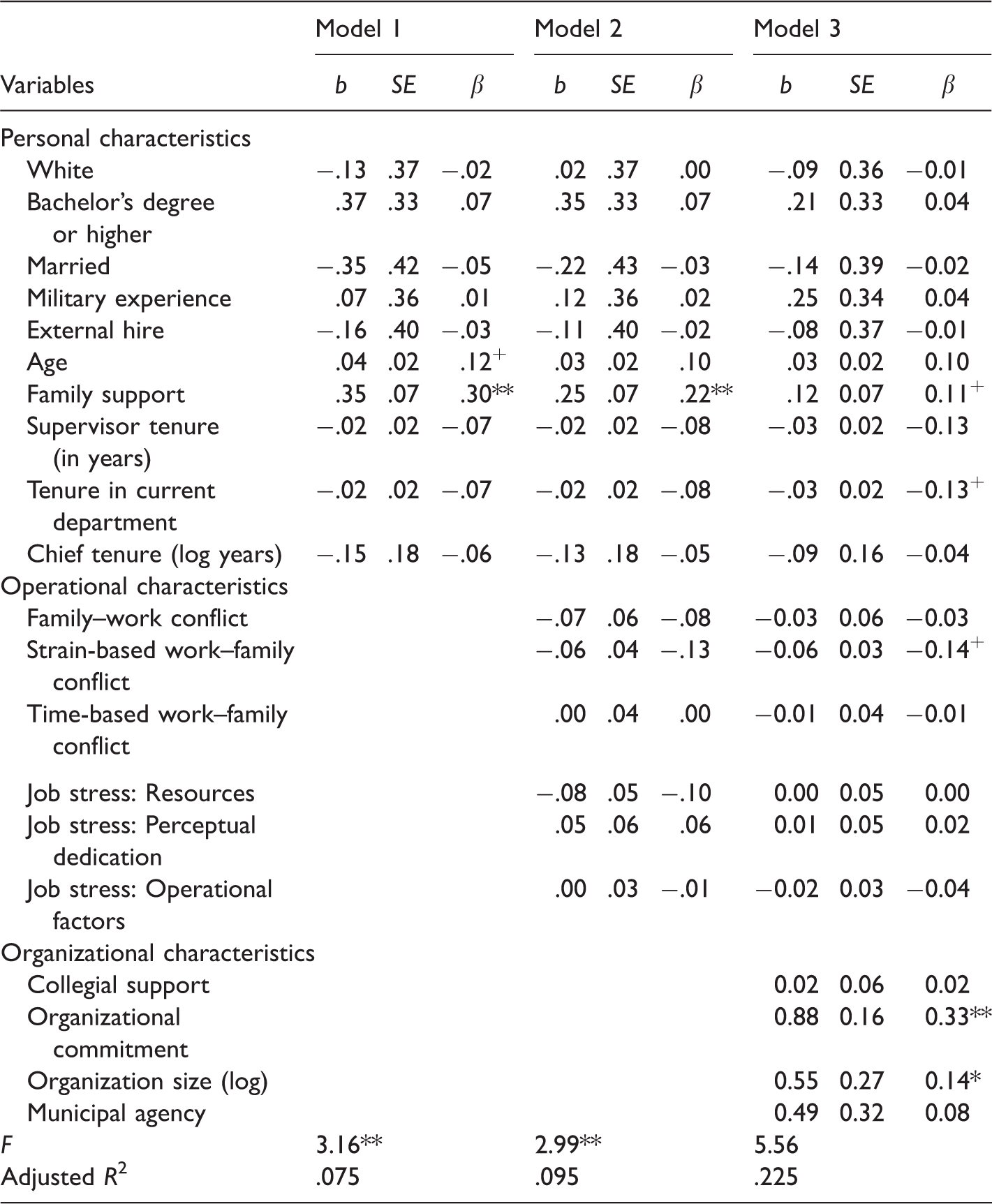
Table 3 presents the results of the three ordinary least squares regression models estimating the effects of personal, operational, and organizational factors on JS. Model 1 serves as the baseline model and includes only the personal characteristics of the chiefs. Overall, personal characteristics accounted for approximately 7.5% of the explained variance in JS, F(10, 304) = 3.16, p <.001. Greater family support was the only significant personal characteristic associated with greater JS scores (b = .35, p < .001). While age (b = .04, p = .09) was positively associated with JS, the relationship was only marginally significant.
OLS Regression Results: Personal and Work-Related Factors Associated With Job Satisfaction (N = 315).
Note. OLS = ordinary least squares.
+p < .10. *p < .05. **p < .001.
The inclusion of the operational characteristics in Model 2 moderately increased the model’s overall predictive strength, as evidenced by the adjusted R2 = .095; F(16, 298) = 2.99; p <.001. Despite being significant at the bivariate level, findings indicated that none of the six operational characteristics was significantly associated with JS in the multivariate models. Even with the addition of the operational factors, however, greater family support (b = .25, p < .001) continued to be significantly associated with higher JS scores.
Model 3 represents the full model, which regressed the personal, operational, and organizational characteristics on JS scores. The inclusion of the organizational characteristics dramatically increased the predictive strength of the model, as it accounted for approximately 22.5% of the explained variance on JS, F(20, 294) = 5.56, p <.001. In the full model, only two organizational characteristics were significantly associated with JS at the p <. 05 level. Indeed, the results indicated that higher JS scores were associated with greater OC (b = .88, p < .001) and being a chief of a larger police department (b = .55, p < .05). Greater family support (b = .12, p = .08), having a shorter tenure in their current department (b = −.03, p = .09), and lower strain-based WFC (b = −.06, p = .08) were also associated with higher JS scores; yet, the relationships were only moderately significant.
What is interesting in the full model is that family support went from being significant at the p <. 05 level in Model 2 to being marginally significant at the p <.10 level. Inconsistent with the first two models, chiefs’ tenure in their current department and strain-based WFC emerged as marginally significant as well. This suggests that organizational characteristics, particularly OC and agency type, potentially mediates, albeit partially, the effects of personal and operational characteristics on JS.
Discussion
The current study examined the extent to which police chiefs enjoyed their job and identified important personal, operational, and organizational factors associated with JS. Previous policing studies have shown that personal characteristics have a limited impact on JS, as it is largely shaped through factors inherent in the work environment (Ercikti et al., 2011; Herzberg, 1968; Johnson, 2012; Zhao et al., 1999). Findings from the current study were consistent with the extant scholarship in that work-related factors, particularly organizational variables, accounted for most of the explained variance in JS. Indeed, personal characteristics accounted only for 7.5% of the variance, which increased to 9.5% with the addition of the operational variables, and finally 22.5% with the addition of the organizational variables into the multivariate models.
While the explained variance in JS for the full model is similar to the variance explained in JS in previous studies of police officers (Johnson, 2012; 24.5%), nearly three-fourths of the variance is still unaccounted for. Since JS is shaped by one’s work environment (Herzberg, 1968), future studies should examine other correlates that are related to police organizations, along with factors that are inherent to the role and responsibilities of police chiefs. For example, Zhao et al. (1999) and Johnson (2012) examined the effect of Hackman and Oldham’s (1975) five core dimensions of the immediate work environment on JS among frontline officers. Zhao et al. (1999) found that skill variety, task identity, task significance, and autonomy were the strongest predictors of JS among police officers, while Johnson (2012) identified autonomy as the strongest predictor of JS. Yet, to better isolate work-related factors associated with JS among police chiefs, future studies should first explore the routine activities of police chiefs. Indeed, little is known about the daily routines of police chiefs and where they dedicate most of their time and efforts (for an exception, see White, 2017). Perhaps employing a time-task analysis of police chiefs could help better understand the roles and responsibilities of police chiefs, along with parceling out how these routine duties influence their work-related attitudes.
Previous studies have linked JS among police to personal (e.g., education and tenure), operational (e.g., WFC, job stress), and organizational correlates (e.g., collegial support and burnout; Burke et al., 1984; Howard et al., 2004; Jaramillo et al., 2005; Johnson, 2012; Zhao et al., 1999). In the current study, however, OC and organization size were the strongest and only significant predictors of JS among police chiefs. For personal characteristics, increased family support and shorter tenures in chiefs’ current department were associated with higher levels of JS, while strain-based WFC was the only operational characteristic related to JS. After the inclusion of the organizational characteristics, however, the relationships were only marginally significant at the p <. 10 level.
Much of the literature on organization size and JS is mixed, with some scholars arguing that JS would be greater in larger organizations due to better employee benefits and more opportunities for specialization/promotion (Johnson, 2012). Conversely, Crank et al. (1987) hypothesized that JS would be lower in larger organizations due to the increased stress from the volume of decisions. The current study, however, was among the first to actually incorporate organization size in a multivariate model of JS. Findings revealed that JS was shown to be greater among chiefs working for larger organizations. Inconsistent with Crank et al. (1987), job stress was not significantly associated with JS, so perhaps chiefs of larger departments enjoy the challenge of having increased responsibilities and demands. On the other hand, the current study did not use measures assessing the impact of external pressures from institutional sovereigns (e.g., the media, political environment, police unions) on JS among police chiefs. While police chiefs enjoy increased autonomy and discretion compared to the rank-and-file, external constituents or sovereigns play an important role in shaping the degree of discretion chiefs possess (Matusiak, King, & Maguire, 2017; Tunnell & Gaines, 1992). Both Zhao et al. (1999) and Johnson (2012) found autonomy to be a significant predictor of JS. Thus, it would be interesting for future studies to determine (a) if the influence of external sovereigns accounts for the additional explained variance in JS and (b) if organizational size continues to be a significant predictor of JS net of controlling for the degree of external pressures from sovereigns.
Organization commitment (OC), which refers to chiefs’ bond, loyalty, or attachment to their organization (Mowday et al., 1979), was the strongest predictor of JS among police chiefs. OC has been a relatively understudied construct in the policing literature, particularly among police administrators. Of the studies that exist, however, OC has been strongly linked to JS among the rank-and-file (Brunetto & Farr-Wharton, 2003; Jaramillo et al., 2005). According to Steers (1977), “people who are highly committed to their work organizations are willing to devote more effort to the organization, identify more with the values of the employer, and seek to maintain their affiliation with the organization” (p. 302). The significance of OC and its relationship to JS among chiefs has important practical and theoretical implications.
Indeed, OC has been linked to many work-related attitudes and behaviors, such as motivation (Meyer, Becker, & Vandenberghe, 2004), absenteeism, JS, job performance, and turnover (Mathieu & Zajac, 1990; Meyer et al., 2002; Mowday, Porter, & Steers, 1982; Riketta, 2002). In addition, JS and OC have been identified as major determinants of organization performance (Riketta, 2002). Thus, it makes sense that chiefs who are not as invested in the mission or goals of the department or lack motivation or attachment to their organization would not enjoy being police chief. As a result, chiefs with low OC and low JS can negatively influence the attitudes and behaviors of the rank-and-file, which, in turn, can impact the quality of services provided to the community.
From a theoretical standpoint, it is important to note, however, that the temporal relationship between JS and OC has not been fully established. To date, four competing models have been proposed: (a) JS is a causal antecedent to OC (JS → OC); (b) OC is casually antecedent to JS (OC → JS); (c) the relationship between JS and OC is reciprocal (JS ←→ OC); and (d) there is no relationship between JS and OC (Vandenberg & Lance, 1992). The JS → OC model is the most widely accepted model in the organizational psychology literature (Mowday et al., 1982). This model argues that JS develops more quickly, while OC manifests over time after an employee has developed a thorough understanding of the job and job facets, along with having enough positive and negative experiences with an organization to understand the long-term implications of maintaining employment. However, other longitudinal studies have produced mixed results with support for each of the four proposed models (Huang & Hsiao, 2007; Vandenberg & Lance, 1992).
Previous studies have found OC decreases with officer rank and tenure (Beck & Wilson, 1997; Brunetto & Farr-Wharton, 2003). In the current study, however, OC had no significant relation with tenure at the bivariate level. Even more, JS can be dynamic and vary according to one’s current work environment (Ercikti et al., 2011; Rhodes, 2015). Thus, moving into a new position may not only help officers develop a stronger connection to the organization, but the new responsibilities and opportunities can reduce the cognitive dissonance and, in turn, improve their level of JS. Future studies should use longitudinal designs and structural equation modeling to (a) parse out the temporal relationships between JS and OC; and (b) determine whether recognition and promotion among midlevel managers and new police chiefs account for variations in JS and OC.
It is important to note, however, that even though chiefs in the current study reported, on average, relatively high levels of JS, this was not the case for every chief. Indeed, the sample also included chiefs who scored below the midpoint, which indicates they were not satisfied with their job. Locke (1976) notes that job dissatisfaction manifests from a disconnect between the expectations one has for a job versus the reality of the position. Thus, while being promoted to chief may improve one’s work-related attitudes initially, a mismatch between the expectations and realities of the job can become an issue. Moreover, aligning with the behavioral commitment perspective (Bateman & Strasser, 1984), burnout and turnover intentions/turnover may manifest if there are limited opportunities for police chiefs to adjust their work environments to reduce dissonance and align their JS with their commitment to the organization.
The current study is not without limitations. First, the findings should be interpreted with caution given the data were cross-sectional and comprised of male police chiefs from a single state—Texas. Second, the current study used global versus specific measures of work-related attitudes. While not a limitation per say, using multidimensional measures of work attitudes could provide a more nuanced understanding how personal and work-related factors influence attitudes related to certain facets of the job. For example, while OC was a significant predictor of JS, this finding should be interpreted with caution due to limitations of the instrument. The original OC instrument was comprised of six items; yet, the factor and reliability analysis limited the instrument to two items with an alpha-level slightly below the acceptable threshold (Cronbach’s α = .640; Field, 2013). Thus, future studies should employ a multidimensional measure of OC to determine the unique effects of affective, continuance, and normative OC on JS (Meyer & Allen, 1984).
Conclusions
Collectively, the findings from the current study indicated that Texas police chiefs were generally satisfied with their jobs. In addition, organizational factors, particularly OC and organizational size, were better predictors of JS than operational or personal characteristics of police chiefs. The fact that increased family support and strain-based WFC were marginally associated with JS in the full model suggests that families may also play an important role in shaping chiefs’ satisfaction with their job. The current study is among the first to conduct a multidimensional analysis to assess work-related attitudes among police chiefs, and findings suggest that additional research is warranted. Considering that JS is a dynamic work-related attitude (Ercikti et al., 2011; Rhodes, 2015), future studies should employ longitudinal designs to assess JS over time, along with how institutional sovereigns impact chiefs’ JS. Only then will we be able to isolate the key factors responsible for brass satisfaction.
Footnotes
Declaration of Conflicting Interests
The authors declared no potential conflicts of interest with respect to the research, authorship, and/or publication of this article.
Funding
The authors received no financial support for the research, authorship, and/or publication of this article.