



Abstract
We describe a collaboration between Māori (Indigenous people of Aotearoa/New Zealand) and Tauiwi (non-Māori) researchers on a software engineering project. Te Tiriti o Waitangi (The Treaty of Waitangi) provides the basis for Māori to lead research that involves Māori as participants or intends to impact Māori outcomes. Through collaboration, an extension of the traditional four-step software design process was created, culminating in a nine-step integrated process that included Kaupapa Māori (Māori ideology) principles. The collaboration experience for both Māori and Tauiwi highlighted areas of misunderstanding within the research context based on differing worldviews and our ability to navigate and work through this. This article provides context, guiding principles, and recommended research processes where Māori and Tauiwi aim to collaborate.
Nā to rourou, nā taku rourou, ka ora ai te iwi With your food basket and my food basket, the people will thrive
Introduction
In Aotearoa (New Zealand), Te Tiriti o Waitangi (The Treaty of Waitangi)—Te Tiriti—is the founding document that dictates the principles for relationships with Māori (Indigenous people of Aotearoa/New Zealand) by government-mandated institutions (Te Tiriti o Waitangi, 1840). Te Tiriti includes active protection and equity for Māori, along with ensuring tino rangatiratanga (self-determination and sovereignty). In research, Te Tiriti provides assurance for Māori to be included and lead projects that involve Māori as participants or intend to impact on Māori outcomes. To this end, in academia, Māori research expertise is often sought by research teams to ensure they are meeting their obligations under Te Tiriti. Also, Māori academic expertise supports culturally sound processes. It allows the integration of cultural practices and knowledge that will uplift the mana (prestige) of Māori who are engaged in a research project.
Historically, Māori tend to mistrust research, which stems from the presentation of Western men’s earliest research in Aotearoa (Smith, 1999). Information gathered typically led to the comparison of Māori and life in Aotearoa with a Westernised worldview. The picture, presented to the outside world, was one where the first knowledge of Māori was contrary to an Imperial standard. The crews of Tasman and Cook presented Māori to be primitive savages, for whom intervention was necessary to ensure that their way of life was altered. A specific example is the research performed by Tauiwi (non-Māori) Elsdon Best with the Tuhoe (tribal group of Te Urewera, Aotearoa) people. In the reports written by Best (1897), he is acclaimed as the expert on Māori, the people, customs, traditions, and history. By contrast, his inquiry subjects, who gifted him the knowledge he sought, are left unnamed and unknown. Research has, therefore, been implicated in privileging Western knowledge and denying for Māori the validity of Māori knowledge, language, and culture (Smith, 1999).
Of particular importance in research where communities are involved is the approach made by institutions, such as universities, directly to those communities. Therefore, high-quality community engagement is essential for any research team that wishes to conduct their work with Māori (Cram, 2009). However, the right process for engagement and the building of trust relationships are not well described or embedded within university systems. When a Tauiwi research team acknowledges their obligations under Te Tiriti and thus knows the importance of engagement, then it is likely that they will engage Māori researchers to initiate and establish relationships with the community. However, while this is an unwritten expectation in areas such as health, where it is generally accepted and understood that projects need Māori expertise and leadership, this is not the case for other disciplines such as computer science and technology.
This article is about the collaboration between Māori and Tauiwi during Te Tini o te Hakituri (Guardians of the Forest) project. The authors are two Tauiwi computer scientists (Bowen and Hinze), one Welsh, one German, and three Kaupapa Māori (Māori ideology) researchers (Rolleston, Korohina, and Matamua). The following aims are to
Describe and reflect on the process of collaboration between Māori and Tauiwi colleagues on a technology-focused research project;
Describe how collaboration between Māori and Tauiwi led to positive outcomes for the project;
Provide recommendations to research colleagues for establishing and maintaining relationships for the benefit of communities.
Te Tini o te Hakituri project
Aotearoa’s forestry industry is one of the most dangerous work environments in the country (Hutching, 2018). Like many other high-risk work environments, forestry has a high proportion of Māori workers at 38.5% (Ministry of Business, Innovation & Employment, 2018). For serious, non-fatal work-related injury (2012–2014), Māori had a significantly higher rate than workers overall (Lilley et al., 2020). The Tauiwi computer science research team was interested in technical interventions that could reduce the rate of injury and fatalities.
Their initial research focused on gathering data about forestry workers’ physical workload (Bowen et al., 2019). A pilot was undertaken (Bowen et al., 2015), and the outcomes (Griffiths et al., 2017) led to developing what would eventually be Te Tini o te Hakituri project—Hakituri. The project aimed to predict hazardous work situations in forestry and explored collecting personal data for worker safety through a co-design process. Because of the Māori participant population, Kaupapa Māori methodology was intended to be integrated into the project. The team understood that using technology to gather personal data from workers for measuring fatigue levels or hazard risk must be considered within an appropriate cultural perspective.
Methodological approaches
Participatory design is a well-established methodology in software engineering to ensure product development will have relevance for the end-user. Kaupapa Māori methodologies also call on the inclusion and involvement of whānau (family) and community in research. There are similarities in the approaches and the philosophy behind each approach, but there are also significant differences.
Computer science approach to participatory design
The designing of software or technology is not a linear process. A series of steps should be followed, each of which is typically iterative, and as the development progresses, there may be a return to earlier steps to incorporate new knowledge. Figure 1 shows the four main categories of activities, each of which may consist of several iterations. The activity categories are (1) gathering and analysis of requirements; (2) software design, where functionalities and interaction elements are decided; (3) implementation, where the software is created, and user interfaces are built; and (4) evaluation then occurs, which may lead to insights that require adaptations.
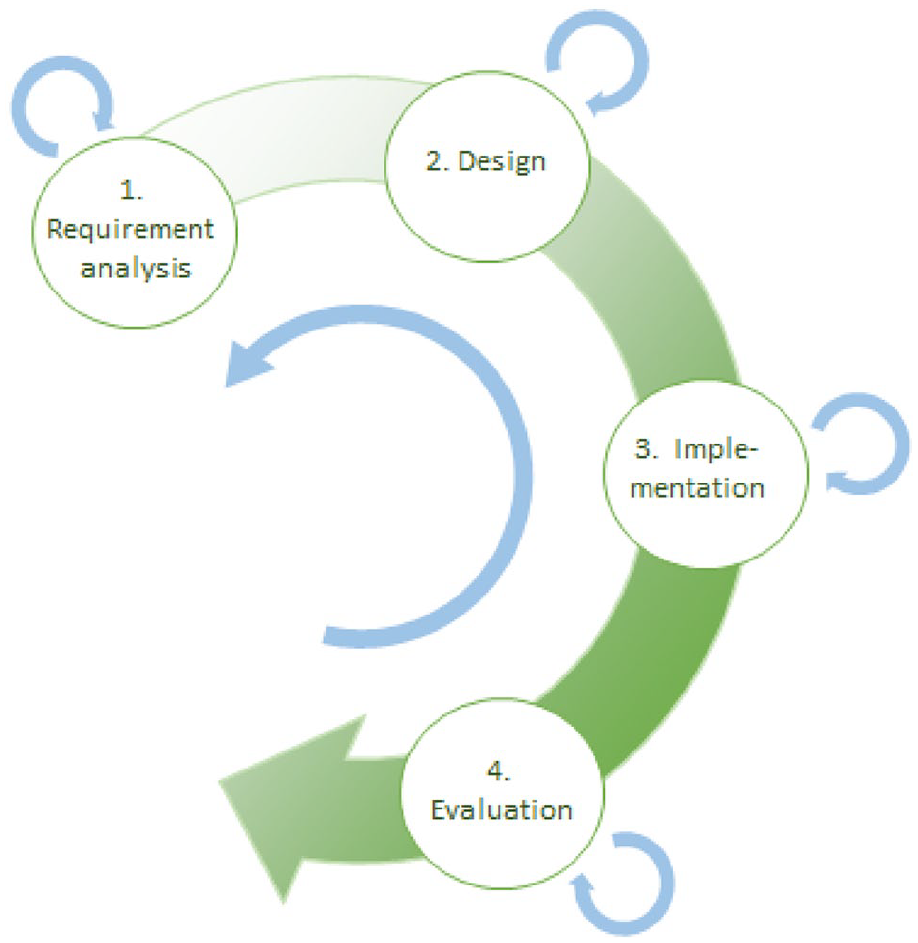
Software design process with iterations at each step (small blue arrows) and evaluation (large blue arrow).
The amount of user involvement within each category is dependent on the design methodology. Co-design suggests that the users are involved in all steps as an equal and active partner. In participatory design, the users may provide input to all steps but are not directly active in undertaking them. When designing for specialised domains, participatory design has many benefits. End users involved at key stages in the design process work alongside the development team (Figure 2).

Participatory design process showing user interaction (grey arrows).
Participatory design ensures that the needs of users are identified, which might otherwise not be obvious (Schuler & Namioka, 1993). It also serves as a reminder that the development team are not themselves the intended users. When the end user’s cultural background is different from that of the development team, techniques such as cultural probes (Gaver et al., 1999) are intended to ensure developers acknowledge cultural differences and build them into their proposed solutions. Software developers should understand and address their preconceptions about different cultural contexts.
While there are examples of successful projects that involve designing for Indigenous communities with a design team of non-Indigenous people, there is no clearly defined process to follow, which ensures that end-user engagement follows culturally appropriate methods. For the Hakituri project, this meant engaging with Māori researchers and handing over the leadership for the community engagement and data gathering component to them and Māori communities.
Kaupapa Māori methodology
Kaupapa Māori is an accepted methodology in research. The word kaupapa (process) is derived from the words kau, which is described as the process of coming into view or being disclosed and papa, which refers to the foundation or base coming from the word Papatūānuku (Earth Mother) and indicates a Māori view of the world (Taki, 1996). Kaupapa Māori relates to the laying down of a plan, philosophies, and strategies based on Māori values, beliefs, and worldviews. It has distinctly different epistemological and metaphysical foundations than Western philosophies. Therefore, Kaupapa Māori is “the conceptualisation of Māori knowledge” (Nepe, 1991, p. 6). It sees the world from a Māori perspective, unconstrained by Western ideals, attitudes, or societal structures.
Kaupapa Māori research is where all aspects of the research process are informed by Kaupapa Māori (Irwin, 1994). Bishop (2005) described it as, collectivistic and is oriented toward benefiting all the research participants and their collectively determined agendas, defining and acknowledging Māori aspirations for research, while developing and implementing Māori theoretical and methodological preference and practices for research. (p. 205)
Kaupapa Māori research was part of an international movement of Indigenous peoples to challenge the act of colonisation by settler states around land, culture, and language subjugation. In Aotearoa, this affected a greater commitment to Te Tiriti and its application within the research and academic space.
Kaupapa Māori is underpinned by critical and Indigenous theory and reflects the embeddedness of research within Te Ao Māori (the Māori world), with the research emerging from community need (Smith, 1999).
The guiding principles of Kaupapa Māori research are the following (Walker et al., 2006):
Tino rangatiratanga—sovereignty, autonomy, and self-determination, where control of the research sits within Māori cultural values and practices;
Manatika pāpori—social justice, where Māori benefit from the research, and there is the opportunity to build Māori research capabilities;
Te Ao Māori—the privileging of the Māori world;
Whakawhanaungatanga—the process of establishing and maintaining relationships between the researcher and the participants;
Te reo Māori—using the Māori language whenever possible, and although the reality is that many Māori researchers and participants may not be fluent in te reo Māori, the opportunity is always given;
Whānau—refers to family and extended family, which affirms the idea of the collective in understanding and sharing research findings.
Using Kaupapa Māori principles and concepts ensures Māori beliefs and values are central to the research, and interpretation of findings is based on a Māori worldview. If research provides evidence that informs policy and service provision for Māori, then Kaupapa Māori research is essential for ensuring Māori appropriate outcomes.
Technical co-design with Kaupapa Māori methodologies
In health research, Kaupapa Māori has been used alongside Western methodologies to imbed a best-of-both-worlds approach when Māori are participants. Elder (2013) used marae wānanga (a forum for discussion held at a marae—a traditional Māori building complex for gatherings) as a data collection process in a project about health journeys of whānau Māori (Māori families) where a member had traumatic brain injury. The concept of Te Waka Oranga was introduced, which provides a framework of intervention in the following two stages: (1) Hoe Tahi (establishing ground rules—learning to paddle as one) and (2) Te Haerenga o Te Waka Oranga (whānau and clinical team—launching, sailing, and arriving together, towards achieving recovery objectives).
Rolleston et al. (2016) have applied a Kaupapa Māori philosophical approach within a medical care setting. The project aimed to determine the impact of incorporating Māori values into a 12-week exercise and lifestyle management programme for cardiac risk reduction. Māori participants were able to remodel a usual care programme to incorporate Māori values and knowledge. A programme was produced that supported a Māori worldview while still maintaining key clinical outcomes.
Te Morenga et al. (2018) describes integrating co-design methods with Kaupapa Māori research when designing the OL@-OR@ app. The OL@-OR@ team included a European professor, a Māori researcher, a Pacific Island researcher, and representatives from Māori and Pacific Island health providers. The project team worked with communities and established strong relationships. Te Morenga observed that the research team should meet often for a successful project, building a team culture. Although the team experienced tension due to research priorities and expectations, they could resolve their differences using engagement principles they established during their meetings.
Despite some good examples of projects that weave Māori and Tauiwi worldviews, the relationship and the non-research aspects of the processes are not often articulated in dissemination documents focused on reporting methods and outcomes.
The engagement process
The process of engaging with Māori academic and community support for the Hakituri project was a significant learning journey for the Tauiwi team.
Original expectations
The first steps for Authors 2 and 3 were to engage with Te Pua Wānanga ki te Ao (Faculty of Māori and Indigenous Studies) at Waikato University. Initial contact was made because Author 3 had worked with a Māori professor on a previous project. This led to the inclusion of Author 5 into the research team. Authors 2, 3, and 5 worked to identify the project’s key features from a Māori perspective throughout several meetings and conversations. Author 5 then gifted the name Te Tini o te Hakituri to the project.
Within Hakituri, Authors 2 and 3 had the role of software designers. Author 5 acted as Māori advisor. While a typical participatory design process would have entailed techniques to support both Māori and Tauiwi workers, it was clear to Authors 2 and 3 that participatory design alone would not meet the needs of the post-colonial context of Aotearoa and Te Tiriti. Even with the guidance of Author 5, there was an understanding that engaging in Māori-focused research needed additional Māori support within the research team. The need for Māori leadership for engaging with Māori workers was implicitly understood to enable a Kaupapa Māori philosophical approach to be used. The intention was to extend the participatory design process to include te ao Māori, as shown in Figure 3.

Enhanced participatory design process (Kaupapa Māori = Māori ideology, Te ao Māori = the Māori world).
A conversation led to a recommendation to contact a local Kaupapa Māori research and primary care organisation (MRO). The managing director, an established Kaupapa Māori researcher, had previously held academic positions at both Waikato and Auckland universities. When connecting with MRO, the intention was that they would work collaboratively with the research team to undertake the participatory design focus groups. In hindsight, both parties had their own interpretation of what collaboration meant: We appreciated that we were not experts in incorporating Te Ao Māori into the design process. We knew we needed to ensure a proper engagement process with the Māori forestry workers. There were initial challenges when we engaged MRO, not least because we did not have a shared vocabulary or real understanding of how we each typically worked. We needed to think differently about the process, and we couldn’t just put together a design focus session and ask Author 1’s team to run it. If we wanted to engage with a tikanga Māori process, then we had to relinquish ownership of the process and trust in the relationship with Authors 1 and 4. There were definitely times where we realised we were not on the same page. One of the things that made it work was talking openly about the challenges and having “difficult conversations.” (Author 2)
The MRO team had experience with engaging with universities to perform aspects of research work on behalf of Māori. They had firm expectations of the arrangement, including leadership, management, data analysis, interpretation, and dissemination. However, it was later discovered that these aspects were lost in translation for the Tauiwi team: We received an email asking for assistance with an already established and funded research project where it had been identified that there was a large proportion of Māori in the participant population and the research team were Tauiwi. We get these requests now and again, but we don’t always engage, as it can sometimes be more trouble than it’s worth. We make our first decision about engaging based on the nature of the research, whether it fits both our philosophical framework and our research priorities. This project was aligned on both, so we agreed to an initial hui (meeting) with Authors 2 and 3. We had a kanohi-ki-te-kanohi (face-to-face) hui to hear about the project and convey our way of working, including our must-do and won’t’s. We always look for a connection, get a feel for peoples āhua (character or nature). They came to us; they introduced themselves, they were cognisant of our tikanga (traditions and practices), we liked them. You get a sense for whether people understand equity, Te Tiriti and have aroha (love) for Te Ao Māori, or if they don’t. There were connections made, and there was humour. We agreed to progress based on that initial hui. (Author 1)
Māori community engagement and tikanga
A forestry industry contact recommended that the team get in touch with a Māori worker (WS1) from Worksafe—New Zealand’s primary workplace health and safety regulator. As part of his role, WS1 is directly responsible for the health and safety of Māori forestry workers. Author 2 made initial contact by email with a brief description of the project. Several phone conversations followed, and WS1 agreed to suggest suitable forestry teams for the project and also volunteered to help facilitate the meetings. WS1 thus became an adjunct to the research team as Māori community support.
Authors 1 and 4, with support from WS1, embedded a Kaupapa Māori approach to engagement. The approach was contextualised as creating a Kaupapa Māori korowai (cloak) that wrapped around the research proper to ensure that Māori values, beliefs, systems, and culture were privileged and woven throughout the research process. The korowai for this work included the concepts of tuakana–teina (older sibling–younger sibling), manaakitanga (kindness and care), tikanga and ngāwari (flexibility).
The tuakana–teina model stems from a well-known Māori concept about the relationship between an elder and younger sibling or cousin (Mead, 2003). The relationship is based on reciprocity and dual responsibility and can be applied in various settings (Winitana, 2012, p. 32). The tuakana–teina model situates whānau and communities as the experts and positions the researcher as teina or learner, the one who is there to listen, observe, and learn. Whānau and community, therefore, hold the mana and tino rangatiratanga over the process, and they decide what they want to discuss because their needs are inherent to the research (Walker et al., 2006).
The concept of manaakitanga in the project included the researchers understanding their role as manuhiri (visitors) and the importance of being a good visitor (Kennedy & Cram, 2010). It was also important to acknowledge the gift of the kōrero (conversation) and mātauranga that the participants shared, and thus, the research team provided kai (food) and koha (gift).
The tikanga and kawa (protocols) in place for each community were adhered to by the researchers. Tikanga allows a pathway that works for each given situation. For instance, with one community, the team participated in a whakatau (short semi-formal welcoming encounter) and thus was appropriately welcomed onto a worksite to conduct hui. In another community, a pōwhiri (formal ritual welcome ceremony) was held, and the team was welcomed onto a marae to facilitate the research process.
The approach of ngāwari meant the researchers being able to be flexible, for example, Friday afternoon sessions when participants did not want to be held up for too long or staying an extra night, so the team did not have to leave early to catch a flight.
Since the research was undertaken within the community, making whakapapa (genealogy) connections to those communities was essential. Bishop (1998) argues that by identifying the whakapapa connections, it gives an understanding that those involved in the process are connected by being nurtured by the same whenua (land) and are part of the same, albeit extended, whānau and this creates a shared sense of belonging: We met the second community group at their marae. While the hui with both groups had started with pepeha (traditional Māori method of introduction) by the researchers—in Te Reo Māori and English [Author 4], in Welsh and English [Author 2], in Te Reo Māori and German [Author 3]), in the second, smaller, group each person from the whānau also introduced themselves. In this meeting, the whanau identified links with our background by talking about their German ancestors and their part-Welsh heritage. Through these conversations, a link was created, some common ground, independent of the research project. It helped to build the relationship. (Author 3)
Three hui had been planned with the forestry workers. These had been planned to provide an introduction to the project and explore the use of technology and sharing of health information by the workers. The plan was shared with Author 4, who then developed the actual sessions from her Kaupapa Māori perspective. Each hui was undertaken utilising the kawa and tikanga of the mana whenua (the people who have jurisdiction over the land). That included pōwhiri or whakatau to welcome the team, karakia (prayer) and whanaungatanga to introduce and connect the researchers to the whānau: There were lots of processes that are a normal part of engagement for us as Māori that happened in the project. These processes keep us and our participant whānau, safe. We invited whānau, not just the workers, to come to the hui to support and participate, and at one, we had representatives across three generations. We also allowed the space for kōrero to happen outside of the actual hui. I found that some participants felt more comfortable having a kōrero while we sat outside the wharekai (dining hall). We even went back to each community to ask for feedback on our dissemination plans, allowing them to change or add kōrero. (Author 4)
The first forestry group was 30 rangatahi tāne (young men) and their supervisors, with the hui being held in a small room at the forestry offices. The sessions were often noisy and full of laughter. The second group was made of 15 participants, including forestry workers and their whānau. The hui with this group was held on a marae. The researchers were supported to facilitate the workshops by WS1 and the leaders within the forestry group itself.
Data coding
Following the hui, Author 4 and a member of the MRO Kaupapa Māori research team performed an initial brainstorming workshop using information, notes, and photographs from the hui. An initial coding outline was developed. A subsequent session was held with Authors 1, 2, 3, 4, and an independent qualitative researcher. In this session, the initial coding outline was discussed, codes were modified, refined, and the coding framework to be applied to the transcripts was agreed upon. On commencement of coding, based on the developed framework, a further discussion ensued between the coding researcher and the research team and minor amendments were made, and parent and child nodes were included in the final coding framework.
The coding framework provided a practical structure that described the key themes that arose from the hui. These themes constitute the findings of the research work. However, because the hui’s philosophical basis was Kaupapa Māori, the framework was themed within a Te Ao Māori context. The key themes that were derived from the workshops were presented in the Coding Framework as Parent Nodes. These themes were wrapped within a korowai of hauora (health and wellbeing). This meant the conversations and reflections to answer the research questions were framed for Māori within the context of health and wellbeing. This was to ensure that the kaupapa had a meaningful context for the audience.
The transcribing was challenging as there were multiple recordings for the same session, and it was often hard to hear and interpret the discussions, which were in both English and Māori. This is not unusual in Kaupapa Māori research where hui are held with collectives of people, and both languages are used throughout. Transcriptions are written as accurately as possible, with more than one recording device being used to capture discussions from different angles and side conversations. It was valuable for Authors 4, 3, and 2 to maintain a reflective practice and have a debrief after each hui, which helped flesh out the themes, and this was then used to overlay the coding and transcriptions: We decided that we had reached a good level of saturation of content once we were three-quarters of the way through the recordings. In fact, when we did the formal analysis and theming, it was evident what the messages were. Our context and our way of understanding the kōrero was not the same as for our colleagues, however. We didn’t figure this out until later when they wanted to see all the “data”. We had presented all the analysis, and that’s what our contract was for—to provide qualitative analysis. When our colleagues kept asking for the “rest of the information”, we were confused. What other information was there? Well, every word is a data point. Who knew? (Author 1) Typically, when we transcribe recordings of participatory design sessions, we are analysing the data to generate requirements. We want to ensure that everything that is said is captured and considered. A single word or phrase may be vital for the final software product. When we set up the contract and agreed that MRO would do the transcribing and coding, we assumed that our interpretation of what this meant was the only interpretation. We appreciated that there would be a richer interpretation of the kōrero and recordings, but we still imagined there would be a full set of data that we could then use to determine requirements. It led to one of those email conversations where we had to work through the misunderstandings and reflect on what constitutes data analysis and what the kōrero and recordings represent. (Author 2)
Dissemination
A Māori designer was engaged to create posters for each group as part of dissemination (Figure 4).
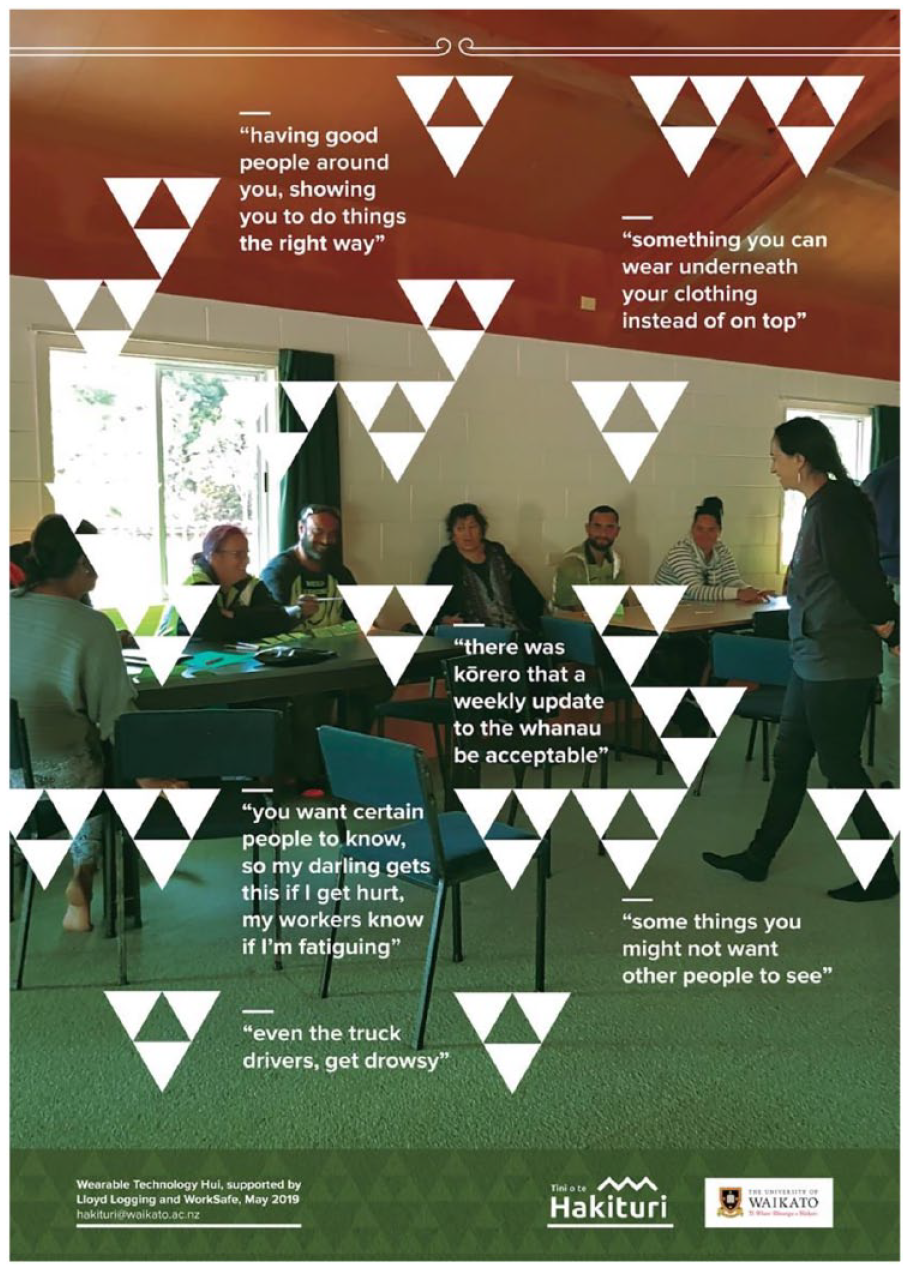
Poster designed for dissemination (kōrero = conversation).
The posters represented reminders of the workshops undertaken and some of the insights gathered. These were presented to participants along with transcribed material from the hui—on a USB stick, an overview of design activities, copies of photographs taken, and a summary of the coded data was provided. These items were gathered into a kete (flax woven basket) and presented to the groups. During the visits to disseminate information and give back data, we were also able to update them on the work’s progress and reaffirm their importance within our design process. WS1 insights were that the joint engagement between himself, Author 4 as the Māori research facilitator and Authors 2 and 3 as the technical team was successful because it was based around a shared kaupapa: I really appreciate that you came back because so often with these types of projects, it’s an email, and you’ve been introduced into their world, and now you’re going to say thank you by sending an email, and that means nothing to them. Not only does it mean nothing to them, but you just become those two Tauiwi scientists that came and were never heard from again, but you didn’t, you did the Māori thing and came back and took ownership, and you shared kai, and you participated in tikanga, it was, yeah it’s been a great example. (WS1)
Discussion and reflections
It became clear that through our joined efforts, we had effectively extended the initial four steps of the software design process (Figures 1 to 3) into nine steps (Figure 5) through our collaboration. Originally, the requirement analysis is the first step of the software engineering process. However, in our project, we found three steps that needed to be acknowledged before the requirement analysis. These steps were an initial planning phase, a preparation phase, and then a team-building phase. The initial planning includes preparing the funding application and integrating Kaupapa Māori within the project plan and budget. The preparation phase includes the contract negotiation with partner organisations and defining clear outcomes and expectations at this time. The team-building phase was about developing a shared vocabulary and understanding for the collaboration at an operational level. The process’ requirement analysis phase has been split into the following two steps to acknowledge: the engagement with end users and whānau for data collection and the subsequent data analysis. The returning of collected data and reporting back of insights to participants is different from what usually happens in computer science—symbolised by the bi-directional arrows.
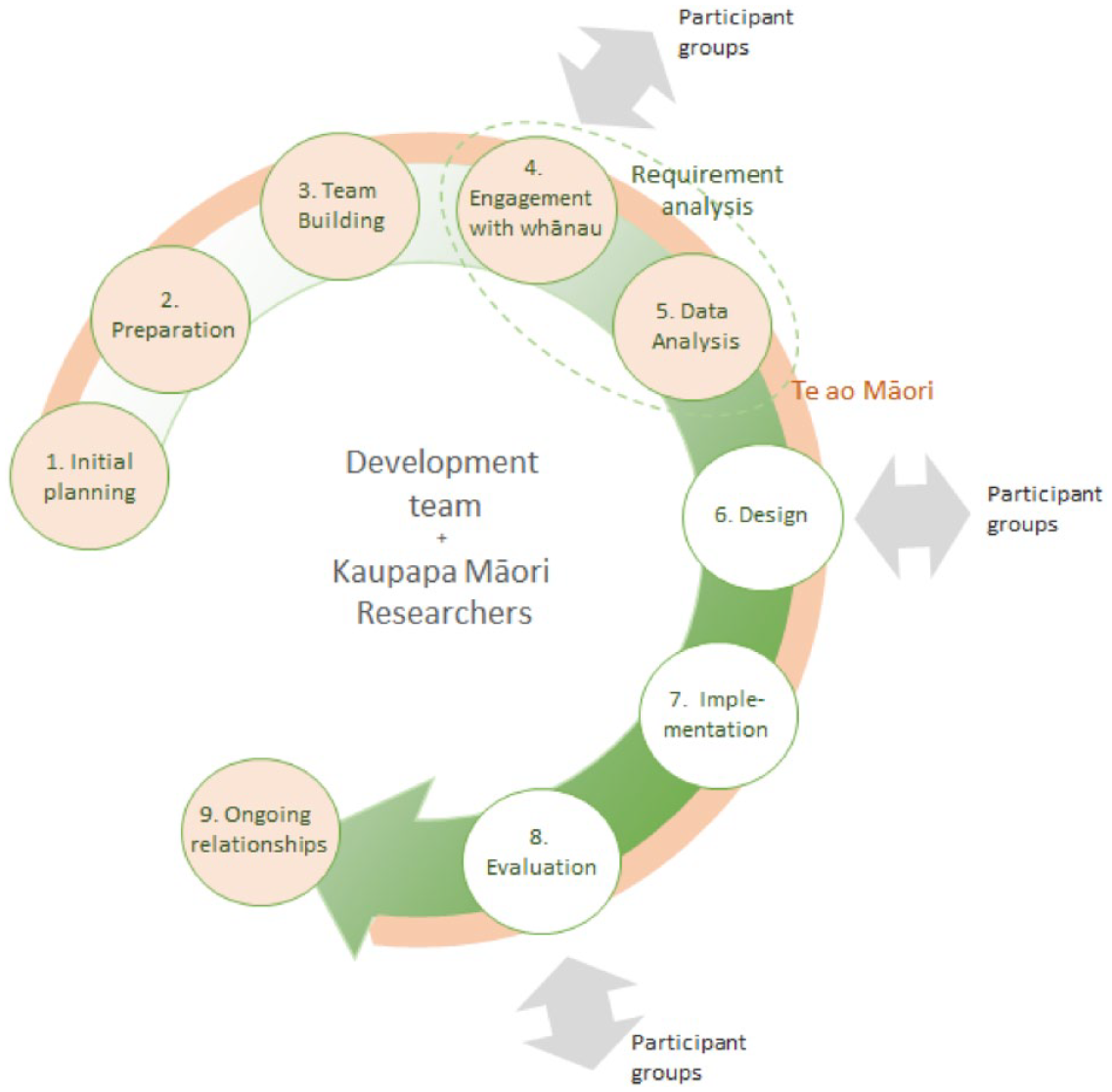
Extending and continuing the process together (Kaupapa Māori = Māori ideology; Te ao Māori = the Māori world).
The next three steps—design, implementation, and evaluation—within the software design process are maintained as described in Figures 1 to 3 and shown in white in Figure 5. Finally, the relationships built within the project do not cease with the completion of the research. We acknowledge this here by the inclusion of the ninth step, ongoing relationships.
Learnings that occurred as a result of interaction with each other on this project are presented in Table 1 according to the phases that were undertaken (those in orange in Figure 5). We adopt a weaving analogy to illustrate how the learnings for Māori, for Tauiwi, and those that were collective experiences of learning come together to create a strength that previously did not exist. Strands coming from the left of Table 1 (yellow) are learnings from a Tauiwi perspective. Strands coming from the right (green) are learnings from a Māori perspective. Strands that go across the whole width of the table (blue) are joint reflections.
Reflections on learnings from Tauiwi (left, yellow), Māori (right, green), and shared across the team (centred, blue).

Māori = Indigenous People of Aotearoa/New Zealand
Tauiwi = non-Māori People
whānau = families
whanaungatanga = introduce and connect the researchers to the whanau
Kaupapa Māori = Māori ideology
Summary and recommendations
In this article, we described a collaboration between Māori and Tauiwi researchers on a software engineering project. Leveraging off a strong relationship created at the outset between the two groups of researchers, we learned about each other and gained insights about researching in partnership.
Kaupapa Māori values underpinned the research team’s partnership, and those values were also used in the research process with the communities. Whanaungatanga has been central to the success of the collaboration and has provided the basis for working through the hard parts. Our engagements became less formal over time, and we were able to be vulnerable, acknowledging when things were confusing, confronting, and uncomfortable.
The learnings listed in Table1 1 provide guiding principles for such projects in which teams of Māori and Tauiwi researchers collaborate. As the need to collaborate across cultures is ongoing, we also present a list of recommended research processes where Māori and Tauiwi aim to collaborate:
The ability to safely raise concerns and hold awkward conversations is essential for a project’s success but is not easily achieved. We found that upholding both parties’ mana was an innate part of our trust relationship and ensured that general planning could be achieved efficiently and respectfully;
Hearing a contrary view, sitting with that view alongside your own, and then coming to a point of re-setting is not always easy. The Tauiwi researchers found that reflecting on their own experience of sexism and cultural displacement provided an entry point to empathetic listening;
Despite there being equity in the partnership between Māori and Tauiwi, there needs to be a privileging of a Māori worldview and the ability to enact tino rangatiratanga by Māori researchers. We identify that being able to assert oneself and place a privilege for the right context and at the right time is essential in cross-cultural partnerships;
To address the trauma of past transgressions by Western scholars, researchers must spend time planning and preparing for community engagements. The connection with communities by Tauiwi researchers can be mana enhancing or diminishing for that community. A Māori research team experienced with community engagement should lead the community connection process and guide the interactions. When a research team understands the context of a Māori community, they can ensure that their interactions are always mana enhancing for those who give their time and knowledge to a project;
Engaging with key community contacts before starting the joint research activities is essential for ensuring the process has community support. This needs to be followed by ongoing regular communication with the community contact throughout and after the project;
Reporting any insights gained and returning data to the communities are essential to acknowledge their contributions to the research and share the knowledge gained.
When adopting these recommendations, there are, of course, wider implications to consider. Researchers are required to conduct research and produce publications regularly to enhance their academic careers. The benefit of following a Kaupapa Māori process and building and maintaining strong community relationships is often not supported in research settings. There needs to be a wider shift in understanding that these processes and relationships are not merely altruistic but essential, not only for individual researchers but for institutions and government authorities as an obligation under Te Tiriti. This includes acknowledging and valuing the time and other costs required for essential aspects of the process and relationships with Māori, so that research in Aotearoa can be connected, safe, and responsive to all.
We need to acknowledge that the Tauiwi voice presented in this article is different from the Pākehā (New Zealanders of European descent) experience. However, we believe that the learnings and recommendations we present are relevant for all cross-cultural research contexts in Aotearoa.
There is also a danger that this article is preaching to the converted because only those who are interested in cross-cultural partnership might take the time to read. We hope that the descriptions of the Kaupapa Māori principles that guided the project team and our reflections on parts of the research that are not normally written about will nevertheless be helpful to others. In conclusion, by highlighting the “ups and downs” in our work, we provide a starting point for more genuine collaboration by Māori and Tauiwi for the benefit of the community.
Footnotes
Declaration of conflicting interests
The author(s) declared no potential conflicts of interest with respect to the research, authorship, and/or publication of this article.
Funding
The author(s) disclosed receipt of the following financial support for the research, authorship, and/or publication of this article: The research was funded by a Smart Ideas Grant from the Ministry of Business, Innovation and Employment.

Glossary
āhua character or nature
Aotearoa New Zealand
aroha love
hauora health and wellbeing
hoe tahi establishing ground rules, learning to paddle as one
hui a meeting
kai food
kanohi-ki-te-kanohi face-to-face
karakia prayer
kau process of coming into view, being disclosed
kaumātua elders
kaupapa process
Kaupapa Māori Māori ideology
kawa protocols
kete flax woven basket
koha a gift
kōrero conversation
korowai a cloak
mana prestige
manaakitanga kindness and care
manatika pāpori social justice
mana whenua the people who have jurisdiction over the land
manuhiri visitors
Māori Indigenous people of Aotearoa
marae traditional Māori building complex for gatherings
marae wānanga a forum for discussion held at a marae—a traditional Māori building complex for gatherings
mātauranga Māori knowledge
mokopuna grandchildren
ngāwari flexibility
Pākehā New Zealanders of European descent
papa foundation, base
Papatūānuku Earth Mother
pepeha traditional Māori method of introduction
pōwhiri a formal ritual welcome ceremony
rangatahi tāne young men
Rangiātea a place in the ancestral location of Hawaiki
Tauiwi non-Māori
Te Ao Māori the Māori world
Te Haerenga o Te whānau (family) and clinical team—Waka Oranga launching, sailing, and arriving together, towards achieving recovery objectives
Te Pua Wānanga ki te Ao Faculty of Māori and Indigenous Studies, University of Waikato
Te Reo Māori the Māori language
Te Tini o te Hakituri Guardians of the Forest, the name of a research project
Te Waka Oranga an Indigenous intervention for working with Māori children and adolescents with traumatic brain injury
tikanga traditions and practices
tikanga Māori Māori traditions and practices
tino rangatiratanga self-determination and sovereignty, autonomy
tohunga experts
tuakana-teina older sibling-younger sibling, the model used to situate whānau (family) and communities as the experts and researchers as learners, listeners, and observers
Tūhoe tribal group of Te Urewera, Aotearoa
wairua spirit
wānanga forum for discussion
whakapapa genealogy
whakatau a short semi-formal welcoming encounter
whanaungatanga introduce and connect the researchers to the whānau
whakawhanaungatanga process of establishing relationships
whānau family; immediate and extended
whānau Māori Māori families
whanaunga kin
wharekai place for eating
wharekai dining hall
whenua land