



Abstract
The Indigenous people of Malaysia are a heterogeneous community scattered over more than 852 villages in Peninsular Malaysia. This community has been identified to be among the poorest and marginalized in Peninsular Malaysia. This study evaluates the well-being factors as well as problems that hinder the development of an Indigenous community in Peninsular Malaysia. This article adopted a quantitative approach based on data collected through survey and 2,136 respondents were interviewed. The study reveals that the Indigenous community is likely to remain poor in terms of economic status significantly because of insufficient access to basic education and the inability of being employed. This is also due to the inability to receive support for housing, economic livelihood, and other social infrastructures. In addition, the study indicates that economic status and access to education are the most significant factors that may help improve the overall well-being of an Indigenous community. This finding also suggests that the social and environmental aspects in Peninsular Malaysia have not improved together with economic development.
Introduction
Historically, Indigenous people have been dominated, placed in the marginalized part of society, and discriminated. Such oppressions are still persistent to this present time (Anaya, 2009). Currently, the Indigenous people still face a lot of problems. Although they are utilized as human capital, the Indigenous people still cannot earn a higher income and experience a poor socioeconomic condition. This kind of situation can be seen in countries where the Indigenous people are considered as a part of the general population like Mexico (Ramirez, 2007) and in countries where a great part of the population is Indigenous like Bolivia (Feiring et al., 2003). Surprisingly, this kind of situation is also present in Australia, an industrialized country (Altman et al., 2005), and in a developing country like Vietnam (Rovillos & Morales, 2002). Given so, Malaysia is not an exception.
Back in 1991, Malaysia aimed to be economically, politically, spiritually, psychologically, and culturally fully developed by 2020 (The Economic Planning Unit (EPU), 1991). This objective was sketched out in various policies made from 1991 and in the recently launched Eleventh Malaysia Plan (EPU, 2015) with the theme, anchoring growth on people for a society that is socially inclusive. It should be noted that the effort of Malaysia to eradicate poverty is truly commendable because the government was successful in combating poverty and has shown a truly remarkable growth in the economy. However, Malaysia was affected by the financial crisis that happened in 1997–1998 including the global financial crisis in 2009. Despite the financial crises that have happened, the EPU reported 2.7 million households with a mean monthly income of RM 2,537 (EPU, 2015). These households are classified as the bottom 40% (B40) households income group. Out of the 2.7 million households, 63.1% reside in an urban area, whereas the remaining 36.9% live in the rural area. The largest group in the 40% of household income group in Malaysia is the Indigenous community. The Indigenous people ranked the lowest in income. The 50.92% of the Indigenous households live below the poverty line while 34.34% of those Indigenous households belong below the hard-core poverty line, whereas the national figure is at 0.06% for poverty (Malaysia, 2015). Similar to this, Noor (2012) states that about 80% of the Indigenous population in Malaysia are living below the national poverty line. The government explained that this failure is due to the failure of the Indigenous people to perceive a different kind of perception about development in the policy enactment manual (JAKOA, 2011).
Deaton (2008) studied the well-being of adults from 132 countries. His findings showed that income has a positive relationship with well-being, and this relationship is stronger in rich countries. Using per capita income as a proxy of personal income, and life expectancy as a proxy of health, the study revealed that health is an important factor of well-being, but it only has a weak effect on well-being. According to Deaton, education is also an important part of well-being. In another study, Kahneman and Deaton (2010) concluded that a higher income may lead to a higher level of life satisfaction, but it does not necessarily lead to better emotional well-being or overall happiness. Therefore, income is an essential component of well-being but income alone cannot account for well-being. Haq (2009) measured human well-being in Pakistan and found that human well-being can be understood and measured in four domains: economics, education, living conditions, and health. The study was focused on subjective and objective dimensions of well-being. Education was used as the main indicator for objective well-being, and the economic conditions of households and societies were used as the main indicators for subjective well-being. The study found that objective well-being differs substantially between different communities whereas subjective well-being did not differ much between communities. Selvaratnam et al. (2010) studied the well-being and morbidity of the elderly in Malaysia. The study was conducted with primary data, and 10% of the total elderly population in Malaysia was surveyed. The study showed that morbidity has a negative impact on both economic and human well-being. The study also found that social relations are an important factor which affects the well-being of an elderly person. Noor (2012) explained that Malaysian family well-being can be predicted and explained by 10 key indicators: work–family balance, resilience, child care, safety, the importance of religion, debt, savings, healthy lifestyle, and number of bedrooms at home. According to their index, family well-being is relatively high in Malaysia. The study also found that the economic situation of a family is directly linked with meeting the family’s needs and standard of living, which directly impacts well-being.
The Malaysian government has given reasonable consideration for the well-being of the Indigenous community through the Indigenous Peoples economic development project. The project allocated RM 25 million for the development of palm oil and rubber plantation in 2016. Tuck Po (2002) states that the Indigenous people have traditionally depended on their natural environment for livelihood. Their main livelihoods include cultivation, hunting, fishing, and gathering forest resources (Tuck Po, 2002). Deforestation is a common problem in Peninsular Malaysia because new lands are usually utilized for commercial-based crops. Other than these, there are also concerns that need to be addressed in the socioeconomic gap among the B40 households and vulnerable groups. These include insufficient basic infrastructures in both the rural and remote areas. As Kardooni et al. (2014) illustrate, 60% of Indigenous people can be found in the outlying districts of present-day rural villages; 37% reside in isolated areas while a relatively small population reside in the surrounding areas of townships. In addition to this, there also exists an imbalance in terms of regional economic opportunities and a great difference among parts of the Bumiputera community. Moreover, there are also concerns on the number of school dropout of students from primary education, insufficient access to higher education, skill development programmes, the inaccessibility to health services, and the absence of opportunity to own a land individually and communally. According to Cooke et al. (2007), very few investigations have been done on the different economic experiences of Indigenous people within a given society and even less is done recently in comparing the states of Indigenous people across different countries. In addition, there is also the absence of social-based and community-based entrepreneurship. This study, therefore, aims to evaluate the well-being factors as well as problems that hinder the development of an Indigenous community in Peninsular Malaysia.
Literature review
The Indigenous people are still facing many problems, and they are utilized as human capital. However, they still have poor socioeconomic condition and cannot earn a higher income. This a common phenomenon in countries where the Indigenous people are considered as a part of the general population (Altman et al., 2005; Feiring et al., 2003; Ramirez, 2007; Rovillos & Morales, 2002; Subramanian et al., 2006). Saugestad (2011) states that the plight of the Indigenous people has garnered attention in the recent decades due to the Indigenous rights movements that have taken place which were also raised at the international level. Eversole et al. (2005) published a study about the Indigenous people in the USA, Colombia, Mexico, New Zealand, Taiwan, Canada, Australia, and Russia. This study identified that different countries use diverse approaches, so making a comparison of the results across each country is quite difficult to do. In addition to this, it should also be noted that the Indigenous people are considerable in number and generally represent the poor population of the world at a disproportionate level; therefore, a study, such as the one mentioned, makes the measurements of the socioeconomic levels subdued.
A familiar scenario over the past years is the suffering that Indigenous communities have had to endure because of colonial expansion along with changes in the economy, acculturation, and intrusions in populations (Anderson et al., 2006). Many Indigenous people desire that their community retain their own tradition and culture and lessen the kind of cohesion in restructuring their societies. A number of developments in literature have acknowledged the level of poverty that the Indigenous people are in (Chiswick et al., 2000; La Ferrara & Alesina, 2005). Moreover, the relation among perceiving economic inequality and being a part of an Indigenous community in a developing country has recently become a topic of great importance (Nopo et al., 2007; Van de Walle & Gunewardena, 2001). Borooah (2005) and Asadullah and Yalonetzky (2012) conducted an empirical study on discrimination and tribalism in the Indian labour market and discovered that discrimination does exist due to the different castes getting into ill-paying jobs. Gustafsson and Shi (2003) examined the income distribution among the Indigenous and non-Indigenous population in China and found out that both groups showed a rise in income; however, those who belong in the Indigenous group showed a slower rise in income compared to those who are in the non-Indigenous group. Hamid et al. (2013) reported that the Indigenous people included in the resettlement plan scheme have given favourable opinions about the agriculture land development programme since their living standards have improved. The agricultural projects of the Land Consolidation and Rehabilitation Authority give financial benefits and assistance to the Indigenous community. Agricultural activities are considered as the main source of livelihood of the Indigenous communities as opposed to dependence on forest products. Unfortunately, the Indigenous people also perceive that agricultural activities will not be able to totally eradicate poverty in the long run. This article has the objective of outlining the well-being indicators and major impediments that hinder the development of the Indigenous community in Peninsular Malaysia.
The Indigenous people are highly dependent on their natural environment and forests for livelihood. Their main economic activities include cultivation, hunting, fishing, and collecting forest products (Tuck Po, 2005). According to N. Abdullah (2014), some self-dependent Indigenous people engage in small-scale economic trade with outside communities. These people buy only the items which they themselves cannot produce. The absence of economic activities contributes to the poverty of the Indigenous communities along with cultural factors and lifestyle. Moreover, development programmes have been undertaken with an objective that includes the rapid development of ethnic groups and to create competition with other ethnic groups as well. Such development programmes have delivered an increase in income and overall improvement in the socioeconomic status of the Indigenous communities because of changes from traditional to more modern economic activities. As such, the quality of consumer goods has now become affordable to the local Indigenous community. The social and environmental movements in Southeast Asia go against the small-scale plantations. Plantations do not help for the development of a rural area because it increases poverty and have ill effects to the environment (Barney, 2004). Many nongovernmental organisations (NGOs) in Southeast Asia use local people in order to oppose the promotion of plantations as a tool for development. Some drawbacks that a small-scale plantation poses are the lack of technology and the cost of production as opposed to big plantations.
Several research findings have revealed that the Indigenous population is at a great disadvantage worldwide when it comes to health and education. Lewis and Lockheed (2006) recently reported that the rural minority population is most likely to be absent from attending school. Moreover, girls in rural areas are at the worst disadvantage point when it comes to access in education. This is especially true for girls who reside in Malawi, Laos, Benin, India, Ghana, and Pakistan. Likewise, Hannum and Xie (1998) and Hannum (2002) also found that Indigenous people face challenges in education.
Burgess et al. (2009) state that even developed and progressive countries are not exemptions to the issues regarding the condition of the Indigenous communities. Indigenous people suffer from shocking health conditions. There exists an increase in the poor health condition of the Indigenous people, and this poor health condition translates to high rate of mental illness and mortality (Bradley et al., 2007; Dixon & Maré, 2007; Gundersen, 2008; Stephens et al., 2005). Ohenjo et al. (2006) state that in other parts of the world, there is little knowledge about the health condition of the Indigenous people and the access to decent health facilities. A few studies done on some communities reveal that some of the Indigenous people have a substantially poorer health condition compared to the overall population, along with a higher mortality rate and illnesses compared to the overall population (Vos et al., 2009). Adults are also experiencing poor health condition in the Indigenous community. Not surprising, the Indigenous people in Vietnam live at a much lower level of standard of living. This is because of the habitat they are in. The Indigenous people in Vietnam live in inadequate productive areas with minimal access to education, poor infrastructure, skilled job, and market economy (Van de Walle & Gunewardena, 2001). Globally, Indigenous people also have poor access to good health services. As a result, their health situation is also in want despite living in a wealthy nation. Their health conditions cover a wide range of illnesses and conditions, such as diabetes, cancer, and mental illness, with infant mortality at an increasing rate. This situation is present in communities that have been deprived of livelihood, existence of unemployment, inadequate housing, and presence of drug addiction (Subramanian et al., 2006). On one end of the pendulum, the Indigenous people who have been underprivileged of several social facilities suffer from depression to a certain extent that they themselves pose a danger to their very demographic endurance.
The perspective in which households operate is the external environment such as seasonal, trend, and shocks that will have a great impact on lives and accomplishments. Seasonal refers to seasonal changes in factors such as prices, production levels, availability of food, and opportunities (Morse & McNamara, 2013). The long-term trends are usually large scale in nature. Shocks in terms of vulnerability context include shocks to human health such as epidemics, natural shocks due to natural disasters, and economic shocks such as conflict and livestock or crop pests and diseases. This can lead to the direct destruction of any property as in the case of floods or storms that destroy agricultural land, hampering agricultural output. Shocks can also force households to sell-off their assets as part of its strategy to deal with them. Continuing drought could affect social and human capital as people are forced to leave their homes. A household resilience to shocks is an important determinant of the sustainability of lifestyles (Hallegatte et al., 2020; UNDESA, 2020).
Overview of Indigenous community in Malaysia
Malaysia is indeed a very distinct country with its multicultural and multiracial facets along with its diversity in races, religion, culture, stability of the country, tourism, and other factors. According to Department of Statistics Malaysia (DOSM, 2020), the total population of Malaysia is 32.7 million which can be divided into 69.6% of Malays, 22.6% Chinese, 6.9% Indians, and about 1% of other ethnic groups. Nineteen ethnic subgroups comprise the Indigenous peoples in Peninsular Malaysia, and from these 19 ethnic subgroups are the 3 main ethnic groups. The first of these is the Negritos who can be found in the northern part of the peninsula. The second ethnic group is the Senois who live in the central region. The last is the Proto-Malays or Aboriginal Malay who can be found in the southern region of the peninsula. The Senois group makes up more than half or 55% of the Indigenous population. The Proto-Malays comprise the 43%, and the Negritos make up the 3% (Noor, 2012). The Malaysian government perceives the Indigenous people as underdeveloped and in need of support and modernization. At present, the Indigenous people are roughly from 140,000 to 180,000 in population. The Department of Orang Asli Development has reported a total of 180,458 Indigenous people in 2011 (Don, 2014). That figure represents 0.5% of the total population in Malaysia. Moreover, there is still over one-third of the Indigenous population in Malaysia that are classified as hardcore poor despite the many projects that have been done and given on Indigenous community development (JHEOA, 2008).
Malaysia revised the national poverty line income to RM 2,208, which means over 400,000 households in the country with monthly incomes below this level were considered poor in 2019 (DOSM, 2020). Kelantan State has the highest poor households with 12.4%. The Indigenous households in Kedah State have the second highest poor Indigenous households with 8.8%. This is followed by the Perak State with 7.3% household poverty rate in Peninsular Malaysia (DOSM, 2020). The other states were reported to fall at around 3% to 5% in household poverty rate (JAKOA, 2011). A great number of the Indigenous people in Peninsular Malaysia reside near the peripheries and surrounding areas of the urban part of the country. The Indigenous people still practice traditional economy and ways of living. They are popularly associated to the forest. The people believe that the forests has spirits that reside in them, and such spirits need to be protected and guarded in order to preserve the sustainability of the forest. Majority of the Indigenous people rely on arboriculture, forest-product trade, swidden farming, and fishing, coupled with some hunting, gathering activities, and employment as an unskilled worker. However, development projects and agricultural programmes have changed a great number of the rural poor into relatively modern and small family farmers. Consequently, an increasing number of the youth of the Indigenous people have also found employment in many different fields in the urban areas. But they specifically land in low-paying jobs. Since the 1990s, the government of Malaysia has done some means to include the Indigenous people in the national mainstream development plan while taking note of protecting their livelihood property rights, customs, and institutions. The government aims for a more natural integration process over artificial assimilation means as what was done in the past.
Since the mid-1990s, the Department of Indigenous Peoples Affairs has been asking for help and facilities of other government agencies. Such agencies include the Ministries of Health and Ministry of Education. The government has also solicited additional support from the Rubber Industry Smallholders Development Authority and the Federal Land Rehabilitation and Consolidation Authority for land development and agricultural production of the Indigenous people. A 10-point development strategy was also developed by the Department of Indigenous Peoples Affairs with the objective of lacing Indigenous people are on the path of development on a manner that is non-compulsive in nature and allows them to set their own pace (JAKOA, 2011).
The Department of Indigenous Peoples Affairs undertook in its new development plan a few of the constructive statements in the 1961 Statement of Policy. It states that the Indigenous people will not be relocated to another location and Indigenous people should be given the land rights. However, these policies were not honoured in the past, but because of favourable judicial decisions that respect the rights of the Indigenous people, new efforts have been made in order to resolve the land right issues of the Indigenous people. Land titles have been given to Indigenous people due to decisions of many state governments. According to Nicholas (2000) and Kari et al. (2016), the Department of Indigenous People Affairs state that Indigenous people can apply for claims of the lands which are unclaimed, reserved for cluster agriculture schemes, and under the scheduled villages concept permitted by the state governments. Unfortunately, this is not what happens in actuality; as such, owning a land by an Indigenous individual has been proven to be a challenge in outlining a development model (Bulan, 2010; Nicholas, 2000).
Methods and materials
Study site
The study was done within the boundaries of Peninsular Malaysia, also known as West Malaysia. According to Kari et al. (2016), Peninsular Malaysia has an area of 131,587 km2 (50,806 mi2), extending 748 km (465 mi) SSE-NNW and 322 km (200 mi) ENE-WSW. On its North is Thailand. On its East is the South China Sea. The Straits of Johore is on its South, and to its West are the Straits of Malacca and the Andaman Sea, with a total boundary length of 2,068 km (1,285 mi). The study covers the six states in Malaysia, namely, Negeri Sembilan, Pahang, Selangor, Perak, Johor, and Kelantan in Peninsular Malaysia, which have the highest population of Indigenous people.
Data collection and sampling technique
Data are primarily collected by face-to-face interviews and information acquired from government policy documents. In order to draw the target sample size, the information on Indigenous community database system (i-Damak) data set from JAKOA was used. The purpose of i-Damak is to provide a comprehensive database that connects all parts of JAKOA.
The i-Damak is an important source for data on the Indigenous people living in the outskirts of rural villages comprising data of about 852 villages where 37% reside in remote areas and only 3% of Indigenous people live in the vicinity of existing townships (JAKOA, 2014; Kardooni et al., 2014). The study used sociodemographic factors, namely age, gender, employment, address, and household with special needs as the first selection criteria to confirm i-Damak dataset has this information. These selection criteria were utilized to identify the age, gender, and employment status of the head of the household. Hence, the dataset already consists of households with some basic information that was determined before the field level study. After completing the first selection criteria, the location was used as the second selection criteria. This step-by-step method was adopted by the authors to provide a good representation of the state residential locations. After incorporating the two selection criteria, a list of households was obtained which was used to collect primary data. The study used stratified systematic sampling based on location to draw samples from the list of Indigenous households. Primary data through survey were collected from every fifth household, which eventually covered 53 villages in six states.
Sample size
The sample of participants for this study is from the villages of the six selected states in Peninsular Malaysia. A total of 2,136 respondents were interviewed using a set of structured questionnaires specifically aimed to meet the purposes of the study. The sample size was chosen based on the number of Indigenous households in each state. Table 1 shows, Pahang has the highest number of Indigenous households and Negeri Sembilan has the lowest. Hence, Pahang has the highest number of respondents (765 participants) and Negeri Sembilan has the lowest number of respondents (134 participants). The samples from each state were selected based on the housing locations of the participants—peripheral, rural, and urban areas. Such technique was used in order to get a good demonstration of the residential locations. The head of the Indigenous household is the sample unit of the study. The researcher deems that this sort of selection is suitable since the researcher will be able to obtain more information about the Indigenous lifestyle of each household with regard to their socioeconomic background. The head of a household is determined based on the person whom the other family members rely on for financial means. In most nuclear families, the head of a household is usually the husband or the male in the family, and usually the one who supports the family and provides the basic needs such as shelter and other necessities. It should be noted that there are also female household heads as a result of the death of a partner or separation. The selection of the head of the household was done before the interview with the use of the questionnaire. JAKOA officers and the Tok Batin (village heads) helped the researchers in identifying and verifying that the sample taken from the sampling frame is indeed the head of the household and qualified to be a part of the study.
Households and sample distribution by States.
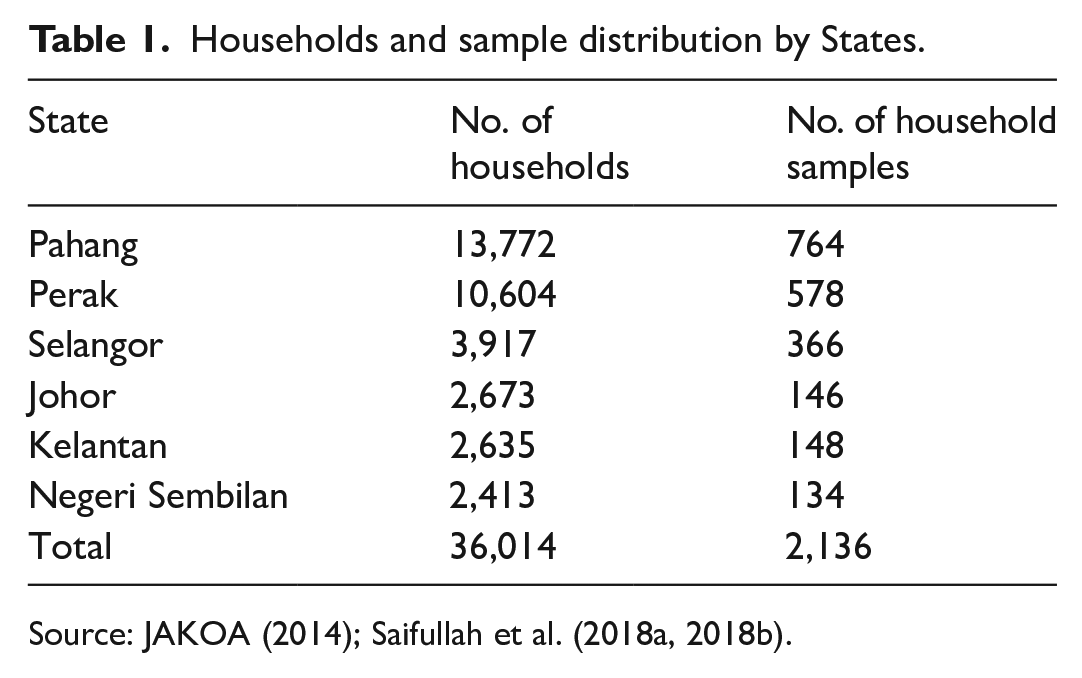
Source: JAKOA (2014); Saifullah et al. (2018a, 2018b).
Questionnaire design
The questionnaire that was utilized for this study is divided into two sections—Section A and Section B. Section A refers to the demographic information about the head of the household. Section A comprises total number of family members, age, and gender. Section B refers to questions related to job status, employment status, month income, poverty profile, education, health condition, environment conditions, social engagements, and the vulnerability context of the participants.
Dimension of well-being and the vulnerability context
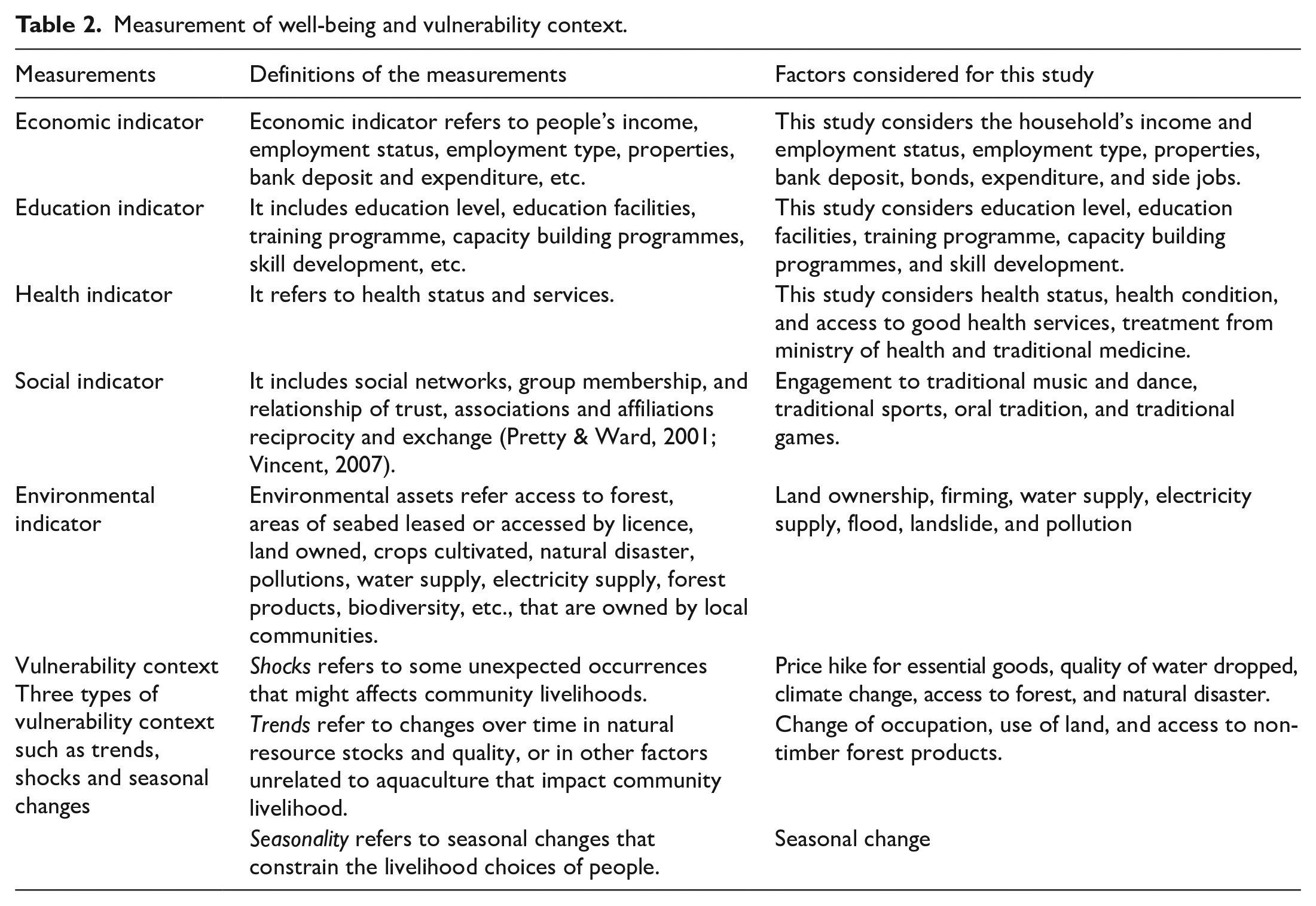
This research aims to measure the well-being and vulnerability of the Indigenous community in Peninsular Malaysia. The context of vulnerability is divided according to shocks, trends, and seasonality. This study identified the well-being indicators and vulnerability based on different factors as depicted in Table 2.
Measurement of well-being and vulnerability context.
Statistical analysis
Data were entered and analysed using statistical package for the social sciences (SPSS 25). In determining communities’ perceived importance of well-being indicators, respondents were requested to score selected practices based on a 0- to 3-point Likert-type scale, where 0 is the least important practice and 3 is the most important indicator. The well-being indicators were then ranked using the weighted average index (WAI)

where F = frequency of response; W = weight of each score; and i = score (3 = highly important; 2 = moderately important; 1 = less important; 0 = not important).
WAI was applied by many researchers of previous studies such as Uddin et al. (2014), Devkota et al. (2014), and Ndamani and Watanabe (2015). In this study, we used WAI to identify the most important factors that were impediment to the development of Indigenous community in Peninsular Malaysia. A ranking was conducted using the Problem Confrontation Index (PCI). Respondents were asked to grade major challenges to their development of socioeconomic conditions based on a 0 to 3 Likert-type scale (i.e. ranging from not a problem to highly problematic). The PCI value was estimated using the formula below

where PCI = Problem Confrontation Index; Pn = number of respondents who graded the constraint as no problem; Pl = number of respondents who graded the constraint as low; Pm = number of respondents who graded the constraint as moderate; Ph = number of respondents who graded the constraint as high.
Results and discussion
A total of 2,136 Indigenous household participated in the interview; however, the final sample size of the study was 2,079 because of missing data. The study shows 72.9% are male respondents and 27.9% are female respondents. Table 3 contains the number of respondents per age group. The age group 30 to 39 years old is the largest number of respondents (27.4%). This is followed by the 40 to 49 years old age group at 25.1%, then the 20 to 29 years old age group at 16%. There are 1,730 respondents who are married; the rest are either widowed or widower, divorced, or single. The percentage breakdown is shown in Table 3.
Demographic characteristics of the respondents.

Income level (monthly) is according to the DOSM (2020) income group. RM 1,104 and below = hardcore poverty line (extremely poor); RM 1,105 to RM 2,208 = national poverty line; RM 2,209 to RM 3,152 = income group above national poverty line but below the average monthly income of B40; RM 3,153 to RM 7,901 = the monthly income is equal or above monthly income of B40 but below average national monthly income; RM 7,902 and above = the monthly income is equal or above average national monthly income.
The study reveals that the average monthly income of the respondents ranges from RM 761 to RM 2,536. The income of this group is above the national poverty line (RM 2,208; DOSM, 2020) but it is considered below the average monthly income of the B40 group. The respondents who earn RM 1,104 and below fall is 65.6%; this group is considered as the households that live below the national hardcore poverty line (RM 1,104; DOSM, 2020). From the total number of respondents, 25.5% had incomes that range from RM 1,105 to RM 2,208 monthly; this group is classified as the households that live below the national poverty line. Overall, there is a total of 91.1% of households that live below the national poverty line with 2.4% households that has a monthly income of higher than the average monthly income in the B40 group. Moreover, there are only 0.3% of the total households that has a monthly income of RM 7,902 and above. As such, only six households have the monthly income as the national average or higher (RM 7,902; DOSM, 2020). The average monthly income of the respondents is RM 1,048.94 (n = 2,079). Looking at the scenario from a wider point of view, 91.1% of the households live below the national poverty line, 97.3% of households fall below the average monthly income of the B40 group while the 99.7% of the households fall below the national monthly income as displayed in Table 3. The educational level of the respondents shows that 40.6% have primary education while 17.3%, 0.5%, and 0.3% fall under the lower secondary, higher secondary, and tertiary education, respectively. However, 40.6% of the respondents have no formal education at all, and not a single respondent has achieved higher education as can be seen in Table 3.
Vulnerability context of the Indigenous community
The Indigenous communities have identified several problems that hinder their overall well-being in Peninsular Malaysia. They state the absence of availability of training and skills development problems as one of the impediments. This impediment had a PCI value of 4,944. This is ranked as the most critical hindrance towards achieving the well-being of the Indigenous community in Peninsular Malaysia. The results also show that Indigenous community faces other problems as well. This includes the lack of skills programmes, poor education level, unemployment, poor access to health services, susceptibility to natural disasters (landslides, floods, etc.), and inferior access to water supply, inability to own a land, and finally, inability to have a side job, each of which has a PCI value of 4,932; 4,904; 4,716; 4,443; 4,398; 4,082; 3,936; and 3,664, respectively (Table 4).
Vulnerability context of indigenous community.
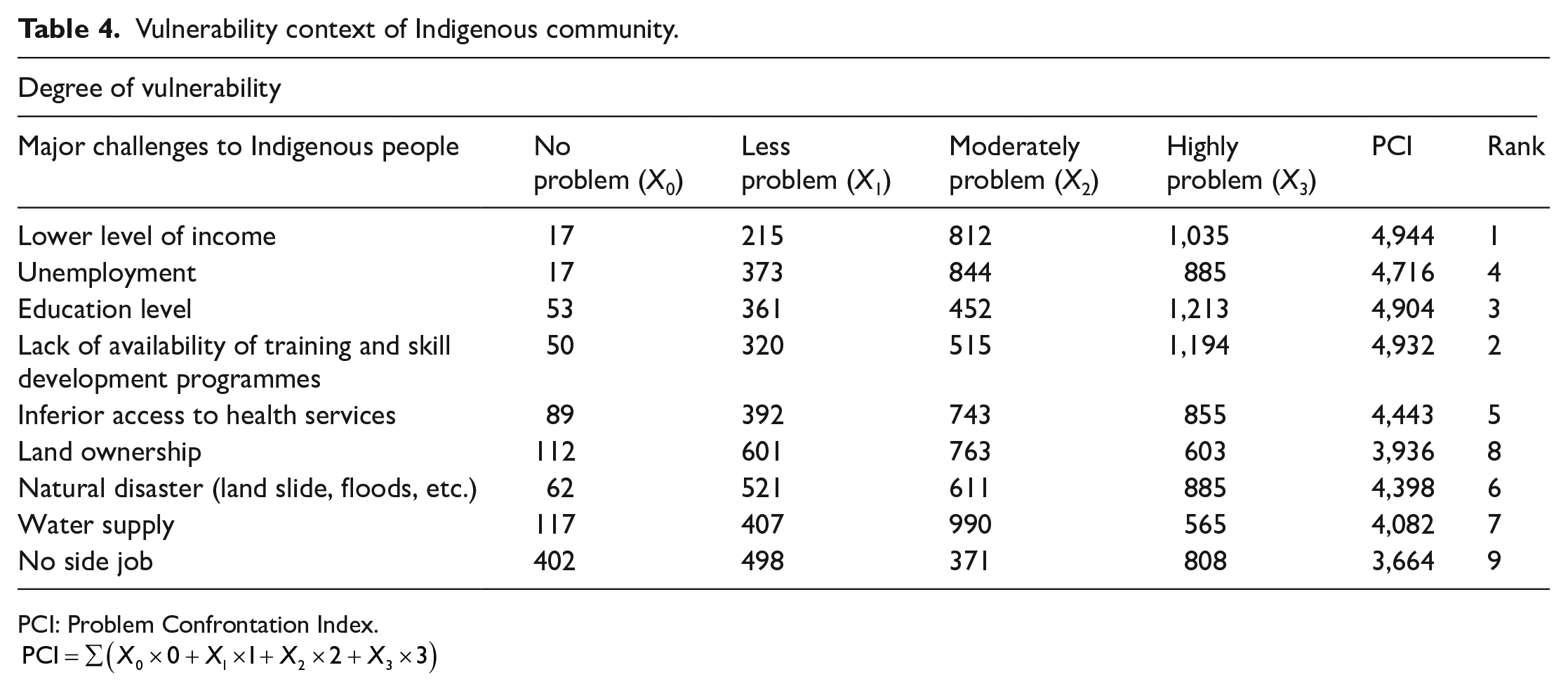
PCI: Problem Confrontation Index.
Important factors of well-being
In order to determine the most important factor for the well-being of the Indigenous community in Peninsular Malaysia, the study computed the WAI and ranked the results accordingly. The results show that the economic factor is deemed as the most important factor among all the well-being indicators for the Indigenous community with a WAI of 2.601. Education factor is ranked as the second most important factor with a WAI of 2.388, shown in Table 5. This is consistent with what Kari et al. (2016) has stated. Indigenous communities do have poor income and education level. As such, the policy makers of the country should give more attention to the economic and education factors of the Indigenous communities. Health factor ranks in third with a WAI of 2.211. Social factor ranks in fourth with a WAI of 2.156, and environmental factor ranked as fifth with a WAI of 1.778.
Important factors of well-being.
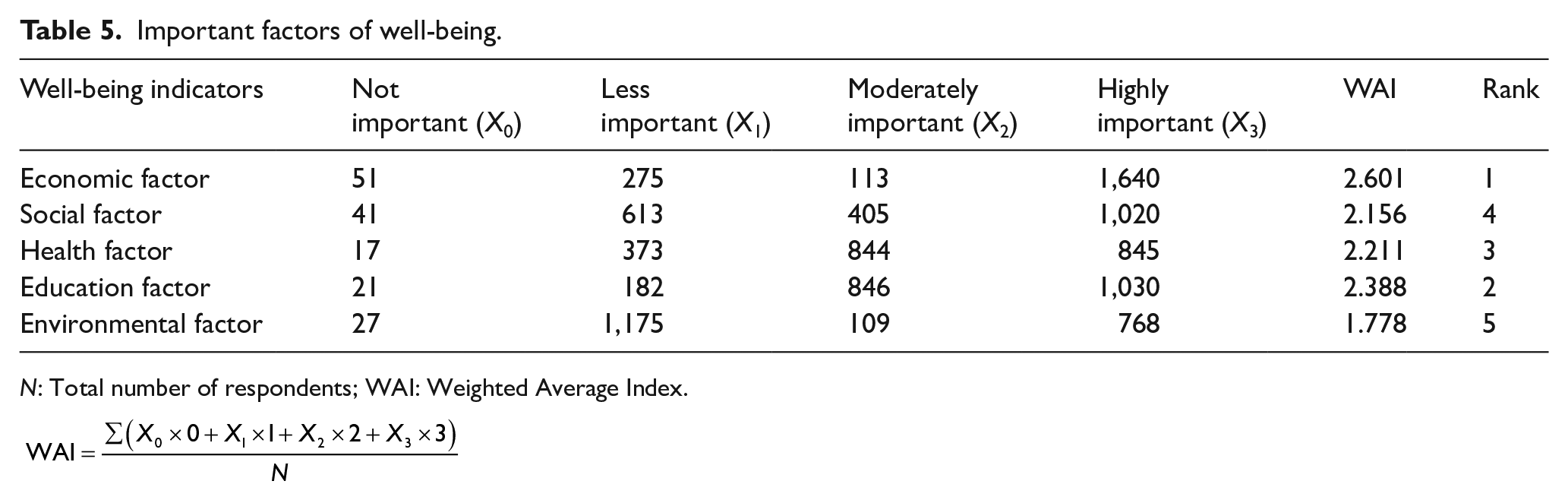
N: Total number of respondents; WAI: Weighted Average Index.

Discussion
Todaro and Smith (2003) and Sachs (2006) state that if the head of a household is well educated then the children of that household will be educated as well; thus, there will be a higher chance of producing high achievers in that given household. Being so, it is important that a plan be made in order to ensure that there will be a continuous developmental strategy in addressing the poverty issue among the Indigenous people through providing education for the children (Filmer, 2000; Filmer & Pritchett, 1999). There is an estimate of 47% of the Indigenous households that fall below the national poverty line with a monthly mean income of RM 760 or less. The most vital determiner of the socioeconomic condition of the Indigenous people is the availability of jobs for them in Peninsular Malaysia. A great number of the Indigenous people depend on the swidden, small agricultural production and forest products for livelihood. Unfortunately, such livelihoods do not give predictable and stable returns. Because many forests in Malaysia are considered as protected areas and of regulations, and a licence has been made obligatory by the Department of Wildlife Drainage and Forest Department, livelihood activities are limited for Indigenous people (Gomes, 2004). Excessive and illegal logging activities also hinder the dependency of the Indigenous people on the forests.
The steady dependence of the Indigenous communities on the forests will determine the design of substitute livelihood for these people. This is a pertinent and serious concern particularly among the youth who seek employment in the rural areas, which could impose a restriction on the constant moving of the youth to the urban areas. Because the Indigenous community feels a filial and robust bond with their natural environment, the sustainable strategies for forest management that will be planned should not only be able to preserve the biodiversity of the forests but also offer livelihood and jobs for the youth. Consequently, the Indigenous community must also be held as stewards and custodians in ensuring a sustainable development of the forests and be able to provide water supply for the entire country.
The reliance on land by the Indigenous community is not a novice idea anymore. Bulan (2010) and Gomes (2004) state that despite the need to be on the move always because of the need to study, a substantial number of Indigenous people would like to go back to their land because of the strong affectations they have for their home environment. Being so, a more practical and realistic approach to land ownership must be made with livelihood and equity strategies included in order to assure the future survival of the Indigenous community. The dependency on land of the Indigenous people is a pertinent issue that should be considered in consolidating the community with the developmental process of the country. The United Nations Declaration on the Rights of Indigenous Peoples (UN, 2007) states that the human rights–based approach is based on moral agreement and legal obligation. This sets the tone for the relationship between the state, individuals and groups with legitimate rights, and non-actors with corrective obligations. The rights-based approach is considered as comprehensive because it includes the intermingling interaction of the economic rights, cultural rights, political rights, social rights, and civil rights.
A great number of the Indigenous households fall below the poverty line. Poverty remains as the main concern because a significant number of households remain trap in the never-ending poverty cycle amid the progressive economic growth that Malaysia has experienced over the last five decades (Nicholas, 2000; Zin, 2009). The low level of income among the Indigenous people is result of inability to be employed, being employed in a low-end job, and insufficient skills, which is a by-product of the low level of education. It should be noted that the several factors significantly contribute to the poverty problem of the Indigenous communities include the household location and the rural area that the people reside. The ability to forage the forest for food and products which can be sold to the market contribute to the economic well-being of the Indigenous community. This ability to forage the forest has contributed greatly to bear the existing livelihood of the Indigenous community. Unfortunately, a great part of the forests has been used for the development of new town and other infrastructure projects and as a result, have displaced the livelihood of the Indigenous community. More so, the efforts of the government to relocate and resettle the Indigenous community in other permanent agricultural places have not been very successful in terms of the socioeconomic conditions of the community. A major problem encountered in this scheme is the inability to access a forest for economic activities.
Conclusions and recommendations
The primary objective of the study is to investigate the well-being of the Indigenous people in Peninsular Malaysia using the five well-known standard of living indicators. The results show that there is no marked improvement in the standard of living of the Indigenous people. The findings also reveal that income is considered as the most important factor among the standards of living indicators. The writers discovered that the income of the Indigenous people is very low compared to the other people in Malaysia. The results also reveal that the Indigenous people have inadequate access to health services and education with some concerns on environmental issues. As such, the Indigenous community have poor access to basic human needs and other social infrastructures. These results did not align with the Malaysian government’s goal to become a developed nation by 2020. The study also reveals that the majority of the respondents come from low-income groups. Despite the significant success of Malaysia in fighting poverty, policy makers should give more attention on how to raise the financial income of all its residents especially the Indigenous community.
The Indigenous resettlement project, which included basic amenities, such as housing, and economic agricultural activities, such as small-scale palm oil and rubber plantations, was introduced in 1979 under the Fourth Malaysian Plan. Since inception, this project was re-enforced in every Malaysian Plan to increase the socioeconomic condition of Indigenous people. Besides improving the socioeconomic condition, resettlement project gave Indigenous people a chance to be involved in the modern economic activities. About 14% of Indigenous people are living in resettlement areas (Hussain et al., 2017). The resettlement project is aimed at all ethnic group of Indigenous people in Peninsular Malaysia (J. Abdullah et al., 2016). However, most of the Indigenous people in Malaysia are resettled due to their land being acquired for various development purpose. Generally, Indigenous people are not happy with the acquisition and resettlement by the government (J. Abdullah et al., 2016; Alias & Daud, 2011). The plantation resettlement project brought mixed results. According to Hadi et al. (2013), resettlement programmes has increased poverty, mortality rate, and decreases health condition of Indigenous people. Moreover, they have negative impacts on environmental issues such as forest conservation.
Poverty among Indigenous households in Peninsular Malaysia deserves greater attention from the Malaysian government. The continuous degradation of the rainforest and the strict regulations on forest governance as part of the conservation efforts of the government has greatly misplaced the Indigenous community in terms of their socioeconomic status and natural environment. Consequently, there is also the need to investigate the development strategies along with the human right of the Indigenous people as stated in the United Nations Declaration on the Rights of Indigenous Peoples (UN, 2007). Such reference gives a more self-determined approach in coming up with developmental programmes for the Indigenous community because it gives emphasis on the informed consent of the community. There is a need to review the issues of the Indigenous community to ensure their source of livelihood. Increasing the economic status of a country is deemed important because it proves development. However, it should be noted that the general well-being of the Indigenous community in terms of livelihood must be considered as well. The Indigenous people have traditional rights over a land that has become their source of livelihood and sustainable lifestyle.
Footnotes
Declaration of conflicting interests
The author(s) declared no potential conflicts of interest with respect to the research, authorship, and/or publication of this article.
Funding
The author(s) disclosed receipt of the following financial support for the research, authorship, and/or publication of this article: This study was funded by the University of Malaya under the postgraduate research grant (PPP) grant (PG234-2015A).
Informed consent
Informed consent was obtained from all individual participants included in the study. All participants signed a written informed consent form, or, if they were illiterate, were read the consent form and provided their fingerprint with a witness signature.
