



Abstract
The concept of a national flower was an important part of the culture and poetry of the imperial courts of the Tang and Song dynasties. Li Bai and other poets in the Tang period used the tree peony as an icon of the imperial concubine Yang Yuhuan’s beauty. Later Tang poetry, however, also includes undertones of disquiet, using this flower-image as a sign of unhappiness at the state of the country. With the advent of the Song dynasty, the poetic focus exalts the plum blossom, a very different kind of flower than the tree peony. I argue that this reflects the Song dynasty’s different mentality. Writers of this age emphasized refinement, rationality, and introspection. For example, Lin Bu felt wedded to his plum tree. Su Shi developed a theory of the plum blossom’s character. The shift in government from North to South may have also contributed to the shift. The tree peony suited the northern climate; the plum tree thrived in the South.
Keywords
Introduction
China is perhaps the only superpower which still has not determined its national flower. However, this does not mean China had never had the concept of a national flower. On the contrary, for over 1,000 years, the tree peony and plum blossom have always been favorites in Chinese tradition. Both of them used to be candidates for the national flower of China. A famous academician of the Chinese Academy of Sciences, Chen Junyu, even suggested setting up dual national flowers to express the harmony of Chinese culture. Venerating these flowers had a deep link with the aesthetic culture of the Tang (618-907 AD) and Song (960-1279 AD) dynasties. This is of broader interest to scholarship on the role of flora in cultural symbolism and natural symbols of particular societies in their historical and geographical specificity. This also contributes to discussions of the role of climate in cultural symbolism.
Morals Drawn From Symbolic Values in the Aesthetics of Flowers
In The Book of Songs (诗经) we catch a glimpse into China’s earliest poetic flower imagery. The Odes of Chu (楚辞), attempts to employ the image of various kinds of flowers as symbols of virtues. A poeticizing tradition originated with these texts and continued through the Wei (220-266 AD), Jin (266-420 AD), Northern (420-589 AD), and Southern (439-581 AD) dynasties. Poets of Tang and Song not only had the desire to praise the virtue of various flowers but also succeeded in bringing the genre to its poetic apex. Hence it is justifiable to assert that floral celebration was a distinct type of poetry in the Tang and Song dynasties. The Tang tree peony was the public’s preferred flower while the plum blossom was the beloved bloom of the Song people. That the position of the tree peony was usurped by the plum blossom signifies a cataclysmic event that reoriented the evolution of China’s national psyche in the historical periods extending from Tang to Song. It points not only to a hidden fission but also to a hidden integration in major ingredients of Chinese culture. This unfolded a new vista for the Chinese culture whose architectonic was based by a unity of two opposite aesthetic styles.
The Tree Peony and the Status of “National Flower”
Flowers on a tree peony are usually large and gorgeous. Similar to other blossoms of the peony family, 1 they impart a torrid, vernal verve (see Figure 1).
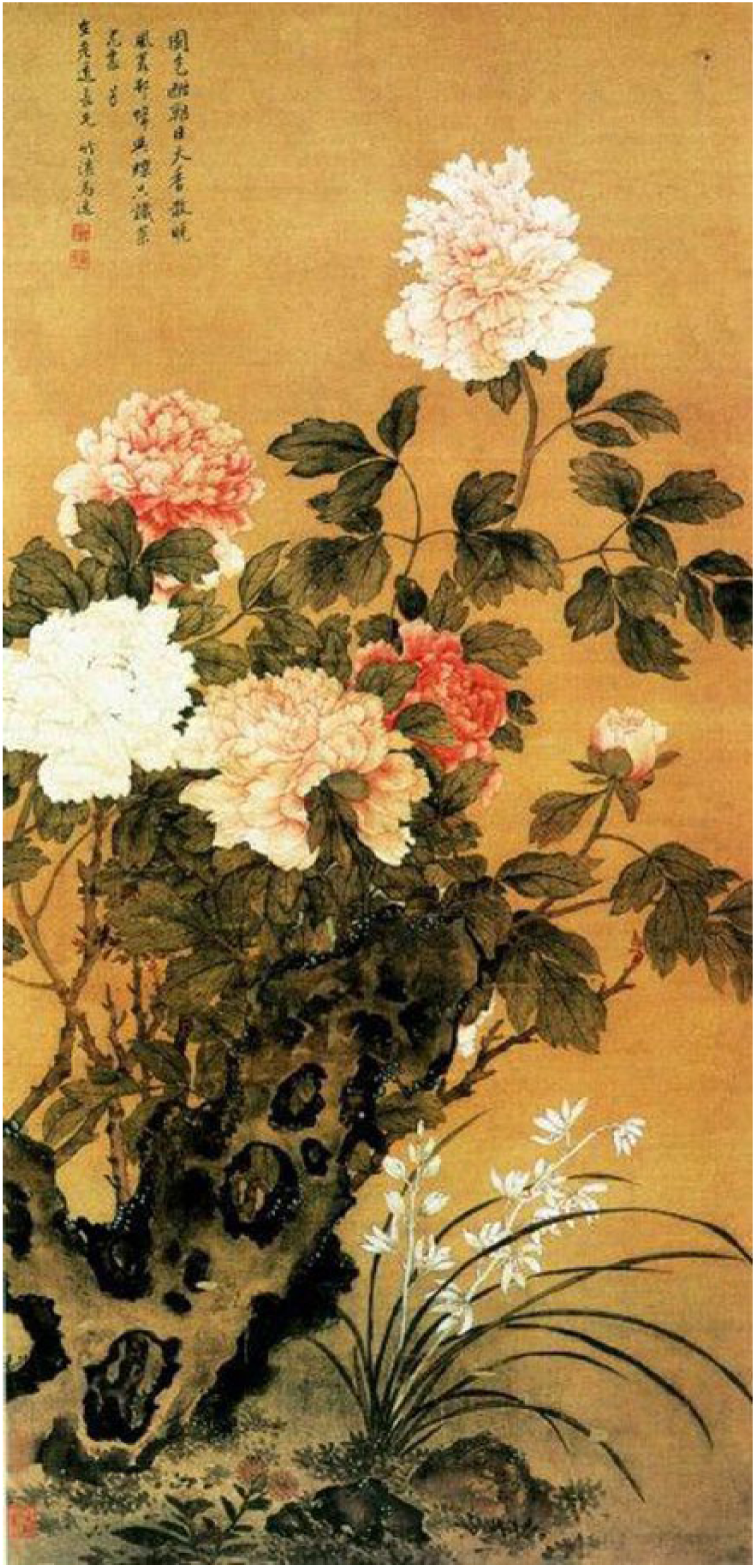
“Guo Se Tian Xiang Tu” 国色天香图 (National beauty and heavenly fragrance—Peony picture), was drawn by Ma Yi (unknown). According to historical records, he lived during the Qing dynasty (1644-1912). “Guo Se Tian Xiang Tu” [国色天香图] is the most outstanding tree peony painting in Chinese ancient history.
This ethereal beauty entitles the tree peony to play the role of “emblem and epitome” of a halcyon High Tang epoch.
Robust national wealth and an ingrained sense of social well-being characterized the High Tang Period and offered momentum for the populace and the social elite to inaugurate a national flower. On the basis of both the historical records and extensive archival research on articles, I argue that the eulogy of the tree peony, during the Tang Dynasty, epitomized the public’s nobility and generosity (for an extended discussion, see Wang, 2011).
During the reign of Kaiyuan (开元, 713-741), a flower bed of tree peonies lay alongside an elaborate structure called the Agalloch Pavilion, which sat to the east of Qingxin Pond in Emperor Xuan Zong’s palace that was in Chang’an (长安). One evening when the flower bed was in full bloom, the monarch took his imperial concubine, Yang Yuhuan (杨玉环, 719-756), there to share a drink and to bask in the presence of the flowers. Similarly, Li Bai (李白, 701-762) produced three poems which, following the traditional Chinese versification scheme of “Qing Ping Diao” (清平调), served to immortalize him. In Li Bai’s poems, the attractiveness of the tree peony becomes a metaphor for the beauty of Yang Yuhuan, the imperial concubine. The association of the beauty of the tree peony with that of Yang Yuhuan was the ultimate compliment. Li Bai’s three poems are (1) In iridescent raiment, she looks lovely like the flower. But when bedewed or caressed by the vernal breeze, she’d look even prettier. And pampered by the monarch’s affection, she could never be outshone. Oh, a divinity she must be, diving into our mundane life just off and on. (2) When moistened by dew, a miraculous flower would have its charm redoubled. When graced with His Majesty’s solicitude, she’d remain more dignified. You would, in the engulfing intimacy your lord does cuddle, Simply dismiss the romance of the Chu monarch and the nymph as tarradiddle. Even the fully adorned Zhao Feiyan was not worth a tithe of your beauty,
2
Not to say any other belle in the imperial household of the Han Dynasty. (3) Now you, madam, and tree peony are collaborating on building the palatial carnival. His Majesty’s love of both of you can never be otherwise than eternal, Because he would, from now on in his leisure hours, nothing do But the two of you to woo. (Li, 1960, Vol. 27, p. 391)
Li Bai’s poems balance not only the image but the charismatic appeal of both the flower and Yang Yuhuan. The poet’s eye for the similarities between Yang Yuhuan and the tree peony elides the distinction between the two to a faint intimacy.
The elevation of the tree peony to the status of national flower during the Tang dynasty hinged directly on the charismatic and hypnotic hold of Yang Yuhuan over Emperor Tang Xuan Zong. The three poems by Li Bai functioned as a catalyst, irrevocably bringing the elevation of the tree peony’s status to fruition.
The Nationwide Festivity Celebrating the Tree Peony as a “National Flower”
Of all the poetic works produced during the Tang dynasty on the tree peony, the most significant poem is the one by Liu Yuxi (刘禹锡, 772-842). “To the Tree Peonies” reads as follows: The peonies in bloom in my yard exhibit gaudiness in spades, The lotus flowers in my pond look apathetic and ill at ease. Only the tree peonies can sublime comeliness engender. The time they unfold is bound to turn the imperial capital raptly astir. (Liu, 1960, Vol. 365, p. 4119)
For centuries, the Chinese have exalted the tree peony. The tree peony has reciprocated this collective gesture by creating a cultural and moral climate of magnificence, flamboyance, and generosity. The later generations Chinese comment that these three traits combine to instill self-confidence, broadmindedness, willpower, and tolerance, and boost the morale of the Chinese people. “An Ode to Tree Peony” (牡丹赋), composed by Shu Yuanyu (舒元舆, 791-835) expresses the effect of the tree peony on public awareness during the Tang dynasty. In it, Shu Yuanyu compared the tree peony to many beautiful flowers, and absolutely believed that the tree peony prevailed (Shu, n.d.1706, Vol. 121).
“The Truths behind Events” (事物记原) is a work by Gao Cheng (高承), a scholar of the Song Dynasty. The passage, “justifiable recalcitrance camouflaged with a winsome outward appearance” reveals one of peony’s unique attributes. The passage states that in an early spring, Empress Dowager Wu Zetian (武则天, 624-705) ordered that all the flowers bloom when she strolled in the garden, but the tree peony defied her command and bloomed in the late spring. Gao Cheng wrote as follows: Therefore it is apparent that superiority of tree peony rested with not only its exceedingly enchanting blooms but its indomitable willpower to cling to dignity and reject sycophancy. So, wouldn’t it sound like an understatement to declaim that the superiority evinced by tree peony consists merely in its perfect comeliness? (Gao, 1985, Vol. 10, pp.394-395)
This passage indicates that both the Tang and Song elite believed that the tree peony surpassed the rest of Chinese flora in both appearance and willpower.
From the Tang Dynasty to the Song Dynasty, the enchanting appearance of tree peony attracted people from diverse walks of life. However, some discordant undertones did intrude into the mass of post-High-Tang tree-peony–extolment poetry. As a result, praise of the tree peony is employed to disguise ironic metaphors meant to prod the general public to reevaluate the historical period of High Tang. The volume of poems was spearheaded by the emergence of a new poetical genre called “xinyuefu” (新乐府) to which Bai Juyi (白居易, 772-846) contributed several poems. Tree peony poems were used to camouflage critiques of Emperor Xuan Zong and his imperial concubine, Yang Yuhuan, during the transition to the Song Dynasty. The poem titled “Purchasing Flowers” (买花) written by Bai Juyi has the following lines: The sum paid by the imperial palace to a peasant For a bunch of newly gathered blooms of tree peony To such a total amount of annual revenue is equivalent As is collected from ten middle-class families by the imperial treasury. (Bai, 1960a, Vol. 427, p. 4703)
Below are lines from “The Charms of Tree Peony” (牡丹芳), which is also a poem by Bai Juyi: In the twenty days, when a tree peony passes from unfolding to fading, Nobody around us seems to be any longer in a right mind living. I do pray Heaven’d intervene by marring a bit tree peony’s pulchritude, So that the imperial officialdom would get less inebriated And well behave themselves as our sovereign does To save our nation from all manner of troubles. (Bai, 1960b, Vol. 427, p. 4676)
Beneath the wording of the “xinyuefu” genre, realism imbues the tree peony with a veneer of melancholia. Below is a poem titled “Tree Peony” (牡丹) by Chen Yuyi (陈与义, 1090-1138). The poem conveys both his nostalgia for homeland and his reflections on historical and personal vicissitudes: Since the conquest of China proper by the nomads, The imperial court’s been ousted from the capital for less than two decades. Now, in my dotage I’m alone by the stream lingering And, with the spring breeze scouring me, the tree peonies watching. (Chen, 1986, Vol.43, p. 409)
During the “Five Dynasties” period (the transition period beginning with the end of the Tang Dynasty in 907 and the founding of the Song Dynasty in 960) and the historical period of the Song Dynasty (960-1279), the symbolic values invested in the tree peony were transmuted into an intellectual instrument that was used principally for imparting diverse sentiments of individual poets. It was either their angst over the state insecurities or their grief over their fate that spawned these sentiments. The shift in the role and symbolic value of the tree peony as a national flower to that of an intellectual instrument, during the Tang Dynasty, sparked a nationwide tree-peony cult during the historical period of the Five Dynasties and during the Song Dynasty. It communicated diverse sentiments of individual poets who served to enrich, glamorize, and eternalize the symbolic value of the tree peony.
Why Did Song Reject Tang’s National Flower?
Over 50 years elapsed between the fall of Tang and the establishment of the Song Dynasty. This period saw a tremendous change in the orientation of Chinese culture. Many characteristics of Song culture were polar opposites to those of Tang culture, since Song culture was characterized by an intense want for introspection and an overwhelming penchant for staying in studied reserve, whereas the Tang culture encouraged one to be outgoing, liberal, and unconventional with chivalrous abandon. In Song culture, the rationalistic way of cogitation was dominant, whereas in Tang culture, a sentimental approach ruled supreme. Despite this, the tree peony had attained such symbolic value, as “an ingredient of national cultural heritage,” that its dominance remained unaffected at the start of the Song period.
The elevation to prominence of Neo-Confucianism in the Song Dynasty imbued the contemporary literati with a rationalist ideology of their own, meticulously concerned with the minutia of life. As a result, both adamant moral integrity and exalted aesthetic taste in the matters of literature and arts were upheld by the literati as supreme ideals. In their efforts to shed their residual ideological constraints, different segments and strata of Song social elite struck out in various directions, and each struggled to stake out its own turf. Consequently, each segment of society managed to avert isolationism and made a point of learning from their peers. Viewed as a whole, Song culture should be seen as highly rationalized in nature, and the Song literati were markedly noted for their intensely introspective psyche.
In the latter half of Northern Song, gardening became a craze which catapulted the plum blossom to the acme of its popularity. In the Song Dynasty, the life of officialdom and of other genres of social elite was characterized by luxury, leisure, and intellectualism. By infiltrating the lives of bureaucrats and the literati the plum blossom succeeded in gradually elevating itself from its original status of “thing-in-itself” to “apical-aesthetic-appreciation” so much so that it was crowned “the pride of all kinds of flowers in our land.” Thus, the plum blossom, having emerged victorious in undermining the status of tree peony as a national treasure, was finally crowned the national flower of the Song Dynasty.
Plum Blossom Under the Song Dynasty
It is from Northern Song onward and when Lin Bu (林逋, 967-1028) and others of his ilk persistently and admirably lent themselves to exalting all those virtues allegedly referential to plum blossom that a special genre of poetical works dedicated to extolling the plum blossom was created. The later emergence, in the poetry under the genre, of some very beautiful poetical lines—poetical lines such as “暗香疏影,” “半树横枝”—helped the genre become consolidated. 3 From Southern Song onward, the practice of using poetical work as a medium for extolling plum blossom reigned just rampant in poetry circles (Guo Yuheng, 1997, Vol. 167).
Living a reclusive life in his abode located at Gushan in Hangzhou, Lin Bu, enjoyed his “Chinese Plum Orchard,” home. Remaining single all his life, Lin Bu professed that his affection was reserved wholly for the plum blossom. He thought of the flower as his “spouse.” Lin Bu himself was the epitome of freedom from vulgarity, sensuality, and vanity. Given Lin Bu’s character and his life experience, the image of the plum blossom—as depicted in his unique artistry and personification of the plum blossom as well as his poetry—stands out as irresistibly engaging and compassionate. Lin Bu and poets like him succeeded in opening up a new vista of poetic creation centering on the plum-blossom eulogy. Consequently, in one of his poems, Xin Qiji (辛弃疾, 1140-1207) pronounced that “the plum-blossom poetry would be starkly nowhere near what it is now without Lin Bu” (若无和靖即无梅) (Xin, 1965, p. 1901). Lin Bu composed a series of eight poems that revealed his passion for the plum blossom, known as “The Eight Plum-Blossom Poems Written at Gushan” (孤山八梅). He also composed two ci lyrics written, respectively, to the tune of Rui Zhegu (瑞鹧鸪)
4
and Shuangtian Xiaojiao (霜天晓角). Bearing the same title, “Written in Remembrance of the Tender Plum Blossoms in My Hilly Garden” (山园小梅), Lin Bu’s ci lyrics are his finest plum-blossom poetry. The first of the couple of ci lyrics—written to the tune of Rui Zhegu (瑞鹧鸪)—is more popular, and it reads as follows: After all the other species of flowers have exited to leave the stage clean, As a rule, plum blossom would pop up to dominate the scene. Right now, in my garden the plum blossoms epitomize all of its charms. There reflections of stems and branches with flowers crisscross its diminutive streams. The flowers’ sweet scent can turn a moonlit twilight here into so wondrous a fairyland That my two white cranes won’t casually alight without doing a wary scan beforehand. Butterflies’d dolefully fume, should they know plum blossom’s comeliness is so unusual, Because they cannot survive till late winter to attend plum blossom’s debut annual. So long as I can greet your annual debut, my dear plum blossom, with my crude lyric You needn’t feel as a disgrace the absence, at your debut, of a fanfare and ritual bric-a brac. (Lin, 1986, Vol. 13, p. 409)
Lin Bu also formulated a new method of poetry intended to conjure up in the reader’s mind a virtual vista where sublime—though rather exotic and elusive—tranquility reigns. His method is effective in expanding and upgrading dimensions of the plum blossom’s symbolic value. On the basis of Lin Bu’s poetry, the Song literati extensively explored milieus, settings, objects, and entities depicting the grace and beauty of the plum blossom as represented below: Slightly clouded sky, inchoate sunshine at dawn, moderate chill, a drizzly day, a barely smoggy day, a full bright moon, a sunset, the scene of very mild snow, glow of the setting sun, a rare fowl, a lonely crane, a limpid rivulet, a small bridge, the bounds of a bamboo grove, a small piece of ground in the shade of a large pine, a window with crystalline panes, a thin hedgerow, a darkish cliff, a stretch of mossy ground, a brass bottle, paper drapery, there is a thicket where somebody is playing a Chinese flute, a seated musician is seen playing a zither placed in his lap, on a stone table a game of chess is in progress, tea is boiling in a kettle, while a pageboy is seen sweeping the snow off a trail in the court,
a fair maiden wears little makeup except for a few hairpins.
(Zhou, 1983, p. 275)
When the plum blossom is associated with any of the milieus, settings, objects, and entities named above, the outcome is a worthy manifestation of Song literati’s aesthetic preference, which emphasized simplicity, moderation, natural grace, and unaffected refinement. The aesthetic creed to which the literati firmly adhered was the proposition that “the appeal of the plum blossom is too magical to be overpowered by that of any other flower” (see Figure 2).

“Meihua Xiuyan Tu” [梅花绣眼图] (Plum Blossom and White-eye), was drawn by Zhao Ji 赵佶 (1082-1136), who was one of the emperors of the Northern Song Dynasty, who was called Song Huizong 宋徽宗. He was also an outstanding painter and calligrapher. “Meihua Xiuyan Tu” [梅花绣眼图] is currently displayed in the Beijing Palace Museum.
Su Shi (苏轼, 1037-1101), a very brilliant and influential man of letters of the Northern Song Dynasty, after Lin Bu, multiplied the dimensions of the plum blossom’s symbolic value, and advanced for the first time the theorem of the plum blossom’s “ego.” Acceptance of Su Shi’s theorem was a de facto recognition by the general public of the personification of the plum blossom in poetry. Of all of Su Shi’s 57 plum-blossom poems, the most popular is a three-stanza poem titled “A Triplet of Poems Portraying the Red Plum Blossoms” (红梅三首). The content of the first stanza in the triplet was intended to rebut “The Red Blossoms” (红梅), a poem written by Shi Yannian (石延年, 994-1041). “The Red Blossoms” (红梅), reads as follows: Though the flowers on the tree look as peach blossoms beautiful, Pity that total absence of green leaves gives them no foil at all. The twigs on which the flowers perch are so lifelessly sombre and dismal. Hence enough evidence to nix their being florescence of an apricot at all. (Shi, n.d.1707, Vol. 297)
And the one in Su Shi’s triplet runs as follows: We choose to unfold annually very late, ‘Cause we, being rid of all worries, like to stay whopping long in slumber. Since we’re afraid the white color isn’t your favourite, Wear makeup we do, as florescence of peach or apricot does, scarlet in colour. But won’t relinquish our slender build and chaste bearing. Since our modest psyche allows us to be susceptible to no vernal stir, That we’ve got crimson is simply beyond our understanding. Apparently the idea of “plum blossom’s ‘ego’” is beyond your ken, sir; Otherwise you won’t have gotten so aghast and benighted When green foliage and branches aren’t around to have us foiled. (Su, 1986, Vol. 21, p. 681)
The “Plum Blossom’s Ego” maintains that a description or portrayal of the plum blossom should conform with its “ego” and that a certain form of symbolic value with which the plum blossom is endowed needs to be in agreement with its “ego” too. The theorem asserts that it is only by seeking concurrence between a portrayal of the plum blossom, and its ego and between the content of its symbolic value and its ego that a certain form of the plum blossom’s symbolic value can be imbued with morality and sublime ethical significance.
Wang Anshi (王安石, 1021-1086) was, like Su Shi, an influential poet of Northern Song. Wan Anshi exerted significant influence on the later poets who continued the “plum-blossom-extolment” tradition. He left behind 17 plum-blossom-extolment poems and a plum-blossom ci lyric to the tune of “xi jiang yue” (西江月). He should be considered among the Song Dynasty’s best plum-blossom poets. His most popular poem is titled “The Plum Blossoms” (梅花), which reads as follows: At the foot of the wall stand a few Chinese plum trees, Outpouring their blossoms in defiance of the freezing weather. Too purely white is the florescence to tell apart from the snow like fleece. But the telltale fragrance belies to be what the flowers appear. (Wang, 1986, Vol. 19, pp. 616-617)
Wang Anshi’s role in informing the development of plum-blossom poetry in feudal China was that of an inheritor and developer who combined the most essential elements of Chinese plum-blossom poetry heritage of previous generations. On the one hand, his poetic composition adhered to the tradition originated in The Odes of Chu (楚辞). This tradition praised the flower by analogizing its sweet scent to its alleged virtue. It also reflected the symbolic value most Six-Dynasties literati gave to the plum blossom. On the other hand, he set to enlarge the plum blossom’s symbolic value and succeeded in shaping the two poetic subgenres, one clinging to “purity” as its primary aesthetic norm and the other to “integrity.” His poetic precepts were passed down, and improved and matured in the Southern Song.
The first two lines in “The Plum Blossoms” (梅花), project a proud image of undaunted plum blossoms valiantly brushing the freezing weather aside: “Beside the wall stand a few Chinese plum trees” (墙角数枝梅) Outpouring their blossoms in defiance of the freezing weather” (凌寒独自开) (Wang, 1986, Vol. 19, pp. 616-617)
This deliberately highlights the plum blossom’s “integrity.” The last two lines in the poem undoubtedly showcase the flower’s “purity.” Therefore, the poem stands out as an exemplary precedent, which guided Southern Song poets to further explore the plum blossom’s symbolic value. Moreover, by subjecting the plum blossom to the naked severities of inclement weather and to claustrophobia-induced trauma and pressure arising from being marginalized, the practice of personifying the plum blossom was, thus, infused with new vistas of moral comparison and a new dynamic.
The Plum Blossom’s Symbolic Value
The Song imperial court’s exodus to Southern China ushered in the Southern Song period. China’s cultural hub then migrated there too. This facilitated the growth of deeper and more dynamic affinity between Chinese culture and the plum blossom’s symbolic value. Such a development could be analogous to the ideological alliance formed in the Tang Dynasty between the symbolism of the tree peony and the cultural hub of Tang, which was in Luoyang. Such an ideological alliance could promote a powerful incentive for human imagination to work on enriching or multiplying the plum blossom’s symbolic value. Two of the four most significant poems in the Southern Song, written by Lu You (陆游, 1125-1210) and Fan Chengda (范成大, 1126-1193), drove Southern Song poets to explore and enrich the then-existing plum blossom’s symbolic value.
Lu You’s plum-blossom–extolment compositions—159 poems and 5 ci lyrics in all—surpass his contemporary poets not only in intellectuality and poetical artistry but also in quantity. Two lines from the third stanza in “Six Quatrains Portraying the Plum Blossoms” (梅花绝句六首) illustrate what, he conceived at the time, was the emotional and spiritual tie between him and the plum blossom: Is there such magic as is able, towards a billion doubles, to multiply me, And to grow, right before each of my doubles, a Chinese plum tree? (Lu, 1986, Vol. 67, p. 1935)
Lu You wished to change into a Chinese plum tree or to have every Chinese plum tree turned into a Lu You. He figured that he and the plum blossom shared the same identity. His love for the plum blossom propelled the plum blossom to national flower status.
It goes without saying that Su Shi’s marvelous literary acumen prompted his “theorem of the plum blossom’s ‘ego.’” Lu You’s ingrained patriotic passion and irrepressible sorrowfulness from his traumatic life experience moved him to substantially improve “the theorem of plum blossom’s ‘ego.’” Moreover, his definition of the plum blossom’s “ego” conflicted with Lin Bu’s. Lin Bu conceived of the plum blossom simply as a wifely companion who had an amiable and affectionate nature the “ego” would duly reflect. Lu You defined the “ego” either as “an iron determination which stays ‘semper fidelis’ to established morals or to an ethical norm in defiance of hellish adversity” or as “justifiable pride that simmers in an unjustifiably unacclaimed hero.” This, indeed, is the kernel of Lu You’s own version of the plum blossom’s symbolic value. “A Chinese Plum Tree’s Monologue,”
5
a ci lyric—written to the tune of “busuanzi” (卜算子)—searingly depicts the aforesaid justifiable pride intertwined with iron determination: Near the broken bridge which nestled close to the posthouse, In sheer loneliness unfolding neither shielded nor sheltered are my blossoms. In addition to the wind and rain swooping down in a rage The engulfing twilight threatens to drown them in sorrow and rid them of any anchorage, Though they have neither attempted to cut a figure in the grand promenade of spring Nor planned to respond to aspersions in their direction others are to sling. They know to muck they are to be reduced by the wind and rain pounding, Yet here and forever will their intrinsic sweet scent be circulating. (Lu, 1965, p. 1586)
This ci lyric contains more sublimity than any other plum blossom imagery. It is venerated as a strong enunciation of the aggrandizement of the plum blossom’s symbolic value achieved during the Southern Song.
Fan Chengda was the only Southern Song poet who carried the same weight as Lu You in poetic circles of his day. He is generally recognized as an unbiased and infallible explorer and practitioner in the realm of plum blossom symbolic value. He extensively promoted the adoration and aesthetization of the plum blossom. He even built a garden within the Fan Family’s village, praising the plum-blossom.
Fan Chengda deserves credit for his original ideas: the aesthetically detailed image of the “ancient Chinese plum tree” and for the “three manifestations of sublimity.” His intellect allowed him to discern the aesthetic worth inherent in both the grotesque shape of a centuries-old (and even a millennium-old) Chinese plum tree and its peculiar florescence and, to uncover its cultural heritage. Thanks to his explorations, he ushered in a new stage in the development of plum-blossom praise. This new stage was characterized by an extensive attempt to understand the aesthetic depths of the bizarre conformation, configuration, and spatial attributes peculiar to an ancient Chinese plum tree. He lived in the Southern Song, a dynasty incessantly and drastically bombarded by invasions by ethnic hordes. His contemporary literati were perennially disillusioned and despondent. Given their psyche, burdened with grief and desperation, it was only natural for them to echo Fan Chengda’s drive to discover some enlightening moral value out of the ancient Chinese plum tree because their ego was hungry for consolation and relief. Thus, among most of the Southern Song literati, a new fanaticism emerged that strengthened the tradition.
What was meant by the aesthetic depth and cultural overtone inherent in an ancient Chinese plum’s bizarre conformation, configuration, and spatial attributes? Perhaps Fan Chengda’s (范成大, 1126-1193) poem, titled “An Ancient Chinese Plum Tree” (古梅), can answer that question: “It is quite against my nature,” so think aloud I, as an ancient tree aloof and upright; “To have myself in a competition with a blooming tree locked tight.” The bizarre quaintness which the elements have molded my skeletal figure into Has been dramatically enriched on my part without much ado. Even the whimsical shape of a tiny cluster of my branches weirdly intertwining Suffices to outmatch the splendour of florescence the blooming tree enwrapping. (Fan, 1962, Vol. 23, p. 328)
Fan Chengda praised the plum blossom by emphasizing that the aesthetic quality inherent in the gnarly and contorted shape of the Chinese plum tree be appreciated. His proposition of “three manifestations of sublimity” proposition in essence imagines a unity attained by blending four different—and yet at the same time, mutually supplementary—qualities, or “entities”: (a) “natural grace,” (b) “distinctly different egos,” (c) “the nexus of blurred shadows formed of ragged and interlacing branches,” and (d) “a grotesquely gnarled and contorted trunk.” The proposition is significant because it amplifies the plum blossom’s symbolic value.
The Role of Climate in Elevating the Plum Blossom
The tree peony and the plus blossom received both glory and popularity in different historical periods. However, their journeys to the heights of glory were different. The tree peony received sweeping social attention from the general public based on its inherent beauty, whereas the plum blossom relied solely on its natural grace and unparalleled daintiness. A question follows, however, as to what prevented the tree peony’s symbolic value from evolving into one that was multiple-layered, or comprehensive. The answer can be set forth as follows:
The impression left by the tree peony, as a flower and also an emblem of prosperous High Tang civilization, on the “unalterable memory” and general awareness of the Chinese nation, was and still is an unchangeable—or rather a stereotyped—one.
Criticisms inflicted on the tree peony in historical periods closely following the High Tang were too many to be refuted altogether. The most notorious include accusations such as “the beautiful ones are invariably a bane in the last analysis,” and that “beauty is bound to shatter public morals.” These combined to gag all those who tried to glorify the tree peony even though they knew it deserved such glory.
The impact of regional subculture upon the rulers of either dynasty could in due course have played a decisive role in determining the aesthetic criteria by which a national flower’s merits were to be judged and further explored. For example, the climate in North China which is cold and arid, favored the tree peony’s growth and hindered the plum blossom’s growth. The warm and humid Southern China climate, however, could be favorable to the growth of the Chinese plum but not to the tree peony. Climate, thus, provided a nation with different candidates to be nominated to the status of national flower.
The founders of the Tang Dynasty came to power in China by sheer military strength. Therefore, the convention that originated with and infused the Tang Dynasty, was to uphold simplicity and common sense as cardinal elements of the imperial court’s conduct. Given that the imperial house and the whole hereditary aristocracy adhered to one line of conduct, a national universal consensus emerged approving tree-peony extolment.
The imperial house of the Song Dynasty, conversely, valued literature and arts above military strength. Most Song emperors were scholarly. The civil service under the Song played the preponderant role in the governing of the country. As a result, the Song bureaucracy strongly echoed the sophisticated tastes and refinements peculiar to the literati of the time. The subculture fostered by the bureaucratic apparatus gradually evolved in a new direction, which deviated from the subculture of the populace. The divergent directions in which the two subcultures—one stressing refinement, other adoring earthiness—developed, led naturally to the tree peony becoming significantly downgraded in populace’s eyes. This led to the upgrade of the plum blossom.
The shift in popular aesthetic preference and common values, which evolved from the latter half of the Northern Song Dynasty onward, was both epitomized by the replacement of the tree peony with the plum blossom as the national treasure and was accomplished by a change in the public psyche and worldview of the literati.
Thanks to the Song Dynasty literati’s energetic exploration, the plum blossom’s symbolic value as a national flower was continuously enriched. The plum blossom eventually was dubbed not only as “one of the three closest friends showing up simultaneously every winter” (岁寒三友), but also as “the leader of a quartet of the most dignified floral species in the country” (花中四君子). Having been thus exalted for centuries, the plum blossom was finally accepted by the general public as a flower that embodied the virtue of “fortitude.” Indeed, after the virtue of “fortitude” had been incorporated into the plum blossom’s symbolic value, it has been generally acknowledged by the Chinese literati of later generations that its value was instrumental in further strengthening traditional Chinese morals and culture, and that the properly aestheticized image of the plum blossom should stand out as a “totem” of the quintessence of China’s national moral.
Footnotes
Acknowledgements
I am very grateful for the assistance of Prof Huang Weiwei黄为葳 in Zhengzhou University for expert translation of the ancient poems.
Declaration of Conflicting Interests
The author declared no potential conflicts of interest with respect to the research, authorship, and/or publication of this article.
Funding
The author received no financial support for the research, authorship, and/or publication of this article.