



Abstract
This article investigates the spatial articulation of architecture and home through the exploration of current domestic experiences in Basil Spence’s Claremont Court housing scheme (1959-1962), Edinburgh. How architecture and home are both idealized and lived is the backdrop for a discussion that draws on the concept of “model home,” or physical representation of a domestic ideal. The article reads Claremont Court as an architectural prototype of the modern domestic ideal, before exploring its reception by five of its households through the use of visual methods and semistructured interviews. Receiving the model home involves negotiating between ideal and lived homes. Building on this idea, the article contributes with a focus on the spatiality of such reception, showing how it is modulated according to the architectural affordances that the “model home” represents. The article expands on scholarship on architecture and home with empirical evidence that argues the reciprocal spatiality of home.
Keywords
Exploring the Spatial Articulation of Architecture With Home
This article explores domestic experiences in Claremont Court housing scheme, with a focus on how current residents spatially negotiate the modern domestic “ideal” embedded in its design. Thus, the article expands on a body of work that looks at the articulation of architecture and home (Attfield, 1989a; 1989b, 2000, 2002; Blunt, 2008; Busch, 1999; D. Chapman, 1955/1998; Dowling, 2008; Jacobs & Cairns, 2008; Jerram, 2006; Llewellyn, 2004a, 2004b; Lloyd & Johnson, 2004; Miller, 2001b; R. Munro, 2013; Rapoport, 1982; Ravetz & Turkington, 1995), with a novel focus on the spatiality of this articulation.
How architecture and home are both idealized and lived backdrops the discussion, framed by reading architectural space as sensitive to adaptation (Harris, 1997; Lefebvre, 1991; Llewellyn, 2004a, 2004b; Shields, 1999), “appropriation” (Attfield, 2002; Busch, 1999; Lang, 1985; Miller, 2001b; Seamon, 2014), “personalisation” (Cooper, 1995/2006; Rapoport, 1982, p. 21; Riggins, 1994; Shields, 2002) or “accommodation” (Dowling, 2008; Miller, 2002). Miller (2002, p. 115) adds that “this process of accommodating in the sense of an appropriation of the home [. . .] is reciprocal” and involves granting concessions. Thus, he argues, the home has to be considered “not as a thing but as a process” (Miller, 2002, p. 115), as the “setting of mobility and change” (Miller, 2001a, p. 4), where residents negotiate between ideal and lived homes.
In order to gain insights into the articulation of architecture with home, we draw on the concept of “model home.” Both an ideal image and its architectural representation, the “model home” can offer a “physical prototype” (cf. Ravetz, 1974; Wright, 1991, p. 213). We reveal Claremont Court as an architectural representation of the modern domestic ideal, before exploring its contemporary reception. Receiving the “model home” involves a process of negotiation between “ideal” and “lived” homes. In this negotiation, which represents a mediation with wider society (Gorman-Murray, 2007; Jacobs & Cairns, 2008; Wright, 1991), prevailing narratives of home are constantly “recast through home-making practices” (Blunt & Dowling, 2006, p. 89).
The reception of the modern home has been studied through its material culture (Attfield, 1989a; Clarke, 2001; Llewellyn, 2004b; Miller, 2001a, 2001b, 2002). We contribute by focusing on the spatiality of such reception, on how it is modulated according to the architectural affordances that the modern “model home” represents. The spatial practices involved in recasting a domestic ideal hinge on inward and outward aspects which reflect the relationship between the private and the public domains (Blunt & Dowling, 2006; Donahoe & Toadvine, 2011; Laumann & House, 1972; Morley, 2000; Seamon, 2013; Woodward, 2001). In the imagery of home, the “front” relates to its wider context by being visible or accessible to the public; while the “back” presents restricted access, or view, to the public (Darke, 1996; Goffman, 1959; Madigan & Munro, 1999; Ravetz & Turkington, 1995).
Although pervasive, spatial notions of “front” and “back” can be subject to reconstruction, afforded by architectural space as “structuring agent” (Jerram, 2006, p. 539). Thus, we attend to Jerram’s claim that the role of architectural space in affording social relationships and behaviors “has been under-examined, in favour of discussing the symbolic value of spaces” (Jerram, 2006, p. 539). Foregrounded by spatial constructions, the articulation of home with architecture is the subject of this article, which draws upon textual and visual explorations in order to reach beyond material culture studies, and argue the reciprocal spatiality of home.
The “Cross-Class” Domestic Ideal and the Modern “Model Home”
The articulation of architecture with home is not unequivocal. Ideals of home are not a natural attribute of dwellings; instead, they are shifting phenomena, resulting from sociocultural construction (Blunt & Dowling, 2006; Wright, 1991). In the 1960s, alongside the convergent size of middle-class and working-class dwellings (Burnett, 1978; Ravetz & Turkington, 1995), the societal change started to blur clear divisions between working-class and middle-class households, and it originated “cross-class” domestic ideals built on the common desire of domestic privacy (Crow, 1989; Langhamer, 2005, p. 347; Rosser & Harris, 1965).
Wright (1991) noted that the imagery of home entangles (imposed) cultural ideals with individual desires and realities. The proliferation of home exhibitions since the war was symptomatic not only of the emerging domestic ideal but also of the tangible tensions between “ideal” and “lived” homes. Woodham (2004) identified Britain Can Make It (1946) as the first exhibition dedicated to the “cross-class” modern home. Here, architect Basil Spence presented the modern kitchen as a room for family living, indicating the beginning of change in social attitudes toward Victorian codes of use (Jeremiah, 2000), which were still “broken only under some strong imperative” (Ravetz & Turkington, 1995, p. 149). Therefore, the “cross-class” ideal of modern domesticity (although originated before the second world war) was a dream rather than a reality for a significant number of households in the early 1960s (Langhamer, 2005). Nevertheless, alongside home exhibitions, postwar housing manuals addressed people’s domestic dreams by featuring the fundamental spatial ambitions of modernity, namely having a modern kitchen; and having two main rooms.
Women’s mass access to paid work, and the disappearance of servants in the middle-class home, were the main factors that contributed to the popularity of the modern kitchen for both middle-class and working-class households (c.f. Forty, 1975; Freeman, 2004; Johnson, 2006). Housing manuals indicated its social acceptance with the introduction of the term working kitchen (Ministry of Health, 1944; Ministry of Health & Ministry of Works, 1949), a dual space “for light meals as well as cooking” (Llewellyn, 2004a, p. 51). As the Victorian “kitchen” represented a space of inferior status for laundry, food preparation, women, and servants (Tuan, 1974), where eating was socially unacceptable (Gray & Russell, 1962); earlier manuals (Local Government Board, 1918) had not used the middle-class term kitchen for working-class housing.
Labelling in housing manuals evidenced the emergence of the “cross-class” ideal, as the Victorian classed terms kitchen and parlour gave way to the classless terms working kitchen, dining room and living room. Although the formal Victorian “dining room” belonged to “middle-class and ‘gentry’-class houses” (Markus & Cameron, 2002, p. 49), its modern iteration appeared by itself or in an open-plan arrangement: “dining room,” “dining-kitchen,” or “living–dining room” (Ministry of Health, 1944; Ministry of Health & Ministry of Works, 1949). As a consequence of the growing presence of leisure in the working-class and middle-class home, and the subsequent need for individual space (Ministry of Housing & Local Government, 1961), the “living room” and “dining room” offered space where individuals could withdraw from the family (Burnett, 1978; D. Chapman, 1955/1998; Ravetz & Turkington, 1995).
Modern domesticity has been theorized within the British trend toward privatized lifestyles (Tomlinson, 1989; Zweig, 1961), and the conceptualization of home as relaxation (Ravetz & Turkington, 1995), which resulted from societal change and rising “affluence” (Langhamer, 2005, p. 351; Galbraith, 1969). Originated before the war, modernity steadily superseded the “classed” and spatially segregated Victorian home (Forty, 1986; Hepworth, 1999; Markus & Cameron, 2002; Morley, 2000; Murdoch, 1986; Muthesius, 1982; Worsdall, 1989), eventually infiltrating “the domestic environment in Britain by the mid-twentieth century” (Attfield, 2002, p. 251) through public housing.
The Scottish housing drive offered a fertile ground to materialize the “cross-class” modern home for two particular reasons. First, flats were rooted in the Scottish imagery of home across social classes as a result of the “tenement” tradition (Clark & Carnegie, 2003; Faley, 1990). This is relevant because, although flats were favored over houses among modern planners (Llewellyn, 2004b), they were not popular as homes in England and Wales (Llewellyn, 2004b; Ravetz & Turkington, 1995). Second, in the 1950s and 1960s, Corporation flats were quite aspirational and not directly related to social class. Due to the housing shortage, married couples living with parents were “regarded as homeless” by Edinburgh Corporation and moved to the top of the waiting list, regardless of their income (Rogan, 1997, p. 69).
This work looks at Claremont Court (1959-1962), a Modernist housing scheme designed by Basil Spence & Partners for the City of Edinburgh Corporation, on the premise that public housing programs offer a “cultural narrative, recounting assumptions about transformation and continuity in the home” (Wright, 1991, p. 219). Claremont Court’s representation of a “cross-class” modern home has been noted (Costa-Santos, Bertolino, Hicks, May, & Lewis, 2017). Still, how this representation was spatially materialized, pivoting on modern “concepts of functionality and labour saving” (Attfield, 2002, p. 252), needs unpacking.
As Claremont Court included communal laundries, kitchens were designed around two work centers: a sink under the high-sill window (facing the open-deck access); and a cooker and water-heater. They featured space for a table near the door, and a hatch serving the living–dining room. In doing this, Spence placed the kitchen at the center of the discourse of modernity, challenging well-established associations between “back” and “front” (Johnson, 2006). Narratives of “operational efficiency” (Meah, 2016, p. 43), and a process of “aestheticization” (Hand & Shove, 2004, p. 243) freed the kitchen from the “back” (Forty, 1986; Sparke, 1995) and made it a streamlined space that could be linked to the living area (Cieraad, 2002; Matrix, 1984). Merging interior spaces was “an often-used device by Modern architects” (Llewellyn, 2004a, p. 54), which allowed the connection between kitchen and other rooms. Either theorized as an indicator of efficient “home management” (Jeremiah, 2000; Partington, 1995; Woodham, 2004), or as an indicator of gendered space (Attfield, 1989a; Johnson, 2006; Lloyd & Johnson, 2004), in spatial terms, the modern kitchen “broke the traditional correlation of ‘front’ with public display of status” (Attfield, 1989a, p. 217).
Claremont Court maisonettes featured an open-plan “living–dining room” opening into a balcony and including the stairs to the upper floor. Attfield (2002) observed that the open-plan “seriously questioned the received social hierarchies of class and gender that were normatively inscribed into domestic architecture” (p. 249). In architectural terms, the open-plan avoided these hierarchical undertones by removing the wall between the front reception room and the rear family room. In Claremont Court, Spence also endorsed the Modernist trend of designing circulation within open-plan living spaces (Brindley, 1999). Ultimately, Spence adhered to the living room becoming the domestic center in accord with notions of “collective family life” (T. Chapman, 1999, p. 52) that permeated the “informality and democratization” of modern domesticity (Dowling, 2008, p. 538).
Attfield (2002) suggested that architects, such as Spence, who “favoured a classless, functional open-plan living room” (p. 253) were challenging the social custom of keeping a room for display, or “for best.” Even in the lower middle-class tenement flats in Edinburgh, the “front room” was “reserved for the reception of visitors” (cf. Clark & Carnegie, 2003; R. Munro, 2013, p. 217). When Modernism’s narrative of functionality attacked “classed” architecture and the rigid social hierarchies that it represented (Brindley, 1999; Curtis, 1982), such an attack initiated the conceptual turn from “status to function” (Ravetz & Turkington, 1995, p. 166) that eventually permeated housing manuals in the mid-20th century. Scottish policy makers openly criticized the distinction between “front” and “back” elevations, and urged designers to consider sunlight, outlook, or privacy and access needs instead (Department of Health for Scotland, 1956).
Such reading of Claremont Court as a “model home” of modern domesticity, which precedes our exploration of the domestic experiences of five mixed-class households in Claremont Court, grants certain alignment with literature on the reception of the modern domestic ideal (Attfield, 1989a; 1989b, 2002; Clarke, 2001; Llewellyn, 2004b; Miller, 2001a, 2001b, 2002). However, our focus is located on the reciprocal spatiality of such reception, and on how this reception is modulated according to the architectural affordances of the “model home.”
Methodology
This empirical study is based on research undertaken in 2016-2017, which was primarily aimed at elucidating how current residents of Claremont Court spatially negotiate the modern “model home.” The emphasis was placed on how home is spatially afforded by architecture.
Initial contact with residents was made through Claremont Court Residents Association in 2015, before inviting all 63 households by letter to participate in the study. Using a snow-balling technique we asked participants to introduce us to other residents. The sample consisted of 17 participants from 12 households. In order to protect the participants’ anonymity, pseudonyms were used. The research was carried out after ethical clearance was granted by Northumbria University’s Ethics Committee (RE-EE-15-160310-56e19543c0f97) and all participants signed an informed consent form.
Although the 12 participant households included various dwelling typologies (one- and two-bedroom flats and two-bedroom maisonettes), here we focus on 5 households that live in a two-bedroom maisonette. The maisonette’s original design included an entrance hall, a working kitchen (fitted with a serving hatch) and a living–dining room downstairs with a balcony facing the landscaped courtyard. The design had a bathroom and two bedrooms upstairs. The smaller bedroom, with a balcony onto the courtyard, was labelled as “bedroom 1” (master bedroom). The bigger bedroom, named “bedroom 2,” had two built-in cupboards.
The selected five households include a young couple, a single man, a young family of three, a single young woman, and a family of three adults, showing different household tenures and social backgrounds. The first maisonette has been recently bought by Nicola and David, a couple of middle-class professionals in their mid-30s who relocated from another city. It has a “kitchen” and “dining room” downstairs. Upstairs, the original “bedroom 1” and “bedroom 2” become their “living room” and “master bedroom,” respectively (Figure 1).
In the second household lives Ewan, a working-class care worker in his early 40s. He is single and has lived in this maisonette for over 14 years as a council tenant. His maisonette has a “kitchen-dining” and “living room” downstairs. The original “bedroom 1” is his bedroom; he uses “bedroom 2” as a spare bedroom for visiting relatives (Figure 2).
The third maisonette belongs to Karen, an entrepreneur, and Neil, a professional, who bought it 5 years ago, before having daughter Mia. This middle-class couple in their late 30s have a “kitchen-dining room” and a “living room” downstairs. The original “bedroom 1” and “bedroom 2” are the “master bedroom” and Mia’s room, respectively (Figure 3).
In the fourth household, we find Isla, a middle-class single woman in her early 30s who works in support services. She bought this maisonette 9 years ago. Downstairs includes the kitchen and what she calls a “modern reception” and a “lounge.” The original “bedroom 1” is her bedroom; she occasionally rents “bedroom 2” to a lodger (Figure 4).
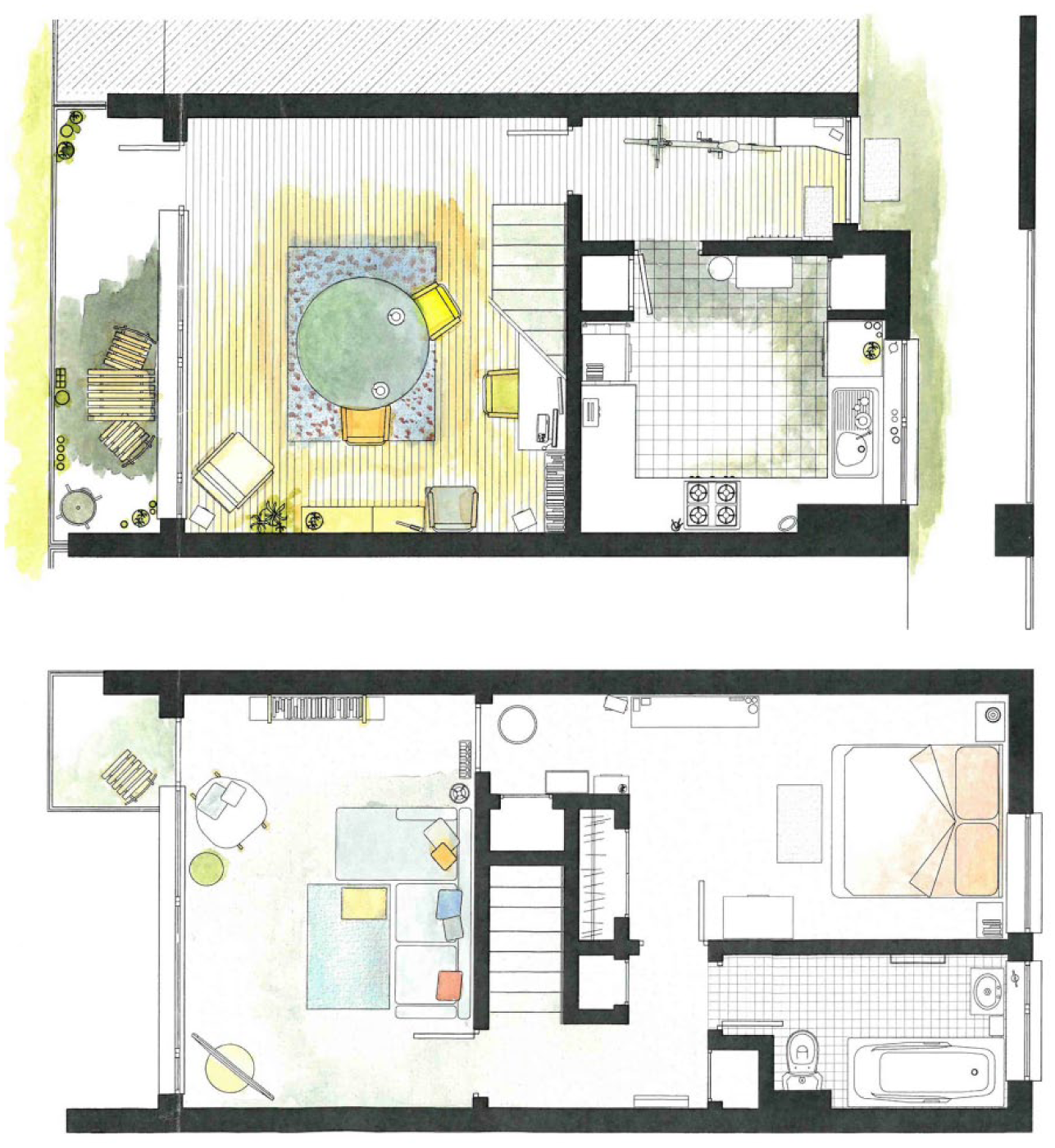
Contextual mapping of Nicola and David’s maisonette, 2017.
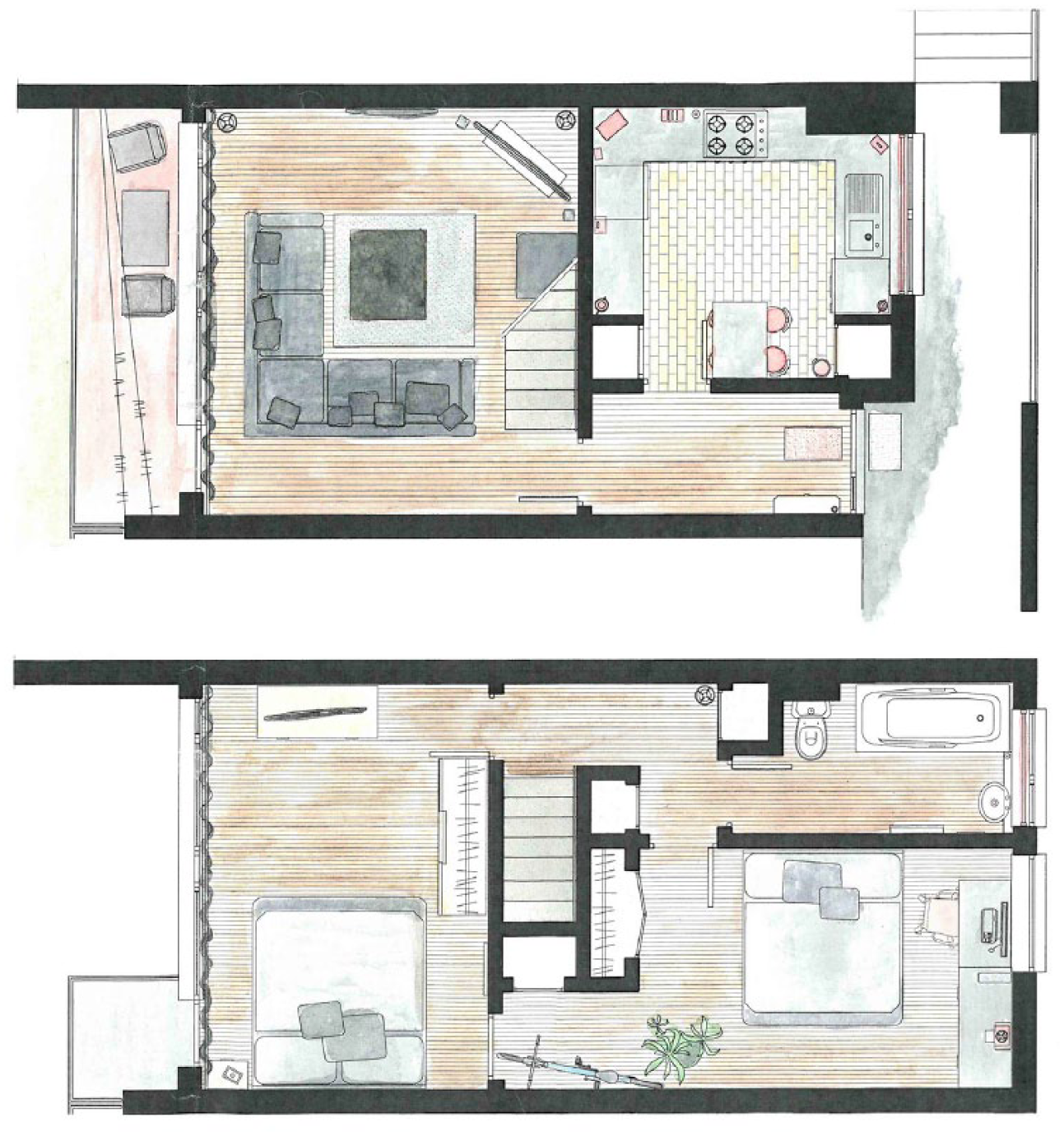
Contextual mapping of Ewan’s maisonette, 2017.
In the fifth household, we find Kath and Gordon, a middle-aged working-class couple, and their daughter Niamh. This maisonette has been their family home for 26 years, where they brought up their two daughters. Gordon is a manual worker and Kath is the homemaker; they were originally council tenants, but they bought their maisonette 8 years ago. Downstairs includes a “kitchen-dining room” and a “living room.” Upstairs, “bedroom 1” is their master bedroom, and “bedroom 2” is Niamh’s bedroom (Figure 5).
We explored the domestic experiences of these households in a twofold approach: First, we used visual methods (contextual mappings and visual narratives) to trace meaning by observing the “arrangement” of domestic objects and furniture (Rapoport, 1982, p. 23) as a type of nonverbal communication. Visual methods have been recognized as a valuable tool to explore those aspects of everyday life that are not necessarily consciously thought about, and therefore difficult to articulate (Pink & Leder Mackley, 2014). Rapoport (1982) argues that the arrangement of furniture and objects offer information about the “occupant, about private and public zones, and hence about behavior” (p. 56). However, a relevant aspect of Rapoport’s argument, is the consideration of the role of architecture in enabling occupants’ behaviors.

Contextual mapping of Karen and Neil’s maisonette, 2017.
Second, as walk-along interviews have been identified as particularly useful to explore spatial practices and architecture (Kusenbach, 2003), we conducted both semistructured and walk-along interviews to explore the residents’ domestic experiences in Claremont Court. Interview questions were purposefully open; nevertheless, we included questions about how residents came to live in Claremont Court, and what they had done to their dwelling in order to make it their home. A selection of verbal narratives and visual contextual mappings appear throughout the discussion in order to illustrate it.
Discussion
The discussion focuses on how home is spatially enmeshed in the architecture of Claremont Court. The Court’s “model homes” allow certain spatial affordances according to the domestic ideal embodied by its design. The discussion is structured around the spatial strategies in Claremont Court maisonettes which underpinned the “cross-class” modern domestic ideal, namely, the multifunctional kitchen, the open-plan living–dining room, and the function-led architectural design.
The Multifunctional Kitchen
Domestic experiences in Claremont Court show that kitchens are used for eating, cooking, socializing, or even gardening (Isla). The residents’ inclination to spend time in this room supports current understandings of the kitchen as a space for living and sociability (Hand & Shove, 2004).

Contextual mapping of Isla’s maisonette, 2017.
Stuenkel (2005) relates the increasing commodification and outsourcing of food to the renewed perception of cooking as a sporadic and pleasurable activity instead of a daily domestic obligation. As a result, cooking and eating can be felt as leisure and sociable activities with ambitions of “visibility and applause” (Cieraad, 2002, p. 263). These ambitions trigger the desire for a kitchen-dining room. For Nicola and David, this has been a compromise “with the kitchen ‘cause we did want like a big kitchen diner area which obviously this doesn’t have,” making them use the living room as dining room instead (Figure 1). This desire is echoed by Neil, for whom a dining area next to the kitchen would have been ideal.
Releasing the kitchen from the “back” and making it a sociable space has been theorized as the process of “becoming ‘at home’ in the kitchen” (Hand & Shove, 2004, p. 252), that involves reconsidering what the room is for. The kitchen offers a more informal setting to display domestic objects than the living room (Freeman, 2004), and also a less formal room for entertainment (Dovey, 1994). When the kitchen becomes a sociable space in its own right, the need for a serving hatch is questionable. In Claremont Court, the serving hatch appears blocked (Nicola and David; Ewan; Kath and Gordon) or unused for serving food; instead, they have decorated it with plants (Isla, Figure 4), or family photographs (Karen and Neil). Only Isla keeps the open hatch, which she describes as one of her “favourite things,” as it allows conversation to flow when she entertains guests.
Our findings support Freeman’s (2004) claim that the ideal of the kitchen as “the heart of the home” (p. 159) still permeates our culture; however, it now encompasses domestic duties, leisure pursuits, and the expression of family unity (Freeman, 2004; Hand, Shove, & Southerton, 2007). The kitchen as domestic center is epitomized by gathering around a central dining table; however, the small size of Claremont Court’s working kitchen can be felt to preclude the realization of this ideal (Nicola and David) or urge residents to rearrange the layout of the kitchen. Kath says that her family gathers in the kitchen at mealtimes; for that reason, they blocked the serving hatch and rearranged the kitchen units so they could place the table under the high-sill window (Figure 5). In doing so, they broke the strategic visual links of the modern kitchen, where the female gaze could supervise entrance and living room (Johnson, 2006), in favor of a more private kitchen, because “half the time you’d see people and I thought, oh,” remembers Kath.
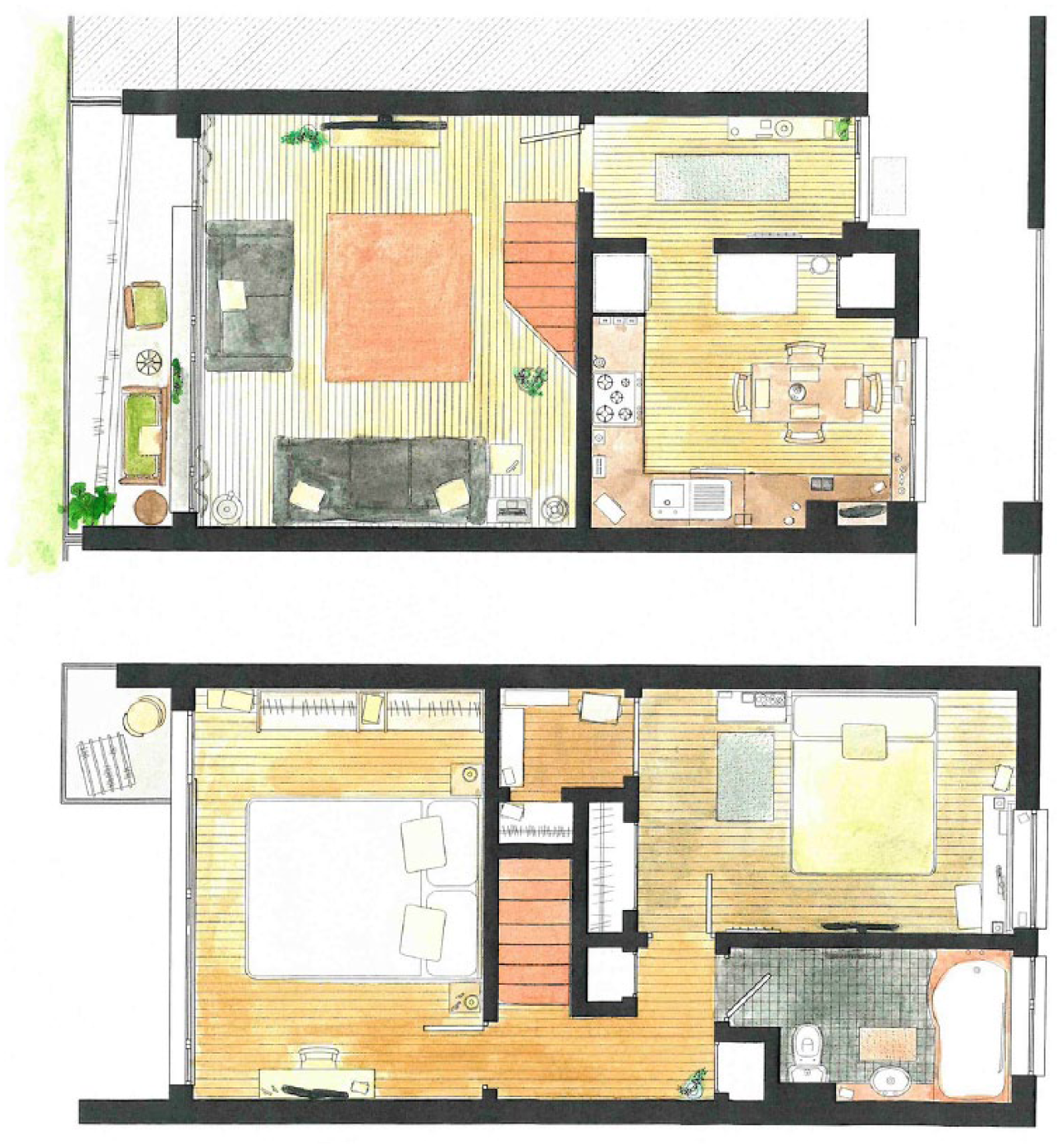
Contextual mapping of Kath and Gordon’s maisonette, 2017.
The Open-Plan Living–Dining Room
The desire for a formal room for sociability, and a relaxed private room is apparent in Claremont Court homes (Karen and Neil; Nicola and David; Isla). However, this desire is spatially articulated in various ways, to the extent that a room originally designed as “bedroom” can be appropriated into something else (Nicola and David; Isla). Nicola and David have made one of the bedrooms into their “living room” (Figure 1). This is what they call the “chill out zone,” while they remind us that the room with a central round table “downstairs is more formal, where we entertain people,” dine more formally, or work.
Similarly, Isla’s bedroom (Figure 4) becomes bedroom and private living room, where she reads or does yoga. This grants Isla enough privacy despite sharing her maisonette with a lodger, and echoes Allan and Crow’s claim that domestic privacy hinges on the “power to exclude others” (p. 4) and restrict access to privileged ones (Morgan, 1985), rather than exclusivity. But this also shows that the home “is not a singular uniform space” (Reimer & Leslie, 2004, p. 201) where micro-geographies can conflict with mainstream housing design (M. Munro & Madigan, 1999), usually aimed at nuclear families.
In Karen and Neil’s maisonette, we find that although the open-plan character of the original “living–dining room” has been lost, their actual “living room” has a dual nature, both public room and family room. This duality is perceived by Karen and Neil as a strain, as something imposed by a lack of space that forces them to use “time zoning” (Ravetz & Turkington, 1995, p. 167) as a device to allow the public–private duality to materialize (work, entertaining; or relaxation and play . . .; Figure 3). Darke (1996) relates the problematic nature of the dual living room to residents’ struggle to keep the neatness of a formal room and relax at the same time. Madigan and Munro (1999) add that this may result in the residents’ internalization of high standards of neatness, and in them perceiving the public and private “to coincide” (p. 69).
A consequence of merging public and private, is that the dual living room becomes the site for developing home identities through domestic relations, and also, the interface with the outside world. Theorized as the domestic “transactional space” (Money, 2007, p. 357), this is a place where friction may result under the current general belief that “individual ‘self-fulfilment’ for all members of the family is vital within the communion of the family” (T. Chapman, 1999, p. 52). Originally imagined as a representation of harmonious family life, Claremont Court’s open-plan living rooms expose individual geographies, thus echoing work that challenges the dominant construction of “home” as family unit (Morley, 2000).
Even within the family unit, individual geographies entail individual boundaries. While Mia has her own room, her parents, Karen and Neil, share public space in a similar manner to most middle-class families. According to M. Munro and Madigan (1999), this results in parents feeling forced to suppress their own individual privacy needs in order to maintain home values. However, in a domestic environment of individual voices, relaxing together in the living room involves stabilizing conflicts of choice, thus, also indicating a conscious decision to “be together.” Kath and Gordon’s maisonette shows a television set in each room (Figure 5); now that Niamh does not share her bedroom with her sister, watching television in the living room means quality family time.
Alongside dual living rooms, we find Claremont Court’s “living–dining rooms” reimagined as spaces of relaxation. Ewan decorated the maisonette many times, and although he blocked the serving hatch (Figure 2), if he owned the maisonette, he would remove the partition between kitchen and living room. Interestingly, despite having arranged his living room as an informal space centered around the television, Ewan wishes he could look out into the landscaped courtyard from the kitchen; as he says, they “are tremendous.” Living by himself, the desire of an open “informal living area” is driven by the idea that the kitchen would be more used if, rather than enclosed, it was associated to the “informal” domestic center that his living room constitutes.
The Turn From Status to Function: Function-Led Architectural Design
We find that residents in Claremont Court spatially make home in relation to perceived notions of “front” and “back,” reinforcing the idea that notions of “front” and “back” remain in our imagery of home, even if they can be reconstructed (Darke, 1996; M. Munro & Madigan, 1999). Echoing the view that exterior walls do not always represent the domestic public–private boundary (Rybczynski, 1986), some residents perceive a more public and formal room or set of rooms as the “front” of their home (Nicola and David; Karen and Neil; Isla). Isla arranged her “lounge” around the piano, where she likes to host parties that flow into the kitchen (Figure 4). We find that the perception of a space as the “front” comes with the expectation of more striking architectural features, and it is usually signified by the arrangement of furniture for collective use and a more formal display of objects. Neil, for whom the idea of a formal room is important, confesses his “in-built desire to live in a tenement with high ceilings,” followed by his reflection on the more generous rooms that a middle-class two-bedroom tenement flat would have.
By the same token, stigmatized architectural elements can preclude the perception of a space as “front.” When Neil comments on people thinking that “lots of social problems tend to go with” open decks, although he distances himself from this belief, he is aware that this stigma can be attached by extension to the maisonettes in the Court, and ultimately to himself. Similarly, Kath qualifies the balconies as the “back,” reasoning such label with the fact that they “are filthy.” Self-reflectively, she indicates the conflict between the designed and the perceived front. For Kath, the sunny side of the maisonette, the courtyard, feels like “the front,” and consequently they “call that the front, but it’s really the back end.”
Faced with an elusive spatial “front,” residents feel perplexed (Nicola and David; Kath and Gordon). Nicola and David call the “living room” upstairs their “front room,” thus, qualifying the rooms facing the courtyard as “front.” They expect that, like in traditional homes, the master bedroom would be at the “front,” showing a larger size and more ornamented features. Consequently, Nicola and David believe that the bedroom facing the courtyard was “meant to be the master bedroom”; nonetheless, they decided to use what they call the “back bedroom” because it is bigger and it has built-in wardrobes. Of note is, that the bedroom facing the courtyard, was originally designed as “master bedroom.”
While Claremont Court dwellings do not show a tangible spatial “front,” the residents’ home-making involves a meaningful “front” toward which they relate. This public aspect of the home is fluid and related to the residents’ own values and understanding of home: Some residents look at the size and proportion of rooms (Nicola and David; Karen and Neil; Isla), while others relate to the most pleasant outlook (Kath and Gordon).
Closing Remarks
This work investigates the spatial articulation of architecture and home through the exploration of domestic experiences of five households currently living in Claremont Court housing scheme. After developing a reading of Claremont Court as “model home” of modern domesticity, the spatial strategies that underpin the “cross-class” modern domestic ideal are used as the lens through which the reception of the “model home” (and the process of negotiation that this involves) is discussed. The focus of the discussion sits primarily on the spatial negotiation between ideal and lived homes.
Our work supports representations of the negotiation between ideal and lived homes as a mediation with wider society (Gorman-Murray, 2007; Jacobs & Cairns, 2008; Wright, 1991). This is because the spatial practices involved in recasting the domestic ideal hinge on the inward–outward dynamics on which residents base their domestic and social relations, according to their values and aspirations within a social locale. Negotiating the domestic ideal, therefore, predicates on setting private–public spatial boundaries. Private–public boundaries may be subject to reconstruction, they may be fluid and varied; but nonetheless, we find that they pervade notions of “front” and “back.” Not only this brings to the fore the spatiality of home, but it also exposes the role of architectural space in the making of home.
Our findings illustrate that residents spatially develop their domestic and social relations according to the architectural affordances that the “model home” represents. Thus, we need to return to Jerram’s (2006, p. 539) proposition that architectural space can play the role of “structuring agent” in affording behaviors. Rather than assessing the currency of the postwar modern “model home,” as a prescriptive model, we suggest that the spatiality that underpins the “model home” plays a role in affording residents’ home constructions.
We therefore present the reception of the “model home” as a process of reciprocal spatiality, as a two-way negotiation. In one way, the “model home” is spatially appropriated by residents either by altering the original layout, or perhaps by changing the prescribed use of the rooms. But also, the “model home” has a spatial disposition that is perceived by residents, contrasted to their own values and expectations, and then negotiated. For instance, we see how the duality of the modern living room does not eliminate the idea of the “front room” (even if contemporary reimagined); instead, it forces residents to blend the public and the private dimensions into the same space by means of internalizing high standards of neatness.
If we conceded that values and expectations have undertones of class, at the very least we can argue that the spatial disposition of the modern cross-class “model home” is not perceived as “classless,” but rather it is perceived as affording (or not) “classed” spatial constructions. Finally, in arguing the reciprocal spatiality of home, and illustrating the role of architecture in the making of home, we expand on relevant literature that studied the spatial creation of the domestic realm (Attfield, 1989b; D. Chapman, 1955/1998; Kent, 1990; Rapoport, 1982; Ravetz & Turkington, 1995; Wright, 1991; Zweig, 1961).
Footnotes
Acknowledgements
Claremont Court Residents Association.
Declaration of Conflicting Interests
The author(s) declared no potential conflicts of interest with respect to the research, authorship, and/or publication of this article.
Funding
The author(s) disclosed receipt of the following financial support for the research, authorship, and/or publication of this article: This work was supported by the Arts and Humanities Research Council (Grant No. AH/N002938/1).
