




Abstract
This article analyzes cases of do-it-yourself (DIY) homes in South Korea in terms of the role of architects in today’s information society. Some South Koreans have started to seek residential options that reflect their personal tastes and particularized lifestyles. With the development of digital technologies and widening access to computer programming tools, technology-savvy South Koreans have started to design and construct their own homes. This article explores the emerging DIY housing movement to see whether its participatory nature enhances individual agency and how the movement may influence the professional field of architecture. Contrary to the commonly held notion, this article concludes that the role of architects is unlikely to diminish in the context of a rising number of DIY homes. Although the possibility of neoliberal co-optation exists, the rise of DIY homes presents an opportunity for architects to play an enhanced role in promoting community empowerment.
Introduction
Self-built or do-it-yourself (DIY) houses have been a topic of discussion for many scholars studying residential environments. Most studies of self-built houses have focused on informal housing for the urban poor, usually those with minimal economic means and low education levels. For instance, favelas and slum dwellings in Latin America, and substandard housing in China due to rapid urbanization, have gained much scholarly attention. Hobbyist housing activities in the northern hemisphere, especially in the United States and Canada, have been studied as well, to highlight the virtues of a nonelitist approach to architectural design. In both cases, self-built houses are considered an anomaly, which is necessitated by extreme economic hardship or is a rare hobby for adventurous individuals in the developed world. It is assumed that housing should be supplied in its finished form, although those rich enough to hire an architect may become more involved in the design process. Even in the context of promoting participatory design, most studies of co-design or participatory design are focused on the planning process of public buildings (Ciolpi & Bannon, 2008; Hyysalo et al., 2014; Sanders & Stappers, 2008). The common assumption is that the prospective resident will not become involved in the construction process unless it is unavoidable, as in the case of very-low-income households in developing countries.
Yet self-built houses represent a larger phenomenon that is not limited to cases emerging from economic necessity or a rare group of hobbyists. Even children express the wish to be actively being engaged in constructing their own homes. Far from being extreme examples, self-building activities can flourish among the middle-class mainstream in developing countries. This article analyzes cases of DIY homes in South Korea in terms of the role of architects in today’s information society. With the widespread phenomenon of returning to farming or rural life (guinong/guichon) in the new millennium, some South Koreans have started to seek residential options that reflect their personal tastes and lifestyles. With the development of digital technologies and widening access to computer programming tools, some technology-savvy South Koreans have started to design and construct their own homes.
Vernacular houses in South Korea went through various changes after the Korean War. While many factors contributed to this shift, they all had one thing in common. Most vernacular houses built prior to the 1980s were subject to processes of modernization, largely involving the use of more permanent new materials such as glass and concrete. Also, the implementation of new features, such as a boiler ondol, brought with it lifestyle changes for dwellers of vernacular homes. This is shown most dramatically by the Saema-eul Undong (New Village Movement), which encouraged the replacement of thatched roofs with more permanent slate roofs. As a result, vernacular houses with thatched roofs disappeared, even in the most remote rural towns.
But new developments are afoot in the design and construction of recent Korean vernacular housing. Socioeconomic changes that included slow economic growth and a new focus on leisure and well-being brought with them a new era. Many South Koreans have started to look backward in search of a more suitable form of living. Remodeled hanoks, Korean traditional houses, started to reemerge in the 2000s as an alternative to high-rise apartment buildings. In addition to urban hanoks, in the years of slow economic growth following the International Monetary Fund crisis in 1997, other types of new vernacular houses started to be constructed by South Koreans who chose guinong or guichon.
A few returnees who had amassed enough capital were able to hire an architect and construction company to build their dream homes. Others decided to take matters into their own hands. The so-called DIY movement associated with home improvement had started in the United States and other developed countries during the 1970s. What distinguished it from earlier pursuits of self-reliant lifestyles was that individuals were choosing to make by themselves things that they could easily buy in the market.
This article analyzes cases of DIY homes in South Korea to illuminate the role of architects in the current information society. This article explores the DIY housing movement, addressing the question whether its participatory nature enhances individual agency and how the emerging DIY movement may influence the field of architecture. It highlights the delicate role of architects in alleviating obstacles facing DIY builders without relinquishing their professional authority. What are the implications of this phenomenon for future architects? What are the opportunities and obstacles facing DIY builders in South Korea today? Is there a way of bridging the experiences of DIY builders and work-deprived architects in the slow-growing South Korean economy, punctuated as it has been with recessions?
Structure and Method
This article is organized as follows. First, I discuss the theoretical debates surrounding the DIY housing movement, including defining DIY and vernacular to frame the shift in the meaning of these terms. After the theoretical section, I provide a brief history of the DIY movement in the U.S. and Korean contexts. Then, I move on to discuss the South Korean DIY housing movement, including its depiction in popular media and the online/off-line activities shared by DIY builders. Finally, the article concludes that the role of the architect is unlikely to diminish even in the context of a rising number of DIY homes.
This article makes use of several research methods. First, theoretical debates involving DIY movements, including the DIY movement in the United States in the 1960s, are discussed to situate the current DIY movement in South Korea within the theoretical framework. Second, media analysis of the DIY movement, through the examinations of articles in popular magazines and newspapers, is employed to explain the cultural context in which DIY houses became popular. Also, a survey and interviews were conducted among members of DIY housing communities to better understand the various motives and desires that fuel the movement. Last, interviews and participant observation research were carried out. Virtual ethnography, which involves examining online encounters, was also employed to understand the activities of members of DIY communities. Off-line in-depth interviews were held as well, especially with the founders of certain DIY communities, including the Earthbag Life-technology Network and Strawbale Houses.
For a media analysis, leading popular magazines that deal with housing, including Juteck (meaning house in Korea), as well as other magazines that offer advice about rural life and the “return to farming,” were analyzed. For the virtual ethnography and fieldwork, two main web search portals in South Korea, namely Naver and Daum, were used to find Internet communities of DIY housing hobbyists. After the initial search using keywords such as “DIY house” and “self-building,” the Internet communities that were found went through a process of elimination based on the number of members, frequency of blog updates, and nature of online discussions. Those with members numbering fewer than 500, or with updates on a less than weekly basis, and those that consisted predominantly of advertisements were excluded. In the end, six Internet communities were chosen as subjects. Online surveys were conducted within the six communities. Eighty-two persons answered the survey, which consisted of five questions. Then, the author arranged an off-line meeting with the manager of the blog to conduct interviews. Two communities—Earthbag Life-technology Network and Strawbale Houses—agreed to meet off-line. Others either did not reply or refused to meet, stating that the profession of the author (a professor of architecture) made it uncomfortable to discuss building activities. After the initial two interviews, a snowballing sampling was used, as the blog owner or hobbyist introduced other self-builders. The snowballing sampling was appropriate since some blogs were only DIY in title and represented works of small-scale construction companies or real estate developers.
The online surveys were effective in obtaining general information regarding DIY community members, such as the motives behind self-building, the scope of their involvement, and the willingness to get outside help. Yet they revealed little regarding specific experiences related to DIY activities. Off-line interviews revealed more about the individual experiences and the difficulties and challenges facing the DIY housing movement as a whole. While DIY members were more eager to discuss technical topics such as the technical difficulties faced in a given project, they rarely reflected on bigger issues such as the challenges or weaknesses of the DIY movement as a group. In off-line interviews with blog owners or managers in charge of directing the DIY group, the persons interviewed were more self-reflective about these issues.
Yet relying on a snowballing sampling presented a limit to this research, as some hobbyist groups could not be included. Some felt uneasy discussing amateur building activities with the author despite her explanations of the research intention. Thus, media analysis of popular magazines, where amateur building activities are more freely expressed, was necessary to supplement the understandable reticence of DIY members. Despite combining different methods, this research has limitations in the sense that it could not include all DIY communities in South Korea, especially those with fewer members.
Theoretical Debates Surrounding the DIY Movement
The traditional view of self-building activities is that they are not the first housing choice residents opt for but are an alternative choice when prospective home owners cannot hire professional builders. Necessity was considered the prime motive behind self-building activities, although other factors, such as the availability of low-priced land, stable employment, and absence of strict planning, also contributed to an increase in self-building (Dingle, 2000). Scholars looking at DIY community gardens in Europe and the United States have argued that they serve to reduce the state’s responsibilities and instead burden individuals who are already impoverished (Ghose & Pettigrove, 2014). In other words, the emphasis on individual entrepreneurship can result in the abdication of the state’s role in the provision of welfare and social resources, including affordable housing. Yet more recent scholarly works have argued that self-building activities are complicated processes that require the active involvement of municipal planning authorities, although it has also been argued, by think tanks in the United Kingdom that promote self-building, that it benefits from reduced regulations and the removal of red tape (Lloyd, Peel, & Janssen-Jansen, 2015). By comparing self-building activities in the Netherlands with those in the United Kingdom, the authors highlighted the complex nature of self-building and showed that it is not a panacea for housing shortages in all urban contexts. While self-building activities may contribute to the increase in affordable housing, such benefits cannot be realized without appropriate policy measures that enable self-building by allowing access to land. In other words, what is needed is not a reduced role for planning authorities but a “reconfiguration of the actors’ positions in housing provision” (Bossuyt et al., 2018, p. 532). Others (e.g., Leonard, Perkins & Thorns, 2004; Mackay & Perkins, 2017b) have shown that cultural changes that are largely global contributed to the current development of DIY housing activities in New Zealand. Although New Zealand had a strong tradition of DIY home building, the introduction of global commercial structures through big-box retailing and new reality shows have propelled the further development of DIY home activities. In both cases, the government’s role is considered central, as infrastructural support from the government plays a pivotal role in influencing DIY movements. For instance, the dedication of land for self-built houses in Almere, the Netherlands, by a municipal planning bureau was one of the factors behind the perceived success of self-building in that city (Lloyd et al., 2015). Also, the government’s decision to lift strong controls on imports had resulted in booming commercial developments in DIY industries in New Zealand with an introduction of international brands of tools and superstores (Leonard et al., 2004).
With regard to personal motives and consumer behavior, Mackay and Perkins (2017a) have argued that DIY activities entail a great amount of socializing as most DIY participants exchange ideas about home improvement with friends and family members. Also, their research has shown that the principal motive behind DIY is not capital gain but the pleasure coming from discussing and carrying out tasks related to making their “ideal home.” DIY activities constantly change even in a single household, as the desires and needs of the occupants change according to lifecycle transitions and fashions as they are depicted in the popular media. Rosenberg (2011) has observed that the motives behind the DIY phenomenon are more complex. DIY members are far from merely expressing their personal identities, as they have to consider many factors, including tastes as status markers and future tradability (Rosenberg, 2011). Watson and Shove (2008) have argued that in DIY activities competence becomes an important factor and that it is dependent on complex cycles involving tools and materials, skills, and project formulations. Competence influences exploratory DIY projects as products and practices are combined to embark on new projects that emerge in a “potentially unending and co-evolutionary cycle” (Watson & Shove, 2008, p. 86).
Finally, there is a debate regarding the term DIY, as it can mean very different things depending on the context. Although the term suggests working on housing alone, many DIY builders get outside help when they face challenging tasks or problems. Thus, this article does not exclude those who receive outside help, as long as the property owner was involved in some part of the construction himself or herself. Also, this article uses the term DIY principally to refer to the hobbyist activities rather than to the past practices of self-building during the preindustrial periods, although there is an overlap between the two. This is to emphasize the fact that DIY builders have a choice of either building the home themselves or having it built professionally by others. Similarly, vernacular architecture in this article is defined as structures built by nonexperts with local materials, while the term vernacular allows much room for different interpretations.
A Brief History of the DIY Housing Movement
The DIY housing movement has spread to many places, with its largest and most influential instantiation being in the United States after World War II. For instance, the Whole Earth Catalogue, published in the 1960s and 1970s, emphasized self-sufficiency through access to tools. Many product innovators, such as Steve Jobs and Steve Wozniak, joined the Homebrew Computer Club, a computer hobby group that encouraged self-assembling computers and DIY improvements to them. In architecture, Buckminster Fuller’s experimental geodesic dome (Figure 1) was popular among youths who sought to build self-sufficient communities outside cities. The culture of self-reliance and hands-on experience spread further in the context of the countercultural movement in the 1960s.
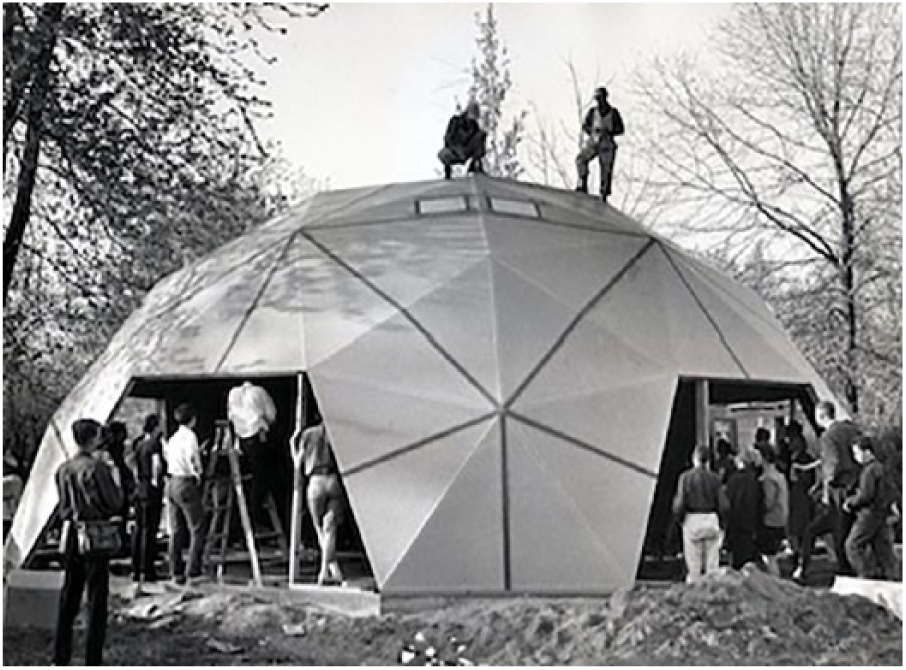
Fuller’s Geodesic Dome being built in Carbondale, Illinois, in 1960. Photo: Ben Gelman/The Southern Illinoisan.
Some DIY projects, such as Drop City, a community of artists in Colorado, were widely regarded as too radical to be popular, being a form of “hippie culture.” Yet the spirit of DIY was carried into the more recent Maker Movement. The Maker Movement is led by a group of entrepreneurs and hobbyists who share tools for making whatever they desire to make. Mark Hatch (2014), the central figure in the movement and author of The Maker Movement Manifesto, has argued that any interested person can make anything he or she wants. Hatch argues that such cheap access to tools, along with introductory classes on how to use them, will usher in an era in which anyone can innovate, without big capital investments. Similarly, Chris Anderson (2012) has observed that “by simply bringing the Web’s culture and collaboration to the process of making, they’re combining to build something on a scale we’ve never seen from DIY before” (p. 21). According to Anderson, this amounts to a Third Industrial Revolution, in which any inventor or maker can become an entrepreneur since the development of the Web and e-commerce has eliminated the need to find distributors.
Unlike countries like the United States and New Zealand, where a DIY movement of hobbyists emerged relatively early, the DIY housing movement as a hobbyist activity emerged much later in South Korea. Although self-building (with the help of members of the community) was the norm in the era before industrialization, this practice became rarer as the rapid urbanization and modernization drive discouraged self-building activities. The explosive population growth of Seoul in the 1950s and 1960s produced a lack of housing, and many migrants resorted to building shacks themselves. Many squatter settlements emerged, with most houses having a poor construction quality. Yet these shanty towns disappeared fast in the 1980s as a result of the active involvement of the state, including in demolition, relocations, and urban redevelopments (Y. Kim, Shin, & Kim, 2015). Prior to the 1990s, most self-building activities arose as a result of economic necessity rather than as a hobby.
The rise of DIY housing activities as a hobby in South Korea is a very recent phenomenon and is closely related to the lifestyle changes of baby boomers. In South Korea, the DIY housing market is thriving as part of the social phenomenon of guichon/guinong. Among those who returned to farming or the countryside, most are middle-aged and older people facing retirement. According to the statistics, those in their 50s were the largest group, occupying about 40% of the guinong population, with people in their 60s, 40s, and 30s occupying only 24.4%, 20%, and 9.6%, respectively (KOSIS, 2015). Many boomers who have either retired or are planning to retire soon are dreaming of returning to the rural countryside instead of staying in crowded and polluted cities. Among those who expressed the desire to return to the countryside, about 40% to 50% were “active/assertive” returnees who were actively seeking the positive features of countryside living, along with the “passive/avoidance” type who were fleeing problems in the city (e.g., pollution and the loss of jobs), at 30% to 35 %, and the neutral type (those who inherited farms) being 15% to 25% (Kang, 2010).
Although some studies were conducted about the housing issues of the returnees, most were focused on rental housing (C. Lee, Park, & Lee, 2016) and the reuse of older empty houses (C. Lee & Ji, 2013) rather than on DIY activities. Self-building activities as a hobby have received little academic attention due to their recent emergence. Yet contextual observations of popular magazines revealed that the factors that have contributed to the popularity of DIY housing in South Korea include the following. First, the DIY option presents a particularly appealing option to those middle-aged Koreans living in big cities whose residential options there are limited. More than half of South Koreans live in apartment houses, whose floor plans do not vary much since the focus is placed on easy exchangeability. Yet many, if not all, boomers who were born in rural towns lived in vernacular houses before they migrated to the big city. Thus, many DIY houses, if not all, resemble vernacular houses in form although they introduce new materials and modern technologies.
The DIY Housing Movement in South Korea
Nostalgia combined with dissatisfaction with the uniform housing in cities contributes to the dream of owning a personalized house in an idyllic town. Popular magazine articles narrate the story of middle-aged and older South Koreans who wish to provide the same idyllic and rural environments for their children. An example is an interview in Life Design Magazine with a 42-year-old man who has decided to return to rural life. He notes, Children need to be raised in nature. I do not want to raise kids in a heap of concrete. When I recall my childhood, the most memorable thing is living in a rural setting. That was the happiest moment of my life. I want to make such memories for my children (Yoon, 2013, p. 8).
In Jutek, another popular housing journal in South Korea, examples of those who opened lodges by self-remodeling existing old houses are introduced. The articles somewhat romantically narrate the stories of those who generate income through the self-directed building activity (Gu, 2016). Yet DIY housing is not only for those wanting extra income, or dreaming of a simpler life, but is also introduced as an attractive option for rich retirees whose main pastime is playing golf. For instance, Sisa Golf Magazine ran an article about the recent DIY land lot development in Bears’ Best CheongNa Golf Club in Songdo International City (Sisa Golf News-Sa, 2016). Enticing potential residents to build their dream home next to the fairway, the magazine promotes the notion that the entire fairway can become their backyard. Although it is highly unlikely that rich elderly retirees will be physically involved in construction themselves, such a marketing strategy is a new trend, as houses built by conglomerates are usually preferred by residents as a construction quality guarantee.
Second, the desire to lead a more ecological mode of life has also contributed to the popularity of DIY housing. Journals focusing on green issues published interviews with those who built their homes and those whose building materials reflect a conscious ecological choice. For instance, Dalpengyi Tongsin (“Snail Communication”), which focuses on educating children on the issue of sustainability, straw bales and earth are discussed as the local and environment-friendly materials (Y. Lee, 2012). Yet although some construction companies specialize in building construction using more natural materials, these are not in abundance. Unlike countries such as the United States, where the history of suburbanization goes back to the late 19th century, the suburban housing market in South Korea emerged very recently.
Two factors differentiate the South Korean DIY houses from those of other countries. First is the characteristics of would-be owners or residents. Most studies of self-built houses focus on extralegal housing for persons of very low income, usually with a low level of education and job skills (Joshi & Khan, 2010). Even in the more progressive interpretation of informal housing as the norm considered as having its own internal logic rather than as an aberration, the central assumption has been that it is for lower income residents (Brillembourg & Klumpner, 2010). In South Korea, the people leading the DIY housing movement do not particularly represent a low-income group, although most are not rich enough to hire a well-known architect. Rather, they choose to be more involved in housing activities since the current housing market in South Korea does not offer diverse options. As retired or middle-aged South Koreans, they represent a middle-income group with more time and greater desire to participate in designing and constructing their homes. Second, most people who will ultimately seek to build a house themselves receive help from outside, as they are aware of the limitations and the problems and have the means to address them. Therefore, using the term DIY may not be perfectly accurate (although I have used it in this article to distinguish the South Korean case from that of self-built houses in other countries such as in Latin America). The DIY housing movement in South Korea is also different from that in developed countries like the United States where the culture of DIY is relatively new and stores like Home Depot are not readily available.
Discussion
Many DIY Internet communities have sprung up in major South Korean Internet portals such as Daum and Naver. One popular Internet community, titled “Sesang eh Eron Jip Yi!” (What a house!), has posts with construction advice that are updated daily. Many online DIY house communities purchase land together and develop a town for those who wish to settle in a rural area after a long residence in cities. While practical difficulties related to construction prevent many from constructing their own homes, the availability of information is helpful for those who are willing to take on the task. Sungwon Kim, the founder of the DIY online community Earthbag Life-technology Network, is one such adventurous individual.
According to Kim, bags of earth are a suitable building material in South Korea. When Kim returned to farming in 2007, he originally wanted to build a house with straw bales, but he could not find any since it was early spring. He did not want to build a conventional concrete slab house or a prefabricated house, since he wanted a more ecological solution. Building a hanok was one option, but the construction cost was too high. After several months of gathering construction information and know-how, he decided to build a house made of earth bags. Then, after successfully building his own house, he decided to share his experience by joining an online DIY housing community site, to help other people achieve the same results with fewer mistakes. Many members of the group have sought his advice and built similar earth bag houses (Figure 2). In his book Yi-ut-gwa Hamggye Jit-nun Huk-bu-dae Jip (Constructing Earth Bag Houses With Your Neighbor), Kim observed that while building his own house presented him with a long and difficult task, it also made him feel like he was partaking in a fun game when the whole town participated in the process (S. Kim, 2009). Emphasizing the communal achievement, he noted that “earth houses become the most distinguished form of ecological housing when the village community builds them together” (S. Kim, 2009, p. 234).

A do-it-yourself house built by a member of Earthbag Life-technology Network (S. Kim, 2009, p. 241).
DIY houses are built of various materials. Some have started using straw bale as a building material for new vernacular houses. Wunghee Lee and Sunchon Hong, who published a book about straw bale house construction based on their own DIY experience, noted that many stereotypical beliefs about straw bale as an unsuitable building material have proven to be wrong (W. Lee & Hong, 2007). Depictions of straw bale houses as weak and vulnerable to strong winds, as propagated in bedtime stories like “The Three Little Pigs,” are simply untrue, since contemporary straw bale houses use compressed straw bale blocks, which weigh about 20 kilograms per block. Lee and Hong, who attended a straw bale architecture workshop held in Australia in 2005, explained that the construction is different from Korean traditional straw bale houses that use mixed earth and straw bales. Instead, plastering is applied after the straw bale blocks are piled up. Both observed that straw bale houses provide warmth and safety without the side effects of harmful chemicals emitted by some modern interior materials.
Online DIY communities have expanded their scope by holding regular offline meetings and workshops and even offering construction schools for those who want to build their own homes. For instance, the Earthbag Life-technology Network started to work with the UNESCO School of Earthen Chair Architecture, supported by Terra Korea, an academic society focusing on earthen architecture. At the 2017 Kyunghyang Housing Fair, supported by the major South Korean newspaper group, many DIY organizations participated in promoting their works (Figure 3). The housing fair is held twice a year, providing opportunities for industries to advertise different products and for consumers to learn about them. Besides the earthen architecture school, another DIY club exhibited a wooden construction frame as part of its effort to recruit members. At first glance, it looked like a hanok with a traditional wood post-and-beam construction. However, when I approached the booth, I noticed that the joints do not look like the traditional brackets. When I pointed this out (in an interview held on February 24, 2017), the recruiter noted that the construction is much simpler than the traditional one since the objective is to allow many people to build their own houses. Stating that space was fast filling up, he urged me to sign up to participate in the upcoming construction camp.
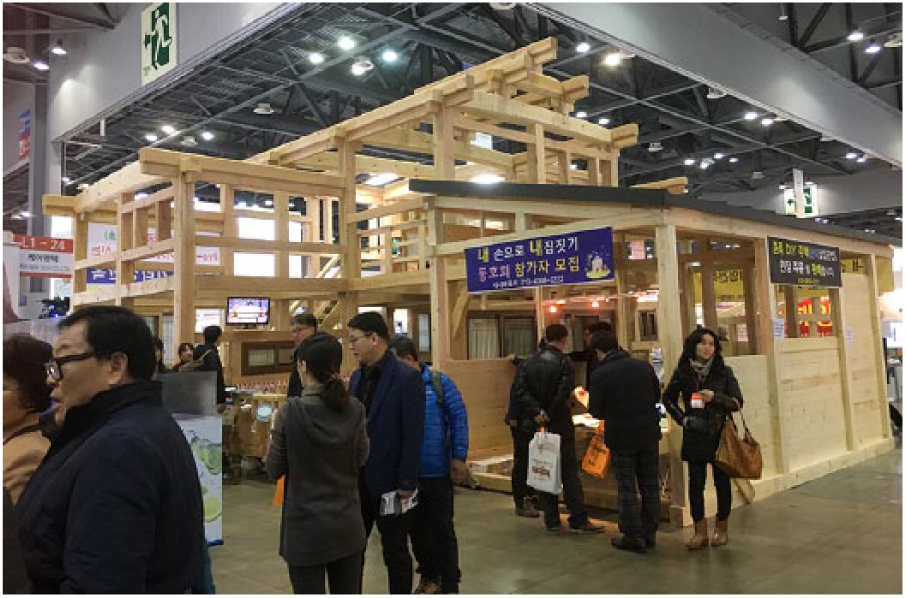
Do-it-yourself organizations promote their works at the 2017 Kyunghyang Housing Fair, held in Seoul, February 24-27, 2017.
Neoliberal economic forces that emphasize an individual’s entrepreneurial acumen and market relations do exist within the DIY housing movement. The first wave of “returning to farming/the countryside” coincided with the aftermath of the structural adjustment, and many returned to the cities after the economy recovered (J. Kim, 2009). Some online sites with the title “DIY” are run by real estate and construction companies rather than being true communities of hobbyists. In such cases, the term DIY is used to advertise the works of the companies rather than promoting self-building practices. On such sites, investing in rural real estate properties is promoted as providing economic security for those facing near-future retirement. Following the South Korean pension system reform, a mounting sense of crisis has been felt among middle-aged and older South Koreans who fear the disintegration of the social safety net when they retire (D. Kim, 2012). However, some returnees who returned to the countryside with a romantic vision of a rustic life failed to generate income due to a lack of farming skills and an inability to mix with the local community. According to a study of guinong policies, support from the local government was considered insufficient for a successful transition for returnees in Gyeongbuk Province, one of the provinces with many returnees (C. W. Lee & Park, 2015). Also, there is room for this DIY housing movement to become a useful alternative enabling state and local government to abdicate their responsibilities to provide affordable housing and an adequate social safety net for the aging population.
However, the reasons why DIY housing clubs are popular in contemporary South Korea are complex. Besides the trend of “returning to farming/rural towns,” an increased desire to live in a place that reflects personal tastes also contributes to its popularity. Among 82 respondents, 35 (42.6%) replied that their motive for building their own house was to have a more unique and interesting home (Figure 4). Most DIY housing club members believed that building houses on their own would better reflect their personal tastes. Although 32 (37.6%) replied that they were motivated mainly by economic reasons, there were other significant factors such as dissatisfaction with the existing housing market (10 votes, 12.1%). Since the reasons and motives behind choosing DIY differ, it is only natural that there are many different types of DIY homes. While some regard the ease of construction as the most important prerequisite for DIY housing, others attend hanok schools to learn about the traditional bracket system used in constructing hanoks. Most DIY club members expressed excitement and a sense of achievement at the fact that they had designed and built their own houses.
Yet despite the positive feelings associated with DIY houses, DIY builders face many challenges and obstacles. Some DIY builders expressed a sense of regret about certain aspects of their self-built houses, although they were generally satisfied with the process. Some have encountered internal conflicts. In an interview held in April 2017 in Damyang, Wunghee Lee noted, “People these days want many different things. . . . They are used to a convenient lifestyle in apartment houses. Some (DIY builders) want to enjoy such convenience but their expertise does not match expectations.”
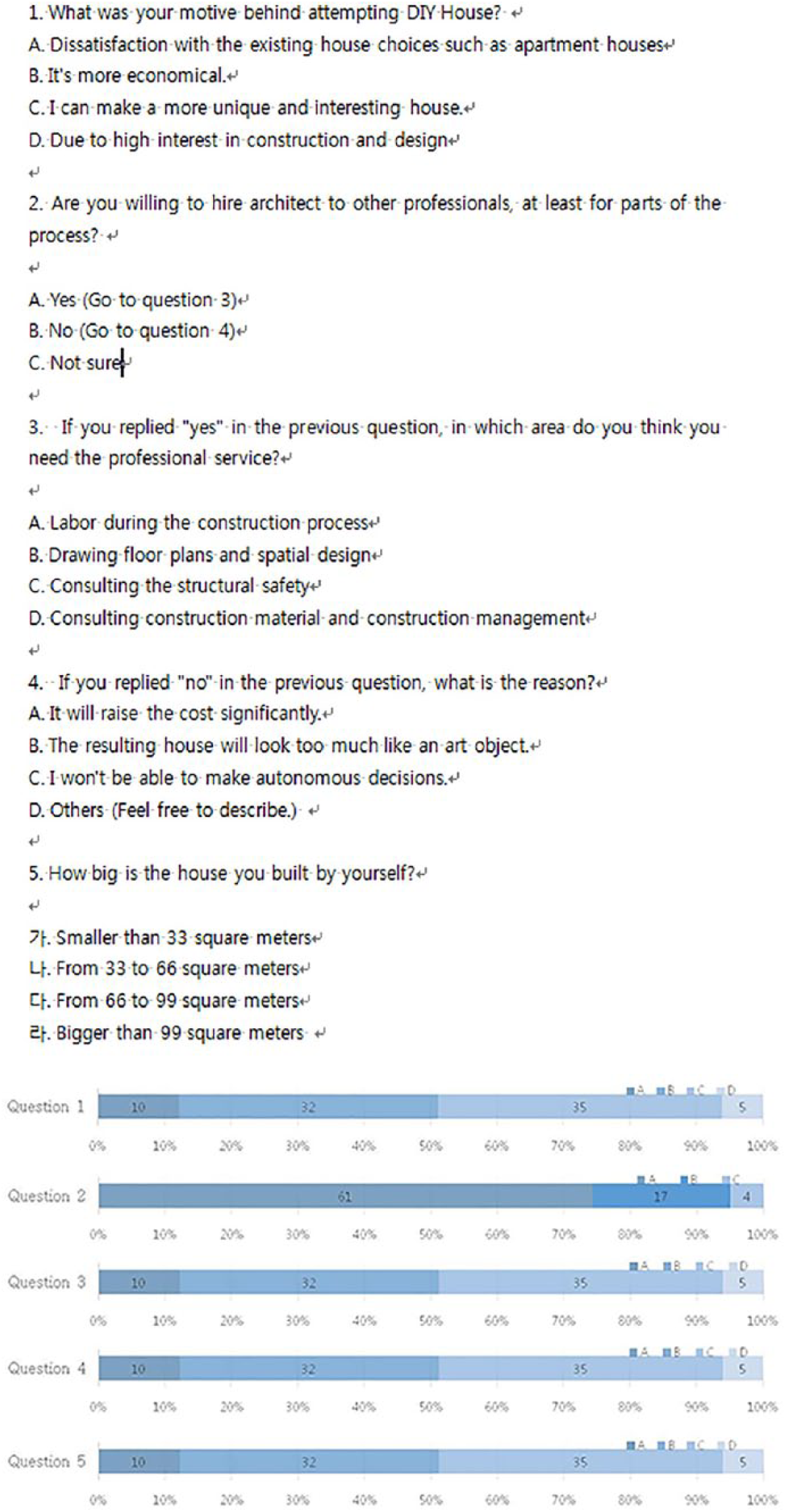
Survey questions and results.
In other words, some potential DIY house owners want to build houses that are beyond their capabilities. Since most of South Korea’s middle-class population is used to conveniences associated with apartment housing, some DIY builders expect the same level of convenience in DIY houses. Also, according to Lee, some DIY novices mistakenly believe that DIY housing always costs less than non-DIY houses. Even among those with realistic expectations, lack of construction expertise was a major obstacle. Although many online and off-line communities provide advice and help regarding construction with a specific building material, finding an appropriate material remains a difficult task.
Others noted that it would have been better if they could obtain more specialized advice as to whether their original plan could be implemented. For instance, Sungwon Kim noted (in an interview held in March 2017 in Seoul) that the most difficult challenges were design development and materials management. He observed, Some members (of our community) know how to use software like Sketchup, and they are very good at it. But most of them come up with floorplans of apartment houses with a living room in the middle. . . . They lived in apartment houses and they have only seen those of more or less the same floorplan.
Most DIY builders focus on architectural engineering alone rather than on spatial design. As a result, the floor plans of some DIY houses are not very different from those of apartment houses, since most builders are not familiar with the various types of residential floor plans, nor with the names of building materials, and so determining the necessary amount of each material is very difficult. This has often led to much waste of time and money. Second, since most do not have an architectural background, DIY builders tend to lack a comprehensive understanding of how buildings work and focus only on certain functions such as insulation. Other functions, such as lighting, ventilation, and cooling, are given less consideration in the process. After living in self-built houses for some time, many regret the fact that they did not put much emphasis on spatial design and various building functions.
When I asked DIY builders whether they are willing to hire an architect or other professionals at least for part of the construction process, most DIY builders (61 votes, 74.3%) replied positively. Most of those not willing to hire an architect or other professionals worried that hiring an architect would be costly (35 votes out of 49, 71.4%). Others noted that while getting advice on certain aspects of construction, such as determining the amount of material, would be great, they did not want the architect or the building company to take over the whole process (10 votes out of 49, 20%). Many believed that only the very rich can afford to hire an architect or a construction professional. Such a conception of its professionals has been criticized in the architectural field. The tendency to emphasize the architect’s self-expression over other concerns is still dominant in the field. In Down Detour Road: An Architect in Search of Practice, Eric J. Cesal (2010) has criticized architects’ preoccupation with the evaluations of their peers (other architects) rather than with those of nonarchitects, including clients and local residents.
Yet this is changing, and so-called neighborhood architects (Dongnae Gonchukga), who primarily design contextualized local projects, are putting efforts into redefining the role of the architect. For instance, Sukkyoon Kim, the president of Sallym, an architectural firm in Sunchang, in North Jeolla province, is convinced that architects should consider not only individual aesthetics but also community needs and the local economy. Kim provides architectural and construction advice to local residents who seek help with certain building activities. He and his wife run an educational program for the villagers that provides practical training, consisting of sessions such as “remodeling an old furnace,” “making a shed with a discarded pallet,” and “how to do earth plastering” (Figure 5). When asked about the future of DIY housing, he pointed out that for many people there are obstacles involved in DIY housing, such as a lack of construction expertise and structural knowledge. Explaining further, Kim noted that “self-directed housing activities” is a more appropriate phrase, since no one can single-handedly build a house (interview held in April 2017). Kim’s wife said that the best thing about the educational program was that “villagers acknowledge the diversity within the community and rediscover good things about other persons with different lifestyles.”
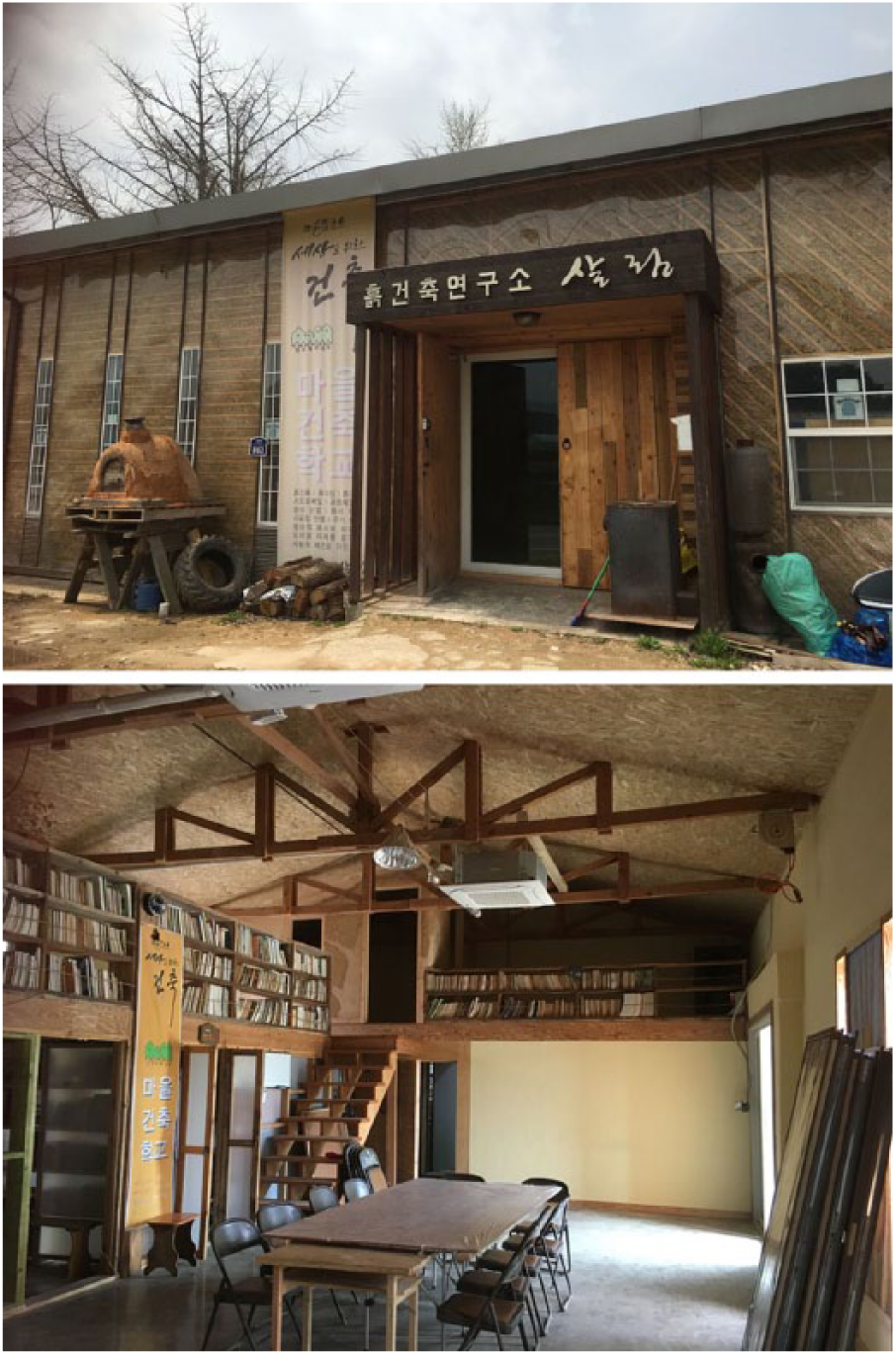
The Sallym in Sunchang with a classroom for village education program.
When asked about the difficulties and challenges in assisting prospective returnees to either self-directed or self-commissioned houses, Kim observed, “It is necessary to provide educational programs for prospective clients about diverse ways of approaching housing. Some just define houses by their material, and others say “we want a house that costs this much per square meter.”
While self-directed housing activities can be pleasurable, especially when they become communal events, they can be enhanced by the involvement of professionals, who can provide insights regarding different ways of approaching housing design and construction.
The future of DIY or self-directed housing remains uncertain. Many challenges and obstacles threaten to render this new housing trend a mere episodic event in the long run. One potential problem that DIY housing activists and returnees in South Korea may encounter in the future is its possible contribution to the urban sprawl. South Korean metropolises, including Seoul, are considered less affected by sprawl due to green belt policies and their mountainous geography (S. Lee, 2018). Yet smaller cities have exhibited a tendency for urban sprawl that showed a positive correlation with urban decline (Hwang, 2017). In small to medium South Korean cities that may experience further population decrease due to a low birth rate, DIY housing constructions in the hinterland may accelerate the urban decline.
Another problem is the legal one. A new architectural code, implemented in February 2017, requires the presence of a site manager with construction-related qualifications even on small-scale construction sites. The implementation of this code means that many DIY houses will have to employ a site manager, and this new requirement may discourage some from pursuing DIY building activities. Although some were worried about finding a suitable site manager with the requisite qualifications (but without another full-time job), others thought that once the new system had been settled into, it would be for the better. For instance, one DIY Internet community user with the ID “Joonhoo’s Father” noted that the presence of a site manager would help reduce unnecessary costs as well as assuring construction quality. This new requirement may work to the benefit of the current grassroots building activities by reducing the safety concerns and other difficulties faced by the DIY house builders. With the aid of an adequate level of architectural and construction services, a self-directed housing movement in place of the current DIY movement may become a more sustainable form of vernacular housing.
Conclusion
Although neoliberal economic tendencies are present within the DIY movement, they do not represent the whole spectrum of the movement. Most DIY builders expressed excitement and a sense of communal achievement over the fact that they had designed and built their own houses. Contrary to the commonly held notion, this article concludes that the role of the architect is unlikely to diminish even in the context of a rising number of DIY homes. As the survey results and interviews demonstrate, most of those engaging in DIY housing are willing to obtain professional help in areas in which they are unfamiliar. For this reason, it would be more accurate to call the phenomenon one of self-directed housing activities. Thus, the DIY phenomenon presents a new opportunity for architects to play a different role in promoting community empowerment. The architect’s role can be redefined as that of a guide in self-directed building activities in the context of the South Korean gwinong/gwichon. Rather than providing an overall architectural service, partial consultation, especially in the stages of spatial design and finalizing of materials, would alone be needed.
Considering the self-directed housing activities in South Korea, it is perhaps time to think again about the scope of vernacular architecture. Despite the intense modernization drive that has characterized South Korean society since the 1950s, it could not erase the desire of many Koreans for a vernacular lifestyle. The resurgence of interest in local construction materials seen in DIY houses attests to the emergence of modern vernacular architecture. While the term vernacular architecture itself has never been narrowly defined, it needs reconceptualizing, especially in the context of a fast-changing society like South Korea. The soul of vernacular architecture is carried into the new building forms, albeit in a slightly changed manner.
Footnotes
Declaration of Conflicting Interests
The author declared no potential conflicts of interest with respect to the research, authorship, and/or publication of this article.
Funding
The author disclosed receipt of the following financial support for the research, authorship, and/or publication of this article: This work was supported by the Hongik University 2017 Research Support Fund.