



Abstract
This article presents the results of a qualitative study that explored how freedom in music can stimulate creative development in students. A series of musical and pedagogical activities, called Creative Freedom, which involved favourable conditions for autonomy and creative agency, was developed. This study was conducted between 2013 and 2018 in two different universities and involved a total of 72 musical volunteers. The data analysis methodology chosen for this study was grounded theory, with the aim of understanding the social and individual meanings present during the empirical research. The findings showed empirical evidence that freedom can enable creative development through the minimization of dysfunctional beliefs and the promotion of a more positive self-concept, allowing students to glimpse musical abilities that they had not previously noticed.
Introduction
In Western classical music teaching, creative autonomy is usually granted after one has acquired certain musical skills and the knowledge required by academic curricula. Traditionally, the pedagogical approach in these educational environments tends (a) to highlight the canons that emphasize the great geniuses of classical music, favouring composition as an individual creative act belonging to members of a select elite who have the necessary knowledge to express themselves creatively; and (b) to focus exclusively on technical expertise and theoretical learning with little consideration of a more humanistic musical education that leans more toward self-discovery (e.g., Allsup & Benedict, 2008; Burnard, 2012a, 2012b; Hill, 2009b). Hill (2009a), in her research at the Sibelius Academy (University of Helsinki, Finland), reported the dissatisfaction of folk music educators with Western musical art due to it providing virtually no opportunity for improvisation and limiting composition to a select gifted elite.
Similarly, studies on popular musical performance have attributed the subject of creativity to the knowledge of codes and rules of style, excluding many musicians who have not yet gained the necessary knowledge to perform accordingly (Berliner, 1994; Filho et al., 2011; Hill, 2018; Pinheiro, 2011). A social construction exists that is capable of intimidating or delaying creative action due to the idea of a lack of competence, that is, the misconception that creative musical thinking only occurs when a greater understanding of music is achieved (Webster, 2000). According to John Blacking (1973), “The majority of us live far below our potential, because of the oppressive nature of most societies” (p. 116). This is true insofar as students’ curiosity is shaped by rules, models and systems that guide their actions and thoughts.
With the goal of enabling students to see themselves as more creative human beings, several methods have been created both to develop creativity and, at the same time, to incorporate compositional procedures of avant-garde music into their practices (e.g., Paynter, 1972; Schafer, 1991; Self, 1967). Institutions have included free improvisation as a pedagogical alternative that allows students to have creative musical experiences and artistic freedom. The pedagogical works of Pauline Oliveros, Ed Sarath, Fred Frith and David Ballou (Hichey, 2015), as well as the generative improvisation proposed by Alain Savouret (Canonne, 2010), are some of the many examples of free improvisation in academic curricula. According to Bailey (1992), free improvisation is a plural and democratic activity that allows collaborative joining with any available skills and knowledge – enabling students to create music without the need for “authorization” or highly specialized knowledge (e.g., Costa, 2003; Falleiros, 2012).
However, as Merker (2006) pointed out, listening to a musical sequence appreciatively requires a minimum base of knowledge and familiarity for it to be apprehended and recognized. Such familiarity can only be obtained through a history of listening. Activities that involve the use of avant-garde or non-idiomatic music, such as free improvisation, and that are disconnected from students’ everyday practices may present motivational challenges if we consider that they usually learn music within a particular style or genre (Thompson, 2008). This unfamiliarity with non-idiomatic music or post-tonal practices may cause many students not to appreciate such activities or to view them as a mere distraction since they have little or no relation to their purposes and values. Schafer (1991) noted, for example, that his pedagogical proposals may not be seen with due seriousness, being viewed more as a distraction from the tedium of routine.
Many of the agents that this study identified as inhibiting musical creativity are associated with technical worldviews and teaching traditions that are unable to place the student at the centre of the learning process. Students are not free to create (there is a need for talent, technical knowledge etc.) or, when they are allowed to create, many do not recognize the relevance of the proposed creative activities to their daily music practices. Seeking to minimize the problems presented in this literature review, this study aimed to verify whether freedom in music can stimulate creative development in students through the value of students’ subjectivity 1 and personal experiences. We sought to answer the following research questions:
This work was carried out at State University of Campinas (Brazil) as a PhD research project funded by São Paulo Research Foundation (FAPESP) from 2013 to 2017 and at the Federal University of Rio Grande (Brazil) from 2017 onwards, where a multidisciplinary team was formed with researchers and students from music, psychology, pedagogy, arts, languages, and anthropology. The findings presented in this article refer to data collected at both universities from 2013 to 2018, involving a total of 108 hr of classroom activities and 80 hr and 47 min of audio and audiovisual recordings.
Creative freedom approach
Definitions
In this study, creative freedom was understood as the conscious act of creation; that is, creative freedom is the reflective process that leads individuals to question the systems and values of their own society and culture, becoming free to think and to create or solve problems with autonomy (Hill, 2009a; Nazario, 2017). As seen in the literature review, there are many elements that directly or indirectly affect students’ creative behaviour negatively. In music, creative freedom seeks to promote reflection on such elements, enabling a re-encounter with students’ own musicality. Creative freedom encourages free sound imagination and creative behaviour—that is, behaviour in search of self-expression, invention, and discovery without external or self-imposed restrictions (Cabra & Uribe-Larach, 2013).
The terms creativity and freedom acquired specific meanings in this work. Creativity encompasses cognitive and psychological components. The first component concerns the ability to use cognitive flexibility 2 to create something or solve a problem, implying a process that leads to divergent thinking (e.g., for general creativity, cf. Sternberg, 2006; for musical creativity, cf. Hill, 2009b; Webster, 2000). The psychological component refers to the presence of self-expression. According to Winnicott (1990), “to be creative a person must exist and have a feeling of existing” (p. 39). Creativity is “the doing that arises out of being” (Winnicott, 1990, p. 39). Based on these premises, the creative act in music can be as present in a well-regarded orchestral work as in a simple piano improvisation performed by a child. The focus is not on a judgement of the value or acquired knowledge but on the presence of cognitive flexibility and self-expression during the act of creation. Musical practices that are often understood as activities that stimulate creativity (such as musical improvisation or composing) may not necessarily allow full creative action if they only emphasize automated actions (leading to known outcomes) or do not allow student self-expression. This understanding led us to consider creativity as both a necessary element for self-realization (e.g., Maslow, 1968; Rogers, 1969) and a general human ability 3 capable of manifesting itself at any level of knowledge.
Freedom has been one of the great themes of philosophical reflection. Three general approaches to freedom have overlapped throughout history: (a) freedom as an absolute and unconditional individual characteristic, (b) freedom as a necessary cosmic or divine order, and (c) freedom as a limited and conditioned possibility or choice (Abbagnano, 2007). The understanding of freedom discussed here is more philosophically related to item (c), since the choices must be limited to a norm of reciprocity, attributing to others the same possibilities as are attributed to oneself. To be free is not to choose but the possibility to choose (Abbagnano, 2007). Freedom is understood as the result of the process of being aware of making one’s transition from heteronomy to autonomy (Aranha, 1990), and this autonomy is achieved through a reflexive attitude towards oneself, towards others and towards the world. For Piaget (1944), education for freedom presupposes, first, education of intelligence and mind. An individual who is subjected to the repression of tradition or is unable to think for himself or herself is not free. For Freire (1970), freedom is a human condition that is often inhibited and socially repressed, and it is necessary for the subject to face not only the oppressor who is outside but also the oppressor within. According to the author, freedom is present in the awakening of human creative possibilities, allowing the human being to transform the world and himself or herself. Following Chauí (2000), freedom allows the individual to give new meaning to what seemed to be fatality, transforming his or her situation into a new reality (Chauí, 2000). As Hill (2009a) pointed out, freedom extends beyond creativity itself: it connotes the desire to be free from perceived constraints and the challenging of imposed boundaries.
In this sense, the correlation between the cognitive and the psychological components involved in creativity, together with the autonomy of action (provided by freedom), are the foundations that permeate the approach proposed here. Creative freedom will be in full movement whenever an individual uses his or her cognitive flexibility and self-expression to create imaginatively with independence and self-sufficiency.
Steps to creative freedom
Some studies have suggested that human beings have intrinsic implicit knowledge of structural patterns and organizational principles in music and are able to give meaning to sound events as well as to interpret them actively in terms of their functions in the musical context (e.g., Bigand & Tillmann, 2002; Krumhansl, 2001; Margulis, 2013). Following this assumption, creative freedom builds on students’ existing musicality as the basis for developing their specific skills. It seeks (a) to be open to students’ subjectivity, (b) to emphasize free sound imagination, and (c) to minimize negative beliefs and the idea of non-musical potential that students may have about themselves, thereby reducing possible creative blocks.
This study focused on musical improvisation practices and, therefore, the inferences presented here refer to these practices. However, we believe that creative freedom can enable significant changes in other musical activities that involve creative action (composition, creative performance etc.) because the elements present in this approach (autonomy, cognitive flexibility, and self-expression) enable behaviour towards the new, towards experimentation, which are relevant elements of any type of creative activity. Musical activities act more as tools for the reflexive immersion necessary for the development of creative freedom. Three steps are taken in this approach.
Step 1: Identifying problems
The first step is the identification of certain axiological principles capable of inhibiting musical creativity in students. In the field of education, researchers have highlighted that values and beliefs are at the basis of individual actions and behaviours and the reflection on established value systems is essential to educational praxis (e.g., Aranha, 1990; Fives & Buehl, 2008; Pajares, 1992). These principles highlight the creative inhibitors associated with the worldviews formulated by participants during their lived experiences. Individuals who value creativity as a super skill inherent in a few people who have highly specialized knowledge, for example, are likely to have a more negative self-concept than those who value it as an intrinsic human ability.
The values and beliefs that students bring with them tend to be reported through answers to simple questions such as the following: Do you consider yourself to be creative or musical? Why? Is it difficult to improvise or create music? Why? However, such questions will rarely provide more telling accounts if a dialogic–reflective environment has not previously been established in the classroom. Self-expression is more easily manifested when students perceive empathy (from both the teacher and the group) towards the way in which they communicate their affective states, meanings, and self-images. To facilitate this environment, a more humanistic relationship in the classroom is contemplated through a pedagogy that encourages self-acceptance, self-confidence, and greater flexibility in perceptions (Rogers, 1959). Meetings should be not only a moment of musical fulfilment but also a conversation group in which there is room for discussions that cover the most diverse topics.
Step 2: Implementing actions to solve problems
In this approach, creative development is associated with the resignification of dysfunctional values/beliefs that, over time, have minimized students’ creative action, limiting them in their potentialities. This reconstruction is achieved through questions that seek to challenge their foundations and through accomplished creative performances during meetings.
Many dysfunctional values/beliefs are of a sociocultural origin and tend to be resignified by highlighting the ethnocentric perspective in which they were generated. Others are more durable and rooted because they are associated with the schemas 4 that individuals have about themselves (Beck & Haigh, 2014). There are many situations that can impress values and influence the behaviour of individuals. The relationships woven into the family environment, in the community, at school, and in society and the lesser or greater contact with situations of individual freedom, in addition to the various inhibiting factors mentioned in this article, affect each person in a unique way. In such cases, an investigation is conducted that considers the complexity involved in the emergence of such beliefs and values, always showing respect for the student’s subjectivity during the investigative process. Table 1 presents samples of questions used as a starting point in the process of value/belief contestation.
Contestation of Values and Beliefs.
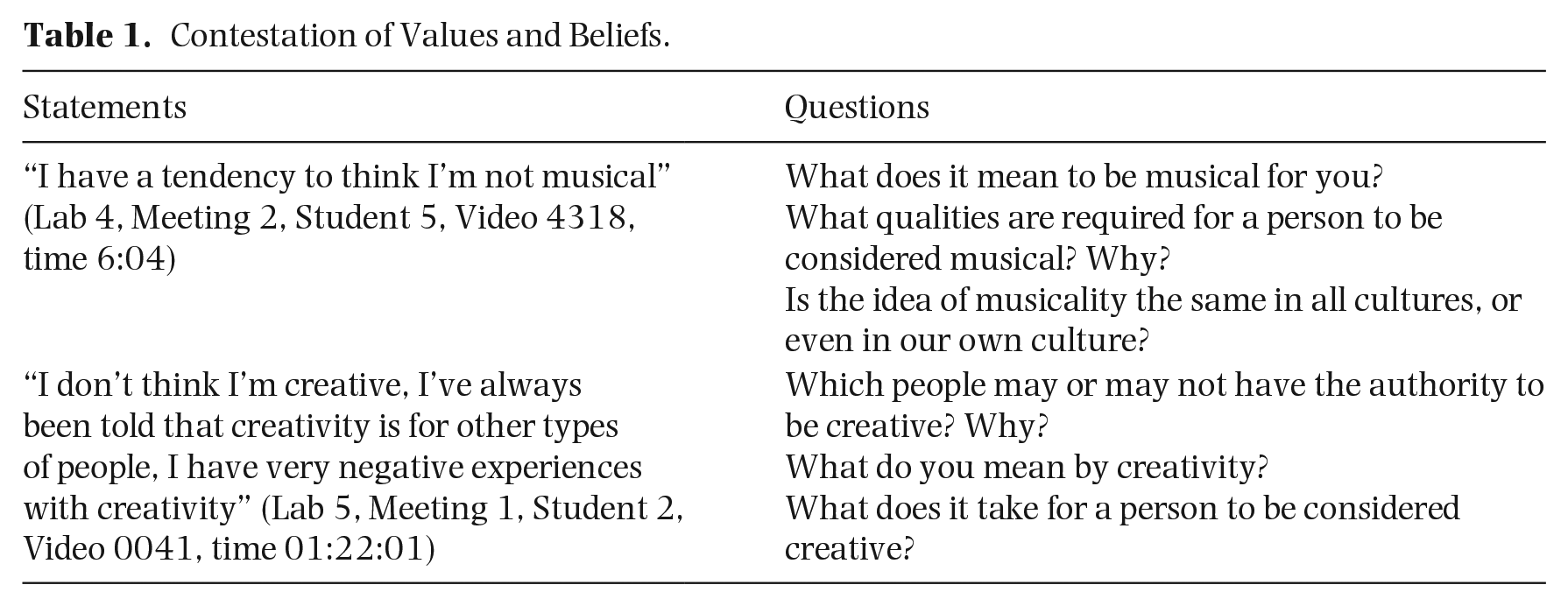
The questions presented in Table 1 were addressed to all the participants, not just to the individual who expressed the specific thought. The goal was to stimulate discussion and collective empathy. The process of reconstructing values and beliefs is strengthened when the respondent, when exposing his or her personal experience, also reproduces thoughts or situations shared by other participants. This factor, called universality by Yalom and Leszcz (2005), is common in therapeutic groups, in which subjects feel relieved when they realize that they are not the only ones who think and feel in a particular way. Another factor that is also present is altruism, in which the participants themselves offer support, suggestions, and insights, helping both the individual and themselves (Rogers, 2002; Yalom & Leszcz, 2005).
Regarding musical performances, practices such as improvisation, composition or any other action associated with creative development may be used, provided that the following conditions are present:
(a) Activities should provide an environment that allows everyone the possibility of creating music together, regardless of the different levels of knowledge that the students have;
(b) Because music is constructed through the meanings that we attribute to sounds, activities should broaden these meanings, enabling students to open up to new ways of understanding, listening to, and creating music;
(c) Activities should make possible the creation of music from any sound source (e.g., the human body, the voice and objects), enabling students to explore musicality simply and without requiring specialized knowledge; and
(d) Most activities should be collective because they enable communication, interaction and discoveries that are proper to a collaborative dialogue. Being free creatively implies reflecting not only on our actions but also on the effects of our actions on others’ actions, that is, on the collective.
Practices of free improvisation embrace these conditions and allow students artistic freedom. However, as the focus of this approach is on students’ experience, and most students learn music in an idiomatic context (Thompson, 2008), it is essential to contemplate idiomatic activities, without, however, requiring in-depth aesthetic knowledge during performances.
Step 3: Analysis of the actions’ results
The analysis of the results involved answering the following questions: Was there any resignification of beliefs considered dysfunctional for creative development? Did the participants change their behaviours? Did they reduce their creative blocks? Are they more open to experimentation? Do they feel more confident?
Sometimes individual conversations are necessary in cases in which one or more participant persists in operating dysfunctional beliefs. These conversations allow a deeper investigation of the axiological principles present in participants’ thoughts. In some cases, it is not possible to reconstruct certain values or beliefs because they are associated with a worldview and schemas raised even before the first musical learning. According to Young and colleagues (2008), schemas struggle to survive due to humans’ instinctive need for coherence. Although some of these schemas cause suffering, they are comfortable and familiar to the individual.
Musically, whether a melody, scale, rhythm or harmony is correct or incorrect was not evaluated, as this would incur models and values adopted in traditional pedagogy. The process of analysis considered the degree to which the students understood the musical material and how they managed to interact with that material. By providing students with conditions that enable creative freedom (Step 2), many of the axiological principles identified in Step 1 tended to be reconstructed. The Creative Freedom approach was considered successful when, in the final meetings, the group demonstrated a high degree of cognitive flexibility and spontaneity in creating within diverse musical situations, showing more autonomous and reflective attitudes, many of them free from sociocultural barriers.
Methodology
This study had a small-scale, qualitative design to gain an in-depth understanding of how people ascribe subjective meaning when practicing improvisation (Johansen, 2017). The Creative Freedom approach was applied at two different universities through six university extension courses (four courses held at the State University of Campinas and two courses held at the Federal University of Rio Grande), which were open to any adult volunteer musicians (regular or non-regular students). The activities consisted of musical improvisations, conversations (testimonials), and written open questionnaires. All the participants were informed about the nature of the research activities and signed a statement of informed consent that followed the ethical requirements of the State University of Campinas (registration number 35478314.4.0000.5404) and Federal University of Rio Grande (68451717.2.0000.5324). All the participants gave the necessary permission to participate in this study. Data were collected through audio and audiovisual recordings as well as questionnaires completed at each meeting. Prior to the courses, this approach underwent a pilot study (pre-lab), conducted with 22 volunteers, which aimed to evaluate the effectiveness of the proposed musical activities and the suitability of the questions to obtain data. In total, this study involved the participation of 72 musicians using convenience sampling with no delimitations regarding the population of participants. Volunteers belonged to both genders and played diverse musical instruments (electric bass, saxophone, piano, violin, drums, etc.). The majority of volunteers were amateur musicians with essentially informal or non-formal learning experience (83%), followed by musicians with scholarly university training (13%) and music conservatory students (4%).
The data analysis methodology applied in this study was grounded theory (Strauss & Corbin, 1998), with the aim of understanding the social and individual meanings present during the empirical research. Without denying the researcher’s interpretative bias, the coding processes proposed by grounded theory aimed to minimize the subjectivity of the analysis through the correlation between the occurrence of codes and the conceptual categories. The study sought to identify repeated patterns of events and actions/interactions in response to problems or situations that people were experiencing (Strauss & Corbin, 1998). It considered the importance of certain meanings for the respondents as well as the recurrence of these meanings in different testimonials.
Two criteria were used to evaluate this approach: (a) an analysis of the outcomes of actions envisaged in Step 3 of this approach and (b) the motivation of participants to complete the course. Criterion (a) is qualitative and involves the researcher’s subjective interpretation of the participants’ performances and testimonials. Criterion (b) is quantitative and concerns the percentage of participants who did not complete the course. To ensure greater reliability, the coding processes, musical performances, and testimonials were analyzed by different reviewers (including the advisor and doctorate board of examiners at the State University of Campinas and the research group members at the Federal University of Rio Grande). In addition to these elements, this second group of inter-evaluators focused their attention on the extra-musical aspects present in class (beliefs, values, emotions, social influences, etc.), and the analyses and interpretations were discussed collectively through weekly meetings held at the Federal University of Rio Grande. Data were also triangulated through empirical research carried out in different geographical regions located more than 1,400 km apart and at different chronological times: four groups were investigated in south-eastern Brazil (State University of Campinas) between 2014 and 2016, and two groups were investigated in the south of Brazil (Federal University of Rio Grande) between 2017 and 2018.
Findings and discussion
In this section, we present the findings and inferences that were based on the concrete data collected during the empirical research. Inferences concerning the perceived experience of freedom in the creative development of students took into consideration the solution to the proposed musical problems (evidenced through musical performances) and the minimization of any identified creative blocks (which were confirmed in testimonials and performances). The rating scale used the following classification: A (excellent participation), B (good participation), C (below expected interest), and D (poor work, low participation). Table 2 presents the favourable findings regarding the perceived experience of the creative freedom in the investigated groups, with evaluations A and B and dropout percentage below 40%:
Perceived Experience and Comparison of the Creative Freedom Approach Among the Six Study Groups.
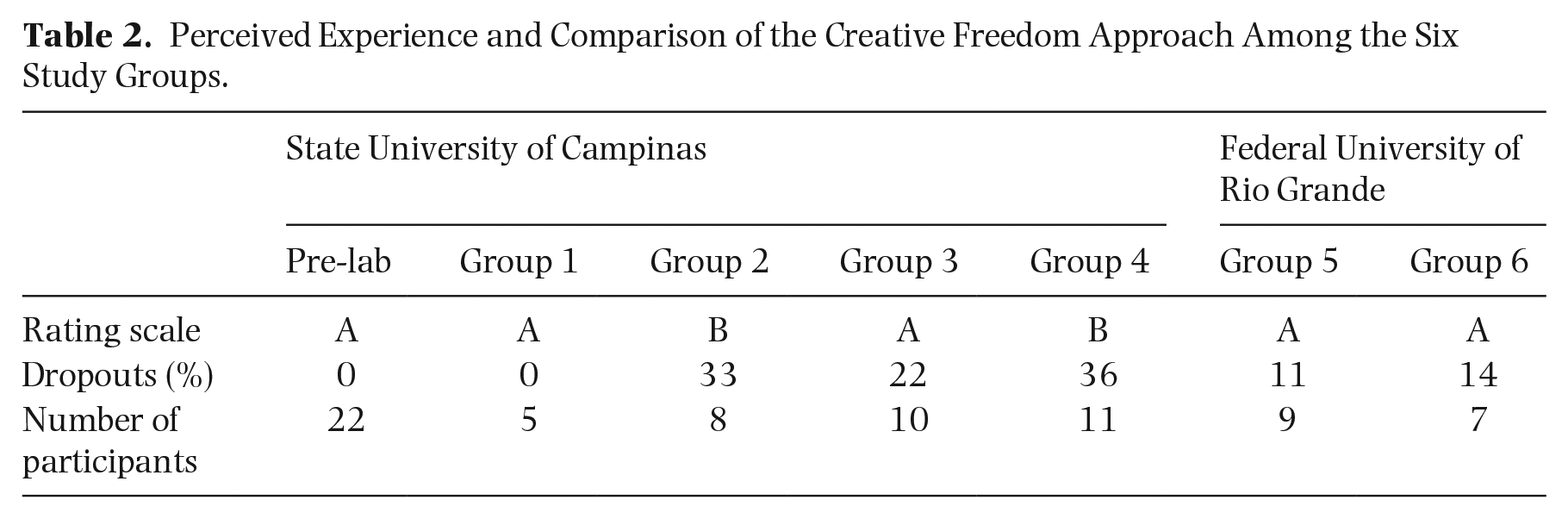
Although the percentage of dropouts indicates a lack of motivation in the motivational aspect, the reports showed that some participants had intended to gain knowledge through theoretical teaching involving music theory, harmony, and practices of music styles. When they realized that the project did not follow these priorities, they no longer attended the meetings. The participants’ creative development was analyzed according to the procedures provided in Step 3 of the Creative Freedom approach. The increasing level of spontaneity in proposing new sound ideas (creativity) during the various musical situations was considered in addition to the intensification of reflective and autonomous attitudes (freedom). The analysis is therefore interpretive and it was based on personal experience in the classroom, but it was also grounded in the respondents’ testimonies and the musical recordings collected during the meetings.
During the application of the empirical research, we sought to answer the research questions through the investigation of the meanings and situations considered to be the most relevant to the investigated subjects. At times, during the testimony of a group member, the others nodded, agreeing and sharing similar experiences. Three categories were selected from their testimonials for presenting greater groundedness (the number of quotations associated with codes), representativeness (the quantity of occurrences of codes in different primary documents), and density (relationships between codes of the phenomenon studied). The base categories selected were inflexibility, creative freedom, and openness to new possibilities, creative freedom being considered as a central category of this study.
The category inflexibility was present whenever a methodology was conducted with stiffness, paying little or no attention to other interests that the students could have in relation to their own learning. Some participants re-examined their learning experiences and reported sensitive personal histories, some of which related to the austere behaviours or strict methodologies applied by their teachers: I attended lyrical singing classes, but It pisses me off, I lost pleasure, I got so caught up in that technique I wanted to hit him, I grew up absorbing and learning that “ If I tell my teacher I am doing that [referring to the activities proposed in the course] During school band rehearsal,
It is noteworthy that their testimonials, thoughts, and feelings express much more than simple answers: they reveal a sociocultural and historical construction. That construction, according to Aguiar (2009), not only manifests the individual’s subjectivity but also contains a social totality present in other subjects who live in similar conditions. The above testimonials, for example, evidence a pedagogy that overestimates technique (the object) and gives little consideration to the human (the subject), contributing to the constitution of a negative self-image and low self-esteem among students (as in the testimonials reported in Table 1). During the labs, in some cases, after a performance that was considered unsatisfactory, participants also verbalized their self-criticism and/or low self-esteem, and many of their self-evaluations were grounded in the values/beliefs that they thought were essential for creative action, such as
(a) Technical musical knowledge understood as imperative and not as a tool for creativity:
(b) Formulation of an aesthetic pattern of creation to be followed (social conformity 5 ):
I have a concern not to displease people . . .
(c) Errors seen as a synonym for inability, leading to anxieties about failure and/or negative feedback from peers:
The course freed me a lot because, at first, I couldn’t perform in group,
These values/beliefs highlight the creative inhibitors associated with the worldviews formulated by the participants during their lived experiences. Throughout the courses, the participants tended, at each meeting and gradually, to express themselves creatively with more ease and freedom (creative freedom category). Individuals who did not allow themselves to create because they understood that they had not acquired sufficient knowledge for such action, for example, quickly reconstructed this belief when they glimpsed their musical and creative capacities during musical performances:
When experiencing freedom, some participants realized that they brought with them intuitive musical knowledge, becoming motivated to learn music in a lighter and more pleasant way. The presence of freedom was therefore a relevant factor in being open to acceptance in musical perception, encouraging experimentation and empowering the expressive possibilities of participants, leading them to a musical performance enriched with new ways of expression (openness to new possibilities category). As evidenced in the following testimonials, some participants expanded their understanding of music and glimpsed previously unnoticed musical abilities.
The testimonials point to positive results regarding the relevance of freedom to the process of minimizing dysfunctional beliefs. The conditions and pedagogical approaches presented in different steps of the Creative Freedom approach not only enabled volunteers to perceive themselves as creative but also paved the way to experimentation and to the broadening of their creative perspectives: The psychological state is very important when playing an instrument. Even as a beginner, I realize that At each meeting I perceive things in myself, Here I was able to listen more closely to music, to the musicians and to myself during the creative process.
The testimonials point to positive results regarding the relevance of freedom in the process of minimizing dysfunctional beliefs. The conditions and pedagogical approaches presented in different steps of the Creative Freedom approach not only enabled volunteers to perceive themselves as creative but also paved the way for experimentation and to the broadening of their creative perspectives.
Final remarks
The current investigation has provided empirical evidence that freedom can enable creative development. The findings may contribute to knowledge insofar as they indicate the relevance of a pedagogy focused on human subjectivity, that is, a pedagogy that is attentive to students’ emotions and embodied knowledge. As evidenced in the data, extremely technical pedagogical approaches can negatively affect students, either through rigid and austere postures (as exemplified by the inflexibility category) or through normative teaching that disregards multiplicities and diversities, excluding musicians who do not fit the proposed parameters (Jaffurs, 2004).
Many of the testimonials relating to creative inhibitors collected during this investigation also corroborate and support the ones found by Hill (2018) during her cross-cultural research, showing evidence that some creative inhibitors are shared by musicians in different countries. According to the author, the factors that inhibit creativity can operate on psychological, social, moral, physical and material levels, and these factors present themselves as a sociocultural construction (Hill, 2018). In line with her findings, some testimonies collected in this research present psychological (e.g., low self-esteem) and moral inhibitors (e.g., value judgements), and, although such testimonies are presented at a personal level, research has shown that individual discourses obey a social order that allows their legitimation and naturalization (Fairclough, 1995; Foucault, 2014). In this sense, a pedagogy of creative freedom can contribute to the process of identifying these creative inhibitors, enabling a significant change in subjects through the resignification of beliefs considered dysfunctional for creative development.
Incorporating creative freedom into our actions means reflecting on our own learning process and the way in which the ideas and concepts are presented in our society. Several testimonies presented in this article show this awareness, whereby respondents, through their reflections, could move towards more autonomous and critical thinking. Providing creative freedom implies giving students the freedom to choose not only “what” they want to express but also “how” they want to express it. This choice is not made casually by the students but occurs through a maieutic process that allows them to discover themselves as musical and creative human beings. Based on our findings, we understand that creative freedom in music requires a pertinent pedagogical approach in educational environments that aim to foster a more humanistic and liberating education.
Footnotes
Acknowledgements
The author is sincerely grateful to all the volunteers who attended the courses held at the State University of Campinas from 2014 to 2016 and at the Federal University of Rio Grande from 2017 to 2018. The author profoundly thanks the advisor, the doctoral board, the research group and all the people in charge of providing the necessary logistics that allowed the courses to be accomplished at both universities. Without the support of this whole team, this investigation would not be possible.
Funding
The author(s) disclosed receipt of the following financial support for the research, authorship, and/or publication of this article: The author received financial support from the São Paulo Research Foundation (FAPESP) from 2013 to 2017 for the research, authorship and/or publication of this article.
