



Abstract
Students’ motivation has often been the subject of discussion in the field of music education. This article reports on an exploration of students’ motivation during their first year of attending music lessons in Cypriot lower secondary schools (Year 7). This study was a longitudinal study tracking the students (N = 170) over one academic year. The first questionnaire was completed as students entered secondary school and the second at the end of their first year when students had encountered the new Cypriot music curriculum for the first time. The findings indicate that students’ overall motivation by the end of their first year at secondary school had diminished. As noted in previous research, problems with student motivation in school music were persistent, notwithstanding changes to the curriculum. The implications of the findings to enhance students’ motivation were examined, and future research directions are discussed.
Introduction
Motivation issues, focusing on student engagement with school music lessons, have been discussed extensively. First, researchers such as Sloboda (2001) and Wigfield and Wagner (2005) have highlighted that students’ motivational beliefs toward general education often demonstrate a decline. Second, it has been suggested that school music lessons lack relevance and enjoyment, as claimed by Harland et al. (2000) and Jeanneret and Sommervelle (2010). Following this view, previous research in the Cypriot context showed that music seems to be irrelevant to students’ interests (Economidou, 2006; Teklos, 2011). These two key issues underpin the research reported in this article, whereby problematic issues with students’ motivation for school music were found.
Motivation seems to decline as students get older
Several studies (Bandura, 1995; Wigfield & Wagner, 2005) have shown that as school-aged students get older, their general education-related motivational beliefs demonstrated a noticeable decline. These studies have suggested that the biggest drop-out occurs immediately following the first year of lower secondary school. For example, Jacobs et al. (2002) conducted a longitudinal study of ability, self-perceptions, and subjective task values within the domains of mathematics, languages, arts, and sports. They found that students’ motivational beliefs declined over time. The findings suggested that the perceptions they had about their abilities influenced the value they accorded to adhered subjects.
Wigfield and Wagner (2005) stated that inappropriate instructional practices often lead to increasingly negative attitudes of school-aged students. For example, irrelevant topics and materials which do not stimulate their needs have a crucial role in students’ attitudes. Bandura (1995) proposed that ability groupings and competitive teaching environments can affect students’ fragile self-efficacy beliefs. Therefore, school learning environments that are impersonal and too controlling can disengage students from participating in elective programs.
Similar trends have been reported in the context of music. The decline in student participation in school music activities during the transition period, such as that from primary to secondary education, is also observed in the context of music (Colley & Comber, 2003; Marshall & Hargreeves, 2007; McEwan, 2013; O’Neil et al., 2002). Other researchers have suggested that most students decide to drop music during or after the first year of lower secondary school (Lowe, 2012; Sloboda, 2001).
Lack of relevance and enjoyment in school music lessons
Some researchers have proposed that school music lacks relevance for most young people (Bray, 2000; Green, 2008; Jeanneret & Sommervelle, 2010; Lowe, 2012; Ross, 1995). Lowe (2012) reported that keeping students engaged in lower secondary class music programs during their senior years is a challenge, internationally.
Research findings have proposed that motivational issues in the specific context of secondary school music may be particularly flawed. Harland et al. (2000) investigated the processes and effectiveness of arts-based education in the United Kingdom. Their project focused on five case study schools with reputations for good practices in art, drama, and music. Data from the case study schools included a questionnaire, secondary data analysis, and interviews with employers and employees in the arts. Results suggested that music was the most problematic art form regarding sustaining student motivation. Compared with art and drama, music was associated with a more limited range of outcomes; there were exceptionally low numbers enrolling for music at Key Stage 4 and there were lower levels of enjoyment in General Certificate of Secondary Education (GCSE) music courses. Most pupils displayed an absence of enjoyment, relevance, skill development, creativity, and expressive dimensions in music. More recent research confirms that the low levels of music enrollments at Key Stage 4 and Key Stage 5 continue to exist (McQueen & Hallam, 2010).
Previous research in the Cypriot context has shown that music seems to be irrelevant to students’ interests (Economidou, 2006; Teklos, 2011). At the primary school level, Economidou (2006) investigated the “received” primary music curriculum as experienced by children and how this corresponded with the expectations of the official music curriculum. This study revealed that music was one of pupils’ least favorite school subjects. A subsequent study carried out by Teklos (2011) examined pupils’ perceptions of the subject of music in Cypriot secondary schools. His research revealed largely negative attitudes towards school music. Almost half of the participants provided unenthusiastic and unfavorable responses toward the subject of music while there was more positive feedback toward private music lessons.
Theoretical framework for motivation
The framework that shapes student motivation and learning is complex, and there are various aspects that teachers need to monitor (Cogdill, 2014). Previous research studies on motivation have focused on various theoretical perspectives. This study took an exploratory approach that focused on theoretical constructs, exploring student motivation from several perspectives that should not be treated as separate entities but as features to help build a richer picture of the many factors that motivate students to engage with their learning (Pintrich & Schunk, 2002). Accordingly, this study explored both cognitive and humanistic theoretical perspectives derived from a review of the literature. In particular, the questionnaire explored motivation through the lens of cognitive and humanistic perspectives that have been linked with learning and particularly with engagement in music education. The four motivation subscales developed for the questionnaire were Self-Efficacy (Bong & Skaalvik, 2003; Pintrich & Schunk, 2002) which is defined as people’s judgments of their capabilities before a task; Enjoyment, which relates to musician’s motivation and learning practices (Green, 2008; Hallam et al., 2011; Koops & Keubel, 2018); Flow (Csikszentmihalyi, 1990; Csikszentmihalyi et al., 2005; Elliott & Silverman, 2015), which was used to characterize optimal experience; and Musical Goals (Deci et al., 1981; Ryan & Deci, 2000), which are related to concepts found in self-determination theory (SDT) such as the need for competence, belongingness, and autonomy, and the need for fulfilling one’s potential.
Bandura (1995) defined self-efficacy theory as the beliefs people hold about their abilities to perform specific tasks. Various researchers have discussed the importance of students’ self-efficacy beliefs in the music context (Hallam, 2009; Hallam et al., 2011; Ritchie & Williamon, 2011). For instance, prior music experience and participation were found as the highest predictors of self-efficacy (Ritchie & Williamon, 2011).
The effects that self-efficacy has on the performance of instrumentalists were shown in McCormick & McPherson’s (2003) study, which investigated the relationship between aspects of motivation, music practice, and performance. Their findings suggested that self-efficacy was the best predictor of actual performance, which is consistent with research completed in other academic contexts. Further research in an instrumental music context (Lowe, 2012) has provided evidence that encouragement for their students, by teachers, was strongly related to self-efficacy among secondary school students.
The Expectancy-Value theory also describes motivation in terms of competence beliefs but at the same time considers the values that students place on the activities. Eccles et al. (1983) developed the Expectancy-Value theory, which stresses the notion that behavior is a joint function of students’ expectancies for success and the value they place on a task. They defined different components: attainment value, intrinsic value, utility value, and cost. O’Neill & McPherson (2002, p. 32) defined the four different components of achievement values in an instrumental music context. According to these music researchers, (a) “attainment value” referred to the importance that a student attaches to succeeding in a task, (b) “intrinsic motivation” indicated the feeling of enjoyment an instrumentalist has when performing music, (c) “extrinsic utility value” referred to the perceptions of students about how useful the activity is for their future goals and careers, and (d) “perceived cost” of an activity indicated the negative aspects of engaging in an activity such as the amount of practice one dedicates to improve.
Enjoyment has long been considered a major aspect of musicians’ motivation and learning practices (Green, 2008; Hallam, 2010; Hallam et al., 2011; Koops & Keubel, 2018). In the secondary school classroom context, Lamont et al. (2003) found that playing instruments, making up music, and having opportunities to connect with professional musicians were some of the most liked aspects of class music lessons. Green’s (2008) research revealed two main areas related to enjoyment: music-making and the autonomy students were given to direct their own learning. Playing instruments, making up music, and having opportunities to connect with professional musicians were some of the most liked aspects of class music lessons.
Another perspective of intrinsic motivation is the notion of “flow experiences,” developed by Mihalyi Csikszentmihalyi (1990). He stressed that flow occurs when the presented challenge can potentially be reached. The concept of flow has been studied in high school classroom contexts (Shernoff et al., 2003) and in a variety of music contexts such as choral conducting (Durrant, 2003), instrumental learning (O’Neill, 1999), creativity in students’ compositions (Byrne et al., 2002), and live music performance (Sinnamon et al., 2012; Wrigley & Emmerson, 2013).
Shernoff et al. (2003) examined flow in high school classroom context by investigating how adolescents spent their time in high school. Participants were engaged when their skills were in balance with the challenge of the task. These researchers found that students experienced flow when they felt confident and could control their own learning. In another study, Wrigley & Emmerson (2013) examined flow in a live music performance context. Two hundred and thirty-six students from five instrument families completed the Flow State Scale (FFS-2) questionnaire immediately after their performance examination. The results showed that most students did not attain a high state of flow in their performance examination. Most students did not believe that they were skilled enough to encounter the challenge of the performance and did not enjoy the experience.
Deci & Ryan (1985) proposed SDT, a needs satisfaction theory that focuses on the environmental factors that can support or undermine students’ motivation. From this perspective, environmental factors that enhance intrinsic motivation may include optimal challenges, opportunities for self-direction, acknowledgment of feelings, and positive feedback. Cognitive Evaluation Theory (CET) which is a sub theory of SDT concerns intrinsic motivation and refers to doing an activity for its inherent satisfaction. CET addresses the impact of external events such as rewards, feedback, and communications on intrinsic motivation and interest. Ryan & Deci (2000) defined intrinsic motivation as doing something because it is inherently satisfactory and extrinsic as doing something because it offers a separable outcome. Extrinsic motivation, for example, is observed when students perform alien to them actions that do not motivate them, therefore lacking interest that drives them to feel externally forced or compelled to complete a task. Intrinsic motivation, on the contrary, might be characterized by strong and positive self-concept, and clear goal-directed behavior. In a music lesson, students might express high intrinsic motivation through being interested, or finding pleasure in optimal challenges. Students might express low intrinsic motivation by avoiding challenges and not believing in themselves. Thus, educational practices that encourage self-direction, optimal challenges, and positive feedback can enhance intrinsic motivation while conditions with fewer opportunities for autonomy and the articulation of competencies can undermine intrinsic motivation (Renwick & Reeve, 2012).
CET focuses on links between competence, autonomy, and intrinsic motivation, which is critical in education, arts, sport, and many other domains. According to this perspective, tasks that endorse greater perceived competence will increase intrinsic motivation, while tasks that reduce perceived competence will lead to diminished intrinsic motivation. Furthermore, when tasks are deemed internally controlling, they may be experienced as pressure toward achieving specific outcomes and may undermine intrinsic motivation while less controlling tasks can facilitate self-determined functioning and can enhance intrinsic motivation (Ryan & Deci, 2000).
Dweck’s “Mind-Set” theory provided a research-based model of motivational processes showing how particular goals of students shaped their reactions to success and failure (Dweck, 1986, 2012). She explained that a performance goal focuses on ability, leading to fragile confidence and reluctance to engage with challenging tasks. In contrast, a learning goal encourages children to focus on effort. Classroom goal structures were shown by Anderman & Anderman (1999) to have an impact on the motivation of school-aged students in their school academic lessons. Among 660 students moving from fifth toward the sixth grade, data were found to indicate that students’ learning goals decreased and performance goals increased. Changes in students’ goal orientations were predicted by their perceptions of goal structures of their classrooms in sixth grade. The findings of this research point to the significance of teachers’ goal orientations and the influence of these goal orientations on students’ motivational orientations.
The findings of the studies mentioned above suggest that motivation may be enhanced when pedagogical strategies focus on improving students’ self-efficacy with positive reinforcement (Lowe, 2012), increasing the value they invest in their tasks (McPherson & O’Neill, 2010), offering opportunities for autonomy and development of self-esteem (Ryan & Deci, 2000), encouraging flow experiences (Shernoff et al., 2003), and encouraging mastery rather than performance goals (Anderman & Anderman, 1999).
Research questions
The literature has highlighted the importance of students’ motivation in learning and the significance of this in music. The focus of this article was to draw on the data derived from a longitudinal study in Cypriot schools to answer the following questions:
Method
This article reports on a longitudinal correlational study tracking the students over one academic year. A total of N = 170, Year 7 students, representing eight different government schools, completed questionnaires at the commencement (Trial 1) and completion of their academic year (Trial 2). The sample comprised of one Year 7 class from each of the participating eight schools where each class ranged in size from 19 to 24 students. The study was approved by the ethics committee of the Faculty of Policy and Society, Institute of Education, University of London, and the Cypriot Ministry of Education and Culture.
The questionnaire consisted of a 4-point Likert-type scale where four indicated the highest score and one the lowest score (4: strongly agree, 3: agree, 2: disagree, 1: strongly disagree) and contained 26 items related to motivation constructs. The reason I chose to leave out the neutral position was to make students take a standpoint and avoid getting many neutral responses. The analysis conducted and presented in this study consisted of checking for the reliability of the subscales for motivation, preliminary analysis, descriptive statistics, and paired-samples t tests to ascertain whether the scores for individual items of motivation subscales had changed over time (Pallant, 2010).
The items included in the questionnaire (see Appendix 1) derived from motivation literature, and in particular, previous research concerned with motivation in secondary music (Hallam et al., 2011) and were based on theoretical constructs, exploring student motivation from several perspectives (Self-Efficacy, Enjoyment, Flow, Musical Goals, and Goal Orientations). These items were selected to represent the essential features of related motivational theories to build a richer picture of the factors that motivate students to engage with their learning. Accordingly, the motivation framework was not confined to one theoretical perspective but rather explored theoretical perspectives derived from a review of the literature concerned with motivation in secondary school music.
During the construction of the questionnaire, the indicators were organized into five subscales related to motivation: Self-Efficacy, Enjoyment, Flow, Musical Goals, and Goal Orientation. The Goal Orientation subscale (Dweck, 1986; Meece et al., 2006) comprised of four indicators, two indicating mastery goals and two indicating performance goals, each of which was related to the Patterns of Adaptive Learning Survey (PALS), which assessed classroom goal structures (Midgley, 2002). When the reliability of each subscale was checked, it was found that the Goal Orientation subscale had very low reliability (Trial 1 = .196 and Trial 2 = .238). Pallant (2010) suggested removing items with a reliability of less than .7. As this subscale was not reliable, the two indicators of mastery goals were reconceptualized as indicators of Self-Efficacy, which in turn increased the reliability of the Self-Efficacy subscale. Two indicators of performance Goal Orientations were excluded from the analysis.
The four motivation subscales that were used in this questionnaire were Self-Efficacy (Bong & Skaalvik, 2003; Pintrich & Schunk, 2002), Enjoyment (Green, 2008; Hallam et al., 2011), Flow (Csikszentmihalyi, 1990; Elliott, 1995), and Musical Goals (Deci et al., 1981; Ryan & Deci, 2000). In calculating the Flow subscale score, the score for the indicator “Music is a hard subject” was reversed as it indicated negative flow while other indicators indicated positive flow. The Flow subscale included items that could also be related to the area of Enjoyment (i.e., “I look forward to music lessons”). After a careful reading of the related literature (i.e., Csikszentmihalyi, 1997; Shernoff et al., 2003), these items were contextualized in the flow construct. The Musical Goals subscale included statements related to the ideas found in the music curriculum (MoEC, 2010), which encouraged aspects such as playing music in groups, inviting musicians to schools, and performing in concerts outside school.
Limitations
This study has certain limitations including the participation of students which was not random and the size of the sample which could have been bigger. Another limitation is the collecting of data at the start and the end of the year only.
Results
Reliability and validity
The internal consistency of each of the motivation subscales was determined with alpha coefficients (Cronbach, 1951). Reliability was high. For each of the subscales, the Cronbach’s alpha coefficient at Trial 1 and Trial 2 exceeded .7, and in some instances .8 (Table 1).
Reliability for Subscales of the Motivation Measure.

Motivation subscales: Descriptive statistics
The means and standard deviations for the subscales are presented in Table 2.
Means and Standard Deviations for the Subscales at Trial 1 and Trial 2.

SD: standard deviation.
The scores for the subscales at the beginning of the year (Trial 1) were calculated: Self-Efficacy (M = 3.15, SD = .503), Enjoyment (M = 3.17, SD = .624), Flow (M = 3.29, SD = .646), and Musical Goals (M = 3.07, SD = .715). Flow had the highest mean score and Musical Goals had the lowest mean score. Also, Self-Efficacy had the lowest standard deviation, indicating that the responses were less spread, while Musical Goals had the highest standard deviation indicating greater diversity among the responses for that subscale.
The scores for the subscales at the end of the year (Trial 2) were calculated: Self-Efficacy (M = 3.09, SD = .546), Enjoyment (M = 2.95, SD = .733), Flow (M = 3.04, SD = .705), and Musical Goals (M = 2.95, SD = .718). Self-Efficacy had the highest mean score. Enjoyment and Musical Goals had the lowest mean scores. As at Trial 2, Self-Efficacy had the lowest standard deviation, and Enjoyment had the highest. There was a decrease in the subscales’ scores at the end of the year (Trial 2). Self-Efficacy decreased by 0.06, Enjoyment by 0.22, Flow by 0.25, and Musical Goals by 0.12. However, as compared with Trial 1, the standard deviations at Trial 2 were higher, indicating that while the overall mean scores had decreased, the diversity among the students, as reflected in their responses, had increased.
Self-Efficacy
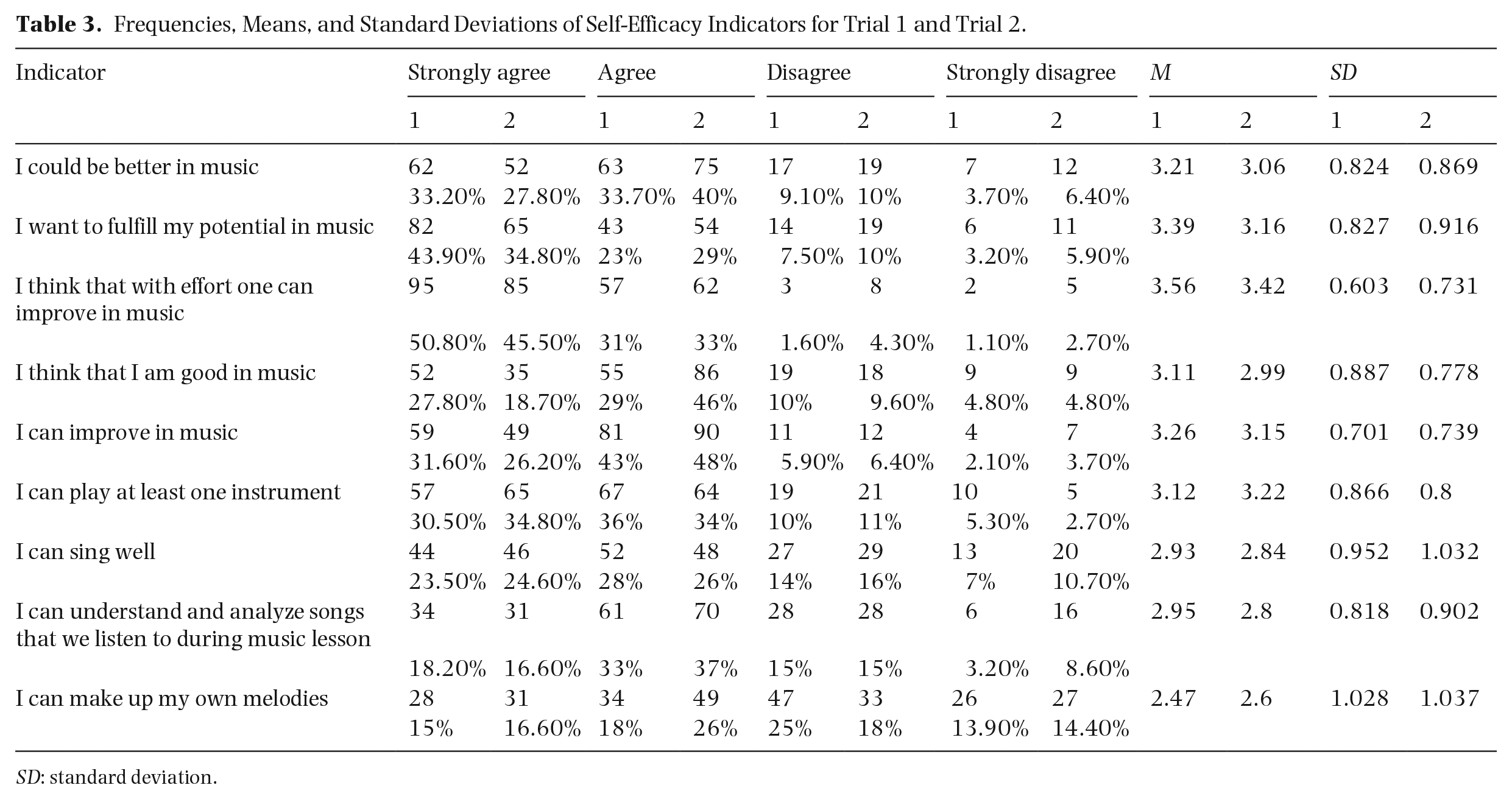
Table 3 shows the frequencies, means, and standard deviations for each indicator of Self-Efficacy.
Frequencies, Means, and Standard Deviations of Self-Efficacy Indicators for Trial 1 and Trial 2.
SD: standard deviation.
All other indicators showed a decrease at Trial 2 except two indicators, one indicating student Self-Efficacy for playing instruments and the other indicating student Self-Efficacy for making up melodies increased. At Trial 2, more students said that they agreed and strongly agreed with the statement “I can play at least one instrument” (38.8%) whereas at Trial 1, fewer students agreed or strongly disagreed (36.5%). Similarly, at Trial 2, more students agreed and strongly agreed with the statement “I can make up my own melodies” (42.6%) whereas at Trial 1, fewer students agreed or strongly disagreed (33%).
Enjoyment
Table 4 shows the frequencies, means, and standard deviations for each indicator of Enjoyment.
Frequencies, Means, and Standard Deviations for each indicator of Enjoyment.

SD: standard deviation.
Only two of the indicators increased at Trial 2. These were “I like playing instruments during the music lesson” and “I like composing during the music lesson.” At Trial 2, more students said that they agreed or strongly agreed with the statement “I like playing instruments during the music lesson” (75.9%) whereas at Trial 1 fewer students agreed or strongly disagreed (69.5%). Similarly, at Trial 2, more students agreed or strongly agreed with the statement “I like composing during the music lesson” (56.1%) whereas at Trial 1, fewer students agreed or strongly disagreed (45%).
Flow
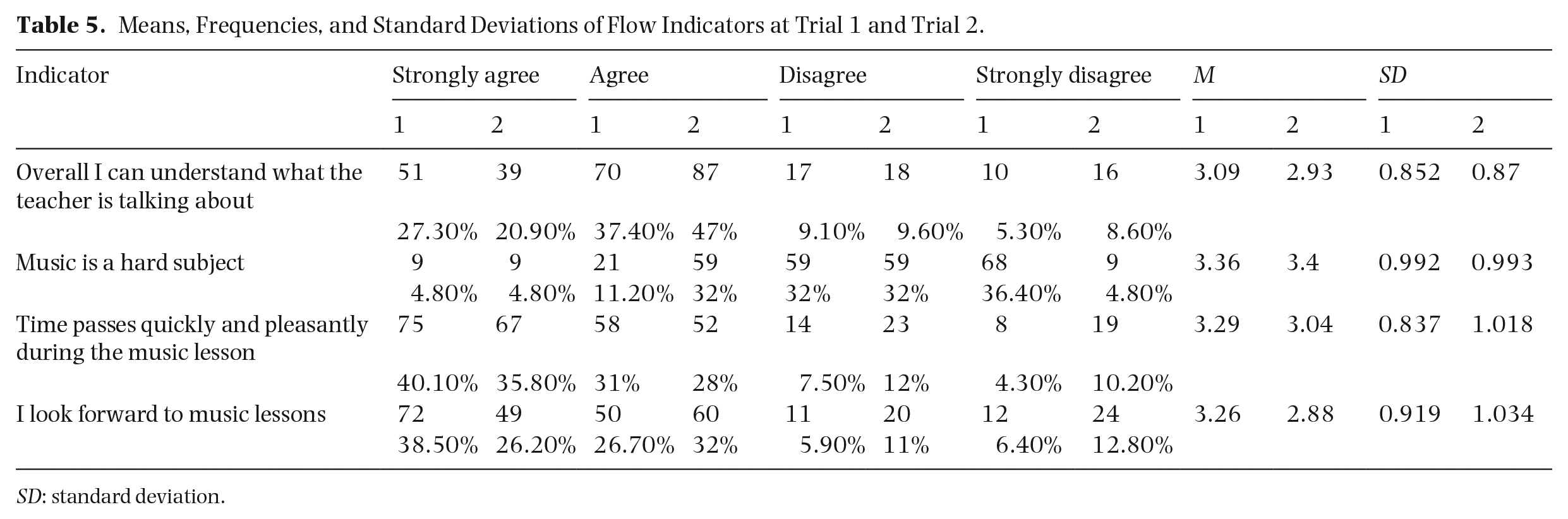
Table 5 shows the means, frequencies, and standard deviations for each indicator of Flow.
Means, Frequencies, and Standard Deviations of Flow Indicators at Trial 1 and Trial 2.
SD: standard deviation.
Only one indicator increased at Trial 2: “Music is a hard subject.” As this indicator was reversed because it had a negative loading, the results indicated that all Flow indicators decreased.
Musical Goals
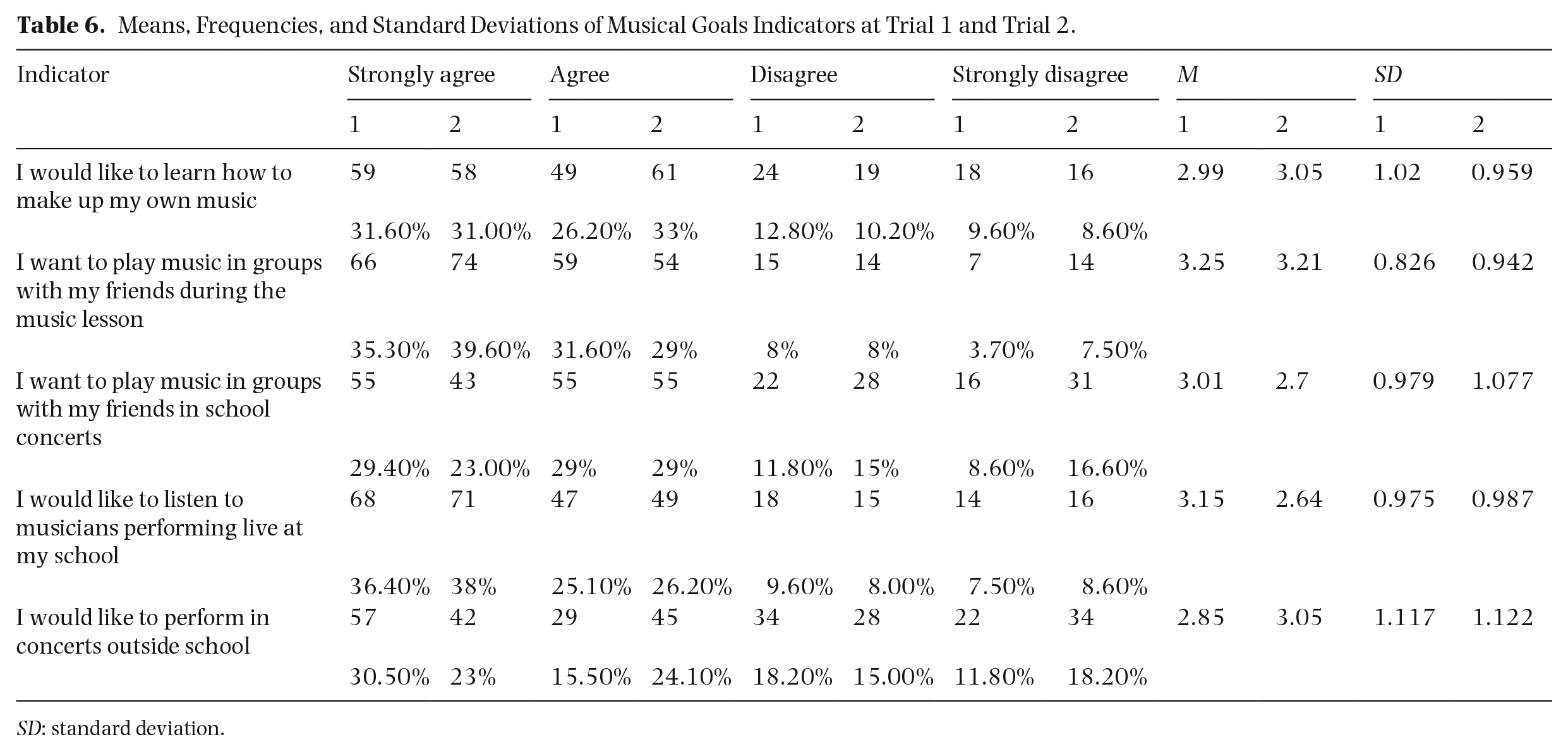
Table 6 shows the means, frequencies, and standard deviations for each indicator of Musical Goals.
Means, Frequencies, and Standard Deviations of Musical Goals Indicators at Trial 1 and Trial 2.
SD: standard deviation.
Only two indicators increased at Trial 2: “I would like to learn how to make up my own music” and “I would like to perform in concerts outside school.” At Trial 2, more students said that they agreed with the statement “I would like to learn how to make up my own music” (64%) whereas at Trial 1, fewer students agreed or strongly disagreed (57.8%). Similarly, at Trial 2, more students agreed and strongly agreed with the statement “I would like to perform in concerts outside school” (47.1%) whereas at Trial 1, fewer students agreed and strongly disagreed (35.5%).
Change over time
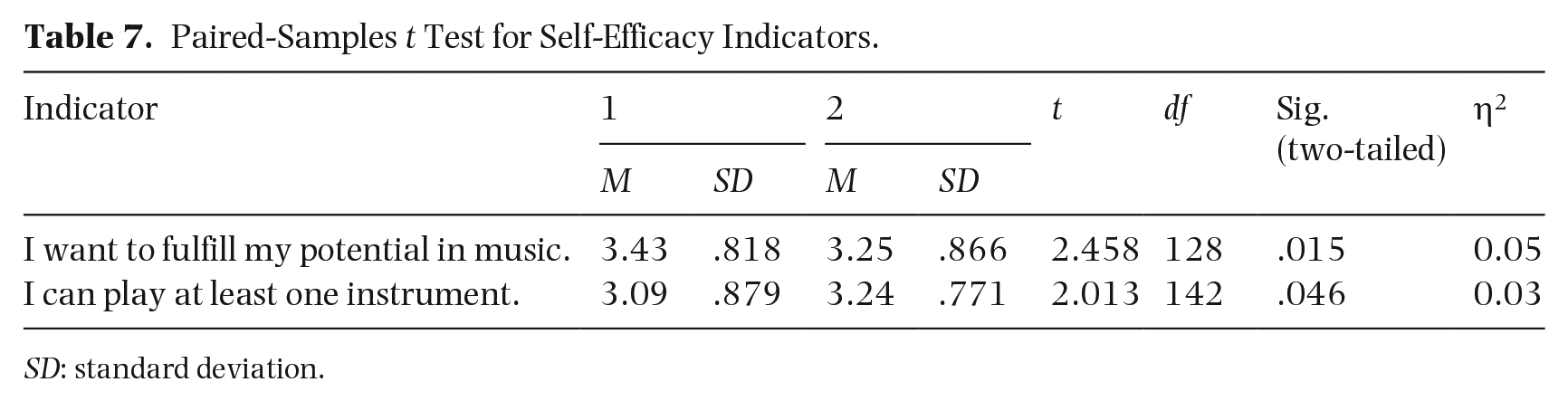
To test for change over time, a paired-sample t test was conducted. Out of the 26 indicators (Likert-type scale statements) of motivation which were included in both Trial 1 and Trial 2, there was a statistically significant difference over time for eight indicators of motivation subscales. Only the indicators that were found to have a statistically significant difference are presented here. A statistically significant difference was found in the mean scores for Trial 1 and Trial 2 for two indicators of Self-Efficacy: “I want to fulfill my potential in music” and “I can play at least one instrument” (Table 7). A small to moderate effect size (η2 = 0.05) was found for the indicator “I want to fulfill my potential in music” which decreased from Trial 1 (M = 3.43, SD = .818) to Trial 2 (M = 3.25, SD = .866), t(2.458), p = .15. The mean decrease was 0.18 at the 95% confidence interval ranging from 0.035 to 0.322. A small to moderate effect size was found for the indicator “I can play at least one instrument” which increased from Trial 1 (M = 3.09, SD = .879) to Trial 2 (M = 3.24, SD = .771), t(2.013), p = .46. The mean increase was 0.15 at the 95% confidence interval ranging from 0.003 to 0.305. In this case, the effect size measured by the η2 statistic was small, at 0.03.
Paired-Samples t Test for Self-Efficacy Indicators.
SD: standard deviation.
A paired-samples t test indicated statistically significant differences in the mean scores for Trial 1 and Trial 2 for two indicators of Enjoyment: “I like singing during the music lesson” and “I think that the subject of music is interesting the way it is taught” (Table 8). A small to moderate effect size (η2 = 0.05) was found for the indicator “I like singing during the music lesson” which decreased from Trial 1 (M = 3.17, SD = .986) to Trial 2 (M = 2.95, SD = 1.060), t(2.957), p = .04. The mean decrease was 0.22 at the 95% confidence interval ranging from 0.073 to 0.367. A small to moderate effect size was found for the indicator “I think that the subject of music is interesting the way it is taught” which decreased from Trial 1 (M = 3.14, SD = .787) to Trial 2 (M = 2.93, SD = .871), t(2.484), p = .14. The mean decrease was 0.21 at the 95% confidence interval ranging from 0.041 to 0.364. The effect size for change over time regarding this indicator, as measured by the η2 statistic was 0.04.
Paired-Samples t Test for Enjoyment Indicators.

SD: standard deviation.
A paired-samples t test indicated statistically significant differences in the mean scores for Trial 1 and Trial 2 for two indicators of Flow: “I look forward to music lessons” and “Time passes quickly and pleasantly in music” (Table 9). The highest effect size (0.10), considered to be moderate effect was found for the indicator “I look forward to music lessons,” decreasing from Trial 1 (M = 3.27, SD = .918) to Trial 2 (M = 2.91, SD = 1.018), t(3.893), p = .001. The mean decrease was 0.36 at the 95% confidence interval ranging from 0.179 to 0.547. A small to moderate effect size (η2 = 0.05) was found for the indicator “Time passes quickly and pleasantly in music” which decreased from Trial 1 (M = 3.35, SD = .791) to Trial 2 (M = 3.12, SD = .983), t(2.729), p = .007. The mean decrease was 0.21 at the 95% confidence intervals ranging from 0.064 to 0.399.
Paired-Samples t Test for Flow Indicators.

SD: standard deviation.
A paired-samples t test indicated statistically significant differences in the mean scores for Trial 1 and Trial 2 for two indicators of Musical Goals: “I want to play music in groups with my friends in school concerts” and “I would like to perform in concerts outside school” (Table 10). A small to moderate effect size (η2 = 0.05) was found for the indicator “I want to play music in groups with my friends in school concerts” which decreased from Trial 1 (M = 3.02, SD = .989) to Trial 2 (M = 2.76, SD = 1.054), t(2.714), p = .007. The mean decrease was 0.26 at the 95% confidence interval ranging from 0.069 to 0.285. A small to moderate effect size (η2 = 0.05) was found for the indicator “I would like to perform in concerts outside school” which decreased from Trial 1 (M = 2.88, SD = 1.111) to Trial 2 (M = 2.60, SD = 1.114), t(2.662), p = .09. The mean decrease was 0.28 at the 95% confidence interval ranging from 0.070 to 0.473. The significant decrease of the statement “I would like to perform in concerts outside school” was in contrast with the descriptive statistics result where an increase in Trial 2 was found. This is due to the missing values provided at Trial 1 and Trial 2.
Paired-Samples t Test for Musical Goals Indicators.

SD: standard deviation.
A paired-samples t test indicated statistically significant differences in the mean scores for Trial 1 and Trial 2 for Enjoyment and Flow (Table 11). A moderate effect size (η2 = 0.06) was found for Enjoyment which decreased from Trial 1 (M = 3.19, SD = .623) to Trial 2 (M = 3.04, SD = .734), t(2.23), p = .28. The standard deviation increased, which means that the variability in the scores increased. The mean decrease was 0.15 at the 95% confidence interval ranging from 0.016 to 0.280. A moderate effect size (η2 = 0.10) was found for Flow which decreased from Trial 1 (M = 3.33, SD = .632) to Trial 2 (M = 3.12, SD = .671), t(3.513), p = .001. The mean decrease was 0.21 at the 95% confidence interval ranging from 0.095 to 0.340.
Paired-Samples t Test for Subscales.

SD: standard deviation.
Discussion
The findings of this study revealed that the motivation of students for classroom music declined between the beginning and the end of their first year in secondary school, thus confirming previous research (Sloboda, 2001; Wigfield & Wagner, 2005). There was a decrease in all subscales scores at the end of the year and statistically significant changes were found for Enjoyment and Flow. Teachers need to draw attention to the importance of finding ways to improve students’ motivation through making their lessons more enjoyable and providing opportunities for flow. They must be aware of the various aspects that shape student motivation and learning (Cogdill, 2014).
The descriptive analysis of this study revealed that the indicators “I can play at least one instrument”, “I can make up my own melodies”, “I like playing instruments during the music lesson”, “I like composing during the music lesson”, “I would like to learn how to make up my own music”, and “I would like to perform in concerts outside school” increased at Trial 2. Interestingly, all these indicators are related to performance and composing. This may suggest that the teachers managed to offer enjoyable performing and composing activities while managing to increase during the year students’ self-efficacy and future musical goals related to performing and composing.
The indicator “I can play at least one instrument” increased significantly, suggesting that students had more opportunities to play instruments and they felt that their performance abilities increased. Previous research findings (Hallam et al., 2011) showed that students value practical work, and their self-esteem increases when they can perform to others. There are certain implications for teachers based on the previous observation; by placing practice at the center of their teaching, student motivation can be enhanced. Thus, this finding might also suggest that the teachers of the students involved in the current research did subscribe to the idea of learning through practical experience. The increase of the indicator “I can make up my own melodies” may suggest that students were provided with opportunities to compose their own music, which is related to the wider body of literature that has pinpointed the importance of autonomy in motivating students (Green, 2008; Hallam et al., 2011).
The significant decrease of the Self-Efficacy indicator “I want to fulfill my potential in music” suggests that students were not motivated toward fulfilling their musical potential and that teachers should try to help students increase their positive self-efficacy to experience success in specific tasks (Hallam, 2009). In addition, this may be related to students’ low value placed on music education at school.
The significant decrease of the indicators of Enjoyment, “I like singing during the music lesson” and “I think the way music is taught is interesting,” suggests that students’ task values in terms of interest were diminished. Earlier research has recommended developing students’ reflective thinking about musical values by asking questions like “why might this knowledge be important or useful?” (McPherson & O’Neill, 2010, p. 134). Through engaging students in reflective thinking and bolstering their belief in themselves and their musical values, student motivation could, arguably, be enhanced.
Interestingly, none of the Flow indicators increased. A significant decrease was found for the indicators “I look forward to music lessons” and “Time passes quickly and pleasantly in music.” In addition, the indicator “I look forward to music lessons” had the highest effect size (0.10), thus revealing strong implications for music teachers who need to try to find ways to make music more appealing to students. This may suggest that students were not given the opportunity to work on tasks that were matched with their level. This finding agrees with previous research in music education showing that students had a low state of flow (Wrigley & Emmerson, 2013). As the authors proposed, through fostering students’ flow experiences, their self-efficacy and enjoyment can increase. Teachers need to provide tasks that are appropriate to students’ skills and help students experience flow by finding ways to develop their confidence and provide opportunities to control their own learning (Shernoff et al., 2003).
The significant decrease of the two indicators of Musical Goals, “I want to play music in groups with my friends in school concerts” and “I would like to perform in concerts outside school,” may suggest that students have low competence beliefs and thus do not feel encouraged to participate in concerts in and out of school. It might be related to previous findings suggesting that some students perceive that only those with high-level instrumental skills would succeed (Lamont et al., 2003). This finding may suggest that teachers’ classroom goal structures were not based on learning goals where effort rather than performance is encouraged. As students’ perceptions of classroom goals can predict their goals (Anderman & Anderman, 1999), teachers need to make sure that classroom tasks endorse greater perceived competence that can help increase intrinsic motivation (Ryan & Deci, 2000). For example, teachers can try to motivate students toward participating in concerts in and out of school by creating goals that students can align with and feel competent that they can achieve.
The findings of this research align with previous research in Cyprus, reporting the negative attitudes of students toward music (Economidou, 2006; Teklos, 2011). There is a need for further research on the motivation of students in both primary and secondary schools in Cyprus. This research has made an effort to investigate the motivation of students right at the beginning of the introduction of the new music curriculum. Future research examining issues of motivation a few years after the introduction of the curriculum is needed to see how the motivation of students has been influenced by the implementation of the new curriculum and whether the problematic issue of lack of motivation and engagement of students in the subject of music has finally been addressed. In addition, as Flow had the highest effect size (0.10), future research could concentrate on this factor and further investigate how pedagogy influences students’ state of flow in music.
These results agree with previous research indicating that music teachers might not be informed of the complex framework that shapes student motivation (Cogdill, 2014) and strongly suggest that music teachers should be provided with professional support which engages them in developing students’ motivational beliefs. Teachers need to be educated on the various aspects that may help them to increase student motivation.
Footnotes
Appendix 1
Subscales of the Motivation Measure.

| Subscale | Indicator |
|---|---|
| Self-Efficacy | I think that with effort you can improve in music. I could be better in music. I want to fulfill my potential in music. I think that I am good in music. I can improve in music. I can play at least one instrument. I can sing well. I can understand and analyze songs that we listen to during the music lesson. I can make up my own melodies. |
| Enjoyment | I think the way music is taught makes music more interesting. I enjoy music lessons. I would like to do more music at school. I like learning music at school. I like singing during the music lesson. I like playing instruments during the music lesson. I like composing during the music lesson. I like listening and analyzing songs during the music lesson. |
| Flow | Overall I can understand what the teacher is talking about. Music is a hard subject. a Time passes quickly and pleasantly during the music lesson. I look forward to music lessons. |
| Musical Goals | I would like to learn how to make up my own music. I want to play music in groups with my friends during the music lesson. I want to play music in groups with my friends during school concerts. I would like to listen to musicians performing live at my school. I would like to perform in concerts outside school. |
This indicator was reversed when calculating the score for the subscale.
Acknowledgements
The author would like to thank Dr. Andrea Creech for the help and guidance throughout this research.
Declaration of conflicting interests
The author(s) declared no potential conflicts of interest with respect to the research, authorship, and/or publication of this article.
Funding
The author(s) received no financial support for the research, authorship, and/or publication of this article.
