



Abstract
Social media are prominent channels to foster the social debate about climate change. This research explores the strategies that institutions supporting scientific consensus on climate change undertake in order to communicate through social media. We conducted 21 semi-structured interviews with community managers and communication directors of organizations of different characteristics in several countries. From the responses we have identified strategies that are based on communicators’ perceptions and experience. We identified strategies that: (a) orientate the communication objectives, (b) help to approach citizens in an effective way, and (c) create interaction with the users. This provides a repertoire of well-grounded strategies that can work as a guide that may help organizations to design their actions to communicate climate change through social media. We conclude that including higher levels of interaction in social media strategies remains a challenge that could lead to a more effective social debate on climate change.
Introduction
There is a wide scientific consensus that large-scale shifts are needed for mitigation and adaptation to climate change, and thus avoiding its most severe consequences. According to the Paris Agreement (signed in 2016), the rise in global average temperature should be kept below 2 °C from pre-industrial levels. This requires a substantial reduction of greenhouse gases emissions, to increase the ability of the world to adapt to the impacts of climate change and make “finance flows consistent with a pathway towards low greenhouse gas emissions and climate-resilient development” (United Nations, 2015). However, climate change is still far from being among the main concerns for many citizens, as many still do not engage in discussion about the topic (Geiger et al., 2017).
In this context, social media are relevant tools to engage citizens in the discussion about climate change, since they can encourage knowledge, mobilization, and discussion about the phenomenon (Anderson, 2017). Research indicates that social media are useful channels to spread knowledge about climate change and thus develop knowledge communities around this topic (Segerberg and Bennett, 2011). Besides, social media can help in disseminating risk-based messages (Dalrymple et al., 2016), as well as in encouraging different forms of action on the issue of climate change (Anderson, 2017).
Communicating climate change is challenging, due to several reasons like its inherent abstractness, complexity, and slow-moving nature (Boykoff, 2011), as well as the fact that it is not perceived as an immediate problem (Weber, 2016). Previous research suggests that a number of strategies are frequently used to overcome these challenges (Thompson and Schweizer, 2008). Although such strategies can be applied to communicate climate change on social media, we argue that the specific characteristics of social media require using specific strategies, in order to get the most out of them.
In particular, social media use is significantly driven by a social need that implies social influence and interaction, transforming passive individuals into active producers who share opinions, knowledge, and content, and maintain relationships with other individuals with similar interests (Zolkepli and Kamarulzaman, 2015). This suggests that strategies specifically designed for social media may help to develop communication actions that leverage the social need for expression, recognition, and to interact.
However, research on strategies to communicate climate change on social media is still scarce and mainly based on theoretical thinking or case studies, frequently derived from other areas of knowledge, like marketing.
The aim of this research is to explore and formulate typologies for strategies currently used to communicate climate change on social media, by a varied set of stakeholders, in different cultural and geographical contexts. This variety of geographical locations and organization types tries to ensure that a wide range of strategies are included in these typologies.
We argue that this exploration and these typologies can provide well-grounded ideas that may help organizations to develop their communication actions through social media, with strategies that are based on what others are currently doing. Although these strategies can be related to more general communication strategies, the typologies we formulate provide a set of options that take into account the social needs that social media attempt to address.
Literature review
Climate change on social media
Social media is defined as “a group of internet-based applications that build on the ideological and technical foundations of Web 2.0, and that allow the creation and exchange of user generated content” (Kaplan and Haenlein, 2010: 61). Social media have become relevant means of communication about climate change as, in this context, people come into contact with news, debates, action, and social input related to this issue (Segerberg, 2017). The decentralized and participatory nature of social media offer novel possibilities to promote climate change engagement and peer attitudes can influence individual perception about this phenomenon (Kahan et al., 2012).
Many stakeholder groups participate in the social media debate on climate change, including businesses; governments and international organizations; scientists and scientific institutions; organizations, groups, and individuals in civil society; public intellectuals, and political, religious, and entertainment leaders. The purpose of these communication efforts include engaging citizens, changing citizen behavior and other goals such as explaining scientific results (or sow doubts about them) and urging policy solutions (or slow decision-making down) (Segerberg, 2017).
Social media have modified the way many citizens, especially young people, receive information about climate change (Painter et al., 2018). Research shows that content about climate change on social media is characterized by the use of mainstream information sources and the discussion of “settled science” (Pearce et al., 2019), although there is a significant difference between what the news media publish and what people share on social media (Olteanu et al., 2015).
Social media can bring climate change psychologically closer to citizens, since information exchanged across the various platforms can help to personalize and concretize a topic that, in principle, is perceived as abstract and remote (Anderson, 2017). Furthermore, the social media environment facilitates the creation of knowledge communities sharing specific perspectives on specific topics. Technical features such as hashtags encourage the development of spaces for communities (Anderson, 2017). Such capability is used for focused campaigns related to local crises, as well as addressing climate change in specific socio-cultural contexts (e.g. indigenous rights) and developing different ways of living (Segerberg, 2017).
Besides receiving and exchanging information, climate change agents use social media for other purposes, like discussing related issues, criticizing policies, and interacting with other people (Edson et al., 2017). In addition, social media are used as tools to promote and organize logistics of offline activities, like climate events and engagement actions (Segerberg and Bennett, 2011).
Several studies have explored the relationship between social media and climate change awareness. Research shows that a wide array of attitudes towards climate change circulates on social media, ranging from activism to denialism. We know that, on Twitter, activists’ messages predominate over deniers’, which suggests that Twitter is a valuable channel to increase climate change awareness (Cody et al., 2015). However, promoting awareness through social media is a complex task, since most users only interact in “echo chambers” or communities dominated by their own view (Williams et al., 2015).
Besides “echo chambers,” the climate change debate on social media is often characterized by homophily and polarization and this provides a fertile ground for misinformation to spread. This includes information that is false, inaccurate, or misleading and includes several forms of skepticism, contrarianism, and denial (Treen et al., 2020). Dealing with misinformation can be a challenge for organizations whose communication on social media is based on scientific consensus.
Other studies point out that the use of social media is related to raising public awareness about climate change (Mavrodieva et al., 2019), and taking action on this phenomenon (Vraga et al., 2015, Anderson, 2017). We also know that social media encourage environmentally friendly behaviors for climate change mitigation and promoting activism (Anderson, 2017). Consequently, social media are used for different purposes and can be useful in promoting citizen engagement and action related to climate change. However, the effective use of this potential capacity may depend, among other factors, on taking into account the social need that is implied for the design of communication strategies.
Strategies
Although strategy has become a catchall term, it is often understood as “a plan, some sort of consciously intended course of action, a guideline (or set of guidelines) to deal with a situation” (Mintzberg, 1987). Strategies can refer to general guidelines that work as orientations for the communication process (communication strategies), as well as more specific guidelines to create effective messages (message strategies). This article focuses on communication strategies.
In the area of climate change communication, the term strategy has been applied to a varied conjoint of guidelines of different nature and several catalogues of strategies have been proposed. Thompson and Schweizer (2008) compiled a list of ten strategies that are frequently used in environmental communication. They underline the importance of knowing the audience as the starting point to design communication strategies, connect messages that are salient with cultural values and beliefs, before finally recommending specific actions they can take.
A few years later, based on literature review, Shukla (2017: 273–276), compiled a catalogue of strategies that are more closely related to climate change communication, which also includes attending cultural values, appealing to the co-benefits of addressing climate change, and considering geographical location of the target population.
In a similar vein, Markowitz and Guckian (2018: 42–50) proposed seven “insights to improve climate change communication.” Besides stressing the importance of knowing what motivates the audience and highlighting solutions, they propose to find frames that fit people's needs.
Boykoff (2019) also recalls the importance of designing strategies that start from a good knowledge of the audience, since citizens have “different ways of knowing about climate change as well as different perspectives on how to communicate effectively about it” (Boykoff, 2019, p. 5).
From a wider perspective, this varied range of strategies that can be used indicates that there are several ways of understanding the process of science communication, as theorists have explained. Some of the strategies are based on the idea of transmitting knowledge to the audience (deficit model), while others underline the need of establishing a dialogue with the society (dialogic model) or fostering citizen participation (participative model). As experts suggest, efficient science communication (including that of climate science) must be based on a combination of the three models: it can start with knowledge transmission and continue with dialogue and participation, so that citizens are not only passive receivers but become active agents and therefore can obtain a wider cultural benefit from science (Bucchi, 2008).
In general, these catalogues, as well as others that have been formulated, underline several ideas that can be applied to the specific case of climate change. However, in general, they are not formulated from the knowledge of communication praxis in this area but from general principles of good communication.
Interaction
The interactive nature of communication has been increasingly acknowledged by theorists and this has resulted in a growing body of research that reflects on the interaction as a key force to understand communicative processes. From this perspective, communication is a process where the source, the medium, and the target receive multiple influences related to culture, attitudes, and beliefs (Kiousis, 2002).
The concept of interactivity has been applied to many different types of communication, from face-to-face exchanges to computer-mediated communication (Downes and McMillan, 2000). Although a detailed explanation of the concept is beyond the scope of this article, for the purpose of our research, we present the definition formulated by Jensen (1998: 188), who defined interactivity as “the relationship between two or more people who, in a given situation, mutually adapt their behavior and actions to each other.”
Interactivity is regarded as a key component of social media use that has been researched from different perspectives. Interaction in communication can be achieved through several means, ranging from collaborative text production through sharing media content to conversational dialogue in real-time or simulating F2F communication in a virtual world involving multiple sensory perceptions (Kaplan and Haenlein, 2010). Drawing from uses and gratifications theory, Whiting and Williams (2013) underline the importance of interactivity on social media, as a way of meeting people “with my interests,” keeping up with “what’s going on” and searching for “companionship” (p. 363).
Uses and gratifications theory emphasizes the way audiences actively use media in socializing activity as well as for gathering information. Drawing on the contributions of social presence (Kaplan and Haenlein, 2010; Short et al., 1976) and media richness theories (Kaplan and Haenlein, 2010; Daft and Lengel, 1986) which discuss the time-dimension (immediacy vs asynchronous), symmetrical versus asymmetrical, intimacy (personal vs mediated), multi-sensory properties of social interaction. Qiao (2019) devises three categories that are useful for categorizing levels of interactivity: medium-based, conversation-based, and process-based interactivity.
Medium-based interactivity is categorized as low level and characterized through the structural interactive features of the social media platform such as sharing hyperlinks, photos, images, videos, retweeting, emojis, and so on. From an organizational viewpoint, the primary objective of medium-based interaction is to mutually distribute salient information with and among key audiences.
Conversation-based interactivity is categorized as medium level and characterized by brief dialogue between the organization and audiences that allow for communication roles to be interchangeable, therefore increasing degrees of interaction (Qiao, 2019; Sundar et al., 2003). The back and forth flow of exchanges between participants, allowing for reflection on current and previous discussion points closely simulates F2F conversation in real time (symmetrical and synchronous).
The highest level, process-based interactivity, makes additional use of computer-mediated technologies and in some ways extends interactive opportunity beyond F2F limitations. Process-based interactivity is characterized by the dialogue features of conversation-based plus sharing salient information (hyperlinks, infographics, etc.) that reinforce the arguments made by the participants. Quiao found process-based interactions assisted credibility claims and relationship building between organizations and their key audiences as argument premises were supported with supporting evidence through hyperlinks to credible sources and other online resources.
According to Ballantyne (2016), in the area of climate change communication, there is a need for a shared platform that looks at communication as a process of production and reproduction of common understandings that allows to generate a multi-perspective argumentation on the role of climate change communication in society. However, there is still a “tendency to conceptualize lay audiences as mere receivers of climate information from political or scientific expert sources” (Ballantyne, 2016: 339).
Research on climate change communication on social media indicates that interaction is mediated by many factors (Arlt et al., 2011). We also know that political polarization plays a key role (Gruzd and Roy, 2014) and users are often segregated in “echo-chambers” (Williams et al., 2015).
Similar to the more general findings of Quiao (2019), Kaplan and Haenlein (2010), and Sundar et al. (2003), science communication researchers emphasize the need to create a social dialogue with their key audiences. In particular, social dialogue about climate change that facilitates people's engagement in mitigation efforts (Barnosky, et al., 2016), taking into account the various personal values and world views (Corner, et al., 2015). This should help to improve the current situation in which there is not much debate between national policy makers and environmental groups, which may help to reduce psychological distance and affect people's engagement with climate change (Horta et al., 2017).
Interaction about climate change is also affected by the general phenomenon of disinformation, with special relevance on social media. Influential misinformation campaigns about climate change have spread fabricated controversies and false information that has provoked a harmful type of interaction (Boykoff, 2011).
Research aim and methodology
The main objective of this project is to explore the strategies that institutions and groups supporting scientific consensus on climate change undertake in order to communicate climate change through social media. More specifically, we aim to explore and formulate typologies of strategies related to:
Objective objectives. Organizations usually follow one or more general strategies related to the objectives they pursue. These strategies work as general orientations to design the communication processes, and help to optimize resources and processes. Approach strategies. Organizations try to approach the group of people they want to reach in a way that allows establishing a solid communication channel, by taking into account the interests of this group. Interaction strategies. Given the interactive nature of social media, organizations can follow strategies that help to situate interaction as a key component of the communication processes.
In order to meet the aims of this study, we conducted semi-structured interviews (N = 21), from June to October 2020. Before conducting the interviews, we designed a detailed protocol that was approved by the Ethics Committee of the University of Otago.
We aimed at conducting semi-structured interviews with appropriate community managers and communication directors of relevant institutions devoted to climate action and actively utilizing social media. No predetermined sample size for the interviews was set. Rather, data collection continued until data saturation occurred (i.e. no new information comes from the interviews).
Relevant institutions were identified through the social media and literature review process. We created a preliminary list of institutions that met the following criteria: (a) their main topic of social media posting is climate change or environmental issues, in general; (b) support scientific consensus on climate change, and (c) have a minimum of 1000 followers on Twitter.
Individual representatives from the institutions were identified through contact with the appropriate head offices or representatives. As such, a convenience sample, determined with the aid of a snowball sampling method, was obtained.
Efforts were made to ensure that the interviewees represented a diverse array of approaches to climate change communication and action, including diversity of geographic locations and organization types. This will allow for analysis of the potential diversity of strategies. Emergent themes from each interview were provided to interviewees for verification and clarification (whenever possible) prior to in-depth analysis. Some of the proposals to conduct interviews were not accepted, alleging different reasons, ranging from lack of time to not willing to share confidential information. Finally the authors conducted 21 interviews. As Table 1 shows, the profiles of the interviewees include a variety of geographic locations and organization types (see profiles in Supplemental Appendix 1).
Geographic location and organization type of the participants.
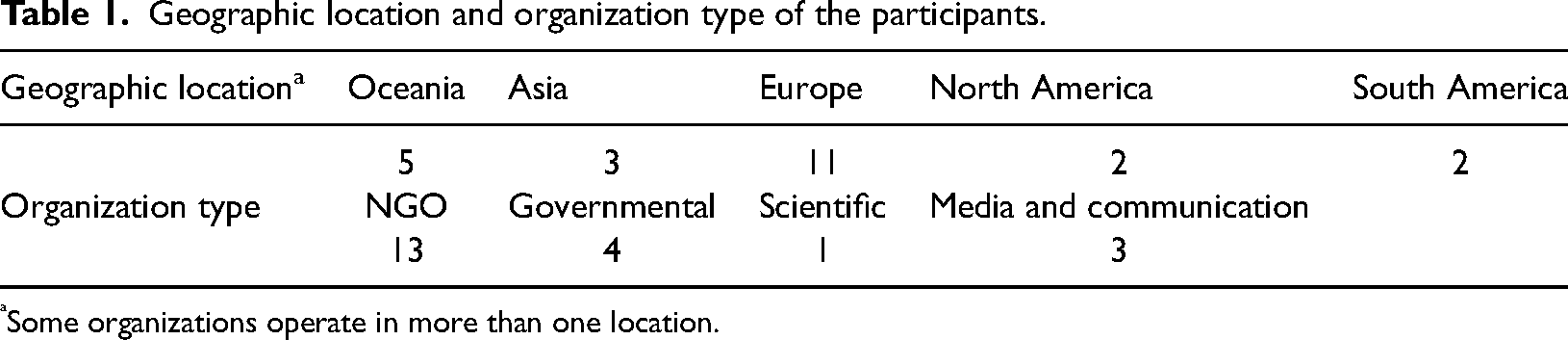
Some organizations operate in more than one location.
Before conducting each interview, interviewees were given an information sheet with relevant information regarding the research aim, method, and information management. Participants signed a consent form or expressed a verbal agreement in the recording, where they also indicated whether they allowed for their name and affiliation to be used in the publications or reports stemming from this research, or they chose to remain anonymous. We focused on the communication strategies that these institutions use on social media. More specifically, we explored the following areas of questioning: (a) objectives of social media communication; (b) intended strategies; (c) level of perceived effectiveness; (d) use of each social network; (e) use of texts, images, and videos; (f) effectiveness of each type of content; (g) engagement strategies; (h) framing strategies; (i) interaction strategies.
The interviews were audio-recorded and transcribed. Relevant content for the research was selected, classified, and analyzed, using an inductive coding approach, and interpreted in the context of the literature review. The data collected were securely stored in such a way that only the researchers associated with this project will be able to gain access to it. The bulk of the data obtained as a result of the research will be retained for at least 5 years in secure storage but any personal information held on the participants (such as contact details, audio or video tapes, etc.) will be destroyed at the completion of the research.
Results and discussion
Objective strategies
Our study allowed identifying a varied conjoint of strategies related to the objectives that are pursued by environmental organizations through social media, which can be classified into four main categories:
Developing a community; Promoting environmental education and awareness; Science popularization; Briefing opinion leaders and decision makers.
Firstly, social media provide affordable efficient channels to reinforce communication within the group. Social media can help to develop a community since they make it “easy to connect with people and help to create a feeling of group or community,” which allows the group to expand (Interviewee #1).
Developing a community requires spreading self-information, including that on the activities that the group is conducting. Some social media posts are specifically aimed to attract views to the organization website. One of the organizations that pursue this goal is APIA, the Spanish Association of Environmental Journalists. In the words of its community manager, “We try to promote environmental journalism, in general, and the work of our members, in particular. A big part of my job is to help to spread and make the work of all those environmental journalists visible, and bring out the shine of environmental journalism” (Interviewee #13).
Secondly, environmental education is a goal that can be promoted on different levels. The first one is spreading environmental information to the general public, which can serve as a basis for the other levels. Social media provide a channel to inform not only people who are environmentally aware but also people who are not. This is actually the main objective of social media use for a public institution in Spain: “we try to inform environmentally aware people and also to engage new people” (Interviewee #13).
Informing people through social media allows transmitting the message without the intermediation of traditional media, which is seen as an advantage by some of our interviewees: “No middleman, no one changing up my message. And it gives me immediate feedback” (Interviewee #11).
A second level is that of education and raising environmental awareness. This effort can have several focuses. For example, an Asian public agency aligns its social media efforts with its overall objective and tries to promote action, by building climate resilience and disaster risk reduction (Interviewee #10). In a different vein, the organizers of COP25 summit in Chile, social media were helpful “to raise awareness and engage people, by promoting a debate among citizens. We try to spread the idea that we can all contribute” (Interviewee #2).
Science popularization is the third objective that we identified in our interviews. Since science is a key component of the messages associated with climate change, it is no surprise that science popularization is a relevant objective for some organizations. For example, the Climate Change Council (Australia) uses social media to “provide a kind of basic climate science content (…) to people who are just starting to think about it, starting to think about how it works, why it's happening” (Interviewee #5).
Finally, for some organizations, the main objective of social media posting is to influence opinion leaders and decision makers, for example, politicians, journalists, business representatives, and international organization workers. The social media manager of a European environmental organizations explains it like this: “One of our big aims or core objectives, so to speak, is to reach decision makers (…) to make them aware of recent developments, recent narratives that support progressive climate action” (Interviewee #20).
Approach strategies
Among the semi-structured interviews, discussions, and insights, we found several strategies that aim at finding effective ways to approach the citizens. They fell into five themes:
Finding common ground; Emphasizing here and now; Focusing on the benefits of engagement; Creatively empowering people.
These themes are consistent with strategies for environmental or climate change communication formulated by previous researchers. The strategies derived from our interviewees’ responses allow to reach a more specific practical level of strategies, related to general principles like adapting to different audiences (Boykoff, 2019), connecting with audience's cultural values (Shukla, 2017; Thompson and Schweizer, 2008), finding frames that fit audience needs (Markowitz and Guckian, 2018), and emphasizing the benefits of engagement (Shukla, 2017).
First, many interviewees pointed to the importance of finding common ground. For example, interviewee #1 noted, “We think the climate crisis is something that affects us all” and consequently “[we] talk about all the people, as if we were one entity, because we want to think we are all one person.” To meet people effectively on this common ground, interviewee #18 explained, “People might be seeing the news, but they might be asking themselves, “What the hell are they talking about?.” So I’m trying to capitalize on those hot button issues: interesting, curious and crisis kind of moments.
Second, many climate change communicators articulated the importance of emphasizing that climate change affects people “here” in our local everyday spaces, and “now” at the present time. For instance, interviewee #4 commented, “we’ve seen some really big impacts through really helping people localize climate change and climate change advocacy on their level.” As an example of this work, interviewee #16 observed, “here in Argentina we also have a lot of activities that hurt the environment: wildfires and disasters. So we try to show people what's going on here in Argentina. This is the main pillar.”
Third, several interviewees emphasized the value of focusing on the benefits of climate change engagement through actions to mitigate its effects. For example, interviewee #3 noted, “We try to make people understand that it's good to accelerate climatic action” while interviewee #2 discussed the importance of climate-related communications focused on “healthy habits to address climate change.” Similarly, interviewee #12 remarked that their organizations’ general strategies were “very solutions focused, looking at how businesses, decision makers can actually benefit, maybe economically or more broadly.” Finally, interviewee #9 effectively summed this up by noting that “what we try to highlight is that climate change mitigation has a lot of cool benefits in terms of sustainable development.”
Fourth, many social media communicators interviewed here noted that creatively empowering their audiences—and people more generally—had benefits for greater climate change engagement. For example, interviewee #14 discussed the making connections between biodiversity crises and climate crises, for instance, help prompt people to take action. Similarly, interviewee #19 noted, “you have to focus it on people who are responsive to your message and will likely take action based on your message.” Some advocated engaging with the creative talents of their audiences. For instance, interviewee #4 pointed out the importance of using “videos with musicians or artists and poets”—to increase the audience's abilities to see connections between climate change and other associated challenges.
Together, these four themes cohered meaningfully with our four main categories of objectives elaborated at the beginning of the section “Results and discussion”.
Interaction strategies
Barriers to interaction
Several interviewees cite different digital strategy goals, resource scarcity, and the message specificity as reasons for not placing interaction as a high priority in their digital communication strategies.
For some managers, their strategy is to use social media as an efficient channel for distributing information to key audiences instead of a two-way (symmetrical) medium for dialogue. For example, the director of the Spanish environmental news agency EFE Verde stated his organization's aim is “information generated by our journalists makes it to the citizens” (Interviewee #13). A similar gate-keeping function is expressed by the Digital Senior Officer for Climateworks Australia when queried about their focus on interaction as part of their digital strategy, describing social media as more of a “filter rather than a platform for engagement” (Interviewee #12). Instead, communicative activities such as webinars and group meetings are used as the primary fora for interacting with key audiences. The Climateworks officer also described social media as an “entry gate” alerting people to topics, which are explained in more depth for those interested in following the links provided by the organization. Other participants describe a similar audience gatekeeping approach to interactivity but differentiated between open and closed member groups on their social media platforms. For example, a communications manager in an autonomous Asian regional organization referred to open and closed Facebook groups, in which more interaction and open discussion takes place in the private group space of the closed forum, suggesting “people feel more comfortable talking to each other in a closed group” (Interviewee #10).
Her comment suggests a greater propensity for key audiences to interact at conversation-based and possibly process-based levels of interaction among members in the closed Facebook forum, which she later adds is moderated by the organization but not actively used to present its views and content.
The use of Facebook as an interactive channel for participants is also recognized by a senior UN communications manager, who describes it as a “social connection platform where you want to have content that people feel comfortable with their community” (Interviewee #11). Again, direct social dialogue between the organization and its audiences is not a high priority.
Others recognize the value of interaction but cite the lack of resources and time as reasons for not pursuing more two-way engagement with key audiences. For example, a manager at Climate Action Network International (Interviewee #6) cited “lack of capacity” as a reason for limited interactive activity, although she noted some polling and retweeting efforts, signifying low level medium-based interactivity.
Significantly, the participant (Interviewee #19) identifies interaction with basic social media metrics of click-rates and sharing, representing feedback and message salience dissemination rather than two-way dialogue engagement.
Levels of interaction: from pulpit to the Holy Grail
Other interviewees draw distinction between levels of interaction: “Some accounts are like a pulpit. But we try to be open to dialog. And, in time, I think this works. People know what organizations just sell their product but really have nothing to say” (Interviewee #13). The participant contrasts an asymmetrical “pulpit” with his preferred two-way dialogue, which is perceived as more interactional with long-term benefits than “selling” an expected message. His comments clearly identify the benefits of conversational-based interactivity.
As discussed, most interactive activity occurs at the medium level, leaving the conversational and process level desirable but not actionable due to the barriers discussed above.
Medium-process level characteristics of interaction are indicated in participants’ references to the technical features of different social media platforms as a measure of interactivity and subsequent success. Chief among those cited is Twitter's retweet function, which allows collective resonance around a theme or relevant message, serving a social as well as informative function: “We retweet content that's on the positive side because it's like a silver lining. It's not always, you know, helpful things or positive things happening. So when they do happen, people are excited to share those. So it goes … Those resonate” (Interviewee #8).
A number of participants (Interviewees #21, 11, 9) cite Facebook as a key channel to elicit petition signatures or sign on to email actions, and also hyperlink and resend stories, again representing low level or medium based but effective interactive level engagement with key audiences. Similarly, emojis data is used as a measure of basic interaction effectiveness. Functioning as collective attitudinal memes, icons of likes and dislikes are easily aggregated to provide simple indications of medium-level interaction success.
As a communicative phenomenon, higher level interaction remains a desirable outcome for many but minimal in their social media programs as indicated by a senior UN manager expressing the hope to have the resources eventually to “have a proper community engagement manager.” Noting the challenging but important link between interactive engagement, trust and deep attitudinal shifts she states: “I think we’re doing a lot of push, push, push, push, and limited engagement, which is that Holy Grail because that's how you change people's beliefs” (Interviewee #11). The Holy Grail metaphor captures both the current state and promise of social media strategies for communicating climate change.
Of all the social media features discussed during the interviews, higher-level interaction at the conversational and process-based levels (Quiao, 2019) between the organization and key audiences remains the least explored and for many of our participants a low priority. Social media activity described by our participants refers to interaction that is medium based, primarily asymmetrical and asynchronous following an elaborated one-way information flow although feedback is often encouraged in the form of comments, emojis, and shared links. This indicates that some climate change organizations tend to conceptualize audiences as mere receivers of information (Ballantyne, 2016).
Messages are amplified through retweeting or re-sending information in other channels such as Facebook and Instagram, and attitudes toward topics are suggested through emojis, which collectively indicate low level medium-based interactivity (Quiao, 2019), but can be effective to achieve some objectives, like underpinning organization reputation.
Notwithstanding the limitations of medium-based interactivity for relationship-maintenance, its social capital value can still be leveraged. For example, one participant observed the snow-balling value of their Linked-In account as a hub leveraged around a network of voluntary staff-initiated Linked-In accounts in which organization content is shared supplemented with the Linked-In account owner's personal commentary. She described the result as creating micro-communities that potentially have far reaching effects into policy making. These micro-communities are built around the credibility and trust established from staff voluntarily sharing organization's messages, commenting: “Once you get your own staff sharing things willingly, not out of a sense of duress, you know that you’re reaching that audience again. Those thinkers and policy experts who want to change things” (Interviewee #11).
Her observation illustrates the social value of trust, reinforcing organizational reliability and legitimacy, which theorists observe is a key objective of interaction that extends beyond message distribution and transmitting information (Kelleher, 2009; Sundar et al., 2003). Significantly, the example illustrates the ability to build and leverage social trust, benefits of conversation, and process-based interactivity, even at relatively low levels of interaction.
Creative ways to interact with youthful audiences around climate change are used in Twitter and Instagram accounts for competitions and quizzes as described by a communications manager for a national public institution in Spain (Interviewee #3).
Others describe similar use of the interactive features of social media used with adult audiences, including creating humorous quizzes as well as requests to share personal experiences and videos (Interviewee #1). Another participant describes the value of planning into a campaign mutually produced content by both the organization and its public members, which can be shared through the network (Interviewee #4).
However, the examples listed once again describe low-level interaction rather than dialogic exchanges either in delayed or real time. The digital content producer at the Climate Council participant alludes to the importance of symmetrical exchanges: “I think it's really important that the conversation isn't one way, that it's a two way conversation, and people feel like they have that space to ask questions. So I see that part of our role is really important, people having somewhere to go if they’re worried or confused about climate change and they feel like they’ll be listened to” (Interviewee #5).
His response points to the intrinsic social value of interaction, which is relational, based on the ability to reflect and respond to previous episodes in a communication exchanges, and extends beyond information transmission, feedback or even simple responses to calls to action in activities such as surveys and competitions.
Dialogic interaction eschews simple transmission-based models favored by communication scholars since Warren Weaver used more accessible language to explain Shannon's mathematical model that represented telecommunication processes (Shannon and Weaver, 1949; Rogers, 1994: 424). Later, elements of feedback (Berlo, 1997) were added to represent two-way exchanges, understanding, and message modification. The model remains useful (Sapienza et al., 2016) but is incomplete and unable to capture all the complexities of communication (see Carey, 1989; Habermas, 1984). Furthermore, dialogic communication models emphasize communication is not the means to an end but the end in itself, placing an emphasis on relationship building through the engagement. The personal flow of messages back and forth between participants with a focus on both the rational and emotional interplay of message and meaning-making, multi-sensory perception, reflection and subsequent changed or reinforced opinions and convictions—conversation and argument. In addition, although transmission models incorporate socio-cultural-based values and beliefs identified from research when constructing messages, dialogic communication pays particular attention to the influence of socio-cultural factors in the actual engagement of meaning-making in real-time interaction, which is a far more challenging communication enterprise. At a conceptual level, dialogic communication views communication as an end in itself and not as a means to an end as reflected in the positions of Martin Buber (Kent and Taylor, 1998) and Habermas (1984), who also notes communication cannot be dominated by one party. In a similar vein, Kent and Taylor (1998: 324) describe dialogue as involving a “cooperative, communicative relationship”.
The higher level of interaction remains actual dialogue in real-time manifested as conversation based which can be leveraged to process-based levels when combined with sharing relevant hyperlinks and supporting evidence salient to the discussion. It is evident from participant responses, replicating its efficacy through social media remains a challenge.
A specific but very important kind of interaction for organizations and groups is interacting with climate change sceptics and dealing with mis(dis)information. It is evident most of the participants do not challenge hostile audiences directly. Some prefer to use indirect means such as directing them through links to credible news media sources and stories (Interviewee #3). Many participants simply ignore hostile posts and comments as summed up by two participants who described arguing with denialists is like “going back in time” and if you reply you help them go back to the “starting point” for a case that is already settled (Interviewees #15, 5). Another observed engaging in dialogue with denialists and providing space to share their erroneous material also gave wider dissemination to their messages as well as causing confusion among new group members (Interviewee #20). One strategy the organization uses to confront mis(dis)information involves preventing access to their social networks by “working with tech companies to increase the procedures or check and balance systems that tackle misinformation” (Interviewee #20).
Conclusion
This research has allowed identifying several strategies that are currently being used to communicate climate change on social media that are based on communicators’ perceptions and experience. This provides a repertoire of well-grounded strategies that can work as a guide that may help organizations to design their actions to communicate climate change through social media. However, communicators should take into account that some strategies may be suitable for some organizations and unsuitable for others. Therefore, this repertoire must be regarded as a first-approach guide that each organization must adapt to its specific objectives and context.
From the responses to the interviews we identified four strategies that point at the objective that the organizations pursue when they use social media. Three of the strategies are linked to an intended general benefit for citizens: promoting environmental education and awareness, popularizing science and briefing opinion leaders and decision makers. The fourth strategy pursues a benefit for the organization itself: developing a community.
We also identified four strategies that the organizations use to approach citizens through social media. This finding, which is consistent with previous research (Boykoff, 2011), provides a solid base that may help organizations to communicate climate change through social media in ways that may result in a more effective approach to the citizens and may thus help to overcome current difficulties to engage people in the climate change debate and action.
Our exploration indicates that the strategies that organizations are using to communicate climate change on social media are often based on science communication models that give priority to knowledge transmission informed by simple sender–receiver models of communication. However, considering the dialogue and participation models that focus on the relationship-building potential of communication as well as socio-cultural complexities could provide a wider perspective and more opportunities for citizen engagement. Closely related to dialogue models of communication is the depth or levels of interactivity between the organization and key audiences.
Many acknowledge the existence of barriers to interaction, imposed by resource scarcity or by specific characteristics of the messages. Despite the challenges, a number of strategies are used in order to promote interactivity on social media posting about climate change. This is a relevant element, since interactivity on social media is key to facilitating citizen engagement with climate change mitigation.
Along the continuum of interactive phenomena, most exchanges would not classify as dialogue, although this approach could be beneficial to effectively communicate on climate change in rather than through social media. Perhaps perceiving social media as virtual meeting spaces for engaging in dialogue about climate will help to establish stronger trust-based relationships rather than focusing primarily on deficit models based on transmission-based models of communication. In this way, dialogic models might allow for a more fruitful debate on climate change and facilitate people's engagement in mitigation efforts. This would require moving a step forward from the current position in which, in many cases, interaction is more a desired “Holy Grail” than an actual strategy that is pursued through specific actions.
Our research has analyzed the perceptions of social media interaction formulated by a group of communicators of climate change, who work for different types of organizations, in different geographical and cultural contexts, with different objectives and different communication strategies. Our scope is limited to organizations that communicate through social media in support of the scientific consensus on climate change. Future research may explore the strategies employed by those organizations that deny or do not support the scientific consensus on this issue. In addition, future research may also explore the effectiveness of such strategies in promoting climate change engagement among citizens.
Supplemental Material
sj-docx-1-mia-10.1177_1329878X211038004 - Supplemental material for Strategies for climate change communication through social media: Objectives, approach, and interaction
Supplemental material, sj-docx-1-mia-10.1177_1329878X211038004 for Strategies for climate change communication through social media: Objectives, approach, and interaction by Bienvenido León, Michael Bourk, Wiebke Finkler, Maxwell Boykoff and Lloyd S Davis in Media International Australia
Footnotes
Declaration of conflicting interests
The authors declared no potential conflicts of interest with respect to the research, authorship, and/or publication of this article.
Funding
The authors disclosed receipt of the following financial support for the research, authorship, and/or publication of this article: This work was supported by the Spanish Ministry of Science and Innovation under Grant RTI2018-098190-B-I00.

Supplemental material
Supplemental material for this article is available online.
References
Supplementary Material
Please find the following supplemental material available below.
For Open Access articles published under a Creative Commons License, all supplemental material carries the same license as the article it is associated with.
For non-Open Access articles published, all supplemental material carries a non-exclusive license, and permission requests for re-use of supplemental material or any part of supplemental material shall be sent directly to the copyright owner as specified in the copyright notice associated with the article.
