




Abstract
This article explores how research helps construct a certain type of ‘gender’ knowledge that arises from, informs and reinforces ‘instrumentalist’ gendered policy perspectives on development of the Global South. It uses a case study of research funded under the ESRC-DFID Joint Fund for Poverty Alleviation which awarded 122 grants amounting to £66.2 million (around US$88 million) between 2005 and 2015. From a systematic review of the awards a typology of gender inclusion and exclusion was constructed that found 60% of all awards mentioned gender or included some level of gender analysis. The subsequent synthesis of the evidence suggested that in only 30% of all awards was the gendered knowledge produced central to the study and/or focused on better understanding gender roles, relations and identities. Applying a Feminist Institutionalist lens, the study highlights how institutional ideas around gender are reflected in the funding call specifications, and in turn influence how researchers ‘engendered’ their research, and the type of gendered knowledge produced. It finds much of the new gendered knowledge produced out of the Joint Fund emerged from non-gender focused research often produced by non-gender specialists. It suggests that as gender becomes mainstreamed into research, and as more researchers ‘do gender’, so research may become, conversely, less ‘gendered’. The ‘new’ gender knowledge produced may then merely evidence existing institutional policy positions rather than advance the policy agenda.
Introduction
The importance of research in informing policy has been explicitly recognized within recent moves to evidence-based policy approaches, which are said to enable accountable decisions regarding which of a number of competing interventions should be funded (Cornish and Gillespie, 2009). Development actors such as the UK’s Department for International Development (DFID) have embraced evidence-based policy discourse and practice. In 2013 the Director of Research and Evidence and Chief Scientific Adviser of DFID suggested ‘proper evidence empowers the decision-maker to be able to make better choices’ (Whitty and Dercon, 2013). This article explores what constitutes ‘proper evidence’ for key development policy makers such as DFID, how gender is being included and understood within this, and what this means for gendered understandings of development.
DFID is an interesting case study as in the mid-2000s its aid budget rivalled that of the World Bank (Winder, 2006) and its gender approach was said to be ‘widely admired’ by those outside the organization (Watkins, 2004: 5). DFID not only finances development projects but also research on development. DFID in partnership with the UK’s Economic and Social Research Council (ESRC) developed the ‘Joint Fund for Poverty Alleviation’ initiative (known hereafter as the ‘Joint Fund’). The Joint Fund commissioned research into issues related to development and poverty reduction, and awarded 122 grants to a value of £66.2 million (approximately US$88 million) between 2005 and 2015. To ascertain the extent to which the Joint Fund had contributed to research knowledge in the four key areas of gender, methods, children and young people, and health, in 2014 a series of Evidence Synthesis Research Awards (ESRAs) were commissioned by ESRC-DFID. This article reports findings from the gender evidence synthesis (Bradshaw et al., 2015).
As the Joint Fund is a large and prestigious funding stream for international development research, a review of the outputs generated by the awards reveals a great deal about the evidence base policy makers such as DFID are using, in this case to ‘engender’ development. More importantly, the nature of the gendered knowledge produced can also reveal something about how the notion of ‘gender’ and how we ‘do gender’ is understood by key development and research agencies. 1 This article explores differences in understandings of gender within the research produced under the Joint Fund and its implications for international development policy, applying a Feminist Institutionalist lens to better comprehend changing understandings of gender.
Engendering international development: From Beijing to the MDGs
Gender and international development emerged as a field of academic enquiry and as a policy practice in the 1970s, beginning with the Women in Development (WID) approach (Boserup, 1970). WID sought to better integrate women into what was constructed as a benign development process, and brought gains in education and employment and fulfilment of what have been termed women’s ‘practical gender needs’ – such as providing better access to water (Molyneux, 1985; Moser, 1993). However, the approach was critiqued for its focus on women only, and the Gender and Development (GAD) tradition emerged focusing on gender roles, relations and inequalities that are at the basis of women’s exclusion from development. GAD approaches are more holistic and address women’s ‘strategic gender interests’ by seeking to eliminate institutionalized forms of discrimination around land rights, or ensuring the right of women and girls to live free from violence and poverty, for example (Bradshaw and Linneker, 2014; Bradshaw et al., 2019). At the Beijing conference in 1995 it was suggested that women were ‘70% of the world’s poor, and rising’ (UNDP, 1995; see also Chant, 2016: 1–2). Women and poverty became intertwined and the stage was set for gender to become a key development concern, both a mainstream policy concern and mainstreamed into policy.
As gender has become more mainstream, how gender is included in development has become a concern for some. De Jong (2016: 95) argues that once its femininst grounding has been removed, the category ‘gender’ lends itself more easily to being ‘emptied out of political content’. Such a depoliticized approach may render gender just another category to be included in policies with little thought or analysis, a reductive, box-ticking exercise (Lang, 2009; Rees, 2005) needing no gender expert or expertise. As such, the inclusion of ‘gender’ as a category poses little challenge to the existing status quo when included in such an instrumentalist way. However, some feminist scholars have argued that it is the approach to mainstreaming, rather than mainstreaming per se, which needs to be interrogated (Lang, 2009; Rees, 2005; Walby, 2005).
The charge of ‘instrumentalism’ is a common critique of development agencies by gender academics and activists and one most strongly associated with the World Bank (Chant and Sweetman, 2012). Research from the World Bank (2001) suggests that societies that discriminate by gender tend to experience slower economic growth and poverty reduction than societies that treat men and women more equally, thus arguing that social gender disparities produce economically inefficient outcomes. Rather than gender equality being a goal in itself, gender equality is increasingly understood by a range of actors as a means to an end, an efficient way to bring about economic growth and to reduce poverty. While these instrumentalist ‘efficiency’ arguments can be a useful way to leverage resources and political will for programmes promoting gender equality – and perhaps provides openings for feminist agendas (Prügl, 2017) – efficiency arguments may lead to the wrong interventions being chosen, since the best outcomes for economic growth are not necessarily the best outcomes for women and girls. Such policies may improve the lives of individual women and girls by helping them overcome the barriers they individually face, but do less to remove the structural barriers which reproduce gender inequality (GDN, 2012).
Cornwall and Rivas (2015) suggest the Millennium Development Goals (MDGs) highlight the limits of the ‘instrumentalist rationale’. The reductionist nature of the gender goal, articulated as ‘gender equality and women’s empowerment’, is witnessed by it being measured by improved access to primary education, increased seats in government, and more women engaged in ‘non-agricultural’ employment. This suggests that gender equality would come through women’s involvement in formal channels for ‘empowerment’ – education, politics and employment. The hard-won rights enshrined in UN conferences such as sexual and reproductive health rights and women’s right to live free from violence were not included as measures of women’s empowerment in the MDGs – despite the positive impact that augmenting these rights would have on women’s lives. This instrumentalist approach to understanding what ‘empowerment’ should look like meant that these important elements were excluded from mainstream international development policy discourse that the MDGs represented, and which framed the actions of development actors such as DFID from 2000 to 2015.
Roberts (2012) problematizes the belief, seemingly shared by governments and corporations, as well as some gender activists and development actors, that we should promote women’s equality within mainstream development projects such as the MDGs, given they support the reproduction of neoliberal capitalist frameworks of accumulation that are inherently inequitable and exploitative. Fraser (2013) highlights the ways in which some mainstream forms of feminism have been co-opted by neoliberal capitalism. She argues that certain groups of feminists, often white, middle-class women located in the Global North, promote gender equality, but focus on issues that will disproportionately benefit white, middle-class women in the Global North. Rather than challenging existing power relations, these feminists who are now ‘walking the halls of corporate and state power’ appear to have ‘gone to bed with capitalism’ (Prügl, 2015: 614).
From a feminist perspective gender mainstreaming draws on analyses of gender inequality, and claims to offer a ‘superior understanding of the ways in which deeply embedded norms and assumptions about gender relations pervade all aspects of social and political behaviour’ (Daly, 2005: 440). Walby (2005: 322) highlights that as gender mainstreaming involves at least two different frames of reference – ‘gender equality’ and ‘the mainstream’ – then gender mainstreaming is ‘inevitably and essentially a contested process’. She also argues that the issue of who is ‘expert’ and the power dynamics implicit in the process of establishing ‘expertise’ is important when considering who should ‘do’ mainstreaming.
In a similar way, power dynamics are implicit when considering who does and should ‘do gender’ in development research. Related to this is an important critique of gender mainstreaming – that once mainstreamed, gender theoretically becomes the responsibility of all, but in reality often becomes the responsibility of no one, resulting in mainstreaming leading to gender being ‘streamed away’ (Mukhopadhyay, 2004). The idea that gender, once mainstreamed, is the responsibility of all suggests that anyone can ‘do gender’ – implying that incorporating gender equality requires no meaningful expertise.
DFID’s partnership with Nike in developing ‘the Girl Hub’ highlights the issues raised when gender equality is addressed from what Roberts (2015: 222) terms a ‘transnational business feminist’ perspective. Through financing projects for adolescent girls in the developing world and encouraging decision makers and donors to do more for girls, the Girl Hub aimed to ‘unleash the Girl Effect’, and to ‘smooth the path for the revolution’. In addition to promoting a naturalized and essentialized view of poor women in need of saving by Westerners, Roberts highlights that the Girl Hub ‘naturalizes and depoliticizes the growing power of Nike and other corporations to define what constitutes development and poverty alleviation’. Just as the World Bank has developed gender expertise since the turn of the new century (Prügl, 2017) so too have Nike and other corporations become ‘experts’, constructing knowledge about development and about gender. This alongside other more traditional actors, such as universities, who are also deeply embedded in this neoliberal capitalist model of development.
Researching gender in development: The evolution of the Joint Fund
DFID suggests that research is ‘at the heart of DFID’s thinking’, and that high-quality research which generates ‘strong and applicable evidence’ helps build good development programmes (DFID, 2018). One of its three research strands is to commission research that helps understand what development approaches work most effectively in order to improve the ‘impact and value for money’ of spending on development. Some have critiqued what they see to be DFID’s shift away from consideration of the structural causes of poverty and gender inequality to an emphasis on results-based actions (GDN, 2012). The emphasis on ‘value for money’ and the push to demonstrate funding ‘impact’ is also a key characteristic of the ESRC, and as such the ESRC and DFID have a common ‘institutional’ discourse that informs the Joint Fund.
The Joint Fund began in 2005, with the stated aim to enhance ‘both the quality and impact’ of social science research to address the key aim of the MDGs – reducing poverty amongst the poorest countries and peoples of the world. To achieve these goals, ESRC-DFID sought to commission ‘world-class scientific research’ that provides a ‘robust conceptual and empirical basis’ for development and has the ‘potential to impact on policy and practice related to poverty reduction’ (ESRC, 2018). While the initial phase was very much guided by the MDGs, the expectation of the Joint Fund was not only to contribute knowledge to improve the policy outcomes related to the MDGs but to advance the policy discourse beyond the MDGs. The extent to which the research funded by ESRC-DFID scheme did this in terms of gender is examined through consideration of the findings of the Gender Evidence Synthesis Research Award (G-ESRA).
The Joint Fund had awarded 122 grants at the time of the G-ESRA, with Phase 1 of the funding awarded through calls for proposals in 2005, 2006 and 2007. Phase 2 of the funding ran from 2009 to 2011 and Phase 3 grants were awarded in 2012. While gender has still not been presented as one of the ‘overarching questions’ or themes in the calls for proposals, it is clear that over time there has been a move to a more explicit recognition of the importance of gender within the Joint Fund.
As the calls under the Joint Fund have evolved, so too have the ways in which gender has been included in the calls, and this change may mirror a wider change in how the Joint Fund as an ‘institution’ understands gender. Feminist Institutionalist theories posit that gender not only operates at the level of the subjective/interpersonal but is also a feature of formal and informal institutions (here the ESRC-DFID Joint Fund) and helps us understand how institutional change can occur (Waylen, 2014). Gender relations are not only institutional but may also be understood as ‘institutionalized’, embedded in institutions, constraining and shaping them through the construction of rules, norms and policies (Mackay et al., 2010). Institutional contexts shape discourses and these discourses alter some, but not all, parts of the broader institutional environment (Mackay, 2011) bringing about change while also resisting change (Thomson, 2017). Kenny (2014: 679) argues it is not enough to simply assert that gender bias exists in institutions but rather there is a need to explore gendered institutional processes and mechanisms and, importantly, their gendered effects (Mackay et al., 2010). Considering the Joint Fund as an institution that constructs understandings of development through funding selected research projects, analysis of the mechanisms by which project proposals are bound – the call specifications – can help demonstrate how rules and norms ‘constrain and shape’ the broader institutional environment – here the construction of gendered knowledge – and have gendered effects – through constraining and shaping how gendered knowledge is or is not produced and does, and does not, inform gendered development policy.
The stated aim of Phase 1 Call 1 made in 2005 was to address the ‘key international development goal of reducing poverty amongst the poorest countries and peoples of the world’, noting the importance of the MDGs for DFID. Despite gender being one of the MDGs, the first call did not explicitly mention gender at all, even as a level of analysis. The stated aim of Phase 2 in 2009 was to provide a more robust conceptual and empirical basis for development and to enhance the quality and impact of social science research which contributes to the achievement of the MDGs. Gender did, however, make an explicit appearance, with the First Round Call stating the need for ‘gender analysis and use of disaggregated data where relevant’. The last call for Phase 2 went further, making clear that there are research and evidence gaps in terms of gender knowledge of poverty, and the call states that ‘proposals should recognise that to promote gender equality and empower girls and women is not only a goal in its own right, but is also often a means to achieving other goals’. Such language, stressing gender equality as a ‘means to’ not just a goal in its own right, echoes the dominant policy discourse and almost invites an instrumentalist approach.
The guide to applicants for Phase 3 in 2012 highlights the need to refer to both men and women in proposals and analysis. The call specification also stated that proposals should not assume that the household is a unit in which everything is pooled and shared, nor should assumptions be made that the household head makes optimum decisions on behalf of all household members. However, Phase 3 continues the rather instrumentalist discourse, noting that gender inequality remains a ‘key stumbling block to human development and poverty reduction’ – or put another way, that gender equality is a way to bring about development and poverty reduction. The last call made during the G-ESRA timeframe (deadline of January 2015) had the strongest statement on gender, with gender included in the list of ‘structural inequalities’ that need to be considered by applicants as ‘cross-cutting issues’ or, in essence, it was a call to ‘mainstream’ gender.
Gender inclusion and exclusion: A hierarchal typology
The ESRAs commissioned by ESRC-DFID were to provide an evidence synthesis of the knowledge produced from the grants awarded under the Joint Fund for Poverty Alleviation. The shortcomings of the systematic review and evidence synthesis methodology in relation to international development have been documented elsewhere (Cornish, 2015). Accepting the problems with these (imposed) methodologies, a systematic approach to the review process was adopted and this included analysis of each of the 122 awards and a review of all the published outputs related to these awards (over 400 documents). Information related to gender and gendered poverty was extracted and new knowledge was noted as it related to empirical evidence, as well as methodological, conceptual and theoretical advances in gender, poverty and understandings of gendered poverty. In the drive for the ‘objectivity’ desired by ESRC-DFID the ‘newness’ of the knowledge produced was assessed by the reviewers against the existing literature, using an edited collection consisting of over 100 chapters on established and emerging themes around gender and poverty as a benchmark (Chant, 2011). Active engagement by one of the G-ESRA team in the ongoing discussions around the formulation of the Sustainable Development Goals informed the analysis of the policy relevance of the research being reviewed. In epistemological terms, the review was framed by our ideas of what ‘good’ gender research should look like (Bradshaw et al., 2015).
Mackay (2011: 191) reminds us that ‘definition’ is a central mechanism of power, and of the complex interplay of discursive struggles over the interpretation and representation of political ‘problems’. Gender equality has been constructed as a ‘problem’ and what ‘good’ gender research looks like then depends on how the gender ‘problem’ is defined and is a subjective and discursively constructed notion. For us, as for many feminists, gender is a way of signifying relationships of power and hierarchy, it is fluid and intersectional. Good gender research then should consider gender roles and relations, not just differences by sex; should recognize and discuss gendered identities and social constructions of masculinities and femininities; and should explore how these gendered identities interact with other characteristics to determine the relative positions of power that, in the context of the Joint Fund, help explain differences in lived experiences of poverty and well-being. This demands an explicit feminist approach, and one that recognizes current concerns about the co-option of feminism in development practice.
To understand how gender was included in the projects awarded under the Joint Fund, the first level of review focused on the Case for Support (CfS) and for older awards the End of Award Report (EoAR) was also reviewed, to establish if, how and why gender was included in the project. From this we developed a ‘typology’ of gender inclusion and exclusion based on the gender attributes of the research (Table 1). To begin with, a basic first search established if the awards even mentioned women and/or gender. The review found that overall 30% of awards made no mention of women or gender, but only a very small number (2%) could be defined as ‘gender neutral – being focused on the planning of colonial transport routes, for example. Yet even with ‘gender neutral’ projects it would be possible to include a gender perspective, for example issues such as design of transport routes are often seen to be ‘technical’ issues, but in general transport routes are determined by male occupation mobility or needs, not women’s, and thus there is a gender element. While we are not arguing all projects should be about gender, we suggest that a greater recognition of the gendered nature of seemingly gender neutral topics would yield a more nuanced and political analysis. Concerningly, a number of the awards that had no mention of women or gender focused on key issues such as property rights, HIV and education – issues that are highly gendered and should include some level of gender analysis. As such, projects that explored highly gendered issues but did not include gender in any meaningful way were categorized as ‘gender blind’ rather than gender neutral.
Hierarchical typology of gender research inclusion.
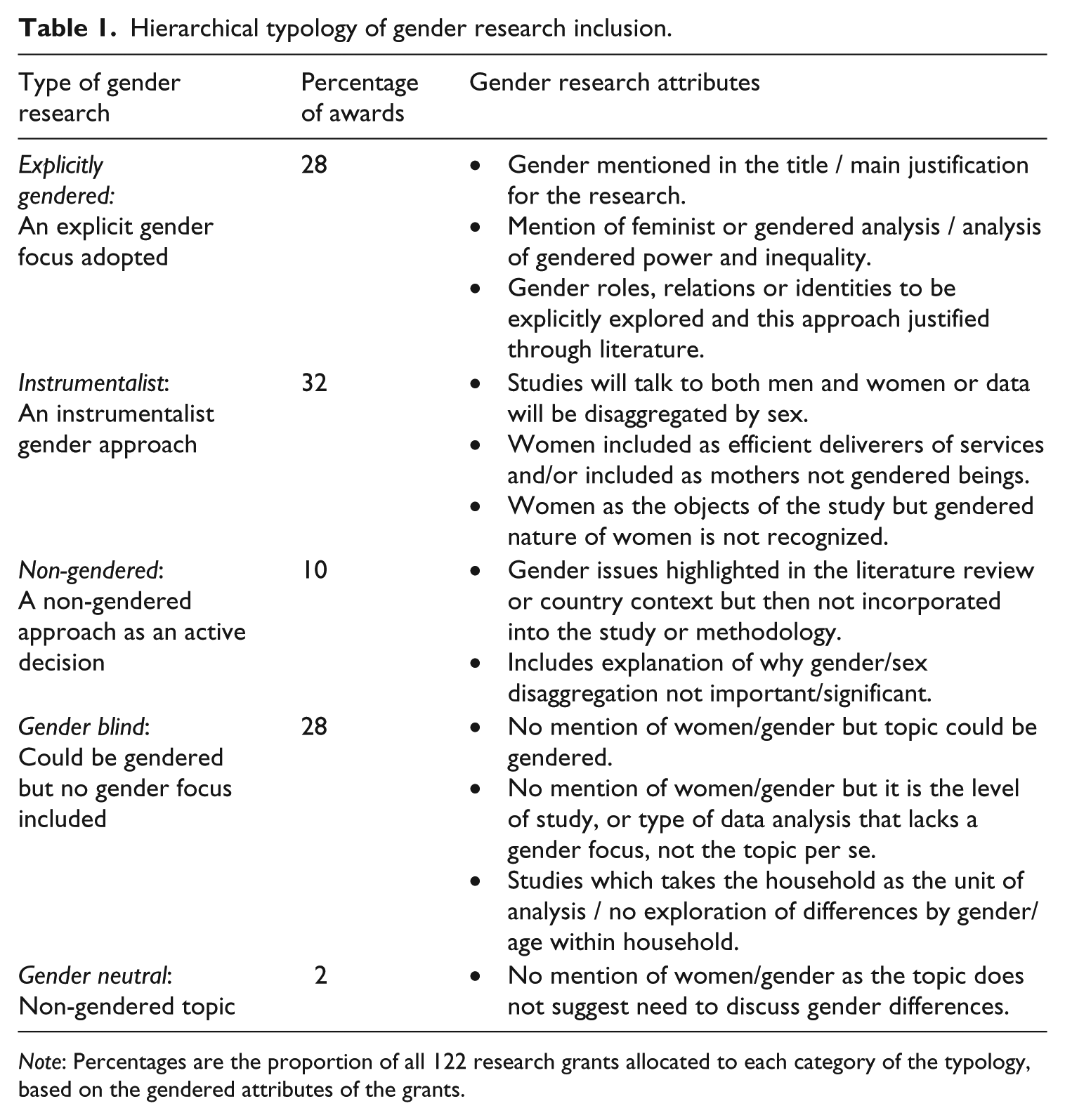
Note: Percentages are the proportion of all 122 research grants allocated to each category of the typology, based on the gendered attributes of the grants.
Around 28% of all the awards were classified as ‘gender blind’. The gender blindness of the majority of the studies in this category was related to the focus of the study rather than the topic per se – looking at processes, policies and places rather than people – with studies defining power in terms of political or local power, for example, or exploring notions of livelihoods or capabilities, but not exploring gender differences in how these are experienced.
While the gender blind studies did not mention gender, another set of studies (around 10% of all projects) were defined as ‘non-gendered’ in that they implicitly or explicitly recognized the possible gender dimensions of the study but then either never mentioned gender again or sought to actively justify the lack of engagement with gender. This was particularly the case within economic and econometric modelling projects, which tended to ‘control’ for sex or hold sex ‘constant’, for example, or use the household as the unit of analysis, ignoring gender differences within households.
Before discussing the proposals classified as ‘gendered’, it is important to note that this typology is based on an initial reading of the proposal/Case for Support (CfS), and where available, the End of Award Report (EoAR). A second level of analysis involved reviewing all published outputs from the 122 awards. In just under 15% of studies originally classified as ‘non-gendered’ or ‘gender blind’ a review of outputs revealed they had generated some new knowledge around women and poverty in their related publications. This was often confined to one paragraph or one section on gender-disaggregated analysis in one of the many publications from the project, and this one ‘gendered’ publication was often written by ‘co’ rather than the principal investigators. However, for another 15% of awards classified as non-gendered or gender blind in the typology, published outputs provided rich insights into gender relations. Yet award holders made no mention of these gender findings in the EoAR (hence their original categorization in the typology), suggesting they did not see these findings as important. This raises the question of how gendered knowledge is, or is not, valued by researchers or, perhaps more importantly, perceived by them to be valued by the institution they were reporting to, the Joint Fund.
Of most interest is the set of studies that clearly included gender, but adopted what we defined as an ‘instrumentalist gender approach’ (around a third of all awards). The influence of the institutional understanding of gender on informing what gender ‘is’ becomes clear here. A sub-set of the instrumentalist studies ‘did gender’ through holding separate focus groups, or disaggregating quantitative data by sex, reducing gender to simple binaries. As often no methodological justification or rationale was presented for this, this approach might have been influenced by the wording of the call specifications from Phase 2 that explicitly called for the use of disaggregated data. The Phase 2 specification also called for ‘gender analysis’ but this was often interpreted as presenting data in the form of ‘women do X’ and ‘men do Y’, stopping short of a discussion of how any of the noted differences may be accounted for, which the word ‘analysis’, for us, would imply. When there was recognition of the need to explain the difference often ‘culture’ was used as an explanatory catch all, with static notions of culture being promoted that ignored shifts and changes in norms. While these studies provided new and interesting descriptive information on how men and how women view the same issue, they failed to analyse why this was the case or what this meant for gender roles and relations, and as such, there was a missed opportunity to further gendered knowledge of the topics studied.
Other studies defined as adopting an ‘instrumentalist approach’ included those where women made up the majority of participants due to their occupations or other characteristics, but, while being the main object of the research, gender analysis was not necessarily key or even included – their sex was constructed as ‘incidental’ to the study. For example, in some cases women were the focus of the study because they did a particular job more than men, not because they were women per se. In these instances the focus was on understanding the occupational sector, rather than the women and men who work in that sector, and at times these inherently ‘gendered’ studies were actively constructed as not about gender or as not ‘doing gender’. A further sub-category of these types of instrumentalist studies were those that constructed women as mothers or carers, and the majority of studies on maternal health lacked a robust gendered analysis which looked at power, identity, norms and rights. This fits into Razavi’s (2017) discussion of instrumentalism in the development policy context, and suggests there is a tendency to ignore the significance of unpaid domestic and care work as an issue in and of itself.
In other studies within the ‘instrumentalist’ category the issue was not the lack of gender analysis but the nature of this analysis. These studies took an approach to gender that is in line with many ‘gendered’ development policy approaches adopted by international agencies – an efficiency rather than an equality approach. In policy terms this approach is summed up by the World Bank’s (2006) statement that ‘gender equality is just smart economics’. Following the same vein, a study might note how women’s ‘coping strategies’ make them even more time-poor, but rather than exploring how this may impact on the woman’s well-being, it instead focuses on how this will reduce the woman’s productivity and the impact on the wider household and economy. If these studies are then used by policy makers, the result might well be the introduction of policy targeted at women that would further the collective ‘good’, but not necessarily the well-being of women. An additional danger here is that an instrumentalist policy approach informs institutional gender norms, and this may shape (and constrain) institutional ideas of what gender research should look like. This ‘gender-but-non-gendered’ approach produces instrumentalist gendered knowledge that further reinforces instrumentalist gender policy. As DFID and other actors such as the World Bank and the UN are all producers and consumers of knowledge, funding research and funding development projects, it is easy to see how the mainstream gender discourse is produced and reproduced, ‘evidenced’ and institutionalized in this closed circuit where gender is trapped.
While the majority of the projects funded under the Joint Fund could be seen to reproduce the dominant discourse, some 28% of awards successfully problematized this normative discourse and explicitly addressed the issue of gender inequality and power. For example, one study highlighted the complexity of understanding the causes of income poverty as it relates to employment, exploring differences over time and space and inequalities of power between women as well as between women and men. Another worked to develop a strong Southern team of researchers, incorporating an empowerment approach to developing and mentoring the research team (who were comprised almost exclusively of women) into the core of the research methodology. Unsurprisingly, many ‘successful’ awards in terms of gender advancement were explicitly feminist, using feminist theory and/or feminist methodologies to shape the research agenda.
A number of the ‘gendered’ awards had an explicit focus on women only, but the majority considered men and/or boys as well as women/girls. However men were often only considered as a reference point to highlight women’s relative disadvantage. This is not confined to research under the Joint Fund, and in the gendered development discourse men have tended to have been imagined as ‘powerful and oppositional figures’ (Cornwall, 1998: 46), yet, conversely, and simultaneously also constructed as lazy, sitting round talking while women work (Whitehead, 2000). While a number of awards do fall into this trap, a number challenge existing ideas and highlight that gendered relations and identities are more nuanced than often suggested by the existing literature. For example, a study of the highly masculinized mining sector highlights how inequalities of power in male–male, female–female and male–female relationships need to be explored rather than assumed.
There were many more examples of ‘good’ gender research and these were not confined to one methodological approach or one region. That being said, the dominance of South Asian and Sub-Saharan African countries among the studies makes any meaningful regional analysis of difference difficult. This could reflect the focus of the Joint Fund on poverty leading to a focus on the regions where the majority of the poor live. However, Camfield et al. (2015) note the numerical dominance of South Africa and India among the studies funded by the Joint Fund may not just lie with the call specification, but illustrate a bias towards Anglophone or English-speaking nations and those with a relatively well-established research infrastructure.
What difference does a call specification make?
Adopting a Feminist Institutionalist lens suggests the Joint Fund’s call specifications will be important in constructing gender norms and in shaping, but also resisting, change in relation to how gender is understood and ‘done’. Considering changes in gender inclusion/exclusion over time suggests this may be the case. In the older/completed grants under 25% have an explicit gender focus while the review of the CfS of newer projects, still ongoing, suggests 40% of them have/will adopt a gender perspective. The difference in the proportions of the earlier and later awards that are gendered seems to be explained by the fact that while nearly 15% of earlier awards had no mention of gender or were ‘gender blind’, this is true of only 5% of the newer awards. As such, explicitly mentioning gender in the call specification may well lead to a greater number of funded awards having a gender focus.
Considering trends across the call specifications over time highlights that gender instrumentalist approaches endure, and although more of the older/completed awards (35%) adopted an instrumentalist approach, the proportions were not significantly different for newer awards (27%). The first inclusions of gender in the call specification (early Phase 2 calls) sees a significant decline in the number of gender blind projects but an increase in the proportion of proposals justifying why they will not focus on/include gender (an increase from 24% to 40%). That is, those putting forward proposals recognized they had to mention gender, but that this could be merely to explain why they needed no further mention of gender. From Phase 2 Call 3 onwards the proportion of this type of project declines once more, and the proportion of gendered projects being awarded rises to 40% overall, in line with the greater steer by the call specification for proposals to actively engage with gender, not just acknowledge it.
The numbers of gendered grants being awarded under the scheme then appears to increase as a proportion of all grants over time/calls. It raises questions about how gender is being included – and what is understood by a gender perspective by those generating new ‘gendered’ knowledge and it also asks why. It begs the question: are new grants merely including gender because the call specification suggests they should do? As with critiques of the World Bank’s co-option of gender for efficiency-not-equality reasons, it might be that some projects adopt an efficiency approach to research – including gender as an ‘efficient’ means to obtain funding, rather than an actual desire to produce gender knowledge, or indeed an understanding of gender. A pragmatic approach (Razavi, 2017) would suggest that, despite the ‘efficiency rationale’, if the research produces new gendered knowledge it is to be welcomed, and that the overall number of gendered grants awarded under the Joint Fund has increased over time is a positive. However, it is important to ensure that in this, and other funding schemes, gender does not become something everyone feels they must do, without thinking about the how and the why. More importantly perhaps is that gender does not become something everyone feels they can do, or know how to do, rather than being a specialized academic discipline.
This notion of gender being seen as a ‘non-discipline’ by mainstream institutions is somewhat supported by a report commissioned by ESRC-DFID on the Joint Fund, which documents the wide range of discipline areas covered by the Joint Fund, but does not include gender studies. Gender studies is a recognized academic discipline in its own right informed by feminist theories and distinct epistemological perspectives. A cultural geographer without specialist training would be unlikely to suggest they could themselves incorporate an econometric modelling component within a project; indeed, they would almost certainly seek specialist knowledge about an area of expertise unknown to them. Yet ‘gender’ seems to be something that untrained researchers think they can ‘do’ rather than being a specialist field of enquiry, in part, perhaps, explained by everyone living gender differences on a daily basis. Equally, many gender mainstreaming initiatives have constructed a technical ‘tool-kit’ approach to engendering policies and this technical approach to ‘doing gender’ may also influence the research funded by mainstream development and governmental institutions. Indeed, it has been suggested that DFID’s attempts to simplify the gender ‘problem’ have resulted in an institutional analysis that is ‘over simplistic’ (GDN, 2012: 4). The dearth of feminist methodologies and theoretical framings across even the majority of the explicitly gendered projects, and the resultant limited conceptual and theoretical advancement brought by research funded under the Joint Fund, may reflect the ‘over simplistic’ institutional understandings of gender.
What ‘doing gender’ looks like may be changing over time as it becomes mainstream and institutionalized, and as more ‘do gender’ so it becomes, paradoxically, less ‘gendered’. Institutional norms not only impact the nature of what is produced but also what is not produced, as well as who produces what and how. These gaps and silences tell us much about how gender is understood in the development context.
More gender, still silences
Although the proportion of gendered projects within the awards has increased over time and the issues covered have also widened, it is striking that none of the awards has had an explicit and central focus on sexualities or sexual and reproductive health as rights 2 (including issues such as sexual violence and FGM), and only two projects focused on violence against women as the main research topic. 3 Given the salience of these issues for many women, this gap is particularly concerning. While education and employment were well covered, some other obvious, and highly important, gaps included an explicit focus on women’s unpaid and paid care work, and transactional sex – although both emerged as important in a number of studies. Only a small number of studies looked at environmental change, with only one award researching ‘disasters’ and one focusing on climate change adaptation. None of the studies analysed the effectiveness of international policy to improve gender equality and women’s well-being.
A large number of the topics not covered by the Joint Fund are issues that emerged as key within the post-MDG context and discussions of the Sustainable Development Goals. This suggests the Joint Fund may have helped inform the existing international development agenda – reflecting and reinforcing the mainstream discourse – rather than providing the basis for a new, transformative agenda that would challenge the causes of gendered inequalities of power. Power operates through discourse to fix certain constructions of gender as dominant and to marginalize or exclude counter-discourses. This constrains and bounds the agency of certain actors, including feminists (De Jong, 2016; Mackay, 2011). Camfield et al.’s 2015 analysis of the principal investigators of Joint Fund awards highlights a range of biases including education (having an Oxbridge undergraduate degree), sex (being male), age (average age of 56) and ‘status’ (being a professor). Such selective profiles suggest there may be some bias in terms of allocation of awards, however unconsciously, and this narrow field of researchers might negatively impact on the Joint Fund’s ability to deliver innovative gender research. That nearly half of those awarded had previously held a grant from DFID, and over a third had previously held a grant from the ESRC (and in both cases typically more than one), also suggests institutional resistance to change. That gender norms have to fight their way into institutional thinking (Elgström, 2000) is further evidenced in the Joint Fund by the absence of some notable gender/feminist scholars from the list of award holders.
Discussions with some of these ‘absent gender scholars’ suggests the majority were absent because they did not apply to the Joint Fund, not because they applied for funding but were not successful. 4 The reasons they did not apply for funding were related to the ways in which the ESRC-DFID Joint Fund call specifications set out their agenda. They suggested that both the lack of gender or feminism being specifically mentioned as a theme, as well as concerns about methodological and/or disciplinary biases meant that they did not think a proposal looking at gender and/or using feminist methodologies would be seen as relevant. The perception (rightly or wrongly) was that the ESRC favoured large-scale quantitative methods, which dissuaded some from applying. The lack of gender as a thematic subject in the call also meant that these scholars worried that issues such as violence against women or women’s rights would not be fundable, and any money given to gender projects would go to less controversial, more mainstream issues that might include gender as an element of a larger project. Thus those who first and foremost want to study gender as a substantive area, and who would likely use feminist theories and methodologies to inform their projects may not be applying. It seems instead to be non-gender specialists (and/or those who seek to include a gendered element in the study of another topic) who are constructing ‘gendered’ knowledge under the Joint Fund. As the ESRC-DFID funded research informs DFID and other policy makers, it may be the case that gendered policy is being informed by non-gender focused research often produced by researchers with little gender expertise.
Conclusion
Feminist Intuitionalist theorists highlight institutions as being gendered entities, arguing that institutionalized gender norms influence understandings and practice of gender within wider policy processes. Understanding the ESRC-DFID Joint Fund as an institution helps us understand what drives and constrains the ability to produce new gendered knowledge from this multi-million-pound research fund. Knowledge which in turn informs how we understand gender and how we ‘do gender’ in policy terms.
The Joint Fund uses call specifications to shape the nature of the knowledge produced in line with institutional priorities, and the way gender is presented in the call specifications reflects institutional gender norms. Our analysis of the knowledge produced via the various calls shows how the type of gendered knowledge produced changes, but is also constrained by these institutional norms. Echoing the outcomes of decades of ‘doing’ gender in development, through successive calls, the inclusion of gender in funded research projects has become naturalized, something expected or mainstream, essentialized, seen as a non-specialist disaggregation exercise, and depoliticized, reinforcing rather than challenging the current policy agenda.
While over time more gendered knowledge has been produced, who produces this gendered knowledge has not necessarily changed and the gender absences and silences tells us much about how gender is understood and ‘done’. Rather than being a focus of the funded research, gender has been included as an element in studies of other more mainstream topics and often only as a methodological or technical consideration. The gendered knowledge produced from this is then mainstream, or what we might term ‘Laura Ashley gender’, like her designs subdued and genteel, non-challenging and acceptable to the institutions that produce and use it. It does not challenge the dominant discourse, but reinforces existing gender norms by reinforcing voices from non-specialized researchers already dominating the field. Institutional instrumentalist gendered norms may produce instrumentalist gendered research, which in turn may reproduce instrumentalist gendered norms in policy. DFID, like other development agencies through funding global research, becomes a producer of knowledge and consequently becomes an ‘expert’ in gender. However, DFID is also a consumer of knowledge, and as a consumer evidences its gender policy through knowledge which it may co-produce.
The tension between the mainstream development approaches to achieving ‘equality’ and approaches that advocate for gender equality are evident here in the ways in which reductive, instrumentalist approaches to including gender are writ into gendered development research and development policy. As has been seen in development policy and practice, as gender becomes mainstream and institutionalized in research funding calls, meaning more ‘do gender’, so research may become conversely, less ‘gendered’. If gendered policy is being informed by non-gender focused research often produced by non-gender specialized researchers, by design, it can at best highlight gender inequalities, but can do little to promote gender equality.
Footnotes
Declaration of Conflicting Interests
The author(s) declared no potential conflicts of interest with respect to the research, authorship, and/or publication of this article.
Funding
The author(s) disclosed receipt of the following financial support for the research, authorship, and/or publication of this article: The paper draws on the findings of the ESRC-DFID Joint Fund for Poverty Alleviation Research Evidence Synthesis Research Award (ESRA) - Gender.
