



Abstract
Resistance hinders the potential of gender equality strategies to modify institutional arrangements and challenge the status quo. Applying the integrationist or agenda-setting distinction of approaches to gender mainstreaming and drawing on feminist institutionalism and gender policy implementation theory, this article analyses resistances that undermine a more transformative agenda-setting approach to gender mainstreaming in university research settings. The analysis of qualitative data from a selection of three Catalan universities reveals implicit institutional resistance and individual opposition from research managers that contribute to integrationist approaches to gender mainstreaming and the ineffective implementation of actions that aim to achieve distinct gender equality in research goals. Despite the favourable policy context and rhetorical commitments in university gender equality plans and in research managers’ discourse, norms of meritocracy underlie resistance to actions that imply greater structural and cultural change, including research managers who lack knowledge of gender mainstreaming and participate minimally in implementation. Entrenched norms around research autonomy and the non-prioritization of gender inform more explicit resistance to actions that aim for a more gender-aware science, to incorporate the gender dimension into all research and to promote gender research, where progress is particularly slow.
Introduction
Progress towards gender equality (GE) in the area of university research is slow, despite two decades of European directives and a commitment to gender mainstreaming (GM) (European Commission (EC), 2021b). In Spain, while 43% of all university researchers are women, they constitute only 25.6% of Full Professors and 25% of Rectors (Unidad de Mujeres y Ciencia, 2023). Women remain significantly under-represented in university decision-making and in some disciplines (e.g. Engineering and Architecture). They face greater difficulties balancing work and family life, as well as sexism and stereotyping that impede their advancement (Pastor Gosálbez et al., 2020). Furthermore, few research projects address gender themes specifically and the gender perspective is lacking from mainstream research content (Verge and Cabruja Ubach, 2017). Dedicated GE units and gender equality plans (GEPs) have been adopted to tackle the multiple faces of gender inequality, yet women-centred measures outweigh structural and cultural change initiatives (Elizondo et al., 2022). Like in other European contexts, real institutional change, and the incorporation of gender into research are proving particularly challenging (GENDERACTION, 2019: 3). Engendering research is low priority and GM efforts face significant resistance (Verge et al., 2018).
Applying a feminist institutionalist (FI) lens, and drawing upon Jahan’s (1995) distinction between ‘integrationist’ and ‘agenda-setting’ GM, this article asks the following: How is a more transformative agenda-setting approach to GM in research resisted in universities? What form does resistance take towards different initiatives that aim to achieve distinct gender equality in research objectives? While analyses of resistance towards GE policy implementation in Spanish universities are numerous (Alonso and Diz, 2022; Castaño Collado and Vázquez-Cupeiro, 2023; Lombardo and Bustelo, 2021; Verge et al., 2018), the analysis of resistance towards efforts to mainstream gender into research remains neglected. Furthermore, studies tend to centre on resistance as experienced and told by gender equality actors. Few studies identify opposition to GE interventions in the discourse of other potentially resistant university actors, such as research managers.
This article analyses resistance to GM in university research, relying on qualitative data (predominantly interviews with research managers and gender equality actors) from three public universities in Barcelona, Catalonia. Here, GM has been adopted as the principal strategy to achieve GE and a comprehensive, feminist policy framework for GM in research exists at the regional and municipal level. Yet, progress towards GE goals in research remains slow and uneven. This article argues that, while GM has been introduced into university research settings, institutional and individual resistance undermines the implementation of a more transformative agenda-setting approach, resulting in integrationist approaches in practice. The interviews reveal explicit and implicit resistance from research managers and other actors, while analysis of the universities’ GEPs reveals some subtle discursive strategies that dilute more transformative goals. The article distinguishes between resistance to more or less transformative actions and that aim to achieve distinct objectives as defined by the European Research Area: to create gender-equal working environments, to ensure women’s equal presence as decision-makers and research leaders, and to integrate the gender perspective into research content (EC, 2021a).
Resistance to agenda-setting GM in university research: A theoretical framework
GE policy implementation involves power struggles between status quo actors and gender equality actors that aim to transform unequal, hierarchical power relations in institutions (Tildesley and Bustelo, 2022). Compared to other GE strategies, GM is particularly likely to face resistance as it targets the norms, beliefs, processes, and practices that maintain inequalities in gendered institutions, in which gender is inherent to the institutional ‘processes, practices, images, ideologies and distributions of power’ (Acker, 1992: 567). A feminist intervention strategy, GM aims to eliminate discrimination and biases and (re)organize institutional processes and practices from a gender perspective, demanding a participatory approach and involvement of ‘regular’ actors (i.e. relevant actors involved in policymaking in different domains) (Benschop and Verloo, 2006). However, power differences between regular actors and gender equality actors, as well as confusion over what GM means, contribute to ineffective implementation (Meier and Celis, 2011). Resistance and the opportunities to affect change because of it, are key for understanding how gender reforms are implemented in institutions (Chappell and Waylen, 2013).
Observing how GM is applied in development institutions, Jahan (1995) distinguishes between the following two distinct approaches: ‘integrationist’ and ‘agenda-setting’. While an integrationist approach aims to incorporate women into the prevailing system, the institutional structures and masculinist cultures that maintain unequal power relations and women’s disadvantage remain unchallenged (Jahan, 1995). Institutions may take action to promote women’s participation or gender research, adopt gender-conscious practices (e.g. tools or targets) or ‘take account of’ women and gender issues (e.g. unequal representation, gender-based discrimination, or barriers to access) within institutional policies and practices, yet these are not prioritized or considered the responsibility of regular actors. Feminists have criticized the integrationist approach to GM as depoliticized and watered-down (Lombardo, 2005; Meier and Celis, 2011). Reduced visions of GE (e.g. equality of opportunity or treatment) in policy documents and among actors, as well as an emphasis on ‘softer’ awareness-raising measures (e.g. campaigns to make inequalities visible; actions to promote gender research), or ‘individual’ targeted measures that aim to support (e.g. mentoring) or ‘fix’ women (e.g. early-stage career initiatives for women), are indicative of this approach.
Considered by many to have greater ‘revolutionary potential’ (see Verloo, 2001), agenda-setting GM aims to re-orient the institutional logics maintaining the status quo, ensuring GE objectives are prioritized and mainstreamed throughout the institutional agenda and modifying decision-making structures to ensure substantive equality (Lombardo, 2005). This would require a clear, structural understanding of gender inequality in policy documents, as well as the commitment and participation of regular research actors to incorporate the gender perspective, assuming a significant level of GM ‘know-how’ among these actors even where experts lead on GE work. Alongside targeted measures for women, it requires ‘structural’ actions (e.g. gender-blind selection and promotion processes; measures to achieve gender-balance) and ‘cultural’ measures (e.g. training on GM for decision-makers; work-life balance measures), to change institutional practices and to challenge gendered norms (Kalpazidou Schmidt and Cacace, 2018). It also requires actions to ensure gender research is prioritized and that all research projects consider gender from the beginning, rather than gender or women’s questions simply being ‘added in’ (Caprile et al., 2012: 155).
Research suggests the prevalence of integrationist approaches to GM in universities (Peterson and Jordansson, 2022: 89). While GM has been widely adopted, with GE units and GEPs put in place as the principal instruments to drive it, the masculine norms, discriminatory, and gender-blind practices that maintain unequal power relations remain largely unchallenged (Elizondo et al., 2022; Müller et al., 2011; Wroblewski and Palmén, 2022). Diagnosing resistance that contributes to this, requires identifying where an agenda-setting approach is absent and the hegemonic institutional ‘rules’ that underlie opposition, as resistance has its roots in the gendered rules embedded in institutions (Lombardo and Mergaert, 2013). Not only do formal rules (written laws or policy) affect men and women differently, serving to maintain inequalities, informal rules – the norms, values, and practices that constitute unquestioned and universal ‘ways of doing things’ in institutions – favour masculine behaviours and reproduce gender biases (Mackay, 2011). Normalized, enacted by actors, and reproduced in discourses, hegemonic rules maintain the status quo and impede transformative action, undermining the effective implementation of reforms or diluting their impact (Chappell and Waylen, 2013).
Not only are universities gendered, implicit androcentrism is also a defining feature of research. Male dominance is seen in men’s over-representation as researchers, project leaders, and decision-makers, as ‘gatekeepers’ shaping research agendas and allocating resources (Husu, 2004). Male informal networks and opaque recruitment processes facilitate men’s advancement, while biases blight supposedly objective evaluations of merit (Nielson, 2021; O’Connor and Barnard, 2021). Gender-blind policies and practices also disregard women’s socialization, biology, and the sexual division of labour, contributing to family un-friendly work-arrangements that hinder women’s advancement (Alonso and Diz, 2022). Masculine research orientations are positioned as the gender-neutral standard, disguising biases as to what constitutes ‘excellent’ science (Hodgins and O’Connor, 2021; Van den Brink, 2015). Stereotypes and epistemic hierarchies mean male-dominated ‘hard’ subjects (e.g. STEM) have higher status (receiving greater funding and institutional support), while women-dominated, subjective epistemologies remain periphery and are devalued (Burke, 2021). Furthermore, actors can be resistant or hostile to GE discourse, perceived to threaten a culture of excellence and merit (Diogo et al., 2021), and feminist knowledge, considered ‘illegitimate’ or ‘ideological’ (Powell et al., 2018; Van den Brink, 2015). These supposedly ‘neutral’ rules governing research processes and practices underlie resistances and hinder transformative change in universities (Linková and Mergaert, 2021).
Demanding the reformulation of priorities, practices, and workloads of actors responsible for research policy, as well as shifts in decision-making and authority relationships, resistance to agenda-setting GM is likely from research managers who may defend established research agendas, academic freedoms, or decision-making autonomy (Roos et al., 2020). They may also resist more ‘radical’ reforms because of their own, more limited, understanding of GE and how to achieve it, lack of implementing capacity, or because of conservative or anti-gender values (Lombardo and Mergaert, 2013). An integrationist GM approach, and actions that require minimal overhaul of institutional arrangements and participation of regular actors, are therefore likely to face less opposition. Gender equality actors may achieve greater implementation success of lower-conflict, individual, or isolated measures in gender-friendly or feminized departments (Elizondo et al., 2022; Tildesley et al., 2021).
Resistance can be individual or institutional, explicit, or implicit, and takes three principal forms; a refusal to take responsibility for gender inequalities, denial of the need for change, or trivialization (Female Empowerment in Science and Technology Academia (FESTA), 2016; Lombardo and Mergaert, 2013; Tildesley et al., 2021). Explicit resistance, such as non-action or anti-gender discourses, is easier to identify. Implicit opposition, however, may be hidden behind declarations in favour of GE or post-feminist positions that GE has already been achieved or universities as gender neutral (Diogo et al., 2021; Smidt et al., 2021). Actors may distance themselves from initiatives, claim non-responsibility for GM, or blame non-implementation on others (Lansu et al., 2020; Powell et al., 2018). Individual resistance may also be linked to institutional resistance that includes lack of support, limited resource allocation, the absence of enforcement mechanisms, or busy-ness around softer actions (Diogo et al., 2021; Hodgins and O’Connor, 2021; Peterson et al. 2021). It may also manifest as ‘defensive institutional work’ in discourse that diminishes the institution’s responsibility for gender inequalities and legitimizes the status quo, for example, by rejecting time-bound initiatives (Roos et al., 2020) or employing framings of gender inequality as an individual problem (Hodgins and O’Connor, 2021). Depoliticized policy discourse, where key GM concepts (e.g. feminism, sexism, or substantive GE) are missing, is not accidental and serves to undermine agenda-setting GM (Joseph et al., 2011; Verge, 2021). Analysis of university GEPs, developed by gender equality actors but negotiated with and approved by high-level institutional actors, is a first step for grasping institutional commitment to GM.
GM in research: The case of Barcelona
The analysis takes place within a favourable context for GM implementation in university research. In Spain, the central and regional governments share competence on GE, research, and higher education policy, and have dedicated women’s machineries responsible for developing policies to tackle gender inequalities in research. Since GM’s introduction as the European Union’s principal strategy for GE, it has been adopted within Spanish national policy and legislation in these areas; The Equality Act (2007) promotes GM in higher education teaching and research and mandates GEPs; The Universities Act (2007) mandates GE units, parity measures for decision-making bodies as well as actions for women’s greater participation as researchers; The Science Act (2011) states that institutions should integrate gender transversally, in all research stages, as well as promote women’s and gender studies. However, ambiguous instructions (e.g. ‘encourage’/‘promote’), a lack of sanctions and definition of responsible actors, means implementation remains relatively undefined.
At the regional level, Catalonia has a strong research infrastructure and has pioneered GM policy instruments and incorporation of the gender perspective in research (Alonso, 2017). The Catalan Government’s Strategic Plan for Gender Equality Policies (2019–2022) promotes GM in universities and research, as does the Catalan Equality Act (2015) that also mandates GEPs and positive actions for gender parity in decision-making (Art. 28.3e.1). Universities must promote women’s research and participation, guarantee gender training for staff, incorporate the gender perspective across all disciplines, and address gender biases in evaluations (Art. 28.2 and 3). Universities must also ‘assess positively research projects that incorporate the gender dimension or women’s studies’ (Art. 28 3.e.2). Both the National and Catalan Equality Acts implicate the local level in GE policy implementation (Art.21.2, Art.27.3.c). In Barcelona, there is a clear commitment to feminist policy and GM and a dedicated office has been created to facilitate the implementation of the gender perspective.
Yet, progress towards GE in university research is slow and uneven. While women represent around 44% of overall research and teaching staff across a total of 12 universities in Catalonia, they represent significantly lower proportions in some disciplines 1 (Pastor Gosálbez and Pérez-Quintana, 2019: 71). Furthermore, only around 32% of women lead research projects, 23% are Full Professors and only 12.5% occupy the highest position of Rector (Departament d’Empresa i Coneixement, Secretaria d’ Universitats i Recerca, 2021; Pastor Gosálbez and Pérez-Quintana, 2019). Data on the incorporation of the gender perspective from the Xarxa Vives network, 2 shows only 3.1% of university research projects incorporate the gender dimension to some degree and only 1.7% are gender-specific (Verge and Cabruja Ubach, 2017).
Methodology
The cases selected are the following: The University of Barcelona (UB), Autonoma University Barcelona (UAB), and the Pompeu Fabra University (UPF); all public, generalist universities with a strong research focus. Purposive sampling was employed (Luborsky and Rubinstein, 1995), accounting for variance in size, year of adoption of the first GEP (see Table 1), actions in research, proportion of gender research groups, as well as presence and visibility of women in research leadership, identified previously (Verge and Cabruja Ubach, 2017). Focusing on a specific local context, possible biases from public/private variables and the multilevel nature of the Spanish state are avoided.
Case characteristics.
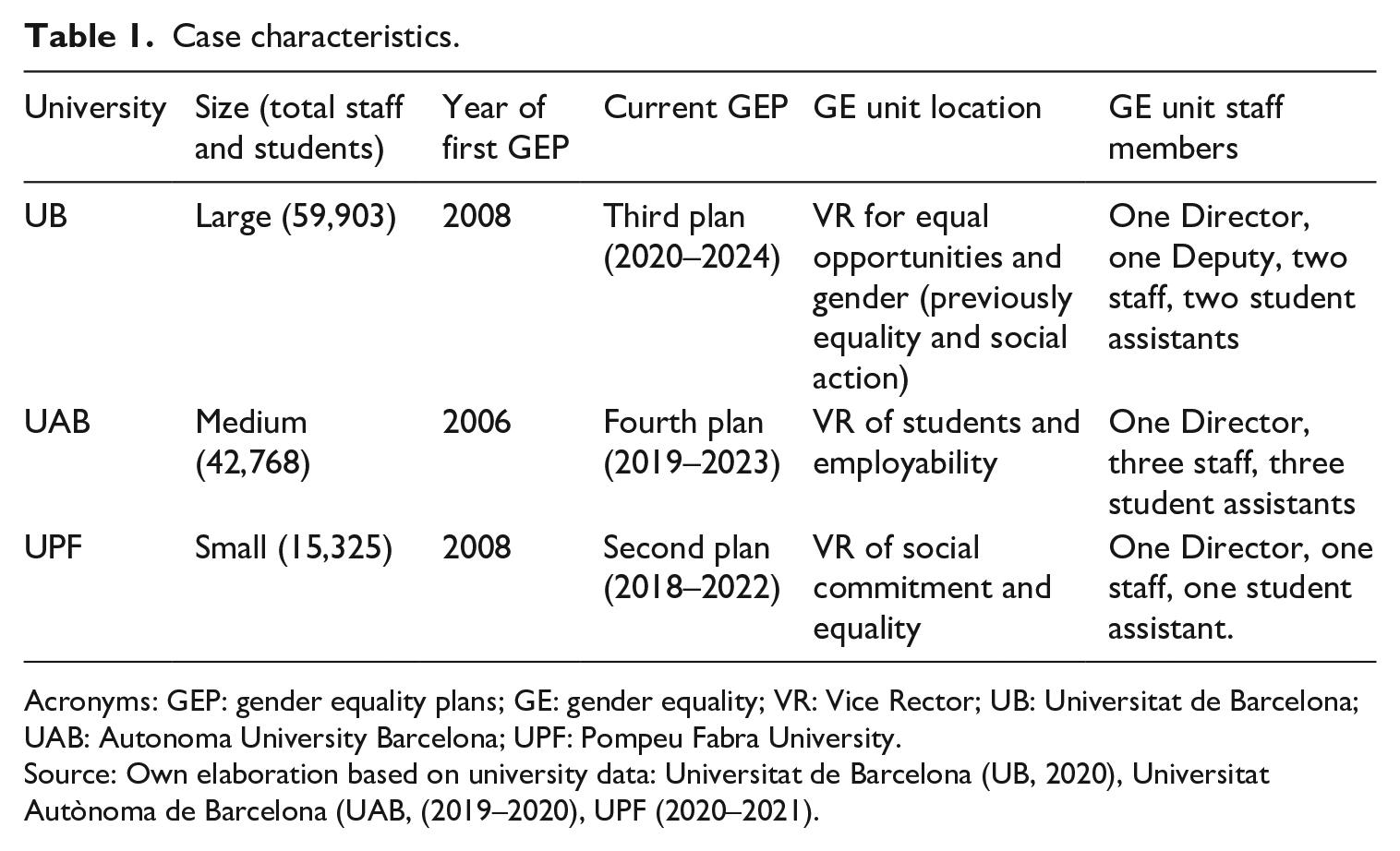
Acronyms: GEP: gender equality plans; GE: gender equality; VR: Vice Rector; UB: Universitat de Barcelona; UAB: Autonoma University Barcelona; UPF: Pompeu Fabra University.
In all cases, the university GE units are directed by a feminist, gender-competent professor (the principal gender equality actor), assisted by a deputy and/or ‘Equality Technicians’ (technical or administrative staff) and student assistants. These units lie organizationally within a Vice-Rectorate and are therefore dependent to some degree on the Rectors’ office, an important source of support and legitimacy. However, GE units in Spain are typically under-resourced, limiting positional power (Elizondo et al., 2022). In all cases, the Vice Rector (VR) of Research is the principal actor responsible for research policy development and implementation, and thus mainstreaming gender in this domain. VRs are political positions, typically senior academics, within the Rector’s governing team and have considerable symbolic and strategic decision-making power. In all cases, a Research Services Department (consisting of predominantly of technical and administrative staff) supports research policy planning and implementation.
A preliminary analysis of the university GEPs was carried out to determine: the understanding of gender inequality (e.g. as a structural problem) and definition of GM proposed, the different actions proposed to achieve gender equality in research, and the actors identified as responsible for implementation. The analysis also sought to identify discursive strategies and silences, which could indicate weakened institutional commitment to an agenda-setting GM approach. Semi-structured interviews were carried out with actors expected to play a role in GM implementation, identified as responsible in the GEPs or by the principal gender equality actors. As the focus is GM in research, principal actors are the VR for Research and other managers within the Research Services Department (‘research managers’), as well as the VRs responsible for the gender equality unit, the unit Director and staff (‘gender equality actors’). A total of 13 interviews (3 men, 10 women) were carried out between May and July 2019. All were asked about their role, perception of gender inequalities in the university, GM actions and implementation processes, as well as experiences of resistance.
Interview data were analysed using a thematic approach. Resistances were identified as being towards (1) an agenda-setting approach, (2) actions for more equal and women-friendly research environments (i.e. awareness-raising measures, work–life balance measures, early-stage career initiatives for women), (3) gender-balance in leadership and decision-making (i.e. parity measures, bias-free evaluations, consideration of care leaves in evaluation processes, positive actions), (4) the incorporation of the gender dimension in research (i.e. actions to promote gender research and to incorporate gender into research (Kalpazidou Schmidt and Cacace, 2018). Resistances were coded by ‘type’ (explicit/implicit, institutional/individual), and ‘form’ (denial of the need for gender change/refusal to take responsibility/trivialization (Tildesley et al., 2021). Guided by FI and GE policy implementation theory, informal rules underlying resistances were deduced where possible.
GM in university research: Institutional and individual resistances
Resistances to an agenda-setting GM approach
While an express commitment to tackling gender inequality and the need for a participatory GM approach for institutional and cultural change figures in the university GEPs, gender inequality is not explicitly defined as a structural problem. The UPF’s GEP is the only document to recognize the university’s role in the reproduction of norms, practices, and social gender roles, contributing to gender inequalities (UPF, 2018: 4). Certain discourses also serve to reduce institutional and individual responsibility for the implementation of GE actions and key GM concepts are missing. On one hand, references to the ‘profound social and cultural changes made over the years’ (UB, 2020: 20), in terms of women’s progress, and to discriminatory situations for women that ‘exist in the university, like in the rest of social and cultural life’ (UB, 2020: 21), subtly normalize and downplay inequalities. The lack of calendarization of actions in the UB and UAB GEPs, making them non-time bound, also reduces incentives for implementation. On the other hand, while ‘substantive’ or ‘effective equality’ is referred to as the goal of GE action in all documents, references to ‘sexism’ are only found in the UAB’s GEP and ‘feminism’ missing from all texts.
Key GM concepts (feminism, sexism, substantive equality), however, are most notably absent from research managers’ discourse. These actors also implicitly denied the need for transformative action. While intentions to correct gender inequalities were expressed, they were considered ‘historical’ (UB.3), or ‘inevitable’ (UPF.3), discourses that legitimize the unequal status quo (Hodgins and O’Connor, 2021). They defined GE as equality of opportunities and treatment, as providing ‘conditions that should be fair and equal to everyone’ (UPF.1). In doing so, they disregard the structural barriers facing women and express GE goals in line with an integrationist approach, without problematizing existing institutional arrangements. Reduced visions and framings of GE as an individual problem contribute to these actors’ non-participation in GM work. Revealing a post-feminist discourse that considers gender inequality a stronghold of the past that will be fixed with time (Verge, 2021: 550), one actor stated, ‘We just need time . . . lots of men retiring . . . we just need to wait . . . women will advance’ (UB.3).
Research managers’ resistance appears to stem from their limited knowledge of GM, GE actions, and participation in implementation, despite being named responsible for the implementation of multiple actions in the GEPs. A lack of ownership of actions by research departments is facilitated by a lack of sanctions and monitoring (UPF.2, UAB.4), contributing, according to one interviewee, to perceptions of their ‘voluntary’ nature (UAB.3). Gender equality actors, while acknowledging having high-level institutional support, lamented the lack of visibility of GEPs and resources (time, money, and personnel) of research departments (UB.2, UPF.2, UAB.3). According to one interviewee, this limits their own capacity – as the drivers of GM – to implement or suggest new actions (UPF.2). A lack of institutional prioritization and resistance from research managers contributes to a non-participatory, integrationist approach; successfully implemented actions are predominately those the GE unit is responsible for (UPF.2, UAB.1) requiring minimal action from other actors and changes to institutional structures.
Resistances towards initiatives for women-friendly research environments
Awareness-raising initiatives were considered by interviewees and recognized in the GEPs as implemented and little resistance was identified. Yet, when campaigns or data on gender inequality call-out discrimination or expose violence, therefore targeting the institutional gendered subculture and power hierarchies, resistance may occur. As one participant noted, As long as gender equality is seen as something positive . . . it’s not questioned. But the moment you challenge . . . release figures that show gender imbalances . . . or reveal violence . . . there are enormous obstacles. (UAB.1)
Early-stage career initiatives for women, despite constituting actions for women’s inclusion (i.e. more integrationist), also face resistance based on equality of opportunity norms and the fallacy of assumed equality (the idea that equality has already been achieved (Smidt et al., 2021). UPF research managers denied that actions such as training for women researchers are needed, stating, for example, ‘If we didn’t do it for men too, it would be discriminatory’ (UPF.3, UPF.2). Here, mentoring initiatives for women – identified in the GEP as the responsibility of the VR for Research – are funded externally or by departments themselves, revealing resistance to take responsibility for these actions. Their non-implementation in feminized departments was also considered justified ‘because women are in the majority there’ (UPF.1). When research managers discussed women’s under-representation, they frequently referred to these departments (UPF.3, UAB.4, UB.3). In doing so, they seek to legitimate non-action based upon the experiences of a token few and the appearance of GE (UAB.1, UAB.3).
Finally, while work–life balance initiatives – more transformative ‘cultural’ measures – were identified as adopted, resistance affects their effective implementation due to normative ideas around care, which is seen as women’s individual problem, and its non-prioritization. Institutional resistance is reflected in the limited administrative support provided to women when registering care leaves, as well as difficulties getting their contracts renewed or receiving teaching flexibility upon their return (UPF.5, UB.2). Institutional inertia and non-prioritization of actions to create more family-friendly work environments appear to inform individual resistances from research managers who do not have the knowledge or capacity to effectively apply these initiatives (UAB.1). As one participant stated, ‘No-one knows what to do or what your rights are, and so no one makes an effort to help you’ (UB.4).
Research managers also denied the need for greater institutional efforts to aid women balance work and family responsibilities, framing the problem as an individual one and legitimizing the status quo (Hodgins and O’Connor, 2021). When asked about work–life balance issues, one manager stated, Everyone manages how they can, it’s personal . . . with no impediment from the university . . . What’s important is that these things are clear from the outset so women know how it’s done, so they can plan. (UPF.1)
Resistances towards initiatives for gender-balance in research leadership and decision-making
The analysis identified significant resistance towards agenda-setting ‘structural’ actions to achieve gender-balance and alter decision-making hierarchies. Gender equality actors reported that, in practice, ‘quotas are not applied’ (UB.2), or remain ‘an ongoing discussion’ (UPF.2), as well as a sense of anxiety from privileged actors when positive measures were proposed, as they ‘might have to give things up’ (UAB.3, also UPF.2). Norms of meritocracy underlie resistance to positive action to ensure gender-balance, seen to undermine principles around ‘the best person for the job’ (UB.2).
While research managers were not explicitly against gender parity initiatives, they shifted the responsibility of these goals and outcomes onto others. For example, one interviewee stated, ‘it [parity] is very hard to impose when there are collaborators from different projects, different universities . . .’ (UPF.1). Another stated that while the VR of Research ‘was extremely interested’ in ensuring gender-balance, it was the ‘union staff that are not interested’ (UB.3). These statements reveal how implicit individual resistance, in the form of inaction, may be smoke-screened by declarations in favour of GE (Roos et al., 2020). Statements, such as ‘it is not always possible to find sufficient levels of women, but at least it is the intention’ (UB.3), reveal attitudes that blame women for lagging behind. Implicit resistance was also identified towards gender training actions for evaluation committee members, considered by one interviewee as something ‘we talk about . . . but we can’t enforce’ (UAB.2), because of departmental autonomy.
Finally, actions to promote women as principal researchers (in line with an integrationist approach) encounter explicit resistance from research managers manifesting as a denial of the need for GE change and trivialization. Like early-career initiatives, proposals for actions to promote women’s leadership, for example through training, were met with responses such as, ‘if we do it for women, we should do it for men. We cannot discriminate’ (UPF.2). Another research manager stated, ‘What we can do is ensure that women aren’t afraid . . . they shouldn’t feel like there are obstacles’ (UPF.1). Where the structural and cultural obstacles are denied and the problem individualized, a lack of specific measures and increasingly competitive research context contribute to women ‘constantly having to fight, in worse conditions, for the same resources as men’ (UAB.1).
Resistances towards initiatives for a gender-aware science
Across the cases, some actions to promote gender studies (making gender courses visible on university webpages), or gender research (prizes), in line with an integrationist approach, were acknowledged as implemented. According to one interviewee, the lack of institutional priority given to gender studies in fact provides opportunities for implementation: Gender studies doesn’t have the same value as other studies . . . so we can do what we like when promoting or making them visible. (UAB.1)
This quote suggests that gender equality actors in this university have significant freedom to promote the subject, without rigid guidelines or institutional oversight, because of its perceived lack of value.
Yet, institutional non-priority, evident as university gender studies and research centres are considered under-funded and under-valued (UB.4, UPF.2, UAB.1), also constrains efforts to mainstream gender into research and can contribute to individual resistance. Research managers and department heads are reluctant to provide training and create resources for researchers on how to incorporate gender in their research and courses (UPF.2, UAB.1). Gender equality actors thus assume responsibility for these actions; providing the training and ‘fighting’ for the inclusion of gender courses in the departments (UPF.2, UAB.1, UB.4). In one case, ‘strong resistance’ from the VR for Research to take responsibility for funding gender research prizes, meant gender equality actors had to seek an alternative source (The Catalan Women’s Institute) (UPF.2). According to the interviewee, this has further driven resistance from department heads who do not consider other GE actions to be their responsibility (UPF.2).
In other instances, research managers consider action to promote gender research as discriminative towards other subjects (UPF.2). Perceptions of gender research as being controversial may contribute to this. For example, when asked generally about action that might be effective to incorporate gender into research content, for example, one research manager talked about institutional funding
3
to promote gender research: We don’t have specific funds set aside to promote that . . . or to finance any research in any domain. So, there’s no discrimination there because we don’t do that. OK? Just as we don’t devote funds to research on Catalan as a minority language or, I don’t know, other things . . . (UPF.1)
The comparison made here to research on the Catalan language, a polarized debate, suggests that the interviewee considers gender research to be ideologically charged and periphery. Resistance may also rest upon perceptions of gender research’s inferior and non-scientific nature compared to ‘hegemonic research that is recognized as ‘scientific’ and ‘tough’’ (UAB.1). Interviewees perceive that gender and feminist academics are ‘looked down upon’ (UB.2, UPF.3, UB.4) and gender research is dismissed as ‘research for the feminists, for the girls’ (UPF.2).
Other initiatives aim to incorporate the gender perspective into research projects by requiring research proposals to explain how the gender perspective is incorporated or how it is not relevant. These actions are implemented in all cases, largely attributable to external pressures – namely EU framework and national research programme requirements (UB.2, UAB.2, UPF.4). Gender equality actors, however, believe they are still considered ‘more like recommendations’ (UAB.4), ‘a formal thing . . . just one more thing to do’ (UAB.4), revealing a bureaucratized ‘tick-box’ approach to implementation (Meier and Celis, 2011). A lack of monitoring, consequences for non-compliance, and considering ‘funding possibilities are not actually conditioned by this’ (UPF.5), mean researchers ‘fail to see the benefit’ (UPF.4) of this requirement or ‘take it as a joke’ (UPF.5).
Opposition among research managers appears to stem from a lack of knowledge. When asked about actions to incorporate the gender perspective, one actor asked, ‘What do you mean exactly?’ (UB.3). Another answered, ‘I’ve heard about the gender dimension before . . . to this day it’s very hard for me to define the boundaries of this’ (UPF.1). Denial of the need for a mainstreamed approach was also detected as the relevance of the gender perspective for some disciplines was questioned: It’s hard to think about what the gender dimension is, for a theoretical mathematician, for example . . . Anything to do with social sciences, population samples or brain cognition, yes, it should be there. (UPF.1)
Finally, in two cases, a lack of monitoring, incentives, as well as resolve from research departments to enforce the implementation of actions to incorporate the gender perspective in research was identified (UAB.3, UPF.5). Statements such as, ‘the university doesn’t get involved or tell you how to do your research’ (UPF.5), ‘we’re still very far away from intervening in the research area, it’s like a private sphere’, and ‘in the end, it’s the researcher’s decision whether it [gender] makes sense in their project’ (UPF.2), reveal the engrained nature of institutional norms around academic freedom and research autonomy, leading to the rejection of these actions because ‘we cannot tell anyone what research they should do . . . we cannot impose’ (UPF.2).
Discussion and conclusions
This article contributes to the growing body of studies concerned with opposition to GE initiatives in universities, centering on resistance to GM and actions to achieve distinct goals for GE in research. Putting into dialogue Jahan’s (1995) distinction between ‘integrationist’ and ‘agenda-setting’ GM with feminist institutionalist and GE policy implementation theory, it offers a fine-grained analysis of this opposition. It identifies how an agenda-setting GM approach is undermined, and what actions – in line with an integrationist approach or those that aim to go beyond this to modify existing institutional arrangements and the status quo – are most resisted and how this opposition manifests. Agenda-setting GM also requires the commitment and participation of ‘regular’ actors in relevant policy domains (Lombardo, 2005). Thus, research managers – influential actors involved in GM implementation in Spanish university research settings yet typically missing from studies in Spain – have been included, shedding light on their limited knowledge of GM and reduced visions of GE that informs their resistance. This highlights the need for greater knowledge of the meaning and importance of agenda-setting GM, as well as the pitfalls of integrationist applications, among regular actors, which might start with a clear explanation of what agenda-setting GM might look like in university GEPs and equipping these actors with improved institutional change capacity through training and the necessary resources.
Across the cases, while GM has been successfully introduced as the principal GE strategy, resistance limits the approach taken in practice to a more limited, integrationist one. The lack of an agenda-setting approach is indicated by narrow concepts of GE and GM in the university GEPs and research manager’s discourse and a lack of recognition that institutional transformation is required (Hodgins and O’Connor, 2021), these actors’ limited knowledge of GM goals, participation and ownership of GE work, and non-prioritization of gender research. Implicit institutional resistance in the form of refusal to take responsibility is seen in the under-resourcing of GE units, well documented in the literature (Castaño Collado and Vázquez-Cupeiro, 2023; Tildesley et al., 2021; Verge et al., 2018), but also research departments (to dedicate to the implementation of initiatives) as well as gender studies and research centres. Individual resistance, implicit and explicit, comes from research managers who, employing legitimizing discourses (Roos et al., 2020), deny the need for more transformative actions and do not consider action on GE their responsibility. Institutional non-prioritization was identified as further driving research managers’ non-ownership of actions to create a more gender-aware science, providing an example of how institutional and individual resistance are linked (Lombardo and Mergaert, 2013).
The analysis finds resistance to structural and cultural change initiatives, such as positive actions to ensure gender-balance in leadership and work–life balance initiatives, based on norms of meritocracy and care as women’s individual problem, in line with other studies (e.g. Alonso and Diz, 2022; Hodgins and O’Connor, 2021). Interestingly, targeted actions to promote women’s participation at early or later stages of their research careers, despite not demanding significant institutional change and in line with an integrationist approach, also face explicit resistance from research managers in our cases who view these actions as discriminatory to men. The analysis also illuminates resistances towards actions to promote gender research as well as to incorporate the gender perspective in research, overlooked in much of the literature. Manifesting as refusal to take responsibility and the denial of the need for change, perceptions of gender research as ideological and inferior appear to underlie explicit individual resistance from research managers towards actions to promote gender research. A lack of knowledge of what the gender dimension is, norms around research autonomy and freedoms, as well as a lack of institutional monitoring, contribute to bureaucratized, integrationist approach to actions to incorporate the gender perspective transversally across research content.
Future research concerned with the slow and uneven progress of GE initiatives in university research settings should pay attention to the variety of actors involved in implementation, especially mid-level research managers (Lansu et al., 2020), as well as resistance to GM that may come from department heads or researchers themselves. The idiosyncrasies of each institutional and policy environment make the study of resistances to strategies and actions for gender equality an ever-relevant endeavour. Identifying this opposition, through studies such as this one, is an important first step in enabling change agents to develop and implement more effective strategies to achieve transformative change (Lombardo and Mergaert, 2013).
Footnotes
Declaration of Conflicting Interests
The author declared no potential conflicts of interest with respect to the research, authorship, and/or publication of this article.
Funding
The author disclosed receipt of the following financial support for the research, authorship, and/or publication of this article: This work was supported by the Spanish Ministry of Science, Innovation and Universities under Grant (PRE2018-084960) from the Promotion of Talent and Employability State Subprogram, and in the framework of I + D Retos 2017 (Ref: Fem2017-86004-R).
