




Abstract
The orthodox literature on situated learning has favoured a conception of agency which is linked to habitual action and as a consequence it emphasizes learning as routinized enactment based on social cohesion. To highlight the contested nature of situated learning we draw on the case study of situated learning during organizational change and we employ a relational sociology perspective. The latter views agency as a process encompassing iterative, projective and practical evaluative dimensions which unfold in relation to the temporal and structural contexts within which situated learning is embedded. The evidence illustrates situated learning as an emergent process shaped by the diverse modes in which actors—operating in a context imbued with ambiguity—connected with a seemingly shared set of principles informing their practice.
Introduction
Mainstream readings of situated learning theory have stressed the importance of social cohesion for explaining knowledge sharing and acquisition; situated learning is enabled because actors operate within a seemingly virtuous circle of cooperation, mutual benefit and shared purpose. This is apparent in Lave and Wenger’s (1991) idea of legitimate peripheral participation—practices rely on relations of cooperation and subordination to create the accepted pathways for apprentices to become practitioners. Similarly, Brown and Duguid’s (1991) notion of communities of practice emphasizes how self-selecting members benefit from a shared understanding of the work process as members share personal experiences of workplace problem solving. By prioritizing extant social relations and legitimate local knowledge such normative readings stress the reproductive features of situated learning activities when individuals are socialized into established sets of practices (Wenger, 1998).
Critical accounts of situated learning theory have, however, cast doubt on this version of situated learning drawing particular attention to the importance of conflict and contestation when explaining contemporary workplace training and learning (Contu and Willmott, 2003; Fox, 2000; Fuller, 2007). Indeed, there is growing recognition that the explanatory value of the approach, as originally articulated, has not been fully realized because scholars have failed to adequately assess the historical and cultural sensitivity of situated learning within organizations (Lave, 2008: 287). For example, while Lave and Wenger (1991: 116) recognize that ‘shared participation is the stage on which the old and the new, the known and the unknown, the established and the hopeful, act out their differences and discover their commonalities, manifest their fear for one another, and come to terms with their need for one another’ their thesis stressed regularity in the outcomes of practice. As Fuller (2007: 17) has suggested: ‘a successful path from legitimate to full participation typically appears to occur with minimal changes to practice or social relations’. What has yet to be adequately studied or explained is the relationship between continuity and change, or how the divisions that exist among groups or teams of practitioners, emerge, and how these processes shape the learning outcomes in contemporary workplaces (exceptions include Hong and O, 2009; Macpherson and Clark, 2009).
Our aim in this article is to contribute to a more reflexive understanding by exploring contexts where situated learning involves conflict, difference and change, and by developing a conceptual framework that recognizes habitualized practices within an understanding that also provides the means to explain how actors confront conflicting demands and changing social expectations. Ours is a case study of situated learning that is based on relational sociology that is motivated by the contributions of Mustafa Emirbayer who argues (1997: 289) that to understand organizational action we must specify the ‘relations between terms or units as pre-eminently dynamic in nature, as unfolding, ongoing processes rather than as static ties among inert substances’.
We agree with his focus on contextuality and process in sociological analysis and in taking an action approach that is based ‘upon a search for robust explanatory processes that operate across a multiplicity of social situations’ (Emirbayer, 1997: 308). Such an approach offers the language and concepts to explain situated learning within dynamic contexts when the outcomes of practice are neither uncontested nor regular. To do this, we use a relational form of analysis that explores situated learning as a feature of the temporal-relational contexts that can transform as well as reproduce social structures and practices (Emirbayer and Mische, 1998).
Drawing upon Emirbayer and Mische’s (1998) concept of agentic orientation we assess differences in the nature of situated learning with reference to three agentic orientations—past, present and future—that specify how different temporal-relational contexts shape the way actors engage with and assess learning activities. To explore the significance of context and process we report on an in-depth longitudinal study of a merger between two European brewing firms that led to the promotion of a new set of procedures in the telesales department. In the context of significant changes to the consumption and production of beer, we study how telesales practitioners, who were socialized into a new set of principles informing sales, learned to enact these norms in a mode that ran counter to managerial expectations for knowledge sharing that was underpinned by social cohesion.
We find that the introduction of a new sales template, post-merger, revealed three distinct kinds of learning orientation. First, we identify iterative orientations that specify established understanding and practice. This shows the importance of extant local knowledge and established relations of coordination and subordination for becoming a telesales worker. Second, a projective orientation specified the role of management in legitimizing the new sales model, as telesales operatives appropriated the new telesales practices. Third, practical evaluations indicate variations in how telesales workers actually responded to customer queries as the new sales model was implemented. This confirms that telesales personnel exercised discretion in dealing with (and learning how to respond to) customer queries. Recourse to past practices followed those efforts to overcome inconsistencies in adopting the new practices and served to confirm the importance of past readings to understand the here-and-now.
However, such actions also created new divisions in the department. Situated learning was not just about adopting the new telesales model and embedding this understanding within practice. It also underscored the differences amongst groups of operatives when reading sales situations. While there was common commitment to telesales practice, the coping strategies that were adopted to deal with the transition from one mode to another highlighted differences in the depth of knowledge and the meanings attributed by operatives to situations that reproduced social divisions as all involved learnt to deal with these emergent circumstances. These developments reveal differences in the temporal-relational contexts that shaped learning and work practices in the telesales department as the post-merger situation unfolded. Such changes confirm how industry and organizational restructuring recast the social relations and work processes in the department and helped create both opportunities and barriers for learning in telesales practice.
Our article makes three main contributions to situated learning theory. First, we examine such activities in relation to emergent events connected with a merger. This empirical site allows us to examine situated learning as such practices unfold over the period of the merger situation. This offers an opportunity to respond to criticisms of situated learning theory, as originally articulated, that failed to adequately explain the importance of context in examining organizational learning (Lave, 2008). We take care to examine changes in the beer market to contextualize discontinuities in learning activity. Considering the impact of the wider context allows us to understand situated learning as a process shaped by emergent events, which require engagement with new concepts and principles informing work practice in contrast to the more routine forms of learning featured in the extant literature (Huzzard, 2004). We adopt a relational approach to recognize the constraining and enabling character of social structures and the prospects of learning orientations on the part of actors (Fox, 2000; Handley et al., 2007).
Second, we develop a multi-orientation model that extends orthodox theory and the focus on habitualization and regular practice outcomes. We explore emerging temporal-relational contexts to uncover cooperation and conflict in different measure as interest groups gravitate toward competing interpretations of the merger case. We argue that unfolding temporal-relational contexts limit and create chances for learning as actors respond to the immediate practicalities of appropriating the new practice. In particular, the idea of the chordal triad of agency—past, present and future—allows us to highlight how different contexts and distinctions in the knowledgeability of actors shape their enactment of new forms of practice. We draw attention to the role of on-the-job experience in a multiplicity of settings to assess why different contexts present some individuals with the opportunity for reflective action as circumstances unfold, but not others (Elder-Vass, 2008; Emirbayer and Mische, 1998).
Finally, as these forms of learning orientation entail a range of interests in the way actors link with their social contexts, our work also refines an understanding of learning as an inherently contested process. Our study refines recent empirical studies that have indicated the lack of cohesion during learning by raising the issue of established power relations (Hong and O, 2009) or the importance of management style (Macpherson and Clark, 2009). By considering the knowledgeability (and interests) of those involved within the brewing productive system we examine situated learning as a process informed by differentials between managers and employees and also among different groups of employees themselves, understood using a temporal-relational lens of the agency-structure relationship.
In the next section, we review the idea of situated learning and relational sociology before presenting our merger case and the methods section. Our intention is to justify a relational analysis by specifying both the conceptual and methodological implications of the approach. The final section concludes the article with a discussion of the implications of our work for understanding situated learning.
Theoretical background
Situated learning theory stresses the importance of existing social relations and actor knowledgeability for explaining action and the outcomes of social practice. This interpretation of situated learning refers to the ‘institutionalized and institutionalizing character of reproduction and of simultaneous transformation, in that practices are indeterminate or, if one prefers, indexical’ (Gherardi, 2006: 34). While actors are seen to be embedded in existing social relations they are knowledgeable and are therefore able to reflect upon and potentially transform practice. This understanding allows for a dynamic interpretation of the relationship between agency and structure in accounts of situated learning. However, the full implications of this assessment remain largely unrealized because mainstream studies are dominated by studies that emphasize social cohesion and stasis, as opposed to, reflexive action and change.
Our main aim is to reassess the conditions for reflexive action and learning by reinvigorating debate over the historical and cultural sensitivity of situated learning. Our interest in relational analysis reflects concerns that current thinking downplays the wider settings in which learning occurs (Lave, 2008). This reveals a further issue, which is that scholars have conflated agency and structure and are therefore unable to specify how actors reflexively change practice. By adopting a relational approach for understanding context and process we avoid the trap of pure voluntarism, structural determinism and conflationism by offering theoretical consistency across different levels of analysis (Mutch et al., 2006; Reed, 1997). Ours is a study that clarifies the connection between unfolding social contexts and the conditions that facilitate reflexive action. Rather than prioritizing the explanatory value of continuity we consider the importance of changes in context in relation to the knowledgeability and roles of actors to explain learning (Emirbayer and Mische, 1998).
A relational analysis of situated learning
As recent work demonstrates, relational analysis is increasingly informing the way organizational action is understood and situated (Dachler and Hosking, 1995; Emirbayer and Mische, 1998; Mutch et al., 2006). For example, in New Institutionalism there has been considerable debate about the paradox of embedded agency and how action is theorized to explain institutional entrepreneurship when action is assumed to be institutionally embedded (see for example, Delbridge and Edwards, 2007; Dorado, 2005; Edwards and Jones, 2008; Mutch, 2007). This approach is also informing debate on situated learning with Hosking and Bouwen (2000) offering a relational-constructionist perspective. This breaks with cognitive approaches that treat the individual learners and the knowledge acquired by them as separate entities, by confirming learning as a social process that unfolds in relation to others.
Studies that explore the structural and relational elements of situated learning have emphasized the contested nature of learning processes. For example, Fox (2000) draws attention to the role of power differentials and struggles for control to explore the process of building and extending a network of activity based on cross-boundary collaboration. In particular, Fox (2000) draws into focus the potential for conflict by questioning the assumed connection between boundaries and social cohesion. In turn, Handley et al.’s (2007) refinement of Lave and Wenger’s (1991) idea of learning as the formation of new identities throws light on the connections between participation and identity structures. Their study of learning as participation in consultancy work reveals how identity regulation led junior consultants to decline the learning chances that did not resonate with their identity as ‘rational analysts’. While such studies may draw upon different theoretical traditions, taken together, they illustrate the fault lines within processes of learning and action.
From our perspective, a relational approach recognizes that ‘social actors are embedded in space and time and respond to specific situations in ways that are not captured in accounts that reify structures as causal factors’ (Mutch et al., 2006: 613). Rather than adopting what is a substantialist approach, which takes preformed entities (and their properties) as the unit of analysis, a relational analysis assumes the relations among units are dynamic and unfolding (Dachler and Hosking, 1995). Here we draw parallels between an entitative perspective and normative readings of situated learning theory. An example is the distinction made by Lindkvist (2005) between knowledge communities that are based on consensus and a lack of critical enquiry and knowledge collectivities—project teams where diverse expertise instigates an agential approach. From this approach, agency is seen as a property that characterizes certain groupings, but not others, by virtue of their differentiated view of the social world. In contrast, a relational approach views agency, not as ‘a property breathing life into passive substances’, but as a social process that is ‘inseparable from the unfolding dynamics of situations’ (Emirbayer, 1997: 294).
However, a relational approach as discussed here also represents a significant departure from the mainstream approach to the agency-structure relationship because it avoids the central conflationism of scholars such as Lave and Wenger (1991). While these authors acknowledge that actors can engage in reflexive action, this element of social engagement is obscured by the use of structuration theory to explain stasis and change (Giddens, 1984) Structuration theory tries to resolve the tension evident in analyses that place exclusive emphasis on either individual action or social structure. This is achieved by drawing on the concept of the ‘duality of structure’ whereby structure is the medium and outcome of action. Yet, by arguing that structure does not exist outside of its continuous re-enactment by actors, this view prioritizes routinized action (Bagguley, 2003).
In the case of situated learning an emphasis on the recurrent enactment of forms of practice can be seen in Wenger’s argument (1998: 52) that ‘our engagement in practice may have patterns but it is the production of such patterns anew that gives rise to an experience of meaning’. Structuration theory contends that actors are able to reflect on the process of structural reproduction and transformation and monitor the way in which it unfolds because they are knowledgeable about the conditions of their action. However, critics have pointed to a contradiction between the idea of reflexive monitoring that implies taking a distance from rules and the notion of duality of structure which implies more habitual reproduction (Mouzelis, 1991: 29).
The assumption that action and context are inseparable and always presuppose one another restricts the scope for analysing situated learning as a process informed by critical enquiry in the way actors connect with their social world. As Lindkvist (2005: 1196) has argued: ‘Lave and Wenger forge such a strong link between the individual/community and knowledge’ that it ‘makes it hard to think of individuals as engaged in a process of critical reflective activity’. Tywoniack (2007), also highlights the tendency of the substantive literature to emphasize the influence of shared context in facilitating knowledge sharing (evident in Brown and Duguid’s work), overlooking the importance of individual agency and the depth of knowledgeability in enacting and validating communal norms of practice.
In contrast to a conflationary account, the relational approach proposed here builds on Emirbayer and Mische’s (1998) work on agency as a temporally embedded process unfolding in relation to the problematic features of the structural contexts of action. The element of temporal embeddedness is highlighted in their concept of a chordal triad of agency encompassing three agentic orientations, namely: iteration (past), projectivity (future) and practical evaluation (present). As they note: ‘all three of these constitutive dimensions of human agency are to be found in varying degrees, within any concrete empirical instance of action’ (Emirbayer and Mische, 1998: 171). In turn, one of these three orientations predominates in any given situation with the other two featuring as ‘subtones’.
To explain further, iteration refers to the selective reactivation by actors of past patterns of thought; projectivity entails the reconfiguration of received structures in relation to future plans, while practical evaluation pertains to the ability of actors to make judgments in response to emerging demands, dilemmas and ambiguities of presently evolving situations (Emirbayer and Mische, 1998: 171, 172). The latter shares similarities with Archer’s (2000) conception of reflexivity, which is viewed as the ability of actors to prioritize their concerns in the course of interacting with both the possibilities and limitations of the world. As Archer (2000) argues, engagement with the practical order entails concerns about performative competence, i.e. attaining and maintaining a skilful performance in response to demands and requirements that are related to practice.
We find the practical evaluative dimension of agency especially relevant in the context of our empirical case study of a merger because different actors seek to enact a set of principles reflecting changes in practice. In turn, the concept of the triad can also reveal how these practical evaluations may encompass an integration of past knowledge and a projective outlook depending on the contextual aspects of interactive situations (Tsoukas, 1996). Understanding agency as a chordal triad opens up the idea of situatedness that is not seen as singular, as actors connect with the communal context of action (shared principles of practice) in diverse modes in line with their unique interests, knowledgeability and concerns.
By considering different temporal-relational contexts this approach recognizes that agency-structure connections are not uniform. Here the emphasis is on capturing different conditioning arrangements within which situated learning unfolds. This is useful because while previous work has sought to highlight the power asymmetries of, for example, the employment relationship, showing how learning reflects managerial agendas (e.g. Contu and Willmott, 2003; Fuller et al., 2004; Huzzard, 2004), our aim is to extend this discussion beyond differences among managers and employees. Here we explore conflict in the context of a group of practitioners who are engaging in similar practice and socialized to a shared set of norms.
The merger illustrates how situated learning is shaped by its embeddedness within a multiplicity of social relations and processes pertaining to the production of goods and services (Felstead et al., 2009). In particular it shows how situated learning is linked with wider organizational and sector processes informing the production and sale of beer. In turn, learning is also informed by the modes in which individual actors interpret and connect with emergent events (changes in practice) stemming from the interlinkages between different conditioning elements in this unfolding social context. Consequently, situated learning in the context of a merger is informed by managerial agendas and it reflects shifts in influence within a group of practitioners. The latter is also linked to the degree in which the actors’ knowledgeability resonates with the dominant views of practice resulting from the reconfiguration of broader relations of production (e.g. the demise of vertical integration links between manufacturers and retailers and the implications for selling beer).
Using a case of organizational change and building a relational perspective that stresses how actors relate to their contexts of action allows us to examine how practitioners socialized into a common set of principles learnt to variously enact these elements within an emergent context (in terms of social relations and meanings). If agency is not seen as inseparable from structure, but unfolding in relation to the latter, then it follows that different forms of agency may become more prevalent in relation to different temporal-relational contexts. For example, settled times support a habitual focus (prioritizing established meaning and practice) while periods of upheaval or uncertainty reflecting a negotiated domain may call for a practical evaluative outlook, as is the situation in our case study.
We suggest that the changing context of the merger required a shift of focus from learning as exploitation to learning as exploration (Huzzard, 2004). In particular, our case indicates that as the social context unfolded (in terms of industry and associated organizational changes) the learning environment became more fluid than it was before the merger. Indeed these upheavals created uncertainties around the nature of practice and learning in the workplace. In the context of such social entropy, actions undertaken to cope with uncertainty were not uniform because the post-merger context was characterized by the influx of new operatives, the introduction of new work practices and the relative incompatibility of those with what customers considered established practice in a sales situation. The post-merger context was, therefore, far more ‘open’, demanding practical solutions, which reflected the operatives’ unique experiences and knowledgeability, as shaped by their engagement in the setting over time. This reveals the influence of temporality, as the way actors perceive practice within the passage of time, provides a diverse focus to their practical evaluations.
As the line managers in the setting socialized all operatives into the new principles of sales practice, divisions around situated learning were not rooted on pre-existing differences but were emergent and rooted in distinct forms of knowledgeability that came to the fore as actors sought to enact these new tenets of practice. In summary, we consider learning in the context of changing historical and temporal relations that extends an assessment of agency and learning beyond accounts that have stressed the regularity of practice outcomes (Emirbayer and Mische, 1998).
Research methods and data analysis
Here, we introduce the case study, research setting and the methods employed as part of our fieldwork. This research took place in Brewers Limited (BL) (UK), a merging organization in the UK brewing sector. BL(UK) resulted from the acquisition of two British companies, Britco and O’Hagan brewers respectively, by Brewers Limited in 2001. The data presented are based on work that took place in the telesales department of the Scottish subsidiary (part of O’Hagan brewers) of the new company based in Glasgow. The department consisted of 39 tele-account managers and was split into four teams, each led by a team leader. Each of the teams covered four different geographical areas in Scotland—east, west, north and south—and all team leaders reported directly to the telebusiness manager. Following the integration, a significant number of new recruits entered the setting as experienced employees moved on to different positions in the new organization.
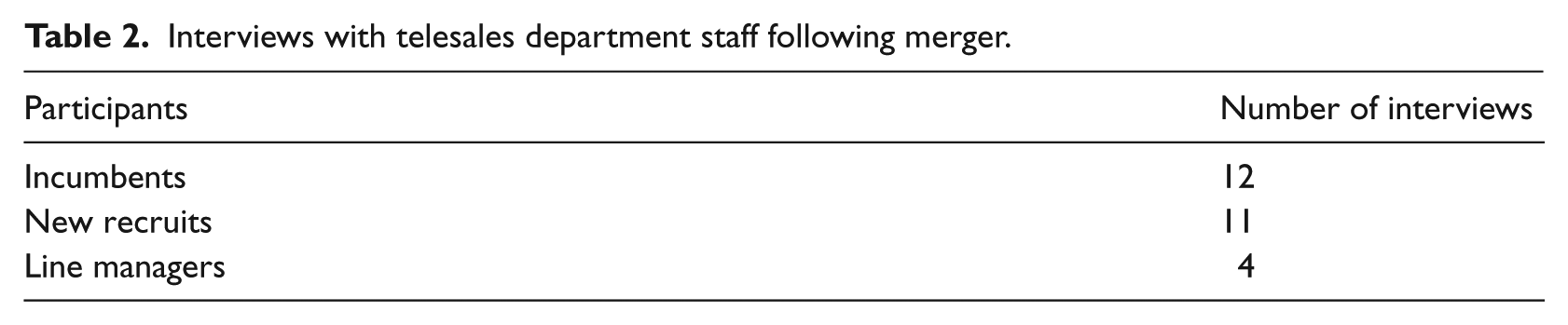
Given the exploratory nature of the study, semi-structured interviews were the main method employed to allow for the coverage of issues of interest as well as issues emerging in the course of the fieldwork (Bryman, 2001). For the same reason, purposive sampling for the interviews was employed to allow us to gather data that would add insight to the emerging theme of situated learning (Lincoln and Guba, 1985). Initially, eight interviews were conducted with management staff of all levels, based in Scotland (with the exception of two telesales line managers from the English site) and involved in the integration project. This initial round of interviews provided an overview of project implementation covering systems and people integration. To explore people integration, further access was secured to the telesales setting where we conducted 27 interviews with the line managers and the employees (Tables 1 and 2).
Interviews with integration management staff.

Note: a denotes that more than an interview was conducted with an individual participant.
Interviews with telesales department staff following merger.
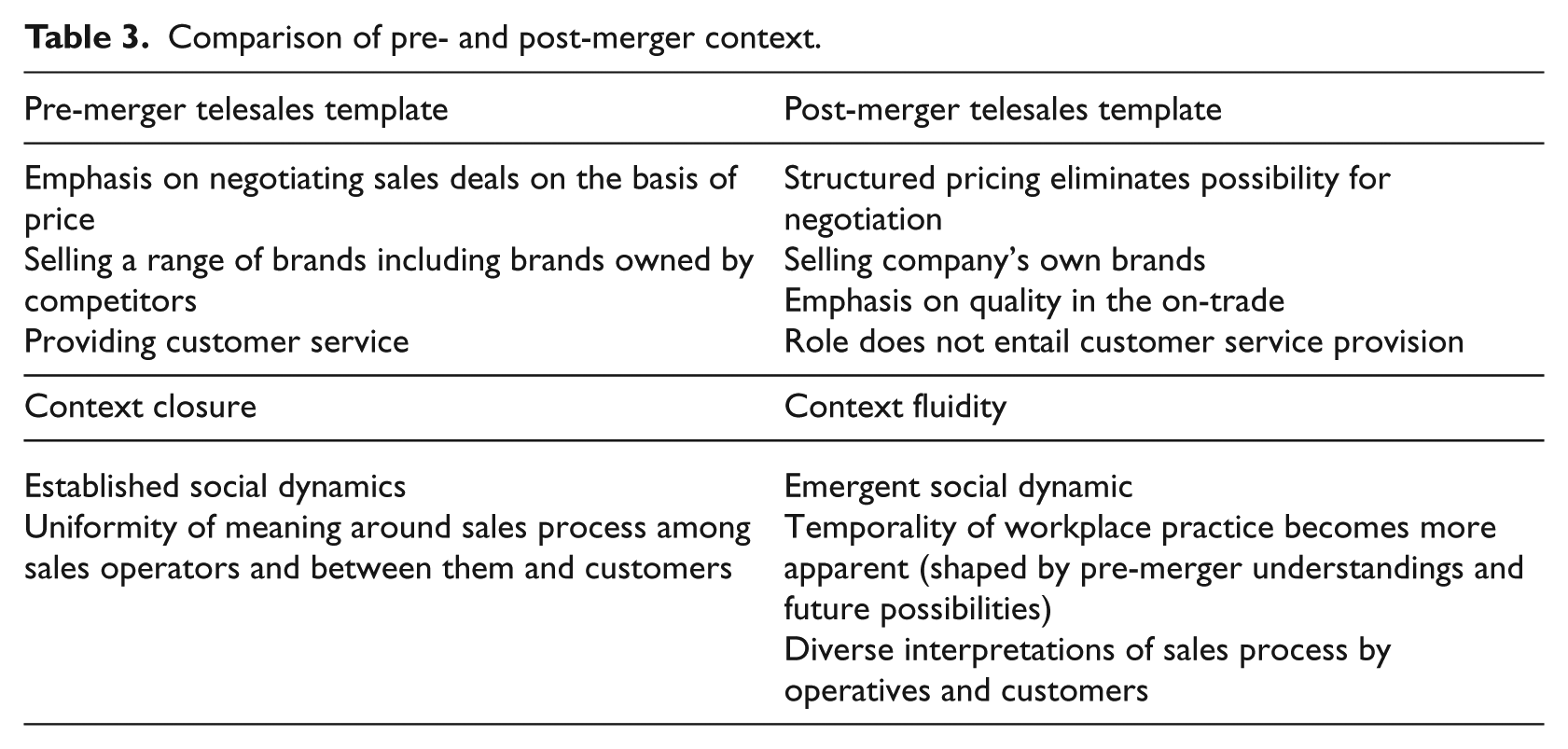
Interviewees were encouraged to reflect on the changes in telesales work when compared to the pre-integration period including changes in the way they learned their role. A summary of the key differences between the pre- and post-merger context is provided in Table 3. To obtain a better understanding of the nature of learning in the BL(UK) era interviewees were also invited to talk about the ways in which they coped with the challenges of their role and the format that this process took. Managers were encouraged to elaborate on their role in communicating the changes in practice to employees and establishing a basis for learning.
Comparison of pre- and post-merger context.
In addition to interviews, we observed a nationwide communication exercise which was introduced to familiarize the staff with the new strategy, together with team meetings that took place in Glasgow. Observation of the meetings served to confirm differences that the interviews revealed in how experienced practitioners and newcomers understood the new tenets of telesales practice. Organizational documents were also used, including the company’s market overview for 2004, a copy of a presentation organized by the line managers on the future direction of telesales, and a document assessing the outcomes of the merger in terms of systems integration and people integration.
The first stage in the data analysis process involved assessing the data collected during the interviews, the notes taken from our involvement in the nationwide communication exercise and the archive we collected as part of fieldwork. In providing insights into the merger we used this data to develop a timeline of events. This overview allowed us to obtain a clear understanding of telesales work and the nature of learning in the setting overtime. We were also able to develop a narrative of the way in which the merger was understood by management, how this was presented to telesales operatives and subsequently operationalized.
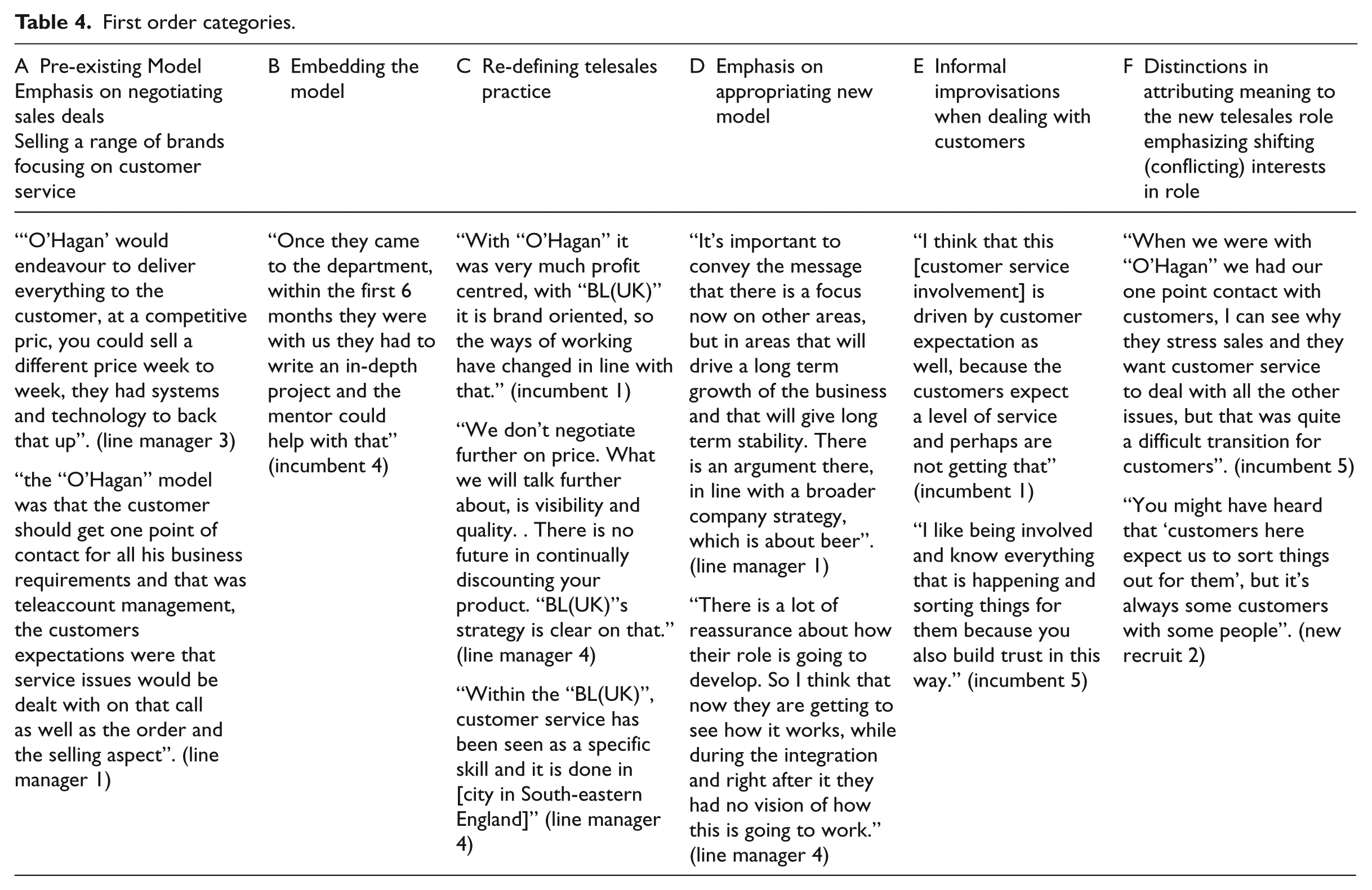
In the second stage of analysis we examined our data sources and the established timeline of events and through a process of open coding we developed first order categories (A–F in Figure 1 above) pertaining to the various operating procedures and types of learning within the period of time that stretched from the O’Hagan days to the ‘new’ post-merger era. These categories related to the rationale for the pre-merger telesales model and its maintenance, the subsequent attempts at creating and embedding a new model and finally its enactment by telesales staff. The latter pertained to informal action which was imbued with distinct meanings regarding the operationalization process.
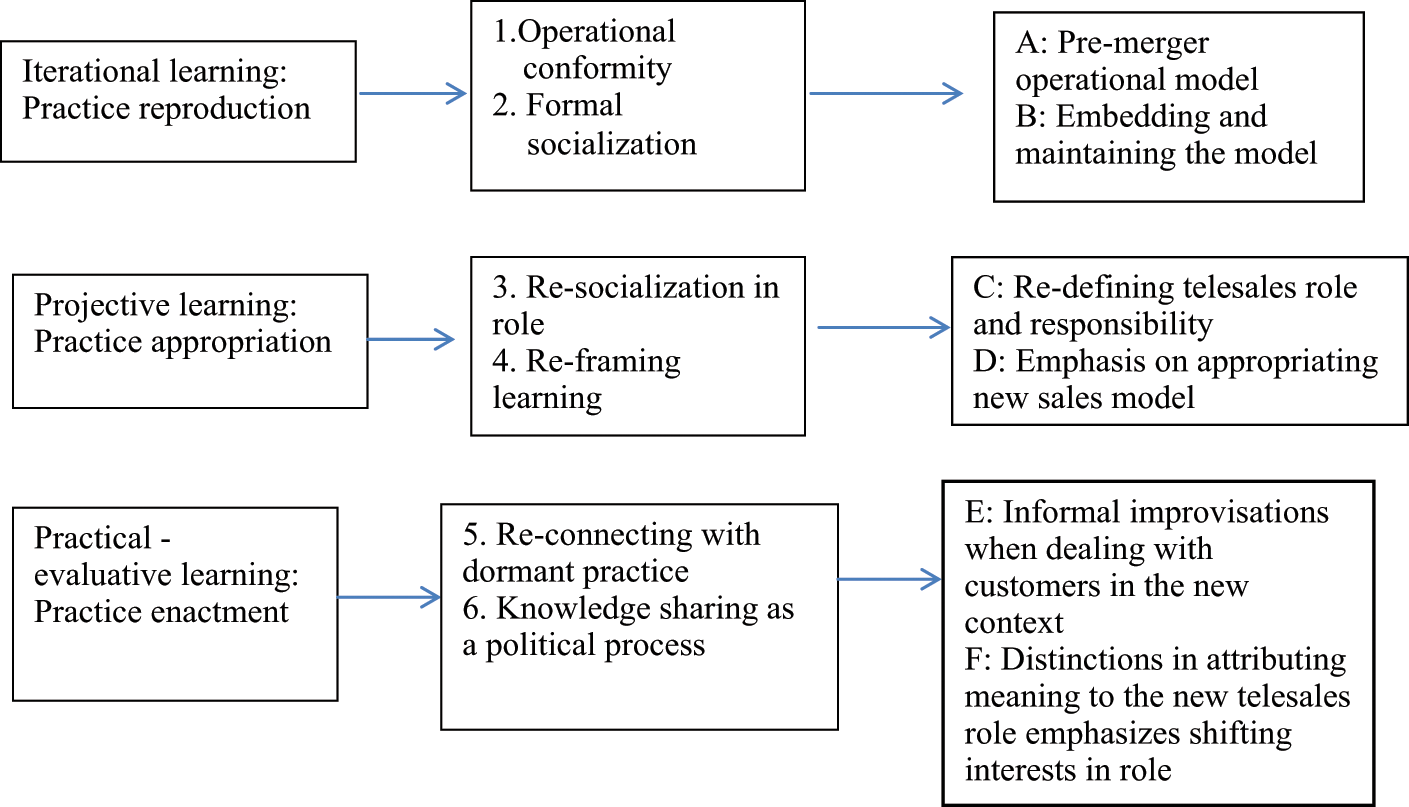
Data analysis.
As these first order categories pointed to operating procedures and associated learning environments at distinct points in time, the Emirbayer and Mische concept of agency emerged as a fruitful approach through which to analyse situated learning. Consequently, the third stage of the analysis involved axial coding informed by the concepts offered by Emirbayer and Mische (1998) and the broader literature to distil the elements of diverse orientations as represented by the first order categories. This led to second order categories (1–6 in Figure 1) contained within the three broad dimensions of iterational, projective and practical evaluative learning. Thus, iteration related to situated learning as captured in the orthodox literature focusing on newcomer socialization and practice reproduction. Projective learning, as pursued by management, aimed to appropriate the newly established model. This involved re-socializing telesales operatives into the role while it also emphasized learning as exploration using informal knowledge sharing. Finally, practical evaluation pertained to the application of these new principles of practice in interaction with customers. This process incorporated past knowledge (in the case of incumbents) or a closer alignment with the new sales model, which created divisions in the department that constrained knowledge sharing. In addition to Figure 1 which outlines how the three broad dimensions are rooted in the second and first order categories (developed through axial and open coding respectively), Tables 4 and 5 illustrate how empirical evidence from our data supports these analytical categories and overarching themes.
First order categories.
Second order categories and theoretical dimensions.

Background
The acquisition of O’Hagan by BL(UK) opened up possibilities for the emergence of different readings of telesales practice as the new company adopted a different strategy to address the challenges attributed to a reduction in the consumption of beer in the on-trade section of the market (pubs, restaurants etc.) compared to the off-trade segment (supermarkets etc.), which was growing. It also reflected changes in legislation that changed the structure of the market significantly because they led to independent pub firms becoming powerful actors in negotiating supply agreements with the major brewers.
Following integration, the focus was on selling own brands using structured pricing that eliminated the element of sales negotiation, but included educating customers in selling beer as a quality product. This emphasis on quality aimed to address the growth of the take-home segment of the market, which had necessitated an increase in the price of beer in the on-trade. Also, due to the greater emphasis placed on growing the beer category in the on-trade, customer service as a function was removed from the tele-account managers’ role. The disruption attributed to these changes in function and structure was complicated with the influx of new recruits into the setting, which created divisions between incumbents and new comers based on their knowledge of the telesales function.
Pre-merger situated learning: Practice continuity
Historically, the key aspects of telesales practice included negotiating sales deals with the customer (having the discretion to negotiate on price to close the sale) and providing customer service. A long period of continuity in engaging with telesales practice contributed to a significant degree of stability that reinforced habitualized practice. Newcomers would be assigned a ‘preparatory’ project that would familiarize them with the key aspects of their role by requiring them to reflect on a work issue and how they would address it. An experienced colleague would act as a mentor offering information and support not only during the project, but also following its completion. Formal socialization was the key learning mechanism and the transition of newcomers from peripheral to full participants would reproduce rather than challenge the dominant view of practice.
Post-merger projective learning: Living with change
The period post-merger presented related challenges; first, it required telesales personnel to acknowledge that their autonomy to negotiate sales deals was no longer perceived as relevant under the new regime. As one incumbent described:
We have a different focus. Before it was just negotiation on price and profit. You have to change your way of learning, skills, just trying to change the way we used to work. (incumbent 2)
Second, this period presented personnel with problems in customer service that were also compounded by the customers’ responses to the focus on quality and brand building:
It is difficult. The customers still are talking price and we talk about brands and quality, so in a way we are talking two different languages at the moment. (incumbent 9) Talking to customers about quality … it’s time that you change them as well, because they are still into pricing and profit, they haven’t made that move, they haven’t realized that quality and visibility will help them raise their profit, we are trying to keep them aware of that. (incumbent 2)
The learning objectives at this time were to appropriate a new set of operations and redefine relations that had to be communicated to staff and customers alike. To educate staff about changes in the beer market and how they linked to their own role, management sought to build upon the communication exercise. This provided the basis for the line managers to invite a discussion with incumbents and new recruits on what they envisioned their role to be after the integration. As a result of these discussions a list of ‘aspirational quotes’ by the employees was produced, defining their role in accordance to the new working practice. In turn, these quotes were used in a presentation prepared by managers on the future objectives of telesales, conveying the message of reinventing telesales practice in relation to market changes. In addition to socializing staff into the key aspects of their new role, particular emphasis was placed on re-framing learning. In contrast to the mentoring arrangements that focused on ‘learning as exploitation’ (replicating and successfully maintaining established practice), the ambiguous response of retailers to the company’s new operations called for an emphasis on ‘learning as exploration’ that aimed to embed change by negotiated agreements. This meant creating an informal body of knowledge that allowed practitioners to be more reflexive on how they interacted with customers. This reserved a greater role for informal knowledge sharing than was the case before the merger:
O’Hagan was less brand focused. It was more about price, deals, margin and commercial knowledge. So, in discussions we tended to have around work, the issues tended to be less creative. In a way, we asked people to be less creative. The issues were almost always seen as technical issues. For example, if you couldn’t sell a Smirnoff, or your customer wanted a different price, what you needed to do was to find a price that both of you liked and then you go forward. Now, what [BL(UK)] wants to do is to be having a brand or two, key brands, that people want at a fixed price, so now tele-account managers have to be creative, on how they sell our brands and what we are trying to do with quality and visibility, and of course they cannot do that totally on their own … (team manager 4)
To aid in this process line management came up with an idea they called ‘the wall board’. It was placed at the entrance of the telesales office and it referred to the successes of various employees in meeting sales targets while also including snippets illustrating how they managed to achieve work goals. The aim was to draw connections between engaging in knowledge sharing and being a successful practitioner, an argument that would appeal to the incumbents, who took pride in their professionalism in the O’Hagan days. This would also serve to re-educate customers, embedding the new practice as a feature of recognized relations and expectations between operatives and their counterparts negotiating product sales.
Operative’s response: Practical evaluative learning
Our evidence indicates that the modes in which operatives connected with the new operations required them to recognize the situational circumstances as they related to the past, present and future. In terms of the commercial realities management attempted to provide co-orientation (Macpherson and Clark, 2009) around the new operations and instil the importance of knowledge sharing as a feature of the incumbents’ and new recruits’ sense of professional integrity. This was accepted by the incumbents as they saw the need to develop ways of responding to the changing needs of their clients:
Not only it is a good idea to share knowledge, I think in a sales environment you have to do it. You have to be creative in how you are selling your product. (incumbent 5) We share ideas all the time. You hear someone in the office was doing something and you ask them what you are doing, how you are doing it, because we all have certain targets to meet. (incumbent 2)
However, success was also set against divisions emerging from the legacy effects of past customer relations. In particular, there was a divergence of focus in the attempts both the incumbents and the newcomers made to enact the new model in the light of customer service issues. With evidence of inconsistent levels of service by the newly founded customer service department, a lot of the incumbents felt it necessary to “bridge” the poor levels of service. Despite the changes in practice, building and maintaining customer relations was still an integral aspect of the telesales role. As customer expectations were still shaped by the pre-integration reading of practice (focus on price), incumbents felt that customer service inconsistencies obstructed their attempts to embed the new template while they also presented a threat of loss of income:
I think you don’t have much control in managing your accounts because there are too many other influences. You don't know what is happening with your account until you might find out there is a problem. My opinion is that the customers would prefer to speak to the tele-account manager in person. (incumbent 1) There is no flexibility [by customer service] and there is a lack of appreciation of what we have to achieve … the business is precious to us, coming down to targets that we have to meet, and we don’t want to lose anything, we don’t want customers to go somewhere else. (incumbent 8)
At the other end of the spectrum, newcomers felt that despite the occasional problems, attempts at engaging with customer service were distracting from the key task of selling flagship brands and educating the customers about quality:
Before that [centralization] happened, a lot of your time was spent on it, you could have spent half a morning trying to arrange a delivery and in that morning there wouldn't be time to sell and you should have talked to customers. Now, we are more free to sell and meet our targets. (new recruit 6)
Overall, these situational circumstances shaped the mode in which operatives learned to enact the new template. As mentioned earlier, incumbents attempted to bridge between the past and present to address customers’ expectations. They often dealt with customer queries because they felt that a more consistent standard of service (in accordance to the pre-integration era) would allow customers to be more attentive to the new model's emphasis on quality and brand name building. Such improvization and re-evaluation of practice was possible because incumbents were able to draw on past dispositions and experiences (Tsoukas, 1996).
Such occurrences revealed a temporal-context shaped by a combination of features related to who was involved in the exchange and the unintended consequence of the merger on customer services. These operatives understood the needs of the customer and they recognized operational limitations at the time. Learning revealed a skilled understanding of this context, which also contrasted with the experiences and understanding of many new recruits. The latter would tend to disregard any customer service inconsistencies as they viewed such reflexivity as a subversive undermining of expected practice. These diverse modes of connecting with the post-merger template created divisions in the setting as new recruits also shared knowledge, but were cautious in developing collaborative relationships with the incumbents. Often, the new recruits were selective with whom they discussed responses to these situations:
It’s informal all the time. In breaks, people socialize and you always talk to friends and peers about a problem rather than maybe the more senior members [incumbents] of the department … you don’t try to teach the old dog new tricks. (new recruit 4) I would not say that we bounce ideas so readily amongst the whole section, it tends to be in our clusters (incumbent 1)
These divisions in the department indicate that learning featured conflicting interests. Incumbents were interested in maintaining established customer relations while they felt that customer service problems undermined their sense of professional integrity and thus their status as it was perceived by their existing customers. On the other hand, the new recruits had an interest in establishing themselves as successful practitioners and tended to see these inconsistencies as isolated incidents, secondary to the new template’s emphasis on brands and quality.
As knowledge sharing between the two cohorts was undermined due to these diverse modes of enacting practice, management entered into activity aiming to intensify interaction between incumbents and the newcomers. This was pursued by establishing ‘facilitators’ in three categories of telesales practice: promotions, quality and brand building. The facilitator’s role was undertaken by one person from each of the four teams which involved incumbents and newcomers. These facilitators summarized the results of activities related to each of the three areas and planned moves to take integration forward. Around the time we were about to exit the setting, interviews showed that this tactical move by management went some way into re-establishing the basis for collaboration, which excluded involvement in customer service.
Our evidence indicates that social divisions in telesales did not as much reveal preexisting differences (Hong and O, 2009), but resulted from the unique ways in which actors connected with the local context of action after the merger. In the following section we explain these findings by drawing on the idea of agentic orientation. Central to our argument is the idea of agency as a chordal triad featuring dominant orientations and sub-tones. The latter becomes evident in the practical evaluative activities of incumbent and new recruits, aiming to address issues pertaining to the present context of action, yet incorporating iterative and projective elements.
Discussion
Lave and Wenger (1991), provide a view of learning that links agency to routinized action and social cohesion. This is evident in their empirical examples that highlight apprenticeship schemes as stable contexts (Huzzard, 2004). The aim of this article has been to re-visit these assumptions by drawing on the case study of a merger and by re-theorizing situated learning from a relational perspective. In doing so, our intention has been to view situated learning in its broader structural and temporal contexts examining learning as it entails different orientations in how actors connect with practice.
Beginning with the impact of the broader context, we saw how the adoption of the sales strategy led to changes in practice. We showed how the interconnectedness of workplace practice with broader organizational and sectoral contexts gave rise to ambiguity and uncertainty. This became evident in the incompatibility of customer expectations with the new focus of the telesales role. As a result of this uncertainty, a shift towards learning as exploration aimed to appropriate these changes and embed them in the context of customer interactions. Hence, the involvement of management in a series of activities that delivered a projective learning orientation articulating the future direction of the telesales setting and establishing the basis (knowledge sharing) upon which operatives would learn their role.
However, while all the telesales operatives were re-educated about their role acknowledging the need for knowledge sharing post-merger, situational contingencies associated with customer service served to problematize the mode in which these new principles of practice were acted upon. Here, the negotiated aspects of the post-merger context opened up spaces for operatives to learn to enact their new role differently, even though their actions served to provide responses to the same challenges. How actors engaged with this changing context reveals the importance of temporality which shapes the unfolding connection between knowledgeability, context and action. Temporality refers to the unfolding nature of the new telesales context; the introduction of new actors with limited experience of telesales in the department; the unresolved nature of the new sales model as existing customers tried to continue to negotiate on cost and not quality; and the actions of incumbents to these demands given their prior experience of maintaining customer relations pre-merger. This resonates with a core feature of relational sociology: ‘how people understand their own relationship to the past, future and present make[s] a difference to their actions’ (Emirbayer and Mische, 1998: 973). While much of the mainstream literature argues that individuals connect with their social context according to their level of experience and understanding, the scope for action tends to be limited to habitualized action. In contrast, our case study demonstrates how changing contexts and local circumstances can create opportunities and demands that require actors to re-evaluate their actions. Such reflexive action is, however, not unbound because actions are shaped by those situational circumstances and by the depth of knowledgeability that actors are able to bring to bear during such critical moments.
Arguably, the incumbents had greater awareness, willingness and opportunity to reflect on the way they connected with their work and learning environment. Their socialization into two distinct periods (pre- and post-merger) gave them insights not apparent to the new recruits, which presented an opportunity to evaluate practically situational circumstances from a distinctly self-referential perspective. This was only possible due to their past experiences that enabled them to bridge the gap between the novel aspects of their sales role and their customers’ expectations. Through recourse to an iterative understanding of practice the incumbents engaged in a process that offered a degree of stability, which confirmed the ongoing relevance of past practices and interpretations of telesales roles (Emirbayer and Mische, 1998: 971). However, the incumbents did not limit their intentional manoeuvring to past actions; they were also cognizant of other changes in the context of action, thereby learning to incorporate the sales model. In combination, the incumbents revealed ‘subtones’ of action based on enacting past dispositions relating to the local conditions and their engagement with the new sales practices as circumstances demanded.
For the new recruits their actions revealed different combinations of agency. Their positioning within a single temporal-relational context—present—resulted in a narrower engagement with the post-merger reading of practice because they were not exposed to the same habitual understandings as the incumbents. Instead, projectivity, as displayed by the newcomers, embodied a form of knowledgeability shaped by the emergent events in the brewing sector, which reflected management activities to develop guidelines on enacting the new sales practice. The latter were employed in a context of emerging relations; the short tenure of new recruits shaped how they dealt with customers. From this orientation, practical evaluations created divisions because the adoption of projective orientations disrupted relations within telesales. While both newcomers and incumbents attempted to problem solve by engaging in knowledge sharing, aware of their differing approaches, they made judgments about the relevance of such collaborative relationships in ways that created divisions in the department that effectively transgressed managerial expectations for learning.
Focusing on divisions emerging from a range of agentic orientations entailed in engaging with practice allows us to revisit the issue of interest and differences and how they shape the form and content of situated learning. Previous studies (e.g. Contu and Willmott, 2003; Fuller et al., 2004; Huzzard, 2004) have discussed asymmetries that are rooted within the employment relationship, thereby pointing to how managers shape the learning agenda by virtue of their hierarchical position and their access to symbolic and material resources. Macpherson and Clark (2009) show how managers create co-orientation among employees around trajectories of learning which serve organizational goals. In our case study this is apparent in the managerial activities aimed toward embedding changes in sales practice and framing learning by emphasizing the importance of informal knowledge sharing.
However, as our data also show, focusing on the hierarchical position of those managers to set new directions for work and learning does not explain the format and content that these processes acquired when performed on the ground. The practical evaluations on the part of both incumbents and newcomers illustrate that managerial guidelines and normative expectations are interpreted against the background of past dispositions, specific goals and situational circumstances (Tsoukas, 1996). From a relational perspective, explanations rely on offering an analytical narrative to explore the temporal-relational contexts, which emphasize connections with the past, present and future in different combinations as circumstances unfold (Emirbayer and Mische, 1998: 970).
Pre-merger, learning largely confirmed the mainstream emphasis on habitual action and established social relations. This confirmed relative continuity in the beer-selling market and the preferred methods of training within sales department as firms concentrated on negotiating sales with customers based on price. Within this context situated learning was embedded within industry-wide practices. However, as changes in the market began to influence the locus of beer consumption and selling, after the reported merger the telesales function was subject to changes in how sales practice was understood and conducted. This unfolding temporal-relational context shifted the way incumbents, new recruits and managers engaged in organizational action. In this case, the incumbents had an interest in preserving the professional status they enjoyed prior to the merger which they felt was at risk of being eroded by customer service inconsistencies. In turn, the newcomers had an interest in establishing themselves as operatives in a way that responded to the developments in the sector. Likewise, the managers were attempting to respond to the demands of those strategic objectives set following the merger.
These variations confirm how different operatives related to telesales practice given their knowledgeability and their expectations of customer demands. Variations in the enactment of the new practices and the constrained nature of knowledge sharing that followed the different reading of the situation illustrate how situated learning is a feature of unfolding agentic orientations that were to limit the impact of management plans and shaped the adoption of the sales template. Rather than assume that contexts connect with agency in ways that reflect habitual actions, a relational approach reveals a multiplicity of conditioned relations that explain the scope for reflexive action. Here we illustrate how a relational approach draws attention to different agency-structure relationships that explain coordination and contradiction within the same temporal context of action.
Conclusions and future research
The orthodox literature on situated learning has highlighted the nature of learning as enculturation, emphasizing the role of social cohesion in the way in which sets of practices are maintained as they are passed on from experienced practitioners to newcomers. This emphasis on habitualized action informs Lave and Wenger’s (1991) conception of how actors link with their context of action. Here we take an action approach to emphasize the importance of context and process for understanding situated learning (Emirbayer and Mische, 1998; Mutch et al., 2006). In particular, we have been at pains to use a relational approach of agency and context interplay to help explore the structural and temporal contexts within which situated learning unfolds over time. This we have done by featuring a study of organizational change to assess coordination and contestation in contemporary workplaces. We believe the relational approach outlined above captures the different forms and degrees of knowledgeability (reflexivity) which develop as a result of diverse agentic orientations denoting a range of interests in the way actors read and connect with their contexts of action. As indicated, social contexts unfold in ways that create opportunities and barriers for action in terms of the actors involved, how they are positioned in the field of activity and the experiences and understanding they bring by virtue of their involvement in the field overtime.
In developing a relational approach we recognize the opportunity to contribute to critical studies in the field. In particular, we recommend that relational analysis as described draws into focus the temporal and contextual significance of learning that helps to explain conflict. For example, consideration of different agentic orientations in understanding identity formation (e.g. Handley et al., 2007) would help locate the limitations and opportunities for engaging in learning especially when the beliefs and values of identity groups are challenged. The benefits of a relational approach confirm the importance of analyses that are culturally sensitive, which set out to explain the contextual setting of learning practices and their emerging characteristics (see Lave, 2008).
Certainly, future research could develop these ideas by examining how agentic orientations are informed by a range of processes (e.g. intra- and extra-organizational relations, positioning across multiple temporal and structural contexts) giving rise to practitioners’ concerns and interests and opening up the possibility for multiple modes of knowing in practice, even in seemingly stable contexts. Such an endeavour would confirm the importance of a temporal-relational approach for understanding situated learning as an emergent process.
Footnotes
Funding
This research received no specific grant from any funding agency in the public, commercial or not-for-profit sectors.